Mastering Shop Flow with Online Scheduling and AI Communication [THA 497]
Now playing — Remarkable Results Radio
About this episode
Thanks to our Partners, NAPA TRACS, Today's Class, KUKUI, and Pit Crew Loyalty Watch Full Video Episode What if the key to a better customer…
Key takeaways
- —Online scheduling can significantly increase appointment bookings and improve shop efficiency.
- —Clients prefer online scheduling, with many younger customers unwilling to use shops that don't offer it.
- —Effective online scheduling requires a solid manual process to ensure smooth implementation.
- —Communication with clients should focus on setting clear expectations for the next steps in their service journey.
- —AI technology can enhance customer interactions without replacing the personal touch of service advisors.
Frequently asked
- What percentage of clients prefer online scheduling?
- Approximately 50% of clients prefer to schedule appointments online, with this number potentially higher among younger generations.
- How can shops effectively implement online scheduling?
- Shops should first establish a solid manual scheduling process, then layer the online system on top to ensure it aligns with existing workflows.
- What role does AI play in the scheduling process?
- AI can handle initial appointment requests and streamline communication, allowing service advisors to focus on more complex client interactions.
▸Full transcript
This is the Automotive Repair Podcast Network. Yes, it is everyone. Carm Capriato, Remarkable Results Radio, and another Town Hall Academy. We do this each and every week where we bring in a couple or sometimes 3 additional guests on my panel to talk about a single subject. Hey, look, our episode goal has always been, and it always will be, to listen and learn just one thing, but implement it.
And I have to say that If you can live within that, then you could be a, a hell of a listener and a hell of a fan of this show. What we say when we say listen to learn just one thing, it's not a tagline. It's a philosophy, a dependency. You know, we give you a learning opportunity each week to hover over and listen to some of your peers in the industry spew sometimes and to give great information about all the things that are happening in their world and even what they may be expert in.
We have a great show. We're going to talk about online scheduling. So much to talk about there. And if you're not doing it, then maybe this episode is going to give you some guidelines on how to do it. Look at some of the goods and maybe not so goods of making this thing happen in your shop. And we want to thank so much NapaTrax, today's class, Kukui and Pit Crew loyalty.
Hey, let's face it, your shop management system is the most critical tool in your shop, and NapaTrax will move your shop into the SMS fast lane. With on-site training, 6 days a week support, and local representation. Find Napatrax on the web at napatrax.com. Ready to optimize with today's class? Boy, listen to an episode we did with David Boyes. Great program. Roll out a training plan for your automotive shop in just 5 minutes daily.
Boost knowledge retention and improve team performance. Start seeing results today. Join your peers at todaysclass.com. Shop owners, stop juggling multiple marketing tools. Kukui's integrated platform, they deliver 4 times better website conversions, automated follow-up, and real-time ROI tracking. Get industry-leading customer support with Kukui. That's kukui.com. You're probably tired of chasing new customers who never return. We understand. Pit Crew Loyalty ends the one-and-done cycle, turning first visits into lasting reliable revenue.
On the web at pitcrewloyalty.com. Hey, welcome back. Don't forget everyone, arpn.app, all in one place, one of the best listening apps for all of your automotive repair podcast information. automotiverepairpodcastnetwork.com/app or arpn.app. Everything is there. You'll have a blast with that. Well, I'd like to introduce to you now my panel to talk about online scheduling. Coach Murray Voth. Hey, Coach. Hey, Carm. Nice to see you again.
Thanks. Same here, man. RPM Training at rpmtraining.net. Murray, I added it up, 28 episodes over the last 10 years you've done with me. Oh, wow. Do I get a star? Yes, you do. I'll send you a star in the mail. No, in fact, you have Tim Hortons up there, don't you? We do. Yeah. Where's Tim Hortons up in Boston? There's none. I'm sure it's all about the Dunkin', right?
But anyway, Murray, thank you so much for all the contributions you've made and you've been on panels and you and me one-on-one. And Doug Brackett is here. Doug was on with me just 2 years ago, episode 971, Remarkable Results Radio, just him and I one-on-one. And we talked about going paperless. The only paper Doug still uses in his world is in the bathroom.
I heard you're absolutely correct, Carm. Solving shop issues one digital piece at a time. I love it. And who knows that they were gonna tune in and get standup comedy? Who knows? Doug is, uh, the proud owner of Downtown Automotive in Nelson, British Columbia for the past, what, 18, 19 years? 19 years. We are almost at 20. You're absolutely correct. Cool. Good for you.
Thank you. And this guy is very passionate about anything that has to do with online and scheduling. So we're gonna break this thing off. Raise your hand in the audience who's doing online scheduling or not. And I assume right now that this was kind of like DVI, Murray, probably 10 years ago where you got involved the web and then you got involved the phone, and how do we make our service advisors more efficient, and can we set parameters?
And I have a friend who just put this in. My daughter Tracy was asked, hey, go and listen to my AI voice and set an appointment up. And she was thrilled about the experience that she had. And I talked to her more in depth about the behind-the-scenes stuff on how it has made them more efficient. They've scheduled more vehicles. Because they're paying more attention.
And so because of all of that that I said, Doug, I'd like to jump into this whole fundamentals basic thing. I don't think you could get electronically involved in online scheduling if you don't have at least a semi-decent manual way to do it, right? Yeah, absolutely. And raise your hand if you do online scheduling in your shop, but more appropriately, I want people to raise their hand if they think they are really crushing the online scheduling in their shop.
The reality of the world that we live in today is I would suggest to you 50% of your clients would prefer to schedule online. So are you booking half your appointments through your online systems? If you're not, there's barriers there. That's a huge number. Oh yeah, absolutely it is. Is it the younger generations who want that, Doug? Absolutely. Right. I think it's part of what makes this better for us is that it's all about Removing barriers, right?
Making it easier for our clients to do business with us. And online scheduling is a huge part of that. I think it's even higher than 50%, Doug, when I talk to my kids in their late 30s. 2 of them will not use a business that doesn't have online scheduling. They will not. I wanted to set a number that people thought they could attain here.
I'm sorry. Good call. Good call. Smart man, Doug. Restaurants. I'd love to know the percentage of our young generation that wants to schedule online. It's, I'll bet you it's 70%, Murray. Bet you it's 90%. Man, I got a couple teenage daughters and they live on their devices. If they can do it on the device, all the better and easier, right? Murray, what did we do without that phone?
Life was just different. It was a different approach to life. Time was used differently. Yeah. A different approach to life. That's a heavy, heavy comment. I've been thinking a lot about that lately, guys, and I know we're going off a tangent right here, but I mean, if we're paying attention to how the world works today, then online scheduling is a must. And the thing that I want to call a place, me, my generation, I want to talk to the individual.
I would go to a shop I know, like, and trust, and I have for many, many years. And so when I pick up the phone to schedule an appointment for anything or discuss a problem that I have with my vehicle, why me? I wanna talk to a human. I guess that's because that's my generation, or that maybe that's the, the level, the deepness of the relationship that I have.
Yes and no. This is an absolutely key part to this, right? And I think this is where so many shops struggle with technology implementation, right? Is They look at the technology as the be-all end-all solution to the issue, but the technology is typically the enabler for the truly human part of the solution, right? An AI voice assistant that has the capability of scheduling appointments is not a replacement for advisors talking to clients.
About what they need. It's a super easy initial, get it off the to-do list, first contact piece that then tees everything up and all the process that follows after it to really actually leverage what that technology can do for you. So when we talk about, you know, a high portion of the appointments in our shop being booked online, that doesn't replace our contact with the client.
We'll still email, text, or phone call, and this is on the client's preference ideally, not the shop's preference, right? How would you like us to communicate with you? And then it's all the normal steps, but what it does is it takes them away from being interruption-based for our busiest people in the shop, classically our advisors that are just interrupted all day long.
And puts it into a regular task workflow for them where it's all lined up. They don't have to stress about what the next thing they have to do. It's really straightforward. We have these 8 appointment requests, and this is a key part. I want, if there's nothing else anybody takes away from this, our clients are not scheduling their own appointments. They are requesting a reservation.
And we take that reservation and fine-tune it with them. We make service proposals upfront. We give them costing upfront. You know, somebody can request a reservation for an oil change, but we present a service proposal for all the preventative maintenance they're due for. Doug, you are speaking my language. I mean, God, the word reservation, and thank you for going deep and more professional.
In how we treat our clients. Let me go back to this. If I am a loyal client and I know that I wanna schedule an oil change because I didn't do it when I left, and I should have set a reservation when I left, at least for what I think are the next 5,000 miles, however that works. In your world, Doug, the online scheduling, is it more toward older established clients or is it new?
What's the percent? Our new client uptake is pretty low in the shop. We have a very loyal client base. So we're looking at somewhere between 8 and 15%, maybe a month of new clients. And the majority of those are using our online reservation system. The new ones are using it. Absolutely. This is where they find out about us, right? This is the new word of mouth is your Google listings.
Let's remove barriers to that. You know, our Google listing has a book now button on it, right? Let's make it easy for people. We actually learned a lot through building our online reservation request system over the years. We initially built it so that it would capture all the information that we would typically ask as questions on the phone, right? Oh, is it coming from the front or the rear?
Or is it a squeal, a clunk, a thud? But then we were making our clients navigate through this complicated issue tree, right? To get as much information as we could out of them. But what we've realized over the years of doing this is that we need to make it simple for them. Just, what are you concerned about? Tell us about it. We'll get ahold of you, right?
We initially looked at it as how can we use online scheduling to replicate a service advisor to client interaction, where really what it actually is, is, uh, how do we get people through the first step with as little friction as possible? Let's just make this really easy and then tell them what the steps are going to be that we follow up on.
There's online scheduling where you're going to actually press a button and find a calendar, or there's the AI voice They're probably both steeped in AI, but the AI voice, what's coming in more, the finger touch or the voice reservation? Oh, that's interesting. So the ability for our online scheduling system, which is AutoOps, by the way, and our AI phone system to interact is brand new.
This is something that is only recently integrated. For our system. So we're talking about 3 or 4 months in here. To be able to give you a solid percentage, I don't have enough data yet, but the AI voice taking reservation requests is the same system as using an online reservation system. And to be clear about this, part of the reason why we're able to have such high usage on our online reservation request system is that it integrates into how we schedule.
So we have built the manual rules that we would use if we were just clicking on time slots into the online system. So it shows our live availability. It is pared down to what we do as a shop. It won't allow a client or, you know, 4 different clients to request diagnostic services at the same time. We can get so smart with these digital tools now.
And then the AI side knows everything that's happening on that online scheduling side, reads the schedule the same way. So you're talking about an absolute perfect service advisor that never guesses when it's got time and can slot people in as is perfectly appropriate. Okay. I'm listening. I'm ready. I want to do this. I just don't have time for all the switches and all the knowledge and all the training.
It's like, are you kidding me? Uh, I'll worry about that when I have to worry about— I'll worry about in a year. Doug, tell me, tell the audience, it's probably not that hard. You just gotta pay attention to the prompts and the switches and the disciplines around how much and how many and who and what. If not, this would've failed years ago.
It's gotta be pretty easy. Absolutely. It's as complicated as you wanna make it, but back in, and in all fairness, yeah, I nerd out on this stuff all the time, right? And, and I'm always playing with the switches. We couldn't tell you were a nerd. Think about it as well in that, you know, it can be built as simply as you want it to be as well.
But if you don't understand how you should be scheduling your shop from the get-go, how do you layer a tool on top of that? Do you have good scheduling processes already? And if you are constantly struggling with them, guess what? The implementation of online scheduling is also going to be a constant struggle. And this is where I think we see shop owners buy tools and turn them on and then You know, never revisit them, never look at how they're working, never really set them up to do what they want to do because they don't even understand what they want them to do.
Murray, I want to take a stab into the coaching realm right now. I want to do this in a very big way, and you're my coach. You finally convinced you got to do this online scheduling. Okay, Murray, let me see. Tab A into slot B. I don't know. Now, Murray, you're not the expert in all these pieces of software. What would you do?
Pick up the phone and call, hey Doug, can you help my client? Would you do that? And so there's a couple of good points you're raising up that I wanted to introduce earlier. So Doug, in addition to owning his shop, is also a coach with RPM Training. So he has several sessions that he does with us, and one is called Digital Discussions with Doug, right?
So then he has a monthly session with our clients on how to implement the best practices and things like that. He has another session to do with our dashboard where he helps people find the numbers in their software and help implement their measurements for the rest of us coaches, right? And I've actually got Doug's dashboard open because I was going to look and see how many new clients he was actually taking in.
And he was close. His average is 18.7 new clients a month for the last 12 months. That's 13.6% of his invoice count. That's a proxy matrix that we created. For whatever reason, Doug, you guys got 32 new ones this month, last month. So something went crazy in your marketing last month. But here's a more important thing, Karp. Guess how many service advisors Doug has?
2. 3. He has a ratio of 1.3 technicians to advisor. So are you hearing the hint? You want to implement change in technology. You can't be either wrenching in the back, you know, full-time or part-time, or you can't be a full-time service advisor. You got to be working on your business. Otherwise, how can you implement this stuff? Doug, would you agree with that?
I think I'm close. Absolutely. And in that giving me time to work on the business and the implementation, I've also realized it is just as important that I give my people time to do that. So handing off the projects, right? Being there for the support. Hey, we're implementing this new AI into your phones. Jeff, you're going to take the lead on this and right into it, back him up all the way through CRM campaigns.
Mike, one of my advisors, incredibly smart guy, and he's tackling a whole digital systems revamp of our hardware. In the shop right now. Let's face it, your shop management system is the single most important tool in your shop, period. NapaTrax was built from the ground up to make your business more profitable and efficient. We provide an extensive set of tools to increase and track profitability in real time.
NapaTrax offers the industry's best post-sale support, hands down, and we train your people on-site Yep, on-site, and we offer remote refresher training 10 times a week, and customer support is open 6 days a week. Give us a call, visit the website, or join our Facebook community today to learn more. We'll prove to you that Tracks is the single best shop management system in the business.
NAPA Tracks is always customized and tailored for you, whether you're a one-man shop or a large multi-bay or multi-location company. After all, it's your shop, so it's your choice. Visit us on the web at napatracs— that's napatracs.com. Hey, want to test your team's knowledge? Well, today's class quizzes show how much your techs and advisors really know, so you can train smarter and build a stronger, more efficient team.
Whether it's the basic quiz, perfect for all techs to test their foundational knowledge, the advanced quiz built for experienced technicians ready to dive into complex topics, or the Service Advisor Quiz focused on communication and customer service. Now, each one gives your team a clearer view of what they know and where they can grow. Take the quizzes now at todaysclass.com/tcquiz. Shop owners, we know you are overwhelmed with a flood of missed calls, empty bays, and disconnected marketing tools.
Kukui has spent over a decade building one integrated platform for auto repair shops. Shops, one login, one dashboard, and mobile-first websites that convert 4 times industry average. Smart, innovative CRM with automated follow-up, 24/7 online booking, and real-time ROI tracking. With 900+ years of combined team experience, we fuel the growth of 2,200+ shops and have influenced $3 billion in revenue. Stop working harder, start working smarter.
Get industry-leading customer support and book a demo with Kukui. That's K-U-K-U-I.com. You know, most shop owners feel trapped spending on ads while half their first-time customers never come back. It's frustrating. It's exhausting. And it's not your fault. The industry average is 54% one-and-dones. We understand how discouraging that can be. Well, Pit Crew Loyalty changes the story. Our clients cut that rate by up to 38%, raising lifetime value by more than 50%.
Loyalty members visit nearly 3 times more often, creating predictable revenue without extra ad spend. Pit Crew Loyalty, where customers stay and shops thrive. On the web at pitcrewloyalty.com. So we have, to everyone's point here, handing off some admin work to the AI, to the online scheduling, to the AI voice that you're doing. But ultimately, to your point, when those reservations come in, Doug, somebody's got to do a God bless over them to make sure they work.
So there needs to be time in the day, but you're also following through with the customer. The human voice comes in once that reservation gets set or the text or the email, however they choose to want to get contacted. But it is taking— what is it we're removing? The lid off the pressure cooker a little bit by implementing all this technology? Absolutely.
Yeah, for sure. It's about removing the interruption piece, right? And then, you know, when you're asking so much of our advisors and they're constantly interrupted by the phone, by the technicians, by the fires that happen just every day in a shop, because that's what they are, right? Once you remove that, they can be calm through the day. A constant piece of feedback I get from our clients is just what our office feels like, right?
You can't fake that. It's not something that is even like right on the surface. It's subliminal for people, but you walk into a calm environment and you will find that you get calm back, right? And a good calm client is obviously going to be much nicer to deal with for us. It's a huge piece. It's calming. I love it. I mean, I mentioned the word pressure cooker and you end with calming.
I love it. It is a perfect scenario. And it, again, it's another high-tech tool that you cannot set it and forget it. As Ron Pilpiel used to say 30 years ago, you cannot ignore it. And if you set it up right, you're gonna be getting an email. Your service advisors are gonna be getting email. You're gonna wanna go back and look at some of the follow-up and the follow-through.
And especially, and I think with voice AI, it's really giving you a transcript and is giving you an idea how well it went. And call scoring. I mean, we can look at sentiment from both our AI side, so we can actually score our AI using AI. And score our people using AI and getting an idea of how our clients are feeling about it.
There's so many layers. Consider also, we can use AI to simulate clients and use it for training for our people. So the client ends this AI call with you, Doug, and I know you're just starting out on it, but I guarantee you a few of these examples exist already. I'd love a price on something. Please call me back. Where does that get set in the priority?
In fact, we've given specific enough instructions for our AI that it responds quite naturally as we would as an advisor. I'm sorry, sir, but until we actually get a look at your vehicle, we can't nail down a price. But what we will do if you want to request a reservation is we'll put together a service proposal. For the initial inspection, we're never going to proceed with any work unless we've discussed the exact cost upfront with you and have your approval.
So we'll give you a price, just bring that puppy in. In fact, we'll give you a price before it comes in for exactly what you requested, which is classically, hey, I've— my brakes are grinding. Okay, here's a brake inspection. We don't know what it's going to need until we look at it, but we've built out the custom instructions for our AI. To actually provide this information correctly to our clients.
Okay. And I know it's early that you've used AI voice. You have any idea though, how many pushbacks you get or non-replies or no scheduling because you want to see the vehicle? We look and monitor every AI interaction. So if there are some that go south to that extent, or just the straight hangups kind of thing, we can follow up on those.
And this might surprise you a little bit. One of the actually biggest wins out of using an AI phone system is to deal with the people that we don't want to deal with, right? We've got to recognize that if, if we're going to be a top performer shop with the ultimate implementation, we're not for everybody. And I mean, for us, that even extends into, we don't work on European vehicles.
But now here's the piece, right? And here's where, you know, you are doing this well, is they have to thank you for not working on their car. That's how you know that interaction went properly. It's gotta end with a thank you. I have a new term, guys. Murray, you, you're, you're in terms of it. It's called a pre-fire. I heard you say, you wrote that.
Wow. We always say, have you fired any clients? No, I, but I've pre-fired a bunch of them. We have a philosophy we've been working on, you know, years ago in my training and coaching, I used to talk about that we would have to qualify clients. Like it was our job to qualify them or we would fire a client. And we've been changing our language to Uh, qualifying our potential clients' expectations to see if we're a good fit for them.
That's the positive or the professional way of doing what Doug's doing is we're here to serve you. What is your concern? Here's how we do things to look after you. If you like that, we're all 100% in. If this is not for you, then great. We hope you will find somebody that will serve you on that. You know, we, we've been working on documentation that's filtered its way through the RPM culture and stuff like that about Qualifying the client's expectations, everything from a quick estimate, a ballpark over the phone to customer supplied parts to will wait appointments to, you name it, all the things that frustrate this industry where we've come out of this industry
where everything's a 911. I've got to drop everything to help you. And then I've got to drop my drawers to give you a good price to match the whatever cheapest price you got. And this is so refreshing to hear a shop that Says this is how it is and doesn't apologize for it. I absolutely love what you just said, Murray. This is how we do things.
I've got KPIs here, Doug. Sorry, but I'm gonna brag about you. Average repair order size, 1,188. Average hours per build hours per repair order, 4. You don't think Doug's team's pissing people off, do you? No, I don't believe so. I think they're doing exceptional work. And 3 new clients in June. Like there is a group of public, the people that own their cars that are dying for this experience that Doug's team is giving them, but we've never given them the language to ask for it because it's new, newish.
Sorry, Doug, go ahead. No, I want to drop something here that is hopefully maybe for a lot of you out there, this is the one piece you pick up out of this podcast and You know, Murray's talking about qualifying and, but how do you actually do that? The way I talk about it with my team is every interaction needs to end with the next expectation, right?
And that is, here's what we're going to do next. Every single step of that client journey, when they know what is coming next, you build raving fans out of your clients. There you go. And trust, because trust is everything for us. Trust is 100% what we do. We do trust. I love this so much that every discussion ends with the next expectation.
And I just, again, you know, I'm into analyzing what we do against the doctoring world. The doctors don't do a good job at the next expectation. At all. We'll give you a call sometime in the next 3 months. That's right, Carm. You need to go see this specialist a year. Wait a minute. You go take this test. Well, what happens after that?
Well, we have to see. It's not. I love that. And no expectation is too small, Carm. That's right. This is what we're gonna do next. This is what we're gonna do next. I'm gonna give you a call. You make that phone call. You built trust. When people pre-fire themselves, they're pre-qualifying themselves that they really aren't a client of yours. I'm sorry. This is the biggest takeaway here.
Now go back and implement it. We're done. The line I use at this point in these conversations is, do high-end dining establishments, like high-end steakhouses, do they apologize for their pricing and their processes? Never. No. They can't wait to raise them. Right? But if you go in and you don't have the experience that you expected or that they thought you would have, That's where price becomes an issue, or that's when you get mad at that restaurant.
Like training restaurants to do it in the order that me as an old timer are used to, where you're greeted and you're given water, and then they come and take your drink order, and then they come and take your food order, and then, you know, whatever. And the couple of times we went out to eat this summer somewhere and the appetizers came after the mains, I'm like, what part of the proper old ways the way we used to eat, what changed?
And the excuse was, well, the prep cook got backed up or this got backed up. And I'm kind of like, you know, so it's, it's the same in any industry, but high-end restaurants that do it well, and we've had some great experiences, they don't apologize for their price. Protocols, baby. Things weren't working in the back. Talk about workflow and who's responsible for this and who's the person who calls out.
I mean, did you ever see those heavy-duty chef movies? And you know, there's always this person, literally the, if you will, the shop manager or the kitchen manager that calls out and things happen for a reason on time because everybody's paying attention to it. I'm gonna back this up with a couple of other numbers. We measure repair orders per advisor in a day.
Our new guideline in our industry, our coaching company is 3 to 4. Doug's advisors deal with 3, average 3 advisors per of 3 repairs per advisor, just a little bit less. Their technicians deal with 1.8 to 2 recorders per day. And you got 4 hours build in each. Imagine the calmness in the back, never mind the calmness in the quiet in this calmness in the front.
One of Doug's favorite things to do is get rid of chaos, right, Doug? You can add more cars per day with this level of Sanity, I guess that's the next word that would be. And I love the fact that where this is all coming from, I think, is blending down, is managing the technology frees up your service advisors to do all the right things that they've been assigned to do.
And when it comes back to do a callback, it's not in that rushed moment. Either online or AI voice is taking care of that initial Calmness. I got an appointment. I'm happy with it. I can't wait to hear back from them. The chaos isn't going on. The phone's not ringing. There's a customer that just walked in. There's a drop-off. There's a, we need a request for another part, blah, blah, blah.
All that stuff, depending on how your protocols are, the place goes into chaos by 10:30. If you're lucky, it's about 9. Hey, I wanna bring something back that Doug hinted at or said, but I would like Tim to elaborate on it. About best practices, old school or manual or analog, and then converting to digital. If you have a good approach, Doug, you mentioned something about reducing the number of certain types of work per day.
So you only allow X number of diag per day, X number. Can you elaborate a little bit on how you guys schedule that stuff, the different work? Our online scheduling system through AutoOps allows us to assign service types. Right? So we can block out and customize our availability exactly to what we want in the shop. So only a certain number of oil changes, only a certain number of tire changeovers built out in a day.
We only have one guy that changes tires, so he can only handle so many, right? So it's about, you know, using the technology to remove the human element would circumvent process. Let's jump into another interesting area. Let's talk about after hours and weekends. And have you had a chance to take a serious look at that and say, hey, are you 5 days, 6 days?
What are you, Doug? We're 5 days a week. I value my weekends quite a bit. And so, and my staff's weekends as well too, of course. We're all families, right? And I would've guessed that just knowing you and seeing you and knowing about your great operation. So after hours and weekend, have you been able to look at the KPIs on that, even if you're not doing voice AI as much lately, but a lot's coming in on, on, on those times?
Yeah, we see about below 20% of our appointments are booked after hours. Classically, something you probably wouldn't have gotten had you not had that option. Totally. Right. And it's about just removing that friction, just taking it off people's list. You know, we talk that they can text us at any time. We might not reply at any time, but we'll reply as soon as we're there for it.
Right. You've got a question at 1 o'clock in the morning, send us a text, right? Is the most unobtrusive form of communication out there. I feel like, I think that an individual who's listening to this, who owns a shop, who's really been disgusted by trying to call, let's go back to the medical profession, you know, you get this 8-minute discussion, you know, do this, do this, do this, do this.
By the time you're done, and then you're caller number 7, and then you're caller number 6. I hope we never get that bad in our industry that people would just wanna say, you know, I'm done with this. I have to find someone else. Can you set in the, in your voice AI, the number of rings and is there any adjustments so that an owner would feel comfortable That, you know, I really want our service advisors to answer if they have the capabilities to do it.
I mean, 4 or 5 rings. What do you got going, Doug? Thank you for bringing this up. This is actually a huge area where we've learned a lot. We've been working with voice AI for over a year and a half now in the shop. We've recently switched over providers because of the integration involved in it. Our first crack at the can was that when we couldn't answer the phone, it would forward to a number that was the AI assistant and would give us transcript and send us an email that there was an interaction.
That's a dead end for the client. They can't move away from that, right? If they want to talk to a person, they're stuck and all they can ask for is a callback. Our new system through Steer is fully integrated with our online scheduling. It sees our availability, but it's also part of our VoIP phone system. So you can ask our AI assistant, hey, I'd actually like to talk to Doug about this.
It knows my extension and will dial my phone. So the AI can forward and do customized pieces that are integrated with the rest of our systems and workflow pieces. So it's not a dead end for anybody ever. The AI can say, hey, this is beyond me. I'm going to transfer you to a person. And that's where our team knows they've got to get that phone, right?
They can ignore the phone all they want. They know there's backup on the AI answering it, but when the AI forwards to them, now it's go time. I have a friend who offers towing as an option, but the problem he was having until he went to voice AI was there had to be a callback and a second step. But now, yeah, Ike Towing, it dials the number of this national towing company that's in his program group, and they're immediately handled so that the vehicle can be brought into the shop.
And so when you start thinking about convenience and a higher level of client services and expectations, I think this is going to be, you know, the norm today. But again, don't make it, in my opinion, I know the doctoring business is tough to call 911 and all that junk about if it's an emergency, but let's make it fluent. Let's make it easy.
Let's make it comfortable. Let's make it friendly. So where the next level of this AI phone implementation for us is once we are comfortable with it making very, very few mistakes currently, We're gonna move it to answering every call. Triage, right? It's, it's gonna be our triage nurse. I love it. I mean, everyone, if you're listening to this, we've got a lot of fabulous— the triage nurse of a growing, successful, on-fire business.
Wow. That's pre-firing clients. I love this. Just to give you guys an idea as well too, and, and Murray knows me well, Carm, you know me a little bit. We're a small town shop. We're in a little town of 10,000 people. You don't have to be in a huge center with a ton of people to be able to build out a really well-run shop and to have enough customer base to maintain the best systems out there.
You hit those really good KPI numbers, And your client base doesn't have to be huge. You're not looking for a massive number of new clients all the time. And you don't need a high turnover because a lot of shops will have a high turnover as well, right? 2 things come to mind, Doug, that you're bringing up with this. One is one of our group members, don't remember who, got into the voice, the VoIP phone system.
They hadn't gone to any digital scheduling yet. The owner of the shop had said to his peer group, his mastermind group, you know, we thought we were so good at answering the phone. You know, we had our policies and we answered within so many rings and we thought we were so good until this VoIP system came with reports and documentation, uh, that we were, you know, that we could never capture before with our own phone system.
And he said, we were still losing like a high percentage of calls because I could use that term. It's a dead end, right? Leaving a voicemail. Or something like that. And so that converted him to looking into the tools that Doug's using because he thought they were good because they were physically, you know, present answering the phone is one thought comes to mind why this is, you know, you think you're good.
The other part is, is, you know, you hear resistance from owners about how impersonal this is, or, and the thing about it is, is if you listen carefully to how Doug described it, they're making it as personal as possible, removing friction. Think about those of you that have shops with multiple service advisors. If you are an owner, have a service advisor, or you are one of the advisors currently, are there a segment of clients who choose favorites?
Have you noticed that? Well, I don't want to talk to Kim. I want to talk to Susan. I don't want to talk to Susan. I want to talk to Carl. Right? Have you noticed how even within the realm of human beings, clients begin to choose their favorites? Well, why are they choosing their favorite? Because they resonate? Is it a relationship? It could be a little bit of that too.
But it also could be that that person does things the way this person likes it to be done. Well, now AI could be Kim, Susan, Doug, and Carm all rolled into one because it will begin to provide that person with what it needs. Does that make sense, Doug? Yeah. Because people choose favorites now. So why not just have the AI be the perfect one?
That way everybody wants to talk to it, whatever pronoun we're going to use for the, for the one that you choose that you shot, right? Interesting that you bring that up, Marie. We've actually been in discussion over the fact that the AI we've got right now taking online scheduling to phone scheduling, we've got a class of client that we consider VIPs. Let's give them a different experience.
Let's give them the yes AI, right? Because we're going to bend over backwards for these people. They are our absolute top clients. So recognize phone number, send to a different AI. Super easy. As I was listening to Murray, again, I wrote down another big takeaway word, and that word is connection that we have. You know, you said, how do we get along?
Well, you know, go back to the DISC charts and see how people need to communicate with each other. And an individual says, I just love this guy. What a great relationship. We're compatible. We have a connection. And that's why you wanna say, I wanna talk to Doug. Give me Doug. I need Doug. Or to your point, that's the A-game, the A-game AI voice.
Think of other reasons why people ask for certain people. In some cases, they ask for the owner because they'll twist the owner's arm to give them a discount, right? The old emotional bank account. They'll call for a certain advisor because that advisor will give them a discount. Or that will break some of the shop policy rules, or they'll ask for that certain advisor because that advisor, you know, will allow them to bring their own parts, even though the shop culture is not to do that.
Right. So the clients are trying to manipulate their results, their experience, because they've had such bad experiences. They want a deal. So what we need to do, and Doug, what Doug's done so brilliantly is when you remove friction, You've taken away all the reasons for them to manipulate you. Powerful stuff. Because that's why people do that. Like when somebody books, right? I'm here for my 7 o'clock appointment.
The assumption that if I'm first, I'm first out. That's been around in our industry for 70 years. It doesn't work that way anymore. Cars are way too complex. Or the idea that I have a breakdown and I'm late for a meeting and that somehow makes me more important than everybody else that's parked in that shop parking lot. Just because you arrived at a certain time, Murray, to your point, doesn't mean that your car's gonna be worked on at that exact moment or be pulled into bays.
We have to do stuff. But if the AI said, you know, I'm really sorry to hear that your car's broken down, and that must be so stressful that you have a meeting in 15 minutes. You know what? If you can get that car delivered down to us, we'll have an Uber waiting for you here by the time you get here. Would that help you, sir, to get to your meeting?
I mean, this is infinite. I think it's brilliant and it is a super important piece. It twigged me into thinking about something that I really wanted to talk about. And Carm, I know you are passionate about language. I think the language our industry uses is absolutely critical and is one of the areas where we can update ourselves so quickly. Folks out there, if you haven't spent time thinking about the language that you use, really, please, please do.
It is so important, right? But We do it in the reservation request process as well too. You can ask a client, when do you need your car back? And there's more. So there it is. It says appointment, right? Reservation. You see it? That's the new word. Yeah. We've been pushing this so, so darn hard and thanks for bringing it up. By the way, you could keep talking, but give me a minute to plug this, The Rise of the Specialist.
And it's not only the language that we use in the roles that we do. But it's also all the other words that we use in front of, well, we're gonna have to do an ADAS on your car. Oh, nobody wants to say that they don't know it, but if we said we're gonna give this to our calibration specialist to bring your car back into OE specs to be sure that your, all those really cool new computer, uh, software are working, adaptive cruise, auto emergency braking, and lane keep assist that you have on your vehicle.
Okay, gotta have it done. We're speaking more common language, but a more sophisticated professional language. So I love that. Thank you. And my particular example on this is, you know, we can ask people, when do you need your car back? And they'll say they're doing an oil change. I think that should take an hour. I'm going to say an hour after my appointment.
What we do in our shop is, do you need your car back before 4:30, right? We are setting an expectation in how we ask the question that you should leave it here for the day. And it will be special scenario for us to accommodate if you can't do that. We're still going to do our best to accommodate that and make sure that that expectation is reasonable and everything like that.
But you've got to ask questions in such a way that you are more likely to get the answer you're looking for. This is, you know, people interaction 101. The person asking the questions is in control of the conversation, right? And don't ask a question that you don't want the answer to. It is amazing. After every episode of Late of this last 6 months, they end up becoming so good, so in-depth, so discussionable.
I don't even know if that's a word that I don't know where to end it and how to start. And we could talk for 3 or 4 hours on this thing, but I love this. I thank you so much. A couple of takeaways that I have, a ton of 'em by the way, but professionalism kind of was ruling here, which is, it does in just about everything that I do.
But to run a more sophisticated business, Doug, that was my big takeaway from this, is not only the protocols inside, but it's the fact that your mouse and your brain and your manipulation of building, you know, a bigger, better client base all the time is yours within your mouse on how you answer calls, push people to certain places, review the reservation, the call, the tonality.
It's an exciting time, in my opinion. Very exciting. The pace of development we are seeing right now. I mean, you know, I get to work closely with some of our software providers in doing initial testing and things like that. We were the very first one on Steers. AI phone system, and we ask for things and they deliver. It is impressive. And that world that we live in right now where things can be rapidly improved upon and changed and developed is a fantastic place to be a small business owner.
Murray, I'll give you the last word. Well, my last word is a question for Doug. So Doug, on occasion when you walk through the front area with your advisors, do you still hear human beings, like clients talking to advisors and visiting about life and making relationships. Absolutely. All the time. It doesn't replace it. If they want it, it's available. And in fact, the advisors have more time to be in a relationship than they ever did before.
So that would be my closing thoughts. So my big takeaways, set the next expectation, potentially pre-fire a client who doesn't want to get on board. And I'm not being nasty or sarcastic. It's just an evolution of what you've noticed happen, Doug, and the whole sophistication of what you need to do to run a really great business in our industry. You gotta pay attention to the stuff like this that, you know, in our, the episodes that we do each and every week.
Wow. Thank you so much, Murray Voth, RPM Training at, uh, rpmtraining.net, and Doug Brackett from Downtown Automotive in British Columbia. Almost 20 years in business, the paperless man and the online digital realm man. Ooh, somebody should do a movie on you. Thanks guys for being here. Thanks, Carm. Yep, thanks. Thanks for being on board to listen and learn from the premier automotive repair business podcast, Remarkable Results Radio.
Get your episodic education on the ARPN listening app at automotive automotiverepairpodcastnetwork.com. Also enjoy the podcast on our Carm Capriato YouTube channel. Carm is all for advancing the professional automotive service industry. Until next time.
More from Remarkable Results Radio

Work Together, Thrive Together, Build a Business You Can Sell [THA 504]
Watch Full Video Episode *]:pointer-events-auto scroll-mt-[calc(var(--header-height)+min(200px,max(70px,20svh)))]" dir="auto" data-turn-id="request-WEB:8e59eec7-a235-4fa3-a072-956fea3fe478-7" data-testid="conversation-turn-4" data-scroll-anchor="false" data-turn="assistant"> *]:pointer-events-auto scroll-mt-[calc(var(--header-height)+min(200px,max(70px,20svh)))]" dir="auto" data-turn-id="request-WEB:49a777bf-d263-4496-bf0b-2eb3a46ac96a-11" data-testid="conversation-turn-24" data-scroll-anchor="false" data-turn="assistant"> What does it take to work alongside someone you love, thrive through the pressures of business ownership, and ultimately build a company that can succeed without you? Amy Castro and Kit Lindsay share a story that goes far beyond the challenges of working together as a couple. It’s about communication, boundaries, complementary strengths, succession, and building a business valuable enough to eventually pass into someone else’s hands. What You’ll Learn How couples and family members can successfully work together in businessWhy complementary strengths can become a competitive advantageHow clear boundaries help separate business conversations from personal relationshipsWhy assumptions can become one of the biggest communication problemsHow Kit identified and developed an internal successorThe importance of Kit’s “3 A’s”: Attitude, Aptitude, and AmbitionWhy succession requires owners to mentor future leaders and give them room to leadHow letting go of ego becomes part of a successful transitionWhy building a business that can continue without you creates options for your future Kit operated Lindsay Transmissions for 37 years before selling it to Cody, an employee who originally joined the shop at age 16 sweeping floors. After Cody expressed interest in ownership, they created a plan to develop his business skills and prepare him for the transition. Kit ultimately carried the note, and Cody paid off the business in four years. A successful family business isn't simply about working together. It's about learning how to thrive together while building something that can eventually succeed without you. Amy and Kit show how communication, boundaries, complementary strengths, mentorship, and the willingness to let go can help turn a family business into something worth passing on. Thanks to our Partners: NAPA TRACS, Today's Class, KUKUI, and Pit Crew Loyalty NAPA TRACS will move your shop into the SMS fast lane with onsite training, six days a week of support, and local representation. http://napatracs.com/ Optimize training with Today's Class: In just 5 minutes daily, boost knowledge retention and improve team performance. https://www.todaysclass.com/ Stop juggling multiple marketing tools. KUKUI’s integrated platform delivers 4x better website conversions, automated follow-up, and real-time ROI tracking. https://www.kukui.com/ You’re probably tired of chasing new customers who never return. Pit Crew Loyalty ends the one-and-done cycle, turning first visits into lasting, reliable revenue at https://www.pitcrewloyalty.com/ Connect with the Podcast: Download and Listen on Our Mobile App: https://automotiverepairpodcastnetwork.com/app/Visit the Website:https://remarkableresults.biz/Subscribe on YouTube:https://www.youtube.com/carmcapriottoFollow on Facebook:https://www.facebook.com/RemarkableResultsRadioPodcast/Follow on LinkedIn:https://www.linkedin.com/in/carmcapriotto/Follow on Instagram:https://www.instagram.com/remarkableresultsradiopodcast/Join Our Virtual Toastmasters Club:https://remarkableresults.biz/toastmastersJoin Our Private Facebook Community:https://www.facebook.com/groups/1734687266778976Join our Insider List:https://remarkableresults.biz/insiderAll books mentioned on our podcasts:https://remarkableresults.biz/booksOur Classroom page for personal or team learning:https://remarkableresults.biz/classroomBuy Me a Coffee:https://www.buymeacoffee.com/carmSpecial episode collections:https://remarkableresults.biz/collections The Automotive Repair Podcast Network: https://automotiverepairpodcastnetwork.com/ Remarkable Results Radio Podcastwith Carm Capriotto:https://remarkableresults.biz/Automotive Field Theorywith Matt Fanslow https://mattfanslow.captivate.fm/<a...

Inside the Role of a Performance and Accountability Team Leader [RR 1110]
Watch Full Video Episode What does a Performance and Accountability Team Leader actually do inside a high-performing auto repair shop? Nate McDonald of Empower Automotive gives us an inside look at a unique leadership position that connects inspections, client experience, team development, performance, and accountability. As Sales Manager, Inspection Team Lead, and Performance & Accountability Lead, Nate isn't managing from behind a desk. He's working alongside his team, performing inspections, shooting videos, checking vehicles, answering questions, coaching younger team members, and looking for opportunities to improve the process. Nate believes accountability becomes easier when you're present. Working side by side with the team creates opportunities for quick conversations, immediate coaching, and reinforcing standards before small issues become bigger ones. What You'll Learn What a Performance and Accountability Team Leader does inside an auto repair shop.Why Nate views his sales responsibility more as hospitality than traditional selling.How working "in the trenches" creates natural coaching opportunities.What Nate has learned from mentoring Gen Z team members.Why mistakes and questions are valuable opportunities for development.How Empower Automotive's daily "Take Five" aligns the entire team before the day begins.How inspections connect the back of the shop with service advisors and the client experience.Why performance numbers are openly discussed with the team.How quick one-on-one conversations reinforce standards and accountability.Why team members should have a voice in improving processes and efficiency. A Performance and Accountability Team Leader doesn't just measure performance. They help create it. Nate's role demonstrates the value of having someone close enough to the work to see what's happening, coach in the moment, reinforce expectations, listen to ideas, and keep the team connected to the purpose behind the process. It's not about waiting for the annual performance review or calling someone into the office every time something goes wrong. Sometimes leadership is a quick conversation behind a vehicle. Sometimes it's answering a question during an inspection. And sometimes it's simply being willing to work alongside your people. Performance and accountability become part of the culture when leadership is present every day. Nate McDonald, Inspection Team Lead and Performance & Accountability Lead, Empower Automotive, Traverse City, Michigan Thanks to our Partners, NAPA Auto Care and NAPA TRACS Learn more about the benefits of being part of the NAPA family by visiting https://www.napaonline.com/en/auto-care NAPA TRACS will move your shop into the SMS fast lane with on-site training and six days a week of support: http://napatracs.com/ Connect with the Podcast: Download Our Mobile App:https://automotiverepairpodcastnetwork.com/app/Website:https://remarkableresults.biz/YouTube:https://www.youtube.com/carmcapriottoFacebook:https://www.facebook.com/RemarkableResultsRadioPodcast/LinkedIn:https://www.linkedin.com/in/carmcapriotto/Instagram:https://www.instagram.com/remarkableresultsradiopodcast/Join Our Virtual Toastmasters Club:https://remarkableresults.biz/toastmastersJoin Our Private Facebook Community:https://www.facebook.com/groups/1734687266778976Join our Insider List:https://remarkableresults.biz/insiderBooks Page:https://remarkableresults.biz/booksOur Classroom Page:https://remarkableresults.biz/classroomEpisode Collections:https://remarkableresults.biz/collectionsBuy Me a Coffee:https://www.buymeacoffee.com/carm The Automotive Repair Podcast Network: https://automotiverepairpodcastnetwork.com/ Remarkable Results Radio Podcastwith Carm Capriotto:https://remarkableresults.biz/Automotive Field TheorywithMatt Fanslow:https://mattfanslow.captivate.fm/Business by the NumberswithHunt Demarest: https://huntdemarest.captivate.fm/The Auto Repair Marketing Podcastwith Brian and Kim Walker: https://autorepairmarketing.captivate.fm/The Weekly Blitzwith Chris Cotton: https://chriscotton.captivate.fm/Speak Up! Effective Communicationwith Craig O'Neill: https://craigoneill.captivate.fm

How to Develop a General Manager for Your Auto Repair Shop [THA 503]
Thanks to our Partners: NAPA TRACS, Today's Class, KUKUI, and Pit Crew Loyalty Watch Full Video Episode *]:pointer-events-auto scroll-mt-[calc(var(--header-height)+min(200px,max(70px,20svh)))]" dir="auto" data-turn-id="request-WEB:8e59eec7-a235-4fa3-a072-956fea3fe478-7" data-testid="conversation-turn-4" data-scroll-anchor="false" data-turn="assistant"> *]:pointer-events-auto scroll-mt-[calc(var(--header-height)+min(200px,max(70px,20svh)))]" dir="auto" data-turn-id="request-WEB:49a777bf-d263-4496-bf0b-2eb3a46ac96a-11" data-testid="conversation-turn-24" data-scroll-anchor="false" data-turn="assistant"> How does a shop owner find, develop, and trust the right person to become their number two? Shawn Gilfillan, owner and CEO of Automotive Magic, and Will Barkiewicz, General Manager and Integrator, share the evolution of a leadership partnership that started when Will applied for a technician position. Shawn quickly recognized something beyond Will's technical abilities. Their values around family, trust, service, and taking care of people aligned. Will eventually moved from running the maintenance center to becoming General Manager over both locations and the Integrator Shawn had been looking for. Their story demonstrates that developing a number two isn't about finding another version of the owner. It's about finding someone with complementary strengths, then building the trust that allows both leaders to grow into their roles. What You'll Learn Why core values can matter more than someone's original job title.How the Visionary-Integrator relationship works within EOS.Why owners shouldn't look for "another me."How responsibility and trust are earned over time.Why a strong General Manager needs the freedom to push back on the owner.How DISC profiles can improve communication and self-awareness.Why standardized protocols create consistency as leadership responsibilities expand.How a "Reboot" mindset turns mistakes into opportunities to improve the business. Finding your number two isn't about finding another you. It's about finding the person who complements you. For Shawn, that meant learning to hand over responsibility and allowing Will to "dance his own dance." For Will, it meant earning trust through communication, accountability, and a willingness to take ownership when things didn't go perfectly. The transformation happens on both sides. The General Manager learns to lead, execute, and protect the vision. The owner learns to let go, become the guide, and gradually move responsibilities off their plate. You don't hand someone the keys to the business overnight. You give them responsibility, build trust, and develop the leadership partnership one step at a time. Shawn Gilfillan, and Will Barkiewicz, Automotive Magic, Kenvil and Lake Hopatcong, NJ. Shawn’s previous episodes HERE NAPA TRACS will move your shop into the SMS fast lane with onsite training, six days a week of support, and local representation. http://napatracs.com/ Optimize training with Today's Class: In just 5 minutes daily, boost knowledge retention and improve team performance. https://www.todaysclass.com/ Stop juggling multiple marketing tools. KUKUI’s integrated platform delivers 4x better website conversions, automated follow-up, and real-time ROI tracking. https://www.kukui.com/ You’re probably tired of chasing new customers who never return. Pit Crew Loyalty ends the one-and-done cycle, turning first visits into lasting, reliable revenue at https://www.pitcrewloyalty.com/ Connect with the Podcast: Download and Listen on Our Mobile App: https://automotiverepairpodcastnetwork.com/app/Visit the Website:https://remarkableresults.biz/Subscribe on YouTube:https://www.youtube.com/carmcapriottoFollow on Facebook:https://www.facebook.com/RemarkableResultsRadioPodcast/Follow on LinkedIn:https://www.linkedin.com/in/carmcapriotto/Follow on Instagram:https://www.instagram.com/remarkableresultsradiopodcast/Join Our Virtual Toastmasters Club:https://remarkableresults.biz/toastmastersJoin Our Private Facebook Community:https://www.facebook.com/groups/1734687266778976Join our Insider List:https://remarkableresults.biz/insiderAll books mentioned on our podcasts:https://remarkableresults.biz/booksOur Classroom page for personal or team learning:https://remarkableresults.biz/classroomBuy Me a Coffee:https://www.buymeacoffee.com/carmSpecial episode collections:https://remarkableresults.biz/collections The Automotive Repair Podcast Network: https://automotiverepairpodcastnetwork.com/ Remarkable Results Radio Podcastwith Carm Capriotto:https://remarkableresults.biz/<a...
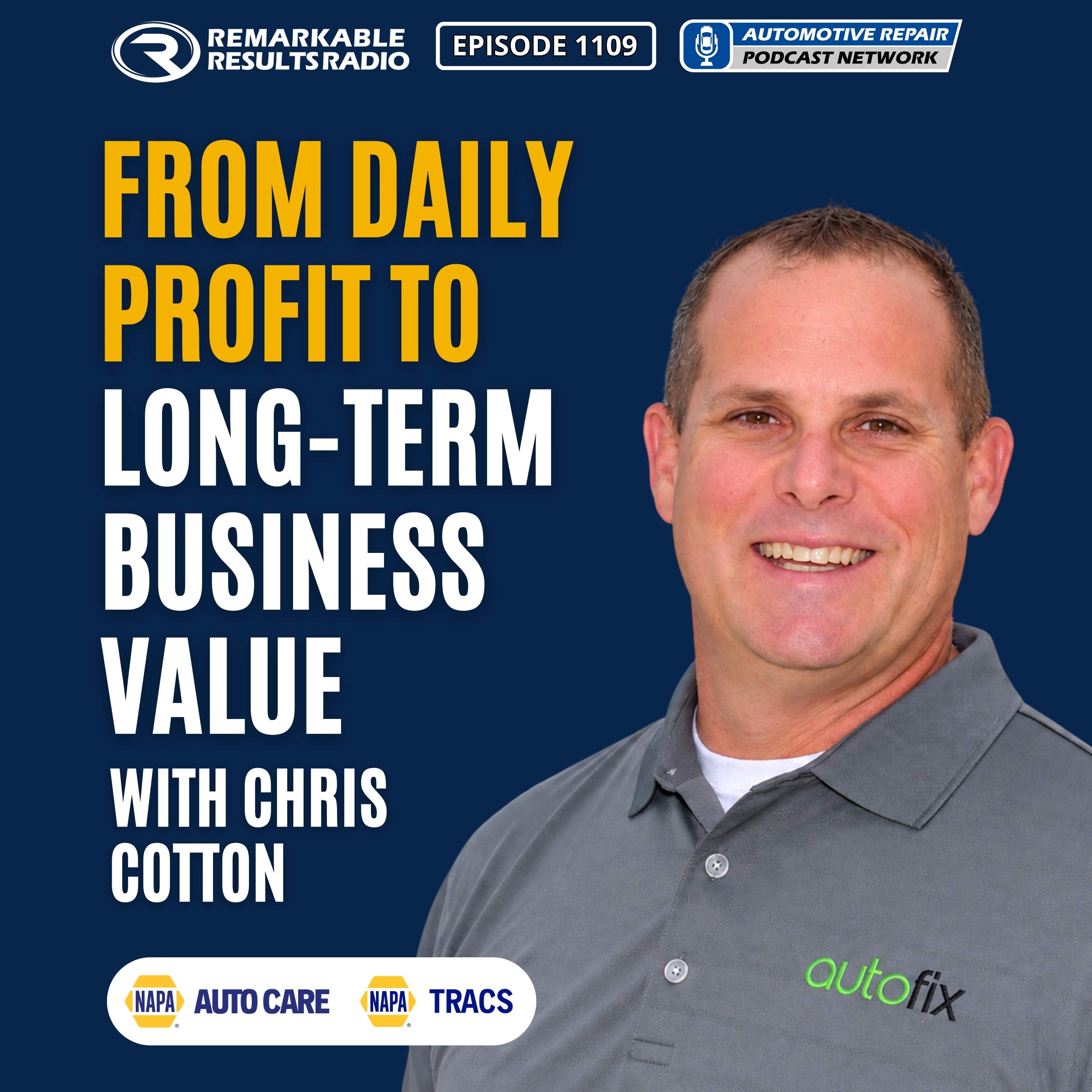
From Daily Profit to Long-Term Business Value [RR 1109]
Thanks to our Partners, NAPA Auto Care and NAPA TRACS Watch Full Video Episode What is your auto repair business really worth, and are you building it to become more valuable every year? Coach Chris Cotton, podcast host on the Automotive Repair Podcast Network, challenges shop owners to look beyond today's sales and profits and start thinking about the long-term value of the business they're building. Many owners spend years on the operational hamster wheel, focused on car count, payroll, production, and this month's bottom line. But when it's time to sell, transition the business to the next generation, or simply step away from daily operations, buyers and banks look much deeper. Chris explains why clean financials, documented systems, owner independence, and intentional succession planning can transform a shop from a business that provides the owner a job into an enterprise with significant transferable value. What You'll Learn Why profitability and business valuation aren't the same thing.What buyers and banks want to see before financing an acquisition.Why removing the owner from daily operations can increase business value.How documented systems and protocols make a shop more transferable.Why clean financial statements and tax records are critical to valuation.Chris Cotton's five stages of shop ownership, from daily survival to eventual exit.How increasing capacity can grow value without necessarily adding locations.Why succession and exit planning should begin years before you're ready to leave. Don't just build a profitable shop. Build a valuable business. Create strong systems. Develop leaders. Clean up the financials. Build capacity. Reduce owner dependence. And understand what your business is worth long before you're ready to sell it. Coaching to Valuation [E269]: https://chriscotton.captivate.fm/episode/cc269 The Weekly Blitz with Chris Cotton: Weekly Inspiration with Business Coach Chris Cotton from AutoFix – Auto Shop Coaching. https://chriscotton.captivate.fm/ Learn more about the benefits of being part of the NAPA family by visiting https://www.napaonline.com/en/auto-care NAPA TRACS will move your shop into the SMS fast lane with on-site training and six days a week of support: http://napatracs.com/ Connect with the Podcast: Download Our Mobile App:https://automotiverepairpodcastnetwork.com/app/Website:https://remarkableresults.biz/YouTube:https://www.youtube.com/carmcapriottoFacebook:https://www.facebook.com/RemarkableResultsRadioPodcast/LinkedIn:https://www.linkedin.com/in/carmcapriotto/Instagram:https://www.instagram.com/remarkableresultsradiopodcast/Join Our Virtual Toastmasters Club:https://remarkableresults.biz/toastmastersJoin Our Private Facebook Community:https://www.facebook.com/groups/1734687266778976Join our Insider List:https://remarkableresults.biz/insiderBooks Page:https://remarkableresults.biz/booksOur Classroom Page:https://remarkableresults.biz/classroomEpisode Collections:https://remarkableresults.biz/collectionsBuy Me a Coffee:https://www.buymeacoffee.com/carm The Automotive Repair Podcast Network: https://automotiverepairpodcastnetwork.com/ Remarkable Results Radio Podcastwith Carm Capriotto:https://remarkableresults.biz/Automotive Field TheorywithMatt Fanslow:https://mattfanslow.captivate.fm/Business by the NumberswithHunt Demarest: https://huntdemarest.captivate.fm/The Auto Repair Marketing Podcastwith Brian and Kim Walker: https://autorepairmarketing.captivate.fm/The Weekly Blitzwith Chris Cotton: https://chriscotton.captivate.fm/Speak Up! Effective Communicationwith Craig O'Neill: https://craigoneill.captivate.fm
Related across the catalog
They’re Married AND Mobile Mechanics?! with Ben and Jenna Dellaria
Like the show? Show your support by using our sponsorsNeed to update your shop systems and software? Try Tekmetric HERESave 15% on your next Launch Tech USA tool with code Launch15. Use that code at checkout HEREIn this episode, Jeff sits down with Ben and Jenna of 3Ts Automotive to talk about mobile automotive repair, business growth, marriage, and building a business online. Ben and Jenna share the realities of running a high volume mobile business, from working in extreme heat to managing customer expectations and diagnosing vehicles on camera. They discuss their plans for a future brick and mortar shop, the challenges of growing a YouTube channel, and why staying authentic matters more than chasing views.The conversation also covers pricing, profitability, parts sourcing, scheduling, maintenance, industry misinformation, online trolls, and the importance of supporting technicians who want to do quality work. They also share lessons on working together as a couple, avoiding burnout, staying focused on your own journey, and keeping the business fundamentals ahead of social media.Timestamps:00:00 Ignore Online Hype00:36 Meet 3Ts Automotive01:02 Heat and Going Brick and Mortar04:23 Working With Your Spouse09:57 Filming Real Diagnostics11:32 Authenticity Over Views14:35 Trolls and Teaching Values19:12 Pricing Labor and Profit23:34 Wild Customer Calls32:16 No Means No Requests33:34 Turbo Noise Request34:14 Why Enthusiast Cars Hurt35:46 The Never Ending Project39:40 Parts Sourcing Reality40:23 Friends and Family Pricing Trap43:56 Home Shop Time Management46:53 Hemi Truck No Start Mystery50:16 Flexible Repair Philosophy54:24 Maintenance First Hard Truths59:42 Social Media Pricing Damage01:08:03 Battery Light Surprise01:08:52 Alternator Fix Then Stalls01:10:42 Cat Converter Root Cause01:11:23 Parts Quality Domino Effect01:14:10 Parking Lot Mechanics Debate01:17:34 Regulation and Certification01:22:24 Building the Skool Community01:28:21 Rage Bait and Misinformation01:34:43 Staying Positive Online01:40:00 Profitability and Public Perception01:42:49 Who to Argue With01:45:14 Quiet Supporters Matter01:46:51 Handling Trolls Online01:48:12 Who Deserves a Platform01:49:57 Internet Outsiders Weigh In01:53:36 Stay the Course01:54:51 Working With Your Spouse01:59:35 Mobile Life and Burnout02:02:14 ADHD, Anxiety and Focus02:06:08 Stop Comparing Journeys02:08:03 Closing Advice and Growth02:10:22 Content Second, Business First02:13:18 Revenue Goals and Training02:16:04 Thanks, Sponsors and Community02:18:23 Final Sign Off and CTA Follow/Subscribe to the show on social media! TikTok - https://www.tiktok.com/@jeffcompton7YouTube - https://www.youtube.com/@TheJadedMechanicFacebook - https://www.facebook.com/profile.php?id=100091347564232

EVERYTHING You Need to Know about Master Tech to Millionaire + Autoshop Answers
In this crucial & very special episode of Master Tech to Millionaire, Joe Adams & Glenn Piccolo break down the essential terminology, history, and operational secrets of the Auto Hospitality Group to get you totally dialed in. Whether you’re gearing up for the legendary Key to Key to Callbacks weekend, VIP, Courtside, or just want the blueprint on how a master technician scales into a millionaire, we’re decoding it all. Get ready to learn the 8-figure difference between auto repair and auto hospitality, what a "VIP Rack Attack" actually looks like, and why hands-on jobs in "Bay 1" are your biggest opportunities. Stop guessing and start scaling. Hit play to learn the language of million-dollar auto shops, and visit AutoShopAnswers.com to get your business on the fast track. https://autoshopanswers.com
Bonus Episode - Emily Oliver On Keeping It in the Family While Facing Challenges and Growth at a Small Auto Shop
Don't get to the end of this year wishing you had taken action to change your business and your life.Click here to schedule a free discovery call for your business: https://geni.us/IFORABEDon't miss an upcoming event with The Institute: https://geni.us/InstituteEvents2026Shop-Ware gives you the tools to provide your shop with everything needed to become optimally profitable.Click here to schedule a free demo: https://info.shop-ware.com/profitabilityTransform your shop's marketing with the best in the automotive industry, Shop Marketing Pros!Get a free audit of your shop's current marketing by clicking here: https://geni.us/ShopMarketingProsShop owners, are you ready to simplify your business operations? Meet 360 Payments, your one-stop solution for effortless payment processing.Imagine this—no more juggling receipts, staplers, or endless paperwork. With 360 Payments, you get everything integrated into a single, sleek digital platform.Simplify payments. Streamline operations. Check out 360payments.com today!In this episode, Emily Oliver joins the podcast to share her journey of taking over a small family auto repair shop in Gloucester, Massachusetts. Emily talks about the challenges of modernizing operations, from adopting new software like Shop-Ware to implementing more thorough documentation and communication processes with customers. The conversation also highlights the complexities of hourly billing in auto repair, the challenges of managing family roles in business, and the importance of continuous learning and adaptation as the shop grows.00:00 Family auto shop's history08:56 Simple billing system explained10:55 Tracking time in auto repair bays19:04 Standardizing Inspection Processes23:10 Issues with technician pricing30:07 Convincing family about car maintenance36:33 Communicating with customers39:47 Dealing with other mechanics' issues46:27 Early challenges and learning curve54:21 Managing finances and staying focused56:10 Discussing parts pricing strategy01:01:21 Gaining insights from peer feedback
Ep 111 - Mike and Bryan | Technicians Want More Money… But Won’t Do the Work
Tekmetric transformed my shop. Plain and simple. Want that for yours? Touch HEREIf you're like me and aren't good at marketing, don't do it on your own. Let the experts handle it. Touch HERE for more on Turnkey Marketing.47 Consultants brings your shop’s story to life on social media, helping Carfix engage 60,000 people in Raleigh in just a few weeks. See what 47 Consultants can do for your shop, and tell them Big Daddy Mike sent you!Elite Worldwide's Ignite 2027 is coming up in February and NOW is the time to sign up. It's happening in Vegas February 4-6 and it will be the best 3 days of your shops year when you attend. Save $100 when you use code CONFESSIONS HERE When I used the maintenance tool for the fist time with Detect Auto, my mind was blown. My advisors had the same reaction - and then SO MUCH MORE TIME. Learn more about Detect Auto and book a free demo now!In this episode of Confessions of a Shop Owner, Mike Allen and Bryan Pollock get into technician pay, work ethic, training, shop culture, and whether today’s owners are expecting too much from the modern workforce. Bryan questions whether the self-motivated technician is disappearing, while Mike pushes back on the idea that someone should receive six-figure pay before developing a six-figure skill set. They also get into government regulation and price-gouging enforcement, bad repair shops, Mike’s anonymous Facebook trolling, and why sometimes the industry’s problems feel impossible to fix. And because this is Confessions, Mike also explains how he managed to injure himself playing kickball on the beach.Timestamps:00:00 Mike’s Casino Decisions & Bryan’s Corvette Disaster04:54 Mike Gets a Letter From the Attorney General07:34 Fraud Alert…Live During the Podcast08:05 Mike’s Fake Career as a Professional Blimp Folder12:23 Confession: Mike Has Been Trolling Shop Owners Anonymously17:17 Why There’s More Than One Right Way to Run a Shop19:37 Three Shop Owners With Completely Different Business Models21:44 David Roman Wants Absolutely Nothing to Do With Mike24:19 Cheap Labor Rates & Buying Failed Shops’ Equipment25:07 Is Bryan Becoming a Cranky Old Shop Owner?27:05 Are Technicians Becoming Too Dependent on Shop Owners?29:22 Bryan’s Crash Course Into Becoming a Technician32:26 Is the Self-Motivated Technician Disappearing?33:23 Should You Make $100K Before You Have $100K Skills?35:31 What Happens When Newer Cars Get Even More Complicated?35:58 “I Want to Learn”…But Won’t Use Free Training37:10 Technicians Who Say Training Is “Too Basic”39:18 Bryan’s Government Intervention Rant Begins41:00 Price Gouging vs. Shops That Can’t Fix Cars43:43 Who Gets to Decide What an Auto Repair Shop Should Charge?47:01 Why Government Regulation Won’t Fix the Real Problem48:10 Should Shops Call Out Bad Repairs From Other Shops?52:44 Mike Adds Four Employees to His Shops55:10 Mike’s Most Embarrassing Kickball Story57:02 Mike Defends His Sumo Wrestling Record58:25 Why You Need to Be at ASTA Expo