Mistakes That Nearly Broke Us Became Systems That Saved Us
Now playing — Repair Shop Reckoning
Summary
You can be busy. You can have trucks lined up outside. You can be selling work every single day. And you can still go broke. This week on Repair Shop Reckoning, Kevin is joined by his wife, Marilyn Brown, and daughter, Jordan Valle-Perez, for a very...
About this episode
You can be busy. You can have trucks lined up outside. You can be selling work every single day. And you can still go broke.This…
Key takeaways
- —Effective accounting systems are crucial for managing shop finances.
- —Communication and teamwork are essential in overcoming business challenges.
- —Understanding cash flow is vital for keeping a shop operational.
- —Training and empowering staff can lead to better business outcomes.
- —Having a clear process for managing accounts receivable can prevent financial issues.
Frequently asked
- What should I do if my shop is struggling financially?
- Start by reviewing your accounting systems and cash flow. Identify areas where you can cut costs or improve efficiency.
- How can I improve communication with my staff?
- Regular meetings and open dialogue can help foster better communication. Encourage feedback and create a culture of teamwork.
- What are the key components of a successful accounting system?
- A successful accounting system should include accurate tracking of income and expenses, timely invoicing, and regular financial reporting.
▸Full transcript
Welcome to Repair Shop Reckoning: From Chaos to Control. Because too many shops today are running on chaos. Phones ringing, technicians frustrated, front counters overwhelmed, owners buried in problems with nobody to call. Kevin Brown has spent over 30 years in the trenches learning how to take that chaos and turn it into control. Shop owner, operator, consultant, leader. Through industry shifts, insurance games, bad hires, great hires, and lessons learned the hard way, This isn't theory.
This isn't corporate training fluff. This is real shop experience, unfiltered. On this show, Kevin breaks down what actually works: running profitable shops, front counter control, training technicians, negotiating with insurance companies, building systems that make your shop run instead of burn, and the mistakes that quietly bankrupt shop owners every single day. No corporate scripts, no sugarcoating. And yeah, somebody might get offended. That's okay.
Disney's 2 doors down. But if you want the truth about this industry, buckle up. This is Repair Shop Reckoning: From Chaos to Control. Let's get started. Welcome back. This ought to be an interesting episode of Repair Shop Reckoning. We got a lot of cool shit going on today. We have the lovely Jordan Valley Perez with us. It's my daughter. This is the one I talk about in podcast number 3, how Me and her found ourselves staring down the barrel of a gun, deciding we had to repair the accounting system.
And we're going to talk about that today. And we have an announcement to make on top of that. We have the lovely Marilyn Brown who is here. Yeah. She's my, uh, she's my first wife. Sometimes she sounds like my ex-wife, but hey, and, uh, she's going to be here today. We're going to talk about, uh, what she's done over the years and how we all came to the conclusion that we need to do what we're about to announce later.
What do you guys think? Yeah, let's do it. All right, so let's start out with you, Jordan, because sometimes people think that our stories are complete bullshit. Obviously, Mom was working a full-time job at that time, um, and we found ourselves looking at an accounting system going, oh shit, we just now got into QuickBooks. You remember how I came home from Puerto Rico?
Yeah, I left you guys all there and we were in Puerto Rico. It was the week before Christmas and Steve Garrett called me and said, you have to come home My wife is in the hospital. She has a brain tumor. And that we did. That's all we knew at that particular point. Right? Right. Later, it ended up being glioblastoma, multiform cancer, brain cancer.
And that started a 2-year clusterfuck in everybody's lives. Right? Well, let's back up. Why was Jordan there? She was working for you while she was going to college to be a nurse. Yes. So Jordan was at the shop, and I want to get to that part where I cried when she said. Wrote me the note and said, thank you for the opportunity to work with you.
And I see I'm gonna get sappy again because I really, really, really liked seeing Jordan when she came in them days. That was like me and her had a bond. There's definitely no doubt about it. Um, she's a mini— we don't have that bond. No, I don't even like you most of the time, but after 30 years, it's like, got to. Yeah, she's just cheaper to keep her, so Me and Jordan, I got into QuickBooks.
I was like, quite frankly, we tell the story how there's no money left on a credit line, maybe like $6,000 to $10,000. I don't remember the exact amount. And we really didn't know what to do. So when you got back, I told Jordan, I said, well, we're gonna have to spend however long it is to figure this out. 'Cause we had Marsha at the time, but we ended up just getting rid of her because she was just making things worse.
Remember that whole thing, hiding the bills? Whatever. And, uh, me and Jordan were like, okay, the way they had 3 different systems going on, they all had to kind of like— you had to do calculator calculations and then put this number on. And if the number ended up X amount of dollars more than it was the last week, you were good. If not, you had to back it.
Remember, we had to figure out the sales for the week was like hard as hell. We never could get it. Yeah, there was a special report and then you had to subtract certain numbers and It just wasn't working out. Right. So me and Jordan started taking stuff apart piece by piece, right? We didn't know how to do sales tax. We didn't know how to do anything.
No. And do you remember it? Tell me some of the things you remember going through. Uh, just figuring out exactly what was going on and what needed to be fixed was the first part. And then just working with you, spending hours just Diving into certain things that we didn't have any idea about and working through those processes. That was a lot. And working with you is great, but sometimes it's a lot too.
So what are you saying? I'm over the top? A little bit. Just a smidge. And then that's also— You're an asshole without really saying you're an asshole to work with. Smidge. Just a smidge. But that's also where I realized that you have your own language. They say my siblings are not as smart as me because they don't know how to talk your language, when to approach you and things like that.
Apparently your wife isn't either. Yeah, you still have a lot to learn on that one. Well, it's very interesting you say that 'cause you would tell Cooper when she was doing sales and stuff like that, she'd be like, you just don't walk in the door and just start talking to him about stuff. You had to let him come in, sit down, get his coffee, And then you're like, know when to approach him.
And he's going to ask you these questions. He asks the same questions over and over again. You don't have to be really smart to know them. I would walk in, Jordan would start just regurgitating numbers. I'm like, oh, okay, okay. But going through that step-by-step, that process, I don't think I've ever used so much brainpower as we did figuring all that out.
Because you got to remember everybody, we didn't know what we were doing. Obviously I could balance a checking account because I did my own at home. But how I did mine at home every month, when I would go in there and the checks would clear, the transactions would clear, I would clear them. So I was always doing a running reconciliation. I just never waited till the end of the month, pull out a bank statement.
So I always knew how much money was in my bank account, right? So I kind of understand the principle. And so did you, because you're smart, right? But we went through and we wrote the whole system and it was, it was overwhelming for a while there. Do you remember them days where we're like, man, we were really happy. When we could actually pay, knew that we could pay the last bill.
Because remember, we dug ourselves out of that hole. Do you remember how we were paying the bills weekly? We're like, okay, we need $5,000. I remember one week we needed $5,000 more to finish paying, um, Bob Sellers' Pontiac GMC. Do you remember that? Yeah. And then I got into the mindset of thinking like, well, if I don't get on these people, then how are we going to pay the workers?
You know, like thinking in that mindset. And then it also helped me with my people skills because I'm not very outgoing when it comes to meeting new people. So just having those crucial conversations is helpful now for me. Yeah. Doing collections, that was a whole thing, right? Because— Yeah. Some weird stuff has happened. You remember that lady? I don't remember what business it was.
Yes, I do. Across the street from it was Contractor's Pipe. We were chasing and she ended up using her, the business account to pay for her own car repairs. But then I would go to the business and I confronted her and she like pulled me to the warehouse and we ended up taking her to small claims court. That was wild. Yeah. The story went was she came in, she said to my brother who was at the time, oh, I got the approval from one of the owners over there to fix my car.
It was like $900-some, right? Or $1,000. I don't remember. It was somewhere in that neighborhood. And, um, They'll pay. We're like, okay, we put it on their account. We did a lot of business with them at the time. Well, they didn't pay. Then you went over there. What? She wasn't there. We went back and forth. Then she took you in the warehouse, talked to you.
And then finally I ended up going over there and she took me in the back room and she said, you know, they're not paying their bills, not doing this. Well, come to find out she was a freaking scammer. She was doing this to everybody. So we went to court and she was crying in the room. Do you remember that? Yeah. Where you were with me.
I was No. Um, yes, you had sent the letter to the company and she took it out of the mail before they got it. And then you hand-delivered the second letter telling them that you weren't going to do business anymore. No, no, that was after court. Oh, that was after court. Me and Jordan went to court. We went to the room, the mediation room.
Yeah. And then you ended up working out an agreement with her, like making a formal list, having her sign it and saying you would come by and pay me X amount of dollars a week And if not, then you were gonna add on totals or whatever. And then she like, I don't remember if she paid once and never came back or what.
Never paid. And then the part where mom just talked about coming out, I said, fuck this. And I went and wrote up a letter and I took it over and I was gonna hand it to the owner and I handed it to the owner. And then all of a sudden all hell broke loose. He came over, he's like, what is going on?
I told her they had her arrested, I believe. He was like, she is a great employee. And I'm thinking, okay. Right up to the point where she was jacking you. Yeah, but I had written out like a historical timeline of our events and everything, like a little chart thing, and gave it to him. Yeah, with all the specific dates and emails and everything.
That was insane. Yeah, that was crazy. And then, you know, we had the, uh, we had the Shy Grossmans. He bounced a check off us. You gotta remember, everybody, when we're talking about this stuff, we just got— we're right now I just got thrown into running a company that I only owned probably 15% of at that time. Okay. No accounting experience. I got thrown into the seat like, okay, we don't have enough money to pay our bills.
The line of credit's backed up. And guess what? You don't even know how to write a check out of QuickBooks yet. I mean, that's how elementary you are. So like, I'm at this point, Steve's MIA because he's dealing with stuff with Vicki and me and Jordan are trying to figure out how to pay payroll. We didn't even know how to do 941s.
We didn't know how to do any of this. You guys, you gotta remember. And we were doing payroll through QuickBooks at the time, right? And we were doing that. And, you know, so $4,000 or $5,000 checks bouncing or stuff, that was life or death back then. Okay. I remember doing, uh, Shai Grossman's truck, Shai's Landscaping, $8,000 check bounces. So I'm like, I call him up.
I'm like, yo, the check bounced. Oh my God. I'm so sorry. Let me give you another one. That fucking bounced. He knew exactly what he was doing. He just didn't have no money. So I just called him up and had a few choice words with him and said, listen, if this doesn't happen and this doesn't happen, well, your mom, my wife, or my wife's gonna come over to the house and you better give her cash.
So I've said a few nice things to him, maybe put a little bit of fear in him. And he got there, my wife got there. Hi. So there's— I had— okay, you can tell the story. I had no idea. Like a little lamb to the slaughter. Yeah. Like I was the heavy. Um, I had no idea that he had like given him a few choice words.
So when I went over there thinking everything's good, he practically threw the money at— like he was afraid I was gonna shank him or something. Yeah, well, fuck him, right? Pay your bills, you know. So we did that, and then we had another one which was Emerald Pool Company. He was at the end of Welch Road, straight across into his driveway. He owed us like $7,000.
And these are, this is money, guys, that like, this is like us keeping the doors open or closing down. Well, there was many weeks that I remember you would be like sitting with Jason, the service advisor, and saying, okay, what do you have working on? What is going to close? Like, we need these jobs to close because we need this money to make payroll.
So it wasn't, it was like living, you know, RO, You know, some mouths. Yeah, and it was— I remember that guy. I chased that guy, wouldn't answer his phone. I stood next to his front porch in the dark till he came home, and I stepped out in front of him. I said, I want my fucking money, you're gonna pay me. He said, I don't have it all.
I said, give me what you fucking got. And I followed him in his house. I thought, he's gonna shoot me, I know he is. He opened his safe and emptied, gave me all the money he had. I think he gave me half of it. I said, I'll be back fucking next week. And he got the rest of the money, and we got paid.
But I mean, that was kind of the lengths we had to go to to freaking keep the doors open. And remember, guys, I didn't even own the place. Okay? Me and Jordan are sitting there struggling, going, okay, we have this due and that due and going on. And, you know, and I would call you for like and ask you a lot of questions because you, you know, you have an accounting background, you have an accounting degree and HR degree, more degrees than a thermometer, highly educated corporate lady.
You were HR for a while, for a lot of years. You did a lot of different accounting type of jobs at NLB when you worked there for 35 years, right? Yep. I did AR, AP, billing, um, reconciled bank statements there in the beginning. And then I got, I got an accounting degree and realized that I don't necessarily like story problems. And then, um, finished off with getting a degree in HR.
Yeah. So I would call you and ask you questions and you would build me spreadsheets and stuff like that. Me and Jordan are going through this process and we, one good thing we learned to use Excel, didn't we? Yes. Um, so we're going through this whole thing and it took a year. It was about a year, if you remember correctly, for us to actually get all this nailed down to the point where we kind of understood what was going on in the company.
And I remember it was like piece after piece, like there was like such roadblocks. Like I remember like we go to do the sales tax, we, we didn't even know what program to use. Remember that Stacks program? So we finally figured out the Stacks program. You got to remember, guys, this This was years ago before AI. We had Google. Back then Yahoo was popular.
So we would Yahoo, look on Yahoo for stuff and, okay, this is a tax program. Then we go, okay, how does this work? Oh, it's expired. Who do we even get to? Do you remember that whole thing? Figure out how to renew it. Then we did that. Then we're like, okay, where do we get this number from? We can't, we don't, we used to get it from QuickBooks, but them numbers were always wrong.
So then me and Jordan figured out, okay, The shop management program we had was a piece of shit. Remember that? We had Mitchell. Yeah. But we ended up figuring out them reports. We ended up— then we found problems with that, the way that stuff was being inputted in Mitchell. And then you got to remember too, we did not have AccountingLink. We did not have the connector.
So anything that happened up front, them repair orders would come to the back desk and Jordan and me would put them in line by line, labor lines, shop supply lines, part lines. Remember all that? Yep. Then you would write a little Q on it. So, and the date. So we knew that it was in QuickBooks and we would put it away. Yep.
We've made 3 folders simple. We did work in progress or stuff that we paid, credit cards in progress. What was it? Work in progress and something else. 3 little folders. Yeah. And we just tried to keep it as simple as possible. And it's still that way to this day. Right. We just kind of switched up the reports and shop management programs have gotten better.
Um, what was some of the things that really you would get done, Jordan, after we were working on this stuff? What were some of the things you were just like, man, this, this is crazy? Um, just working on the, the, the AR. I think a lot of that stuff, trying to figure out, like, we had a vendor list, so just figuring out, um, what vendors paid up front, which ones had like net 30, net 60, that sort of thing.
And then figuring out too, like, I think I made a mail template. So each Wednesday I would look at who owed us what, and then I would send it out and I would keep sending it out. And I got a few nasty responses like, you don't have to keep sending me the same invoices, but just trying to figure out that process too.
Yeah, I don't do any of that. I know. Well, we've gotten rid of 90% of our charge accounts. Yeah, before you would send an invoice to the customer with a copy of the statement. Yeah, I don't do that. Well, at first it was mail and then it went electronic. So then I could see the read receipts on it because of all that weird stuff that was happening.
Well, if you remember, some of our vendors or customers, customers would say, oh, I never got it. And there's one particular company that does it all the time. Well, we would put a read receipt in. So when we send them their statements, they read it. We're like, you didn't get it. Like, you read it. You did get it. Yeah. Do you remember that?
So we learned a lot of different stuff back then. And what I learned during that whole thing was, is we were a small business. And hear me now, now, guys, you can't afford to let corporations get in your back pocket for 35, 45 days when you're expected to pay all your bills on net 30. Not unless you have the bank. Not unless you have the bank account or a line of credit where you want to revolve and pull off back and forth on your line of credit.
And that's not something I want to do. I kind of always believed like, okay, If I do the job, you should pay me. Well, to now— now today it's morphed into most people have credit cards and pay with company credit cards. But if you go to a, um, car dealership, whatever, they don't have accounts. You know, if you're little Joe Schmo and they go to get your car repaired, you have to pay for it in full before you pick it up.
It is what it is, right? You know, and I've always said to you, like, you couldn't understand why people would get so upset about getting a big bill. Well, car repair is not something that you budget in. You just don't. You've got all your other important things like food, water, gas, heat in your house. Absolutely. So, you know, looking from the outside in, that's, that's a big— it's a big deal when somebody gets hit, but you're not necessarily doing home repairs or home, um, you know, individual car repairs, you're doing commercial.
Commercial. Yeah. And, you know, we did for a long time. We still do some personal stuff. And I like the commercial stuff because you're dealing with one fleet manager with 20 trucks versus 20 customers with 20 personalities, 20 budgets, home budgets, and stuff like that. And you're right. I mean, car expenses are something that is not budgeted in, right? I would have to say probably half of our customers are such shitty business owners that they don't even budget in truck breakdown.
They literally take a truck and they run it into the ground and they bring it to us and they get a huge bill. And they're like, I can't believe my truck needs all this work. Well, last time we seen this truck was 9 months ago. Right. Or you declined X, Y, and Z. Maintenance isn't something that people think about. No, your truck will let you know when it needs maintenance.
Just, just keep driving. Right. You know what I mean? But back to the accounting thing, you know, Steve was always of the impression, well, we'll just let these people sign. We would give everybody an account. Like, so we had all these house accounts and that causes a whole nother job. Well, I think also too, his, his generation coming up would be like, oh, you don't have money to pay for it?
Well, give me your chickens then and we'll be good to go. Like, seriously, that's how, that's how it was. Oh, I've just met you, but I'll go ahead and, and repair your car because you look nice. That's how he was. Yeah, you're right. They had a lot of people that, uh, there's a guy named, uh, Scott Szymanski That was on that list, that accounts receivable list of me and Jordan.
I'm like, okay, I can remember this conversation very vividly. I was leaning back in the chair. I'm like, Jordan, how do we get money? And she's like, everybody pretty much owes money around town to you guys. And she pulled up the sheet matter-of-factly like she did. And she's like, look at this. And we would go down to $30,000 to $60,000 and $60,000 to $90,000 and $90,000 to $120,000.
And we're like, holy shit, there's like $40-some thousand or it was in that range. I'm like, there's all our money. And that's when we learned about Cash flow. We had the money, we just didn't have it where we wanted it. Everybody was just using the money, right? So I remember that's when we started— we need to start calling these people. So I remember sometimes I would get on and get in the truck and go down there.
I can remember one, uh, Fife Electric, who ended up going bankrupt. They owed us like $6,000 for a transmission on an Isuzu back then. That— back then, if you think about it, this is like what, 2008, '09? So that's in today's dollars, that's a lot more money, right? Kind of like in 1970, a car was $2,500. And I remember walking in there and there's an accounting firm that does bankruptcies or a bankruptcy firm, they're called McTevey and Associates.
They were standing there and they're account breakers. And I walked in there and, uh, I said, you know, who do I talk to about getting a fucking bill paid? I keep getting ignored. He's like, well, under the blah, blah, blah bankruptcy protection of this act, blah, blah, blah, we don't have to pay. And I was like, this is so fucked up. So I remember that was a total loser for us there.
I remember driving over to some of these people's places. I remember sitting in the front office of, who the fuck was it? The metrics, Boltz Metrics place that owed us money for fixing their truck. I sat right in their front lobby and anybody walk in, I go, these people don't pay their fucking bills. Can you just pay me what you're gonna pay them so I can have my money they owe me?
And that lasted for about 15 minutes, they're gonna call the police. I'm like, you can call the police on me all you want, you need to fucking pay me. And, uh, the guy's name was Eric Moline that owned the place. He fucking— you got into an argument with him on the phone. You're like, I'm coming, I'm coming down. But— and you did.
The thing is, what people don't even seem to understand, this was life and death. So I was willing to go to, to pretty deep, dark places to get fucking money to keep that company going. And the thing is about it, do that Necessarily now. Like, Jimmy, there's too many— there's too many cameras. But, you know, it goes to show you, you're not that kind of businessman.
You're the person that if you owe a bill, you pay a bill. You know, that's— and you have an issue when people don't reciprocate. I get it. You know, there's a guy that owns a plumbing supply that freaking dicked me out of $100 5 years ago, and about 6 months ago, we're in the hall or in the Coney Island, and he was sitting there with his $50 bill on his fucking check.
I walked up, took the $50. I said, now you owe me a fucking— now you only owe me $50. He's like, what? I go, you fucked me out of cleaning them battery cables on your fucking truck. You owe me $100 fucking dollars. You owe me $100. I go, now you— I gave you 2 quarters and you didn't give me them back. You owe me a quarter now.
I'm 70. I can't afford it. I don't care. You owe me a quarter. But here's the fucking thing. The way I look at it this way, I don't rip people off, so I don't like being ripped off. One thing I don't do is cheat people ever. I, I charge for what we do, huh? Yeah, I know. Yeah, she went on a trip and put the fucking money on the company credit card trip with the girls.
Oh, the old hag club. And, uh, then pockets the cash. I'm like, bitch, you're stealing. It's like, you ripped me off $100. You're a thief. You're a thief. I guess I am a thief. So do you want your honor box? No, you can keep it. That's all I wanted. It's just an offer up. My point of this is, guys, I was very passionate about collecting money that was owed to us because I want to stay in fucking business.
That was like— I had been in that place already since 1995. It's 2008, right? And I knew I was buying the place, so I had to save it because that was my life. So at that point, I had no fucking heart. When somebody owes us money and they're sticking around, I fucking made them pay me. And it— I went to some, some lengths to get people to pay me, and I'm okay with that.
I'm the ice woman. Yeah, well, you are the one that came up with credit card fees because you're reconciling the bank accounts after— fast forward, well, I guess we'll get to that, but fast forward Jordan and me get this whole synergy going. So it had— okay, we started Carry That Crane in 2010. So I don't know when Vicki would've got cancer 'cause we started Carry That Crane in 2010 and we had that.
She was still working there when you did the crane company. 'Cause remember when we went out to Las Vegas? Yep. She was fine then. Yeah. So it had to have been 2013 maybe. Whatever. It's just a number. Well, we got to say this because people are like, we have a timeline that we dug out and the trolls start fucking hitting their little drums and everything.
Like, we got him, we got him. Sometime, sometime in the past century. Yes, there you go. Just sometime in the last century. So after we got everything all situated and stuff like that, Jordan pretty much knew the system, obviously, because she set up, so she handled it. And you know, I want to give you kudos. I've never said this. When we went out to start the crane company here Because we grew it in the back corner to the point where we had to get a building here.
And we got the building I showed you, it was in 2011, um, because it popped up on the Facebook time hop. You handled— you ran the whole shop. Do you remember? You wrote all the bills, you did payroll, you did everything. Yeah, because I mean, that was just another extension. We had already figured a lot of stuff out. Yeah, I just want to tell you, I just Website too.
Oh yeah, yeah. And I hate that thing. I didn't know much about cranes, so I was just winging it on that one. But because you were posting cranes online and it was— people would call. I think you put my phone number up on the website. Well, that's when I realized that you could hire Indians off of, um, that one site. And I would hire like 15 Indians to go and put paste ads up, and I'd hire a manager of the Indians.
You got to remember, like, when I say Indians, they literally were Indians. Not like the kind of the teepee, They were the ones that freaking lived in India. But you could hire these guys for like $3 an hour off this app. I don't remember the name of the app, I'd have to look it up. But then you would hire a manager for like $6 an hour to manage them all.
And they had this thing where when they were working, that app or that website would watch their screens so they couldn't say, oh, we're signed in doing the work and not do anything. It showed their screen moving and what they're doing the whole time. So you would get reports, hey, so-and-so didn't do this, so-and-so— you would just fire these guys. So we were getting— when we started that crane site, uh, we went after Crane Network.
We did Crane Trader Online, remember? So we were doing that website huge, and you were answering all the support calls. Yep. And doing that too. But, you know, kudos to you. You did rent— you basically were— how old when you, when you left Garrett's to go pursue your nursing career? I was fresh out of high school, I think. Yeah. So during high school you were coming and running basically the back office with the system we set up.
That's how simple we set it up, guys. Now it's even easier nowadays with all the connectors for the programs and stuff like that. So me and you started basically an accounting system from scratch and got it all the way to a point where you in high school could literally do this. And then when you left, Baby girl decides she had to come in once a week and handle business when she shows up.
Her attendance is atrocious. I still help out where I can at home. Like, I— Mom, give me the bank recs, I'll help you, right? Whatever. I always find stuff, right? So she does. She— if I can't find something, I'm like, Jordan, I need your help, I can't find it. I hate story problems. I always like how she starts out Well, okay. This is what I came on.
Here's the flow. So Jordan comes and she's like, okay, dad, I want to be a nurse. I'm like, I could pay you more than a nurse. Why don't you just stay here and work in the family business? She's like, I really want to pursue my passion of helping people. I go, you're so outgoing. This ought to be interesting, but you are a great nurse because you're very, you're like me.
You're very detail-oriented, right? Orientated. So like that? No, no, honey, honey, honey. Yeah, I don't have a stack of papers to show. You see, you look around. So Jordan comes to me and she's like, okay, I want to go to nursing school and stuff like that. And I remember she gave me a notice and, uh, it was quite upsetting because I didn't get to see you every day.
Fruit basket. So then at that point, Mom was supposed to go part-time, right? So now let's fast forward. No, I was supposed to leave NLB, and right when I was leaving it, COVID happened. So they're like, well, can you stay, you know, help part-time, whatever? So I did that for like 5 years. Yeah. So Jordan— backup— so Jordan stayed Jordan went to, um, nursing school during COVID No, but Jordan stayed at the shop working while she was going to nursing school.
Yeah. Okay. So that's where the time that I was sitting there thinking, how did you wind up getting the 2? Okay. Yeah. So, um, then I, when I left or I was still doing both. You retired 3 times from the same company. Yeah. I had big parties each time. And then she would get home. They would call her. So Everybody enjoyed your party.
Uh, how much for you to come back Monday? The last time they're like, we are not throwing a company-wide party. Okay, that's fine. Just want to walk out. Yeah. So you want to retire, they talked you into staying, then COVID happened and you stayed on doing all the work, payroll and that's it, HR and stuff like that. And that was 5 years later to the point where you're like, okay, Baby E was born.
So we'll call him Baby E because that time I called him Baby E was born. Yep. And then so you're like, your dream from when we got married, someday I want to watch my grandkids just like my grandma used to watch us. That's your dream. Now you're like, this is not a dream. This is a fucking nightmare. They have 2 kids. Yes, you do.
Listen, by the 3rd day, the 3rd kid, I'm putting them in daycare. You get a full-time job and I'm paying for them to go to daycare. Well, you kind of surprised us when you had one and then get one, then, oh, by the way, Yeah, he just snuck in there. I can just picture him. But yeah, so Marilyn, you know, you've really— Jordan kind of showed you a few things and you— it was not that complicated.
She made that book, like it had step-by-step screenshots. Oh, that's right. Yeah, it was like the Bible and, you know, how to do this page by page. And, and when you're doing the taxes, you need this letter A, B, and C. Like, everything was there in case I got hit by a bus or something happened. I forgot that we started out that whole book for every operation in the shop.
If the credit card machine goes down because the internet— you do that. Like, we did a whole book procedure process manual or whatever. It was very, very, um, detailed. Yeah, well, I, I actually made a book before I transitioned roles at the hospital, and I made a book with screenshots like that for the next person. So I also call that my baby.
Don't put papers in there that aren't supposed to go in pocket protectors, none of that. So those things I utilize now today, the stuff that you showed me, or how to talk to people, that sort of thing, it really helped me out. Yeah, I appreciate you being there for that. And this one, she's, she's a whole, she's a whole different character. I'd be like, when I would come in, Jordan had all this.
I ain't your fucking daughter, I'm your wife, and I don't know what to tell you. You don't really need them numbers. Like, Marilyn, I'm like, okay, Rain Man. Well, you already know the numbers, so I was just showing you the numbers. You already knew them. Yeah, I just, you know, after we got into the whole accounting thing, I realized how important it was to know the numbers because we Applied.
I applied what I learned at Management Success and I had to pull that book out. But when I lived being completely 100% in charge of everybody's well-being and we didn't have the money and the money was here and the money was here and I'm like, I don't even know what the fuck what's going on with the account. Like, that was a stressful time.
You remember I was getting up at like 5:00 every morning and going in there and beating my head. I like— so that's why I try to preach people that if you could get to know your numbers and set up your accounting in the back end like we did, Um, and you got to remember, we didn't have accounting brains. We basically came— became that way, right?
And you gave us pointers and stuff like that, but we figured it out pretty good. So a lot of people that own these shops have come to the conclusion, or they worked at other shops, they've came to the conclusion, well, you know, I want to start my own shop. They never take into account the back-end stuff. And I believe there's 2 parts of a business, the front end and the back end.
You have to know where your money's coming in and where it's going out, how much you're keeping. Don't you? As a business owner, nobody watches your money better than you watch your money. You cannot leave your business to your service advisor. You cannot, you cannot leave your business to your office assistant. You can't because they don't— they say they care, but in the end, they're still getting a paycheck, so it doesn't matter.
So it's very, very important. You know, you don't have to have an accounting degree, but you need to know where your money's going and where it's coming from. Checks and balances. Like I give my guys every week now, they get a report Monday morning, it's sitting in their inbox of where their numbers are red and where their numbers are green last week and what happened.
And 9 times out of 10, I've already been working with them so much they can tell me. They go out on lunch on Fridays, we pay for it, and they go out and sit together and go, what happened this week? And with this, the 2 managers And they know, but that's very important. So I, my, of my, the reason I started doing that, I thought to myself, okay, if something happens to me and I die, there's gonna be a lot of unhappy people.
I know that, but they're gonna know their numbers. So you'll be able to keep them running the businesses and you guys will have a livelihood. The other day I said to, um, one of your service techs, I went out there and I turned around and I'm like, You have a lot of keys on your board. He gave me a thumbs up. That's all he said.
Well, you walk in, they're scared to death of you because you always got this RBF going on. And you're like, I don't hear mechanic things going on in here. They're all like, they all start laughing. But, you know, um, but so then you came in and you changed some stuff. And one of the good things you did, you changed our payables per invoice.
Yeah, we were paying based on statement. I could not stand that because, um, you don't ever know exactly if you've paid it or not. We have one vendor right now that when I pay for the invoices, let's say we send them a check for $1,000, they take and apply it to the oldest invoices. Well, now they say that we're past due on our account.
I don't even— I don't even know how I'm going to begin to find out if we're past due or not because they've just been taking our money and paying it on the oldest invoices, which they make mistakes now. Terrific. And people hear me now, there's big things happening in the parts world where these new parts guys don't know what the fuck they're doing and they're sending parts to the wrong shop and billing to your account and stuff like that.
And that's why we have the PO systems in place and stuff like that because we pay our bills, right? And if we call the salesman, they'll be like, oh my God, this has happened. Like, we had that happen when they switched over the accounting at the auto parts store, Auto Value. Well, I got an email, for instance, I got an email a couple of days ago that said we're severely past due on a May 1st invoice.
And I called them. I'm like, what are you talking about? I paid this invoice. They're like, did it come from a Kay Ransley? I said, yeah. She's like, oh, that was an incorrect email, but we couldn't catch it until after it went out. So if you don't know, if you're paying per statement, I just don't think that that's, that's a good business practice because how are you going to back into it?
You have nothing to prove that you did or didn't. Right. So if you pay per statement and they say, well, you didn't pay these, you can pull out the statements here or the invoices. So yeah, numbers on this check here and this check. And it's so getting so elementary out there, guys. We had to actually write an AI. I did to Marilyn grabs all the credits and all the invoice amounts and numbers and she drops them into the GPT and it says, okay, we're giving you a check for $1,000 for these 10 invoices and we had $200 worth of credit.
So we're giving you a check for $800 and here's where we want you to apply them. Yeah, because QuickBooks is weird when you, let's say you're paying a vendor and you're paying them 50 invoices including credits, the remittance will only print 25. Invoices, and then it'll just say total amount of additional invoices or total amount of credits. Well, it makes it really difficult for the end user to actually apply it correctly to your account, right?
So we do it with the spreadsheet or with the piece of paper we give them, and we do with the AI we wrote, the GPT we wrote on that. I wrote on that, and, uh, that has definitely made your life a lot easier, have these different little tools that I've built to do stuff to drop in. Yeah, because I'm late to the game when it comes to AI.
30 years ago, we watched I, Robot, and I kept telling you that my chair is like— I kept telling you it's coming. It's coming. Like, it's going to happen. I try not to talk to Siri. I don't like Grok. Oh, bullshit. I swear. You asked me to throw something in ChatGPT. I do use Chat for a lot. A lot. It makes you— it makes you sound smart.
That's the problem. You got a bunch of dumb fuckers putting stuff. Yeah, but you send something smart, you send something and they're like, oh yeah, chat wrote that. Yeah, you got to take the dashes out and shit. You got to tell it, hey, write me this email, put a few spelling errors in and a few, uh, punctuation errors and make it look like a 4th grader wrote it, and then it'll be— they won't even notice.
And stop using words like analytical and shit like that because I don't use words like that. Accusatory. Yeah, well, you could tell when he starts using AI by the word track. Frustration. It's not frustrated, it's fucking pissed. Okay, let's— in our generation, write that in a letter. I do. You piss me off. No, you don't. Right. So what we have realized is now that we've gone through this and now we have started consulting other shops and I go through and I fix their front end numbers and stuff like that.
If they don't have an accounting firm that's really, really good, there's problems. I have, out of all my customers, I think we have 4 guys that have good clean books that we can get a good picture of what's going on on the back end. Everybody else, we try and try and go back and forth and we try to get this fixed. We, we've tried to go out into market with, uh, people that have given us, you know, references and we've tried to use these other people.
And they're just, they don't, they don't, they're, they account. Let's start here. Accountant firm and bookkeeping is 2 different things. The books are kept at the level of the business and then they go to the accounting firm for the tax purposes, tax returns. And the accounting firm isn't necessarily questioning what's being done. It's garbage in, garbage out. So if you send your information, your year-end P&Ls, they will process your returns based on that, and that's it.
But, you know, the mechanic that buys the shop doesn't understand that you need to have everything properly coded or properly put in place, and your year-end tax liability depends on it being correct, right? And last person you want knocking on your door is the IRS. We need to take a look up your ass with a freaking microscope and a light here. And it's going to cost you a lot of money.
So you got to be really careful with that. So with that being said, we found that there is a big hole in the repair industry for a lot of these shops that we work with, that they need bookkeepers. So we were going to start a business called Two Hoes and a Calculator. She X'd it. But Jordan said that name would not work at all because I was going to do the logo of like 2 hookers walking with a calculator.
But then you're like, I'm not really a hooker and your daughter isn't either. So I did that, that way back in the day. I just— 2 shovels and a calculator. Oh, 2 hoes, garden hoes and a calculator. That would even have been better because it would. Yeah. So we ended up coming up. You guys want to say the name? Metrics Accounting Services.
Yep. So Jordan and Marilyn have started Metrics Accounting Services. They're going to start taking care of books if our clients need it, or shops that need their books fixed, tidied up and stuff like that. Usually what I do when I take on a client, I do a reckoning on their books. I personally go through every line of their P&L sheet, look at their every— all their financials and stuff like that and say, okay, here's what we need to do and what we need to do and how we need to fix it.
I did not want to get into the bookkeeping part of it because it's so time consuming. So I never offered that as a service, as repair— of repair shop reckoning. Now, I have you guys to take that out. So as we grow, shops are going to have a go-to for our trade. And why is it important? Well, you know, stuff about the automotive coding and how we do stuff, shop supply taxes and stuff like that.
Obviously states are different, right? But we can research all that stuff and do use it the right way. Use the information we know about repair shops. Sometimes I think also too, like, companies are so in it on a daily basis that they don't have the opportunity to have somebody step back and say, okay, what can we do to fix this part of the business?
Right? You're working to try to get the sales and to finish the jobs, and they just don't have the time. I'm not saying that we're going to go in and change how a company does certain things. We're just going to straighten it up. And some companies might just only use our services to straighten it up and then like slowly get their office staff trained so that they can go forward and do what they need to do.
Right. And you offer HR services and you offer training. Yeah. So you put these systems in place modeled after ours. Obviously we can, we'll have to change them up a little bit, different shops, whatever. Right. It's fluid. Yeah, it's fluid. Yeah, we don't want to frustrate anybody. We'll circle back later. Circle back on them. And if somebody says it's— what is it?
What's the other, uh, keyword? Empower. We're going to empower people. Empower. I fucking hate that. Yeah, I can't. Yeah, it's just this new world is such fucking babies nowadays. It's ridiculous. But you know, I think it's important to— for people to understand for you guys to understand, I've talked to you guys in depth about this. Some of these people don't even have QuickBooks, right?
They're using nothing, paper, nothing. Some of them have nothing. Some— you could ask these guys, hey, what is your net? What is your P&L sheet? What's a P&L? Who's that? They don't even have a P&L sheet. They don't even have QuickBooks. Sometimes these guys just give it all to their accountant and their accountant gives them an income statement. If they're cash basis or accrual basis, like there's so many different things going on that I'm not even going to begin to talk about.
You've got minds like Maria, our, our accountant. I mean, we have how many companies? So we have a middle of the year. No, and she has like, even when she's talking to me, she's talking so fast. I'm like, whoa, whoa. And I'm not saying I'm like the end-all be-all. There's plenty of people out there that could, that can do the accounting. Like, I have questions now that I even go back and ask this, um, person I used to work with, and I haven't worked with her in years, and I'm like, okay, I need you to— I need your help.
Like, she taught me a ton of stuff. So it's not like you learn everything when you go to college. You don't. You don't. Practical application is, is, is on-the-job training. Yeah. Okay. Because you know it as a nurse, like, some of the things they told you to do, you're like, if I fucking do that, this is going to cause a mess. I have to improvise and do it this way.
No, you don't improvise when you're a nurse. Well, I didn't know how to be a nurse until I started my job because it's so different from school. Thank you. Yeah, exactly. So you don't even know how to apply the stuff they teach you in the book. And it's no different when I went to college and they're freaking teaching us how to work on 471 Detroits and 6V71s, and I go out there in the workplace and there's freaking 855 Commons and there's no— there's no freaking 2-stroke Detroits.
I went to— I look like Travolta. When I was in school, I took a taxation class Literally, the guy said that we spent, you know, $600 on the tax book and it looked like a Bible. He's like, I don't even know why you had to buy it because by the end of this class in 12 weeks, it's going to be outdated. Yeah, you can't outcrook the crooks.
You know, they fucking keep writing these tax laws to their benefit. And you know, the thing is, not everybody has a Kevin. Like, okay, Steve had a Kevin. I remember Steve going, uh, you know, I don't know nothing about accounting. I'm like, that's fucking 2 of us. He's like, well, I can't do it, so you're gonna have to figure it out. He literally told me that.
Just like you told me, you're gonna, you know, when I die, you're gonna have to tell everybody what my will says. And you did. Yeah. And it's not my fucking problem. I'll be dead. Like, gee, thanks. You know? Um, but I think, you know, I think this is a good opportunity for a lot of people, you know, reach out to us, you know, and get you in touch with these lovely ladies.
Um, I don't know how they'd even do a TikTok because how exciting— look at this bookwork. We won't, we won't, because I don't use TikTok. You don't? God, you're missing so much. I listen to your reels, if that's what they're called. Yeah, we used to have to take— I had to take Marilyn off of my business page because she wanted to start answering people because the trolls would start running their mouth and it would make her mad the way they'd talk about me.
Or sometimes I would— you— but you did take me off. You're like, oh, we had to revamp the page or something. I did. But I had one guy call, he's like, how many times do you have to say the F word So I went on there, I'm like, you know, studies show that somebody that says the F-word is actually very smart. Or like, I just want— yeah, it— people don't understand that, how taxing it becomes when you start reading your own comments.
Listen, you see it all over the world, like all of these young influencers that are committing suicide because of whatever reason. It's horrible. It's absolutely horrible the things that people can say on a computer. Yeah, I would agree with that. And I don't give a fuck what any of them say. I just don't fucking care. I, I'll bring this story up. We had one that went viral at the very beginning when I talked about the kid that I fired.
And me and Jason just started working together. He's like, calls me, he's like, hey. I'm like, what's up? He's like, uh, that video is going viral. Um, do you want me to take it down? I'm like, what are they saying? He's like, well, some are saying you're assholes. Some people are saying you're great. I'm like, nah, fucking leave it up. I don't give a shit.
And I would get down there and argue with them. I don't care. Because here's the thing, I look at this and this is no book I read or anything. I came with this all by my little lonesome. Would they want to be in my position or would I want to be in their position? That's the way I look at it. So I don't give a fuck what they have to say.
I don't care what any of them have to say. I know it's not going to change my bank account. I tell Lincoln all the time, my son, I go, Lincoln, what these people are saying to you online, go look at your bank account after a guy says this shitty comment. Does your bank account go down? He goes, Michael, then he doesn't fucking matter.
Literally. You've had that outlook on life since you were a 3-year-old blonde-haired, blue-eyed boy that this doctor wrote a report on Dad when his mom said there's something wrong with him. And he went and sat with this doctor, and the doctor said, I interviewed a 3-year-old blonde-haired little boy that basically just says he wants to be left alone and he doesn't care what people say.
So it's no different. You're, you know, 50-ish. No, my mom and dad were talking about the other day. They're like, you've always freaking walked to the beat of your own drum and you just didn't give a shit. And I care about what certain people say, the right people say. Like, I take advice from very few people, and I take it from you.
I do. I take it from Jordan when she would tell me something about the shops and stuff like that. We work together, and there's a couple other people. So I listen to Shane's advice sometimes. And Shane listens to my advice, right? But Shane doesn't listen to very many people's advices when they give it to him, vice versa, because we're just not that type of guys.
But I value what he has to say and he values what I have to say, right? But I don't go take advice from somebody like Steve Lackey that was fucking broke his whole life. Your broke brother-in-law. I don't take— I remember we went to buy his furniture, him and Terry's furniture. They're broke over there on Squire Street. And I'm giving him $700 and he's like, I had to sell this furniture so we could pay the art van off because it sold.
Far behind. And he starts telling me how I need to fucking do something else financially. Do you remember that whole thing? I said, you're fucking selling me your furniture because you can't afford to pay with it. You're giving me financial advice? Are you fucking kidding me? Well, you don't have to be a fucking asshole. Get really good into my family. Besides, you know, the first time he met my family, the chair— I said, the one thing you cannot do is say the F-word in front of my family.
Like, for whatever reason, they did everything else, but the F-word was off limits. But so he sits down and the chair buckles under his small physique and it crushed his thumb. And he screams out the top of his lungs and it stopped the entire reunion, family reunion. Like, yeah, that's the man I'm gonna marry. Motherfucker. Fucking goddamn fucking chair. You're over there.
Kevin Hart thinks it's ridiculous, but we've always said it's my man. But yeah, you know, over the years, I think, you know, people need to understand it's not always been freaking, you know, rainbows and butterflies and unicorns for us. We've had some really hard times financially. You and Lincoln kind of had it better than the younger 2 because we had more money.
We were making money. We could actually pay our bills when you came home. And you listened. And you listened. You listened to us. Your other 2 siblings, the other older ones, they were nothing but a pain in the ass. But you know, then we got Lincoln, you know, so people, you have to understand something. What I think the young generations right now are missing They're not doing their time in the trenches.
You cannot walk onto the football field and be the coach. You have to learn how to play football first. Listen, did you see the news today? University of Michigan is not going to grade, give grades for their students. I've read this before, but I believe it's just for their freshman students. They're not going to be giving grades because they care about their students' mental health.
This is the way our world's going. We can't tell somebody you're doing it wrong. Yep. You can't tell somebody that 'cause it'll make 'em sad. Like, what in the fuck is this world coming to? What did I put on that post? Oh, they need to put up the lactation stations for these students then. Titty babies. No, it's serious. Well, it's horrible. It's horrible that they think that they're going to not grade a child.
They just went through 12 years of being graded and then all of a sudden they're not gonna have to do that in college. You require me to take math, science, English again after doing it my entire 12 years. You're not gonna give me a grade, right? Do you remember, like, I remember like one of my favorite things to all of our kids, like, don't be a little bitch.
Don't cry. Like, not like calling the girls bitches. Like, don't be a little bitch. I remember one time Beau was saying something to you and he was, he was doing something in high school. I'm like, don't be a fucking bitch, Beau. Just do it. And he's like, do you hear what Dad said? He's like, yeah, don't be a bitch, Beau. You don't need to be a bitch, Beau.
I remember that's how we raised our kids. Right, is what I'm getting at. Like, we didn't go, oh really, did the teacher do this? Let's go talk to that teacher, that teacher's bad. We'd be like, what the fuck did you do? Let's face it, we knew our kids, right, had certain personality traits that we didn't like, right? So we're like, oh my God, we can't stand dealing with this bullshit at home, how do you think a teacher put— right?
So we would be like more on the teacher side. Now when you talk to teachers, the parents come in here and they actually have cartoons about it in the '50s, '60s, and '70s. You know, the parents are pointing at the little kid, the teacher's standing over here at the conference right now Now it's changed with the little kids sitting there smiling and the parents yelling at the teacher because nobody freaking makes their kids tell the lie.
That's why I like that your husband and you are very strict. All my kids are strict on their kids except for Beau. Beau's a gentle parenter. And we were like, dude, this is going to bite you regardless of what. It's going to bite you in the butt. It just— gentle parenting does not work. People need boundaries. Employees need boundaries. Kids need boundaries.
Everybody needs boundaries. And I get it, like, you're not sitting there going off on your employees, effing them all day long where it makes you sick to want to go into work. That's not what we're saying. No, but there's rules put in place because of, of certain things, and people need that. Like, it's a free-for-all. The prisoners are running the asylum, not the employee and the employers.
And you know what, all of our employees are happy. We don't— I don't ever— they don't— they're afraid to say it. Yeah, well, they'll get beat. We know that. Just look at them. They're gonna— don't say that, we'll have them on the podcast. Look at them, you see this? No, but no, they're all like— they're all happy. Like, I went there today, I wasn't there last week.
They're like, man, where were you last week? It was quiet, it was lonely. We like— because I go around bullshit with them all and stuff like that. I have a good rapport with people. And the one thing that I find very interesting— we got to wrap this up is a lot of the people that I do consulting with, their employees are treated very well and they don't have employee problems.
You said it yourself, we don't have HR problems at our companies. And the one thing that people don't understand, that all of our people come to work and do their job. Like, we don't have to beg people to do their jobs. It's kind of crazy. Our people just come to work and do their jobs. That's how NLB was when Forrest was there and stuff like that, right?
The older generation is what I'm getting at. People went to work and did their job. It's no big deal for somebody to call in right now because their wife's sick. At some of these companies, I talked to these guys who are going to pick up their truck. Hey, we're going to pick up their truck, but my driver couldn't come in today. His wife is sick.
Please. I used to have people call in and say, hey, I can't come to work because my dog is sick. What? What? Like, so what? Put it in a cage. It'll be fine. And if not, you'll get another one. You sound more fucking cold than me now. Well, it got to— it got to a point it was like, I, I just can't think of— I can't— you can't think this stuff up.
No, it's just— it's crazy. And, you know, that's the world we live in. So guys, I think that, you know, everybody needs to treat their people well and, you know, and have, have the right people in place, right? And, you know, if you guys want to reach out to these young, lovely young ladies, just— you can hit me on a PM on any of the platforms.
Instagram, YouTube, Facebook, TikTok, YouTube. I said that. I'll say it again. OnlyFans. OnlyFans, Feet Finder, Butts R Us. Stop. All right, well, thank you for being on and add the humor to all this too. Anything you guys want to say? Thanks for having us. All right, uh, the check can be made out to Repair Shop Reckoning. No. What? What check? The one for me having you.
Oh yeah. Well, where's my check for letting you have me as a child? Well, I don't remember you ever asking consent, so I don't owe you shit. Damn. I like these people that are suing their parents because they never had consent. You never asked me if I wanted to be born. You ever hear that asshole? I could take care of that pretty quick.
I remember— we'll let this go. I remember one time when Cooper came home from school, she said, my Teacher that we had a lady in that said, "I don't have to listen to you." That da da da. I'll call protective services. You whip the freaking blazer over the side of the road. You're like, "Get out!" She's like, "What?" You're like, "Get out and start walking home.
I don't want to abuse you." I'm not getting out. Sit there. I yeah, I took a lot, and then when it was like over the hill, it was it we were it was on. It was on. Yeah, it still is with your kids. You put up with it to a certain extent. Then when Marilyn does her demon voice. Listen to me. I'm like, oh, Satan's popping out.
She gets a really deep voice when she gets mad. I bring it out of her quite a bit. I mean, we still fight after what, 30— gonna be 30 years this year. We still, we still go. Jordan's always like, all right, I'm gonna let you go. We start arguing in the car. That's my exit cue. Gotta go. You say some— Mom always tells you, you say some stupid shit.
All right, thanks for watching. Thank you. All right, have a good day, peeps. Bye-bye. Bye. All right, that's gonna do it for this episode of Repair Shop Reckoning. If this helped you, please make sure to subscribe so you don't miss what's coming next. We drop real conversations, real systems, and real solutions every week. We'll see you back here next time on Repair Shop Reckoning.
More from Repair Shop Reckoning

RSR Feeling Stressed Pod
Owning a repair shop can look pretty damn good from the outside. The cars are moving. The team is working. The bills are getting paid. Maybe there is even money sitting in the bank. So why does it still feel like everything could fall apart...

The Business Partner You Never Wanted: You Do the Work, They Control the Outcome
Who actually controls whether your collision shop makes money? You own the building. You pay the technicians. You buy the equipment. You warranty the repair. You deal with the customer when something goes wrong. You carry the liability. But someone...

The Kids In The Hall: The Outcasts Who Keep America Running
What if the kids who never fit the system were exactly the ones built to fix it? This week on Repair Shop Reckoning, Kevin Brown gets more personal than usual. After using AI to explore patterns and tendencies he has noticed in himself his entire...
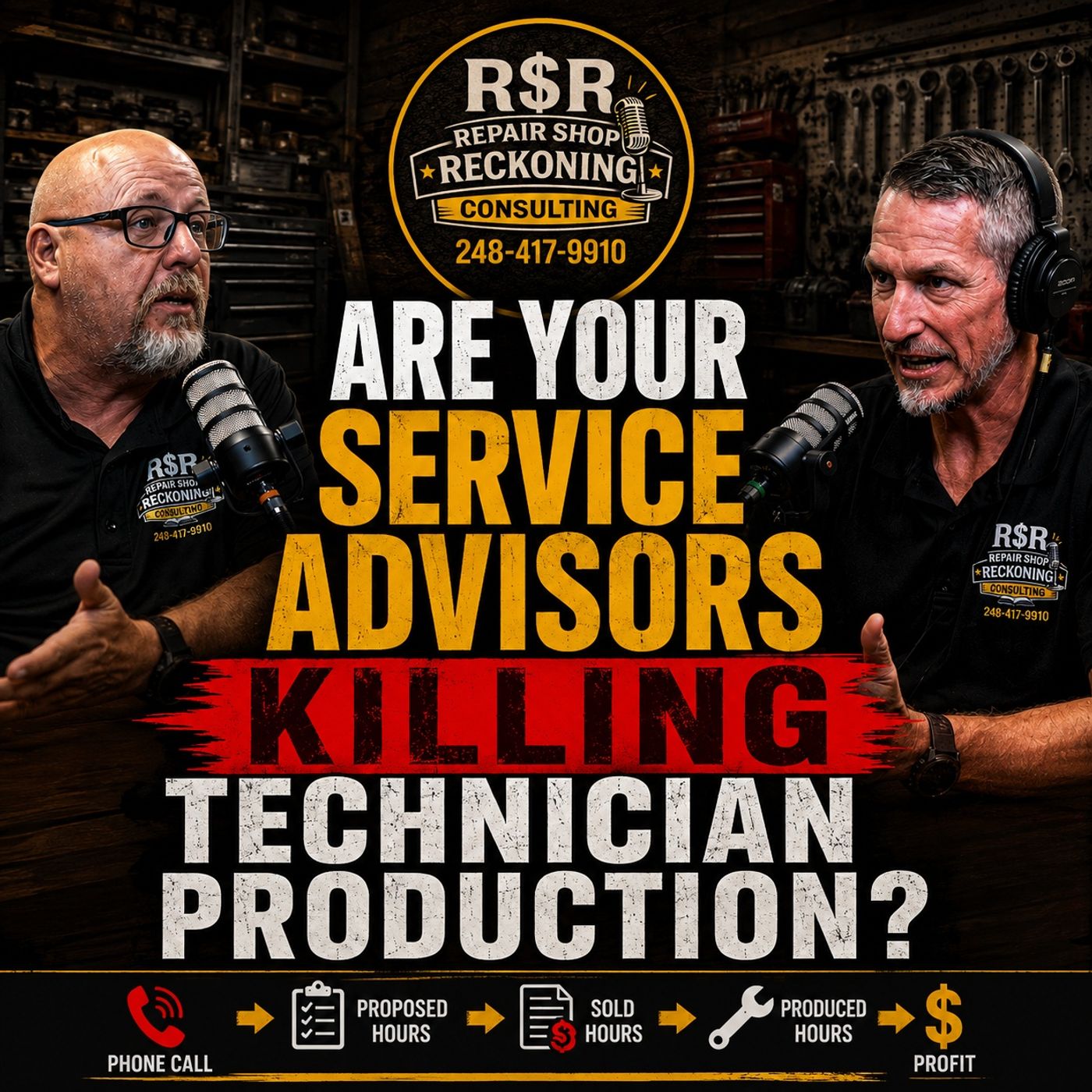
Are Your Service Advisors Killing Technician Production?
This week on Repair Shop Reckoning, Kevin and Jason dig into a problem happening in shops everywhere: technicians are being blamed for not producing enough hours, but nobody is stopping to ask whether those hours were ever sold in the first place. If...
Related across the catalog
Ep 104 - Jordan Mosely | The Truth About Scaling an Auto Repair Business
Tekmetric transformed my shop. Plain and simple. Want that for yours? Touch HEREASTA is coming up September 24-26 in Raleigh. Be there or be square, dog! Register now and use code confess25 for $25.00 off your registration. Sign up HEREIf you're like me and aren't good at marketing, don't do it on your own. Let the experts handle it. Touch HERE for more on Turnkey Marketing.Tired of your shop’s social media looking like every other repair shop on the internet? Stand out with 47 Consulting. Learn more HERESend your service advisor to hands down the BEST service advisor training in the industry (even other coaching companies agree). It's Elite Worldwide's Masters Program. The next one is happening in Dallas Texas, September 10-12. Learn more HERE When I used the maintenance tool for the fist time with Detect Auto, my mind was blown. My advisors had the same reaction - and then SO MUCH MORE TIME. Learn more about Detect Auto and book a free demo now!In this episode, Mike Allen sits down with Jordan Mosely to talk about growth, technology, and the realities of running a multi-location business. Jordan shares how sticking to a proven playbook has helped him scale his quick lube and hybrid locations, and explains why obsessing over small cost details—like labor and materials—makes a huge impact on the bottom line. The conversation also dives into the pain (and promise) of current AI and software integrations, when Mike and Jordan both agree that the right technology is important, but execution, adaptation, and focusing on the basics are what truly drive success.Timestamps:00:00 Covered wagons and old-school shop software02:14 What really goes down at shop events and happy hours03:15 Playbooks and the secret to sticking with a process04:14 The quick lube model vs. full-service auto repair05:48 Learning from industry “gurus” and finding what works06:38 Car wash business models and subscription secrets08:09 Breaking down car wash economics and margins09:26 Pennies make the profit: expense structure and labor10:22 Why every phone call counts—and how much fumbled calls really cost12:04 AI cameras, call reviews, and upgrading shop tech12:41 Why onboarding new AI tools is painful (but worth it)14:00 Using Rilla, custom AI, and making tech work for your team16:28 Are unified shop platforms possible—or is it always 19 subscriptions?18:42 The challenges of double-entry and why Tekmetric stands out20:54 Tectonic event review: what a professional trade show looks like22:24 Fixing cars vs. trying to code your own AI: why you should pick a lane24:00 Confessions about chaos, change—and the need for therapy26:14 Dealing with online haters in the auto industry27:16 Remote and virtual advisors: the future, or a flop?30:07 The “sales hammer” model and selling from afar31:49 What happens when you try to run a fully remote shop32:35 Why execution is everything for new shop models34:42 20 groups, private equity, and the independent shop owner line36:44 Why big shop owners show up at trade shows38:14 Confession time: Subaru oil change disasters and red flags39:25 High turnover in quick lube—onboarding and training struggles40:05 Why you need to launch that training, even if it’s not perfect41:57 What’s next: acquiring more stores, riding the oil price wave, and 1% daily improvement
Dealership or Independent Shop: Which Is Better? | Eric Schoenberger
Like the show? Show your support by using our sponsors. Need to update your shop systems and software? Try Tekmetric HERELaunch your tool game to the next level with Launch Tech USA! HEREIn this episode, Jeff Compton sits down with Kansas technician Eric Schoenberger of Holt Motor Company. Having grown up around Chrysler dealerships alongside his father, a veteran drivability and transmission specialist, Eric shares his experiences in dealer life and why he ultimately transitioned to the independent repair world. The conversation explores flat-rate frustrations, warranty and recall work, shop politics, diagnostic strategies, transmission repairs, evolving technology, and the value of ongoing training. Eric also discusses how independent shops offer less stress, and a different approach to customer service and technician growth.Timestamps: 00:00 Podcast Welcome and Holiday 00:45 Kansas Guest and Vision Talk 01:30 Shop Intro and Dealer Roots 06:03 Family Influence and Career Path 08:12 Flat Rate and Recall Frustrations 17:25 Favorite Dealer Work and Transmissions 23:03 PT Cruiser Love-Hate Jobs 25:35 Diagnostics and Techline Support 27:49 Dealer Life and Shop Politics 32:37 Misfires, Burnt Valves, and Borescopes 36:31 Pentastar Problems and Tips 41:26 Diesel Disasters 44:04 Recall Work Realities 49:21 Hybrid Battery Discussion 52:37 Leaving the Dealer World 55:47 Advisors, DVI, and Communication 01:01:38 Training Great Advisors 01:08:35 Transmission Service Debate 01:14:38 Moving to Independent Shops 01:16:27 Learning Through Service Information 01:18:46 Oddball Repairs and Old Mopars 01:27:05 Caravan Rear A/C Repairs 01:33:05 Training Events and Mentors 01:38:49 Shop Culture and Dispatching 01:40:44 A/C Diagnostics and Leak Testing 01:47:37 Parts Support Challenges 01:54:02 Technician Pay and Flat Rate 01:56:23 Gravy Work vs. Diagnostics 02:02:27 Independent Shop Mindset 02:12:28 Training and Networking 02:20:06 Final Thanks and Wrap Up Follow/Subscribe to the show on social media! TikTok - https://www.tiktok.com/@jeffcompton7YouTube - https://www.youtube.com/@TheJadedMechanicFacebook - https://www.facebook.com/profile.php?id=100091347564232
Ep 92 - Mike Allen and Bryan Pollock | Should Advisors Be On Flat Rate?!?
Tekmetric transformed my shop. Plain and simple. Want that for yours? Touch HEREASTA is coming up September 24-26 in Raleigh. Be there or be square, dog! Register now and use code confess25 for $25.00 off your registration. Sign up HERETurnkey Marketing takes the stress of doing something I'm not good at off my plate. And gives it to someone who is. Click HERE for more.Tired of your shop’s social media looking like every other repair shop on the internet? Stand out with 47 Consulting. Learn more HERESend your service advisor to hands down the BEST service advisor training in the industry (even other coaching companies agree). It's Elite Worldwide's Masters Program. The next one is happening in Dallas Texas, September 10-12. Learn more HEREWhen I used the maintenance tool for the fist time with Detect Auto, my mind was blown. My advisors had the same reaction - and then SO MUCH MORE TIME. Learn more about Detect Auto and book a free demo now!In this episode, Bryan Pollock and Mike Allen take a shot at service advisors. Well...not out of hate, out of a comp on how we treat technicians. Why can shop owners treat techs a certain way, but when they approach advisors with a similar stance, it's the end of the world? Something to chew on. They also dissect the myth that more advisors are always the answer, showing how deep-dive analysis can reveal wasted hours and productivity bottlenecks. And of course, they have some spicy, unfiltered fun, taking swings at industry sacred cows like the “300% rule” and sharing why making your own AI tools (and adopting top-tier shop software like Tekmetric) can boost both sanity and profits.Timestamps:00:00 Kicking off with a classic: Service advisors and efficiency “WTF” moments03:44 Are podcasts ruled by ADHD? (Spoiler: Absolutely)04:36 Lessons from Becky Witt & Hunt Demarest07:13 Techs-to-advisor ratios and what shops get wrong08:52 Where does the advisor’s time really go? Company-wide honesty hour10:07 The “unaccounted for” hours—every shop’s dirty secret12:24 Why mental gear-shifting kills productivity (and everyone’s guilty)14:07 Investing big in software and still doing things “the old way”16:07 Bridging the front-to-back gap: Should advisors have to see every repair?19:31 Switching to Tekmetric: Will Bryan ever actually do it?22:59 Real shop, real talk: One tech per bay and the volume game27:20 Training, conferences, and why small events can outshine the big names29:31 Free diagnostics, efficiency, and why some shops should re-think their value31:35 Can great techs break the rules? The real value of experience34:08 Should customers pay for your learning curve?38:38 Average effort = average pay (and why that’s actually okay)40:49 Diagnostic rates, shop profitability, and the marketing money trap42:45 Getting left behind: AI, chatbots, and the future of shop work43:09 Upcoming class: Build your own AI shop agent & get your hoodie!48:53 Final confessions, hoodie reveals, and a not-so-subtle jab at 300% stores
Episode 269 - Lessons Learned From Custom Car Builds and Business Ownership With Sunny Massera
Don't get to the end of this year wishing you had taken action to change your business and your life.Click here to schedule a free discovery call for your business: https://geni.us/IFORABEDon't miss an upcoming event with The Institute: https://geni.us/InstituteEvents2026Shop-Ware gives you the tools to provide your shop with everything needed to become optimally profitable.Click here to schedule a free demo: https://info.shop-ware.com/profitabilityTransform your shop's marketing with the best in the automotive industry, Shop Marketing Pros!Get a free audit of your shop's current marketing by clicking here: https://geni.us/ShopMarketingProsShop owners, are you ready to simplify your business operations? Meet 360 Payments, your one-stop solution for effortless payment processing.Imagine this—no more juggling receipts, staplers, or endless paperwork. With 360 Payments, you get everything integrated into a single, sleek digital platform.Simplify payments. Streamline operations. Check out 360payments.com today!In this episode, Lucas Underwood and David Roman are joined by Sunny Massera, a custom car and truck builder from Oregon. Sunny Massera shares the hard lessons he learned from business ownership, including the importance of choosing the right business partner and the unexpected realities of running a shop versus working for someone else. The conversation also covers the challenges of building custom and performance vehicles—from managing customer expectations to dealing with unreliable aftermarket parts.00:00 Moving between New Mexico and California04:19 From flat rate to custom cars07:30 Realizing business complexities09:46 Deciding not to work alone13:05 Getting hired at second Bronco shop16:22 Discussing how to fund a startup20:36 Partner's role in business growth23:18 Revamping old Broncos28:11 Understanding the engine issue31:14 Working at custom car shops33:21 Learning through hands-on projects36:45 Test driving vehicles before ordering40:00 Restoring a 59 Ranchero41:33 Future of classic car market46:46 Challenges finding car parts50:09 Troubleshooting transmission issues53:35 Fixing ongoing installation issues56:10 Tuning engine installations59:15 Advice for young professionals