Ep 94 - Coaching Call #17 | The Secret to a "Perfect" Day at the Shop
Now playing — Confessions of a Shop Owner
About this episode
Keep shop management, payments, marketing (all the things) all in one place with Tekmetric. It will CHANGE YOUR LIFE. Click HEREASTA is coming up September…
Key takeaways
- —Establish clear metrics to evaluate daily performance in the shop.
- —Implement a 'perfect day plan' to maintain operational standards.
- —Utilize AI tools for more efficient customer targeting and service.
- —Focus on improving customer retention by encouraging repeat visits.
- —Regularly audit processes to ensure compliance and effectiveness.
Frequently asked
- How can I objectively assess if my shop had a good day?
- You can create a scorecard that tracks key performance indicators like gross profit, customer appointments, and technician hours to evaluate daily success.
- What should I do if my shop is underperforming?
- Identify the root causes by reviewing your daily metrics and adjust your strategy accordingly, such as reallocating resources or changing your marketing approach.
- How can I improve customer retention?
- Focus on providing excellent service during initial visits and offer incentives for repeat business to encourage customers to return.
▸Full transcript
Really what I'm trying to do is at the end of the day, I'm trying to say, does the individual store manager and does they have a way of objectively looking at the day to say whether it was a good day or not? Because that keeps us from stringing together. If I answer that question no, 2 or 3, 4 times in a row because I have it mapped out of what a good day is, you know, if we got 3 or 4 days in a row where we were way far off of being a perfect day, then I know we're going to have a not perfect week.
I can't have a perfect week without having a few perfect days. The following program features a bunch of doofuses talking about the automotive aftermarket. The stuff we, or our guests may say, do not necessarily reflect the beliefs of our peers, our sponsors, or any other associations we may have. There may be some spicy language in this show, so if you get your feelings hurt easily, you should probably just move along.
So without further ado, here's your host, Mike Allen, with Confessions of a Shop Owner, presented by TechMetric, the best software ever invented for any purpose, ever. We're, uh, talking on Memorial Day, uh, which is a little atypical for us to get together on a day off, but I wanted to make sure that we got the recording in time. I didn't know Braxton's on vacation at the beach, and he was like, uh, yeah, I'm gonna be at the beach all next week.
And I was like, well, you're gonna be working from the beach, bro, because we haven't released our lead episode yet this month. So maybe he can edit in the sand. We'll see. You tell them I'll be working from the beach next week too. So I'll be working from the shop next week. Lame. So if I took more of your advice, maybe I'd be able to work from the beach.
It's coming. Um, so this is going to be released on May 29th, uh, effectively 2 weeks before the, uh, AI class that Seth Thorson is coming down to teach in Raleigh. Um, you're sending one of your guys to that. Are you coming also? I'm gonna definitely try to be there. Okay. I talked to Seth, uh, this week about it, and he's, he's like pumped up.
He's like, this is a totally different class than what I did, uh, at Vision. You know, the technology is continuing to develop, uh, but also instead of 3 hours, it's 8 hours., and he's got like this big-ass book that he's, uh, creating and printing. Everyone's going to get a copy that has the prompts that you need to create the tools that he's demoing in the class and has kind of the framework for you to be able to build your own tools.
Um, and in answer to the question of the people that are going to ask this, no, it's not going to be recorded, it's his intellectual property. No, it's not going to be live broadcast, it's his intellectual property. And no, I'm not going to share a copy of that book with you because then he'd never come back and teach another class at my, at my shop.
So, uh, but if you want to come, uh, by all means, you should, uh, you should come. I think we've got 8 seats left available before we hit max capacity. Um, and I think it's going to be pretty awesome. I'm excited about it. Um, I've got— for those of you that have never heard Seth teach before, uh, Seth is probably one of the most detail-oriented instructors that I have ever been in a class with.
Um, so I've not taken his AI class, but if he puts the same level of effort that he does into that that he does into his Tesla class that he teaches at ASTA, it's, uh, it's going to be a phenomenal event. Yeah. So yeah, super excited. And like you said, it's been— there's been so many changes, not just, you know, not just since Vision, but really in the last 4 to 6 weeks., you know, with AI and a lot of improvements.
So, uh, the, uh, well, that's the nature of the evolution of technology, right? It's going to be an incredibly valuable class, and the content in that book is going to be incredibly valuable. And probably a year from now, it'll be, you know, it'll be, you know, surpassed by everything else that's new. But I think the benefit, the opportunity is here for the early adopters.
That's going to be, um pretty remarkable. So I'm excited about it. And then we've got other exciting stuff to talk about coming down the line in the future. We'll save that for, for next month's recording. But I'm excited about some other projects that we're working on. ASTA is right around the corner now. We're all coming into summer season, right? But, you know, the fall shows are right around the corner and the course selection process for that happened last week.
And so all the instructors are being notified next week that their courses were selected because, man, we're so lucky yet again. We got far more courses submitted than what we actually have capacity for. So we had like an incredible group of individuals get together last week and go through all the submissions and try to select out a well-rounded set of courses for ASTA.
We're going to have— the idea is that in every learning session throughout the event, there's a course actively happening that's good for advisors, good for marketers, good for owners, good for managers, good for entry-level techs, good for journeyman techs, good for master techs. So if you want to bring the entire shop, you can, and there's something for everyone at every session. Um, so that's going to be awesome.
And obviously Confessions is sponsoring the hospitality suite yet again. We're trying to make sure that we kick it up even another notch than what we had last year. And that's, you know, possible thanks to Elite and our other sponsors. That's what makes that possible. So thanks for that. So yeah, absolutely. But should we talk about Carfix and how things are going there?
Let's do it. Yeah. How, how was April for you guys? It was the best month of the year so far, revenue and net profit-wise. Not that it was on benchmark, uh, but, you know, getting top-line revenue where it needs to be or closer to where it needs to be is always a good thing. And we continue to kind of, uh, zero in on getting our expenses back in line with where they need to be.
And we've taken some more steps in that direction, or some steps have been taken in that direction, that, uh, we're not gonna we're not going to regain those expenses. I had, uh, one of my service advisors, um, left in May, and, uh, I don't think we're going to replace them. Uh, the, the technology that we have available now to make, uh, the estimating process and the DBI process more efficient and, and, uh, effective— I think I'm gonna run a little bit leaner, uh, and see how that works.
I think it's gonna work really well if the last, uh, couple of weeks is any indication. It's gonna be way better. So We shall see. But, uh, hey there, I'm going to tell you about something that has completely transformed how I run my shop. TechMetric. As a 20-year shop owner, outdated systems used to slow us down. Everything was clunky, from check-in to estimate building to customer updates.
It all felt just super inefficient. Switching to TechMetric has changed everything. With TechMetric, you get a powerful shop management system that includes DVI, quick and easy estimate building, inventory management, real-time reporting, amazing customer communication, and it's really easy for your employees to learn how to use the software. I'm talking like a 1-day learning curve. On top of that, TechMetric has tons of other tools to make you an even better operator.
Stuff like integrated payments with buy now, pay later options is a huge asset. Ask me how I know. And recently they've added a CRM component with their partnership with ShopGenie, which I'm a happy ShopGenie customer already, so I'm super excited about that. Obviously there are a lot of factors at play here, but I want to give you some facts about my business since I made the change to TechMetric.
In September of 2020, when I switched to TechMetric, my ARO was $293. In September of 2024, we were $916. That's over 300% growth. Now I'm not saying that TechMetric created all of that change, but I'm 100% saying that I couldn't have come this far without TechMetric. It's a key factor in our growth and success. If you're ready to level up your shop, TechMetric has everything you need— productivity, revenue, customer experience.
Measure up by every measure with TechMetric. Tap the link in the show notes to learn more. Hey guys, Kari Lynn with Turnkey Marketing. If you are looking to increase cars and you're looking for the right demographic to go after, you want to get the right people who need auto repair right now, then give us a call. We have a service called Direct Track and it utilizes AI to find people in your area who are the great demographic that you wanna go after, have raised their hand and opted in saying, I need auto repair help right now.
We send them an email. As soon as they open the email, we then get their physical address, follow it up with commercial ads on all their streaming services like Hulu and YouTube and ESPN, Fox News, all those different things. And then we also get their physical address and we start sending banner ads and display ads to every single device in that house.
It has been incredibly effective. It has made shops seem like they're everywhere to those people who need repairs right then. And I mean, I'm telling you guys, the return on investment has been huge. So if you want to increase car count, you want to get great people in the door, give us a call or reach out to us and ask us about DirectTrack Marketing.
Let's see, we had, uh, last month from a pure number standpoint, while we— our revenue was better and our profit was better, none of the numbers were like, let me brag about this numbers. 232 cars, um, 35% close ratio for a $461 ARO. So ARO was really low. Um, tech average quote was really low. If you think about that, that means the tech average quote was only about $1,200, $1,300.
Yeah. Yeah, yeah. Um, gross profit was lower than it needs to be, was at 53.5 points. Some of that was a couple of warranty jobs that we had, but a lot of that was falling off of, uh, margin. Um, I think there was some emotional discounting happening. Um, so one of the things that we uncovered with a little bit more accurate RO auditing was that So the way we had TechMetric set up is we had TechMetric set up to automatically, uh, attach a DVI to every repair order when it was opened, right?
And so when I pulled the reports, every repair order gets a DVI, and I wasn't doing deep dive, um, deep dive audits. And what we found is we're nowhere near every repair order getting a DVI. We were finding reasons not to do the— oh, they were just in last week. Right. Oh, they're here for work that was declined last time. We're just doing the stuff that we recommended when they were here 2 months ago.
Yeah, but it's been 2 months, you know. Um, and look, I, I don't think that we're gonna have DVIs done on 100% of cars, uh, because— or 100% of tickets, because not every ticket is a car, right? Sometimes, you know, Miss Jones brings in her spare tire or her flat tire without the car, right? Um, but 95 to 98 to 99, yeah, I think, uh, that should be a reasonable target.
And, uh, so we're watching that much more closely and expecting to see a move in the right direction. And so ultimately, that's what I kept focusing on— tech average quote being too low— as we're not inspecting the vehicles effectively. And in reality, the vehicles that are getting inspected are being inspected well, and the ones that get a DVI have a really good tech average quote.
It's all the ones where we were finding an excuse not to do a DVI that was dragging down that tech average quote because it was just a state inspection. So what is your— what is your inspection sent to customer percentage? Uh, embarrassing, but let's pull it up. So if you're a TechMetric user, you're going to go into reports employee reports, and then the last report on the bottom is inspections.
And then you can select your date range and pull that report by technician, by service provider, or by inspection name. So for us, I go to inspection name and our preventative maintenance inspection is our primary DVI, right? Yeah. Sent to customer was 70%, and this store was better than any of the other stores in that capacity. Okay. Viewed by customer was 45%, meaning they were not actually, uh, using our process, which is, you know, hey, Miss Jones, is now a good time to talk?
This is Mike from Carfax. I sent over a link. Have you had a chance to look at that yet? Okay, let's look at it together. I'm going to walk you through it. Go ahead and open that up. Let me know when you get it open. Right. And less, less than half of the ones that got sent were viewed and only 70% got sent.
So less than half of 70%, that means 32, 33%, roughly one-third of the cars were getting— the customer was viewing, uh, the DVI, which— so ARO is going to come up, and if every vehicle gets a DVI, tech average quote is going to come up. I mean, it's just failure to follow process. Yep. So for sure, that's something that we've begun focusing on in the last couple of weeks.
And it's a little bit embarrassing to say that I allowed it to get to that level without catching it. But this is a broken record. I wasn't paying attention. So, so what is the— I know we've talked about this in the past. Where do you have— because right now it's just you and Steven on the management side of things., overall for the company.
Yep. What is, you know, what are the triggers that we have in place to take a look at that preempt an audit and then preempt some sort of action after the audit? So I don't have set triggers. It's like, hey man, if ARO gets this low or tech average quote gets this low, or if inspections viewed by customer gets this low, then we have to do XYZ.
We've talked about that, I don't know, probably 6, 8 months ago. We talked about setting trigger points, but I never formalized those trigger points and put them in, codified them. So what do you suggest? So what I would suggest is, um, I would suggest putting together— we call it a perfect day plan, which is if everything goes like it's supposed to go, these are the, you know, this is what the numbers should look like.
And then, you know, so that's your, that's your dream day, right? And I mean, all the way down to what we're going to have on the schedule, um, you know, how many preschedules we should have, how many rollovers we should have, how many waiting appointments we should have, how many drop-offs, what the ARO should be, what the GP per hour should be.
How many build hours should we sell? So on and so forth. And then I want to try to build some contingency plans inside of there of what to do if one of those, you know, what do we do if a technician calls out sick? Right? So there's a, there's a, there's already a plan in place of how to adjust for the day.
What do we do if we're taking a look at our day and we have too many waiters? Coming in? What do we do if the mix of work or the mix of cars coming in is probably not going to yield the discovery that we're expecting? All right, so in other words, we're looking at it, we have 3 state inspections on 2024-2025 vehicles, right?
We're going to have good car count, but we're going to have real low discovery off of that because there's not going to be a lot of opportunity. So that's going to impact the opportunity to sell, which is going to impact the overall numbers of the store, either today or in the future. So then I'm trying to figure out what the, you know, what is the minimum level, you know, that we can accept for those numbers.
Okay. I'm making this as fast as I can. Yeah, you're good. And then, so for the perfect day, really what I'm trying to do is at the end of the day, I'm trying to say, does the individual store manager and does— do my regional— do they have a way of objectively looking at the day to say whether it was a good day or not?
Because that keeps us from stringing together. If I answer that question no 2 or 3, 4 times in a row because I have it mapped out of what a good day is, If we didn't have 3, you know, if we got 3 or 4 days in a row where we were way far off of being a perfect day, then I know we're going to have a not perfect week.
I can't have a perfect week without having a few perfect days, right? Yeah. Yeah. And so that allows us to act a little bit faster. And you can set up a during-the-day scorecard to see if we're on track. So like you can set up a 10 o'clock check, a 2 o'clock check. To see are we on pace today or not. And if we're not, that I'm just trying to shorten the decision-making process, the timeline for decisions, right?
So there's like 3 weeks to say, oh shit, things are bad. Yeah. And because that's, that, that's the problem, right? I mean, that's, that's when things get real crazy is, you know, we're not we're looking at the, we're looking at the estimate or the RO that we have in front of us and we're not looking a day, 2, 3, 4, 5, 6 out, you know, it's got date, location, um, self-assessment.
How did the team do today? How did, uh, you do personally today? That you being Steven, my ops manager. Um, how did the technical team at this location do today? And how did the front office team do at the location? Uh, list any big wins, list any big problems or issues that need improvement, uh, any major carryover jobs I should be aware of, anything that needs my immediate attention.
So those are kind of the generalized scores. And then we've got, uh, total, uh, approved gross profit for the day. We just track gross profit, we don't track top-end sales, uh, for that purposes. So yeah, approved gross profit for the day. We know what the breakeven gross profit per day is and we know what the, what the high, what the high target is.
So did gross profit exceed breakeven? Did it exceed the high target? Yes or no on each of those. How many appointments do we have tomorrow? How many new 5-star reviews do we get today? Were there any sub-5-star reviews today? How many Labor hours, did we bill out and what was the gross margin on the billed out work for the day? And then he's got the last 3 questions are, did we make money today?
Have we made money so far this week? Have we made money so far this year or this month? So that's what's sent every day. But, you know, I like that and I don't have any issues with it. The— you got the top, the top half of that's very subjective. Mm-hmm. You know what? And it's kind of how you feel, right? The top half, you know, how did the technicians do today?
How did the service advisors do today? You know, I'm, I'm shifting away from as many subjective questions as I can in that regard. I'll have a spot down at the bottom of mine that says, you know, give me your thoughts and feelings for the day kind of deal, you know, but how many negative reports do you get at the top half of that?
Uh, the most negative numbers are him judging himself negatively. Sure. But I mean, and I don't, and I don't mean that right now. If we had a technician that left halfway through the day because he wasn't feeling well, and that was the, the negative for the day, right? Yeah. So the issue there that I have is, and I'm not saying that we're searching for negatives, what I'm saying is, is that you're gonna get You know, when I first stepped away from the day-to-day operations, I would call into the store, I would send a text to my manager, and I would say, how's everything going today?
Every single message that I ever got back was, it's going great, having a really good day. There were never any problems. What's up, guys? So if you know me at all, you know that I think I'm pretty awesome at everything, right? But the reality is I get so busy that a lot of things fall by the wayside. And one of the things that I've always really enjoyed is actually the process of hiring and recruiting.
But as the business grew and as the podcast has grown, I just don't have time to react quickly like you have to, to be competitive in the recruiting market that we have right now. That's why I've partnered with Promotive. I've used their full-service recruiting process also to great effect for technicians that were like immediate culture fits. That was awesome and useful. But what I'm really excited about is their new tool, Page.
If somebody applies to one of my job listings, Page contacts them immediately and has an interview with them. By the time I get the information, I already know if they're worth the time and effort to jump on that applicant quickly or not. It saved me a ton of time with bad applicants. It's prepped me really well for good applicants. It's just a super effective, super useful, super efficient tool to help me stay on top of my hiring and staffing needs.
If you want to learn more about their full-service recruiting process or about their new tool Page, go to info.gopromotive.com/confessions or scan the QR code below. Okay, you might have heard me talking about it already, but if you haven't, listen up. Saturday, June 13th, I'm hosting an AI course in Raleigh, North Carolina. And by AI, what I really mean is I'm flying Seth Thorson down to teach a full-day class about how to build your own AI agents and use them in your business.
Now, the details are this: if you early sign up between now and May 17th, the ticket's only $899. This is a full-day course on building your own AI agents. If you wait until after May 17th, then the ticket's going to go up to $1,299. So sign up soon. There's a limited number of seats. You can tap the link in the show notes to learn more, or you can scan the QR code on your screen.
At Elite Worldwide, we exist for one reason: to help shop owners build better businesses and better lives. We believe that you can run a profitable shop without burning yourself out, sacrificing your family, or feeling stuck in survival mode. Everything we do is about clarity, leadership, and execution, so you can work on your business, not just in it. That's what Elite Worldwide is all about.
And I'd look at the end of the day and it's like, well, we had $1,200 of approvals, and, you know, 2 cars that came in. I mean, how's this even possible that we had a great day and this is what we got out of a great day? So we had to go back through. And so they don't mean anything by it. They just don't want to— A, they don't want to down the team, right?
In their mind, they're supposed to uplift the team and they are. And then number 2, uplift the team to the team. To us, they need to tell us what's going on. Yes. You know. Yeah. But they also, they also feel like if they tell you that there's a lot of problems, then that's an indictment on them as the manager and the leader of the person that's there.
Right. So if I'm supposed to be managing the location while you're not there, and I text you and I tell you all of these terrible things that are happening at the location, then I'm telling on myself as being somebody who can't handle you know, the people and the staff at the location. So I've just found that I get a very— or, or they're not even trying to hide anything, they're just very subjective in how they're viewing the day, right?
It was a good day because no technicians came up and cussed out a service advisor today, right? It was a good day because no customers came in and yelled and screamed at us. It was a good day. It felt easy, right? So we had customers that came in that we liked, you know, our favorite customers came in, not necessarily the ones that buy everything, but the ones that are the most fun to talk to.
Yeah. So I tried to take away as much of that subjectivity as possible. So if there was something that I wanted to know, I want to attach a number to it and get them to report the number, or it's a binary yes or no, right? Just because I don't want, I don't want the number of operations on that reporting. Yeah, I just, I don't want them to spend a lot of time filling out something that's going to yield zero intellectual data, right?
In other words, I can't make a decision making off of something that you're subconsciously going to give me not 100%. And not that they're lying to you, but they're just, they're, again, it's subjective. So I have to take you at face value that it was what it was, right? Gotcha. So what you really want to know is things like— and what you're going to get reported on is, did we have a technician leave early, right?
So just what was my available technician hours for the day, right? How many techs do we have? We have 3. How many did we have work today? 2. Instead of having 24 hours, we had 16 hours. You know, that's really what I need to know. Because that's going to make a difference in how I view the data, because I can't hold them to the same expectation for 16 available hours as I can for 24 available hours, right?
Yeah, absolutely. So, um, that's what you're saying is my daily manager report is shitty? It's not shitty, it's too much. Okay, it's too much. Um, because again, if I'm filling out all that, if I'm the manager, I'm going to breeze through the top half of it and just give you the fluff and the rainbows., and then the stuff down at the bottom has to be accurate, right?
Because it's the things you have down there are binary. It's, did we make money today? Yes or no? Did we cover GP today? Yes or no? What was our GP total? What was this? What was this? What was this? So I mean, those are, those are things that they can't hide from. They have to get it directly from, you know, from the results of the day.
And so I like that a lot better. The step that I would take next is, is what happens if we're below on that? Right. So just think about the subjective stuff at the top. Think about the number that you really want to attach to that subjective thing to make it objective. You know, you know, because there's, there's 2 or 3 questions you could ask on the technician side of things.
Did everybody show up? Did we have all our available hours? Did we have any comebacks?, you know, today. I mean, that's what you're really looking for, right, uh, is that type of stuff. Um, and then service advisor, you could ask a few questions to figure out how the service advisors are doing too. And then, um, you know, then what we can do is we can start attaching a what to do in case of situation.
So we go, we go down that list one by one and we say, alright, Stephen, what should we do if we have less technician available hours today than expected? What should we do if we look at today and we have less than expected on our— in other words, let's say we have 4 appointments this morning, 3 of them cancel. What do we do?
And I know we have generic slow day plans in place But I find that they don't realize that it's a slow day until 2 o'clock. Yeah. Yeah. So, and, and then what I would probably do there is put some pace checks in the day. So like, instead of him waiting till the end of the day to report these things, are they on track for the numbers that you have set up in there at 10 o'clock and at 2 o'clock?
Do you think that's too much reporting during the day? Well, I don't think he necessarily needs to send that to you, but he needs— somebody needs to be looking at it. Because my thing is, is again, if it's, if it's 10 o'clock and I identify that, and I identify that we have less available hours because we have a technician out and we had 2 canceled appointments today, or our schedule is filled up with a bunch of non-opportunity things, I can do something about it at 10 o'clock.
By the time we get to 4 o'clock when I'm starting to do my report, the day is already over. Yeah. Right. And so, and I'm not saying that I can turn at 10 o'clock, I'm not saying I can turn that day into a perfect day, but I'm trying to— there's more money in raising the floor than there is raising the ceiling sometimes.
In other words, the consistency of it. So, um, let's say it's 10 o'clock and at the beginning of the day we had 14 appointments, but we've got 4 no-shows. And of the 10 that we, uh, do have, you know, 3 of them are not historical buyers. So we know that we're set up for a shitty day. What are the types of things that you would expect, that manager, uh, what's the conversation he's having at 10:15 when he does his check-ins?
Like, oh boy, we gotta scramble. Yeah, so what we're doing there is we're going through and taking a look at our deferred services from our VIP customers that have come in recently. Um, we're gonna, we're gonna go ahead and look at pre-scheduled appointments in the future and see if I can rob some of those coming forward. In other words, I'm gonna look into next week.
I'm gonna steal from next week for this week. I, you know, a bird in the hand is worth two in the bush, right? I'd rather have a good today than I would the promise of a good tomorrow. Um, and so I'm gonna start pulling in my pre-scheduled appointments. We're gonna contact fleet accounts, see if we can steal one, you know, one or two extra cars from a fleet customer.
Um, so those are the, that's the action plan of 10 o'clock and we're behind. And so what we're doing there is we're taking a look at what we have on the schedule and multiplying out what the opportunity is. Right? So if I know that, if I know that $2,000 is our, our discovery target and our average, then I can say we have 10 cars on the schedule.
That's $20,000 of discovery. I can take that and determine what our average closing percentage is. Mm-hmm. And we can pretty closely predict out what the day is going to be., you know, for approvals. And at 7:30 in the morning when she's running through her, you know, beginning day, you know, checklist there, if our approval number is gonna be below what the target is, just based off the way the schedule's laid out, then we're starting that process at 8 o'clock in the morning to try to, you know, sometimes you need to add more cars, you know, sometimes you have enough cars, but again, those cars aren't gonna yield any opportunity, and then it's really how do
I speed up the throughput of the cars that aren't going to yield any opportunity so I can spend more time with— that way they have a focus of, again, the customer that comes in for a state inspection that never spends any money. I'm not saying treat them poorly, I'm just saying if I have a new customer that's coming in with an F-150 that's a good opportunity vehicle, why do I want to go spend— even though Mike's been in 27 times, If he's got $150 ARO, I'm not going to be rude to Mike, but I'm going to spend time with, you know, Jim over here that's walking in for the first time that's got a good
opportunity vehicle, and I'm going to try to make sure that I put my attention where, you know, where our intention is supposed to be. Copy. That makes perfect sense. So, and we are running into that a fair amount, you know, 2025 Tesla coming in for a state inspection, safety only. You know, it's the amount of discovery opportunity that's there for us is not a ton.
So no, no, it's, it's little to nothing. And, you know, the way the North Carolina, you know, procedure is set up, you can't, you can't do a PMI on it unless you sell something else, um, or unless they tell you that you can, or unless you ask and they give you authorization. Um, but, you know, from a technician standpoint, if you know you're getting a $13.60 state inspection that you're getting 0.14 or whatever it is, and you're going to do a free PMI on top of it.
Yeah, you know, yeah, it just— they wind up breezing through it. So how do you feel about all these, uh, shop owners out there that report their numbers but exclude state inspections from the numbers? So I have clients that I ask, so I did that for a while. My coach asked me to do that for a while, um, just to see what the, what the real numbers of repair were.
And when I say numbers of repair, I'm not talking about the quantity, but to see what the quality was off of the, if you took out state inspection tickets, what is your ARO? What is your hours per RO off actual general repair work? Look, when I first opened my shop, I thought my old systems would keep up. The software that I had would continue to evolve, but As we grew, the slow estimates, scattered workflow, increasing downtime, it really just, it was becoming a real problem.
That's why I switched to TechMetric. It's not just software, it's a complete shop management system that makes my life easier. SmartJobs, instant estimates, integrated payments, integrated financing options. I mean, it allows me to focus on the work that actually makes me money and not get bogged down in the other details. My shop's repair orders have jumped over 300% since switching to TechMetric, and when I need help, their support team responds in real time.
Time. I actually was online with them asking questions just this week, and I got answers in minutes rather than having to wait for callbacks and emails days later. If your system is holding you back, it's time for a change. Tap the link in the show notes and see how TechMetric can help you move your shop forward. You know, because what we found was— he's— I think I told you this in one of the early episodes— he used to ask me this question all the time.
What business are you in? What business are you in? And it used to annoy the crap out of me. You know, cause it's like, well, it's obvious I'm in the automotive repair business. What he was trying to get me to realize was I was in the state inspection and lube business. And so, cause we didn't do a lot of repair early on.
We were doing a lot of state inspection and lube. And, uh, so finally he said, look, Matt, cause I, I, I tell this story, you know, when we teach Eagles, when I first joined Elite, uh, by the end of 2017, which was our first year in business. We were doing about 115 cars a week. And that sounds really good, but the first time I went to Fly With the Eagles, I was talking to— you wouldn't know who I'm talking about— Borst Automotive in Arizona.
They had sent their general manager to Eagles at the time, and it was a nice guy. I can't remember his name, but we spent a lot of time talking and eating at lunch. And so we're asking the shop owner questions, right? You know, how many bays do you have? How many techs do you have? How many service advisors? And then it got to how many cars.
And so, you know, I told him how many cars we did and he's like, my God, he goes, what are you guys doing, like $2, $3 million a year? And I'm like, no. I was like, we did $700,000. And he goes, oh, oh, are you guys like an express loop or something? And it wasn't, we were an express loop. You know, we just, we weren't intending to be., we just didn't have the processes in place to, you know, capitalize off what we were doing.
But, uh, so at that point in time, I, you know, he did ask me to pull out state inspections, uh, and oil change only tickets just so we could track, you know, how are we actually doing on repair tickets. Um, and I'll do that from time to time with customers that I know that have a lot of, have a lot of state inspections.
But by and large, no, because I wanted it, like you said, excuse all the numbers. Right. And it hides the pain. You know, if you're doing 30 state inspections a week, uh, Joe Marconi says something and it's, it's accurate. He says everything that you do should either be for a profit or lead to a profit. And if you're doing 30 state inspection tickets a week and they're not leading to a profit, then you got to do something about it.
Right. Uh, funny we say that. I, I've always scoffed at the people who pulled those numbers out. I'm like, it's a car, it counts, you know. But we did 70 state inspections out of the 200 and however many cars last month. Uh, 232 cars, we did 70 state inspections. So I mean, that would probably make the numbers look prettier, but it doesn't change the top line revenue or the net.
No, no. For you, I wouldn't take it out. And, and the only reason that we'll take it out for others is just to show them really like if we, if we limited this and we replaced those 70 cars with more repair work. Yeah. You know, the other thing is, is that the other thing that I'll get clients to do is track of those 70 cars, how many of them return?
Right. So one of the things I, I have found that state inspection customers, first-time state inspection customers have one of the lowest, you know, return rates of any other. They're calling you because their normal guy told them he can't get them in right now. Yeah. Like they waited till they got the thing in the mail. Then they waited another 2 weeks after they got the thing in the mail.
Now they've looked at their sticker on the back of the license plate and they've realized we got 1 week until we're into the next month and they're getting ready to get pulled over. Yeah. And this is their one day off that they have time to come and do it. And so they're calling around, they've called their 2 or 3 normal people that they would call, and then they're— the only reason they came to you is you said yes.
Yeah. And so, um, and so if we take a look at that, so we did, we did some client studies, um, this year, and what we found was so If you take, if you take a look at retention rates across, you know, customer visits, right? So one visit to two visits, two visits to three visits, three visits to four visits. The first-time customer has about a 30 to 40% chance of coming back for a second visit.
All right. And these, these are good shops. This isn't like shops that have 4-star reviews. And have retention issues. So if, if at really good shops, you know, we're seeing 30 to 40%, you know, from first visit to second visit, it goes to about 50 to 65% from, from second visit to third visit. From third visit to fourth visit, we're seeing above 70%.
Yeah. And then fourth visit on, it's like 80 to 90%. So getting them back that second time is crucial, and So if I'm going to take in— so the conversation that I have with my advisors with the state inspection is the state inspection yields zero, nothing for us, right? It's going to be a big zilch in most cases. Maybe we sell a set of wiper blades.
Maybe we really piss them off and tell them that they need something else and we fail them. And they, you know, but by and large, it's going to be— it's not, it's not something that we can expect to yield a bunch of discovery and opportunity for. So what is the real opportunity? The real opportunity is to gain a second visit. Visit, right?
So that's where we're pushing really hard to identify, is this— is the vehicle something that we want to get back in, and is the customer something that we want to get back in? And if it is, that's our focus on, on estate inspections. How do I get that next visit sold? Yeah, I think you just— for those, let's just make it a fast, efficient pain-free, pleasant experience and leave them thinking that was easy and those guys were nice?
No, if you do that, they're never coming back. Really? Well, because you— because there is no experience in a state inspection. All you've done is met their expectations. So you became fast food service, right? So you met the bottom line expectation and they'll come back to you the next— all they're ever going to come back for is the state inspection in that scenario.
You know, they're gonna remember it was really fast, quick, and easy and painless to get the state inspection there, and they're gonna come back for that. Even if part of the conversation with the customer is telling 'em about how we're full service and we do everything and we have loaner cars and we have shuttle service and, and then I have, then I have to ask the harder questions of, you know, so I'm gonna ask, you know, are you new to the area or you're just new to me?
Yeah. Right. And then I'm gonna find out. You know, why are you coming in today for the first time? You know, and then before we leave, I'm gonna give you a, I'm gonna give you a reason to come back. So I'm gonna sell you an offer that says, you know, and it pretty much guarantees me 3 visits out of you. Yeah. Right.
So that's, that's gonna be my plan with that is I'm gonna identify while you're there again, is the vehicle, you know, something that we, that we covet, you know, does, does this vehicle have a lot of opportunity for us? Um, and if it does, I can't judge the customer until they come in 2 or 3 times, right? Because I don't know anything about their buying habits.
We haven't developed a relationship yet. I don't know anything about their driving habits. I don't know any— I don't know where they work, and I'm not going to figure all that out in the first visit, right? I'm going to get a piece of it, but I'm not going to get all of it. And, you know, how many times have you seen a customer come in And the first 2 or 3 times they buy nothing and the service advisor goes, oh, that guy's, he's a dud.
He's not our customer. And then the 4th or 5th visit, he comes in and he gets everything done and everybody's all surprised. Like, oh, Mike's come in 4th. He's never gotten anything done. Look, you just approved everything. Well, yeah, it's because he came in the first time with his arms way up here. Then he came in the second time like this. Then he came in the third time like this.
And by the 4th time he comes in, he's, you know, his hands are down and he's you know, there's, there's a relationship and an element of trust there, right? So, you know, it's how do I get them to that third or fourth visit as quickly as possible is what I'm looking for. That's great, man. You're way better at this than me. Um, you want to just come run my shops for me?
Sure. I don't want to pay you as much as you want though. You do not. But there's a number, Mike. Probably the number is you own my business. I would be a terrible service advisor. You would fire me immediately. I'm a terrible service advisor too. I tell, you know, my team will tell you, like, if you need one thing sold in the shop, like, if that's— if you had to talk to one customer and you needed to sell it, I'm probably your guy.
But if you needed somebody to stand there for 8 hours a day, 40 hours a week, I get shiny squirrel syndrome way too bad, and I hate being stuck behind the desk. It's just— I get antsy for sure. I, um, I will tell you that I went to, uh, Matt Curry's Level Up event last week. Yeah. And toured a few of his shops and spent some time with him and the folks that were there.
And, um, I could talk a lot about that whole experience. It was overall a very good experience, um, and I didn't really know what to expect coming into to it, but I came away with a, uh, really good opinion of Matt, um, and his operation. Um, but one of the things they were doing during the second day is they were just kind of, they were doing an example of their role plays.
So they put a big, uh, like a scenario and an estimate up on, uh, the screen and they'd pass the microphone around and you'd role play and then they'd break down what you did well and what you could have improved upon and kind of their word tracks and their touch points that they use and they train. So it was kind of like a sales training meeting for for them, right?
Fucking microphone came to me and, oh, it was bad, bro. It was, it was bad, bad. But, uh, I was not the worst in the room, but it was kind of taking lambs to the slaughter, a room full of owners who don't really ride service anymore, uh, asking them to do that gig. But it did make me feel a little bit convicted that if I'm going to be running the, the sales conversations and the training conversations within my company, I need to be able to execute on what, uh, what I'm asking them to execute on.
So yeah, I mean, it's— so I would— and I just told you, like, I would be the worst service advisor in my store. There's no question about it. So my people are better than I am at doing it 40 hours a week. But I do tell every owner, you should be as good as them once. You know, if not better, because like you said on that, you know, on the roleplay training side of things, if I can't roleplay it at a high level, how can I expect them to?
Hey, how do I train them and how do I hold them to a standard? But I mean, it's, I would say, I mean, you have scripts and processes and everything for yourselves. What we did was I have some— my, my highest producing advisor, she does a great job of leveraging AI. All right. So what we did for her was we uploaded all the sales scripts into ChatGPT, into a project, and then she'll upload the RO into that same project and then turn on the voice deal and tell it, hey, that, you know, we're gonna, we're gonna role play this RO.
You're going to be the customer, you know, and I'm going to be the service advisor. And then they role play it back and forth, and it, you know, the prompt tells them to review the scripts that we have and then give her feedback on how she could, you know, follow the script better. So it knows what our, you know, sales scripts and customer prompts and stuff like that are.
Um, and we've gotten the script there, and you can make chat the service advisor and you can be the customer and see how it follows the script and how it overcomes objections too, which is pretty slick. Yep. And so our, our process— and this doesn't make it right, but I want to try to get everything down to a price objection, right? Because, and the only objection that I really want my service advisors to really know how to handle is the price I'm gonna rephrase that.
If we do our job correctly on the front end, the only thing that we should have left at the end of it is a price objection. Right. And I want them to know trust and everything else as a possible. Yeah. If, if they, if they believe that it needs to get done and they believe in the urgency that it needs to get done now, then the only thing that could be the only reason that they wouldn't get it done is they didn't see the value in the price that we presented to get it done.
Right? And that value could be, I don't have the money today, which is a future issue, right? We just got to figure out how do we get the money today that they would have tomorrow. It could be they don't have the money at all and they have no way of getting the money. Like, they would love to get it done with us, there's just no way.
Yeah. Uh, or it could mean that they think we're full of crap, that brakes for $680 is way too much money, and, you know, they're used to paying $400 for brakes. So I'm trying to condense it down to, to that as quickly as possible and just get them really good at overcoming that. Because, and then if we, if we identify later in their audit that it was something other than a price objection, then we screwed up somewhere before that.
Right? Copy. Quick shift of gears. I know we're running out of time. When is your next Eagles program? So we have Fly with the Eagles coming up. We just had our last one in Charlotte this past— not last week, but week before last. And that was an awesome event. It really was cool. We had Dutch Silverstein there. I know we talked about that.
And so Dutch was our special guest. If you get the grumpy old man to come to the room and sit in the back to audit the class and he says that he can unreservedly recommend it, That's pretty high praise from that old dude. Yeah, he said it was really good, so that's awesome. Yeah, it was, it was great to have him there, and he added a lot to the class as well, um, and was gracious.
He did, he, he was gracious enough to buy lunch for everybody the first day and, um, and brought a, you know, brought a guest with him that got a lot out of the class. It was fun having him there. And, uh, and then so our next one coming up is going to be in Providence, Rhode Island in October. We should have the dates sealed for next week.
But it will be, it will be in October in Providence, Rhode Island. So Providence is between New York City and Boston, which is— it'll be gorgeous up there that time of year too. It's yeah, fall time, fall time up there is going to be really pretty. So those of you that are looking for a fall vacation, This is one you bring the wife to, and then afterwards you guys go sneak off to Boston for a day or two, or go sneak off to New York City for a day or two and enjoy yourselves.
Again, it's, it's 3 days between management and owner training. We spend a lot of time, uh, we spend a lot of time on employee development. We spend a lot of time on how to not just the fact that you need processes and procedures, but structurally, how do you actually build and implement a process and procedure? And then we spend an entire day on, on the numbers, and we actually do some breakout groups.
So we ask you to bring your information with you, and we actually help you develop what your breakeven should be, what your labor rate should be, and then how to, how to identify what your KPI target should be based off of those things. So you're going to leave with some very actionable things that you can take back and implement. And it's not just a bunch of theory, you know, theory of operation, and it's not a generic playbook that says this is the way everybody should do it.
You can tailor, tailor it to your facility as well, but we'll teach you the steps that it's going to take to be able to do that. So, um, really excited about, you know, the direction of that program and where it's been going. The feedback that we've gotten off of it over the last 18 months has been been really awesome. Well, I know that it was great, um, back in the day when I went, and I know that it's been completely rewritten and it's all new content and everything I hear is great about it.
So, um, Masters— when is the next Masters program start? Masters, our next one is in June. Um, they have— I think they have 1 or 2 seats available for that. So anybody interested in service advisor training, that's a 6-month service advisor course. It's 3 days in person and then 6-month, uh, group coaching, uh, after that. Uh, Sabrina does a fantastic job with that program.
Um, Darren, our CEO, actually co-hosts that on the in-person side of things. So that's his passion project is teaching the advisors. So they do a great job with that program. Uh, again, that's gonna be filling up pretty quick here. Um, so if you're interested in that, and I think the next one is Probably around that same October time. I'd have to take a look at that.
But there is, there is one following that up. No, it's in September. Okay, so the next master's being September. Um, I did find out, uh, this weekend that, um, for the first time ever, I'm going to be hosting a class at ASTA Expo. Nice. It's like, it's going to be Lucas Underwood, Tanika Haynes, and I. It's, uh, owners only, so, uh, no managers, no advisors, no techs.
No vendors, owners only in the room. And are you doing the, are you doing the Brian Pollack thing where it's like shit you should know but don't? Well, I mean, that you just watch our recording episodes. This is the 17th one of these we've done. It's full of, it's 17 hours of shit Mike doesn't know that I should know. You can just cut, you can use AI to cut Mike's part out and just listen to what Matt says.
And there's your class. No, but it's going to be very open engagement. I'll come with, you know, hot topics to discuss. We'll have the two of them or the three of us kind of give our, our feedback and our input and our answers and see where we agree and where we disagree. And then we'll pull the, pull the attendees into the conversation as well.
And there'll be some opportunity for them to kind of lob topics up there too. Very interactive, uh, course. I think it'll be a lot of fun. Um, ASTA Expo is going to be pretty awesome this year. Just hearing some of the stuff that they're talking about, um, some of the, the content that there's going to be there, it's going to be awesome.
So I'm looking forward to that too. So a lot of fun stuff on the horizon. Um, it's gonna be fun. Yeah, man, always look forward to ASTA. It's, um, you guys do a great job of putting that event on, and it every year it just gets better and better and Um, super— oh, it's always the only circle on the calendar and look forward to getting to.
I hope I get to see you in a, uh, in a couple weeks. I hope you come down on Saturday for, uh, Cess class, uh, even if you can't make it for the whole day and hang out. Or come down Friday night, we're doing— we're hanging out Friday night doing shenanigans also. So, okay, one or the other. So yeah, man, love, peace, and hair grease, dog.
See ya. Happy Memorial Day. Thanks for listening to Confessions of a Shop Owner, where we lay it all out. The good, the bad, and sometimes the super messed up. I'm your host, Mike Allen, here to remind you that even the pros screw it up sometimes. So why not laugh a little bit, learn a little bit, and maybe have another drink? You got a confession of your own or a topic you'd like me to cover?
Or do you just want to let me know what an idiot I am? Email mike@confessionsofashopowner.com or call and leave a message. The number is 704-CONFESS. That's 704-266-7000. 3377. If you enjoyed this episode, be sure to like, subscribe, or follow. Join us on this crazy journey that is shop ownership. I'll see you on the next episode. All right guys, AI class. Learn how to use AI so that you can make it your bitch and you don't become its bitch.
Saturday, June 13th, Seth Thorson's teaching a full-day class in Raleigh, North Carolina. Tap the link in the show notes or scan the QR code on your screen to learn more. It's going to be awesome.
More from Confessions of a Shop Owner
Ep 114 - Turnkey Marketing Call #1 | The $84,000 Mistake Hiding in Your Shop
Keep shop management, payments, marketing (all the things) all in one place with Tekmetric. It will CHANGE YOUR LIFE. Click HEREASTA is coming up September 24-26 in Raleigh. Be there or be square, dog! Register now and use code confess25 for $25.00 off your registration. Sign up HERETurnkey Marketing has made my life SOOO much simpler, AND they've helped keep the phone ringing. Do you need these two things too? Learn more HERETired of your shop’s social media looking like every other repair shop on the internet? Stand out with 47 Consulting. Learn more HEREWhen I used the maintenance tool for the fist time with Detect Auto, my mind was blown. My advisors had the same reaction - and then SO MUCH MORE TIME. Learn more about Detect Auto and book a free demo now!Elite Worldwide's Ignite 2027 is coming up in February and NOW is the time to sign up. It's happening in Vegas February 4-6 and it will be the best 3 days of your shops year when you attend. Learn now HEREMike Allen sits down with Carrie-Lynn Rodenberg of Turnkey Marketing to kick off a new monthly series that lets listeners sit in on the marketing side of running Mike's shops. They break down marketing budgets, customer acquisition, direct mail, attribution, branding, customer retention, phone performance, and why simply making the phone ring means nothing if the shop can’t convert the opportunity. Carrie-Lynn also uncovers a painful number at Mike’s flagship store: hundreds of first-time callers but only a fraction turning into customers, potentially representing tens of thousands of dollars in missed revenue. Along the way, Mike admits he may be Turnkey’s worst client, explains why shutting marketing off when you’re busy can come back to haunt you months later, and learns that sometimes the marketing isn’t broken — the operation is.Timestamps: 00:00 Seven Years Since Turnkey First Visited Carfix00:41 Mike Used to Sleep at the Shop03:15 Meet Carrie-Lynn Rodenberg and Turnkey Marketing05:24 Mike Buys Marketing Tools… Then Forgets to Use Them07:05 How Mike Started Working With Turnkey08:57 Mike Tried Doing His Own Marketing — Then Came Back09:07 Why We’re Recording Mike’s Marketing Calls11:21 The Hidden Cost of Bad Marketing13:25 Sniper Marketing vs. Spray and Pray13:41 Carrie-Lynn Went From Doing Everything to Building a Team14:44 Mike’s 115-Episode Long Con 😂15:51 Stop Making Your Marketing About Yourself17:28 Why Most Small-Business Marketing Becomes White Noise20:14 Your Competition Is Better Than You Think21:36 How a Business Responds When Things Go Wrong23:07 Every Shop Says They Have Great Service23:53 How Do You Actually Stand Out?26:24 Why Direct Mail Takes Time to Work28:50 Every Shop Has Blind Spots29:33 Want to Ruin Mike’s Day? Listen to His Phone Calls30:12 Did Your Marketing Actually Make the Phone Ring?30:59 Why Marketing Attribution Is So Difficult32:27 The Creepy Side of Modern Targeted Marketing34:29 Can You Target Technicians at a Competitor’s Shop?36:12 What Turnkey’s Marketing Onboarding Looks Like37:26 SEO, AI Search and Building the Right Marketing Mix40:04 Bad Marketing Can Cost You Technicians Too40:24 Mike Confesses He Might Be Turnkey’s Worst Client42:34 Carrie-Lynn Finds a Painful Number43:41 What Should Your Call Conversion Rate Be?44:25 229 New Callers… Only 56 New Cars44:55 Mike Explains Where Carfix Dropped the Ball46:16 How Service Advisors Say “No” Without Saying No47:06 More Staffing Means More Opportunity to Say Yes49:54 Did Carfix Leave $84K on the Table?50:24 The Marketing Worked — Carfix Didn’t Convert It50:49 Why You Shouldn’t Turn Marketing Off When You’re Busy51:23 Today’s Marketing Decisions Affect Your Slow Season52:47 The Cheapest Customer Is the One You Already Have53:16 Why Customer Retention Matters So Much54:18 Why Shops Should Prebook the Next Appointment54:54 Convenience May Be Your Biggest Competitive Advantage55:21 You Might Be Paying to Market Your Competition56:20 A $100 Lead Could Become a $32,000 Lost Customer57:33 What This New Monthly Marketing Series Will Look Like58:51 Mike Finally Promises New Pictures
Ep 113 - Saurav Kumar & Kamran Rahman | Why Generic Social Media Is Killing Your Shop
Tekmetric opened my eyes to just how much a good SMS will do for a shop. Their software is top of the line, and with them, so is my shop. Try them for yourself HEREASTA is coming up September 24-26 in Raleigh. Be there or be square, dog! Register now and use code Confess25 for $25.00 off your registration. Sign up HEREMy marketing before and after signing up with Turnkey Marketing is pretty scary. In a good way. Get your marketing right today HERETired of your shop’s social media looking like every other repair shop on the internet? Stand out with 47 Consulting. Learn more HERE Make your techs happier with Detect Auto. They'll stop getting "check noise" or "check vibration" from advisors with the customer concern tool. It will CHANGE YOUR LIFE. Book a demo HERESend your service advisor to hands down the BEST service advisor training in the industry (even other coaching companies agree). It's Elite Worldwide's Masters Program. The next one is happening in Dallas Texas, September 10-12. Learn more HEREMike Allen sits down with Saurav Kumar and Kamran Rahman from 47C to talk about what actually makes social media work for an auto repair shop—and why going viral might be the wrong goal entirely. They break down the difference between generic content and real brand-building, why local relevance matters more than raw views, how shops can create trust before a customer ever needs a repair, and why the right audience is more valuable than a huge one. Mike also admits one of his shops is now charging for diag, gets on a soapbox about technician pay and training, and somehow turns a discussion about marketing into another story about his pants coming off.Timestamps:00:00 Generic Social Media Is Everywhere00:59 Was This the Worst Recording Day Ever?01:27 What It’s Really Like Filming Inside a Repair Shop03:00 Can Shop Owners Mix Their Own Content With Professional Content?04:00 Mike’s First Impression of 47C05:53 Why Saurav Never Carries His ID08:08 Mike Admits He Didn’t Understand 47C at First09:47 The Confessions Lounge and Studio12:00 The Story Behind Mike’s Throne13:51 Meet 47C17:10 Why They Chose the Automotive Industry18:33 Are Repair Shops Actually Bad at Business?20:05 Why Automotive Attracts Private Equity21:56 What 47C Actually Does for Repair Shops25:19 Why Customers Want to Feel Like They Belong26:45 Mike Finally Buys Into Social Media Brand Building28:52 Are Repair Shops Still Early to Short-Form Video?30:11 Why Mike Doesn’t Want to Be the First Early Adopter31:05 Landscape vs. Portrait Video34:24 Mike Is Now Charging for Diag at One Shop35:58 Learning Dynamic Pricing From an Ice Cream Truck37:36 Technician Pay, Training and Labor Rates41:18 The Reality of Entrepreneurship43:22 No Booze, No Cocaine While We’re Working44:46 You Can Run a Good Business and Still Have Fun45:52 Why 47C Limits How Many Clients It Takes49:55 The Biggest Problems Facing Repair Shops52:55 Focus on What You’re Good At and Hire Out the Rest54:00 Why Generic Social Media Isn’t a Strategy55:00 Are Viral Shop Videos Actually Useful?56:00 Mike’s Million-View Video Reached the Wrong Audience58:40 Mike Learns What Kind of Content His Audience Really Wants59:09 Closing Thoughts
Ep 112 - Coaching Call #20 | Mike is Going to Charge for Diag??
Tekmetric transformed my shop. Plain and simple. Want that for yours? Touch HEREASTA is coming up September 24-26 in Raleigh. Be there or be square, dog! Register now and use code confess25 for $25.00 off your registration. Sign up HERETurnkey Marketing takes the stress of doing something I'm not good at off my plate. And gives it to someone who is. Click HERE for more.Tired of your shop’s social media looking like every other repair shop on the internet? Stand out with 47 Consulting. Learn more HERESend your service advisor to hands down the BEST service advisor training in the industry (even other coaching companies agree). It's Elite Worldwide's Masters Program. The next one is happening in Dallas Texas, September 10-12. Learn more HEREWhen I used the maintenance tool for the fist time with Detect Auto, my mind was blown. My advisors had the same reaction - and then SO MUCH MORE TIME. Learn more about Detect Auto and book a free demo now!Mike Allen sits down with Matt Lofton for another open-book coaching session, digging into the real numbers behind one of Mike’s shops and figuring out what has to change to push it past 20% net profit. They break down car count, closing ratio, effective labor rate, gross profit per billed hour, staffing capacity, revenue per employee, and why a shop can look busy while still leaving a lot of money on the table. The conversation eventually forces Mike to reconsider one of his favorite controversial strategies—free diagnostics—and whether qualifying customers and charging for testing could actually improve the shop. As usual, there’s plenty of math, sarcasm, questionable financial decisions, and Mike reluctantly admitting that Matt may have a point.Timestamps00:00 Mike Forgot the Most Important Podcast Preparation: A Drink01:21 A $734 Power Bill vs. Matt’s Accidental Backyard Rainforest04:25 Growing the Business Just Creates New Problems07:35 Are Shop Owners Bad at Celebrating Wins?11:33 Opening the Books: $115K Revenue, $530 ARO & 24% Closing14:40 The Shop’s Best Month of the Year15:18 Building a 20%+ Net Profit Goal18:18 How to Calculate the Revenue Your Shop Actually Needs20:41 Can the Current Team Produce Enough Hours?25:45 “I Have No Excuse Not to Put $25K–$30K in the Bank”27:04 Could This Be a 30% Net Profit Shop?27:45 The Gross Profit Per Billed Hour Every Shop Needs to Know30:21 The Problem With a 24% Closing Ratio31:47 Your Loss Leader Doesn’t Have to Be for Everybody34:29 23 Cars Out of 110 Generated $034:57 “We’re Not Hospice for Cars”35:19 Should Repair Shops Have an Age Limit on Vehicles?36:32 Mike Admits He’s About to Make a Bad G-Wagon Decision39:58 Matt Sees Mike’s Effective Labor Rate and Gets Sad41:12 Mike Calls Capacity Calculators “Mental Masturbation”42:02 Should Mike Finally Start Charging for Diagnostic Testing?43:15 What McDonald’s Can Teach Repair Shops About Pricing44:04 Qualifying Customers Before Giving Them Something Free46:25 Mike Promises to Rage-Bait Matt Again46:54 Raising Effective Labor Rate Could Add $500K in Capacity49:11 What Should the Entry-Level Diagnostic Fee Be?51:41 The Revenue-per-Employee Hiring Benchmark55:05 Is It Already Time to Hire Another Technician?55:49 Why Your Shop Can’t Operate at Redline Forever57:17 “Good Dude Is Not a Qualifier for Employment”59:42 Mike Prepares to Admit He Was Wrong About Free Diag
Ep 111 - Mike and Bryan | Technicians Want More Money… But Won’t Do the Work
Tekmetric transformed my shop. Plain and simple. Want that for yours? Touch HEREASTA is coming up September 24-26 in Raleigh. Be there or be square, dog! Register now and use code confess25 for $25.00 off your registration. Sign up HEREIf you're like me and aren't good at marketing, don't do it on your own. Let the experts handle it. Touch HERE for more on Turnkey Marketing.Tired of your shop’s social media looking like every other repair shop on the internet? Stand out with 47 Consulting. Learn more HERESend your service advisor to hands down the BEST service advisor training in the industry (even other coaching companies agree). It's Elite Worldwide's Masters Program. The next one is happening in Dallas Texas, September 10-12. Learn more HERE When I used the maintenance tool for the fist time with Detect Auto, my mind was blown. My advisors had the same reaction - and then SO MUCH MORE TIME. Learn more about Detect Auto and book a free demo now!In this episode of Confessions of a Shop Owner, Mike Allen and Bryan Pollock get into technician pay, work ethic, training, shop culture, and whether today’s owners are expecting too much from the modern workforce. Bryan questions whether the self-motivated technician is disappearing, while Mike pushes back on the idea that someone should receive six-figure pay before developing a six-figure skill set. They also get into government regulation and price-gouging enforcement, bad repair shops, Mike’s anonymous Facebook trolling, and why sometimes the industry’s problems feel impossible to fix. And because this is Confessions, Mike also explains how he managed to injure himself playing kickball on the beach.Timestamps:00:00 Mike’s Casino Decisions & Bryan’s Corvette Disaster04:54 Mike Gets a Letter From the Attorney General07:34 Fraud Alert…Live During the Podcast08:05 Mike’s Fake Career as a Professional Blimp Folder12:23 Confession: Mike Has Been Trolling Shop Owners Anonymously17:17 Why There’s More Than One Right Way to Run a Shop19:37 Three Shop Owners With Completely Different Business Models21:44 David Roman Wants Absolutely Nothing to Do With Mike24:19 Cheap Labor Rates & Buying Failed Shops’ Equipment25:07 Is Bryan Becoming a Cranky Old Shop Owner?27:05 Are Technicians Becoming Too Dependent on Shop Owners?29:22 Bryan’s Crash Course Into Becoming a Technician32:26 Is the Self-Motivated Technician Disappearing?33:23 Should You Make $100K Before You Have $100K Skills?35:31 What Happens When Newer Cars Get Even More Complicated?35:58 “I Want to Learn”…But Won’t Use Free Training37:10 Technicians Who Say Training Is “Too Basic”39:18 Bryan’s Government Intervention Rant Begins41:00 Price Gouging vs. Shops That Can’t Fix Cars43:43 Who Gets to Decide What an Auto Repair Shop Should Charge?47:01 Why Government Regulation Won’t Fix the Real Problem48:10 Should Shops Call Out Bad Repairs From Other Shops?52:44 Mike Adds Four Employees to His Shops55:10 Mike’s Most Embarrassing Kickball Story57:02 Mike Defends His Sumo Wrestling Record58:25 Why You Need to Be at ASTA Expo
Related across the catalog
Bonus Episode - Emily Oliver On Keeping It in the Family While Facing Challenges and Growth at a Small Auto Shop
Don't get to the end of this year wishing you had taken action to change your business and your life.Click here to schedule a free discovery call for your business: https://geni.us/IFORABEDon't miss an upcoming event with The Institute: https://geni.us/InstituteEvents2026Shop-Ware gives you the tools to provide your shop with everything needed to become optimally profitable.Click here to schedule a free demo: https://info.shop-ware.com/profitabilityTransform your shop's marketing with the best in the automotive industry, Shop Marketing Pros!Get a free audit of your shop's current marketing by clicking here: https://geni.us/ShopMarketingProsShop owners, are you ready to simplify your business operations? Meet 360 Payments, your one-stop solution for effortless payment processing.Imagine this—no more juggling receipts, staplers, or endless paperwork. With 360 Payments, you get everything integrated into a single, sleek digital platform.Simplify payments. Streamline operations. Check out 360payments.com today!In this episode, Emily Oliver joins the podcast to share her journey of taking over a small family auto repair shop in Gloucester, Massachusetts. Emily talks about the challenges of modernizing operations, from adopting new software like Shop-Ware to implementing more thorough documentation and communication processes with customers. The conversation also highlights the complexities of hourly billing in auto repair, the challenges of managing family roles in business, and the importance of continuous learning and adaptation as the shop grows.00:00 Family auto shop's history08:56 Simple billing system explained10:55 Tracking time in auto repair bays19:04 Standardizing Inspection Processes23:10 Issues with technician pricing30:07 Convincing family about car maintenance36:33 Communicating with customers39:47 Dealing with other mechanics' issues46:27 Early challenges and learning curve54:21 Managing finances and staying focused56:10 Discussing parts pricing strategy01:01:21 Gaining insights from peer feedback
The Shop Owner Comparison Trap | Anders Gustafson - Ep 29
Running a shop is hard enough—you don't need your software making it harder. 😂 If you're ready for more clarity, better organization, and a smoother experience for both your team and your customers, check out Tekmetric HEREConsistency is key - heard that! But, consistency is HARD. That's why I gave up on trying and let the experts handle it. Detect Auto. Let them clean up your estimating process and raise your ARO - like they did for me! CLICK HERE TO BOOK A DEMOIn this episode, Tonnika Haynes welcomes Anders Gustafson to discuss the real journey of shop ownership, from humble beginnings to scaling up. Anders shares the challenges of starting a shop with little experience, reflecting on the lessons learned from opening a second location and the importance of picking the right spot. Together, they get real about the mental toll of comparing yourself to others on social media, the need for community and coaching in the automotive industry, and why self-growth matters more than flashy online wins.Timstamps:00:00 The Comparison Trap: Social Media and Shop Owner Wins01:26 East Coast Roots: Moving for a Dream02:15 Breaking into Automotive: From Office Job to Shop Life03:38 U-Hauls & Humble Beginnings—Opening Shop in Virginia07:27 Location Matters! Lessons from Two Stores11:01 Second Location Struggles & Mistakes14:36 Going It Alone: The Cost of Not Getting Industry Support17:32 Social Media: More Harm Than Good?19:02 Measuring Growth: Why the Only Race is With Yourself25:02 Teaching & Tectonic: How Humor Changes the Game28:23 Tech-Enabled Services: ShopLevers Explained32:46 Business Partners: Horror Stories & Happy Endings37:04 Boondoggling Across the Globe: Adventures Post-Shop Life41:40 Real Shop Drama: Roller Coasters, Jabronis & Jalopies44:00 The Power of Coaching, Training, and Community46:53 From Fear to Freedom: Finding Your Shop Owner Tribe49:01 Shop Ownership = Roller Coaster (and Why You Should Love It)52:44 Google Reviews, Value, and Standing Your Ground
Simple Changes That Make an Auto Repair Shop More Professional | Frank and Margarita Wiebe
Like the show? Show your support by using our sponsorsNeed to update your shop systems and software? Try Tekmetric HERELaunch your tool game to the next level with Launch Tech USA! HERERecorded at the TOOLS in Hershey, Pennsylvania, Jeff sits down with Canadian shop owners Frank and Margarita Wiebe of 3D Auto to share their first destination training event and the lessons they're bringing back to their shop. They share how the welcoming community helped them build new relationships, the value of technical and service advisor training, and why effective customer communication starts with selling value—not price. The conversation also covers diagnostics, shop processes, professionalism, preventive maintenance, and building a culture focused on continuous learning and integrity.Timestamps: 00:00 Honesty With Customers 00:46 Meet Frank and Margarita Wiebe 01:42 Road Trip to Hershey 03:39 First Destination Training Event 04:26 Finding Community at TOOLS 06:30 Women's Dinner Experience 08:34 Their Podcast Journey 09:38 Tire Lifting Tips 11:12 Women in the Shop 13:18 Safety and Leadership Lessons 15:09 Favorite Training Sessions 21:11 Hershey Lodge Experience 23:32 Improving Customer Estimates 27:50 Building a Professional Shop Brand 29:48 Training Technicians and Using Lab Scopes 33:41 Battery Testing Best Practices 34:55 Preventive Maintenance Mindset 36:12 Doing Maintenance the Right Way 37:26 Advocating for Customers 39:04 Fleet Maintenance Success Stories 41:41 Why Phone Estimates Don't Work 43:51 Diagnose Before Replacing Parts 46:14 Handling Difficult Customers 51:39 Pricing and Setting Priorities 54:05 Free Services and Due Diligence 01:00:22 Tekmetric Experiences 01:04:13 A/C Season and Fleet Planning 01:06:31 Final Takeaways and Wrap Up Follow/Subscribe to the show on social media! TikTok - https://www.tiktok.com/@jeffcompton7YouTube - https://www.youtube.com/@TheJadedMechanicFacebook - https://www.facebook.com/profile.php?id=100091347564232
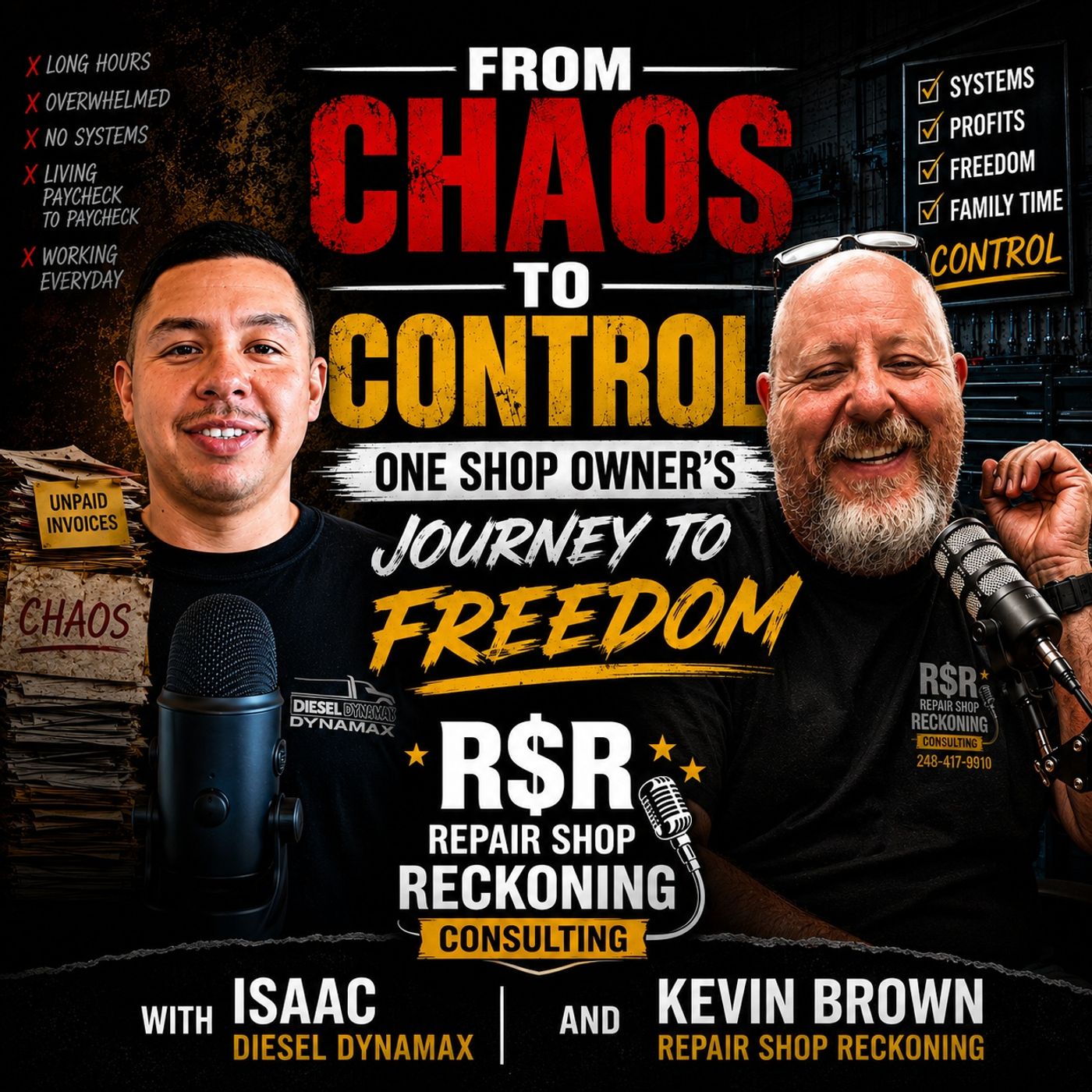
From Chaos To Control: One Shop Owner's Journey To Freedom
In this episode of Repair Shop Reckoning, Kevin sits down with Isaac, owner of Diesel Dynamics in Texas, to talk about what really changed after six months of focusing on the fundamentals of running a better business. Like so many shop owners, Isaac...