AI Search Visibility: How Customers Find Your Auto Repair Shop [THA 492]
Now playing — Remarkable Results Radio
About this episode
Thanks to our Partners, NAPA TRACS, Today's Class, KUKUI, and Pit Crew Loyalty Watch Full Video Episode *]:pointer-events-auto scroll-mt-[calc(var(--header-height)+min(200px,max(70px,20svh)))]" dir="auto" data-turn-id="request-WEB:8e59eec7-a235-4fa3-a072-956fea3fe478-7" data-testid="conversation-turn-4" data-scroll-anchor="false" data-turn="assistant"> *]:pointer-events-auto…
Key takeaways
- —AI is becoming integral to local search visibility, and shop owners must adapt to its influence.
- —Maintaining an updated Google Business Profile is crucial for attracting customers through AI-driven searches.
- —Quality content and customer reviews are more important than ever in the age of AI.
- —Social media presence is now a key factor in how AI platforms assess and recommend businesses.
- —Shop owners should focus on revenue metrics rather than vanity metrics like clicks and impressions.
Frequently asked
- How can I improve my shop's visibility with AI?
- Focus on maintaining an updated Google Business Profile and ensure your business listings are consistent across platforms.
- What role do customer reviews play in AI search results?
- Customer reviews are critical as AI systems increasingly use them to assess business credibility and visibility.
- Is it necessary to have a social media presence for my shop?
- Yes, social media is now important for AI visibility, as platforms use data from social media to understand your business better.
▸Full transcript
This is the Automotive Repair Podcast Network. Hey everybody, Carm Capriato. Welcome to another Town Hall Academy, uh, nothing like the greatest episodic education for the professional automotive repair industry. Carm Capriato here. Deep thanks to you for hanging out with us, just partaking in all this great content, and to our wonderful sponsors. Hey, for over 30 years, NAPA TRACS has made selecting the right shop management system easy by offering the best, most comprehensive SMS in the industry.
We'll prove to you that TRACS is the single best shop management system in the business. Find NAPA TRACS on the web at napatracs.com. Hey, how well does your team know their stuff? Test their automotive skills with the Today's Class basic, advanced, or service advisor quizzes. It's a quick, effective way to spot gaps and grow stronger teams. Take the quizzes now at today'sclass.com/tcquiz.
Shop owners, stop juggling multiple marketing tools. Kukui's integrated platform— they deliver 4 times better website conversions, automated follow-up, and real-time ROI tracking. Get industry-leading customer support with Kukui. That's K-U-K-U-I.com. You're probably tired of chasing new customers who never return. We understand. Pit Crew Loyalty ends the one-and-done cycle, turning first visits into lasting, reliable revenue. On the web at pitcrewloyalty.com. Hey, don't forget everyone, we've got that podcast listening app out there.
I want you to make sure you get to arpn.app and download it. It's a blast. There's so many great things. All the shows that we produce, there they are right in front of you if you're watching on video, are there. You can have your favorites. You can share. We love this app and I know that you will too. It's the place to be.
Okay, I've got this very interesting episode for you. It's another episode on AI. I get it, we've done a lot of stuff on AI, but Listen, there's this shifting behavior that's going on, and we want to talk to you, the shop owner, and all the people that work in it, what we need to do to be visible using AI. I'd like to introduce two of my great guests that are here today.
Heather Myers, the Chief Technology Officer of Kukui. Hello, Heather. Hello, Carm. Hello, everybody. Thank you for having me. Glad you are here. Connor Tracy, Director of Partner Development at Kukui Corp. Hey, bud. I'm doing great, buddy. How are you? Good. Got the Kakui beads on, man. Got my electric shirt on. One day I gotta get a set of those Kakui beads. I, I came so close, and I'm not sure I knew the, the password or something in order to get them.
I just don't remember. It's a secret handshake, but we'll get it to you. Yeah, I know, I know it is. Look, my curious questions to the industry about AI— I want you to stick around and listen to this stuff because this is not going to be the typical AI. We're not talking about how the technicians patients are going to use it, you know, what are we going to use at our counter?
We've done a lot of shows on that, and that is such an intense and growing portion of what's going on with AI in our shops. But you're going to want to learn about this. I'm going to ask these tough questions to Heather and, and Connor. I've got Google, so I'm okay. What do our guests see from AI? Should I keep relying on the Google Business Profile since AI is God now?
Have the rules of reviews changed? And are we as an industry still learning what AI can do for us? And these are the questions that I'm gonna ask. So Q1 for you both, the shift is happening now, but do I need to pay attention and get on board or can I just hang out and wait and some magical thing will happen one day and I'm in?
Magic's probably not gonna happen. There should not be waiting. You know, it's actually similar to what happened when Google Business Profile first came out, right? It was just there. Everyone started filling it out, but a lot of people just kind of sat back with, what's this going to do? I don't know what this means. You know, fast forward 10 years later and it's the single most important thing you can do from a local search perspective.
This is where we are now with AI. The good news is Part of AI is Gemini, which is Google. They kind of went all in on Google Business Profile. So the good news is if you went all in on Google Business Profile, you're already pretty much set up for a big portion of what's required for Gemini. So that's really the main focus on a Gemini perspective today.
You know, get ready. If you haven't jumped on the Google Business Profile bandwagon, you really should. For a few reasons, not just AI, because local search, you want to be there too. And then it keeps building on top of it. So that's really one of the big— today the shift isn't totally there. People are still using organic, they're still doing local search.
You still have people who don't trust AI, a lot of people who don't trust AI, so they'll exit out of it. So, but Google Business Profile is still critical. As is some organic business. Connor, just got more complicated because we have to worry about two things now. Yes and no. So, you know, the reality is, is that by and large, a lot of the methodology that has been preached and should be opted— you know, in our industry, we have this thing where things are not a problem until they're a problem.
You know, things like Heather mentioned, like updating and maintaining a Google Business Profile. Another huge aspect when it comes to local search, when it comes to AI visibility, and not just talking about Gemini or ChatGPT, it's pretty universal, is having clean and updated business listings. There's over 200 listing agencies that list your name, address, and phone number information. Now, that's always been really mission critical when it comes to increasing map visibility when it came to, you know, for instance, Google Maps and, and other map programs as well.
But now with AI, you know, when we do a little thought exercise with it, you don't have a Google Business Profile on Apple Intelligence. You don't have that in all these other platforms, right? So how do these platforms— and I'll use my wife's example because, um, she uses her favorite little AI platform and it's now turned into one of her best friends in the world— but she'll search up recipes.
And what a lot of folks are doing is, hey, my vehicle's doing this, Hey, it's shaking on the highway, right? Hey, great, you know, it could be a tire out of balance, you could have loose front end parts. Next question is, what's the shop near me that can help me fix that problem? How do these software platforms understand geographically where you're at?
And the reality is, is they're using those same listings that Google has always used to gain that NAP, which is name, address, and phone number consistency. They are using those to an even greater level because you don't not have a business profile to tell them where you're at. So it's really a lot of the same methodology that we use to leverage Google visibility.
It's now just expanded out. You know what I'm loving about what I'm hearing from both of you? We're going under the covers on this stuff. I think this discussion is not going to be superficial. You must do this and here's why. You're really helping us understand what it is that the consumer is doing, because we still got to capture those opportunities. And as a marketing company, that's what you guys are passionate about.
You've gotta look at it from all these angles. When you work with clients on this stuff, are you getting pushback? Are they buying in? Are they saying, ah, it's too soon? So here's a good thing about Heather that I'll share with you is generally not a lot of asking when it's the best thing for them. And putting that in a polite way, but a lot of it is stuff.
I mean, I'll use as a really good example of that, and I'm being a little cheeky here, but like when we found out, and this was going into last year, that there was a search volume shift. There are some strategic differences with the coding of a website that is required to be visible on AI platforms that is different from search engines. And I gotta give our development team a ton of credit.
Heather and her teams were able to do that across all of our sites. So there's a lot of stuff that may or may not be happening in the background that you're not aware of. If you're a Kuku user, we're already helping you get there.. But also then, you know, there's other things that have had limited importance, like social media posting, that now has gained in importance, right?
Social media has been a relevance tool. You can't rev up Facebook or Instagram and search auto repair near me. And that still is the case. But now these platforms are using the data from your social media feeds to understand who you are. It's actually easier for them to crawl data from a social media platform because it's uniform, right? Every Facebook post from a software standpoint is posted using the same kind of coding, right?
Every website is essentially a little nuanced and different, so it can find data from social media platforms about who you are, what you do, the information about your business easier. Well, I mean, let's also call it what it is. Who owns these AI platforms? It's the social media platforms, right? Social media is a shift. So credit again to our teams here at Kukui, but posting on social media, we've made that extremely easy for our users.
We've got some new tools that we put in place, but posting on social media is incredibly important. Helping have clean business listings and all these things are all fundamentally more important before, but just more important now. I got a question. Percentage of people that use AI. Now I know you can go into Google search, I get that. And they're using Gemini to support that.
Are other people going to like ChatGPT in order to do the same research? Auto repair near me. Are people sophisticated enough to want to get there and do that? Is that on their phone or is it more desktopy? Unfortunately, yes. And I'm saying unfortunate because depending on the license, for instance, ChatGPT, depending on which level you have, it doesn't necessarily have web search.
There are different things that you have access to based on which AI tool you're using. And the problem is the best way to think of these AI chats are as people pleasers. When they respond, their responses are what they think you want to hear, not necessarily what is actually true. So if you're asking for a certain, you know, maybe it is Auto Repair Near Me, It may not even totally know where you are.
For instance, maybe your geolocation didn't update. It may make some assumptions about what you're looking for based on pre-context from your previous search. It may not necessarily recommend a shop that is aligned better. It may not even have access to everything. So it's a combination of factors that, yes, people are starting to do it. It is somewhat generational, right, based on adoption, but people are certainly starting to use these tools.
Definitely hasn't been a full shift, right? The shift's just really starting with it, but there has to be that be careful because unfortunately they are using it and don't necessarily know they're not getting everything. And the other thing to call it too is the integration. There's two names that I won't say very loudly because a lot of people might be having their cell phone in, in reach and we don't want it to rev up a new search, but Apple has one that's named and Android has one that's named as well, and those are AI platforms.
And the reason why these companies have invested so heavily is those are being integrated into those platforms. Apple just did a huge software announcement on Tuesday, and it talked about how much more deeply within Apple's infrastructure that Apple's AI is going to be integrated. So those tools, when we've asked, you know, old Lexi and old, not Sarah, for years, these questions, what you're doing is you're adding to your own internal algorithm, right?
So people may not even know that they're searching using AI when they are. You know, in the past it would use much different data. Now it's using these AI algorithms to push this out. And really the advent of the newest versions of these AI tools has become so much more natural language. People are feeling more comfortable. Like I said, I'll use my wife as an example.
She has ChatGPT in her phone. And she will have a full-on conversation doing problem solving or learning about something using ChatGPT. And we did an exercise with her. I said, hey, tell it that the car is doing this and see if it can help you figure out potentially what's wrong with your car and see if it then can help recommend who can help you fix it.
And it had a whole conversation. Hey, we think that the Audi might have these potential symptoms based on information that we have. And she's like, "Cool, is there a shop that can help me fix it?" And the results kind of varied, but that is the reality of what folks are doing. And they may not even realize that they're using AI because they may not be wholesale using like a ChatGPT app or a Gemini app, or you name it, your AI tool.
But, you know, our social media devices in our pocket, our cell phones, they have those embedded in them more deeply than they ever have. And even in the last few weeks, Both Android as well as Apple have announced those are even tighter. So you mean overnight when I get a little sign on my phone that says there has just been an update, and if I refuse to find out what it was all about, buyer beware?
Oh, if you're lucky, not every app alerts you. That's just for your operating system on your phone. If you think about every website that you go to, they don't always tell you something's been updated and With AI and the rapid coding now, odds are everything's getting updated lots faster than it used to be. And you're not always told, sometimes you just stumble over it and go, okay, what just happened?
That's new. Let's see how to use this. That's another thing you're seeing. And they don't, I mean, if you think about Google SEO, right? They never released that, right? They never announced, hey, this is all the things in our latest update. You might know there's an update. Most of the time you didn't know there was an update until after your site stopped ranking and the ranking factors changed.
Same thing's happening with every LLM and all the various tools as they're doing crawls. They're changing the ranking factors rapidly. Hey, let's face it, your shop management system is the single most important tool in your shop, period. NapaTrax has made selecting the right shop management system easy by offering the industry's best, most comprehensive SMS. Now it all starts when a local representative meets with you to learn about your business and how you need to run it.
After all, it's your shop, so it's your choice, and having local representation is a huge plus. Customizing Trax to your business, whether you're a one-person shop or a large multi-bay or multi-location company, a A representative consults with you to help optimize your shop's workflow, efficiency, and profitability. Traxx always has the flexibility to do business how you need to do it, which means it can also grow as your business grows.
And unlike the other guys, we'll be there for you after installation with the best training and support in the business. Yes, a learning management system tailored to each role in your company. Simply put, Trax was designed and built for shop owners just like you. Visit us on the web at napatrax.com. That's N-A-P-A-T-R-A-C-S dot com. Transform your team with today's class where automotive training is easy, quick, and fun.
Just 5 minutes a day on our app can eliminate hours of looking up forgotten information later. It's perfect for technicians, advisors, and managers alike. Keep critical knowledge fresh and top of mind, ensuring your team operates at peak efficiency. Today's Class is impactful, accessible from anywhere, and a bit of fun too. And we're not talking about after-hours pizza either. For training that gets results, turn to todaysclass.com.
Shop owners, we know you are overwhelmed with a flood of missed calls, empty bays, and disconnected marketing tools. Kukui has spent over a decade building one integrated platform for auto repair shops. One login, One dashboard and mobile-first websites that convert 4 times industry average. Smart, innovative CRM with automated follow-up, 24/7 online booking, and real-time ROI tracking. With 900+ years of combined team experience, we fuel the growth of 2,200+ shops and have influenced $3 billion in revenue.
Stop working harder, start working smarter. Get industry-leading customer support and book a demo with Kukui. That's K-U-K-U-I.com. You know, most shop owners feel trapped spending on ads while half their first-time customers never come back. It's frustrating. It's exhausting. And it's not your fault. The industry average is 54% one-and-dones. We understand how discouraging that can be. Well, Pit Crew Loyalty changes the story.
Our clients cut that rate by up to 38%, raising lifetime value by more than 50%. Loyalty members visit nearly 3 times more often, creating predictable revenue without extra ad spend. Pit Crew Loyalty, where customers stay and shops thrive. On the web at pitcrewloyalty.com. This is mind-blowing to me that I wake up tomorrow, it's a different world. The next 2 days later, it's a different world of me having how I run my business, how I do search, how I do marketing.
It's like, are you kidding me? It's why should business be so hard? So Heather, I know you were telling me you guys are doing testing on this kind of stuff. Walk us through why and how. Constantly changing, right? We're testing a lot. We're monitoring sites, we're making changes, and then we're testing, testing and checking again, right? Because there's new things that come out rapidly.
But the good news is it seems daunting, right? It seems scary. It's, and almost how do I even keep up with this? I give up. The core is still the same and this hasn't changed months and months of this. You still have quality content, right? That's always been the thing with your sites, having a website, even Google Business Profile, have quality content.
Some people are trying to mass produce hundreds of pages of content because, ooh, AI writes it and they write it good. Or good enough, but it's still not quality, right? It's got to be written for the end user, not for AI, not for Google. Write it for who's going to the website. And you get that, that's your core, that's your base. And the text does matter.
And then what's increasingly more and more is reviews. Uh, reviews have always been important, but now— and there was actually just a release from Google, an update on how they're reviewing reviews on Google Business Profile, and that was just done in April. They're now using AI in order to eliminate what they suspect are false reviews or spam reviews, or they removed something like 292 million reviews last year alone, and they're ramping that up.
They've also gone back to enforcing review gating, which is a huge, huge thing. Just while we're on the topic of reviews, Karm, you and I have talked about that before where you might be using a platform that sends out a notice and says, hey, give us a thumbs up or thumbs down. And if they give you a thumbs up, then it's like, hey, leave us a review.
The reality is, is that really since reviews have come around, Google's had in their terms of service, no bueno. You can't incentivize to leave a review and you cannot gate these reviews as they come in in any way. Honestly, it hasn't really been enforced probably since just before COVID Now, we did see some people get enforced just before COVID and oh boy, it was bad.
Like, we had clients of ours that actually had like a year's worth of reviews get taken away. We had one that had their Google Business Profile actually shut down for a period of time. But why a year? How come a whole year? It's whatever Google decides, and you have no appeal. They just, hey, this is what we're doing. But what if they were all absolutely 100% legitimate?
Yeah, I mean, there is an appeal process that they've released. You know, if you find your Google Business Profile has been put into Google jail, there is an appeal process that you can go through to actually appeal it. Sometimes it works, sometimes it's an AI bot that's actually reviewing your appeal and doesn't like being told they can't. Are they making a technology mistake, not a human mistake?
I mean, that something is just trashing this stuff for no reason? In this instance that I'm speaking about, it's specifically doing any sort of filtering prior to the review coming in. So a couple really important things for the views: you can never incentivize anybody to leave your review. So if you have a card on your account— and literally, you remember, like, right after COVID, everybody, it was like a big thing where people got those 360 camera views inside of their shops.
It was like a big thing. We actually heard from a couple shops that they had had a counter card that said, hey, leave us a review and you get $10 off your next oil change. Seems extremely innocuous, right? Seems like a nothing burger. Well, they got this 360 view, they posted it to their Google Business Profile, and now Google knows that you're giving people $10 for leaving me a good review.
Whoa, I see. It's enforced, but it is in there. So just a couple things with reviews that are just really, really critically important: cannot incentivize them. We can ask to leave a review. We cannot give you a benefit for leaving it, full stop. And there shouldn't be anything that keeps the consumer from going to the review. Basically, they need to have the opportunity to leave the review without any sort of gating, filtering prior to that happening.
That's in their terms of service. They have been very lax about enforcing that. So there's many platforms out there, there's many businesses out there that have said, hey, based on that, Hey, we're going to do this, but also a couple things. Consumers know that you have a 5-star review rating. It's BS. They know that. And now Heather can speak to that a little bit more, but Google is actually viewing that and like, hey, big problem if that's who you are.
Yes. And, you know, tying that in, you know, they're using it and, you know, we're not going totally down the fearmonger, you know, they're not going to catch every possible one that's doing it. There might be some false flags. There is an appeal process, but ultimately, as Tanya was saying, you know, don't incentivize, don't try to direct them to one page to submit if it's a good review, which is Google, you know, the complaint department.
If it's not a 4 or 5 star, don't send them straight to the complaint department, because if they do find the gating, your Google Business Profile could end up in Google jail. And what What that means is it's anywhere from your site's not ranked, meaning you don't appear in results, or just suspending the profile entirely. I appreciate this. This is a great piece of content right here to appreciate and understand how reviews work for both Google and AI.
Let's go back to the whole AI premise. Is there anything in AI like Google that I can get on the top of the list? Anything right now that we know of? No, I mean, but the same question, there really isn't anything in Google that can guarantee top of the list either, right? Unless you pay for it. Even then you're bidding, right? When it's ads, you're bidding to get up there.
And then they introduced local service ads, which then you go through a background process and then you also have to pay per lead. You know, I would be very surprised as a business person if there is not a way to monetize ads within the AI results very, very soon. In fact, well, there's already beta stuff happening with that, so of course that's going to happen.
But the best way to compare it is with organic, right? So when you think organic results, it's similar as in you can't control the ranking factors. And if you try to beat the system, you might get away with it short term, but the long-term game You're not going to stay on top of organic anymore than you'll stay— and you're not going to stay on top of the AI search results.
In fact, it's even less likely because now there are AI bots specifically looking for black hat techniques that you're trying to circumvent to get ahead. What is consistently working is really the same things that worked for organic and local search. And as long as those are being followed consistently, that's the long game. That will actually show results. And then once ads are supported and released at scale, it's going to be also pay your way to the top, which is always true.
Pay your way to the top. So the methodology there though is making sure that you're consistently sharing unique content. That's always been important to organic. Talking about some of those shifts and what is a little bit different. You know, I talked about the importance of these different social media platforms. So in past where maybe you had a blog post on your website, Now you also want to share that content across social media platforms.
So make sure you post it to your Google Business Profile, put it on Facebook. You know, we've built a platform that allows you to do these wholesale one posts and it'll post it across multiple platforms, creating efficiency. But post it on Facebook, post it on LinkedIn, post it on Instagram, post it wherever you can, because you're increasing the odds that whatever data you're putting out there can get found by the software and then in turn hopefully present that as a search result.
The methodology is the same, it's just how far you need to cast that net is just a little bit further, to be honest with you. But the methodology is the same. Share unique content that separates your business from your competitors. Make sure that as much of that is human written as possible. And that content being shared now across multiple platforms where before it was like, make sure it's organic on your website, you know, post your Google Business Profile.
Social media was just kind of there to be relevant. Well, now, yes, it is still there for that relevance, but then it's gonna get crawled and could potentially result in a search result for you. I can't tell you how much I keep thinking of Big Brother here. I don't know why. And I'm not saying Big Brother as the government, I'm saying Big Brother as the red eye of HAL.
Yeah. And I keep thinking about, How does the human stay in control? I do believe that we gotta pay attention. We gotta go to class. We have to be learned. We have to offer responsibility to people inside of our business, even if it's maybe not you and you're not good at this stuff, but you can't ignore everything you've talked about here today.
It's some people, it's scary. For some people, it's just piece of cake. For some people saying something else I gotta do. So how does the human stay in control with this? Nebulous moving thing called AI, the internet, search, and SEO. Both of your jobs 5 years ago, I bet you are 100% different today. Carm, the real thing that I'll share with shop owners is in the effort to keep it simple, to have an eye on your revenue.
You know, that's core to what we do. But if you see changes in your revenue stream, have the ability to then deep dive where that's changing. You know, that's a core tenet to our platform. You know, some of the value we bring is tying these marketing efforts to your ROAS, right? If I see that new customer search volume is going down, what does that mean?
Does it have an effect on my revenue? And being able to look at short and long-term trends. So having a platform, whatever platform that may be, where I can see, okay, Here's what my impact was last month. Here's where I'm looking at over a series of months. So I have this data in front of me to understand where I'm trending, because when you can see where you're trending, now you've got a baseline to understand either I'm trending the way I want to be or I'm not trending the way I want to be.
And if I'm not, now, okay, do I have the partners in place where I can then correct that? Is it an organic search thing? If I'm not generating new customers, that's going to be that I don't have new people finding me digitally to come into my business. Okay. What do I need to do to get visible? And where do I need to get visible?
Or what aspect of the marketing that I'm doing is not performing from a revenue standpoint the way it is? It has to be revenue. Clicks and impressions are vanity metrics. And frankly, they can be extremely dubious. We talked about this before, like when we talked about Google Ads a few months ago, I can get a click, I can get an impression, but if it's from two states away, that cannot be a success metric.
So the success metric in our business is, did it develop a car showing up in my business that I was able to diagnose, I was able to repair, and send somebody happily down the road safely? At the end of the day, that is the success metric. When we look at that and work it backwards, then that's where we can understand it simply.
And do I have the ability at my counter to convert those opportunities into revenue? And so I get what you're saying, Heather. It's, there's this nebulous big brother, SEO, AI, you know, Google My Business ads. And then there's the real human factor in being able to do something with all of that and make revenue happen when the opportunity comes in. It's To everyone's point, you got to pay deeper attention to your entire business than you ever have before.
Correct. Yeah. And it's trust but verify too, right? Not just— I mean, across everything. I mean, if you're asking AI, trust but verify, ask the source because the hallucinations can be funny at first and then they get to frustrating real quick, much like parenting a preteen of sorts. Trust but verify. And it's really— it's never a replacement for the human. It should be— it's your researcher.
It's a tool. It helps the job go faster, but it's not going to replace human decisions and shouldn't. It shouldn't. I am in love with what you just said. In fact, this could be the title of our episode. It could say AI colon trust but verify. Yeah, I mean, that's powerful because this is not generating unique information, full stop. We have to call this out.
Nothing that AI is going to tell you, it is creating on its own, okay? It's taking information and it is restating it to you. But at the stage where it's at, we have to understand that this is not a Nobel laureate that's speaking to you. It's somewhere with like a middle schooler. So we'll use examples. You know, a few months ago we had some folks and there was some information that was shared and they were given some chat prompts and like, hey, use this to analyze your website.
And that's all they were given. They weren't given any understanding of how these tools can give you misinformation. And what these tools will never do is go, you know, Carm, I don't know, I'm not a good source of information here. They'll never do that. Why? Because then you're never going back. So what it'll do is it'll spit out a result. We actually did an exercise.
We're like, hey, can you analyze this site? Yep. And then we had to ask it a follow-up question. So it's these extra follow-up questions. We said, hey, did you actually access this URL to get this answer? And it went, no, we just grabbed some information that we found commonly online, and that's how we came up with this. So that's the type of verification we're talking about, is just like you would do when talking to a middle schooler and they're giving you something that's a matter of fact is, hey, is that really the case?
It very well may be. And that's one thing we don't want you to assume, that it is just lying, because it's generally not. Now, is it filling in spots where it doesn't have information? Darn near every time. And it's how much is filled in is what you need to ask those follow-up questions to understand. Did you access my URL to get this data?
Where did you find this information? It's the same reason why papers have to have citations. It's understanding exactly where the data is coming from, because that's all it's telling you is data that it's found other places. Everything I just heard from Connor was all about this middle school, you know, grilling— not grilling, but asking questions of a middle schooler. It's a dad of 6 talking here.
Yes. And wonder if you're getting the right answer. I know. Wow. That summarizes how much we have to pay attention. And every time we get something back, it may not necessarily from AI. It may not necessarily be the whole, you know, yes, your honor, I prefer to tell the truth, the whole truth, and nothing but the truth. You can't ask AI to put their hand on the Bible.
The great analogy is like, I was on vacation. My son was supposed to mow the lawn. And I'll, this is a perfect analogy. Called up my son and said, hey dude, did you mow the lawn? Yeah, Dad, I mowed the lawn. He knows that I looked at the doorbell camera and I could see that the front lawn was mowed. Got home from vacation and I'm gonna need a machete and a pack mule to get through my backyard.
Now technically, was my son correct? He did mow the lawn. I didn't ask, did you mow all of the lawn? It's the same thing here, right? Like, it's going to give you an answer that maybe based in factual correctness, but is it a complete answer and what information was filled in or extrapolated? So great analogy there. Yes. And that actually, it's one, as you were describing that, that's where the prompt matters, right?
So if you had said, did you mow the front and the back lawn, then the answer could be different. It's the same when you're asking any of these AI chats. In fact, pretty much all of my conversations when I start is, do not fabricate, do not try to please me, be blunt, tell me if something is inaccurate, tell me if there's data missing.
And I actually preload my conversations with this. And for instance, in Claude, you can actually have an MD file that it reads in that has all these parameters, which it's long, but in essence it's starting, all right, no lies, don't fabricate anything, and don't try to please me, tell me the blunt truth. And if you don't have access, Don't try. So you dump that in every time?
Yeah. Okay. Everything except for you have to make eye contact. Again, it's like talking to your kids. Exactly. I have another thought about the lawn. Son, did you just cut the lawn in front of the doorbell camera? Yeah. I mean, that's damn near like— the reality is though, is it really is the same thing though. It's the more data you give it.
I'll use another example. So I was kind of tinkering with this. I create some of the artwork for our social media and for some of our visual stuff that I do here at Kukui. And we were going to Superconference and I basically, I was making a poster of a guy golfing and we were in Florida. So I was like, hey, will you create a visual of somebody on a putting green with crocs, meaning crocodiles and flamingos?
It spits out a picture of a guy on a putting green with flamingos wearing Croc shoes. And I literally, I sat back and laughed, but I can't be mad at the tool because I didn't say the animal crocodile. It did what I asked it to do. And it goes to this people pleasing, right? So we need to tell it, hey, don't please me.
I want you to be blunt. I want you to treat me like Heather treats me whenever I ask her about software development. I can't do that because it doesn't quite understand, but it gets close when I do that. Oh my God, I got to tell this to Tracy because she's out there with Sarah teaching this class on communication. And when you stop to think about the power of Ask AI, the interpretation, you said this, they heard that.
You said this to AI, AI took it literally. Oh, wow. This has been a very fun but yet very powerful episode. I know what we intended to talk about. But like always in all my shows, it goes in a million different directions. Final words in us trying to stay in control, what works, that AI, because it's like I'm at this point in all the episodes that we've done on AI in different areas of the business that it's here, it's real, it's gonna stay, but we have to almost bring it on as an individual who works for us.
That is brand new, even though it may be really smart, we have to teach it us. And we can't ignore this. We have to be inside. We gotta be on it. And don't get distracted by the convenient widgets. There's a lot of stuff out there. This has really replaced SEO as the kind of new byword, and it's here to get your attention.
Like really focus on the stuff that has traditionally been important. Getting visible online, handling the phones well, you know. Yeah, there's going to be AI widgets that do this and that, and you know, like AI is going to answer your phone. I'm sorry, but if somebody is going to bypass every digital means in the world, they are making a human effort to talk to a human.
Don't have a robot answering the phone. Look through all of that noise, okay, and just focus on the things that are core and important. Am I building revenue? Am I aware that these tools are impacting my business and how are they impacting my business and what can I do to leverage the power of them? Because that power is absolutely there. That's the biggest things that I would say that, that mean the most right now.
Thank you, Connor. Heather, final word. Not just auto repair shops, right? It's the small businesses. The businesses that come out ahead aren't going to be the ones that find a hack, right? Find that easy way to get to the top of no matter which search tool there is out, it's the ones that have been doing it all along. They've got that strong online presence.
It works everywhere, right? Traditional search, AI search, whatever comes next, because it's going to keep evolving. As long as those fundamentals and the structure and foundation is there, it will continue to function and be built upon and ultimately keep the human in the loop. And then of course, as we said, you know, trust but verify. Be skeptical of anybody selling that magic elixir.
Trust but verify. I mean, I took so many incredible major talking points out of this episode. That middle schooler thing was just very impactful to me. I love it. Thanks. Uh, it's been great to have you guys on the podcast. We appreciate your support as a sponsor and wow. We were here talking about the shifting AI behavior and I think exactly what it is that you need to know and learn about.
Heather Myers, CTO, Chief Technology Officer of Kukui, and Connor Tracy, the Director of Partner Development at Kukui. Thank you both for being here. Yeah, we appreciate it. If anybody wants any further education too, just another kind of give some kudos to our team. Heather and her team has put together an amazing blog series and white paper. It's completely free to the industry.
kukui.com, click on blogs. They're all in there for you. There's no cost. They're not cuckoo commercials. They actually even don't talk about product at all. But it's everything from how to understand if they're hallucinating to should you just put on one with all these changes and reviews. It's free education for you. So please leverage it. Great stuff. You can't learn enough. Get the resource.
Appreciate it, Connor. Thanks, guys. Thanks for being on board to listen and learn from the premier automotive repair business podcast, Remarkable Results Radio. Get your episodic education on the ARPN listing app at automotiverepairpodcastnetwork.com. Also enjoy the podcast on our Carm Capriato YouTube channel. Carm is all for advancing the professional automotive service industry. Until next time.
More from Remarkable Results Radio

Work Together, Thrive Together, Build a Business You Can Sell [THA 504]
Watch Full Video Episode *]:pointer-events-auto scroll-mt-[calc(var(--header-height)+min(200px,max(70px,20svh)))]" dir="auto" data-turn-id="request-WEB:8e59eec7-a235-4fa3-a072-956fea3fe478-7" data-testid="conversation-turn-4" data-scroll-anchor="false" data-turn="assistant"> *]:pointer-events-auto scroll-mt-[calc(var(--header-height)+min(200px,max(70px,20svh)))]" dir="auto" data-turn-id="request-WEB:49a777bf-d263-4496-bf0b-2eb3a46ac96a-11" data-testid="conversation-turn-24" data-scroll-anchor="false" data-turn="assistant"> What does it take to work alongside someone you love, thrive through the pressures of business ownership, and ultimately build a company that can succeed without you? Amy Castro and Kit Lindsay share a story that goes far beyond the challenges of working together as a couple. It’s about communication, boundaries, complementary strengths, succession, and building a business valuable enough to eventually pass into someone else’s hands. What You’ll Learn How couples and family members can successfully work together in businessWhy complementary strengths can become a competitive advantageHow clear boundaries help separate business conversations from personal relationshipsWhy assumptions can become one of the biggest communication problemsHow Kit identified and developed an internal successorThe importance of Kit’s “3 A’s”: Attitude, Aptitude, and AmbitionWhy succession requires owners to mentor future leaders and give them room to leadHow letting go of ego becomes part of a successful transitionWhy building a business that can continue without you creates options for your future Kit operated Lindsay Transmissions for 37 years before selling it to Cody, an employee who originally joined the shop at age 16 sweeping floors. After Cody expressed interest in ownership, they created a plan to develop his business skills and prepare him for the transition. Kit ultimately carried the note, and Cody paid off the business in four years. A successful family business isn't simply about working together. It's about learning how to thrive together while building something that can eventually succeed without you. Amy and Kit show how communication, boundaries, complementary strengths, mentorship, and the willingness to let go can help turn a family business into something worth passing on. Thanks to our Partners: NAPA TRACS, Today's Class, KUKUI, and Pit Crew Loyalty NAPA TRACS will move your shop into the SMS fast lane with onsite training, six days a week of support, and local representation. http://napatracs.com/ Optimize training with Today's Class: In just 5 minutes daily, boost knowledge retention and improve team performance. https://www.todaysclass.com/ Stop juggling multiple marketing tools. KUKUI’s integrated platform delivers 4x better website conversions, automated follow-up, and real-time ROI tracking. https://www.kukui.com/ You’re probably tired of chasing new customers who never return. Pit Crew Loyalty ends the one-and-done cycle, turning first visits into lasting, reliable revenue at https://www.pitcrewloyalty.com/ Connect with the Podcast: Download and Listen on Our Mobile App: https://automotiverepairpodcastnetwork.com/app/Visit the Website:https://remarkableresults.biz/Subscribe on YouTube:https://www.youtube.com/carmcapriottoFollow on Facebook:https://www.facebook.com/RemarkableResultsRadioPodcast/Follow on LinkedIn:https://www.linkedin.com/in/carmcapriotto/Follow on Instagram:https://www.instagram.com/remarkableresultsradiopodcast/Join Our Virtual Toastmasters Club:https://remarkableresults.biz/toastmastersJoin Our Private Facebook Community:https://www.facebook.com/groups/1734687266778976Join our Insider List:https://remarkableresults.biz/insiderAll books mentioned on our podcasts:https://remarkableresults.biz/booksOur Classroom page for personal or team learning:https://remarkableresults.biz/classroomBuy Me a Coffee:https://www.buymeacoffee.com/carmSpecial episode collections:https://remarkableresults.biz/collections The Automotive Repair Podcast Network: https://automotiverepairpodcastnetwork.com/ Remarkable Results Radio Podcastwith Carm Capriotto:https://remarkableresults.biz/Automotive Field Theorywith Matt Fanslow https://mattfanslow.captivate.fm/<a...

Inside the Role of a Performance and Accountability Team Leader [RR 1110]
Watch Full Video Episode What does a Performance and Accountability Team Leader actually do inside a high-performing auto repair shop? Nate McDonald of Empower Automotive gives us an inside look at a unique leadership position that connects inspections, client experience, team development, performance, and accountability. As Sales Manager, Inspection Team Lead, and Performance & Accountability Lead, Nate isn't managing from behind a desk. He's working alongside his team, performing inspections, shooting videos, checking vehicles, answering questions, coaching younger team members, and looking for opportunities to improve the process. Nate believes accountability becomes easier when you're present. Working side by side with the team creates opportunities for quick conversations, immediate coaching, and reinforcing standards before small issues become bigger ones. What You'll Learn What a Performance and Accountability Team Leader does inside an auto repair shop.Why Nate views his sales responsibility more as hospitality than traditional selling.How working "in the trenches" creates natural coaching opportunities.What Nate has learned from mentoring Gen Z team members.Why mistakes and questions are valuable opportunities for development.How Empower Automotive's daily "Take Five" aligns the entire team before the day begins.How inspections connect the back of the shop with service advisors and the client experience.Why performance numbers are openly discussed with the team.How quick one-on-one conversations reinforce standards and accountability.Why team members should have a voice in improving processes and efficiency. A Performance and Accountability Team Leader doesn't just measure performance. They help create it. Nate's role demonstrates the value of having someone close enough to the work to see what's happening, coach in the moment, reinforce expectations, listen to ideas, and keep the team connected to the purpose behind the process. It's not about waiting for the annual performance review or calling someone into the office every time something goes wrong. Sometimes leadership is a quick conversation behind a vehicle. Sometimes it's answering a question during an inspection. And sometimes it's simply being willing to work alongside your people. Performance and accountability become part of the culture when leadership is present every day. Nate McDonald, Inspection Team Lead and Performance & Accountability Lead, Empower Automotive, Traverse City, Michigan Thanks to our Partners, NAPA Auto Care and NAPA TRACS Learn more about the benefits of being part of the NAPA family by visiting https://www.napaonline.com/en/auto-care NAPA TRACS will move your shop into the SMS fast lane with on-site training and six days a week of support: http://napatracs.com/ Connect with the Podcast: Download Our Mobile App:https://automotiverepairpodcastnetwork.com/app/Website:https://remarkableresults.biz/YouTube:https://www.youtube.com/carmcapriottoFacebook:https://www.facebook.com/RemarkableResultsRadioPodcast/LinkedIn:https://www.linkedin.com/in/carmcapriotto/Instagram:https://www.instagram.com/remarkableresultsradiopodcast/Join Our Virtual Toastmasters Club:https://remarkableresults.biz/toastmastersJoin Our Private Facebook Community:https://www.facebook.com/groups/1734687266778976Join our Insider List:https://remarkableresults.biz/insiderBooks Page:https://remarkableresults.biz/booksOur Classroom Page:https://remarkableresults.biz/classroomEpisode Collections:https://remarkableresults.biz/collectionsBuy Me a Coffee:https://www.buymeacoffee.com/carm The Automotive Repair Podcast Network: https://automotiverepairpodcastnetwork.com/ Remarkable Results Radio Podcastwith Carm Capriotto:https://remarkableresults.biz/Automotive Field TheorywithMatt Fanslow:https://mattfanslow.captivate.fm/Business by the NumberswithHunt Demarest: https://huntdemarest.captivate.fm/The Auto Repair Marketing Podcastwith Brian and Kim Walker: https://autorepairmarketing.captivate.fm/The Weekly Blitzwith Chris Cotton: https://chriscotton.captivate.fm/Speak Up! Effective Communicationwith Craig O'Neill: https://craigoneill.captivate.fm

How to Develop a General Manager for Your Auto Repair Shop [THA 503]
Thanks to our Partners: NAPA TRACS, Today's Class, KUKUI, and Pit Crew Loyalty Watch Full Video Episode *]:pointer-events-auto scroll-mt-[calc(var(--header-height)+min(200px,max(70px,20svh)))]" dir="auto" data-turn-id="request-WEB:8e59eec7-a235-4fa3-a072-956fea3fe478-7" data-testid="conversation-turn-4" data-scroll-anchor="false" data-turn="assistant"> *]:pointer-events-auto scroll-mt-[calc(var(--header-height)+min(200px,max(70px,20svh)))]" dir="auto" data-turn-id="request-WEB:49a777bf-d263-4496-bf0b-2eb3a46ac96a-11" data-testid="conversation-turn-24" data-scroll-anchor="false" data-turn="assistant"> How does a shop owner find, develop, and trust the right person to become their number two? Shawn Gilfillan, owner and CEO of Automotive Magic, and Will Barkiewicz, General Manager and Integrator, share the evolution of a leadership partnership that started when Will applied for a technician position. Shawn quickly recognized something beyond Will's technical abilities. Their values around family, trust, service, and taking care of people aligned. Will eventually moved from running the maintenance center to becoming General Manager over both locations and the Integrator Shawn had been looking for. Their story demonstrates that developing a number two isn't about finding another version of the owner. It's about finding someone with complementary strengths, then building the trust that allows both leaders to grow into their roles. What You'll Learn Why core values can matter more than someone's original job title.How the Visionary-Integrator relationship works within EOS.Why owners shouldn't look for "another me."How responsibility and trust are earned over time.Why a strong General Manager needs the freedom to push back on the owner.How DISC profiles can improve communication and self-awareness.Why standardized protocols create consistency as leadership responsibilities expand.How a "Reboot" mindset turns mistakes into opportunities to improve the business. Finding your number two isn't about finding another you. It's about finding the person who complements you. For Shawn, that meant learning to hand over responsibility and allowing Will to "dance his own dance." For Will, it meant earning trust through communication, accountability, and a willingness to take ownership when things didn't go perfectly. The transformation happens on both sides. The General Manager learns to lead, execute, and protect the vision. The owner learns to let go, become the guide, and gradually move responsibilities off their plate. You don't hand someone the keys to the business overnight. You give them responsibility, build trust, and develop the leadership partnership one step at a time. Shawn Gilfillan, and Will Barkiewicz, Automotive Magic, Kenvil and Lake Hopatcong, NJ. Shawn’s previous episodes HERE NAPA TRACS will move your shop into the SMS fast lane with onsite training, six days a week of support, and local representation. http://napatracs.com/ Optimize training with Today's Class: In just 5 minutes daily, boost knowledge retention and improve team performance. https://www.todaysclass.com/ Stop juggling multiple marketing tools. KUKUI’s integrated platform delivers 4x better website conversions, automated follow-up, and real-time ROI tracking. https://www.kukui.com/ You’re probably tired of chasing new customers who never return. Pit Crew Loyalty ends the one-and-done cycle, turning first visits into lasting, reliable revenue at https://www.pitcrewloyalty.com/ Connect with the Podcast: Download and Listen on Our Mobile App: https://automotiverepairpodcastnetwork.com/app/Visit the Website:https://remarkableresults.biz/Subscribe on YouTube:https://www.youtube.com/carmcapriottoFollow on Facebook:https://www.facebook.com/RemarkableResultsRadioPodcast/Follow on LinkedIn:https://www.linkedin.com/in/carmcapriotto/Follow on Instagram:https://www.instagram.com/remarkableresultsradiopodcast/Join Our Virtual Toastmasters Club:https://remarkableresults.biz/toastmastersJoin Our Private Facebook Community:https://www.facebook.com/groups/1734687266778976Join our Insider List:https://remarkableresults.biz/insiderAll books mentioned on our podcasts:https://remarkableresults.biz/booksOur Classroom page for personal or team learning:https://remarkableresults.biz/classroomBuy Me a Coffee:https://www.buymeacoffee.com/carmSpecial episode collections:https://remarkableresults.biz/collections The Automotive Repair Podcast Network: https://automotiverepairpodcastnetwork.com/ Remarkable Results Radio Podcastwith Carm Capriotto:https://remarkableresults.biz/<a...
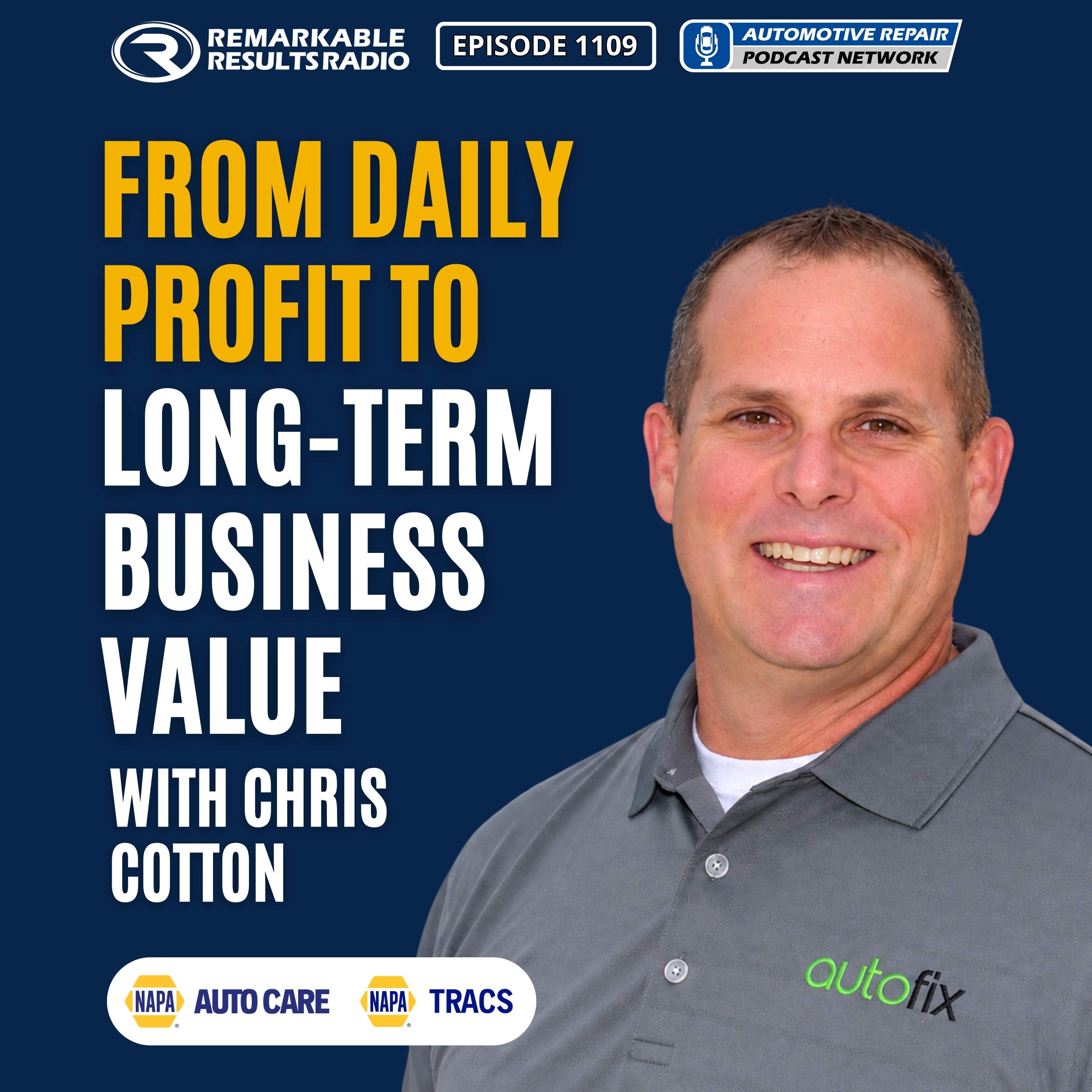
From Daily Profit to Long-Term Business Value [RR 1109]
Thanks to our Partners, NAPA Auto Care and NAPA TRACS Watch Full Video Episode What is your auto repair business really worth, and are you building it to become more valuable every year? Coach Chris Cotton, podcast host on the Automotive Repair Podcast Network, challenges shop owners to look beyond today's sales and profits and start thinking about the long-term value of the business they're building. Many owners spend years on the operational hamster wheel, focused on car count, payroll, production, and this month's bottom line. But when it's time to sell, transition the business to the next generation, or simply step away from daily operations, buyers and banks look much deeper. Chris explains why clean financials, documented systems, owner independence, and intentional succession planning can transform a shop from a business that provides the owner a job into an enterprise with significant transferable value. What You'll Learn Why profitability and business valuation aren't the same thing.What buyers and banks want to see before financing an acquisition.Why removing the owner from daily operations can increase business value.How documented systems and protocols make a shop more transferable.Why clean financial statements and tax records are critical to valuation.Chris Cotton's five stages of shop ownership, from daily survival to eventual exit.How increasing capacity can grow value without necessarily adding locations.Why succession and exit planning should begin years before you're ready to leave. Don't just build a profitable shop. Build a valuable business. Create strong systems. Develop leaders. Clean up the financials. Build capacity. Reduce owner dependence. And understand what your business is worth long before you're ready to sell it. Coaching to Valuation [E269]: https://chriscotton.captivate.fm/episode/cc269 The Weekly Blitz with Chris Cotton: Weekly Inspiration with Business Coach Chris Cotton from AutoFix – Auto Shop Coaching. https://chriscotton.captivate.fm/ Learn more about the benefits of being part of the NAPA family by visiting https://www.napaonline.com/en/auto-care NAPA TRACS will move your shop into the SMS fast lane with on-site training and six days a week of support: http://napatracs.com/ Connect with the Podcast: Download Our Mobile App:https://automotiverepairpodcastnetwork.com/app/Website:https://remarkableresults.biz/YouTube:https://www.youtube.com/carmcapriottoFacebook:https://www.facebook.com/RemarkableResultsRadioPodcast/LinkedIn:https://www.linkedin.com/in/carmcapriotto/Instagram:https://www.instagram.com/remarkableresultsradiopodcast/Join Our Virtual Toastmasters Club:https://remarkableresults.biz/toastmastersJoin Our Private Facebook Community:https://www.facebook.com/groups/1734687266778976Join our Insider List:https://remarkableresults.biz/insiderBooks Page:https://remarkableresults.biz/booksOur Classroom Page:https://remarkableresults.biz/classroomEpisode Collections:https://remarkableresults.biz/collectionsBuy Me a Coffee:https://www.buymeacoffee.com/carm The Automotive Repair Podcast Network: https://automotiverepairpodcastnetwork.com/ Remarkable Results Radio Podcastwith Carm Capriotto:https://remarkableresults.biz/Automotive Field TheorywithMatt Fanslow:https://mattfanslow.captivate.fm/Business by the NumberswithHunt Demarest: https://huntdemarest.captivate.fm/The Auto Repair Marketing Podcastwith Brian and Kim Walker: https://autorepairmarketing.captivate.fm/The Weekly Blitzwith Chris Cotton: https://chriscotton.captivate.fm/Speak Up! Effective Communicationwith Craig O'Neill: https://craigoneill.captivate.fm
Related across the catalog

218 - What Your Opt-Outs Reveal: Your CRM Isn't Broken. It's Being Misused
218 - What Your Opt-Outs Reveal: Your CRM Isn't Broken. It's Being Misused September 9th, 2026 - 00:55:22 Show Summary: Most CRM systems are capable of producing results but the way shops use them can weaken customer relationships. Mass messages often focus on filling bays instead of delivering value customers actually want. Strong retention starts by understanding communication preferences and earning permission before sending messages. Shops can build stronger relationships by creating meaningful reasons for customers to stay connected. Automation can support that process but it should never replace genuine human communication. Returning customers should become a primary measure of success because lifetime value matters far more than a single repair order. A retention focused culture can create steadier car count and stronger long term growth. Host(s): Jimmy Lea, VP of Business Development Guest(s): Craig O'Neill, VP of Training Autoflow Show Highlights: [00:02:45] – CRM systems work but shops often misuse their capabilities. [00:06:32] – Mass text blasts can create opt outs instead of appointments. [00:12:10] – Effective communication must focus on what matters to customers. [00:18:18] – Customer retention should create meaningful relationships built on trust. [00:21:08] – Customers should understand why your messages provide real value. [00:27:36] – Promotional mass texts require proper permission before being sent. [00:33:28] – Retention should become a goal across the entire organization. [00:35:02] – Returning customers can reveal more than traditional sales metrics. [00:41:12] – Give customers a compelling reason to return after every visit. [00:45:35] – Safe reliable vehicles provide a powerful purpose for follow up. In every business journey, there are defining moments or challenges that build resilience and milestones that fuel growth. We’d love to hear about yours! What lessons, breakthroughs, or pivotal experiences have shaped your path in the automotive industry? Share your story with us at info@wearetheinstitute.com, and you might be featured in an upcoming episode. 👉 Unlock the full experience - watch the full webinar on YouTube: https://youtu.be/10RC8L1nKhM Don’t miss exclusive insights, expert takeaways, and real talk you won’t hear anywhere else. Hit Subscribe, drop a comment, and share it with someone who needs to hear this! Links & Resources: Want to learn more? Click Here Want a complimentary business health report? Click Here See The Institute's events list: Click Here Want access to our online classes? Click Here ________________________________________ Episode Transcript Disclaimer This transcript was generated using artificial intelligence and may contain errors. If you notice any inaccuracies, please contact us at marketing@wearetheinstitute.com. Episode Transcript: Jimmy Lea: Hello, welcome. Glad to be with you today. It is Wednesday, so excited for Webinar Wednesday. Coming to you live from the road. I'm in Eugene, Oregon, here at Brian Slater's shop in Eugene, Oregon. This is the North Eugene Auto Repair in in Eugene, and so coming to you from the road. Thank you, Brian. Jimmy Lea: Appreciate you letting me use your office today as we're out and about visiting shops. It's just an awesome, gorgeous weather here in northern U- northern... no. I was gonna say northern Utah. I'm not in northern Utah. I'm in Eugene, Oregon, and this is not northern Utah, but it is gorgeous weather. Jimmy Lea: So if you don't have gorgeous weather where you are, you wish you were here. We're gonna have a great conversation today. Those of you who have comments, questions, comments, put them into the chat section. That chat section comments allows us to have this conversation back and forth. I will be the voice for You've got questions, comments, concerns for our guest, want to make sure that those are voiced for you, put them in the comments section. Jimmy Lea: My guest with us today is ever-present, ever-linguist, Mr. Craig O'Neill of AutoFlow. Craig, how the heck are you, brother? Craig O'Neill: I'm really good, Jimmy. Really good. I was actually thinking northern Utah, as you mentioned Utah, even though it was Oregon. Both places are beautiful. I can't blame you for the distinction issue there. Craig O'Neill: That was- that's all right. Jimmy Lea: Yeah. Yeah. No it is absolutely gorgeous up here. Now, I will tell you that there is a large lack of mountains in Eugene, Oregon- ... Jimmy Lea: That northern Utah does have, is bounteous mountains. Craig O'Neill: Yeah. A lot of them. Yeah. I can't wait. Ogden, a couple, next month. Next month now is October. Jimmy Lea: Yes. October for the Mars Conference. Craig O'Neill: Yep. Jimmy Lea: Yes. Yes. Speaking of Mars Conferences we're gonna put up a QR code for the Mars Conference. If you scan this QR code, it will get you right onto our registration page, and those sticking around to the very end, there is this very special, very unique offer for anybody who wants to attend the Mars Conference. Jimmy Lea: So stick around, scan the QR code. Save that in your smartphones. We are gonna have a great conversation about marketing. Craig is one of our presenters at the Mars Conference, and super excited for Craig to be here. Craig and I have known each other for a couple of years now, and worked together at a couple of companies, and- Jimmy Lea: glad that we are able to still be friends here in this wonderful industry that we call home. Craig, what are we talking about today? Craig O'Neill: Jimmy, this is the, one of my favorite topics to go into. We're talking about CRM systems, of course. Now I have some opinions about CRM systems. Both of us come from a background that deals in these systems. Craig O'Neill: You have opinions as well, and you have some observations, and my observation is simply this: the systems themselves are capable of some pretty cool things- Jimmy Lea: Yeah ... Craig O'Neill: but we aren't using them very well. The it's not broken, they're being misused, is the title of our conversation today. Your CRM isn't broken, it's being misused. Craig O'Neill: And I don't like to walk into a conversation with "Oh, you're doing something wrong", or on the opposite side of it, I don't like to walk into a conversation as you guys are doing it right. You're just fine, but other people are doing it..." Like I, I've used stuff wrong. I've made mistakes in how I leverage the different systems and tools that are available, and I just believe, and I hope you just go along with us today, there might be a better way than our way that we're approaching it now. Craig O'Neill: Be open to that. Jimmy Lea: Yeah. Be open to it, because what they're, what you as a shop may be doing today is working. Craig O'Neill: Yeah. It's not even a debate. It is getting results of a certain level and type that are appearing to be adequate. Jimmy Lea: Adequate for today. And hopefully with this conversation that you and I are gonna have as we talk about the customer relationship management software Hopefully there's something we can expose shops to that might say, "Hey, maybe there is a different way of doing this." Craig O'Neill: Yeah. Jimmy Lea: So what are these ways? What are the five mistakes that shops make the most, or not the mistakes. What, how can we help these shops improve? Sure. I would call Craig O'Neill: them hurdles that we have to get over, right? Jimmy Lea: Yeah. Yeah. This one it's an opportunity for us to make it better. It's an opportunity to make it better. Jimmy Lea: This is what it is. It's not a mistake. You're not doing it wrong. Consider this. Craig O'Neill: Yeah. We're gonna talk about a lot of things on this, and I think before we even get into those hurdles, let's talk about the nature of communication today. Yeah. People's attention span today, because I think that there's a couple of different things that we need to understand. Craig O'Neill: And first off, let's talk about why we even wanna leverage a CRM system. And for many shops, you might have a sustainable s- sort of automatic practice here, but when you're a busy shop, you feel very successful, and then all of a sudden things are not as busy as they are. This happens to all of us. All the time. Craig O'Neill: We've ... shop, Jimmy, our transmission shop, family business that I came up, down into grew up in, and like we never had a slow spell. The shops around us always had those little slow spells, and we're like, "Yeah, we don't." And that was a good feeling until it happened to us, too. So we're all vulnerable to it, and the knee-jerk reaction that I see is this. Craig O'Neill: People as eventually hit that slow spell. They check, see if other people are experiencing it, too. We comfort ourselves with the fact that others are doing it, defining it as a, a market-wide symptom of broader events that we have no control over. And so then we can just comfort ourselves with another idea. Craig O'Neill: It's like, "Ah, it'll come back around." And I heard this over, and over again from my family who is owner of the business, my, my dad and my grandpa, because that has been the experience. It always comes back around. Why would we ever be okay with the fact that a slow spell also technically always comes back around? Craig O'Neill: And if our knee-jerk reaction to those moments is then to go into a, a degree of marketing or a degree of follow-up or a mass blast text strategy, like I see a lot of people fall into is like, "Huh, the work needs to be drummed up. We'll turn to our CRM system. We'll construct the perfect message and send it out, and then people will make appointments and fill our bays." Craig O'Neill: Sound familiar? Jimmy Lea: Oh, it does. It does. And if we know those, those times are gonna come back around because it's cyclical, what are we doing? We... It- Yeah ... is preventable. What are we doing that we can prevent this from happening and being that cyclical item? Because- Craig O'Neill: This is, this goes straight into it, because what I see people doing with the knee-jerk response is they're actually crippling their ability to handle the cycles of this. Craig O'Neill: When you do a knee-jerk text blast response, what's the number one reaction that you get to it every single time? Opt-outs. They are the most common reaction to this, and that's what I... If you go on the socials and you look on comment threads of shop owners experiencing a slow spell, they're asking each other "What's the perfect message that you can type out that gets fewer opt-outs and more appointments?" Craig O'Neill: There isn't one. There is no perfect message that gets X number of people. The ratio will never be the same in two demographics with unique people being the customers or clients in every one of the unique repair facilities that we have. There is no perfect message. Jimmy Lea: No. They're not. They're looking for that silver bullet, Craig. Craig O'Neill: Yes. It's silver bullet is the right term for this, and I discussed this on my podcast in an early episode of the podcast Speak Up: Effective Communication on the Automotive Repair Podcast Network. It was episode 14. I said, "What your opt-outs are really telling you," and I think that what they are telling us is something we need to listen to. Craig O'Neill: So now on that, let's move into the attention span of the people in the world today versus the past. And Jimmy, I love to read. I love deep thoughts, and we're gonna get philosophical for a second. I know you don't mind. Love it. We love this. Yeah. Let's Jimmy Lea: go. Craig O'Neill: Signature classic, C.S. Lewis. One of my favorites, Screwtape Letters. Craig O'Neill: In the early chapters in that book it's describing... I won't go into the details of Screwtape Letters, but the way that you distract someone if you're trying to distract them from serious thoughts in C.S. Lewis' time period was, and I'll quote here from the book that- Got the guy to think he was hungry, and then I showed him a newsboy shouting, "The midday paper," and the number 73 bus going past, and before he reached the bottom of the steps, I had him into an unalterable conviction that whatever odd ideas might come into the man's head when he was shut up alone with his books, a healthy dose of real life, which he meant by the bus and the newsboy, was enough to show him that all that sort of thing just couldn't be true. Craig O'Neill: He knew he had a narrow escape, and then years later was fond of talking about it. I w- I'll skip ahead. But thanks to the process which we set at work in them centuries ago, they find it all but impossible to believe in the unfamiliar while the familiar is before their eyes. So this is hard to digest 'cause it's C.S. Craig O'Neill: Lewis. You... It's like a tough piece of wonderful, awesome, the best flavor steak in the world that you gotta chew on a whole lot of times before you can actually get to digesting it. But the point is, C.S. Lewis's era, the distraction was you wanted to get them into this stream of events and that's your business is to fix his attention on the stream. Craig O'Neill: Teach it to call it real life, and don't let him ask what it means by real. And that stream is exactly what people are having today. This is a word used by C.S. Lewis before streaming like we are on a webinar, streaming across the web even existed. What distracted a man? Just being on the street with a bus and a newsboy shouting. Craig O'Neill: That's yesterday. That's 1940s United Kingdom, actually, in C.S. Lewis' time. Let's fast-forward Johann Hari's book, Stolen Focus: Why You Can't Pay Attention and How to Think Deeply Again, absolutely nails the same point in the modern age and puts a name to it with this term called the f- this frenetic digital interruption, and he says, "Is pulling our attention away from our thoughts and suppressing your default mode network," cool term. Craig O'Neill: I think we're almost in this constant stimulus-driven, stimulus-bound environment, moving from one distraction to the next, and if you don't remove yourself from that, it will suppress whatever train of thought you had, right? And I think that frenetic digital distraction really i- it's just, we have to acknowledge this is the reality we're in today, and there's people that are struggling with notifications and attention, and bombarded with media messages. Craig O'Neill: Every news article you read has the pop-up ads. Are we in that same zone like C.S. Lewis, where a newsboy and the sign on a bus is the only thing that could distract our attention? No. We are under a constant 24/7 assault for our attention span today. That's where we're communicating from, and when your shop gets a little slow and you decide you're gonna have a knee-jerk reaction to the slowness, and you expect a message to land that leads to action with a population that's drowning in this reality, would it be any surprise that it only sees marginal results? Jimmy Lea: Is there any irony that it is called streaming? Is there any irony that it's called a reel? No. Craig O'Neill: Jimmy, it's like the oldest problems are always resurfaced again in our lifetimes today- Yep ... with different technology. Jimmy Lea: Oh, it's totally different. And now it's 17-second blurbs about it's a seven-second commercial, it's a 17-second commercial. Jimmy Lea: We're being bombarded with this instant stimuli to totally distract us from what is actually real- Yes ... and consequential, and you're being bombarded by things that are momentary blurbs of Jimmy Lea: Endorphins Craig O'Neill: Yeah. It, and it just- It's a Jimmy Lea: temporary- Craig O'Neill: You're competing with that- Yeah ... tendency too, to escape with these things. You're spot on. This, this topic is why I lead into these five barriers to that are causing us, like the things that we're misusing in our CRMs, right? Yeah. I consider them barriers or hurdles because we can get over them. Craig O'Neill: Yeah ... and we can decide to lever it right. And number one and we have a slide for this, so I put it up there. I know some people like to read and some people can listen. I wanted to put this quote on there because... And I'm gonna, fatal sin of speakers, I'm gonna read the quote. I know it's on the slide, but I know some of you can't see it, and I know some of you are only listening. Craig O'Neill: Yes. I can't read it. Oh, Jimmy, I'm sorry. It's too small. Too small? Oh, that's okay. That's why I'm here. Yeah. So- You can Jimmy Lea: read all of them. Read all of Craig O'Neill: them ... it's a big meaty slide. Problem number one though is we're not communicating to people on what matters to them. That's the problem. And to reference this point the, a great read, and please write this down, pick up this book, How to Win Friends and Influence People in the Digital Age. Craig O'Neill: Amen. If you're interested in this topic at all, read that book. It's from the Dale Carnegie and Associates. So updated for the digital age. There's so many profoundly good things in this, and this is a quote I pulled straight from the book, and I wanna make sure it gets its proper reference there. Craig O'Neill: But it says, "When it comes to mattering to others, you must discuss what matters to them. Assume all else will fall on deaf, or in this case, dull ears. This is an interesting principle to consider given the spirit in which the vast majority of people are communicating today. Most messages are primarily meant to educate others about our lives, our products, to reveal compelling portions of ourselves we think others would be attracted to. Craig O'Neill: While this appears to be an assertive strategy, it is actually a passive strategy in that it requires others to connect with us." "The trouble is that's marketing monologue, not relational dialogue. It's assumption, not assimilation. When assumption guides our efforts to befriend or influence others, the results end up on the wrong side of memorable." Craig O'Neill: Okay. End quote. That is that's another, like I'm giving you solid food to digest today. That's, that's- ... we don't have time to go this layer of depth in our presentation at Mars, so that's why I'm really happy to have this conversation today. It's a primer. If you walk in primed with some of these thoughts, you're gonna be able to get a lot more out of it. Craig O'Neill: But here's where I go with this. We are communicating from a position of our interests most of the time in the auto repair shop. When it slows down, we're interested in filling our bay. If we were really interested in having those customers come in, we would have done the harder work of relating and documenting and managing the data, all sorts of things differently to have a sustained conversation that they understood the value in, because we understand what's important to them. Craig O'Neill: And that's a whole different thing, and that's gonna come up again as we move into these, these other hurdles. But I think that's the thing, first and foremost, remember what messages right now are you pushing out there that are not memorable? I didn't give this in the slide, but I have an example recently, Jimmy very recently. Craig O'Neill: I turned 43 earlier in August, and I'm not on social media these days. The one thing that was fun is getting all those birthday harvests. You know how you get all the happy birthday thing. It's actually a lot of work. Yeah. Then you gotta go like everything and all that stuff too. But don't worry, I don't miss that entirely because I have been a patron in local businesses that have CRM systems in my neighborhood chiefly my Subaru dealership where we have a, a vehicle leased presently. Craig O'Neill: And I got three happy birthday emails from three separate people in that organization. Two of them were identical emails automatically constructed, and there was a neat little quote in the bottom of one of those emails. It actually said, "This email is automatically generated, and we do not monitor replies to it." Jimmy Lea: Oh my God. That's- Craig O'Neill: But it was a beautiful picture of balloons with the branding of that dealership on it. Oh, it was touching. It was such a great birthday blessing to receive that on Sunday afternoon. Jimmy Lea: Had it been from an actual person and not an automated system would've made it even better, but... Craig O'Neill: Sure. But does the birthday greeting from a business actually land on the memorable side of communication, or is it a cheap and simple automated gimmick to feign that you care with a direct interest that is more for the business's benefit rather than it is for my birthday, right? Craig O'Neill: Congratulations, you captured my birth date in a data field in a system that is automated to generate a joy, because I don't unsubscribe because I love these examples. It really was a gift for me that I get to use and communicate from. Jimmy Lea: Yeah. Yeah. And that's good. That's good. Craig O'Neill: But no, this is a common thing, and we've we've seen this strategy. Craig O'Neill: You and I have been in the CRM space for a while, and you've seen that given as a best practice. We wanna capture the, birth date and month, not the year. Birth date and month. And then you can have these sort of birthday messages go out. All right, maybe you have that strategy applied in your shop. Craig O'Neill: Is that a wrongness? No. Maybe some people really appreciate it. I think a lot of people don't give it a second thought, and that's the majority. Jimmy Lea: They probably don't, but they also aren't sending it from an email that is not being monitored and not gonna reply. Craig O'Neill: Let's hope not. Yeah. ' Jimmy Lea: Cause if Jimmy's Super Shop were to send you a happy birthday message, it would purely be a happy birthday message. Jimmy Lea: There's no other ulterior motives whatsoever. Craig O'Neill: Yeah. Jimmy Lea: Jimmy- And you would reply and say, "Oh, thank you so much, Jimmy's Super Shop." We would reply again to say Craig O'Neill: I would hope so. Yeah. Now, my experience in birthdays are one thing, but all sorts of messages. I know when CRM automation occurs, and I'll touch on this at Mars a little bit further the team is not engaged in that part of the process, and it's difficult for them to engage in the inbound Present Jimmy Lea: conversation. Jimmy Lea: Yeah Craig O'Neill: Yep. There's a, a loss of continuity there. So I do feel a lot of times there's automated things going out from a shop, but there is actually no behavior that is being encouraged or directed or accountable any accountability layer for the team to be a participant in that. So it does play in that. Craig O'Neill: But this goes to number two which I think is at the root of the whole problem, and this is, again, another quote from the Dale Carnegie and Associates. First off, problem number two we're not cultivating a community, and this, this principle comes for me from my study in this book. And as I was reading that book, assessing how shops are leveraging CRMs, this stuck out. Craig O'Neill: And it says, and I quote, "Often forgotten is the long-term plan. Businesses call it a customer retention strategy, but it is best thought of as a lively, meaningful dialogue among a community of friends. If the foundation of all long-term success is the establishment of trust-based relationships, then the goal of all interactions should be to convey value as soon and as often as possible." Jimmy Lea: Not just birthdays. Craig O'Neill: Not just birthdays as a data field. What's meaningful for a client in a repair shop? What's meaningful to them in a repair shop? What is the purpose in our community, and how are you articulating the value of staying in touch so we can continue to express what this purpose is and how it benefits you? Craig O'Neill: And by the way, Mr. Client, it's very important, save this number in your phone so that you recognize that we're a contact 'cause you can reach out to us here, and we're gonna be here if you have any questions. And that's starting to get to the sense of community here. And Jimmy, this is getting more important. Craig O'Neill: In today's world, here's a tip for y'all right now. I want you to open up your phone, go to your text message app, look at the spam folder How many messages do you have in the spam folder of your messages app, whether you're using Android or Apple, does not matter. Automatically, messages are going straight to those folders with default settings from the phone's operating system and device. Craig O'Neill: There's a bunch in there, and a lot of it probably is spam, correct, Jimmy? Jimmy Lea: Oh, I'm pretty sure all of it's spam. Craig O'Neill: A lot of times it's very accurate in mine. I- I've only on occasion seen one or two messages in there. Here's how your shop is gonna land in the spam folder. If the client never accepts you as a contact and never engages in the dialogue with you in text. Jimmy Lea: Yep. Craig O'Neill: And so the manifestation of this, and I've started to see more of this recently, very recently, just this summer people sending a DVI link to their client, for example, but the client claims they never got it. Jimmy Lea: Yeah. Craig O'Neill: But they do receive- Because it went to spam ... messages without the link went to the spam folder because sometimes those links are just being interpreted when it's not saved as a contact. Craig O'Neill: The solution is to get it saved as a contact. Interesting little issue, but that takes a little effort, doesn't it, to keep your client- Yeah ... to add you as a contact. There's some cool tools to do that, simple QR code scans, and lots of things we can do at the counter to help people through this problem. Craig O'Neill: But we need our advisors to express the importance of the communication and why they should want it before they'll ever accept it as a contact. Jimmy Lea: That's right. Craig O'Neill: Yeah. So interesting, right? So I think that cultivation of a community, that's the easy entry point. Help them understand the value of the communication that's coming and why we're going to be reaching you and make sure they actually do want it. Craig O'Neill: And that leads perfectly into hurdle number three. Hurdle number three is we are not gaining an opt-in for the purpose we seek. And Jimmy, you know this is true across the board generally for opt-ins and shop capturing, and we're gonna talk just a minute about this here as well. We'll do this after the next point. Craig O'Neill: The next point is a strong one on this. But you want the customer to want the message from you. Yeah. Does that happen automatically that they understand what you're going to be sending them and why you're going to be sending it? Jimmy Lea: Not unless you explain it. Craig O'Neill: Not unless you explain it. What's the value in it for them? Craig O'Neill: Why is there a benefit for them to be on a list in your shop for a certain type of message? I used an example earlier about text blast when it gets slow. And the mistake I see the most, Jimmy, is that shops literally have their all or repeat customer list, and they just hit this whole list with this message like, "Hey, we're slow. Craig O'Neill: Come in." Yeah. What if... just go with me here. Love it. What if you created a list that people could sign up and subscribe to in your shop? It's like, "Hey, if you wanna join our slow day list, there's a couple advantages of this. If you wanna just you have a few lingering maintenance items type of a thing, and we have openings we have a... Craig O'Neill: Maybe there's a promotion rate, or maybe it's just literally we can get you in and out because we know time is important, and we're not a discount culture anymore here, right? So maybe we express the speed of service. We know it's inconvenient to have the car down when it's quiet like this. We'll have loaners or rides available. Craig O'Neill: Whatever. There's benefits for you signing up on this list, so you can gain access to this thing that we're gonna do to make it better for you. Would you like to be on that list? We maybe send one or two of these out-" a quarter and perfect, right? And they sign up for that, so now you've got a warm lead list of people who are ready to fill your bays when they need filling. Craig O'Neill: How hard would it be to create that? Jimmy Lea: Oh, not very hard, and I wanna rename it already. I wanna call it the VIP available spots list. Perfect. Craig O'Neill: Yes. Yes. All sorts of things that you could do. Yeah, you could call it your membership list. Whatever. You go crazy. Have fun with it. Communicate the value of it. Craig O'Neill: Yeah. And you have some- My wife does this at art shows. She sells her art in these art shows, and she's found that even just the placement of the sign-up form matters. Like, when it's front and center, people who are waiting in line for the checkout now are able to sign into that book while they're waiting for their turn to check out with the art, and she gets way more signups for her email list. Craig O'Neill: Love it. It's perfect. Yeah, and similar practices are totally possible still today, but what do shops do? We automatically assume everyone wants to get any type of message we wanna have for any purpose, and we never clarify or distinguish any special type of thing, and thus they never get the opt-in. Craig O'Neill: And thus, what are your opt-outs telling you? Man, that's their first chance to talk to you about their preference for the type of communication you send. And you know what happens in an opt-out, Jimmy. You know as well as I do. That number's blacklisted at the carrier level. Jimmy Lea: Yep. Craig O'Neill: That's hard to undo. Now you gotta communicate to them about the value of reengaging in that by texting the word start to this number, and that's a harder thing for a busy service advisor or customer service rep to be able to engage in. Jimmy Lea: Yeah. No, it's true. It's true. Craig O'Neill: Yeah. Jimmy Lea: We've gotta communicate with them on the level they want in the form that they want. And sometimes those opt-outs are them saying, "Look, I just don't want to communicate in this method." Craig O'Neill: Yeah. Jimmy Lea: But what do they prefer? Craig O'Neill: Yeah. Jimmy Lea: Might Craig O'Neill: be. Yeah. Jimmy Lea: What's the conversation? Where have you built the relationship to continue that conversation on their preferred platform? Craig O'Neill: Yeah. Look, I cooked my cellphone a long time ago doing demos of AutoFlow at, with multiple instances. Now I get texts that I forget to clear out of their thing all the time. That texting's not the best way to get me during the day. I am, however, in my inbox. And I promise you, you have clients that's the same thing for them too. Craig O'Neill: Yeah. Or they don't even want... Now, go with me here. What if we had a list of people who prefer a phone call follow-up, Jimmy? Jimmy Lea: Oh, I love it. And there are. Craig O'Neill: Yes. Jimmy Lea: There's people that's what they would prefer. Craig O'Neill: Yes. 100% yes. And if you don't get the buy-in from that group, and you think everyone wants a phone call follow-up we already do this- You're wrong Craig O'Neill: at Chris' shop, Jimmy. Yeah. You wanna know in about 90 to 120 follow-up calls that we do in a week there we have a gal doing this for us, for Golden Rule Auto Care. Yeah. We get about 10 to 15% of those calls that go out end up with good connections. Like a good conversation. Jimmy Lea: Oh, they actually answer the phone and have a Craig O'Neill: conversation. Craig O'Neill: Actually answer the phone and have a conversation. Only 10 to 15% 10 to 15. Around 120 calls. Jimmy Lea: Yeah. I, Craig O'Neill: I- Not a huge number. Jimmy Lea: No, it's not. Because people are busy, and they don't wanna be interrupted. And those that want the conversations, they're the ones that answer the phone. And the other 80, 85%, 90% prefer a text message or an email or a Facebook message or purely nothing at all. Jimmy Lea: Thank you very much. Goodbye. Craig O'Neill: Let me ask you this, Jimmy. You got it, man. And when you get a phone call today from a number that's not a contact in your phone- ... do you answer it? Jimmy Lea: Voicemail. No. I- Craig O'Neill: Or screening? Yeah ... Jimmy Lea: I found the you push the two buttons on both sides, boop, right into voicemail. Done. Craig O'Neill: Yeah. I, I have, one of the call screener things on mine now. If it's not a contact, it hits that pretty much automatically. I don't answer my phone. I don't answer my phone. I then check to see the missed call, and if it is something important, I'll call it back. That's the world we're entering, and it's the same principle that we just discussed with that text message that i- if they darn a contact, same is true for the phone number that you're dialing from. Craig O'Neill: If that hasn't yet been saved as a contact, look, guys, your call isn't gonna be trusted yet. Area codes that are mine are the least trusted. Craig O'Neill: Yeah. Yes. But that's the world now, and we have to be able to recognize that and combat that. Yeah ... but that involves becoming that contact, agreeing to that type of conversation, and maybe making a note somewhere in your management or CRM system about those preferred lev- levels of contact. Jimmy Lea: Yeah. Craig O'Neill: Yeah. So- that's the hard work here, and I understand why shops that are low staff or only have one service advisor to five technicians, and he's also the CSR, and he handles payroll because he's also the owner, and yeah, it gets really tough really fast. And you have opportunity there when you're overwhelmed to hire someone else who can do these things, that's gonna add value to your business. Craig O'Neill: They'll be able to help cultivate these lists, which ke- it's more retention, guarantees you have the income and the cashflow to be able to support their livelihood, and everything gets better. But the starting point's really tough. Problem Jimmy Lea: Number four Craig O'Neill: Let's go. All right, this one's key. Mass blasts- Oh Craig O'Neill: without express written permission are against the law. True. And this is- True ... the really bonkers part of this is shops are loosely aware of this and yet they do it anyway. I forget what the fine is right now, and I'm not a lawyer. I'm not giving legal advice. Just disclaimer on that if you can put it in bold. Craig O'Neill: Yeah, no. But I think it's a $1,500 fine per offense, and if somebody knows that they did not expressly give you permission to text them very specifically- Jimmy Lea: Yep ... Craig O'Neill: text is what we're talking about here. Yep ... that's something they could sue you for and win every time. Notice a lot of the largest organizations out there with multiple locations do not engage in this method of follow-up Jimmy Lea: Because- They Craig O'Neill: know the targets Jimmy Lea: they've lost multiple court cases. Jiffy Lube is one that comes to mind. You can Google it. Court cases where Jiffy Lube had to pay out multimillion dollars because of their mass texting clients. A- and- and what's makes it worse is that they were mass texting clients who had opted out. Craig O'Neill: Oh. Oh, no. Craig O'Neill: So they had a blacklist failure- Yeah ... which is even another thing. So yeah, this is where, okay, you videcoders out there, I know you're out there, and I know you're even playing with APIs from groups like Twilio. And you might think "Cool, we can do texting real easy." Guess what? Start managing your blacklist because Twilio sometimes doesn't do it properly for you. Craig O'Neill: Yeah. And the carrier sometimes doesn't do it properly, and it is still you on the hook every time. And if you're giving your software platform to other people to use, your platform, unless it has clear terms and conditions, could also fall under some scrutiny. Oh, boy. It gets sticky. Investigate that. Jimmy Lea: Yeah. It does. It really is. So there's a difference between mass sending a marketing message versus pinpointing and being very specific. Craig O'Neill: Oh, I'm glad you bring this up, Jimmy. Yeah we have a slide on this. So CRM permissions are not actually the same across the board in multiple channels. So the- you probably use terms like transactional versus promotional, Jimmy, I'm sure. Craig O'Neill: But industry terms do vary from- from some- And our industry itself is not usually good at taking universal language- ... Craig O'Neill: And carrying it forward. But these three categories of- of text messages, I put this out. This is I don't have the source on here, but I pulled this source from online. Craig O'Neill: Conversational, informational, promotional. I wanna draw your attention to that blue arrow on the screen. It's kind of a bluish-green arrow, Jimmy. It's on that- Yep ... one, two, three, third row down, where it's talking about how that- that message is constructed. Messages promoting a brand, a product, or a service Or anything that prompts a consumer to buy something, go somewhere, or otherwise take an action. Craig O'Neill: That, if it's in that category, requires express written consent to be legal. Express written consent. Consumers may sign a form, check a box online, or otherwise provide consent to receive promotional text message in some fashion. That express written consent is the highest form of consent, and I haven't met an organization that's tracking it yet. Jimmy Lea: And through the TCPA- Yeah ... which is the act that governs over texting and how you can communicate, it used to be that you had to have a wet signature for that promotional message to go out, and you had to retain it for seven years even after you stopped your business. You still had to have it on file. Jimmy Lea: It's now changed. You can track it digitally. Yes. But you have to be able to provide the source, the date, the time, where it consent was given- Craig O'Neill: Yeah ... Jimmy Lea: for you to send promotional messages. Craig O'Neill: Yeah. Yeah ... Jimmy Lea: conversational, reminders, informational. Now and it's interesting you've got informational broke out here that you do need consent Craig O'Neill: Express consent, which is different than express written consent, and this was interesting to me when I started studying this too, and these things are pretty stable. Craig O'Neill: I don't see this element changing a lot. Yeah. But permission can happen over text on that, or on a form or a website, or verbally, and that's an interesting one. And that's just a message that contains information, just information. It's a status update, it's an appointment confirmation or a reminder. Craig O'Neill: Those types of things are information text, and that's handled- Yeah ... very differently than a promotional marketing text that's asking them to take an action. It tips towards promotional anytime you're asking them to click a link to schedule an appointment, for example, on your slow day blast type of scenario. Craig O'Neill: Yeah. That is a promotional text purely. Even if it's a deferred service reminder. Think about those deferred service drips that people have active in just about every CRM system in the world. Jimmy Lea: Yeah. Craig O'Neill: That is asking the consumer to take an action, and this is exactly the type of thing I will be combating in, in, in our session at Mars 'cause we have a better way forward. Craig O'Neill: We can start talking a little bit about that here too. But those deferred work little drips are... Like, it's a strange thing to do. It's the thing your customer said no to during your visit that we're now assuming they want to receive an, a reminder about without any knowledge that this is coming, and certainly no express written consent. Craig O'Neill: And all of the burden is fully on them to take the action to make something happen about that still deferred work. Yeah. We aren't doing anything. We, in fact, automated the whole thing. Jimmy Lea: Yeah. So what's- Craig O'Neill: It's a passive reminder, as we discussed earlier, right? Jimmy Lea: What's the better way? Are we gonna discuss that here, or are you waiting for Mars? Craig O'Neill: Oh, we can ta- we can talk on it here. So our better way is, it depends on our sense of purpose here, but I think let's go to barrier number five before we talk about that better way, 'cause I think this plays into the whole topic that we're discussing. And this is really the largest barrier, and it is the, the one that I think needs to be overcome before you fix any of the other ones. Craig O'Neill: We don't have our whole organization truly oriented towards retention as a goal What are we oriented towards then? Is the question I like to ask. And if you really stop and you really think about what your organization is structured to achieve, what is it? And it might be what you consider your most important metric might give you a clue. Craig O'Neill: I think it's an interesting question to ask, Jimmy. I do this a lot in different courses. I ask what's the most important metric for a service advisor or for a technician or for this or that?" I like to ask specifically for our front counter staff, whether it be a CSR, a reservationist, a service advisor, whoever we have working our front counter. Craig O'Neill: What is their most important metric? And you get all kinds of answers. You've probably heard every one of them, Jimmy. Closing rate. Those service advisors are like, "I sell 98.92% of all work I ever write up." Terrible stat, by the way, 'cause that's the work you write up. You can artificially inflate your closing rate on sales by writing up what you know will sell. Jimmy Lea: Yep. Craig O'Neill: Yeah. But I th- I'm gonna give you my answer. Jimmy Lea: Okay. Craig O'Neill: Your ratio of returning customers Jimmy Lea: Agreed Craig O'Neill: It's your most important statistic Jimmy Lea: If they're not coming back, you're doing something wrong Craig O'Neill: Correct. Yeah, I don't care what your ARO is really. It's an interesting stat to know. You'll establish baselines for all sorts of KPIs. Craig O'Neill: They tell you useful information. But is our goal to sell all of the stuff we find on every visit? And is our team like, "Is that's what's gonna impress the boss? That's what's gonna make him very happy"? Jimmy Lea: No, returning customers. Totally agree. Craig O'Neill: Yeah, because what's the value of one good visit, right? Yeah. Craig O'Neill: What's the value of one visit versus the lifetime value of a client? Jimmy Lea: Yes. The lifetime value has so much more weight to it. Neck and neck. Tens of thousands of dollars versus- Craig O'Neill: Hundreds. Yeah ... Jimmy Lea: hundreds that, for that one visit. Craig O'Neill: Some, yeah. Yeah. And o- I had family accounts, family accounts- Yeah ... literally in the hundreds of thousands with, For Jimmy Lea: the lifetime value? Craig O'Neill: Lifetime value of that particular individual. He had a lot of vehicles in the family. Jimmy Lea: And, What's the family fleet? Craig O'Neill: It's the family fleet ... it's a family fleet. It's Jimmy Lea: a Craig O'Neill: fleet Jimmy Lea: account. Craig O'Neill: Yep. Yep, but even when the kids grew up, they were still coming in as well, too, and that, the lifetime value of the relationships that turn into more things, like, man, if that's true, though, and we do this. Craig O'Neill: Jimmy, we pay lip service to this all the time in our industry. It's a relationship-based business. It is. And then we go and we emphasize we gotta sell this much, and this is our target for sales, and all this other thing, and it's and how much time really are we putting our human attention on our team's human attention in this frenetic age on retention strategy? Craig O'Neill: Yeah. How involved are they in your team right now towards the goal of getting people back in the door from the beginning of that visit to the end of that visit, and what happens in between, the humans involved? And Jimmy, you've been in this industry. It... Most shops, I hear they say, "Hey, my guys aren't gonna use this. Craig O'Neill: I just need this to be automated." Jimmy Lea: Yeah. We'll try and make it sound as personal as possible in that automation, but Craig O'Neill: Yeah, we use those cool little variables. Your service advisor gets filled in with the service advisor's name, all the automated message, and automation has merit. It does. We create, through automation, consistent repeatability of things that we want to have occur That's good, right? Craig O'Neill: It is. Jimmy Lea: Make it personable, and make sure you're responding. Craig O'Neill: And make sure you had a hand in that, and make sure you are responding. Correct. The service advisors know these are going out, they know when it's going out, and they're maybe involved in scanning to see who replied and who didn't, or maybe that's somebody's job in the shop. Craig O'Neill: Yeah. And we'll talk about this at Mars a little further. I believe it is somebody's job in the shop. We call... I call it the reservationist. A lot of people have a CSR. Yes ... it's a fun topic because... And it goes deep, and we have podcasts on that too. But dude, it's an orientation thing. It's if it's important to you, you're gonna do something about it. Craig O'Neill: If it's not important to you, you won't do anything about it, and that's the measure that, yeah, like, all right. So I just kinda threw a C.S. Lewis mindset at you. There's like this is one of the things I love about reading some of these, these thinkers, right? It's and of course, he's Christian apologetics and that sort of thing, but he said... Craig O'Neill: i'm breaking it down to just a simple point, like something is important or it's not important at all. Craig O'Neill: That middle ground in this topic, I think this is true, that middle ground's not given to us, which forces us to either have to decide, "Eh, it's really not important and we can continue as we are because we're okay with the results," or, "No, this is a really important topic. Craig O'Neill: Our strategy for getting clients into the shop is of actually critical importance to the ultimate success of our business, and is the most important thing that we should be focusing on to guarantee our success. So we're gonna really put in all of our effort towards this goal instead of just reacting to the chaos, reacting to the things that made it in today." Jimmy Lea: Yeah. Craig O'Neill: Wow. What would happen to your business with that focus? Jimmy Lea: Oh, I love it. I love it. Yeah. Man. We wanna exponentially increase it. We wanna rocket fuel this. Craig O'Neill: Yeah. Jimmy Lea: And I wonder what the statistics are. There, there was a, a, a read a while ago that talked about restaurant industry was tracking this. How can they get a client to come back for the second dining experience- Yeah Jimmy Lea: and the third dining experience, and the fourth dining experience? And once they get 'em in for that fourth dining experience, they've got a client for life. Craig O'Neill: True. Yeah. I actually just had a interesting restaurant follow-up. I'm on the email list for one of the sushi joints here in Grand Rapids. I love sushi. Craig O'Neill: Love this place. We go Maru Sushi on Cherry Street. Fantastic. Next time you're in Grand Rapids, wonderful. Love going there with my wife. It's our go-to spot. We had a couple months of a dry spell there where we didn't make it in, and we were busy with art shows and all sorts of stuff. Sure. And I got an email that must have been triggered. Craig O'Neill: It's like their little lost customer reminder. It's like- Jimmy Lea: Yeah ... " Craig O'Neill: It's been a while. Here's a free app- appetizer" Okay ... for next, on, on your next visit." It was an interesting follow-up. I thought it was really good. Oh yeah, it has been a while. Man, I want sushi right now, is what I experienced with that. Craig O'Neill: And then, and there's a benefit for me right there in it, and I already wanna go there anyways. It's just been a while. Jimmy Lea: Yes. Craig O'Neill: Yeah. Jimmy Lea: It's a great way of getting you back in. I, there, there was the example That the manager would go around and say, "Oh, is this your first time?" They had different colored napkins, so he knew- The servers ask us, they're the new ones that don't recognize us. Jimmy Lea: They ask, "Have you guys been in before?" It's like, "Oh, yeah." Yeah. All right. "You can hold on to the menu. N- unless you need it to show us that you haven't taken the order yet," right? Yeah. Yeah. The the managers are going around and they're giving away, "Hey, on your second visit, make sure you try the cheesecake, and here's a coupon for a free cheesecake." Jimmy Lea: You get me back for a $100 meal for a free cheesecake, is it worth it? Craig O'Neill: Totally. Jimmy Lea: What's that cheesecake cost you? Craig O'Neill: Cheapest marketing. All right. So look- Cheesecake more cost ... how much Jimmy Lea: money Craig O'Neill: do you spend on other marketing efforts for what kind of results? Jimmy Lea: Yeah. And we've got to do the optimizing everywhere. Jimmy Lea: We've got to optimize ourself in all the locations. There's, which is true. Craig O'Neill: Yeah. Jimmy Lea: But also how effective, and it's extremely, ex- extremely effective when they're there at your shop enjoying the experience, you give them a reason to come back. Craig O'Neill: Yes. And I like what you said there, Jimmy, and I think that's worth drawing some out a little further. Craig O'Neill: What you described is what I we have an improv club in our Toastmasters club, so the we play a lot of improv games, and we've been taught the yes and- Yes and ... approach. Yes and. Yes and. It is, it's, so it's a rule in improv where one of the people in your troupe are make something, that's truth now. Craig O'Neill: You react with that. It's not, you can't go combat this thing. It's not this or this. It's these things now have to be recognized as, as connected. The reality of Jimmy Lea: what you create. Combining forces for something good. Craig O'Neill: Yeah. So you said- Using that idea ... all networks, all channels, and this is exactly it. Craig O'Neill: This conversation that we're having doesn't say "Oh, yeah, we just master this and we won't need to spend as much money in this other area." That's not necessarily the case. Now, although maybe you have have some restructuring of that, it's you do refine your strategy on how your team is engaging retention, and you continue your outreach efforts, and maybe restructure how your phone call skills and other things go into all the m- effort you did take towards generating leads actually gets converted into real clients that come back again. Jimmy Lea: Oh, yeah. W- I was talking to a shop the other day, "My marketing's not working. My marketing's not working. I need to redo all my marketing." Got digging into his phone call log, discovered 43% of phone calls were- Ooh ... not being answered. No. 43%. Craig O'Neill: This is the world th- that AI assistants are entering. Craig O'Neill: And Jimmy- Yes ... this is this is the deepest, saddest thing in the world for me. AI assistants are one, a thing that is i- in demand and two, that it's sometimes better than the Jimmy Lea: people. If you're not able to answer the phone, you need to figure out either you need a human that's there answering the phone, or you implement this AI answering system- Oh, man Jimmy Lea: that's tied to your point of sale that sees your schedule, that can schedule- Better Craig O'Neill: at containing the context and keeping the notes and everything else ... four different... Jimmy Lea: Absolutely. Craig O'Neill: Yeah, I know. Jimmy Lea: And it's true. If- I do not support the idea that the AI answering your system is going to replace your advisor. Jimmy Lea: Absolutely not. Yeah. Craig O'Neill: No. Jimmy Lea: You do need to answer the phone as quickly as you humanly possibly can, but if you're not able to, that's where you've got this backup that can take care of business. And it's an interesting thing. Craig O'Neill: And this backup Jimmy Lea: is just that. Yeah. It needs to be backup, not plan A. Craig O'Neill: Oh, not plan A. Craig O'Neill: And in fact, you need to be aware And we were having this conversation in our team, too 'cause our sales guys, when they're calling shops, they're hitting AI- Jimmy Lea: Yes ... Craig O'Neill: systems far more frequently than they ever used to, and it's interesting to see that volume go. But simultaneously, we understand, like, how do you feel personally when you call a business and the first thing you get is an AI? Craig O'Neill: Are you happy or a little sad about that? And in an election year right now, it has turned divisive. And we did tailor- trace this back to this really started about two weeks ago. Even in demos where we're talking about AI features- ... the data center issue is coming up. And, like, all these things are, like, top of mind, front and center. Craig O'Neill: "Oh, I can't believe you guys are engaging with AI stuff in this world right now." And it's oh, wow, hot button issue. You have an AI assistant, you probably are gonna have a 50/50 split. I'm y- I'm talking 50/50. Some people will love it and think it's fine or just tolerate it. The other 50% are going to hate it, hate you, and may never call you again. Craig O'Neill: And congratulations, now we're in 2026. Yep. Jimmy Lea: And I, I think the 50/50 might be a little, Craig O'Neill: I'm just thinking about how the elections play out- Jimmy Lea: Yeah ... for two different parties. I propose there's probably a 30%, maybe a 33% that loves it, 33%- Fair ... that hates it, and 33% that's in that middle that says, "Ah." Craig O'Neill: Yeah. Jimmy Lea: I Craig O'Neill: would love to see a strong third party too, Jimmy, but that's neither here nor there. Craig O'Neill: Yeah. So look at this though. We talked orientation. We don't have a whole organization structured towards retention. Now I had a great coach. Bob Greenwood was my coach. He passed away 2021. And I talk about this frequently. I echo what he taught me a long time ago, and he described our professional responsibility. Craig O'Neill: He asked the question, "What's our job? What's our job? What is your job?" I remember being the technician in the room that raised my hand, and I told him what he was expecting someone in the room to raise their hand and say. Jimmy Lea: Fix cars. " Craig O'Neill: I fix cars." Yep. He pounced. He was ready. This is what he did. I've seen him do it multiple conversations after that. Craig O'Neill: He said, "No. Your job, your professional responsibility, is to make sure the vehicle's safe, reliable, and efficient. That's the job. And that, Mr. Client, is why we do a multi-point inspection on every vehicle that we do, and we will send this digitally to you, and we won't let you down." And there's lots more that goes into that, but there's a whole underlaying sense of purpose about the service that we provided. Craig O'Neill: And if that is our job, to make sure the vehicle's safe, reliable, and efficient, we owe it to our customers to be participants in that- Yeah ... as a member of the community of which they are also driving in. It has direct benefits to us and the other people we love on the streets. But that's an orientation, right? Craig O'Neill: And if that is what you believe about your purpose in this industry- Amen ... yeah, we're gonna start following up with the strong ability to communicate that sense of purpose, and people will hear the conviction in there and that commitment that you made to not letting them down. And that is not going to be heard in your competitors. Craig O'Neill: If you master this, and you don't, you will stand out, I promise you. Jimmy Lea: It's true. It's true. Yeah. Craig, this is a, a phenomenal conversation that we're having, talking about all things marketing, customers, customer relationships. Craig O'Neill: Yeah. Jimmy Lea: Managing those relationships, communicating in their preferred method, form, and fashion. Jimmy Lea: This is gonna continue in our Mars Conference. I can't wait. Let's throw up that QR code again. If you are able to attend, and you are listening to this, today is... What day is today? Craig O'Neill: Today is the 9th. Jimmy Lea: September 9th It's called Wednesday. September 9th, intensive giveaway winners. Oh, don't forget the giveaway winners here, Craig. Jimmy Lea: We've- Oh ... le- but- Great Do you wanna announce the winners first, or do you wanna announce the the special giveaway for everybody listening? Craig O'Neill: Let's do the winners first, Jimmy. I'm excited. So we had a drawing as we had two tickets to give away to Mars, and we have two winners, and we'll be sending emails to these winners as well. Craig O'Neill: Winner number one, Preston Callahan. Winner number two, Jordan Jawarenko. And we will get those emails out to you and hope to see you in Utah. And yeah bring your hiking shoes if you wanna go up in the hills with me. I definitely encourage getting up in the hills. So- Jimmy Lea: Are you gonna be rucking? Craig O'Neill: Oh, see, when I'm in the hills I don't just bring useless weight, I bring actual hiking gear, so I just call it hiking when I'm actually in a mountain. Jimmy Lea: When you're in Utah, you go hiking. Yeah. Everywhere else it's Craig O'Neill: rucking. Yeah. Rucking is what I would call urban hiking. Jimmy Lea: It's for you flatlanders. Craig O'Neill: Yeah. Yeah. So no, I will definitely be ha- I have a pack, I have I put water in there for weight and snacks that I can eat, and the, the idea is you get it lighter as you go with that sort of stuff, but- Oh ... it's absolutely beautiful. So these- Yeah ... are the winners from the Autoflow drawing that we'd had. Craig O'Neill: Those of you who did not win on that drawing, we'll still email you and hope to see you in Utah. Take advantage of this promotion. I think it's gonna be a great conversation. I've done this intensive multiple times. Jimmy, I gotta give you guys some props on this because this is my favorite format literally in all events that I go to. Craig O'Neill: You're in one room together at your headquarters in Ogden, Utah- Yeah ... which is a cool town. Everyone hears the same presenter. We get everyone here asking those same questions, and then- Yep ... the next presenter's gonna be up, and then we do that. We have great food in between, and then there's breakout sessions afterward where we get to go and break out into groups and discuss everything that's done. Craig O'Neill: No one's missing any of the context from any of the presentations. It's not like you're in one session and then another session is going on and "Man, that would've been a cool talk too, but this is really good." You don't have any fear of missing out on anything that's happening. Everybody's a participant the whole way. Craig O'Neill: It's awesome. Jimmy Lea: Oh, and I love the, the vendors are included. Everyone is in the same- Yeah ... room, and we're having these conversations together. It's not just shop owner to shop owner point of view. We get everybody's point of view in on these conversations- Yeah ... which is super awesome. All right. So if you scan this QR code, grab out your smartphone, scan this QR code, this is a coupon. Jimmy Lea: It is on- coupon, oh, I hate calling it that. Yeah. This is a special member VIP. Because you are watching this webinar, this is a cu- the, this code is good until 12:00 AM tomorrow morning, Pacific Daylight Time The code is, and I have to switch over to my other computer, the code is Mars300. This is $300 off of the general admission pricing. Jimmy Lea: So you and a- anybody of the public that is out there, you will get the webinar, the the whole entire intensive, Mars Intensive at the institute member pricing. So use the code Mars, M-A-R-S 300, and that is good until, for in the next, what? 12 hours? Craig O'Neill: Yeah. Where are we? 10, 12- And after Jimmy Lea: you fill that out- Oh, 13 hours. Jimmy Lea: You got 13 hours. Ready, set, go. Go ahead ... after Craig O'Neill: you fill that out, email us and I will tell you my favorite two sushi joints in Ogden, Utah, and maybe we can even grab a bite there. Jimmy Lea: Ooh, that's great. And you know what? We do have a couple of more tickets available. There's not a lot, but there are a few more tickets available for that exclusive dinner with Cecil Bullard. Craig O'Neill: Nice. Jimmy Lea: We're gonna have some great conversations. Those that are speakers are invited to be able to be part of this conversation and it's an exclusive dinner with Cecil, so you're gonna have some really good, intense, great conversations with the speakers of the event, with Cecil being there. These are gonna be some really good focused conversations. Jimmy Lea: Those Craig O'Neill: are my favorite moments, Jimmy. Yeah, the event is one thing, but the conversations that happen throughout and at dinners these... If you're not frequently going to industry events like this is... You owe it to yourself to do this. The ideas that you get to go back with are phenomenal, and the connections that you make and the sense of community that you feel that, that's permanent Jimmy Lea: Agreed. Jimmy Lea: Agreed. Couldn't have said it better. Thank you, Craig. Oh, yeah. Congratulations to Preston. Congratulations to Jordan. Look forward to seeing you in Ogden, Utah, October 26th, 27th and 28th, right before SEMA Apex. And for those who are the adventurous types rent a car. Let's go drive down through Zion and Bryce Canyon and- Yes Jimmy Lea: I'm sure Craig Craig O'Neill: and- Zion. If you haven't been to Zion National Park, what is that place? It is beautiful. It is. Southern Utah, phenomenal, dude. I could go... We have another hour here, so we can just talk about Southern Utah. Man, dude- ... you guys have got the pocket of beauty in this world. It is phenomenal. Craig O'Neill: Like- Jimmy Lea: It's gorgeous. Yeah. It is gorgeous. Craig O'Neill: Absolutely. You will... And Salt Lake City's no joke either. You fly in there, you're gonna think, "This is amazing," and it is. And then you go to Southern Utah and you think "What is... It gets better?" Jimmy Lea: Yep. Yep. Glad you had a great experience with your family down there in Southern Utah. Craig O'Neill: Dude, my wife and I are flying out a little early. We're staying through the weekend before the Mars Intensive we're gonna be hiking some hills then too. It's hard to get the bigger hikes in between the event stuff. Jimmy Lea: Yes. Craig O'Neill: It gets dark- Yes, it is ... it gets hard on the mountain. Jimmy Lea: It does. It does. Jimmy Lea: Even with that, it's not quite enough. I got you. With that, thank you, Craig. I appreciate you being here, brother. Oh, thanks. Thank you so much. Look forward to Mars- Can't wait ... the Mars Intensive. Let's continue this conversation. Let's get in deeper with these conversations and have a great time. I will see you there. Jimmy Lea: Thank you, everybody. See Craig O'Neill: you soon.

Autoshop Ministries Episode 9- Ask With Vision: What Do You Really Want from God?
Joe Adams and Pastor Devonte Tidwell unpack the story from Mark 10 to show why being specific about what you ask for matters in prayer, leadership, and business. They contrast clear, faith-filled requests with vague desires and explain how vision shapes outcomes. The episode offers practical takeaways: sharpen your language, examine motives behind requests, trust God’s timing, and seek the deeper need (sight) rather than temporary status (a seat).
From College Basketball to Automotive Leader | Gabby Oglesby - Ep 34
Rick White was my VERY FIRST business coach, and trust me when I say he helped me get my shop-owner life together! 😂 Now I’m proud to have 180Biz presenting Downshift, so head to 180Biz.com and book your FREE strategy session with Rick because, honey, you don’t know what you don’t know!Y’all, if you missed the first Tektonic, you missed a GOOD one, but you've got another chance! 😂 Tekmetric is going even BIGGER in Houston, Texas, April 1–3, 2027, so head to Tekmetric.com/Tektonic and get registered because you're NOT missing out twice!Consistency is key - heard that! But, consistency is HARD. That's why I gave up on trying and let the experts handle it. Detect Auto. Let them clean up your estimating process and raise your ARO - like they did for me! CLICK HERE TO BOOK A DEMOYour techs don’t need another YouTube rabbit hole—they need real answers to the problem in front of them. SWAT Training and Diagnostics brings the tech support and hands-on, virtual, and just-in-time training to help them fix today’s car and be ready for the next one - LEARN MORE HEREIn this episode, Tonnika Haynes chats with Gabby Oglesby, Director of Product at Kukui, about her journey from college basketball to innovator in the automotive tech space. Gabby shares how her background in sports shaped her leadership style, why diversity and representation matter in the industry, and the importance of designing user-friendly products for shop owners. Timestamps:00:00 Social media confessions and TikTok addiction01:34 How basketball built Gabby’s leadership from a young age02:46 Honored in the Hall of Fame: Gabby’s journey from Guilford College to Kukui04:57 Wearing the green: The inside truth about Kukui’s infamous uniforms05:25 Four years at Kukui—bridging product creation and real shop needs06:22 From country kid to tech leadership: Gabby on moving, growing, and learning08:24 Designing products with empathy for shop owners and customers09:08 The power of community & networking at industry events10:06 How the game (and teamwork) led to a new kind of leadership at work12:25 Breaking barriers: Black women, LGBTQ+ leaders, and showing up at automotive events16:31 Why representation and village vibes make the industry stronger17:19 So many career options in auto, even if you don’t wrench18:35 Tackling imposter syndrome and showing up19:49 Being underestimated, finding your voice, and showing confidence21:30 Masculine-presenting in leadership and the importance of authenticity22:00 Parenting, adoption, and non-traditional families in auto23:08 Growing LGBTQ+ visibility at trainings—breaking old assumptions24:38 How stereotype-busting leads to stronger community25:48 The real secret: Diversity and curiosity build the best teams27:46 How Kukui builds new tech for shops—straight from owner input28:55 Toggles, choices, and making products user-friendly30:58 Keeping up with tech—old school meets new school shop culture31:19 AI, customer experience, and the tools that really matter for shop owners34:39 The loyalty program and the importance of customer retention36:06 New shops, new competition—standing out with service, not just tech38:24 Lessons from rapid change: Stick to what works, be wary of shiny new “solutions”41:00 Lasting legacy: Gabby on commitment, voice, and bringing your full self43:16 What diversity really brings to your shop—food, flavor, and unstoppable teams44:00 Why the next generation matters and why you need to be at the table44:46 Where to find Gabby, Kukui, and upcoming events
The Fine Line Between Viral Content and Rage Bait | Bryan Pollock, Tonnika Haynes and Braxton Critcher
Like the show? Show your support by using our sponsors.Need to update your shop systems and software? Try Tekmetric HERESave 15% on your next Launch Tech USA tool with code Launch15. Use that code at checkout HERERecorded at Tools Pennsylvania 2026, this discussion brings together Jeff with Bryan Pollock, Tonnika Haynes and Braxton Critcher to talk about the realities of growing a podcast and business through social media. They explore why short-form content and reels are essential for reaching new audiences, the downside of viral clips attracting negative comments, and the challenge of balancing attention-grabbing content with long-term brand integrity. The conversation also covers dealing with online criticism, protecting your mental health, and staying focused on helping people make meaningful changes instead of chasing internet arguments.Timestamps: 00:00 Do You Focus? 01:34 Disc Golf Banter 01:52 Emotional Support Wiener 02:10 Tools PA Roundtable Introduction 02:30 Group Chat Chaos 03:32 Reels Are the Devil 05:05 Why Social Media Matters 06:51 Viral Reels and Online Hate 09:29 Deleting Ignorant Comments 11:01 Rage Bait vs. Clickbait 15:00 Shop Rates and Industry Reality 16:24 Producer Clip Strategy 20:58 Can You Change the Industry? 23:53 Choosing Positivity 29:34 Why Good Content Still Gets Hate 32:42 The "Must Be Nice" Mindset 34:40 Handling Large Audiences 35:53 Protecting Your Peace 36:16 Keyboard Warrior Stories 38:34 Why Viewers Get Angry 41:01 You Can't Save Everyone 42:30 The Highlight Reel Trap 48:24 Stop Complaining—Start Changing Follow/Subscribe to the show on social media! TikTok - https://www.tiktok.com/@jeffcompton7YouTube - https://www.youtube.com/@TheJadedMechanicFacebook - https://www.facebook.com/profile.php?id=100091347564232