Now playing — Repair Shop Reckoning
Summary
In this episode of Repair Shop Reckoning, Kevin takes on one of the most controversial topics in the collision repair industry: Who decides what a repair is worth? Too many shop owners have accepted the idea that an insurance estimate is the final...
About this episode
In this episode of Repair Shop Reckoning, Kevin takes on one of the most controversial topics in the collision repair industry:Who decides what a repair…
Key takeaways
- —Insurance estimates are not contracts; shops should not feel beholden to them.
- —Understanding your costs and margins is crucial for running a profitable collision shop.
- —Shops should push back against insurance companies to ensure fair compensation for repairs.
- —Transparency with customers about potential out-of-pocket costs is essential.
- —The collision industry is facing a race to the bottom due to acceptance of reduced rates by shops.
Frequently asked
- Why shouldn't I give my parts receipts to insurance companies?
- Parts receipts are internal documents that reflect your costs and should not be shared with insurance companies, as they do not dictate your pricing.
- What should I do if an insurance company offers less than my estimate?
- Communicate with the customer about the shortfall and explain that they may need to cover the difference to ensure their vehicle is repaired correctly.
- How can I effectively push back against insurance adjusters?
- Document everything, be transparent with your customers, and don't hesitate to assert your pricing and labor rates when negotiating with adjusters.
▸Full transcript
All right. Welcome back to Repair Shop Reckoning from Chaos to Control. Since we have everybody all riled up in the collision world, we'll go ahead and do a collision, um, podcast today because I want to kind of go a little bit deeper into the clips we put out. We kind of put out the clips where I can't believe how fucking stupid some people are.
Let's start there. Literally, I'm like, I don't give the insurance company my receipts anymore. They're like, why? Why? And I tell you what, if you're— you— I would never do business with you if you won't give the customer receipt. You're a scammer. You're overcharging. You're doing this. I actually had a guy that messaged me and said, you are nuts trying to get 25% markup on parts.
We only get 10. And I went back and forth and he started to tell me industry standards, 10. I had Chat look it up real quick because I was driving and sent it to him. The low— I said, and before I had Chat look it up, I said, the insurance companies will pay you list or 25% above what you, you cost. It used to be 30.
They're kind of weaning back down again. Yeah. So I'm just like, these people, my God, 10%. Yeah, these people are the problem in our industry, in the collision industry. These people that don't know their costs and they just sit there and trade dollars, maybe even lose money on jobs, and then their shops go out of business. And the insurance companies keep getting people to take lower and lower and lower, to the point where the MSOs are taking over with the DRPs and having contracts with these people, contracts that really don't exist, or agreements, or however you want to spin it.
And they're pushing all the little mom-and-pops out, and they're doing shit work. You know, I'm gonna get flamed for that. A lot of these people, these MSOs, these guys tell me, I worked at this shop, and now they have the flat rate having their helpers— the flat rate techs have to pay their helpers out of their wage. How the fuck do these collision shops get away with this?
Like it's insanity. And on top of it all, the insurance companies driving down the wage or driving down the, what they pay these shops and stuff like that, that keeps everything down. That means if the shop's not making any money, they can't afford to pay their people more. Why are these people leaving the industry? It just goes on and on and on.
Right. So I kind of did my notes thing today and you know, the topic, the first topic we're going to talk about is the insurance estimate is not a contract. For some reason or another, you guys all think the insurance company is the ever-beholden one. Okay, the customer is your customer. They have an agreement with the insurance company. They have a policy with the insurance company, whether it's whatever they bought, whatever their deductible is, whatever.
That's the agreement between the customer and the insurance company. The shop is not beholden to the insurance company unless they're a DRP, and we're not a DRP. Yep. Okay, the DRP has certain rules they have to follow. And they have set prices and all that, and they get audits and all the kinds of bullshit, right? So the biggest misconception that consumers have is the insurance company is what they're— what the insurance company is willing to pay.
And a lot of the shops are going to resonate with this. You will get guys that come in, or women, whoever, will come in with their vehicle wrecked, and they'll be like, oh, and by the way, try to tell the insurance company that happened during the wreck, and that happened during the wreck. And, you know, and they think that all of a sudden the insurance company's just gonna open their checkbook and be like, how much do you want, Mr.
Shop? They think that, oh, hey, you know, we wanted $5,000 to fix your truck. They gave us $10,000 because what you told us what to say, Mr. Customer. So here's $5,000 back for you and here's your deductible. Like, we'll waive your deductible. It's like, oh, and should we throw a rental car in there for you too? It's like, there's not that much money in these insurance estimates.
Yeah. Like, their job is to fix your car. As cheap as possible. They can say whatever they want, as-is condition, before wreck, blah, blah, blah, blah, blah, all the bullshit word tracks they use. They want to fix your car as cheap as possible. This is a numbers game. They are a business. State Farm is not like a good neighbor. They're the good neighbor that dog comes over and shits on your lawn and they swear to God he didn't shit on your lawn when you have him on the camera or you've seen him shitting on your lawn.
You know what I mean? And the little fucking lizard, yeah, he's designed to get in your fucking wallet. We don't want to start talking about what Flo has to do for Progressive. The only one that I find really funny is the Allstate guy, Mayhem. Them are the best. But you know, that should be basically the customer. So, you know, the insurance company, what they're willing to pay doesn't necessarily mean that's what it costs to pay to fix the vehicle correctly.
They are not pros. Okay. Back in the day, and once again, a lot of these guys will say I'm adjuster, I call them adjusters still from the old school. They, they, they had given all these fucked up titles, but basically the back of the day, these guys really knew how to fix shit. They were ex-body men that retired and went into, you know, doing insurance adjusting and all that stuff like that, or, you know, estimating and coming out and all that stuff.
But they got rid of all them guys after COVID. They got rid of all the guys and they hired a bunch of young kids and put them in a room and showed them pictures and told them, you now are insurance adjusters or whatever fucked up title they gave them. And now these guys are just guessing. They look at, oh, you know, a dent the size of your fist, you know, that's, you know, 3 hours, 2 hours, whatever.
They're guessing. They're throwing it on paper and you're supposed to make it work. Okay. And a lot of the shops just accept what they do and they don't push back. Well, when you talk about a lot of this stuff on my podcast, you get a lot of guys saying, we don't do this, we don't do that. You don't do this. You're the problem.
You know, sometimes I feel like these guys are from the insurance company because I'm like, okay, Jake from State Farm. I was wondering that too with some of these guys. I'm like, are you from the insurance company? There was one guy that was literally like, I don't see a problem if you send the send your cost and they just naturally adjust and put in what margin they think is acceptable.
I think that's okay. And I'm like, I know it's crazy, you know? You know, and the insurance estimate that they send you and what they're trying to do now is try to get ahead of the shops. So they're trying to get these estimated before they came. So what we do now is when they drop it off, we'll do the estimate and we get the customer to agree to the estimate fee upfront., then we send the insurance company the estimate.
That way we kind of, we start out with everything the vehicle needs, not some bullshit estimate that we can have a hard time even understanding by design. Yeah. What these guys are doing, all their overlaps and all their bullshit, you know? So we try to get ahead of it and send our estimate in. Here's our pricing. Here it is, you know, blah, blah, blah.
And I did talk about, we had 4 last month that we did the, uh, short payer balance billing. It's no different. Hear me now, guys. It's no different than the medical field. And I talked about this last week. When you go to the dentist, the doctor, whatever, they say this procedure is going to be $1,500. Your insurance company is willing to pay $500 or $1,000, we'll just say.
So you're responsible for $500. How do you want to pay that before we do this procedure? They used to just say, okay, we'll bill you and they would figure it out. Now they've been— I think they've been screwed so much. Now they make you pay. Yeah. If you don't have the money, they actually call you now beforehand and tell you, hey, we ran your insurance.
You're going to have to bring this much money if you want the procedure done. It makes sense. It makes sense, right? Yeah. But for some reason or another, we've downgraded the collision world to the point where we're not worth what, you know, if we charge over what the insurance company says, we're not worth it. We're ripping people off. Okay. The insurance company doesn't know your overhead, your employee costs, all your different— your taxes.
Okay. And how can they say, you know, it's a prevailing wage, it's, you know, the industry standard and stuff like that. They're all over the place. There's different economies going on in the United States. You think I have the same taxes as Harlem? You know what I'm saying? Well, and we'd want to talk about markup. Like, look at the markup in the medical industry, the cost of like getting a, uh, like gauze, you know, it probably cost them like 20 cents, and you look at your bill and it's like $100.
Yeah, exactly. The markup is astronomical, right? Because of their overhead, that building, that freaking— the staff, the oxygen, the rubber gloves. Like, the people just don't put that shit into perspective, you know what I mean? And that, that's another big thing we'll talk about here later in the podcast. They call it sundries, okay, or materials. Sandpaper, freaking rubber gloves, paint sirs, paint cans, all that shit costs money.
Plastic and stuff like that. Oh well, you can move that. That should be into your paint cost. Or, you know, we don't pay for that. How the fuck can the insurance company say we don't pay for that? I can tell you why. Because all these bitch-ass body shop owners that don't know how to run a business say, well, you know, that plastic grill's only $80.
Yeah, but you went through 8 of them last month. Yep. Okay, well, we don't really worry about the rubber gloves, you know, it's part of doing business. It's not part of doing business. You don't give shit away. Okay, you tell me Like we talked about it, like you go to U of M Hospital, there's tampons in every bathroom, men's and women's. Okay, whatever.
But my point to you is somebody's paying for them tampons. They're just not giving away your panty lines, whatever, rubber gloves. They just don't give them away. That is baked into the $100 gauze. Yep. Everything else. But the insurance companies act like we're just supposed to, oh, fuck it, just, you know, don't worry about that. We're not— we don't pay for that.
And these guys laid out, say we don't pay for that. Yeah, okay. I think— hear me now, guys— when you do an estimate, back and forth through the insurance company, that's a guideline. You do your own estimate, and if your estimate is $5,000, insurance company comes in at $3,000, you have a short pay. You call the customer up and say, hey, to fix your vehicle correctly, we are the professionals, it's X amount of dollars.
The insurance company says they want to pay— we're just— we'll talk numbers. Our estimate is $5,000, they want to pay $3,000. You owe $2,000, you want your vehicle fixed right here. Well, the insurance company says it's only $3,000 to fix it. Our labor rate is $100 an hour, they want to pay us $50 an hour. Right there's a problem. Yeah. Okay, wages have gone up.
They cannot tell us once again that wages are going down. Yeah, but they did. Yeah, State Farm sent out freaking letters. Okay, but we're not going to repeat all that freaking dialogue. So the short pay billing needs to be something normalized in our industry, and people need to get used to it. Okay, just because you pay for an insurance policy doesn't mean that they're going to fix your car 100% right.
They're going to try to get it fixed as cheap as possible so that CEO can get his bonus. And guess how they're making all this money? Out of dumb fucking people that own shops that don't know how to run it. Now, there's a lot of good body shops that the guys do a really good job. I know them because I see them online and I listen to what they say and they do the same stuff we do.
Yeah. And them are the guys that know what their costs are, know what their margins are, and they can afford to look at a guy that comes in and goes, well, you want $900 more than the insurance? I can't afford to do that. I'm going to go somewhere else. Okay, go somewhere else. And they go by. But then there's the guys that are scared to fucking death because they don't know what their numbers are and they're broke.
All the time. So what do they do? The insurance company says, well, you know, you wanted $5,000 to do it, we'll pay you $3,000 to do it. And they're like, okay. And they just lay right down. Then they're like, hey, I bought these clips, you know, for this fender or whatever. And it came with a bag of 12. Well, you only use 4, so we're not paying for the other, you know, you can use them somewhere else.
Or sandpaper, we're not paying you for sandpaper, we're not paying you for plastic. So they already chiseled you on the job and now you're there. Now they're playing with your supplement. Okay, and this comes back to the point where let's talk about our parts receipts. Our parts receipts are our business. That's a document from our vendor to us. That's no business of the insurance company to see my parts invoice.
Yeah, because they want to look at and go, oh, we can only pay you less, or only pay you 25% more than you paid. They are not setting my prices. They don't know what my overhead is. They don't know what my health insurance is. They don't know my property taxes. They are not setting my pricing. Now, a lot of these shop owners, not all of them because there's good ones out there, just accept it.
Well, you know, they give me more work, they do this for me. They don't do shit for you. They do it for theirself. Okay, so we don't give them. And I'll tell you what, I told that whole story about Progressive, and I'll tell you here in a minute, uh, it's kind of crazy. But you know, if the vehicle authorizes a $5,000 repair, an insurance company pays $3,000, which I already went into this.
The unpaid balance still exists. That could be actually your fricking— some of your profit. Yeah. Yep. Like, what if, what if your cost to do that job— we'll just say you, you estimate at $5,000, your cost to do that job is $2,900, and you know them numbers because you're a good shop operator. So the insurance company says, well, we'll only pay you $3,000 to do that job, and you know you're going to make $100 fricking on that deal.
Yeah. You got— you look at it, go, absolutely not, there's no way I could do that. Now, what if you're a guy that doesn't know and you can't make payroll and you're broke? $3,000. And you're like, $3,000? Oh, goddamn. Yep. Oh yeah, I'll do it for $3,000, bruh, I got this. And guess what? You possibly lost money. At the best, you made $100.
At the best, right? You know, so the customer, you know, you have to pursue the insurance company for for reimbursement is what I tell them if they want to have a huge fight. And guess what? It worked with the last guy, but he was a fucking prick. And I'm sure the guy from Progressive was like, oh, Danny Boy from Progressive, just like, oh my God, you know, you know, the insurance company's refusal to pay doesn't transfer the debt onto my business.
That's a good point right there. Like, I was sitting there going through all this stuff and I was sitting there and I said, go out there on social media and find all the different things we're talking about, Collision World, and I want to put it all in these topics so I could touch on all of them. Yeah, yeah, yeah. I don't care who you are, you're sitting there trying to write a podcast transcript.
I kind of know what I want to say, but it comes up some good shit. Yeah. You know, so the insurance company basically looks at you and says, well, your estimate's $5,000, we'll pay $3,000. So I don't know what to tell you. Does that $2,000 just disappear? So the customer has to pay for it, right? Well, how do you get a customer to pay for it?
Well, in our case, we work on a lot of RVs. And the guy I was telling you about, he's like, "I'm not paying that. I'm going to call, take it over to the RV dealer." I'm like, "Okay, we're cool." And he was being a prick about it, but he called back and he's like, "Yo, they can't get it done until October." And I wanted to say, and this is my fucking problem, how?
We're willing to do it right now, but you have to pay. He had a $500 deductible. He called Progressive after the guy short-circuited everything. I could tell the whole story again, but I think we've already heard it. You can go back to the last 2 episodes if you haven't heard it. Just watch the last 2 episodes. Very beginning of the last episode.
Very beginning. 2 episodes I told the story. Yeah. And the guy ended up— Progressive ended up calling and whining and stuff like that. We're like, I don't know what to fucking tell you. We're not sending you our invoices. When I say invoices, I'm not sending you my parts supplier invoices. When the customer picked up his vehicle, he got a receipt, a work order, you know, an invoice with all the pictures, everything we did, all laid out by state law, Michigan state law guidelines.
He signed it and everything. We're good. Okay, but I do not give my internal documents to the insurance company. I quit a while ago. Well, and what would be the difference of doing that or giving your, your list of costs to your customers? It's the same thing. I mean, there's no reason for the insurance company to know your costs or anybody to know your costs.
Well, does Home Depot show you the supplier invoice before they sell you the hot water heater? No. Do I walk up to the guy at the cash register and go, buying this hot water heater, I'm going to need to see the vendor invoice. I'm from State Farm. No, fuck off. Yeah. And I know it's not exactly the same, but we all get the idea.
Yeah. Yeah. Business is business. Yep. You know what I mean? Um, the insurance company, you know, here, here's like, I had to do a list. Okay. And I added some stuff into here too. The other discussion points, they're not buying the part. They're trying to tell you where to go to buy the part, the cheapest part. We all see where they're like, now lately they've been having Amazon.
You could buy this part right here on Amazon. So they're telling you where to buy the part, how much they'll pay for it, and you're warrantying it. So they're buying the cheapest piece of shit and they want you to put it on, maybe not fit, it doesn't fit right, then they want you to warranty when it fails. And then to go back into it, these guys are not— these people that are doing this adjusting, they don't know what they're doing.
They're not industry people. They don't know. So if they're looking at a part on Amazon, they don't know if that works or not. No, they're just, a lot of times they just throw it at it and get it and move on to the next one. They're just trying to find the cheapest thing. It's your job to figure it out. Yeah. Yeah. You know, they don't own the part.
They're not your customer. See, insurance company sitting there talking to me, they're not the customer. Yes, they're paying the bill, I get it. Well, they could pay what they're gonna pay and we're gonna go ahead and write what we write and the customer can pay the short pay. Yep. And then a lot of guys are like, well, I just don't do insurance work.
Shut the fuck up. Fuck up, you know, it's part of the deal. Yeah. Um, they don't know your overhead. Once again, I'm gonna talk about, they don't know your overhead. They don't know what you have to get an hour. Like, this is not all a big guess for some shops. It's just a big guess of, uh, ah, you know, how does this feel?
Well, it's not about feel. The numbers don't lie. Okay. They just don't lie. Um, you know, they don't know, like, here's another one that nobody takes into consideration, which a lot of the good guys do, just like me. They don't— they say we don't pay any markup on shipping. Do you think that the phone calls and the times and everything, sending the frickin tax ID forms and all that shit is free?
There's administrative costs with it. There's somebody in the office have to order this shit, have to figure it all out. And these people act like it's free. Yeah. Once again, these shitty shop owners have set it up so the insurance companies have pushed them around and they keep driving it lower and lower. I'm going to say it 100 times during this podcast.
And guess what? Now we have the industry standard, you know. Um, I'll tell you, like, it's crazy, okay? Insurance companies constantly say we only pay X amount in a labor rate. That's nice. My labor rate isn't based on what you want to pay. Once again, we talk— we go back to the P&L. Yep. Episode. My labor rate is calculated by my hourly rate.
I have to make a certain percent profit on that labor hour per guy, that goes into the cost of goods sold. We have to figure out all our costs and then we say, okay, wait, this is what we made on our cost of goods sold. And then the middle of the P&L sheet then comes to the net, right? So if you have it all figured out and you know what you're doing with your numbers and you come in, you gotta make $100 an hour, we'll say, and they want to pay you $50, what's it going to do to your bottom line?
The guys who know, know. The guys who don't know, Don't care. Ignorance is bliss. Well, and you said this a lot of times, and I love this, like every dollar has a name. Yeah. And so if every dollar has a purpose and a name to it, and they say, we're going to cut your labor rate, where those dollars, they, you, they still need to exist, right?
They still need to go somewhere. So you're now losing dollars that need to go places. Yeah. That makes sense. No, exactly. So all of a sudden, you know, 5 of the $10 are gone. Yeah. 'cause the insurance company says they're not gonna pay for it. I mean, the thing is, it doesn't artificially just disappear. That's what these people don't get. Like these guys who don't, and I always go back to the numbers 'cause let's face it, this is a financial show.
We talk about the money a lot. And if you really stop and think about it, where does it all lead? To the fucking money. It ends up to the net, you know? But a lot of these guys won't even take the time to figure it out, nor they don't understand it, their body math, whatever. They're the problem because they're causing this industry— well, it's already been done.
Let's face it, it's the cat's out of the bag. Yeah, there ain't no fixing this industry. You know, I have a feeling that it's just going to keep going and keep going until they can figure out to get rid of all the mom-and-pops and they have MSOs. And at that point, it doesn't matter. Yeah. You know, guys like me will always be around because a lot of people don't do RVs and stuff like that.
Or, you know, now some of the RV stuff that These people are taken to the RV dealers that have collision shops. They're like, yeah, we're not even going to touch that because they're running out of people that are skilled enough because they won't pay. Well, you look like if the RV dealer is out till October, this is June. That's a pretty big backlog right now.
Right. And in Michigan, not to mention, we only have a few. We have the window of opportunity for camping and everything. Yeah. So October, it's done. You might as well pack it back up. Yeah, exactly. So I want to go back and touch on this. You know, our labor rate is based on technician wages, benefits, equipment, training, scan tools, building costs, insurance, environmental.
There's a whole lot of everything that goes into all this to set your labor rate. But, you know, people don't, don't care because they don't know. Yeah. You know what I mean? Here's a, here's one that I got in an argument with a guy the other day. Not really an argument because he was fucking 100% wrong about storage charges. Okay, Michigan does not have the same, does not have the same.
I looked this law up because guys are like, well, every state's different, so you have to look it up in your state, guys. But you know, Michigan does not have the same type of insured controlled storage regulations that some other states have. In fact, the proposed legislation is currently being debated because existing law does not broadly cap repair facility storage fees the way the insurers would like it.
Well, wow, why wouldn't it? Yeah, because this is— it costs us real money, you know, like that job. The way the insurers would like it. Yeah, the lobbyists, right? They're the guys that pay. Currently, Michigan law actually recognizes the ability to recover storage fees in various vehicle custody situations. I thought this was very interesting. Repair facilities in Michigan law specify states that if repairs are delayed because of parts are unavailable, a facility may charge storage after informing the customer of the delay in storage rate and obtaining consent.
That's a little bit weird. Like you have to get consent, like I'm going to charge you storage fees. Yeah. I don't know about that, but a guy told me that you're only allowed to charge 9 days. Did you see that guy? Yeah. And he lost in court 20 years ago. 20 years ago. Yeah. Yeah. Yeah. This is a couple of weeks ago.
Yeah. Well, here's the problem. The insurance company doesn't get free storage simply because they're dragging their feet, you know, waiting for this, waiting for our supplements to come back, waiting for reinspections or just inspections in general, waiting for approvals, waiting for total loss decisions or waiting on the customer decisions. Right. None of that stuff really is my problem. Yeah. And here's a perfect example.
That van that was sitting out there, what would I say, 31 days or 50-some days, whatever it was, sat in my parking lot. By the time they sent the little kid out to take pictures, by the time they did the thing, I think it was like almost 2 months. Yeah, it sat here for almost 2 months while they were getting their shit together.
That's not my problem. You know, the real estate still has to get paid for. I had to make sure that thing was secure, right? What happens if they start stealing parts off it? I'm really— I'm liable for it now, right? Yeah. I pay for the insurance to make sure if it does get sold, I can cover it, right? Administration costs, and then handling the phone calls and the other opportunity.
When I'm spending time calling around finding them, I could be doing estimates, or my administrative people could be doing other stuff, but instead we're dicking with that. That all costs money. Yep. That's what these insurance companies don't give a shit about— your time. How many of these guys call up, these insurance companies call up and go, hey, I need you to go outside, I need your pictures, 4 pictures, one of each corner, a picture of the odometer, da da da.
My, my thing is like, okay, I'm gonna go ahead and send you an invoice for an hour of my time or half an hour of my time, depending what you want. Approve it, I'll go do it. We don't pay for pictures and I don't take fucking pictures. I'm not going out there for free. I could be doing something else, handling a customer or doing something else.
I'm not the insurance company's job. It's not my job to do your, your work, take your pictures. And the reason why this all came about, they've gotten rid of so many of their adjusters, they expect the shops to do this work now too. It's, it's insane. And you know, all the guys that are in business, you know, like they're there, you're their employee.
Yeah, absolutely. Like you're their shop. They tell you exactly what to charge, where to get the parts, where to mark them up, when you can get it done, get me pictures, do this, do that. I mean, what the fuck? You know, you can't charge for sandpaper, you can't, you know, we started billing it all out. The sandpaper and everything, all the materials and stuff, we put it on there.
Bought this, here's the price. We use X amount of it. We put it on there. We need your receipts. We're not giving you receipts and we're not paying you. That's fine. It could sit here. Storage starts tomorrow. Well, you can't do that. I absolutely can do that. Here's a supplement of what we need. I'm not giving you the receipts. This is the money it took to fix the vehicle.
Here you go. Well, we're not paying that. Okay, storage is $100 a day. Would you like me to pull it in? If it's inside, it's $125 a day. And when you're done dicking around, let me know. Well, your customer is going to be mad. No, it's your customer. And when the customer usually finds out what they're doing, the customer, unless they're a complete asshole, is like, yeah, wow, I can't believe they do this shit to you people.
You guys are really nice people. You did a really good job on my car. You fought them already to get these good parts and this and that. Or, you know, I'm okay paying the extra because I don't want my $100,000 motorhome friggin hacked back together because, you know, Jake at State Farmer Flo or Danny Boy wants to do it the cheap way to save the company money.
Well, because that's the, that's the other thing is like, yeah, the, they are then, they are the insurance company's customer, but you're, and they're your customer too, but you're going to bat for them. You want the quality of work done. You wanna make sure that's actually done. Right, right. There's, there's people need to understand the customer has two relationships going on. It's like we're, we're, you know, he's cheating.
He's got, State Farm or whatever insurance company and him, that's who they have a contract together, right? Yep. We do not have a contract. Now, that customer is our customer, so we watch out for 'em. We wanna make sure we fix their vehicle 'cause think about, we have to warranty it. Yep. So we're not gonna use subpar parts and have the thing back every other week costing us money because Danny wanted to save $20 on a part.
And that's a big problem right now. Warranty and reputation because they're not talking shit about the insurance company if something goes wrong. Absolutely. They're talking about the shop that fixed it. Absolutely. Well, this hood doesn't fit my truck that Motor City put on. They don't say, well, Progressive made Motor City put this hood on and it doesn't fit. Now, you know, I'm mad at Progressive.
Progressive, all of a sudden, they're sitting there going, whoa, wait a second, the shop's a professional. Well, wait a second, you told us where to get the part, you looked up the part number, you told us the price, blah, blah, blah, blah. So we don't even dick with that. We're like, yeah, we're not buying that part, we're doing this, and the difference is to the customer.
And I will tell you, like I said, last month alone we had 4 of them. We had a problem with one. And the insurance company actually paid it once he started arguing with them. Yep. You know, you know, another one that fires people up, the vehicle arrives, the insurance company takes 5, 10, 20 days to determine a total loss. Meanwhile, guess what?
The space is occupied, the staff is handling calls back and forth from the customer. The insurance company wants pictures, wants this, wants that. And then they're like, is the vehicle secured? Yeah, it's out in the yard, you know, blah, blah, blah, blah. All right. Well, it's a total loss. We're going to send Copart to get it. Okay, great. There's an admin fee.
There's this fee. There's that fee. There's this fee. Well, we never— we're not paying that. Well, somebody's paying it. I did all this work. So they've gotten better about admin fees. I think people are pushing on them to the point where it's just like they're dealing with it. But I will tell you, when the customer comes in, we have a disclaimer that, you know, insurance responsibility.
You're responsible if the insurance company doesn't do this, insurance company doesn't do that. I'm not going to get into— people can call me or PM me on the back end. I can get into it. And I also put a thing in there. Once we do the estimate and we have the okay from the insurance company, when they send you the check, because a lot of them are sending it now, single party to the insurer.
Yeah, they're like, I'll just keep the money and not get the job done. So we get like our admin fee of $200. Now we get up to 15% of that check. And I had a lawyer word it all up that we would get 15% of the actual claim for admin fees, all the work, all the research and all that stuff. We get 15% of that.
We make them agree to it upfront because we have been pimped a couple of times. Like we did a horse trailer that had glued on panels and they basically We went to bat, we knew the adjuster, we worked with him. He does a lot of weird stuff. He's a good guy. He came out, we explained to him, we called the manufacturer, we figured out the procedure and everything like that.
And it ended up being like an $8,000 job. Then once he realized that he got an $8,000 check, the guy on the trailer, it was that, "Oh, I could live with that dent." Yeah. And we did all that work and spent all them hours and dealing with all that shit and got, you know, an hour labor. So now they pay up to 15% of the check they get from the insurance company to us.
And it's admin fees and some other types of fees. It's all listed out legally in Michigan. So you don't get the work, but at least you get covered for your time. Yeah. I mean, this shit takes time. Oh, yeah. Calling these RV manufacturers, researching this stuff takes hours. It doesn't take minutes. It takes hours. Yeah. And anybody who's in our business knows it takes hours.
It just doesn't take minutes. The automotive business is a lot different, but in our business it takes a lot of time. So we're going to get paid for the time. You know, customers, my many customers have been conditioned insurance companies owes whatever it owes, shop must accept it. Shop has no choice. Not true. We're free America. Yeah, right. Yeah. Fourth of July is coming up.
You know, the insurance company doesn't own us. They don't tell us what to do. It's just bullshit. No more. It's like, there's like, you're not getting— there's nothing making up that money. There's no subsidy. The government's not funding you or making up the cost because insurance company said go ahead and waive it for them. You know, there's nothing in there making this up, right?
And you know, hey, you know what, I have no problem if you go buy something for $300 that's worth $100. Think I— do you think I lose any sleep if something's worth $99, you go pay $200 for it? No, absolutely not. It's not my money, right? Nobody watches your money like you watch your money, okay? Why do you think the term insurance adjuster came out years ago because he adjusts shit.
Yeah, yeah. So, you know, here's— they're not evaluating, right? They're adjusting. They're adjusting. They're like the fruit fucking ninja, you know? And people need to understand. I'm gonna use this analogy. You go to Home Depot, there's white paint, there's white paint, there's white paint, there's white paint. Is all white paint the same? Absolutely fucking lutely not, right? Yep. Now, your credit score dictates your insurance rates nowadays.
Why do you think they have that ghetto-ass Look Insurance next to the Secretary of State? That's for broke people. Oh, okay. They're not strategically just next to the Secretary of State just because that was the building that was open. Okay, so them are the insurance companies that already know that everything's figured out. So you're paying this huge rate, they're cashing in on you.
But if you read your policy, your coverages are horrible. Yeah. And most people don't even read their coverages. They call up the State Farm agent in their town. They say, hey, Jason Tracy from State Farm. And you're like, yep, get me, I'll give you this. Oh, that's kind of expensive. That's no problem. We can move this coverage here. We'll make your deductible here.
We'll do this now. Oh yeah, that took $200 off. Perfect. But now you have little coverage. Yeah, right. It literally says in there Beijing Parks, you know, we won't do this, we won't do that. You're paying for what you get. And in Michigan, you have to have the PLPD bullshit. It's a no-fault state, you know. I mean, they're killing these young kids.
Insurance is such a great analogy to show with everything. You get what you pay for. Oh my God. Right. Just because, oh great, this cheaper number, like now you're screwed on the back end. You better hope something doesn't happen. Right. The insurer, the insurer owes according to the contract, what your contract says. As long as they fulfill that, they're good. Yeah, right.
If they can come in under it, you know, they're going to come in under it and have an excuse why, you know, but that's between the policyholder and the insurance company. We're the shop that has costs and everything else associated with the repair. We can't just look at this State Farm, can't go right around the customer and start arguing with us to get it down, down, down, down.
But they can because they have all these big MSOs and these big huge corporations that just embed with them. They just feed them. So they're trying to make it up on volume. But what ends up happening, they— everybody closes their blind eye. They look at something and they're like, well, you know, we'll go ahead and do, uh, we'll go ahead and— they wrote it for, say, a new door shell.
We'll go and find a new one at the— use one at the junkyard and put it on there and paint it. And do shitty stuff like that. Or does that door handle really need to be replaced? No, I'll just straighten it out and paint it with black paint. Or there's a lot of shops that do shit like that. Then they don't ever even have the cost associated with the part.
And the insurance company, they know what goes on. Come on. The insurance company now sends the one-party check to the fricking insured. Why do you think they do that? Strategically, most of these people are broke. They get a check for $5,000 more than they've seen in a long time or their life. And their car's a little bit smashed up. Eh, I could live with that.
It still drives. I still go to work every day. I'll just cash that check. And the shop gets screwed. Yep. You know what I mean? So that's like weird-ass shit that goes on. They're doing that stuff. Not to mention, if they do a two-party check, that means they have to bring it to the shop. We have to sign it. That means work has to be done, right?
And that means 9 times out of 10, there's probably going to be a supplement that insurance company is going to have to pay, right? So it's going to cost some more money, right? Because an estimate is just what it says. It's an estimate of repairs. We're just estimating the repairs, right? 9 times out of 10, there's more repairs coming. But if I send a one-party check to the insured and he doesn't fix the car, he picks it up from the shop.
Guess what? The insurance company strategically just saved a fuck ton of money. And you don't think they, you don't think they sat there in a think tank and thought all that up. That's exactly what they did. Yeah. Because, well, With the house, it's different because like, if, if, if you don't pay your mortgage or whatever else, I know during the housing crisis, uh, during the recession, people were just taking the money.
They weren't repairing their roof or whatever happened. And then they get their house taken away from them and the bank gets a house that's all fucked up and like, you know, all messed up. So like when we had our insurance stuff done, it was written to the mortgage company and to us, and we had to send it into the mortgage company and then they release funds.
As it was getting repaired? Yeah. As it was getting repaired. Yeah. Because that was the insurance scam bullshit. Yep. But it's a higher value, a car. They're like, oh, you've got a dent in it. Who cares? Let's give them the check. We're going to— you'll go cash the check because you're broke and you want that $5,000 or whatever. And then they don't have to pay any more money on the supplements.
Yeah. So what does that tell you about the insurance industry and the mortgage companies now? They're in bed together. Oh, they're in bed together for sure. You know what I mean? Like they're like, hey, We got you. Like, I had never thought about that. That's— I have heard of that because a lot of people, the hail damage, were talking about how they're dealing with sending their— Jim was talking about having to send in a check to the mortgage company after— had to send it in, then they would release the funds to the contractors.
Yep. Yeah. They— so they didn't release it to the funds. They're kind of— they're releasing the funds straight through us. But then, like, I'm thinking about it because when I got the first funds, I got a, you know, just a high-yield interest account, threw it in there because there was going to be a few months before the work was being done. So made interest on it, but then they still had like $30,000 sitting there.
So I know that they're making money on my money, right? Like technically my money, right? So because I would have just sat there in the bank and waited for our work to get done and made money on it while, you know, waiting for it. Instead, what are they doing with that money? Yeah, they're sitting on it and stuff like that. Yeah, what a joke.
So you tie it back together, it's the race to zero. The very, the tagline that this podcast started out, the race to zero, 'cause discount, discount, discount to the point where there's nothing left to discount. Yep. It's like we're racing to zero to try to keep that customer. So tie it back together and here comes the industry problems. Every time a shop accepts reduced labor rates, reduced paint rates, reduced materials, reduced storage, reduced markups, the benchmark gets pushed where?
Lower. Yep. So the benchmark gets pushed lower, then every other shop suffers, especially in your area. They kind of pit everybody against each other. But what if all these shops got together and said, I don't really give a fuck. Here's our labor rate, here's Bob's labor rate, here's Tom's labor rate, here, I don't know what to tell you. The insurance companies would start to have a hard time.
The problem is most of these guys are bitches, or we have the dealers who don't give a shit. Yep. The body shops at a dealership are the dumping ground. They're the money loser. They're like the loss here. They're the milk and bread at the grocery store. People always watch the fricking price of the milk and bread at the grocery store, but don't give a shit about the peanut butter.
Think about it. Yeah. So, you know, by us accepting all these— not me anymore, I quit a long time ago— accepting all this stuff, the industry is just taking it, taking a tank, right? All the way to the race to zero. But I'm doing way better. We are doing less cars at a higher profit margin. You know, our bills are paid, we're profitable, we have tools, we like, we don't scramble anymore.
Yeah. Well, because it goes back to if the cost is $2,900 and you've got $3,000, you didn't make any money. You might as well just sit in the bucket, you know, and did nothing. Right. And let me tell you something, you know who the insurance company's favorite shop is? The cheapest one, the one they can control. Yep. Okay. And I will tell you another thing.
Third-party adjusters are a real fucking problem. If you think any third-party adjuster is your friend, unless you got something going on in the back door. Now, just on a side note, years ago you would get the same adjuster in your area, but guess what they did? They started shuffling them. So you never got any relationship with these adjusters. Yep. So, yeah. They've done that too.
So the best shop, their favorite shop is the cheapest shop. It's the guy who really doesn't know how much it costs them to make money and they can push this guy around. You don't think that they have a database and go send it over to Jason Tracy's? This guy's a fucking clown. He gladly accepts what we do. Look at him, he's scared to even put, he's so unorganized, he doesn't even give us supplements.
He's a broke bitch. He didn't even invoice us. Yeah, let's put Brokeback Mountain on his ass. You know what I mean? Didn't even invoice us. Like they send a check and they're like, Oh, yeah, we're good. No, we don't need it. You know what? I'm not going to write that. That's a $199 part. Ain't worth my time because you don't even know you're losing money because you don't even know what your numbers are.
And then insurance companies, man, they love me. They just keep sending me work. The guys on the phone, hey, man, I got another one for you. Oh, man, these fucking people love me. I'm not even a DRP and they feed me. Why do they feed you? If you're not proud of the product, if you're not paying, you're the product. Like, that's a social media thing, right?
Yeah. Here's the, here's the topics that adjusters absolutely freaking hate when they come in here. Who determines your labor rate? Because they're like, well, our labor rate is this, this prevailing labor rates. We did a survey. You did a fucking survey and you're literally telling me that it's supposed to be cheaper than it actually is around here. It's gone up. Everything's gone up.
But you're telling me that the labor rate has to stay the same. My guys, nobody got a raise out there. Like, come on. Cost of living is going up and the guys are going to stay the same. Yeah. You know, what market survey are we talking about? We talked about that. If you get the MSOs where you say, well, your paint cost is way out of line, the industry standard for that paint is $99 a gallon.
Yeah, if you buy $80 million at a time from PPG because you're an MSO, but here we come, maybe spend, you know, $30,000 or $40,000 or $100,000, whatever, a year, we're not going to get the same discount level. So they look at the big guys and go, here's the discount level, this is what you should be Wait a second, they're selling the paint for what I'm buying it for.
Yeah. You know what I mean? Like, so, you know, they don't like pushback. They do not like pushback. You want to piss a fricking insurance adjuster off? When they come out, you just tell them, hey, take a picture of my door rates. Here's my— they're all posted. Take a picture of that storage and everything. You got a picture? That pisses them off.
Because at that point there's no, oh, I didn't know your labor rate was— I didn't know your storage rate. I didn't know this. We're like, yep. And I always tell Jim, if you can get a picture of him taking a picture, that's even better. Because a lot of these guys are like, well, I don't know what your storage rate is. Well, actually, it's on the bottom of our email and highlighted yellow on every email.
It's highlighted yellow. Nice try. You know, we like overtly make it obvious. We make it obvious because I don't want them to go, hey, oh, we didn't know your rate. We told you 3 fucking times and we got you email. Do you not read the emails? You know, record the phone calls, send the emails back and forth, bring your customers in on the emails, carbon copy them.
That pisses them off. I don't even blind copy them. I put the customer, I actually do the title. You know, if it's Bob the insurance guy and then there's Fred, the guy who owns the truck, Dear Bob and Fred, these are where we are in your repairs. So they know right away. Yeah, the insurance adjuster, Bob, Fred, he does not want to do this the right way, this the right way, this the right way.
He says we should fix it this way. The manufacturer says we should fix it this way. So we have a problem. He doesn't want to pay to fix your vehicle right. I don't know what to do. And then, oh my God, why do you have to bring them in? You know what? They're my customer. Yeah. Well, they're our customer too. Yeah, but you're trying to treat them like he's your wife on Friday night.
You had 6 beers. You're trying to bang her. I'm saying, like, come on. In the ass. Exactly. It's just like, come on. And that's the thing with these, you know, um, I don't do DRP, no DRP shit. You know, we're not in bed with them, you know. Um, the shops that participate in them, good for them. Great. I don't really care. They say they make a great living.
Good. I'm sure there's guys out there that know how to do just fine in the DRP world. I'm not going to do it. I'm not beholden to anybody. And I've told you guys before on this podcast, if you get good enough at your business and you make enough money, you can pick and choose what you do. And that's called freedom. You know what I mean?
So, and with that being said, I think that once everybody starts pushing back on the insurance companies, cause they're not going to have no choice. These independent shops are either going to, they're going to either go out of business or they're going to screw their balls on and start figuring this shit out. Okay, you heard, uh, the last two guys I had on my podcast about Collision.
Yeah, okay, yeah, they're pushing back. They're like, nope, we're not doing this anymore. I was thinking of George when we were talking earlier, and I can't think of the other guy's name we just had. Yeah, me neither. It's just, uh, you know, I, I don't get the whole idea of letting somebody set your markup, tell you where to buy the parts, tell you how long you have to warranty them for and all that stuff, and then on top of it Tell the customer you really don't want to stay at this shop because we took it to one of our shops in our network.
They would do a way better job when they actually give you a warranty in our network. Like, we don't give a fucking warranty. Like, let me tell you something, guys. When the insurance adjuster comes in and you're like, hey, Bob, how you doing, man? You're shaking his hand, kissing his ass, thinking he's going to write you for a little bit better. He's not.
He doesn't give a fuck about you. He's got a set of numbers he has to hit. Okay. That goes back to the third-party adjuster. If a third-party adjuster comes out from an insurance company, what is his major objective? His major objective is— his main objective is to write it as cheap as possible, get the shop to agree to it. Because what does that get him if he comes out here and writes it dirt fucking cheap?
If you guys— they have an estimated money, and I learned this, they have an estimated money on these vehicles or a lawsuit or anything when it happens. When they started to like estimated loss is $30,000, we'll just say. So what if the insurance company sends a third-party guy out, he ends up writing that thing for $13,000? Does he get a bonus on that end?
No, but he gets more work. Oh, all of a sudden they're sending him all the work because he writes a good sheet and gets the shops to agree to it. It's his KPIs. Yeah, he's kicking ass. Yeah, because when somebody I know got in a lawsuit They have a set amount of money when it starts. They're like, this is probably gonna cost about $100,000.
Yeah. So the insurance company already forecasts all this stuff. Yep. So if you don't think they have it for automotive forecasting and stuff like that, they need to know how much money they're about to spend for the month. They have budgets and shareholders and everything else, right? So you don't think they have these, these whole guidelines of what's gonna go on or forecasting applications?
Goddamn right they do. Yeah. So here you come, third-party adjuster. I'm going to write this really light and lie. And we had one of our third-party adjusters there right down the street from us. We did not get along with them. And yeah, he lied to us. He said, yeah, they said that they're only going to pay, you know, your labor rate was $165.32.
The most they'll pay on this is $120. I went to bat for you. Oh, you did? Yeah. Let's call Fremont. It was Fremont Insurance. We called Fremont and said, hey, we have this claim going on. The insurance adjuster said, hey, I like, you know, Fremont's only willing to pay this. I said, listen, our labor rate is X. It was $165.32. Let's do something here.
And they're like, we could pay $140. That's not a problem. Okay, thank you. Can you go ahead and, yep, we'll let him know. He was fucking pissed because he negotiated a cheaper deal for us. That gets them more work. Guess what happened? He was pissed. And the other guy came here last week. You sat outside the week before. We told him we're not giving him the fucking receipts.
That was an uncomfortable conversation, wasn't it, for him? Yep. Yep. And I was calm as can be. I'm like, you just don't seem to listen, do you? You're not getting the receipts. Well, can you tell me where you got the price? No, it's none of your fucking business. And he tried to deny up and down that there's no kickback or no incentive for him to come in and get a lower price.
And that's just bullshit. If you write it way below their, their estimated amount. Of course you're going to get more work. And not to mention, several times during that conversation, if you remember what he said, that's just a work truck, I don't know why you're so worried about it. That was a 2024 Kenworth freaking box truck, a tandem axle. It was about $175,000 truck, okay?
And he's like, it's just a work truck. It's freaking nice-ass blue metallic truck, like a nice truck, and he wanted to fucking hack it back together. Well, we repair them all the time. Great. We don't. And you heard Jim said to him, we're the professionals. You're the guy who writes estimates to save the insurance company money. We will fix it the right way.
We called the customer and they paid the difference. The customer, they actually wrote the estimate. We told them finally, just write the fucking estimate for whatever you want. We're going to charge the customer the difference. He already agreed to it. I think they came in at maybe $15,000 or no, it was $10,000 difference. And he told the fuck— called the insurance company, said, I want to fucking sue you.
This is bullshit. They said, no problem. They took it all the way down to like $2,500. So he owed $2,500 out of pocket for us to fix it the right way. Wow. Wow. So like these insurance adjusters and stuff like that, I go right around and call the insurance company because maybe, just maybe, the insurance company works with you. And there's been several insurance companies.
I will say none of the big dogs, but some of these, you know, off-brand insurance companies that they're not hard to work with. They're just not. They— I don't know. They just don't give us a hard time. Here's our price. Okay, that seems reasonable. Believe it or not, Snap-On's insurance company, we just— we're doing a Snap-On truck and we sent them the estimate and the guy called us up and said, yeah, that's pretty much in line.
Exactly what it's going to take to fix that truck. Wow. He's like, I'm mailing you a check. Were you like, is this a prank? Like, yeah, I was waiting for Ashton Kutcher to walk out. You're fucking punked.. But nope, the guy's like, yeah, that's about right. And you're right in line with everything that we knew the truck needed. Wow. And they sent us a check.
I was like, holy fuck. Yeah. But I mean, what would you expect outta Snap-on? Thank God. Yeah, yeah, yeah, yeah. Their insurance company or whatever. But they, you know, I think that the more shops that push back on all this stuff, I think the better it's going to get for all of us little shops. It's like, have you ever seen the movie Antz?
Uh-uh. Oh, it's like, it's a good Disney movie or something, right? Pixar. I think it's a Pixar movie, but it's like, uh, these grasshoppers like pick on these ants and make them like work for them and stuff like that. At one point in the movie, the ants realize that there's so many fucking ants they can just push back on the grasshoppers. Even though the grasshoppers are bigger, there's so many of them, they push back.
There's— they can control the grasshoppers. And it's that, it's like, yeah, there's— if there's so many shop owners, if they're pushing— if you're pushing back, if you're saying no, we're not going to accept that, then that they can't lower the standard. You know, I'll probably get flamed for this, but it almost seems like mechanical shop owners are smarter than body shop owners because the insurance companies come in and they're like, here's our rate, and we're like, who gives a fuck?
Or think about this, you take an insurance job to a shop for AC recharge or whatever, they pay what the freaking invoice is. "From the mechanical shop. They used to let us mark it up 25%. Now a lot of them are like, 'Nope, we're not paying anything.'" So I'm like, "Yeah, you go fucking take it there then." "Excuse me?" "Progressive, well, you take it down to the shop to get the AC done and the front alignment."
"Well, we don't do that." "Neither do we for free. So you better figure it out. I'll call the customer." So the adjuster called me on that one. I was like, "Just listen." You know, I'll put a couple hours on there because it's going to be a couple hours round trip. I said, actually, it's going to be 2 guys for an hour. So I end up— and we got to go 2 times.
So it was like 4 hours. I said, put 4 hours on there and we'll talk at, you know, a mechanical rate. Oh, come on. No, no, put it at mechanical rate. And he did, because if not, he was going to drive his ass over here and take the fucking thing down there and had to bring a friend because it takes 2 to deliver a vehicle.
Yeah. And we do it honestly, guys. It gets really uncomfortable. Not for me. I think it's fun. Yeah, I just fucking get a kick out of making them fucking squirm. I'm like, they're, they're fucking scumbags. A lot of these freaking adjusters are scumbags. They— people just don't, just don't care. Yeah. So I'm here to tell you, the insurance companies are not your friends.
They're ready to freaking screw you any freaking moment they can. Not to mention, look what they do to their insurers. Tell the story really quick because people haven't heard about your fucking Escapade with the Tree, how you end up, end up getting somebody to actually pay attention because he watched your podcast. But look at— yeah, if you didn't, if you weren't plugged in anywhere, look at the runaround you got.
No. Well, and you talked— it's funny because I thought about this the whole time as you're talking about it, but the third party and third-party adjusters— this guy came out, uh, albino pale skin, like, you know, looked like he'd never been outside. He had a beekeeper's hat on. I'm like, what's this guy doing? He looked like he was going out on Safari, and he's talking to Gracie, and then, uh, he had to get up on the roof with our roofing contractor and like, looking— he looked like he was so nervous, he looked like he was gonna fall.
And then after he got down, he— and he was leaving, he told Gracie that he had to go back to the shop and do some online training because he was, you know, they were just trying to learn all this stuff. And then our stuff got denied because he— there was like 100 pages of this, uh, this document, and he didn't put that we had damage from a tree until like page 78.
And so it got denied. My brother's my insurance guy, so he was like, wait a minute, it doesn't— it says here that there's no tree that fell through your roof. And I'm like, there is, you saw it. Like, there's a— and, uh, so he, he luckily saw it, kicked back, and then it was a big, a big, a big process. But to your point, I ended up having a guy that watched my podcast, ended up being the adjuster, and he called and he ended up getting everything pushed through.
And our kitchen was officially done. Everything's officially done as of Monday. So isn't that crazy that to the point where if you didn't know somebody, you probably could have been denied? I mean, your brother got it done, but think if he wasn't your brother. Yeah. And you know what I mean? Yeah. And you didn't have no money. Yeah. Your house has a hole in the roof from a fucking tree.
State Farm or whoever's like, yeah, sorry about your luck. Yeah, yeah, yeah. Our guy, you know, Powder, our third party adjuster, Powder, our guy Powder, Whitey came out. Whitey the Beekeeper came out and he didn't see a tree or what the fuck. Like, talk about incompetence. That's a perfect example of what I just said to you a few minutes ago about all these adjusters or all these people that come out and have no fucking clue about what they're doing.
Yep. Yeah. No clue. This guy had— you could tell he had no clue. He was so nervous getting up and talking to our contractor on the roof. Like, he looked like he was nervous of heights. It was, it was pretty funny. Uh, and then it ended up, the guy that ended up helping us was like straight from the, he wasn't a third-party adjuster.
He was an adjuster from the company. But, um, it was more of a relationship, I guess. But it's like, you know, for years and years, this is the closing. For years and years, these independent repair shops think they need the fricking insurance companies to give them permission for pricing and stuff like that. Set your pricing and go to fight, go to bat for yourself.
Nobody watches your money like you watch your money. Fight back. If something costs $10, insurance wants to pay $5 for it, tell your customer you're going to have to pay the other $500 or $5 and pay and be upfront with these people. When they drop it off, say, hey, listen, you know, we haven't had a problem with this insurance company. You might end up paying out of pocket.
Warn them. Be transparent. If they don't have no money and they're not your customer anyway. Well, and I'd say even though the insurance companies don't like it, it's not really up to them whether their customer is going to do business with you. Exactly. They try. They're not allowed to steer, but they sure do give heavy-duty recommendations. That's for sure. Yeah. We've actually had them try to— we had that third-party adjuster try to talk them into taking one of these vehicles somewhere else because they don't like us because we fight with them.
And they're like, no, we're going to take it right there. These guys got a good reputation doing good work. And the other shop you're trying to steer me to, Fucked up 3 of my friends' vehicles. 3 different people's vehicles got fucked up at that other shop. So I'm good. Yep. But they weren't going to give you— they have a warranty. You know, a lot of people, you know, it might be a little bit different for us guys because we're in the motorhomes and trailers and bigger stuff like that.
So we could push back a little bit. I mean, yeah, yeah. You know, a car is a car is a car. It's a little bit different. Yep. But we push back. And if you were in the motorhome trailer or any of the bigger stuff like we are, You need to push back. I would push back on all of it. And it seems to me when you talk online or hear these guys on TikTok, a lot of these small body shops now are pushing back.
You know, if you guys want to be on my podcast, you're an ex-adjuster or anything like that, you're retired so you could talk shit, reach out to me. You know, we'll put this clip out there, a clip on itself, see what time, the time is, and we'll see what the clip and we'll put it out there. And this is an open invitation.
Let's get some adjusters and talk about these settings and all that stuff, you know, all the numbers you guys had to stick with to do to the shops. That'd be a, that'd be a whole interest because nobody ever talks about that stuff. Yep. Yep. It's kind of, you know, George got into a little, a little bit because he was an ex-adjuster, right?
And then he ended up becoming a guy, the shop manager, body shop manager, and he hammers some guys. Yeah. I mean, if you know the game, it's easier to play it, right? Oh yeah. So there's a guy that reached out to me and said, man, I could tell you all kinds of stuff I was an ex-adjuster. I said, reach out to me, PM me.
You know, he never did. But like a lot of it, you can get a lot of good information because I'd like to know what the, what the jig is, what the scam is with, with all this stuff. Yeah. What set of rules do these guys, you know what I mean, have to play with and all that. So that'd be interesting. That'd be super interesting.
Anthony was the other guy's name. Yeah, Anthony. That's it. Yep. All right, everybody. Thanks for watching. Have a great Friday.
More from Repair Shop Reckoning
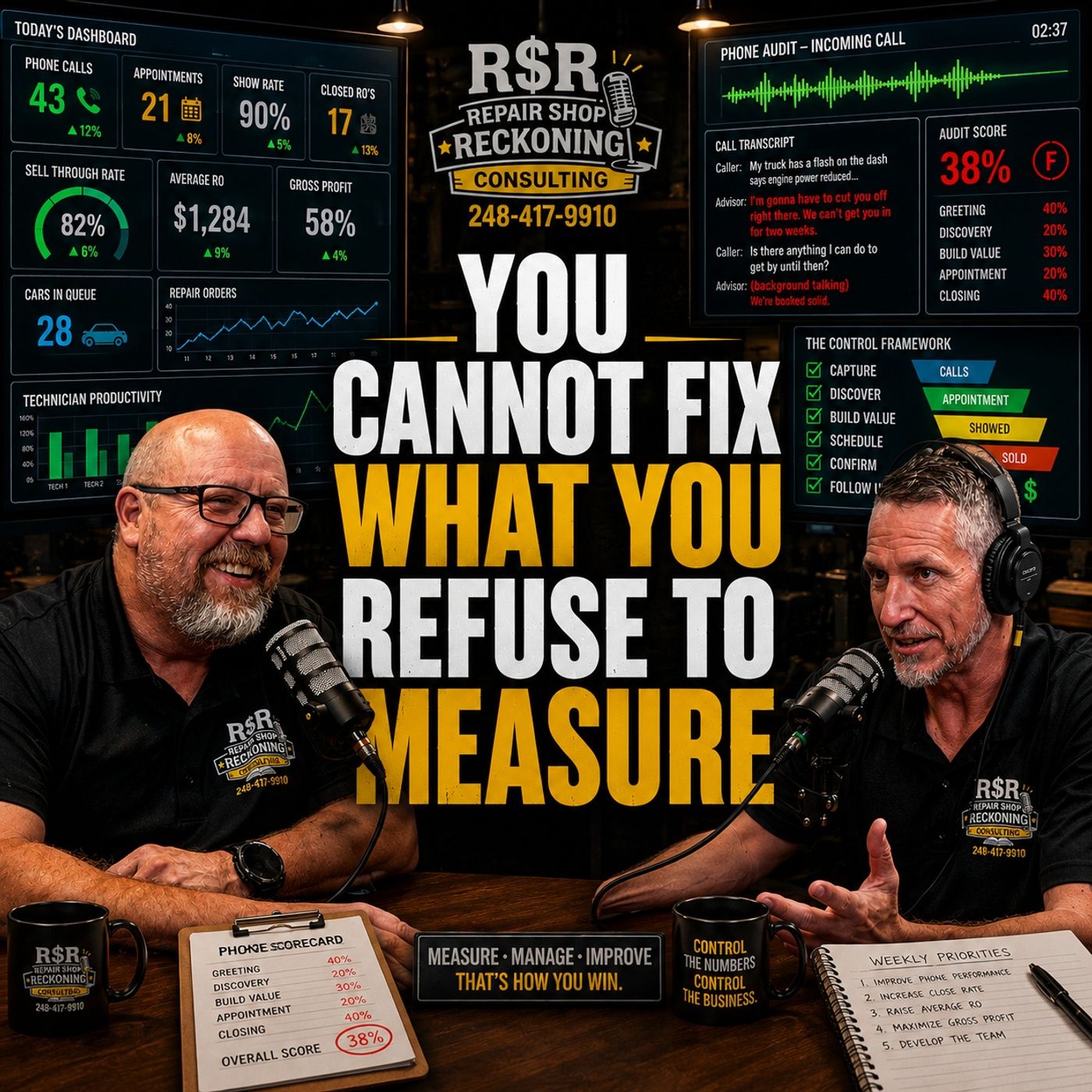
You Cannot Fix What You Refuse To Measure
Most shop owners think they need more calls, more customers, or more work. But what happens when the phone is already ringing and the opportunities are being lost before the vehicle ever reaches the shop? In this episode of Repair Shop Reckoning,...

Don't Send Your Service Advisor Into A Battle Unarmed
Your service advisor may be the gatekeeper of your entire business, but have you actually trained them to protect it? In Part One of this two-part Repair Shop Reckoning conversation, Kevin Brown and Jason Tracey break down one of the most expensive...
Adapt or Die: Using AI To Take Control Of Your Shop
Every major shift in business creates two kinds of shop owners. The ones who wait until everyone else has already figured it out. And the ones who adapt early, learn the system, and create an advantage long before the rest of the industry catches up....
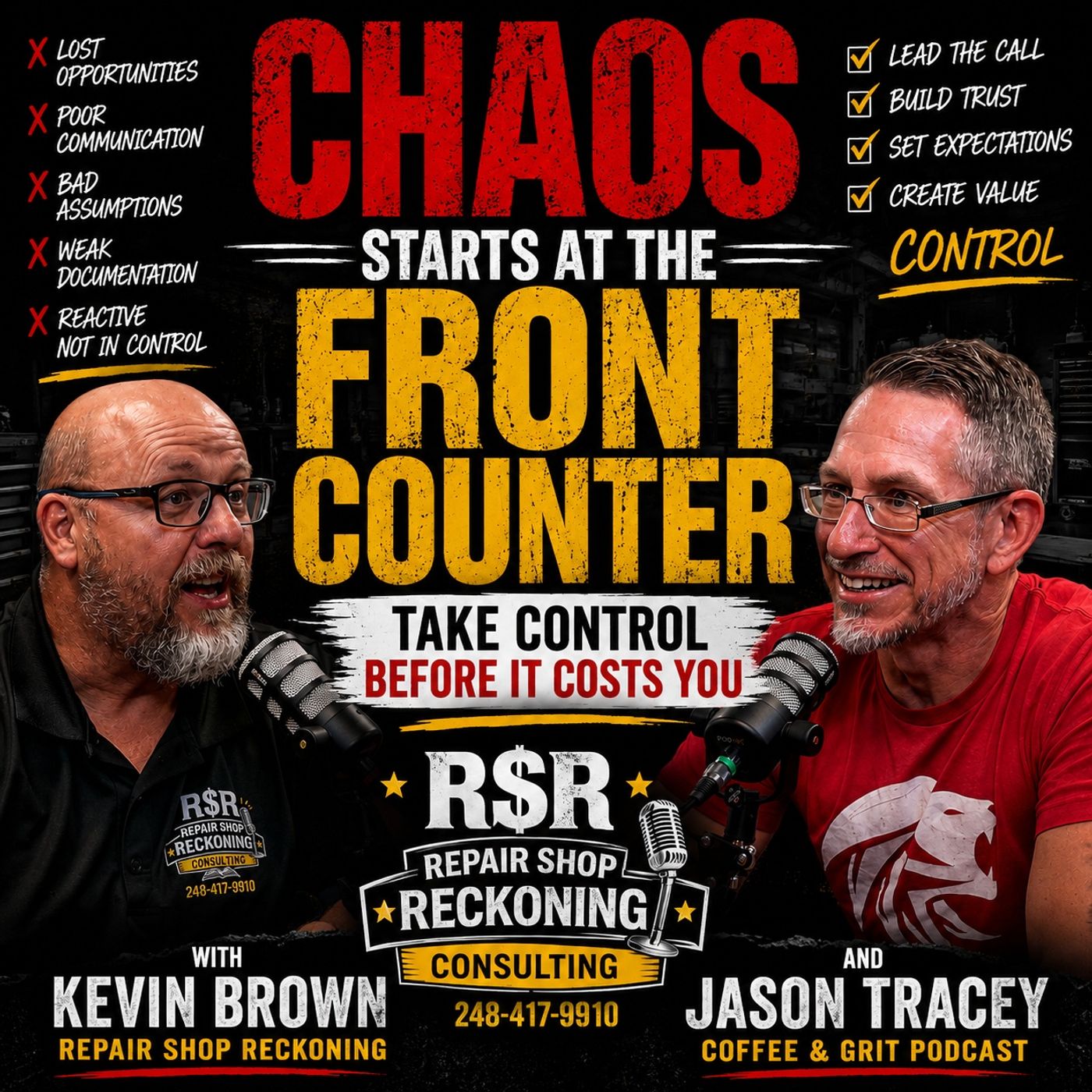
Chaos Starts At The Front Counter...Take Control Before It Costs You
Every shop owner has invested time and money to make the phone ring. But what happens when it finally does? In this episode, Kevin Brown and Jason Tracey tackle one of the biggest profit leaks in the automotive industry: what happens at the front...
Related across the catalog
Ep 104 - Jordan Mosely | The Truth About Scaling an Auto Repair Business
Tekmetric transformed my shop. Plain and simple. Want that for yours? Touch HEREIf you're like me and aren't good at marketing, don't do it on your own. Let the experts handle it. Touch HERE for more on Turnkey Marketing.Send your service advisor to hands down the BEST service advisor training in the industry (even other coaching companies agree). It's Elite Worldwide's Masters Program. The next one is happening in Dallas Texas, September 10-12. Learn more HERE When I used the maintenance tool for the fist time with Detect Auto, my mind was blown. My advisors had the same reaction - and then SO MUCH MORE TIME. Learn more about Detect Auto and book a free demo now!In this episode, Mike Allen sits down with Jordan Mosely to talk about growth, technology, and the realities of running a multi-location business. Jordan shares how sticking to a proven playbook has helped him scale his quick lube and hybrid locations, and explains why obsessing over small cost details—like labor and materials—makes a huge impact on the bottom line. The conversation also dives into the pain (and promise) of current AI and software integrations, when Mike and Jordan both agree that the right technology is important, but execution, adaptation, and focusing on the basics are what truly drive success.Timestamps:00:00 Covered wagons and old-school shop software02:14 What really goes down at shop events and happy hours03:15 Playbooks and the secret to sticking with a process04:14 The quick lube model vs. full-service auto repair05:48 Learning from industry “gurus” and finding what works06:38 Car wash business models and subscription secrets08:09 Breaking down car wash economics and margins09:26 Pennies make the profit: expense structure and labor10:22 Why every phone call counts—and how much fumbled calls really cost12:04 AI cameras, call reviews, and upgrading shop tech12:41 Why onboarding new AI tools is painful (but worth it)14:00 Using Rilla, custom AI, and making tech work for your team16:28 Are unified shop platforms possible—or is it always 19 subscriptions?18:42 The challenges of double-entry and why Tekmetric stands out20:54 Tectonic event review: what a professional trade show looks like22:24 Fixing cars vs. trying to code your own AI: why you should pick a lane24:00 Confessions about chaos, change—and the need for therapy26:14 Dealing with online haters in the auto industry27:16 Remote and virtual advisors: the future, or a flop?30:07 The “sales hammer” model and selling from afar31:49 What happens when you try to run a fully remote shop32:35 Why execution is everything for new shop models34:42 20 groups, private equity, and the independent shop owner line36:44 Why big shop owners show up at trade shows38:14 Confession time: Subaru oil change disasters and red flags39:25 High turnover in quick lube—onboarding and training struggles40:05 Why you need to launch that training, even if it’s not perfect41:57 What’s next: acquiring more stores, riding the oil price wave, and 1% daily improvement

A.I. Native Auto Hospitality - The Future of Customer-First Auto Repair
Joe Adams interviews Michael Floyd, Chief AI Officer at Auto Hospitality Group, about using generative AI (ChatGPT, Codex, Claude) to automate repetitive shop workflows—like splicing customer videos, transcribing and scoring calls, and connecting Techmetric with accounting tools. They explain how giving context turns AI into a powerful assistant and share concrete wins such as improved booking rates and operational visibility. The episode also discusses back-office risk management, practical starting points for shop owners using out-of-the-box tools, and how the Auto Hospitality Group trains shops to become AI-native to prioritize hospitality and human service. AutoshopAnswers.com Auto-Shop-Media.com
Dealership or Independent Shop: Which Is Better? | Eric Schoenberger
Like the show? Show your support by using our sponsors. Need to update your shop systems and software? Try Tekmetric HERELaunch your tool game to the next level with Launch Tech USA! HEREIn this episode, Jeff Compton sits down with Kansas technician Eric Schoenberger of Holt Motor Company. Having grown up around Chrysler dealerships alongside his father, a veteran drivability and transmission specialist, Eric shares his experiences in dealer life and why he ultimately transitioned to the independent repair world. The conversation explores flat-rate frustrations, warranty and recall work, shop politics, diagnostic strategies, transmission repairs, evolving technology, and the value of ongoing training. Eric also discusses how independent shops offer less stress, and a different approach to customer service and technician growth.Timestamps: 00:00 Podcast Welcome and Holiday 00:45 Kansas Guest and Vision Talk 01:30 Shop Intro and Dealer Roots 06:03 Family Influence and Career Path 08:12 Flat Rate and Recall Frustrations 17:25 Favorite Dealer Work and Transmissions 23:03 PT Cruiser Love-Hate Jobs 25:35 Diagnostics and Techline Support 27:49 Dealer Life and Shop Politics 32:37 Misfires, Burnt Valves, and Borescopes 36:31 Pentastar Problems and Tips 41:26 Diesel Disasters 44:04 Recall Work Realities 49:21 Hybrid Battery Discussion 52:37 Leaving the Dealer World 55:47 Advisors, DVI, and Communication 01:01:38 Training Great Advisors 01:08:35 Transmission Service Debate 01:14:38 Moving to Independent Shops 01:16:27 Learning Through Service Information 01:18:46 Oddball Repairs and Old Mopars 01:27:05 Caravan Rear A/C Repairs 01:33:05 Training Events and Mentors 01:38:49 Shop Culture and Dispatching 01:40:44 A/C Diagnostics and Leak Testing 01:47:37 Parts Support Challenges 01:54:02 Technician Pay and Flat Rate 01:56:23 Gravy Work vs. Diagnostics 02:02:27 Independent Shop Mindset 02:12:28 Training and Networking 02:20:06 Final Thanks and Wrap Up Follow/Subscribe to the show on social media! TikTok - https://www.tiktok.com/@jeffcompton7YouTube - https://www.youtube.com/@TheJadedMechanicFacebook - https://www.facebook.com/profile.php?id=100091347564232
How Failure Can Lead to Huge Success | Josh Oberlander - Ep 18
Consistency is key - heard that! But, consistency is HARD. That's why I gave up on trying and let the experts handle it. Detect Auto. Let them clean up your estimating process and raise your ARO - like they did for me! CLICK HERE TO BOOK A DEMOAnybody can run a shop. Building one that lasts? That's a whole different story. If you're ready to build smarter systems and a better experience for your team and customers, check out Tekmetric HEREIn this episode, Josh Oberlander, co-founder of Detect Auto, sits down with Tonnika Haynes and Ash Kaplan to share his unconventional path into the automotive industry, including how failed ventures and persistent learning led him to build software that makes shops more efficient. Josh talks about the importance of mentorship and coaching—how having the right guidance can help you focus on what really matters in growing your business. The episode rounds out with an honest discussion about balancing entrepreneurship with life’s pressures, and Josh introduces some exciting new tools from Detect Auto designed to help shop owners build consistency and deeper customer relationships. Timestamps:00:00 – Kicking Off: Why Your Business Is Your Lifeline01:44 – Meet Josh Oberlander: From Trees to AI Tools02:38 – The Hard Road: Failure, Pivoting, and Finding the Right Problem04:44 – Building the Team: Partnering with "Brainiacs"06:26 – Lessons from Selling to Real Shops (and Failing Fast)09:14 – First Success Stories: Finding Shops Willing to Take a Chance10:07 – What Entrepreneurs Really Underestimate11:16 – Industry Respect: How Josh’s Perspective Changed12:09 – The Trust Issue: Why Car Repairs Need More Love14:19 – Starting a Business Scared? Real Talk from the Trenches17:05 – Wearing All the Hats: The Truth About Going Solo18:03 – Shifting from Fear to Excitement as You Grow19:36 – The Power (and Price) of Coaching & Mentorship21:51 – You Don’t Need a Fancy Coach to Level Up—Best Practices & Books23:48 – Why Focus Wins: Consistency, Habits, and Not Burning Out25:59 – Small Habits, Big Impact: The Magic of “Making Your Bed”28:26 – Motivation, Mindset, and Getting Real About Priorities32:01 – Don’t Let Social Media Rush Your Timeline35:49 – Building a Business That Lets You Be Present for Life39:01 – What’s Next for Detect Auto? AI, Tools, and 1-Year Plans41:22 – Will AI Replace Service Advisors? The Real Answer43:05 – How Relationship Building Wins Over Tech44:38 – Josh’s Live Pitch: What Detect Auto Actually Does49:34 – Maintenance Sales: Why Most Shops Get Stuck (and How to Fix It)54:53 – Training, Coaching, and Raising the Industry Standard56:09 – Tech Teaser: Tackling Language Barriers & Inspection Apps60:34 – Try Detect Auto Free + Final Words from Tonnika & Josh