Ep 90 - Aniz Lavji | This Shop Owner Saw 50% Growth!?
With Aniz Lavji
Now playing — Confessions of a Shop Owner
About this episode
Keep shop management, payments, marketing (all the things) all in one place with Tekmetric. It will CHANGE YOUR LIFE. Click HEREASTA is coming up September…
Key takeaways
- —Loaner vehicles should be managed effectively to avoid long-term customer dissatisfaction.
- —AI is revolutionizing shop management by streamlining processes and improving efficiency.
- —Building a strong community and culture within a shop can lead to better customer service and employee satisfaction.
- —Investing in training and networking events can significantly enhance business operations.
- —Effective delegation is crucial for shop owners to maintain a healthy work-life balance.
Frequently asked
- How can AI improve shop management?
- AI can automate tasks such as creating work orders and analyzing data to identify missed opportunities, making shop management more efficient.
- What are the benefits of attending trade shows?
- Trade shows provide valuable networking opportunities, access to training, and insights into industry trends that can help shop owners improve their businesses.
- How can shop owners balance work and family life?
- Shop owners can achieve a better work-life balance by delegating responsibilities and investing in reliable staff to manage day-to-day operations.
▸Full transcript
The loaner vehicles are there for people that need it for a day or two, right? If they have an issue that's gonna take 3 months to get parts, they need to find a solution for their automotive needs. They can't have my car for 3 months. Are you kidding me? I shouldn't be in charge of tracking the loaner car aging, but I am responsible for making sure that the people who that gets delegated to are doing the job.
The following program features a bunch of doofuses talking about the automotive aftermarket. The stuff we or our guests may say do not necessarily reflect the beliefs of our peers, our sponsors, or any other associations we may have. There may be some spicy language in this show, so if you get your feelings hurt easily, you should probably just move along. So without further ado, here's your host, Mike Allen, with Confessions of a Shop Owner, presented by TechMetric, the best software ever invented for any purpose ever.
TechMetric. We met in September at ASTA Expo. 2025, and now we're at Vision 2026. And I know that you're, I think, coming to Tectonic. Uh, ASTA Expo was your first ever trade show, right? That was the first one ever. And yeah, I would say that that really changed my life. I remember that halfway through it you were kind of stressed because it was the first time you've been away from wife and kids.
Since you had kids, I think is my understanding. I got 3. And there was, uh, there's stress leaving a single parent back at the house with 3 kids, little kids. 100%. Like, just a second ago, talk to my wife and I'm like, how's everything going? Just want to make sure you're okay, you don't have any papers waiting for me when I get back.
Was she upset about you coming to this, or she see the changes? She's 100% supportive of it. It's, it's more of, you know, it's not easy, right? A single parent being with 3 kids, and I have a 6-year-old, a 2-year-old, and an 8-year-old. I don't know why I did that order, but anyway, that is an interesting order. Not the order you would expect.
No, I would have started with— it was an order of your favorite to least favorite. Is that what that was? 6-year-old would have been the middle. He's the— he's a little bit of a troublemaker. I love them all, but, uh, But no, it's just not easy for one single parent to handle 3. So she ended up taking them to Niagara Falls for 4 days.
So she rented an Airbnb there and— You should tell her to swing by and check in on Wilco Automotive. It's not far from Niagara, I don't think, right? I don't know if she's going to make that trip because right now she's in survivor mode and she's taken them to Bird Kingdom. So she's passed some time there. I've always heard that the Canadian side of Niagara is way nicer.
Yeah, so is that the side they're staying on, or are they on the dirty American side? No, no, we're on the clean American— clean Canadian side. Okay, copy. All right, you're afraid you might get detained if you come across? I don't know, like, it depends on which way the, the wind blows, right? Didn't they just, uh, so it is, uh, Friday, March 6th.
I think they just fired the DHS lady, Noem. Today, I think. So we probably shouldn't talk politics. Yeah, it depends on what's— what side of the bed, uh, that Hunter rolled on. But yeah, let's definitely not get too much. He seems like he would be a very hard man to work for long term. I don't think he's got a very, uh— he's got a really high turnover rate.
Yeah, he's got more of a turnover rate than some shops do have techs. So yeah, well, I actually, um, I just got my DTF t-shirt. Oh yeah. Down to fix your staffing problems. It's down to fix your— Yeah. Oh, okay. Yeah, from Promotive. They're down to fix your staffing issues. I thought that was pretty funny. I like that. So I went and got a t-shirt.
So I was actually talking to Lisa just yesterday and she was saying, yeah, so there's a t-shirt that's a DTF on it. And then the chat just went kind of silent and I'm like, I'm just waiting for her to actually spell out what it is. Did Lisa Coyle just hit on me? That's weird. She's awesome, by the way. She is. And I actually learned about her through some Confessions podcast.
I don't know, like some highly questionable podcast. Yeah, some very, very highly questionable. You know, obviously it works because that's how I found out about Promoter. Yeah, and, um, I've been chatting with her for a while. She's awesome, by the way. Well, when you see her today, tell her that you found out about her through the podcast. I did. Perfect, perfect. But, uh, but yeah, no, she's, uh, been talking with her and yeah, she mentioned that and I was like, okay, I'm looking forward to seeing this t-shirt.
Well, um, so when did you get into town? I just got here today, so I was, I was delayed a little bit. So I flew in Wednesday night. Okay. And, uh, from Canada. And by the time I reached town with all the delays, it was about 10 o'clock I landed, got my ride here, it was 11 o'clock, and then I was Up at 6 in the morning, ready to go.
Oh yeah. I want to talk about the class you took yesterday because you told me a little bit about it. And then I just interviewed Seth Dawson and Keith Perkins. And I'm going to be honest with you, when we sat down, they both serve on the board of NASDEF. And I was like, well, probably going to talk NASDEF. We're probably going to talk right to repair and information access and all that kind of stuff.
We didn't. We talked about AI and about how it's going to revolutionize everything. Tell me about that class. So I'll start off with Seth, if you're watching this, you did— Seth does not watch my stuff. I hope he watches this because he did one hell of a job. He taught an amazing class. I ended up like, we were supposed to actually before the class started sign up for the pro or the paid version of ChatGPT, and obviously I procrastinated.
So I did that in class and he was teaching us how to, how to do things that I didn't think was possible. I knew AI was wild, but he's basically got AI in the background with an agent. I figured out what an agent is and he's like, yeah, you can just go in there and have a Tekmetric make a work order. I'm like, get the fuck outta here.
No. So he said, okay, do this command, blah, blah, blah. And, and I had obviously I have Tekmetric logged in because I'm working 29 hours a day. Hey there, I'm gonna tell you about something that has completely transformed how I run my shop, TechMetric. As a 20-year shop owner, outdated systems used to slow us down. Everything was clunky from check-in to estimate building to customer updates.
It all felt just super inefficient. Switching to TechMetric has changed everything. With TechMetric, you get a powerful shop management system that includes DVI, quick and easy estimate building, inventory management, real-time reporting, amazing customer communication, and it's really easy for your employees to learn how to use the software. I'm talking like a 1-day learning curve. On top of that, TechMetric has tons of other tools to make you an even better operator.
Stuff like integrated payments with buy now, pay later options is a huge asset. Ask me how I know. And recently they've added a CRM component with their partnership with ShopGenie, which I'm a happy ShopGenie customer already, so I'm super excited about that. Obviously there are a lot of factors at play here, but I want to give you some facts about my business since I made the change to Tekmetric.
In September of 2020, when I switched to Tekmetric, my ARO was $293. In September of 2024, we were $916. That's over 300% growth. Now, I'm not saying that Tekmetric created all of that change, but I'm 100% saying that I couldn't have come this far without Tekmetric. It's a key factor in our growth and success. If you're ready to level up your shop, Tekmetric has everything you need— productivity, Revenue, customer experience.
Measure up by every measure with Techmetric. Tap the link in the show notes to learn more. Hey guys, Kari Lynn with Turnkey Marketing. If you are looking to increase cars and you're looking for the right demographic to go after, you want to get the right people who need auto repair right now, then give us a call. We have a service called Direct Track and it utilizes AI to find people in your area who are the great demographic that you want to go after, have raised their hand and opted in saying, I need auto repair help right now.
We send them an email. As soon as they open the email, we then get their physical address, follow it up with commercial ads on all their streaming services like Hulu and YouTube and ESPN, Fox News, all those different things. And then we also get their physical address and we start sending banner ads and display ads to every single device in that house.
It has been incredibly effective. It has made shops seem like they're everywhere to those people who need repairs right then. And I mean, I'm telling you guys, the return on investment has been huge. So if you want to increase car count, you want to get great people in the door, give us a call or reach out to us and ask us about Direct Track Marketing.
That's what we do. And it logs in, it starts making a work order. I'm like, yeah, this is too much. And then he's saying you can even go in there and have it compare your November to last November and find missed opportunities. I'm like, okay, this is just too much. Okay, I'm done right now. But that was a great class. Listening to him and Keith talk about the ways that they're using it in their businesses and the tools that they've built out, um, and the evolution of those tools over time, it's pretty freaking interesting.
I mean, um, I decided he's coming to North Carolina, so I mean, if you're listening to this and, and you want to go sit in on that class, it's going to be happening in North Carolina soon. I'm not sure what date because I got to get with his scheduler because he's so important that he doesn't manage his own calendar. But he'll be teaching that class in North Carolina sometime soon.
And when I know the details, I'll put it out there so that you can come to that. But I mean, it's changing the world, bro. It's changing the world fast. And the limiting factor for folks like you and me is that we don't realize how powerful it is because it can do whatever your imagination and your willingness to learn how to prompt it, right?
Prompting is going to be the skill. You give— if you have enough time to focus on the prompts and everything, that's where it all is. If you— it's only as good as what you feed it, right? So if you're feeding it bad information and bad prompts, you're going to get crap. Yeah, crap in, crap out. So, um, well, cool. Uh, was that— so that was 4 hours of yesterday.
What other class did you take yesterday? Oh man, So, uh, put me on the spot here. It was yesterday. Okay, don't say it now because obviously it was a mediocre class and we don't want to shame whomever it was. Oh no, it was a great class, but I'm, I'm still jet lagged. You're fried. Yeah, I— it will come back to me. I'll bring it back up.
But, uh, today I took, uh, an awesome class. Uh, you may, uh, there's a guy, he's got a beard, uh, Josh Parnell. Josh Parnell. Yeah. Yeah, I took his class, uh, bright and early this morning, and, uh, honestly, I was, I was so glad to take it because I missed North Carolina when he did that Frog Pond. It was 2 weeks ago.
Yeah, and I was trying to make it work, wasn't happening. I had major FOMO, as he would say. Every time I'd see a video posted, I'd see Benji doing his speech, I'm just like, I could have been sitting right there, dude. Benji has I mean, he's in a community. It's not a town. He's in a community. I don't think there's a stoplight.
There might be a stoplight going across Highway 24, which is the little road a couple miles away. Um, it's— from my business perspective, it's in the middle of nowhere. And he has built a business in that community where they are the heart of that community. If somebody in town has a problem, not necessarily car-related, they just have a problem. Generally, the goats got out, they call, he'll figure it out.
Yeah, I mean, uh, you know, the, um, I think they were talking about there's, there's an elderly woman who's on oxygen, and when the power goes out, they know that they stop what they're doing and they go immediately to her house to get backup power running so that her oxygen generator keeps going. It's got nothing to do with fixing cars. It's got to do with taking care of people, right?
The culture in that business is amazing. I mean, that's— I mean, he could teach a class himself just at ASCA and just call it Culture with Benji. I think he's too— I think he's too humble for that. I think he— I mean, like, all those dudes are bought into it, and that whole family is awesome. I mean, his kids are awesome. You know, his daughter's been doing his marketing forever, and I think she just married and is following her husband to Texas.
So it's probably gonna— they're probably gonna have some, some heartbreak from, from that. But their son is awesome and taking more and more leadership there. I think Benji is effectively not involved in day-to-day operations anymore. So, and that's a role model business if you, if you have a desire for a single location, community-focused business, they're a role model for that for sure.
And they're bringing in world-leading trainers multiple times a year and inviting shops from anywhere in the country to come down and visit and hang out. I got the pleasure of meeting him last year and I had a good conversation with him. And again, going back to ASCA, my first time going, I'm this random guy that comes in from Canada. I was one of I think 3 people total— me, Jeff, and I think there's one more guy.
He may not have been Canadian, I don't know. Canadian-ish. He never said eh once. Highly suspect. Maybe a spy. I kind of disqualified. Maybe a spy. Yeah, definitely a spy. Um, I will say— oh, you would like to know that, uh, this week I put the tail light, the brake light bulb, in the Miata. Oh, so, uh, should have brought that car.
You could have driven it all the way here. Oh, I don't know, too many hecklers. I mean, I would have had too many women, you know, just kind of trying to hop in the car with me. I mean, that's— I mean, that would have been a whole nother podcast. It's a sex machine. So no, yesterday, so it's like 75 and beautiful in North Carolina right now.
So I, I'd had it in storage at one of the shops actually, because I've got some non-usable space at one of the shops. So I've had it in storage for the winter, um, and I took it out this week. And so yesterday I wanted to take one of my advisors to lunch and he's, I don't know, 6'2", 300 pounds. And I was like, hey man, we were going to go get sushi.
I said, do you want to meet me there? I'm in the Miata top down. Are you going to be a fat guy in a little car, right? Yeah. He said, no, I want to be Brian Pollock 2.0. And so I pulled up in front of the shop. You have the video, right, of this? No. I did take a picture of the car out again.
Um, I pulled up in front of the shop and he was like, hey, sun's out, guns out, can I take my shirt off for this? And I was like, yes. I was like, I was like, I appreciate the commitment to the bit, but a man's got to know his limits. That would have been gold. It would have been something. It would have been something.
Um, no, but it's a fun little car to drive and It's Miata season again. So you know what Miata actually stands for, right? No. Miata is always the answer. That's what Miata stands for. So did you make that up or was that— No, there's a whole subculture of Miata guys. Yeah, whatever. Say guys because I don't know that there are many chicks that think Miatas are cool.
It's mostly a middle-aged guy thing. Are you part of the North Carolina Miata Club? I am not. I probably should be. Or are you starting a missed opportunity? Oh no, there's absolutely— I guarantee you there's a North Carolina Miata Club. But there's going to be a bunch of guys with the shirts off driving Miatas around, basically. You know what, it's, it's just hard to deny animal magnetism sometimes.
So anyone driving Miata, I mean, that's a whole other level. All right, so you came to North Carolina for ACA Expo. Um, you bought into the idea of coming to training and networking events. Would you say that it's changed your business or your perspective on the business? 100%, yeah. Like, before I even went to that, uh, we were using QuickBooks for our shop management system.
Oh gosh, yeah, that's cumbersome. I mean, we're basically using a software that you can sell flower pots with. Yeah. Okay, so we went from a Stone Age to holy shit, what did I just sign up for? The most amazing automotive management platform in the world. All right, universe, dare I say galaxy. Anyway, beyond. So clearly you signed up with TechMetric. Yeah, yeah.
Okay, I would never touch anything else. Copy. Um, but, uh, but yeah, that once we got that software, it was— oh, okay. Oh This is what everyone's talking about. And, you know, we've got our matrix going, we got parts in order from PartsTech and NextPart. Everything's just flowing. And we went through— yeah, I got it in June, and by the end of the year, I'm like, holy crap, what the hell have I been doing for so many years?
And now, you know, from January 1st till now, like, we're using it completely. And yeah, I mean, I, I definitely see the business is I have a feeling this year we're gonna go up 50% sales. 50%. Wow. Wow. That's— I mean, that's, that's life-changing, right? It's life-changing for me. That's why your wife's cool with you coming to more shows, like, oh wait, we're making a lot more money now.
So, so she's— you know what, she's honestly the best. Uh, I'm, I'm very blessed that she's even letting me come here today for 4 days and she's taking on 3 kids and I'm going to Tectonic. Hopefully, uh, may have to hire a nanny or something just to give her some help. But, uh, what's up guys? So if you know me at all, you know that I think I'm pretty awesome at everything, right?
But the reality is I get so busy that a lot of things fall by the wayside. And one of the things that I've always really enjoyed is actually the process of hiring and recruiting. But as the business grew and as the podcast has grown, I just don't have time to react quickly like you have to be competitive in the recruiting market that we have right now.
That's why I've partnered with Promotive. I've used their full-service recruiting process also to great effect for technicians that were like immediate culture fits. That was awesome and useful. But what I'm really excited about is their new tool, Page. If somebody applies to one of my job listings, Page contacts them immediately and has an interview with them. By the time I get the information, I already know if they're worth the time and effort to jump on that applicant quickly or not.
It's saved me a ton of time with bad applicants. It's prepped me really well for good applicants. It's just a super effective, super useful, super efficient tool to help me stay on top of my hiring and staffing needs. If you want to learn more about their full-service recruiting process or about their new tool Page, go to info.gopromotive.com/confessions or scan the QR code below.
Okay, you might have heard me talking about it already, but if you haven't, listen up. Saturday, June 13th, I'm hosting an AI core course in Raleigh, North Carolina. And by I, what I really mean is I'm flying Seth Thorson down to teach a full-day class about how to build your own AI agents and use them in your business. Now, the details are this: if you early sign up between now and May 17th, the ticket's only $899.
This is a full-day course on building your own AI agents. If you wait until after May 17th, then the ticket's going to go up to $1,299. So sign up soon. There's a limited number of seats. You can tap the link in the show notes to learn more, or you can scan the QR code on your screen. At Elite Worldwide, we exist for one reason: to help shop owners build better businesses and better lives.
We believe that you can run a profitable shop without burning yourself out, sacrificing your family, or feeling stuck in survival mode. Everything we do is about clarity, leadership, and execution so you can work on your business, not just in it. That's what Elite Worldwide is all about. I've got that, and, you know, ASTA is kind of like a non-negotiable Like, I have to be at ASTA one way or the other somehow.
Special place in the heart. Oh, that's where— that's where it all began. Like I was saying, I, I came to town alone. I didn't know anybody. I knew you from messaging on Facebook, and I knew Jeff from listening to his podcast, and Lucas listening, and everyone really welcomed me in, and I felt like part of the family by the time I left.
Like, I was sad to leave because, well, I'm not gonna see these guys for maybe a year, and then here we are less It's a year later and we're sitting down. Well, and you, I think, got bit by the bug also, and I think you talk in front of a camera every now and then too, right? I do. Tell me about that.
So I ended up starting a podcast because I've got so much time on my hands and all your free time, right? Just like you. Um, so I started a podcast and, uh, we're about 13— I'd say 13 episodes in right now, and it's been great. Uh, what's the name? Oh, I wasn't sure it was a shout out. It's the Shop and Tread Talk podcast.
Okay, so we're on Spotify, Apple, uh, we've got all the videos on YouTube as well. Okay, and Shop and or Shop In? The Shop and Tread Talk podcast. Okay, copy, got it. So it's been nice, we've had a lot of fun. I'm with my buddy Frank who has a shop, he's a shop owner and a licensed mechanic. Okay, so both of us were on the— what is this licensure for being a mechanic?
What is that about? Well, in Ontario— oh yeah, so here is basically how does it work if you want to be like in your area? In North Carolina, if you want to be a mechanic, all you have to do is tell people you're a mechanic. You can tie your shoes. Yeah, I am a mechanic. I know, and that's why your, uh, your tail light took, uh, almost a year to Well, look, look, it was not on the road for a significant portion, and it became part of the Miata canon also, was that it had a brake light out.
And but I'll never forget being— you being heckled in the car, and I'm like, Mike, why don't you just leave me alone? All right, so, so listeners, the Miata thing is part of the shtick of the podcast, right? And so it was a whole deal that Brian Pollock, my co-host who's not here at Vision this year, and I were riding around in the Miata because he's like 6'5", 350 or whatever he is, right?
He's a fucking Sasquatch. Yeah, 190, chiseled, chiseled man meat. But so we did a thing that the podcast rented out a go-kart track and it was like, hey, listeners, come, let's go race the go-kart track, right? And I, there was a group chat on the podcast going, it was like, who needs a ride? You know, we're taking an Uber, we're taking a cab, whatever else.
And I was like, well, I got space for one. And you answered. Yeah, right. And so we'd never met at that point. We just talked online. So I pulled up in front of the hotel, you hopped in. Hey, good to meet you. Good to meet you. And we're driving through downtown Raleigh and we're a block and a half from the hotel and a bunch of people start heckling, hey, nice Miata, you got a brake light out.
Anybody you know can fix And what Anis didn't realize was that these were all people that were at the expo that I knew that were in on the shtick of the podcast, right? He just thought that North Carolina was full of raging assholes. I was like, what the fuck is he doing? Let him drive his Miata, he's happy. Just let me seek my inner joy, okay?
But so then an hour and a half later, we're at the bar at this go-kart track and he's like, oh, that's the guy that heckled you. You earlier. Oh, now it all comes together. Yeah, they were just giving me shoes. Oh man. Anyway, it was a good time. Um, so like, are you like— what's your format? Is it very business focused? Is it kind of casual?
What are you shooting for? Trying to keep it really casual. Like, I'll be, I'll be quite honest, I don't really do any editing on the video. I don't really do much editing on even on the audio as well because I just want to keep it's so raw. I don't want it to feel like, oh, you know, I edited this out, edited this out.
We just really go with the flow and we don't have a huge script. Obviously we wanna, whoever we're interviewing, we wanna get the information, hear their story and everything, but just try to keep it really fun. And it's like a mini therapy session for free. You know, Josh Coombs, did you meet him down there? Yeah. So I took a class with him actually last year.
So Joshua Coombs has a shop, All OK Auto Repair, in Fayetteville, North Carolina, um, and he started a YouTube channel that's, um, Auto Shop Therapy something. But if you, if you find Josh on Facebook or if you Auto Shop Therapy search that on, you'll find him. But it's just like a 20-minute daily journal about the shit that's happening at his shop— good, bad, and different.
What customers did he have? What problems What problem cars did he have? What employee issues did he have? His wife is his service advisor. He talks about that. You saw his shirt last year, right? Which one was that? Oh, I'm sleeping with my service advisor. Yeah. And she had one that said, I'm sleeping with my boss, right? So yeah, that was pretty funny.
But he's a good dude and he's just kind of living life out there in the open. No filter, no— and I think it's really refreshing and I hope that he gets some traction from that and some validation because he's sharing a lot of the struggles that— sharing his truth. Yeah, right. Yeah, for sure. All right. So what does 2026 look like for— wait, wait, wait, wait.
We are 24 minutes in. I have not introduced you. Oh, that's okay. Anis, introduce yourself. My name is Anis and I am from Waterloo, Ontario, Canada. Yes, we have free health care. What's your tax rate? Too much. That's okay. I have a 5-bay shop out there. We've been in business, uh, I've been in business since 2006, and we've been running the automotive shop for about 15 years.
Okay. Before that, I had a car dealership where we were just focusing on cars, and then we got busy with tires, and then cars just kind of like a side hustle now. But you do a lot of tires, right? We do quite a few tires. In November, we had one of our greatest months ever thanks to TechMetric, which really helped us stay organized, and we had 454 cars come through in one month.
Wow. And I wrote all the service. You wrote 454 tickets in a month? 54 in a month. And at the same time, we were— when I was not on the phone writing service, we were down a guy in the garage. So you're busting tires too? So I ran in, I was busting tires at the same time, pulling cars out, bringing them in, giving the customers, checking them out, and then back and forth.
But whatever I had to do to take care of the customer. So what you're saying is in November you slept really well? Sleep? Oh, Like when— no, I, I, I banked a lot of my hours I was supposed to sleep, and I'm still banking. So I'm planning in 2027 to actually fulfill those hours and actually sleep. So what's the goal for this year?
This year I'm in the process of hiring a service advisor because, uh, I want to stay married. It's reasonable. I want to actually take some time off and not, uh, not be working in the business as much. I want to run the business more. So I'm in the process of hiring a service advisor. Hopefully that goes well soon. And, uh, yeah, just grow.
So, um, are you prepared to deal with the emotional impact of not having your hands on every ticket? Yes. Okay. I'm fine with it because I do want to spend more time at home, more time with my kids and family. You know, I've, I've been— are your customers going to come in and ask for you by name and not want to deal with whoever you hire?
Well, by that time I'm going to have an AI agent anyways. Oh yeah, yeah, like I'll just have a video screen behind me with the, with the camera and— yeah, you're just going to have an AI model of you. And you know, I'll just get that thing from China that's got the, you know, they got the spinning things on it and It's like an AI 3D thing.
Perfect. Perfect. Like I'm right there. Yeah. And I'll just, all the input in there, I'll just put any advice I've gotten from you, put that in there. I'm not sure that advice from me is the way to go, depending upon your business model. I don't know. If you listen to people on the internet, they're gonna tell you that I'm the best. Of course.
And they're right. No. So that is part of what we talked about earlier, and part of what we discussed earlier is, is AI coming for your job, right? And, um, I think it's going to be taking a very big portion of people's jobs. I don't think it's going to be able to do the job completely because at the end of the day, people still want the human element.
Like, I want to come into your shop and, you know, Mike's going to be there to greet me and tell me that everything's be fine. Your car will be ready by this time. If it's not, you can take one of my loaners, but make sure it's— if it's gonna be the Camry, I want it back this year. Yeah. Did you know what I was talking about this week?
Oh my God, no, but I, I just— every— anytime I see a Camry now that looks similar to what you had I remember the story of your Camry that was out for— I have one that just came back today that was out for 84 days with the same customer, which is— I guess by today it was 85 because yesterday it was 84 when I was losing my mind over it.
It's like, hi, GP Dollaz on that job, hopefully. No, that's it. When they've had one of our assets for that long, I mean, it just erodes. I mean, because it's the, it's the opportunity cost, right? That the loaner vehicles are there for people that need it for a day or two, right? If they have an issue that's going to take 3 months to get parts, they need to find a solution for their automotive needs.
They can't have my car for 3 months. Are you kidding me? So that was a failure of leadership on my part to evolve— to not evolve, to, uh, you know, keep an eye on that. And one of the things that Josh talked about two weeks ago was that if I'm going to effectively lead a business that is growing beyond the capacity for me to have my hand on every car, uh, you know, I think Like Josh has always got like catchphrases and quotes and shit like that.
Um, it was, uh, you should be responsible— you should be in charge of nothing but responsible for everything. And I've been really bad at that. So I shouldn't be in charge of tracking the loaner car aging and who gets them and making sure that we enforce our loaner car policies. But I am responsible for, uh, making sure that the people who that gets delegated to are doing the job.
So only your business is only as good as your team members. I think that's— yeah, that's the case for sure. So, and sometimes, like you were saying, can you imagine a Chick-fil-A with a bunch of assholes on the drive-through? It just doesn't work. Do you have— do you have Chick-fil-A? And where you have one which is 10 minutes from our which is very dangerous.
It is the Lord's preferred chicken. On Sundays. Well, the Lord doesn't eat on Sundays. That's why they're closed. Yeah. In Canada they do. Are they open on Sunday? Okay. I was like, wait a minute. Blasphemy. There's no reason for you to open a shop on Canada. No, Sundays the Lord wants you to go to Popeyes. And so that's what we do. It's not the same.
It's good. It's just a different kind of good. Yeah, so you don't have Bojangles though. So when you come to ASTA, we'll go to a Bojangles and get— that's the third chicken. This is the third chicken. So the first tier is Chick-fil-A, then it goes to Popeyes, and then it's Bojangles. Yeah. Dare I say, what's four? Do you need four in your life?
I don't know. Now I'm curious. I feel like I mean, I guess you could go like Raisin Cane's. Never heard of that. Yeah, it's an also-ran. Nobody remembers who finishes fourth in the Olympics. If you're not on the step, it doesn't matter. That's true. So that's true. Like, I mean, like, and the Olympic, uh, hockey championship game. But you know what? Yes, we lost.
But I'm actually a dual citizen, so I still won. Well, so I can't lose if U.S. and Canada are playing. Well, who was in the bronze medal match? Uh, huh? I don't watch. Oh yeah, exactly. Somebody got third, but nobody even knows who was fourth, right? I watched most of the Canada-U.S. game. That was an amazing game. So my kids did not cooperate when overtime happened.
Well, it's probably for the best that you missed the overtime, right? Yeah, so then, yeah, we're trying to get them to settle down and stop— turn the TV off. Thanks, kids. And before I knew it, turn the TV back on, I see the big USA flag. I'm like, turn it off, we're done, no problem, I know what happened. Well, I mean, like, the kid who got his teeth knocked out makes the winning shot in overtime.
It's storybook. But I'm here to tell you that the keeper on the US side should never pay for another beverage in his in his life. Uh, that was an incredible performance. Uh, so they deserved to win. I mean, I'll say it right here, they had a good game. The keeper kept us in it. So I mean, he, he had to be covered in bruises the next day.
Yeah. So anyway, not a hockey fan. I don't know how to speak intelligently to it. So that's the one thing that I could talk about. I'm all basketball. Okay. I can, I can talk basketball for hours. Pro or college? It's got to be pro. You're Canada. Yeah, I mean, we— Vince Carter, best Canadian basketball player ever. He's amazing. Also, he went to the University of North Carolina in Chapel Hill, where I'm from.
Yeah, so also not Canadian, but you know, he just played for the Raptors forever, right? So, um, no, I'm a big Tar Heel basketball fan. Uh, college basketball is where it's at for me. So I know I've seen you post a few— my obnoxious stuff. Well, I've, I've pulled back from it right now. I just post a link to www.diddukewin immediately after, because that's a website.
It just says yes or no, is all it says on the website, after every Duke men's basketball game. And anytime the Tar Heels beat Duke, I just post that link. You know, it's funny, it was a few weeks ago, I don't know who I was talking to, but they're saying, you know, you're, you're so into the automotive and you're going to these conferences conferences, and you're so heavy into it, like, you're always going to the States.
And I don't know, you know, what it means always, but the States, I've been twice, 3 times. I've been to one conference, this is the second one. Like, you should open up a shop in the States. And I'm like, look, there's only one place I'd open, it'd be North Carolina. It's a great market. And you know what the reason is? It's for you guys, because I can see the, the culture that you guys have in your shops.
And you guys care to a level where we don't see it on our end in Canada. I care, I have my own level of caring, but I don't see that very many shops— there's some in, in my area for sure, but when I was in North Carolina and talking to shop owners there, it's different, man. You know, we've had conversations trying to figure out why it's different like that, and I think I think that it's, you know, the association is Automotive Service and Tire Alliance right now, but it was the Independent Garage Association.
It was formed in the 1950s. It was an insurance agency originally because shop owners couldn't get insurance. Well, it was, uh, the show was ASTE, the Automotive Service and Technology Expo, and after the merger happened, it was ASTE Presented by ASTA. It was just too much alphabet soup. So it just became the ASTA Expo, right? But I think it is that we had for 70 years a trade association that brought training, management and leadership training into the area every year.
And it made a huge difference. And I think now that we're 3 generations deep in that. We're seeing that there's just a culture of one, not being, not hating your neighbor, right? Right before we started recording, I was saying that we started 2 or 3 minutes late because I ran into a couple of guys outside who, it's the shop foreman and the son of the owner of the shop that is literally immediately next to one of my shops.
Shops. Yeah. Um, and they were over at my shop at an ASTA event, social event, last month, uh, hanging out, drinking beer. I think we were playing poker, right? Um, and when I moved into that building, I went in, and there's actually— it's 3 shops in a row, 3 consecutive addresses. Uh, I went into both of them, and they're both IGO members, both former IGO board members.
And I was like, hey man, you cool if I go into that building? And they're like, yeah, sure. Hey man, you cool if I go into that building? And he said, the owner of the shop of those guys, he was like, if I lose any customers to you, it's my fault, not yours. Yeah, there's enough cars to— there's, there's more cars than there are shops to fix them.
Yeah, for sure, for sure. Works together. I mean, well, and, and it's cliché to say, but a rising tide lifts all boats, right? And if we can all be better together and we can all pay well and give good benefits and be a good working environment. You know, the shop foreman there worked for me. He moved up from Florida and worked for me for, I don't know, 2 or 3 years, and he quit to go somewhere else for more money and probably thought I was a dumbass, right?
Whatever. But he's found his happy home now where he is, and it's good, man. You know, you don't have to be adversarial No, because like you said, there's more cars than I can work on, there's more cars than you can work on. Let's just take care of people and take care of our people, be ethical, and, and shit just tends to work out, you know.
Like Josh says, service mindset, right? I mean, our job is to service the customer's vehicles, take care of them, and if we've done that by the end of the day, you've done your job. Yeah, for sure, for sure. What are you looking forward to for the rest of this show? Rest of the show, I've got, uh, I'm like looking forward to going through the expo and going through all the different stalls.
Give me flashbacks of ASTA, just seeing all the different stuff. This is bigger, this is bigger than ASTA. It's huge. Yeah, I walked— well, I actually walked through the expo kind of quickly because I wasn't sure exactly where this room was, so I did a quick Round 2, and I'm like, I am lost here. You know, I said, you know what, I say it's bigger than ASTA, but ASTA was huge last year.
Yeah, no, it's— I think it's about the same size as ASTA now. So ASTA has grown up to almost this size. This has always been way bigger. Yeah, way bigger than us. I have to look at it properly in comparison because I remember I have a picture, you know, at ASTA when you go up the escalators. Yeah, looking— I have a picture that's looking down and I'm thinking of that picture compared to this.
Well, so this year in 2026, the plan— and I'm no longer the board president. So you're rejigging this year? Thank you, Jesus. It's probably good for the association that I'm no longer the board president, but I think we're doubling the floor space this year. So we're actually going to have it. And if you think about the escalators, there's going to be two sets of escalators, one going on each side.
And there's going to be a restaurant in the back, and we're going to have the big central area with all the tables for dining and everything else. And all the meals will be on the trade show floor. And so I think that's going to be pretty cool. And that'll be big. No, I don't know. So we're doing the hospitality suite again. Of course.
Which is a good time. Confessions of a Shop Owner. That was pretty awesome last year, right? It was, it was awesome. Not pretty awesome. Yeah, it was awesome. So how do I, how do I bring the heat again this year? Um, I don't know. I've still got all the video games and most of the furniture. Uh, so I got the throne, that's key.
Have you sanitized everything or is it just gonna— No, I just left all the stains. Okay, I just left all the stains. Um, so we're gonna be in a different part of the hotel this year because that space that we were in, one, wasn't quite big enough. Yeah, you need a bigger space. Yeah, um, you did too good of a job last time, that's why.
Well, I mean, I think we were pushing up on fire code on the number of people that we had in there at points, so fire code, schmire code, whatever, not our problem. Yeah, um, so I'm pretty excited about how that's going to go this year, and I'll probably try to do the go-kart racing thing again because, um, way too much of my self-worth is wrapped up in my ability to drive rental go-karts quickly.
Um, are you, are you going to Andretti? You know, I had not signed up for it, but I was, I was just saying, I'm surprised you're not going because I think I'm gonna go buy a ticket right after we finish recording. Last time, like, you did really well. Well, and then I went to Elite's event in Arizona, uh, earlier this year, and Braxton destroyed you.
No, no, that was at Apex. That was— well, so Braxton didn't go to Elite's event, so we went to Techmetric, one of Techmetric's, uh, events at Apex, and it was, uh, it was at Speed Vegas. Yeah. And you get to drive your selection of supercars, right? Uh, with— that's what it was. Yeah. And, um, and he did get a better lap time than me.
How much better was it? I think he was like a half a second faster, which is pretty significant. Uh, yeah. You slept okay that night? No, I wept into my pillow until the sun came up, and then I went back to work. Yeah, so, but we did do an indoor go-karting event at the Elite event, and my coach that I do my coaching calls with, Matt Lofton, he's the director of coaching for Elite.
Uh, in a previous life, he was a race driver, and he got all the way up to the NASCAR Truck Series. So he's done like 200 miles of Talladega, you know, all that kind of stuff. Um, and I fucking crushed him. It was, ah, it's great. So you still talk about a little bit? Oh yeah, I live vicariously I like it. I'm like, I was never athletic enough to be the high school quarterback, but I'm like the 40-year-old guy who's like, I could have gone pro, but I blew my knee out.
Like, I could have, I could have raced Formula One if I just, you know, had more skill and talent and time and money. Because then at ASTA, there's some pretty major competition and shit talking going on during, uh, the go-karting. So yeah, if that's gonna happen again this year, it's gonna be nice. I think so. I think so. I do have, if you If you look at the episodes that I record at home right now, I've got the $9 trophy in the background on my desk behind me.
I got it from that. On your counter? Yeah. It's actually sitting on top of the counter. Is your counter— did your counter hit 30,000 yet? Well, we passed over 25,000 this week. With all your schmoozing over the next few days, you should easily hit 30. I mean, why stop there? I mean, half million I think would be good. Middle. Yeah, yeah. No, I, uh, it's crazy, man.
I mean, we were at, uh, like 10,000 in October, and to be at 25,000 now, I don't know what to make of it. But it must be all the rage bait. I think it is the rage bait, and I think it's, uh, I think it's Brian Pollock is really, really good at making funny cap cuts. That helps. Um, the funny thing about rage bait, that's all Braxton.
He just knows how to cut a clip to cut out all of the appropriate context and nuance and just make it easily misunderstood. Yes. And then, and then the, you know, whoever gets pissed off from it, they watch the whole episode, they're like, hey, I see what you did there. Well, they don't. It's like when you're like, hey, did you watch the episode?
They're like, I don't need to watch the episode. No, you're a dumbass. I was like I already know what you do. I watched the whole 9 seconds of the one hour. Yeah, yes, I am a dumbass, but not for that reason. So, so now I'm curious what 9 seconds of this episode, uh, Braxton's gonna put on. I think, I think mostly the part about me saying that he was good at something is the part that he'll cut out and choose to highlight.
So, uh, probably the part about where he beat me on a racetrack. 100%, that's gonna be on there. I let him win for his ego. So everyone's got to win. Cool. Well, dude, thanks for coming on, man. Thanks for having me. And what's the name of your podcast one more time? The Shop and Tread Talk Podcast. Find it on Spotify, Apple Podcasts, YouTube, or your player of choice.
Yes. Thank you. Thanks for having me. I'll see you at the expo. 100%. All right, guys. AI class. Learn how to use AI so that you can make it your bitch and you don't become its bitch. Saturday, June 13th, Seth Thorson's teaching a full-day class in Raleigh, North Carolina. Tap the link in the show notes or scan the QR code on your screen to learn more.
It's going to be awesome.
More from Confessions of a Shop Owner
Ep 114 - Turnkey Marketing Call #1 | The $84,000 Mistake Hiding in Your Shop
Keep shop management, payments, marketing (all the things) all in one place with Tekmetric. It will CHANGE YOUR LIFE. Click HEREASTA is coming up September 24-26 in Raleigh. Be there or be square, dog! Register now and use code confess25 for $25.00 off your registration. Sign up HERETurnkey Marketing has made my life SOOO much simpler, AND they've helped keep the phone ringing. Do you need these two things too? Learn more HERETired of your shop’s social media looking like every other repair shop on the internet? Stand out with 47 Consulting. Learn more HEREWhen I used the maintenance tool for the fist time with Detect Auto, my mind was blown. My advisors had the same reaction - and then SO MUCH MORE TIME. Learn more about Detect Auto and book a free demo now!Elite Worldwide's Ignite 2027 is coming up in February and NOW is the time to sign up. It's happening in Vegas February 4-6 and it will be the best 3 days of your shops year when you attend. Learn now HEREMike Allen sits down with Carrie-Lynn Rodenberg of Turnkey Marketing to kick off a new monthly series that lets listeners sit in on the marketing side of running Mike's shops. They break down marketing budgets, customer acquisition, direct mail, attribution, branding, customer retention, phone performance, and why simply making the phone ring means nothing if the shop can’t convert the opportunity. Carrie-Lynn also uncovers a painful number at Mike’s flagship store: hundreds of first-time callers but only a fraction turning into customers, potentially representing tens of thousands of dollars in missed revenue. Along the way, Mike admits he may be Turnkey’s worst client, explains why shutting marketing off when you’re busy can come back to haunt you months later, and learns that sometimes the marketing isn’t broken — the operation is.Timestamps: 00:00 Seven Years Since Turnkey First Visited Carfix00:41 Mike Used to Sleep at the Shop03:15 Meet Carrie-Lynn Rodenberg and Turnkey Marketing05:24 Mike Buys Marketing Tools… Then Forgets to Use Them07:05 How Mike Started Working With Turnkey08:57 Mike Tried Doing His Own Marketing — Then Came Back09:07 Why We’re Recording Mike’s Marketing Calls11:21 The Hidden Cost of Bad Marketing13:25 Sniper Marketing vs. Spray and Pray13:41 Carrie-Lynn Went From Doing Everything to Building a Team14:44 Mike’s 115-Episode Long Con 😂15:51 Stop Making Your Marketing About Yourself17:28 Why Most Small-Business Marketing Becomes White Noise20:14 Your Competition Is Better Than You Think21:36 How a Business Responds When Things Go Wrong23:07 Every Shop Says They Have Great Service23:53 How Do You Actually Stand Out?26:24 Why Direct Mail Takes Time to Work28:50 Every Shop Has Blind Spots29:33 Want to Ruin Mike’s Day? Listen to His Phone Calls30:12 Did Your Marketing Actually Make the Phone Ring?30:59 Why Marketing Attribution Is So Difficult32:27 The Creepy Side of Modern Targeted Marketing34:29 Can You Target Technicians at a Competitor’s Shop?36:12 What Turnkey’s Marketing Onboarding Looks Like37:26 SEO, AI Search and Building the Right Marketing Mix40:04 Bad Marketing Can Cost You Technicians Too40:24 Mike Confesses He Might Be Turnkey’s Worst Client42:34 Carrie-Lynn Finds a Painful Number43:41 What Should Your Call Conversion Rate Be?44:25 229 New Callers… Only 56 New Cars44:55 Mike Explains Where Carfix Dropped the Ball46:16 How Service Advisors Say “No” Without Saying No47:06 More Staffing Means More Opportunity to Say Yes49:54 Did Carfix Leave $84K on the Table?50:24 The Marketing Worked — Carfix Didn’t Convert It50:49 Why You Shouldn’t Turn Marketing Off When You’re Busy51:23 Today’s Marketing Decisions Affect Your Slow Season52:47 The Cheapest Customer Is the One You Already Have53:16 Why Customer Retention Matters So Much54:18 Why Shops Should Prebook the Next Appointment54:54 Convenience May Be Your Biggest Competitive Advantage55:21 You Might Be Paying to Market Your Competition56:20 A $100 Lead Could Become a $32,000 Lost Customer57:33 What This New Monthly Marketing Series Will Look Like58:51 Mike Finally Promises New Pictures
Ep 113 - Saurav Kumar & Kamran Rahman | Why Generic Social Media Is Killing Your Shop
Tekmetric opened my eyes to just how much a good SMS will do for a shop. Their software is top of the line, and with them, so is my shop. Try them for yourself HEREASTA is coming up September 24-26 in Raleigh. Be there or be square, dog! Register now and use code Confess25 for $25.00 off your registration. Sign up HEREMy marketing before and after signing up with Turnkey Marketing is pretty scary. In a good way. Get your marketing right today HERETired of your shop’s social media looking like every other repair shop on the internet? Stand out with 47 Consulting. Learn more HERE Make your techs happier with Detect Auto. They'll stop getting "check noise" or "check vibration" from advisors with the customer concern tool. It will CHANGE YOUR LIFE. Book a demo HERESend your service advisor to hands down the BEST service advisor training in the industry (even other coaching companies agree). It's Elite Worldwide's Masters Program. The next one is happening in Dallas Texas, September 10-12. Learn more HEREMike Allen sits down with Saurav Kumar and Kamran Rahman from 47C to talk about what actually makes social media work for an auto repair shop—and why going viral might be the wrong goal entirely. They break down the difference between generic content and real brand-building, why local relevance matters more than raw views, how shops can create trust before a customer ever needs a repair, and why the right audience is more valuable than a huge one. Mike also admits one of his shops is now charging for diag, gets on a soapbox about technician pay and training, and somehow turns a discussion about marketing into another story about his pants coming off.Timestamps:00:00 Generic Social Media Is Everywhere00:59 Was This the Worst Recording Day Ever?01:27 What It’s Really Like Filming Inside a Repair Shop03:00 Can Shop Owners Mix Their Own Content With Professional Content?04:00 Mike’s First Impression of 47C05:53 Why Saurav Never Carries His ID08:08 Mike Admits He Didn’t Understand 47C at First09:47 The Confessions Lounge and Studio12:00 The Story Behind Mike’s Throne13:51 Meet 47C17:10 Why They Chose the Automotive Industry18:33 Are Repair Shops Actually Bad at Business?20:05 Why Automotive Attracts Private Equity21:56 What 47C Actually Does for Repair Shops25:19 Why Customers Want to Feel Like They Belong26:45 Mike Finally Buys Into Social Media Brand Building28:52 Are Repair Shops Still Early to Short-Form Video?30:11 Why Mike Doesn’t Want to Be the First Early Adopter31:05 Landscape vs. Portrait Video34:24 Mike Is Now Charging for Diag at One Shop35:58 Learning Dynamic Pricing From an Ice Cream Truck37:36 Technician Pay, Training and Labor Rates41:18 The Reality of Entrepreneurship43:22 No Booze, No Cocaine While We’re Working44:46 You Can Run a Good Business and Still Have Fun45:52 Why 47C Limits How Many Clients It Takes49:55 The Biggest Problems Facing Repair Shops52:55 Focus on What You’re Good At and Hire Out the Rest54:00 Why Generic Social Media Isn’t a Strategy55:00 Are Viral Shop Videos Actually Useful?56:00 Mike’s Million-View Video Reached the Wrong Audience58:40 Mike Learns What Kind of Content His Audience Really Wants59:09 Closing Thoughts
Ep 112 - Coaching Call #20 | Mike is Going to Charge for Diag??
Tekmetric transformed my shop. Plain and simple. Want that for yours? Touch HEREASTA is coming up September 24-26 in Raleigh. Be there or be square, dog! Register now and use code confess25 for $25.00 off your registration. Sign up HERETurnkey Marketing takes the stress of doing something I'm not good at off my plate. And gives it to someone who is. Click HERE for more.Tired of your shop’s social media looking like every other repair shop on the internet? Stand out with 47 Consulting. Learn more HERESend your service advisor to hands down the BEST service advisor training in the industry (even other coaching companies agree). It's Elite Worldwide's Masters Program. The next one is happening in Dallas Texas, September 10-12. Learn more HEREWhen I used the maintenance tool for the fist time with Detect Auto, my mind was blown. My advisors had the same reaction - and then SO MUCH MORE TIME. Learn more about Detect Auto and book a free demo now!Mike Allen sits down with Matt Lofton for another open-book coaching session, digging into the real numbers behind one of Mike’s shops and figuring out what has to change to push it past 20% net profit. They break down car count, closing ratio, effective labor rate, gross profit per billed hour, staffing capacity, revenue per employee, and why a shop can look busy while still leaving a lot of money on the table. The conversation eventually forces Mike to reconsider one of his favorite controversial strategies—free diagnostics—and whether qualifying customers and charging for testing could actually improve the shop. As usual, there’s plenty of math, sarcasm, questionable financial decisions, and Mike reluctantly admitting that Matt may have a point.Timestamps00:00 Mike Forgot the Most Important Podcast Preparation: A Drink01:21 A $734 Power Bill vs. Matt’s Accidental Backyard Rainforest04:25 Growing the Business Just Creates New Problems07:35 Are Shop Owners Bad at Celebrating Wins?11:33 Opening the Books: $115K Revenue, $530 ARO & 24% Closing14:40 The Shop’s Best Month of the Year15:18 Building a 20%+ Net Profit Goal18:18 How to Calculate the Revenue Your Shop Actually Needs20:41 Can the Current Team Produce Enough Hours?25:45 “I Have No Excuse Not to Put $25K–$30K in the Bank”27:04 Could This Be a 30% Net Profit Shop?27:45 The Gross Profit Per Billed Hour Every Shop Needs to Know30:21 The Problem With a 24% Closing Ratio31:47 Your Loss Leader Doesn’t Have to Be for Everybody34:29 23 Cars Out of 110 Generated $034:57 “We’re Not Hospice for Cars”35:19 Should Repair Shops Have an Age Limit on Vehicles?36:32 Mike Admits He’s About to Make a Bad G-Wagon Decision39:58 Matt Sees Mike’s Effective Labor Rate and Gets Sad41:12 Mike Calls Capacity Calculators “Mental Masturbation”42:02 Should Mike Finally Start Charging for Diagnostic Testing?43:15 What McDonald’s Can Teach Repair Shops About Pricing44:04 Qualifying Customers Before Giving Them Something Free46:25 Mike Promises to Rage-Bait Matt Again46:54 Raising Effective Labor Rate Could Add $500K in Capacity49:11 What Should the Entry-Level Diagnostic Fee Be?51:41 The Revenue-per-Employee Hiring Benchmark55:05 Is It Already Time to Hire Another Technician?55:49 Why Your Shop Can’t Operate at Redline Forever57:17 “Good Dude Is Not a Qualifier for Employment”59:42 Mike Prepares to Admit He Was Wrong About Free Diag
Ep 111 - Mike and Bryan | Technicians Want More Money… But Won’t Do the Work
Tekmetric transformed my shop. Plain and simple. Want that for yours? Touch HEREASTA is coming up September 24-26 in Raleigh. Be there or be square, dog! Register now and use code confess25 for $25.00 off your registration. Sign up HEREIf you're like me and aren't good at marketing, don't do it on your own. Let the experts handle it. Touch HERE for more on Turnkey Marketing.Tired of your shop’s social media looking like every other repair shop on the internet? Stand out with 47 Consulting. Learn more HERESend your service advisor to hands down the BEST service advisor training in the industry (even other coaching companies agree). It's Elite Worldwide's Masters Program. The next one is happening in Dallas Texas, September 10-12. Learn more HERE When I used the maintenance tool for the fist time with Detect Auto, my mind was blown. My advisors had the same reaction - and then SO MUCH MORE TIME. Learn more about Detect Auto and book a free demo now!In this episode of Confessions of a Shop Owner, Mike Allen and Bryan Pollock get into technician pay, work ethic, training, shop culture, and whether today’s owners are expecting too much from the modern workforce. Bryan questions whether the self-motivated technician is disappearing, while Mike pushes back on the idea that someone should receive six-figure pay before developing a six-figure skill set. They also get into government regulation and price-gouging enforcement, bad repair shops, Mike’s anonymous Facebook trolling, and why sometimes the industry’s problems feel impossible to fix. And because this is Confessions, Mike also explains how he managed to injure himself playing kickball on the beach.Timestamps:00:00 Mike’s Casino Decisions & Bryan’s Corvette Disaster04:54 Mike Gets a Letter From the Attorney General07:34 Fraud Alert…Live During the Podcast08:05 Mike’s Fake Career as a Professional Blimp Folder12:23 Confession: Mike Has Been Trolling Shop Owners Anonymously17:17 Why There’s More Than One Right Way to Run a Shop19:37 Three Shop Owners With Completely Different Business Models21:44 David Roman Wants Absolutely Nothing to Do With Mike24:19 Cheap Labor Rates & Buying Failed Shops’ Equipment25:07 Is Bryan Becoming a Cranky Old Shop Owner?27:05 Are Technicians Becoming Too Dependent on Shop Owners?29:22 Bryan’s Crash Course Into Becoming a Technician32:26 Is the Self-Motivated Technician Disappearing?33:23 Should You Make $100K Before You Have $100K Skills?35:31 What Happens When Newer Cars Get Even More Complicated?35:58 “I Want to Learn”…But Won’t Use Free Training37:10 Technicians Who Say Training Is “Too Basic”39:18 Bryan’s Government Intervention Rant Begins41:00 Price Gouging vs. Shops That Can’t Fix Cars43:43 Who Gets to Decide What an Auto Repair Shop Should Charge?47:01 Why Government Regulation Won’t Fix the Real Problem48:10 Should Shops Call Out Bad Repairs From Other Shops?52:44 Mike Adds Four Employees to His Shops55:10 Mike’s Most Embarrassing Kickball Story57:02 Mike Defends His Sumo Wrestling Record58:25 Why You Need to Be at ASTA Expo
Related across the catalog
Flat Rate Doesn't Match the Real Repair with Josh Forbes
Like the show? Show your support by using our sponsors. Need to update your shop systems and software? Try Tekmetric HERELaunch your tool game to the next level with Launch Tech USA! HEREIn this episode, Jeff is with Josh Forbes of Maxim Muffler in Winnipeg talks about his unconventional path into the automotive industry. What started with constant breakdowns on his first car—a 1993 Ford Tempo—turned into a career built through hands-on learning, apprenticeship experience, and years of navigating different shop environments. Josh shares lessons from dealership life, the importance of shop culture, why employee appreciation matters, and his concerns about the future of right-to-repair legislation.Timestamps:00:00 Tools and Debt Lessons 00:45 Podcast Introduction 02:44 Shop Schedule and Weather 03:27 First Cars and Fuel Costs 08:22 Tempo Breakdowns That Started It All 12:24 College Training at Fanshawe 14:17 Choosing the Trade Path 17:54 Ford Dealer Quick Lane Reality 24:19 Book Time vs. Real Repairs 36:41 Why He Left the Dealer 39:06 Finding the Right Shop 41:29 The Culture That Changed Everything 45:21 Appreciation Over Pay 52:17 How Bad Culture Breaks Technicians 55:04 Forever Apprentice Mindset 58:44 Trade Pay Gap Debate 01:02:19 DIY Repair Horror Stories 01:07:54 Training Service Writers 01:16:24 The Right to Repair Fight 01:21:22 Quality Control Basics 01:23:46 Training Instead of Punishment 01:27:35 Oil Leak Case Study 01:31:46 Recognition and Longevity 01:37:35 Smart Tool Buying 01:40:05 Diagnostics, Process, and School 01:47:00 Wrap Up and Final Thoughts Follow/Subscribe to the show on social media! TikTok - https://www.tiktok.com/@jeffcompton7YouTube - https://www.youtube.com/@TheJadedMechanicFacebook - https://www.facebook.com/profile.php?id=100091347564232
Maximizing Profit Through Effective Labor Rate Strategy [THA 493]
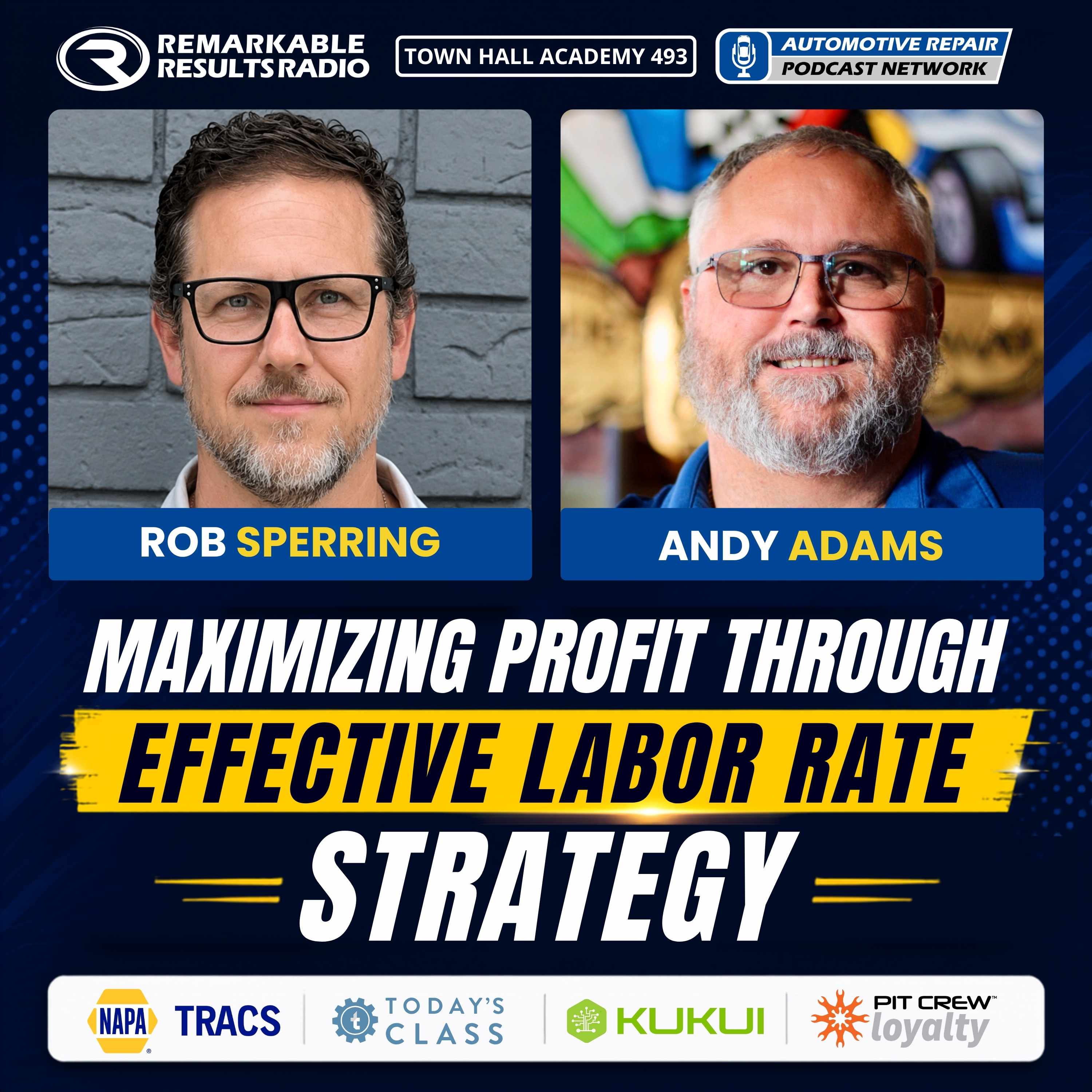
Thanks to our Partners, NAPA TRACS, Today's Class, KUKUI, and Pit Crew Loyalty Watch Full Video Episode *]:pointer-events-auto scroll-mt-[calc(var(--header-height)+min(200px,max(70px,20svh)))]" dir="auto" data-turn-id="request-WEB:8e59eec7-a235-4fa3-a072-956fea3fe478-7" data-testid="conversation-turn-4" data-scroll-anchor="false" data-turn="assistant"> *]:pointer-events-auto scroll-mt-[calc(var(--header-height)+min(200px,max(70px,20svh)))]" dir="auto" data-turn-id="request-WEB:49a777bf-d263-4496-bf0b-2eb3a46ac96a-11" data-testid="conversation-turn-24" data-scroll-anchor="false" data-turn="assistant"> Your posted labor rate may not be the labor rate you're actually collecting, and that gap could be costing your shop thousands of dollars every month. In this episode, Carm Capriotto is joined by Andy Adams, a shop owner and business coach, and Rob Sperring, a service manager, to explain why the Effective Labor Rate (ELR) is one of the most overlooked yet impactful performance metrics in the auto repair industry. They break down why ELR falls short, how it affects profitability, and the practical steps every shop owner can take to close the gap. What You'll Learn What Effective Labor Rate (ELR) is and why it matters more than your posted door rate.Why healthy shops should collect at least 90 percent of their posted labor rate.How unbilled diagnostic time, underpriced canned jobs, and complimentary inspections reduce profitability.Why excessive discounting, even with good intentions, can quietly erode your bottom line.Why improving ELR creates opportunities to increase technician compensation and strengthen your business.How auditing repair orders can uncover missed labor opportunities and unnecessary discounts.Why updating your labor matrix and canned jobs can immediately improve financial performance.How sharing KPI's (key performance indicators) with your team builds ownership and accountability throughout the shop. Effective Labor Rate is more than a financial matrix; it's a direct measure of how well your shop captures the value of the work it performs. By understanding where labor revenue is being lost and making intentional operational improvements, shop owners can increase profitability, invest in their teams, and build a stronger, more sustainable business. Rob Sperring, Grand Rapids Motorcar, Grand Rapids, MI Andy Adams, Adams Garage, Terre Haute, IN. Coach at Repair Shop of Tomorrow Thanks to our Partner, NAPA TRACS NAPA TRACS will move your shop into the SMS fast lane with onsite training and six days a week of support and local representation. Find NAPA TRACS on the Web at http://napatracs.com/ Thanks to our Partner, Today's Class Optimize training with Today's Class: In just 5 minutes daily, boost knowledge retention and improve team performance. Find Today's Class on the web at https://www.todaysclass.com/ Thanks to our Partner, KUKUI Stop juggling multiple marketing tools. KUKUI’s integrated platform delivers 4x better website conversions, automated follow-up, and real-time ROI tracking. Get industry-leading customer support with KUKUI at https://www.kukui.com/ Thanks to our Partner, Pit Crew Loyalty You’re probably tired of chasing new customers who never return. We understand. Pit Crew Loyalty ends the one-and-done cycle, turning first visits into lasting, reliable revenue at https://www.pitcrewloyalty.com/ Connect with the Podcast: Visit the Website:https://remarkableresults.biz/Subscribe on YouTube:https://www.youtube.com/carmcapriottoFollow on Facebook:https://www.facebook.com/RemarkableResultsRadioPodcast/Follow on LinkedIn:https://www.linkedin.com/in/carmcapriotto/Follow on Instagram:https://www.instagram.com/remarkableresultsradiopodcast/Join Our Virtual Toastmasters Club:https://remarkableresults.biz/toastmastersJoin Our Private Facebook Community:https://www.facebook.com/groups/1734687266778976Join our Insider List:https://remarkableresults.biz/insiderAll books mentioned on our podcasts:https://remarkableresults.biz/booksOur Classroom page for personal or team learning:https://remarkableresults.biz/classroomBuy Me a Coffee:https://www.buymeacoffee.com/carmSpecial episode collections:https://remarkableresults.biz/collections The Automotive Repair Podcast Network: https://automotiverepairpodcastnetwork.com/ Remarkable Results Radio Podcast with Carm Capriotto: Facilitating Wisdom Through Story Telling and Open Discussion. https://remarkableresults.biz/Diagnosing the Aftermarket A to Z: From Diagnostics to Metallica and Mental Health, Matt Fanslow is Lifting the Hood on Life.<a...
Episode 276 - Navigating Apprenticeships With Angela Mitchell & Shop-Ware Scholarship Winner Kaitlyn Schave
Don't get to the end of this year wishing you had taken action to change your business and your life.Click here to schedule a free discovery call for your business: https://geni.us/IFORABEDon't miss an upcoming event with The Institute: https://geni.us/InstituteEvents2026Shop-Ware gives you the tools to provide your shop with everything needed to become optimally profitable.Click here to schedule a free demo: https://info.shop-ware.com/profitabilityTransform your shop's marketing with the best in the automotive industry, Shop Marketing Pros!Get a free audit of your shop's current marketing by clicking here: https://geni.us/ShopMarketingProsShop owners, are you ready to simplify your business operations? Meet 360 Payments, your one-stop solution for effortless payment processing.Imagine this—no more juggling receipts, staplers, or endless paperwork. With 360 Payments, you get everything integrated into a single, sleek digital platform.Simplify payments. Streamline operations. Check out 360payments.com today!In this episode, the conversation focused on the experiences of an apprentice technician who won the Shop-Ware scholarship. One concept discussed was the importance of standardized processes in the shop to ensure consistent work quality and reduce customer complaints. A key theme that emerged was the value of mentorship and hands-on learning, with support from experienced technicians helping apprentices gain skills and confidence. The discussion explored how exploring diverse training resources, including online courses and technical classes, can accelerate professional growth for new technicians.00:00 Brake pad inconsistencies and complaints05:44 Cleaning caliper brackets16:24 Bringing Kaitlyn on board17:54 Training and skill progression27:40 Learning electrical diagnostics skills31:43 Talking about tough car repairs33:59 Discussing employee pay incentives42:57 Choosing the right conference sessions48:07 Learning diagnostics through videos52:21 Testing car battery voltage58:50 Dealing with difficult customers

99.08% Diagnostic Accuracy: Inside a Master Tech’s Playbook
Joe Adams interviews Adams Automotive Master Technician Josh Gerbrecht about his journey from technician to top diagnostician, sharing the systems that drove his 99.08% diagnostic accuracy and the big takeaways from a Key-to-Key-to-Callbacks weekend. They discuss the front-office/back-office symbiosis, the Rack Attack inspection process, recruiting and paying technicians their worth, shop tours and hospitality, and how AI could streamline diagnostics and incentivize accuracy over just speed. AutoshopAnswers.com Auto-Shop-Media.com