01

Master Tech to MillionaireAugust 30 · 32 min
Autoshop Ministries - DeVante Tidwell K2K 8/23/26 Sermon on Freedom Through Forgiveness
This live recording of Autoshop Ministries explores forgiveness as Gods plan for connection, freedom, and abundant life, unpacking Colossians 2, Matthew 6:14, John 10:10 and practical illustrations about letting go of grudges. DeVante invites listeners to both receive and give forgiveness, explaining how forgiveness frees us from the past, restores relationship with God, and opens the door to living fully in Christ.
Listen →
02
Master Tech to MillionaireAugust 27 · 1h 24m
99.08% Diagnostic Accuracy: Inside a Master Tech’s Playbook
Joe Adams interviews Adams Automotive Master Technician Josh Gerbrecht about his journey from technician to top diagnostician, sharing the systems that drove his 99.08% diagnostic accuracy and the big takeaways from a Key-to-Key-to-Callbacks weekend. They discuss the front-office/back-office symbiosis, the Rack Attack inspection process, recruiting and paying technicians their worth, shop tours and hospitality, and how AI could streamline diagnostics and incentivize accuracy over just speed. AutoshopAnswers.com Auto-Shop-Media.com
Listen →
03
Downshift with TonnikaAugust 27 · 1h 23m
Shop Owners: Maybe YOU'RE the Problem | Tristin Sweeney - 38
Running a shop is hard enough—you don't need your software making it harder. 😂 If you're ready for more clarity, better organization, and a smoother experience for both your team and your customers, check out Tekmetric HEREConsistency is key - heard that! But, consistency is HARD. That's why I gave up on trying and let the experts handle it. Detect Auto. Let them clean up your estimating process and raise your ARO - like they did for me! CLICK HERE TO BOOK A DEMOAt 29 years old, Tristin Sweeney is running an auto repair shop, building automotive technology, and questioning some of the industry's favorite excuses. In this episode, Tonnika Haynes talks with Tristin about his unconventional path from the startup world into automotive, acquiring Honest Automotive, building Shift, and why owning a shop became the ultimate testing ground for solving real industry problems. But things get spicy when they tackle the supposed technician shortage, outdated hiring practices, shop owners blaming younger generations, and why good employees may be leaving shops that refuse to change. They also dig into AI, technician training, communication, leadership, burnout, and why new technology should solve problems instead of creating more work. If you're a shop owner who keeps saying, “Nobody wants to work anymore,” this conversation might make you look in the mirror.Timestamps:00:00 Why automotive has become unattractive to work in00:23 Downshift intro00:42 Meet Tristin Sweeney: 29, busy, and obsessed with automotive01:23 Audi, Volkswagens, and where the car obsession started03:15 Can you be a great service advisor without knowing cars?04:40 There are more automotive careers than turning wrenches06:26 From tech startups to the automotive industry07:17 Getting laid off, joining ShopGenie, and finding his industry09:17 Running TWO automotive businesses at 2910:11 How Tristin bought Honest Automotive after finding it on Facebook14:01 Has shop ownership given him gray hair yet?14:32 Building a shop around passion and customer experience16:21 Honest Automotive is also Tristin’s “laboratory”16:48 How Shift Automotive was born18:19 Building software from the problems that drive shop owners crazy19:10 Technology problem or people problem?20:17 How does someone working 60–70 hours a week avoid burnout?22:55 Success isn’t worth burning yourself out by 3023:19 Tonnika gets VERY personal about Tristin having kids 😂25:32 Why Tristin is committed to automotive for the long haul28:53 Shift grows to more than 150 shops30:02 Why simply SHOWING UP can change your career31:21 The “Gen Z stare” and learning how to communicate33:34 Get in rooms where you’re uncomfortable37:04 What will automotive look like 10 years from now?41:11 Shop owners who ignore AI WILL get left behind42:43 How should shops prepare technicians for new technology?43:27 Does every tech need to understand the newest cars right now?45:48 Why the next generation matters more than ever47:58 What does a technician actually need to “look like”?48:48 Is the technician shortage actually a hiring problem?49:48 How many great technicians are shops overlooking?50:48 “I hire people. I don’t hire jobs.”52:00 Why automotive can be an unattractive place to work54:18 Great shops generally aren’t struggling to find applicants54:51 The talent is out there—and some of them want to leave their current shop55:55 If recruiters can steal your technicians, that’s a YOU problem56:04 Most shop problems start with the owner57:30 Accepting criticism from your employees—even your own son58:03 Old-school leadership vs. the way Tonnika leads today59:33 The macaroni-and-cheese recipe for evolving a family business1:01:47 Is treating every employee differently “coddling”?1:03:50 Why one universal pay plan doesn’t work for everyone1:04:39 Flexible schedules, flat rate, salary, and what actually motivates people1:07:08 Shop owners who refuse to compromise may lose great technicians1:07:56 Bad bosses create the next generation of bad bosses1:08:21 Why leadership and communication have to be learned1:13:00 Stop micromanaging every detail of your shop1:14:22 “Granddad did it that way” isn’t a good enough reason anymore1:15:28 The Carfax data debate gets spicy 😂1:16:24 What Carfax actually gets from your shop1:17:47 Tonnika’s grandfather discovers OnStar and thinks “they’re coming for him”1:19:03 Technology fear usually comes from misunderstanding1:19:45 Tristin’s legacy: Leave automotive better than he found it1:20:00 Where to find Honest Automotive and Shift Automotive1:21:22 Closing, AI hot takes, and what’s next
Listen →
04

The Institute's Leading Edge PodcastAugust 26 · 55 min
216 - Coach the Call: Using AI Insights to Develop Stronger Service Advisors
216 - Coach the Call: Using AI Insights to Develop Stronger Service Advisors August 26th, 2026 - 00:54:51 Show Summary: Strong phone skills can turn more incoming calls into appointments while building trust from the first interaction. Consistent call reviews give service advisors a clear path to improve without making coaching feel like punishment. AI call analysis reduces the time required to find useful coaching opportunities and helps owners identify patterns across their team. Positive reinforcement also matters because great calls give advisors examples they can repeat. Simple habits like smiling asking for the appointment and using the customer’s name can dramatically improve the experience. Better phone performance ultimately supports stronger customer relationships higher appointment conversion and long term shop growth. Host(s): Jimmy Lea, VP of Business Development Guest(s): David Boyd, Founder & CEO of Callinbound Tonnika Haynes, Owner of Browns Automotive, Downshift with Tonnika Haynes Show Highlights: [00:04:00] – Listening to real calls reveals missed opportunities that owners rarely see. [00:10:00] – AI identifies coachable calls without hours of manual review. [00:14:00] – Consistent coaching creates awareness before advisors answer each call. [00:17:00] – Replace a hard no with a plan focused on customer needs. [00:24:00] – Help advisors self coach instead of simply pointing out mistakes. [00:28:00] – Every missed appointment can represent significant lost customer value. [00:34:00] – Asking for the customer’s name immediately creates a stronger connection. [00:39:00] – Scheduled call reviews make coaching normal instead of threatening. [00:43:00] – Asking for appointments helped turn successful marketing into a fuller calendar. [00:49:00] – Call tracking connects marketing performance with actual appointment conversion. In every business journey, there are defining moments or challenges that build resilience and milestones that fuel growth. We’d love to hear about yours! What lessons, breakthroughs, or pivotal experiences have shaped your path in the automotive industry? Share your story with us at info@wearetheinstitute.com, and you might be featured in an upcoming episode. 👉 Unlock the full experience - watch the full webinar on YouTube: https://youtu.be/fv9ewVBoSks Don’t miss exclusive insights, expert takeaways, and real talk you won’t hear anywhere else. Hit Subscribe, drop a comment, and share it with someone who needs to hear this! Links & Resources: Want to learn more? Click Here Want a complimentary business health report? Click Here See The Institute's events list: Click Here Want access to our online classes? Click Here ________________________________________ Episode Transcript Disclaimer This transcript was generated using artificial intelligence and may contain errors. If you notice any inaccuracies, please contact us at marketing@wearetheinstitute.com. Episode Transcript: Jimmy Lea: Good morning, good afternoon, good evening, or good night. Thank you for joining. So excited for us to have this conversation today with some really good friends. Everyone, this is to be an interactive webinar. So you're sitting there, you've got questions, you've got concerns, type them into the chat. We wanna be able to ask those questions of our panel today as we are talking about a very interesting topic. And with us today, first, is our good friend, Mr. David Boyd of Inbound Communication. David, how the heck are you, brother? David Boyes: I'm great. I, I, uh, I fully intended to have my jacket on, Jimmy. Jimmy Lea: Man. David Boyes: So excited to be here. We Jimmy Lea: coordinated on this and everything. David Boyes: I know. I, uh- Next time ... I, I was, I was lucky as, as busy as we've been at Call Inbound to, uh, uh, get up and, and organize and dress today. So I really, uh, it's always great to see you and of course, um, uh, we got to visit a little bit out at, uh, Worldpac STX and, uh, man, I tell you what, your wardrobe is always top notch. Jimmy Lea: Hey, thank you. Thank you. We're glad you are dressed today, just don't stand up. Thank you very much. David Boyes: Great. Jimmy Lea: And joining for us in our conversation today, David, is Tanika, Tanika Hayes with, uh, Haynes with Browns Automotive. Tanika, how the heck are you, sister? Tonnika Haynes: I'm doing good, guys. What's going on? Jimmy Lea: Staying alive. Good to see you. Great to see you. Also at STX, what did you think of the, the conference there with Worldpac? Tonnika Haynes: It, it was really, really good. I was not prepared for the size of it. There was a lot of people. People were peopling. So, um, once I got adjusted to all of the crowds and everything, I enjoyed it. I hadn't sat in a class in a really long time, like at an expo. Ooh. I'm usually just walking around and being nosy, but I picked up some good nuggets, so it was great. Jimmy Lea: Beautiful. That's awesome. Well, if, if the STX was a large conference to you, I would suggest that you really prepare yourself months in advance if ever you come out to SEMA and Apex in Las Vegas. Tonnika Haynes: I will be there this year. Oh, good. I keep hear- hearing that, so I don't know what meds I need to be on to take, To take it all in. But Jimmy Lea: we'll- You- Tonnika Haynes: I'm excited about it ... Jimmy Lea: we, we will talk about that because there is more than you can see within a week, and you really only have three days at Apex, four days at SEMA. You want to map out where you're gonna go, who you're gonna talk to, who you're gonna see- And for you, Taneka, schedule some time to sit down and chill Tonnika Haynes: Yeah. I'm gonna have to definitely do that. You're talking about, um, scheduling times. I'm gonna schedule time to go sit in the corner and recoup. Uh-huh. So where's Taneka? She's in the corner. Jimmy Lea: Yep, and, and I- It's David Boyes: scheduled time ... Jimmy Lea: I, I'm gonna work with you on that because I know the corners, I know the places where you can go and, and find some solitude. Tonnika Haynes: All right. Jimmy Lea: I am. Well, our conversation today is in preparation for making your shop better David, I'm gonna kick it over to you, brother. Let's start this conversation with Taneka. David Boyes: Yeah. Let's, uh, let- let's kinda move into this. You know, we're, uh, talking about communication, and there are so many facets that impact the customer experience. I think that it's important to know that, you know, there are tools and there are, uh, from an owner or, and manager's perspective and from a service provider's perspective, there are ways that we rally around making communication better. Um, you know, one of the things that is common at all shops is, uh, the customer phone call. Tonnika Haynes: Oh, yeah. David Boyes: So you winced a little bit. Tonnika Haynes: Yeah. David Boyes: Uh, how many times do we, you know, talk about our phone skills, uh, getting better on the phone, understanding the customer, understanding their needs, addressing their needs? And there's so much, you know, revolves around, uh, the phone calls and, and the way that our advisors and our front office team handles these. Maybe you have a CSR, maybe you have, you know, a service manager. Um, but people are, are answering calls all day long, and this becomes important that we understand who's answering the phone- Mm-hmm ... how they're communicating, what, what's the message that's being shared. Every time that phone rings, uh, that, you know, we like to say that's money calling. So Taneka, let me just ask you, you know, what, what are some of the challenges that you see or the, uh, the successes that you have with your team when it comes to managing and, and, uh, getting better on our phones? Tonnika Haynes: I wanna start by saying, um, I think I listened to my first phone call at my meeting with Jen- Jennifer, with the Institute. I'm currently coaching with the Institute, and that is life-changing- Yeah ... to listen to your team answer the phone. So if anybody's out there and they have not done that, they have not listened in on a phone call, figure out a way to do it. I don't know if it's gonna be a little paper cup and a string, but figure out how to do it. Um, and then I, listening to my own phone calls, and I- I'm the boss, right? I still cringe. And so you never know what's missing from those phone calls, what, what, what is standing out. You know, my team, we would not even ask for the appointment. Like, "Would you like to bring this in today?" You know- Oh ... you ask all the questions, they go through the scripts, but then we found that they were not saying, "Hey, would you like to get that done? Would you like to bring that in today or tomorrow? What works for you?" They were leaving it all to the client to say- Jimmy Lea: Mm-hmm ... " Tonnika Haynes: What's next? What's next?" Hmm. So they were answering the phone, and they were s- being very polite, but they were not closing. They didn't have a lot of words with closing. And so with inbound, I've been able to coach- You know, when you listen to yourself and you're like, "Ooh, ooh." And you can say, "Do you see what you did there?" Or even, 'cause you know, the team can listen to their own phone calls. "Oh, I see what I did there. I see where I dropped the ball." So that was, opened up a whole bunch of eyeballs around here. Well- It's like, "Oh, it's Monday, it's time to listen to phone calls." Like, "Ah." But you just increasingly get better over time. Jimmy Lea: Oh, it's so true. And, and the ability, Taneka, the ability to have calls from today- Tonnika Haynes: Mm-hmm ... Jimmy Lea: or from yesterday or, or even the day before. Uh, there was a time a decade ago when we would have to listen, as coaches, we would listen to calls. Listen, listen, listen, listen, listen, listen, listen. We're trying to find a coaching call, a call that is coachable, and this might be a call from two weeks ago, three weeks ago. Mm. The advisors are going, "Dude, oh man, that's forever ago. No, man, I, I don't do that anymore. I'm not like that." But David, I, I think you kind of solved a bit of that problem with your phone services. David Boyes: Yeah, thanks. It, you know, it's, it's important to, to recognize. I think every owner I've ever talked with has a similar issue. It's... And a lot of it rev- revolves around time, right? Are, are we aware of what's actually happening- Jimmy Lea: Yeah ... David Boyes: on the front line? Mm-hmm. And, uh, some of it is, uh, I wanna keep this a little bit at arm's length because I, I can tell you as an owner, I will have an emotional response when I listen to that phone call. And Taniki, you brought up a great point. For owners and managers here that are on the phone, please listen to your own calls. Yeah. Do it at least one time. Tonnika Haynes: Yeah. David Boyes: Well, twice. Have to Tonnika Haynes: bite the bullet. Just do it. David Boyes: Yeah. Just do it. And, Tonnika Haynes: and, and be ready. Just like- ... just like, "Oh, that is me." Yeah, that is you. David Boyes: Do it- Yeah do it twice because the first time that you listen to a call, uh, it's gonna just be weird, right? So listening to myself on recordings is always weird, but there's this heavy lift of time, right? Am, am I aware of what's actually happening on the front line, and how are we interacting with customers? And then do I have, do I have a mechanism to understand what's my expectation? As an owner, um, you know, it, it's important to establish that expectation. Maybe you're working with a call coach, maybe you've been in trainings yourself. It's, it's ideal to have a method by which you're going to measure your call handlers. And, um, you know, we wanna be professional. We want to build confidence and, and build rapport with these customers. It doesn't have to be fast, but typically- Mm-hmm ... you know, an incoming call from a customer is likely an appointment setting call or a status call. We're gonna set that status call, uh, bucket aside for a second 'cause we wanna be in front of, uh, status calls instead of having customers call us. But if you're listening to these and you have that rhythm around it, uh, we understand how these small habits can build on one another. Am I, am I smiling when I answer the phone? There's something physically that hap- When I, when I physically smile, there's something that is noticeable in the way that I'm communicating. And, uh, am I, am I clear? So what are the expectations? You know, uh, if you watch your advisors, I have, uh, my little cordless handset here. If they tuck their phone in like this, and, and you know, they're, they're trying to multitask Listen to those calls because likely it's very, very difficult to hear on the other side of this. So listening to calls, uh, helps us understand how, you know, how we conduct ourselves, how we conduct business, how am I representing the business that I, you know, that I'm working at as a professional. But also, what is the customer hearing and what is the customer's experience? So, um, these are, uh, important points, and it starts by listening. Jimmy, you brought up a, um, an important aspect here. Historically, we would listen to call after call after call after call to try to find something I can use to coach. So Taneka, you might do this. You've got a call recording system. It doesn't do much but just record those calls, and now I have to go through this, this process to identify a coachable opportunity. And this is now I think where we can move effectively into technology, right? We all hear so much about AI today, and what's really nice about, uh, having, you know, a, a phone system that records is now you have an asset, and you can use that asset to do something more with it. And we can use AI to help that heavy lift of time and, you know, take 90% of the time requirement off. So instead of having to spend 30 minutes, I might have to spend two or three minutes to take that call, sit down with my service advisor, go through this, and have a meaningful, constructive conversation about the things that work well. Jimmy Lea: Yeah. I, I love, David, that your software makes it so easy to find these coachable calls so much faster. A- and Taneka, that's just gotta be a lifesaver for you as well, coaching your service advisors. Tonnika Haynes: It is. I remember, um, speaking with a friend, fellow shop owner, and he's like, "I need you to set aside a time." And so what I did is on my calendar, on Wednesday, that's the day that I sit down and we go over phone calls. And so, you know, you got the dashboard, and that dashboard will say, "This is a coachable call. This is a coachable call." And it is a habit for me as the owner/manager, um, to make sure that I'm staying on top of it all the time because we'll slip into old habits, right? So me listening to the calls and bringing the service advisor or, um, or bring Jay in and say, "Hey, let's listen to this. Let's see how we can get better." You know, you continuously improve on it, and you don't slide back into old habits. Because I'm not on the phone as much anymore. If I have to answer the phone, I know personally, and everything's at stake for me, I slide back into old habits. So we all are capable of it, and so having that dashboard in front of us and said, "Hey, this is a call you need to look at," the service advisor or the person answering the phone does not feel like they're being picked on, but they're being improved upon. So, "Look, I'm just lifting you up. This is what we can do. Do you see how we can make this better?" And it's a we, it's a us, it's coachable, it's there, it's real, and, um, I really enjoy th- that part of the dashboard. Jimmy Lea: Oh, I love that. How often, Taneka, do you send, "This is a really good call"? This is a really good call. I Tonnika Haynes: like a really good call How often do you send that to the team? You know what? Yeah. I probably should do that more. But when I see a good call, I, I, I like to share it. And when I get a good review, like I l- literally just got a good review based off of a bad situation that we were able to turn around with proper communication, and the customer l- literally said, he's like, "The communication... The problem was still there," he said, "but the way they handled it and the communication was key." So he was not satisfied when he left, but the way that we dealt with it afterwards, and that recording of how we guided him through the process, and how we, you know, we apologized, we came up with a plan, apologized again, and kept it moving, and that was a great coachable call. It's like, this is how you handle a bad situation. Look how we won here. So yeah, those are just as important as the, as the losses, as the bad calls. "Hey, this is a good call. G- this is a good call." That balance is super important. Yeah, it balances it. Yeah. And then, you know, it's like, okay, I did that right. Even when that client is a client that does not belong to you, and you can hear them tell the customer, it's like, "Hey, you know what? Appreciate your call, but this isn't the place for you." And that's not the word for word, but, "Hey, you handled that good. Thank you for saving us from a nightmare." Jimmy Lea: Yeah. Tonnika Haynes: Amen. Share it with your team. So you gotta share the wins and the, the misses. Jimmy Lea: Yeah. And, and, uh, for a lot of people, I think they struggle in the creative. So if they can hear it, that it's already been done, they can duplicate. Sure. They can mimic. They can do the same thing over and over and over again. So the more we send these beautiful calls, "Oh my gosh, you guys did so well on this phone call. I, I love this part, this part, and this part," they're able to duplicate that, and they'll do it over and over and over again. And then, then you're- The mistakes that are being made become much less because you're showing, you're, uh, mirroring to them these are the really good calls that we wanna hear. Tonnika Haynes: And, and sharing that when you're going over a call, you got the good call here, we can work on this call, but this is another good call. You know, we talk about giving that sandwich. Yeah. And so that's another opportunity you can give that good sandwich. So when it's time to come in on Wednesdays and listen to your phone calls, you're like, "Ooh, I know I got one coming and I think I know which one it is." And then you're like, "Yeah, but you got this one too, so you won here, and, uh, we missed on this one, but next time it's not happening." Right? Right. So it's, you know, it's all in coaching. Jimmy Lea: Oh, David Boyes: it's so true. You just said something that's super important, and, uh, ooh, I think I know which one this is. Tonnika Haynes: Yeah. David Boyes: Um, there, there's a lot to unpack there. I, I, I love the, the good with the bad. We'll talk about that more too, but, um, creating the awareness. So consistency wins, and, um, I'll say it again, be consistent with the process because consistency wins. And when you have that rhythm where it's familiar and it's expected, we're gonna sit down and we're gonna listen to calls, we're gonna go through this, identify the opportunities, um, it's not good and bad calls, it's, you know, it, it, uh, we call them top calls or champion calls and coachable calls. So a coachable call isn't inherently bad. Maybe we even got an appointment. Tonnika Haynes: Mm. David Boyes: Right? But there's, there's opportunities. So, uh, when we have that rhythm and it's expected, what's really important about what you just said is the awareness. So when I go to pick up that phone, is this the call that Tanika's gonna be talking with me about tomorrow or, you know, Wednesday, whatever our rhythm is? It, it will begin to create that moment of pause that as an a- an advisor when I'm picking up that phone, I can take that breath. Yeah. I can, I can, uh, let that, uh, you know, that technician that just blew me up Tonnika Haynes: Let 'em David Boyes: go. I can let that slide off. I can shake that off. Yeah. And I can focus for a moment to make sure that that customer knows right at this moment they are absolutely the most important person to me right now. Tonnika Haynes: Mm-hmm. David Boyes: So that's an important message to convey over the phone, our, uh, the, you know, the way that we speak, the words that we use, my en- excitement and enthusiasm about being on that call all comes through. So as we get through this rhythm and we develop the consistency and it becomes normal, now I've got that awareness on my team that, hey, this next call I'm taking, I'm gonna have the moment of pause to focus because this might be the next one that, that we're reviewing. I want this to be a positive call that, that Tanika's coming to me and saying, "You did really well on this one. Let's continue to develop this," and, you know, replicate the things that are working well. Instead of, "Hey, there's some opportunity here. You know, you didn't ask for the appointment. You were, you know, pricing over the phone. You said 'no'." No comes out in a lot of ways, doesn't it, Tanika? Where- Tonnika Haynes: Oh, yeah ... we, David Boyes: we might be telling somebody, uh, "You know, I'm really busy right", or, or, or "W- we, we're really busy right now, I can't get you in until Friday." Tonnika Haynes: Yeah. David Boyes: That's, that's, we might as well just say, "No, I can't help you." Yeah. Tonnika Haynes: Yeah. You, that's, that's all they heard was the no. Um, even if you give... And, uh, everybody knows that I'm, I'm big on nos. Like, I can give you a no where there's some healthy nos, but then there's some nos and you have the customer saying, "Hey, um, m- my brakes are making the noise and it just started." And he's like, "Oh, no, I can't see you till Friday." He's like, "Yeah, but I'm gonna die before Friday. I wanna see somebody now." Um, so you don't, you have to learn how to coach them and say, "Yes, so bring that in. Let's take a look at what you've got, and then we'll come up with a plan." You didn't promise that it was gonna be today or tomorrow, but you said, "Bring it in. I'm worried about your safety. Let's see what you've got." Yeah. "Let's see if you should really be concerned about that check engine light. It might be a EVAP code." They don't know that, "But go ahead and bring them in." So and then you, like you said, the cadence in it. This, I'm not gonna make you any promises over the phone, and I would literally say that. "Hey, I don't wanna disappoint you by making a promise that I can't keep. So don't- Yeah ... don't make me, don't put me in that hole. But I need you to go ahead and bring that in to me as soon as you can. Um, and let's scan it. Let's see what you've got, and let's see if you should really be worried, if you can make that trip or we need to bring you in right away. We will help you come up with a plan." So just that solid no. "No, I'll see you Friday." Jimmy Lea: He, " Tonnika Haynes: Meh. No you won't." Yeah. Like, so that's support. That's Jimmy Lea: my- David Boyes: It, it becomes very collaborative in what you just said. Hey, let, let's make this about you, let's make this about your safety and your confidence to drive that vehicle. Maybe you gotta get across town and your commute is 30 minutes. Let's make sure that your vehicle is safe, and then once you're here and we make sure you're safe, let's talk about, uh, when we're gonna have that on the schedule. We'll get that vehicle in Tonnika Haynes: and prepared. Yeah. What are the next steps? Yeah. So let's go ahead and get- let's get your nerves calm- Mm-hmm ... and then let's come up with the next step. Let's come up with a plan. Us, us, us, we, we, we. So Jimmy Lea: yeah. Yeah. Oh, I love it. I love it. And, uh, you talk about s- building a solid foundation for this, the solid foundation for their skills so that the, the ongoing training you're doing really builds on that foundation. Uh, we've got a three-day service advisor with the institute. We're gonna give a shout-out to the institute here right now. So everybody grab out your smartphones, scan the QR code if your service advisor needs a solid foundation. Thank you, David. If you need a solid foundation- Registered now ... and you need to start with... Yeah, get registered. I know you've been to a couple of these, David, 'cause- I have you've talked about all the skills here just really, really well. If your service advisor needs that and you need to go from zero to hero very quickly, this is an intensive that you wanna send your service advisor to, and it will be at headquarters in Ogden, Utah. Fly right into Salt Lake, and, uh, and we got you set up there in Ogden. So, yes, David Boyes: scan that. It's a beautiful drive up from the airport. This class is, uh, it, it, it will help establish the, the fundamentals to build on. Yeah. So you come here, it's, you know, it's boot camp, right? We're, we're going to make sure that we're establishing the expectation and give you something to build on as the owner. Send your service advisors in here. Uh, they'll get those fundamentals, and then you'll have, you know, these, these mechanisms, uh, to improve them over time. I promise you it'll be a, a real game changer for your frontline. Tonnika Haynes: Well, you know what? Beautiful. I wanna piggyback on that. Um, and I wasn't coached to saying this. If they've already been, send them again. Jimmy Lea: There you go. Mm. Tonnika Haynes: Send them again, because here's the thing that I know, and I'm just gonna make it simple. I want you to think about your favorite movie. Like when, when I was in the 20s, for me it was Friday, the movie Friday. And then we watched that movie every Friday after work with the crew that I worked with, and it was just the most ignorant movie and the best movie for my generation. Each time I watched that movie, I would see a different thing. So I want you to think about your favorite movie and, or v- your favorite comedy. Each time you'd watch it, you would pick up something else. So it was like, "Oh, I didn't see that that last time." So even when it comes to training, "Hey, I did this three-day class and I did it a year ago. I grew." Jimmy Lea: Do it again. Yeah. Tonnika Haynes: Do it again. Do it again. You, you're never too mu- uh, there's never too much coaching. So just do it again and you'll see it from a different angle. I just wanted to say that. Yeah, 'cause, um, there's been some classes that I, I take, and not just this one, but other classes, like, let me take that class again. Yeah. And you're like, "Aha. I didn't remember that from last time." Yeah. I didn't implement that from last time, 'cause we, you guys tell us, and coaches will tell you, "Just go and implement one thing. One thing." I mean, watch those changes, and then the next time you take the class, let's do one more thing, maybe two, and get, get a little bit better. Right. Jimmy Lea: Yeah. So speaking of training, ASTA, A-S-T-A, is coming up here real soon, Taneka. Real Tonnika Haynes: soon. We're less than 30 Jimmy Lea: days out. Let's give them a shout-out. Tonnika Haynes: Shout out to ASTA. Those are the people, not the people that made me, but it's my just one, my just one thing that I took away from there each time has helped build me to where I am. And I am, I cannot say I would not be where I was without them. But I would not be where I was, where I am without them. From those, those people that I met, the village that I met, meeting you, meeting my first coach, just meeting my, my industry brothers and sisters that I can call on at any time when I'm about to flip out, or when I have a win. 'Cause you know as owners and when, when you're a little higher, you can't share your wins with everybody without some jealousy. True. Yeah. So when you have a win and you have that community to call on. Mm-hmm. So yeah, ASTA is the place to be, September 24th to 26th, right here in Raleigh, North Carolina. So I hope somebody shows up. And, uh, I wanna meet some... Well, I know Jim. I'll be there. Jimmy will be there. You will not miss him. David Boyes: He'll have the jacket. Tonnika Haynes: He will have plenty of jackets on. It is a fun atmosphere, lots of community, lots of learning and growing. Jimmy Lea: Yeah. Yeah. We're gonna have a jacket war, so anybody who wants to play. David, you're bringing your jacket, so David Boyes: who wore Jimmy Lea: it best? Yes. Yeah. David Boyes: Yeah. I, I wanted to make sure that we were gonna f- uh, be able to carve out some time to do the who wore it best. Tonnika Haynes: Oh, David Boyes: always. I think, so B- Benji will be involved. Brett will probably be involved, right? Mm-hmm. And, uh, you, you two- Mike Allen ... Mike, okay, Mike, yep. Tonnika Haynes: I, I, I feel like we should have a girls version of this, 'cause you know, if the women got involved- Jimmy Lea: We always lose Tonnika Haynes: I mean, we would just throw you guys under the bus. Jimmy Lea: It's true. We tried that, Tanika, and you swept it. Yeah. You swept it. There, there was no- Tonnika Haynes: I don't wanna do that to you guys ... competing with Jimmy Lea: Tanika. Tonnika Haynes: I don't wanna do... Yeah, I don't wanna do that to you, so we'll, we'll figure it out. Maybe I'll make a f- couple phone calls and text messages and see what's up. David Boyes: Yeah. Speaking of phone calls. Speaking of phone calls. Tonnika Haynes: Throw that back in. David Boyes: I have a question for you. Yeah. Yeah. That's, hey, I couldn't have asked for a better softball there, but that's great. Um- ... thinking, thinking about the coaching process, you know, I, I, I had mentioned before it can seem a little uncomfortable, even as an owner. You know, listen to two calls, because that first one, you're gonna be so- Mm-hmm ... consumed by how weird I sound on the phone, right? So, but when you, when you started this with your team, what, how was it received? What were some of the, the challenges, uh, do, you know, h- what feedback did you get about listening to calls and going through the analysis? Tonnika Haynes: So I wanna say that when I first did it in, in coaching, so in a group setting, and you're listening to your team, so they call in, they have to do a call and they'll record a call. And so it's like, "Oh, well this time she did this, and this is the excuse." You wanna come up with excuses. You wanna defend- Right yourself. I wanna defend my shop. And so that service advisor's gonna wanna defend him or herself. Like, "Oh, well, you know, that customer and this was that." I was like, "No." So you get past that, and it's like, okay, like I said, you give the sandwich. Okay, so this is a great call. You tell me what you could have done, could have done better in this call. Right. 'Cause I don't wanna be in... 'Cause if you go into attack mode and say, "Oh, you should do this better, and you didn't follow the script, and you, you, you, you, you," you're gonna get somebody that's gonna put up a guard and be like, "Whoa, whoa, whoa. I did my best." So I'll say, "I know you did your best on this, this one call, and you did a great job on this call. What happened, brother?" Balls in your court. Tell me how you can improve on this. Mm. What do you need from me to help you improve here? Was there a distraction? What was, what was the problem? So I kinda feel like I can teach them to self-coach. Jimmy Lea: Yep. Tonnika Haynes: I'm, I'ma give you a whole toolbox. You've got this toolbox. You know what a good call to- sounds like. Like, you also have a mirror. There's a mirror right there. Look at yourself. You've got reminders. I've got sticky note reminders on each, each person saying, "Don't forget to ask for the sale." What happened? "Oh, man, I was distracted, I sh- I should've..." Yep, you should've put the mouse down. You should've put the mouse down. So usually people will first get defensive, same. Mm-hmm. Um, then the defense mechanism starts to come down. Say, "All right, okay, so how do we fix this so next time I cannot find a bad phone call?" Jimmy Lea: Bingo. David Boyes: Yeah. Jimmy Lea: I love it. It, yeah. I love that you have a mirror there and you have sticky notes there helping as well, Taneka. Tonnika Haynes: Yeah. Jimmy Lea: Yeah. That's, that's so good. ' Tonnika Haynes: Cause we forget. And- And it's okay- Oh, we do ... 'cause we get busy. But the Jimmy Lea: more Tonnika Haynes: we work on it- And I, Jimmy Lea: I, you... I'm certain that you guys have heard this before, that a fake smile is better than a real frown. Tonnika Haynes: Yes. David Boyes: Yep. Tonnika Haynes: Yes. And I'm really good at that. And so I've learned that because I've been doing it a very long time, so people know that I can really make you... I could, like, really fuss you out, and I would sound so sweet 'cause I'm smiling at you the whole time. "Well, you know what, Jamie? I think that was the stupidest thing you've ever said." Jimmy Lea: And if you do it with a smile, you can Tonnika Haynes: get away with it. And you're doing it with a smile and, and when you're shaking your head. So that smile makes a difference. And when I'm- It does ... picking up the phone out of an emergency, if they are busy up front and I'll see that phone ringing, and I pick it up and I'm not ready personally, I'm not ready to answer that phone, and it's a client that knows me, and I'm not smiling, I will get a, "Hey, Taneka, what's wrong?" You Jimmy Lea: okay? 'Cause Tonnika Haynes: they, "You okay?" And I'll say, "Oh, I'm sorry. I was distracted." 'Cause that's usually what happens, you're distracted, or that service, that, um, technician just rubbed you the wrong way or something's happened at home. So but once you put that smile on- You just fake it till you make it. And now you, I usually don't like to say that, but sometimes you do have to fake it till you make it. Like, yeah, absolutely. And use those words of, those positive words. Absolutely. Let's look into that for you. Yeah. Yeah. Jimmy Lea: Sure. I love it. Love it. We talk about the phone call and how much it's worth. Uh, Bimmer PhD Motorsports is saying, "Can we dig into that a little bit?" How much does it cost to get that phone to ring? How much does it cost to acquire a new customer? You talk about the mindset and you talk about the service advisor- Mm-hmm ... and the smile that's needed to be there, fake or real. How much is that phone call worth, Tanika? Have you analyzed any of that in your shop? Tonnika Haynes: So that was actually a, um, something we did in the 20 group with my coach Jen. We went through that and we calculated how much it costs to sh- get that phone to ring. And I really wish I was prepared and I had that number for you. But once you realize that number, share it with your team. Jimmy Lea: Yeah. Tonnika Haynes: And then, uh, the institute probably has, um, a blueprint on how to figure that out. So you're looking at how much your website is, your Go- Google ads, any form of marketing that you have out there, down to the phone bill. Jimmy Lea: Yeah. Tonnika Haynes: How much does it cost to make that phone ring? And once you see it as the owner, you're gonna be like, "Whoa." And you share that with the team. Like, every time that phone rings, it costs me this. And then also think about your ARO. Jimmy Lea: Mm-hmm. Bingo. Tonnika Haynes: And every time- Yep, yep ... we do not get a y- yes, and we don't get that client through the door, we lost $850. Potential $850, potential $1,100. Jimmy Lea: Yep. Tonnika Haynes: So once we start thinking about, you know, everything, everything's not about money. It is That Jimmy Lea: we keep score. Tonnika Haynes: It is how we keep score. Yeah. Like, you know, we, we talk about we've got the metrics on the dashboard. Numbers don't lie. People do. Your emotions will. David Boyes: Yeah. Tonnika Haynes: It costs me $75 every time that phone rings. Mm-hmm. And when you ring it, and when you land that deal, that's a potential 850, or whatever your ARO is, or whatever- Yeah ... that's what it is. And that's, and how long does it take to get that one client to get through the door? Yeah. And also think about how long you can hold onto them as a client. How many years Jimmy Lea: are you gonna- Tonnika Haynes: What's the lifetime value of the client? What's the lifetime of that client? Jimmy Lea: Yeah. Tonnika Haynes: So that smile when you answer the phone, yeah, that's worth a lot of money. Jimmy Lea: Tens of thousands of dollars. Tonnika Haynes: Tens of thousands. So go ahead and put your Vaseline on your teeth- Jimmy Lea: Mm-hmm ... Tonnika Haynes: and, and start a- smiling. Jimmy Lea: Yeah. That's an old theater trick. Yes. Are you a, are you a musical theater person? Tonnika Haynes: No, but I just know about- Where are you pulling that from? ... Vaseline on your teeth and, 'cause you get tired of smiling. You, you know, at the conference, you have this whole muscle thing. You're like... Jimmy Lea: Uh, yeah. Tonnika Haynes: Keep s- keep, just keep smiling, smiling, smiling. Jimmy Lea: That's right, David Boyes: Dorothy. Those are important numbers, uh, to know how much does it cost to get that phone to ring. Tonnika Haynes: Mm-hmm. David Boyes: Uh, in some cases it can be, uh, you know, several hundred dollars depending on really all of those factors around generating those phone calls, and then what that ties into when the phone does ring, um, and we don't ask for the appointment. Has that $850 or $1,100 just walked over to my competitor across town? Yeah. But it also sets the stage when we're talking about coaching and development to bring it back to what's in it for me. As a service advisor, you know, most high performing shops are incentivizing their advisors on these, you know, these GP numbers and, you know, there might be other metrics on Google reviews, maybe have spiffs for these different things. It all requires us to generate the appointments and get those vehicles in so that we can have an inspection and we can, you know, generate the, the estimate and ultimately have a sale, and then make this an amazing experience for the customer so they're gonna come back next time. Tonnika Haynes: Mm-hmm. David Boyes: Uh, at the very front end of the phone call, you know, it, it takes X number of dollars to make the phone ring. When that phone rings, the customer, if they're a first time caller- Uh, they're likely y- we as, as a business are likely setting the stage within that first 15 to 20 seconds for the length of our relationship. So based on those initial interactions, we're going to begin setting the stage of how well this customer visit is going to go, uh, how much that we're developing trust with this customer. Do they trust me as an advisor? Do they trust this business, that we're experts and we're gonna help them, and we're gonna do so in a, in a fair and meaningful way? And then also, uh, we're going to set that basis for a repeat customer. Jimmy Lea: Mm-hmm. David Boyes: So that, that's where we get into the, the longevity of our relationship. Interestingly enough, so much of this happens at the very first moments of that very first phone call. And when we acknowledge that as a service advisor, I'm like, "Oh, that does tie back to the paycheck I get." As a business owner, "Wow, that ties back into the stickiness of my customers." I love, you know, repeat customers. I love repeat business. So we wanna drive these skills up front. Uh, Taneka, you talked about, you know, sitting down and going through, um, some of these calls and the, the service advisor reaction. Have you really developed and, you know, share your expectations on how you'd like the, the phone answered? I'm not asking about a script. Tonnika Haynes: Mm-hmm. David Boyes: But like that flow, right? We don't wanna create robots. Right. What have you done at, when you, you know, train and develop your team on here's what I would like to hear from you? Tonnika Haynes: So I haven't honed that in 100%, but I, I do know that we wanna thank them for calling. David Boyes: Mm-hmm. Tonnika Haynes: We wanna know how did you find out about us? Great. Is this your first time calling? How'd you hear about us? So, so we can track that, right? Yeah. Was it a repeat? Was it a neighbor? Was it a Google? How did you... Was it a postcard? How did you hear about me? Um, what can I help you with, and how soon can I get to it? Can you bring that in today or tomorrow? And, um, and smile. So I have these little things that I want them to say that's on the side- Yeah ... of their computer, and I don't want you to sit there and read and just say, "Oh, well, yes, sir, how can I help you today?" I want it to flow naturally because that's who we are as a shop. We- we're not a scripted shop. We're, we're a bunch of goofy people, actually. People. We just happen to fix cars. Um, and that's who we are. Yeah. And I want that to come through. I want you to be friendly. I want you to re- when they come in with the cat or the dog or whatever, please not a cat, but the dog. I want you to put in the notes, this is, this is that customer's name and this is what their dog's name. If they refer to their, their car, "My car's name is Pearline." If you called my car by his name, I'm not taking it nowhere else So I want you to build that relationship. And so I don't have a script and I don't have a formula yet, and maybe I should work on that. And, um, we do have like a SOP. Yeah. Probably should do a better job at that. But then what you just said made me raise my eyebrow, like, I should do better with that. But we do have some things that I'm, that are non-negotiables. David Boyes: You've got your flow there, which is great. Mm-hmm. And I think you're, you're doing better in that than, than- Yeah ... uh, some owners that, that we talk with. I encourage, I encourage everybody to have a flow, right? Yeah. We, we wanna kind of go through the conversation. I'll tell you the number one, um, deficit that I hear within the first probably 10 seconds of a phone call is asking for the customer name, right? So- Right ... "Thank you for calling ABC Automotive. How may I help you? Um, yeah, I can help you with that. My name's David. What's your name?" Jimmy Lea: Mm. David Boyes: It's so simple. Yeah. And, uh, I listen to call after call after call. I mean, these, they, they pop out because of our AI call analysis, but where we go through this whole process and we've had a 90-second call or a two-minute-long phone call, and at no point ask the customer name. Tonnika Haynes: Right. And then you assume that the name on a caller ID is their name. David Boyes: Mm-hmm. Right. Tonnika Haynes: That, that's a problem, too. I know that we were doing... I was doing it as well. Yeah. I would do it as well. David Boyes: Yeah. Tonnika Haynes: But, um, and, and with that, I had a little challenge saying, "Hey, I want to see you guys' name on the, the review." Yeah. And it really bothers me when a client calls to check on their car, and I have to, have to answer the phone, "Hey, who was your service advisor?" "Uh, I don't know." What? David Boyes: Mm. Tonnika Haynes: They need to know your name. David Boyes: Mm. Tonnika Haynes: So I had to make sure that everybody had their own business cards when the car was dropped off. "Hey, my name is Stuart. This is who you should call to check on your car. Everybody here can help you, but I'm the main person." So I think a lot of people just don't do that, and say, "Hey, well, my name's Tanika. Who am I speaking with?" Great. "Have you been here with us before?" David Boyes: Mm-hmm. Tonnika Haynes: You know, if it doesn't pop up on the caller ID, "Have you been here with us before?" Yeah. But the caller ID pop up, that's a game changer. Am I skipping ahead? Should we not go that far yet? David Boyes: No, you're fine. Yeah. Tonnika Haynes: Thank you, David. Yeah, just be ready. Yeah, be ready when, when David Voigts calls Brown's Automotive, and you call and say, "Brown's Automotive. This is Tanika. Hey, David, how can I help you today?" What is that? What are you doing? You knew I was calling. You know, like- Yeah ... yeah, caller ID exists. People forget about that. David Boyes: Yeah. Tonnika Haynes: But- They do. They do. But it, it's just extra special. Yeah. And that's what the caller ID... I know one thing I do when the customer's walking in, and if I know I have a blue Toyota Coro- Corolla coming in at 9:00. "Who is this coming in?" Yeah. "Hey, Mrs. Such-and-such. Good morning. Oh, hey." Instead of saying, "Can I help you?" Yes, you can help me. That's why I walked through the door. David Boyes: Mm-hmm. " Tonnika Haynes: Hey, M- hey, Mary David Boyes: Jane." Or, "Hang on a second. I'll be with you in a second." Tonnika Haynes: Yeah. No. David Boyes: Don't do that. Tonnika Haynes: Don't do that. David Boyes: Yeah. Tonnika Haynes: So, um, there's a lot to be said about customer service, and there's a lot to be said about s- calling people by their name. Jimmy Lea: Amen. Tonnika Haynes: Yeah. David Boyes: It creates familiarity. Yes. And, uh, when, when we have familiarity, we have a relationship. Mm-hmm. It's in- it's potentially implied. But people love to do business with, with the, the folks that they have a relationship with. Mm-hmm. And they're inclined... You know, this is the fun thing about consumer behavior and human behavior, is when I have a great experience, I wanna rally my friends around that too. I want to include them in the joy that I get to experience when I come see Tanika and her team. Yeah. So I'm gonna- I, I'm gonna be much more likely to tell folks about it. If I have a meh- Meh ... average experience, it's probably not gonna come up in conversation. I'm not gonna stick my neck out there. But, um, how do we do that? Well, we address people by their name. We know when they're calling, right? I might even be pulling that up in my shop management system or my CRM. Just the s- the second the phone rings, it's gonna pop and present that information. "Yeah, I saw you were in three, three months ago, and we had looked at, you know, X, Y, Z on your vehicle. Should we add, add some additional time to take care of that this time?" Right? It, we have an awareness. They have confidence in us. We know them as a person. We know their vehicles. And now we're, we're joining together with our customers. Mm-hmm. Yeah. Uh, at, at a common goal, right? And it comes back to their safety. Well, Tonnika Haynes: so what'll happen is you'll get a client, and, um... Sorry about the background noise. That's all right. You'll get a client, and they're not thinking about their car. They, they, they've grown to love you. They've grown to know you. They know you by your name. And then you made the recommendations last time. They trust you enough that they are just gonna be like, "Okay, whatever. I'll talk to you about it next time. Tanika's gonna remember that for me." Say, "Hey, Miss Mary Jane, you remember we talked about..." "I don't remember we talking about." "Well, here's a copy. I'm gonna send that over to you. We're gonna look at it, these things again." Yeah. It's just like having a whole system, and then you become that person. It's like I don't have to remember what my car needs 'cause Tanika and her team have the history, and they know me by my name. David Boyes: Mm-hmm. Tonnika Haynes: Right. And they're gonna take care of me. David Boyes: The paradigm shift there is I, you know, as a service advisor, I'm the expert. Tonnika Haynes: Mm-hmm. David Boyes: As the service manager, I'm the expert, right? You've come to me because of our and my expertise, and I'm sharing the belief that you wanna be safe and you wanna care for your vehicle. So allow me to make these recommendations. Allow me to, to keep that, those notes about our previous interactions so that when we meet to, when we meet again, we can make sure that w- you know, we're, we're not starting from zero- Tonnika Haynes: Mm-hmm David Boyes: that we already have this information available, and we're going to improve that experience. Tonnika Haynes: Yeah. David Boyes: Um, on the, on the call coaching side of it, um, you know, I, I think at some level you've kinda normalized it in your shop, and I'd love to learn more about how, you know, how did you do that? It's, it's not typical, I would say, that people are just, like, rallying around, "Let's listen to calls," right? 'Cause part of it is, you know, the exposure or this kind of fear of judgment. But once you normalize that and make it consistent, um, I'd love to know how you've done that and, and keep the, uh, the Big Brother mentality out the door. Tonnika Haynes: Well, I don't, well, we've got cameras, and we've got these things recording the calls. And, and first of all, these calls are not being recorded to get you. These calls are recor- Yeah ... recorded to cover your butts from that crazy person that swear they didn't say it. Mm-hmm. These calls are recorded to make you better. Um, I remember Chad say, "Hey, just put it on the calendar. Just put it on the calendar." It's like ha- having that one-on-one for the first time. Nobody knows what to say or to do. I'm not trying to attack you. I'm just trying to make you better. So let's just... I listened to my call. Be vulnerable. Me. Hey, Jimmy Lea: Yeah ... Tonnika Haynes: you don't wanna listen to your call. I didn't wanna listen to my own call. But let's, let's do this. It's just on the calendar. And like I said, the defense will just break down a little bit at a time, and I found that with my one-on-ones again. Like, we do a first Monday one-on-one. If I was late or if I skipped the one-on-one, they're like, "Well, why did, I didn't get my one-on-one. Am I in trouble?" They look forward to it. Everybody wants positive reinforcement. Amen. So if you keep it positive, and then some- like, "Hey, I looked at 10 of your calls, and out of the 10, only 3 of them were coachable." Or, "Hey, you remember when we started out, how you would have, like, a 11 bad calls out of 20? Dude, you only got two this time." So make sure we measure it, okay? Schedule it, measure it, keep it going. Know you're uncomfortable, they're uncomfortable, and just say- I don't wanna do this. Nobody wants to do it. Nobody wants to lift that... Well, a lot of people don't wanna lift the heaviest weight for the muscle gain. Mm-hmm. It's gonna be painful, but it's gonna get easier. It's gonna be easier for me and you as the coach and the coachee, or is it a coachee? Whatever. So, I mean, it, it's... I don't know if there's an easy way to put it, but I just know that you just keep doing it, you be consistent, and you let them know if you're uncomfortable. Like I hear shop owners say, "How do you start this one-on-one stuff? How do you start this coaching stuff?" You just start it. And you're just like, "Ooh, hey, I don't know what I'm doing either. Let's do this together." Yeah. "Let's, let's get better together." Like, I'm listening to my calls too. We're all getting better together. So I would just say start it, put it on a schedule, make it, make it pop up, show up. Yeah. Wednesday, coaching calls. Jimmy, one of the- Schedule it. It's ready to go. David Boyes: Yeah. That, that's perfect. I, I, I love the perspective too. And Jimmy, one of the, you know, the things that I share with owners consistently is be consistent. Mm-hmm. So I think the, the technology drives that, right? We're delivering an email with, you know, here, here's a, a top call, here's a coachable call. Here's some additional information. So delivering that is important, and the technology really helps us drive that consistency in this case. So, um, when that, that email comes out, here's a call example, you don't have to do anything with that today, or you can. If you don't, there's another one tomorrow, right? Mm-hmm. And we wanna create that normalcy. And th- this is the part that drives change, is one, you know, we're, we're making this normal. Yep. And Tanika, you were just talking about that, right? We're gonna put this on the calendar. People begin to expect it, right? It becomes normal for them, and that's a super important milestone in the coaching, training, and development process, is that sense of normalcy in the shop. And then, um, u- understanding the expectations and, you know, where do we have the opportunities. Um, Tanika, you know, one, one thought that comes to mind here is, you know, you'd mentioned at the beginning, like ask for the appointment. As you began doing this, you know, what, what did you begin to understand and, and see happening across, you know, the phone calls and across your organization? What patterns began to emerge? And really, what's that aha moment you had where you're like, "This is bringing value to me while I'm bringing value to my team"? Tonnika Haynes: Ooh, that's a good question. So when we start asking for the appointment, you know what? The calendar filled up. David Boyes: Yeah. Tonnika Haynes: Yeah. So the marketing was working. And, um, but the big aha moment... Ooh, that's a good question, Dave. You got me on that one. Should have text me that before you asked me that one. I'd been ready. David Boyes: My Tonnika Haynes: apologies. Phone with you. Aha moments with phone calls. I don't know. I, I really, I can't answer that one for you, but what I do wanna say before I forget the chance, don't get the chance to say it, when they're sitting beside each other up front and they're lis- 'cause they're, everybody can hear everybody's phone calls. Mm-hmm. I can hear them say, "That was a good one. What was that one about?" Or like Stuart would tell Hailey, he's like, "She's, she's had a lot of good phone calls here lately. I can hear the change in the way she's handling the phone calls." So again, um, may have got a little bit off subject, but them helping each other and encouraging each other. Maybe they can only hear one end of the phone call, but there's some key words like, "Oh, you killed that one." Jimmy Lea: Yeah. " Tonnika Haynes: You killed that one." Or making that sale on the phone call. Yeah. "I heard how you delivered that BVI. I heard that delivery. You gave them the good sandwich," and they said yes. Like this morning, she was like, "She said yes to everything." It's like, "God, it's working." Imagine that. Love it. Imagine doing a training, following the instructions, and it actually working. Jimmy Lea: Yeah. Gotta David Boyes: love that. It really is the aha moment too, right? Tonnika Haynes: Yeah. David Boyes: You're, you're going through, you're driving consistency. You have, you know, some form of flow and expectations, and you're learning from one another. I love the fact that- Mm-hmm ... they're listening at least to one side of each other's conversations- Right ... in real time. Tonnika Haynes: I David Boyes: think I'm lucky Tonnika Haynes: with that- And then getting to populate from that ... with my team. David Boyes: Yeah. Tonnika Haynes: I think I'm lucky with my, 'cause they're, they're not in competition, and, um, it's like how do you keep them... I don't know. God blessed me with that, but I'm just lucky that way. But encouraging each other- So. Jimmy Lea: It's good. That's good, Tanika. You, you've set up a solid culture there, solid people. They've got great results. You're listening to the phone calls. Consistency, like David's talking about. You know, um, hearing one side of the conversation helps a little bit, but if you, if you, as an owner, if you're only listening to half the conversation and you are not booked up three, four, five, six, seven, eight days in advance, chances are you're missing the other half of the conversation, and you need to listen to it. So you do need a device, a program, a, a hardware. You need a, a phone system that allows you to listen to all sides- Mm-hmm ... of the conversation. You've g- just gotta be able to do that. You gotta be able to do that. Now I'm gonna give another shout-out here as we work in our marketing. So a lot of times I hear shops talking about their marketing. "Well, my marketing's not working. I'm not... It's not working. It's not working." A lot of times it comes back to the phone call. Mm-hmm. How well is the phone call being handled or treated from an advisor? But speaking to the marketing part, we've got a shout-out here for the institute is holding a marketing intensive this October 26, 27, 28. Tanika, I just got off the phone with Brett Faidley. He is signed up. He is coming out for Mars Conference, so if you wanna get signed up as well, sister, we'd love to have you out here. Tonnika Haynes: I gotta get a real flashy jacket for that one. Jimmy Lea: Uh-huh. Tonnika Haynes: Pull out my Jimmy Lea: rhinestones. Right behind that Mars Conference. So if you got your smartphone there in front of you, grab out your smartphone, turn on your camera. There's the QR code right there. Oh, man. Flash the QR code and get registered. The, the, uh, the Mars Conference is going to be awesome. It is a conference where when you are done with the workshops, it's a three-day conference. When you're done with that three-day conference, you have 2027 mapped out, ready to go, and you know what you're gonna be doing month to month throughout that whole next year. It's super awesome. I, I love the Mars Conference. David Boyes: I do too. So Jimmy Lea: come- David Boyes: I was at the last one. Excited to be there. I'm, let me just say I was there as a participant at the last Mars Conference. Tonnika Haynes: Mm-hmm. David Boyes: And, uh, one, getting to, you know, to interact with so many, uh, friends across the industry was great, but also, uh, you know, I, I, I don't own a shop. I own a, uh, communication business. I took so much away from that that I immediately applied. I can speak from my own experience. Uh, and I know, uh, you know, many of the participants there that took those components right back to their shop and made immediate changes. So it is, uh, it's not just a, um, it's not just a workshop where you're gonna come away with a flashy workbook and put that in a dusty cabinet somewhere and never do anything with it. I promise you, you attend the Mars Conference, and, uh, you will come away energized and ready to make a real difference in your shop Jimmy Lea: Yep, for sure. For sure. Tonnika Haynes: All right. Like I s- I'm never gonna be at work if I keep coming, following you around, Jimmy. David Boyes: Just imagine your wardrobe, though. Tonnika Haynes: Oh, I know. It'd be so good. Jimmy Lea: It'd be so good. Tonnika Haynes: But no, we'll see. I, I'm thinking about that. I thought about what we talked about the other day, but we're not gonna get off subject 'cause I do that a lot. David Boyes: It can happen. Jimmy Lea: Yeah. David, what else? What else can we talk about with phones, phone systems, programs? Um, can we track our marketing using your phone system? David Boyes: Yeah. Uh, just on that very note, you know, the, uh, uh, we'll talk about this a little bit this year at Mars as well, but, you know, market tracking is important, right? We, we spend a lot of money, and understanding the performance, uh, is important. So with our phone system, you know, we can provide, uh, market tracking numbers if you have different campaigns, mailers, text messaging, website, uh, related, uh, leads that you're generating. Um, we can certainly provide unique numbers. The customer experience is the same, and the, um, you know, the shop experience is the same, except you have all of this additional data about, you know, how many calls were generated. So that's important to know, and, uh, it's also important to, uh, use that as a, you know, a good baseline of information about your capacity to manage phone calls in your shop. So when we look at some of the, uh, the other performance metrics, how long does it take us to answer the phone? Are we answering the phone, right? Jimmy Lea: Mm. David Boyes: In order to ask somebody for the appointment, we have to first answer the phone. Uh, and if you're spending this money on marketing campaigns, there are a variety of reasons, and I'll just tell you one example that I hear often from owners is, you know, they put out a marketing number and they, you know, advisors, uh, might believe that it's, you know, it's generating bad leads, something like that, so they won't answer that phone. Um, but we wanna, we wanna understand, uh, the behavior of what's going on. Is it something that we can control? Um, are, are we effective in the marketing campaign? What information do I have around that? And then additionally, uh, running that into the call analysis, uh, so that we understand are we, are we converting these, right? If we're generating the leads, are we actually generating appointments? And then, uh, from that point, if you know you have the appointment, you can measure your performance, uh, go forward. So there's a lot of data that we can capture, um, other than just sending in all of these phone calls to the main number. Jimmy Lea: I love it. David Boyes: Mm-hmm. Jimmy Lea: I love it. I love the, the phone is such a powerful tool. I love when we can multitask that tool and do multiple things with the, the same tool. Very cool. Very cool. But i- if there a- any questions, comments, concerns from our audience, we would love for you to type those in. If there's questions for David or questions for Tamika, go ahead and type those into the comments section. While they're doing that, I will say if you are trying to keep up with me, good luck. But you can find it on our website. The website page is, uh, wearetheinstitute.com/events. That's all of the events that are coming up here in the very near future where you will see the institute participating and locking arms with the industry to help elevate the industry. Our motto, our mantra is, better business, better life, better industry. We're gonna lock arms with you as a shop owner so that you have a better business. The net result of you having a better business is that you have a better life. Tonnika Haynes: Mm-hmm. Jimmy Lea: And not just you have a better life, your advisors have a better life, your technicians have a better life. Your, uh, your partners have a better life. Your spouse Your advisors' significant others, their spouses, uh, their, their technicians and their spouses, the, and their children. Everyone elevates, everyone breathes better, everyone sees a bluer sky and greener grass when we have a better business, a better life, and our commitment is that we will help this become a better industry. Looks like there's a couple of comments that did come through. Oh, no, that's Raleigh posting out the webpage for the events. Yeah. Uh, super awesome. Super awesome. Uh, last final thoughts, final ideas. David, we'll start with you. Tanika, then to you. Yeah. That we can help this industry grow. David Boyes: Tanika, thank you for joining today and, and sharing your experience. It's super valuable for, for me as a provider to our industry that, uh, we understand how we're driving impact. So thank you again for that. Thank you for your trust and support. For the, uh, the audience, uh, Call Inbound is our company, callinbound.com. Uh, we provide communication services, uh, call tracking information, uh, advisor call handling performance metrics, and AI call analysis. But above all, we're part of the industry, right? So, uh, I got my start with, uh, with the institute in a 20 group. Got, you know, very ingrained in the industry, uh, while I was building my company. And, um, you know, I'm proud to say that I'm part of the, uh, not just the automotive aftermarket, but the, the service repair industry. Thank you, Tonnika Haynes: gentlemen. I wanna make, make sure you know that I appreciate your company. Um, I don't know how many employees you have, but it seems like they're all just sitting in the same room waiting to help. I can send an email and I get a response so quickly, and it's always been consistent great service, so I do appreciate that. And, uh, anybody that's on the fence, whether you, you know, I'm like, "I don't wanna listen to phone calls, that's just another thing for me to need to..." Do it. Listen to the phone calls. Start with yourself. Start with yourself as the owner. I always say start, start with yourself. I always assume that I'm the problem, then I can work from there. Listen to your phone calls, and if you think you're good and then you listen to them, you realize how bad you are, think about how bad your team is if you're not coaching them. So get them in coaching call services or what- whatever. Listen to the phone calls. Get everything in order. And not only will you make better sales and better connections, more appointments, but I really truly believe that it could save you a lot of heartache. Yeah, they record bad calls, too. Bad calls from the other end that you're, you know, that you need, I hate to say for court, but anything. It's like, "Hey, sir, we've got that call recorded and that didn't go quite the way you're saying it's gonna go." So that's another part to it that could, that could be very important in your shop. We call that David Boyes: the replay booth. Tonnika Haynes: Yeah. Jimmy Lea: Yeah. Yeah. David Boyes: We'll take that to the replay booth. Tonnika Haynes: Yeah. Jimmy Lea: It, it, it's an important to CYA. Exactly. You gotta cover your own behind. Tonnika Haynes: There's a great... That's a great tool for that. Jimmy Lea: Yep. Yep. Yep, for sure. Well, with that, thank you very much. David, thank you for being here. Taneka, thank you very much for being here. Tonnika Haynes: Any Jimmy Lea: time. Look forward to seeing both of you very soon at our next conference, and to give you a big hug and say hello. Uh, bring your best jackets, David. Say Tonnika Haynes: less. Gotcha. Say less. Back in the David Boyes: studio. Jimmy Lea: Yes, yes. Very much looking forward to working with all of you in the very near future. And for everyone that is listening, thank you so much for joining us today as we talk about building a better business, a better life, and a better industry. My name is Jimmie Lee. I'm with the Institute for Automotive Business Excellence, and we're here to lock arms with you and make a difference. Click on it. Come find us. We're here to help. How can we help you? Let's make a difference. Talk to you soon.
Listen →
05

The Limitless Leadership PodcastAugust 26 · 33 min
Ep 173: How to Upskill Leadership Skills in the AI Era with Jacki Lutz
Listen →
06
Master Tech to MillionaireAugust 25 · 47 min
From Key2Key to Massive Cashflow - August Key2Key debrief - Bonus Zoom Episode 13
Glenn Piccolo and the Auto Hospitality Group debrief an explosive Courtside weekend and break down how shops can actually get started with the Key2Key concept. Also, overcoming public-speaking fear through repetition, using scatterplots to track team development, and available resources (VIP Rack Attack, leadership classes, AI Academy, and Auto Shop Answers) to help shops scale. AutoshopAnswers.com Auto-Shop-Media.com
Listen →
07
Downshift with TonnikaAugust 25 · 59 min
Are You Running Your Shop… Or Is It Running You? | Darin Johnson - Ep 37
You shouldn't have to play detective just to figure out what's happening in your own shop. 😂 If you're ready for all your shop's information in one place, check out Tekmetric HEREConsistency is key - heard that! But, consistency is HARD. That's why I gave up on trying and let the experts handle it. Detect Auto. Let them clean up your estimating process and raise your ARO - like they did for me! CLICK HERE TO BOOK A DEMORunning an auto repair shop is one thing—but what happens when the shop starts running you? In this episode, Tonnika Haynes sits down with Darin Johnson, a one-man shop owner from Great Bend, Kansas, who admits he's working seven days a week, struggles to tell customers no, and hasn't taken a real vacation since 2018. They get into the difficult transition from technician to business owner, why coaching and industry connections have changed Darin's approach, and how raising his labor rate didn't create the customer revolt he feared. Tonnika also gets fired up about boundaries, last-minute customers, “free” tire pressure checks, and why serving your community doesn't mean allowing customers to control your schedule. Darin is heading to ASTA with a mission: build his network, learn how to step away from the shop, find help, and finally create a business that gives him a life outside the bays.Timestamps:00:00 Cold open: “It’s gonna be on one more day”00:19 Downshift intro00:38 Darin still has a FLIP PHONE?!02:10 Meet Darin: Running a one-man repair shop in Kansas02:44 How he accidentally became a shop owner04:27 From hot rods to 25 years in automotive05:39 Does Darin really want to stay a one-man operation?07:06 Heading to ASTA for the first time07:40 Why Darin LEFT his first training event early08:39 Coaching struggles: Knowing what to do vs. actually doing it09:55 The real reason Darin is coming to ASTA10:16 Shop ownership can feel like you’re on an island13:08 Working seven days a week & being married to the shop14:20 The people-pleasing problem15:03 Customers asking about cars at dinner and the grocery store16:27 What happens when the shop becomes your only hobby?20:26 Feeling guilty for taking time away20:57 “Schedule your hats”—including downtime22:59 Darin’s five-year plan: Train someone to replace him23:38 His last REAL vacation was in 201824:34 Open-heart surgery changed how Darin viewed the business25:21 Becoming an owner instead of just a technician28:06 Why 15–20 cars are constantly sitting at the shop28:34 The work Darin has finally started saying NO to30:49 Bringing an accountability partner to training32:42 Why a few unhappy customers can ruin your mindset33:58 Should you just FIRE the worst 5% of your customers?38:02 Tonnika gives Darin his official ASTA assignment40:40 Finding your automotive family42:39 Why Tonnika recommends coaching43:57 Coaching’s impact on Darin’s mindset and mental health45:01 “I wish I would’ve done this 10 years ago”46:04 Why shops that don’t train get left behind46:58 Darin now has the highest labor rate in town47:34 Tonnika’s $12 lawnmower tire era 😂49:00 Learning how to say NO without losing customers49:12 Scheduling your different “hats” as an owner51:10 Customers don’t control your schedule51:44 “It’s been on for two weeks? It can wait another day.”53:05 Your six-month-old check engine light isn’t suddenly my emergency53:50 How “real quick” jobs steal HOURS from your day54:52 Why Tonnika refuses to just throw air in a tire55:32 “My air isn’t free!”56:23 The right way to say no: Give customers another option57:45 Darin’s ASTA challenge & what’s coming in Part 2
Listen →
08

Remarkable Results RadioAugust 25 · 31 min
Top 5 Qualities of a Genuine Service Advisor [RR 1106]
Thanks to our Partners, NAPA Auto Care and NAPA TRACS Watch Full Video Episode What makes a good service advisor great? Levi Linseman, performance coach at Autoflow, shares the five human qualities that separate a good service advisor from a truly trusted professional. With 25 years of automotive experience, including 15 years at the service desk, Levi explains why eye contact, a smile, warmth, caring, and humility can turn everyday transactions into long-term customer relationships. The conversation also explores sophisticated professionalism, the role of AI in the customer experience, proactive communication, hiring for coachability, and why the best advisors know when to simply say, "I don't know." What You'll Learn The 5 qualities that define a genuine service advisor.How admitting mistakes can actually increase customer trust.Why AI should support the service advisor, not replace the human connection.How digital vehicle inspections can improve transparency and communication.Why coachability and continuous learning are essential for advisors.How proactive communication reduces customer anxiety.Why setting clear expectations can dramatically improve the customer experience.What shop owners should look for when hiring their next service advisor. Great service advisors do more than sell repairs. They build trust, reduce anxiety, communicate with honesty, and make customers feel cared for. Technology can make the process more efficient, but genuine human connection remains one of the most powerful advantages a shop can offer. Levi Linseman, Performance Coach, Autoflow Learn more about the benefits of being part of the NAPA family by visiting https://www.napaonline.com/en/auto-care NAPA TRACS will move your shop into the SMS fast lane with on-site training and six days a week of support: http://napatracs.com/ Connect with the Podcast: Download Our Mobile App:https://automotiverepairpodcastnetwork.com/app/Website:https://remarkableresults.biz/YouTube:https://www.youtube.com/carmcapriottoFacebook:https://www.facebook.com/RemarkableResultsRadioPodcast/LinkedIn:https://www.linkedin.com/in/carmcapriotto/Instagram:https://www.instagram.com/remarkableresultsradiopodcast/Join Our Virtual Toastmasters Club:https://remarkableresults.biz/toastmastersJoin Our Private Facebook Community:https://www.facebook.com/groups/1734687266778976Join our Insider List:https://remarkableresults.biz/insiderBooks Page:https://remarkableresults.biz/booksOur Classroom Page:https://remarkableresults.biz/classroomEpisode Collections:https://remarkableresults.biz/collectionsBuy Me a Coffee:https://www.buymeacoffee.com/carm The Automotive Repair Podcast Network: https://automotiverepairpodcastnetwork.com/ Remarkable Results Radio Podcastwith Carm Capriotto:https://remarkableresults.biz/Automotive Field TheorywithMatt Fanslow:https://mattfanslow.captivate.fm/Business by the NumberswithHunt Demarest: https://huntdemarest.captivate.fm/The Auto Repair Marketing Podcastwith Brian and Kim Walker: https://autorepairmarketing.captivate.fm/The Weekly Blitzwith Chris Cotton: https://chriscotton.captivate.fm/Speak Up! Effective Communicationwith Craig O'Neill: https://craigoneill.captivate.fm
Listen →
09
Shop Fix Academy PodcastAugust 24 · 31 min
From Harsh Truths In Mentorship To Reaching A $14M Operation | EP11 | Shop Fix Academy Podcast
Hard conversations don’t hold you back, they expose what has to change if you want to grow.In this episode, multi-shop owner Adam Preusser sits down with Guy Roberts and Michael "The Berg" Rosenberger to talk about the kind of mentorship that doesn’t just tell you what you want to hear. This conversation gets into why real growth often starts with accountability, covering the relationships that challenged Adam's thinking and expanded what he believed was possible. He shares what he learned from the mentors who pushed back, why surrounding yourself with people who simply agree with you can keep you stuck, and how those hard-earned lessons helped shape the owner he became while building an operation now profiting roughly $14M annually. Learn why the right mentor should challenge you, accountability has to come before growth, and you need to hear the harsh truths you've been avoiding.Join Shop Fix LITE and learn alongside experienced coaches and a community of shop owners committed to building stronger, more profitable businesses.https://shopfixacademy.com/shop-fix-lite?utm_source=sfa-podcast&utm_medium=podcast&utm_campaign=join-lite&utm_content=ctaAccess free guides, training, and on-demand replays from Shop Fix Academy to keep growing long after this episode ends.https://shopfixacademy.com/replays-and-guides?utm_source=sfa-podcast&utm_medium=podcast&utm_campaign=shopfix-resources&utm_content=ctaThere's something different about learning in a room full of shop owners who are solving the same challenges you are.https://shopfixacademy.com/upcoming-events?utm_source=sfa-podcast&utm_medium=podcast&utm_campaign=sfa-events-2026&utm_content=cta
Listen →
10
Master Tech to MillionaireAugust 23 · 31 min
Autoshop Ministries Episode 8: Do Your Part - When Faith Demands Action
Joe and Pastor Devante explore how faith and obedience work together, using examples from Exodus, Nehemiah, and Jesus’ first miracle. They challenge listeners to move from asking God for blessings to doing the practical next step—identify one thing you’ve been praying about and act on it before the end of the day.
Listen →
11
Remarkable Results RadioAugust 21 · 48 min
Your Shop’s Toughest Competitor Is in the Mirror [THA 499]
Thanks to our Partners, NAPA TRACS, Today's Class, KUKUI, and Pit Crew Loyalty Watch Full Video Episode *]:pointer-events-auto scroll-mt-[calc(var(--header-height)+min(200px,max(70px,20svh)))]" dir="auto" data-turn-id="request-WEB:8e59eec7-a235-4fa3-a072-956fea3fe478-7" data-testid="conversation-turn-4" data-scroll-anchor="false" data-turn="assistant"> *]:pointer-events-auto scroll-mt-[calc(var(--header-height)+min(200px,max(70px,20svh)))]" dir="auto" data-turn-id="request-WEB:49a777bf-d263-4496-bf0b-2eb3a46ac96a-11" data-testid="conversation-turn-24" data-scroll-anchor="false" data-turn="assistant"> Who is your shop's toughest competitor: the business down the street, or the people inside your own four walls? Carm Capriotto sits down with shop owners Dwayne Myers and Al Oramas to explore internal competition and why the biggest threats to a shop's success often come from within. The conversation challenges owners to stop obsessing over competitors and start examining their own leadership, consistency, processes, and customer experience. What You'll Learn Why operational consistency matters and how small deviations can create chaos.Why owners can't effectively lead from the "engine room."How true delegation requires owners to let go of control and trust their teams.Why "everything speaks" when it comes to the customer experience.How standing at the curb can reveal things owners no longer notice inside their own shops.How simple physical and operational improvements can create meaningful change.Why asking employees what they love and what they would change can reveal the true health of a business. Your greatest competitor may be staring back at you in the mirror. The shops that grow stronger are willing to look inward, challenge their own habits, listen to their teams, and consistently raise the standard. Leadership isn't about controlling every detail; it's about creating the environment, expectations, and trust that allow the entire team to perform at its best. Dwayne Myers, Dynamic Automotive, 8 locations, Maryland. Dwayne’s previous episodes HERE. Al Oramas, Pro Auto Care, 2 locations, Denver and Littleton, CO Optimize training with Today's Class: In just 5 minutes daily, boost knowledge retention and improve team performance. Find Today's Class on the web at https://www.todaysclass.com/ David Boyes, President of ‘Today’s Class” David’s previous episodes HERE Brad Updegraff, Dave’s Ultimate Automotive, 7 locations, Austin, TX. Brad’s previous episodes HERE. Thanks to our Partner, NAPA TRACS NAPA TRACS will move your shop into the SMS fast lane with onsite training and six days a week of support and local representation. Find NAPA TRACS on the Web at http://napatracs.com/ Thanks to our Partner, Today's Class Optimize training with Today's Class: In just 5 minutes daily, boost knowledge retention and improve team performance. Find Today's Class on the web at https://www.todaysclass.com/ Thanks to our Partner, KUKUI Stop juggling multiple marketing tools. KUKUI’s integrated platform delivers 4x better website conversions, automated follow-up, and real-time ROI tracking. Get industry-leading customer support with KUKUI at https://www.kukui.com/ Thanks to our Partner, Pit Crew Loyalty You’re probably tired of chasing new customers who never return. We understand. Pit Crew Loyalty ends the one-and-done cycle, turning first visits into lasting, reliable revenue at https://www.pitcrewloyalty.com/ Connect with the Podcast: Download and Listen on Our Mobile App: https://automotiverepairpodcastnetwork.com/app/Visit the Website:https://remarkableresults.biz/Subscribe on YouTube:https://www.youtube.com/carmcapriottoFollow on Facebook:https://www.facebook.com/RemarkableResultsRadioPodcast/Follow on LinkedIn:https://www.linkedin.com/in/carmcapriotto/Follow on Instagram:https://www.instagram.com/remarkableresultsradiopodcast/Join Our Virtual Toastmasters Club:https://remarkableresults.biz/toastmastersJoin Our Private Facebook Community:https://www.facebook.com/groups/1734687266778976Join our Insider List:https://remarkableresults.biz/insiderAll books mentioned on our podcasts:https://remarkableresults.biz/booksOur Classroom page for personal or team learning:https://remarkableresults.biz/classroomBuy Me a Coffee:https://www.buymeacoffee.com/carmSpecial episode collections:https://remarkableresults.biz/collections...
Listen →
12
Downshift with TonnikaAugust 20 · 1h 31m
Why Young Technicians Keep Failing | Riley Spence - Ep 36
Consistency is key - heard that! But, consistency is HARD. That's why I gave up on trying and let the experts handle it. Detect Auto. Let them clean up your estimating process and raise your ARO - like they did for me! CLICK HERE TO BOOK A DEMOAnybody can run a shop. Building one that lasts? That's a whole different story. If you're ready to build smarter systems and a better experience for your team and customers, check out Tekmetric HERE00:00 Meet Riley Spence and the dangers of reading internet comments03:12 Starting in the automotive industry at 14 years old04:54 Learning from mistakes, trouble, and a different career path06:06 Moving from turning wrenches into service and parts management07:36 Being promoted without training, procedures, or support08:21 Are service advisors really doing the easier job?09:52 How technician roles differ between dealerships, independents, and fleets12:31 Front and back must work together—not against each other14:35 Ego, arguments, and the shop cultures nobody wants17:23 Why Riley loves his current shop and the people around him18:34 Not every mentor is right for every apprentice19:02 Riley admits how ego hurt him as a young technician20:11 What Tonnika tells young employees who ask for help but won’t listen22:20 Making mistakes, slowing down, and learning without giving up24:20 What happens when a technician oversells their abilities25:51 Tonnika’s “green banana” scale for inexperienced technicians26:54 Do experienced technicians actually want to teach the next generation?28:30 The most important lesson for apprentices: shut up and listen30:00 Could an experienced technician learn from a 20-year-old apprentice?33:00 How younger employees can make an entire shop better35:18 Accountability, respect, and preparing young people for the workforce37:42 Mental health is real—but it cannot erase accountability41:04 Work-life balance and creating a safe place for technicians to talk44:10 Riley shares a costly mistake involving a car with no brake pedal47:52 The high-school dropout who became a talented technician50:35 Finding potential in unexpected employees51:24 How shops can make automotive careers more attractive53:01 Tool allowances and helping young technicians build a toolbox54:45 Why shops need to invest in training55:20 Technicians don’t have to wait for their employer to educate them58:40 Don’t let a bad shop stop your career growth01:03:00 Why support at home matters in a demanding automotive career01:05:11 Parenting your own children is not “babysitting”01:07:33 From “Brown’s daughter” to “Tonnika’s dad”01:08:09 Making a difference in employees’ lives01:10:36 What legacy really means inside and outside the shop01:12:52 Why shop owners need honest feedback from their employees01:21:11 Jordan’s roadside repair and a helpful stranger01:22:11 Banana pudding, Southern culture, and automotive friendships01:23:47 The automotive leaders Riley admires01:26:32 Why conversations and community are changing the industry01:27:00 Why Tonnika finally started a podcast01:27:29 Showing young people that automotive can be a great career01:29:24 Riley’s responsibility to the next generation01:29:42 Dirty hands, clean money
Listen →
13
The Limitless Leadership PodcastAugust 18 · 46 min
Ep 171: How Emotional Intelligence Makes Better Leaders with Dan Taylor
Listen →
14
The Jaded MechanicAugust 18 · 1h 55m
Why Flat Rate Is Failing Today's Technicians with Dustin Stutzman
Like the show? Show your support by using our sponsorsNeed to update your shop systems and software? Try Tekmetric HERELaunch your tool game to the next level with Launch Tech USA! HEREIn this episode, Dustin Stutzman, a shop foreman and high-efficiency flat-rate technician, shares why he left engineering for the automotive industry and how he became a master technician without a dedicated mentor. Drawing from years in dealership service departments, Dustin explains how flat-rate pay, poor dispatching, and corporate policies often discourage quality repairs and technician development. The conversation explores AI, diagnostic pay, training, dealership culture, and what it will take to retain skilled technicians in the future.Timestamps:00:00 Learning Without Mentors 00:47 From Engineering to Automotive 01:51 Work-Life Balance and Career Values 04:45 AI and the Future of Service Advisors 07:16 Paying Technicians for Video Inspections 11:45 The Shop Foreman Role 14:07 Dispatching Work by Skill Level 17:19 Solving a Cold-Start No-Start Mystery 23:31 Fighting for Diagnostic Pay 24:50 Feeling Appreciated by Great Leadership 30:00 Leaving After Pay Cuts 34:46 Dealer Groups and Industry Consolidation 39:48 Becoming a Chrysler Master Technician 42:40 Life on the Training Road 43:27 Why Dustin Avoided GM 44:30 Diesel Emissions and Warranty Pay 49:02 Getting Diagnostic Time Approved Upfront 55:40 Quoting Worst-Case Repairs 57:53 Service vs. Parts Department Friction 01:03:41 Dispatch Roulette at Dealerships 01:05:15 Demanding Real Diagnostic Data 01:05:46 The Air Filter Diagnostic Lesson 01:11:25 Old-School Electrical Diagnostics 01:13:57 Chrysler Warranty Pay and the Neon Squeak 01:15:19 The 40-Hour Dash Rattle 01:16:46 Brick Road Dash Rattle 01:17:32 One-Shot Repair Success 01:18:06 Foam-Filled Repair Solution 01:19:25 Why Dustin Praises Chrysler WiTech 01:21:09 Preventive Maintenance Matters 01:22:34 Oil Change Reality Check 01:25:19 The Cost of Oil Neglect 01:29:45 Training Technicians Under Flat Rate 01:33:18 The Missing Career Path for New Techs 01:34:39 Learning by Doing 01:37:45 Advocating for Better Pay and Metrics 01:41:20 Dealer Groups and Technician Burnout 01:45:07 The Technician Shortage and Pay Gap 01:50:16 Keeping Great Technicians 01:53:16 Closing Thoughts and Upcoming Events Follow/Subscribe to the show on social media! TikTok - https://www.tiktok.com/@jeffcompton7YouTube - https://www.youtube.com/@TheJadedMechanicFacebook - https://www.facebook.com/profile.php?id=100091347564232
Listen →
15

Remarkable Results RadioAugust 18 · 39 min
Bring the Classroom to the Shop: Raising the Bar For On-Site Training [RR 1105]
Thanks to our Partners, NAPA Auto Care and NAPA TRACS Watch Full Video EpisodeWhat if the best place to train your technicians isn't a classroom, but your own shop?In this episode of Remarkable Results Radio, Carm Capriotto sits down with Brandon Steckler, former Motor Age editor and industry educator, to discuss S.W.A.T. (Steckler Worldwide Automotive Technical Training and Diagnostics) and his mission to elevate automotive repair through hands-on education, diagnostic support, and a culture of continuous learning.Brandon explains why effective training should close knowledge gaps rather than simply provide quick answers, and why shop owners should view education as an investment in their people, their business, and the entire local repair community.What You'll LearnHow S.W.A.T. combines just-in-time diagnostic support with technician training.Why on-site training can create stronger technical foundations and better diagnostic habits.Why shop owners shouldn't fear inviting neighboring businesses to participate in training.How collaboration between local shops can strengthen the entire automotive repair community.Why technicians need to become "perpetual students" as vehicle technology continues to evolve.How investing in training can improve technician confidence, productivity, and profitability.Why bringing education directly into the shop can shorten the distance between learning and earning.Great technical training doesn't simply help a technician fix today's vehicle. It builds the knowledge, habits, confidence, and diagnostic thinking needed for tomorrow's challenges. Brandon's message is clear: shops that consistently invest in education create stronger professionals, stronger teams, and a stronger industry.Brandon Steckler, S.W.A.T Training and Diagnostics. Brandon’s previous episodes HERE.Brandon's Cell Phone: 1 (484) 824-4621Learn more about NAPA Auto Care and the benefits of being part of the NAPA family by visiting https://remarkableresultsradiopodcast.captivate.fm/napaautocare NAPA TRACS will move your shop into the SMS fast lane with onsite training and six days a week of support and local representation. Find NAPA TRACS on the Web at http://napatracs.com/Connect with the Podcast:Download and Listen on Our Mobile App: https://automotiverepairpodcastnetwork.com/app/Visit the Website: https://remarkableresults.biz/Subscribe on YouTube: https://www.youtube.com/carmcapriottoFollow on Facebook: https://www.facebook.com/RemarkableResultsRadioPodcast/Follow on LinkedIn: https://www.linkedin.com/in/carmcapriotto/Follow on Instagram: https://www.instagram.com/remarkableresultsradiopodcast/Join Our Virtual Toastmasters Club: https://remarkableresults.biz/toastmastersJoin Our Private Facebook Community: https://www.facebook.com/groups/1734687266778976Join our Insider List: https://remarkableresults.biz/insiderAll books mentioned on our podcasts: https://remarkableresults.biz/booksOur Classroom page for personal or team learning: https://remarkableresults.biz/classroomSpecial episode collections: https://remarkableresults.biz/collectionsBuy Me a Coffee: https://www.buymeacoffee.com/carmThe Automotive Repair Podcast Network: https://automotiverepairpodcastnetwork.com/Remarkable Results Radio Podcast with Carm Capriotto: Facilitating Wisdom Through Storytelling and Open Discussion. https://remarkableresults.biz/Automotive Field Theory: From Diagnostics to Quantum Physics and Mental Health, Matt Fanslow is Lifting the Hood on Life. https://mattfanslow.captivate.fm/Business by the Numbers: Understand the Numbers of Your Business with CPA Hunt Demarest. https://huntdemarest.captivate.fm/The Auto Repair Marketing Podcast: Marketing Experts Brian & Kim Walker Work with Shop Owners to Take it to the Next Level. https://autorepairmarketing.captivate.fm/The Weekly Blitz: Weekly Inspiration with Business Coach Chris Cotton from AutoFix - Auto Shop Coaching. https://chriscotton.captivate.fm/Speak Up! Effective Communication: Develop Interpersonal and Professional Communication Skills with Craig O'Neill. https://craigoneill.captivate.fm
Listen →
16
Shop Fix Academy PodcastAugust 17 · 28 min
Your Shop Isn't Scaling Past $1M For These 5 Reasons...
The average U.S. auto repair shop profits under $600K, however the average Shop Fix Academy grown shop profits $2.4M. Guy Roberts and Michael “The Berg” Rosenberger cover 5 proven strategies that explain why so many owners still can’t break the $1M ceiling. This is not a car count problem. It is a leadership, people, systems, and capacity problem. Learn whether or not a $1M manager can actually lead a $2M store, why the employees who helped you reach your first million may not be the ones who can help you double profits, and how hiring more bodies can double overhead without moving production. They unpack the “Front of The Step, Back of The Step” model every growing shop owner needs to understand. Stay tuned to get the right people producing at the right level, and scale a $1M shop into a $2M operation without crushing cash flow along the way.Ready to break through your next growth ceiling? Shop Fix PRO gives you 1:1 coaching, proven systems, and a community of experienced shop owners to help you build a stronger, more profitable business.https://shopfixacademy.com/shop-fix-pro?utm_source=sfa-podcast&utm_medium=podcast&utm_campaign=join-pro&utm_content=ctaExplore free replays, practical guides, and proven resources designed to help you improve profitability, strengthen your team, and grow your shop with confidence.https://shopfixacademy.com/replays-and-guides?utm_source=sfa-podcast&utm_medium=podcast&utm_campaign=shopfix-resources&utm_content=ctaThe best shop owners never stop learning. Explore upcoming Shop Fix Academy events and find the training that's right for you and your team.https://shopfixacademy.com/upcoming-events?utm_source=sfa-podcast&utm_medium=podcast&utm_campaign=sfa-events-2026&utm_content=cta
Listen →
17
Changing the Industry PodcastAugust 17 · 1h 9m
Episode 282 - AI, Recruiting, Shop Culture, and the Drive for Better Hires with Promotive
Don't get to the end of this year wishing you had taken action to change your business and your life.Click here to schedule a free discovery call for your business: https://geni.us/IFORABEDon't miss an upcoming event with The Institute: https://geni.us/InstituteEvents2026Shop-Ware gives you the tools to provide your shop with everything needed to become optimally profitable.Click here to schedule a free demo: https://info.shop-ware.com/profitabilityTransform your shop's marketing with the best in the automotive industry, Shop Marketing Pros!Get a free audit of your shop's current marketing by clicking here: https://geni.us/ShopMarketingProsShop owners, are you ready to simplify your business operations? Meet 360 Payments, your one-stop solution for effortless payment processing.Imagine this—no more juggling receipts, staplers, or endless paperwork. With 360 Payments, you get everything integrated into a single, sleek digital platform.Simplify payments. Streamline operations. Check out 360payments.com today!In this episode, Lucas Underwood and David Roman are joined by Sam Freeman, Alexandra Pare, and Daniel Ekstrand from Promotive. The group demos “Paige,” Promotive’s AI-powered virtual recruiter, showcasing how AI is transforming the hiring and prescreening process in the automotive industry. The conversation dives into current industry trends, including why technicians are leaving dealerships for independent shops and the top reasons candidates are looking for new positions. They also get candid about the frustrations of online reviews, sharing stories and strategies shop owners use to respond to feedback—both good and bad.00:00 Overview of Promotive's Services11:55 Managing morning priority calls15:43 Handling Language and Mumbling Issues18:44 Automated messaging for applicants27:21 Icy disaster during bachelor party32:58 Early adoption of Facebook and DVI37:41 Missed email confusion42:59 Hotel room negotiation challenge44:38 A quick conference trip52:30 Challenges of running a car shop59:36 Trying the Worst BBQ in KC01:03:25 Handling negative feedback01:07:19 Feedback on Uber improvements
Listen →
18
Master Tech to MillionaireJuly 23 · 49 min
July Courtside & Key2Key Debrief: The No‑Risk, Perfected Business Model - Bonus Zoom Episode 12
Glenn Piccolo hosts the Profit Panel with special guest Todd Hayes to debrief Key2Key to Callbacks and the Courtside program in Houston. They highlight our high-energy training, VIP Rack Attack day, and real stories from team members like Mike Quinn who transformed from knowing nothing about cars to running the entire Houston market in three years. Guests emphasize implementation over theory: surrendering to the concept, doing the work (start with the take‑five), teamwork between front and back of house, and the idea that this perfected business model removes risk when executed. To come and be a part, contact Todd Westerlund at 925-980-8012 or visit AutoshopAnswers.com. Auto-Shop-Media.com
Listen →
19

The Institute's Leading Edge PodcastJuly 23 · 1h 0m
213 - The Wealthy Tech: Building Value, Skills, and a Stronger Future
213 - The Wealthy Tech: Building Value, Skills, and a Stronger Future July 22, 2026 - 00:59:59 Show Summary: A technician’s greatest long term asset is the knowledge they build throughout their career. Intentional learning helps strengthen confidence and improve problem solving while creating more opportunities for growth. Experience becomes valuable when technicians review mistakes and use those lessons to improve future performance. Small efforts repeated over time can produce major gains in efficiency and skill. The right tools support the work but knowledge determines how effectively those tools are used. Technicians who continue learning become more adaptable and more valuable in a changing industry. Host(s): Kent Bullard, CCO, The Institute for Automotive Business Excellence Nick Pope, Industry Coach, The Institute for Automotive Business Excellence Jim Cokonis, Technical Director, Today's Class Show Highlights: [00:00:00] – Technician wealth includes skill value satisfaction income and opportunity. [00:05:42] – Growth begins when you seek people who challenge your thinking. [00:10:12] – Experience creates wisdom when mistakes become useful lessons. [00:15:02] – Every workday provides another chance to improve your skills. [00:18:27] – Intentional practice transforms routine work into professional growth. [00:23:36] – Confidence comes from knowing how to find solutions. [00:29:08] – Focused daily learning can quickly strengthen technical ability. [00:34:04] – Repetition improves efficiency productivity confidence and performance. [00:42:06] – Tools support the repair while knowledge creates lasting value. [00:47:02] – Investing in yourself creates the strongest long term return. In every business journey, there are defining moments or challenges that build resilience and milestones that fuel growth. We’d love to hear about yours! What lessons, breakthroughs, or pivotal experiences have shaped your path in the automotive industry? Share your story with us at info@wearetheinstitute.com, and you might be featured in an upcoming episode. 👉 Unlock the full experience - watch the full webinar on YouTube: https://youtu.be/UUqQdK1xqPM Don’t miss exclusive insights, expert takeaways, and real talk you won’t hear anywhere else. Hit Subscribe, drop a comment, and share it with someone who needs to hear this! Links & Resources: Want to learn more? Click Here Want a complimentary business health report? Click Here See The Institute's events list: Click Here Want access to our online classes? Click Here ________________________________________ Episode Transcript Disclaimer This transcript was generated using artificial intelligence and may contain errors. If you notice any inaccuracies, please contact us at marketing@wearetheinstitute.com. Episode Transcript: Kent Bullard: Hello everybody. I am so excited for the topic we're gonna cover today, the wealthy technician. Today we're gonna dive into building your skills, building your value as a technician in the marketplace, and really building a solid future for you. Today we've got Nick Pope and Jim Kokonis, both incredible instructors. And I couldn't be more proud to work alongside these gentlemen today. Gentlemen, welcome to the webinar. Good Jim Cokonis: morning, Kent. Everybody. Nick Pope: Good morning, Kent. Good morning everyone. Thanks for having us. Before we- I was... real quick, as Kent said w- we're gonna be covering the wealthy technician, and we wanted to just quick touch base on what defines wealthy. Jim, what are some thoughts that come to your mind right away? Jim Cokonis: I guess that depends on the person. But value, skill, job satisfaction, pay, all of it. Nick Pope: Yeah, I like that. And you said value and building on that. Value creates opportunity. So Kent, could you please take this away? I- Kent Bullard: yeah, I honestly, just coming back to this wealthy. Wealthy has several different definitions, and I know that we're gonna cover a few of those today. Let's jump into our, this next slide here and kick this thing off So before we get started, we know we've got a lot of you out there. I think we ended up having 40 to 45. Let us know that you guys are here in the chat, and I'd love for you guys to introduce yourselves. So what's your role? Where are you from? And think about this, name one thing that you've been able to do this year that made you a more valuable technician. As you guys are answering those questions in the chat I wanna cover some ground rules for this webinar. If you guys have any questions, please ask them in the chat. I'm gonna be your voice for this webinar. I'm gonna be p- paying attention to the comments and asking Nick and Jim your questions. Let's keep it as positive and constructive as we can. I know that sometimes these conversations can get very heated. We're very passionate. We care deeply, but let's try to put this in a positive forward perspective. And take notes, key takeaways, and most importantly, like all of us were having before we started this webinar, is to have fun. Nick, I'm gonna hand it back to you, sir. Nick Pope: Perfect. Thank you, Kent. So as we talk about what builds a, a valuable technician, Jim made some ex-excellent points and, the, the one thing that really stands out to me is every day we have the opportunity to build on where we were. And as we move on to our next slide here, we're gonna talk a little bit deeper about that. There's many areas that we can dive into, but before we do that, I want to start out with a little bit of a story. And, t-to take back myself in time, back when I was an early technician, a lot of what I knew then I do not know now, right? Over time, there are things that we're going to pick up along the way, but when we're at a certain point in our lives, we really don't have the capacity to look at things through a certain perspective. And what I mean by that is for most of us that were, or are right now young- ... early technicians, we're learning the ropes, right? We may be in a new role in a new business and understanding what the dynamic is there. Where do we fit in? We may have a family, and we're trying to figure out how to be, a good husband or a good wife and then, a good father or a good mother. Our focus is on a lot of other things, and a lot of the time, naturally, we're just trying to make a living to get by, and that's extremely understandable. Now, the one thing that I wish I would have known then that I know now is if I would've just opened my mind a little bit earlier, sooner in my career, I would've had the ability to learn a little bit more that would really add up over time. Just a little bit, versus just doing the same thing over and over again. Jim, can you think of a story back in your time when you can put yourself back into, in your early careers as a, or your early career as a technician when you were first starting out? What was your mindset like then? Jim Cokonis: My first job out of trade school was working in a fuel injection shop. And That that environment where one piece of dust can ruin a rebuild or destroy a piece of equipment gave me an extreme attention to detail and cleanliness. And it took me a long time to figure out that w- the way I need to do a fuel injection pump is different from what I need to do on an engine rebuild or a transmission repair. Because I would use the same really detail-oriented, super clean approach to everything I was doing, and there comes a point when you hit a spot where the customer's not willing to pay for that attention to detail on that job. So I had to learn that pretty early on in my career. Nick Pope: Yeah. Was it ever a thought in your mind to get yourself in a place to expand your mind and challenge yourself and find new things that you can use and apply in your career. Jim Cokonis: Wow. Okay, here's a quote we haven't talked about in the past, Nick, but, I heard a piece of advice from somebody a long time ago that says, "If you wanna keep growing, if you find you're the smartest person in the room, find another room." And I still find it very easy to be in a room where people are smarter than me. And I seek that out because, I like to be challenged and learning something every day. Even with all these experience highlights I still try to learn something every day. So yeah, I definitely would challenge myself, take on something new. Nick Pope: Yeah, I love that. Nick. And, yeah. Kent Bullard: Nick, we've got a question for you, by the way. Sure. From Michael on Facebook. Do you think you, younger Nick, would have listened? He says that, "I think this industry has to have some pivoting moments to even prepare their minds for that upgrade." Nick Pope: That's a great question. And I really think that if I was exposed to it in a way where it struck curiosity within me, yes. I was not, and, that's a big driving force why we're here right now, quite frankly to begin. But I only knew what I knew, and, I was surrounded by people who were very skilled. I had some great mentors that really elevated my game. As Jim stated, the, the people around you are going to shape you in one way, shape, or form. And ideally, it is a, a great honor to be around people that are extremely knowledgeable because you can pick up so much. You don't realize what you catch when you're around people of that stature and it's priceless. The moment you understand what's happening and you pick that up, and you're intentional about really paying attention to the details of how they carry themselves, how they think, how they respond upon certain situations and approach things, how they use the resources around them it's remarkable. Yeah, I th- I like to think if younger Nick had someone that planted that seed or maybe knocked me on the head and said, "Hey, we gotta look at it this way," I probably would've at least thought about it, right? So great question. Kent Bullard: At least in, in my perspective I didn't have to have an older Kent. I had other people that were there for younger Kent that really helped me on my own path, I take a bit of appreciation for that. So Nick, we've got a few of these Jim Cokonis: your environment will impact you good or bad. Choose your environment wisely. Kent Bullard: So Nick, you've got a couple of these things here listed for what builds a valuable technician. Nick Pope: Yep. There are just a few examples here. There are definitely going to be more, but these are a few areas that are going to work uniquely together. They're going to be combined. They're compounding quite a bit over, the course of a day into over a long period of time. So as we invest into ourselves and grow our knowledge we are hopefully gonna be in a position where we can take that and apply it into what we do. So the value of that is ultimately not only going to reflect, our role and our ability to be successful, but it's also hopefully going to impact our income, right? When we see wealthy, automatically we're going to think money. That's what I think when I hear it, but there's way more to it than that. And, circling back, the, the wealth really in our career is really what lies in between our ears. Our knowledge is going to take us places and as we continually grow that, we have the ability to stay on top of the trends within our industry and keep up it with, as things are evolving. And also just keep up with if we're working in independent shops, right? There's a large array of vehicles we're working on and that's a lot in its own. So ultimately it's endless and we can look at that two ways. We can look at it as, yeah, it's overwhelming, it's a lot or we can view it as this is great because there's always going to be something new to learn. We're ultimately challenged in the environment we're in, which is the ideal environment is to be challenged. Experience. Jim, how do you think experience factors into, building value within ourselves as technicians? Jim Cokonis: For me, I've always taken experience to grow wisdom. I've... Have you ever had your butt put in a bucket by a car and carried out of the shop? Nick Pope: Yeah, more times than I can count. Jim Cokonis: Yeah, that's experience. That's experience, and am I willing to take that and learn from it to not... To me, the craziest thing that you can do is continue to make the same mistake and get frustrated by it. If a method I tried didn't work we used to have this saying called "Fix the car backwards to learn forwards." So review what you did, what didn't go well today, what did go well today, and use that experience to practice in your mind to set your head up for the next time you see that. So that's what experience does for me. It helps my problem-solving. And there- Yeah ... there you go. There's a couple that tie together. Three, the three first, knowledge, experience, and problem-solving all feed off of each other. Nick Pope: Yeah, absolutely. And we could probably even tie consistency in there, 'cause that's happening over and over again, right? And I love how you said, what you said about experience because when we think about experience, what is it? It's in the h- it's in history, right? It's our past, which is ultimately our history, and what's done is done, but what's done is done as a reference for us to examine and articulate, what worked well, what didn't work. Kent Bullard: It's through those repetitions that you build that, that kind of, library of, "Hey, I've solved this problem in the past. This is what I did. I can use this in this new situation." I like what Joe said here, just relevant to building value. He said, "I was a tech at the beginning of my career. Now I oversee several Bosch auto service shops with apprentice technicians, and I wanna help them become certified master techs." So I think sometimes, especially we go back to that conversation of the technician coming out of out of the trade school. It's like, what does their field of view look like? Is it just finding a job so I can take care of myself, or is it this long-term, where's the road actually go? I see, a lot of technicians are in positions now in their careers that, that aren't working on cars. They might be, on a webinar teaching others, Nick Pope: yeah. Kent Bullard: Joe, thank you for the comment. Nick Pope: Yeah, Joe, that's- Just- ... amazing, and that sparked one thing on in my mind, Kent, when you said road, and with Joe's statement that we just saw, right now we have the opportunity to really, rise up. If we are senior level technicians, if we have a lot of experience if we're a foreman, a mentor, whatever the case may be. But there's an old saying "If you wanna know the road ahead, ask those coming back." And when I was young- ... I wish I would've had somebody that was already coming back that was intentional about trying to guide me, right? Nowadays, we have that opportunity and think about just the position that we're in where we can really build people up with knowing what we know, right? Experience, you cannot teach that from a book Kent Bullard: I love that quote Nick Pope: When we talk about measurable goals and results, those are gonna be tied together, and, these might be ind- individual goals where we're working on a certain area where we can improve upon. Maybe it's something new. When we talk about, results results are generally not gonna lie if we're measuring them accurately and we're being honest with ourselves as we monitor them. And it's good to measure, our progress because it's going to motivate us. It's gonna give us live, tangible data where we know where we are. And if we have to make any adjustments along the way, we can do that and that'll increase our ability to improve in all of these areas that you see here a-and then some. I'm gonna move on here. Go ahead, Kent Before we go to the next slide, I'm just curious 'cause as we're talking about going and experiencing new problems, solving new problems, does Joe... Joe, if you're still listening, do you find being a mentor is a new challenge that you're going through right now? Kent Bullard: And do you see that the experience you've had is helping you through that? I'd love to know in the comments Jim Cokonis: Give him a little while to type that out and keep rolling. Nick Pope: We... There we go. He Jim Cokonis: says yes. Straightforward answer. I love Nick Pope: it. I like it. Nice and direct. As we, forward think a little bit here, and we shift gears, what does our opportunity look like? And, as we talk about opportunity, we can really break it down. So for example, if we have 250 days out of the year that we're working over the span of 10 years, that's 2,500 opportunities that we have. 25 opportunities that we have while we're already at work, where we're making a living, doing what we do. But yes, we're going to get better by doing a lot of the same things day in and day out. However, what if, each day we spent a little bit of time being intentional about trying to learn something new and try something new while we're getting in the repetition, while we're making a living, while we're serving our customers Kent Bullard: When you put it like that it's almost a... Sorry to butt in, guys. No, you're good. It's almost a bit of a grace, right? Because maybe I'm not able to leverage every single day, but at the same time, there's hope because tomorrow's another day that I have a new opportunity to learn and grow, rather than saying I didn't learn today, so I'm just gonna stop trying." I, I remember somebody saying that you don't get fat eating one hamburger, and you don't get skinny eating one salad, right? So you've gotta... It's the multitude over a period of time. So if you end up having a cheeseburger on a Friday don't beat yourself up. Come back tomorrow better. Jim Cokonis: Find a better cheeseburger? Yeah. Sorry. Wagyu. You know- so I got a question for you, Nick. When you put something- Yeah ... like this up here- why can't I just learn from doing the job? Why-- W- I'm playing the game every day. Why can't I learn from playing the game? Nick Pope: I don't think that-- I think the real question is, how can I learn by playing the game? Because ultimately we're learning every day, right? We might not really realize it, but when we're in the daily grind we are going to face new things. There's gonna be a car that comes in with an electrical issue that we have not encountered before, right? So we are learning, but are we intentional about it? Meaning if I have an example that comes to mind it's an electrical issue I've had in the past, and we'll just say we have a We'll just make it simple. We have an electrical issue with a, a lighting system, right? We've been down this road before, and automatically we might already know, what the answer is. Do we really know? And when we shift our mind and when we try to create that with a little bit more of an open mindset, we are going to automatically put ourselves in position to learn with the understanding that we do not know, even though we have walked that path before. Does that make sense, Jim? Kent Bullard: It I see it Oh, I was gonna add on, or is that all right, Jim? Jim Cokonis: Go ahead. Kent Bullard: I feel like it's not okay. Jim Cokonis: No, Kent Bullard: it's... Go ahead. I've got my thought in my head. I feel like it has to be, it has to be intentional because when we get in the habits, when you get in the, the, I'm just doing the work, I'm just doing the work, you can turn off... And not to say that those of you aren't doing that out there, but you can turn off your brain, 'cause this is work I've done. This is work I'm used to. This is work. And you fall into those habits rather than having something that is a little more like you said, intentional. It's introspective. What are the things I'm doing specifically that I know that I can improve on, right? It's like going from, hey, I play basketball on the weekends, to somebody who's professionally playing. They're tracking how many assists they have, how many layups they have, how many, three three-pointers they shoot, those types of things Jim? Jim Cokonis: That you just, there, you segued right in. So there you are standing on two wheels going, "Neow." Professional athletes still work with coaches. They track their stats. And everything I've ever taught, I tell people, "Train your weak side. Train your places where you struggle so that you don't struggle and your performance comes up." And if a person's playing baseball and they struggle against left-handed pitchers, I'm gonna take practice from a left-handed pitcher until I can start to figure out how to see the ball come in the direction it's gonna come against that pitcher. If I go out in a game and I'm starting trying to throw a bunch of three-pointers and I can't hit it then all I'm doing is wasting time and offering a, a better opportunity for a turnover. I'm gonna practice my three-pointers when I'm not in the game. And so if you wanna learn a system, if you wanna learn a vehicle, to some extent we have to be able to do that on the fly at the car. I call it just-in-time training, JITT. You gotta know your JITT. And we have to have the ability to do that, but that gets easier if we already have the skills to look up service information, to comprehend it quickly, and to do all these things. A lot of us as techs, maybe we weren't that enamored in school and, we didn't like math, we didn't like science, and we didn't like to read. Okay, let's go be auto mechanics. And then the reality is we get out there, and what do we have to do? We've gotta read and comprehend technical information that may be at a upper high school or collegiate level. I've actually run Ford OBD information into an analyzer, and it came back that it was 12th grade or collegiate level. And if we struggle to read that, we gotta practice that, and we gotta get better with that because the faster we can digest that information and turn it into knowledge, then we can apply it. And that helps us get through the job faster. Kind of- So maybe my personal goal is to get better at reading I like some of the comments coming in. Andrew Condontzet said, "I wouldn't say that it's about learning every day," because you're right, not every day has those learning experiences, but what I tell our young techs is that every day you need to be 10% better every day. Kent Bullard: Sean, I love what Sean says because this goes back to it can't just be in the moment. You've gotta have some external feedback. I would rather learn from someone else's mistake than from my own. And then Joseph Joe said, "Great point on coaching. Doctors say they have a practice." I think that applies for our shops also, especially with the new products and technologies coming down the pipeline. We have so m- many more advancements, and they're getting faster and quicker and more every day Jim Cokonis: that, I like Joe's response because I used to tell people, they'd say, "What do you do for a living?" I'd say, "I'm a practicing technician." Kent Bullard: That's all it is. Nick Pope: There's a lot of truth to, to having that mindset. We never... let, let's circle back. We don't want to have our lid too low where we're not gonna be able to grow, right? So we wanna keep it- ... as high as we possibly can so we can continue to expand our capacity. Now, when we look at, just measuring, our workdays, right? We have 2,500 workdays, 2,500 opportunities and yes, every day we would love to get better. We would love to learn more every day. Whatever that case may be, whether we have training outside of work, whether we have a mentor that we're working with while we're in work the goal is to have some kind of system in place where we're just intentional about closing the gap on the areas that we need to improve upon. And Jim makes an extremely valid point. It may not directly mean, something to a system in the shop that we're struggling with. Most likely it will be, but what if, the biggest gap we can close right now is maybe improving how we comprehend things or how we read or understand information? Because as things continue to change, most of our resources are written documents and wiring schematics which change occasionally as well. So continuing to just understand that content throughout those resources is extremely massive. And not to go too deep into it, but I do wanna just plant this seed that everybody does learn differently. Everybody does hear things differently. And- ... it's good to keep that open mind as we begin to, coach a technician or if we're a technician that is being coached. If you don't understand something, ask questions. Make sure that we're receiving the information in a way that it is sinking in and we truly understand it, otherwise we're not going to be able to move forward and progress. Kent Bullard: That's right. You gotta have that feedback, which I think takes us to our next slide. Nick Pope: So when we talk about feedback and live data and, when we look at, data logger on vehicles, right? We're looking at live information and, let's just take that. We understand what that is, when we're looking at a car. But let's look under our hoods and think about, a few things and ask ourselves if we've been paying attention to this. Because again, as I alluded to earlier, we're all at different points in our lives, and wherever we are, we may not have had the exposure to this. And, we're-- we can look at, where is our knowledge level? How do we measure that? What does that look like? And confidence, confidence is gonna tie into so many things. And in our industry, we're most likely going to be presented with vehicles that have issues we may have not seen before. And- ... and that's okay, but how confident are we when we get a vehicle in our bay with a problem that we've never really ran into, right? And that's a testament to us, and it-it's not that we have to have all of the answers, but the real question is: Do we have the tools and the knowledge to find them? And then we can take a look at adaptability is another really important one, and that's really going to tie into, to our confidence, right? How adaptable are we to go from, being super efficient at general line work with steering and suspension and brakes and then jumping into, diagnosing we'll just say any networking issues, for example, right? There's a huge gap there. But, are we able to do that? Are we adaptable? Where are the low-hanging fruits that we can trim to get to the point where we need to be? And the most important thing is we just need to be honest with ourselves because nobody knows everything. And Jim, we've, we have talked about this before, but, when we have the mindset that we only know what we know, how does that help us as a technician? Jim Cokonis: We've had a lot of conversations, Nick. I'm trying to... I gotta know what I know, but I also have to know what I don't know. That's where wisdom comes from. So if I don't know what I don't know and I get a new vehicle in and I'm doing brakes on it I've been doing brakes for X number of years, maybe decades. And maybe I never learned that you gotta open the bleeder screws before you push a caliper back, and I shove the pistons back on a caliper, and I just trashed the ABS unit on a GM because I didn't read service information on that model to the point where GM had to put a bulletin out to inform their technicians that they were causing warranty issues on these cars 'cause they were doing it wrong. But knowing what I don't know when I get something new in front of me and having the ability to go to that service information real quick that's gonna keep me from having the mistake because I'm gonna go learn something. Did, did I answer your question? Nick Pope: Yeah. Yeah, absolutely. You're... I agree with you after we get off this webinar today, write this question down and, ask yourself if you're paying attention to the live data i- in your career. And write down some areas that are important to you, and here are some examples that are extremely universally related. However, we're all at different places, so whatever resonates with you, I encourage you to take some notes on that. Jim Cokonis: Love it. I like that you have mindset as determined, not stubborn. Nick Pope: Yeah. It is an option, but right now I think you were looking at this and using it, Jim. If I don't remember, ... forgive me, but I think you are determined. Jim Cokonis: Am I? Nick Pope: You are. So we're gonna talk a little bit ab- See Jim Cokonis: you're be- you're being a lot nicer here. One person in the comments said 10% every day, and you're only asking for one. Nick Pope: 1% of knowledge. He said 10% of i- I think just getting better every day. Okay. And but I- Yeah, there we go ... I caught that right away, and I'm like, "I love this guy. He's shooting high." Jim Cokonis: That's it. Nick Pope: Shoot high, baby. Jim Cokonis: I- Nick, the thing I said to you, and the thing I'll say to everybody here, right? We've all gotten those jobs. Maybe we had a job that didn't go real well, and we get one of those in the bay, and we spend the first 15 minutes going, "I really hate doing these," and Nick Pope: ra," Jim Cokonis: right? Because we're human, and we can get that stinking thinking which gives us a hardening of the attitudes. I love Zig Ziglar. He used to say stuff like that. But if we just go, "Let's get started." A journey of a thousand miles starts with a first step. So start taking things apart. Start looking at it. Get the service information. Look at the procedure. Maybe I did something that cost me time the last time. Just- I- ... just get going. Kent Bullard: Do something. I'm of the mind that rather, I'd rather make a mistake than not make a decision at all, because at least the, there's movement and there's feedback, right? So if I make a mistake, I can backtrack and go in the di- in a different direction. If I don't move, then I don't move. Just don't take the crank bolt out on that Ford. But anyway. I won't now, 'cause now I know. Nick Pope: Or take it out and have it towed into yours truly. We're here to help. There you go. When we talk about- Jim Cokonis: Does this take- im- Does this take four hours a day to do this? Do you have to have four hours a day dedicated to... some- somebody that's pretty, pretty well-known said that your skillset's really gonna get better in the second 40 hours. I won't call him out per- personally, but I hope this, this is one of the clips that gets made. He talked about the second 40 hours and got a lot of pushback. But is it really the second 40 hours? There's... Or are there any studies that say, if you wanna go from here to here So many minutes a day in your chosen field, focused and learning, within a number of years you'll be in the top percentage of knowledge in your field. Nick Pope: One study that I do know that has been done as of late they say one hour per day of dedicated time to learning whatever it is, new. If you want to learn how to play the guitar, for example, great, one hour a day for 365 days, Jim Cokonis: you're- It's gonna be intentional though ... Nick Pope: it's intentional learning, but you're going to be way up there as far as your skill set and knowledge in that. So you're-- I agree with you, Jim, you're right. And and the message here is not go and spend an hour a day at learning how to improve at, maybe using an oscilloscope, whatever the case may be. If you wanna do that, yeah, absolutely do that, but the key is you have to want it. You have to make that decision, and it has to be for the right reasons. And that's the most important thing, otherwise it's not going to be real or effective. Cameron, you make a really good point, and I love your mindset about staying positive when you're approaching something where you may have low confidence at the beginning. And I'm really glad you brought that up and shared your comment with us because the truth is where our mind goes is, a lot of times, is ultimately what's gonna dictate what the outcome is. So if we're gonna go into something, fearing failure, and failure is the only thing that's on our mind, we're most likely setting ourselves up to failer-- to fail. And if we're aware of our low confidence, that's fine. And how you're handling this is just remarkable. Keep doing what you're doing and share that with your team 'cause these are the little things that we're not gonna pick up in shop information. Last time I checked, there's no warnings on removing crank bolts from Ford to, tell you to be positive before you take this out without doing certain things. I'm gonna just jump forward and we're gonna talk a little bit about, how we can use information and understanding to create knowledge. One of the biggest common misconceptions that I believe when we're just talking about learning is when we think we have the information, a lot of times that doesn't mean that we ultimately have the knowledge, right? We might have read something or saw something or watched something on a video which is great. It's information. But how are we Getting ourselves to the point where we can really understand it, where we can apply it, right? If you've worked with somebody before maybe you've been on the receiving end and someone has just walked you through something new you have not done, and they ask to confirm that you understand, "Do you understand?" Or, "Do you have any questions?" And unconsciously, most of the time, we, we-- we'll answer, "No, I got it," because we just saw it. We think we have it. And, there's really no easy way to put this, but the truth is, do you really understand it, though? So when we talk about information, we're learning the what, right? So we're getting the facts, we're getting the data, we're getting the details. That's the what. But the real factor in this, what really ties it all together is the why. The why is gonna create that understanding and the why is for us to figure out. The why has to be intentionally driven and that's really gonna create that connection, and then we're gonna understand how to do it, and then we can go do it The only other area I wanted to just point out is don't take the information here to heart. This is just speculation with the multiplier here. Technically, when I did the math, if we have two hundred and fifty opportunities over the course of the year, it's about twenty-six times improvement if we spend fifteen minutes a day on intentional learning. But what I wanted to just point out is, how growth multiplies, right? And you can see over a series of time it really starts to trend in the right direction. It's a small amount, right? So just imagine if it's even more than this. It's gonna be quite substantial. So the goal is, whatever the opportunity may be, we're gonna be able to learn, we're gonna be able to apply what we learned a-a-and grow. And it's a cycle that is extremely repeatable Jim Cokonis: That next slide you have, I think that I teach the continual improvement cycle of, for problem-solving, and you basically have a learning cycle here that reinfor- you know, the different parts of it reinforces it. It's, it doesn't have a beginning and an end. It really doesn't. So go ahead and get into this, because this slide, And, the, the one-two after this I think we really need to cover before we wrap up. Nick Pope: Yeah. And a lot of this information we have covered, we're tying things together now to send her home. But, when we talk about repetition, right? The power of repetition is incredible. That's really where we go. We're going to get increases in our efficiency. We're gonna build our confidence. We are going to build our proficiency, our productivity. As long as we're doing, as long as we're hitting the mark, right? We're hitting the quality mark. We're not having comebacks. Yeah, there's things that are out of our control, and at the point, at that point, that's just what it is at the end of the day. There's never going to be perfection, but, we can aim high and wherever we land we adjust and we go back at it again. But, we have the ability to continually, use repetition to improve what we're already doing. But in addition to, we can tie in our intentional learning to that, which is really going to multiply our growth. It's gonna really give us, a little bit more wing under our wings to elevate our careers and have such a large impact across the board. So as we continue to climb and learn, in different areas that we're not completely competent in or continue in areas that we might think we are, but there's areas we maybe can learn a little bit better upon or catch up on something new that's just coming out. Whatever the case is, there's always going to be something and that's a beautiful thing. And the key here is together, we can continually grow over the period of time by creating this cycle. And like Jim said, it never ends, right? So there's going to be different levels as we go, but it's a constant cycle. This- It truly never ends. Kent Bullard: This goes back to something that you said earlier, Jim, where you're talking about, those, those additional hours and doing it an additional hour every day. There's a lot of studies that show-- This is why video games are being used heavily in education now, is because it's not about, hey, here's the insight, here's the stuff you need to learn, and here's all of this information. It has to go through a cycle of presen-presenting that information, gaining some competency and understanding, enough so that you can apply it. And once applied, you can see the feedback of that execution, which informs your next move, and it's the repetition of that cycle that builds competence Right? Is gaining that insight applying it, seeing the results, and then getting more information. You've got that there where you've got proficiency, efficiency, productivity, and confidence. What you're doing is you have to go through that cycle of application and insight to gain the competence, right? So you could sit in a class for four hours, but if I can't go and do something with that and apply it and see if it got the result I was hoping to get, I'm not gonna gain that, that confidence I was hoping to get from that insight. Nick Pope: Yeah, and, and I, can I s- can I share a hack for people who may struggle to be disciplined and learn? A lot of us techs have a We have a tick, we have a thing that we're normal. H- how many of you people, how many people in the audience have struggled to sit down and read a book or something like that? Jim Cokonis: But if you find something that interests you, you'll look up and four hours went by. Okay? So bring that last slide back up It's just an example, but if you are struggling to get started with learning to be disciplined in this, I encourage you, there's something about adults. Adults learn different than children, and we will be drawn to things that we're interested in. That's what the algorithms do on social media and everything. They find things you're interested in, they feed it to you so you get hooked. Do it with yourself. Pick it. Okay? So find something that you're interested in. Maybe you're not really good at electrical work, or you got bit by electrical work and now you're interested in figuring out why. That's when you're ready to learn electrical, not when you're sitting in class being taught that, volts and amps and ohms and resistance and all that stuff. You're "Oh my goodness just tell me how to fix the car." But when you get interested in something and you're like, "Why did I misdiagnose this blower motor?" And then you find something, you find that there's this relationship, and you go print out that formula and you stick it on the toolbox on that pull-out drawer where we can write up invoices, and every time you pull that drawer out, you see that formula, guess what? It's gonna stick in your head, right? And then you'll be able to do it from memory. So find something you're interested in to start with, and then once you do that, start looking for how things are related. Because I used to teach guys, "Look, electricity is fluid dynamics, and that applies to a fuel injection, it applies to hydraulics, and it applies to air flow in an engine." Okay? So if I have pressure through resistance, over time I get flow. And that's how a f- an old Ford DPFE sensor used to work. I used to draw it up as a series circuit and teach guys how it worked, and they went like, "Oh. Oh." So once you learn one thing really and you start seeing those common concepts, and you can start applying it to the brake job. Why do I step on the brakes and it dogs to the left, and then when I let up it dogs to the right? I've got an imbalance in application and release. What could cause that? I started asking myself better questions. Sorry. Yes. I'm on fire today, Nick. I apologize. It got my brain going. I figured I'd share it. No, let's go. Nick Pope: Glad you jumped in. Kent Bullard: No you made something- You had me going ... you made a really good point, Jim, in that not only do we have to learn this new stuff, but we have to find relevant examples where we can apply it in our own life. In talking about, "Yeah, I gotta get the work done, but why did I get the work done that way, and why do I need to pay attention to this?" Because it's gonna help me in the future. It's taking that insight and applying it to real world situations where you can execute and you gain that insight Nick Pope: Yeah. And in closing, one thing that sparked my interest here was there's more than one way to skin a cat. There's more than one way to cook a steak. There's always, other things that we can learn from other people around us. So keep your mind open because you might be able to take something away that could help you do what you're doing already just a little bit better. And, you know- That's right ... as we think about, how repetition makes us faster, right? It's gonna increase our efficiency. By combining that with intentional learning, it's going to make us better. This'll be just one quick slide, and the picture that we're painting here is we have one day, we have one decision, and we have one step forward. So over the course, we have, again, over the year, hypothetically, 250 opportunities. Each one is gonna count. You have the choice, right? You have the decision to make them count So Jim- Kent Bullard: Ooh. ... Nick Pope: Jim is really excited to talk about this slide. And, we've been... You probably noticed a little bit of a trend here. We've been talking about knowledge a little bit, right? And it's so important, right? It's extremely important in our careers, in our lives. This goes beyond the shop. It truly does. However, we wanna be in a position as professionals in whatever it is we do where we are valuable, right? In my opinion, nobody is replaceable, period, end of story. Now, we're gonna leave that at that because that's not what we're here to talk about but my point is we can invest in ourselves It doesn't have to be every day. It can be, designated to certain times, whatever the case may be. But the, the thing here is, what can we carry with us every day? I don't think I can carry my toolbox with me every day. I know we have toolboxes that have brakes and steering and suspension on them and that's awesome. Tow hitches. Yeah. It's extremely great, right? Toolboxes on wheels in our cars, wonderful. However, the tools help us get the job done. There's no question or doubt about that we need those tools. However, the most important part or asset to us is in our mind and we talk about interest. Jim, have you ever spent a lot of money on a tool truck? Have you ever financed anything, perhaps? Jim Cokonis: Oh, I have. I have. Yeah. But I always paid it quickly. Nick Pope: Yeah. Because Jim Cokonis: the, the- why did you pay it Nick Pope: quickly? Jim Cokonis: Because the, the amount of interest on the payments off of most of the tool trucks is almost like going for a payday loan. Nick Pope: Yeah. Jim Cokonis: But here's, here's the thing. Is it nice... And I'm specifically speaking to younger techs, and I'm not calling anybody out if you've made different decisions. I got a friend that has a toolbox so big he has a snowmobile mounted on top of it. But if we think about this, it's nice to have a nice toolbox. It's nice to have everything organized, and there will come a point in your career when organization of the toolbox, arrangement of tools, ability to do inventory quickly, will save you time over the course of the day, the week, the month, the year. And that's absolutely true. But you I worked for many years out of a repo'd Snap-on bottom box and a factory paint blem top box that I got for a graduation present, and it took me a long time before I bought a really nice, large, one of the largest roll cabinets they made at the time and paid it off quickly. But here's what I'll say about toolboxes. I love 'em. I love good tool storage. I like organization. I have not figured out how to plug that box up to a car and fix it yet. And so I had five scan tools before I bought a fancy s- fancy toolbox, okay? So the other thing that I learned in my career after a period of time, do I buy the whole rack of sockets? There was a time when I pre-delivered Kubota tractors, and there was one giant half-inch drive Allen wrench I needed to check the front differential for factory fill. I didn't buy the whole rack of half-inch Allen wrenches. I bought that one, and I still have it. I didn't buy all the large Allen drives. I bought the 17 millimeter for checking the diffs on certain vehicles, and that saved me a lot of money over the years. And that, that's what allowed me to buy some of the s- the tools and the scopes and the scan tools and things that I had, and I would get called to look at vehicles that other people couldn't get into because I had the equipment. Because getting the right kind of equipment drove my knowledge, and my knowledge drove my proficiency, and that actually made me wealthy in several ways. So if you're new to this, tools are fantastic. Buy judiciously and- ... put the money into yourself. Does that make sense? Kent Bullard: I'd love to, I'd love to add to this, Jim 'cause we do have a bunch of conver- comments coming in, but from my own part of this, it's like, look, y- you want to invest in the tools. Those are things that you can use your experience and your hands your body to go and fix the car. Like you said, I can't plug the, the toolbox into the car, and it's really our knowledge and experience that can make those tools valuable. What I've seen is that we can get transfixed on just building our tools and saying our tools is our value, and that's not necessarily true. You have to have both. You have to have the right tools to work on the vehicles, and you have right tools to do the job, but it's not gonna work unless you've got the experience, the knowledge, and the know-how. And you have to have both of those things. So don't lose sight of investing in your own skills and talents for investing in tools. James said something really great. He said, "In the beginning of this journey, the feedback was generally negative with our technicians, but it was a requirement that was implemented." I'm assuming training. Fast-forward to today, they have more interest in discussing topics and one has decided to pursue ASE certification. We lost Joe apparently on some of this, and I think that's par for the course. You've got a lot of technicians who've invested, thousand- hundreds of thousands of dollars in their tools. Andrew said it's for the free stickers." Cameron said "The day you stop learning is the day that you die." I truly believe that there. And then Joe said, "Very good information. Share this information with the shops." Joe, we'll connect with you after this. Yeah. Nick Pope: So the, it's clear, we're pushing that the greatest investment is in yourself. And the, the truth is, tools wear out. Knowledge is going to pay forever as long as we continue to nurture that and grow. So I wanna just talk a little bit about opportunity, right? We've talked a lot about opportunity and, if our shop is willing to invest in us and give us the opportunity outside of, the walls of our shop, or if we're looking into any type of training, within whatever the case may be, are we willing to embrace that and really take on that opportunity to the point where we see the value in it for us, for our career even going a little bit deeper- Jim Cokonis: is this... I'm sorry to cut you off, but is this like a 401? If the shop's gonna put money into the 401, is, if it's gonna match what we put in, are we willing to put in our level to get the extra? Is like that, actually. So this is kinda like the reverse of that. Kent Bullard: Oh Jim Cokonis: my gosh, that's Kent Bullard: such a brilliant analogy, Jim. Jim Cokonis: Don't tell Kent Bullard: anybody. I love that. No, I love that. Jim Cokonis: It just came into my head. I'm like, "Ah, this is like a 401." Nick Pope: Y- absolutely. Here's the thing. If, for one, if it's not costing us anything but our time and our energy, that's great. And whatever the cost may be, the value is something that we're gonna be able to carry with us, hopefully forever, right? And then multiply that around the people that work alongside us. But the point is, are you gonna multiply that investment? And, the caveat here is we talk about compound in- interest with tools- ... on a tool truck, right? Where is that money going, and is it adding value to us? If we're paying all that extra money and interest we're losing money. Jim Cokonis: Yeah. Nick Pope: And now let's flip it and go the other way. And Jim, your analogy's spot on. We can multiply the investment that's put into us for ourselves. So- Jim Cokonis: So can I kinda tie something together, Kent? And this'll kinda lead into what you wanna get to. Beautiful. You talked about how they're using video games and b- believe it or not, flight simulators were what really taught education and industry that gamification of training works. Okay? And everybody knows that most people know that I'm with Today's Class, and we have an app that delivers content. So many questions a day. It's designed to be, just a daily little hit of training that's related to your job role, and it really focuses on foundation and core content, and then throws some interesting things out from time to time And it gets the shop talking, and some shops run contests with the points because you get so many points for a correct answer, but you don't get as many points for an incorrect answer. But you have the opportunity to learn something right there. Because we'll explain it. We don't just go, "Eh, you failed." It's like, "Here's why." All right? So we gamify it, and it's still interesting because y- you'll ask a question about putting, dielectric grease on a connector for an ignition coil, and you'll get a lot of people that push back on that concept. "You can't put dielectric grease in the contacts." And I can't do this, but I will tell you all, I created a video that supported the practice with technical service bulletins and diagnostic charts from General Motors, part numbers from Toyota, BMW, Mercedes-Benz, Ford, for dielectric grease exactly for the purpose of preventing terminal fretting on connectors even though they're inside of a w- a weather pack fitting. And The question was designed to teach that piece of knowledge. But it is amazing how many people just go, "That's absolutely not true. You can't do that." And it's just you should really write this up and send it to all the engineers at these companies, because they're lost." But there's always opportunities to learn. Did you guys know that some Ford oil filters require no lubrication when you s- tighten them down? And it's like, what? And it's because some of them are on aluminum housings. Fords and Chryslers are on aluminum housings, and if you lube them up and you tighten them down too much, you warp the housing and you cause a leak. I didn't know that, not until we were doing research, and that's something I learned. I'm like, "Wow, I'm gonna share this in a question." That one gets a lot of angst too, but it's an opportunity to learn and it's a game. It's not a test, it's a game. Kent Bullard: I think this, this puts us near this end, end part here Jim. We started this series with an idea of just introducing some different concepts with the technical training that we move along. Investing in yourself, growing yourself. I know that the focus of today's class is building careers, and that's what we wanna do at the institute as well, is build lifelong meaningful careers. So I wanted to give a, a big thanks to today's class for helping us out with this webinar. And just to reinforce what Jim was saying today's class is Gear Group's daily training platform designed to help shops and technicians really build their knowledge and their capabilities through that consistent learning. Rather than relying solely on those occasional classes or events or webinars, like we're doing here, today's class delivers that training through personalized three to five-minute sessions each day that fit naturally into your guys' workflow just like the comment said there. The platform includes technical training for technicians, but we also have been working to and we have content now for service advisors, managers, and other team members as well, so the whole shop can get invested in this continuous growth and development every day. This experience is designed to keep everybody engaged through the daily participation, gamification, like you said, rewards, and personalized learning paths that you can customize with your shop. Today's class helps those technicians reinforce comprehension, build your confidence, and grow your performance and value as a technician one day at a time. You guys can schedule a, a free demo today, and I'm gonna put the link in the chat. If you guys are interested for a, a free demo, just to check out the training, it's incredible. Any questions, we'll hang out for a few minutes here. If we have any more questions for this. Nick, final thoughts? Nick Pope: Thanks for everyone for taking the time to, to be here today. And, in closing the the big takeaway I hope that you have is that the greatest investment that you will ever make is in yourself. So keep building every day. Jim Cokonis: Awesome. Thanks, Nick. Thanks, Kent. Kent Bullard: And thank you guys- Thank you, Jim and Kent everyone in the comments who attended here. Keep an eye out. Pay attention to the institute, to today's class, to GEAR Group. We're gonna be posting on social, and I guarantee you with the success of these webinars, we're gonna bring some new and incredible things to you guys very soon
Listen →
20
The Limitless Leadership PodcastJuly 23 · 37 min
Ep 166: Why Great Leaders Give People Permission to Fail with Ron Helmer
Listen →
21
Downshift with TonnikaJuly 23 · 1h 4m
How to Build a Business While Raising a Family | Kassiady Markham - Ep 31
You shouldn't have to play detective just to figure out what's happening in your own shop. 😂 If you're ready for all your shop's information in one place, check out Tekmetric HEREConsistency is key - heard that! But, consistency is HARD. That's why I gave up on trying and let the experts handle it. Detect Auto. Let them clean up your estimating process and raise your ARO - like they did for me! CLICK HERE TO BOOK A DEMOIn this episode, Kassiady Markham joins Tonnika Haynes to share her journey of building Phase Two Automotive alongside her husband from the ground up. Kassiady opens up about the challenges of balancing motherhood, business ownership, and overcoming setbacks—including business failures and family health crises. She emphasizes the importance of coaching for growth, setting boundaries at work, and building generational wealth for their family.Timestamps:00:00 Kassiady introduction: therapy, humor, and owning half the company01:02 Shop origins: EMT careers and turning a car hobby into a side hustle04:08 From “side gig” to baby in the office—juggling kids and business05:16 Struggles: marriage stress, foreclosure, and raising autistic children07:00 When the first business collapsed and the comeback began10:09 Taking a leap (again): Starting over with Phase Two Automotive13:32 IRS threats and the decision to take full control14:29 Stepping into leadership: Doing the books, HR, and payroll16:36 Coaching with Elite: Solving problems, boundaries, and marriage tips18:45 Why running a family business was the only way20:01 Who’s in Kassiady corner when it gets hard? Support systems23:30 How the team runs the shop (including her brother!)25:38 The crucial role of coaching in unlocking new growth27:20 The vision: generational wealth, success goals, and involving the kids30:35 Lessons learned: “It’s not a bad life—just a bad day.”32:01 Setting work boundaries and prioritizing family34:19 Therapy as self-care; keeping the marriage strong39:05 Parenting philosophies and supporting kids to adulthood41:14 Leading as the only woman in the shop: standing firm43:19 Customer confrontations and not backing down44:50 Real advice for women running shops or helping husbands50:39 Discounting, boundaries, and protecting the shop’s future54:49 Giving back to the community—doing good when it matters56:29 Expansion goals: property headaches and future shop dreams60:08 Rapid fire: first car, dream car, entrepreneurship in one word61:49 Biggest lesson: Wishing they’d started coaching sooner62:13 Why she’ll never be without a business coach
Listen →
22
Master Tech to MillionaireJuly 21 · 1h 20m
Using the Shop Tour to Identify Pain & Close the Deal
Joe Adams hosts a legendary wealth management advisor, exploring and breaking down the Sandler sales approach—professionals solve by identifying pain, quantifying it, and personalizing solutions—so shops can build trust and close more business. The episode also covers wealth-building basics: start early, buy assets not liabilities, use compounding, diversify outside the business, and plan estate and insurance strategies to protect family wealth and prepare for an exit. AutoshopAnswers.com Auto-Shop-Media.com
Listen →
23
The Limitless Leadership PodcastJuly 21 · 35 min
Ep 165: Leadership Isn't Talent, It's Daily Practice with Lynne Ghelfi
Listen →
24
Downshift with TonnikaJuly 21 · 2h 0m
The Mistake That's Costing Your Shop Money | Nick Yannessa & Chi Wong - Ep 30
Consistency is key - heard that! But, consistency is HARD. That's why I gave up on trying and let the experts handle it. Detect Auto. Let them clean up your estimating process and raise your ARO - like they did for me! CLICK HERE TO BOOK A DEMOAnybody can run a shop. Building one that lasts? That's a whole different story. If you're ready to build smarter systems and a better experience for your team and customers, check out Tekmetric HEREIn this episode, Tonnika welcomes Nick Yannessa & Chi Wong to talk about how they started a auto repair shop. Nick brought up how he thinks it's dangerous to judge customers based on their car or background—presenting recommendations equally is key for success. They all discuss the importance of efficiency and processes, especially for one-person operations, with strategies ranging from shop layout to streamlined part sourcing. The discussion explored how relationships—whether through peer support, coaching, or personal connection with customers—can make or break both morale and business success.Timestamps:00:00 Growing up in the business, judging customers & learning not to assume03:00 The wild origin story of a Philly-area repair friendship07:00 Shop ownership journeys: from dealer frustration to Craigslist finds13:15 Shop expansions, partnerships, and the big pains of growing fast16:30 Management mistakes: Getting hurt by the wrong coaching advice22:30 Why shop friendships (and roasting each other) drive real growth26:00 Breaking out of the tech mindset — why process & sales skills matter35:00 Single bay or big staff? How to thrive as a one-man show41:30 Efficiency hacks: leg surgery for your shop layout47:00 The power of batching tasks, double-dipping on equipment, and finding your warehouse51:00 Bootstrapping a new shop, from free desks to Techmetric (or not)59:00 Real-life sales training: How to pitch brakes and win trust1:12:00 Dealership vs. Indie: Why premium service isn’t just about the brand1:20:00 Body shop margins, insurance games, and why service rocks1:33:00 The secret sauce: Making your shop unforgettable1:39:00 Building trust over time (without a single DVI)1:44:00 Health, happiness, and generational wealth—success beyond KPIs1:46:00 Why driving a free CR-V might beat flexing a Cadillac1:52:00 Building benefits for your people, and leveling up your future1:58:00 Final rants and why you need to be the “dive bar” your customers love
Listen →
25
The Jaded MechanicJuly 21 · 1h 18m
The Biggest Mistake Shop Owners Make with Josh Coomes and Brian Ramsburg
Like the show? Show your support by using our sponsors.Need to update your shop systems and software? Try Tekmetric HERELaunch your tool game to the next level with Launch Tech USA! HERERecorded at Tools in Hershey, Pennsylvania, Jeff sits down with Josh Coomes of Auto Shop Therapy and technician Brian Ramsburg to discuss the realities of running a modern repair shop. Brian reflects on more than 18 years in the trade, the challenges of being a solo technician, and why he enjoys variety in his work, while Josh shares his customer-first approach, leadership lessons, and the importance of protecting a shop's reputation. Together, they explore diagnostics, pay plans, hiring, training, and building a culture that values quality over speed.Timestamps:00:00 Listen or Become a Liability 00:35 Tools in Hershey Introduction 02:37 Brian's Career Journey 04:18 Owning a Job vs. Owning a Shop 07:42 Customer Empathy and Service Standards 09:21 Turning Away Older Vehicles 14:48 Favorite Types of Repairs 18:02 Why They Avoid European Vehicles 19:40 Shop Scheduling and Profitability 21:56 Technician vs. Owner Priorities 25:38 Working Relationship Challenges 28:28 Hiring and Leadership Lessons 36:20 Mentoring and a Proof-Based Culture 40:41 Pay Plans and Team Morale 42:03 The Starter Diagnosis Debate 45:41 The Stress of Being the Only Technician 48:50 Quality Control vs. Book Time 52:40 Shop Standards and Fair Productivity 55:27 Workflow and Imperfect Data 58:51 Flat Rate Pressure Stories 01:05:10 Hiring Through Working Interviews 01:10:23 Charging Properly to Grow 01:12:44 Final Advice and Closing Follow/Subscribe to the show on social media! TikTok - https://www.tiktok.com/@jeffcompton7YouTube - https://www.youtube.com/@TheJadedMechanicFacebook - https://www.facebook.com/profile.php?id=100091347564232
Listen →
26
Shop Fix Academy PodcastJuly 20 · 25 min
I FIRED My Top Performers and Reached $5.6M | EP6 | The Shop Fix Academy Podcast
With a growing shop, a great local reputation and a team that ran the business without him, Allen Baughman thought he'd finally built the dream operation every shop owner chases, but instead his top performers were quietly telling his techs the shop was a sinking ship and plotting to start their own. In this episode, Allen breaks down the mistakes that led to 10 empty bays and him being forced to turn wrenches again, the pay plan switch that erased his profit for six straight months and the vital leadership and culture lessons that he learned to turn everything around and build a $5.6M repair shop. Join The Fastest Growing Network Of Auto Repair Professionals! Get the structure and clarity your shop has been missing with Shop Fix LITE. https://shopfixacademy.com/shop-fix-lite?utm_source=sfapodcast&utm_medium=podcast&utm_campaign=join-lite&utm_content=cta-textlinkGet Tickets Now!Learn the systems top shop owners use to consistently increase profit and build stronger teams at Shop Hackers Conference. https://shophackersconference.com/?utm_source=sfapodcast&utm_medium=podcast&utm_campaign=shophackers2026&utm_content=cta-textlinkJoin Us at Our Events! Explore Shop Fix Academy Events led by operators who have solved the same profit, leadership, and operational challenges you’re facing now. https://shopfixacademy.com/upcoming-events?utm_source=sfapodcast&utm_medium=podcast&utm_campaign=sfa-events-2026&utm_content=cta-textlink
Listen →
27
Changing the Industry PodcastJuly 20 · 59 min
Episode 278 - Can You Create A Disney World Experiences in Auto Repair With Bret Beitler
Don't get to the end of this year wishing you had taken action to change your business and your life.Click here to schedule a free discovery call for your business: https://geni.us/IFORABEDon't miss an upcoming event with The Institute: https://geni.us/InstituteEvents2026Shop-Ware gives you the tools to provide your shop with everything needed to become optimally profitable.Click here to schedule a free demo: https://info.shop-ware.com/profitabilityTransform your shop's marketing with the best in the automotive industry, Shop Marketing Pros!Get a free audit of your shop's current marketing by clicking here: https://geni.us/ShopMarketingProsShop owners, are you ready to simplify your business operations? Meet 360 Payments, your one-stop solution for effortless payment processing.Imagine this—no more juggling receipts, staplers, or endless paperwork. With 360 Payments, you get everything integrated into a single, sleek digital platform.Simplify payments. Streamline operations. Check out 360payments.com today!In this episode, David & Lucas are joined by Brett Beitler to discuss the challenges and rewards of leadership in both family entertainment centers and the auto repair industry. Brett shares his experience in turning around struggling businesses, highlighting the importance of strong leadership, employee empowerment, and cultivating a culture of unreasonable hospitality. The conversation also explores the differences in leadership needs between industries, emphasizing the value of coaching, communication, and continuous personal growth for business success.00:00 Setting up automatic audio switching09:40 Inspiration to join preschool industry10:28 Expanding business in Houston16:37 Forming a Leadership Partnership23:16 Improving airport bathroom satisfaction27:04 Issues with Accountant and Bookkeeping35:00 Dealing with customer feedback40:18 Finding the Right Coaching Clients43:05 Practicing effective leadership skills53:33 Teaching Leadership to the Next Generation58:29 Empowerment in the Workplace01:01:37 Keeping up with rapid tech changes
Listen →
28
Master Tech to MillionaireJuly 19 · 30 min
AutoShop Ministries Episode 4 - Iron Sharpens Iron: The Power of Friction in Business
Joe Adams and Chaplain Devontae Tidwell discuss the importance of partnerships, community, and mentorship in business, using Proverbs and Ecclesiastes to show how the right people sharpen you and produce ROI. The episode emphasizes finding mentors, creating healthy friction to grow, paying it forward by mentoring others, and practical steps to get into the right rooms and relationships.
Listen →
29

The Institute's Leading Edge PodcastJuly 15 · 1h 2m
212 - Think Like the Circuit: Mastering Electrical Diagnostics
212 - Think Like the Circuit: Mastering Electrical Diagnostics June 23, 2026 - 01:02:01 Show Summary: Electrical diagnostics become much easier when technicians understand the fundamentals instead of relying on guesswork or the parts cannon. Jim Cokonis and Nick Pope share real shop stories that highlight how critical thinking and a solid understanding of circuits lead to faster and more accurate repairs. They explain how wiring diagrams voltage drop testing and logical troubleshooting can eliminate costly misdiagnoses. The discussion also explores continuous learning teamwork and building stronger communication inside the shop. Finally they challenge technicians to close the gap between thinking they know the answer and proving it with proper testing. Host(s): Kent Bullard, CCO, The Institute for Automotive Business Excellence Nick Pope, Industry Coach, The Institute for Automotive Business Excellence Jim Cokonis, Technical Director, Today's Class Show Highlights: [00:00:00] – Learn why electrical knowledge is essential for every repair today. [00:05:05] – Jim shares a blower motor misdiagnosis that changed his testing approach forever. [00:08:00] – Nick explains how one corroded ground created a lasting lesson. [00:11:45] – A transmission replacement failed because the real problem was electrical. [00:20:05] – Learn how wiring diagrams guide faster and more accurate diagnostics. [00:24:10] – Follow current flow instead of guessing where the fault exists. [00:31:30] – Free circuit simulators help technicians visualize electrical theory and testing. [00:39:20] – Small daily learning habits create top performing technicians over time. [00:44:30] – Think like a circuit to improve communication across the entire shop. [00:49:55] – Strong fundamentals create confident technicians and accurate diagnostics every time. In every business journey, there are defining moments or challenges that build resilience and milestones that fuel growth. We’d love to hear about yours! What lessons, breakthroughs, or pivotal experiences have shaped your path in the automotive industry? Share your story with us at info@wearetheinstitute.com, and you might be featured in an upcoming episode. 👉 Unlock the full experience - watch the full webinar on YouTube: https://youtu.be/iMqCrP4N6JU Don’t miss exclusive insights, expert takeaways, and real talk you won’t hear anywhere else. Hit Subscribe, drop a comment, and share it with someone who needs to hear this! Links & Resources: Want to learn more? Click Here Want a complimentary business health report? Click Here See The Institute's events list: Click Here Want access to our online classes? Click Here ________________________________________ Episode Transcript Disclaimer This transcript was generated using artificial intelligence and may contain errors. If you notice any inaccuracies, please contact us at marketing@wearetheinstitute.com. Episode Transcript: Kent Bullard: Hello everybody, and welcome to today's webinar. We are s- kicking off our technical training series. I gotta tell you, the content that we have today is awesome. We've got some incredible instructors with us and some really fun stuff we're gonna cover. So to get things started, I'd like to introduce the webinar. Here we go. Today we're gonna be covering mastering electrical diagnostics, as well as some critical thinking skills. Where's everybody coming from? I'm out of Utah today. We've got some people on the East Coast. Our trainers, instructors are on the East Coast. Let us know in the chat. We're gonna be watching that as we go through this. Our real goal with this series was to dive into a lot of the technical skills, but at the same time some of the critical skills that you need to be a good technician in the shop, to work well with your the skills that you need to develop, the team that... and relationships you need to develop. And so we had a mashup of technical and business training, some development training here, and it's awesome. I've loved to see how these guys have put this content together. Today what we're gonna do is we're gonna dive into some technical content, some critical thinking skills. At the end of this training, we're gonna open up for a Q&A, and we'll actually hang on a few minutes past, maybe 10, 15 minutes after the hour, to answer any additional questions that you guys might have. So first off, we're gonna be asking some questions throughout, so let's practice this. What tool do you guys tend to start with or rely on more when starting electrical diagnostics? And type in the chat either a one or a two to answer the poll. One, a scan tool, or two, an altimeter. Let us know in the comments section. So looks like we've got Southeastern Tennessee, we've got Wyoming, South Florida. Oh my gosh, Milwaukee, Brookfield, Wisconsin, New Jersey. My goodness. So we've got that poll going. Let us know do you tend to start with a scan tool or with your multimeter when you start electrical diagnostics? At the same time, if you guys have any questions I've been in- involved in a lot of these trainings. I've done-- gone and taught classes. I tend to enjoy open discussion and conversation. Now, in this type of circumstance it can be a little challenging, but hey, that's what I'm here for. I'm gonna be your guys' voice with the instructors. So if you have questions or comments or you wanna add to the dialogue, I strongly urge you guys to let us know in the chat, and I'm gonna answer those questions for you or ask those questions for you so we can get them answered. At the same time, let's keep things positive and constructive. We wanna make sure that questions get answered. We don't wanna, maybe punish somebody who, if they don't know what's going on or they do have those curious questions, that's what this space is for, right? So we wanna keep things positive and constructive and again, take notes, key takeaways, and most important, we want you guys to have a lot of fun. So before we introduce our instructors, what I'd like to ask is, what would you rather leave with today? Actually, do we have poll results for that? Can you post those for the first question? All right. Let's try this one then, guys. What would you rather leave with today? Number one, one big idea that you can take back, or number two, several practical tips that you can deploy in the shop. While you guys answer either one or two in the chat, and I think it's just a one or a two. I'm not quite sure how the poll system works, but there we go. We've got a few there. Several practical tips. Love that. The guys that we have on here, we've got Jim Kokonis and Nick Pope. These guys have been some incredible instructors. I'd love to bring them on and introduce them. I'm very excited for the content they're gonna share with you today. We've got a lot to dive into. Welcome guys. Thank you for joining us. And Jim, I'm gonna hand things over to you. Jim Cokonis: Awesome. Welcome everybody. For those that don't know me, Nick and I had a conversation, and I always start off classes with, "My name's Jim Kokonis, and I don't know everything." We were joking about making the title under my name Eternal Student. But I have a question for you, and this is an official poll, but just give us a yeah or a no. Has anybody in the room ever had their hind end put in a bucket and carried out of the shop by a car that was being difficult? I have. I have, and I'm gonna share a story with you early on. But when we think about electricity, i- is there anything on the car that isn't controlled, monitored or communicated with electrical anymore? You don't, you can't even do suspension work and brake work without understanding electricity and systems and how those components work. I'm seeing some yeses in the chat. W- if you're, if you say no to that, I'm like, "What are you working on? Wrought iron gates? I don't know." We've all been humbled by a car, right? Nick? We've all had that, and what I wanted to share with you is that I had a long time ago in my career, I've got a experience highlights. I was diagnosing a vehicle with an inoperative blower motor, and I had bought one of those new-fangled logic probes. You hook it up to power, and you go around and you touch places on the circuit and right? If you touch something that had power, it goes meep, gives you a green light, and you touch something where it's supposed to be on the ground side of the circuit or the low side of the circuit, it goes merp, and it gives you a red light. So I go to the blower motor, and I get my meep, and I get my merp, and I call a blow- call a blower motor. And I put the blower motor in it, and it didn't fix it. For the longest time I had that logic probe. And it was great for some uses, but I had that thing in my toolbox with the pigtail cut off of it to remind me that electrical testing has other aspects of it that we've gotta keep in mind. So with that said- This slide was just an introduction to that conversation. But here's a, here's an interesting one. This is an example of one of the questions, not how it's presented, but the basic question that's on the platform. And this question is- questions aren't designed to test with today's class. They're designed to teach through the question. This particular question is looking for an understanding, and Nick and I had a conversation about that, and he's gonna chime in here in a minute. But the question basically says, which of the following choices apply to testing a circuit or a device with an ohmmeter? And these are the four options. Now, this is what we call a multi-answer question. And so on the real platform, it's always gonna say select all that apply. And it's gonna indicate through a couple different ways that there's more than one answer here. So the- there are two correct answers on this. And a lot of people get this one wrong, be honest with you. And so when they answer the question, they're gonna get a response. If they get it right, it'll look like this. Now, this is an actual screen capture. And it says that it can determine if a wire is completely broken and it can tell if a device has an open circuit. Then it ... An incorrect answer is it can determine if several strands inside of a wire are broken and it confirms if a device is good. What do you guys think about that? Put a comment in the chat. But Nick, what do you think about this? Nick Pope: Jim, this one really resonates with me. I would be lying if I said this does not trigger a memory that stuck with me most of my career. We've all had those, and this one for me started shortly after high school. I was working at the dealership and I had a customer vehicle with the complaint of a flashing four-wheel drive light, and come to find out I had that classic no communication with the four-by-four module. And upon traveling through the Ford trouble tree, I came to the point where I was presented that I needed to replace the module. And I put the module in, went through the programming process, and lo and behold, it was not repaired. And at that point- I had that gut-wrenching feeling. I was sick to my stomach. I felt horrible. Went back, went through the motions, not once, but twice, and ended up coming to the same result. So then at that point, I was embarrassed, I was frustrated I felt horrible. I, I spoke with my manager, and his automatic response shocked me. He automatically walked me over to the foreman, and the shop foreman came over and wanted to help walk me through this. And that really helped me feel a lot better aside from, the obvious, right? And we got to the realization that there was a corroded wire. So it's... in specific, it was a corroded ground wire. And, I knew right away what I did wrong, and I... it just slipped my mind, and at that point I realized a really valuable lesson that has stuck with me my whole life. And, this ties into, resistance is as only as good as the circuit is that can withstand the load of that circuit. And now this is something that I've been able to carry on and share with, all the people I have worked with throughout my career, and it was a very valuable lesson in so many ways, shapes, and forms. However, it really got me to the point where I understood that I have all of these resources around me, resources and service information, resources with tools, with my experience, with my peers, and I need to use them and I need to think for myself to really know why the failure occurred, how it occurred, if there were any other variables to it, to ensure that it is repaired properly and it does not happen a- again. And the one thing I wanna just point out, Jim, is in this process, not only did I have so many great takeaways that stuck with me my entire career, however, there were people there that were there to support me and help me learn this lesson. And yes, it cost the shop money, however, the silver lining is when we have people around us that are willing to invest in us and lift us up in these moments, it sticks and those are the really valuable things of wanting to continue and grow in our careers as technicians. Jim Cokonis: Thanks, Nick. Costing a shop money. Scott made a comment in chat that says an ohmmeter can only tell you when a circuit is bad. There's some other fancy types of tools and things that we can use to see very small changes, but most technicians when they're using an ohmmeter, and they love to give you... And I know Ford is "Check for continuity on this wire, check for continuity on this wire." It only takes, one or two strands to get an ohmmeter to go, "Yep, beep," and give you a continuity tone. And yet it can cost you money. So when we look at that, th- this is a, this was a real vehicle. And you can put your comments into the chat too. Here was a vehicle that had set multiple codes and the transmission was in limp mode All right? And so I've got a, I've got an example of the codes that were set, and I've got an example of the wiring diagram that's on this slide here. And w- we're not gonna dive into everything here, but this vehicle came in and the shop diagnosed it as a bad transmission, and they replaced the transmission. And it didn't fix the vehicle. And so the vehicle got a new PCM put in it. And the reason I know that is because they called me to program it at the time, and I'm like, "Where are you getting this PCM from?" And at the time, they w- the company they were buying it from would bench program this older GM because they had the tools to do it, and they would do it free of charge because they were buying the PCM from them. So I'm like, "They'll do it for you." So they did that. Unbeknownst to me customer was in a rental car while they were trying to figure this thing out 'cause they didn't get it back in time. So the customer's in a rental car. They put a transmission in it. That didn't fix it. They've had a PCM put in it. That didn't fix it. They had the transmission rebuilder, well-known company, send out a test box, and they ran through phone support and did a whole bunch of tests with this specialty box, and they said, "We're gonna send you another transmission." So now it's had a second transmission put in it, and it's still not fixed. And then I got another phone call. "Can you come out and look at this?" And of course, in their mind you have the factory scan tool for this General Motors vehicle. Can you come out here and see if you can see something that we can't see? And so I went out there. I did use my scan tool, but I used their service information and got a look at this thing. I went out and scanned the vehicle. I came in and went to the service information. I went back out. I found a- an area of the wiring that I was interested in. I found a problem. I took a jumper wire and connected from a fusible link to the output of a specific fuse, and then we took and drove the truck and the transmission was normal. Total elapsed time, 20 minutes. What do you guys think was wrong? Any thoughts? Anybody care to, to venture a guess? Kent Bullard: Nick, what do you think? Nick Pope: Gosh. Jim, could it have been a corroded wire? Jim Cokonis: It could have been. It could have been. I'm gonna highlight an area. You see all these shift solenoids? Down here on the right-hand side of this wiring diagram, if you look at that you see the splice S116, and that the PCM shows that's an ignition feed. So the PCM knows when the ignition is turned on, right? And then that wire feeds all of the shift solenoids. I like what- And then the shift solenoids are controlled by the PCM. Kent Bullard: I was gonna, I was gonna add, Scott said something interesting. He said, "There's three fuses in the world: good, bad, and missing." And he says, "Oh, four now, not seated properly." Jim Cokonis: I think I know Scott. If it, at least I know the name. We don't have faces on here, but anyway. Yeah, Scott. Yeah. It... and you're exactly right. But wait a minute, I'm gonna add a fifth. Incorrectly made fuses that are not fuses, they're pieces of wire that burn up harnesses when they should pop. Okay? And we've seen this in the world as well. So now we can make that into five. The whole sum total of the problem with this thing is this particular vehicle had a specific spot in the ignition switch that completed this circuit. And that's coming from a fuse, and I'm sorry the way this went on here, it cut it off. But that fuse is coming from an output of the ignition switch, and it feeds that transmission power. And all of those codes were all circuit-related electrical codes. And if we think about that, if we understand how electricity works, there was a reason why I looked at the codes, I looked at a wiring diagram, and I went straight to a specific spot on the truck to get to the fuse block because it was an easy place to test That computer is doing a voltage drop test at one point in the circuit. We're feeding it voltage, and it is saying that coming through these solenoids, I don't have enough voltage to control this thing. It's declaring a circuit problem A smoke fuse. Yeah, Michael, definitely a smoke fuse. So that's all the computer's doing when we're checking, con- continual component monitoring. It's looking at powers and grounds, and if we understand electricity and we look at this thing, how many of you guys have ever seen a code that says circuit open or shorted to ground? Wait a minute How can that be? How can it be those two different extremes? Back in the day, the, we didn't run a bunch of extra wires, we didn't have a bunch of extra circuits, and the computer, if it wasn't seeing voltage when it should, then either I'm on the control side of this device, like on, on the ground side of this solenoid, and the voltage can't come through the solenoid, so maybe I have an open in the circuit, or this wire is broken, or this wire is shorted to ground, which is making the voltage drop there, and the computer can't see it because it's only looking at one spot. And so the way I used to describe this is the computer only knows what it can see. If that computer was monitoring this little yellow wire here, and it also had the ability to monitor here and monitor up here and monitor over there, it could tell you exactly where the break was. Oh, I've lost voltage between these two points. But the computer can't do that. That's our job. So how well do we understand electricity? And so just like Nick said, he, when he had that one early in his career, it told a, taught him a lesson. When I misdiagnosed that blower motor, it taught me a lesson. And then, 25, almost 30 years ago, I was going out and doing this type of stuff for other shops, and was one of the first mobile diag and programming guys out there, and I can't tell you how many times you'd get there and this complex problem that had spent, three weeks in the shop and had a customer in a rental car turned out to be a pretty straightforward electrical problem So with that in mind, let's take a look at this one. This is older. Some of you guys will recognize this. But let's say we had a circuit code for fuel injector number five. So we had a P0205 code. If we had that, if we actually had that as a code, what is the most likely area that you would look in? Where would you start? Throw something into the comments Kent Bullard: Michael said "Could I watch a recording of the class?" Yes, we're gonna give recordings afterwards. We'll post those and share those out, Michael. Same with the resources and links. Let us know in the chat, guys. Jim Cokonis: Glad to have you here, Mike Kent Bullard: Nobody yet Jim Cokonis: Nobody, nobody's put anything in- Anybody have any ideas? Look, I'm gonna say something right now. This is a safe space. There will be no teasing, laughing, groaning. We all make mistakes, and I'm not gonna go, ha, you're wrong." That's not what this is about. This is about just, I don't know about you guys, but if you've ever been to a big event or whatever, You'll realize that the networking and talking through things, we think we need to learn hands-on, but actually if we have a conversation about something and we talk ideas and methods through, we actually are gonna retain probably about 60% of those conversations. We have some answers. When the only thing that gets a little bit past that- Kent Bullard: So Jim, it looks like Scott had said injector would be my starting point. Shad said fuse 15 amp, and then Scott also added the rat chewed wiring. Jim Cokonis: Okay. Okay. So remember what I was talking about with a voltage drop test, all right? As opposed to a resistance test, a voltage drop test. When this computer is looking, and I'm sorry, this is not a full good wiring diagram, but I wanted to be really detailed in. This is one of those old sequential fuel injection centralized injectors. This is old school, but I could have picked anything that has sequential fuel injection. When you look at this, each one of these w- pink wires is power to a fuel injector, okay? And then each injector is individually controlled by a specific driver circuit in the computer. So the fact that I'm setting a fuel injector number five circuit code But I'm not setting a circuit code for any of the other injectors Do you think this could be a fuse? Now I know somebody answered fuse, and I'm not picking on them, not at all. But I know a lot of technicians were taught by someone somewhere, always check your fuses. Now there's some validity to that, so I'm not knocking it. But my goodness if we have a situation where four things are fed off the same fuse and three of them are working, we can probably take the idea of the fuse being an issue and move it down in priority. Now- Michael- If it's injector- Michael said test the control side ... number five. Kent Bullard: Huh? Michael said, Test on the control side. Jim Cokonis: Test on the control side or at the device. But Mike, I don't disagree with you, but one of the things you have to realize, and this is why I love wiring diagrams for understanding what I'm gonna do with electricity. This connector point right here at D10, that connection, there's a splice and there's two wires coming right out of that connector. I could actually have a problem where one of them's making connection, and so that's why fuel injector two's not having an issue, but fuel injector five is. So that could be on the feed side. Now, if I go down to this central injection harness and I go along and I probe at E, D, B, H, J, and L, if I can get to those and they all have power, and then I go over here to this black and white wire at pin A and I don't have voltage, I've got it here and I don't have it here. Where's the open? It's at the injector. But if I have power coming out here and I have it all the way to the computer, could I potentially have a bad driver? Could. But if I have it coming out here at pin A on this black and white wire and I don't have it at the computer, now I'm looking for a broken wire on that ground side. Does all this, is all this making sense? Is it, are you seeing like this logical thought process of how we go after it? Nick Pope: Seems like you're going about it the, with the path of least resistance, Jim. Jim Cokonis: Ba-dum-bum. Yes. Yes. We don't want electrical work to be revolting, right? Sorry. This is one. And this cooling fan setup has been around forever. I'm gonna zoom in on this thing a little bit You guys have seen these General Motors cooling fans with the three relays used to control the fans. And if you see, it's got a cooling span low-feed relay, low-speed relay a span a fan speed control relay, that's an interesting term, and then a high-speed relay. And if we look at this there's multiple fuses here, right? There is there's a fuse here that's a 10 amp, and that's on the control side. Then we have this 40 amp fuse that's feeding the fan. That's hot at all times, right? And then we have cool fan high fuse, 40 amp. So we got two 40 amp fuses here. So how does this thing actually work? Here's my two fans down here. Left cooling fan, right cooling fan And I'm not gonna spend a lot of time on this 'cause we don't have it, and I need to get this thing turned over to Nick. But this fan, if I understand this diagram, when this relay, the low-speed relay is turned on, if I trace this, right? The power comes down from this K1 fuse, 40 amp. It goes through this relay and it goes down through this fan Then it comes up and goes up through this relay, and if this relay is normally open, it comes back down and it actually goes through the second fan to ground. So how are the fans wired? Are they in series or are they in parallel? Kent Bullard: In series? Jim Cokonis: They're in series. Okay? So if two identical devices are in series and we understand our electrical theory, they're gonna share source voltage. So if the car is running at 13 and a half volts, each one of these fans, if they're the same size, they're gonna share the voltage. They're gonna run at low speed. And then when we toggle on the switchover relay and the high-speed relay, basically what happens is when we toggle over here, we put the one fan directly to ground, so now it has full source voltage, and the other fan gets fed full source voltage. And so now these things will run at full speed. And I have watched time and time again where somebody will get a vehicle in and it's getting awful warm and the air conditioner doesn't work real well, and they've got one fan that runs all the time When the car gets hot, nothing happens and then one fan comes on high. So what can be wrong? It can be one of the relays, it could be one of the wires, could be one of the fuses, but we have to look at this circuit holistically and go after it. And so with that being said, I'm gonna show you guys a couple of things that you can use. And Kent, do you have the do you have the webpage? I do. The browser? Yep. Drop that in chat for everybody. I have used these simulators from the University of Colorado Boulder to help techs learn electrical and description and operation and theory for a lot of years. I don't even want to talk about it. But I have a couple of these open, and a lot of people have found these helpful. You can actually set up an electrical circuit, and I built this one already, and you can measure the battery voltage And it says 13 and a half volts, and I can actually adjust the battery voltage. And then I can go over and say, okay, with this circuit working, how much voltage is actually reaching the bulb? And I'm showing conventional theory. And oh, it says 13 and a quarter volts because I have the ability to add resistivity, which is the real thing that happens when a wire is carrying current. It's gonna have a little bit of internal resistance, and it's gonna cause a little bit of a drop. If there happened to be too much resistance, I would see that get bigger. I can do a voltage drop directly across a load. And so now out of 13 and a half volts from the battery, this light is getting 12.17. So is that because I've got a problem somewhere, or is that just the normal amount? And I can adjust that a little bit. Hang on a second There, now it's less than a volt lost in the wiring. So you can actually test along and see if there's an issue, and then if there is an issue, it could be because there's additional resistance somewhere Now look what happens when we start testing voltage We see 13 and a half there. We still have seven volts after the bulb. That's because it is taking energy get across that resistance, and that could be bad wire, a bad connection, a bad ground. And so this little simulator can help you have the time to play around with these concepts and prove them to yourself. And by the way, when you see a guy that's new to a scope and he's "I wanna check the injector current with my scope, which wire do I go around?" It's because they don't really understand that the current flow on a series circuit is the same no matter where you check, and this allows you to reinforce those concepts in your head. You guys think that this thing is useful? Kent Bullard: Oh yeah. Jim Cokonis: If you got a, if you've got a person you're trying to help learn electricity, probably one of the best references. Nick, you wanna take it away and talk about putting this all together? Nick Pope: Yeah, absolutely. And building on what you just shared with us, Jim, we had some conversation and electricity's tough to teach. It's tough to understand because you can't see it. So having these illustrations really helps, and it's a really powerful free resource to use. So I encourage those of you with us to, to use these and share these with people All right, so we're gonna talk a little bit about using our minds. And earlier in my story regarding the four-wheel drive module, I talked about the powerful takeaway I had a- about learning to think for myself and using the resources around me. I'd like to go a little bit deeper into that, and we'll just start with some of the items on the left here. So we have our scan tools, our wiring diagrams, service information, oscilloscopes, specialty tools. These are all tools that we can use. Now we do need to spend time to understand how to use them and how they work. And I'm gonna just pick on myself. When I was using the multimeter, I never once even thought about the amount of voltage that's induced into the circuit when I would be testing the resistance, right? And it's a small amount, and that's why when I ran that test to check for resistance that I had an acceptable reading. So those little tiny caveats to this multimeter, and really any tool that we're gonna be using, make a big difference. So it's not something we can just pull out of a toolbox and use. Understanding them understanding how we can read a wiring schematic is huge. Jim did a really good job pointing out how we can use a wiring diagram as a map and we can pinpoint certain areas to, to isolate. If we have several codes that are gonna be related to a certain circuit, that's gonna give us a really good direction to, to jump onto to look at and hopefully find the problem. Those are just resources that we can start to use once we understand them. The other resources I wanna talk about are on the right side. Technical training experience, mentors and peers, real world testing, curiosity and questioning. I can't stress how important it is to be curious and to question things. Take advantage of the situations in the shop and lean on those people that are around you. It really shouldn't be a competition. At the end of the day, we're all in this together and we're all gonna have our strong areas that we are really talented in. However, the more we work together and help build each other up, the better of an atmosphere we're gonna have, the more we're all gonna learn and grow together, and that's the mindset we want. The moment that we close that door on being curious or wanting to not learn or grow anymore is the moment we are stopped dead in our tracks. And with the way the industry has been going for as long as I can remember, it's constantly changing, right? We're always coming up with new innovations. There's new technology, new trends. It's endless. And Jim, what are your thoughts? Do you think that to stay ahead a little bit it's great to just try to stay on the cutting edge, to stay current with technology? Kent Bullard: Jim, I think you're muted, sir Jim Cokonis: Yes, I muted myself. I have a f- a friend that has a nickname called Rural Joe, and some people in the group probably will know who I'm referring to, who, who made the comment about a second 40 hours. And I pushed back on him a little bit that it only takes a little bit of effort to stay at the top of your game. And so the way I look at it, Nick, is Michael Jordan didn't do his practice only on the basketball court. Best golfers in the world still work with co- coaches and they still practice and they have practice sessions and train. And putting the time in to do some of that is how you keep up with the technology and you learn the new technique. But if you go try and pick up that fancy new thing without learning anything about it, it can actually cost you time in the shop. So where do you do that? So yeah, absolutely. I think you've gotta, you gotta put some effort in to stay up on it. Kent Bullard: Do you think it's a give and take? And I'm just gonna make some assumptions, guys, and I hope I'm not to- off base or putting myself out there. But do you think that s- some, in some cases technicians are looking at those questions, those sidebars where I might have somebody who's younger than me is asking these questions, it's taking away from my ability to produce hours, which can hit my, wallet. And I would just add on that, that I think sometimes we can get into... 'Cause I've done it myself. There's times where I've, "Hey, I can't help with this or that because I'm really just trying to get this thing done." But at the same time, that investment of the training, having somebody else with additional resources or knowledge or experience, or even just yourself investing in that additional insight, that frees up efficiency later on. So it's a small investment early on, but you'll make the dividends back later. Do you think that's About right or in that ballpark? Nick Pope: It- Jim Cokonis: Go ahead. I'd like to know what the people in the audience are thinking, but everybody seems to Kent Bullard: be quiet. Michael added it's the back 40, he said, by the way. Jim Cokonis: Yeah, I s- I saw that. It made me chuckle. I'm sure he'll make a meme of it soon Kent Bullard: So Michael a different Michael added, "Brian Pollack is a smart guy. By practicing new tests, he is becoming proficient with them by doing his second 40 hours of learning." Jim Cokonis: Yeah, he Mike knew exactly who I was referring to. And yet this person is also, a single dad and a business owner and everything else, and he's trying to juggle it all like we all are. And we're not telling somebody that if you wanna be, if you wanna be the absolute pinnacle, that you've gotta, work 100 hours a week. I heard a thing a long time ago, Nick, you may actually agree with this, but if you spend even 15 minutes a day doing some independent study or learning in your chosen field, that it's only a few number of years before you're in the top 10%. Nick Pope: Yeah, 100%. And I, building on that, I read a study where if you spend an hour a day working at anything over the course of the year, you're gonna be in, in that top 10%. So I think the trend here that is a commonly shared view is we don't need to spend, 40 hours a week in addition to training and learning. If we want to and we love that, great, go for it. That's awesome. However, we can take off smaller chunks, and those are going to compound and in the long run, in the grand scheme of things, we're gonna be able to maintain and continue to grow. And it doesn't have to be a one-all be-all with one resource. There are many different resources. So those are really wonderful things to take advantage of. But the point of this slide really ultimately is the most important tool that we have is in our minds, right? It's it is our minds. And when we think about that, how are we sharpening that? Jim Cokonis: Against other minds Nick Pope: Exactly Jim Cokonis: So there... how many of the names that are in the chat do you guys recognize? 'Cause I'm recognizing a bunch of these guys. And they are, to my knowledge, they're people who put in the extra time. So I would really be interested in hearing from them what do they think is a good approach to continue the opportunities for these types of conversations, of get-togethers, of building these groups where You know, because I don't know how Nick feels, but I know me. I don't have to be the smartest person in the room. As a matter of fact, I don't really wanna be the smartest person in the room. I wanna be in a room of people who challenge the way I think. I love it when I'm teaching a class and I have a student challenge me because it's like it could be my issue. Maybe I didn't explain it well. Now I have an opportunity to get better with what I'm doing, or my tongue might've gotten in front of my eye teeth and I didn't see what I was saying, and so I said it wrong. If nobody ever speaks up, everybody that was in the class gets hurt by that. I, Kent Bullard: I- Jim Cokonis: And so I wanna know what these guys think about what can we do with... there's 20 groups for owners, or should there be 20 groups for shop techs? Maybe we can handle a 40 group. I don't know. But should there be jam sessions like this that are deliberate with a chosen topic that gives us an opportunity to learn skills from each other? I have a- I'm just brainstorming here. Go ahead. Kent Bullard: I have a thought, Jim. So first off- ... I just wanted to bring in, Michael had said everyone should be attending, the ASTA event that's coming in September, where Jim and Brian are gonna be teaching some great classes. I think, and for me, this has been the differentiator, 'cause I flunked, barely graduated high school, totally flunked out of college. I've never considered myself a very smart guy, but I did surround myself with the tools and the resources, and definitely the people, that if ever I came into a problem, there was resources that I could lean on to help me move past that point. And I think there is a distinct difference between that back 40 that we were talking about, and it has to do with being proactive or reactive, intentional practice versus just reaction. So you're gonna be going through a lot of these things in your general day-to-day. You're gonna encounter these vehicles. You're gonna run through some of these, diagrams and these maps, and you're gonna deal the, with these problems, and those are all opportunities. You're gonna have online sessions like this. That's another opportunity. You're gonna have conversations with people about this specific webinar in your shop. That's another opportunity to gain some competency, to have that micro-learning opportunity, and it's whether or not you're intentional about it. If you are paying attention, if you are leveraging that and understanding this is an opportunity for me to gain a little bit of insight and a little bit of experience, that's where I think you get that compounding effect over time, where you have those opportunities because it's intentional and it's not reactionary. Does that make sense? Jim Cokonis: No, I agree. I just, the, Scott made a comment in the chat that back in the day that's what IATN was, and we used to have different chat rooms, and we used to have the forums and things. And there's still venues like that. But the other thing was there were events. I can remember going to to Toady's house and shop. We called him Toady because we called him Tech of the Year. But a guy that was in South Carolina hosted a whole bunch of people that came from around the country for a jam session one weekend, and we brought different tools and techniques and showed each other things and had fellowship and beverages and learned. So was it vision? No, but it was a very, it was a microcosm of vision. Oh, Tim. Yeah Scott remembers Tim Taylor. Yeah, not that Tim Taylor. But yeah we've been, we've b- we've done events like this, and I guess what I'm looking for is and Big Bird, Michael is out there calling me the Greek philosopher 'cause he knows me too. It's one of those deals where we need to figure out, 'cause What, what is going to change the industry? And I don't, I think the only thing that's gonna do it is us. That's just me. Kent Bullard: Nick, did you have a final thought on- Nick Pope: I do. Absolutely. And I wanna build on your statement, Jim, what is going to change the industry? And I also look at it as, how can we improve the industry? How can we rise above to the occasion, to the challenge, to find the resources, find the people, create the community where it's going to allow everybody to accelerate consistently? I have one more slide that I'd like to talk about, and this is gonna tie the team together in the shop. And this works out really well because we're on the electrical topic, and I want us to just think about for a moment how we can think like a circuit, and we can think about when we're linking our technician through our service advisor through the customer, right? When we have a complete circuit, our communication is clear. At any point, if we run into a resistance issue, that can slow down that process, right? In any of those areas, the technician could have a delay and maybe get caught up looking at something on the vehicle and then delay communication to the advisor, and then that trickles down to the customer, right? Just like on a vehicle, if we have high resistance in a circuit, it's gonna slow down our voltage. And again, the process is delayed. So thinking about this the power of continuity, not only on a car electronically speaking, but in, in our buildings and our businesses, is extremely important and valuable. I do realize that sometimes there are disconnects in really any of these areas. And I- I'm curious, I wanna know for those of you listening and that are with us, in the chat type in, and I want to know if your team is connected or disconnected or has resistance. So type in disconnected, connected, or resistance. I'm curious to know. This is extremely important. And when we're firing on our cylinders, our team dynamic is going to be outstanding, and it's just gonna continue to build a really great environment where we want to be at work every day. So I don't see anybody chiming in, so hopefully you do. I would really love to hear if you are connected, disconnected, or have resistance with your team. Jim, as we get to an end here I wanna share something with you and everyone with us. There are... There's one thing that I'd like to talk about, and it's the space between, and we're gonna look at the space between thinking and knowing. So we've all had multiple issues where we feel we've been here before, we've seen this before. We get that technician intuition where we have a code and a symptom and we just know we've been there. Now we think this is it. It's so tempting to just say, "Gosh, this is just what it needs and I'm gonna send it and we're gonna let it go." So tempting, right? We can get that one hour for our labor diag and move on to the next thing. Most of the time, does that work? I don't know. I'm not gonna say anything there, but I think you guys know where I'm going with that. But on the other side, there's knowing. Knowing isn't always just for you. It should be, but it should be for our customers, it should be for our business. That's the valuable part of doing what we do to the T. The value in going deep to find out the real why even though we feel like we've been there before. It might feel unnecessary, however, it's critical to do that because it's part of what we do. So I just want you to think about the gap between thinking and knowing, and when we close that gap, that really unifies us to a high-level professional, and at the end of the day it's the right thing to do. Jim Cokonis: Agreed. Just tell Scott not to load the parts cannon. He's over here laughing in the chat. Anyway. Nick Pope: The parts. Jim Cokonis: I think Kent Bullard: it's- Yes ... I think it's really important what you're saying here, Nick, when you're saying the space between. I think when we're in that point of, it's chaos at the shop. You've got so much on your plate. We can become reactionary in that we don't think about that gap. We think about either we hit it or we missed it, and that's it. And when we look back, that's what we're looking back towards. It's all past. We missed the mark, and then we feel bad. And by the way, you can't change anything that happened back there. But when you look at the gap, that is a forward-facing thing. Here is where I'm at, here's where I wanna be, and there's an, a space in between I can focus on. That is momentum building. That is progress. If you can focus on the gap, you can ask the right questions, you can leverage the resources available to you, that's how you close the gap and that's how you make progress. Doesn't have to be perfect. You can make mistakes, but then what's the gap, right? Nick Pope: Are learned. Lots of lessons are learned in the gap and the goal is to not make them over and over again. To learn it, the goal is to learn from them and share those with those around us so they can do better than us. Kent Bullard: Love that. Nick Pope: Yes, absolutely. So that's all I have for my slide, everybody. Jim, I'm gonna throw this back to you. Jim Cokonis: I've actually... My presentation portion of that's done. I think Kent had some- Kent Bullard: I was gonna ask- Closing business. Jim Cokonis: Go ahead ... Kent Bullard: so Jim, if there's one thing that you would want the attendees or the students to take away from the electrical training that you covered today, what would that be? Jim Cokonis: The biggest thing that I was trying to point out in that is that anything advanced that we wanna do is all in the basics, and it's that way in everything. If you don't have a solid foundation under a house it's not gonna be strong and it's not gonna stand. You can't build a skyscraper on a sound foundation. And a lot of people get frustrated 'cause they wanna learn the, the high-end moon phase type stuff, and they wanna focus on that. My message is that if you really understand the fundamentals, you can be the person that creates the moon phase tech when you, tech- technique when you need it. But if you're just copying somebody else, I wanna be careful how I say that. If you're just copying somebody else, you haven't internalized the skill yourself. That's it. Kent Bullard: I think that's really insightful, and I wanna go back 'cause I learned quite a lot. I'm not a car guy, so thank you for this. But I really liked, when you were talking about the sequential and connecting the dots. I think sometimes with those problems you're dealing with it's more of that sporadic I'm just trying to solve the problem," and you end up spinning your wheels. You're going in this direction or that direction. I think it's really important to have that base foundation to start with and an end goal, and just to connect the circuit. And if you can follow the path, then you can look at the opportunities or the challenges that you really need to deal with rather than the busy work that might be distracting you, the red herring that might be, pulling you in the wrong direction. And you can save a lot of time, effort, and stress by being a little more strategic in where your attention and focus is when you're dealing with these problems. Anyway that's one of my takeaways, is look at a lot of these challenges as a sequential, right? Go back through the map from the, where you need to, where you're starting from and where you need to be, and then work the map. That was my takeaway. I really appreciated that one. With that said, we're coming up on just a few minutes here, everybody. I wanna talk a little bit about this series and what we're planning with this, and I wanna give a big thank you to Today's Class for helping us put this together. We have another training coming up. Part two is gonna be on the 8th, and it's not just oil. We're gonna talk about understanding modern lubricants and service recommendations, and at the same time talk about, some of the skills necessary on the... to be a good technician, to have a good career in that phase and things that'll help you out be better and put you in a better opportunity. And part three is gonna be the wealthy technician. This is about building values, skills, and a stronger future for yourself. Just to highlight some things with Today's Class, we've had quite a lot of shops who are starting to use it, and a lot of technicians who really appreciate it. And it goes back to some of the things that we mentioned earlier. They have a lot of dynamic content in that it's going to evaluate where you're at, what are the needs, what are the gaps that you have in your skill set, and then help provide the training necessary in very short intervals, so you can get that consistent practice over time. There's a lot of fun gamification. I'm still going through and learning some of the, systems myself. It's really fun to beat my dad in scores and and share that. And no, it's been a, it's been a really good treat to see some of the paths that they have there, 'cause it's not just for technicians. It can be ser- for service advisors and managers, and you can even curate some of the training in your shop and in, with your team. Maybe if you're looking for ASE testing prep and wanna get your, really sharpen your ax on those, they've got a pathway for that as well. If you guys wanna know more information about that I'm gonna go ahead and share... Let's see. We'll go to this next slide here, but I'll share a link there that you guys can get more information on Today's Class. At this time, we're gonna open it up to just questions and takeaways. We're closing things out. We're gonna get to this point here, but any of you here wanna hang out with us for a few more minutes and ask some more pointed questions, some more detailed questions, we've got Jim and Nick here to answer those questions. And just a big thank you to ga- to everybody who participated in this, who joined us for this. Keep an eye out for the other ones. We're really excited for those to come out and yeah. And again, tell us what you guys want training on. You can send that to the link I provided it earlier. But let's see. I'll re-share that link as well. That's gonna be content@todaysclass.com. Any questions? Let's see what we got here. A few comments. Aziz said "Relating DTCS and wiring diagram and the basics of how to work helps a lot. Thanks for revalidating my techniques." I actually, I really appreciate that. Sometimes we just need that recognition and validation that we're doing the right things. Christopher Johnson said, "Know your fundamentals." Awesome. We here for a little bit longer if anybody has any questions Jim Cokonis: Electricity is actually one of my favorite things because it's physics and it's logical And unlike other aspects of life- It's not emotional. It's not emotional. It's not illogical. It can be Kent Bullard: emotional. Jim Cokonis: I'm the only moody one allowed in here. Anyway Thanks, Chad Always learning, lifelong learning. Listen, content@todaysclass.com is an email address. With some planning and knowing we can put together, one of these things and schedule it out. But here's one of the big things for me with training is how do we know we're covering the right stuff, and how do we know if it actually takes? And that's one of the reasons why I'm so excited about this platform with the adaptive learning content, because the forgetting curve is real. You can hear something and you can think you've got it down, and within a few days you're gonna lose 90% of what you heard. If you don't go and reinforce it and lock it down then it disappears. And so that's one of the reasons why I got excited about this concept of blended learning. So we can do an event like this, we can do an in-person jam session, and if it's intentional, we can actually create content that comes back and asks questions to be sure that somebody picked up the key points, that they lock those fundamentals down. And to me, that's the ultimate way to learn is because you have to... and then you can have a situation where somebody has taken some content and they've got a proficiency of understanding the basic terms we're gonna use, so now we don't have to explain the terms and we can get right into the meat of the topic. So if you have any interest in what that can look like in the future, again, send us an email and let's talk about what that looks like. Kent Bullard: I'm more excited to check out some of the simulations. I've had talks about electrical for a w- over the years, and I've never really understood it. This is one of the first times I've actually seen how those charts actually work and the way that the current's gonna flow and all of that. So that was really insightful to see it physically. It's digital, but to physically see you manipulate and show how it is affecting the current was really cool. Jim Cokonis: Awesome. Kent Bullard: I'm excited for the next one, which we're gonna be talking about, fluid dynamics and not just oil, right? Lubricants and service recommendations. You guys have some really good content on that as well. All right with that said, if we don't have any other questions, thank you all so much for being here. Jim Cokonis: And thanks for the comments in the chat too. Good stuff. Kent Bullard: Yeah. Thank you guys for your contribution and joining the conversation. We hope to see you on the next one with even more questions. Nick Pope: Thanks everyone. Bye for now. Kent Bullard: Thank you, Nick. Thank you, Jim. Jim Cokonis: Thank you.
Listen →
30
The Limitless Leadership PodcastJuly 15 · 42 min
Ep 164: You Don't Need More Leads—You Need Better Follow-Up with Jono Long
Listen →
31
Downshift with TonnikaJuly 14 · 1h 50m
What Nobody Warns You About Shop Ownership | Andrew Klement & Caleb McElmurry - Ep 28
You shouldn't have to play detective just to figure out what's happening in your own shop. 😂 If you're ready for all your shop's information in one place, check out Tekmetric HEREConsistency is key - heard that! But, consistency is HARD. That's why I gave up on trying and let the experts handle it. Detect Auto. Let them clean up your estimating process and raise your ARO - like they did for me! CLICK HERE TO BOOK A DEMOIn this episode, Tonnika Haynes sits down with Andrew Klement and Caleb McElmurry to dive into the realities of young shop ownership in the automotive industry. Andrew and Caleb talk candidly about their rough starts, the importance of being profitable (and actually charging the right prices), and how building a supportive community has made all the difference.Timestamps:00:00 Young shop owners introduce themselves, plant mom stories, and moving from mobile to brick-and-mortar04:36 Caleb describes his dealership beginnings, lessons from a used car lot, and why integrity matters06:35 Andrew shares his “started from the lawnmower” story, learning on the job, and meeting the right mentors12:27 Why both left bad bosses and how they leveled up their skills13:55 Building a customer base: overcoming $20 repair mindsets and finding the right clients17:15 The hardest part of moving from technician to owner—payroll, pricing, and pressure21:21 Learning to price (and value!) your work: Big mistakes shop owners make25:28 What it actually means to take care of your community—and yourself34:12 Balancing family and business: honest talk about shop life with kids39:16 The shop mistake neither will EVER repeat again43:03 Coaching, community, and why there’s no single right way to win in this business57:00 Are you building a legacy? Talking new generations and what it means for your shop1:01:50 What to know before you open your own shop (spoiler: it’s harder than you think!)1:16:10 Why undercharging and sacrificing profit is hurting everyone in the industry1:21:55 Being proud of what you’ve built—yes, you deserve that truck!1:29:12 Marketing in small towns & finding the customers who value your shop1:33:09 There’s more than one way to run a shop—and that’s okay1:39:09 Real talk: mental health, community, and lifting each other up in the industry1:44:01 Wrapping up: finding your people, making it your own, and why the journey is worth it
Listen →
32
The Jaded MechanicJuly 14 · 1h 51m
Flat Rate Doesn't Match the Real Repair with Josh Forbes
Like the show? Show your support by using our sponsors. Need to update your shop systems and software? Try Tekmetric HERELaunch your tool game to the next level with Launch Tech USA! HEREIn this episode, Jeff is with Josh Forbes of Maxim Muffler in Winnipeg talks about his unconventional path into the automotive industry. What started with constant breakdowns on his first car—a 1993 Ford Tempo—turned into a career built through hands-on learning, apprenticeship experience, and years of navigating different shop environments. Josh shares lessons from dealership life, the importance of shop culture, why employee appreciation matters, and his concerns about the future of right-to-repair legislation.Timestamps:00:00 Tools and Debt Lessons 00:45 Podcast Introduction 02:44 Shop Schedule and Weather 03:27 First Cars and Fuel Costs 08:22 Tempo Breakdowns That Started It All 12:24 College Training at Fanshawe 14:17 Choosing the Trade Path 17:54 Ford Dealer Quick Lane Reality 24:19 Book Time vs. Real Repairs 36:41 Why He Left the Dealer 39:06 Finding the Right Shop 41:29 The Culture That Changed Everything 45:21 Appreciation Over Pay 52:17 How Bad Culture Breaks Technicians 55:04 Forever Apprentice Mindset 58:44 Trade Pay Gap Debate 01:02:19 DIY Repair Horror Stories 01:07:54 Training Service Writers 01:16:24 The Right to Repair Fight 01:21:22 Quality Control Basics 01:23:46 Training Instead of Punishment 01:27:35 Oil Leak Case Study 01:31:46 Recognition and Longevity 01:37:35 Smart Tool Buying 01:40:05 Diagnostics, Process, and School 01:47:00 Wrap Up and Final Thoughts Follow/Subscribe to the show on social media! TikTok - https://www.tiktok.com/@jeffcompton7YouTube - https://www.youtube.com/@TheJadedMechanicFacebook - https://www.facebook.com/profile.php?id=100091347564232
Listen →
33

Remarkable Results RadioJuly 14 · 41 min
Curing Organizational Drag: The Courage to Fire a Non-Fit Employee [RR 1100]
Thanks to our Partners, NAPA Auto Care and NAPA TRACS Watch Full Video Episode Building a successful auto repair business isn't just about hiring great people; it's about creating a culture where the right people can thrive. In this episode of Episodic Education, Carm Capriotto welcomes Matt Lachowitzer, founder of Matt's Automotive Center, to discuss the leadership principles that helped grow his company to 11 locations. Matt shares why protecting culture sometimes means making difficult personnel decisions, how investing in employee development fuels long-term success, and why great leaders always begin by looking in the mirror. What You'll Learn Why one employee who doesn't fit your culture can create organizational drag.When letting go of a top performer is the best decision for your team.How leaders should evaluate their own role before blaming an employee's performance.How 29-day customer follow-up calls build trust and long-term loyalty.How company-wide training events reinforce culture and accelerate growth.The leadership mindset required to build a business that succeeds without depending on one person. Strong businesses are built by protecting culture, developing people, and leading with both accountability and compassion. Matt's leadership philosophy demonstrates that long-term success comes from investing in your team, making values-based decisions, and creating an organization where everyone has the opportunity to grow. Matt Lachowitzer, Matt’s Automotive Service Center, Fargo-Moorhead, North Dakota and Minnesota. Listen to Matt’s previous episodes HERE Learn more about NAPA Auto Care and the benefits of being part of the NAPA family by visiting https://remarkableresultsradiopodcast.captivate.fm/napaautocare NAPA TRACS will move your shop into the SMS fast lane with onsite training and six days a week of support and local representation. Find NAPA TRACS on the Web at http://napatracs.com/ Connect with the Podcast: Download and Listen on Our Mobile App:https://automotiverepairpodcastnetwork.com/app/Visit the Website:https://remarkableresults.biz/Subscribe on YouTube:https://www.youtube.com/carmcapriottoFollow on Facebook:https://www.facebook.com/RemarkableResultsRadioPodcast/Follow on LinkedIn:https://www.linkedin.com/in/carmcapriotto/Follow on Instagram:https://www.instagram.com/remarkableresultsradiopodcast/Join Our Virtual Toastmasters Club:https://remarkableresults.biz/toastmastersJoin Our Private Facebook Community:https://www.facebook.com/groups/1734687266778976Join our Insider List:https://remarkableresults.biz/insiderAll books mentioned on our podcasts:https://remarkableresults.biz/booksOur Classroom page for personal or team learning:https://remarkableresults.biz/classroomSpecial episode collections:https://remarkableresults.biz/collectionsBuy Me a Coffee:https://www.buymeacoffee.com/carm The Automotive Repair Podcast Network: https://automotiverepairpodcastnetwork.com/ Remarkable Results Radio Podcastwith Carm Capriotto:Facilitating Wisdom Through Story Telling and Open Discussion.https://remarkableresults.biz/Diagnosing the Aftermarket A to Z:From Diagnostics to Metallica and Mental Health, Matt Fanslow is Lifting the Hood on Life.https://mattfanslow.captivate.fm/Business by the Numbers: Understand the Numbers of Your Business with CPA Hunt Demarest.https://huntdemarest.captivate.fm/The Auto Repair Marketing Podcast: Marketing Experts Brian & Kim Walker Work with Shop Owners to Take it to the Next Level.https://autorepairmarketing.captivate.fm/The Weekly Blitz: Weekly Inspiration with Business Coach Chris Cotton from AutoFix - Auto Shop Coaching.https://chriscotton.captivate.fm/Speak Up! Effective Communication: Develop Interpersonal and Professional Communication Skills with Craig O'Neill.https://craigoneill.captivate.fmhttps://remarkableresultsradiopodcast.captivate.fm/napaautocare
Listen →
34
Shop Fix Academy PodcastJuly 13 · 28 min
How an Ex-Firefighter Built a $9M Auto Repair Empire | EP5 | Shop Fix Academy Podcast
People don't usually go from working as a firefighter to accidentally starting a series of auto shops generating over $9 million, but that's exactly what happened to Coach Brandon Peavy. When Brandon saw a vacuum in his hometown to start an emergency services company he jumped on it and quickly scaled it to 100 employees, but what he wasn't expecting was for it to transform into a 7-figure auto repair business. In this episode, Berg and Guy sit down with Brandon as he explains the practical business level changes he implemented that turned his unintentional venture into his biggest success, including why your tech cost in your shop management system is probably lying to you, how he used the reset button to win his team over, and what finally unlocked multi-shop ownership after two years of dead ends. Get the structure and clarity your shop has been missing with Shop Fix LITE. https://shopfixacademy.com/shop-fix-lite?utm_source=sfapodcast&utm_medium=podcast&utm_campaign=join-lite&utm_content=cta-textlinkLearn the systems top shop owners use to consistently increase profit and build stronger teams at Shop Hackers Conference. https://shophackersconference.com/?utm_source=sfapodcast&utm_medium=podcast&utm_campaign=shophackers2026&utm_content=cta-textlink Explore Shop Fix Academy Events led by operators who have solved the same profit, leadership, and operational challenges you’re facing now. https://shopfixacademy.com/upcoming-events?utm_source=sfapodcast&utm_medium=podcast&utm_campaign=sfa-events-2026&utm_content=cta-textlink
Listen →
35
Master Tech to MillionaireJuly 12 · 32 min
AutoShop Ministries Episode 3 - From Technician to CEO: Pace, Purpose, and Long-Term Success
Joe Adams and Chaplain Devontae Tidwell discuss why endurance beats speed in leadership and business. Using scripture & practical examples, they explain how steady, sustainable effort builds lasting success. They challenge listeners to slow down, set a sustainable pace, and ask whether today’s choices will still be good eight years from now—emphasizing discipline, patience, and long-term planning.
Listen →
36
Remarkable Results RadioJuly 10 · 40 min
Maximizing Profit Through Effective Labor Rate Strategy [THA 493]
Thanks to our Partners, NAPA TRACS, Today's Class, KUKUI, and Pit Crew Loyalty Watch Full Video Episode *]:pointer-events-auto scroll-mt-[calc(var(--header-height)+min(200px,max(70px,20svh)))]" dir="auto" data-turn-id="request-WEB:8e59eec7-a235-4fa3-a072-956fea3fe478-7" data-testid="conversation-turn-4" data-scroll-anchor="false" data-turn="assistant"> *]:pointer-events-auto scroll-mt-[calc(var(--header-height)+min(200px,max(70px,20svh)))]" dir="auto" data-turn-id="request-WEB:49a777bf-d263-4496-bf0b-2eb3a46ac96a-11" data-testid="conversation-turn-24" data-scroll-anchor="false" data-turn="assistant"> Your posted labor rate may not be the labor rate you're actually collecting, and that gap could be costing your shop thousands of dollars every month. In this episode, Carm Capriotto is joined by Andy Adams, a shop owner and business coach, and Rob Sperring, a service manager, to explain why the Effective Labor Rate (ELR) is one of the most overlooked yet impactful performance metrics in the auto repair industry. They break down why ELR falls short, how it affects profitability, and the practical steps every shop owner can take to close the gap. What You'll Learn What Effective Labor Rate (ELR) is and why it matters more than your posted door rate.Why healthy shops should collect at least 90 percent of their posted labor rate.How unbilled diagnostic time, underpriced canned jobs, and complimentary inspections reduce profitability.Why excessive discounting, even with good intentions, can quietly erode your bottom line.Why improving ELR creates opportunities to increase technician compensation and strengthen your business.How auditing repair orders can uncover missed labor opportunities and unnecessary discounts.Why updating your labor matrix and canned jobs can immediately improve financial performance.How sharing KPI's (key performance indicators) with your team builds ownership and accountability throughout the shop. Effective Labor Rate is more than a financial matrix; it's a direct measure of how well your shop captures the value of the work it performs. By understanding where labor revenue is being lost and making intentional operational improvements, shop owners can increase profitability, invest in their teams, and build a stronger, more sustainable business. Rob Sperring, Grand Rapids Motorcar, Grand Rapids, MI Andy Adams, Adams Garage, Terre Haute, IN. Coach at Repair Shop of Tomorrow Thanks to our Partner, NAPA TRACS NAPA TRACS will move your shop into the SMS fast lane with onsite training and six days a week of support and local representation. Find NAPA TRACS on the Web at http://napatracs.com/ Thanks to our Partner, Today's Class Optimize training with Today's Class: In just 5 minutes daily, boost knowledge retention and improve team performance. Find Today's Class on the web at https://www.todaysclass.com/ Thanks to our Partner, KUKUI Stop juggling multiple marketing tools. KUKUI’s integrated platform delivers 4x better website conversions, automated follow-up, and real-time ROI tracking. Get industry-leading customer support with KUKUI at https://www.kukui.com/ Thanks to our Partner, Pit Crew Loyalty You’re probably tired of chasing new customers who never return. We understand. Pit Crew Loyalty ends the one-and-done cycle, turning first visits into lasting, reliable revenue at https://www.pitcrewloyalty.com/ Connect with the Podcast: Visit the Website:https://remarkableresults.biz/Subscribe on YouTube:https://www.youtube.com/carmcapriottoFollow on Facebook:https://www.facebook.com/RemarkableResultsRadioPodcast/Follow on LinkedIn:https://www.linkedin.com/in/carmcapriotto/Follow on Instagram:https://www.instagram.com/remarkableresultsradiopodcast/Join Our Virtual Toastmasters Club:https://remarkableresults.biz/toastmastersJoin Our Private Facebook Community:https://www.facebook.com/groups/1734687266778976Join our Insider List:https://remarkableresults.biz/insiderAll books mentioned on our podcasts:https://remarkableresults.biz/booksOur Classroom page for personal or team learning:https://remarkableresults.biz/classroomBuy Me a Coffee:https://www.buymeacoffee.com/carmSpecial episode collections:https://remarkableresults.biz/collections The Automotive Repair Podcast Network: https://automotiverepairpodcastnetwork.com/ Remarkable Results Radio Podcast with Carm Capriotto: Facilitating Wisdom Through Story Telling and Open Discussion. https://remarkableresults.biz/Diagnosing the Aftermarket A to Z: From Diagnostics to Metallica and Mental Health, Matt Fanslow is Lifting the Hood on Life.<a...
Listen →
37
The Limitless Leadership PodcastJuly 9 · 42 min
Ep 163: The Culture Every Business Owner Wants to Build with Edward Caswell
Listen →
38
Downshift with TonnikaJuly 9 · 49 min
Stop Running Your Shop Like a Technician | Rick White and Buckaroobob Bucknbob (John Firm) - Ep 27
Consistency is key - heard that! But, consistency is HARD. That's why I gave up on trying and let the experts handle it. Detect Auto. Let them clean up your estimating process and raise your ARO - like they did for me! CLICK HERE TO BOOK A DEMOAnybody can run a shop. Building one that lasts? That's a whole different story. If you're ready to build smarter systems and a better experience for your team and customers, check out Tekmetric HEREWhat does it really take to run a thriving auto shop without living in the bays? Today Rick White and Buckaroo Bob join Tonnika to break down the journey from wrench-turner to true business builder. Hear firsthand stories about learning to trust your team, why “hiring smarter” is the real secret, and how the right coaching can seriously change your shop’s future.Plus: Why you need to delegate, why “set it and forget it” marketing frees you up to lead, and why building your network is as important as building your car count.Timestamps:00:00 Are you running your shop—or is your shop running you? 02:07 Letting go: When Bob's son joined the family business03:43 The long road from working IN the business to working ON it06:03 Bob’s transformation: Training yourself out of a job07:25 How group coaching built an unstoppable shop owner family10:03 ARO breakthrough: From $252 to $820 by trusting the process12:00 Control freaks, “Mama syndrome,” and learning to let your team lead14:50 Why you must hire people smarter than you—and how to spot them15:43 Book club for bosses: “One Minute Manager” and more game-changers18:01 Coaching: Are you looking for a coach—or just a cheerleader?21:20 Rick’s journey: From micromanagement to true leadership25:51 Letting go: Real growth means they don’t need you every day30:26 Training is NOT optional—why you’re never too good to learn31:39 The three reasons shop owners skip coaching (and how to fix it)33:02 Your only entitlement: Opportunity, not comfort35:59 Facing big challenges—without carrying all that baggage39:02 If you’re still taking technical classes… you’re not leading your shop40:34 Simple details that set your shop apart—yes, the smell matters!41:21 Saying yes to more—adventure, networking, and stepping outside your comfort zone43:22 Big invitations: Family reunions, cookouts & open mic wisdom44:07 Upcoming advisor training and summer events—don’t miss out!
Listen →
39
Master Tech to MillionaireJuly 8 · 51 min
Wayne Stewart and his Precision Tune Shop Transformation - Bonus Zoom Episode 11
Glenn interviews Wayne Stewart, owner-operator of a top Precision Tune in Noonan, GA, about his journey from past struggles to running a high-performing shop. Wayne explains how Auto Shop Answers and Key2Key helped transform his business—boosting sales, improving shop presentation, and fostering a disciplined, winning culture. He shares practical lessons on hiring and developing A-players, managing conflict versus toxicity, and the day-to-day execution that drives results. The episode is a candid look at leadership, faith, and the real work behind creating a standout auto hospitality business. AutoShopAnswers.com Auto-Shop-Media.com
Listen →
40
The Limitless Leadership PodcastJuly 7 · 55 min
Ep 162: How Coachability Turned a Struggling Shop Into a $7M Business with Thomas Andrews
Listen →
41
Downshift with TonnikaJuly 7 · 42 min
The Conversation Women in Automotive Need to Hear | Maryann Croce , Melissa Birdie Patterson and Tiffany Scherado-Birou - Ep 26
Running a shop is hard enough—you don't need your software making it harder. 😂 If you're ready for more clarity, better organization, and a smoother experience for both your team and your customers, check out Tekmetric HEREConsistency is key - heard that! But, consistency is HARD. That's why I gave up on trying and let the experts handle it. Detect Auto. Let them clean up your estimating process and raise your ARO - like they did for me! CLICK HERE TO BOOK A DEMOIn this episode, the conversation focused on the Amazing Women in Automotive group and its mission to recruit, retain, and engage more women in the industry. One concept discussed was the importance of mentorship and how even new members can offer fresh perspectives to the group. A key theme that emerged was the challenge—and the necessity—of giving yourself permission to evolve as a leader and embrace new roles as your business and life change.Timestamps:00:00 Belonging in Automotive: Propping Each Other Up00:40 What’s Amazing Women in Automotive REALLY About?01:15 The Origin Story: Creating Space and the Mission02:12 Men, Listen Up: Why This Matters for Everyone03:24 Safe Spaces & Real Talk—NOT a Kumbaya Circle05:07 Welcoming Newcomers and Building Confidence06:22 Mentoring & the Power of Fresh Eyes07:09 Automotive Auntie: Why Mentorship Matters08:20 There’s a Community Out Here—Don’t Miss Out09:09 Transferable Skills: You DON’T Need to Be a Tech10:10 Bringing Marketing, Accounting, and More to the Shop11:16 Events, Retreats & Partnering with Schools12:13 It’s OK to Focus on You—Permission to Refuel13:38 Balancing Motherhood & Shop Life: Permission Granted14:41 Leading at Work, Leading at Home: Raising Leaders16:00 Why Don’t We Give Ourselves Enough Credit?17:15 Permission to Say Thank You (& Mean It!)18:14 Auntie Advice: Sometimes You Just Need a Dance Party19:25 AI, SOPs & Finding Time—Give Yourself Grace21:05 Getting Women Out of Their Shell & Into Community22:33 Technician Engagement: Cultural Differences and Challenges24:21 Why You Need to Show Up—Even if You Think You Don’t25:20 Weekly Encouragement & Why Laughter Matters26:07 Tears, Tough Days & Doing Leadership the Right Way27:31 Letting Go: Empowering Your Team and Yourself30:13 Redefining Your Role—No More Mom Guilt32:12 Coaching, Leadership & Sharing the Wins34:05 Raising Leaders at Every Level of the Shop36:00 When Your Why Changes—Identity, Shifts & Legacy40:43 How to Join Amazing Women in Automotive!41:18 The Power of Community & What’s Next
Listen →
42

Remarkable Results RadioJuly 7 · 38 min
Selling to the Curb: How AI Turned More Calls into Customers [RR 1099]
Thanks to our Partners, NAPA Auto Care and NAPA TRACS Watch Full Video Episode What does it take to build one of the fastest-growing auto repair businesses while leveraging artificial intelligence to improve performance at every level? In this episode, Carm Capriotto welcomes Jesse Jackson, Founder and CEO of Mango Automotive, to discuss how she scaled from zero to eight locations in less than five years. Jesse shares the leadership lessons learned through rapid growth, how custom AI tools are helping improve customer experience and operational consistency, and why she believes it's time to rethink how independent shop owners plan their exit from the industry. What You'll Learn How Mango Automotive expanded from a startup to eight locations through strategic acquisitions.The leadership challenges that come with rapid growth and why building a corporate support team became essential.The three cultural principles that drive employee engagement: never yell, bonus well, and have fun.How AI is being used to measure standard operating procedures and improve accountability.Why analyzing phone conversations with AI helps advisors convert more callers into customers.How providing realistic price ranges over the phone can improve appointment conversion rates.How AI-driven follow-up processes dramatically increased maintenance rebooking rates.Practical ways any shop owner can use tools like ChatGPT or Claude to evaluate service advisor performance without spending hours reviewing phone calls.Why thousands of shop owners approaching retirement may be leaving significant business value on the table.How Jesse's cooperative exit model could help independent shop owners achieve substantially higher business valuations than traditional private equity acquisitions. Artificial intelligence isn't replacing great leadership; it's making great operators even better. Combined with a strong culture, measurable processes, and innovative thinking about business ownership, AI can help repair shops improve customer experience, scale more effectively, and create greater long-term value for both. Jesse Jackson, CEO, Mango Automotive, 8 locations Learn more about NAPA Auto Care and the benefits of being part of the NAPA family by visiting https://www.napaonline.com/en/auto-care NAPA TRACS will move your shop into the SMS fast lane with onsite training and six days a week of support and local representation. Find NAPA TRACS on the Web at http://napatracs.com/ Connect with the Podcast: Visit the Website:https://remarkableresults.biz/Subscribe on YouTube:https://www.youtube.com/carmcapriottoFollow on Facebook:https://www.facebook.com/RemarkableResultsRadioPodcast/Follow on LinkedIn:https://www.linkedin.com/in/carmcapriotto/Follow on Instagram:https://www.instagram.com/remarkableresultsradiopodcast/Join Our Virtual Toastmasters Club:https://remarkableresults.biz/toastmastersJoin Our Private Facebook Community:https://www.facebook.com/groups/1734687266778976Join our Insider List:https://remarkableresults.biz/insiderAll books mentioned on our podcasts:https://remarkableresults.biz/booksOur Classroom page for personal or team learning:https://remarkableresults.biz/classroomSpecial episode collections:https://remarkableresults.biz/collectionsBuy Me a Coffee:https://www.buymeacoffee.com/carm The Automotive Repair Podcast Network: https://automotiverepairpodcastnetwork.com/ Remarkable Results Radio Podcastwith Carm Capriotto:Facilitating Wisdom Through Story Telling and Open Discussion.https://remarkableresults.biz/Diagnosing the Aftermarket A to Z:From Diagnostics to Metallica and Mental Health, Matt Fanslow is Lifting the Hood on Life.https://mattfanslow.captivate.fm/Business by the Numbers: Understand the Numbers of Your Business with CPA Hunt Demarest.https://huntdemarest.captivate.fm/The Auto Repair Marketing Podcast: Marketing Experts Brian & Kim Walker Work with Shop Owners to Take it to the Next Level.https://autorepairmarketing.captivate.fm/The Weekly Blitz: Weekly Inspiration with Business Coach Chris Cotton from AutoFix - Auto Shop Coaching.https://chriscotton.captivate.fm/Speak Up! Effective Communication: Develop Interpersonal and Professional Communication Skills with Craig O'Neill.https://craigoneill.captivate.fm
Listen →
43
Shop Fix Academy PodcastJuly 6 · 29 min
He Made $3.1 Million and ZERO Profit (And How He Fixed It) | EP4 | Shop Fix Academy Podcast
With a full lot, $3 Million in revenue and a huge local following, Coach Thomas Andrews and his business partner Mike should have been at the height of their lives, but instead they were drowning in overhead and nonexistent profit margins. In this episode, Thomas breaks down the brutal coaching question that exposed their ego at the door, why revenue is the most dangerous number in your shop, the moment he almost gave it all up and the mindset shift that took them from 18 hour days and no ROI to a $1.5M profit swing in just four years. Get the structure and clarity your shop has been missing with Shop Fix LITE. https://shopfixacademy.com/shop-fix-lite?utm_source=sfapodcast&utm_medium=podcast&utm_campaign=join-lite&utm_content=cta-textlinkLearn the systems top shop owners use to consistently increase profit and build stronger teams at Shop Hackers Conference. https://shophackersconference.com/?utm_source=sfapodcast&utm_medium=podcast&utm_campaign=shophackers2026&utm_content=cta-textlink Explore Shop Fix Academy Events led by operators who have solved the same profit, leadership, and operational challenges you’re facing now. https://shopfixacademy.com/upcoming-events?utm_source=sfapodcast&utm_medium=podcast&utm_campaign=sfa-events-2026&utm_content=cta-textlink
Listen →
44
Changing the Industry PodcastJuly 6 · 1h 1m
Episode 276 - Navigating Apprenticeships With Angela Mitchell & Shop-Ware Scholarship Winner Kaitlyn Schave
Don't get to the end of this year wishing you had taken action to change your business and your life.Click here to schedule a free discovery call for your business: https://geni.us/IFORABEDon't miss an upcoming event with The Institute: https://geni.us/InstituteEvents2026Shop-Ware gives you the tools to provide your shop with everything needed to become optimally profitable.Click here to schedule a free demo: https://info.shop-ware.com/profitabilityTransform your shop's marketing with the best in the automotive industry, Shop Marketing Pros!Get a free audit of your shop's current marketing by clicking here: https://geni.us/ShopMarketingProsShop owners, are you ready to simplify your business operations? Meet 360 Payments, your one-stop solution for effortless payment processing.Imagine this—no more juggling receipts, staplers, or endless paperwork. With 360 Payments, you get everything integrated into a single, sleek digital platform.Simplify payments. Streamline operations. Check out 360payments.com today!In this episode, the conversation focused on the experiences of an apprentice technician who won the Shop-Ware scholarship. One concept discussed was the importance of standardized processes in the shop to ensure consistent work quality and reduce customer complaints. A key theme that emerged was the value of mentorship and hands-on learning, with support from experienced technicians helping apprentices gain skills and confidence. The discussion explored how exploring diverse training resources, including online courses and technical classes, can accelerate professional growth for new technicians.00:00 Brake pad inconsistencies and complaints05:44 Cleaning caliper brackets16:24 Bringing Kaitlyn on board17:54 Training and skill progression27:40 Learning electrical diagnostics skills31:43 Talking about tough car repairs33:59 Discussing employee pay incentives42:57 Choosing the right conference sessions48:07 Learning diagnostics through videos52:21 Testing car battery voltage58:50 Dealing with difficult customers
Listen →
45
Master Tech to MillionaireJuly 5 · 33 min
AutoShop Ministries Episode 2 - Make Your Best Your Standard: From Technician to CEO
Joe Adams and chaplain Devante Tidwell discuss making "your best" the daily standard—drawing on Colossians 3:23 and Proverbs—to defeat laziness and build consistent excellence in work, faith, and family. The episode mixes Scripture, practical shop and life examples (micro wins, habits, leadership) and a challenge to choose one small change today that compounds into long-term success.
Listen →
46
Downshift with TonnikaJuly 4 · 18 min
Why Busy Shops Stay Broke | Josh Oberlander | Ep 25
You shouldn't have to play detective just to figure out what's happening in your own shop. 😂 If you're ready for all your shop's information in one place, check out Tekmetric HEREConsistency is key - heard that! But, consistency is HARD. That's why I gave up on trying and let the experts handle it. Detect Auto. Let them clean up your estimating process and raise your ARO - like they did for me! CLICK HERE TO BOOK A DEMOIn this episode, Tonnika Haynes and Josh Oberlander break down why slowing down and focusing on process can actually turbocharge your shop’s growth. Tonnika shares hard-won lessons about moving from high car count and burnout to prioritizing quality over quantity, showing how DVIs (with more photos!) increase both trust and repair order value. Josh jumps in with actionable advice on building team buy-in, gamifying new processes, and leading from the top. Timestamps:00:00 Leading from the top: Why technicians and advisors must buy in00:35 The untapped power of free training for shop owners01:17 Doing less for more: Getting profitable work from fewer cars02:16 Maximizing ARO by slowing down and focusing on DVIs03:07 The quick lube trap: Saying yes to everything vs. building real value03:23 Photos = trust: How transparent DVIs win more jobs03:34 Josh shares shop success with upping DVI photo counts04:04 Protecting your shop with good photos (and covering your … liability)05:01 Why busy shops are still "broke"—the cost of missing training & coaching06:10 Saying 'no for now': The hardest lesson for shop owners06:41 Why oil changes almost never build loyalty (and what to focus on instead)06:53 Coaching your team: Breaking through resistance to DVI and new processes08:04 Gamifying buy-in: Whiteboards, numbers, and making it a challenge09:20 The 60- or 90-day challenge: Real tracking for real results10:00 Why photo & video DVIs build trust—and prevent burnout11:19 Video in the shop: When and why you want to use it12:08 Technicians, not actors: Keeping DVI videos authentic12:25 The magic of just one extra hour per ticket12:36 Team buy-in starts at the top—stop relying on "because I said so"13:18 Creating a culture of “disagree and commit”14:20 How team input drives goals, ownership, and commitment15:08 Buy-in that sticks: When your team runs the shop without you15:53 Setting the next big goal (and getting your team hyped!)16:06 The never-ending work of real leadership17:01 The payoff of openness: Why your team should know the numbers
Listen →
47
Downshift with TonnikaJuly 2 · 49 min
ATTENTION: Shop Owners - Buy Back Your Time | Dan Thieken - Ep 24
Consistency is key - heard that! But, consistency is HARD. That's why I gave up on trying and let the experts handle it. Detect Auto. Let them clean up your estimating process and raise your ARO - like they did for me! CLICK HERE TO BOOK A DEMOAnybody can run a shop. Building one that lasts? That's a whole different story. If you're ready to build smarter systems and a better experience for your team and customers, check out Tekmetric HEREIn this episode, Tonnika Haynes and Ash Kaplan chat with Dan Thieken, owner of Kreager Tire and Service LLC in Millersport, Ohio. Dan opens up about the journey from sweeping floors as a high school student to owning his own shop, emphasizing the importance of building the right team so that owners can eventually step away from day-to-day operations. He also shares his philosophy on why shops should offer tires—not only as a profit center, but as a window into the car's soul that keeps customers from ever needing another shop. Timestamps:00:00 Why you should ALWAYS offer tires at your shop02:11 Dan Thieken's origin story: From sweeping floors to owner04:32 The leap to management—and whistleblowing on bad leadership05:25 Not a tech? Why owning a shop is still for you07:07 People skills: Bartenders, restaurant work, and automotive service10:41 Building a team so you (finally) can step away13:31 Small town challenges: Hiring, no running water, and real culture16:14 The trust fall: Letting go of your “baby” shop18:17 Shop success = buying back your own time20:04 The slippery slope of coaching and paying it forward22:11 What’s your business mix? Service vs. tires, and how it changed24:22 Two reasons EVERY shop should offer tires25:10 How selling tires unlocks full-vehicle inspections26:20 Stop “selling”—just advise and build relationships28:00 Would Dan ever hire a coach? The answer might surprise you32:26 Advice for new shop owners: Train your replacement34:21 The personal side: Boundaries, empathy, and being “too nice”39:00 Mistakes owners make: Wanting to be absentee too soon43:12 The real trick: Let your staff learn from their mistakes46:00 Why Dan feels more at home away from the counter47:51 Upcoming events, classes, and golf trips
Listen →
48

The Institute's Leading Edge PodcastJuly 1 · 1h 0m
210 - Ask Cecil & Lucas The 5 C's of Effective Vehicle Diagnosis & Repair Documentation
210 - Ask Cecil & Lucas The 5 C's of Effective Vehicle Diagnosis & Repair Documentation July 1, 2026 - 00:59:46 Show Summary: Strong repair order documentation protects the customer the technician and the shop while improving efficiency and profitability. Cecil Bullard and Lucas Underwood explain the Five Cs of repair documentation and why every repair order should tell a complete story from the customer's concern to the final verification. They share real court cases shop experiences and practical examples that show how better documentation reduces liability improves communication and builds customer trust. They also discuss accountability shop culture and why consistent processes create better teams and better results. Host(s): Lucas Underwood, Shop Owner of L&N Performance Auto Repair and Changing the Industry Podcast Cecil Bullard, Founder of The Institute Show Highlights: [00:00:00] – Repair orders protect the customer the shop and the technician. [00:03:00] – Ask better questions to fully understand every customer concern. [00:07:12] – Confirm every complaint before diagnosis begins to prevent wasted time. [00:12:05] – Complete documentation can protect your shop during legal disputes. [00:18:28] – Use a two arrow diagnostic process to prove the true cause. [00:22:10] – Technicians should document the repair plan and final verification. [00:31:02] – Accountability and quality control keep repair order standards consistent. [00:36:08] – Leaders must follow shop processes before expecting employees to. [00:42:18] – Strong culture grows from systems training and customer focused communication. [00:53:05] – The Five Cs create better documentation stronger shops and happier customers. In every business journey, there are defining moments or challenges that build resilience and milestones that fuel growth. We’d love to hear about yours! What lessons, breakthroughs, or pivotal experiences have shaped your path in the automotive industry? Share your story with us at info@wearetheinstitute.com, and you might be featured in an upcoming episode. 👉 Unlock the full experience - watch the full webinar on YouTube: https://youtu.be/cIbTInGm09Q Don’t miss exclusive insights, expert takeaways, and real talk you won’t hear anywhere else. Hit Subscribe, drop a comment, and share it with someone who needs to hear this! Links & Resources: Want to learn more? Click Here Want a complimentary business health report? Click Here See The Institute's events list: Click Here Want access to our online classes? Click Here ________________________________________ Episode Transcript Disclaimer This transcript was generated using artificial intelligence and may contain errors. If you notice any inaccuracies, please contact us at marketing@wearetheinstitute.com. Episode Transcript: Lucas Underwood: Good afternoon, everybody. My name is Lucas Underwood with the Changing the Industry podcast. I own an auto repair shop here in Blowing Rock, North Carolina, called L&M Performance Auto Repair. And today I am joined with one of the elite of the industry, Mr. Cecil Bullard. Cecil is the founder and chairman of the Institute in GEAR Group. And one of my very first classes on writing repair orders was with Cecil. And I'm just gonna tell you right here and right now, I know that we just think that fixing the car is about fixing the car, but when I took that class with Cecil, I really understood the importance of writing a repair order. Because not only is it a repair order that tells you what to fix and tells the consumer what's wrong with the car, but it's a repair order that it's a legally binding document, and it helps us explain and convey information to the client, but it also protects us. So Cecil, how you doing today, buddy? Cecil Bullard: I'm great, Lucas, as always. I'm doing fantastic. Lucas Underwood: Very good. Very good. So we're talking repair orders today. The s- the idea of it is the five Cs, but I think that we need to talk through the process of writing a repair order. So many of us show up at work every single day, and we jump in and we start working on cars, and we focus on fixing the car. But who writes the repair order, who does what part of the repair order, and what information is on the repair order is mission critical to the success of the shop. Because it impacts the close ratio, it impacts liability, right? So if you've ever had to go to court you know how important it is to have some information on there. But it impacts the effectiveness of the shop. So I have seen a difference in productivity and efficiency all the way around by getting the correct information on the repair order at the right time. And so Cecil, I'd like you to kick it off and tell us, guys ask me all the time, "What are the five Cs?" You wanna jump in and tell us what they are? Cecil Bullard: So the five Cs so let me get there in a sec. I wanna- Yeah ... step maybe two steps backward. The repair order starts with the conversation with the service advisor and the consumer- Lucas Underwood: Yeah ... Cecil Bullard: the client. And if I have good canned jobs good descriptions of what I'm doing. For instance, if I'm gonna do a mill light, a diagnostic, or a a electrical diagnostic, I wanna have a really good description of all of that builds value for the client and gets information for the technician. So let, let's think about this- it really starts there. Yeah. I've seen techs spend hours and hours go- because they didn't get the good information in the front. Lucas Underwood: For Cecil Bullard: sure. Going after, going after- Lucas Underwood: It's one of the primary complaints, Cecil. One of the primary complaints- Yeah ... is I just spent four hours looking for this- Cecil Bullard: Yeah ... Lucas Underwood: and you didn't give me the information. And then Cecil Bullard: y- yeah, and then they go up to the service advisor after th- all that frustration, and the service advisor says, "Oh, no. That's n- that's not really what I meant," right? Yeah. And so creating really good CAN jobs to start, which gives us a good heads-up on creating value for our client and give- giving the technician the information that the technician needs to move forward is kinda where this starts. And that really is in a way, that's the first C. What is the complaint from the consumer, right? Yeah. The client. So the first C is the complaint, and we need to document that complaint fully and completely. A- so I can't have a car runs rough. That's not enough for my technician, because my rough, and the consumer's rough, and the technician's rough could be three different things. So I really wanna ask the questions as a service advisor, how often, when, is the car cold? Is the car hot? Is it going uphill? Is it going downhill? Is this only on Tuesdays on a certain road at a certain time- Yeah ... of day? I need to be asking questions of the consumer so that I can get my technician the information that will help them create a problem. So I'll give you an example. Consumer comes in. I'm- I happen to be the service advisor, and I used to be the tech, and says, "I've got a rattle." I happen to jump in the car, and, I write it up, and I'm gonna end up giving it to a tech. But I jump in the car to pull it in the back, and there is just the most ungodly rattle in the trunk. And I- I open the trunk as a service advisor, and there's a bowling ball rolling around. Lucas Underwood: That'll Cecil Bullard: do the trick- And seriously ... Lucas Underwood: won't it? Yeah. Cecil Bullard: Yeah, seriously. And so I take the bowling ball. There's a towel in the trunk. I wrap it in this towel, and I put it in the backseat, where it's gonna be secure, and I test drive the car, and there's no rattle. There's no noise, right? And so I basically finish the work order, and the tech never sees the car. And I figure I got her whooped. And so I write the customer up. It was, I don't know, it was probably at the time it was an hour diag. I think I charged him half of the time and said, "Oh, yeah, we got her found, and, isn't this kind of funny? You have a bowling ball." There's actually dents on the inside of the trunk from this bowling ball rolling around. And the consumer pays the bill, drives out, the client, and not three minutes later, he's back in my- ... in the bay in my face. And, you Lucas Underwood: know- This sounds so Cecil Bullard: familiar. And he goes you didn't get the r- you didn't get the rattle." Yeah. And I'm like, "Oh, really?" Could you- Lucas Underwood: How could that not be the rattle? Cecil Bullard: Yeah, how could that... You- you ignored that completely, and now there's some minuscule... So I go for a ride with the guy, and it's actually a squeak coming out of one of the struts. Going over a bump, right? I didn't ask enough questions. I didn't, as the service advisor. And so now, the customer's already paid. They didn't pay enough 'cause I discounted it because it was so easy to, you know- Yeah ... fix, and I felt bad. And now I've gotta give it to a tech and track, put ears on it and track the noise down, and we end up replacing struts. But that's an example of not really understanding the customer's complaint, and that's- For sure ... that's the first, that's the first C. For sure. Lucas Underwood: And look, I'm gonna tell you, this is something that, that I have been through with my team over and over again. We're not just talking about understanding the complaint alone. We're trying to understand their desired outcome. Yeah. We're trying to understand what it is they're trying to accomplish. Yeah. Because if you knew the number of times that I have been working with a client, and they're like, "Hey, I have this noise." And we're talking, and we go all the way through it, and I fix the noise, right? I call them and say this. And I found out later that here I am, I'm on the telephone with them, and I'm talking through, "Oh, the noise. Yep, absolutely. Got this taken care of." Oh, you got this. But I wasn't active listening. Cecil Bullard: Yeah. Lucas Underwood: They were saying, "Hey, I'm not worried about the noise, but there's this thing." Yeah. And so i- if we're not active listening and paying attention to what they actually want to accomplish... and Susan just came back from the advisor intensive. Yeah. And she said one of the things that she brought up is that, hey, I've been on to her. "Hey, convey to the technicians what it is the consumer's trying to achieve." Cecil Bullard: Yeah. Lucas Underwood: Like- Yeah ... let's talk about what this is. So Cecil Bullard: maybe we need to, we n- maybe we need to create a sixth C, or maybe it's five Cs and an, a- an A- Yeah ... or something because- ... what is it the customer wants? When they walk away at the end of the, at the end of the interaction, what are they really what are they really searching for? Yeah. And I hope that through the five Cs we actually- Find it, we get it, we confirm it, et cetera. So first C is the customer's complaint. The second is the confirmation of the complaint. Yeah. I need somebody in my business to have felt, experienced heard whatever it is the customer is complaining about. Because, I had a guy who worked for me love... One of my best employees ever, do anything for you. Deaf as a post, yeah. And so if you sent him out on any kind of a noise complaint i- with a car, he'd come back and say, "Not a thing. All this... I can't... There's nothing." And I go drive that thing, and sure enough the, there's a noise. And so somehow I want a confirmation. Whether it's the service advisor that, that drives with the customer and hears the noise. One of my questions as a service advisor was, "Can you duplicate the noise?" Yes. "Can you make it happen-" Yes ... at will? And if the customer said, "Yeah," I'm like, "Let's go for a ride," right? Yeah. I wanna hear the noise, right? Because when it's all done, the, I'm the guy who's responsible as the service advisor for making sure that the customer gets what they expected, and that's no noise, right? The, a solution- ... to their problem. How do we create a list of the right questions to ask? Yeah, that's Lucas Underwood: a... Cecil Bullard: Yeah, that's a great question. And ensure we capture it properly. I think that number one, there's an experience. I think at one point there's somewhere I have a list of questions that would be asked. Yeah. Some of my- A Lucas Underwood: diagnostic questionnaire or something ... Cecil Bullard: some of my shops have a diagnostic questionnaire that they use with the client to help make sure some of that doesn't get missed, right? And I think that as a... I need to be, I don't know, I need to be an investigator as a service advisor and I need to ask probably five more questions than I probably would ask anyway, right? Yeah. I would really like the consumer to say, "Wow, that's a lot of questions." Because I tell my service advisors, I, or I used to "I don't wanna know that it's got a noise. That's simple. What I wanna know is how often can it be recreated? When does it happen? Under what circumstances? At what temperature? Driving on what roads?" Yeah. I'd like to pinpoint it so much so that you could say it only happens on Tuesdays and Thursdays between 1:00 and 2:00, going uphill- Come- On X road. I want Lucas Underwood: every bit of Cecil Bullard: detail Lucas Underwood: you can get me. Yeah. I, you know how many complaints that I get from technicians who say, "These advisors are lazy. These advisors aren't getting me what I need. These advisors are frustrating me. These advisors are causing me extra work. These advisors are running me around like crazy"? Well- And, and- There's a Cecil Bullard: natural tension, right? I mean- Lucas Underwood: There is. Yeah. But just good questions can make all the difference in the world. It can. Getting this information, asking better questions. Because look, it only makes the technician more efficient, and when the technician's more efficient, guess what? You're gonna sell more work, Mr. Advisor. Cecil Bullard: More productivity equals- Yeah ... more money in the bank. And also less frustration, and that's- Exactly ... for me, that's kinda the point. I don't want anyone in my business to be frustrated. Yeah. Frustration you don't work at your best when you're frustrated. Yeah. I don't care what, which job you're doing you just don't work at your best. Yeah. And I want a confirmation. I want in the write-up Someone to say, "I took the car, I drove the car, I heard the noise, I experienced the problem and I need that in the write-up." Yeah. Not just the car has a noise. We replaced the upper control arms, and now it doesn't have a noise. Yeah. I need to... that customer could have another problem six months from now, two years from now. Yeah. Most shops now are y- are probably at least three year, 36,000-mile warranty on most of what they do. And so if that customer comes in two years from now and there's a different service advisor or even myself, I'm not necessarily gonna remember everything that happened. Yeah ... I wanna be able to read that work order and understand not the process, what we went through, what we experienced, why we did what we did. Yes. And I wanna be able to really clarify that for the for my client. I, hey- and it has little to do with court, but I gotta tell you, even yesterday I'm talking to a client and they're like- ... "Oh, I'm in trouble. This customer wants $1,700 back for X, Y, and Z." And I'm like, "Okay. Did you take pictures of the service and the repair that the car was fixed when you did what you did?" "No the tech always forgets to take pictures. They won't take pictures." Yeah. Whatever. And looking at the write-up, there's no clear why we did what we did and what the outcome was. For sure. Lucas Underwood: Absolutely. Cecil Bullard: It's just we replaced the upper control arm bushings. Okay. And if you go to court with that, you're dead. You- Lucas Underwood: Exactly ... Cecil Bullard: don't go. Lucas Underwood: I'm gonna tell you a little story, okay? Years ago, and it was when I first started kinda learning how to run the business, I'd hired my first coach at the time, and a guy came in, and he came from a local rental place, and he was tearing a building down. He was loading the building up, and he was taking it back, and he's kinda like one of these hotshot truck drivers, except he was doing work while he was on site. And if I remember, I'll go post pictures of this at some point. I gotta be careful about it 'cause I don't wanna alert anybody, but so long story short, this gentleman has a brake problem, and I get done with the c- with the truck, and I did the things he wanted done, and I said, "I'm gonna tell you something. I don't trust this thing. It's not stopping right. I couldn't tell you why." And I need to do more testing to determine what that is. You're telling me you need to leave right now, but something does not feel right. Something is not right here. And so I'd driven it, and this was right when I first started learning to write repair orders, and so I put all over that ticket, the brakes are not right, the client declined additional testing, we offered to do the testing for free, et cetera, et cetera, et cetera. We don't know what the results might be of this. And so few days later, the guy who referred him out here and he said, "Hey man," he said, "Is this that truck that you were telling me about that I sent over?" And it's this picture, and this thing, Cecil, there's nothing left of it. Yeah. It's in pieces. The cab's ripped off of it. The axles are out from underneath it. The bed's ripped off of it. Now, the highway patrol shows up out here at the shop. Yeah. And he walks in and he's asking all these questions about the truck, and I said, "Here..." "Here's what I have, and here's the signed repair order where they signed off picking the truck up, and here's all the information that I had about the truck." He said, "I've never seen anything like this." He said, "I've never seen this written up." He said, "You were in the clear anyway." And I said, "Why?" He said, "Because he went off the top of that mountain with 42,000 pounds on a truck that was rated for 12." Cecil Bullard: Yeah. He said, "There was-" you know why it wouldn't stop, right? He said- I don't know why. Maybe it's 42,000 pounds in the back- ... when it's only supposed to have 12. Lucas Underwood: Exactly. And so he was- Wow ... he was super cool about it, but he said, "Man," he said, "I'm telling you," he said, "That just..." He said, "That's all I need. What you put on there is enough for me-" Yeah ... "to know that the driver was at fault for this accident." He said, "Because you told him as a professional something was wrong." Which, yeah, and- The number of tickets we see that have nothing on it- Yeah ... fixed brakes. I probably see 10 to 15 of those that come into my shop, dealers, independent shops, the whole nine yards, and they bring me their service history and I'm like Fixed brakes Cecil Bullard: So think about this, 'cause I don't think any shop owner understands the liability that they have. Lucas Underwood: Yeah. Cecil Bullard: So I put a fixed brakes on the work order- Yeah ... and I don't write anything else. I don't write what I found, I don't write why I fixed them, I don't write what happened when they were fixed and how it rode. Yeah. I do nothing but fixed brakes, right? Lucas Underwood: Yep. Cecil Bullard: And that guy goes out and drives it off a mountain and all of a sudden I'm in the middle of a lawsuit that could cost me everything I have. And you think, you would think that wait a minute. I'm a corporation, I'm an LLC or a, an S corp or whatever, so I'm protected as the owner." If there's- Yeah ... anything illegal that goes on, your protection is wiped away. Gone. And so- Yeah, Lucas Underwood: buddy. If you've ever- And- ... pierced the corporate veil- Cecil Bullard: Yeah. Lucas Underwood: And then- ... they can find out anything. Cecil Bullard: And then I have the excuses of it takes too long to write the work order." Okay. Charge the customer for it. Yeah. I mean- Yeah ... if I have to document and I have to do a good job of documenting what happened and it takes an extra 20 minutes, then raise your labor rate. Or I don't know- Yeah ... add another 20 minutes to the work order to, so that you can document properly, because it's too important, right? Lucas Underwood: It is. Cecil Bullard: So I- It's too Lucas Underwood: important ... I've got a question though because it- Okay ... this is something that comes up. I've got a lot of shop owners that I talk to about this and they say no, you're better off putting less information on there, because then if you put more information, they could say you touched something. You did something. You took something apart.'" From my experiences, that's not the case. I- Cecil Bullard: I have never gone to court. I've gone to court personally for myself like four times. Yeah. I've gone to court 13 times for clients. I've been asked to go to court probably 50. All right? The 47 times I did not go to court- Were because the paperwork wasn't done right. Yeah. There wasn't enough information. Okay? The 13 times I went to court, I won. Lucas Underwood: Yeah. Cecil Bullard: Because the paperwork was done properly, because everything- Yeah ... was spelled out correctly. Because the signatures were in the right places. Because the mileage when it came in was on, and the mileage when it left was on. I had a lady with a Chrysler. It's one of my favorite stories. Really nice older lady. Came in, we did, I don't know, $3,500 worth of work to it. Struts, suspension work, tires, brakes, blah, blah, blah. And as part of what we did, we documented the fluids. We documented that the transmission fluid was good. We documented that the transmission was shifting properly. We documented that the engine was running well, that there were no oil leaks at the time that we were driving the car. We drove the car, I don't know, 22 miles as part of what we did. And 800 miles later, about three and a half weeks later, the transmission crapped itself. Okay? 123,000 mile, 140,000 mile Chrysler. Old Chrysler, yeah. Yeah. And so she came in hot. And I brought out the work order. I looked at what we did. I looked at why we did it. I told her, I said, "Look, see here? We checked the fluid. Here's a picture of the fluid. It looked good. There was no metal in it. See here? We drove the vehicle. We drove the vehicle, 22 miles. It was shifting perfectly. There were no problems with the way it shifted. So let me ask you a question. I just wanna ask you one question." She said, "Okay, fine." "Should we have sold you a transmission At, 800 miles ago when it was, when the fluid was good and the transmission was shifting perfectly as a precaution just because you had 123,000 miles on your car. And she looked at me and she went, "No, probably not." Okay, great. And but if you don't have the story, you can't back up what you did and why you did it. Yeah. Yeah. You have to have the story. And it, I don't know. For me if you're a service advisor in my shop, which okay, I don't have one today but I certainly ran a lot of shops for many years. And you're a service advisor in my shop, and you're not gonna write the story out, and you're not gonna create the right documentation, you're not gonna work for me. Yeah. And if I have to take over for you at 3:00 'cause you got a dentist appointment or you gotta go to your daughter's dance recital or whatever, and there's no information for me, the next day's gonna be a hard day for you, Lucas Underwood: right? Yeah. Absolutely, man. We- Absolutely ... Cecil Bullard: we should get in the pattern. So let's talk C number three, right? Okay. We talked about two. Number three is what's the cause? What is causing the vehicle? And I can tell you in my shops we use what we call a two arrow approach. Lucas Underwood: Yeah. Cecil Bullard: Okay? So you can't tell me that the code was whatever and it means that the number five spark plug wasn't firing properly. That's ... Okay, that's, that is not necessarily the cause. That's the out- an outcome, right? And you can't say we need to replace the number five spark plug because the code was here." I want testing done that tracks it to say, "This is what we're replacing, and this is why we're replacing it." Yeah. I want a second arrow. And so- For sure ... all of my guys knew if they didn't have a two arrow approach we, w- I wasn't selling it. Okay? Yeah. Or I might call the customer and say, "Look, we need to do some additional testing." I didn't have a problem with a guy coming to me and saying, "Hey, Cecil- ... I gotta run three more tests and then I need two more hours to, to really figure out what this is." Lucas Underwood: Exactly. Does not bother me a bit. Cecil Bullard: Not even- I'll do it Lucas Underwood: all day long. Cecil Bullard: Yeah. But I do have a problem with the computer basically told me number five cylinder." Lucas Underwood: Yeah. Cecil Bullard: And- Absolutely. Lucas Underwood: 100% Cecil Bullard: Because I know having done this for a million years, right? Look at me, I look like I'm a million and a half. But that's a problem waiting to happen- It is ... if we don't have a clear what the cause is. Lucas Underwood: And I'm gonna tell you something. So there's this new and it relates to this question that's coming up right now, so leave the question up. There's apps now, like WhisperFlow, right? And so I can open this app on my phone, and I can dictate directly to it. Does an- ... excellent job of dictating what I'm saying, and even if I wanted to drop it into AI and have AI clean it up and make it more presentable, and I copy and paste it in, you're talking about 15, 20, 30 seconds of me describing- Yes through voice transcription what's going on with this car. So we're not talking about adding a lot of time. We're talking about converting the expertise of the technician To text on the repair order that the consumer could understand and that if, God forbid, you ever had to go to court the judge could read it and understand it. There are a ton of videos of court cases where- Yeah ... a technician is in court explaining what happened, right? And listen, I'm gonna tell you something, because this says, "Isn't it the technician's job to document all these things on the repair order?" A lot of it is, right? The initial stuff, in other words, where we're talking to the client, trying to understand what's happening, that is the service Cecil Bullard: advisor. Service advisor. St- begins the Lucas Underwood: story. But everything else... Exactly. The beginning of the story- Everything else does come to the tech ... Cecil Bullard: the beginning of the story and the end of the story are the service advisor. Lucas Underwood: Yes. Cecil Bullard: Okay? Lucas Underwood: 100%. Cecil Bullard: The middle is the tech. Today. Now, 20 years ago, that wasn't true. All right? Yeah. We didn't have systems where the techs could go in and put the story, and we still have a lot of shops where there's communication issues with the technician that they don't speak, English as a second language or a third language and they just- Yeah ... don't communicate very well. Yes, I want my technician documenting the tests they ran, what the outcomes were. And by, by the way, if, i- again, if you're working for me, let's say that we got an air conditioning system. I want documentation a problem with the air conditioning. Air conditioning doesn't cool. Blows hot air, right? Okay. When? All the time. All right, great. Now I wanna put the gauges on it. I wanna document the pressures. I wanna document- Vent temps ... the vent temps, et cetera, and I want someone to test drive it to verify that it's got hot air, right? Yeah. And under what conditions. All right? 100%, yeah. And a- and that's the tech is, that, that's going to do that for me. Now, we're gonna recommend we're gonna point to a cause. The compressor's bad, right? And we're gonna point to a cure, the fourth C. What's the cure? We're gonna replace the compressor. We're going to replace the condenser. We're gonna replace the I don't know what they have in POA valves- Orphus tubes ... or Orphus tubes or whatever we got today. And then we're gonna evac and recharge the system, right? That's the repair plan. Lucas Underwood: Yeah. Cecil Bullard: And in my opinion, the technician's the one that has to create the repair plan, okay? Yeah. And once we've done that- I want a retest of the system. Lucas Underwood: Yes. Cecil Bullard: I wanna know what's different. What were the pressures today- Yep ... when we drove it? And I wanna show by mileage that we actually drove the car. I don't- Yeah ... I want an in and out mileage on everything. Yeah. I don't care if you drove it just a mile test drive, so it came in at, I don't know, 143,000 miles and it left at 143,001. Yeah. But I want the finish of the story. Here's what happened after we fixed it. Yeah. Here's what it looks like. Here's what it feels like- You're exactly right ... today, right? Lucas Underwood: Yes. Cecil Bullard: And because I'm, what I'm doing is I'm also creating a story for the customer so they understand that I didn't just fix the air conditioning, right? Yeah. And I do that in quotes on purpose, right? Because if all I did was fix the air conditioning, what is that, right? Yeah. Oh, you put a little Freon in it. What does that take? Five minutes? Yeah. They make those little cans that you can go down to Pep Boys and buy, and you just put 'em on and turn 'em upside down- The bane of my existence ... and in five minutes the Freon's in the thing and you're done, right? No. We did all of this testing. We did this. We pulled these parts off. We put these parts on. The cleaner and the clearer the story- Yeah ... the less liability I have. If I have to go to court- The more value in the ticket ... or if I have to defend my... Yeah. If I have to defend myself- Yeah ... the more able I am to. And I, don't get me wrong, I don't wanna create a four-page story if there should be a half a page story. Yeah. I used to tell my techs, if you can tell me the service advisor. So when you're writing the work order, a- as a service advisor I always felt like I needed four pieces of information from my tech. One, tell me what's wrong. Okay? Tell me why it's wrong, right? Brakes are worn and need to be replaced. Okay? They're at two 30 seconds, one 30 second, metal to metal. Te- tell me that. Tell me the parts you need to do the job correctly. So is it pads? Yeah. Is it pads and rotors? Is it pads and rotors and a hardware kit? Is it pads, rotors, and a hardware kit, and calipers and hoses? What is it? And then tell me how much time you think it's gonna take. Yeah, for sure. I get that we have a book, and I understand- ... that the book is write X-tra Mile. But you're the one looking Lucas Underwood: at the car, not me. Yeah. I can't tell you how long it's gonna Cecil Bullard: take. You s- you see the fact that somebody has, you know- Yeah ... narfed up the bolts and et cetera, or there's rust or whatever. Tell me what you think and- Yeah ... and then I can create an estimate. And if I get those four pieces of information, they're clear enough, then I can create an estimate and sell that work to a customer. Lucas Underwood: Yeah. Cecil Bullard: I have an... Here, so you gotta bring me back, man, 'cause I'll go, you know me, I'll go- Down the rabbit hole ... Lucas Underwood: way with Cecil Bullard: it. But I ha- I have customers that just they don't get that from the techs, and then the service advisor can't do their job properly. And what they want is for the service advisor to go out and look at the car. Yeah. I don't wanna go out and look at the car. In fact, there's a whole coaching company that's service advisors should be the ones looking at the car because then they can see..." Service advisor, if you're not a good- They're not the professional ... it's not their job and they're not the person. That's the job of the inspection of the car and the repair- Yeah ... plan for the car is the technician's job, Lucas Underwood: right? Exactly. And look, if you know how many times that I have worked with shops and somehow that advisor ends up walking out to the car, making a recommendation, saying, "We should do this, we should do that," used to be a technician. And it's this desire, it's like a curse of knowledge. I wanna fix this thing. I wanna help. I wanna show them I know what I'm talking about. And they get so overzealous that they end up making a mess. And so I think, somebody just dropped in the comments and said, "Hey, that's the responsibility of the shop to train the tech." Stop the Cecil Bullard: technician. Absolutely. I thought it was a- I got a comment I have to make. Matt Allen, go screw yourself, buddy. Lucas Underwood: I Cecil Bullard: thought that you were saying- I was in business for 27 years, and that whole time I ended up in court four times. All right? I went 13 times for different clients, and I've had thousands of clients. Lucas Underwood: Yeah. Cecil Bullard: So buddy, you know- ... stop trying to yank my crank. Lucas Underwood: Diesel's, diesel does not Cecil Bullard: put up with any of that. And go screw yourself. Have a nice day. Oh, Lucas Underwood: that's awesome. Now, Cecil Bullard: where were we? Lucas Underwood: That's awesome. Okay. Cecil Bullard: Look- you wanted some fire, there's some fire, Matt. Lucas Underwood: You got the fire. Cecil Bullard: You can add that to your- This is gonna Lucas Underwood: be a real, Cecil Bullard: we're gonna chop this up to your internet and get some hits Cecil's a mean guy. Lucas Underwood: He's Cecil Bullard: an Lucas Underwood: idiot That's it. That's it Thank you very much. I, look I'm just gonna say that I think that overall when we look at this process, 'cause I just had a good talk with a friend of mine just I guess two nights ago, and he said, "Man," he said, "My technicians came to me and they said, 'Hey, we don't feel it's our responsibility to put all this information down. That's the front's responsibility.'" And I'm gonna tell you something, I, one of the biggest things that I've learned, and we... You remember Jeremy Hoyum? He's from Phoenix. And Jeremy is just such a phenomenal human being. And he was talking about this a while back, and he was talking about accountability, and he said... A- and let me explain. So he coaches 15, 16, 17, 18-year-olds into leaders, right? Because he was in the military, he came out of the military, and he went into the family entertainment space. And here he is, he's saying all this stuff, and he's trying to teach these kids how to work in a business and how to talk to people. And in today's world, I'm gonna tell you, that's a whole different ball game, right? It's a whole different ball game. Yeah. And he said, the failure..." And listen, he's worked for some massive organizations, right? Like- Yeah ... thousands and thousands of employees. Yeah. And this guy's in charge of training them. And he said, "The problem is that we don't have the conversation when it happens." And he said, "So listen-" Wait, well- Go ahead. Cecil Bullard: We are so great at- At picking up the pieces at the end. We're not really great at fixing the process- Definitely ... in the middle. Lucas Underwood: Exactly. Okay. So he tells this story. It's about taking the trash out, right? And he says so Tim is a new employee." And he said, "So Tim comes in and I trained Tim on how to do all the things." And he said, "At the end of the training, I talked to Tim about taking the trash out. 'Tim, you take all the other cans and you put them in this bag. You tie this bag up, you take it out, and you put it in the dumpster.'" And he said, "So Tim comes to work for me," and he said, "Here we are, it's four days in, Tim's taking out the trash every day, and I come in, and Tim didn't take the trash out." And I said but Tim's a nice guy. I really like Tim, and I don't wanna pick on him. I'll just take the trash out." And he said, so it goes on a little bit, and he said, "Three weeks later, Tim doesn't take out the trash again." He said, "Man, what is up with this kid? I've told him about this, and I need to go talk to him. I open the door and the place is full of people." He said, "I can't talk to Tim right now." He said, "So I forget about it. A few more weeks pass, and Tim forgets the trash again." He said, "Now I'm really upset. I'm frustrated. Why is this kid not taking the trash out? I've, Because I've had this experience, I'm thinking about it like Tim should be able to read my mind and know I'm frustrated, right?" And he said, "So what happens is here's Tim, and we're not taking the trash out, and I'm raging, and I sling my door open. Tim's not at work today. And so now the next time Tim doesn't take out the trash, I go and pull him aside and I rip him apart." And- "What were you thinking? You didn't take the trash out." Cecil Bullard: Yeah. And what I should have done is the first time the trash wasn't taken, I said, "Hey, Tim, what's the process? How do you do this?" Lucas Underwood: Exactly. "How often do you do this?" Exactly. He said there's only three answers. Cecil Bullard: Yeah. Lucas Underwood: There's the right answer, a partial right answer, and there's the wrong answer. Yeah. And he said the partial right and the wrong answer are my fault, not Tim's, right? And Cecil Bullard: If you're if you're paying attention- Lucas Underwood: Yeah Cecil Bullard: and you're doing the right things, then your employees are gonna understand you're paying attention. They're much more likely to go ahead and do what needs to be done. Lucas Underwood: Exactly. Cecil Bullard: If you'd handled it in the beginning, you didn't have to get mad, right? Yeah. Lucas Underwood: And we, we- I talk a lot about- Cecil Bullard: Yeah Tim Kite. We struggle. Lucas Underwood: You remember Tim Kite? And I talk a lot about him. I've sent you a couple of his videos, and one of the things that Tim Kite said is, "You promote what you permit." Yeah. And so Tanner is in the comments. Tanner is the shop owner that I'm talking about. Yeah. And it's like Tanner gets distracted, and he goes and he wants to do all these new great big things. Now I'm over here doing this, now I'm over here doing this, now I'm over here doing this. But you weren't holding your team accountable. Yeah. And so if I'm not holding my team accountable, and if I'm not policing the work orders, and I'm not reviewing the work orders, and I'm not doing an audit, and I'm not checking in with my team and saying, "Hey, this didn't meet my expectation"- and if I continue to let it slide- Cecil Bullard: Yeah, and do you have it documented how the work order's sp- supposed to be written up? Lucas Underwood: Yeah. Cecil Bullard: I don't know. I think mine is like seven pages with pictures of the order, why it's in that order how it's written up, whose responsibility is each piece of it, right? Yeah. And so that, and, is it the technician's job to do all of that? Eh, maybe s- maybe not. You might have a different process in your shop. Yeah. It's management's job to make sure everybody that's involved in the process understands clearly their part of the process- For sure ... and how to communicate clearly. Lucas Underwood: And that the process is efficient, right? Yeah. Like I, that's what I hear from so many technicians and so many advisors is, "Hey, our process does not flow. Our process does not work in our shop." And so nobody's looking at it. It's just we've always done it this way." Yeah. Okay. Let's work together to figure out how the process needs to work. And one of the greatest piece of visi- pieces of advice I've ever gotten was that repair order comes up and it's not right, it goes back, right? Cecil Bullard: Yes. Lucas Underwood: Yes. I'm not moving forward until it's fixed. Cecil Bullard: Yeah. Lucas Underwood: I'm stopping right here right now. You're not going on to another car- Well- ... until you correct this repair order ... Cecil Bullard: you put quality control in place as part of your process. Yeah. So in our shop we had a parts guy. We felt like that was a value to us, and so we had a parts guy, so he was the first one to see the work order from the tech. If the inspection sheet, w- again, we're talking a few years ago, we didn't have DBIs, but if the sheet wasn't filled out properly and the estimate wasn't filled out properly, the tech got called in to redo it. Yeah. The work order didn't move. Yeah. And if that means the customer didn't get their car today- Oh right? Yeah. I know I've disappointed a lot of people about getting their car today. Sometimes because of parts, sometimes for other issues. Sometimes it's because my tech wasn't playing the game right, and we had to, send it back two or three times. Yeah. But the other thing is i- if you're willing to put that effort in and make sure that the job is done as efficiently and correctly as possible, and then you have quality control. When I first got to the last shop that I ran, I, for probably three months, I QC'd every work order- ... because it was so messed up. Yeah. At the end of three months, 95% of the work orders were going through fine. Yeah. The stories were good. The stuff was in the right order. The estimates were done. The inspection sheets matched the estimates. The service advisor had written everything up and presented everything, and the work order had the customer did not buy these things, here's why we recommended them- Yeah. Declined repairs ... at this time, right? Yeah. Declined repairs- Yeah ... et cetera. We had a very specific way all that was done. It was documented in a process. It was taught to everybody. It was retaught to everybody. It was quality controlled throughout. So the parts guy's the first guy to look, the second guy's the service advisor, the third guy's the manager, right? Yeah. And as a manager, after three months, I started pulling one day a week. Yeah. I didn't need to look at every work order because I had the other things in play. I only had to pull one day a week and look at them to make sure that we were still on target, right? Yeah. I'm l- I'm looking for pattern failure. I'm not looking for, oops, somebody made a mistake and missed one piece, right? Lucas Underwood: Exactly. Cecil Bullard: And- Exactly ... and so I'm trying, I'm always trying to identify pattern failure because pattern fails then get you in trouble, right? Lucas Underwood: I've got a question for you and see if this resonates with you, because this is something that when I first started really working on my shop and learning about how a shop should run and what a shop was supposed to do, that this was the biggest issue that I had, and I just wanna see if this resonates. When I put these processes, policies, and procedures in place, and I made a video about this just the other day, I oftentimes said, "Yeah Mrs. Smith's in a hurry, so I'm not gonna do that today," or, "This happened, so I'm not gonna do that today," or, "Oh, they can bring their own parts this time because I don't want to upset them And so I put processes, policies, and procedures in place, and as the business owner, I gave myself permission to override them because I- it was my name on the door, right? And I'll never forget, I had an employee come to me one time and "This is asinine. Why are we even, why do we even have rules if we're not gonna follow them?" I'm like I'm, but I'm the owner." And they were like but you put the rules in place, and that they're the, they're making the mess. Like, why are we doing this?" I Cecil Bullard: think, I think- And that made Lucas Underwood: so much sense ... Cecil Bullard: I think we need to be smart about exceptions, and I think there are exceptions. Yeah ... I have a rule that no owner supplied parts. None. Lucas Underwood: Yeah. Cecil Bullard: But I have Mrs. Jones that's been a customer for 35 years. Her husband died five years ago. They brought their oil because, 25 years ago we let people bring their own oil. Yeah. And so she's just used to bringing her oil. I'm not gonna beat Mrs. Smith up about bringing her oil. I'm, you know- ... d- I'm paying back 35 years of a great customer- Of Lucas Underwood: loyalty, yeah ... Cecil Bullard: yeah, et cetera. And I think my staff would understand, yeah, we do have a rule. It is, the only exception is Mrs. Smith. So number one, few exceptions. Yeah. Number two, if you are the owner You have to abide by the rules better and more- Yes ... than anyone else in the business. If you're a manager, if you're a leader in that company, you abide by the rules better than anyone else. Yes. Because they're looking at you and they're saying that's a stupid rule. I don't know if I wanna do that. And wait, Lucas didn't do it." Yep. "If he doesn't have to do it, I don't have to do it." Yep. And pretty soon- Or every Lucas Underwood: staff ... Cecil Bullard: pretty soon there's no process. Lucas Underwood: Yep. Cecil Bullard: And pretty soon- It's not a rule anymore your average repair order's dropped- A suggestion ... your productivity's dropped. Yeah, and you're just not making money the way that you should. You're not profitable the way that you should. Lucas Underwood: And it's chaos, right? Yeah. It's pure chaos because now the standard that we're supposed to be operating by is no longer functioning. And if we continue to break that and we continue to say, "Yeah, but. Yeah, but. Yeah, but." And look I have exceptions too. Yeah. But we've gotten really good about "Hey, let's have a discussion about this exception and make sure we all agree that this exception is reasonable and rational," right? Cecil Bullard: Yeah. Lucas Underwood: I love the- Let's not just jump at it ... Cecil Bullard: yeah, I love the, I'll tell someone, "No waiters." Waiters are not... It's not in your favor to have a waiter in your shop. They're not thinking right, they're not in the right place. But again, I have Mrs. Jones, who's always waited for her car. Yeah. She's got nowhere else to be. Being at the shop is an exciting thing for her. Yeah. Because otherwise she's sitting at home, staring at the walls. And- Yeah ... and so yeah, I'm gonna let Mrs. Jones come in and wait. And that's... And I've also got somebody who, their car broke down on the road and they're with the car, and they don't have an option. They've got a car, they've gotta be somewhere, we're fixing the car, they're gonna sit around and wait. They're... Yeah, I'm gonna let them wait. They... We need to have common sense. Lucas Underwood: Yes. Cecil Bullard: But we also need to have policies and processes that are followed 99% of the time, right? By everybody. Lucas Underwood: Yeah. Cecil Bullard: And that's what, that's what creates efficiencies in your business. If it, if done right- It's a ballet, right? Yes. Yeah. The call is answered right, the customer feels good about coming to, they feel like you care about 'em, they feel like you've listened to them et cetera. They show up, you're there to greet 'em, shake their hand, say hi, pump up the shop and why, talk about your unique selling proposition. Ask them questions so that you are sure that you understood what the situation is, what their out- desired outcome is, what their problem is. Document that properly so the technician can pick it up. If necessary, and I can't... If I have to write a five-page story for the tech I'm probably not writing that five-page story. That's the one that I'm gonna write a one-page story, and then I'm gonna go out and talk to the tech about. Lucas Underwood: Yeah. Yeah. " Cecil Bullard: Hey, I just wanted you to know, here's some strange things or different things," or whatever. And then the tech gets the work order and knows what to do and documents the stuff properly, beginning, middle, and end. And then it goes to the, in our shop, the parts guy, who then verified that we made our profit and that we stayed within the estimates that we talked to our customer about, and et cetera. And then the service advisor gets it and verifies again that the parts are done right, the margins are there, the stories are correct, the spelling is 99% good, the grammar is 99% good. Yeah. That two years from now, somebody picks this up, they know what happened. If a w- a, a a wife takes that home to her husband and hands it to her husband, he could read it and understand- Yes. Yeah ... not just what was done, but why it was done, and create value there, or vice versa. If a husband takes it home to his wife, right? I'm not being misogynist here. I'm literally saying there are often- Yeah ... other people involved. That work order could go- Yeah ... in any one of a number of people's hands, and Lucas Underwood: my- And they need to be able to understand it. Cecil Bullard: Yeah. Yeah, my story. Lucas Underwood: And same for me, right? That's a major thing for me, because there's nothing more embarrassing than that car coming back a year later. Yeah. And me standing here saying, "I wish I could tell you why we did what we did or why I thought we needed to do that," or whatever it may be, but I can't. Cecil Bullard: You know what I r- ... what I really hate? I've got a customer standing in front of me, and the customer says "Hey how are my tire pressures?" And I look down And there's no tire pressure recorded Lucas Underwood: So embarrassing. Cecil Bullard: Or, how are my bra- I thought my front brakes might be bad. Oh, no, it says here your front brakes are good. Well- They're green ... how much is l- how much is left, right? The I don't have the information I need, even right at my counter. I took my truck in the local Goodyear, and I said, "Align it. ... You're putting tires on it, align it. The tires are worn." We put I put brakes with what it drilled and slotted rotors. Yeah. I spent big money and put tires on it at the same time, said, "Align it and check it out w- when you do the service," right? When I come back and the guy says I said, "There, there's nothing here on the inspection. Nothing." And he goes you only have 43,000 miles. It's probably fine." Lucas Underwood: It's probably fine. Cecil Bullard: Yeah. And I said, "And you didn't align it." It was close enough." I'm not a close enough guy. Lucas Underwood: Yeah. Cecil Bullard: And- Lucas Underwood: Close enough counts in horseshoes and hand grenades. Cecil Bullard: Yeah. And I ended up taking my truck somewhere else, and they did the alignment, and they bought, for the rear part of it, they had to buy whatever to make the alignment work and, the- Yeah ... I don't know, I spent another $1,200 on this thing that... And at the same time, I'm at the Goodyear, they're complaining about how bad business is, right? You could've got another 1,200 bucks out of me- Yeah ... if you'd have done it right. Lucas Underwood: How much of that, though, okay, so let's go back to Michael Smith for a minute. How much of that is culture? How mu- Well- ... like if in your shop, because in my shop I walk out here and I talk to these guys. Their focus is taking care of the client. Their focus is being an advocate for the client, because that's what we talk about. That's what we do. Yeah, and- That's what we believe Cecil Bullard: in ... and do they understand what that really means in the day-to-day operation- Yeah ... have I- ... it's one thing for me to say we're here to take care of the client." It's another thing for me to have the systems and processes in play that get taught and that my people really understand what that means. Lucas Underwood: Yeah. E- exactly, and my thing is, "Hey, if you don't understand this and you don't know why we're doing what we're doing, let's talk about it as a team," right? But you look at some of these other shops, and I've talked to a lot of guys from those other shops, and what do they say? It's the only thing they talk to us about is money and production. Yeah. That's all they talk about. And the advisor's over here saying, "I'm not gonna get my bonus if you don't get this done," and the technician's saying I'm not gonna get a bonus anyway. I get paid flat rate, and you're not giving me enough work," and it becomes this dog-eat-dog thing. There's a whole- As opposed to the focus being taking care of the client ... Cecil Bullard: there's a whole methodology for running an automotive business and making it as efficient and creating the best culture that you can in the business. And then there's, it, there's a lot involved, but there really isn't, right? Yeah. You could say geez, I have to think about hiring and my hiring message, and I need to have, a employee requisition form because I need to know what the skillsets and the traits are that I need from the new employee so they fit into my culture. And I need to have a good interview process and then I need to have a good training process, and I need to have the processes to train on," right? "And then I need this and I need this and I need this." And I think for a lot of guys, they're just trying to get the job done so they can get the money so they can pay the bills. And a- as you said in the beginning of this or in, in early parts of this, we're- We miss the, like we don't fix the problem when the problem should be fixed. Lucas Underwood: Yeah. Cecil Bullard: Yeah. We- we're really good at saying, "I can't do that I can't have that conversation right now because there's people." Okay. Lucas Underwood: Yeah. Cecil Bullard: Then let's go for a walk, right? Yeah ... I'll go for a walk 100 yards away from everybody else. I'll have the conversation about the trash cans and taking the trash out. Yeah. I don't... Or I'll put it on my calendar for tomorrow and say, "Can you meet me in my office at 10:00 so that we can have a-" Yeah. "I need to speak to you for 10 minutes," right? Yeah. We, w- we are so often, overwhelmed with making the money and just trying to make sure that the bills are paid that we miss some of the really important pieces. And it is, once you have the team on track and you have the culture, it makes it a lot easier. Yeah. When you have the processes, it makes it a lot easier. If you create consistent communication, company meetings at the right times well-defined it makes it easier, right? Yeah. And with every little thing that you are able to put in place, everything that you're able to fix, every time you do that, it makes it easier, and you're also more likely to get the outcome that you want. Yeah. Which frankly it isn't all about money. It has to be somewhat about money because if I can't- Yeah ... pay my bills, then I'm working all the time- ... and I'm not home, and my head's not in the game a- at home, and I need that too. Lucas Underwood: I'm gonna tell you something. Cecil Bullard: Yeah. Lucas Underwood: I talk to a lot of shop owners. I talk to a lot of- ... technicians, and I talk to a lot of service advisors And they all believe that one of those others is looking at what they can get from them, right? Yeah. The shop owner's looking at how much money you can make me. The advisor's looking at how many hours you can turn and what I can get out of the deal, and the technician's looking at how many hours he's gonna get on his ticket. And you know the interesting thing about it, Cecil, is when I talk to them individually, none of them actually want that. None of them actually believe that. They just want to come to work. They wanna earn a good living. Sure. They don't want it to be stressful. They don't want it to be aggravating. They don't want it to be a mess. They don't wanna get yelled at by a client. They don't wanna get yelled at by a coworker. They just want to live a good life, right? Cecil Bullard: The point i- in a way is first of all, I always say this: automotive service and repair is a team sport. Lucas Underwood: Yes. Yes. Cecil Bullard: The service advisor is not more important than the tech, and the owner is not more important than the service advisor or the tech. Yeah. And the kid that cleans the floors and takes the trash out, whoever that is- ... or the old per- old guy that does. Who knows- Yeah ... I, my next career. That, that person is just as important. I- if we all- Yeah ... play our roles and do our thing, we're all gonna be fine. Lucas Underwood: You're exactly right. Remember what Zig Ziglar said? He said years ago, and he said the CEO could leave for a month and nobody would notice." Cecil Bullard: Yeah. " Lucas Underwood: But if the lady who answers the phone were to leave for a month, the place would fall apart." Cecil Bullard: Fall apart. Lucas Underwood: Because the director of first impressions was no longer present, right? And you need- And we just miss it. We Cecil Bullard: just- Yeah ... Lucas Underwood: don't see Cecil Bullard: it. And you also need to cross-train because you are gonna have people that are gonna be out, and so- Yeah ... it, the- Like I said, to me, running a shop and a successful shop is really fairly easy. Yeah. There's, th- there's always gonna be some issue. "Hey, our car count's down. Hey, our average repair order's dropped." Okay. If you have the methodologies in place to measure and the methodologies in place to manage, then you're gonna be okay, right? Lucas Underwood: That's it. You'll make it through the- As long as you'll learn, right? Yeah. As long as you're willing to open your mind, do a little bit of research, learn from people who have been there before because, there's way smarter people out there than me, and I don't need to- See- reinvent the wheel. Cecil Bullard: You see this flat spot on my head? Lucas Underwood: Yeah. Cecil Bullard: So that's from banging it against the wall way too many times. Lucas Underwood: Yeah. Cecil Bullard: So we haven't covered all five Cs. Lucas Underwood: Yeah, we got one more. One Cecil Bullard: more. So we have the cause and the correction. I need a confirmation of the correction in my write-up. Lucas Underwood: Yeah. Cecil Bullard: Test drove the car 23 miles, verified that it's running properly, the temperatures are at X degrees. The, the gauges are fine. The light's not on. Yeah. Yada, yada, yada. Because when that customer leaves, if they have another problem, they come back, I want it well-defined what we did, and I wanna know, is that my problem, or is that not my problem? Yeah. Because cars break, thank God, right? They break- Yeah ... and otherwise I wouldn't have a job. I wouldn't have a place to be. Yeah. So I think you're reading- Sure ... the comments. There's a pretty long one that came in. Lucas Underwood: I like that because that is my belief as well, and I know it's yours as well, is I feel like- Yeah Personally feel like flat rate for technicians and commission for advisors are the worst things that can be implemented. And I understand there's gives and takes of that, right? I- Yeah ... I know. But a lot of these guys, and so I posted this in some groups that have a lot of dealer technicians in it- I'm gonna tell you something, Cecil. The only answer I have at this point is leave the dealer, right? Yeah. That's the only answer I have for you. Because a- as I'm talking to these dealer guys, it's not fair. Okay? Cecil Bullard: No. Lucas Underwood: The way they're treated is not fair, there's no doubt about it. Cecil Bullard: I'm sure there's a dealership or two out there- Yeah that do a really good job and treat their people very fairly. There's not enough. And there just aren't enough. Lucas Underwood: Yeah ... Cecil Bullard: every time I teach a service advisor class or a management class, I'll have somebody come up to me and they'll say, "Yeah, Cecil, I know that all sounds good, but my owner won't let me do X, Y, and Z." Yeah. "My owner won't. My owner won't won't follow the rules," et cetera. And I have a comment. Your owner sent you to me. I can't badmouth your owner. On the other hand, you have to decide what you're willing to work with and what you're not willing to work with. Lucas Underwood: Yeah. Cecil Bullard: And so if you're... what's the minimum level of, Acceptable ... of incompetence I'm willing- Yeah ... acceptable level of incompetence I'm willing to put up with? And if you are good at what you do, if you're a good service advisor, if you're a good tech, oh, my God- Get a job ... the sky's the limit right now, right? You can go to... I could send you to th- three different recruiting companies that would get you a fantastic job with great pay tomorrow, right? Yeah. And, Pay how Lucas Underwood: you wanna get paid. Cecil Bullard: Yeah. Lucas Underwood: In the environment- Cecil Bullard: Et cetera ... you Lucas Underwood: wanna be in. Cecil Bullard: And I would say, you know- The problem with flat rate and the problem with hourly there's problems on both sides of that. There is no pay plan that is perfect except a blended pay plan that allows for as they produce, as they do what they, you want them to, they can make more money. But the base- Yeah ... has got to be a substantial base. We know that from Maslow. If we're not able to- Yeah ... take care of our people and have them feel comfortable working for us, like they're gonna be able to pay the bills and once, maybe once a week get a steak or something then we're not taking care of our people properly. Lucas Underwood: Yeah. Cecil Bullard: And we're not charging what we need to charge to do that. Whatever that is, it has to be fixed, right? Lucas Underwood: Exactly. Cecil Bullard: You're- or we're gonna, or we're gonna not attract and keep good people in our industry. Lucas Underwood: Yeah. And, here's what I keep hearing is that, "Oh we've got these warranty times," and, "Hey, I don't get paid for going out. 'Hey, can you go out and check the tire pressure in this? Can you go out and read the codes in this? Can you go do this and go do that?' And it's not on the ticket anywhere, and I'm not... and like I'm compensated by flat rate, so you're basically stealing my time." And Cecil Bullard: that's not right. I would agree 100%. That's why you need- Yeah ... a good base, because if I ask you to, if you need to go help one of your fellow workers, I want you to be able to do that and not feel like you're getting punished, right? Yeah. Lucas Underwood: Yes. Cecil Bullard: And, a- and so pay plans is a whole nother it's another meeting, right? Lucas Underwood: Yeah. Cecil Bullard: It's another podcast. Lucas Underwood: It's a... I think that we all believe that we have to change this industry. Cecil Bullard: Yeah. Lucas Underwood: We have to make this industry different than what it's been. Your whole belief system is I have to make a change because I want this to be different when I leave it because of the efforts that I made, right? And I think we all feel that way. We want this industry to be better. And here's the thing that frustrates me the most, is that we've got to pull these people along with us. Yeah. So many of them are jaded. So many of them are aggravated. So many of them are frustrated. And so I'm saying, "Hey, we've got to work together and share a message that resonates with everybody, and we've got to move the industry." Because when David and I started the podcast, one of the discussions was is like, we weren't... "How are you guys gonna make a difference? You're not gonna reach that many people." And we said but if we reach one person and we made their life better and they got a little bit better, and maybe they could impact somebody else." If somebody doesn't take action, nothing ever changes. And I think that's where our industry has been stuck for so many years. And so I commend you for what you're doing with everything you're doing right now to genuinely make the change, not just talk about making the change, but genuinely make the change. Cecil Bullard: I got a limited time. I don't know what it is, the older I get, the shorter that window seems to be, and we're not there yet. We got a lot to do. Lucas Underwood: Yeah. And like- Cecil Bullard: And Andrew Andrews, you- if you wanna reach out to me I'd be more than happy to spend an hour and go through pay plans and systems because we have 'em, I have thousands of shops using them. They're fantastic. They're great. Yeah. Technicians make good money. Get the desired result. Yeah. Techs make great money, service advisors, the shop, et cetera. It's not the end of the world. So I... We got the five Cs, right? Yep. The the customer's concern, the confirmation of the concern, the cause, the cure, and the confirmation of the cure. So we- Yeah ... we did what we promised here. And if you guys need to You know, like I said the institute, we're here to help, and sometimes that's... We've got stuff online, we've got stuff on YouTube- Yep ... that you don't have to pay big money. We have we have gear4shops.com. We have, Yep Auto Academy. It's not always, "I gotta pay." Yeah. 100%. A lot of the stuff we do is let's help you, and maybe at some point you say, "Wow, they did a good job helping us, and so now we wanna- Yeah ... sign up for coaching," or whatever. Lucas Underwood: Yeah. And look, I'm gonna tell you, this data is good data for technicians too, okay? Yep. I see a lot of these guys going out and starting their own shops and they don't have any knowledge or any experience. Their dream's to start their own shop, and do this thing on their own, and show the world how to fix the industry by doing it themselves. And so I just wanna say hey, if you're a technician, go consume this data now, right? Even if you don't wanna- Yeah ... start a shop. Go- Cecil Bullard: yeah. Lucas Underwood: Well- Go learn about this right now ... Cecil Bullard: but understand how you're paid, and why you're paid, and how that works, and how what the shop charges, and how what you do makes a difference on that. Yeah. Because i- if you can't understand, then it's gonna be difficult for you, and you're never gonna make the kinda money that you wanna make. You're j- it's not gonna happen for Lucas Underwood: you. Amen. Cecil Bullard: So the more you know, the better prepared you'll be. Lucas Underwood: Amen. Amen. Cecil Bullard: I made a decision 1,000 years ago, when I started to be as, to get as much information and to just know much about this business as I could. Lucas Underwood: Yeah. Cecil Bullard: And it has paid off in spades for me. Lucas Underwood: Amen. Cecil Bullard: Just as a tech, as a service advisor, as an owner, as a consultant. That effort, that choice that I made, 35, 45 years ago- Lucas Underwood: Paid big dividends, didn't it? ... Cecil Bullard: changed everything, so- Lucas Underwood: Yep ... Cecil Bullard: do the same. Lucas Underwood: See- Thank you for being here. Yes, sir. Cecil Bullard: Love you, brother. You know that, right? Lucas Underwood: Love you, brother. Y'all be good- Yes, sir ... and we can't wait to see you at the next AMA. Cecil Bullard: Yes, sir.
Listen →
49
The Limitless Leadership PodcastJuly 1 · 40 min
Ep 161: The Leadership Lessons Behind Building a Trades Business with Evan Richard
Listen →
50
Downshift with TonnikaJune 30 · 1h 2m
Your Shop Might Be Driving Customers Away | Jessica Watkins - Ep 23
Consistency is key - heard that! But, consistency is HARD. That's why I gave up on trying and let the experts handle it. Detect Auto. Let them clean up your estimating process and raise your ARO - like they did for me! CLICK HERE TO BOOK A DEMOAnybody can run a shop. Building one that lasts? That's a whole different story. If you're ready to build smarter systems and a better experience for your team and customers, check out Tekmetric HEREIn this episode, Jessica Watkins tells Tonnika and Ash about her time in marketing and how she got into the automotive industry. They bring up the challenges women face, from working in shops without AC or clean bathrooms to building customer-centered businesses. Learn from the ladies on how shop owners can make their spaces more inviting for women and why curb appeal, safety, and clean facilities truly matter.Timestamps:00:00 When shops refuse to upgrade: The pain of paper tickets01:04 Is it hot in here? Real talk about shop air conditioning (or the lack of it!)02:04 Jessica’s origin story: Tripling sales & demanding more05:18 Why clean bathrooms and AC matter for customer (and staff!) happiness07:16 The surprising power of shop curb appeal10:22 Making the automotive industry friendlier for women12:10 How Ash built Golden Hour Garage to make shop life easier14:35 The little things that build trust and boost your brand17:50 Want higher prices? Start by raising your standards20:12 Why your marketing matters (and how not to suck at it)22:46 Nosy people are your next customers. Get visible!25:41 Safety first: Creating a shop environment everyone feels safe in28:40 What women notice that shop owners miss31:14 True service stories: When a shop loses a customer for good36:29 Why front counter greetings and clean lobbies can’t be ignored40:13 The secret to staff training and customer loyalty43:06 Confessions & how to encourage more women to join the shop life47:25 Lessons (and laughs) from real shop experiences54:00 How to connect with Jessica and get solutions for YOUR shop!
Listen →
51

Remarkable Results RadioJune 30 · 34 min
Building a Winning Scoreboard For Your Auto Repair Shop [RR 1098]
Thanks to our Partners, NAPA Auto Care and NAPA TRACS Watch Full Video EpisodeWhat if your shop operated like a championship team, where everyone knew the score and was motivated to win together?Gerry Frank, business coach and former shop owner of 35 years, joins Carm Capriotto to explain how gamification can transform an auto repair business by increasing profitability, accountability, and employee engagement. Rather than relying on pressure or incentives alone, Gerry shares a practical system that turns daily performance into a shared game built around visibility, ownership, and teamwork.What You'll LearnWhy diagnosing the real business problem is more important than applying quick fixes.How visible scoreboards create accountability and keep the entire team focused on shared goals.Why technicians and service advisors should update their own scores instead of management.Which key performance indicators matter most, including car count, billable hours, margins, and hours presented.Why aligning the front and back of the shop creates stronger teamwork and better customer outcomes.How storytelling helps employees understand the importance behind the numbers.A leadership approach that improves performance by focusing on results instead of criticizing people.Gamification isn't about making work feel like a game, it's about giving every employee clear goals, measurable results, and ownership of their performance. When leaders diagnose problems correctly, track meaningful metrics, and connect the numbers to a larger purpose, they create a culture where accountability, engagement, and profitability naturally grow. Gerry Frank, former shop owner, trainer and coach for Maverick Shop Owners Want a more profitable shop? Start with your service advisor. They are the face of your business, the voice on the phone, and the key to every approved repair. Download 'Words That Work - The Service Advisor's Complete Phone Scripts Playbook at https://serviceadvisortraining.com/ Learn more about NAPA Auto Care and the benefits of being part of the NAPA family by visiting https://www.napaonline.com/en/auto-careNAPA TRACS will move your shop into the SMS fast lane with onsite training and six days a week of support and local representation. Find NAPA TRACS on the Web at http://napatracs.com/SPONSOR: NAPA Auto CareConnect with the Podcast:Visit the Website:https://remarkableresults.biz/Subscribe on YouTube:https://www.youtube.com/carmcapriottoFollow on Facebook:https://www.facebook.com/RemarkableResultsRadioPodcast/Follow on LinkedIn:https://www.linkedin.com/in/carmcapriotto/Follow on Instagram:https://www.instagram.com/remarkableresultsradiopodcast/Join Our Virtual Toastmasters Club:https://remarkableresults.biz/toastmastersJoin Our Private Facebook Community:https://www.facebook.com/groups/1734687266778976Join our Insider List:https://remarkableresults.biz/insiderAll books mentioned on our podcasts:https://remarkableresults.biz/booksOur Classroom page for personal or team learning:https://remarkableresults.biz/classroomSpecial episode collections:https://remarkableresults.biz/collectionsBuy Me a Coffee:https://www.buymeacoffee.com/carmThe Automotive Repair Podcast Network: https://automotiverepairpodcastnetwork.com/Remarkable Results Radio Podcastwith Carm Capriotto:Facilitating Wisdom Through Story Telling and Open Discussion.https://remarkableresults.biz/Diagnosing the Aftermarket A to Z:From Diagnostics to Metallica and Mental Health, Matt Fanslow is Lifting the Hood on Life.https://mattfanslow.captivate.fm/Business by the Numbers: Understand the Numbers of Your Business with CPA Hunt Demarest.https://huntdemarest.captivate.fm/The Auto Repair Marketing Podcast: Marketing Experts Brian & Kim Walker Work with Shop Owners to Take it to the Next Level.https://autorepairmarketing.captivate.fm/The Weekly Blitz: Weekly Inspiration with Business Coach Chris Cotton from AutoFix - Auto Shop Coaching.https://chriscotton.captivate.fm/Speak Up! Effective Communication: Develop Interpersonal and Professional Communication Skills with Craig O'Neill.https://craigoneill.captivate.fm
Listen →
52

The Institute's Leading Edge PodcastJune 29 · 1h 1m
209 - The Real Story of Growing an Independent Auto Repair Shop with Andy Severein
209 - The Real Story of Growing an Independent Auto Repair Shop with Andy Severein June 24th, 2026 - 01:00:41 Show Summary: Andy Severein shares how Andrew's Auto grew from a single shop into a thriving multi shop operation through coaching leadership and a commitment to continuous improvement. Jennifer Hulbert explains how understanding financials improving repair order value and developing managers helped transform the business. They discuss building a strong culture creating opportunities for employees and preparing the next generation of leadership. Their story shows that long term success comes from intentional growth consistent training and serving both customers and employees well. Host(s): Jimmy Lea, VP of Business Development Guest(s): Director of Programs & Owner of Service Plus Automotive Owner, Andrew’s Auto Show Highlights: [00:02:29] – Jennifer shares her journey from shop owner to Institute program director. [00:06:11] – Andy explains why he purchased a struggling repair shop. [00:09:00] – Coaching revealed the business metrics Andy never knew existed. [00:11:54] – Average repair order nearly doubled through better processes and training. [00:16:00] – Profit sharing and community support became the business mission. [00:20:10] – Learning financial statements changed every business decision. [00:27:00] – Teamwide coaching fueled one million dollars in sales growth. [00:34:00] – Intentional leadership strengthened culture and employee development. [00:38:02] – A newly acquired second shop quickly doubled its repair order. [00:48:00] – Andy encourages owners to embrace coaching before opportunities disappear. In every business journey, there are defining moments or challenges that build resilience and milestones that fuel growth. We’d love to hear about yours! What lessons, breakthroughs, or pivotal experiences have shaped your path in the automotive industry? Share your story with us at info@wearetheinstitute.com, and you might be featured in an upcoming episode. 👉 Unlock the full experience - watch the full webinar on YouTube: https://youtu.be/_3LVDHjy2G4 Don’t miss exclusive insights, expert takeaways, and real talk you won’t hear anywhere else. Hit Subscribe, drop a comment, and share it with someone who needs to hear this! Links & Resources: Want to learn more? Click Here Want a complimentary business health report? Click Here See The Institute's events list: Click Here Want access to our online classes? Click Here ________________________________________ Episode Transcript Disclaimer This transcript was generated using artificial intelligence and may contain errors. If you notice any inaccuracies, please contact us at marketing@wearetheinstitute.com. Episode Transcript: The Real Story of Growing an Independent Auto Repair Shop with Andy Severin 06242026 Jimmy Lea: Good morning, good afternoon, good evening, or good night, depending on when and where you're joining us from today. It is a gorgeous day outside. I hope you are able to go outside and breathe in some beautiful fresh air. Hey, today is awesome. Today is going to be amazing. We've got a great conversation gonna happen with a phenomenal shop owner, with a phenomenal coach and trainer from the Institute for Automotive Business Excellence. But before we get into that, let's talk about you and where you're at, and what's going on in your life. This is going to be an interactive webinar. Interactive how? In the comments section, in the questions, in the comments, put in there where you're joining us from today. Love to give you a shout-out here as we are on the live webinar. We're streaming through many different, multiple streams. Multiple live streams are going out on Facebook, and on YouTube, and on StreamYard. So we've got all these avenues that we're reaching out to the industry to, to, for us to connect, for us to come together. So drop in the comments where you're joining us from, city, state, and your shop name. Love to give you a shout-out so we can recognize everybody who is here for this live event. And it seems that everybody is shy today. Which is awesome. That's great. You know where the comment button is. When you find it, put in there your information, and we'd love to give you a shout-out here as we're on our live event. Streaming on Facebook, and on LinkedIn, and on YouTube, and on StreamYard. Oh my gosh, this is so awesome. This is so awesome. All right, for our conversation today Jennifer Holbert is here from the Institute for Automotive Business Excellence. She is a shop owner. She is a a coach, an industry coach, an industry facilitator with the GEAR Performance Group, and most recently moved into the position of director of programs with the Institute for Automotive Business Excellence. Thank you so much, Jennifer, for being here. Good morning, good afternoon. Jennifer Hulbert: Thank you. Thank you for having me. Excited to be here. Jimmy Lea: Yes. We're gonna have an awesome conversation. I'm in the good morning part, and you're in the good afternoon part. Jennifer Hulbert: I am. Jimmy Lea: 'Cause you're in New York, right? Jennifer Hulbert: I am. Northern New York. Jimmy Lea: Northern New York, awesome. How long have you been in the industry, Jennifer? Jennifer Hulbert: Ooh 25 years? Yeah, 25 years. Jimmy Lea: So you started sweeping floors when you were, like, five, six years old then? Jennifer Hulbert: Yeah, you could say that. I started filing probably when I was in my teens, but officially joined the business in 2001 when we moved to our new building and started as service advising, accounting, marketing, and then now do it all. Jimmy Lea: Yeah. No, a- and you've had a long journey with the institute as well, joining as part of the GEAR Performance groups, and then moved into being an industry coach. Jennifer Hulbert: I did. Jimmy Lea: What did that... What's that short story look like for you? Jennifer Hulbert: Yeah. I was a group member in group two for about 19 years prior to the opportunity to become a facilitator with the institute. That was four years ago, and just was recently asked and accepted the director of programs position, so I'll be overseeing all of our coaching programs with our owners coaches, our service advisors, and our managers. So just in the infancy of that position right now, and we've got lots of good work to do and lots of exciting things to bring to the industry that I'm super excited to be part of. So yeah, it's been a journey. I, and I know all the things, all the positions, so as, first time coming to a meeting to being an integral part of a group process and looking at elevating our own internal groups and the members that we were talking to, including myself. So yeah, it's been quite the journey. Jimmy Lea: Oh, I love it. I love it. And here comes a shout-out from Downshift with Tanika. "That's my coach, Jennifer." She is. Thank you, T- Jennifer Hulbert: But love Tanika ... Jimmy Lea: Tanika's with Brown's Automotive out of- Yeah ... North Carolina. Yeah. Chapel Hill. David Boy's also saying, "Hey. Yay, Jennifer." And David, are you joining from Minnesota today? Minneapolis? Are you joining from Florida today? Where is home? Where are your feet planted today? Jennifer Hulbert: He's all over the place. Jimmy Lea: Yeah. No, that's awesome. That's awesome. Th- thank you for being a coach. Thank you for being in the industry. You are an inspiration f- to many. You have influenced many, and one of those people you have influenced is Andy Severin with Andrew's Auto. Andy, how the heck are you, brother? Andy Severein: Doing wonderful, Jimmy. Good to be here. Jimmy Lea: Good. Bro, you gotta sit up or something. You look... I got out... We Andy Severein: all these people back. Jimmy Lea: There we Jennifer Hulbert: go Jimmy Lea: I'm so excited to talk to you about this conversation a- as we talk about you and your shop and your business. How long have you been in the business, Andy? What does that look like for you? Andy Severein: I started in this business when I was in high school. I swept floors in a shop when I was 14, 15 years old, and got a job working there right out of... I went to Vo-Tech when I was a senior in high school and and their work work experience program puts you out in a shop halfway through senior year. So I started working there yeah, when I was 17, 18 years old, and was in that shop for, probably till I was about 25, I believe. Wow. Left the industry for a little bit, did some different things with trucks, and was learned a lot about life skills and running a business by owning big trucks. That teaches you a lot quickly. And when I got out of that, I got into the used car side of the business in inventory management, which I had my fingers in the repair side of our inventory. I was... I'd say I was a part of this industry at that part p- that point, that time, that 10 years of my life, but in a little different aspect. Yeah, most of my life I've had my hands getting dirty somewhere. Jimmy Lea: Oh, I love it. I love it. Isn't it funny we all start by sweeping floors? Yep. We got a shout-out coming in from David Boyd. Y- you need... You're sitting low for a tall guy. Reach up there, grab your camera, p- point it down just a little bit 'cause it looks like you're sitting on the floor. Andy Severein: It's down as far as it can go. I'm sorry. Jimmy Lea: Oh, really? That's funny. All right, Da- David, you just gotta get over it, man. Don't worry about it. Hey, so you got out, you went into trucking, you came back into into a shop. Did you go directly into owning another shop, or did you get back into turning a wrench first? Andy Severein: I went into the dealership world and- Yeah ... and purchasing and inventory management. The shop that we 10 years ago we started Andrew's Auto. There was a shop that had been in business for 50 years. It's I could see it from my house. We were that close, and it was a mess. Oh, I bet. I knew the owner. I had a relationship with the owner for years, and I planted that seed at one point. If you're, when you're interested in, in, in getting out that I'd be interested in talking. And I at that point, I don't know if my interest more was in cleaning the property up because I could see it from my house and it's that bad- ... or actually being in the auto repair business. But really my experience, the relationships I had had people coming to me constantly with advice, and had people- Yeah coming to me with looking at... They were looking for advice on their cars, and they were sharing experiences with me, experiences that they had at shops. A lot of them bad experiences. So it really it really it really Made me realize that there was a need in our area for a good, honest repair shop. Yeah. So that was my drive behind it, not having any idea what I was getting into at that point. I just knew how to work on cars. That w- that was really it. But thankfully through my life I've worked for some really good people, and looking back through, all the way back to when I was sweeping floors, what I learned from each one of those employers and even my years in, in being in trucking, what I've learned from each thing really prepared me for where I am today. Jimmy Lea: Oh, Jennifer Hulbert: yeah. For Jimmy Lea: sure. Jennifer Hulbert: In a previous conversation, Andy, you said you- you've always put yourself in front of the right people. Andy Severein: Yeah. Jennifer Hulbert: And I think right from an early age, that was just inherent in your personality to put you- ... in the right place at the right time, in front of the right person, to give you some of these opportunities. Andy Severein: Yep. Yep. Jimmy Lea: Oh, I love that you're learning along the way. At what point as the business grew, at what point did you realize that your role had to change from being involved in everything to truly being leading the business? Andy Severein: Definitely the institute had a, big part in that. I- Yeah. Jimmy Lea: Jennifer, why are you laughing? Jennifer Hulbert: Because we've had this conversation multiple times. Andy Severein: Yes, we have. Yes, we have. So we, I worked from, it was right in December of 2016 is when we started and things went well. We were busy from day one. We grew, we added people constantly. We did our first major addition renovation to our building in the end of 2019. The the, things were going very well, but there was just so many things I didn't know. And when I I was at the Napa Expo in 2022 in Vegas and and was in one of Cecil's classes, and it just it made me realize there was just a lot that I didn't know, and things I needed to know. And w- what he said really resonated with where we were at that point in time. I had no idea. Like I said, I knew how to fix cars. I didn't know what an average repair order was. We were using Mitchell at that point, and I really paid no attention to the reports. I didn't even know what that stuff was, right? We were just using Mitchell so we had a platform to give people invoices. So it taught me right away some of the, key indicators to, to look at, and I thought, "Whoa. We have a long way to go here." Jimmy Lea: Wow, and by that time you had already been six years in the business. Andy Severein: Yeah. Yeah. Jimmy Lea: And- Yep wow, there comes an eye-opening experience. Interesting. That's awesome. What, what- So from that point, you decided, "Oh my gosh, we've gotta change, we've gotta grow, we've gotta develop." What, at what point did you decide, "Hey, you know what? I need to really look at this coaching and training business. I really need to hire me a coach." What did that look like for you? Andy Severein: What drove that and what's still driving me today, I know I'm getting into the future there, but this business, I started it with my son on day one, and the intention of him taking this business over, I hadn't really put a timeframe on when that would happen, but it I think I realized that I need to make this a well-functioning successful business before I hand it over to him. So that, that was really what, resonated to me at that point. "Hey, we have a long way to go." So that that was, why we made some significant changes there right away and adapting to those changes is hard. I tell people that all the time. Being told, "Hey, your ARO should be this," and you think, "Oh my goodness, how are we ever gonna get from $350 to..." I believe our first goal was $550- ... if I'm not mistaken. And, we were inching- And I- ... inching to 500 and all of a sudden it was like maybe we ought to look at things a little different." Now at 600, I'm thinking, "Oh, my goodness." Jennifer Hulbert: I can remember one of those early conversations of, Jen, everyone's talking about this 850, $900 average repair order but you don't understand, my, my customers are different." Andy Severein: "My Jennifer Hulbert: customers aren't going to accept that because I live in an area of the country where we're completely different." And it wasn't until we started to break it down and Andy, you took a really a hard look at understanding the KPIs. We had a lot of discussions on what they meant, what the formulas were, how they're impacted, and that I think opened your eyes to say, "Okay we can do this with a better and a more thorough DVI, and some sales training for our advisors, and a different marketing strategy and conversations with our customers." So I, I was joking with Jimmy before we started this that's typically the first conversation that we as coaches get is, "Oh, wait a minute, you don't understand, my customers are different." And what we've found is what most people realize is no, they're not. They're, they're- ... Jennifer Hulbert: They will respond to the presentations and the information that you're going to give them. And I have some statistics in front of me. In 2022, your average repair order was $367. End of last year it's 732, and I think this year we're knocking the $800 range. So again- ... with some systems, process changes, ideology changes, training, this is exactly what's possible. Andy Severein: Yep. Jimmy Lea: Absolutely. So I have a coaching question for you, Jennifer. How often- are shops coming to you as a coach or you as a facilitator and singing the exact same song that Andy was singing? Jennifer Hulbert: Often. I would say probably 90% of the time. Jimmy Lea: Yeah. Jennifer Hulbert: And it's because we're fed, there, there's a lot of noise out there. There, there's a ton of noise of what the industry should be. There, there's news articles there's all kinds of news report of what our industry's reputation is, and it's not positive. So we look at this differently. We wanna educate our customers on what's best for you and your vehicle. Nowhere in our sales process that we teach at the institute or that we coach is a hard sales process. We're gonna look at your situation, your vehicle. We're gonna be open and honest about everything that we see, and then work a plan that's gonna work for you. Andy Severein: I Jennifer Hulbert: love that. So when you address it with honesty and true humility, it, it becomes a different conversation than one of a hard press sales, and I'm gonna sell you services that you don't need. It... That, that's not what we do. That's not the integrity of the institute, that's not the integrity of the coaches, and that's not the integrity of the shops that we work with. So a lot of times it's you don't know what you don't know. True. So you don't understand the power of a DVI process. You don't understand the power of an actual structured sales process. And that's exactly what Andy started to realize, and then really took a deep dive in, is, "Okay, I see things differently now, and I can see where we're benefiting our customers from doing this." "So I'm gonna put all the effort into training staff and making sure that we're starting to work towards those different key performance indicators." Jimmy Lea: Yeah. Andy, did you feel called out, just Tanika? She's wondering if this is a setup. She feels like she's being called out right now. Did you feel like you were being called out, Andy? Andy Severein: No. I would say not. No? No Jimmy Lea: When you were first starting, you didn't feel like you were being called out, you didn't feel like you were being spotlighted. And you know what? Now let me tell c- build up a little bit more, clarify a little bit more. I enjoy the process that we have at the institute where we're here to meet you where you are as a business and as a shop owner- Yeah and we're going to start from there. What does it take to run your business? What kind of business do you want to have? 100%. Now- Okay. If that's- Yeah, I do ... the kind of business you wanna have, these are the steps we need to take to get to that business that you wanna run. As opposed to a rubber stamp that says, "Follow this process, procedure, and you'll be successful." Okay you don't understand my clients or my customers Jennifer's laughing 'cause yeah we're gonna meet you where you are. What, how do you wanna run your business? What do you, what does success look like for you? 'Cause Andy, your definition of success might be different than Jennifer's, might be different than mine Andy Severein: Sorry, I dropped out with just a moment there. It was just about a five-second window where I had s- Jimmy Lea: For just the most important Andy Severein: point ... in the meat of that, I lost you. Jennifer Hulbert: He- he was saying what success is to you is not the success to someone else. And I'll use something that's very important to you, and that is compensating your staff very well with your profit sharing plan- and your community involvement and sponsorships. So Andy and I have had the conversation of the effects of that on his, to overall net profit- ... but that's his why. He wants to give the best financial outcome to all of his staff based on their efforts towards their success with a profit sharing plan. And then be a very good leader financially in the community to, to support those organizations that are supporting him. And that's much different than my why, and that's gonna be much different than Tanika's why as well. So we've looked at what's important to you in creating that profitability level so you can carry out that why. Andy Severein: Yeah. Absolutely. That why is something that we've figured out over time. We didn't realize going into it what our true why was. I just wanted to build a race car. I thought, "Hey, I have a shop. I can deduct all these parts and, it'll be great." And it took a few years of doing this until we figured out what our true why is, why we're here, and it's awesome. I love that. I'll back up just a minute, though, Jimmy, to your question, if I felt called out, and maybe I misunderstood what you were saying, but I'd probably share with the people that are listening that are thinking about coaching no. I went in there new to everything that was happening, and I never felt called out, put on the spot "Look at this guy." The group has been awesome from the first time I was there with helping me to feel comfortable and share their, their struggles and successes. I never felt called out in a way that I was uncomfortable. And I'm not sure if that's what you meant, but hindsight, that's what I was thinking. Jimmy Lea: Yeah. No. That's exactly it. You weren't called out in an embarrassment point of view, but you were- No ... enlightened into, "Oh, wow, these are some things that I can do. These are the steps I can take and need to take so I can run the business the way I want to." I love that. That's awesome. Now, question for you here about pricing and parts and parts GP and labor rates. This can be very emotional for shop owners. This is an emotional subject. What helped you move from being emotional about these topics and these subjects to becoming more logical in those areas? Jennifer Hulbert: Besides peer pressure. Jimmy Lea: Peer pressure is positive. It can be. Andy Severein: Definitely that emotional attachment that, that, as shop owners you have that. When you're working in the shop, you're, you're turning the wrenches you're hands-on with the vehicles, you're talking to the people at the customer. You're talking to the customers at the counter, and there's people you've known forever, and you know their, their families and their financial situations. There's a huge emotional attachment to that, and it's not bad. Yeah. But it definitely it, it definitely is a hindrance to the growth and success of a business, and I... It took me a while to, to learn and understand that. And it's still why I stay away from the the counter, and the, the service advisor role is so important, and I realize that. I'm so blessed to have the people we have now that are really good at what they do, and they get it. They understand. They're coaching with the APT programs, and I keep putting plugs in for you, but it's been very powerful for us. But overall the growth of the business is dependent on that, so we... I've learned to just stay away Jimmy Lea: Oh, I love it. Andy Severein: I, of course. Jimmy Lea: You know your strengths and your weaknesses. Go ahead, Jennifer. Andy Severein: Yeah. Jennifer Hulbert: I think you also had an understanding of the overall effect o- of what a labor rate increase will do. So that impacts labor gross profit, which impacts your total GP, which impacts your overall net profit. So- ... when we first started to talk about what is your why, and that you wanted it to input this profit sharing and your community involvement we need- those net profit dollars to be able to do that. And we get those through parts and labor GP. So no, it's not just a 10 or a 15% or 10 or $15 labor rate increase, it's going to overall impact that labor GP, which will help the net profit, which is gonna allow you to do what you want to do. Andy Severein: Absolutely. Yeah, that's so true. Absolutely. Yeah, being in the upstairs your knowledge teaching me initially how to read my P&L. I'd never looked at a P&L. When I started to enroll, I didn't even know how much money we had in the bank. I didn't care. Yeah. Bills were being paid, it was great. But now the composite reporting, which was really hard for me, and you remember that, it was super hard for me in the beginning. And now I'm I'm not gonna say I enjoy doing it, but I see the I see the... I do enjoy doing it. I enjoy the results of it. But the the understanding of how we're getting to net profit and why that net profit is so expensive is so important, Yeah that- It's critical ... that's not being downstairs, but w- my offices are upstairs staying up there and keeping an eye on that is is, it's been my the key to, to, to the growth here. Absolutely. Yeah. Jimmy Lea: And let's break this down for those that are watching that don't understand what a P&L is. They hear the word all the time. They hear P&L. This is your profit and loss, pro- P&L, profit and loss. Most shop owners will look at their P&L, they really don't understand it. They're looking for that last number. Is it red or is it black? If it's black we know we're good, we know we're making money. If it's red We're losing money, and that's what the understanding of most shop owners are. At the institute, we also have a financial intensive that helps you as a shop owner to understand how to read the entire P&L, how to get it set up properly with your accountant so that you are getting the right and correct information when you need it most. And a P&L should not take months and months for your accountant to put together and g- and- No ... deliver to you. W- what's the average? How long should it take, Jennifer? Jennifer Hulbert: To, for, to start to make changes? Jimmy Lea: Oh, no. J- In order- Hey, Mr. Accountant or Mrs. Accountant, I would like my P&L. Jennifer Hulbert: You should get that once a month. M- minimally, I would say, our require- our reporting requirement is by the 20th of the month. So you should be getting that by the 15th or the 18th from, for the previous month from your- ... accountant or your bookkeeper. Jimmy Lea: So if you're only getting a P&L once a year, you may wanna either ask for more and get a better understanding, or m- perhaps you need a different- accountant. So if you need a different accountant, we know a guy. Come talk to us. We know a guy. Jennifer Hulbert: We do. Yeah. We do. A- Yeah ... and it, knowing where you're at from a profitability standpoint tells a tenth of the story. So where do we need to put our focus? Yeah. Is it in gross profits for parts? Is it in gross profit for labor? Is it in expense control? Because, so many times- ... we have a lot of members who have really good gross profit percentages, but they're not controlling their expenses and they eat away, their profitability that way. Yeah. We break down our expenses into, what, 30 categories probably, 35 categories individually, and have benchmarks for individual expenses. So th- that's what our owner coaching and our group process does, is we- ... we focus on not only systems and processes within your shop, but the understanding of your financials, so you know- ... which specific areas to target and to make some improvements on. Andy Severein: Yeah. Jennifer Hulbert: And Andy, that's where I credit you because th- we had some, many meetings where he's "Jen, make me understand this. I really need to understand how all this works together," and we probably worked for six months- ... u- until you had that understanding and now you do, and, your profitability is, has increased ex- ... quite a Andy Severein: bit. Jimmy Lea: That's awesome. Yeah, and I think there's a lot of shop owners that are out there that are just like you, Andy, that are in that same position that says, "I don't know what I don't know, and this is definitely one area that I need to know more. Help me understand it." And you dig into it, and you dig into it, and you dig into it and the more you learn, the better you are. Our last financial intensive, I think we had 40 plus people here at, in Ogden at the financial intensive. So next April, if you're wanting to understand your income statement and your profit and loss and your balance sheet, come here to the institute. We've got a phenomenal program for you. You definitely want it. Whoa, that was cool. Now, oh, Raleigh. Props, dude. That was your dr- that was mic drop. Scan the QR code. Get in on our next financial intensive. Yes, that is going to be awesome. We'd love to have you here, y- and you will learn tremendous amount. I want to go back to another acronym you dropped out on, on everybody here. You mentioned the APG. N- our industry is full of acronyms. APG stands for the Advisor Performance Group, and that's with the institute. So Andy, you have your advisors in the program right now? Andy Severein: We do. Jimmy Lea: What have you seen with your advisors? What's the change that they've gone through? Andy Severein: Probably the biggest thing I've ... The biggest thing I appreciate that I that I'm getting directly is, their understanding of the numbers that they're achieving and ... But also, the way the program's put together, allowing them to see the big picture of what the business looks like, what it should look like, what it could look like, whatever your circumstance is. But doing that from a different perspective than myself talking to them, I think allows them to grow. And it's one thing for me, for an owner, for somebody to say something to somebody, but when they're hearing from an actual coach, it's like, "Hey, that guy's not just full of hot air. He knows what he's talking about." Now that's been powerful, but aligning all of our people, Yeah ... through those different programs has been really powerful for us. And that growth that we've really seen in the last, what, year or so I can directly attribute to, and I'll drop another acronym, the MPG program, as well as the APG program. Jimmy Lea: So what's the MPG? Andy Severein: The Manager Performance Group. Yep. We have two managers here now, Nate and Brian. My son, Nate, one of them. They just got back from Utah. We've been so busy, we haven't ... We've done some quick debriefs, but we haven't had time to really sit down and put everything together that that I brought back from the group five meeting last week, or the week before last, and then they came back from Utah with their normal plane delays. ... Oh, no. Jennifer Hulbert: Dang. Andy Severein: But they made it. Jennifer Hulbert: And let's talk about what that growth looks like. So in 2023, you ended the year at 2.1 million. 2025, you ended a million dollars up at 3.1. And you- you've entered the managers and the advisors into the program along with working in the owners of- Yep your performance group program. But like you said, you've aligned your entire staff in the direction that you want to take it- ... with training and opportunities and information of to align to that direction. So just you talking to your staff and coming back from one of the GPG meetings, Gear Performance Group meetings- A- and it's like them trying to absorb what your understanding of the training is- Versus now I'm getting it from a coach who is aligned with that ideology, and now we're gonna move everyone in the same direction. So I think for you, Andy, that's been the biggest change. Now, has it cost you some money? Yes. Coaching is not free. Sometimes, people say, "I want cheap coaching." You get what you pay for. That's what you get. And you're gonna get the results that you pay for. A 30%, 32% increase in two years in sales is the... you could attribute that directly to the coaching. And again I know this sounds like a sales presentation for the institute. It, it's not meant to be that way. I just know that Andy and I have had these discussions over the past three years of how, what can I do to improve? And because- ... you have dedicated the time and the energy to some coaching programs, you've got some very good results. Now, you've set some of that standard. I expect X out of you, service advisor, from a gross profit and an average repair order- ... and an effective labor rate standpoint 'cause you've held those standards high- ... and communicated those expectations, which is also very important for results. But y- you've done a very good job at communicating what the expectation is, and then your team has followed up with those results. Andy Severein: Yeah. Yeah. Jimmy Lea: I love it. Y- there's, the saying is you were talking about the expense of training. Training is so expensive. What what if I train my guys and they leave? What if you don't train them and they stay? Andy Severein: Yeah. Yeah. Jimmy Lea: Andy, have you ever had a situation where you've trained someone and they left? Andy Severein: I have not. We have very little turnover So that's Jimmy Lea: the benefit of training today, is your people will stay. Andy Severein: Yeah. Oh, yeah. Absolutely. No, we have very little turnover of people. In fact, I think there was only one advisor I had that was, he was here for a short period of time and he had come from managing an entire operation and had another opportunity to go back to what he had been doing. So I don't fault him at all. So he's the only person that I had in training and I hope that the things that he learned, he can take into his future. So- Jimmy Lea: Yeah ... Andy Severein: great guy. Yeah. He's a great guy. Oh, Jimmy Lea: I Jennifer Hulbert: totally agree. And let's talk about why your staff stays. What makes you different from some other shops that have some high turnover? And, and- Yeah ... we've talked about this. Andy Severein: Yeah. Jimmy Lea: Well- What are you Andy Severein: doing, Andy? Jimmy Lea: Is it pizza on Friday? Andy Severein: Wednesdays. Wednesdays. And we try not to do pizza too much. That really gets old, right? We have a big old grill here. I like to make food and do different things. But we really try to take care of our people in many different ways, not just, in their, problems that are going on in their life. We try to speak into their lives as, as much as we can and just be there for them. And, they're our family. We s- we spend more time with the people that work for us than anybody else. I'm careful who I allow into that family. And I feel we've done very well. In fact, we had somebody start here just recently, and his comments are just like every person I've heard in the past. Everybody here just gets along. Everybody helps each other. It's it's, it makes me... i'm really happy of that, and I'm really happy about that, because that's what I want. I wanna treat our guys really well. I want them to be excited about what they do, try to keep them motivated and and try to... My goal has always been to try to have a place that the word on the street is, "Hey, you wanna work for this guy, because they'll really take care of you in every way, not just pay." So it's extending a lot of grace regularly, that's that's part of it. Managing that grace can be tough. But but we... it's a blessing overall. It really is. We have a great staff of people here. Jimmy Lea: Oh, I love it. I love it. And what those people are talking about is the company culture, the culture that you have created in your company. They're j- it's, they're just so impressed by it, that this is a great company culture. So I... That doesn't happen by accident What are you doing today as a leader that is different than what you were doing three years ago, four years ago, five years ago? What are you doing different Andy Severein: I can't- honestly don't know if I'm really doing anything different. I hope I'm not, actually. I've always tried to connect with everybody regularly and just, listen to their needs and keep an open atmosphere that they can come to us with whatever's going on, if it's a problem at home or just, bumped into another car in the parking lot, don't be afraid to come to us with anything. And I... so to answer that, yeah, I don't feel like I'm doing anything really differently. I have the help of my wife now. She's a huge part of it. She was here in the beginning for the first five years, and she was working the front desk and it wasn't quite five years. It might've been three or four years and she just couldn't do it anymore. It was way over her head. She's a people person. And she had an opportunity to go work in a restaurant for some friends, which she took, and that opened the door for my, my, my front desk guy, Jimmy, to come in here. Jimmy's just an awesome person. He's just a light. He's always smiling. He's a lot like you, Jimmy. He- Jimmy Lea: It goes with the name. That's, Andy Severein: that's- You're both Jimmy. But yeah, Lori came back here in the beginning of '24, I believe. Nice. And she's been here a little over two years now. I convinced her that her skills, while she was much appreciated at the restaurant, the effort that she was putting in there would be would be very beneficial to us and our staff as we grow here. So she is a huge part of it. Plays Jimmy Lea: defense. Yeah. Jennifer, what are you seeing that Andy does different today? And by the way, Andy, you're constantly improving, so to say you're not doing anything different, it's not exactly true, because that constant improvement- ... is changing and you are becoming better. Andy Severein: True. Jimmy Lea: That's true. So as Coach, what are you seeing different that Andy does today that he didn't do when you first met? Jennifer Hulbert: I would agree with him. I think, hi- his heart i- is in the right place in wanting to do- Totally agree ... what's best for his staff. So that's just who, Andy, you are. I think today you're a little more intentional with that I- in some of the conversations and, interactions with the staff from discussions that we've had. I'll give you a recent example that they've just acquired their second shop months ago. Andy Severein: A couple weeks, three, four weeks ago. Yeah, beginning of May we started. Yep. Jennifer Hulbert: And the advisor there, they're looking to, w- we're gonna look to bring her to the service advisor intensive that's happening right now. She's never- Yeah ... flown before, so Lori says I'll go with you." I will join you on the plane. I will go to Utah with you. I will, get you all set up, make sure that you're completely just at peace with this. But that's who Andy and Lori are. So to say- Love it ... that they've done a lot different I would agree with you, Andy. I don't think you have. I just think you're a little more intentional- Yeah ... w- with it today than you may were three or four years ago. Jimmy Lea: Yeah. Andy Severein: Yeah. More clarity. Jimmy Lea: See, Andy Severein: and Jimmy Lea: That's to the core of who you are. That's to your heart. Your heart has always been in that right place. And that constant improvement are things that you're doing, the things that happen, you don't, probably don't see that you're doing it. But a coach, someone on the outside looking in would say, "You know what, Andy? You are becoming much more intentional. You are having these great conversations. Your heart has always been there," and it's something that you don't see because it's second nature to you, Andy. But a coach is gonna go, "Hey, you know what? This is unique. This is s- this is special. This is awesome that you do this." That's pretty cool. Andy Severein: Yeah. Jimmy Lea: That's pretty good. So what is the future? You just added a second shop. Does that mean that there's a third one, or is it too soon to ask? Andy Severein: I've planted the seeds for the third one. I did that a while ago. That might have been the second one, but this one just kinda flew in there quickly. But it's in a neighboring shop. I can see it. It's just one, two- Two buildings over? ... two buildings away. So they were our closest- Wow ... competition. Jimmy Lea: Wow. Andy Severein: Interesting. So we had the opportunity to buy that. The owner was was wanting to retire, and hap- wanted to make it happen quickly, so he we were able to work a deal out there. I acquired all of his employees and and, it's been a, it's been really good so far. We- I'm really excited about where that is and I've said this to Jennifer to take a business that has not been run well for years and apply, what we've learned we- we've learned and applied it here slowly to try to apply it to a business like that is, it's a pretty exciting challenge. And, seeing that ARO, it was 200-some dollars when we started it and I think we're substantially over that. We haven't advertised it yet. The building needs a lot of work, and we- we're looking forward to doing that work over the coming weeks and months. So we're really excited of what the possibilities are there. We really just needed some overflow, honestly. We're almost at capacity here where we are, and having a little bit of of option for more base space to send some work over there, customers we can't help in our time, in their timeframe with our busy schedule to be able to capture them is high on my priority list of what to do, love it. Always kinda looking for ways to, looking ahead to, what is our next, next, way to grow. To have... If there's more shops I don't know if that's- If that happens, fine. I'm, I've no problem with that. I'm not focused on that. I wanna... I still see a tremendous amount of improvement we could do where we are, and we'll try to, we'll try to continue to focus on that. But our pattern's been about every three years we do, what's the next step? 2023 we did a pretty large addition to be able to handle heavier pickup trucks and the dually trucks, construction pickup trucks. We were doing a lot of that stuff, so we put an addition on there. So here we are three years later, buying another shop. That's our that's- this is the next step and, what's the next in three more years? That's been our pattern. We've got some ideas, Jimmy Lea: Oh, I love it. It- What's gonna come in 2029? That's, you Andy Severein: got to be sweating. Jimmy Lea: Exactly. Andy Severein: Exactly. Oh, that's awesome. Got some pre- got some pretty cool ideas. We'll keep focused keep focused on what could happen there and work towards that goal. Jimmy Lea: Yeah, for sure. I- is it too soon, or can I ask this? You only bought this other shop at the beginning of May, so we're looking at six, seven weeks, eight weeks now that you've- owned the s- the second shop. $200 average repair order. Where are you now? In a very short time period, has it increased significantly, or are you still hovering in that 2 to $300 range? Andy Severein: No it's climbed. I think we're in the $400 range right now. I'm sorry, I haven't looked at that lately. I just realized- Yeah ... as you're asking me that question. So we've about- Yeah ... doubled that. Jimmy Lea: Doubled it in less than six weeks. Andy Severein: Yeah. Jimmy Lea: Implementing proper process, procedures. You intro- did you introduce a DVI program to them? Andy Severein: We did. Yep, introduced that. So that's been good. That's a... W- we're trying to... We have-- There's so many customers there that were the customers that that you don't want, that, we're trying to get rid of 'em. They, you tell 'em what their car needs, they take it home and fix it, and then bring it back and get an inspection sticker. We have state inspection here in Pennsylvania, an annual inspection, so that's a huge part of what we do and so yeah, that's been... working those customers out of our system is the goal here. Make way for good customers. And we've really seen a, an upturn just in the last few weeks of busyness. So it's it's exciting. Jimmy Lea: Oh, that is exciting. That's awesome. Congratulations. So a- as we, we look in towards the future here what leadership skills are you working on today To help you strengthen yourself, strengthen the business as you continue to grow, what are you working on yourself or the business in your leadership realm? Andy Severein: Oh, goodness. I'd love to say that I read a book a week or even a book a month, but that doesn't happen. I, and I could I, probably said it to Jennifer and I'll say it again. What we're doing in the GPG groups right now is so good. What we just did in the group five meeting in Indiana the other week our two main presentations are things that are so relevant to me right now, and that's, defining where in the business, where we need to be and what those roles are, and focusing on those things. That's, it, we're... i, it's funny I still struggle with basic things sometimes it feels even what my roles need to be, but that clarity is huge to me, and we're really, as a, we as our mana- myself and the managers really, working on that stuff. But, I'm, I personally, a- and I'll radiate where I started in, in this business, my goal almost from the start was to work my way out of this and create an opportunity for my son to move into which will probably at this point looks like it'll be my son and Brian together, the two managers. And presenting opportunities for them is exciting to me. They're both going to the to Michael Smith to the leadership- Leadership intensive ... in Washington, DC. Oh, yeah. There's another plug. You'll see the thing come across the bottom of the screen right now. Yeah. But Jimmy Lea: it's not- Leadership intensive in July in Washington, DC. Is that the one? That, oh! There it is. Look at that. There Andy Severein: it is. Oh, Mike Johnson. Jimmy Lea: There it is. Yeah, Raleigh, way to go, brother. He gave me a thumbs up. Andy Severein: But I did that course two years ago, I think it was in Ogden, and I really feel like I could do it again 'cause I'm at a I'm... I've learned so much in two years, but I'm really happy to be able to give those guys the opportunity to do that, to let them grow. Because I look at this now as "Hey this is gonna be for you to run." Yeah. And I want them to outperform anything I've ever done. I just wanna set the stage for them to be able to hit the ground running. Jimmy Lea: Yeah. And attending another leadership intensive, you're gonna learn even more because you've had two- Andy Severein: Yeah Jimmy Lea: years of runway under your belt that you have learned and developed and grown. Now when you attend it again, you have such a solid foundation. Now you're ready to build that building. You're ready to build upon what you've already learnt, implemented, discovered, rewrote as your truth tapes. You know what those next steps are gonna be, and y- you'll go to leadership intensive. You, your brain will still melt, we'll still have to pour it back in your head because of the learning that will happen And now the development and growth you'll have for the next year as well will be just tremendous. So Andy- ... Jimmy Lea: Get to the DC, get to the leadership intensive. You need to be there Andy Severein: I'll consider that. Jimmy Lea: That's a good idea. Yeah, take that into consideration. Anybody that's watching this as well, and you see it go back to that QR code, get into that Leadership Intensive. It really will change... thank you. It really will change the way you think about yourself, about your business, about your life- Yeah about why you think the way you think, and then you can help to discover why other people think the way that they think. Andy Severein: Absolutely. Jimmy Lea: Oh, so powerful. So powerful. Jennifer Hulbert: And one, one of the things that I really wanna point out to the listeners is, typically when we have a new client coming into our individual coaching program is they see people like Andy, and they're intimidated. But hearing Andy's story, that he started off, fixing cars in a very small shop himself, building it to now a multi-shop owner, not having to be an integral part of the day-to-day of the business because he has put people in the right seats, grown the business to a level that you can have a mid-tier manager- it's totally doable. Now, does it require blood, sweat, and tears? Absolutely. I own a shop. I was a service advisor for two years full time. You don't get to this point without going through some of those steps, but it is doable. A- and- Yeah ... sitting saying I only have 500 or $600,000 in sales this year," that, that was Andy at one Andy Severein: point. Jennifer Hulbert: And, now we're in a completely different scenario because of the changes and the improvements and the attention you've put to these improvements and your leadership style. So I, I get a lot of new members and I was actually at a group two member, or group two meeting a couple weeks ago, and then had a meeting with a member, and, she said, "Jen, you don't understand what we come back to because you have two managers in your shop." And I said, "Hold on a minute. I was you 15 years ago." So i- it does take time, and it does take attention but it is totally doable, and we can take you from opening your own shop, I have two members who had, have started to work with us prior to even purchasing their shop, to now owning their shop, to becoming a multi-shop owner. So the, all of those steps and processes we have the ability and the knowledge and the training and coaching to fill all of those steps, but it is a process. Yeah. You're not gonna go, from Andy opening your shop to $3.1 million being pretty much a hands-off owner in two years. It- ... had taken 10 or 14 to do Jimmy Lea: that. Yeah. Oh, yeah. You... If you keep doing what you've always done, you're gonna keep getting what you've always got. You- Yep ... you've gotta do something to change. And so Jennifer, to this specific scenario, a shop owner that you would have worked with that they went from a bucket and a wrench and a computer to multi shop owner what did their timeline look like? So maybe others who are listening can go, "Oh you know what? In six years, I'm gonna be six years older. I'm either gonna be still with a bucket and a wrench, or I can invest in myself and improve." What's that look like? So Jennifer Hulbert: the timeframe differs be- because of this. So it's your ideology, it's your mentality, it's where do you want to go and how are you going to take the steps to get there? We can give you the information. Again, one of the reasons I've suggested Andy being on this podcast is because he's done a lot with the information to get to where he is today. So if you enact it if you take it home and you actually implement some of the things that we talk about, you're gonna move much faster than someone who is, "You don't understand, my customers are different." Jimmy Lea: Yeah. Jennifer Hulbert: Two, two totally different types of shop owners. That's true. So I would say the timeframe is different for everyone, but five, six years to go from small to large, Maybe Yeah ... if I had to put a timeframe on it. Jimmy Lea: And I think you hit on the two elements that must be implemented in every situation. You talked about the attention. You've gotta give it attention. You've gotta give it the attention it needs because it doesn't happen by accident. It needs to be it needs your attention. And the second one is that you have to be intentional- Yes ... about what you're doing. Yes. If you don't know what you're doing, you could wander in the forest and be walking in circles because you don't have that compass. Compasses were created before time, before clocks. Why? Because we needed to know where we were going. So compasses are more important. You need a coach, you need a direction, you need some help to make sure you make- Jennifer Hulbert: And some accountability. That, that's what the premise of our whole GPG program is. Is it's not only the facilitator and the coach holding you accountable, you're being held accountable by a group of your peers. Jimmy Lea: Yes. Jennifer Hulbert: Yeah. Jimmy Lea: Yes. So if you're listening to this and you are the shop that's at that 500,000 or 600,000, let's start that journey together. We can do this. We can do it together and make it happen for you that in four, three, four, five, six years you're having the same conversation with somebody else who's doing a podcast to talk about your success story, and it's gonna be similar to what Andy has. Andy, final question from me and then Jennifer, a question from you for Andy if you want to pipe in here. And in fact, I might have two. My first question is gonna say what advice would you give another shop owner who is thinking that there's gotta be a next level? Andy Severein: There absolutely is, and I can say from experience to figure out what that level or what your goal is, what do you want to achieve and how can you achieve that? It, it-- That's true to anything in life, but it's having the understanding or the understanding of what tools you can use to, to get yourself to that point. Once again, in my case, it was I wanna work my way out of a job, what does that look like? And but certainly doable, with some input, some coach. People, most shop owners that I've found are pretty close-minded, don't wanna be told what to do. You know- ... they're doing it great, don't tell me. And that's why I was at an auction earlier today for a shop that closed down because, they just choose to just do the same thing they always did, and at the end of the day, they got nothing left. No business and just a bunch of tools to sell Jimmy Lea: Wow ... Andy Severein: doesn't have to be that way. Doesn't have Jennifer Hulbert: to be Andy Severein: that way at all. No way. Nope. Jimmy Lea: No. No. Yeah. They're getting pennies on the dollars for those tools and assets. Jennifer. Jennifer Hulbert: I don't think I have a question for you, Andy. I, and you're a pretty humble guy, and I want you to really hear this, so thank you for being an industry leader, and thank you for setting the tone and the example of what success can really look like. And, I hope you're an inspiration to those who are watching and listening to this because you've done exactly my why. My why is to help elevate individual shop owners, and because of your attention and intention to the information that we've been discussing you've climbed to that level. So I want you to really hear that you are an industry leader, and I thank you for being here, and thank you for being a part of the institute. Andy Severein: Yeah. Thank you. That means a lot to me. I certainly don't see myself that way. I I still hear Parker Branch telling me maybe two years ago, "With a few changes, you'll pass me." I'm like, "Yeah, whatever" Jennifer Hulbert: You're getting close Andy Severein: You are Jimmy Lea: getting close, yeah. Andy Severein: Yep. By the end of 2027 when shop number two kicks in, watch out, Parker. Jimmy Lea: You'll join him in that million dollar net club. Yeah. Andy Severein: That's the plan. Jimmy Lea: Yeah. That's the plan. Yep. Yep. All right. One final question coming from Tanika and then a final question from me. Did you get any pushback from your technicians, the technicians you acquired implementing a DVI program, changing their process, procedure, moving their cheese? Andy Severein: Honestly, if you're asking about the shop we just bought- No? ... not a whole lot because they knew that their leadership was terrible. They knew that there was better way to do things. They're a neighboring shop. They saw our parking lot full of cars all the time and their parking lot empty, right? So- Jimmy Lea: Ouch. Yeah ... Andy Severein: that was, for them to be shown How we do it. They understood right away that it worked. They knew that. So it's, it is it's been... Certainly has its challenges, but it hasn't been hard at all. Teaching them the processes has really been the hardest thing, but the understanding, the knowledge of it the knowledge of, the why we're doing it I don't wanna say it's one of the easier parts of taking over that business, but I think it has been. Jimmy Lea: It kinda sounds like it. It sounds like they were definitely primed and ready for you to step in there and take over. Andy Severein: They were all really hungry, yeah. They knew that our leadership was bad. I don't know why they didn't all quit and walk Jimmy Lea: out. Yeah. No, congrats, man. That's awesome. All right, last and final question. Years from now, years down the road, don't know what that number is w- what do you want people to say about your shop, about your team, and about the owner who built it all? Andy Severein: Boy, I, I hope it's, I hope it's what our goal's always been, and that's that we are just awesome people, trustworthy give back to the community, the same things we've always been. I I hope that can be our legacy here. Jimmy Lea: Yeah. For sure. I hope so as well 'cause you are awesome people. Andy Severein: Yeah. Thank you. Yes, Jimmy Lea: they are. Andy Severein: You guys are too, so that means a lot. Jimmy Lea: Thank you. Thank you very much. Thank you. Thank you for everybody who's listening. If any of this has sounded interesting or information that you wanna pursue even further, get out your cellphone 'cause as soon as we go to credits, there is a QR code. Let's meet. Let's talk. Let's sit down and review your business. What can we do to help you? Our goal, our core, is to help build a better business for you to... which results in a better life for you, which our intention is to build a better industry. So we are all about building a better business, a better life, and a better industry. With that, my name is Jimmy Lea. I'm with the Institute for Automotive Business Excellence, and thank you. Thank you, Jennifer. Thank you, Andy. Really appreciate you guys being here. Andy Severein: Yep. Thank you. Jennifer Hulbert: Thank you.
Listen →
53
Shop Fix Academy PodcastJune 29 · 37 min
The Secrets To A Quarter Million Dollars With Your Phone Calls | EP3 | Shop Fix Academy Podcast
$240,000 should be the baseline for a service advisor, but instead it seems like a dream to many shop owners. In this episode Berg and Guy investigate the phone calls that drive your business and how to change your front counter to actually bring in profit. They dive into the systems that will protect your liability, basic objection handling that will save your $8,000 tickets and how properly training one advisor can generate over a quarter million dollars for your shop!Get the structure and clarity your shop has been missing with Shop Fix LITE. https://shopfixacademy.com/shop-fix-lite?utm_source=sfapodcast&utm_medium=podcast&utm_campaign=join-lite&utm_content=cta-textlinkLearn the systems top shop owners use to consistently increase profit and build stronger teams at Shop Hackers Conference. https://shophackersconference.com/?utm_source=sfapodcast&utm_medium=podcast&utm_campaign=shophackers2026&utm_content=cta-textlinkExplore Shop Fix Academy Events led by operators who have solved the same profit, leadership, and operational challenges you’re facing now. https://shopfixacademy.com/upcoming-events?utm_source=sfapodcast&utm_medium=podcast&utm_campaign=sfa-events-2026&utm_content=cta-textlink
Listen →
54
Changing the Industry PodcastJune 29 · 1h 16m
Episode 275 - Trying To Elevate Automotive Training with Trevor Schlientz of Autonerdz
Don't get to the end of this year wishing you had taken action to change your business and your life.Click here to schedule a free discovery call for your business: https://geni.us/IFORABEDon't miss an upcoming event with The Institute: https://geni.us/InstituteEvents2026Shop-Ware gives you the tools to provide your shop with everything needed to become optimally profitable.Click here to schedule a free demo: https://info.shop-ware.com/profitabilityTransform your shop's marketing with the best in the automotive industry, Shop Marketing Pros!Get a free audit of your shop's current marketing by clicking here: https://geni.us/ShopMarketingProsShop owners, are you ready to simplify your business operations? Meet 360 Payments, your one-stop solution for effortless payment processing.Imagine this—no more juggling receipts, staplers, or endless paperwork. With 360 Payments, you get everything integrated into a single, sleek digital platform.Simplify payments. Streamline operations. Check out 360payments.com today!In this episode, the conversation focused on the evolution of diagnostics in the automotive industry and the transition from technician to business owner. One concept discussed was the value and limitations of certifications such as ASE, with a candid look at how credentialing and industry standards affect technician growth. A key theme that emerged was the importance of community-based training and support, emphasizing how shop owners and technicians can elevate industry standards by hosting and attending collaborative training events.00:00 Identifying and fixing a valve issue08:12 Early influence of my dad14:32 Debating test competency methods17:00 Discussing ADOS legislation requirements24:41 Criticizing school accreditation practices29:29 Continuous education in auto care36:00 Community troubleshooting and collaboration38:59 Getting support for Pico tools46:38 Getting help from friends52:22 Building community through hosting53:43 Collaborating with suppliers for training01:01:59 Advantages of live streaming01:08:14 Marketing strategy for 202601:14:30 Improving industry skills through content01:15:01 Getting started with the scope
Listen →
55
Master Tech to MillionaireJune 28 · 28 min
Autoshop Ministries - Devante Tidwell K2K 6/21/26 Sermon on Gifts, Grace & Service
In this live chapel episode, Devante Tidwell with Autoshop Ministries delivers a practical sermon titled "Saved to Serve," urging listeners to recognize their God-given gifts and use their time, talent, and treasure to serve others. He ties faith to real-world leadership, business, and relationships, and invites listeners to follow Jesus.
Listen →
56
The Limitless Leadership PodcastJune 25 · 40 min
Ep 160: Hiring for Culture Changes Everything with Stacey Black and Ethan Whidden
Listen →
57
Downshift with TonnikaJune 25 · 1h 0m
The Secret to Thriving in the Automotive Industry | Justin Allen - Ep 22
Consistency is key - heard that! But, consistency is HARD. That's why I gave up on trying and let the experts handle it. Detect Auto. Let them clean up your estimating process and raise your ARO - like they did for me! CLICK HERE TO BOOK A DEMOAnybody can run a shop. Building one that lasts? That's a whole different story. If you're ready to build smarter systems and a better experience for your team and customers, check out Tekmetric HEREIn this episode, Tonnika Haynes and Ash Kaplan are joined by Justin Allen, Regional Training Representative for Hunter Engineering Company. Justin shares how creating safe and welcoming spaces—like women’s only alignment classes and future Spanish-speaking courses—empowers underrepresented groups in the automotive industry. The conversation dives into the importance of authentic networking, both online and at in-person events, as the true driver for confidence and belonging.Timestamps:00:00 – Finding comfort and sharing the lonely seasons02:34 – Creating inclusive, confidence-building training spaces03:36 – Why “women’s only” (or any specialty) classes matter05:47 – How community happens & why it’s sometimes needed06:39 – Expanding representation: plans for Spanish-speaking classes08:20 – The impact of generosity, authenticity, and industry encouragement09:02 – When to dial back or shine bright with your personality10:19 – Meeting people where they are—connection over performance12:56 – Owning your style & standing strong, even in a sea of jeans14:13 – Loneliness, the internet, and plugging into shop community15:52 – Does teaching/training fill you up or wear you out?17:01 – Local industry events: why independent owners need wider connections18:42 – How past and present approaches to networking differ20:10 – Personality as marketing and the art of standing out22:17 – The magic of turning a group of strangers into a true learning team24:06 – Surprises in the journey from sales to teaching25:08 – Why you never really “finish training”25:41 – Getting better on camera: simple tips for real engagement28:19 – The importance of eye contact in video and making viewers feel seen31:11 – Editing, authenticity, and growing your digital voice32:00 – Tech gadgets: meta glasses & bringing innovation to the bay33:52 – Taking pictures that help your shop shine on social36:44 – The power of networking events, large and small39:17 – Trade shows, podcasts, and the “chosen family” in auto42:04 – Passing on the value of community to the next generation46:14 – Why connection beats Kumbaya: realness at shop gatherings48:17 – Embracing the power of welcoming the “new kid”52:00 – Downshift moment: Loneliness, divorce, and finding yourself again54:36 – Advice for those struggling: “You are not alone” & get plugged in57:14 – Online groups, resources, and making your first connection58:17 – Ready to plug in? Where to connect with Justin Allen
Listen →
58
The Limitless Leadership PodcastJune 23 · 36 min
Ep 159: The Leadership Test Every Owner Faces with Dan Thieken and Ted Cooke
Listen →
59
Downshift with TonnikaJune 23 · 49 min
Burnout Is Killing Great Leaders | Josh Parnell - Ep 21
Consistency is key - heard that! But, consistency is HARD. That's why I gave up on trying and let the experts handle it. Detect Auto. Let them clean up your estimating process and raise your ARO - like they did for me! CLICK HERE TO BOOK A DEMOAnybody can run a shop. Building one that lasts? That's a whole different story. If you're ready to build smarter systems and a better experience for your team and customers, check out Tekmetric HEREIn this episode, Tonnika Haynes and Josh Parnell talk about probably the biggest buzz word used on this podcast: leadership. They dig into the importance of setting boundaries to avoid burnout and ensure you're not just giving your family or team your "leftovers." The conversation dives deep on the value of building authentic connections with your team—way beyond just numbers and KPIs. They also tackle the crucial yet rarely discussed topic of mental health challenges in the automotive industry, urging owners and leaders to find support and pour back into themselvesTimestamps:00:00 Building vision and letting your team take ownership01:20 Making the leap: What brought you to limitless leadership?03:07 The three C’s: Capability, competence, confidence04:11 Living as an introvert in an extrovert’s industry05:05 Refilling your cup—avoiding burnout in leadership06:28 Bringing your best self home: Boundaries and family08:16 Why “pouring from an empty cup” hits harder than you think09:20 The reality behind the social media success story11:10 Blended families, entrepreneurship, and real-life challenges12:18 Hiring people smarter than you—trusting your team13:03 Casting clear vision: When your team expands your mission16:11 Giving people their flowers—impacting lives beyond the business18:46 Finding your “why” as kids grow up and business evolves21:00 Leadership means more than paychecks: Investing in your people22:13 Connecting with employees on a personal level23:07 Toolbox talks and one-on-ones: Navigating tough conversations25:30 How leadership coaching turns intangibles into real results26:39 The discovery phase: Connection before KPIs28:01 Engagement is the missing link in most shops29:29 High emotions, low logic: Regulation and vulnerability32:04 Shop owners are leading by example (and it shows)32:35 Why every owner needs a coach34:03 Comparing playbooks: Continuous growth through coaching36:41 Mindset drives results: Why counseling and coaching matter38:09 The blue-to-black budget—allocating for personal growth39:14 Shop owner mental health: Let’s talk about suicide rates41:08 Emotional regulation: The pause-process-pivot strategy42:40 Creating a softer space for yourself and your team43:42 How to connect with Josh and limitless leadership45:34 How the community can step up—helping each other46:26 “It’s okay to not be okay”—Tanika’s open invitation
Listen →
60
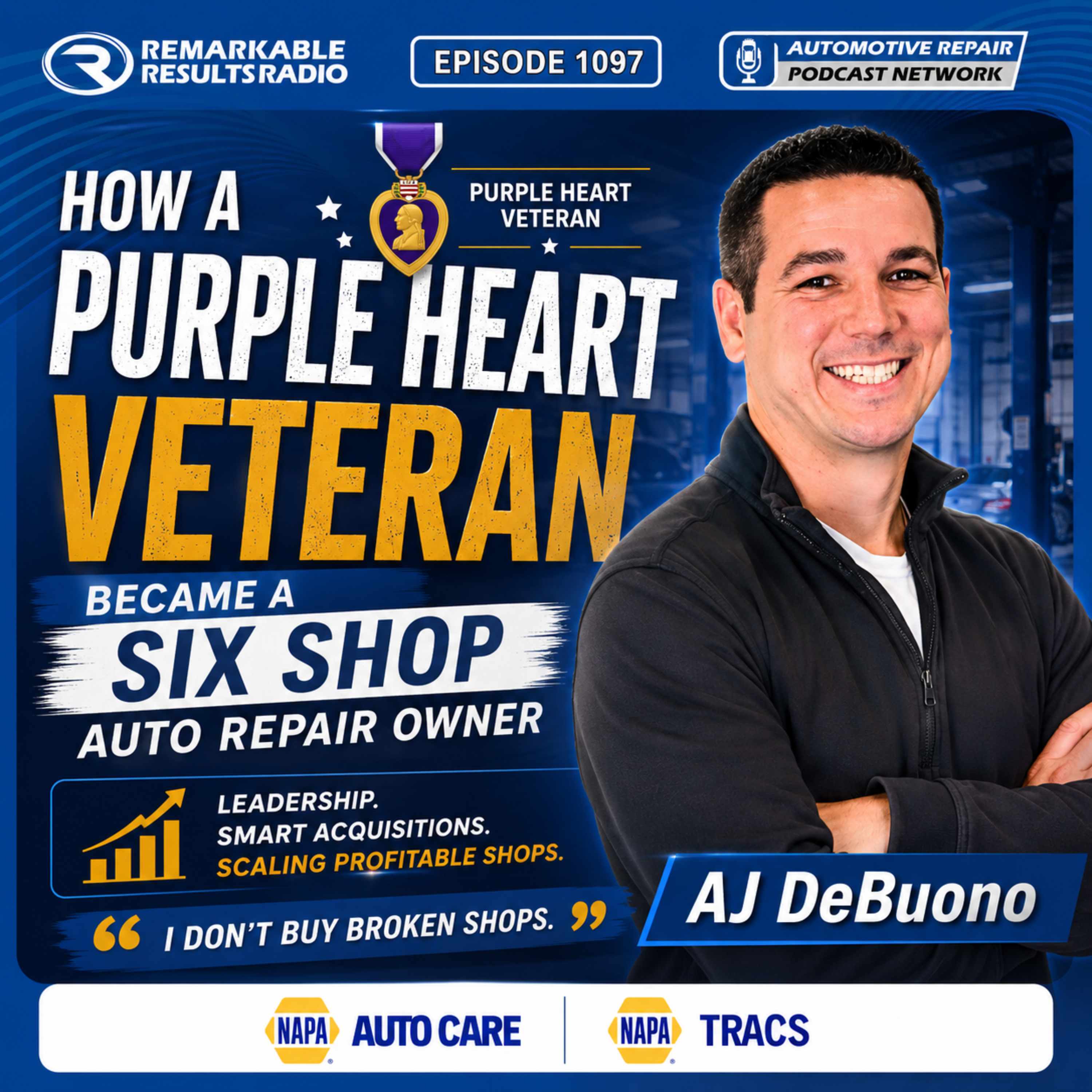
Remarkable Results RadioJune 23 · 30 min
How a Purple Heart Veteran Became a 6-Shop Auto Repair Owner [RR 1097]
Thanks to our Partners, NAPA Auto Care and NAPA TRACS Watch Full Video Episode What does it take to grow from a single auto repair shop to six locations in less than a decade? Host Carm Capriotto sits down with AJ DeBuono to discuss his journey from serving as a U.S. Marine in Iraq and Afghanistan to becoming a successful multi-shop operator. AJ shares the lessons learned through rapid growth, the acquisition strategy that has fueled his expansion, and how military discipline, financial discipline, and a commitment to people have shaped his leadership approach. Rather than buying struggling businesses and attempting turnarounds, AJ focuses on acquiring profitable shops with untapped potential. What You'll Learn How AJ leveraged SBA veteran loan programs to purchase and expand his first auto repair businessWhy he prefers acquiring profitable shops instead of distressed operationsThe key performance indicators he targets to quickly improve profitabilityHow military leadership principles influence his management style and business decisionsThe importance of creating career advancement opportunities through expansionLessons learned from growing too quickly and navigating financial stressHow AJ approaches shop transitions to minimize disruption for employees and customersWhy maintaining strong personal relationships with team members remains a priority despite operating multiple locations Growth is not simply about adding locations. It's about creating opportunities for your people, building systems that scale, and maintaining the discipline to make smart decisions when the pressure is highest. AJ DeBuono's story demonstrates that successful expansion comes from acquiring the right businesses, investing in your team, and staying focused on long-term value rather than short-term gains. AJ DeBuono, Diehl Auto Repair, Chicago, IL Learn more about NAPA Auto Care and the benefits of being part of the NAPA family by visiting https://www.napaonline.com/en/auto-care NAPA TRACS will move your shop into the SMS fast lane with onsite training and six days a week of support and local representation. Find NAPA TRACS on the Web at http://napatracs.com/ Connect with the Podcast: Visit the Website:https://remarkableresults.biz/Subscribe on YouTube:https://www.youtube.com/carmcapriottoFollow on Facebook:https://www.facebook.com/RemarkableResultsRadioPodcast/Follow on LinkedIn:https://www.linkedin.com/in/carmcapriotto/Follow on Instagram:https://www.instagram.com/remarkableresultsradiopodcast/Join Our Virtual Toastmasters Club:https://remarkableresults.biz/toastmastersJoin Our Private Facebook Community:https://www.facebook.com/groups/1734687266778976Join our Insider List:https://remarkableresults.biz/insiderAll books mentioned on our podcasts:https://remarkableresults.biz/booksOur Classroom page for personal or team learning:https://remarkableresults.biz/classroomSpecial episode collections:https://remarkableresults.biz/collectionsBuy Me a Coffee:https://www.buymeacoffee.com/carm The Automotive Repair Podcast Network: https://automotiverepairpodcastnetwork.com/ Remarkable Results Radio Podcastwith Carm Capriotto:Facilitating Wisdom Through Story Telling and Open Discussion.https://remarkableresults.biz/Diagnosing the Aftermarket A to Z:From Diagnostics to Metallica and Mental Health, Matt Fanslow is Lifting the Hood on Life.https://mattfanslow.captivate.fm/Business by the Numbers: Understand the Numbers of Your Business with CPA Hunt Demarest.https://huntdemarest.captivate.fm/The Auto Repair Marketing Podcast: Marketing Experts Brian & Kim Walker Work with Shop Owners to Take it to the Next Level.https://autorepairmarketing.captivate.fm/The Weekly Blitz: Weekly Inspiration with Business Coach Chris Cotton from AutoFix - Auto Shop Coaching.https://chriscotton.captivate.fm/Speak Up! Effective Communication: Develop Interpersonal and Professional Communication Skills with Craig O'Neill.https://craigoneill.captivate.fm
Listen →
61
Shop Fix Academy PodcastJune 22 · 25 min
I Traded A Truck To Build A $5M Shop | EP2 | Shop Fix Academy Podcast
Down to $1,100 in savings Coach Stan Andrewski and his wife made an all or nothing decision to buy a plane ticket and save his business. In this episode Stan explains how he went from bartering his tool truck for a failing auto shop, spending seven years working weekends and draining his 401(k), to hitting $5 Million with his business. Learn from his mistakes as he opens up on his first call with Shop Fix founder Aaron Stokes that gutted his ego, the 100-hour-a-week demand he was making of his techs that was quietly killing his shop and the core principles that brought him from being a great technician to a great business owner. Get the structure and clarity your shop has been missing with Shop Fix LITE. https://shopfixacademy.com/shop-fix-lite?utm_source=sfapodcast&utm_medium=podcast&utm_campaign=join-lite&utm_content=cta-textlinkLearn the systems top shop owners use to consistently increase profit and build stronger teams at Shop Hackers Conference. https://shophackersconference.com/?utm_source=sfapodcast&utm_medium=podcast&utm_campaign=shophackers2026&utm_content=cta-textlink Explore Shop Fix Academy Events led by operators who have solved the same profit, leadership, and operational challenges you’re facing now. https://shopfixacademy.com/upcoming-events?utm_source=sfapodcast&utm_medium=podcast&utm_campaign=sfa-events-2026&utm_content=cta-textlink
Listen →
62
Changing the Industry PodcastJune 22 · 1h 7m
Episode 274 - Can The Automotive Service Industry Be Saved? With Cecil Bullard and Wayne Marshall
Don't get to the end of this year wishing you had taken action to change your business and your life.Click here to schedule a free discovery call for your business: https://geni.us/IFORABEDon't miss an upcoming event with The Institute: https://geni.us/InstituteEvents2026Shop-Ware gives you the tools to provide your shop with everything needed to become optimally profitable.Click here to schedule a free demo: https://info.shop-ware.com/profitabilityTransform your shop's marketing with the best in the automotive industry, Shop Marketing Pros!Get a free audit of your shop's current marketing by clicking here: https://geni.us/ShopMarketingProsShop owners, are you ready to simplify your business operations? Meet 360 Payments, your one-stop solution for effortless payment processing.Imagine this—no more juggling receipts, staplers, or endless paperwork. With 360 Payments, you get everything integrated into a single, sleek digital platform.Simplify payments. Streamline operations. Check out 360payments.com today!In this episode, Cecil Bullard and Wayne Marshall discuss the challenges facing the automotive industry today. They examine the complexities and controversies surrounding technician licensing and certification, highlighting the need for industry-wide standards. The conversation also addresses the importance of financial literacy and measurable productivity in running a successful shop.00:00 Debating dealership licensing issues10:17 Balancing employee pay and motivation13:05 Building Employee Loyalty18:33 Improving employee wages and management23:01 Business fundamentals and financial ratios29:03 Planning an Exit Strategy35:00 Chris Enright on industry frustration41:01 Need for sophisticated testing46:14 Importance of unique selling proposition51:13 Importance of inclusivity and differentiation54:12 Challenges with membership relevance01:03:44 Young talent and enthusiasm01:04:15 Recruiting a young car enthusiast
Listen →
63
Master Tech to MillionaireJune 21 · 32 min
Serve First, Lead Better — Lessons from Autoshop Ministries
Joe Adams and Autoshop Ministries' Devante Tidwell discuss how true purpose is rooted in service, not job titles. Using 1 Peter 4:10 and real shop examples, they explore leading by serving employees and customers, stewarding gifts, and creating lasting impact. Listeners receive practical challenges to serve others, improve morale, and use small acts of care to make a big difference in their teams and communities. AutoshopAnswers.com Auto-Shop-Media.com
Listen →
64

Remarkable Results RadioJune 19 · 51 min
Why Auto Repair Specialists Leave Our Industry (And How Shop Owners Can Keep Them) [THA 490]
Thanks to our Partners, NAPA TRACS, Today's Class, KUKUI, and Pit Crew Loyalty Watch Full Video Episode *]:pointer-events-auto scroll-mt-[calc(var(--header-height)+min(200px,max(70px,20svh)))]" dir="auto" data-turn-id="request-WEB:8e59eec7-a235-4fa3-a072-956fea3fe478-7" data-testid="conversation-turn-4" data-scroll-anchor="false" data-turn="assistant"> *]:pointer-events-auto scroll-mt-[calc(var(--header-height)+min(200px,max(70px,20svh)))]" dir="auto" data-turn-id="request-WEB:49a777bf-d263-4496-bf0b-2eb3a46ac96a-11" data-testid="conversation-turn-24" data-scroll-anchor="false" data-turn="assistant"> Why do talented automotive technicians leave the automotive industry, and what can shop owners do to keep them? Host Carm Capriotto is joined by Technical Specialist Matt Fanslow and Technician Find CEO Chris Lawson to explore what it takes to attract, hire, and retain top talent in today's automotive repair industry. The conversation examines industry professionalism, workplace culture, compensation, employee engagement, and proactive recruiting strategies that help shops become destinations for exceptional technicians. What You'll Learn Why elevating the image of automotive professionals is critical to attracting the next generation of talentThe three primary reasons technicians leave shops: lack of respect, limited growth opportunities, and compensation concernsHow financial transparency can build trust, ownership, and a stronger team cultureThe difference between a shop's "official game" and its "shadow game," and why understanding both mattersPractical ways to gather meaningful employee feedback and turn ideas into actionHow leaders can remove obstacles that prevent technicians from finding joy and fulfillment in their workWhy relationships with tool truck drivers can become a valuable recruiting resourceHow a shop's appearance and reputation can influence whether top candidates choose to work there Finding and keeping great technicians requires more than competitive pay. Shops that create a culture of respect, provide clear growth opportunities, communicate openly, and actively remove workplace frustrations are far more likely to attract and retain top performers. The most successful shop owners don't wait for talent to find them, they intentionally build workplaces where skilled professionals want to stay and grow. Matt Fanslow, Riverside Automotive, Red Wing, MN, Diagnosing the Aftermarket A to Z Podcast: https://mattfanslow.captivate.fm/ Chris Lawson, TechnicianFind.Com. Listen to Chris' other episodes HERE Love your shop? Stay, but stay ready. Auto techs join to level up, find good shops, and keep tabs on top indie jobs nationwide. Techs only. No BS. Independent Wrench Jobs: https://www.skool.com/independentwrenchjobs Thanks to our Partner, NAPA TRACS NAPA TRACS will move your shop into the SMS fast lane with onsite training and six days a week of support and local representation. Find NAPA TRACS on the Web at http://napatracs.com/ Thanks to our Partner, Today's Class Optimize training with Today's Class: In just 5 minutes daily, boost knowledge retention and improve team performance. Find Today's Class on the web at https://www.todaysclass.com/ Thanks to our Partner, KUKUI Stop juggling multiple marketing tools. KUKUI’s integrated platform delivers 4x better website conversions, automated follow-up, and real-time ROI tracking. Get industry-leading customer support with KUKUI at https://www.kukui.com/ Thanks to our Partner, Pit Crew Loyalty You’re probably tired of chasing new customers who never return. We understand. Pit Crew Loyalty ends the one-and-done cycle, turning first visits into lasting, reliable revenue at https://www.pitcrewloyalty.com/ Connect with the Podcast: Visit the Website:https://remarkableresults.biz/Subscribe on YouTube:https://www.youtube.com/carmcapriottoFollow on Facebook:https://www.facebook.com/RemarkableResultsRadioPodcast/Follow on LinkedIn:https://www.linkedin.com/in/carmcapriotto/Follow on Instagram:https://www.instagram.com/remarkableresultsradiopodcast/Join Our Virtual Toastmasters Club:https://remarkableresults.biz/toastmastersJoin Our Private Facebook Community:https://www.facebook.com/groups/1734687266778976Join our Insider List:https://remarkableresults.biz/insiderAll books mentioned on our podcasts:https://remarkableresults.biz/booksOur Classroom page for personal or team learning:https://remarkableresults.biz/classroomBuy Me a Coffee:https://www.buymeacoffee.com/carmSpecial episode collections:https://remarkableresults.biz/collections The Automotive Repair Podcast Network:
Listen →
65
Downshift with TonnikaJune 18 · 51 min
The Hiring Mistake Shop Owners Keep Making | Sara Fraser & Chrisi Falco - Ep 20
Consistency is key - heard that! But, consistency is HARD. That's why I gave up on trying and let the experts handle it. Detect Auto. Let them clean up your estimating process and raise your ARO - like they did for me! CLICK HERE TO BOOK A DEMOAnybody can run a shop. Building one that lasts? That's a whole different story. If you're ready to build smarter systems and a better experience for your team and customers, check out Tekmetric HEREIn this episode, Tonnika Haynes sits down with Sara Fraser and Chrisi Falco from Auto Ignite Management (AIM) to talk all things hiring. Chrissy shares why finding the right fit is about making genuine connections—not just filling a seat. The conversation dives into the challenges of matching candidates and shops, the importance of clear communication (ditch the tech jargon!), and why letting go as a shop owner is crucial for real growth.Timestamps:00:00 Why working 50 cars a day is a no 01:00 Meet the AIM team: Industry roots, passion for matchmaking, and growing connections03:10 Are there really no techs? Why it’s about relationships, not shortages05:50 Should you keep a “bench” of techs? The ethics of recruiting & shop loyalty07:00 Why Chrisi refuses to work with just any shop—setting a high bar for culture08:30 What are you even offering? Shop owner introspection and culture checklists10:00 Women connecting in auto care: From awkward networking to authentic friendships12:15 Real talk on imposter syndrome and why even “superstars” get nervous14:35 Learning to follow up, build real connections & support the women in your network17:30 Teaching shop teams: Building trust (not confusion) with your customers19:00 Communicating repairs like a human—forget the tech jargon21:00 When the dealership totally misses your actual problem (and how to do better)24:00 Interview horror stories: “Honey, darling, babe”—and why culture fit matters27:00 Price matching, value selling, and the scary jump from dealership to independent31:00 Why coaching & confidence count more than the perfect resume34:00 Real interview answers that make (and break) a candidate38:00 Letting go: Why shop owners struggle to step back (and why you should!)41:30 Building a team that actually lets you leave—while your shop THRIVES45:00 You’ve earned your break, boss—embracing leadership, legacy, and life outside the bay49:00 AIM’s not just recruiters—they’re your matchmakers for growth
Listen →
66
Shop Soup PodcastJune 18 · 55 min
EP28: Tenets For A Successful Small Business: With Brent Garrett CEO Of Sirius Plumbing And Heating
Welcome to ShopSoup Podcast @SoupRadio247 In this episode, Brent Garrett shares insights from his book '30 Days of a Better Business,' discussing leadership, business growth, and creating a positive company culture. Greg and Brent explore strategies for small business success, team building, and personal development.Keywordssmall business, leadership, business growth, company culture, entrepreneurship, coaching, team building, business strategyKey topicsBusiness growth strategiesLeadership and team developmentCreating a positive company cultureThe importance of vision and mission statementsManaging the messy middle of business growthBuilding trust and employee engagementUsing Maslow's hierarchy for understanding customer and employee needsThe role of coaching and mentorship in businessSound bites"Slow and steady wins the race.""Trust is the foundation of client relationships.""Make lives better for your team, customers, and vendors."Chapters00:00 Introduction to Brent Garrett and His Journey02:31 The Essence of Small Business Ownership05:10 The Narrative of 'Thirty Days of a Better Business'08:00 Mentorship and Learning from Mistakes10:59 The Importance of Client Experience13:45 Building Relationships in Business16:21 The Value of Younger Generations in Business19:15 Navigating the 'Messy Middle' of Business22:24 Vision and Mission Statements in Business24:46 Strategies for Achieving Business Goals29:00 Navigating the Journey: Vision and Mission30:56 Understanding Needs: Maslow's Hierarchy in Leadership35:17 Burnout vs. Fatigue: Supporting Team Members41:01 Building a Positive Culture: The Power of Gratitude48:23 Coaching for Growth: Empowering Small Business Owners51:19 The Road Ahead: Applying Lessons from the BookGet Your Free Copy of Brent's Book30 Days of a Better Business by Brent Garrett - https://www.amazon.com/s?k=30+Days+of+a+Better+Business+Brent+GarrettThe Skilled Trades Coach - https://www.skilledtradescoach.comLinkedIn - https://www.linkedin.com/in/brentgarrettWebsite - https://www.skilledtradescoach.com
Listen →
67
The Limitless Leadership PodcastJune 17 · 39 min
Ep 158: Stop Managing. Start Multiplying Leaders. | Shawn Gilfillan
Listen →
68
Downshift with TonnikaJune 16 · 1h 7m
Why Young People Aren't Choosing the Trades | Zeb Beard and Benjie Burris - Ep 19
Consistency is key - heard that! But, consistency is HARD. That's why I gave up on trying and let the experts handle it. Detect Auto. Let them clean up your estimating process and raise your ARO - like they did for me! CLICK HERE TO BOOK A DEMOAnybody can run a shop. Building one that lasts? That's a whole different story. If you're ready to build smarter systems and a better experience for your team and customers, check out Tekmetric HEREYou can almost taste the cornbread listening to this episode!!! Boy oh boy, Benjie Burris and Zeb Beard on the same podcast for the first time ever??? Yes way. Today, Tonnika and the guys talk leadership, training, and the future of the trades. Benjie and Zeb reflect on their similar upbringings, sharing how old-school mentorship and tough love shaped their approach to running successful shops. The crew digs deep into why young people aren't entering the industry like they used to, pointing to a breakdown of family structure, lack of respect, and a missing "village" mentality.Timestamps:00:00 Why feelings and political correctness are overrated01:02 How Benjie & Zeb’s shop life and upbringings shaped their leadership05:32 Did they ever dream they’d get this far? Facing doubts and never dialing it back08:45 Biggest lessons learned—they’ve made every mistake so you don’t have to12:00 How screwing up (and getting up again) builds better techs15:04 Tough love truth: The best AND worst thing about this business is people18:05 Coaching up a new generation—pushing young techs out of their comfort zones25:00 Why there aren’t enough young people in the trades (and what’s REALLY to blame)31:40 “It Takes a Village”—what happened to respect and community?35:00 Petting vs. pounding: Can you train techs if you’re too soft?40:03 Whose responsibility is it when things go wrong in the shop?44:00 Why shop owners bear ALL the risk and how that shapes leadership47:00 Investing in real training—who’s actually willing to learn?52:00 Not all shop owners are created equal (and why some are holding you back)55:00 Independents vs. dealerships: what the next-gen needs to know58:15 Level up or get out—finding and keeping the hungry ones1:03:00 Final tough love: Stay real and keep growing—this industry needs YOU
Listen →
69
The Jaded MechanicJune 16 · 1h 56m
Why Some Technicians Are Leaving Flat Rate | Daniel Whitey
Like the show? Show your support by using our sponsorsNeed to update your shop systems and software? Try Tekmetric HERELaunch your tool game to the next level with Launch Tech USA! HEREIn this Jaded Mechanic Podcast episode, Jeff sits down with Canadian technician Daniel Whitey to discuss his journey through the automotive trade. Daniel shares how a Chrysler co-op program at Centennial College led to an apprenticeship, dealership experience, and eventually a move into fleet maintenance. They discuss the realities of flat rate pay, mentorship, shop culture, tool investments, diagnostics, and why Daniel ultimately chose the stability of a straight-time fleet position. The conversation also explores technician mental health, career development, and advice for new technicians entering the industry.Timestamps 00:00 Welcome 00:51 Meet Daniel Whitey 03:48 Career Origins and Licensing 09:09 Centennial Chrysler Co-op 10:58 Chrysler Dealer Experience 21:30 Mentorship and Flat Rate Life 35:12 Diagnostic War Stories 42:04 Hybrids and EV Discussion 44:15 Leaving Chrysler 50:46 Transition to Hyundai 56:45 Hyundai Challenges 01:01:34 Fleet Shop Life and Benefits 01:08:38 Daily Fleet Pressures 01:18:53 Leaving Dealerships Gracefully 01:21:11 Saturday Flat Rate Grind 01:25:35 Recall Day Stories 01:35:46 Advice for New Technicians 01:46:44 Licensing and Competency 01:52:37 Mental Health and Closing Thoughts Follow/Subscribe to the show on social media! TikTok - https://www.tiktok.com/@jeffcompton7YouTube - https://www.youtube.com/@TheJadedMechanicFacebook - https://www.facebook.com/profile.php?id=100091347564232
Listen →
70
Shop Fix Academy PodcastJune 15 · 24 min
I Netted $100K In A Month AFTER I Got Stolen From | EP1 | Shop Fix Academy Podcast
His manager stole from him, his entire staff left and he STILL made $100k profit in one month. In this first episode of the Shop Fix Academy podcast, Coach Jay Huh breaks down the one phone call that pushed him to shut down a shop, and how that execution mindset became the engine that grew his $1k a month operation into a six figure machine. Hear the hard conversations, the make or break moments, and the DECISIONS that built him into the auto repair leader he is today.Get the structure and clarity your shop has been missing with Shop Fix LITE. https://shopfixacademy.com/shop-fix-lite?utm_source=sfapodcast&utm_medium=podcast&utm_campaign=join-lite&utm_content=cta-textlinkLearn the systems top shop owners use to consistently increase profit and build stronger teams at Shop Hackers Conference. https://shophackersconference.com/?utm_source=sfapodcast&utm_medium=podcast&utm_campaign=shophackers2026&utm_content=cta-textlinkExplore Shop Fix Academy Events led by operators who have solved the same profit, leadership, and operational challenges you’re facing now. https://shopfixacademy.com/upcoming-events?utm_source=sfapodcast&utm_medium=podcast&utm_campaign=sfa-events-2026&utm_content=cta-textlink
Listen →
71
Master Tech to MillionaireJune 14 · 36 min
Auto Shop Ministries Episode 1: Launching Faith-Driven Leadership in the Shop
Episode one of Auto Shop Ministries introduces Devante Tidwell as chaplain and outlines a weekly, faith-based series for shop leaders. This episode focuses on how trust scales: being faithful in small tasks signals readiness for bigger responsibilities, the importance of strong processes alongside competence, and practical tools like journaling and consistent evaluation to make better hiring and promotion decisions. AutoshopAnswers.com Auto-Shop-Media.com
Listen →
72

The Institute's Leading Edge PodcastJune 12 · 56 min
208 - A Technician Crisis or a Productivity Problem? Ask Me Anything with Cecil and David
208 - A Technician Crisis or a Productivity Problem? Ask Me Anything with Cecil and David June 10, 2026 - 00:55:43 Show Summary: Cecil Bullard and David Roman discuss whether the industry's biggest challenge is finding technicians or improving productivity. They explore why shop owners often keep struggling employees too long and how clear expectations make difficult staffing decisions easier. The conversation highlights the importance of job descriptions accountability and documented processes. They also explain how poor structure lowers shop value and limits growth. The discussion closes with a look at pricing strategies and why shop owners must stop blaming rising costs instead of adjusting their margins. Host(s): David Roman, Shop Owner Done With Care Auto and Changing the Industry Podcast Cecil Bullard, Founder of The Institute Show Highlights: [00:01:03] – Letting the wrong employee stay hurts the whole team. [00:05:22] – Every employee impacts the success of many families. [00:08:15] – Winning requires the right people in every role. [00:12:14] – Hire carefully and accountability problems become less common. [00:17:10] – AI makes creating job descriptions easier than ever. [00:20:11] – Structured businesses hold greater value and survive longer. [00:24:03] – Poor productivity and margins cost owners millions. [00:30:32] – Employees need coaching before owners assume resistance. [00:37:46] – New habits require daily follow up and accountability. [00:47:13] – Rising costs require pricing changes not excuses. In every business journey, there are defining moments or challenges that build resilience and milestones that fuel growth. We’d love to hear about yours! What lessons, breakthroughs, or pivotal experiences have shaped your path in the automotive industry? Share your story with us at info@wearetheinstitute.com, and you might be featured in an upcoming episode. 👉 Unlock the full experience - watch the full webinar on YouTube: https://youtu.be/Xrs_YGYDAic Don’t miss exclusive insights, expert takeaways, and real talk you won’t hear anywhere else. Hit Subscribe, drop a comment, and share it with someone who needs to hear this! Links & Resources: Want to learn more? Click Here Want a complimentary business health report? Click Here See The Institute's events list: Click Here Want access to our online classes? Click Here ________________________________________ Episode Transcript Disclaimer This transcript was generated using artificial intelligence and may contain errors. If you notice any inaccuracies, please contact us at marketing@wearetheinstitute.com. Episode Transcript: A Technician Crisis or a Productivity Problem Ask Me Anything with Cecil and David Cecil Bullard: Welcome. My name is Cecil Bullard. Welcome to the Institute Ask Me Anything. Today you get to ask me and David Roman from Changing the Industry podcast, a f- good friend of mine. Hey, David. How are you today? David Roman: This is so professional. I'm not used to this. Cecil Bullard: Oh, come on now. Wait a minute, brother. David Roman: I do the production work on my podcast. Trust me, this is professional. I just slap the stuff up on the internet and say, "Go." Cecil Bullard: There you go. I don't know. I'm a nut, so I'm a- ... I'm a perfectionist and- Yeah ... in fact, my hair is bothering me, right? And David Roman: just cut it all off. Cecil Bullard: Yeah. You'll like it. Just cut it all off. What's what's cooking with you, brother? What's what do you got for us today? I know we got some people that will be asking questions and all of that. And David Roman: you- Yeah. I've got an interesting question I- I'd like your opinion on, and this is a discussion Lucas and I have had in the past. In our minds, you, as you start to scale, you become more disconnected with the business on a personal level, and it becomes a business. I've... and this is specifically with your staff, where when the shop is small and maybe there's three employees, maybe four employees, you're all friends. You kinda hang out, you have lunch together. It's a whole thing, right? But as you start to grow the business and you've gotta start letting people go, the weak links or people that are causing problem or people that have just run their course in the business and they can no longer keep up with what you're demanding or what you need for the business to continue to succeed, you have to start letting people go. And that has and this question came up in the, in, in our Facebook group, where the person was having trouble finding the mindset and the wherewithal to let the person go that needed to be let go. And he just, he's "Man I'm just too c- too connected to the person. I don't know what to do. How do you disconnect that?" And he just, he felt bad, and he knew that when the time came, he wasn't gonna be able to pull the trigger. And I see this Incredibly detrimental to businesses in general. You see too many businesses that you walk into and you immediately identify that person's gotta go. That person is causing all this trouble here. They are binding up production. They're questioning everything you do. They're undermining your authority. They don't allow you to implement anything new because they wanna go immediately back to their old ways, and they wanna kinda hide in the weeds a- and hide in the chaos is what we call it, right? Yeah. There's chaos going on in the shop, and they just wanna hide in the chaos and just kinda cruise and collect their paycheck. And they don't let them go because they're like, "Oh, they've been with me for 15, 20 years. I can't let them go." H- how do you make that mindset shift? What have you seen? What have you seen work at other shops? How do you kinda make that change? And how have you done it within just the institute itself? Cecil Bullard: It's never easy to terminate somebody, especially someone that you may have been working with for a very long time. And there, there needs to be some loyalty to your people, right? Yeah. You can't just like, "Oh, you screwed up, so now you're gone." And I think that in mo- for me, it's been a difficult change. I, I think a lot of people think I'm a pretty cold-hearted SOB, so for me to fire somebody, no big deal. But I always keep people too long. I always have too much hope all of that. For me, I think we talk about a vision for the business. We talk about your vision statement, your mission statement, those kind of things. I think the more you clarify the rules and the roles of the job I would I might sit down with with you, David, and I might say, "What's the org chart looks like? What does this business look like, say, five years from now? What do you want out of your life," right? And you say to me Cecil, here's how that looks." And the organizational chart creates structure, right? Who answers to who. But it also, if you do it right, it can create description, job description. What do I need this person in this role to do, right? And so the more you clarify, the more the people that can't or won't get the job done will stand out, all right? And I think that I have to look at my business differently. So let's say that you and I we're buddies and we're gonna start a shop. And by the way, I'm gonna be the sales guy. You can be the tech 'cause I'm not a tech not now anymore. And I'm still pretty good at selling stuff, so- I David Roman: rebuild car, by the way. It'll be a terrible shop. Cecil Bullard: Yeah. So you don't fix cars either. We're gonna have to hire somebody. But let's say that we do that, right? And so we're best buds, and we go along for a couple of years, and I'm not getting what I need or want out of my life, right? I didn't start the institute to pay the bills, right? If I had started the institute to pay the bills, I would've worked for somebody else, right? Yeah. I started the institute to do something special in the world that I live in and to try to control my future and to create my future, and a future for my family and the families of the people I work with. So we have to start thinking differently, two years from now, we've got three techs, we've got a service advisor and you and I, and I'm not responsible for just Cecil or just Cecil and Dave. Now I'm responsible for, I don't know, 25 people, because everybody that works for me has a family, right? Yeah. And if I allow one person in the company or even two people in the company to hold the company back Then everybody gets penalized. This is a, an ecosystem. When the ecosystem gets screwed up, everybody suffers, okay? And it's one thing for me to say I'm gonna, I'm gonna hold onto David even though he's a pain in the ass, and even though he won't change and even though he costs me money and gives me aggravation because, I've got this loyalty thing and I like David and I'm gonna hold onto him." I can do that when it's just you and me, right? Because I'm only affecting me and my family, right? And I can make that decision. But, at the institute we've got 30, I don't know, 34 employees now and that only counts the institute. That doesn't count other companies that we now have brought into the institute, so we're probably closer to 60 or 70. And those are 60 or 70 families- David Roman: Yeah ... Cecil Bullard: that I have to affect. So if I have somebody in here that's fighting the, whatever, not doing their job correctly. Plus, I've created this structure in the organization, remember, because I don't wanna be the only person that's gonna draw... pull the hammer, right? I think you have to understand that and I think this is one of my, kinda one of my things. I wanna win, right? And in fact, I'm so mentally ill that I will do, l- I don't really wanna win, I just don't wanna lose. David Roman: Yeah. Cecil Bullard: And so I will do almost anything it takes to win. And I have to watch that, because that sometimes can push me over the edge, right? And so I have to control that part- And I have to, for, so for me, if I'm gonna win, I can't have people in the organization that can't or won't do their job- Yeah ... or that are fighting the organization. Think I used this morning with one of my clients. I said think if you were building a, you wanted to win the Super Bowl, and you're building a championship football team, and you had a receiver that couldn't catch." Yeah. Okay? What would you do with that guy? Yeah. Would you keep him on your team 'cause he's a nice guy, and, he always shows up to practice, he's early to practice, and he practices really hard? He just can't catch the ball, right? It's not his fault. He's a nice guy, right? Would you keep him? David Roman: Yeah. Cecil Bullard: And the answer's no, because y- you could never win the Super Bowl. You won't. And while that might seem harsh, my- personally, I don't believe it's harsh. David Roman: Yeah. Cecil Bullard: I had a... I took over this company that was failing miserably, and for the first, I don't know, eight, nine months I worked 80 hours a week. I interviewed people. I sold 1.9 million annually at the service counter by myself. I ordered parts. I did a bunch of stuff. And I was away from my family for all that, so my family suffered for that time. And so I hire this guy. We'll call him Mike. A nice guy. Really nice guy. He became my right ar- arm guy. He became the guy that when I decided I'm gonna take Mondays off, he was there Monday. If there was a unhappy customer, he took care of the unhappy customer. And so we're in this thing two and a half, three years, and he's my right arm guy, and he's allowing me to go spend time with my family. Holy smokes. Yeah. And all of a sudden, he is the most sour, rotten guy. "This effing company," and, "This it's the same effing crap every single effing day," and blah, blah, blah, and, "I hate this effing job." And, about two weeks of this, and I pull him in my office and I said, "Dude, I'm gonna terminate you." I said, "It's not that you're not, quote-unquote, doing your job, but you are so unhappy and you're so miserable, you're dragging all of us with you- Yeah ... and our customers with you. And I can't ha- " And I terminated him, right? And about two years later, he... I saw him somewhere and he came up and he said, "I just wanna thank you for firing me." David Roman: Yeah. Cecil Bullard: And you're like wait a minute," that was a hard thing to do. You were my right arm guy. David Roman: Yeah. Cecil Bullard: And he said, "No, I needed something else." "And I went somewhere else and I found something that made me happy. The Institu- It wasn't the Institute at the time, it was Larry's, but Larry's wasn't making me happy. I couldn't- Yeah ... be happy," right? "And you recognized that, and you did the hard thing and you terminated me." David Roman: Yeah. Cecil Bullard: I, I- I think that business, the, what's different between, say, corporate business and, small business- ... right? Little family-run business. We all know each other. Kinda in corporate I probably do, too. The problem with corporate is corporate has a very distinct reason for being there. Yeah. It's about profit, and if you don't make profit- It's well de- David Roman: well defined. Cecil Bullard: Yeah. A- and if you don't make profit, then the investors leave, and you don't have a company. Yeah. It's that easy, right? And so it's very easy, and they also are much more structured. So incorporation, in a corporate, you've got the manual, you've got your, your process manual, you've got the company a man- manual, you've got the safety manual. ... You got your procedures, and if you screw that up and the profits disappear from the company, you're fired. That's it, right? Yeah. There's not... Th- there wouldn't be a manager because if the manager didn't fire you, if your direct manager didn't fire you, the guy above him would. Yeah. And he'd also fire the manager, David Roman: right? Cecil Bullard: Yeah. And so there's no... but we as owners of small businesses, we're much more compassionate, and we put up with it a lot longer. Yeah. I would also say that in a, in corporate, because you know there's consequence and you know that consequence is, it's going to happen, that you're much more likely to handle it sooner rather than later. Sometimes. So what happens... Y- yeah. In small business- Nope ... a lot of times we watch somebody go downhill, and we watch them go downhill, and it's only after we've kinda got the courage up to have the conversation, that could be six months from now- David Roman: Yeah Cecil Bullard: that we have the conversation, and by then we're probably angry, and if we're angry, we're not doing the right things. David Roman: No, we're not rational. Yeah. Cecil Bullard: Yeah. David Roman: Yeah. I've seen, I, we just had somebody on the podcast, and the guy i- is doing extremely well. He's just killing it. He's super young, and he's he just blurted out, he's I fire them as fast as I hire them." And I go hold on now. You're just finding more people and you're just cycling through?" He's "Yeah, I just cycle through them until I find the right person." And it goes back to the phrase you hire slow, you fire fast. Cecil Bullard: Yeah. David Roman: But the hiring slow si- sometimes gets glazed over. If you're finding the right people and you're taking the time to find the right people, and then just as you stated earlier, you're putting them into an organization that is well-defined in their role, in the organizational chart, the likelihood that you're gonna have somebody that you're gonna have to fire is going to go way down. I don't fire a lot of people. I haven't had to fire a lot of people, and the ones that I've had to fire is for a reason. But- Cecil Bullard: If you create accountability and- David Roman: Exactly. But that, that- And if you Cecil Bullard: manage ... David Roman: that assumes that you've got well-defined roles, job description- And that's- everybody knows exactly what they're supposed to be doing because at that point you can then hold them accountable and go, "Hey, this is what we do. We do A, B, and C. You're not doing A or B or C, whatever it happens to be. We need to either fix this or you can't be in the organization." Cecil Bullard: And, a- and in what business can you go to work and say to your boss, "No, I'm not gonna do what you asked me"? David Roman: Yeah. Oh, yeah. Cecil Bullard: The o- the automotive industry, I'm sure a lot of small businesses, who knows, maybe the local bowling alley the guy that's supposed to be, spraying the disinfectant in the shoes and handing you shoes, maybe he's not doing his job right and nobody is catching it. But in, in- almost any world, if your boss asks you to do... I was when I've had an employee that won't do what I need them to do, and f- and I'm sure that we've discussed it, I'm sure they understand what it is, but they still refuse, I always ask them, "Is it illegal, immoral, or unethical?" And they're like no it's none of those. I just don't wanna do it." Okay. That's called gross insubordination, and that's means for termination. Yeah. That's in your employee manual, right? And if you read your employee manual, you understand that when the boss asks you to do something, if it isn't illegal, immoral, or unethical, then that's what you're supposed to do. I could change your whole job description. I could go, "Hey, David, from now on, you're not gonna be talking to anybody on these dang webinars," blah, blah, blah. If I'm the boss I could do that, and you could be really upset about that, but it's not illegal, it's not immoral, it's not unethical so what? Yeah. And then you have the choice to say, "I don't wanna be in that job anymore," right? I- Yeah. You changed my job to a place where I don't wanna... It's not what I wanna do. Yeah. And that's fine. But because we know people, because we're intimately involved with them, we know their lives. My our top admin person is in Ireland right now getting married, along with most of our admin staff. And and you're like, we know these people. We know their lives. We know their husbands, their wives, their kids. They've been to the barbecue, et cetera. I think the way that I look at it is I owe it to the company and to the people we serve. So I've had the opportunity to change- Probably anywhere from 4 to 10,000 lives for the better- in most cases. I, at least I hope so, right? And if I didn't terminate unhealthy people out of the organization- Yeah ... I would've changed a lot less lives. Yeah. I would've helped a lot less people, right? And so I, I look at it differently, and it still takes me too long, and it's still painful to let someone go. David Roman: Yeah. And th- this brings up another question that somebody had had popped up in, in one of the Facebook groups, and that ha- has to do with job descriptions. And just pertaining to the conversation we were just having, if the, if you're not outlining the job for the person, they will invent something for themselves. Cecil Bullard: Yep. David Roman: And then the minute you ask them to do something that in their mind they've created this job description, "This is what I do," it's okay, since I didn't define it, I guess you defined it for yourself. Now I'm asking you to do something that's not within that purview. You're gonna get upset, and then all of a sudden the the hostility starts because now they're slighted that, "Hey we didn't discuss this. Why are you asking me to do this? That's outside of my job description." I don't have a job description written out for you. You invented it for yourself. But This was somebody that needed a something on paper, and I said, "Look, at the very least, you can always start with technician fix the car." Cecil Bullard: Yeah, fix the car. Just David Roman: start Cecil Bullard: with- It should, frankly, right? David Roman: Yeah. Be- I'm telling you, these shop owners- ... they get in their heads about job descriptions and standard operating procedures, and they just overcomplicate it, and they're like I gotta have this outline, and it's gotta look like corporate," like you were saying, the HR manual, and this, that, and the other. You don't need to have all that. Just start with the very basics. Like- Cecil Bullard: But the funny thing is today, first of all, from the institute, if you want a job description, we got job descriptions. I- if you're a client, certainly you have access to all of that. But I would almost tell you that I have posted job descriptions, all kinds of things online- 50 times, yeah. And it... Right now, if you were to Google or use AI and say, "I need a job description for a technician that does XYZ," and you were to just basically define it, it would come up with a pretty dang decent job description for you. And you can- ... David Roman: adjust from there. Cecil Bullard: Yeah, and then you can make adjustments. It's AI, and a lot of us are afraid of AI in our industry, and a lot of us don't really understand what AI is or, some of us think it's gonna, it's gonna decide to destroy us, Skynet and all of that. It's coming David Roman: up. Cecil Bullard: But you never know. Skynet launching David Roman: the missiles or Cecil Bullard: coming to town. Any minute, right? But I think I don't even have to use AI. I can go online and say, "Can I have a job description for a technician?" And Google's gonna give me five different job descriptions. Yeah. And I can go through and pick and choose the pieces that fit my job descriptions. It is... It's not 25 years ago where you might if you went to Google and said I don't know if Google's 25 years old, it's probably about 25. I had- It's almost there ... an opportunity to buy Google stock way back then, which I did not do otherwise. But- David Roman: We wouldn't Cecil Bullard: be talking right now. But no, we would... Maybe not the same conversation. We'd be on a boat. But yeah. But if I... 25 years ago if I said, "Give me a job description," it would've went "I'm sorry. W- what? Huh?" And probably for the last 10 years, I could've went on and got a job description if I really wanted to get a job description. The other problem we have, I think just as an industry, is that we're so busy Just trying to do the job of keep the cars going through and keep the customer happy, that we forget that we need to organize and structure the business in order to ultimately be successful, right? Yeah. There are so many guys that are my age and older that are having to get out of the business for health issues that they haven't structured their business, so there's no- nothing to sell, right? It's solely based on whether or not you made any money, and if you didn't make enough, then it isn't, it has no value. And it's a real shame to watch guys in their, late 60s, mid sev- to mid-70s when they realize, "I'm gonna have to retire and all I'm really gonna have is the little bit of money I saved and my Social Security, if it exists, and I'm not gonna get, really get anything out of this company that I r- I ran for the last 45 years." David Roman: Or they're delusional and they think that thing's worth a quarter million doll- And it's dude- Cecil Bullard: Yeah, and they're David Roman: never gonna get it ... you're doing $30,000 a month and you're not even profitable. What? Cecil Bullard: Yeah. And they're ne- and they're never gonna get it. I mean- ... and, a-again, the more you st- you know with I know a lot of people are not happy with the thought of venture capital coming in and all that, but they're here. And the more you structure your business, the more you pull yourself out of the day-to-day roles in the business, the more your business becomes worth. David Roman: Yeah. Cecil Bullard: Whether you sell it to venture capital or you sell it to your service advisor or someone else who's looking to build their bench, right? Or their their platform. It's it... The game has changed a lot, unfortunately. I was do- a bunch of statistical data we did last week for this big meeting that we were having I think a 127,000 shops out of about 260 are just gonna close in the next five years. David Roman: Yeah. ' Cecil Bullard: Cause there's no, there's nothing there. There's no value. And there might be another 100,000 that will open and start, yeah. But a bunch of guys are just gonna disappear and fade away because they didn't structure, they didn't You know, build job descriptions and flow charts and, Biggest issue in the industry in my opinion is that we really don't fully understand our business, and therefore we don't really run our business in a financially prosperous way. David Roman: Yeah. Cecil Bullard: Yeah. David Roman: Not having those steps outlined... And I, a- about my shop. I'm not- Yeah ... in my shop at all, ever. Yeah. I don't go down. I avoid it. I go to the dumpster once a month and dump stuff out of my house that I need to throw away. And that's it. I just Cecil Bullard: did that this weekend, man. Dumpster's full. David Roman: Yeah. And but the reason why that's been possible, and it- not that I'm maximizing profitability or to the nth degree and tweaking this, that, and the other, but we at least got the blocking tackling down. Yeah. A- and it's automated to the, to a certain point that the manager can talk to anybody that they bring in and say, "This is where we hang the keys. This is where the car goes. This is where we hang the keys for the next car." "This is how we estimate." "This is how we dispatch the work." "This is how we price." "This is how we do the estimate." Yeah. Yeah. "This is how we..." Everything's automated on the shop management side. Y- so just whatever the price is, that's the price. This is how we outline the repairs. Everything is just set up in a specific fashion that it can be tra- it's trainable. They can go onto somebody else brand new... And I brought in two people in the last six months, a tech and somebody to help up front so I don't have to be there at all. And they have, they've been able to get trained on the processes where w- I just had a conversation with somebody, and they were saying that they had brought in this tech. This guy is just hurting for techs, just dying to get techs. Finally gets somebody to bite, and he's probably throwing huge money out there because he finally, he got somebody- I know. Yeah ... and they actually moved their box into the shop. So the money was there. Within two hours, the guy was gone. Two hours, Zola, it took for the guy go, "This isn't gonna work. I gotta go." " Cecil Bullard: I can't make this work." David Roman: Yeah. Yeah. And I guarantee he walked in and he's he was just handed a clipboard, and he's "Hey, fix that car." And he's li- looking at the clipboard, and there's some scribbles on it, and it, there's no process. Where do the keys go? Where are my parts? What work needs to be done? How many hours am I getting paid for? Like, all of these very basic things that need to be outlined haven't been outlined, and the, they're, everybody's just kinda shooting from the hip. 25 years later, they're trying to get rid of the business, and they're like What do you want me to sell here? There's nothing to sell. There's no processes, there's nothing. You're in the business every single day shooting from the hip. Yeah, you can't- You remove yourself from the business, like what do you do? Cecil Bullard: And you're also costing yourself, probably hundreds of thousands, if not millions of dollars over the 40 years that you run the business. Absolutely. Because you're not maximizing, your business. I had a new client it actually wasn't one of my clients, but I often am involved in new client meetings with some of our coaches and- so we have a new client come on board, and their parts margin's off by 14%. And you're like, "Oh, that's 50 grand," right? And then you look at their productivity's at about 55%. And you're like, "Oh, there's 200,000." And so think about that. If you can clean up your margins and your productivity and, put another, say, $200,000 a year into your profit, at over 40 years let's say you s- you saved f- 25% of that. You put 25 grand away every year for 40 years, what would you have, right? Yeah. It's... I- you'd have what, $10 million? Yeah ... maybe 20 because of the interest stuff. A- and so you're not just creating frustration for the people around you, you're not just reducing value in, say, your business, but you're potentially costing your family millions of dollars worth of revenue that you could have just even if you just ran your business smartly and saved a little bit on the- Yeah on the way. And it's unfortunate to see that because those are the same guys. We do a lot of I don't know, we do a lot of... I don't call it marketing, but we do a lot of meetings and stuff. And so we bring in people, we do this leadership intensive meeting, and we bring in shop owners. And a shop owner'll come in and he'll bring his two or three kids in. So we've got a, a 25-year-old a 23-year-old, and a 19-year-old, and they're all there, and they wanna have nothing to do with Dad's business. David Roman: Yeah. Cecil Bullard: Nothing. They don't wanna be involved because they watched their dad work 80 hours a week and struggle to pay the bills and all of a sudden- Stressed out David Roman: of his mind. Cecil Bullard: Yeah ... yeah, and all of a sudden, they're now at an age where they could participate and Dad would maybe like them to participate, but they're not interested at all. Because they don't see any future for themselves in it. We didn't show them a future 'cause we didn't even create a future for ourselves. And to me, that's- that's kinda a l- that's a little criminal. So i- it would go back to, Cecil, how do you terminate somebody that's been with you for seven years that, has-- When you started the business, they were an essential part, and they've kinda worked themselves out of that, their attitude or even what they do, or they haven't kept up on their education or whatever. How do you terminate? Because 15 years from now when my kids are 25, 30, I want them in the business with me. I don't want them, I don't want them going out to do something else with somebody else. Yeah. One of the greatest joys of my life today is being able to work with one of my children, day to day. Yeah. And my second greatest joy is having all of my family near me and having good relationships with all of my family. Yesterday- Yeah ... it was it was my birthday. Don't, please don't do anything or don't send me any more happy birthdays. But- But I was able to have my family with me. And just have a, a nice evening. And the f- the cool thing is the dad is to sit back and watch the kids interact with each other and have good interactions, right? Of they tease each other, give each other crap, but it's all in fun. And, that's... A- and part of that's because I didn't... 'Cause when I was home, I tried to be home 'cause I wanted to have those relationships, and when I was at work, I tried to be at work because I knew that I needed, when I'm at work, I need to be at work so that I can have the home time that I need, right? David Roman: Yeah. Cecil Bullard: Whoever might be listening to us, if you do have questions, we certainly would be more than happy if you'll put them in the comments to answer any of those questions. So- It's gotta be a David Roman: good question, otherwise I won't ask it. Cecil Bullard: Yeah, crappy question, we're not gonna- David Roman: Crappy questions are Cecil Bullard: ignored. No. No crappy quest- So how do you fire somebody? How do you actually terminate somebody? That might be, a good question. Yeah. First of all, you do not go into long, lengthy explanations about what they didn't do right. You're just opening yourself up for argument, pain, and I always just tell people, we've made a decision. We're going to be letting you go." Yeah. That's it. Yeah. And and, Now if, David Roman: In my state, if you don't have good documentation- Yeah ... it turns into now you're fighting them for unemployment benefits and this, that, and the other. In every state. Yeah. And th- and this is... if the person needs to just go, they just need to go and just pay up. It's whatever. Yeah, I don't care about unemployment. Cecil Bullard: And David Roman: we're having that Cecil Bullard: assist-- Yeah. I never cared about unemployment and I never used- David Roman: They raked me over the coals- I used that- in Kansas, let me tell you. Yeah. I never used that- If somebody actually dips into it. Cecil Bullard: Yeah, I never used that as a decision about hiring or terminating. If I need to terminate you and I end up paying unemployment, it's part of the game. Yeah. David Roman: But I will say that if you specifically have a job description You've got something outlined and they are violating whatever it is that you've got in writing with their- Yeah signature acknowledgement that they know that this is what's there, and you know that, hey, this is now going down this path. And it really for me, it's ... I'm looking at it two or three steps down. If I can sit down and coach this person and have conversation and go, "Hey, you're not doing this. I need you to pivot," then I'm gonna have that conversation, and it's not gonna get written down. However, if I see them going down this path that, hey, this is not salvageable, I need to let this person go, the first violation is a write-up. Got you. "Hey, you didn't do this. Here's your write-up." Usually they go on their own, but if they don't, it's just three write-ups and then boom, they're gone. Cecil Bullard: Yeah. David Roman: And- And then that's it. And then the minute- But- ... that the state sends me that letter- Yeah ... here's the write-ups. Boom boom. There you go. Fax it over. Done. Cecil Bullard: And, and- David Roman: I'm not paying squat. And Cecil Bullard: so I wanna make it real clear for anyone that's listening, you need to understand your state's HR laws because- Yeah. ... You need a, an HR professional in your state because each state has different rules about that. Yeah. And in Calif- I know California and Utah really well 'cause I've run businesses in both. I actually know New Jersey now pretty well. W- that's another long story- ... which we won't get into but I'll also tell you I'll never have an employee from New Jersey again. The rules are just too complicated. In California, I have to write you up three times for the same thing. David Roman: Yeah. Cecil Bullard: And I have to put deadlines in your write-ups I need, in two weeks I need improvement here, and this is the improvement I need to see, so that it's not ambiguous. Yeah. And you can't be ambiguous. It'll get you in trouble. David Roman: Yeah. Cecil Bullard: It looks like we have a question- We have a David Roman: question, yeah, Cecil Bullard: from Adam ... that someone's gonna ask there. David Roman: Says, "I'm interested to know if you have a limit to explaining a procedure to an employee. I've had to tell one of my advisors to go over inspections at pickup, and he keeps m- he keeps missing it. What should I do?" Cecil Bullard: I... For me I have a rule, and my rule is when I determine that there is no more hope, I terminate the employee. David Roman: Yeah. Cecil Bullard: So I don't I don't have somebody and I don't have a three times. Okay, I'm gonna explain it three times, and if you don't get it in three times you're done. I don't have that rule. As long as I, I believe that you can get it if I help you or someone else helps you, then I'm gonna keep you and keep working with you. David Roman: Yep. Cecil Bullard: Usually for me, maybe the fifth time is the time where I go, "They're just never gonna get it." The minute, the second I go, "They're never gonna get it," I terminate. I'm... And I don't keep people on because I've watched time and time again where someone said I'll fire him on Friday or next week," and they hurt their back or they- Yeah. Oh, yeah ... they tore their shoulder or they- ... dropped the wheel on their foot and broke their foot or- Yeah ... it just happens. This thing happens. And all of a sudden I've got an employee for life, or at least for the next year- ... that that I'm gonna end up paying for who I knew couldn't and wouldn't do the job. When you- Yeah There is a point and I gotta tell you, being the, like the director I am the direct guy, like I'm gonna sit down with somebody and say, "I've explained this to you four times and you're still not doing it. Why aren't you doing it?" David Roman: Yeah. Cecil Bullard: Because it's almost never, "I don't understand it. I don't know how to do it." It's either you didn't- If it is David Roman: a competency thing- Yeah ... what were you doing during the interview process that you couldn't identify that this person- That I- ... can't read or write? Cecil Bullard: Can't... Yeah. . Yeah. Did you have them? I have them write out a paragraph and, and- ... on their own. Like the wife can't do it or the husband can't do it for the wife. Yeah. And like you have to write a paragraph on your own and what was your interview process like? You may have somebody that i- in most cases, I would tell you it's probably somebody that has... It's like the, "I don't wanna do it." David Roman: Yeah. Cecil Bullard: The... I had an employee that I decided we were gonna announce sales over the intercom. "Hey, Bob, we sold all the work on that blue Honda. It's due Wednesday at 5:00." And so I brought two of my employees in, and both great employees, and I said "Here's what we're gonna do, and what do you guys think about that?" And they were all like, "Yeah, okay, fine." So you want us to do it, we'll do it," right? And so I watched, and my one guy did, the other guy didn't. And I brought the other guy in five, five weeks and I said, in, in five days, and I said, "Hey, remember that conversation we had five days ago about announcing things?" "Oh, yeah." I said I've watched. You haven't announced anything. What's up?" "Oh, it's stupid." Yeah. "Oh, okay. That's fair. It's okay." I said "What part of it is illegal, immoral, or uneth- unethical?" And he went none of it." I said, "Okay, so now you're putting me in a weird position because I'm your boss. I've asked you to do something that's not illegal, immoral, or unethical, and you're telling me no or you're just not gonna do it. So you're being passive-aggressive. You told me you would, but now you're not." Yeah. "That's passive-aggre- can't have passive-aggressive people in the company," blah, blah, blah. Okay, I'll do it," right? And he goes out and I watch another week and he doesn't announce anything. So I went to our HR cabinet, I got out a resignation form, I filled it out for him, gross insubordination. Brought him in my office. I said, "Remember the meeting we had five days ago about the meeting we had five days prior about announcing things?" "Yeah." I said, "You're still not announcing things." He goes, "Yeah, I know. It's stupid." I said, "Okay, that's fine. I just need you to sign this-" David Roman: Yeah . "... Cecil Bullard: and and we'll be walking you out of the building." And he went I don't wanna quit my job." I said you already have." Yeah. "You're not doing what I asked you to do." And so what are you telling all the other employees that I have, right? What are you telling everybody else? You David Roman: can pick and choose what you wanna do. Yeah. Cecil Bullard: Yeah. See, whatever Cecil says doesn't matter. Yeah. I can't have that, right? It's it's no way to run a successful company. David Roman: Here's a follow-up to this. Is this one of those things in California where you need to have multiple write-ups before you're able to fire them? Three, I can just check our HR laws, as you said as well, good old California. Yeah, so- Cecil Bullard: Yeah ... David Roman: check your HR laws. Be very specific about what it is. Cecil Bullard: Yeah. David Roman: Consult an attorney. Cecil Bullard: But David Roman: if you have- I have one of Cecil Bullard: those- If you have an employee manual and they're doing gross insubordination, let's say that you had a, I don't know, you had a cell phone policy that was like, "No cell phones while you're working on cars." That's a safety issue. If someone violates that in certain states, I believe California, that's gross insubordination. That is terms for immediate dismissal if it's spelled out that way in your employee manual, and I don't have- It's a safety concern ... to go through all the BS, right? Yeah. There are things that wouldn't fall under that, and you just have to, you have to look in your state, Yeah ... and have... I really recommend, and we don't understand as shop owners what our liability is. We work on... I got a I was talking to these new clients, and they're basically a general repair shop, but they're like we got our Toyota, Honda price. If we're working on a Maserati, should our price be different?" I said, "You're working on Maserati?" I said- Oh my God, right? The problem is if one of my guys backs a Toyota into the rack, it's gonna cost me a couple of grand. One of the guys backs a Maserati into the rack, it's gonna cost me $40,000 to fix it, right? Yeah. And we don't understand the liability that we create for ourselves sometimes in this business. And so I recommend that everybody, whatever state you're in, that you have an HR professional in that state that can give you the proper advice so you don't get yourself in trouble because- And a David Roman: lot of times, like my insurance company will provide- Yeah some assistance- Yeah ... with like manuals and things like that so you don't get yourself in trouble, because they're trying to limit their liability risks a- as well. And also- Cecil Bullard: Assuming that you have that kind of insurance, and everybody should. David Roman: Yeah, every, yeah. If your insurance company isn't offering that, you need to question whether you have the correct insurance company or if you have enough insurance coverage. Cecil Bullard: Yeah. David Roman: That's an issue as well. But specifically dealing with this employee you need to find out whether this is a competency thing or a compliance thing. If it's just that they don't wanna do it because they're uncomfortable, that's probably what it is. They're just uncomfortable bringing it up. Okay, that's a training opportunity, and you need to think back, "Why did I even hire this person, or why do I have th- what value do they bring to the table?" And if the value is more than what you're paying them, obviously, then it's a net benefit to the company, but you need to try to keep them and go, "Okay, let me give you the verbiage, and then you change it up to whatever best fits you, but this is the verbiage you should be using in order to bring the thing up," because maybe they're uncomfortable bringing the inspection up at after or at pickup. If it's just "No, I think it's dumb," then like you're saying, at this point, it's okay now we have a problem. Cecil Bullard: You're also, there's a question of habit. So my habit is to say, "Thank you very much," hand them their keys after I took their money, and now I, now my boss wants me to add this referral process, okay? And I'm not thinking that. For the last five years, I've just handed them the keys and said thank you, right? And so when y- whenever you're gonna introduce a new habit into your mix, a new thing, you need 60 days, and you need 60 days of daily QC, quality control. Yeah. You have to... You literally have to look- Over the employee's shoulder, make sure that they're doing it. And usually you're in 30, 35 days if you've got good QC. You've created the new habit, and now it's the norm and not- Yeah ... the old thing. Often you have an employee that you have asked to do things, but they don't exactly understand how to do it. And you have not really shown them how to do it. David Roman: Yeah. Cecil Bullard: And so therefore they don't know how to do it, and then they don't do it, and you go, "Why won't you do it?" And so I just wanna make sure that I'm... My wife tells me I'm a horrible communicator. I'm always... It's no, that's not what you said." I went to pick her up this weekend and I, I texted her, I, "I'm gonna be there at 2:30," and the night before we talked and then I said, "Somewhere between 2:00 and 3:00. We'll text tomorrow and we'll figure out, and I'll come get you." And so at about 2:10 I text her, "Hey, I'm gonna be there at 2:30." And she goes I'm already outside." And so I'm a terrible communicator. I don't communicate clearly, obviously, right? And so my assumption when I have someone that doesn't do what we've talked about, that I didn't communicate it well enough. And then my assumption the second time is that they don't really understand it, they don't really know how to do it, 'cause if they did, they'd probably be doing it. Yeah. And so I'm gonna go through that two, three, four times to make sure that I've taught them properly, that they actually know how to do it. I'm gonna sign them off on it, because I'm gonna watch them do it- Yeah ... the way it needs to be done. And then if they still won't do it past then I have a compliance problem, not a competence problem. David Roman: Yeah. And I think we fall into a trap ourselves where we communicate the way we would want it communicated to us, and these are completely different people. I'm a five percenter, like I... And I'm a high D. Like just tell me what the- Yeah, how much, how many people are like you and me, right? Exactly. Tell me- Cecil Bullard: There are like David Roman: five of them ... what the end goal is. What is it that you wanted to accomplish? And I'll make it happen. Yeah. I don't need the steps, I don't need you- Yeah ... to break it down. But most people aren't like that. And I had a manager that I worked under for years, and he used to tell me, "Break it down into the ridiculous." For some of these people, you need to break it down into the ridiculous, because if you don't- Pretend I'm a Cecil Bullard: third grader. David Roman: Y- yeah, if you don't do that, you're not gonna get the outcome that you want. You have a very specific outcome that you want accomplished, and these people just don't know the steps. They can't make the steps up themselves, or they're afraid to because they don't wanna mess up, so they just don't do anything. They freeze, right? So break it down to the ridiculous, step by step. Step one, do this. Step two, step this. And if you do that, then you will ensure the outcome that you want. And that might be all that's happening here is this person just needs to Give the person the verbiage, and then like you're saying, 60 days of, "I'm behi-" If you actually want it to happen, don't assume that the other, the, this advisor's gonna work like the other one. The other one was obviously was just like, "Hey, make this happen." Made it happen. But this one is not gonna be like that. It's gonna be, "I'm gonna stand behind you. We're gonna maybe step through this. What do you say next? Hand it, hand them the inspection," whatever the process happens to be. But you have to go step by step, and it's gonna be a little bit of work for you which I've tried to avoid. That's why I have a manager. Just give it to the manager- Yeah ... and go, "Hey, make this happen." Cecil Bullard: Make this happen, right? Yeah. I wanna make sure that every person that leaves has gone through the referral process and been asked for referrals, and scheduled for their next appointment. And I, it blows my mind because I just have these owners who tell me we can't, I can't get my people to do it. I can't I can't get..." And I'm like, "you... Yes, you can. I've seen it happen. It does work." Yeah. It's not impossible. David Roman: Yeah. " Cecil Bullard: Oh, no, this is impossible," "people won't schedule an appointment." Oh, if you ask them, if you tell them, they will, believe it or not, 'cause I've done it. And yeah I think that in most cases that we make a lot of assumptions, and we don't break it down into the pieces. And when we, whenever we make assumptions, we get ourselves in trouble, David Roman: right? Yeah. Oh, yeah. Cecil Bullard: Absolutely. Absolutely. We still have about 10 minutes here. Yeah, if, so if anyone's online and they wanna ask a question you got me and David both here. If not, David, what what other questions have come up on the podcast recently? David Roman: They we've had one that, that has been setting me off. And this isn't... Now this has come up in the Facebook group, but then I've seen this in other industries, and it's been about parts pricing. So there's a bunch of stuff going on in the Middle East, this, that, and the other, and there are announcements coming out saying that, "Hey, the price of synthetic oil is going to skyrocket because it's just not gonna be available." It Cecil Bullard: has. Yeah. David Roman: The... Yeah. And so everybody's freaking out, going what are you gonna do?" And then I just saw a story the other day about a, i've seen two. We had a barbecue place here in Kansas City shut down, and the guy didn't blame his marketing. The guy didn't say, "Hey, my marketing sucks. I have great barbecue but nobody shows up at my door because I'm not telling anybody about it, and I'm in a terrible location, and it's really hard to get into my building," and blah, blah, blah, blah, blah. None of those things. What did he blame? The price of beef. He said, "Man these beef prices are just out of control, and my margins are just getting tighter and tighter," and this, that, and the other. And then I saw another place in Texas, same line. "Oh, these beef prices are just out of control," this, that. And apparently, the beef prices wholesale haven't changed in the last two to three years. They're the exact same. They haven't gone up. They went up, but it was, like, two or three years ago they spiked, and then they've just been flat. And so these pla- these places and these shop owners are freaking out about cost of goods sold. Cost of goods sold are irrelevant to me because I just mark it up and sell it. That- I'm not paying for it. I've- My customer pays for it. I just mark it up- I've had- ... and sell it. Cecil Bullard: I've had- The David Roman: price is what I... It is what it is. Cecil Bullard: I've had people tell me recently, I don't know how to charge for oil because the price of oil has gone up so drama- three times what it was. And I'm like- It's okay ... how were you charging before, right? We were using a matrix or we had a lower price, right? You might have a lower price in. And all of a sudden they don't know how to price oil. If it costs me a dollar and I'm selling it for three if it costs me $3, I'm probably gonna sell it for nine. Yeah. It's not hard. To me, it's not hard at all. But I'm... I don't wanna close my doors because the price of beef went up. David Roman: Yeah. Cecil Bullard: Okay? I went over to McDonald's yesterday. I don't ever eat at McDonald's, but I got a dollar cheeseburger. I think it was, like, a buck 89. I was... Wait a minute. That's on the do- that's a dollar... it's a buck 89. Get a dollar- Yeah. It, the- ... dollar things aren't anymore. Dollar- The price of beef went up. McDonald's raised their prices. Holy crap. Are we really not smart enough? We're buying groceries. We're buy- we're getting gas. I went and got gas. It was $4.63. And do you think the people that sell us gas haven't raised their prices because the price of oil has gone up? Yeah. I mean- David Roman: It's the craziest mindset. I have no idea where these people are, like... are you nuts? It's... I can understand- He- ... the a bottom-of-the-line expense. "Hey, my insurance tripled. Okay, I'm gonna have to raise my prices because I need this percentage on my P&L to stay about the same, so this is gonna cost more up the top here." But a cost of goods sold? Like- Cecil Bullard: Yeah ... David Roman: the pri- whatever I buy it for, you just mark it up and you sell it. So whatever the price comes in at, it's like- Cecil Bullard: Who David Roman: cares? I'm sorry. And then if the customer says anything, you just, you blame something in the Middle East. You blame Saudi Ara- Cecil Bullard: You blame Iran. Yeah. You blame Trump. You, you- David Roman: Yeah. Just blame something that- I'm sorry ... you have no control over ... it had nothing to do with it ... because you don't. Yeah. I don't have any control of what they sell it to me for. Yeah. And neither do they because I still have to make my margins on it. So yeah, you don't blame the beef price. And what's insane is the, this guy in Kansas City that had to close his barbecue place The minute he got featured in In- he was on Instagram as one of those small business... He cleans windows, but he features these small businesses when he close, when he goes to clean their windows, and he wears the AI glasses, and he does this whole thing. It's a nice, it's a nice channel. It's all Kansas City businesses. The minute he was featured on this massive Instagram channel, he sold out of food every day for, from that point on until he closed his doors. For the next two weeks, he was... By 6:00, he was completely- So what if he raised his Cecil Bullard: price like $2 a pound or whatever? David Roman: If he had just raised his prices- Cecil Bullard: He'd still David Roman: be in business, right? Or he- Yeah ... I'm like, he didn't go, "Hey, if I just had better marketing. If I just had be- Yeah ... because these people found me, they'll probably come back." And it's w- it's insane to me. And he doesn't go "Hey, just a mile down the road is a barbecue place with a line out the door." Cecil Bullard: Yeah. " David Roman: They're paying the same price I'm paying for the beef. So you're done. You can't tell me these shops that are making three, four, five million, these shops that are expanding, they're hiring people, they're paying the same price as you for this oil. What are they doing?" Oh, they're marking it up. They're marking it up. Something, man. Yeah, they're marking Cecil Bullard: it up David Roman: because we're not nuts. Who the hell cares what you're buying it for? Yeah. You gotta... These... We gotta get out of this mindset. I have no idea. Cogs Cecil Bullard: of special- That's, it's the $29.99 oil change mindset. It's the, I have to have this loss leader that, that puts me out of business that gets people in my shop. And it makes me mad. I won't mention names, but we keep this myth alive because it gets us hits. David Roman: Yeah. Cecil Bullard: Because it gets us attention, right? I'm sorry. It's putting shops out of business. It's putting families at risk. It's... y- Your customers will pay what they believe there's value in, and they will not fight or argue about it. You and I both know that. Probably most of the people that li- will listen to this already know that. So if the oil price goes up, the price of the oil service goes up. It, i- it's what it is. If they raise coolant prices... I remember when you could buy coolant for two bucks a gallon. You're sure as hell not buying it for two bucks a gallon now. We used to sell it for six. Yeah. And and now, I don't know, 20 bucks a gallon or something. And so I'm not selling it for six. David Roman: It's oil right now. Yeah. But I'm just... it's... But two or three years ago it was freaking, Cecil Bullard: we David Roman: went through the- ... R1234yf. Yeah, we went through the whole- "What's everybody doing about 1234yf? I just don't understand. Blah, blah, blah." It's dude what Cecil Bullard: are you talking David Roman: about? Freon. Cecil Bullard: Freon back in the day. Just... Freon. Yeah, it just... Yeah. I... We were selling Freon for two bucks a pound when it was R12, and within three months it was $60 a pound. It, 'cause our cost went up dramatically and so the customer paid 60 bucks a pound. David Roman: And we're- And not only that the machines, the 1234yf machines- Yeah ... are so incredibly slow. Yeah. So it takes three times the amount of time that the old- They used to- ... 134a systems, you used to hit a couple buttons and it would zap through the service and then you're in and out. Where this one takes so much longer. So yeah, guess what? My refrigerant service, if you've got 1234yf and I have a specific line- Costs more money ... that we run performance testing, it's triple the price of the standard w- 134a system. And when they ask, you go, "Why is it so much?" It's 'cause you have 1234yf. You have the new refrigerant. Every car is gonna have the new refrigerant now. Yeah. So guess what? Every car is gonna have to be dealing with this. And I just wanna point this out. Lance makes a comment emotional discounting. The customer will walk in with a $10 Starbucks coffee. It... They will co- come in and complain about your price with their $10 Starbucks coffee. It's it's even worse than that, and I was telling this to Lucas. Da- DoorDash just reported profit reve- or record revenue- ... and profitability. DoorDash. They'll Cecil Bullard: pay for DoorDash. They'll pay $18 to get David Roman: a hamburger delivered. $18 for that $1.89 hamburger. To get that hamburger delivered to their- $18 because they want it at their door. While they're complaining about auto repair But then they complain about my $80 oil change. Yeah. No, no thanks. Get out of here. Cecil Bullard: No, thanks. David Roman: Nah. Just, just- People got money is all I'm saying ... and- People got money. You just gotta- And if the s- ... charge what you gotta charge. Yeah. Don't worry about it. And if we- They'll find a way to pay for it ... Cecil Bullard: if we at shops understood what our value is and what our liability is, we'd be charging more than we're charging now. Yeah. Yeah. Which is not... we don't have time for that discussion. In fact, we're gonna have to wrap it up. I guess we're getting to the end of this. Yeah. And we have important lives and other things to do. We'll have another one of these coming up in a few weeks. And David, thank you very much for being here, and thanks for your- Great conversation. I appreciate it ... questions and comments. Yeah. And you know I love you, brother, so- Yeah. You too ... take care, all right? David Roman: All right.
Listen →
73
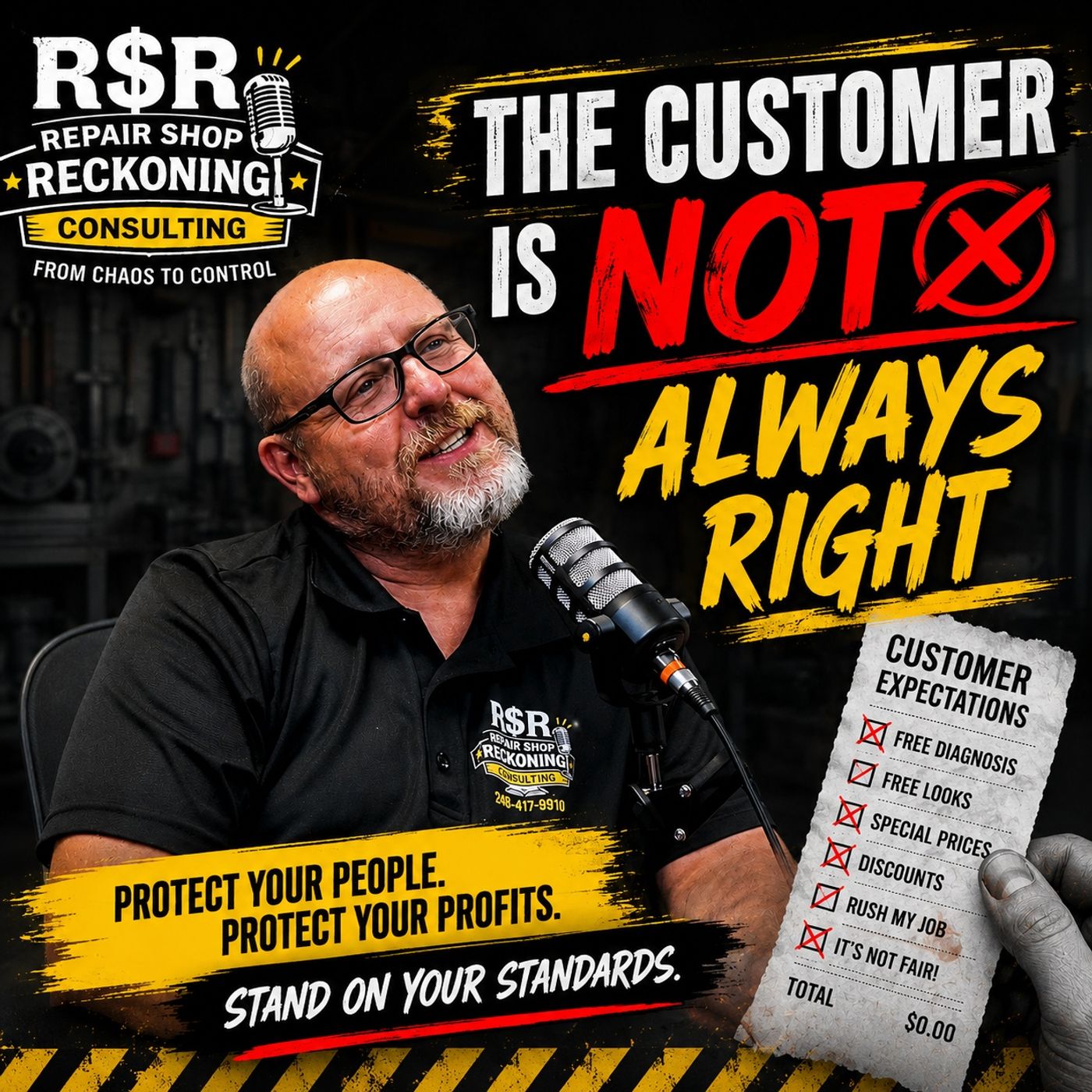
Repair Shop ReckoningJune 12 · 1h 23m
The Customer Is NOT Always Right
In this episode of Repair Shop Reckoning, Kevin tackles one of the most damaging beliefs in business: "The customer is always right." For years, shop owners have been taught to bend over backward for every customer, absorb every complaint, hand out...
Listen →
74
The Limitless Leadership PodcastJune 11 · 43 min
Ep 157: Great Culture Doesn't Happen by Accident with Sam Freeman and Amber Wright
Listen →
75
The Limitless Leadership PodcastJune 9 · 43 min
Ep 156: Patrick Egan’s Secrets to Leading and Marketing in Auto Repair
Listen →
76
Downshift with TonnikaJune 9 · 35 min
How to Build a Team That Doesn't Need You Every Minute | Brandon Steckler - Ep 17
Consistency is key - heard that! But, consistency is HARD. That's why I gave up on trying and let the experts handle it. Detect Auto. Let them clean up your estimating process and raise your ARO - like they did for me! CLICK HERE TO BOOK A DEMOAnybody can run a shop. Building one that lasts? That's a whole different story. If you're ready to build smarter systems and a better experience for your team and customers, check out Tekmetric HEREIn this episode, Tonnika Haynes and Brandon Steckler talk leadership, technician training, and the messy but beautiful journey of managing a team. They bring up the challenges techs face when moving into ownership and leadership roles, the importance of building standard operating procedures to turn mistakes into teachable moments, and why raising up the next generation means focusing less on judgment and more on mentorship.Timestamps:00:00 – Balancing helping vs. enabling: How to stop being a crutch for your team01:32 – Early career: From dealership routine to independent challenges03:02 – Rapid growth, confidence, and being humbled by new experiences04:32 – The importance of mentorship and finding your “Jim Morton”07:00 – Becoming the teacher: Facing nerves and winning over your peers08:22 – Explaining things differently: The power of analogies in learning09:40 – Training new techs: Building a shop “bootcamp” for growth10:54 – Managing personalities: From future prodigies to lovable pains13:11 – Why investing in young staff pays off (despite the daily chaos)14:52 – Hard truths about leadership and letting go of micromanagement15:49 – Turning losses into SOPs: Learning from mistakes as a team17:01 – The importance of asking instead of always answering17:58 – Becoming a student again: Leveraging Audible and ongoing learning20:26 – Redefining shop culture for Gen Z techs22:55 – “Raising” techs vs. just hiring: Creating a rewarding path23:55 – Progression, promotion, and transferable skills for your team25:05 – Why today’s tech workforce is lost, not lazy28:24 – Finding purpose in mentorship and building shop legacy31:00 – On the road, new classes, and giving back to the industry33:55 – Building a leadership blueprint—with a little tough love
Listen →
77

Remarkable Results RadioJune 9 · 35 min
Anyone Can Teach, But Not Everyone Can Educate: Lessons from 30 Years in Automotive Training [RR 1095]
Thanks to our Partners, NAPA Auto Care and NAPA TRACS Watch Full Video Episode Carm Capriotto sits down with Todd Fortier, retiring automotive professor and program coordinator from Illinois Central College, to discuss a lesson learned over three decades in education: anyone can teach, but becoming a true educator requires purpose, empathy, and continuous growth. Todd shares how his passion for education was sparked by helping students experience those breakthrough "lightbulb moments" and why the ultimate goal of teaching is not simply delivering information, but ensuring meaningful knowledge transfer. As he prepares for retirement, Todd reflects on the challenges facing automotive education and his mission to help develop the next generation of industry instructors. What You'll Learn Why technical expertise alone doesn't make someone an effective instructorHow educators can improve knowledge transfer and student engagementTodd's "Three C's" framework: Concern, Cause, and CorrectionWhy connection, empathy, and vulnerability are critical teaching toolsHow to identify the root causes behind student disengagementThe importance of recognizing the personal challenges students bring into the classroomWhy many students leave training programs early and how educators can help retain themHow trainers and mentors can evolve into true educatorsThe soft skills needed to successfully connect with today's students and technicians The best educators do more than share information, they build relationships. Todd Fortier's career demonstrates that teaching is most effective when instructors combine technical knowledge with empathy, curiosity, and genuine human connection. As the automotive industry works to address technician shortages and workforce development challenges, creating better educators may be one of the most important investments the industry can make. Todd Fortier, Professor/Program Coordinator, Illinois Central College, ToddFortier@techtoteacher.com Learn more about NAPA Auto Care and the benefits of being part of the NAPA family by visiting https://www.napaonline.com/en/auto-care NAPA TRACS will move your shop into the SMS fast lane with onsite training and six days a week of support and local representation. Find NAPA TRACS on the Web at http://napatracs.com/ Connect with the Podcast: Visit the Website:https://remarkableresults.biz/Subscribe on YouTube:https://www.youtube.com/carmcapriottoFollow on Facebook:https://www.facebook.com/RemarkableResultsRadioPodcast/Follow on LinkedIn:https://www.linkedin.com/in/carmcapriotto/Follow on Instagram:https://www.instagram.com/remarkableresultsradiopodcast/Join Our Virtual Toastmasters Club:https://remarkableresults.biz/toastmastersJoin Our Private Facebook Community:https://www.facebook.com/groups/1734687266778976Join our Insider List:https://remarkableresults.biz/insiderAll books mentioned on our podcasts:https://remarkableresults.biz/booksOur Classroom page for personal or team learning:https://remarkableresults.biz/classroomSpecial episode collections:https://remarkableresults.biz/collectionsBuy Me a Coffee:https://www.buymeacoffee.com/carm The Automotive Repair Podcast Network: https://automotiverepairpodcastnetwork.com/ Remarkable Results Radio Podcastwith Carm Capriotto:Facilitating Wisdom Through Story Telling and Open Discussion.https://remarkableresults.biz/Diagnosing the Aftermarket A to Z:From Diagnostics to Metallica and Mental Health, Matt Fanslow is Lifting the Hood on Life.https://mattfanslow.captivate.fm/Business by the Numbers: Understand the Numbers of Your Business with CPA Hunt Demarest.https://huntdemarest.captivate.fm/The Auto Repair Marketing Podcast: Marketing Experts Brian & Kim Walker Work with Shop Owners to Take it to the Next Level.https://autorepairmarketing.captivate.fm/The Weekly Blitz: Weekly Inspiration with Business Coach Chris Cotton from AutoFix - Auto Shop Coaching.https://chriscotton.captivate.fm/Speak Up! Effective Communication: Develop Interpersonal and Professional Communication Skills with Craig O'Neill.https://craigoneill.captivate.fm
Listen →
78
Master Tech to MillionaireJune 9 · 43 min
Profit Panel pt.2 : Unlocking Massive Net with P&L Secrets - Bonus Zoom Episode 8
Glenn Piccolo hosts Profit Panel part 2 with Charlie Zlatkos, J.J. Mont and Lynn Massengill to unpack how shops drive real profitability through P&L literacy, gross profit improvement, and operational discipline. The episode covers practical steps: raising gross margins, fast and accurate P&Ls, the crucial Accounting First and Fraud Prevention class, hiring and retaining A‑players, the cost of cash deals, and leading from the trenches. Actionable takeaways focus on measuring every dollar, creating auditable books, incentivizing team ownership, and building a durable, sellable business. AutoshopAnswers.com Auto-Shop-Media.com
Listen →
79
Changing the Industry PodcastJune 8 · 43 min
Episode 272 - Mentoring the Next Generation of Techs with Luke Murray and Charles Burke of Worldpac
Don't get to the end of this year wishing you had taken action to change your business and your life.Click here to schedule a free discovery call for your business: https://geni.us/IFORABEDon't miss an upcoming event with The Institute: https://geni.us/InstituteEvents2026Shop-Ware gives you the tools to provide your shop with everything needed to become optimally profitable.Click here to schedule a free demo: https://info.shop-ware.com/profitabilityTransform your shop's marketing with the best in the automotive industry, Shop Marketing Pros!Get a free audit of your shop's current marketing by clicking here: https://geni.us/ShopMarketingProsShop owners, are you ready to simplify your business operations? Meet 360 Payments, your one-stop solution for effortless payment processing.Imagine this—no more juggling receipts, staplers, or endless paperwork. With 360 Payments, you get everything integrated into a single, sleek digital platform.Simplify payments. Streamline operations. Check out 360payments.com today!In this episode, Lucas Underwood and David Roman are joined by Charles Burke and Luke Murray from the Worldpac Training Institute. The conversation focuses on the importance of mentorship and structured apprenticeship programs in the automotive industry, the challenges of reaching and engaging more shop owners with effective training and business resources, and the personal impact of mentorship—both in the industry and in personal life.00:00 Transitioning from technical to business training05:42 Grounded from flying career09:44 Choosing movies before streaming12:41 Becoming a BMW instructor14:04 Focus on mentor training18:43 Mentorship and training apprentices19:46 Creating a custom apprenticeship program23:10 The importance of effective mentorship28:29 Building ASTA through community sharing31:50 Explaining profit margins simplistically33:25 Helping others with industry insights38:01 Funny story about Chris Chesney39:21 Spreading the word about free training42:11 Passion-driven learning benefits
Listen →
80
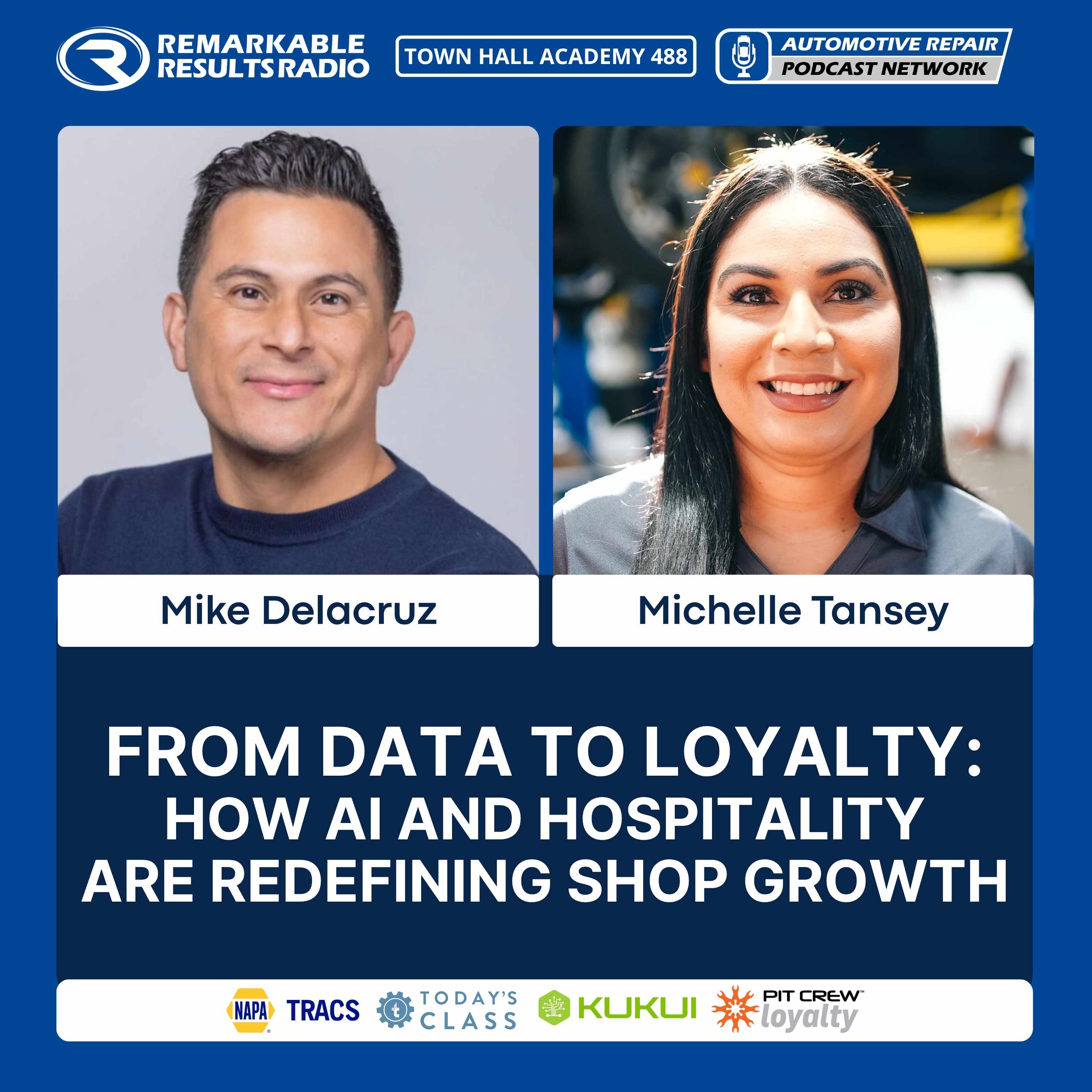
Remarkable Results RadioJune 5 · 57 min
From Data to Loyalty: How AI and Hospitality Are Redefining Shop Growth [THA 488]
Thanks to our Partners, NAPA TRACS, Today's Class, KUKUI, and Pit Crew Loyalty Watch Full Video Episode What happens when artificial intelligence meets world-class customer hospitality? In this episode of Remarkable Results Radio, host Carm Capriotto welcomes Mike DelaCruz, CEO of Overdryve Marketing, and Michelle Tansey, co-founder of Euro Clinic, for a forward-thinking discussion on how auto repair shops can use AI, data, and intentional customer experiences to build stronger businesses. From using AI as a strategic business assistant to creating a luxury-level customer journey that rivals brands like Ritz-Carlton and Nordstrom, Mike and Michelle share practical insights on what separates average shops from elite operations. They explain how predictive marketing, operational excellence, and deeply embedded core values can transform customer retention and long-term profitability. What You'll Learn How AI can serve as your shop's "big brain" to improve decision-making and uncover blind spots.How predictive marketing can forecast car count, identify customer churn, and improve campaign performance.The concept of the "NASA Shop" and what elite automotive operations do differently.How Euro Clinic creates unforgettable customer experiences through personalized hospitality.The importance of building systems and processes around your shop's core values.Why strong operations must come before marketing success.How small communication changes can dramatically improve customer trust and confidence.The role data plays in making better business decisions and reducing emotional guesswork. The future belongs to shops that combine technology with humanity. AI can provide unprecedented insight into customer behavior and business performance, but lasting success still comes from exceptional service, consistent operations, and a culture built around caring for people. The shops that embrace both innovation and hospitality will be the ones that stand out, retain customers, and thrive in the years ahead. Mike DelaCruz, CEO Overdryve Marketing *]:pointer-events-auto scroll-mt-[calc(var(--header-height)+min(200px,max(70px,20svh)))]" dir="auto" data-turn-id="request-WEB:8e59eec7-a235-4fa3-a072-956fea3fe478-7" data-testid="conversation-turn-4" data-scroll-anchor="false" data-turn="assistant"> *]:pointer-events-auto scroll-mt-[calc(var(--header-height)+min(200px,max(70px,20svh)))]" dir="auto" data-turn-id="request-WEB:49a777bf-d263-4496-bf0b-2eb3a46ac96a-11" data-testid="conversation-turn-24" data-scroll-anchor="false" data-turn="assistant"> Michelle Tansey, Euro Clinic, Santa Clara, CA. Thanks to our Partner, NAPA TRACS NAPA TRACS will move your shop into the SMS fast lane with onsite training and six days a week of support and local representation. Find NAPA TRACS on the Web at http://napatracs.com/ Thanks to our Partner, Today's Class Optimize training with Today's Class: In just 5 minutes daily, boost knowledge retention and improve team performance. Find Today's Class on the web at https://www.todaysclass.com/ Thanks to our Partner, KUKUI Stop juggling multiple marketing tools. KUKUI’s integrated platform delivers 4x better website conversions, automated follow-up, and real-time ROI tracking. Get industry-leading customer support with KUKUI at https://www.kukui.com/ Thanks to our Partner, Pit Crew Loyalty You’re probably tired of chasing new customers who never return. We understand. Pit Crew Loyalty ends the one-and-done cycle, turning first visits into lasting, reliable revenue at https://www.pitcrewloyalty.com/ Connect with the Podcast: Visit the Website:https://remarkableresults.biz/Subscribe on YouTube:https://www.youtube.com/carmcapriottoFollow on Facebook:https://www.facebook.com/RemarkableResultsRadioPodcast/Follow on LinkedIn:https://www.linkedin.com/in/carmcapriotto/Follow on Instagram:https://www.instagram.com/remarkableresultsradiopodcast/Join Our Virtual Toastmasters Club:https://remarkableresults.biz/toastmastersJoin Our Private Facebook Community:https://www.facebook.com/groups/1734687266778976Join our Insider List:https://remarkableresults.biz/insiderAll books mentioned on our podcasts:https://remarkableresults.biz/booksOur Classroom page for personal or team learning:https://remarkableresults.biz/classroomBuy Me a Coffee:https://www.buymeacoffee.com/carmSpecial episode collections:https://remarkableresults.biz/collections The Automotive Repair Podcast Network: https://automotiverepairpodcastnetwork.com/ Remarkable Results Radio Podcastwith Carm Capriotto: Advancing the Aftermarket by Facilitating Wisdom Through Story...
Listen →
81
Confessions of a Shop OwnerJune 5 · 1h 0m
Ep 97 - Tektonic 2026 Coaches Panel | Flat Rate, Technician Shortage, Performance Based Pay
Tekmetric opened my eyes to just how much a good SMS will do for a shop. Their software is top of the line, and with them, so is my shop. Try them for yourself HEREASTA is coming up September 24-26 in Raleigh. Be there or be square, dog! Register now and use code Confess25 for $25.00 off your registration. Sign up HEREMy marketing before and after signing up with Turnkey Marketing is pretty scary. In a good way. Get your marketing right today HERETired of your shop’s social media looking like every other repair shop on the internet? Stand out with 47 Consulting. Learn more HERE Make your techs happier with Detect Auto. They'll stop getting "check noise" or "check vibration" from advisors with the customer concern tool. It will CHANGE YOUR LIFE. Book a demo HERESend your service advisor to hands down the BEST service advisor training in the industry (even other coaching companies agree). It's Elite Worldwide's Masters Program. The next one is happening in Dallas Texas, September 10-12. Learn more HEREThis episode was recorded at Tektonic 2026. Thank you to Tekmetric for allowing us to use this recording for an episode. Want to go to Tektonic 2027? Register HEREToday, Mike Allen leads a lively panel of coaches as they tackle some of the auto repair industry's most daunting topics. Things like flat rate and how compensation models impact recruitment, motivation, and shop culture. They also confront the persistent undervaluing of the industry, pointing out the urgent need for better marketing and self-regulation if auto repair is to attract the next generation. Plus, the coaches don’t hold back as they discuss private equity’s growing influence—offering straight talk on exit strategies, business legacy, and the real impact on teams left behind. Tekmetric opened my eyes to just how much a good SMS will do for a shop. Their software is top of the line, and with them, so is my shop. Try them for yourself HEREMy marketing before and after signing up with Turnkey Marketing is pretty scary. In a good way. Get your marketing right today HEREMake your techs happier with Detect Auto. They'll stop getting "check noise" or "check vibration" from advisors with the customer concern tool. It will CHANGE YOUR LIFE. Book a demo HEREFor years I thought I could handle the hiring process on my own. But, after far too many bad hires, it was clear I needed help. Promotive came through for me with a rock star hire in just a few days and I couldn't be happier. Swallow your pride and bring in Promotive for that open position you have at your shop today. You can thank me later. Learn more HEREAI for Shop Owners: Open the Hood of the Future is happening June 12-13 at Carfix in Raleigh, NC. Use AI to your advantage! Register HERETimestamps:00:00 Why is the auto industry undervalued? The real story behind pay and standards01:06 Flat rate pay: Is it tradition, incentive, or what’s driving the “tech shortage”?02:44 Hourly vs. flat rate vs. blended: Can we finally pay techs what they’re worth?04:06 What performance-based pay REALLY looks like in the real world07:03 Is there even a tech shortage, or just a leadership and culture failure?09:09 Recruiting top techs: Why should someone work for YOUR shop?11:05 Employees want more than money—how culture and environment win12:33 Why we can’t afford to be “broke” shop owners (& why most of us are)13:28 Are we destroying our own value? Party clowns vs. techs and the marketing gap15:56 Leadership confession: We got into cars, NOT for people, and it’s catching up16:26 How to reach the next generation of automotive stars17:17 One shop’s youth welding program that sparks real careers18:06 Why trades like welding are beating automotive for young talent20:03 How do we market the industry and reach parents, not just students?23:39 Got Milk? Why we need a national campaign to sell the value of this business24:53 Raising your labor rate: Genius or a recipe for backlash if you don’t raise value28:28 What customers are REALLY paying for—and how service changes the game30:13 Making your shop irresistible: Clean, beautiful, equipped, and worth the price31:42 You don’t need to wait to raise value—start by fixing your shop now34:36 Relationships and trust: The foundation for customer and team loyalty36:24 The biggest profit leak no one talks about: productivity loss39:35 Private equity: Golden parachute or community killer for auto shops?41:54 What’s your exit plan? How to think years ahead (and why it matters)45:45 Should coaches own shops? The truth about what makes a great coach51:39 Leadership, engagement, and communication: The four pillars of high-performing teams55:54 AI, DVI, and service advisors: The NEXT revolution in customer experience58:04 Why hospitality always wins—technology tools are only part of the story
Listen →
82
Downshift with TonnikaJune 4 · 1h 2m
Why Most Shop Owners Stay Stuck | Jimmy Lea - Ep 16
Consistency is key - heard that! But, consistency is HARD. That's why I gave up on trying and let the experts handle it. Detect Auto. Let them clean up your estimating process and raise your ARO - like they did for me! CLICK HERE TO BOOK A DEMOAnybody can run a shop. Building one that lasts? That's a whole different story. If you're ready to build smarter systems and a better experience for your team and customers, check out Tekmetric HEREIn this episode, Tonnika Haynes Downshifts with Jimmy Lea, Vice President of Business Development at The Institute for Automotive Business Excellence, to talk about the real journey of becoming a successful shop owner. Jimmy breaks down the importance of bringing value whether you’re on stage speaking or working with your team at the shop. He shares how coaching can transform not just your business but your life, giving practical advice on moving from chaos to control and learning to delegate effectively.Timestamps:00:00 Bringing Value vs Chasing the Spotlight – The Key to Longevity02:13 The Recharge Routine: Thriving as an Industry Extrovert04:04 Honing Your Craft: Speaking, Coaching, and Constant Growth06:03 Connecting with Your Audience: The Secret Sauce of Great Presenters07:45 Daily Mindset Practices for Owners & Leaders09:09 Jimmy's Journey from Call Tracking to Industry Rockstar13:43 Nailing Your Niche: How to Stand Out & Grow in the Automotive Space16:18 Why Shop Owners, Service Advisors, and Trainers All Need to Bring Value21:28 The Power of Coaching: Why You Can’t Afford To Go It Alone26:06 Technician to Owner: The Real Phases of Shop Leadership30:25 From Chaos to Control: The Blueprint for Scaling & Letting Go34:52 Delegation and Team Building – Getting Out of Your Own Way35:10 The Real Payoff: How Coaching Impacted Tonnika Haynes’ Team and Life40:06 Raising Labor Rates, Elevating the Industry & Gaining Community Respect43:00 Trade Schools, Teen Techs, and Changing Perceptions51:10 Shop Lessons vs College Degrees – Real-World Business Smarts58:07 Final Takeaways: Coaching, Mindset, and Rethinking What “Success” Looks Like
Listen →
83
The Jaded MechanicJune 2 · 1h 48m
Why Shops Lose Technicians Overnight | Lisa Coyle and Kat Ayers from Promotive
Like the show? Show your support by using our sponsors. Need to update your shop systems and software? Try Tekmetric HERELaunch your tool game to the next level with Launch Tech USA! HEREIn this episode, Jeff Compton talks with Promotive’s Lisa Coyle and Kat Ayers about what’s changing in technician hiring, including their AI virtual recruiter and how it helps shops with consistency, speed-to-lead, and 24/7 candidate screening. They discuss common hiring bias, why resumes often don’t reflect real skill, how to interpret job hopping, and why following application instructions matters. The episode also covers shop culture and leadership as key retention drivers, how slow follow-up hurts candidate experience, and what Promotive is building next—expanded platform features, more automation, and plans to move into the Canadian market.Timestamps:0:00 Podcast Kickoff00:28 Fishing and Seafood Talk03:10 Bass Tournaments and Hockey06:30 What’s New at Promotive08:06 AI Recruiting Benefits11:13 Bias and Hiring Fairness20:03 Resume Gaps and Progress22:58 Following Instructions Matters24:43 Job Hopping Explained29:56 Walk-In Resumes vs Process34:35 Call Screen Limits36:23 Tagging Resumes For Future37:59 Techs Becoming Advisors42:56 Trade Shows And Outreach48:26 Cold Calls And Data52:42 Industry Negativity And AI01:00:20 Robots Costs And Culture01:06:41 Leadership Questions And Nepotism01:10:20 Multi Interview Triangulation01:12:13 Candidate Experience Matters01:16:11 Rehiring and Keeping Benches01:21:27 Job Searching Is Normal01:24:41 Legacy Over Resentment01:29:13 Plan B and Hard Questions01:32:02 What Have You Done Today01:34:14 Promotive Roadmap and Events01:37:18 Canada Expansion and Languages01:39:44 Hockey Talk and Show Circuit01:44:35 Final Thanks and Wrap Up Follow/Subscribe to the show on social media! TikTok - https://www.tiktok.com/@jeffcompton7YouTube - https://www.youtube.com/@TheJadedMechanicFacebook - https://www.facebook.com/profile.php?id=100091347564232
Listen →
84
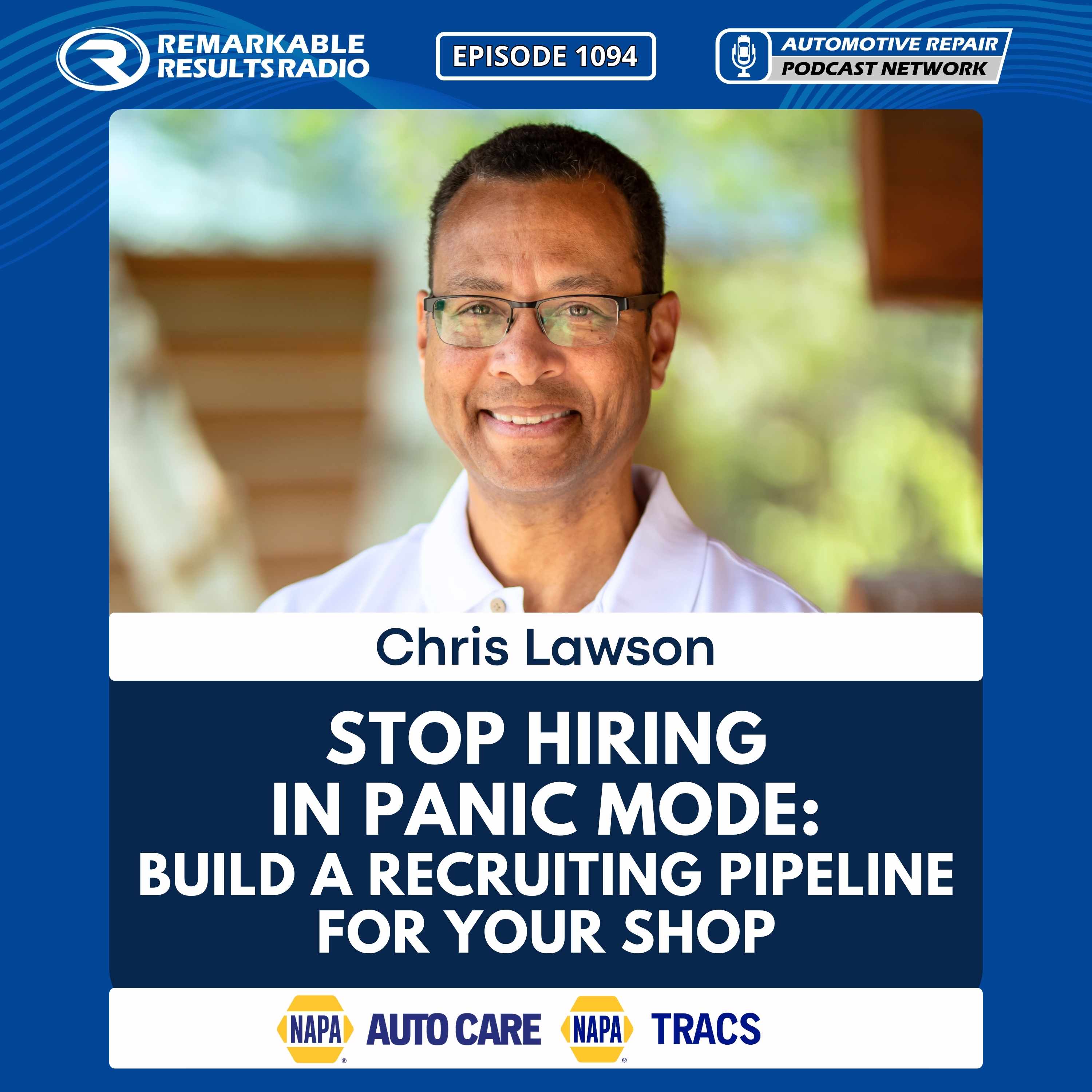
Remarkable Results RadioJune 2 · 38 min
Stop Hiring in Panic Mode: Build a Recruiting Pipeline for Your Shop [RR 1094]
Thanks to our Partners, NAPA Auto Care and NAPA TRACS Watch Full Video Episode Host Carm Capriotto welcomes Chris Lawson, founder of Technician Find, to discuss one of the biggest challenges facing independent auto repair shops today: finding and keeping great technicians. Chris explains why many shop owners fall into what he calls "fire alarm syndrome," waiting until a technician leaves before starting the hiring process. That reactive approach often leads to rushed decisions, poor hires, and ongoing turnover. Instead, he advocates for an "Always Be Recruiting" mindset, where shops continuously build relationships with potential candidates long before they have an opening. The conversation explores practical strategies for becoming a destination workplace, creating a recruiting pipeline, and building a culture that attracts top talent in a competitive market. What You'll Learn Why reactive hiring creates costly staffing problemsHow to build a bench of pre-qualified technicians before you need themWhy becoming "10-mile famous" can help attract both technicians and customersHow culture-focused marketing can outperform traditional help-wanted adsThe three things technicians value most: respect, growth, and compensationWhy sign-on bonuses often fail and how to structure them more effectivelyPractical ways to engage passive candidates who are not actively job huntingResources available through Chris Lawson's free online community for shop owners The best time to recruit a technician is before you need one. Shops that continuously market their culture, build relationships with local talent, and maintain a pipeline of qualified candidates are better positioned to grow, avoid staffing emergencies, and create a workplace where top technicians want to stay. Recruiting is no longer an occasional task. It is an ongoing business strategy. Chris Lawson, TechnicianFind.Com Love your shop? Stay, but stay ready. Auto techs join to level up, find good shops, and keep tabs on top indie jobs nationwide. Techs only. No BS. Independent Wrench Jobs: https://www.skool.com/independentwrenchjobs Finding Technicians Part 1- Chris Lawson [RR 803]: https://remarkableresults.biz/remarkable-results-radio-podcast/e803/ Finding Technicians Part 2 – Chris Lawson [RR 816]: https://remarkableresults.biz/remarkable-results-radio-podcast/e816/ Technician Attraction Blueprint [RR 921]: https://remarkableresults.biz/remarkable-results-radio-podcast/e921/ Attract, Develop, and Retain Top Automotive Talent [CC 113]: https://remarkableresults.biz/remarkable-results-radio-podcast/cc113/ Beyond Babysitters: Developing Strong Managers and Financial Transparency [RR 1076]: https://remarkableresults.biz/remarkable-results-radio-podcast/e1076/ Thanks to our Partners, NAPA Auto Care and NAPA TRACS Learn more about NAPA Auto Care and the benefits of being part of the NAPA family by visiting https://www.napaonline.com/en/auto-care NAPA TRACS will move your shop into the SMS fast lane with onsite training and six days a week of support and local representation. Find NAPA TRACS on the Web at http://napatracs.com/ Connect with the Podcast: Visit the Website: https://remarkableresults.biz/ Subscribe on YouTube: https://www.youtube.com/carmcapriotto Follow on Facebook: https://www.facebook.com/RemarkableResultsRadioPodcast/ Follow on LinkedIn: https://www.linkedin.com/in/carmcapriotto/ Follow on Instagram: https://www.instagram.com/remarkableresultsradiopodcast/ Join Our Virtual Toastmasters Club: https://remarkableresults.biz/toastmasters Join Our Private Facebook Community: https://www.facebook.com/groups/1734687266778976 Join our Insider List: https://remarkableresults.biz/insider All books mentioned on our podcasts: https://remarkableresults.biz/books Our Classroom page for personal or team learning: https://remarkableresults.biz/classroom Special episode collections: https://remarkableresults.biz/collections Buy Me a Coffee: https://www.buymeacoffee.com/carm The Automotive Repair Podcast Network: https://automotiverepairpodcastnetwork.com/ Remarkable Results Radio Podcast with Carm Capriotto: Advancing the Aftermarket by Facilitating Wisdom Through Story Telling and Open Discussion. https://remarkableresults.biz/ Diagnosing the Aftermarket A to Z with Matt Fanslow: From Diagnostics to Metallica and Mental Health, Matt Fanslow is Lifting the Hood on Life. https://mattfanslow.captivate.fm/ Business by the Numbers with Hunt Demarest: Understand the Numbers of Your Business with CPA Hunt Demarest. https://huntdemarest.captivate.fm/ The Auto Repair Marketing Podcast with Kim and Brian Walker: Marketing Experts Brian & Kim Walker Work with Shop Owners to Take it to the Next Level. https://autorepairmarketing.captivate.fm/ The Weekly Blitz with Chris Cotton: Weekly Inspiration with Business Coach Chris Cotton from AutoFix - Auto Shop Coaching. https://chriscotton.captivate.fm/ <span...
Listen →
85
Remarkable Results RadioMay 29 · 43 min
When Personal Stress Walks Into the Shop: How Leaders Protect Performance [THA 487]
Thanks to our Partners, NAPA TRACS, Today's Class, KUKUI, and Pit Crew Loyalty Watch Full Video Episode Are you tired of telling your staff to “leave their problems at the door”? The reality is, what happens outside the shop often follows employees into the bays, the service counter, and every customer interaction throughout the day. Financial pressure, family struggles, burnout, stress, and emotional fatigue all impact confidence, communication, productivity, and sales performance, whether leaders recognize it or not. In this insightful episode, Rena Rennebohm, CEO of Empowered Advisor, and service advisor coach and shop owner Rachel Spencer, challenge the old-school mindset of “leave your problems at the door” and explore what modern leadership really looks like in high-performing repair shops. The strongest shops aren’t built only on process and productivity; they’re built on leaders who understand people. *]:pointer-events-auto scroll-mt-[calc(var(--header-height)+min(200px,max(70px,20svh)))]" dir="auto" data-turn-id="request-WEB:8e59eec7-a235-4fa3-a072-956fea3fe478-7" data-testid="conversation-turn-4" data-scroll-anchor="false" data-turn="assistant"> *]:pointer-events-auto scroll-mt-[calc(var(--header-height)+min(200px,max(70px,20svh)))]" dir="auto" data-turn-id="request-WEB:49a777bf-d263-4496-bf0b-2eb3a46ac96a-11" data-testid="conversation-turn-24" data-scroll-anchor="false" data-turn="assistant"> *]:pointer-events-auto R6Vx5W_threadScrollVars scroll-mb-[calc(var(--scroll-root-safe-area-inset-bottom,0px)+var(--thread-response-height))] scroll-mt-[calc(var(--header-height)+min(200px,max(70px,20svh)))]" dir="auto" data-turn-id="request-WEB:8a36a74e-94b9-45d2-82f2-3a0e09cdfefe-1" data-turn-id-container="request-WEB:8a36a74e-94b9-45d2-82f2-3a0e09cdfefe-1" data-testid="conversation-turn-4" data-scroll-anchor="false" data-turn="assistant"> What You’ll Learn How personal stress impacts sales performance and customer communicationWhy technician morale directly affects advisor confidence and trustThe connection between emotional stability and shop productivityHow great leaders identify performance struggles before KPIs declineWhy empathy and accountability must work togetherThe importance of daily check-ins and emotional awarenessHow negativity spreads through shop culture and how leaders can stop itWhy “soft skills” have become essential leadership skills in auto repair When employees feel supported, understood, and valued, communication improves, confidence grows, and performance follows. This episode offers practical insights for shop owners and managers who want to protect team performance, strengthen culture, and lead more effectively in today’s high-pressure auto repair environment. Rena Rennebohm, CEO and Creator of Empowered Advisor. Rena’s previous episodes HERE. Rachel Spencer, Spencer’s Auto Repair, Krum, TX. Rachel's previous episodes HERE Thanks to our Partner, NAPA TRACS NAPA TRACS will move your shop into the SMS fast lane with onsite training and six days a week of support and local representation. Find NAPA TRACS on the Web at http://napatracs.com/ Thanks to our Partner, Today's Class Optimize training with Today's Class: In just 5 minutes daily, boost knowledge retention and improve team performance. Find Today's Class on the web at https://www.todaysclass.com/ Thanks to our Partner, KUKUI Stop juggling multiple marketing tools. KUKUI’s integrated platform delivers 4x better website conversions, automated follow-up, and real-time ROI tracking. Get industry-leading customer support with KUKUI at https://www.kukui.com/ Thanks to our Partner, Pit Crew...
Listen →
86

Repair Shop ReckoningMay 29 · 1h 14m
Stop Running Your Shop Like A Charity
In this episode of Repair Shop Reckoning, Kevin breaks down one of the biggest problems killing repair shops right now: Owners are doing the work… but they are not controlling the money. What starts as a conversation about cash basis vs accrual...
Listen →
87
The Limitless Leadership PodcastMay 28 · 50 min
Ep 154: Turn Your Tragedy Into Limitless Leadership with JeanAnn SaintGrace
Listen →
88
Downshift with TonnikaMay 28 · 40 min
Boobs, Business & Building Culture That Lasts | Benjie Burris & Callie Johnson - Ep 15
Consistency is key - heard that! But, consistency is HARD. That's why I gave up on trying and let the experts handle it. Detect Auto. Let them clean up your estimating process and raise your ARO - like they did for me! CLICK HERE TO BOOK A DEMOAnybody can run a shop. Building one that lasts? That's a whole different story. If you're ready to build smarter systems and a better experience for your team and customers, check out Tekmetric HEREIn this crossover episode, Tonnika Haynes partners with Mike Allen and Confessions of a Shop Owner for a special preview of the upcoming ASTA Expo in Raleigh, NC this September. Together, they’re joined by ASTA Board Member and shop owner Benjie Burris, along with his daughter Callie Johnson, ASTA’s new Membership & Events Manager, to break down what makes the Expo such a standout event and how strong shop culture creates lasting success—both in business and beyond.The conversation explores the importance of showing up for your local community, building real and authentic relationships, and how consistent involvement and giving back have fueled long-term growth and meaningful connections. They also share firsthand experiences from past ASTA Expos, highlighting the unique, inclusive atmosphere and the way real conversations at the event can shape both careers and lives.And yes—you’ll also hear the story of how Benjie met his wife. Let’s just say it’s one of those stories you won’t see coming.Learn more about the ASTA Expo and how you can be there HERETimestamps:00:00 The funniest icebreaker ever (yes, fake boobs are involved)00:53 Live from Fueling Connections 2026 – ASTA at UTI Mooresville02:22 Audio chaos: Why your own tools matter (and how NOT to record a podcast)04:10 The rise of Downshift and the weirdness of being told “I listen to your podcast!”05:03 Social media hacks: Engagement, trolls, and managing the comment chaos09:19 A blueprint for a family-run business culture that actually works10:29 Turning community support into real shop growth (and why service matters)13:42 Small steps, big progress: Building a shop “patch by patch”14:42 The real reason community work succeeds (hint: It can’t be faked)18:25 Real talk on supporting schools, teachers, and being boots-on-the-ground22:22 Dealing with “big city” demands and setting shop boundaries23:46 ASTA’s new Membership & Events Manager shares social media tips26:53 The ASTA Expo: Networking, parties, and the least clicky vibe in the industry28:29 Conversations that change careers—and lives30:46 Competitors or community? Why ASTA shops help each other32:07 Going from local to international—how ASTA keeps its family feel36:04 Must-attend classes, what’s next for ASTA, and seriously, don’t miss the hospitality suite
Listen →
89
Master Tech to MillionaireMay 26 · 47 min
Burn the Boats: AJ Nealey’s Multi-Unit Breakthrough - Bonus Zoom Episode 6
Glenn Piccolo interviews AJ Nealey about his journey from a one-bay garage to a five-store multi-unit operator in Maryland. AJ shares how Key to Key training, Rack Attack tactics, strict hiring standards, and fraud-prevention controls transformed his business, helped him stop tolerating mediocrity, and drove rapid improvement. The episode covers practical takeaways for shop owners: implement core fundamentals every day, recruit and retain A-players, use accounting controls to stop theft, and lead from the front with relentless execution to scale successfully.
Listen →
90
The Limitless Leadership PodcastMay 26 · 34 min
Ep 153: Redefining Men’s Leadership in the 21st Century with Andrew O'Brien
Listen →
91
The Jaded MechanicMay 26 · 1h 12m
Why Repair Shops are Toxic and Why Technicians Deserve More with Greg Hilliard
Like the show? Show your support by using our sponsorsNeed to update your shop systems and software? Try Tekmetric HERELaunch your tool game to the next level with Launch Tech USA! HEREIn this episode, Jeff Compton and Greg Hilliard talk about Greg's career spent in dealerships, independent shops, and finally as a one-man owner-operator. Greg pulls no punches about toxic shop dynamics, the true value of a technician’s labor, and the personal costs of striking out on your own. He and Jeff discuss compensation, mental health struggles in the industry, how digital tools like chat GPT are already impacting repair businesses, and why demanding respect is not negotiable for survival.Timestamps: 00:00 Feeling valued in engineering role05:56 Becoming the technical expert11:52 Buying a used truck at Ford19:49 Fixing stubborn cab issues24:57 Avoiding the boss at work27:52 Discussing fair compensation concerns35:41 Struggles with retaining mechanics41:08 Streamlining dental office visits43:47 Using technology for car repairs52:54 Struggling to hire a technician57:37 Choosing entrepreneurship over traditional jobs59:35 Getting advice from Larry Grogan01:07:17 Addressing workplace culture issues01:09:20 Electrician shortage and industry pride Follow/Subscribe to the show on social media! TikTok - https://www.tiktok.com/@jeffcompton7YouTube - https://www.youtube.com/@TheJadedMechanicFacebook - https://www.facebook.com/profile.php?id=100091347564232
Listen →
92

Remarkable Results RadioMay 26 · 34 min
From Guesswork to Process: Modern Diagnostic Strategies for Auto Repair Shops [RR 1093]
Thanks to our Partners, NAPA Auto Care and NAPA TRACS Watch Full Video Episode Recorded live at the 2026 TST Big Event, Carm Capriotto sits down with automotive trainer Ken Zanders to discuss the importance of ongoing technical education, building efficient diagnostic processes, and adapting to rapidly evolving vehicle technology. Ken explains why too many shops still rely on a chaotic “grocery list” approach to repairs and how a structured diagnostic strategy can dramatically improve technician efficiency, profitability, and customer trust. What You’ll Learn Why inefficient diagnostic habits directly reduce technician productivity, shop profitability, and overall earning potential.The importance of following a structured diagnostic workflow instead of guessing and replacing parts.How electronic relative compression testing with a lab scope and amperage probe can reduce diagnostic time from hours to minutes.How modern vehicle technologies like GM’s Vehicle Intelligence Platform (VIP) and Over-The-Air (OTA) updates are changing diagnostics and repair procedures.Why continuous education is no longer optional for automotive professionals working on today’s advanced vehicle systems. The biggest takeaway from this episode is that repair shops cannot afford to operate in constant chaos and guesswork. A reactive “grocery list” approach to diagnostics leads to wasted time, unnecessary parts replacement, lower profits, and poor customer outcomes. To succeed in today’s increasingly complex automotive industry, shop owners must create a year-round training strategy that helps technicians diagnose efficiently, think critically, and continuously improve their skills. Structured processes, modern testing methods, and ongoing education are no longer advantages; they are necessities for survival and growth. TST Big Event: https://tstseminars.org/ Ken Zanders, Dorman Training Don’t Base Your Success On Probability – Ken Zanders [RR 822]: https://remarkableresults.biz/remarkable-results-radio-podcast/e822/ Thanks to our Partners, NAPA Auto Care and NAPA TRACS Learn more about NAPA Auto Care and the benefits of being part of the NAPA family by visiting https://www.napaonline.com/en/auto-care NAPA TRACS will move your shop into the SMS fast lane with onsite training and six days a week of support and local representation. Find NAPA TRACS on the Web at http://napatracs.com/ Connect with the Podcast: Visit the Website: https://remarkableresults.biz/ Subscribe on YouTube: https://www.youtube.com/carmcapriotto Follow on Facebook: https://www.facebook.com/RemarkableResultsRadioPodcast/ Follow on LinkedIn: https://www.linkedin.com/in/carmcapriotto/ Follow on Instagram: https://www.instagram.com/remarkableresultsradiopodcast/ Join Our Virtual Toastmasters Club: https://remarkableresults.biz/toastmasters Join Our Private Facebook Community: https://www.facebook.com/groups/1734687266778976 Join our Insider List: https://remarkableresults.biz/insider All books mentioned on our podcasts: https://remarkableresults.biz/books Our Classroom page for personal or team learning: https://remarkableresults.biz/classroom Special episode collections: https://remarkableresults.biz/collections Buy Me a Coffee: https://www.buymeacoffee.com/carm The Automotive Repair Podcast Network: https://automotiverepairpodcastnetwork.com/ Remarkable Results Radio Podcast with Carm Capriotto: Advancing the Aftermarket by Facilitating Wisdom Through Story Telling and Open Discussion. https://remarkableresults.biz/ Diagnosing the Aftermarket A to Z with Matt Fanslow: From Diagnostics to Metallica and Mental Health, Matt Fanslow is Lifting the Hood on Life. https://mattfanslow.captivate.fm/ Business by the Numbers with Hunt Demarest: Understand the Numbers of Your Business with CPA Hunt Demarest. https://huntdemarest.captivate.fm/ The Auto Repair Marketing Podcast with Kim and Brian Walker: Marketing Experts Brian & Kim Walker Work with Shop Owners to Take it to the Next Level. https://autorepairmarketing.captivate.fm/ The Weekly Blitz with Chris Cotton: Weekly Inspiration with Business Coach Chris Cotton from AutoFix - Auto Shop Coaching. https://chriscotton.captivate.fm/ Speak Up! Effective Communication with Craig O'Neill: Develop Interpersonal and Professional Communication Skills when Speaking to Audiences of Any Size. https://craigoneill.captivate.fm <a...
Listen →
93
Changing the Industry PodcastMay 25 · 1h 1m
Episode 270 - Overcoming Shop Owner Struggles: Hiring, Training, and Shop Management With Shaun Tipton
Don't get to the end of this year wishing you had taken action to change your business and your life.Click here to schedule a free discovery call for your business: https://geni.us/IFORABEDon't miss an upcoming event with The Institute: https://geni.us/InstituteEvents2026Shop-Ware gives you the tools to provide your shop with everything needed to become optimally profitable.Click here to schedule a free demo: https://info.shop-ware.com/profitabilityTransform your shop's marketing with the best in the automotive industry, Shop Marketing Pros!Get a free audit of your shop's current marketing by clicking here: https://geni.us/ShopMarketingProsShop owners, are you ready to simplify your business operations? Meet 360 Payments, your one-stop solution for effortless payment processing.Imagine this—no more juggling receipts, staplers, or endless paperwork. With 360 Payments, you get everything integrated into a single, sleek digital platform.Simplify payments. Streamline operations. Check out 360payments.com today!In this episode, Lucas Underwood is joined by Shaun Tipton, who shares his 28-year journey from technician to shop owner. Shaun Tipton discusses the common pitfalls technicians face when transitioning to ownership, emphasizing the importance of understanding financials and setting fair labor rates. The conversation also highlights the critical role of workplace culture and effective leadership in building a successful, ethical shop.00:00 Advice for aspiring shop owners09:04 Understanding fair pricing for clients13:46 Recognizing the need for help15:51 Red flags in job histories24:19 Fair employee compensation discussion30:04 Balancing personal values and money32:43 Flaws in metro coaching models40:49 Switching to a single software system43:49 Benefits of using Shop-Ware48:09 Focusing on personal interests53:42 Importance of leadership in ownership59:46 Long-term life planning advice
Listen →
94
Remarkable Results RadioMay 22 · 52 min
Failing at Retirement: Building Eight Shops in Eight Years [THA 486]
Thanks to our Partners, NAPA TRACS, Today's Class, KUKUI, and Pit Crew Loyalty Watch Full Video Episode *]:pointer-events-auto scroll-mt-[calc(var(--header-height)+min(200px,max(70px,20svh)))]" dir="auto" data-turn-id="request-WEB:8e59eec7-a235-4fa3-a072-956fea3fe478-7" data-testid="conversation-turn-4" data-scroll-anchor="false" data-turn="assistant"> *]:pointer-events-auto scroll-mt-[calc(var(--header-height)+min(200px,max(70px,20svh)))]" dir="auto" data-turn-id="request-WEB:49a777bf-d263-4496-bf0b-2eb3a46ac96a-11" data-testid="conversation-turn-24" data-scroll-anchor="false" data-turn="assistant"> *]:pointer-events-auto R6Vx5W_threadScrollVars scroll-mb-[calc(var(--scroll-root-safe-area-inset-bottom,0px)+var(--thread-response-height))] scroll-mt-[calc(var(--header-height)+min(200px,max(70px,20svh)))]" dir="auto" data-turn-id="request-WEB:8a36a74e-94b9-45d2-82f2-3a0e09cdfefe-1" data-turn-id-container="request-WEB:8a36a74e-94b9-45d2-82f2-3a0e09cdfefe-1" data-testid="conversation-turn-4" data-scroll-anchor="false" data-turn="assistant"> Carm Capriotto talks with Matt Curry and Judy Curry of Craftsman's Auto Care about building one of the automotive industry’s most respected multi-shop operations twice. After growing Curry’s Auto Service to 10 locations and retiring in 2013, the Currys returned to the industry with a new vision, launching eight Craftsman’s Auto Care locations in eight years. Matt shares his role as the visionary leader driving momentum and ideas, while Judy explains how operational discipline, marketing, and customer experience keep the business grounded and scalable. The conversation explores their “5 Ps” philosophy: People, Policies, Processes, Procedures, and Profits, along with their commitment to employee development, strong culture, customer transparency, and community involvement. The Currys also discuss how Digital Vehicle Inspections and an intentional customer experience helped them earn nearly 10,000 five-star Google reviews. What You’ll Learn How Matt and Judy Curry scaled multiple successful shop operationsWhy leadership balance and “staying in your lane” mattersThe “5 Ps” framework for building a strong shop cultureHow employee investment drives long-term successWhy transparency and DVIs build customer trustHow culture and customer experience fuel growth and retention Sustainable growth in automotive repair comes from more than technical expertise. It requires intentional leadership, strong systems, a healthy culture, and a commitment to both employees and customers. Matt and Judy Curry, Craftsman Auto Care, 8 locations, Virginia Thanks to our Partner, NAPA TRACS NAPA TRACS will move your shop into the SMS fast lane with onsite training and six days a week of support and local representation. Find NAPA TRACS on the Web at http://napatracs.com/ Thanks to our Partner, Today's Class Optimize training with Today's Class: In just 5 minutes daily, boost knowledge retention and improve team performance. Find Today's Class on the web at https://www.todaysclass.com/ Thanks to our Partner, KUKUI Stop juggling multiple marketing tools. KUKUI’s integrated platform delivers 4x better website conversions, automated follow-up, and real-time ROI tracking. Get industry-leading customer support with KUKUI at https://www.kukui.com/ Thanks to our Partner, Pit Crew Loyalty You’re probably tired of chasing new customers who never return. We understand. Pit Crew Loyalty ends the one-and-done cycle, turning first visits into lasting, reliable revenue at https://www.pitcrewloyalty.com/ Connect with the Podcast: ...
Listen →
95
Repair Shop ReckoningMay 22 · 1h 28m
From Mechanic to Shop Owner: The First Thing You Have to Fix Is You
In this episode of Repair Shop Reckoning, Kevin gets personal. Before the shop ownership. Before the buildings. Before the consulting. Before the success. There was a broke mechanic blaming everybody else for problems he created himself. Kevin opens...
Listen →
96
Downshift with TonnikaMay 21 · 1h 4m
Build Your Shop, but Don’t Forget to Build a Life | Greg Buckley - Ep 14
Consistency is key - heard that! But, consistency is HARD. That's why I gave up on trying and let the experts handle it. Detect Auto. Let them clean up your estimating process and raise your ARO - like they did for me! CLICK HERE TO BOOK A DEMOAnybody can run a shop. Building one that lasts? That's a whole different story. If you're ready to build smarter systems and a better experience for your team and customers, check out Tekmetric HEREIn this episode, Tonnika and Greg Buckley talk about about the challenges and rewards of running a family business in the automotive industry. Greg shares how health struggles led to a period of self-reflection and stepping back from day-to-day shop operations, only to discover the importance of finding new purpose through nonprofit work. Tonnika also reflects on the influence of her entrepreneurial family and emphasizes the value of building strong, empowered teams—both in the shop and beyond.Timestamps:00:00 Why wait to live? Enjoying life before retirement03:05 Getting hands-off with the shop – and how that backfired04:16 Health scares, stepping back, and losing your sense of mattering06:33 Rediscovering purpose through nonprofit work08:00 The powerful impact of giving back: Charity, YMCA, Autism Delaware11:07 Letting go as a parent and a shop leader – joy and heartbreak13:10 How real leadership boosts your shop’s KPIs14:11 Building a winning team by putting people in the right positions15:04 Why Grandma was the ultimate motivational coach17:16 Family hustle: Lessons from generations of business legacy20:05 Getting fired by your own family (and other shop stories!)24:31 When growth brings new problems (and how to solve them)26:02 The fine line between great service and setting boundaries with customers29:32 The heartbreak and lessons of closing the family shop31:42 Wild shop promos: Parties, hot dog carts, and building community33:56 The secret: Leading with empathy, not the iron fist35:28 Making work really work for your team (4-day weeks & real life outside the shop)36:33 Empowering your team to thrive and need you less38:08 Rebuilding your social circle and connections in the digital age42:15 The importance of “entering the room” even when you doubt yourself46:07 Why representation matters in the industry and mentoring the next generation48:58 Playing the long game: Using your voice for good55:52 Finding your passion outside the shop – and how to get started59:05 How to finish strong – and live out loud, guns blazing
Listen →
97
The Limitless Leadership PodcastMay 20 · 50 min
Ep 152: She Grew from Zero to Eight Shops in Four Years?? | Jesse Jackson
Listen →
98
The Jaded MechanicMay 19 · 1h 36m
Derek Amodio Was a Chef but Now He’s a Technician?
Like the show? Show your support by using our sponsors.Need to update your shop systems and software? Try Tekmetric HERELaunch your tool game to the next level with Launch Tech USA! HEREIn this episode, Jeff chats with Derek Amodio about his unique path back into the automotive industry after spending years working as a chef. Derek opens up about making the switch from the kitchen to the shop, the challenges of moving from hourly pay to flat rate at a Chrysler dealership, and why having the right culture and mentorship around you matters so much. They also talk about keeping up with changing automotive technology, the importance of ongoing training, and how a supportive team can make all the difference for techs getting started or finding their way back into the industry.Timestamps:00:00 Weather and tire myth discussion09:24 Getting hired at FedEx12:32 Choosing a dealership career path20:12 Using memory notebooks26:33 Challenges of incentivized pay systems28:41 Discussing job training and challenges33:37 Tech training and helpful tips42:17 Balancing work hours and breaks45:59 Installing car seats on Saturdays50:56 Thinking about future innovations54:38 Tesla maintenance issues59:28 Driving a yellow SRT8 Challenger01:04:11 Mechanics sharing car repair challenges01:12:19 Teamwork and helping each other01:18:12 Discussing technician pay plans01:21:48 Chrysler heater core issue workaround01:25:34 Supportive service manager01:33:29 Supporting each other in tough times Follow/Subscribe to the show on social media! TikTok - https://www.tiktok.com/@jeffcompton7YouTube - https://www.youtube.com/@TheJadedMechanicFacebook - https://www.facebook.com/profile.php?id=100091347564232
Listen →
99
Master Tech to MillionaireMay 18 · 48 min
Bill Lewandowski: Speed of the Leader is the Speed of the Pack - Bonus Zoom Episode 5
Glenn Piccolo interviews "Bay One" Bill Lewandowski about his five-year journey from sweeping floors to becoming a top managing partner at True Automotive. They discuss lessons from Courtside and Key2Key, the power of process, and the math behind growing revenue. Bill shares practical takeaways on recruiting, running effective inspections, increasing ticket averages through maintenance sales, accountability partners, and how consistent practice and leadership drive steady growth.
Listen →
100

Remarkable Results RadioMay 15 · 54 min
The Rise of the Specialist: Redefining Automotive Professionalism [THA 485]
Thanks to our Partners, NAPA TRACS, Today's Class, KUKUI, and Pit Crew Loyalty Watch Full Video Episode *]:pointer-events-auto scroll-mt-[calc(var(--header-height)+min(200px,max(70px,20svh)))]" dir="auto" data-turn-id="request-WEB:8e59eec7-a235-4fa3-a072-956fea3fe478-7" data-testid="conversation-turn-4" data-scroll-anchor="false" data-turn="assistant"> *]:pointer-events-auto scroll-mt-[calc(var(--header-height)+min(200px,max(70px,20svh)))]" dir="auto" data-turn-id="request-WEB:49a777bf-d263-4496-bf0b-2eb3a46ac96a-11" data-testid="conversation-turn-24" data-scroll-anchor="false" data-turn="assistant"> *]:pointer-events-auto R6Vx5W_threadScrollVars scroll-mb-[calc(var(--scroll-root-safe-area-inset-bottom,0px)+var(--thread-response-height))] scroll-mt-[calc(var(--header-height)+min(200px,max(70px,20svh)))]" dir="auto" data-turn-id="request-WEB:8a36a74e-94b9-45d2-82f2-3a0e09cdfefe-1" data-turn-id-container="request-WEB:8a36a74e-94b9-45d2-82f2-3a0e09cdfefe-1" data-testid="conversation-turn-4" data-scroll-anchor="false" data-turn="assistant"> Host Carm Capriotto is joined by shop owners Craig Noel, Brett Beachler, and Tom Palermo for an important discussion on how “The Rise of the Specialist” is moving from idea to implementation inside automotive repair shops across the industry. Written by Carm Capriotto, “The Rise of the Specialist” is a growing movement and declaration designed to elevate the language, image, professionalism, and culture of the automotive service industry. In this episode, the panel shares how they are actively implementing “The Rise” within their own businesses, from changing terminology and redefining job titles to elevating customer communication, shop presentation, and team culture. The conversation highlights the real-world challenges and successes of shifting away from outdated labels like “mechanic,” “wrench,” and “technician” and embracing the more professional and accurate title of “specialist.” Carm explains that this movement is more than a branding exercise; it is a professional evolution aimed at helping the industry better reflect the expertise required to service today’s highly advanced vehicles. Modern automotive professionals are diagnosticians, calibration experts, technology specialists, and problem-solvers operating in one of the most sophisticated skilled professions today. Throughout the discussion, the shop owners explain how adopting the language and principles of “The Rise” has strengthened team pride, improved customer trust, and helped create a more professional identity within their organizations. The panel also explores how service advisors play a key role in communicating the value of diagnostics, testing, and specialist-level expertise to clients in a way that builds understanding and confidence. The episode draws powerful comparisons to professions like medicine and culinary arts, emphasizing that automotive specialists deserve the same respect given to highly trained experts in other industries. Just as chefs and medical specialists earn recognition through mastery and continuous education, today’s automotive professionals must also be seen as specialists whose expertise protects the safety and reliability of every vehicle entrusted to them. “The Rise of the Specialist” has already gained momentum throughout the industry. Carm’s signature keynote, The Rise of the Specialist, has been delivered to influential audiences across North America, including the ASE Board of Governors, Ford Motor Company, and hundreds of forward-thinking automotive professionals. What You’ll Learn Why “The Rise of the Specialist” was created and what it representsHow shop owners are implementing “The Rise” in their businessesWhy the industry must move beyond outdated titles like “technician” and “mechanic”How language shapes customer perception, professionalism, and team cultureThe role service advisors play in explaining specialist-level diagnostics and repairsHow hospitality, presentation, and communication strengthen customer trustWhy this movement can help attract the next generation of automotive professionals This episode demonstrates that “The Rise of the Specialist” is no longer just a concept; it is becoming a real cultural shift within the automotive industry. By adopting language that reflects expertise, elevating professionalism throughout the customer experience, and embracing the identity of the specialist, shop owners are helping reshape how the industry sees itself and how the world sees it. Download 'The Rise of the Specialist': https://remarkableresults.biz/rise Craig Noel, <a...
Listen →
101

The Institute's Leading Edge PodcastMay 14 · 57 min
205 - The Diagnostic Fee Debate: Ask Me Anything with Cecil Bullard and Lucas Underwood
205 - The Diagnostic Fee Debate: Ask Me Anything with Cecil Bullard and Lucas Underwood May 13, 2026 - 00:56:50 Show Summary: Lucas Underwood and Cecil Bullard explain why diagnostic testing should never be treated as free work. They discuss how weak pay systems and poor communication have lowered the value of technicians across the industry. The conversation compares automotive testing to the medical field and explains why customers should expect to pay for professional diagnostics. They also cover technician growth customer education leadership and the need for stronger professionalism in repair shops. The episode ends with a call for the industry to raise standards and focus on creating long term value. Host(s): Lucas Underwood, Shop Owner of L&N Performance Auto Repair and Changing the Industry Podcast Cecil Bullard, Founder of The Institute Show Highlights: [01:00:25] – Customers understand testing better than diagnostics. [01:03:09] – Proper testing requires skill experience and expensive equipment. [01:04:04] – Shops lose profit when diagnostic time is given away. [01:06:47] – Flat rate pay discourages advanced diagnostic skill development. [01:12:10] – Lucas explains his Level One testing process. [01:14:45] – Cecil compares automotive testing to medical diagnostics. [01:19:22] – Skipping testing leads to poor repairs and wasted money. [01:31:06] – Lucas discusses leadership responsibility and coaching influence. [01:39:40] – Accurate testing saves money and prevents unnecessary repairs. [01:50:16] – The industry must value professionalism and technician expertise. In every business journey, there are defining moments or challenges that build resilience and milestones that fuel growth. We’d love to hear about yours! What lessons, breakthroughs, or pivotal experiences have shaped your path in the automotive industry? Share your story with us at info@wearetheinstitute.com, and you might be featured in an upcoming episode. 👉 Unlock the full experience - watch the full webinar on YouTube: https://youtu.be/cUCa2tz_G1c Don’t miss exclusive insights, expert takeaways, and real talk you won’t hear anywhere else. Hit Subscribe, drop a comment, and share it with someone who needs to hear this! Links & Resources: Want to learn more? Click Here Want a complimentary business health report? Click Here See The Institute's events list: Click Here Want access to our online classes? Click Here ________________________________________ Episode Transcript Disclaimer This transcript was generated using artificial intelligence and may contain errors. If you notice any inaccuracies, please contact us at marketing@wearetheinstitute.com. Episode Transcript: [01:00:00:01 - 01:00:11:22] Lucas Underwood Good afternoon, everybody. My name's Lucas Underwood from Changing the Industry podcast. I'm also a shop owner. And this afternoon, I'm here with the man, the myth, the legend, Mr. Cecil Bullard. Cecil, how you doing, buddy? [01:00:11:22 - 01:00:14:10] Cecil Bullard Howdy, howdy. I'm great, Lucas. As always. [01:00:14:10 - 01:00:24:14] Lucas Underwood Yes, sir. Yes, sir. So we've got some deep dive topics for the day. I'm excited about it because this is a hot button series of topics. So let's dig right into it. [01:00:25:15 - 01:00:53:00] Lucas Underwood Now, now, Cecil, we're talking diagnostics. We're talking testing. We're talking charging for it. But you know something? Very, very early on when I first started kind of working on improving my business, I went to ASTA for the first time and I got into some training classes. It was drilled into my head from the word go. You don't sell diagnostics. You sell testing and testing results in a diagnosis. How do you feel about that, Cecil? [01:00:56:10 - 01:00:56:24] Cecil Bullard Who cares? [01:00:58:05 - 01:01:03:19] Cecil Bullard I don't care. Here's the thing. I mean, I sold diagnostics for, I don't know, 25 years. [01:01:03:19 - 01:01:04:04] Lucas Underwood Yeah. [01:01:04:04 - 01:01:52:00] Cecil Bullard We're going to diagnose your car. Now, testing actually, we keep having these people that come into our industry and they come up with these great new words. And so let's not call it green anymore. Let's call it, I don't know, pumpkin pie or whatever. Who knows? Who cares? Right. And so if you're selling pumpkin posse. Yeah. If you're, if you're selling, if you're, if you're good at selling diagnostics, who cares? Right. This is the one instance where testing probably makes more sense only because the consumer probably understands testing a lot better than they understand diagnostics. Okay. And, and so, you know, I'm, I'm, if I'm going to go to the doctor, they're going to run a series of tests. [01:01:53:03 - 01:02:38:10] Cecil Bullard If those series of tests don't give them the information they need, then they're going to run another series of tests or more tests. And, and so I think that at least because of the medical industry and the, and the work they've done, the testing probably makes more sense at this particular point. And if we made that shift in the industry, would it make it easier for your customers, your clients to understand what you're, what you're doing and why there's a cost to it? And, and the answer is probably yes. So, you know, as far as calling, you know, technicians, mechanics or mechanics technicians or specialists or whatever, I don't care what you call me, you know, just call, make sure you call me. As [01:02:38:10 - 01:02:40:16] Lucas Underwood long as you pay the bill when you're done, I don't care. [01:02:40:16 - 01:02:41:09] Cecil Bullard Yeah. [01:02:41:09 - 01:02:42:09] Lucas Underwood Yeah. [01:02:43:17 - 01:02:44:16] Lucas Underwood Go ahead. Go ahead. [01:02:44:16 - 01:03:09:03] Cecil Bullard I just, we keep coming up with new words, thinking we're going to change the game when we're not really changing the game. The problem is that we don't value ourselves as an industry or our time as technicians or as mechanics and we never have, and we still don't value that time. And that creates a lot of the unrest in our industry and a lot of the financial issues in our industry. [01:03:09:03 - 01:03:45:15] Lucas Underwood I agree a thousand percent Cecil. I completely agree with you. But here, here's where I'm at on the testing thing. Okay. And a couple of thoughts behind this process. When, when I bring a client into my shop, I start with a level one testing routine. Now look, if you've never tested a car, if you've never done the diagnostic process yourself, it is very easy to say, well, hey, I'm just going to wrap that into the price. It's not that big of a deal. No, it's a talent. There is skill associated. There is knowledge associated. There's tooling associated with it. If you've never been the one to do it, you just don't understand how complex the process can be. Okay. [01:03:45:15 - 01:03:52:14] Cecil Bullard I'm talking to a shop yesterday. They have $189 posted labor rate. [01:03:52:14 - 01:03:53:07] Lucas Underwood Yeah. [01:03:53:07 - 01:03:55:29] Cecil Bullard Okay. They have an effective labor rate of 123. [01:03:57:26 - 01:04:00:08] Cecil Bullard Now they're wonder why there's no money in the bank. [01:04:00:08 - 01:04:01:00] Lucas Underwood Yeah. [01:04:01:00 - 01:04:02:13] Cecil Bullard And you know, we're talking about. [01:04:02:13 - 01:04:04:06] Lucas Underwood Everybody they're higher than everybody in town. [01:04:04:06 - 01:05:44:14] Cecil Bullard How many comebacks do you have? Oh, we don't have any, we have hardly any comebacks at all. Okay. And by the way, that's the answer. 99.9% of the time, we don't have any comebacks. Okay. Wonderful. Wonderful. It's not that how many, how many DVI's do you give away without charging that to your customer? Yeah, we do DVI's for free for our clients. Okay. All right. How much, how many times does your master technician, your A-Tech have an hour to quote unquote run tests or diagnose a car and take two days? Oh man, that happens a lot. Okay. Now we've, we've, we've circled in on one of the main reasons that the effective labor rate. And by the way, it's like $27,000 a month for this shop because their effective labor is so far off of their posted rate. And they, their A-Tech is again and again and again. If it's so easy to do this quote unquote diagnosis, anybody can do it in half an hour, anybody can do it in an hour. I cannot, you know, you got these ego tacks out there and I'm going to get blasted, but they're out there and they're like, Oh, well anybody should be able to do that in an hour. You know, we should be able to diagnose this code in an hour that code. And yet hundreds, if not thousands of guys are spending three, four, five, seven, 10 hours on a car, trying to figure out what's really going on. And, and how does that not come together? My ego is being in the way of being profitable and making money. Right? Yeah. Then I'm going to come up to the shop owner who's cheating me. [01:05:44:14 - 01:06:47:25] Lucas Underwood Well, so a couple of things here, right? First of all, let's just, let's put the elephant in the middle of the room and beat it. Okay. Because the reality of the situation is this, the pay systems and the way that we have set up the testing routines have not rewarded technicians. Okay. Now I get that there are thousands of ways to obtain reward and to find meaning and purpose in life, right? We go back to Michael Smith's leadership in the last. It's not all about money. It shouldn't be right. Right. But I'm going to tell you right now, if you don't pay somebody for it, they're not going to develop the skill. Right? I mean, let's just be real about it. You go and you work in the dealership and you get paid 0.25. You get paid 0.5 to go and do said testing that you know is going to take you an hour and a half or two hours to do it. Is it fair? One, no, it's not. B, there's no system. They're, they see them giving it away. Okay. When, when someone sees you giving their work away, it says to them, I don't value this. Well, we've, I don't see value in it. [01:06:47:25 - 01:07:11:22] Cecil Bullard Yeah. That's, that's one of the other issues we've devalued ourselves over and over and over again. And we continue to do that. You've got an owner that used to be a tech and for him or her, it, oh, it was easy for me. You know, every car that came in, I could figure it out in an hour. And, and then, but they're not the one figuring it out. Yeah. I have a, I have some companies that are, um, uh, [01:07:12:29 - 01:09:26:29] Cecil Bullard like restoration. So that what they're doing, there isn't quote unquote a book time for right there. They're sometimes making components and, and taking something off of a vehicle was never intended for this vehicle and, and re retooling it and et cetera. And we're timing materials. So when your timing materials, um, what's better to have the worst tech doing the job or to have the best tech doing the job. And if you do do that, you're going to have to do it. And if you do have the best tech doing the job, is that, is that hurting the shop, but helping the customer? Is that hurting the tech, but helping the client? Right. So yeah, our, our, um, the way we pay and obviously, you know, I'm for a pretty decent base pay. Right. So you're going to be here. You got to know that you're going to have, you know, food at home and a shelter over your head. And once in a while it would be nice if I could take my wife out to dinner or whatever. Right. And you got to know that. And then I think you need to have performance enhancement stuff. And if you are excelling in certain areas in certain ways that I can earn more money, I can make a bigger paycheck. And if you can blend those two, which is what we do, then I think you have the best of both worlds. But, but it doesn't, it will never matter if we don't, if we continue to devalue what we do. We do this techs all the time because, you know, we'll go, "Oh, I know exactly what that is." And then you have to have a lot of money. And I think that's, that's what I think that is. But wait a minute, why do you know exactly what that is? Well, you're some experience. So I have, I don't know, 252 scars on my hands. The reason I know this is because when I'm sitting in church and I'm bored, I'm OCD. So I'm counting the scars. And I've done it a hundred times, right? A thousand times. And where did those 252 scars come from? Working on cars. They came from reaching up under a dash and, and getting cut. And they came from, you know, a bunch of cars. And I think that's, that's, that's the reason why I'm here. sized them as they mostly were. Is because, uh, [01:09:27:29 - 01:09:49:02] Cecil Bullard I work overtime and I had a lot of hard work around them. And then you do the whole thing, pushed into that and I were like, Oh my God, this is terrifying. and, uh, you know, and there at the first time, you're someone else's medical Vancouver department. weren't born with it, right? You, you,u paid for it in blood, sweat and tears. You paid for it in extra hours that you didn't get paid for, you paid for it in real blood. Right? [01:09:50:15 - 01:10:17:11] Cecil Bullard And yet we constantly, we disregard that as technicians. I would say it's epidemic in our industry. And then you have your ATEX who don't understand why the C-TECH can't do it as fast or as good as they can. Right? Well, I don't understand. This is so easy. Well, go back to when you were learning. It wasn't easy when you were learning it. Right? And until we... Absolutely. [01:10:18:16 - 01:10:30:04] Cecil Bullard Until we find a way to kind of value ourselves and our time, that's what we have. Could you imagine a lawyer, like lawyer giving you 30 minutes without charging you? [01:10:30:04 - 01:10:33:09] Lucas Underwood Let me just tell you something. They don't ever. [01:10:33:09 - 01:10:35:01] Cecil Bullard No, they don't. [01:10:35:01 - 01:11:14:29] Lucas Underwood The one I've been working with here recently is fire. I mean, so good. We've got two right now that I work with on pretty much a daily basis. And there's a lot of things that they will just talk to us and say, "All right." And then they roll that into what they're doing. And I understand that, right? Because it's too much to every telephone conversation. Every second. Yeah. But I'm going to tell you right now, I've got a bad one and two good ones. And the two good ones, buddy, I don't even care. I don't flinch when that bill comes in because it's like, a great example is one of them, they're in another state and he calls me the other day and he said, "These people that we're going to battle with." [01:11:16:01 - 01:11:32:03] Lucas Underwood Two years ago, they were in a civil case and they accidentally released a document and I found that document and it is your everything you need to get what you want from them. And it's right there. Yeah. And he went through thousands of documents. [01:11:32:03 - 01:11:36:16] Cecil Bullard A few hundred thousand dollars. I'm like, "Yeah, you're worth your money, man. [01:11:36:16 - 01:11:52:07] Lucas Underwood Whatever you need to do. Send me the bill." Yeah. And so here's the big thing for me and I've dealt with a lot of shop owners and I talked to a lot of techs, a lot of shop owners on a daily basis. I talked to probably six or seven already today. [01:11:53:07 - 01:12:09:14] Lucas Underwood First of all, the main issue that I see is the people who have never done it don't value it because they don't understand it. And so there's a lot of these shop owners who went and they just bought a shop and they just say, "Well, a car goes to tech, tech tells me what to do, car fixed." [01:12:10:14 - 01:12:50:23] Lucas Underwood And all they see is the time associated with it. They don't understand the talent. They don't understand the skill. They don't understand the logistics of what has to happen to properly repair that automobile or to find out what's wrong with it. And so what I started doing in my shop season, and you tell me if this is right or wrong, I start with a level one testing routine. It has one hour on it and they get the basic data. It's a code read, it's fuel trends, it's data acquisition, it's confirm the client's concern, determine where it's at on the car, get me some base data. And if you can figure out in that hour, which about 90% of all cases they're able to, then great. It's an hour. We roll on with it. Typically they're out in half an hour to 45 minutes. [01:12:50:23 - 01:12:59:07] Cecil Bullard And maybe this is just coming in my head at the moment. Maybe what we're really doing in that first hour is creating a testing plan. [01:12:59:07 - 01:13:00:19] Lucas Underwood Well, that's what I was getting ready to say. [01:13:00:19 - 01:13:01:22] Cecil Bullard Or a diagnostic plan. [01:13:01:22 - 01:13:05:20] Lucas Underwood That's exactly what happens if it is something advanced. [01:13:06:21 - 01:13:30:12] Lucas Underwood And so step two, that technician comes to me and they say, Lucas, here's the data I have collected. It tells me that I am looking at an issue that is in X circuit because it says circuit high and I know it's not the component and I know it's not the computer because I've done these two tests. I have to do X to find this. [01:13:30:12 - 01:13:37:01] Cecil Bullard I have to spend this amount of time or I have to run these three tests in order to determine what's really going on. [01:13:37:01 - 01:14:45:03] Lucas Underwood You came back to me with data and you said, here's the test I need to do. Okay. Now, if I go to the doctor, I just want to point this out. If I go to the doctor and I've fallen, I've hit my arm and it's all bruised up and it's all to pieces and I go to that doctor, first of all, I'm going to pay for the visit fee. Okay. So I go into the doctor and they're going to say, Hey, it's a hundred and whatever dollars. The doctor comes in, takes a look and says, Hey, Lucas, I believe you've broken your arm. Now for me to determine the best course of action to correct your concern, I have to do additional testing. That's going to be an X-ray, that's going to be an MRI, that's going to be whatever it is. Now at that point, we'll know what course of action we need to take. Do we have to do surgery? Can we just set it? What do we do next? Right? First of all, they're not giving me an estimate for what's wrong. They're giving me probabilities. They're giving me some idea of where we're headed. But if I went into that doctor's office and they said, man, it looks like your arm hurts. I'm going to have to do some testing. It's going to be about a thousand bucks. Okay. What test are you going to do? Well, I don't know yet. I'm going to figure that out when I get there. I'll let you know. [01:14:45:03 - 01:15:10:13] Cecil Bullard Right. But that's not, that's not kind of how it works. I mean, I was at the doctor yesterday, normal visit. I'm diabetic. So I go twice a year and he says, how are you doing? I paid my $95 coded up, whatever. So he's getting paid, I don't know, $250 for between me and the insurance company. Maybe it's 150 for 10 minutes of his time at most. [01:15:12:09 - 01:16:16:01] Cecil Bullard And he says, oh, well, you're looking great, but I want to send you to this guy because you've got this problem and they need to, we need to figure out what's going on so we can have a course of action. Right. So we know what we're going to do or if we're not going to do anything. And so I paid for him. Now I'm going to go see a quote unquote specialist that will, I'll pay for that visit and then I'll pay for the testing on top of that. And then I'll have a plan to move forward. That's that's you know, we could discuss why are our medical systems out of hand and other things. The process that they do to determine the plan to solve the problem is a good process. They've been doing it for years and years and years. It works. It gets the right answer most of the time, 97% of the time or whatever. Right. And and and we move forward. And yet in our industry, we're like, well, I can't charge anybody for that. [01:16:16:01 - 01:16:23:25] Lucas Underwood Well, I just need to point out to you Cecil. Yeah. That's when you know you over the hill when they start saying, well, we're not going to do anything about this. [01:16:23:25 - 01:16:24:16] Cecil Bullard Yeah. [01:16:25:27 - 01:16:26:03] Lucas Underwood Yeah. [01:16:27:21 - 01:16:30:28] Cecil Bullard Until you can't walk anymore, then we'll think if we need to do something, [01:16:30:28 - 01:16:32:18] Lucas Underwood we'll get you a wheelchair then see. [01:16:32:18 - 01:16:39:16] Cecil Bullard Yeah. Yeah. That'll be great. You can get one of those little things. Yeah. Yeah. Thank you. [01:16:39:16 - 01:16:49:19] Lucas Underwood My dear friend Rick white, when he hurt his back had a scooter that they read him around on at Apex and I've never let that go. I just rubbed it in all the time. [01:16:49:19 - 01:17:00:26] Cecil Bullard You know, I had a, I had a foot surgery three years ago before Apex and I was, I was on a scooter for Apex and yeah, not, not fun. I'm really not fun. [01:17:00:26 - 01:17:18:13] Lucas Underwood I bet not. So look, when we talk about this testing thing, I just want to point something out about this because I think it's so important when we look at that medical field, they see value in the test that they're going to do because they know what test needs to be done. [01:17:19:18 - 01:17:52:23] Lucas Underwood They're in charge of charging you for that test, right? They decide what test has to be done. They put it on there. It gets billed to you and then the thing happens, right? Yeah. I think what happens in our industry is there are so many people who do not understand the service advisor and the owner or the service manager do not understand the skill, the talent, the tools, the ability, the time it takes to properly diagnose an automobile. Well, and so it's, it's different for them to stand up there and say, this is $400, but that's why I do the testing routine. [01:17:52:23 - 01:19:21:25] Cecil Bullard That's part of the problem with our industry. So if we look at, at a doctor, a doctor cannot afford to just go set your arm, right? Yeah. The bone is sticking out. You know, I know I've, I've got the scars to prove it, blah, blah, blah. Bone is sticking out. The doctor says we need to do some testing to find out what's going on because we need a course of action. All right. Now, if they had just set my arm at the time because the bone was sticking out, then I wouldn't have use of my wrist. Okay. Because it was, the bone had shifted when it broke. All right. Now, and they needed to find that out. And, and in the medical field, they cannot afford to set that bone and then later have me sue them or come after them because I know I now, I now no longer have use of my wrist in the automotive field. We don't seem to have a problem with, well, that guy wasn't right. Okay. And we, we even, we even, we propagate this idea that there's too many guys out there that aren't right. Well, yeah, because we're not giving them the tools or the necessity to run the testing to be right or the time when you, when you have a free, Oh, by the way, I have an hour. Man, you've spent three hours on that car. [01:19:22:25 - 01:21:03:07] Cecil Bullard How come, how come? What is it? You know, well, let me pull something out of my behind so that I'll get you off my back. And then, well, wait a minute. That guy was wrong. Now the shop is paying for it or the customer is paying for it or whatever, because we didn't do the testing in the front because we didn't value it because we didn't understand the liability that we have on the other side of that. It's a, it's a problem that is bigger than we think. And it's been going on for a very, very long time. Don't get me wrong. There's some guys out there working on cars that shouldn't be working on cars, but there's a lot of guys, when you put someone in a position for their family to starve or them to cheat, what do you think they're going to do? Let their family starve. Yeah, they have to. Right. And so when you're not charging for your text time and, and I don't know if, if Mike is here or not, but if he is Mike, don't tell me you're not charging for diagnostics. If you raised your labor rate, you are charging for your diagnostics. You're just charging for it in a different way. So now we got that out of the way. All right. But if you're not, if you're not charging for your diagnostic and, and you're asking your tech to do that for free, or you're paying for that yourself somewhere, there's a cost. There's either cost to the customer in poor diagnostics or incorrect answers. There's a cost to the, to the, the owner of the company, the company. And if there's a cost to the company, there's a cost to the employees of the company. And that's one of these things why we have techs constantly complaining about how poorly they're treated. You know, is it fair? [01:21:04:12 - 01:21:29:24] Cecil Bullard You call me, Hey Cecil, I've got this Toyota Camry that, you know, 2014 and it's got this weird blah, blah, blah. What's it going to cost? Right? Oh, well, you know, we're going to need to. We need to do some testing. And so we start at $300 and that'll be applied toward the testing. And if we can solve the problem with that, we'll certainly solve the problem. You come in, it's not even a damn Toyota. [01:21:30:24 - 01:21:46:02] Cecil Bullard Right. Yeah. And you show up with a, I don't know, you show up with a Nissan and you don't even know what you're driving and you want me to tell you on the phone what that price is going to be to fix something that I have no idea what it is or, or anything. [01:21:46:02 - 01:21:55:27] Lucas Underwood But our industry set that expectation, right? Our industry has created that expectation in consumers and, and, and we, you know, Dutch is always bust about us being a commodity. [01:21:55:27 - 01:22:24:05] Cecil Bullard Yeah. We keep propagating that. And you know, some of it is because we have egos and our egos won't let us get out of the way of ourselves. And, and, and some of it is because we don't, we don't get it, right? We really don't understand the, the financial aspects of the business or the, the, uh, uh, liability we have or any of the, you know, a few other things. And, and, and some of it's just probably plain ignorance. [01:22:24:05 - 01:22:43:28] Lucas Underwood Okay. Spicy, spicy perspective coming in here. I think some of it is because we're too stupid to have our own thoughts. So we go and we listen to some big wig coach who is in a metropolitan area who has thousands and thousands of clients that they can pull from. And, and we don't realize that what we're doing is basically market manipulation. [01:22:45:00 - 01:23:01:28] Lucas Underwood And, and we don't care that it devalues our industry as a whole. We don't care that it damages our industry because all we care about is making enough money to sell the shop or do whatever we need to do. We don't care who it upsets. We don't care who it hurts because all we care about is our shop. All we care about is the money. [01:23:01:28 - 01:26:37:16] Cecil Bullard I think, um, when you look at, at, at human beings in general, um, certainly there is the trap of I'm only doing what's best for me. Yeah. Okay. And, uh, right now, you know, someone hangs this sweet carrot of if you get 10 locations, you're going to get 16 X and, uh, and they stay. And by the way, you're going to get a really nice VC company that's going to buy your company for top dollar, and then they're going to take care of all your customers and employees, just like you would. Uh, you know what? I will, I was born at night, but not last night. Okay. So, so yeah, we're. And by the way, should we be doing what's best for us? Right. Yeah. So on the, on the chart of, of, um, uh, what's important, uh, my chart is, is Cecil's relationship with Cecil. Okay. Then it's Cecil's relationship with God. Then it's Cecil's relationship with his family. And then it's Cecil's relationship with his business. And then it's Cecil's relationship with everybody else. Right. And the, and the reason why that has become that over the years, because it wasn't always that was because if I'm not happy with me, I won't be happy with anything else or anybody else. I have to like me. I have to understand me. I have to know that with all the, all the warts and all the other stuff, you know, the temper, the whatever, that I'm a good guy and I'm trying to be a good guy and I'm trying to, you know, et cetera. And so I like me and, and then I need to have a relationship with God, whatever that is, so whatever your. You know, you may say there's no God, Cecil. There's a, there's a being or some science or something. Okay. Whatever that is, you have to have a relationship with it. You have to understand how you fit in the world. Right. And then I got to make my wife, uh, mostly happy. Can't make her all happy. Can't make my kids happy, but I got to do my best for my family. And then it's my business because there's an awful lot of responsibility. So with that nature that we have, are we going to look out for ourselves sometimes more than we probably should? Yeah. You know, I think it's, it's inherent. What, what gets me in our industry is that I almost dread going online anymore because 90% of what I'm hearing is negative. Yeah. And, and I, in this industry, this industry has been good to me. All right. Uh, I was, uh, 19 dropped out of college, came home, started as a tech for my dad. I was making 50,000 the first year I was working as a tech and I got news for you. I didn't know squat. Right. And, and then I became a service advisor and a manager and, and eventually I owned shops and sold those. And then I started a coaching company and now we're, you know, we're expanding and doing other things. And, and the industry has got me here. And got me through, I don't 45 year, 45 tough years with four kids. All right. And, and where else can that happen? You know, someone that drops out of college that really knows very little high, high intelligence, high ego, right? But other than that, not much going for me. Uh, and, and I end up here, this is a great industry. There's more opportunity in our industry right now than there's ever been. And you know what, if your owner is treating you like crap, [01:26:38:18 - 01:26:40:11] Cecil Bullard you know, how many shops need a tech, [01:26:41:11 - 01:26:52:14] Cecil Bullard right? And so don't sit in the, excuse me, do not sit in the pile of shit and then complain how stinky it is. Right. Get out, [01:26:53:14 - 01:27:43:19] Cecil Bullard shower yourself off, go get another job somewhere. Because I know right now I could tell 50 shops, if they could find an ATEC, they'd be paying that ATEC as much, almost as much money as they wanted. And probably a lot more than the average in the industry and, and really giving them a great place to work with all the support they need, all the tools, all the equipment, all the education, all the training, et cetera. And then I understand what you were saying about like the coach. Sometimes we have these companies that are telling you what you want to hear. Yeah. Not what you need to hear. Okay. Absolutely. And, and, and I think, you know, it's probably a good thing that I'm not God, frankly, cause I don't have the patience or the understanding and I might do some, [01:27:44:24 - 01:28:15:15] Cecil Bullard I might do some really crazy bad things because there are people in our industry that, you know, if I had the, if it was up to me, they wouldn't be in our industry, but that competition, that, that knowing that that's out there drives me harder every day, right? Yeah. It makes me want the Institute to do better, to do more, to, to have more impact, to, to help more people be successful. Right. [01:28:15:15 - 01:28:34:29] Lucas Underwood Here's the thing is that those people, okay, let's think about this for a minute. They know, right? Those people are intelligent enough to know what they're doing. They're intelligent enough to know what the outcome is. Um, Mike Allen says he wants a list of people that sees with Smike. Mike's at the very top of it. [01:28:34:29 - 01:28:37:05] Cecil Bullard No, he's not. He's like fifth on the list. [01:28:38:17 - 01:28:38:23] Lucas Underwood Okay. [01:28:39:28 - 01:28:43:19] Lucas Underwood Um, uh, now I need to, oh man, this is going down a dark tunnel here. [01:28:45:20 - 01:28:56:15] Lucas Underwood But I, you know, look, I'm just going to say like, I think that, that those people know, and they know that the impact they're making on the industry. We pick on Mike. Mike really does. [01:28:56:15 - 01:29:01:00] Cecil Bullard Mike's a easy target. Thanks. And thank you for being that target, Mike. [01:29:01:00 - 01:29:09:08] Lucas Underwood Yeah, absolutely. And he's, he is working. I see his efforts behind the scenes all day long of like teaching people and trying to lift them up and, [01:29:09:08 - 01:29:27:23] Cecil Bullard and, but you, you have a big responsibility when you have the ear of the industry. Okay. And if you're going to be an industry influencer, there's a responsibility, not just to provoke, but to educate and to help. [01:29:28:28 - 01:29:39:26] Cecil Bullard Okay. And if you're, if you're provoking for the sake of, um, uh, hits and likes and crap like that, that's problematic. [01:29:39:26 - 01:29:42:05] Lucas Underwood That is not why Mike's doing that. [01:29:42:05 - 01:29:44:15] Cecil Bullard No, I know what Mike's up to. [01:29:44:15 - 01:30:00:18] Lucas Underwood I, yeah, what Mike is up to is he's just trying to meet his brother's level of this success. I mean, his brother was this super successful pilot and he did all these amazing things and Mike has always felt a little bit less than because of that. And so Mike is working really hard to get to the next level. [01:30:00:18 - 01:30:39:16] Cecil Bullard Do you know where we, do you know what we have to compare ourselves to? If you do this, right? You compare yourself to yourself. That's it. Amen. I, if I, I will never be the man my dad was. Okay. Um, he was stronger than I am physically, uh, till the day he died. He, I will never be him. Okay. And there's good and bad about that. And there's a lot of people out there that I admire. Okay. But I'm not going to be them. I hold myself to my own standard, right? It's my standard for me. I don't, yeah. [01:30:39:16 - 01:31:06:00] Lucas Underwood I've got to ask this question. Okay. This has nothing to do with diagnostic testing and it's something that I think I have personally struggled with a little bit, um, and something that I think about often when, when we give advice, right, it's rooted in our belief system. It's rooted in, in who we are, but I take giving advice to other people very seriously, and I take lifting them up and getting them to a better place very seriously, [01:31:07:03 - 01:32:07:05] Lucas Underwood when we look at, at people giving some of this advice and, and I, I think they genuinely believe that they're doing what's right. I think they genuinely believe they're, they're doing the right thing for other people. See, so how do you judge that advice? How do you know that you're leading them in a right direction? Because like these, what I keep seeing is I see these people, they're business owners and they're, they're lost, right? They don't know where to go. They don't know what to do. They don't know. And, and many of them pull from many different facets and they get information from lots of different people. But sometimes someone will attach to a very specific person. And what that person says is the grace and they believe everything they say. My fear is that my belief system may move their morals or their values in a different direction that doesn't align with who they are. And I take that very seriously. But I don't, how do you avoid that as a, as a coach? How do you make sure that you're not infringing on their belief system? [01:32:07:05 - 01:33:31:20] Cecil Bullard Do you, do you remember what I, I, I started out with in, and that is, um, Cecil has to like Cecil and then God and family and et cetera. So, um, you know, I judge the success of what we do with clients by their success, right? And I always said, you know, we, we can influence, um, we can't, I can't make your decisions for you. I can ask you what I can, I can tell you what I would do. Um, I can tell you also as a coach 20 years ago, I was a lot harsher and a lot more imagine that right. Uh, and a lot more, um, you got to do this and you got to do that. There were, there were a lot more definitive statements. All shops should, all people should blah, blah, blah. Uh, those, a lot of those things have disappeared from my, from my vernacular, I look at the, at what the Institute for all the clients that we have served and all the clients we serve and the success that we have. And I judge my success by that success. I also judge my success by being able to look at myself in the mirror in the, in the morning and, and, and like what I see, even though it's, it's a little flabbier, a little older and a little whiter. [01:33:31:20 - 01:33:33:05] Lucas Underwood Well, saggy, the old nine yards. [01:33:33:05 - 01:33:34:09] Cecil Bullard Yeah. All that. [01:33:34:09 - 01:34:34:01] Lucas Underwood There's a, there's a great question that just came up and I'm going to take a stab at this, he's going to pop it up on the screen for us because I'm wondering about the best ways to present a higher cost for Diag to customers. I always have a hard time, especially if we end up having to send it elsewhere because we don't have a special tool or software. We go as far as we can. Then we have to stop sometimes medical field. It's not a big deal to pay a bill to one doctor after they tell you they need to send you to a specialist, but in our industry, it feels like we've just failed. Now, listen, I'm going to tell you that for me, I'm judging that situation very early on. Okay. I'm not taking on things that are out of my wheelhouse and I have learned my lesson. And listen, Cecil, this is something you've seen in my shop. If the advisor is not astute, automatically, if they don't have that technical knowledge, if the manager doesn't have that technical knowledge, it can be very difficult to weed those out. But you have to have a technical team that says, "Hey, I believe this is something that we shouldn't get into. We need to get this out." There's things that require some treatment. [01:34:34:01 - 01:35:55:10] Cecil Bullard But I don't, I would, in a way, I disagree with you because we need to define what our jobs are in the business, right? If I'm the owner and the manager of my company, what's my job? To provide my people with the things they need to be successful, goals, org charts, job descriptions, tools, education, et cetera. Am I the one making the decision as the owner that we're going to take that job or we're not going to take that job? No, I'm not qualified. I haven't worked on cars in 16 years. Okay. There's no grease under my fingernails. There's, you know, the scars I have are well healed and there's no fresh stuff going on. Is it the service advisor's job to make that decision? No, no, no, it's probably not. It's the tech's job. This is beyond our capabilities. And by the way, can the tech do that if we haven't charged some time up front to determine that? And maybe we need to develop a list of specialists in our area that we can say, "We need to send you to a specialist on this type of a car." And not feel bad about doing that because that's what's best for the company. That's what's best for the client and the client's vehicle. It's not to bring it in and try to mess it around and, you know. For sure. [01:35:55:10 - 01:36:32:07] Lucas Underwood But, but I mean, here's, here's the thing. A 1993 Mercedes SL shows up. It's KJET. It's one of the worst injection systems ever built. Somebody's going to yell at me for saying that. It's terrible. It's awful. You look at that car and you say, "Hey, I don't work on cars that are older than 20 years old." "Hey, I don't work on Mercedes that's this type of fuel system." I don't, right? Like there's, if we know, right? If I know there's no way I'm going to work on that car, I know better. I have learned my lesson. I have paid the price for it. I'm not going to take that car. [01:36:32:07 - 01:36:41:12] Cecil Bullard As techs in our industry, we judge ourselves by being the guy that can fix everything and have all the answers. [01:36:41:12 - 01:36:45:10] Lucas Underwood I'm over that Cecil. I am so over that. [01:36:45:10 - 01:36:45:25] Cecil Bullard Me too. [01:36:46:25 - 01:37:06:01] Cecil Bullard Someday, hopefully we mature enough to understand that that's, you know, that there are things in our life that we're never going to do, right? I'm never going to fix every car. I'm not going to fix every client. They won't, you know, I, I've got, believe it or not, there are people that won't listen to me, right? [01:37:07:24 - 01:37:49:25] Cecil Bullard Sometimes I'm like, "God, you've hired us to help you. We're telling you what to do." And yet you won't go do it, right? Right. And again, I can only have influence. So I think, yeah, I think we need to decide kind of upfront what our roles are and what we're willing to do and what we're not willing to do. And the better we make that, the clearer we are, then the better we can focus our business on being more successful as opposed to, you know, all the crap. And I got to tell you, it's, it's really hard when you have no cars in your shop to say no to somebody that's bringing in a Mercedes with a K-Jet system or whatever. Right? [01:37:49:25 - 01:37:56:05] Lucas Underwood No, it's not. So I would rather be broke. I would rather not pay my bills this month. Okay. I'm just telling you. [01:37:56:05 - 01:38:23:07] Cecil Bullard It's hard for most people to, when they think, again, if you think, if you judge yourself on your, your prowess of fixing cars, and now all of a sudden you're making a shift into ownership or something, and you have to judge yourself now on the success of the people that work for you, not, and your clients, not on your own ability to, to fix cars. And that's not an easy shift to make. [01:38:23:07 - 01:38:37:07] Lucas Underwood I agree. And that, that was one of the hardest things for me to do because the things that I saw as easy, the things that I saw as, Hey, just go do this. I recognize other people don't have the same abilities that I had. Now, I don't have the ability anymore. [01:38:38:15 - 01:39:34:28] Lucas Underwood But they were easy for me. And so I would judge the situation based on my knowledge, right? The curse of knowledge. I would talk to clients on the front counter based on what I had experienced and got myself into trouble many times. Now I'm going to tell you, be prepared. Here's where I am with this. What I do is I bring them in for a level one testing routine. And I just explained in 90% of all cases, I'm able to determine the cause or causes of your concern. Other 10% of cases, I may have to refer you to a specialist or do additional testing. I will never, ever, ever change my estimate from this price. You will stay in control of the entire process at all times. But I may come back to you. And if you are one of those 10% cases and let you know, we have to do additional testing or you need to go to a specialist or you comfortable with that. And so I, you know, I made a video last night talking about this until you've been to a shop that throws parts at your car and can't actually fix it. And you just spent $3,500 trying to change all these parts and you still have the same exact problem you went in with. [01:39:35:28 - 01:39:40:05] Lucas Underwood You listen, they have no issue paying for proper testing at that point in time. [01:39:40:05 - 01:40:33:04] Cecil Bullard And those are my clients. The least expensive way to fix your car is to have someone that knows and understands that vehicle, inspect it, do the proper testing, create a diagnostic, a diagnostic process, plan for it and pay for that. That's the least expensive way to fix your car. And this, the stuff we do in our industry, like taking it over to, you know, one of the parts houses and they're going to test it for free and then sell you an oxygen sensor and you're going to bring it in and I'm going to put it on your car. Can't, can't make that work. Right. I, and we, we have to stop as an industry doing those kinds of things. And we have to, and, and those of us that are in the industry that are being affected by that, we should be fighting that tooth and nail. Yeah. Right. [01:40:33:04 - 01:40:54:18] Lucas Underwood Yeah, absolutely. Absolutely. Got an incoming question and I vote. I know which one it is. And it's Mike Allen saying, are you super clear if you have to pump this to a specialist that you're still charging? Yes. Now listen, I've had issues with advisors not being super clear, but I am super clear and I am very, very transparent about that. [01:40:54:18 - 01:41:24:15] Cecil Bullard And what I want to, what I really want to teach my advisors is this. We need to be as clear as, as I mean, crystal clear about what the costs are going to be and what's going to happen with our clients. And by the way, if I want a client to argue with me about the cost, do I want that to happen before I work on the car or after my tech is spent two hours on the car and created a plan, right? And, and what happens a lot is the advisors, we have a lot of. [01:41:25:23 - 01:42:43:22] Cecil Bullard Unqualified salespeople in our industry. We're not really salespeople. Okay. They're not really advisors and, and they're, they might be the nicest people. They might be all kinds of things, but they're not really advisors and they have a fear, I don't want to have this conversation because it's going to be a potential to have that person be mad at me or have that person take their car away or whatever, and they may walk away and not like me. Right. And, and, and so we're vague. We're vague about our answers. We're vague about what we're going to do. We're vague. How many shops have you walked into that have a very good script about Diag and what they do, why they do it, what the costs are, why those costs are the costs and what, what is likely to happen and what could happen. You know, how many shops have that script that your service advisors know and understand. So that customer is right off the bat understanding what's really going to happen and why it needs to happen that way. I would tell you for me, like sales and building value, it's so easy, but it is not easy for the average service advisor because they've been taught how to do that and they don't have the experience to do that. Right. And so we, yeah, we, we need to, yeah, we got to clean that up. [01:42:43:22 - 01:44:28:21] Lucas Underwood You know, look, we, we pick on Mike, but, but let's be honest about why Mike does a lot of what Mike does in this instance. And it's because Mike needs a competitive advantage. He is, he is in a very, very heavily saturated area. There's a lot of shops around him. There's a lot of people around him too, but he uses this as a tool to try and drive more people in the door. He uses it to set himself apart from the rest of the crowd. I use something completely different, right? Like for me, I'm using the fact that we can test anything. I'm using the fact that we have abilities nobody else has. And we have those abilities because we pay our guys to learn this. We pay our guys to go to training. We have this set up so they can develop these skills and we have the equipment and that costs money, right? I understand like in their eyes, a lot of times it's like, Hey, they don't really know that they're still paying for it. They don't understand that it's in the labor rate, but to me, like, I feel like that devalues the industry as a whole. I feel like it makes it look like this should be a free service. You know, just two weeks ago, we had a car in the shop that, that came through and he called somebody else and they, they were going to do the job we were going to do for $700 for $240. And they're telling them about how we're ripping them off. They've never heard of a coolant service. They've never heard of this. They've never heard of that. And then we look at our industry as a whole and it's like, Hey, this guy's over here talking smack on an industry standard just to talk smack about it. I think if we could align ourselves, if we could get our industry moving in a more similar direction, where we're, we're making it better about our actions in our shops, our single shops at a time, we have a chance at getting this industry to where it's seen as a professional industry. [01:44:28:21 - 01:44:34:01] Cecil Bullard So let me ask you, let me ask you a question. I got, I got a couple of points, but let me ask you this question. [01:44:35:22 - 01:44:49:09] Cecil Bullard We're going to go somewhere and have a steak. Yeah. All right. And they've got a, uh, I don't know. It's $120 steak. Yeah. Um, but they also have a $30 steak and they're the same steak. [01:44:49:09 - 01:44:50:04] Lucas Underwood Yeah. [01:44:50:04 - 01:45:00:22] Cecil Bullard Okay. Does that, did, would that even play? I mean, would, would anybody at all look at the $30 steak and think that's the $120 steak? [01:45:01:23 - 01:45:15:16] Cecil Bullard No. Right. So if somebody comes into my shop and we're going to charge them $700 for whatever, right? Uh, Mike, that's my imaginary shop. Okay. Um, I don't own one. I'm thinking of buying one just because you put, you goaded me, [01:45:15:16 - 01:45:18:00] Lucas Underwood but no, I missed this. [01:45:18:00 - 01:45:55:09] Cecil Bullard But, but, um, uh, if I'm 700 and they call and say, this guy is, is saying he doesn't even know, never heard of this and he's going to charge $240 for the same thing, you know, my answer would be it's not the same thing. It can't be the same thing. Because if he, if he knew what he was doing, if he understood his business, if he understood the time it was going to take to properly diagnose and fix this car correctly, he'd be charging you $700 also. And then I want to, I want to play on something you said. Mike uses this for competitive advantage because he's in a saturated place. [01:45:56:13 - 01:47:28:26] Cecil Bullard Boo hoo. I mean, every, you're, you're somewhat unique, right? In your out in the country and you're kind of further away. There's a two thirds of the shops are in saturated places. And there are a lot of guys that aren't using, well, we don't charge for diagnostic as their competitive advantage. And they're doing just fine. I know they're my clients, right? Um, I, I always talk about this stupid book. I'm going to write that Cecil, you don't understand is the title, you know, I love it. You, you don't, you don't understand Cecil. Um, my shop had 41 shops within a mile of it and two dealerships and we were $58 higher than the next shop and we were the busiest shop. We had the happiest clients, the most satisfied. Uh, we, I believe we were the most profitable, although I didn't see all the other shops, P and L's. I did see some of them because I was, you know, that's when I started my coaching career. But, but I, I, I don't need to do that for a competitive advantage. I need to take great care of my clients. I need to help them understand why it costs, what it costs and how they're paying when somebody says, you know, I can get it done for 240 and you're going to charge me 700, you must be ripping me off. I have to say, wait a minute. Time out. No, that's not true. Because if you and I go to the restaurant and I ordered the $120 steak and you order the $30 steak, we're not getting the same steak. Okay. [01:47:30:04 - 01:48:17:23] Cecil Bullard And in, in, intelligently, internally, we understand that emotionally. We don't necessarily get that. We have to help our clients take their understanding and create emotional intelligence around that, uh, with what we, we charge and why we charge it. And I would say that most shop owners understand that we, or at least believe that if the client comes to them, the client is going to get a better repair, a better job, we care more, et cetera. And we should definitely feel that way about it, but a good salesperson helps the client take their emotion, their mental intelligent understanding and create emotional understanding around that. [01:48:17:23 - 01:49:58:04] Lucas Underwood Yeah, absolutely. And I think that if we, if we are not doing that, and so it's your job as a coach to do that for us, it's our job as a business owner to do that for, for your people, for our people and our people's job to do that for the client coming through the door. And I genuinely see that if we don't start taking moves to move our industry in that direction, as far as educating the consumer about the value in what we do, that we are professionals, right? And see that, that, that's the thing that trips me up on this. Because I can look at Mike's shop and say, that's my friend's shop. I love him. I care about him. I want the best for him. And if that's what's working best for him, so be it. He can do whatever he wants. The thing that, that hems me up on that is that I know that it has a detrimental impact to our industry in the longterm, right? There's no ifs, ands, or buts about it. We've seen what it does. We see what the code scan from AutoZone and Advanced Auto Parts does to our industry. And so we know that not charging for that testing makes it look more like a commodity. Right. And I'll never forget. One of these coaches we're talking about was on a podcast a while back and he said, man, he said, I'm a retailer. I'm a retailer. I don't care about the industry. I don't care about any of that. I'm a retailer. I'm here to make money. And I'm like, but, but we're not retail. We're professionals. This is our job. We are here to advise, consult, provide information to the consumer, help them make an informed decision about one of their most expensive purchases that they'll ever make in their lifetime. Right. And it's not just about money to us. [01:49:58:04 - 01:50:16:05] Cecil Bullard And if that customer takes care of their vehicle, that vehicle will service them and service them well for a very, very long time. Now, now here's the, here's the other thing. And I think this is like super important. And we have to stop complaining. [01:50:17:11 - 01:50:48:22] Cecil Bullard We have to stop talking. I'm not, not talking about the bad stuff. And, and, and I can't, whose actions can I, can I change? Luke, Lucas, can I make you do something? No, I can't make you do anything. I can only change my own actions. So we, if we want consumers to understand the value of what we do, we have to start talking like what we do has value, not like what we do is crap. [01:50:49:22 - 01:51:04:17] Cecil Bullard And, and there'll always be some bad guys out there. We can't, we can't help that. We can't make that go away. You know, um, like I said, it's a good thing. I don't have that power because I would do some, [01:51:04:17 - 01:51:06:07] Lucas Underwood there would be some people, uh, [01:51:07:07 - 01:51:08:03] Lucas Underwood burning crisp. [01:51:08:03 - 01:52:23:22] Cecil Bullard Yeah. But, but, but I can be as positive as I can be and work towards a better industry and, and try to bring people together to, to work towards that better industry, I can influence again, what we say on our podcasts and, and how we say it or what we say in our, um, our groups and how we say it, I can influence that hopefully, but I can't change it all. I can only change as much as I can change it and work as hard as I can work. Um, I, we, we, we want to be seen as professionals as an industry. And yet many of us don't act as professionals and we need to, we need to turn that corner. Yeah. Okay. And whatever that takes, I mean, if it's a, if it's a badge that we wear a star on our forehead, a tattoo, whatever, whatever that's going to take, I'm for it. As long as we change the conversation and we start moving towards, you know, becoming in being the professionals that we know we need to be and that we know we should be, that's what we, that's what I'm for. [01:52:23:22 - 01:53:29:05] Lucas Underwood You're exactly right. And I think that it takes experience. I think it takes commitment to trying to do the right thing, focused on doing the right thing. And, and sometimes it has to be, you know, I, and I'm with you, right? Like I've, I've really shifted over the past couple of years from, Hey, I'm primarily focused on our industry and making our industry better, right? But I still have to be able to pay my bills. I still have to be able to take care of myself and my family and I have to be there for them and, and I've seen the impacts through other people's actions of what misaligned, uh, desired outcomes or misaligned intentions can do. And so I recognize that I have to align my, my family, myself, they have to come first, my business has to come first, but still yet, every decision I make in my business, I'm trying my very best to say, how can I improve this industry? How can I make this industry a better place? Because one day I have this vision that I'll maybe my son owns this shop and I want his life as a shop owner to be easier than mine, because I'm not going to lie. This has been a slog. [01:53:30:05 - 01:53:30:11] Lucas Underwood Okay. [01:53:30:11 - 01:55:23:25] Cecil Bullard I'm just saying you like it. I mean, that's the other part. You know, we, we, we go through our lives and, and you know, I, I'm not, I always say I'm not supposed to be in this industry. I wasn't, this wasn't the plan. And, and here I am, you know, 44, 45 years later and here, you know, here I am. And I've been in this industry and, and, uh, it's been good to me. It hasn't been easy. But you know what, the hard part of it has, what's kept it interesting and, and make me strive and all of that. I don't, you know, I don't, I don't think there's a perfect anything and, and, you know, thank you, who, whoever's in charge of the universe for doing that to us so that we, so that we know how to strive and that we continue to strive. Um, I've had a great life. I've enjoyed my life. Uh, I'm going to hopefully enjoy it for another 20, 25 years and, and, uh, continue to try and influence, um, the industry to be as professional as possible. And, uh, I just, I really want to go to the changing the industry blog and all the, the, you know, the group and, and I want to see some people say, man, you know, my owner Lee is just a great guy. And man, this is a great shop that I work in. And there's such great opportunity to be a tech in this industry today. You could almost write your own ticket. And I'd love to see some owners go in there and say, you know what, man, it, it's a struggle, there's some bad weeks and occasionally there's a bad month, but overall, man, what a great industry we work in, because if we can't, if we can't talk about it that way and be that way with it, the public is never going to understand why they pay us a nickel. Yeah. A hundred percent, a hundred percent. If we get, we got to get more positive focused in this industry. [01:55:24:25 - 01:55:45:28] Cecil Bullard And, uh, so look for the, uh, automotive industry initiative coming out soon, which, uh, is the group of, uh, people we put together and we're going to be putting more people into that pile to drive the industry towards more professionalism and towards, um, worse, uh, to be more solidified and more positive. [01:55:46:29 - 01:55:47:03] Cecil Bullard Absolutely. [01:55:47:03 - 01:56:17:17] Lucas Underwood It's going to be great Cecil. Thank you for being here today. Everybody. Thank you for, for being part of the conversation. Our dear friend, David over at inbound is going to get all kinds of diagnostic questions because the email says support at call inbound. So, you know, David, listen, you just answered the best you can. We'll riff off of it next time. Okay. So, uh, you know, I'm really excited about the things that are happening and the moves that we're making and even, even little old Mike Allen over here, his efforts in the industry have been huge as well. [01:56:17:17 - 01:56:21:13] Cecil Bullard I'm going to have to give him a big old wet kiss on the cheek next time I see him. [01:56:21:13 - 01:56:49:14] Lucas Underwood So that's it. He would enjoy that very much. So, uh, but I am so thankful to be here with you today, Cecil, and I can't wait for the next one. We got another one coming up next month and, uh, it's just been a blast. And if you guys have any additional questions, make sure that you email over to the Institute and we'll try and answer those next time on our next AMA with Cecil Buller. Cecil, thank you, sir. Thank you, Lucas. Have a good day, buddy. Love you, brother. Love you, man.
Listen →
102
The Limitless Leadership PodcastMay 14 · 39 min
Ep 151: The 4-Day Workweek Changed Their Lives | Erich and Lola Schmidt
Listen →
103
The Limitless Leadership PodcastMay 12 · 30 min
Ep 150: Embracing Change in Family Business Leadership | Bill Haas and Sara Fraser
Listen →
104
The Jaded MechanicMay 12 · 2h 23m
Christopher Clingerman Compares Fleet Life to the Dealership
Like the show? Show your support by using our sponsors. Need to update your shop systems and software? Try Tekmetric HERELaunch your tool game to the next level with Launch Tech USA! HEREIn this episode, Jeff talks with Christopher Clingerman, a fleet mechanic out of Rochester, New York. Christopher shares how he went from working on tractor trailers to maintaining school buses, and what surprised him most about the switch from dealership life to fleet work. They get into the day-to-day challenges techs deal with, from bad parts and misdiagnosed vehicles to the importance of training and having a shop culture that actually supports its people.Timestamps:00:00 Working at Hyundai dealership11:46 Frustrations with car dealership service26:28 Routine vehicle inspections37:40 Using vegetable oil in hydraulics42:50 Modified trucks and safety issues56:41 Concerns with turbocharged engines01:09:59 Laid back work environment01:19:22 Training opportunities during work hours01:25:33 Changes in welding education01:37:39 Brian's electrical skills explained01:46:34 Working on vehicle repairs01:57:40 Using real tools to teach skills02:10:56 Comparing tire brands and costs02:18:54 Open door for venting support Follow/Subscribe to the show on social media! TikTok - https://www.tiktok.com/@jeffcompton7YouTube - https://www.youtube.com/@TheJadedMechanicFacebook - https://www.facebook.com/profile.php?id=100091347564232
Listen →
105
Confessions of a Shop OwnerMay 12 · 42 min
Ep 90 - Aniz Lavji | This Shop Owner Saw 50% Growth!?
Keep shop management, payments, marketing (all the things) all in one place with Tekmetric. It will CHANGE YOUR LIFE. Click HEREASTA is coming up September 24-26 in Raleigh. Be there or be square, dog! Register now and use code confess25 for $25.00 off your registration. Sign up HERETurnkey Marketing has made my life SOOO much simpler, AND they've helped keep the phone ringing. Do you need these two things too? Learn more HERETired of your shop’s social media looking like every other repair shop on the internet? Stand out with 47 Consulting. Learn more HEREWhen I used the maintenance tool for the fist time with Detect Auto, my mind was blown. My advisors had the same reaction - and then SO MUCH MORE TIME. Learn more about Detect Auto and book a free demo now!Elite Worldwide's Ignite 2027 is coming up in February and NOW is the time to sign up. It's happening in Vegas February 4-6 and it will be the best 3 days of your shops year when you attend. Learn now HEREAniz Lavji is a Canadian shop owner and new podcaster! Today, he and Mike reflect on Aniz's growth over the last year and how attending his first trade show (ASTA Expo) sparked a major shift in both mindset and operations, especially after adopting Tekmetric (the best software ever, obviously). They also talk about the explosive role AI is already playing in shop management, the importance of shop culture and community, and how Aniz plans to continue growing this year. Timestamps: 00:00 There MUST Be a Day Limit onLoaner cars01:14 First trade show jitters, family stress, & Niagara Falls survival09:25 Building heart-centered shop culture & supporting your community13:04 Miata confessions, advisors, and the subculture of small cars14:03 QuickBooks to Tekmetric: The leap that sparked 50% growth22:07 Shop struggles: 454 cars in one month & tech shortages23:12 Planning for the future, hiring advisors, and stepping back24:47 Will AI take over? Balancing efficiency and human connection25:24 Loaner car policies: Leadership, responsibility, and big lessons30:15 North Carolina vs. Ontario: Shop culture & competitive spirit33:04 Trade association impact, collaboration, and ethical business38:45 Go-kart racing, trophies, and shop owner bragging rights40:44 Rage bait, social media, and “winning” on YouTube
Listen →
106
Shop Soup PodcastMay 12 · 1h 19m
EP27: His Life Wouldn't Change Until His Name Was On The Building. With Andrew Dominguez Of Asher Auto Group
Welcome To ShopSoup Podcast. On Episode 27, I sit down with Andrew Dominguez of Asher Auto Group that includes Asher Automotive and DTX Automotive. Two dynamic shops that are a result of Andrews determination to provide growth and opportunities for his team members.SUMMARYIn this inspiring interview, Andrew Dominguez shares his journey from a young dealership employee to successful auto shop owner. He discusses overcoming challenges, building trust with customers, leadership, and strategic growth in the auto industry.KEYWORDSauto industry, entrepreneurship, leadership, business growth, customer trust, auto repair, dealership, small business, success storyKEY TOPICSAndrew's early start in auto industryBuilding customer trust and loyaltyLeadership and team developmentScaling multiple auto repair locationsSOUND BITES"People buy from those they trust""Uniform service is a leadership issue""Success is about giving value to others"CHAPTERS00:00 Introduction to Andrew Dominguez's Journey02:47 Early Career and Lessons Learned05:25 Transitioning to a Bigger Dealership08:34 Climbing the Ranks and Facing Challenges11:30 Desire for Independence and Entrepreneurship14:05 Building Relationships and Customer Trust17:00 The Decision to Start His Own Business19:48 Navigating Challenges and Building a Brand22:41 Personal Life and Support System28:04 The Impact of Tough Love30:45 Lessons from Loss and Leadership32:47 Taking Risks for Growth35:50 Navigating Partnerships and Challenges38:40 Building a Team and Expanding Opportunities40:33 The Role of Coaching in Business Success44:31 Learning from Mistakes and Adjusting Strategies48:13 Understanding Business Dynamics and Financing49:58 The Old vs. New Business Mindset52:18 Empowering the Next Generation of Technicians53:16 The Importance of Transparency in Leadership55:46 Balancing Family and Business Life58:39 Finding Hobbies and Personal Time59:57 Navigating Work-Life Integration01:04:38 The Evolving Nature of Success01:07:18 Future Aspirations and Growth StrategiesRESOURCESAuto Service Leaders Conference 2026 - https://theaslconference.comAuto Service Leaders - https://autoserviceleaders.comAndrew Dominguez's LinkedIn - https://www.linkedin.com/in/andrewdominguezAsher Automotive - https://asherautorepair.com/DTX Automotive - https://dtxautomotive.com/Guest LinksLinkedIn - https://www.linkedin.com/in/andrewdominguez
Listen →
107
Master Tech to MillionaireMay 11 · 45 min
Amy Bartel on 7-Day Shops, Hospitality Hires, and the Fraud-Fighting Formula - Bonus Zoom Episode 4
In this episode Glenn Piccolo interviews Amy Bartel about returning to the family auto business, rebuilding finances, and scaling performance through recruiting, culture, and seven-day operations. Amy shares recruiting strategies (especially hiring restaurant talent), lessons from fraud and accounting training, and more. They also discuss the impact of hands-on trainings like Key2Key, Courtside, and VIP Rack Attack Day, the importance of accountability partners, and practical tips for creating a high-performing team that delivers hospitality-driven service and sustainable growth.
Listen →
108
Changing the Industry PodcastMay 11 · 1h 15m
Episode 268 - Mastering Shop Management and Technician Relations in Today’s Auto Industry
Don't get to the end of this year wishing you had taken action to change your business and your life.Click here to schedule a free discovery call for your business: https://geni.us/IFORABEDon't miss an upcoming event with The Institute: https://geni.us/InstituteEvents2026Shop-Ware gives you the tools to provide your shop with everything needed to become optimally profitable.Click here to schedule a free demo: https://info.shop-ware.com/profitabilityTransform your shop's marketing with the best in the automotive industry, Shop Marketing Pros!Get a free audit of your shop's current marketing by clicking here: https://geni.us/ShopMarketingProsShop owners, are you ready to simplify your business operations? Meet 360 Payments, your one-stop solution for effortless payment processing.Imagine this—no more juggling receipts, staplers, or endless paperwork. With 360 Payments, you get everything integrated into a single, sleek digital platform.Simplify payments. Streamline operations. Check out 360payments.com today!In this episode, Austin joins the Changing The Industry Podcast to discuss his journey from dealership technician to shop owner in South Carolina. Austin shares the challenges of buying a shop as a young technician, including navigating the SBA loan acquisition process and building a reliable team after early hiring struggles. The conversation covers practical strategies for technician management and compensation, as well as the importance of professional bookkeeping and mentorship as a shop grows.00:00 Navigating industry-exclusive groups08:31 Hiring the first technician13:09 Starting the podcast idea20:25 Cost transparency with manufacturers23:02 ETI's role in tool manufacturing27:38 Managing car programming and updates34:15 Car's auto-braking false alarms39:15 Quick and safe control arm repair44:53 Building a strong technician team52:07 Technician attendance and bonus policy55:11 Dealing with difficult coworkers58:51 Growing with business mentors01:05:03 Evaluating business coach effectiveness01:12:50 Importance of clean financial records01:14:53 Wanting a strict accountant
Listen →
109
Confessions of a Shop OwnerMay 8 · 1h 12m
Ep 89 - Sam "Awesome" Freeman & Ethan Whidden | Why You Don't "Need" an A-Tech
Tekmetric opened my eyes to just how much a good SMS will do for a shop. Their software is top of the line, and with them, so is my shop. Try them for yourself HEREASTA is coming up September 24-26 in Raleigh. Be there or be square, dog! Register now and use code Confess25 for $25.00 off your registration. Sign up HEREMy marketing before and after signing up with Turnkey Marketing is pretty scary. In a good way. Get your marketing right today HERETired of your shop’s social media looking like every other repair shop on the internet? Stand out with 47 Consulting. Learn more HERE Make your techs happier with Detect Auto. They'll stop getting "check noise" or "check vibration" from advisors with the customer concern tool. It will CHANGE YOUR LIFE. Book a demo HERESend your service advisor to hands down the BEST service advisor training in the industry (even other coaching companies agree). It's Elite Worldwide's Masters Program. The next one is happening in Dallas Texas, September 10-12. Learn more HERESam Freeman is the Partner Manager with Promotive Ethan Whidden is a Sales Representative. Today, they share with Mike what they've learned about the challenges of recruiting in the automotive repair industry. They discuss the unrealistic expectations shop owners often have when looking for that elusive “A tech” and why most owners should reconsider what they truly need in their shops. The conversation covers the importance of clear communication—both when hiring and when working with vendors—and the need for accountability on both sides of the hiring process.Timestamps:00:00 - The reality of open bays & shop hopping01:14 - Walking the trade show floor & exhibitor life03:23 - Ethan Whidden on joining Promotive, shop culture, and genuine conversation07:27 - Mike Allen confesses: why he hesitated to use Promotive08:45 - Effort vs. results in recruiting—Matt Lofton’s tough love09:01 - Why most shops think they need A-techs (and why they’re wrong)14:47 - Defining technician levels (and what “A-tech” really means)17:26 - Expectations vs. reality: shops, techs, and unicorn hires18:09 - The shop owner who took “unrealistic” to new levels19:31 - Diagnosing your real hiring needs20:01 - Chaos coordinators & fixing the front office21:02 - You don’t need a unicorn—you need to be a better owner24:01 - Shop competition: Mario Kart, go-karts, and Monopoly battles27:02 - Epic neighborhood parties and community building33:06 - Localized guerrilla recruiting vs. Promotive (can you DIY?)34:03 - Why shop owners make terrible customers for vendors35:09 - Communication, unspoken expectations, and messy outcomes37:58 - Candidate screening, accountability, and whose fault is it, really?41:41 - Hiring stories: ghosting, no-shows & offers used as leverage51:14 - Why techs really leave—(hint: it’s not always money)01:00:05 - What you SHOULD pay your B-techs and A-techs in 202601:06:09 - Boasting moms, cheer championships, and motivation01:11:08 - Code yellow, code red: shop bathroom confessions
Listen →
110
Downshift with TonnikaMay 7 · 1h 0m
Why Busy Doesn’t Mean Profitable in Auto Repair | Mike Allen and Jim Cokonis - Ep 12
Consistency is key - heard that! But, consistency is HARD. That's why I gave up on trying and let the experts handle it. Detect Auto. Let them clean up your estimating process and raise your ARO - like they did for me! CLICK HERE TO BOOK A DEMOAnybody can run a shop. Building one that lasts? That's a whole different story. If you're ready to build smarter systems and a better experience for your team and customers, check out Tekmetric HEREIn this episode, Tonnika Haynes, Mike Allen, and Jim Cokonis get real about what it actually takes to build a successful shop without letting the wheels fall off behind the scenes. They break down the danger of stepping away too soon, why empowering your team doesn’t mean checking out, and the numbers every shop owner needs to quit avoiding — labor rates, parts profit, and KPIs that actually matter. This episode is all about leadership, accountability, and building a shop that works because of you… not only when you’re in it.Timestamps: 00:00 — The $100k/month trap: why you need to be IN your shop01:08 — Free Diag for customer acquisition: smart or crazy?03:39 — Leadership styles, micromanagement, and setting your people up for success06:05 — Don’t let KPIs kill your culture08:19 — Giving up micromanaging — but not management itself10:22 — Echo chambers, business focus, and the dangers of stepping back too far12:56 — Toyota Kaizen, process improvements, and empowering your team16:00 — Debunking old-school shop management myths18:03 — Changing workforce motivations: is it really different now?20:26 — Owners chasing absentee dreams before putting in the work22:59 — “Sweep your floor”: hard truths about focusing on your own shop25:51 — Decoding parts profit, labor rates, and the future of shop profitability29:21 — Why effective labor rate actually matters31:08 — Real math for shop owners: hitting your numbers34:39 — Charging for diagnostics: what actually works?38:32 — Selling top-tier service through education, not pressure41:00 — Extreme ownership, replicating leaders, and building scalable success44:27 — Lessons from Toyota: process beats shortcuts46:14 — Can you really teach empathy, sales, and service skills?48:37 — The “I am the problem” moment for every shop owner51:16 — Scaling up: letting go of direct customer ties53:18 — Training, leadership, and the myth of instant success56:36 — Hard-won lessons from promoting the wrong people
Listen →
111
The Limitless Leadership PodcastMay 6 · 48 min
Ep 149: Mastering Servant Leadership with John Firm and Rick White
Listen →
112
Repair Shop ReckoningMay 1 · 1h 1m
Own Your Shop. Own Your Life. The Path To Freedom
In this episode of Repair Shop Reckoning, Kevin takes the conversation beyond numbers and into what every shop owner is really chasing… freedom. Freedom from chaos. Freedom from bad customers. Freedom from living week to week. Freedom from having to...
Listen →
113
Downshift with TonnikaApril 30 · 53 min
How to Build a Repair Shop From the Ground Up | Jennifer Hulbert - Ep 11
Consistency is key - heard that! But, consistency is HARD. That's why I gave up on trying and let the experts handle it. Detect Auto. Let them clean up your estimating process and raise your ARO - like they did for me! CLICK HERE TO BOOK A DEMOAnybody can run a shop. Building one that lasts? That's a whole different story. If you're ready to build smarter systems and a better experience for your team and customers, check out Tekmetric HEREIn this episode, Tonnika welcomes Jennifer Hulbert from the Institute of Automotive Business Excellence and Service Plus Automotive. Jennifer shares her own journey taking over her family shop, highlighting the challenges of building the right team and embracing real leadership. They bust the myth that coaching is a cookie-cutter scam, stressing that true culture and accountability transform both the owner and the team.Timestamps:01:00 – Meet Jennifer: From HR to Shop Owner to Coach05:00 – Building a Shop From the Ground Up (And Surviving Dad’s Retirement)10:35 – Numbers Don’t Lie: Why Financials Matter More Than “Hustle”14:38 – Team Culture That Actually Works (And How To Build Yours)16:30 – Monday Meetings, Leadership Classes, and Real-Life Accountability21:00 – Surviving Economic Downturns & Military Community Challenges25:25 – The Real Talk on Hiring, Firing, and Growing a Rock-Solid Team28:30 – The Truth About Working ON vs IN Your Business31:45 – Letting Go: How to Hand Off Roles and Still Win33:35 – Investing in Staff: Training, Trust, and Those “AHA” Moments36:35 – Employee vs. Team Member: Spotting the Difference39:00 – Profit’s Not a Dirty Word—And Why Your Shop Needs It41:10 – Feeling Stuck as a Shop Owner? Step-By-Step on Moving Forward43:50 – Why You Should Stop Chasing “Bottom Feeders” and Stand Your Ground47:00 – Why Jennifer’s Hopeful for the Future of Auto Repair49:30 – Growth Hurts (But It’s Worth It): Unfiltered Conversation for Shop Owners52:24 – How to Get Connected With The Institute and Take Your Next Step
Listen →
114

Master Tech to MillionaireApril 28 · 1h 9m
Hire Like a Pro: The First 5 Seconds That Reveal A-Players
Joe Adams and Glenn Piccolo break down a no-nonsense interview playbook for auto shops: why first impressions and rapid rapport matter, how to use targeted pre-interview questions to spot commitment, and what distinguishes A-players from B and C-players. They cover working interviews and onboarding, technician vs. front-of-house hiring, extracting referrals, and the case for paying top talent what they’re worth. It's all about culture, accountability, and building a winning team that drives immediate results. This is just one part of the life-changing Key to Key to Callbacks concept - sign up for the next class at www.autoshopanswers.com/ or call 925-980-8012 right now.
Listen →
115
The Limitless Leadership PodcastApril 28 · 39 min
Ep 147: Scale Your Business with Culture | Eric Svedberg
Listen →
116
The Jaded MechanicApril 28 · 1h 33m
Dealer Plate Guy Compares Dealer Pricing with the Aftermarket
Like the show? Show your support by using our sponsors.Need to update your shop systems and software? Try Tekmetric HERELaunch your tool game to the next level with Launch Tech USA! HEREIn this episode, Jeff sits down with Dealer Plate Guy (Austin Conroy), who has a HUGE following on social media. Austin shares his unconventional career path from sales to service manager, emphasizing the importance of building customer and employee relationships in the dealership environment. They also talk about the most common misconceptions about dealership pricing compared to independent shops and the crucial role of technician career development and mentorship programs in addressing the ongoing technician shortage.Timestamps:00:00 International Connections: Jeff & Dealer Plate Guy Meet02:05 Growing Up Near Purdue & Serving College Town Clients03:17 From Car Sales to Multi-Store Manager: Austin’s Journey05:00 First Day as Service Manager: No Wrenching Background Needed07:10 COVID Resets the Department – Building New Structures08:53 Why Techs Should Talk To Customers (and Break Out of the Funk)10:10 Handling Difficult Customers & Flipping the Script13:36 The Unseen Cost of Long Test Drives & Flat Rate Frustrations16:28 Why Relationships Matter: Dealer vs. Independent Shop Service18:31 Career-Oriented Advisors & Building Repeat Business20:44 Managing Pay, Hours, & Mentality in Service Departments24:01 Changing Flat Rate Times: Pushback & Tracking Results29:12 Dealer vs. Aftermarket Parts Pricing: The Real Story33:43 Should Dealers Offer Aftermarket Parts? Educating Customers35:16 The Independent Shop Advantage in “Impossible” Diagnostics38:41 The 20-Minute Battery Draw: Stories From the Bay42:58 Why Dealers Still Need Flat Rate—With Real Solutions44:38 Feeding Your Best Techs: Who Should Get The Gravy Work?46:56 The Reality of Used Car Work, PDI, and Technician Dispatch49:28 Overpromising Service Times: Collision vs. Dealer Mentality52:16 Developing the Tech Career Path: Retaining Talent57:06 Mapping Out Progression Steps & Regular 1-on-1s With Techs1:02:45 Multi-Point Inspections: Making Video Pay Off1:09:29 How Social Media Skits Are Changing Dealerships1:13:42 Bridging the Advisor & Tech Divide: Cross-Training Works1:17:04 Beyond Money: Finding the Right Role for Each Employee1:20:17 The Real Fix for the Technician Shortage1:24:05 Apprenticeship, Dealer Responsibility & Recruitment1:28:47 Final Thoughts & Where to Find Dealer Plate Guy Online Follow/Subscribe to the show on social media! TikTok - https://www.tiktok.com/@jeffcompton7YouTube - https://www.youtube.com/@TheJadedMechanicFacebook - https://www.facebook.com/profile.php?id=100091347564232
Listen →
117

Remarkable Results RadioApril 28 · 38 min
Detective Mind Mapping: A Forensic Approach to Automotive Diagnostics [RR 1089]
Thanks to our Partners, NAPA Auto Care and NAPA TRACS Watch Full Video Episode Recorded live at the TST Big Event 2026, host Carm Capriotto sits down with Andrew Fischer, shop manager at Cergizan's Auto and Truck Repair in Northwest Indiana, and an industry trainer. Andrew shares his disciplined, process-driven approach to diagnostics, his passion for technician development, and why shop culture plays a defining role in long-term success. From daily habits to big-picture philosophy, this conversation is a roadmap for building more confident, capable technicians. What You’ll Learn: Why committing to at least 40 hours of continuous education each year can dramatically reduce comebacks and improve shop performanceHow to build learning into daily routines: whether through short practice sessions, webinars, or online training resourcesThe power of Standard Operating Procedures (SOPs) and why “going rogue” in diagnostics leads to inefficiencyHow Andrew’s “detective mind mapping” technique helps technicians visually organize problems and accelerate accurate diagnosesWhy revisiting foundational knowledge is critical and how ego often prevents technicians from mastering the basicsHow embracing failure strengthens diagnostic ability and builds real-world expertiseThe importance of capturing and studying “known good” vehicle data to improve accuracy on future repairs Great diagnostics is about discipline, process, and constant learning. Shops that invest in their people, reinforce foundational skills, and create a culture where failure fuels growth will not only solve problems faster but build stronger, more resilient teams. TST Big Event: https://tstseminars.org/ Andrew Fischer, Cergizan's Auto and Truck Repair, Burns Harbor, IN. Fischer Automotive Consulting and Training Services: factsautomotive@gmail.com Photography by Joe Manna Thanks to our Partners, NAPA Auto Care and NAPA TRACS Learn more about NAPA Auto Care and the benefits of being part of the NAPA family by visiting https://www.napaonline.com/en/auto-care NAPA TRACS will move your shop into the SMS fast lane with onsite training and six days a week of support and local representation. Find NAPA TRACS on the Web at http://napatracs.com/ Connect with the Podcast: Visit the Website:https://remarkableresults.biz/Subscribe on YouTube:https://www.youtube.com/carmcapriottoFollow on Facebook:https://www.facebook.com/RemarkableResultsRadioPodcast/Follow on LinkedIn:https://www.linkedin.com/in/carmcapriotto/Follow on Instagram:https://www.instagram.com/remarkableresultsradiopodcast/Join Our Virtual Toastmasters Club:https://remarkableresults.biz/toastmastersJoin Our Private Facebook Community:https://www.facebook.com/groups/1734687266778976Join our Insider List:https://remarkableresults.biz/insiderAll books mentioned on our podcasts:https://remarkableresults.biz/booksOur Classroom page for personal or team learning:https://remarkableresults.biz/classroomBuy Me a Coffee:https://www.buymeacoffee.com/carmSpecial episode collections:https://remarkableresults.biz/collections The Automotive Repair Podcast Network: https://automotiverepairpodcastnetwork.com/ Remarkable Results Radio Podcastwith Carm Capriotto: Advancing the Aftermarket by Facilitating Wisdom Through Story Telling and Open Discussion.https://remarkableresults.biz/Diagnosing the Aftermarket A to Zwith Matt Fanslow: From Diagnostics to Metallica and Mental Health, Matt Fanslow is Lifting the Hood on Life.https://mattfanslow.captivate.fm/Business by the Numberswith Hunt Demarest: Understand the Numbers of Your Business with CPA Hunt Demarest.https://huntdemarest.captivate.fm/The Auto Repair Marketing Podcastwith Kim and Brian Walker: Marketing Experts Brian & Kim Walker Work with Shop Owners to Take it to the Next Level.https://autorepairmarketing.captivate.fm/The Weekly Blitzwith Chris Cotton: Weekly Inspiration with Business Coach Chris Cotton from AutoFix - Auto Shop Coaching.https://chriscotton.captivate.fm/Speak Up! Effective Communicationwith Craig O'Neill: Develop Interpersonal and Professional Communication Skills when Speaking to Audiences of Any Size.https://craigoneill.captivate.fm
Listen →
118
Repair Shop ReckoningApril 24 · 54 min
The Balance Sheet Reality No One Talks About
In this episode of Repair Shop Reckoning, Kevin breaks down the part of the business most shop owners either avoid or don’t fully understand… the balance sheet. You can be busy, profitable, and still not actually getting ahead. This is why. The...
Listen →
119
Downshift with TonnikaApril 23 · 1h 23m
Jeff Compton Tells All - A Real Look At His Industry Impact | Jeff Compton - Ep 10
Consistency is key - heard that! But, consistency is HARD. That's why I gave up on trying and let the experts handle it. Detect Auto. Let them clean up your estimating process and raise your ARO - like they did for me! CLICK HERE TO BOOK A DEMOAnybody can run a shop. Building one that lasts? That's a whole different story. If you're ready to build smarter systems and a better experience for your team and customers, check out Tekmetric HEREIn this episode, Jeff Compton, Tonnika and Ash dig into what's been going on lately on social media because of Jeff's podcast the Jaded Mechanic. Jeff opens up on how highlight reels from his podcast can be misunderstood by technicians, stressing the importance of listening to the full message and always communicating openly within the shop. Together, they tackle the problem of toxic employees, with everyone agreeing that sometimes letting go—even when it hurts production—is essential for a healthy team.Timestamps: 00:48 Blind date confessions and why Jeff can’t stop talking02:10 Social media spotlight: When highlight reels create havoc at work03:38 Are podcasts causing techs to “hold the shop hostage”?05:10 What Jeff really tells techs: Not just “quit”—have the conversation07:14 Why bad shop culture crushes accountability (on both sides)10:34 Does Jeff feel responsible for how techs interpret the show?13:09 The truth about good shops: If your team is great, the podcast isn’t your problem14:49 Who Jeff used to be—a “problem tech” story you can’t miss17:45 Holding on to toxic employees: When to cut bait (for real)18:39 Empty bays vs. empty culture: What happens when you finally fire the wrong person21:14 Are you hiring for desperation, or for the long haul?24:25 When lack of information/tools costs EVERY shop time and money26:52 How shop environments drive young techs out—can we fix it?30:12 “Industry uncles and aunties”—our responsibility to the next generation32:08 The real risk: Shop culture, tech mental health, and suicide in the industry33:35 Get real: Who Jeff was, and who he doesn’t want YOU to become36:07 Can “star players” and teamwork mix on the shop floor?43:43 Why guarded leaders struggle—and how to break the cycle48:31 Don’t ask for validation—ask for REAL answers in shop groups52:00 Why we HAVE to keep having these tough conversations1:02:03 Why Jeff is not “causing a technician war”—and how to really connect1:10:52 Ending the division—accountability for both owners and techs1:12:49 Leadership is loving your industry and aiming for 1% better, every day1:20:37 Final thoughts: Building a softer, better industry for the future
Listen →
120
The Limitless Leadership PodcastApril 22 · 40 min
Ep 146: Why You MUST Embrace Change as a Leader | Charlie Burke and Luke Murray
Listen →
121
Master Tech to MillionaireApril 21 · 44 min
Rob Eskew’s Rollercoaster Turnaround - Bonus Zoom Episode 1
Rob Eskew recounts his journey from a small basement shop to a multi-state operation, the near-collapse after rapid expansion, and the hard lessons learned about cash flow, accounting, and leadership. He explains how simplifying operations, tightening parts and accounting controls, and focusing on profit margins (aiming for 62.5%) turned the business around, paid off debt, and rebuilt a sustainable, growing company.
Listen →
122
Confessions of a Shop OwnerApril 21 · 57 min
Ep 86 - Lucas Underwood and Tonnika Haynes | Did We Accomplish Anything Here??
Keep shop management, payments, marketing (all the things) all in one place with Tekmetric. It will CHANGE YOUR LIFE. Click HEREASTA is coming up September 24-26 in Raleigh. Be there or be square, dog! Register now and use code confess25 for $25.00 off your registration. Sign up HERETurnkey Marketing has made my life SOOO much simpler, AND they've helped keep the phone ringing. Do you need these two things too? Learn more HERETired of your shop’s social media looking like every other repair shop on the internet? Stand out with 47 Consulting. Learn more HEREWhen I used the maintenance tool for the fist time with Detect Auto, my mind was blown. My advisors had the same reaction - and then SO MUCH MORE TIME. Learn more about Detect Auto and book a free demo now!Elite Worldwide's Ignite 2027 is coming up in February and NOW is the time to sign up. It's happening in Vegas February 4-6 and it will be the best 3 days of your shops year when you attend. Learn now HEREThis one was fun - put three popular podcasts in a room for an hour, and you never know what will happen...THIS WAS NO EXCEPTION Today, Lucas Underwood, Mike Allen, and Tonnika Haynes open up about the real challenges of shop ownership, podcasting, and share some crazy stories along the way.They dive deep into the difficulties of managing growth and the importance of setting boundaries—especially when it comes to family businesses and succession planning. Timestamps:00:00 Lucas and Mike Make it Awkward01:42 The infamous Benji story and awkward work gaffes02:46 How Tonnika went from outsider to industry board member04:31 Reflecting on diversity, intimidation, and leadership in the industry06:36 Board politics, cleaning up after the "old guard," and learning the ropes08:01 Confessions about podcasting: growth, ego boosts, and business neglect09:37 On loving people (to a fault), hiring headaches, and why feelings can't run a business12:10 Tough lessons learned: leadership critiques gone wrong14:05 Reeling back commitments to avoid burnout and family drama16:45 Discussions about business hours, staff, and shifting industry cultures19:03 Why every shop is different and one-size-fits-all advice doesn't work20:13 Coaching, cult-followings, and why shop owners get fiercely loyal22:44 The weight of influence: why podcasters and coaches impact real lives24:31 When business coaching turns into a fraternity (and how to break free)26:20 The coaching gold rush: who's really helping, who's just cashing in28:33 Podcast production goes legit—systems, processes, SOPs34:25 Therapy time: handshake deals, business agreements, and life after podcasts36:32 Family business confessions—succession nightmares, buyout basics, and trust-but-verify50:43 Lessons learned the hard way—and why you’ll survive51:33 Practical advice: documentation, buy-outs, and avoiding family business disasters
Listen →
123
Remarkable Results RadioApril 21 · 30 min
Build Customer Loyalty: Branding, Event Planning, and Community [RR 1088]
Thanks to our Partners, NAPA Auto Care and NAPA TRACS Watch Full Video Episode In this episode, Carm Capriotto talks with Lola Schmidt, co-owner of Schmidt’s Auto Care, about how shops can rise above the “ordinary” perception of auto repair through intentional event planning, meaningful community engagement, and a fully integrated branding strategy. Key Topic Points Make the Shop an Experience: Auto repair isn’t naturally exciting, so shops must create memorable, in-person experiences that bring customers into the bays and build real connections.Community Events That Matter: Hosting hands-on events, like Girl Scout badge workshops and “Tiny Tech” days, creates lasting impressions and builds trust far beyond what social media can achieve.Differentiate with Purpose: Identify what makes your shop unique (4-day workweek, curbside service, in-house specialties, team talents) and turn those into consistent marketing stories.Branding is Everything: From clean visuals and a great-smelling shop to honest, pressure-free service, every touchpoint contributes to a 360 brand experience.Elevate the Customer Experience: Replace cheap swag with thoughtful, useful gifts that customers actually value, creating a lasting emotional connection.Create Memorable First Impressions: A curated “unboxing” experience for new customers sets the tone and reinforces your brand from the very first visit.Respect the Customer’s Time: Efficiency and convenience are key drivers of loyalty; customers will travel further for a shop that consistently delivers both. Standing out in today’s automotive industry requires more than great repairs; it demands intentional experiences, clear differentiation, and a commitment to making every customer interaction memorable. Lauralee/Lola Schmidt, Schmidt Auto Care, Springboro, OH, Listen to previous episodes HERE Thanks to our Partners, NAPA Auto Care and NAPA TRACS Learn more about NAPA Auto Care and the benefits of being part of the NAPA family by visiting https://www.napaonline.com/en/auto-care NAPA TRACS will move your shop into the SMS fast lane with onsite training and six days a week of support and local representation. Find NAPA TRACS on the Web at http://napatracs.com/ Connect with the Podcast: Visit the Website:https://remarkableresults.biz/Subscribe on YouTube:https://www.youtube.com/carmcapriottoFollow on Facebook:https://www.facebook.com/RemarkableResultsRadioPodcast/Follow on LinkedIn:https://www.linkedin.com/in/carmcapriotto/Follow on Instagram:https://www.instagram.com/remarkableresultsradiopodcast/Join Our Virtual Toastmasters Club:https://remarkableresults.biz/toastmastersJoin Our Private Facebook Community:https://www.facebook.com/groups/1734687266778976Join our Insider List:https://remarkableresults.biz/insiderAll books mentioned on our podcasts:https://remarkableresults.biz/booksOur Classroom page for personal or team learning:https://remarkableresults.biz/classroomBuy Me a Coffee:https://www.buymeacoffee.com/carmSpecial episode collections:https://remarkableresults.biz/collections The Automotive Repair Podcast Network: https://automotiverepairpodcastnetwork.com/ Remarkable Results Radio Podcastwith Carm Capriotto: Advancing the Aftermarket by Facilitating Wisdom Through Story Telling and Open Discussion.https://remarkableresults.biz/Diagnosing the Aftermarket A to Zwith Matt Fanslow: From Diagnostics to Metallica and Mental Health, Matt Fanslow is Lifting the Hood on Life.https://mattfanslow.captivate.fm/Business by the Numberswith Hunt Demarest: Understand the Numbers of Your Business with CPA Hunt Demarest.https://huntdemarest.captivate.fm/The Auto Repair Marketing Podcastwith Kim and Brian Walker: Marketing Experts Brian & Kim Walker Work with Shop Owners to Take it to the Next Level.https://autorepairmarketing.captivate.fm/The Weekly Blitzwith Chris Cotton: Weekly Inspiration with Business Coach Chris Cotton from AutoFix - Auto Shop Coaching.https://chriscotton.captivate.fm/Speak Up! Effective Communicationwith Craig O'Neill: Develop Interpersonal and Professional Communication Skills when Speaking to Audiences of Any Size.https://craigoneill.captivate.fm
Listen →
124
Changing the Industry PodcastApril 20 · 57 min
Episode 265 - Modern Pay Plans and Efficiency Tips To Fix The Tech Shortage With Eric Svedberg
Don't get to the end of this year wishing you had taken action to change your business and your life.Click here to schedule a free discovery call for your business: https://geni.us/IFORABEDon't miss an upcoming event with The Institute: https://geni.us/InstituteEvents2026Shop-Ware gives you the tools to provide your shop with everything needed to become optimally profitable.Click here to schedule a free demo: https://info.shop-ware.com/profitabilityTransform your shop's marketing with the best in the automotive industry, Shop Marketing Pros!Get a free audit of your shop's current marketing by clicking here: https://geni.us/ShopMarketingProsShop owners, are you ready to simplify your business operations? Meet 360 Payments, your one-stop solution for effortless payment processing.Imagine this—no more juggling receipts, staplers, or endless paperwork. With 360 Payments, you get everything integrated into a single, sleek digital platform.Simplify payments. Streamline operations. Check out 360payments.com today!In this episode, Lucas and David are joined by Eric Svedberg of European Autowerks. Eric shares his journey from starting in the gas station business at 16 to owning and growing a successful automotive shop. The conversation dives deep into the persistent technician shortage, with Eric outlining the challenges in attracting and retaining skilled talent and the evolving pay structures needed to stay competitive. The hosts and Eric also explore strategies for fair compensation, diagnostic testing systems, and the importance of shop culture and communication in bridging the divide between owners and technicians.00:00 Starting at a gas station job04:49 Rebranding to Automotive Specialists09:29 Mac and cheese cart setup11:26 Bellman warns about minibar sensor15:40 Salary expectations for auto techs18:05 Explaining the three-level system21:04 Handling customer pushback25:35 Technician pay discussions26:54 Negotiating a technician's pay raise30:33 Paying employees more than expected34:26 Explaining the production bonus system37:27 Growing demand for skilled technicians41:53 Ensuring seamless parts distribution44:01 Discussing social media dynamics48:42 Dealing with unreliable workers52:06 Understanding different industry perspectives55:27 Dealing with technician issues56:07 Discussing employee accountability
Listen →
125
Downshift with TonnikaApril 20 · 1h 1m
[Special Audio Only Episode] Leadership vs. Management: The Truth Nobody Told You | Michael Smith - Episode 9
Consistency is key - heard that! But, consistency is HARD. That's why I gave up on trying and let the experts handle it. Detect Auto. Let them clean up your estimating process and raise your ARO - like they did for me! CLICK HERE TO BOOK A DEMOAnybody can run a shop. Building one that lasts? That's a whole different story. If you're ready to build smarter systems and a better experience for your team and customers, check out Tekmetric HEREIn this episode, Tonnika welcomes Michael Smith of The Institute for Automotive Business Excellence to talk about what it really takes to build a high-performing, people-first shop. Michael explains why genuine motivation can't be created by bonuses or external pressure—real motivation has to come from within. Tonnika brings up what she's learned about the differences between micromanagement and true leadership, opening up about the importance of self-awareness and the hard work of personal growth. Timestamps:00:00 – Why Real Motivation Comes from Within02:20 – What’s Your Shop Actually Worth? Legacy, Acquisitions & Selling05:08 – Why Shop Owners HATE Talking About the Big Picture07:37 – Leadership vs. Management: The Truth Nobody Told You10:06 – Facing Your Shadows: How Self-Awareness Changes Everything13:00 – Not Just Cars: Building a People-First Shop16:11 – Reverse Engineering Legacy: Starting with the End in Mind18:55 – Planning Your Future vs. Living Day to Day22:11 – The Secret Sauce of High-Performance Teams23:44 – Motivation, Bonuses & What Really Drives Great Work25:48 – The Power of Recognition vs. More Money29:12 – Breaking Through Old Industry Mindsets34:03 – Developing People First for Real Business Results37:18 – Little Things You Can Do Now (That Change Everything)42:00 – Resilience, Grit & The End of Imposter Syndrome46:43 – The Science of Growth: Transcendence & Asking Bigger Questions49:23 – Growth Means Getting Uncomfortable (And Why You Should Try)55:10 – How to Break Your Own Ceilings & Why It’s So Worth It59:48 – Recap: The Real Meaning of Leadership in Your Shop
Listen →
126
Remarkable Results RadioApril 17 · 42 min
Meet Paige: The Auto Repair Industry’s First 24/7 AI Recruiter [THA 481]
Thanks to our Partners, NAPA TRACS, Today's Class, KUKUI, and Pit Crew Loyalty Watch Full Video Episode *]:pointer-events-auto scroll-mt-[calc(var(--header-height)+min(200px,max(70px,20svh)))]" dir="auto" data-turn-id="request-WEB:8e59eec7-a235-4fa3-a072-956fea3fe478-7" data-testid="conversation-turn-4" data-scroll-anchor="false" data-turn="assistant"> *]:pointer-events-auto scroll-mt-[calc(var(--header-height)+min(200px,max(70px,20svh)))]" dir="auto" data-turn-id="request-WEB:49a777bf-d263-4496-bf0b-2eb3a46ac96a-11" data-testid="conversation-turn-24" data-scroll-anchor="false" data-turn="assistant"> Recorded live at the VISION 2026, this episode of Remarkable Results Radio features host Carm Capriotto in conversation with Lisa Coyle, Co-founder and CEO of Promotive, and Stacey Black, Account Manager at Promotive. Together, they unpack one of the most urgent challenges facing the automotive repair industry today: how to attract, hire, and retain top talent in an increasingly competitive and fast-moving market. What the Episode Covers: The “Ghosting” Problem in Hiring: Why candidates are applying to 15-20 shops at onceHow speed of response determines who wins the hireThe growing impact of declining soft skills like communication and accountability The Role of Shop Culture in Retention Why culture must be intentional, not assumedSimple, low-cost ways to build connection and loyaltyIdeas like celebrating milestones, supporting families, and investing in trainingHow strong culture reduces turnover and attracts better talent Introducing “Paige” The Industry's First AI-Powered Recruiting Promotive’s virtual recruiter designed for the automotive industryInstantly engages candidates via text after they applyConducts a guided, conversational pre-screening interviewCaptures key data: experience, commute, current benefits, and pay expectations A Live Demo of AI in Action Carm roleplays as a technician to demonstrate Paige’s capabilitiesShows how natural, fast, and effective the process is The 24/7 Hiring Advantage Why candidates often apply after hours, and how Paige captures them in that momentReal-world success, including dozens of completed interviews over a holiday weekendFaster engagement leads to fewer drop-offs and better-qualified candidates Hiring today requires more than posting a job and waiting. The shops that succeed are the ones that move quickly, communicate clearly, and create a culture people want to be part of. By combining intentional leadership with innovative tools like AI recruiting, you can reduce friction in the hiring process, improve retention, and ultimately build a stronger, more committed team. *]:pointer-events-auto scroll-mt-[calc(var(--header-height)+min(200px,max(70px,20svh)))]" dir="auto" data-turn-id="request-WEB:49a777bf-d263-4496-bf0b-2eb3a46ac96a-15" data-testid="conversation-turn-32" data-scroll-anchor="true" data-turn="assistant"> VISION Hi-Tech Training and Expo: https://visionkc.com/ Promotive has over 40 years of recruiting and automotive experience. If you need qualified technicians and service advisors and want to offload the heavy lifting, visit https://gopromotive.com/ Lisa Coyle and Stacey Black, https://gopromotive.com/ Thanks to our Partner, NAPA TRACS NAPA TRACS will move your shop into the SMS fast lane with onsite training and six days a week of support and local representation. Find NAPA TRACS on the Web at http://napatracs.com/ Thanks to our Partner, Today's Class Optimize training with Today's Class: In just 5 minutes daily, boost knowledge retention and improve team performance. Find Today's Class on the web at <a href="https://www.todaysclass.com/" target="_blank"...
Listen →
127
The Limitless Leadership PodcastApril 16 · 36 min
Ep 145: Lead By Letting Go? | Connor Tracy
Listen →
128
Changing the Industry PodcastApril 15 · 24 min
Bonus Episode - Vehlo CEO Reveals What's Actually Changing the Automotive Industry in 2026
Don't get to the end of this year wishing you had taken action to change your business and your life.Click here to schedule a free discovery call for your business: https://geni.us/IFORABEDon't miss an upcoming event with The Institute: https://geni.us/InstituteEvents2026Shop-Ware gives you the tools to provide your shop with everything needed to become optimally profitable.Click here to schedule a free demo: https://info.shop-ware.com/profitabilityTransform your shop's marketing with the best in the automotive industry, Shop Marketing Pros!Get a free audit of your shop's current marketing by clicking here: https://geni.us/ShopMarketingProsShop owners, are you ready to simplify your business operations? Meet 360 Payments, your one-stop solution for effortless payment processing.Imagine this—no more juggling receipts, staplers, or endless paperwork. With 360 Payments, you get everything integrated into a single, sleek digital platform.Simplify payments. Streamline operations. Check out 360payments.com today!In this episode, the Changing The Industry Podcast team sits down with Josh Weiss, CEO of Vehlo, to discuss company culture, leadership, and the rapidly evolving automotive industry. Josh shares his philosophy on servant leadership and the importance of fostering a high-performance, low-ego environment at Vehlo. The conversation highlights how open communication and feedback fuel trust and engagement within the organization. Finally, the group explores the challenges of constant innovation in automotive service, emphasizing the critical role technology and adaptability play in shop success.00:00 Building a winning team culture04:44 Team communication and weekly updates09:41 Joining the company journey12:34 Rapid innovation in auto industry14:05 Shopware's unique customer experience19:35 Choosing shopware for its ease22:35 Listening to customer feedback23:22 Thanking the guest or speaker
Listen →
129
The Limitless Leadership PodcastApril 14 · 24 min
Ep 144: How to Lead the Younger Generation with Eddie Campbell
Listen →
130
Confessions of a Shop OwnerApril 14 · 41 min
Ep 85 - Jay Huh | Why So Many Shop Owners Are Broke
Tekmetric opened my eyes to just how much a good SMS will do for a shop. Their software is top of the line, and with them, so is my shop. Try them for yourself HEREASTA is coming up September 24-26 in Raleigh. Be there or be square, dog! Register now and use code Confess25 for $25.00 off your registration. Sign up HEREMy marketing before and after signing up with Turnkey Marketing is pretty scary. In a good way. Get your marketing right today HERETired of your shop’s social media looking like every other repair shop on the internet? Stand out with 47 Consulting. Learn more HERE Make your techs happier with Detect Auto. They'll stop getting "check noise" or "check vibration" from advisors with the customer concern tool. It will CHANGE YOUR LIFE. Book a demo HERESend your service advisor to hands down the BEST service advisor training in the industry (even other coaching companies agree). It's Elite Worldwide's Masters Program. The next one is happening in Dallas Texas, September 10-12. Learn more HEREJay Huh is the owner Carmedix in Durham, NC. Today, he tells Mike how he figured out how to run a shop the hard way. After years of struggling, he has built an efficient, highly profitable shop that gives him total freedom. They also talk about ShopFix and what the coaching company is doing after the loss of Aaron Stokes. Timestamps:00:00 – Jay's confession on not making enough money02:17 – Why sharing mistakes online changed everything04:40 – Living on $1,000 net per shop and barely making it06:07 – Consolidating down, shop tours, and landing in the “anchor” spot08:19 – Do we really need so many shop owner groups? Breaking down the division09:35 – Shop culture, coaching, and why too many owners are still broke10:45 – Shop Fix vs. other coaching: It’s about heart, not just numbers13:07 – Haters, jealousy, and why everyone thinks their way is best14:43 – Growing the right way—efficiency before expansion and protecting family time15:16 – Let’s talk cruises! Why Speaker A rides MSC and the yacht club life16:46 – Degenerate gambling confessions: Blackjack, craps, and cruise ship casinos18:01 – Owning a beach house: Boats, depreciation, and gathering your crew20:00 – The exit plan: Cashing out vs. the freedom of autopilot shops21:10 – The guardrails: How Speaker A uses daily numbers, not vibes23:00 – Forget top-line revenue, focus on real margin25:17 – Shop meetings, keeping techs and advisors rowing together26:01 – Why the multi-store “dog” life isn’t for everyone26:30 – The danger of scaling without the cash to back it up27:59 – Shop size vs. profit: Luke Walker’s $1M store reality check29:05 – The secret: Hire high skill, pay well, and net more31:12 – Money loves speed: Adapting shop processes for today’s customers32:13 – Show & sell: Finding the urgent fix, but always telling the whole story35:20 – Ethics, shortcuts, and hiring for integrity36:05 – Losing Aaron: Leadership, legacy, and moving Shop Fix forward39:14 – What’s next? Shop Fix’s plan and why the mission’s stronger than ever
Listen →
131
Remarkable Results RadioApril 14 · 47 min
Your Shop Might Need Marriage Counseling: Fixing Communication in Auto Repair [RR 1087]
Thanks to our Partners, NAPA Auto Care and NAPA TRACS Watch Full Video Episode Recorded live at VISION 2026, host Carm Capriotto and Matt Fanslow explore how lessons from marriage counseling can improve communication in auto repair shops. The core discussion centers on Matt’s article for NAPA Auto Care's Insight Magazine, “Your Shop Might Need Marriage Counseling,” and the industry’s gap in soft skills. His central argument is simple: most automotive professionals were never taught effective communication or soft skills. In the past, shop culture often relied on public criticism or shame to correct mistakes. Today, that approach backfires, especially for younger technicians, who are more likely to disengage or “quietly quit” in that kind of environment. Matt proposes a different approach: applying communication techniques commonly used in therapy to everyday shop interactions. Drawing from the Gottman Institute, Matt outlines common communication pitfalls: criticism, contempt, defensiveness, and stonewalling, and how they show up daily in shop environments. Key solutions include: Validating feelings, especially with anxious customersCoaching without shame, addressing mistakes privately with supportSeeking outside perspective, using coaches or therapists to uncover blind spots Finally, both Carm and Matt challenge the stigma around seeking outside help. They encourage shop leaders to work with coaches, counselors, or therapists to uncover blind spots and improve their leadership approach. Far from being a weakness, asking for help is framed as a sign of strength and self-awareness. The goal isn’t to turn shops into therapy sessions; it’s to make small, intentional changes in how people communicate every day. The payoff? Fewer emotional blowups, stronger team culture, and customers who feel safe, heard, and respected. Download Matt Fanslow's Full Article: https://remarkableresults.biz/download/45724/?tmstv=1775829579 VISION Hi-Tech Training and Expo: https://visionkc.com/ Matt Fanslow, Riverside Automotive, Red Wing, MN, Diagnosing the Aftermarket A to Z Podcast: https://mattfanslow.captivate.fm/ Photography by Joe Manna Thanks to our Partners, NAPA Auto Care and NAPA TRACS Learn more about NAPA Auto Care and the benefits of being part of the NAPA family by visiting https://www.napaonline.com/en/auto-care NAPA TRACS will move your shop into the SMS fast lane with onsite training and six days a week of support and local representation. Find NAPA TRACS on the Web at http://napatracs.com/ Connect with the Podcast: - Follow on Facebook: https://www.facebook.com/RemarkableResultsRadioPodcast/ Join Our Virtual Toastmasters Club: https://remarkableresults.biz/toastmasters Join Our Private Facebook Community: https://www.facebook.com/groups/1734687266778976 Subscribe on YouTube: https://www.youtube.com/carmcapriotto Follow on LinkedIn: https://www.linkedin.com/in/carmcapriotto/ Follow on Instagram: https://www.instagram.com/remarkableresultsradiopodcast/ Visit the Website: https://remarkableresults.biz/ Join our Insider List: https://remarkableresults.biz/insider All books mentioned on our podcasts: https://remarkableresults.biz/books Our Classroom page for personal or team learning: https://remarkableresults.biz/classroom Buy Me a Coffee: https://www.buymeacoffee.com/carm Special episode collections: https://remarkableresults.biz/collections The Automotive Repair Podcast Network: https://automotiverepairpodcastnetwork.com/ Remarkable Results Radio Podcast with Carm Capriotto: Advancing the Aftermarket by Facilitating Wisdom Through Story Telling and Open Discussion. https://remarkableresults.biz/ Diagnosing the Aftermarket A to Z with Matt Fanslow: From Diagnostics to Metallica and Mental Health, Matt Fanslow is Lifting the Hood on Life. https://mattfanslow.captivate.fm/ Business by the Numbers with Hunt Demarest: Understand the Numbers of Your Business with CPA Hunt Demarest. https://huntdemarest.captivate.fm/ The Auto Repair Marketing Podcast with Kim and Brian Walker: Marketing Experts Brian & Kim Walker Work with Shop Owners to Take it to the Next Level. https://autorepairmarketing.captivate.fm/ The Weekly Blitz with Chris Cotton: Weekly Inspiration with Business Coach Chris Cotton from AutoFix - Auto Shop Coaching. https://chriscotton.captivate.fm/ Speak Up! Effective Communication with Craig O'Neill: Develop Interpersonal and Professional Communication Skills when Speaking to Audiences of Any Size. https://craigoneill.captivate.fm
Listen →
132
Remarkable Results RadioApril 10 · 43 min
How to Get Unstuck When Your Auto Repair Business Stops Growing [THA 480]
Thanks to our Partners, NAPA TRACS, Today's Class, KUKUI, and Pit Crew Loyalty Watch Full Video Episode *]:pointer-events-auto scroll-mt-(--header-height)" dir="auto" data-turn-id="0e35c993-ad2d-4e51-96b6-080ca2e8cdd2" data-testid="conversation-turn-3" data-scroll-anchor="false" data-turn="user">*]:pointer-events-auto scroll-mt-[calc(var(--header-height)+min(200px,max(70px,20svh)))]" dir="auto" data-turn-id="request-WEB:8e59eec7-a235-4fa3-a072-956fea3fe478-7" data-testid="conversation-turn-4" data-scroll-anchor="false" data-turn="assistant"> *]:pointer-events-auto scroll-mt-(--header-height)" dir="auto" data-turn-id="2bbbdb6c-d025-4cb7-90c5-c8b790caf679" data-testid="conversation-turn-23" data-scroll-anchor="false" data-turn="user">*]:pointer-events-auto scroll-mt-[calc(var(--header-height)+min(200px,max(70px,20svh)))]" dir="auto" data-turn-id="request-WEB:49a777bf-d263-4496-bf0b-2eb3a46ac96a-11" data-testid="conversation-turn-24" data-scroll-anchor="false" data-turn="assistant"> In this episode of the Town Hall Academy, host Carm Capriotto is joined by Matt Wagg and Shiju Thomas to tackle a common challenge in the automotive repair industry: getting “unstuck.” The conversation focuses on breaking through growth plateaus by sharpening leadership, building a meaningful culture, and committing to continuous employee development. Leadership & Accountability Growth stalls when tenure is valued over performanceNot every team member will grow with the businessLeaders must make tough calls and avoid carrying “dead weight.”Practice radical candor: honest conversations build trustSelf-awareness is critical; seek outside accountability (coaches/peers) Culture & Development Culture must be intentional and tangible, not just social eventsBuilt through aligned hiring and shared valuesReinforced with tools like assessments, training, and team learningContinuous education prepares teams for evolving vehicle technologyA learning culture attracts higher-level talent Embracing Being “Stuck” Feeling stuck often signals ambition and growthIndicates you’re pushing into new challengesClear personal and business goals provide directionWithout clarity, the business risks drifting without purpose Ultimately, getting unstuck isn’t about quick fixes; it’s about honest reflection, intentional leadership, and a commitment to growth. The shops that move forward are led by people willing to have the hard conversations, invest in their teams, and take ownership of what needs to change. If you’re feeling stuck, take it as a signal, not a setback, and use it as the catalyst to refocus, realign, and lead your business to the next level. Matt Wagg, Accelerated Diagnostics and Automotive, Bennington, NE. Matt’s previous episodes HERE Shiju Thomas, Hotchkiss Auto Repair, Denver, CO. Shiju's previous episodes HERE Thanks to our Partner, NAPA TRACS NAPA TRACS will move your shop into the SMS fast lane with onsite training and six days a week of support and local representation. Find NAPA TRACS on the Web at http://napatracs.com/ Thanks to our Partner, Today's Class Optimize training with Today's Class: In just 5 minutes daily, boost knowledge retention and improve team performance. Find Today's Class on the web at https://www.todaysclass.com/ Thanks to our Partner, KUKUI Stop juggling multiple marketing tools. KUKUI’s integrated platform delivers 4x better website conversions, automated follow-up, and real-time ROI tracking. Get industry-leading customer support with KUKUI at https://www.kukui.com/ Thanks to our Partner, Pit Crew Loyalty You’re probably tired of chasing new customers who never return. We understand. Pit Crew Loyalty ends the one-and-done cycle, turning first visits into lasting, reliable revenue at https://www.pitcrewloyalty.com/ Connect with the Podcast: - Follow on Facebook: https://www.facebook.com/RemarkableResultsRadioPodcast/ - Join Our Virtual Toastmasters Club: https://remarkableresults.biz/toastmasters - Join Our Private Facebook Community: https://www.facebook.com/groups/1734687266778976 - Subscribe on YouTube: <a href="https://www.youtube.com/carmcapriotto"...
Listen →
133
Repair Shop ReckoningApril 10 · 1h 54m
Deeper Dive Into P & L and Budgeting
In this episode of Repair Shop Reckoning, Kevin breaks down the difference between knowing your numbers and actually running your business with them. Too many owners look at their P&L at the end of the month and treat it like a report card. By...
Listen →
134
Shop Soup PodcastApril 9 · 19 min
EP24: Family Business. It's Pretty Ugly. It's Pretty Beautiful. It's All In The Mirror You Look Into
Welcome to another episode of ShopSoup. This week we cover just some commentary on operating a family business and how one might exit away from it. Sell it to the next generation? Give it away? Simply close it up? Or, do you go the Private Equity route? Many paths to consider.Greg Buckley shares insights on family business legacy, strategic planning, and leadership in the automotive industry, emphasizing the importance of purpose, succession planning, and continuous learning.KEY WORDSfamily business, automotive industry, leadership, legacy, succession planning, strategic growth, mentorship, business exit strategiesKEY TOPICSFamily business legacy and succession planningLeadership and team development in small businessesStrategic growth and diversification in automotive industrySOUND BITES"Knowing your exit strategy is crucial.""Say no more often to focus on your goals.""Put your team in a position to succeed."CHAPTERS00:00 Welcome to Tectonic: A Family Business Perspective02:24 The Importance of Planning for Business Exit05:15 Mentorship and Team Success in Family Businesses07:46 Navigating Family Dynamics in Business10:16 Legacy and Future of Family Businesses12:44 Curiosity and Continuous Learning in Business
Listen →
135
Downshift with TonnikaApril 9 · 58 min
Before I Was the Boss Lady, I Was His Little Girl | William Brown and Ash Kaplan - Episode 7
Today, we welcome the man who started it all....William Brown, my daddio. It took some convincing to get him to open up, but I just HAD to let you meet him! Together with Ash Kaplan, we talk about how my dad didn't just build a shop, but and a legacy. He shares hard-earned wisdom from decades in the business, including how sacrifice and a refusal to quit paved the way for long-term success. Timestamps:00:00 Pricing for Profitability: Why YOUR benchmarks matter01:22 The Brown Effect: William Browns shop owner origin story05:10 From $3,000 Loans to $1.8 Million Shops—The Long Game07:35 Childhood Lessons Learned in the Shop09:02 “Excuses ain’t nothing but a made up lie”—Quitting in the Dip12:17 Making Hard Financial Choices (Do you need the Escalade?)16:28 When Is It OK to Treat Yourself? Dad’s Rules on Wealth18:57 Six Months in the Bank: Protecting Team and Family20:53 Work-Life “Balance”—What it Really Takes24:00 If Your Labor Rate Isn’t THEIR Business—Why Benchmarks are Personal28:38 “Pass the Baton”: Building Teams, Letting Go, and Growth37:40 Leadership vs. Boss: Why Pouring Into Your People Matters42:50 Firing, Hiring, and Being Held Hostage in Your Own Business47:10 When You Outgrow Your Shop (and Why that’s a Win!)56:25 Would You Do It Again?
Listen →
136
Master Tech to MillionaireApril 8 · 1h 6m
Kaleb Nimz on How Auto Hospitality Transformed 98 Shops
Todd Hayes sits down with Kaleb Nimz, president of Grimaud Enterprises, to discuss how Precision Tune transformed its culture and performance across 98 locations using Key2Key and Courtside training. They cover leadership in the trenches, shop cleanliness, automotive hospitality, recruiting, and practical shop stories — including a memorable pit visit and record months for stores that embraced the process. Kaleb also explains how technology and accounting-first discipline support growth, the importance of daily Take Fives and phone skills, and how a faith-driven, people-first approach helped roll out consistent processes that boost sales, close rates, and team morale.
Listen →
137
The Limitless Leadership PodcastApril 8 · 37 min
Ep 143: Proving Yourself vs. Improving Yourself with Levi OBryan
Listen →
138
The Jaded MechanicApril 7 · 1h 50m
Why Technicians Are Leaving the Industry | Adam Matz
Like the show? Show your support by using our sponsors.Need to update your shop systems and software? Try Tekmetric HERELaunch your tool game to the next level with Launch Tech USA! HEREIn this episode, Jeff is join by Adam Matz to discuss challenges facing dealership mechanics today. They talk about stagnant wages, rising labor rates, and management practices that impact technician morale and retention. The conversation also brings up the growing technician shortage and the need for better support and fair compensation to sustain the industry.Timestamps:09:42 Starting in the car industry11:42 Challenges with car repairs20:53 Training and mentoring younger workers27:00 Challenges with customer feedback31:44 Talking about car audio setups36:44 Warranty pay limits for repairs42:57 How mechanics are paid44:26 Mentoring young mechanics and mistakes52:25 Feeling undervalued at work55:47 Generational views on mental health59:39 Keeping technicians happy01:07:38 Challenges of modern living01:13:47 Struggles of young adulthood01:20:13 Building trust with employees01:23:10 Frustrations with dealership management01:27:47 Challenges in fair technician pay01:36:00 The value of trade education01:38:05 Challenges in industry and workforce01:44:04 Dealing with toxic employees Follow/Subscribe to the show on social media! TikTok - https://www.tiktok.com/@jeffcompton7YouTube - https://www.youtube.com/@TheJadedMechanicFacebook - https://www.facebook.com/profile.php?id=100091347564232
Listen →
139
Remarkable Results RadioApril 7 · 46 min
The “Monster” in Your Head Is Costing Your Shop Money [RR 1086]
Thanks to our Partners, NAPA Auto Care and NAPA TRACS Watch Full Video Episode *]:pointer-events-auto scroll-mt-[calc(var(--header-height)+min(200px,max(70px,20svh)))]" dir="auto" data-turn-id="request-WEB:b7123d23-4a4b-4700-b41f-68ea2bc61414-0" data-testid="conversation-turn-2" data-scroll-anchor="true" data-turn="assistant"> In this episode of Coffee with Carm and a Coach, host Carm Capriotto sits down with Greg Bunch, business coach and Founder at Transformers Institute and owner of Aspen Auto Clinic, to unpack the mindset barriers that quietly limit leadership and growth in auto repair. At the center of the conversation is the “monster” voice that is wired for survival, not success. While it once kept us safe, today it often holds leaders and advisors back from difficult but necessary actions: addressing underperformance, having honest conversations, or confidently recommending needed work. Left unchecked, that fear can cost shops hundreds of thousands, even millions, in missed opportunities. Greg shares five foundational pillars for effective leadership: Wisdom: Surrounding yourself with the right voices and guidanceKnowledge: Understanding your numbers and facts without emotionUnderstanding: Knowing what those numbers actually mean in your businessDiligence: Doing what needs to be done, even when it’s uncomfortableRight Choices: Staying aligned with your values, no matter the pressure Together, Carm and Greg explore how business is ultimately an emotional math problem, a constant balance between data-driven decisions and the human side of leadership. They also challenge listeners to become perpetual students, actively seek honest feedback, and confront the habits that hold them back. The episode wraps with a powerful reminder: long-term success comes from “slow dimes,” not “fast nickels.” Doing the job right, every time, builds trust, safety, and sustainable profitability. Greg Bunch, Aspen Auto Clinic, Transformers Institute. Listen to Greg’s previous episodes HERE. https://transformersinstitute.com/ Thanks to our Partners, NAPA Auto Care and NAPA TRACS Learn more about NAPA Auto Care and the benefits of being part of the NAPA family by visiting https://www.napaonline.com/en/auto-care NAPA TRACS will move your shop into the SMS fast lane with onsite training and six days a week of support and local representation. Find NAPA TRACS on the Web at http://napatracs.com/ Connect with the Podcast: Follow on Facebook: https://www.facebook.com/RemarkableResultsRadioPodcast/ Join Our Virtual Toastmasters Club: https://remarkableresults.biz/toastmasters Join Our Private Facebook Community: https://www.facebook.com/groups/1734687266778976 Subscribe on YouTube: https://www.youtube.com/carmcapriotto Follow on LinkedIn: https://www.linkedin.com/in/carmcapriotto/ Follow on Instagram: https://www.instagram.com/remarkableresultsradiopodcast/ Visit the Website: https://remarkableresults.biz/ Join our Insider List: https://remarkableresults.biz/insider All books mentioned on our podcasts: https://remarkableresults.biz/books Our Classroom page for personal or team learning: https://remarkableresults.biz/classroom Buy Me a Coffee: https://www.buymeacoffee.com/carm Special episode collections: https://remarkableresults.biz/collections The Automotive Repair Podcast Network: https://automotiverepairpodcastnetwork.com/ Remarkable Results Radio Podcast with Carm Capriotto: Advancing the Aftermarket by Facilitating Wisdom Through Story Telling and Open Discussion. https://remarkableresults.biz/ Diagnosing the Aftermarket A to Z with Matt Fanslow: From Diagnostics to Metallica and Mental Health, Matt Fanslow is Lifting the Hood on Life. https://mattfanslow.captivate.fm/ Business by the Numbers with Hunt Demarest: Understand the Numbers of Your Business with CPA Hunt Demarest. https://huntdemarest.captivate.fm/ The Auto Repair Marketing Podcast with Kim and Brian Walker: Marketing Experts Brian & Kim Walker Work with Shop Owners to Take it to the Next Level. https://autorepairmarketing.captivate.fm/ The Weekly Blitz with Chris Cotton: Weekly Inspiration with Business Coach Chris Cotton from AutoFix - Auto Shop Coaching. https://chriscotton.captivate.fm/ Speak Up! Effective Communication with Craig O'Neill: Develop Interpersonal and Professional Communication Skills when Speaking to Audiences of Any Size. https://craigoneill.captivate.fm <img
Listen →
140
Changing the Industry PodcastApril 6 · 59 min
Episode 263 - Overcoming Addiction and Trying To Find Purpose in the Automotive Industry With Cole Tanner
Don't get to the end of this year wishing you had taken action to change your business and your life.Click here to schedule a free discovery call for your business: https://geni.us/IFORABEDon't miss an upcoming event with The Institute: https://geni.us/InstituteEvents2026Shop-Ware gives you the tools to provide your shop with everything needed to become optimally profitable.Click here to schedule a free demo: https://info.shop-ware.com/profitabilityTransform your shop's marketing with the best in the automotive industry, Shop Marketing Pros!Get a free audit of your shop's current marketing by clicking here: https://geni.us/ShopMarketingProsShop owners, are you ready to simplify your business operations? Meet 360 Payments, your one-stop solution for effortless payment processing.Imagine this—no more juggling receipts, staplers, or endless paperwork. With 360 Payments, you get everything integrated into a single, sleek digital platform.Simplify payments. Streamline operations. Check out 360payments.com today!In this episode, Lucas and David are joined by Cole Tanner, a veteran technician, who shares his journey through family business transitions, personal struggles, and the realities of working in the automotive industry. Cole opens up about overcoming addiction and trauma, emphasizing the importance of honest conversations about mental health in the trades. The group discusses technician frustrations regarding compensation, shop inefficiencies, and the vital need for support structures within the industry.00:00 Frustrating restaurant wait experience06:25 Growing up with my parents08:11 Discussing childhood challenges12:51 Breaking cycles of family trauma16:25 Losing friends to addiction19:34 Discussing compensation challenges22:25 Consistent vs erratic performance26:35 Running an efficient repair shop27:42 Technicians disconnected from inspection value33:12 End-of-month sales pressure36:27 Improving communication and accountability37:58 Discussing future plans and concerns41:13 Finding balance and past experiences46:02 Struggles with drinking habits47:53 Hitting rock bottom moments50:40 The dangers of addiction53:47 Pushing for constant improvement56:52 Taking responsibility after prison
Listen →
141
Shop Soup PodcastApril 4 · 38 min
EP23: Greg Shares Some Thoughts On Private Equity And Its Effect On The Automotive Aftermarket
Welcome to ShopSoup. I'm your host Greg Buckley and today it's just me on the mic and offering up some personal reflections since I had a week filled with listening and learning about the topic. Thanks for stopping in the Soup Kitchen and please subscribe!Greg Talks Private Equity in Automotive & HospitalityThe Impact of Private Equity on Small Businesses and the Automotive IndustryIn this episode, Greg shares his insights on how private equity influences industries like restaurants and automotive care, emphasizing the importance of understanding this financial strategy’s long-term effects. He reflects on local case studies, historical management practices, and broader economic implications.Main topics:The $29 billion acquisition of Restaurant Depot by Cisco services and its underlying data-driven motivesHow private equity’s focus on scalability and debt impacts small and independent businessesThe rise and fall of Iron Hill Brewery’s expansion through private equity, bankruptcy, and rebrandingManagement philosophies of Jack Welch and their influence on today’s corporate and manufacturing practicesGlobal manufacturing shifts, offshoring trends, and China’s strategic economic manipulationsThe cultural and operational challenges of maintaining independence in a fragmented automotive landscapeThe importance of industry pride, relationship management, and advocating for our craft amidst economic changesThe cyclical nature of business development, debt cycles, and industry consolidationReflection on societal attitudes towards capitalism, fairness, and legal versus ethical strategiesKey insights:Private equity often aims to leverage data and scale for maximum profit, sometimes at the expense of small business stability.High debt levels have caused even successful restaurant chains like Iron Hill to close operations unexpectedly.Management tactics like Jack Welsh’s aggressive workforce reductions have long-term impacts on industry culture and quality.Manufacturing has historically offshored to low-wage countries but is now somewhat returning to the U.S., with China's economic stratagems shaping global supply chains.The automotive service industry is increasingly divided but still retains core values of community and relationships.Industry stakeholders should stay informed, communicate openly, and advocate for a positive industry reputation.Timestamps:00:00 - Introduction and episode overview on private equity in business02:18 - Private equity’s focus on data and scalability in restaurant businesses04:39 - Insights from Adam Coffey on private equity deals and exits06:33 - Case study: Iron Hill Brewery’s expansion and bankruptcy09:03 - The dangers of debt and bankruptcy as strategic tools11:24 - Historical management practices and cultural shifts in business13:45 - Offshoring manufacturing: trends, reasons, and China’s manipulation tactics16:34 - The influence of management styles on today’s industry practices18:03 - The decline of teamwork and industry fragmentation19:29 - Building relationships with consumers and industry pride20:29 - The cyclical nature of debt, build, sell, and rebuild in business22:27 - Corporate history insights from Delaware and industry consolidations24:51 - Lessons from oil companies and industry turbulence26:14 - Reflection on industry resilience and future challenges30:07 - The importance of understanding and managing industry relationships32:27 - The impact of efficiency, debt, and pricing in automotive aftermarket34:53 - Personal reflections on industry passion and legacy36:26 - Final thoughts: industry strength, community engagement, and prideResources & Links:Adam Coffey - Private Equity ExpertRestaurant DepotIron Hill Brewery - Company WebsiteRepair Pal - Founder David's storyCarlyle GroupYelpConnect with Greg Buckley:LinkedInTwitter
Listen →
142
The Limitless Leadership PodcastApril 2 · 41 min
Ep 142: How People-First Leadership Drives Shop Performance with Chris Cloutier
Listen →
143
Downshift with TonnikaApril 2 · 1h 10m
Screw the Customer - Happy Workers Are More Important | Becky Witt - Episode 6
In this episode, Becky Witt joins Tonnika and Ash to say that having happy workers is the foundation for customer satisfaction. Becky also shares how a shift to annual maintenance and eliminating waiters doubled her average repair order, and drives home the importance of transparent pricing—encouraging shop owners not to discount out of emotion.Timestamps:00:00 Why “The customer is always right” is poppycock01:06 Meet Becky Witt: Childhood car obsession to shop owner05:25 From gas stations to Honda and back again07:32 Climbing the dealership ladder & national recognition09:47 Outgrowing stalls: The low-overhead secret13:19 Specializing in Honda: Lessons from the product cheapening department15:42 Luxury vs. lunch-bucket customers: Discovering your ideal clientele17:21 Changing shop management for good: Consulting stories20:00 What motivates techs (and how to find your own unicorn)22:07 Why most shop owners have it backwards about business25:11 Learning to get out of your own way as a leader27:13 The $47,000 mistake: Wasted time every morning30:06 Why you must always be open to new coaching and training32:00 Becky’s donut stories—Making lessons unforgettable34:16 Why she refuses to charge for her wisdom (and why that matters!)38:31 Teaching the whole shop: How real change sticks41:03 Real talk: Pricing from your own pocket hurts everyone43:02 Clients, customers, and people with broken cars—who you REALLY want46:00 Why shop loyalty starts with saying NO to the wrong jobs48:28 How Becky pioneered wait-oil changes (and why she stopped!)51:00 The annual maintenance model that doubled profits54:01 Ditching rides for loaner cars—cutting costs, leveling up service56:05 The #1 thing every new shop owner must do58:20 Why your team’s happiness is everything01:00:13 Why Becky won’t ever do “waiters” again01:03:02 Life after live training: Becky's biker adventures01:06:01 Advice for living your best (motorcycle-filled) life
Listen →
144
The Limitless Leadership PodcastMarch 31 · 39 min
Ep 141: Why You Should Give a $#!+” with Frank Ziede
Listen →
145
Confessions of a Shop OwnerMarch 31 · 39 min
Ep 83 - Hunt Demarest | How to Actually Make Money in Auto Repair
Tekmetric transformed my shop. Plain and simple. Want that for yours? Touch HEREASTA is coming up September 24-26 in Raleigh. Be there or be square, dog! Register now and use code confess25 for $25.00 off your registration. Sign up HEREIf you're like me and aren't good at marketing, don't do it on your own. Let the experts handle it. Touch HERE for more on Turnkey Marketing.Tired of your shop’s social media looking like every other repair shop on the internet? Stand out with 47 Consulting. Learn more HERESend your service advisor to hands down the BEST service advisor training in the industry (even other coaching companies agree). It's Elite Worldwide's Masters Program. The next one is happening in Dallas Texas, September 10-12. Learn more HERE When I used the maintenance tool for the fist time with Detect Auto, my mind was blown. My advisors had the same reaction - and then SO MUCH MORE TIME. Learn more about Detect Auto and book a free demo now!Hunt Demarest is a CPA with Paar, Melis, and Associates. Today, he joins Mike to talk shop financials, tax credits, and private equity. Hunt breaks down why consistent improvement—just 3% better each quarter—is more sustainable than chasing explosive growth. He offers a candid warning about risky investments, sharing his own hard lesson with a too-good-to-be-true real estate scheme. Finally, Hunt dives into the rise of private equity buying up repair shops, explaining how that's driving up valuations and changing the market for owners looking to sell. Timestamps:00:00 Incremental improvement beats unrealistic growth—why 3% better every quarter wins01:10 Teaching personal finance at Vision 2026 (and why accountants don’t read your Social Security statements)02:07 The truth about R&D tax credits and audit nightmares03:44 What you must ask before taking any credit—defending yourself at audit time05:03 Hunt’s background: how he got into auto repair accounting08:08 Will AI replace your bookkeeper or CPA? Real talk, not hype10:32 Why shop owners need to understand financial statements & what current ratio means for your cash12:18 Managing AR, cash flow, and the case for paying vendors weekly14:43 Shop profitability: 8 months out of 12 is the norm, not the exception15:43 Trends: The scale and extremes of shop margins have changed MASSIVELY17:21 Labor rates at $386/hr and what actually drives profit18:54 The 20% net profit “gold standard”—and who really gets there19:34 Why comparing owner compensation plus net income tells the real story21:26 What’s the average net profit for shops? (Spoiler: it’s better than you think)22:15 Beware public “industry average” surveys—actual profits vs. reported tax returns23:01 Why working with an industry-specialized CPA beats a generic accountant every time24:14 The inner circle: who should be on your financial “advisory board”25:00 The most common (and WRONG) beliefs about shop accounting29:53 Hunt’s biggest personal mistake: the $25k investment gone wrong (and what to learn from it)32:10 Private equity: what’s happening, who’s buying, and what it means for YOUR exit36:10 Should you sell now? How PE offers stack up vs. passing to family37:06 Why PE doesn’t care about your P&L—sometimes it’s all about your customer count38:02 Final thoughts, lessons learned, and why even the pros get it wrong sometimes
Listen →
146
The Jaded MechanicMarch 31 · 1h 40m
Can the Technician Shortage Be Fixed?? | Josh Fowler
Like the show? Show your support by using our sponsors. Need to update your shop systems and software? Try Tekmetric HERELaunch your tool game to the next level with Launch Tech USA! HEREIn this episode, Jeff is joined by Josh Fowler, a shop foreman at a Chrysler dealership in Adams, New York. Josh talks about how tough it’s been to find good technicians, especially with changing job trends and not much local talent to pull from. He and Jeff swap ideas on how to bring people in and keep them around, like offering signing bonuses and bumping pay as techs level up their training.Timestamps:00:00 Fuccillo's influence and radio presence08:58 Discussing repair workflow challenges12:30 Using signing bonuses to attract talent19:20 Exploring high school co-op opportunities23:42 Employee training and probation process30:55 Addressing incentive structures for young workers32:53 Developing mentorship and skill-building plans41:36 Building confidence through experience45:55 Developing practical mechanical expertise52:37 Addressing car maintenance and trade-in options54:57 Challenges driving service advisors to leave01:00:16 Technician networking and collaboration01:05:01 Encouraging collaboration and knowledge sharing01:10:26 Evaluating roles in auto repair01:20:02 Selecting appropriate diagnostic tools01:21:23 Addressing wages in the auto industry01:26:20 Addressing technician problem-solving skills Follow/Subscribe to the show on social media! TikTok - https://www.tiktok.com/@jeffcompton7YouTube - https://www.youtube.com/@TheJadedMechanicFacebook - https://www.facebook.com/profile.php?id=100091347564232
Listen →
147
Repair Shop ReckoningMarch 27 · 1h 39m
You Don’t Have a Sales Problem… You Have a Culture Problem
Everybody keeps talking about how this industry is broken. How it sucks. How you can’t make money. How technicians are leaving and shops are struggling. Here’s the truth. Yeah, there are problems. But that’s not the whole story. Because there are...
Listen →
148
The Limitless Leadership PodcastMarch 25 · 36 min
Ep 140: Why Daily Feedback is Valuable with David Boyd
Listen →
149
Confessions of a Shop OwnerMarch 24 · 57 min
Ep 82 - Coaching Call #15 | Why Partnership Agreements Are a MUST!
Keep shop management, payments, marketing (all the things) all in one place with Tekmetric. It will CHANGE YOUR LIFE. Click HEREASTA is coming up September 24-26 in Raleigh. Be there or be square, dog! Register now and use code confess25 for $25.00 off your registration. Sign up HERETurnkey Marketing has made my life SOOO much simpler, AND they've helped keep the phone ringing. Do you need these two things too? Learn more HERETired of your shop’s social media looking like every other repair shop on the internet? Stand out with 47 Consulting. Learn more HEREWhen I used the maintenance tool for the fist time with Detect Auto, my mind was blown. My advisors had the same reaction - and then SO MUCH MORE TIME. Learn more about Detect Auto and book a free demo now!Elite Worldwide's Ignite 2027 is coming up in February and NOW is the time to sign up. It's happening in Vegas February 4-6 and it will be the best 3 days of your shops year when you attend. Learn now HEREIn this episode, Mike Allen and Matt Lofton go deep on the realities of starting a business partnership. Mike Allen shares lessons learned from his own experiences establishing partnerships, emphasizing the importance of clear agreements and communication. Matt Lofton draws from his experience with both successful and failed partnerships, highlighting the dangers of handshake deals and the need for thorough “what-if” planning.Timestamps: 00:00 "Spring Break, Partnerships, Feedback"03:17 "Partnerships: Risks and Considerations"08:27 "Clear Terms Before Partnerships"11:39 "Dissolved Partnership and Planning"15:49 "Partnerships and Business Assets"19:43 Private Equity Incentives Explained21:55 "Effectiveness of Profit-Based Incentives"26:23 "Financial Deep Dive Workshops"29:27 "Key Points in Partnership Agreements"31:14 "What-If Scenarios and Alignment"38:38 "Managing Business Equity Dynamics"41:50 "Front-End Business Agreement Setup"45:03 "Revisit Business Agreements Regularly"47:35 "Partnership Structure and Agreements"52:26 "High-Value Networking & Insights"53:38 "Best Shop Owners Seek Growth"
Listen →
150
Shop Fix Academy PodcastMarch 23 · 58 min
Remembering Aaron - The Best Moments of Success Leaves Clues
Today’s episode is a Berg and Jay sit down to reflect on some of the most impactful moments from the Success Leaves Clues podcast with Aaron Stokes. Together, we revisit the conversations, the wisdom, and the heart Aaron poured into so many people. His ability to encourage, challenge, and lead—always given freely, as he liked to say, at 0%—left a lasting mark on everyone he encountered.Aaron’s consistent care for shop owners and his passion for helping others succeed is evident throughout these clips. Over the past couple of years, we’ve had the privilege of speaking with incredible people, and this episode highlights some of those unforgettable moments.We invite you to sit back, reflect, and relive some of the very best of Success Leaves Clues.As we share this episode, we also want to let you know that the podcast will be taking a short break as we prepare for a relaunch—bringing you even more guests, deeper conversations, and content designed to challenge and inspire you to make a difference in your life.Stay tuned for what’s next, and thank you for being part of this journey with us.
Listen →
151
Changing the Industry PodcastMarch 23 · 1h 5m
Episode 261 - Navigating Grief, Taxes, and Machine Shop Dreams in the Auto Repair Industry With David Veldman
Don't get to the end of this year wishing you had taken action to change your business and your life.Click here to schedule a free discovery call for your business: https://geni.us/IFORABEDon't miss an upcoming event with The Institute: https://geni.us/InstituteEvents2026Shop-Ware gives you the tools to provide your shop with everything needed to become optimally profitable.Click here to schedule a free demo: https://info.shop-ware.com/profitabilityTransform your shop's marketing with the best in the automotive industry, Shop Marketing Pros!Get a free audit of your shop's current marketing by clicking here: https://geni.us/ShopMarketingProsShop owners, are you ready to simplify your business operations? Meet 360 Payments, your one-stop solution for effortless payment processing.Imagine this—no more juggling receipts, staplers, or endless paperwork. With 360 Payments, you get everything integrated into a single, sleek digital platform.Simplify payments. Streamline operations. Check out 360payments.com today!In this episode, Lucas and David are joined by David Veldman, who shares his personal journey coping with the recent loss of his father and its impact on his direction and motivation in the automotive repair business. The conversation explores how major life events, such as grief or health struggles, can affect business owners, especially those without strong support systems or sustainable operations. David Roman provides a contrasting perspective, emphasizing the importance of shifting focus toward the next generation and building a business that can survive without constant owner involvement.00:00 "Grieving Without a Rudder"10:05 "Finding Aim Through Adversity"12:08 "Finding Direction and Motivation"17:14 "Dad's Varied Career Path"24:37 Machine Shop Succession Challenges30:13 "The Box That Changed Me"34:50 Efficient Flywheel Machining Strategy39:58 "Importance of Knowledge and Processes"47:09 "Pay Taxes Like an Employee"51:14 "Tax Payment Delays Explained"57:40 "Sad Start, Weird Ending"01:03:03 Lakeside Anniversary Offer01:04:49 "Possible Marijuana Overdose"
Listen →
152
Shop Soup PodcastMarch 20 · 1h 14m
EP21: To Rise To A Level 10 You Must Dig Deep. With Guest Industry Coach Dave Schedin
Welcome To ShopSoup Podcast. I'm your host Greg Buckley, a multi-shop owner in Delaware that has seen, heard and experienced in being part of a 3 generation automotive repair shop.This weeks guest is Dave Schedin (pronouced, Shi-deen) of Computrek Systems, a coaching and consulting firm out of Spokane, Washington. Dave and I discuss the importance of personal development for the shop owner and it impacts the success of their business.In this engaging conversation, Dave Schedin shares his journey from automotive technician to coach, emphasizing the importance of personal development, purpose, and mindset in transforming auto repair shops. Discover practical strategies for leadership, team building, and creating a legacy that lasts beyond the business. keywordsauto repair, personal development, leadership, coaching, business growth, mindset, industry transformation key topicsPersonal development and self-awareness in businessThe importance of purpose and legacy in leadershipStrategies for team building and technician trainingOvercoming scarcity mindset and embracing abundanceThe role of mindset and emotional intelligence in industry success"Addressing the root pain points in shops""Profit is a map, not the destination""Growth happens outside the comfort zone"Chapters00:00 Introduction to Coaching and Personal Journey02:46 The Role of Psychology in Coaching05:34 Transformational Coaching vs. Behavior Modification08:23 Self-Awareness and Personal Development11:07 Addressing Pain Points in the Automotive Industry13:38 Defining Purpose and Legacy in Business16:36 The Importance of Continuous Growth19:39 Challenges Faced by Service Advisors22:25 Creating a Supportive Environment for Advisors25:20 The Infinite Game of Business27:58 Aging and Its Impact on Business Perspective30:34 Legacy and Long-Term Vision37:44 Taking Responsibility for Personal Growth38:10 Facing Life's Challenges39:47 Transformative Leadership and Self-Awareness42:19 The Journey of Personal Development47:13 Instilling Personal Development in Employees50:34 The Power of Self-Awareness56:19 Finding Joy in Business57:58 Transforming the Automotive Industry resourcesLeadership and Self-Deception by Arbinger Institute - https://www.arbinger.com/resources/books/leadership-and-self-deception/Anatomy of Peace by Arbinger Institute - https://www.arbinger.com/resources/books/anatomy-of-peace/ guest linksWebsite - https://computreksystems.com/
Listen →
153
Remarkable Results RadioMarch 20 · 34 min
General Service Technician Academy: Building Educational Foundation For Tomorrow’s Careers [THA 477]
Thanks to our Partners, NAPA TRACS, Today's Class, KUKUI, and Pit Crew Loyalty Watch Full Video Episode *]:pointer-events-auto scroll-mt-(--header-height)" dir="auto" data-turn-id="0e35c993-ad2d-4e51-96b6-080ca2e8cdd2" data-testid="conversation-turn-3" data-scroll-anchor="false" data-turn="user">*]:pointer-events-auto scroll-mt-[calc(var(--header-height)+min(200px,max(70px,20svh)))]" dir="auto" data-turn-id="request-WEB:8e59eec7-a235-4fa3-a072-956fea3fe478-7" data-testid="conversation-turn-4" data-scroll-anchor="false" data-turn="assistant"> Recorded live at VISION 2026, this episode highlights the General Service Technician Academy (GSTA), a two-day training program offered at VISION designed to build strong foundational skills for early-career automotive technicians. Host Carm Capriotto speaks with industry leader and shop owner Travis Troy and two young technicians who completed the program about how mentorship and structured training are shaping their careers. The discussion emphasizes that great technicians are distinguished not by advanced tools alone, but by how well they execute fundamental skills. The GSTA curriculum covers essential, practical topics including OSHA training, lift safety, fluids and oil, tire safety and repair, alignments, thermal management (A/C), and hands-on electrical training. The academy addresses a critical training gap in the industry through a hands-on learning model that encourages participants to learn it, practice it, and teach it, reinforcing both understanding and communication. Mentorship plays a key role in guiding young technicians who often face unclear career paths and discouraging workplace experiences, helping them build confidence, opportunity, and long-term direction. Ultimately, the conversation reinforces a culture of continuous learning, highlighting that both new and experienced technicians benefit from revisiting the fundamentals to maintain safety, productivity, and professional growth in an increasingly high-tech automotive industry. VISION Hi-Tech Training & Expo: https://visionkc.com/ Travis Troy, Honest Wrenches, Akeny and Des Moines, IA. Listen to Travis’ other episodes HERE Kreon Golden, All Star Automotive, Columbia, MO Jose Franssen, Skalackys Auto Repair, Fargo, ND Thanks to our Partner, NAPA TRACS NAPA TRACS will move your shop into the SMS fast lane with onsite training and six days a week of support and local representation. Find NAPA TRACS on the Web at http://napatracs.com/ Thanks to our Partner, Today's Class Optimize training with Today's Class: In just 5 minutes daily, boost knowledge retention and improve team performance. Find Today's Class on the web at https://www.todaysclass.com/ Thanks to our Partner, KUKUI Stop juggling multiple marketing tools. KUKUI’s integrated platform delivers 4x better website conversions, automated follow-up, and real-time ROI tracking. Get industry-leading customer support with KUKUI at https://www.kukui.com/ Thanks to our Partner, Pit Crew Loyalty You’re probably tired of chasing new customers who never return. We understand. Pit Crew Loyalty ends the one-and-done cycle, turning first visits into lasting, reliable revenue at https://www.pitcrewloyalty.com/ Connect with the Podcast: - Follow on Facebook: https://www.facebook.com/RemarkableResultsRadioPodcast/ - Join Our Virtual Toastmasters Club: https://remarkableresults.biz/toastmasters - Join Our Private Facebook Community: https://www.facebook.com/groups/1734687266778976 - Subscribe on YouTube: https://www.youtube.com/carmcapriotto - Follow on LinkedIn: https://www.linkedin.com/in/carmcapriotto/ - Follow on Instagram: https://www.instagram.com/remarkableresultsradiopodcast/ - Follow on Twitter: https://twitter.com/RResultsBiz - Visit the Website: https://remarkableresults.biz/ - Join our Insider List: https://remarkableresults.biz/insider - All books mentioned on our podcasts: https://remarkableresults.biz/books - Our Classroom page for personal or team learning: https://remarkableresults.biz/classroom - Buy Me a Coffee: https://www.buymeacoffee.com/carm - Special episode collections: https://remarkableresults.biz/collections - The Automotive Repair Podcast Network: https://automotiverepairpodcastnetwork.com/ - Remarkable Results Radio Podcast with Carm Capriotto: Advancing the Aftermarket by Facilitating Wisdom Through Story Telling and Open Discussion. https://remarkableresults.biz/ - Diagnosing the Aftermarket A to Z with Matt Fanslow: From Diagnostics to Metallica and Mental Health, Matt Fanslow is Lifting the Hood on Life. https://mattfanslow.captivate.fm/ - Business by the Numbers with Hunt Demarest: Understand the Numbers of Your Business with CPA Hunt Demarest. https://huntdemarest.captivate.fm/ - The Auto Repair Marketing Podcast with Kim and Brian Walker: Marketing Experts Brian & Kim Walker Work with Shop Owners to Take it to the Next Level. https://autorepairmarketing.captivate.fm/ - <a...
Listen →
154
Repair Shop ReckoningMarch 20 · 1h 24m
They Ignored the Trades...Now They Have to Pay for It
Everybody keeps talking about the technician shortage like it just showed up out of nowhere. It didn’t. We built it. For the last 30 years, we told kids not to go into the trades. We stripped hands on training out of schools. We pushed college as the...
Listen →
155
The Limitless Leadership PodcastMarch 19 · 28 min
Ep 139: Hard Times are Meant to Grow You with Josiah Martin
Listen →
156
Downshift with TonnikaMarch 19 · 51 min
Lower Car Count = More Money?? | Rick White - Episode 4
In this episode, Tonnika has on Rick White, president of 180 Biz. Rick explains why the best shop owners know when to slow down and reassess, not just push harder, and shares lessons on business leadership and the importance of being coachable. Tonnika opens up about her own journey letting go of micromanagement and learning to value her team.Timestamps:00:00 – Why discounts hurt more than you think (the “Disney World” account)02:04 – The real story behind “downshifting” and slowing down to speed up03:19 – Shop owner myths: Free time and business ownership realities06:20 – Social media vs. reality: What new shop owners miss08:01 – Coaching, DiSC personalities, and being (un)coachable10:07 – Rick’s intake process: When do you “fire” a coaching client?12:25 – Absentee ownership myth & staying connected to the shop17:06 – Growing leaders and letting go—real talk for micromanagers19:18 – “Embrace the suck”: Why bad weeks make you better22:00 – The Disney World savings hack: Stop robbing your kids!23:52 – The high cost of devaluing yourself26:55 – Making the numbers work: From $100 ARO to $850+29:12 – Responding to “You’re too expensive”—the mindset shift36:09 – Profit, not just sales: The truth about hitting $1 million42:00 – Working with family: Guardrails with kids in the shop47:09 – Learning to ask for (and receive) help49:13 – Rick’s Just One Thing: Value yourself, be a lifelong learner, and make an impact
Listen →
157
The Limitless Leadership PodcastMarch 17 · 47 min
Ep 138: How Daily Actions Shape Tomorrow’s Results with Al and Alex Oramas
Listen →
158
Confessions of a Shop OwnerMarch 17 · 42 min
Ep 81 - Mike Martin, Travis May & Matt Lofton | Why Getting a Coach Will Change Your Life
Tekmetric opened my eyes to just how much a good SMS will do for a shop. Their software is top of the line, and with them, so is my shop. Try them for yourself HEREASTA is coming up September 24-26 in Raleigh. Be there or be square, dog! Register now and use code Confess25 for $25.00 off your registration. Sign up HEREMy marketing before and after signing up with Turnkey Marketing is pretty scary. In a good way. Get your marketing right today HERETired of your shop’s social media looking like every other repair shop on the internet? Stand out with 47 Consulting. Learn more HERE Make your techs happier with Detect Auto. They'll stop getting "check noise" or "check vibration" from advisors with the customer concern tool. It will CHANGE YOUR LIFE. Book a demo HERESend your service advisor to hands down the BEST service advisor training in the industry (even other coaching companies agree). It's Elite Worldwide's Masters Program. The next one is happening in Dallas Texas, September 10-12. Learn more HERETravis May and Mike Martin are shop owners who coach with Elite Worldwide. Matt Lofton, as many of you know, is the Director of Coaching for Elite (and my personal coach/therapist). Today, we all talk about how having coaches through Elite have literally changed our lives and helped us in ways we may never be able to truly explain.Timestamps:00:00 Falling in love with your own success: Absentee ownership pitfalls01:08 Meet the guests: Legacies, buyouts, and shop owner backgrounds05:21 The journey to Elite: Why top shop owners chose coaching06:30 Humbling lessons—how the Elite Master Service Advisor program changes everything10:09 Accountability, habit-building, and real growth with ongoing coaching12:17 2025 Recap: Big wins, tough months, and lessons learned14:31 The owner’s struggle: Profit discipline & staying out of “the cookie jar”16:02 Finally closing the building deal: How perseverance pays off17:19 Navigating post-pandemic reality: The “sugar rush” is over18:46 Big goals for 2026: Celebrating wins—and moving forward20:40 The power of taking action: Why implementation beats excuses23:45 Personal growth, team impact, and communicating with your staff24:32 Best event takeaways: Coffee Bean Analogy & daily goal setting28:15 Why community events and peer networks make all the difference33:11 Biggest struggles today: Generational gaps & trusting your process38:55 Parting wisdom: If you don’t have a coach, get one!
Listen →
159
Remarkable Results RadioMarch 17 · 34 min
Own the Technician Shortage: How One Shop Owner is Transforming Industry Recruitment [RR 1083]
Thanks to our Partners, NAPA Auto Care and NAPA TRACS Watch Full Video Episode *]:pointer-events-auto scroll-mt-[calc(var(--header-height)+min(200px,max(70px,20svh)))]" dir="auto" data-turn-id="request-WEB:b7123d23-4a4b-4700-b41f-68ea2bc61414-0" data-testid="conversation-turn-2" data-scroll-anchor="true" data-turn="assistant"> In this episode, Carm Capriotto speaks with Chris Machado, founder of XGen Academy, about a bold new approach to solving the automotive technician shortage. Machado has developed an intensive 16-week training program that blends virtual reality simulations, classroom learning, and hands-on shop experience to accelerate the development of new technicians. At the core of the academy’s philosophy is the “reverse funnel,” which attracts a wide pool of young talent and progressively refines their skills toward professional mastery. The program goes beyond technical instruction. Through its “Reality Hub,” students also learn essential life and workplace skills, including financial literacy, professionalism, and ethics. By modernizing the training experience and making automotive careers more appealing to younger generations, Machado aims to build a scalable model that can be replicated nationwide, offering a proactive, high-tech solution for developing the industry’s next generation of technicians. XGen Academy: https://xgened.email/ Chris Machado, Circle M Tire & Auto and Circle M Truck Repair Bakersfield, CA. Thanks to our Partners, NAPA Auto Care and NAPA TRACS Learn more about NAPA Auto Care and the benefits of being part of the NAPA family by visiting https://www.napaonline.com/en/auto-care NAPA TRACS will move your shop into the SMS fast lane with onsite training and six days a week of support and local representation. Find NAPA TRACS on the Web at http://napatracs.com/ Connect with the Podcast: - Follow on Facebook: https://www.facebook.com/RemarkableResultsRadioPodcast/ - Join Our Virtual Toastmasters Club: https://remarkableresults.biz/toastmasters - Join Our Private Facebook Community: https://www.facebook.com/groups/1734687266778976 - Subscribe on YouTube: https://www.youtube.com/carmcapriotto - Follow on LinkedIn: https://www.linkedin.com/in/carmcapriotto/ - Follow on Instagram: https://www.instagram.com/remarkableresultsradiopodcast/ - Visit the Website: https://remarkableresults.biz/ - Join our Insider List: https://remarkableresults.biz/insider - All books mentioned on our podcasts: https://remarkableresults.biz/books - Our Classroom page for personal or team learning: https://remarkableresults.biz/classroom - Buy Me a Coffee: https://www.buymeacoffee.com/carm - Special episode collections: https://remarkableresults.biz/collections - The Automotive Repair Podcast Network: https://automotiverepairpodcastnetwork.com/ - Remarkable Results Radio Podcast with Carm Capriotto: Advancing the Aftermarket by Facilitating Wisdom Through Story Telling and Open Discussion. https://remarkableresults.biz/ - Diagnosing the Aftermarket A to Z with Matt Fanslow: From Diagnostics to Metallica and Mental Health, Matt Fanslow is Lifting the Hood on Life. https://mattfanslow.captivate.fm/ - Business by the Numbers with Hunt Demarest: Understand the Numbers of Your Business with CPA Hunt Demarest. https://huntdemarest.captivate.fm/ - The Auto Repair Marketing Podcast with Kim and Brian Walker: Marketing Experts Brian & Kim Walker Work with Shop Owners to Take it to the Next Level. https://autorepairmarketing.captivate.fm/ - The Weekly Blitz with Chris Cotton: Weekly Inspiration with Business Coach Chris Cotton from AutoFix - Auto Shop Coaching. https://chriscotton.captivate.fm/ - Speak Up! Effective Communication with Craig O'Neill: Develop Interpersonal and Professional Communication Skills when Speaking to Audiences of Any Size. https://craigoneill.captivate.fm
Listen →
160
Changing the Industry PodcastMarch 16 · 58 min
Episode 260 - Navigating Family Legacy and Change in the Automotive Business With Jackie & Darryl Beech
Don't get to the end of this year wishing you had taken action to change your business and your life.Click here to schedule a free discovery call for your business: https://geni.us/IFORABEDon't miss an upcoming event with The Institute: https://geni.us/InstituteEvents2026Shop-Ware gives you the tools to provide your shop with everything needed to become optimally profitable.Click here to schedule a free demo: https://info.shop-ware.com/profitabilityTransform your shop's marketing with the best in the automotive industry, Shop Marketing Pros!Get a free audit of your shop's current marketing by clicking here: https://geni.us/ShopMarketingProsShop owners, are you ready to simplify your business operations? Meet 360 Payments, your one-stop solution for effortless payment processing.Imagine this—no more juggling receipts, staplers, or endless paperwork. With 360 Payments, you get everything integrated into a single, sleek digital platform.Simplify payments. Streamline operations. Check out 360payments.com today!In this episode, Lucas and David are joined by Darryl and Jackie Beech to explore the dynamics of running and transitioning a family-owned automotive business. Darryl reflects on the importance of having strong business processes and work-life balance, sharing his motivation to set Jackie up for long-term success as she steps into a larger leadership role. Jackie opens up about the challenges—and privileges—of carrying forward her father's legacy, focusing on the value of maintaining strong customer relationships while preparing for inevitable changes.00:00 "Doubting His Radio Future"04:40 "Family, Loss, and Betrayal"08:19 "Mismanagement and Lack of Structure"10:42 "Shopware's Lifesaving Support"14:53 Forensic Analysis in Auto Failures18:21 "Tailored Vehicle Maintenance Advice"21:31 Transitioning Business Leadership and Operations23:38 "Balancing Business and Social Hurdles"28:52 "Senior Tech Rejects Management Training"31:54 "Saving a Family Legacy"35:02 Navigating Tough Clients Effectively38:49 "Embracing Leadership Humility"40:32 "Early Career Diversification Needed"44:45 "Growth Through Decisions and Challenges"48:08 Managing Stress and Support Systems49:55 "Overcoming Recession and Struggle"53:34 "Navigating Family Life and Struggles"56:48 "Childhood Memories: The Good Side"
Listen →
161
Repair Shop ReckoningMarch 13 · 1h 31m
The System Said He’d Never Amount to Much...They Were Wrong
Most people know Kevin Brown as the guy who tells it like it is. The shop owner. The operator. The guy calling out the chaos, the excuses, and the bad decisions that quietly kill shops. But this episode is different. This is the beginning of the...
Listen →
162
Downshift with TonnikaMarch 12 · 1h 29m
Overcome Your Fears and Be YOU!! | Episode 3
In this episode, Tonnika Haynes welcomes Ash Kaplan to talk about the realities of shop ownership and building a business with authenticity. Tonnika Haynes shares her journey taking over her family’s automotive shop, highlighting the challenges of stepping into leadership and learning to trust her team. Ash details her path from tinkering as a kid to founding Golden Hour Garage, emphasizing the importance of meaningful connections, empowering shop owners to reclaim their time, and why authenticity is her #1 core value. Timestamps:00:00 Authority, legacy, and what it really means to be in control00:28 Welcome & the power of “downshifting” in business01:22 Meet Tonnika & Ash: Shop owner & efficiency expert introductions02:19 Family, motherhood, and how your “why” changes with time04:20 “Working on, not in the business”—the struggle to delegate06:01 How an industry call led to a friendship—and better business07:16 Generational divides & why standing out matters in shop life11:14 Why Tonnika thought she needed “the old white guy up front” & learning to lead as herself13:04 The moment walking into an industry event changed everything17:33 The story behind “Downshift”—slowing down to level up18:25 Relationships first: Building trust and brand beyond company names21:06 Investing in people: How remote services help reclaim time & sanity24:33 The health scare that became a wake-up call for better business balance27:33 Letting go, trusting the team, and why delegation pays twice29:13 The magic of remote estimating: More customer time, more profit30:58 Selling with empathy, not assumptions—the secret to loyal customers33:40 How serving people first changes everything44:06 Ash’s journey from duct tape diva to shop problem-solver53:00 The grit it takes: Advice for women entering the industry01:04:42 Tonnika turns a struggling shop into a legacy of growth01:16:34 Why shop culture means everything—and how to actually build it01:22:04 Owning your story, embracing authenticity, and letting your “why” shine
Listen →
163
Shop Soup PodcastMarch 11 · 9 min
EP20: Fear Factors: Franklin D. Roosevelt Had It Right
Welcome to another episode of the ShopSoup Podcast. This week I comment on fear factors and how they hold us back from doing the the things we know are needed but we fear the results. When that happens, we take no action and that can be just as bad.Greg explores the pervasive nature of fear, especially related to health and personal growth, and shares inspiring stories of overcoming fears at the YMCA, emphasizing community support and mental resilience.fear, health, community, overcoming fears, personal growth, YMCA, water therapy, mental resilienceThe role of fear in health and personal growthCommunity support in overcoming fearsStories of older adults overcoming water-related fearsFear often holds us back from enjoying life and achieving health goals.Community and shared experiences are powerful tools in overcoming fears.Age is not a barrier to learning new skills and overcoming fears."Fear stops us from enjoying life""Community helps overcome fears""Nothing to fear but fear itself"Chapters00:00 Introduction and the concept of fear00:24 Greg's connection to health and community01:10 The impact of fear on health and well-being02:02 Community spaces like locker rooms and pools as support hubs02:54 Story of a woman learning to swim at 7204:08 The motivation behind overcoming water fears05:28 The broader implications of fear in life and work06:41 Strategies to move beyond fear and build community07:04 Closing thoughts and encouragement to face fears resourcesRoosevelt's Speech on Fear - https://www.presidency.ucsb.edu/documents/inaugural-addressYMCA Rehoboth - https://www.ymca.netWater Therapy and Swimming Lessons for Seniors - https://www.seniorwatertherapy.com
Listen →
164
The Limitless Leadership PodcastMarch 11 · 42 min
Ep 137: From Technician Shortages to Thriving Teams with Jimmy Alauria
Listen →
165
The Jaded MechanicMarch 10 · 2h 2m
Why Forward-Thinking in Auto Repair is Critical | JeanAnn SaintGrace
Like the show? Show your support by using our sponsors. Need to update your shop systems and software? Try Tekmetric HERELaunch your tool game to the next level with Launch Tech USA! HEREIn this episode, Jeff is joined by JeanAnn SaintGrace, host of the BRAND NEW podcast in the Changing the Industry Network "Shop Talk Her Way". She's also an automotive shop coach and former shop owner. JeanAnn shares her journey from accidental shop ownership to building a business focused on profitability, people, and succession planning. Together, they discuss the importance of protecting technicians' pay and treating them like "racehorses," strategies for consistent profit to secure employee futures, and the emotional realities behind leadership and preparing for unexpected life events.Click here to listen to JeanAnn's podcast "Shop Talk Her Way"Timestamps:00:00 "Envying the Natural Puzzle Guys"19:50 "Managing Reputation in Business"25:14 Husband-Wife Power Dynamics in Business32:37 Technician Dynamics and Customer Communication41:43 "Survival Mode and Unequal Pay"57:25 "Challenges of Running a Shop"01:03:40 "Challenges of Transparency in Sales"01:14:02 "Proof Her Method Works"01:29:25 "Have a Plan for Uncertainty"01:42:32 Work-Life Balance Perspectives01:49:59 "Finding Purpose Through Positivity"01:58:19 "Resilience, Connection, and Legacy" Follow/Subscribe to the show on social media! TikTok - https://www.tiktok.com/@jeffcompton7YouTube - https://www.youtube.com/@TheJadedMechanicFacebook - https://www.facebook.com/profile.php?id=100091347564232
Listen →
166
Remarkable Results RadioMarch 10 · 33 min
Stop Winging Human Resources in Your Auto Repair Shop [RR 1082]
Thanks to our Partners, NAPA Auto Care and NAPA TRACS Watch Full Video Episode *]:pointer-events-auto scroll-mt-[calc(var(--header-height)+min(200px,max(70px,20svh)))]" dir="auto" data-turn-id="request-WEB:b7123d23-4a4b-4700-b41f-68ea2bc61414-0" data-testid="conversation-turn-2" data-scroll-anchor="true" data-turn="assistant"> In this episode, host Carm Capriotto sits down with Lola Schmidt, COO of Schmidt Auto Care, to discuss how independent auto repair shops can professionalize their human resources and management systems. Lola outlines a deliberate, multi-step hiring process built to eliminate desperate decisions and reduce candidate ghosting. It begins with a focused 5-10 minute phone screen designed to evaluate attitude, communication skills, and professionalism before investing time in in-person interviews. Once hired, new team members go through a structured two-week onboarding experience that intentionally integrates them into the shop’s culture and operations, complete with personalized touches and cross-training across the team. To establish clarity and transparency, Lola shares her “no gatekeeping” philosophy: providing candidates with a legally reviewed employee handbook before a formal offer is made. She also explains how to handle HR documentation and unemployment claims using a “no feelings, just facts” approach, relying on accurate records, clear timelines, and policies tied directly to the signed handbook. The result? Intentional systems that protect the culture, the employees, and the long-term health of the business. In this episode, you’ll learn: How to build a structured hiring process that prevents reactive decisionsWhy a short phone screen reduces ghosting and wasted timeHow to hire for attitude and cultural fit firstWhat an effective two-week onboarding plan looks likeWhy a legally reviewed employee handbook is essentialHow to document HR issues clearly and objectively The Everyday Educator: How Leaders Reinforce Learning [THA 458]: https://remarkableresults.biz/remarkable-results-radio-podcast/a458/ 4 Day Work Week and Our Own App [AW 146]: https://remarkableresults.biz/remarkable-results-radio-podcast/aw146/ Lauralee/Lola Schmidt, Schmidt Auto Care, Springboro, OH Thanks to our Partners, NAPA Auto Care and NAPA TRACS Learn more about NAPA Auto Care and the benefits of being part of the NAPA family by visiting https://www.napaonline.com/en/auto-care NAPA TRACS will move your shop into the SMS fast lane with onsite training and six days a week of support and local representation. Find NAPA TRACS on the Web at http://napatracs.com/ Connect with the Podcast: - Follow on Facebook: https://www.facebook.com/RemarkableResultsRadioPodcast/ - Join Our Virtual Toastmasters Club: https://remarkableresults.biz/toastmasters - Join Our Private Facebook Community: https://www.facebook.com/groups/1734687266778976 - Subscribe on YouTube: https://www.youtube.com/carmcapriotto - Follow on LinkedIn: https://www.linkedin.com/in/carmcapriotto/ - Follow on Instagram: https://www.instagram.com/remarkableresultsradiopodcast/ - Visit the Website: https://remarkableresults.biz/ - Join our Insider List: https://remarkableresults.biz/insider - All books mentioned on our podcasts: https://remarkableresults.biz/books - Our Classroom page for personal or team learning: https://remarkableresults.biz/classroom - Buy Me a Coffee: https://www.buymeacoffee.com/carm - Special episode collections: https://remarkableresults.biz/collections - The Automotive Repair Podcast Network: https://automotiverepairpodcastnetwork.com/ - Remarkable Results Radio Podcast with Carm Capriotto: Advancing the Aftermarket by Facilitating Wisdom Through Story Telling and Open Discussion. https://remarkableresults.biz/ - Diagnosing the Aftermarket A to Z with Matt Fanslow: From Diagnostics to Metallica and Mental Health, Matt Fanslow is Lifting the Hood on Life. https://mattfanslow.captivate.fm/ - Business by the Numbers with Hunt Demarest: Understand the Numbers of Your Business with CPA Hunt Demarest. https://huntdemarest.captivate.fm/ - The Auto Repair Marketing Podcast with Kim and Brian Walker: Marketing Experts Brian & Kim Walker Work with Shop Owners to Take it to the Next Level. https://autorepairmarketing.captivate.fm/ - The Weekly Blitz with Chris Cotton: Weekly Inspiration with Business Coach Chris Cotton from AutoFix - Auto Shop Coaching. https://chriscotton.captivate.fm/ - Speak Up! Effective Communication with Craig O'Neill: Develop Interpersonal and Professional Communication Skills when Speaking to Audiences of Any Size. https://craigoneill.captivate.fm <img class=" wp-image-40058 alignleft" src="https://remarkableresults.biz/wp-content/uploads/2023/02/NAPA-Call-to-Action-Graphic-v3-1-1.png" alt="" width="720"...
Listen →
167
Changing the Industry PodcastMarch 9 · 57 min
Episode 259 - Building Company Culture and Beating Chargebacks in Automotive Shops With Kevaughn Williams
Don't get to the end of this year wishing you had taken action to change your business and your life.Click here to schedule a free discovery call for your business: https://geni.us/IFORABEDon't miss an upcoming event with The Institute: https://geni.us/InstituteEvents2026Shop-Ware gives you the tools to provide your shop with everything needed to become optimally profitable.Click here to schedule a free demo: https://info.shop-ware.com/profitabilityTransform your shop's marketing with the best in the automotive industry, Shop Marketing Pros!Get a free audit of your shop's current marketing by clicking here: https://geni.us/ShopMarketingProsShop owners, are you ready to simplify your business operations? Meet 360 Payments, your one-stop solution for effortless payment processing.Imagine this—no more juggling receipts, staplers, or endless paperwork. With 360 Payments, you get everything integrated into a single, sleek digital platform.Simplify payments. Streamline operations. Check out 360payments.com today!In this episode, Lucas and David are joined by Kevaughn Williams, Operations Manager at 360 Payments. Kevaughn underscores the importance of company culture in building a motivated, accountable team, highlighting how 360’s values of transparency and peer-to-peer accountability support both employees and customers. The discussion covers practical strategies for automotive shops to protect themselves from payment chargebacks, with Kevaughn outlining red flags to watch for and offering tips to improve payment security. 00:00 "360 Culture and Leadership"04:28 "Honesty and Accountability Matter"08:13 "Impactful Workplace Culture Insights"11:16 "Towing Office Experience Reflection"14:50 Car Rental Customer Support Journey15:54 Rental Car Upgrade Mishap21:08 Mandatory Work Schedule Change24:40 Building Youthful Team for Success27:58 "Disney Trip as Life Milestone"28:40 Prioritizing People Over Business34:51 Preventing Text-to-Pay Fraud38:11 Fraud Awareness and Payment Precautions39:06 DocuSign ID and Card Verification44:24 Chargeback Fraud at Local Shop48:02 "High-Risk Account Threshold Explained"50:23 Transparency and Informed Decisions53:22 "David's CSP Concerns"56:19 "Buttoning Debate Unresolved"
Listen →
168
Shop Fix Academy PodcastMarch 9 · 52 min
From Alaska to Arizona - John Pearson Finds a Way
In this episode, John Pearson shares his wild ride from racing Corvettes to joining the Army and eventually moving to Alaska. Through determination, grit, and relentless drive, John carved out his own path to success.Born in Manhattan… Kansas! John brings humor, fearlessness, and an incredible story that will keep you buckled into your seat for the entire episode.Want to know what it takes to start an auto repair shop in –40° weather—and then move somewhere with 100° heat and do it all over again? John shares the lessons, challenges, and mindset that helped him make it happen.Thanks to our sponsors!Shop Fix EventsOktoRocketMomentum WorksTurnkey
Listen →
169
Shop Soup PodcastMarch 8 · 2h 1m
EP 19: Can The Industry's Past Be It's Future? With Todd Hayes Of AutoShopAnswers
Welcome to SoupRadio Podcast. I'm your host Greg Buckley, a 60 year old, multi-automotive repair shop owner in Delaware. Today's guest is Todd Hayes, a highly successful entrepreneur that is bring back customer service to the automotive aftermarket in a HUGE way. He is the COO of Adams Automotive in Houston along with the CEO of his private equity firm, Houston, Boston Partnership.In this engaging interview, Todd Hayes shares his journey from a young entrepreneur to a successful automotive industry leader. He emphasizes the importance of discipline, exceptional customer service, and innovative business strategies that have transformed his businesses and impacted lives. In this engaging conversation, industry veterans Todd Hayes and Greg Buckley share insights on transforming the auto repair industry through customer service, technology, and efficient business models. They discuss the importance of industry roots, leveraging AI, and building a culture of excellence to achieve sustainable growth and wealth.Keywords For The Showauto industry, customer service, business growth, discipline, automotive success, legacy business, private equity, auto hospitality auto repair, customer service, AI, business efficiency, industry transformation, auto hospitality, private equity, technician recruitmentKey Topics In The ShowDiscipline in business and healthCustomer service as a differentiatorLegacy building and business growth Industry roots and customer service excellenceLeveraging AI for customer relationshipsBuilding a high-performance auto repair businessKey PointsCustomer-Centric ModelEfficiency FrameworkAuto Hospitality ModelPractical Tips To Build The Client RelationshipImplement AI tools for customer profilingTrain staff on customer service excellenceAdopt the Ritz Carlton auto hospitality standards"Customer service is the key to industry success.""Building a team that respects each other is essential.""Focus on the customer, and success will follow."Chapters00:00 Introduction and Personal Connection01:48 Health Journey and Resilience03:42 Discipline in Life and Business07:25 Early Career and Business Foundations11:29 Customer Service and Industry Changes17:10 Legacy and Community Focus24:19 Transforming Auto Shops into Customer-Centric Businesses28:38 The Journey of Entrepreneurship and Family Values32:27 Changing Lives Through Business and Community37:16 Innovative Customer Service Strategies in Auto Repair44:06 De-risking Business Portfolios and Growth Strategies50:11 The Importance of Communication and Customer Relationships01:00:18 Revisiting Business Fundamentals01:01:12 The Evolution of Business Models01:01:49 Harnessing Technology for Customer Engagement01:02:58 Building Relationships Through AI01:04:24 Efficiency in Service Delivery01:06:27 The Importance of Customer Experience01:08:16 The Role of Team Dynamics in Business01:12:24 Customer Service as a Core Value01:14:10 The Need for Respect in the Workplace01:16:13 Choosing the Right Business Model01:18:50 The Importance of Cleanliness and Presentation01:23:28 The Future of Private Equity in Business01:31:42 The Importance of Winning in Sports and Business01:33:11 Running a Business Like a Pro Football Team01:35:56 Discipline and Professionalism in the Workplace01:37:51 Navigating Industry Events and Networking01:39:40 Customer Service as the Core of Business Success01:43:02 Honoring Mentorship and Industry Relationships resourcesAuto Shop Answers - https://autoshopanswers.comTodd Hayes on LinkedIn - https://linkedin.com/in/todd-hayesAI Development by Michael Floyd - https://aidev.comAuto Shop Answers - https://autoshopanswers.comAdam Coffey's Private Equity Books - https://www.amazon.com/s?k=Adam+CoffeyTechMetric - https://techmetric.comBryce's Auto Service Event - https://theaslconference.com guest linksLinkedIn - https://linkedin.com/in/todd-hayesLinkedIn - https://linkedin.com/in/greg-buckley
Listen →
170
The Limitless Leadership PodcastAugust 7 · 48 min
Ep 91: Turn Failure into Success with Jimmy Lea
Listen →
Questions answered on Leadership & Culture
Practical questions on leadership & culture, answered across the catalog — each linked to the episode it came from.
- What is the significance of forgiveness in our lives?
- Forgiveness is essential for maintaining a connection with God and allows us to experience true freedom and peace. From: Autoshop Ministries - DeVante Tidwell K2K 8/23/26 Sermon on Freedom Through Forgiveness →
- Does forgiving someone mean I have to trust them again?
- No, forgiveness does not require trust; it is about letting go of resentment while maintaining appropriate boundaries. From: Autoshop Ministries - DeVante Tidwell K2K 8/23/26 Sermon on Freedom Through Forgiveness →
- How can I experience abundant life through forgiveness?
- By embracing radical forgiveness, we open ourselves to a fuller, more meaningful life and a closer relationship with God. From: Autoshop Ministries - DeVante Tidwell K2K 8/23/26 Sermon on Freedom Through Forgiveness →
- What is the importance of collaboration between service advisors and technicians?
- Collaboration ensures that both parties are aligned in their goals, leading to better communication and a smoother workflow, ultimately resulting in higher customer satisfaction. From: 99.08% Diagnostic Accuracy: Inside a Master Tech’s Playbook →
- How can technicians improve their diagnostic accuracy?
- Technicians can improve their accuracy by gathering comprehensive information, verifying customer concerns, and following a structured diagnostic process. From: 99.08% Diagnostic Accuracy: Inside a Master Tech’s Playbook →
- What role does shop cleanliness play in technician performance?
- A clean and organized workspace not only enhances the technician's pride in their work but also contributes to a more efficient workflow and better customer impressions during shop tours. From: 99.08% Diagnostic Accuracy: Inside a Master Tech’s Playbook →
- What are some effective ways to attract younger technicians?
- Shop owners should adapt their management styles to be more inclusive and communicative, catering to the preferences of younger generations. From: Shop Owners: Maybe YOU'RE the Problem | Tristin Sweeney - 38 →
- How can shop owners create a better work environment?
- By offering flexible work arrangements, recognizing individual contributions, and fostering open communication, shop owners can create a more appealing workplace. From: Shop Owners: Maybe YOU'RE the Problem | Tristin Sweeney - 38 →
- Why is continuous training important for technicians?
- Continuous training ensures that technicians stay updated with the latest automotive technologies and practices, which is essential for maintaining a competitive edge. From: Shop Owners: Maybe YOU'RE the Problem | Tristin Sweeney - 38 →
- How can I improve my team's phone skills?
- Listening to recorded calls and providing constructive feedback can help identify areas for improvement. Regular coaching sessions can also reinforce best practices. From: 216 - Coach the Call: Using AI Insights to Develop Stronger Service Advisors →
- What should I do if my service advisors are defensive about call coaching?
- Normalize the process by participating in call reviews yourself and framing it as a team effort to improve rather than a critique. From: 216 - Coach the Call: Using AI Insights to Develop Stronger Service Advisors →
- How can I measure the effectiveness of my marketing campaigns?
- Use unique phone numbers for different marketing campaigns to track which sources generate calls and appointments, allowing you to assess ROI. From: 216 - Coach the Call: Using AI Insights to Develop Stronger Service Advisors →
- Why is a digital presence important for automotive shops?
- A digital presence helps shops be found by potential customers and technicians, as most people now rely on online searches rather than word of mouth. From: Ep 173: How to Upskill Leadership Skills in the AI Era with Jacki Lutz →
- How can AI benefit automotive repair shops?
- AI can streamline operations, enhance customer engagement, and assist in marketing efforts, making it easier for shops to manage their business effectively. From: Ep 173: How to Upskill Leadership Skills in the AI Era with Jacki Lutz →
- What should shop owners focus on during times of change?
- Shop owners should concentrate on what they can control, such as their personal branding and how they present themselves online, rather than worrying about external factors. From: Ep 173: How to Upskill Leadership Skills in the AI Era with Jacki Lutz →
- How can I get started with daily training in my shop?
- Begin by implementing a 'Take 5' session every morning before opening, focusing on training topics rather than operational issues. From: From Key2Key to Massive Cashflow - August Key2Key debrief - Bonus Zoom Episode 13 →
- What are the key areas to focus on for improving shop performance?
- Prioritize saying yes on the phone, streamlining the inspection process, and ensuring quality visuals for repairs. From: From Key2Key to Massive Cashflow - August Key2Key debrief - Bonus Zoom Episode 13 →
- How can I encourage my team to participate in training?
- Create an interactive environment during training sessions where team members can contribute and share ideas, helping to build their confidence. From: From Key2Key to Massive Cashflow - August Key2Key debrief - Bonus Zoom Episode 13 →
- How can I improve my work-life balance as a shop owner?
- It's important to schedule personal downtime and set clear boundaries for work hours. This helps prevent burnout and allows you to enjoy life outside of work. From: Are You Running Your Shop… Or Is It Running You? | Darin Johnson - Ep 37 →
- What should I do if I feel overwhelmed by customer demands?
- Consider learning to say no to certain requests and focus on clients who respect your time. Offering alternatives can also help manage expectations. From: Are You Running Your Shop… Or Is It Running You? | Darin Johnson - Ep 37 →
- How can networking benefit my shop?
- Networking with other shop owners can provide a support system, share best practices, and help you feel less isolated in your challenges. From: Are You Running Your Shop… Or Is It Running You? | Darin Johnson - Ep 37 →
- What are the top traits of a genuine service advisor?
- The top traits include eye contact, warmth, and humility. These qualities help build trust and rapport with customers. From: Top 5 Qualities of a Genuine Service Advisor [RR 1106] →
- How can service advisors improve their communication skills?
- Service advisors can improve by actively listening to customers, maintaining eye contact, and showing genuine empathy for their concerns. From: Top 5 Qualities of a Genuine Service Advisor [RR 1106] →
- What role does coaching play in the development of service advisors?
- Coaching helps service advisors refine their skills, adapt to new technologies, and improve their overall performance in customer interactions. From: Top 5 Qualities of a Genuine Service Advisor [RR 1106] →
Weekly digest
The week's best automotive podcasts
Into Leadership & Culture? You'll likely enjoy the digest — one email a week with the latest automotive aftermarket podcasts from across the industry, Leadership & Culture and beyond. No spam, unsubscribe anytime.