How an Ex-Firefighter Built a $9M Auto Repair Empire | EP5 | Shop Fix Academy Podcast
Now playing — Shop Fix Academy Podcast
About this episode
People don't usually go from working as a firefighter to accidentally starting a series of auto shops generating over $9 million, but that's exactly what…
Key takeaways
- —Understanding your shop's financials is crucial for profitability.
- —A strong mindset and confidence can significantly impact a shop owner's success.
- —Creating a parts matrix and pricing strategy is essential for maximizing gross profit.
- —Building a positive relationship with employees is key to fostering a successful work environment.
- —Networking with other shop owners can provide valuable insights and support.
Frequently asked
- What are some common struggles faced by shop owners?
- Many shop owners struggle with understanding their financials, managing technician costs, and establishing effective pricing strategies. These issues can lead to low profitability and operational challenges.
- How can a shop owner improve their pricing strategy?
- A shop owner can improve their pricing strategy by implementing a parts matrix that reflects the true cost of parts and labor, and by regularly reviewing and adjusting it based on market conditions and business needs.
- What is the importance of networking with other shop owners?
- Networking with other shop owners provides opportunities to share experiences, gain insights, and receive support. It can help shop owners overcome challenges and foster a growth mindset.
▸Full transcript
This is not what I'm supposed to do. My dream was to be the fire chief of some big city one day, and now I'm running a repair shop. I love the reset button concept. That is a huge takeaway. It's something that's truly going to change the legacy of your family. You're going to be a successful shop owner and a great leader and have a good organization.
This year, if everything goes well, we should be between 8 and 9 million. Welcome to the ShopFix Academy podcast. My name is The Berg, and joining me is Guy with ShopFix Academy, and joining us is shop owner Brandon Peavy. Welcome, Brandon. Tell us a little bit about your background as a shop owner and where you have a very interesting background, where you came from.
I started out in fire and EMS as a firefighter paramedic. In 2005, started an ambulance company completely from scratch that grew rather rapidly into 4 different regions, over 100 employees. But in 2010, Um, we weren't immune to the problems that happened in 2008, so we had to find a way to save money. So you were a firefighter and you decided, I'm gonna, I'm gonna start an ambulance company.
Yeah. And you grew to over 100 employees in 5 years. Yes. How many ambulances did you have? We had over 30 at one point. Wow. Wow, that's crazy. And it was located— where was this happening? Kind of central northwestern Virginia. Okay. Yeah. It was a vacuum of that service in that area, which is why we started it in the first place. Got it.
We're paid by insurers and they set the reimbursement rate for what you do. Doesn't matter how much you bill them based off what it's worth. That's what you're getting. So the only way you can make money in that industry is to control your cost. So if you're looking at it like a profit and loss statement on an auto repair shop now, on our profit and loss statement then, the biggest 2 items on the overhead was payroll for the people, the drivers and the MTs and the analysts and fleet maintenance and repairs.
Oh. Actually fixing the ambulances. Actually fixing the ambulances. Yeah. Because as you can imagine, they break often. They don't drive them. They're not purpose-built vehicles. You know, lots of brake shakes and warped rotors and all that stuff all the time. So obviously we couldn't fire people because we need people to drive the ambulances. So what can we do? And we're like, well, let's hire mechanics in-house.
That felt a little weird at first because I was managing people doing something I didn't know. That was very uncomfortable. Later on in life, I realized that was a superpower. I just didn't know that then. So the goal in all of this was just to save money for the ambulance. You have to save the ambulance company. So you inadvertently started a shop.
Yes. To save money. Right. And then you started covering the mechanics cost by outside work. Yes. Is that correct? That was the goal. Yeah. Wow. Wow. And voilà, Route 11. Route 11, because that's the street out front. Yeah. Route 11 was born. Yep. Wow, that's cool. Managing the repair shop, I didn't know it at the time, but knowing what I know now, looking back, I was the service advisor.
I just didn't know that then. No idea. Um, embarrassingly enough, we had a $45 an hour labor rate for gas and $65 for diesel— no, $60 for diesel. Wow. Um, because I had done the math the same way I ran the ambulance company. I just need X to do Y, right? And I just want to cover it, right? And I was trying to eliminate any barriers to not getting it, so I just made it super cheap because I knew what I needed and I just wanted to get that.
However, being on the front counter and talking to people and learning Um, how to price things. Uh, we didn't have margin back then, we had markup. Okay, that 30% was everything. It was— if it was a $1 bulb, we sold it for $1.30. If it was a $100 water pump, we sold it for $130. Wow. So the healthcare margins, profit margins, are razor thin.
Um, and I saw a huge profit potential in auto repair. Um, so you gotta remember though, I had started an ambulance company completely organically. We didn't buy it from someone else, like we literally started it from scratch. And we grew it to the size I told you earlier. So my ego was kind of big. You know, I'm, I'm making more money than any of my friends at that point in time that either went to college or didn't go to college that I graduated high school with.
And, you know, it was kind of a big deal. Like, I was very proud of that. And I was like, this is just auto repair. It's not healthcare. Healthcare is very complicated. I can learn how to run a repair shop. I was wrong. And I struggled for a long time, probably about 3 years until I was online and found a couple of all repair shop groups, you know, and I learned about Shop Hackers.
Didn't know ShopFix was a thing then and went to the Shop Hackers conference at the end of 2017. Okay. And met Aaron and most of you guys. And actually, you were a fellow client then. Yes. And you were just becoming a coach, I think, at the time. Yep. And man, it's been a whirlwind ever since. And between 2018, beginning of 2018 and 2021, we doubled it every year from that.
Well, obviously we get to a point where you can't double every year, but obviously we've still grown quite a bit every year since then. Yeah. What was that revenue in 2017 that you were doing? $480,000. $480,000 for the year. Awesome. And today, how many locations do you have? We just started our 5th location. 5 locations. And what are you tracking revenue this year?
Store 3, 4, and 5 are all a year old, so they're all still They're also different brands, so that's been another challenge. I like to make things complicated, but, um, but this year if everything goes well, we should be between $8 and $9 million. You had mentioned you were struggling as a shop owner. Can you walk us through some of those struggles of, of what you were going through then?
Yeah, um, one of the primary struggles was my shop management system was AllData Manage On Elite, and then we thought we were doing big things when we went to AllData Manage Online. Um, because we actually had a parts matrix then and some other things. Um, but even then we were very limited to what the capabilities that management system was. I had technicians at the time because I didn't have any front of house staff.
I had technicians at the time. Looking back now, whether they intentionally did it or not, took advantage of me, um, and my lack of knowledge of the industry. Everything that I was learning at ShopFix at the time, um, commission pay plans, charging with the matrix and charging the right way with the warranty and value and all that other stuff, they constantly told me that's not how you do it.
That's not going to work here. That's— we're not California. Not. They constantly listed all these places where all the money was, you know, sure, in little old Harrisonburg, Virginia. You're not gonna be able to do that here. And, um, honestly, that was probably my first major struggle, was getting myself around people that would give me the confidence, not just what to do, sure, but the confidence that you can do this.
Stop listening to them. Yes. And just let them go if you have to. Isn't that crazy how shop owners do that? They say what they're gonna do, but then they listen to the advice that they're saying it to other people, and, and using that and, and looking in the mirror and going, oh, maybe I can't do that, maybe I can't do this.
Like, wait, who are we taking advice from? Sure, you know, absolutely. That's a, that's a big key. Yeah, right there. Uh, and so you mentioned shop management system, which I know AllData back in the day, they've come a long way. I know they've got a much better shop management system now. Um, so, so that's one, one area. And then the technicians— any other struggles that you had?
Yeah, uh, pricing. Um, $45 an hour wasn't getting you there? Yeah, but that was huge. I thought it was a big deal when I went to $80. And like the first couple phone calls or the first couple sitting at the desk across from the customer and be like, so it's going to be this? And they're like, okay, that's fine, can you get it done today?
And I'm like Wow, I just doubled my labor rate and you're still like, yeah, not even being— not even batting an eye. Yeah, I felt pretty, uh, felt pretty amazing that day and pretty dumb that day. Well, that helps you kind of put yourself in a service advisor seat, right? Absolutely. They're always thinking about them, you know, what they see, you know, pulling the curtain back and seeing all the things.
And the customer, I mean, what— that's $40 more. Yeah, and was still nowhere near what we should— you needed— should have been correct. Sure. Yeah, yeah. And that was the biggest thing then is, um, I keep saying that was the biggest thing. There was just a lot of big things. A lot of big things. Uh, we didn't have a separation between the ambulance company and the repair shop.
And that was one of the first major milestones I had to get is those things separated so I could actually see the numbers. Because without seeing the numbers, I was, it was just a guess, honestly, figuring out, let's test this and see if it worked or not. We see a lot of this with used car lots and auto repair. They combine the two and it is so difficult.
To just dissect the financials because the margins don't make sense. The percentages don't make sense because they have all this work that's kind of intermingled. Yeah. Autobody too. Yeah. It's the same way. It artificially props up one company and artificially brings down another. It's a mess. I mean, even just general auto repair shops that were transmission only before and they're getting into general auto repair.
That's another, another huge struggle. While we're on the topic of struggles, like You've been a coach now for ShopFix for, for how long? 5 years. 5 years. Um, one of, one of our lead coaches now doing a phenomenal job. And you've seen a lot of shop owners struggle. What would you say the difference between like a struggling shop owner that's not making net profit, uh, like what's, what's the biggest trends that you see of a shop owner not making net profit?
Well, there's a bunch, but I would say if you had to do the top 3, not knowing their numbers, Okay. Um, usually, um, I call it have golden handcuffs. Someone's got golden handcuffs on them, kind of like I had, you know, metaphorical golden handcuffs on me with my staff at home. Sure. Once we figure out what the numbers should be, um, they go about getting them the wrong way.
And one of the biggest things, the problems that we try to fix first, and I'm going to say probably 99% of the time new ShopFix clients come in, their tech cost in their shop management system is wrong. And if that's wrong, then their GP dollars is wrong. And if their GP dollars is wrong, then what they're selling, if they're profitable, it's literally by accident.
Is that primarily because, uh, they have their techs in their system listed out at their actual— at their actual labor rate, whether they're hourly or flat rate, it's whatever. So if you're making flat rate $46 an hour, if they're hourly making $22, they put that in there. Well, gross profit is after parts cost and technician cost or labor costs in this industry for most of it.
There's some— there's a few franchises out there that do, um, what they call GP before labor. That's the term they'll, they'll use. If you interview a service advisor and you say like, what do you sell at the current store? And they're like, well, I do 80% GP. Dig into that a little bit. They're not getting 80% GP with labor, it's before labor.
So you got to ask the right questions, right? They're not wrong, it's just not the answer that you were looking for, right? But once we get all that dialed in, now that's where the magic happens. You can, you can price it correctly knowing off the desired net profit and the overhead that you have to cover. So we have a GP dollar goal that gets created, and then you, you know, if you get actual real salespeople in there, you can create a minimum and you can actually strategize based off the value you're providing, the price that you're offering, and not only make more money but provide more options for your customers that some of them, they
won't care about the warranty. They also may not be able to afford it at the point in time, but you can still provide them great value with great parts with a decent warranty at a better price, and it, it fit, it works out for both of you. So let's back up just a little bit. So you said the technician cost is just wrong in the shop management system.
How is, how is it wrong? Guy mentioned that you just have the hourly rate or their rate in there. What are the things influence that? Um, because you have a technician that's working 40 hours, how are there influencers on that? Like what, what's the discrepancy? Because your P&L says one thing, shop management says another, right? So I mean, if you look at most of the kind, not all of them, but most of the calculations that we go over are based off of billed hours.
You've got technician cost divided by billed hours, you've got overhead divided by billed hours, you got gross profit divided by billed hours. Everything is by billed hours. Well, once you figure out what the billed hours are, that's what's going to create the, the technician costs. If you have your total technician costs divided by your billed hours, and you always want to do 2 or 3 months, you want to get a big span.
Okay, probably too deep of a conversation to get into why today, but just always do the last 90 days of, um, technician costs divided by the billed hours for that same 90 days. Um, there's a little discrepancy there if you're in massive growth mode. For 99% of the time, that formula right there will get you what you need. We recommend total labor cost divided by the build hours for the same time frame.
Okay, so your total technician cost on your payroll, and this includes anybody working in the back? Yes. So all of those divided by the total build hours out of the shop management system? Yeah, the way I like to teach it is if We'll use TechMetric out as an example, or Shopware. If, if you can hit the little dropdown and their name exists in someone that could be assigned as a technician on that job, they get added into this formula.
Okay. Yeah. Okay, perfect. What's the worst case that you've seen? Like, can you recall? Yeah, I mean, we've had clients come in and have a 30 to 40% discrepancy, meaning that their shop manage— in the shop management system, their labor cost— there's always this telltale sign. You'll have this labor GPU of like 80%, and that's the first I know for a fact your labor cost is wrong.
Big red flag. Yeah, yeah, big red flag. So they'll have very— like, everybody's making $18 to $25 an hour, but they're only doing 20 hours a week, right? So they're actually per billed hour making $46 an hour, or costing you $46 per billed hour. Wow. On the payroll system, they're only charging you $22 an hour, and that's where the discrepancy happens. And you'll get your labor cost— it's basically, if you get— if you have a P&L, hopefully if you have one, but if you get to a point where you got a solid P&L and your GP is like 48% on your P&L, but it's 72% in your shop management system, this is your problem.
Absolutely. Yeah. I had a client once that was at $92 an hour is what we calculated. Yeah. And he had it in his shop management system as $15. Yeah, it was crazy. Yeah. So his GP and his shop management system looked amazing, right? Sorry to backtrack on that, but that was— that's a super important detail a lot of shop owners, especially newer ones, miss.
What other areas would you see that's, that's different, you know, from making a net profit? Um, not having a, a parts matrix that actually has a, um, a method or a mindset behind it. Like, you have to— you can't just set it and forget it. Like, it's something that constantly has to be massaged. And, uh, I actually, actually recommend multiple parts matrixes, um, for a lot of different reasons, and then training your staff to use those based off those different scenarios.
We'll go back to that transmission shop. Parts matrixes is the major downfall of transmission rebuilders across the country. And people usually look at me cross-eyed when I say that, but I don't want to throw any shop management system names under the bus, but we'll just say shop management system X back in the day only had one parts matrix. Sure. But let's say it's this transmission shop and they do R&R, they get them from Certified or Jasper or whatever, they do R&R transmissions, they also do some in-house rebuilds.
The problem is, is those in-house rebuilds, they put them on the same parts matrix as the one that they just do the R&R because they only have the one matrix. Gotcha. If you think about a transmission matrix, those are really high cost, so the matrixes are buckets are really, really narrow. But those in-house rebuilds, those are where the GP dollars— huge GP dollars could make, because you can take a $20 clutch pack kit or a seal kit or something and sell it for $100 when you do bid pricing and put it inside this whole thing.
Sure, there's a lot more money to be made there. Those shops that had builders in-house, that is an art. If you're a transmission rebuilder, you're like in the top, in my opinion, the top 10 of technical people that can actually do the job and understand it and fix those types of things. Agreed. And you should have been paid a premium for that capability.
Absolutely. But they weren't. It wasn't because the tech— the shop owners, they were just bad shop owners and didn't pay their people. They didn't create enough GP dollars to pay their people anything because they didn't price things correctly. They didn't have any money left to pay anybody. Right. So we have transmission shops come in now that don't even do general auto repair, and the first thing I ask them is, do you have an in-house rebuilder?
And if they're like, yes, I do, I'm like, well, then you're getting ready to make a lot more money because we changed that. And literally overnight, it's so great to see it Because that's awesome. We try to get wins pretty quickly for clients so they trust us because sometimes they've never met these people. We're talking on Zoom for the first time. You get a couple of these wins and then they realize that you can actually help them.
From that point on, things go really, really quickly. I don't know why, but when I was a Tribe coach, I got a lot of the transmission clients and pretty much all of them. I mean, we've, we've had clients coming in making $200,000 a month, doing really, really well. Um, but their transmissions are really, really large ARO. Um, but the GP is like down in the 30s when you actually look at it on the P&L.
And there was 2 issues. One, the tech cost that we just mentioned, like unanimously 100% of the time that was an issue. And then for the ones who did have very talented rebuilders in-house, um, they could jump— wouldn't be a significant jump in revenue per se. Sometimes it was, but even if it just went to from $200,000 to $280,000, they would go from 36% GP to 55% to 60% because they were pricing certain things the right way.
GP is what covers overhead and what's left over is net profit. Yeah, and that's, that's the end goal. So that's probably one of the most— the best scenarios that kind of paints the best picture of what we're talking about. What is the difference between a struggling shop owner and a successful shop owner? Like, what is the, the main differences that you notice or name, you know, main patterns?
Yeah, honestly, there's a bunch of different reasons, but they all circle around mindset. They just do. You know, people say you're the sum of the 5 people that you're around the most. A lot of these shop owners are people who grew up in the business, and that's why ShopFix exists, because they're amazing at taking care of people. They're amazing at fixing cars, but they don't know how to run the business.
You know, a lot of it's not just this blue-collar industry. It's a lot of blue-collar industries. Sure. A lot of electricians and plumbers and HVAC people. Start their own business, but they get into tax debt really quickly or 941 payments because they just don't know the things. And that's where we really shine because we can come in and teach them those things, but also the mindset of just what else is capable and what's possible.
Kind of like my mindset when I first joined, of my mindset was based off of what my technicians and my staff told me. And that's what ShopFix was able to do for me is flip that mindset and give me courage and the confirmation. That's the biggest thing, the confirmation that it's not just someone saying, you can do this, go for it. It's, look at all these other people that have done exactly what we're asking you to do.
This is the confirmation. It's not just something we're asking you to do to see if it can be done. It can be done. Here's all the people. It's up to you to get it done now. I know one of the big struggles is like you go to ShopFix and you learn these things and now you got to go back to your team and you got to get them to buy in, right?
So talk a little bit about that buy-in and how you won your team over? So I actually have taught classes at ShopFix on this. I call it, uh, hitting the reset button. A lot of these shop owners are buddies with their employees. They smoke together out back, may go drinking together on the weekends or on, on the evenings or whatever. They do things together.
And I'm not saying that they shouldn't, but they're not— they don't have a relationship with employee and employer. And if you are the employer, whether you like it or not, you're in a position that if you want to be successful, that you have to You have to play the part. You just do. It's just part of it. And it doesn't mean you can't be friends with any people or not, but it does mean that if you're going to be successful, you have to adopt this, this position that you've accepted responsibility for if you want it to work.
And a lot of times, to go home, to go to a conference, to get pumped up, to get all this great information, to go home and tell people about these things that you want to do and to get their buy-in, a lot of times I'm finding these people, their people don't believe them because of who they've been as a human, not as a shop owner sometimes, but a lot of times just as a person.
And, uh, and that's a shame, and it seems very, very difficult to overcome. But I've taught clients to do this, to just go home, write down a list of all the things that you think you haven't done great at, call them out, apologize to them for them, and just say, look, I can't stand here and say I can guarantee I will be different in the future, but I do want to ask for an opportunity to earn your trust.
And an opportunity to be this new owner for you guys because this is what I want to do. And man, it has— there's been times where they go home, everybody's left. Right? Right. That happens. And not that day. Not everybody walked up. Yeah. Not everybody kind of walked out that moment, but it was the beginning of the end of that phase. And then it was up to us to coach them through that phase and know that there's a light at the end of that tunnel and that God has a plan and that this is just part of it.
And that, you know, you initiated the reset. And sometimes the reset, the end of the reset isn't a new thing with what you had. Sometimes it's just a whole new thing. Um, and then those people who get on that path of being a good human or being a good owner is, um, staying on it. It's a struggle for all of us that, you know, life happens and, you know, you get constantly bombarded by certain things and choices and things.
And you, if you're going to be a successful shop owner and a great leader and have a good organization, and something that's truly going to change the legacy of your family, which is what should be the goal, you're going to have to be a good person. Yeah. At the heart of it through the, through the whole process. And that, I mean, resonates with me being a manager of a shop and that trickles down.
Sure. There was definitely a moment when I was managing, I became the manager where those relationships with those technicians, I was a, I was a peer and now I'm your boss and you got to separate. There's no more hanging out after work, you know. It's— and shop owners have to make this decision, and owners and employees have to make this decision. Where do I want to go with my life?
Where do I want to take my family? What's more important? And like you said, you realize you're— you shop owners, I'm sure, and I know because we've coached them, are afraid of that, uh, I gotta go back and I might shake things up so much that I have new people on my front counter, new people in the back. And that's scary, right?
It is. Yeah. Leaving familiar is very scary. I love the reset button concept. That is, that is a huge takeaway on this for sure. Moving from being a shop owner, less than the ambulance, you know, business and growing to multiple shops. So talk a little bit about how you went from one shop to 2 shops and then where it went from there.
When I first got into ShopFix, you know, we were making a lot of money with store 1, and I was, I was content for a period of time. And then I got challenged by my fellow tribe members. That, that's one of the things that we don't talk enough about being in ShopFix and being in a tribe is get around the right tribe and you start pushing each other.
I mean, it's, it's super helpful. I mean, it's one thing to be around the right people in the right environment, but it's another thing to be around people that you push each other and believe in you. Yeah, and believe in you. And not that you like can't ever be happy with what you have. I'm not saying that, but everything can always be a little bit better, a little bit stronger, or you can create a scenario where you're good but you can make things better for your people and then they can grow.
Multi-shop ownership is not just about more money for the owners, creating more opportunity for your employees. You can attract and retain a different type of employee when you create a ladder of success for them to climb. That's one of the biggest unintended things that happened to me when we went MSO is learning the people that we could attract and retain, um, that we couldn't before.
And I didn't know that until we put on the Indeed ad— multiple shops, multiple management positions, you know, multiple pathways to success kind of thing. And then different players started showing up. Interesting. I was like, I wonder where you guys have been. And then that's what it— that's what they were looking for. My scenario may not resonate with everybody, but I wanted to do MSO not to brag about multiple shops, but I saw this opportunity.
But we teach, you know, you want at least 3 months of overhead for the current store and the store you're going into. You want at least $100K in operating budget after you've done your build out, after you've made your down payment, all of the things, right? And you want to be able to step away from your original store for at least a month or two.
Not like never go in, like you're still going to review your P&Ls and stuff, but you're nowhere near any part of the day-to-day operations. Even if a few people call in sick, that's like the safe way. Have people ground stores without that? Absolutely. We know tons. However, as a coach, we're always going to recommend the safe way in that and just help them with whatever they end up doing.
Sure, we're always going to help, but that's the way we have to teach it and what we're going to advise. So I did all that. I did all the things. And I talked to brokers, I talked to tool truck people, I talked to, um, part store managers, talked to all the people that might know where other shops were. And man, for like a year or two, a dead end after dead end after dead end.
And I was like, you know, I'm I'm a big believer in God, and I, I think maybe it's just I need to look at this as maybe this is not what I'm supposed to do. Maybe multi-shop ownership. I was like, because I— my dream was to be the fire chief of some big city one day. Now I'm running a repair shop and I'm not even in healthcare at all anymore.
Wow. So why don't I take that lesson and realize that maybe this is not what I'm supposed to do? I just need to keep doing what I'm— what I know to do, be the best at it as I can, be willing to do what other people aren't, and I'll land where I'm supposed to land. Yeah. And then it was within a couple of weeks somebody said something and it hit me in a weird way and it made me think to myself, what if it's not something that I'm— that I need to do?
What if it's something that I just haven't done yet? And what if it doesn't have anything to do with revenue and operation, operating account and all the things? Because I met all those criteria and it still wouldn't happen. And I said, I thought to myself, what would not happen if I've got a second store today? A local shop owner walked in the door and said, I know you don't know me, but I've heard about you.
I want to retire and I'm worried about my customers and I'm worried about my employees. Everybody says you'd be the best steward of both of those. Cool. Would you be interested in buying? Wow, that's awesome. There's no way. That's, that's not so cool, right? So you just got to look at it from all different avenues. Store 3 was an expansion of Store 1, that brand.
Store 4 was a retiring shop owner. And then Store 5 was the same thing. All Store 2, 3, 4, and 5 I didn't go after, didn't look for. They all came to me because I finally figured out what in life I needed to do to be ready. And now we put a verbal offer in store 6. They haven't accepted yet, but we might be doing that this year too.
Wow, hot off the press. You heard it here first. Yeah. So it is awesome to hear that, you know, if you are a good steward of your things, there is a plan in place for you, right? And you will reap the benefits of that. Yeah. And the saying, you don't always reap where you sow, is so true because I had, I had planted a bunch of seeds a bunch of different places and didn't get any harvest from those places, but I still got the harvest.
It was just from someplace else. I have a saying that, uh, you know, don't, don't pray for God's will to happen in your life and then complain when it happens. Yes. You have to think that sometimes things happen, like your employees leave or whatever, and it's the worst thing in the world. That might have been What everybody's been waiting on this whole time.
Sure. Right. But maybe God didn't create the scenario where those employees are going to leave because you hadn't become the owner of the leadership yet for the good people to show up. Because had the good people shown up before, they wouldn't have stayed because you weren't the leader you needed to be to retain or attract and retain those people. Man, Brandon, thanks so much for being on the podcast.
There is a ton of gold nuggets in there, a lot of wisdom. If you're a struggling shop owner, just have hope and belief because Brandon believes in you. And just like all of ShopFix Academy, that's what I love about ShopFix is our community of people that believe in you and push you further every single time. So keep doing the things that you know to do.
Eventually you are going to reap that harvest. You just don't know what day that's going to be. Last question. Have you ever thought about growing a mustache? No. I mean, firefighter, you should. I think you should. Just think, consider it. Just consider it. That's a different podcast. No, I don't do the— All right. I don't do the mustache podcast. I'll start that podcast.
That's cool. That's good. That's all I needed.
More from Shop Fix Academy Podcast
Super Tech OR Owner: My 15 Year Struggle & How I Fixed It | EP13 | Shop Fix Academy Podcast
90 hours a week, elite technician credentials, and a growing shop... but Eric Walker was still failing as an owner. Why? He couldn't grow long term while carrying the whole auto shop on his back. The cars were being fixed, but nobody’s work was ever good enough. So the “super tech” kept stepping in, taking over, and teaching his team to depend on him. In this episode, Guy Roberts and Michael "The Berg" Rosenberger dig into the shift from technician identity to actual ownership. Learn the moment Eric realized his standards were holding his people back, why letting a technician struggle can actually reduce the owner’s struggle, and why the guy with the quickest answer can become the biggest bottleneck in the building. Your job is no longer to be the hero who fixes every car themselves. Your job is to build people who can solve problems without you. Eric spent more than a decade carrying the load. Today, his auto shop has a 13 person team rowing in the same direction even when he isn’t there.Stop searching for better technicians and start developing the ones you have with Tech Fix.https://shopfixacademy.com/tech-fix?utm_source=sfa-podcast&utm_medium=podcast&utm_campaign=join-tech-fix&utm_content=ctaGet the structure and support to stop carrying your entire shop yourself with Shop Fix LITE.https://shopfixacademy.com/shop-fix-lite?utm_source=sfa-podcast&utm_medium=podcast&utm_campaign=join-lite&utm_content=ctaLearn how top shop owners build teams that perform without everything falling back on you with our free Replays & Guides.https://shopfixacademy.com/replays-and-guides?utm_source=sfa-podcast&utm_medium=podcast&utm_campaign=shopfix-resources&utm_content=cta
I Spent 10 Years Stuck at $1.7M, Now I'm About To Hit $5M (How I Did It) | EP12 | Shop Fix Academy Podcast
For ten years, Wayne Watson's shop hit the same wall — $1.5M to $1.7M in revenue, eight bays, no way through. He'd been in business since 1993, tried everything, and still couldn't crack $2 million. Then something shifted. Today he runs 18 bays, did $4M last year, and his team is already gunning for $6M. He explains how he spent years managing the wrong numbers: parts percentage, GP benchmarks, shop supplies, before discovering where the real breakthrough was hiding and the reframe that reordered how he sees his entire business: that the difference between broke and profitable usually comes down to three or four cars a day.Get the structure, coaching, and accountability to take control of your numbers and build a more profitable shop with Shop Fix LITE. https://shopfixacademy.com/shop-fix-lite?utm_source=sfa-podcast&utm_medium=podcast&utm_campaign=join-lite&utm_content=ctaLearn alongside operators who have overcome the same financial, leadership, and operational challenges you’re facing at a Shop Fix Academy Event.https://shopfixacademy.com/upcoming-events?utm_source=sfa-podcast&utm_medium=podcast&utm_campaign=sfa-events-2026&utm_content=cta Stop tracking numbers without knowing what to do next, watch From Guesswork to Growth and learn the metrics that actually drive profit.https://shopfixacademy.com/guessworktogrowth?utm_source=sfa-podcast&utm_medium=podcast&utm_campaign=fromguessworktogrowth&utm_content=cta
From Harsh Truths In Mentorship To Reaching A $14M Operation | EP11 | Shop Fix Academy Podcast
Hard conversations don’t hold you back, they expose what has to change if you want to grow.In this episode, multi-shop owner Adam Preusser sits down with Guy Roberts and Michael "The Berg" Rosenberger to talk about the kind of mentorship that doesn’t just tell you what you want to hear. This conversation gets into why real growth often starts with accountability, covering the relationships that challenged Adam's thinking and expanded what he believed was possible. He shares what he learned from the mentors who pushed back, why surrounding yourself with people who simply agree with you can keep you stuck, and how those hard-earned lessons helped shape the owner he became while building an operation now profiting roughly $14M annually. Learn why the right mentor should challenge you, accountability has to come before growth, and you need to hear the harsh truths you've been avoiding.Join Shop Fix LITE and learn alongside experienced coaches and a community of shop owners committed to building stronger, more profitable businesses.https://shopfixacademy.com/shop-fix-lite?utm_source=sfa-podcast&utm_medium=podcast&utm_campaign=join-lite&utm_content=ctaAccess free guides, training, and on-demand replays from Shop Fix Academy to keep growing long after this episode ends.https://shopfixacademy.com/replays-and-guides?utm_source=sfa-podcast&utm_medium=podcast&utm_campaign=shopfix-resources&utm_content=ctaThere's something different about learning in a room full of shop owners who are solving the same challenges you are.https://shopfixacademy.com/upcoming-events?utm_source=sfa-podcast&utm_medium=podcast&utm_campaign=sfa-events-2026&utm_content=cta
Your Shop Isn't Scaling Past $1M For These 5 Reasons...
The average U.S. auto repair shop profits under $600K, however the average Shop Fix Academy grown shop profits $2.4M. Guy Roberts and Michael “The Berg” Rosenberger cover 5 proven strategies that explain why so many owners still can’t break the $1M ceiling. This is not a car count problem. It is a leadership, people, systems, and capacity problem. Learn whether or not a $1M manager can actually lead a $2M store, why the employees who helped you reach your first million may not be the ones who can help you double profits, and how hiring more bodies can double overhead without moving production. They unpack the “Front of The Step, Back of The Step” model every growing shop owner needs to understand. Stay tuned to get the right people producing at the right level, and scale a $1M shop into a $2M operation without crushing cash flow along the way.Ready to break through your next growth ceiling? Shop Fix PRO gives you 1:1 coaching, proven systems, and a community of experienced shop owners to help you build a stronger, more profitable business.https://shopfixacademy.com/shop-fix-pro?utm_source=sfa-podcast&utm_medium=podcast&utm_campaign=join-pro&utm_content=ctaExplore free replays, practical guides, and proven resources designed to help you improve profitability, strengthen your team, and grow your shop with confidence.https://shopfixacademy.com/replays-and-guides?utm_source=sfa-podcast&utm_medium=podcast&utm_campaign=shopfix-resources&utm_content=ctaThe best shop owners never stop learning. Explore upcoming Shop Fix Academy events and find the training that's right for you and your team.https://shopfixacademy.com/upcoming-events?utm_source=sfa-podcast&utm_medium=podcast&utm_campaign=sfa-events-2026&utm_content=cta
Related across the catalog

AutoShop Ministries Episode 3 - From Technician to CEO: Pace, Purpose, and Long-Term Success
Joe Adams and Chaplain Devontae Tidwell discuss why endurance beats speed in leadership and business. Using scripture & practical examples, they explain how steady, sustainable effort builds lasting success. They challenge listeners to slow down, set a sustainable pace, and ask whether today’s choices will still be good eight years from now—emphasizing discipline, patience, and long-term planning.

Selling to the Curb: How AI Turned More Calls into Customers [RR 1099]
Thanks to our Partners, NAPA Auto Care and NAPA TRACS Watch Full Video Episode What does it take to build one of the fastest-growing auto repair businesses while leveraging artificial intelligence to improve performance at every level? In this episode, Carm Capriotto welcomes Jesse Jackson, Founder and CEO of Mango Automotive, to discuss how she scaled from zero to eight locations in less than five years. Jesse shares the leadership lessons learned through rapid growth, how custom AI tools are helping improve customer experience and operational consistency, and why she believes it's time to rethink how independent shop owners plan their exit from the industry. What You'll Learn How Mango Automotive expanded from a startup to eight locations through strategic acquisitions.The leadership challenges that come with rapid growth and why building a corporate support team became essential.The three cultural principles that drive employee engagement: never yell, bonus well, and have fun.How AI is being used to measure standard operating procedures and improve accountability.Why analyzing phone conversations with AI helps advisors convert more callers into customers.How providing realistic price ranges over the phone can improve appointment conversion rates.How AI-driven follow-up processes dramatically increased maintenance rebooking rates.Practical ways any shop owner can use tools like ChatGPT or Claude to evaluate service advisor performance without spending hours reviewing phone calls.Why thousands of shop owners approaching retirement may be leaving significant business value on the table.How Jesse's cooperative exit model could help independent shop owners achieve substantially higher business valuations than traditional private equity acquisitions. Artificial intelligence isn't replacing great leadership; it's making great operators even better. Combined with a strong culture, measurable processes, and innovative thinking about business ownership, AI can help repair shops improve customer experience, scale more effectively, and create greater long-term value for both. Jesse Jackson, CEO, Mango Automotive, 8 locations Learn more about NAPA Auto Care and the benefits of being part of the NAPA family by visiting https://www.napaonline.com/en/auto-care NAPA TRACS will move your shop into the SMS fast lane with onsite training and six days a week of support and local representation. Find NAPA TRACS on the Web at http://napatracs.com/ Connect with the Podcast: Visit the Website:https://remarkableresults.biz/Subscribe on YouTube:https://www.youtube.com/carmcapriottoFollow on Facebook:https://www.facebook.com/RemarkableResultsRadioPodcast/Follow on LinkedIn:https://www.linkedin.com/in/carmcapriotto/Follow on Instagram:https://www.instagram.com/remarkableresultsradiopodcast/Join Our Virtual Toastmasters Club:https://remarkableresults.biz/toastmastersJoin Our Private Facebook Community:https://www.facebook.com/groups/1734687266778976Join our Insider List:https://remarkableresults.biz/insiderAll books mentioned on our podcasts:https://remarkableresults.biz/booksOur Classroom page for personal or team learning:https://remarkableresults.biz/classroomSpecial episode collections:https://remarkableresults.biz/collectionsBuy Me a Coffee:https://www.buymeacoffee.com/carm The Automotive Repair Podcast Network: https://automotiverepairpodcastnetwork.com/ Remarkable Results Radio Podcastwith Carm Capriotto:Facilitating Wisdom Through Story Telling and Open Discussion.https://remarkableresults.biz/Diagnosing the Aftermarket A to Z:From Diagnostics to Metallica and Mental Health, Matt Fanslow is Lifting the Hood on Life.https://mattfanslow.captivate.fm/Business by the Numbers: Understand the Numbers of Your Business with CPA Hunt Demarest.https://huntdemarest.captivate.fm/The Auto Repair Marketing Podcast: Marketing Experts Brian & Kim Walker Work with Shop Owners to Take it to the Next Level.https://autorepairmarketing.captivate.fm/The Weekly Blitz: Weekly Inspiration with Business Coach Chris Cotton from AutoFix - Auto Shop Coaching.https://chriscotton.captivate.fm/Speak Up! Effective Communication: Develop Interpersonal and Professional Communication Skills with Craig O'Neill.https://craigoneill.captivate.fm
Episode 274 - Can The Automotive Service Industry Be Saved? With Cecil Bullard and Wayne Marshall
Don't get to the end of this year wishing you had taken action to change your business and your life.Click here to schedule a free discovery call for your business: https://geni.us/IFORABEDon't miss an upcoming event with The Institute: https://geni.us/InstituteEvents2026Shop-Ware gives you the tools to provide your shop with everything needed to become optimally profitable.Click here to schedule a free demo: https://info.shop-ware.com/profitabilityTransform your shop's marketing with the best in the automotive industry, Shop Marketing Pros!Get a free audit of your shop's current marketing by clicking here: https://geni.us/ShopMarketingProsShop owners, are you ready to simplify your business operations? Meet 360 Payments, your one-stop solution for effortless payment processing.Imagine this—no more juggling receipts, staplers, or endless paperwork. With 360 Payments, you get everything integrated into a single, sleek digital platform.Simplify payments. Streamline operations. Check out 360payments.com today!In this episode, Cecil Bullard and Wayne Marshall discuss the challenges facing the automotive industry today. They examine the complexities and controversies surrounding technician licensing and certification, highlighting the need for industry-wide standards. The conversation also addresses the importance of financial literacy and measurable productivity in running a successful shop.00:00 Debating dealership licensing issues10:17 Balancing employee pay and motivation13:05 Building Employee Loyalty18:33 Improving employee wages and management23:01 Business fundamentals and financial ratios29:03 Planning an Exit Strategy35:00 Chris Enright on industry frustration41:01 Need for sophisticated testing46:14 Importance of unique selling proposition51:13 Importance of inclusivity and differentiation54:12 Challenges with membership relevance01:03:44 Young talent and enthusiasm01:04:15 Recruiting a young car enthusiast
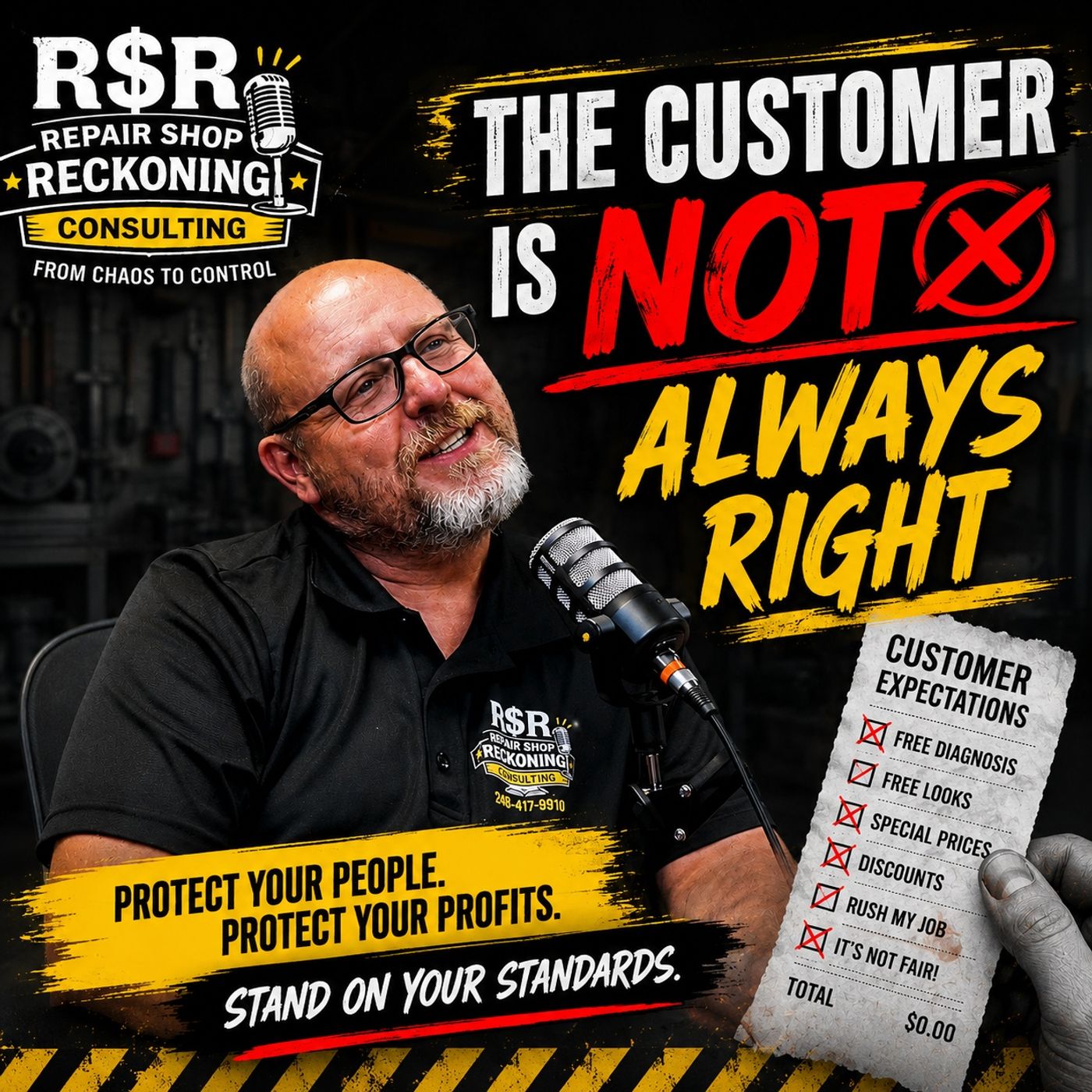
The Customer Is NOT Always Right
In this episode of Repair Shop Reckoning, Kevin tackles one of the most damaging beliefs in business: "The customer is always right." For years, shop owners have been taught to bend over backward for every customer, absorb every complaint, hand out...