The “Monster” in Your Head Is Costing Your Shop Money [RR 1086]
Now playing — Remarkable Results Radio
About this episode
Thanks to our Partners, NAPA Auto Care and NAPA TRACS Watch Full Video Episode *]:pointer-events-auto scroll-mt-[calc(var(--header-height)+min(200px,max(70px,20svh)))]" dir="auto" data-turn-id="request-WEB:b7123d23-4a4b-4700-b41f-68ea2bc61414-0" data-testid="conversation-turn-2" data-scroll-anchor="true" data-turn="assistant"> In this episode of…
Key takeaways
- —Recognize the 'monster voice' that holds you back from making tough decisions.
- —Implement structured training programs like the NAPA Autocare Apprentice Program to address the technician shortage.
- —Understand the importance of diligence in following processes and protocols in your shop.
- —Utilize wisdom, knowledge, understanding, and diligence as pillars for personal and professional growth.
- —Encourage open communication and feedback within your team to improve overall shop performance.
Frequently asked
- What is the 'monster voice' and how does it affect shop owners?
- The 'monster voice' is an internal dialogue that promotes fear and self-doubt, preventing shop owners from making necessary decisions and confronting issues within their business.
- How can I improve my shop's performance despite the technician shortage?
- Implementing programs like the NAPA Autocare Apprentice Program can help cultivate new talent and address the technician shortage by training motivated individuals.
- What are the key pillars for effective leadership in the automotive industry?
- The key pillars include wisdom, knowledge, understanding, diligence, and making right choices, which together support effective leadership and decision-making.
▸Full transcript
This is the Automotive Repair Podcast Network. Hey, welcome everyone. Carm Capriato, good to see you. Good to have you here. Always appreciative to your support and your listenership over all these years. As we're heading into celebrating our 11th year of doing this podcast, I have to tell you, you know, we're so committed to deliver— delivering authentic and actionable content that directly addresses the evolving challenges that you have inside of our great professional automotive industry.
We're gonna do a Coffee with Carmen, a Coach episode today. I'm with Greg Bunch. Can't wait to introduce Greg, but don't forget, we have our really cool app that we've worked on so patiently over the last year for your smartphone, the Automotive Repair Podcast Network. All the shows that are on the network are there. You can save favorites, you can build category libraries, you can see your recently played.
Just go subscribe, go to Google Play, go to Apple, go to automotiverepairpodcastnetwork.com/app. We put these QR code links all over the place so you can get up and on for that. And don't forget, in case you're watching on YouTube, please subscribe. We'd always love to have you as a subscriber. So when we do release this, listen, thank you so much to NAPA Autocare and NAPA Tracks.
Hey, you know, the technician shortage is real, but NAPA Autocare has a solution at no cost to members. The NAPA Autocare Apprentice Program builds tomorrow's technicians through a 2-year, 9-stage curriculum. Learn more at member.napaautocare.com or talk to your NAPA representative today. Hey, did you know that NAPA Tracks has onsite training plus 6 days a week support? It all starts when a local representative meets with you to learn about your business and how you run it.
After all, it's your shop, so it's your choice. Let us prove to you that TRACS is the single best shop management system in the business. Find NAPA TRACS on the web at napatracs.com. Okay, let's get on with Greg. Hi, Greg. Hello, hello. Glad to be here, sir. Thank you. Good to have you here. Oh, by the way, so this is Coffee with Carmen Acoach.
I love that graphic that I made. That is so cool. Absolutely. That is just too cool. And then we have this really cool background that you're all gonna see in a little bit with a brewing cup of coffee. And I said, Greg, you gotta have your coffee. And he said he has his. I got my coffee here. And I have mine. So, okay.
This is going to be a very powerful framework of a leadership episode. It's kind of like this, everyone, because Greg and I have already discussed this and I was blown away by what he's bringing to you. It's like we all have two voices inside of us that every shop owner, every specialist, every service advisor has. One voice builds you and the other one destroys you.
And Greg is gonna teach you how to have those pillars, if you will, of voices help build you, right, Greg? Yes. We're gonna go as far as we can. This is great. All these people inside of us and all these particular pillars. I just love your premise. This is really going to elevate our listener. You bet. Now, I'm excited to bring this to the table.
And really, you know, we're not obviously going to get quote unquote religious on the show here, but, you know, we've got our inner voice, right? Which is that wants us to succeed, that wants us to do well, that wants us to be successful, the true essence of who we are. But we have some other voices that go on in our head that try and tell us, nah, you don't really want to do that, right?
And if you study neuroscience, and I don't claim to be one, I don't play one on TV, but I've been reading a lot about human behavior as a business coach. And really, you become a life coach in a lot of different ways. The question becomes, okay, why as human beings, if we know what we're supposed to do, why don't we do it?
Right? So, there's a lot to unpack there. And I think we have this, what I call the monster voice, And that is that voice, and I give a whole presentation on this, but it's the overprotective security guard. And so when we were kids, whether it was, "Hey, I don't want to be the one not picked on kickball," or, "I don't want to be the one that's ostracized for saying something that I believe," or you're figuring out socially who you want to be, who your friends are, what life is going to be like.
Maybe you've got parents that were a certain way, right? Whether they were helicopter parents, whether they were super authoritative type, maybe they were absentee and you had to be the adult in the family. This overprotective security guard is always talking to us about how to make us comfortable and how to make us safe. And you go all the way back into human behavior and go, why do we behave the way we do?
Why do we do things the way we do? And the only way man has survived thousands of years has been because we survive in tribes. If you're in a tribe and you're all gathered around the campfire, you're not going to want to get kicked out of that because literally you could be kicked out into the jungle and eaten by a wild animal.
And not only you lose your own life but lose your legacy, your offspring. Becoming part of a tribe and staying within that tribe literally was a point of life and death back in the day. Well, now, it may have an emotional pain, but it's not necessarily life or death, but You see somebody's willing to share their opinion just between you and that person, but you put them in a crowd and they may have a strong belief they're not going to voice.
And that it really traces back to, hey, I don't want to rock the boat. I don't want to be seen by the quote-unquote tribe as being an outsider. And so this voice that we have, it's not really designed to make us successful. It's not designed to push the envelope. It's not designed to push us out of our comfort zone. It's designed to keep us safe.
And then, you can, again, maybe just hovering a little bit on the religious side of things that we all have a sin nature and it doesn't matter what you take all the religions of the world or all the philosophical views in the world. I think everybody knows that human beings have a propensity to be selfish, to do things in our own self-interest that could be harmful to ourselves, to other people.
So, I think that voice is in there too, but I As I've been studying this and learning this, really there's a separation between those two voices, three voices really, right? That your authentic self, you've got this overprotective security guard in our brain, and then we have what I'm going to call the sin nature that says, "Hey, you know what? You can get away with this," or just that selfishness really that I think we all are born with and we all have to fight.
Greg, ever since you told me about the monster voice, I started to really think about it a lot. And I started to think that, do we get that? Does it overwhelm us when we have fatigue or stress, or maybe we're a little bit in isolation or we're overwhelmed, we're financially pressured, we're exhausted, we're unsupported, and that monster voice has a chance to take over a little bit of our world.
Absolutely. I was talking to a, a client yesterday and, um, he's involved in a family business. He's got some frustrations that his wife is sharing about the family dynamics and it's a multi-store generational business. So she's pressuring him, "Hey, you're part of it, right? You do more than your brothers that are involved in the business." So you got a family dynamic, you've got a business dynamic, you've got a marital dynamic in there.
And I'm sure that his monster is saying, hey, I want to keep the peace. I don't want to rock that boat. What if I have this really tough conversation with my dad and it doesn't go well, right? What if I don't have that conversation and now I'm at odds with my wife? What if I have this conversation and Dad agrees and the wife agrees, but my brothers are now going to push back and think that there's favoritism?
So that monster is in there saying, well, just let it go, just keep the status quo. And then what's happening, it's eating him up inside. That he's not speaking up. So it can get really heavy. Wow, you just described a huge issue that goes on inside of family businesses every day, right? We do a lot of service advisor training, and it's not that a service advisor doesn't know what to do all the time, but it's getting them to do it.
I always joke around at our company, right? You know what, I forgot to properly introduce you in the beginning. I'm embarrassed. Greg Bunch, Transformers Institute, and the owner of Aspen Auto Clinics. And we've, we've known each other for so many, so many years, done so many episodes together. So yes, this guy's the real deal. All right, go ahead. So I'm looking at my own business, right?
My 6 repair shops, even though I feel like we do a pretty darn good job, there's, you know, because I've got 6 locations, there's approximately $1 million a month of work that doesn't get sold immediately, right? And I think everybody knows, right, that if you had 100% close ratio on every single thing everybody recommended, right, we're going to show up at your shop and say, show me, right?
That, you know, if you've got service advisors, right, they— we all look at our average written, you know, it's $2,500, right? If our service advisor closed 50% of that, right, they're a rock star, $1,200. You know, most general repair shops aren't even at that level, right? They're maybe $800, $900. So all of that additional work that doesn't get sold, what happens? Right.
And I ask my coaching clients and I ask the industry, like, what do you do? And people are like, well, you know, we got a CRM. They get a follow-up email, they get a text message, maybe. And a lot of people are literally just relying that that customer is going to remember it and come back. You know what bothers the hell out of me?
I don't mean to interrupt you, but I wrote this great blog about protocols. And I said, you know, maybe it's possible that you're not being able to install the processes inside of your system because you're in a little too deep. Now, if you thought up top as a protocol, what's the protocol for follow-up and follow-through? What's the protocol? And then you can design your processes under it.
My thought was that maybe we would get more done or respect what those processes are because, hey, we've got a protocol on QC. What's the process underneath that that actually makes it work? Anyway, I didn't mean to bump into you, but you're exactly right. Well, so let's take this from the Monster perspective, right? Psychological. And I'll go into my other pillars that you referenced earlier in the show here.
$1 million of work that's not being sold, right? If you go to your advisor and just say, hey, why don't you jump on the phone, right? Kind of have a slow day today, you know, not a lot on the schedule tomorrow. Why don't you call some of that declined work? And try and fill up the schedule. Well, the reality is, and, and I'm sure shop owners are going to shake their head when I say this, your service writers would probably rather go clean the bathroom than go do that.
Okay, they're going to find every reason. Let me do a parts return, let me do an inventory check, let me clean the bathroom. So the question is again, why aren't they doing that? And to me and the service advisors that I've talked to, right, it goes back to that monster voice going, well, you don't want to bug people. You don't want to annoy people because once in a while you're going to step on a landmine, right?
You're going to find out that they took it to their Uncle Sam. You're going to find out that they don't believe the repair that was done, that you charge more than the guy down the street, and you get a few of those calls and now your protective monster says, well, don't do that again. That hurts. Nobody likes to feel rejected. You just got rejected.
You got kicked out of the village, per se, of your customer base, not realizing that 95% of those people are going to be thankful that you called and got them rescheduled. But we hone in on those people that we had a negative experience with. The other pillars that you were talking about, and I can go as deep as we can. I know we're going to have a short amount of time here together for how deep this can really go.
But as I did a study, I was inspired by a book and really took that on and really studied the book of Proverbs. And again, not trying to get religious, but there's a lot of wisdom that is packed into Proverbs. And so part of the premise of the book is this guy had told his friend that had been fired from like 9 different jobs and was really struggling with his career to say, you know what, read the book of Proverbs for 2 years.
There's 31 proverbs. You read one a day and you just work on applying those principles to your life. You'll see that within a couple years, right, your life is going to look differently. And he tells the story that took him probably about a year to really turn things around in his life. The guy's a successful multimillionaire business owner now. And I had been doing that already where, and I'd gone through Seasons of Life, we're kind of reading through those and like, "Okay, there's some cool stuff in here," but digging deeper and going, "Okay, what do these words really mean?"
So there were 4 words that really stood out, and that was wisdom, knowledge, understanding, and diligence. It's peppered throughout all 31 Proverbs. So I'm like, okay, what does that really mean? And I added one from a class I took back in my early 20s, even before I owned any kind of business. And that was when they said, when you're reading something and it says righteous, think of the word right choices.
So I added that pillar in there too. As I was studying this and going, okay, wisdom is really knowing what that right decision is. So Dave Ramsey talks about this on his radio show, right? I provide wisdom. You know, the same thing that your grandmother would've told you. I think we all know wise principles when it comes to money, and that is don't spend as much as you make, save for a rainy day.
Like, we all know that's good wisdom. And so then we have knowledge, right? So knowledge would be, okay, how much do I make? How much are my bills? What can I do? You know, how much do I need to invest? Where can I put an investment? Right? So that's the knowledge component. So somebody could know that and still not do it. Then understanding is, "Okay, what are the interest rates that I can get?
What is the risk level of those investments?" Understanding how money flows in and out of their budget or household or within their business. Now, the key comes up is diligence. Diligence is that guy that doesn't care how you feel. If you read the book Atomic Habits, that's really what it's about. Diligence is doing what you know that needs to be done whether you feel like it or not.
And then right choices would be, hey, I'm not going to do something immoral, illegal to generate money, right? I'm going to do it in an honest, ethical way. It's not going to violate my core values. And so as I looked at these 5 different pillars that come out of there and studying what each of those words mean, one of the things that gets brought up in my coaching calls as we're talking about this is, man, the one I struggle with the most is diligence.
And I'm like, so that goes back to that component of human behavior. If we know the right thing to do, we understand the numbers, we understand our financials, we understand money coming in and out. Why do we not diligently save money? Why do we make impulse purchases? Why do we not do those things that we know what to do? Why do we hold onto that employee that is on our payroll that really isn't earning their keep, right?
All those components go into diligence. And so that's where that study goes, okay, what— there's got to be something holding us back as human beings from doing what we know needs to be done. And that's where I came up with this concept of the monster, right? This overprotective security guard. If you remember the movie The Village by M. Night Shyamalan— oh, right, yeah, I've seen that movie a couple times and it really didn't hit me until I started putting this together.
And if you remember the monsters And maybe people want to go back and watch that movie now, but those monsters, they weren't there to kill people. They were that overprotective security guard. The elders of that village believe that if we scare people, we'll keep them in our little safe village, right? They won't go outside and find out there's a whole nother dangerous world out there.
But they were using this fear tactic that if you go beyond the fence, these monsters are going to eat you, they're going to kill you. So I kind of look at that same kind of a monster. That's what's in our head. Like, Hey, Carm, you don't want to go do this or that, right? You know, what if people don't like it? What if you get rejected?
What if it takes more time? What if it makes— means you got to get up earlier in the morning? Whatever that might be, that— have an uncomfortable conversation. Showing up when it's hard. And so you have to, you have to figure out a way, and there's different protocols to kind of overcome that voice, right, of saying, you know, and one of the tools is literally you take 5 seconds you shut down that voice.
Like, "I know this is the right thing to do. I may not feel like it, but I'm going to do it anyway." And so really where I looked at, and then I've read a lot of leadership books, I've read a lot of business books and self-help books and podcasts and all that. And I go, "Every one of them I've ever listened to all tie back to one of these 5 pillars."
Atomic Habits is about diligence. From Good to Great is all about wisdom and knowledge and understanding, right? That you tie it back and go, man, there's just so much to unpack there. What's the enemy of our success? Right? It's usually not an external force. It's an internal voice that's holding us back from our true potential. Hey, you know, it's no secret the automotive industry is facing a technician shortage, but NAPA Autocare has stepped up with a powerful solution, the NAPA Autocare Apprentice Program.
And the best part? It's completely free for members. This program was pioneered by shop owners Pete McNeil and master technician Jake Sorensen at McNeil's Auto Care in Sandy, Utah. They recognized that waiting for skilled technicians to appear wasn't an option, so they built a program to grow their own by recruiting motivated individuals with the right passion and attitude and providing them with structured training.
They proved that apprentices could become the next generation of skilled certified technicians. The program features a comprehensive 9-stage curriculum with in-depth classroom videos, instructor-led NAPA Autotech classes, web-based courses, and hands-on training with a mentor. Apprentices move at their own pace, typically completing the program within 2 years. Graduates earn 4 ASE certifications: the G1, A4, A5, and air conditioning, and are officially registered with the Department of Labor as journeyworkers automotive technicians.
And here's the business benefit: as apprentices gain skills, they generate billable hours, often boosting shop profits as early as Stage 5. Plus, NAPA now offers a new apprentice toolkit developed with Carlisle Tools at an exclusive price, helping break down one of the biggest barriers for new technicians: the cost of tools. Together, NAPA Autocare and your shop can tackle the technician shortage head-on.
Start now, grow your own talent, and build your bench for the future. Visit member.napa.com. Autocare.com or contact your NAPA representative today and get started with your apprentice program. Let's face it, your shop management system is the single most important tool in your shop, period. NAPA Tracks was built from the ground up to make your business more profitable and efficient. We provide an extensive set of tools to increase and track profitability in real time.
NAPA Tracks offers the industry's best post-sale support Hands down. And we train your people on-site. Yep, on-site. And we offer remote refresher training 10 times a week. And customer support is open 6 days a week. Give us a call, visit the website, or join our Facebook community today to learn more. We'll prove to you that TRAX is the single best shop management system in the business.
NapaTrax is always customized and tailored for you, whether you're a one-man shop or a large multi-bay or multi-location company. After all, it's your shop, so it's your choice. Visit us on the web at napatracs.com. Greg, it's amazing as I'm sitting here listening to you to discuss diligence, and I think of examples like we've got to follow the processes every time, we have to perform complete inspections, we have to train and educate when we don't want to and when we're tired.
We have to have those hard conversations. And if we can do that and respect that the monster is not talking to us, but we have to be strong in our diligence, we're going to have a lot of success. I think it's also going to build our reputation not only as a business, but as a leader. Absolutely. And you think about consistency in a shop, right?
A lot of shops, the success or whether they have a good day or bad day is truly based on the mood of the owner the manager, the service advisor, the technician, right? That, you know, Carm, you just pencil-whipped an inspection. So I'm old school, started out on paper. I know we all have— probably everybody has DVIs now. So I'm the service advisor, and Carm's kind of that senior tech grumpy guy, but, you know, does good work.
But you pencil-whipped an inspection, and I know it. So the monster is going to say, you know what, just leave Carm alone, he's having a bad day. I don't want to have that confrontation. But what does that do? Cascade that all the way through the customer experience. I don't confront you, so I just, you know, write up the few little things that you wrote down.
I talk about those things with the customer, and now that car's on the road. There's a breakdown. There's, you know, something— the deferred maintenance that caused a further issue. Now that customer's back upset at us, and it all ties back to my unwillingness to have a tough conversation with that master technician and say, We have a protocol here, right? Every single car gets inspected every single time.
There are no shortcuts. I need this thing done correctly, even if that, you know, you're going to bite my head off, right? Like, it doesn't matter. We have a system and a process to follow in my shop. It doesn't matter what mood you're in. Doesn't matter that you don't feel like it. Doesn't matter that you got to pull that car back in and do the job right.
If that system is not followed because it's based on somebody's mood, the customer suffers from that. The business suffers from that. Yeah, I'm just thinking here, here's this guy, Carm, over in the shop who failed to do it completely right. And I'm, if you will, the shop manager knowing this and thinking of what goes on inside of my mind is what kind of conversation can I, should I have with Carm, legacy guy, he knows better.
And I think part of us overthinking what we should do prevents us from doing it a lot of times. Absolutely. Well, if you think about it, right, what does a service advisor really get paid for? They get paid to properly communicate, be the client advocate. So if you are the client advocate, you know, you've got to get this person on your side.
The inspection, okay, it's about safety, reliability, and it's about trust. We can't miss stuff, even though they may not be happy that they may have to have it done. But today in our whole professional world, the DVI, the comprehensive inspection of safety inspection on that vehicle is— it was brilliant when it was discovered. And I think we looked at it as a toy, but it's part of our professionalism.
Carm, have you ever driven a like performance car, like on a track with an instructor or anything like that in your life? I could have, but I didn't. Okay. Well, it's an interesting experience. So I've got an older 2002 911 and took it to the track. I'm not like racing people, right? But it was like a Porsche event and they put a driving instructor in the car with you.
And so, you know, you get warmed up, you go around the track, and we all have like this internal gut of when we hit the brakes, how fast we can take that corner. Now, the instructor that knows another level is saying, okay, hold off, hold off, hold off, now brake, right? Or push, push, push through that corner. And what I found is my car outperformed my gut feeling, meaning that I could— that car could outperform where my level of safety and comfort was.
And I wouldn't have pushed it if I didn't have that person sitting next to me knowing my car better, knowing how to drive on a track like that. And getting more out of that car and out of me. But what I had to do is push past my fear that I'm going to roll the car, spin out of control, going to not be able to brake fast enough.
Right. So we take that analogy and we put it on the sales counter of a lot of service advisors will only talk to a customer, confront that technician up to that level where that knot in their stomach is telling them that that's far enough. But true success comes from pushing past that, having that tough conversation. Again, whether you're a shop owner with your employees, with a vendor, with a customer, being able to push past that fear, that monster that says, hey, if you have this tough conversation, maybe that person isn't going to like you, maybe they quit on you, maybe they badmouth you, whatever that is.
But is it the right thing to do? Is it the wise thing to do? Do you understand the consequences of not doing it? Well, then that means you push past that knot in your stomach and you have that conversation. And believe me, I don't have this mastered either. I'm not perfect at it. There's conversations that I need to be having that I've been putting off because the monster says, "That's going to hurt.
That's going to potentially have a negative effect short-term." But the other voice says, "But Greg, it's the right thing to do. It needs to happen. You've got to address this behavior." So powerful. Hey, I just want to remind everyone, we're here, Coffee with Carmen, a Coach. We're with Greg Bunch from the Transformers Institute. Appreciate you being here, and the CEO of Aspen Auto Clinic, 6 shops out there in Colorado.
This has been brilliant so far. I think you're motivating our listener to dig down deep inside and find— we talk about leadership all the time, but I think this is almost, you know, I don't know if it's Hovering over leadership, if it's supporting, it's the foundation. But there's so much here. Please do a personal reflection on all of Greg's points and say, hey, I am and I'm not.
And if you're not, figure out how to get better at these levels, these pillars. Another one that I run into with shop owners is if they don't want to look at their KPIs, if they're— no, they're not good. They don't want to look at their profit loss statement if it's not good. But you can't manage what you don't measure. And believe me, I've done it too.
Like, "Oh man, this was not a great month." You open up your QuickBooks or your bookkeeper sends you the report and you're like, "Okay, here we go." But I don't want to look. And that head-in-the-sand type mentality. And there's another part of Proverbs where King Solomon writes, "Know the condition of your flocks." That's where the wool from your sheep, that's what they make the clothing, the food, and all that.
It's a call no matter what position we have in life. Like, we have to know, right? And that's that knowledge. Like, do I really know what's going on? Or do I put my head in the sand and I'll— as long as I don't know, it's not going to hurt me. So there's where knowledge says, I'm sorry, I don't mean to get unemotional on you, but you need to know what's really going on.
When you and I were talking, you said something to me I wrote down. You said, business is an emotional math problem. I wish I was the one that said that, but I read that somewhere. I'm let— that was like a big light bulb that went off, right? That everything in the business has emotions tied to it. The emotions of our customers, the emotion of our employees, our emotions.
When really, like you said, it's like a— it's a math problem, right? So that's where knowledge and understanding come in. Go, hey, I know you may feel emotion for this employee,, but they're not pulling their weight or whatever that might be. And are you making a business decision? Are you making an emotional decision? And if you confront that and you ask yourself that question, and some people will literally say, "Gregg, I know I'm making an emotional decision.
This guy's been with me 25 years. He worked for my dad before I took over the business. I am willing to take a hit on my numbers because of the emotional attachment I have to this employee." What am I going to say to that? They own it. They're putting that, that relationship above, right, their profit margin. That's their choice. They're the business owner.
But my job as a coach is to get them to look in the mirror, be able to voice that and admit that, and then understand now I own the consequences of that decision. Someone either on a previous episode or somewhere I read this or heard this— fast nickels, slow dimes. And when I was thinking of the issue that we had with the disgruntled Carm in the bays who didn't do a complete job, he was going for fast nickels and my job is for slow dimes.
That would've motivated me knowing that we can't do things fast because the slow, the fast nickels could've lost that customer. And we have to do things proper and right. So slow dimes gets us where we ultimately long-term strategically always want to be with our clients. Anyway, you just made me think of that. No, no, that's good. And I remember, you know, getting a little bit more psychology here.
When I was a technician, cars that come in and out, they become a piece of machinery that you're looking at. And so when, when I had the opportunity to meet the family that was going to be in that vehicle or the driver of that vehicle, you know, be able to look them in the eye, shake their hand, it did something to me as a technician to go, you know what, I just met that guy.
I just looked him in the eyes. I shook his hand, told him he's going to be in good hands. I need to do a much better job. I need to be even more thorough. It put a human element into that vehicle that you're driving, knowing that, you know, hey, your mom's in the hospital 2 states away, you're going to be driving it.
I better make sure this thing is just perfect. And so, you know, the technicians, we have to talk about that. We— that there's a human element, that these are not just a piece of machinery. These are people rely on us to make sure their transportation is safe. And so that nickel guy, how could we maybe change that, right? Understand, you know, who drives that car.
Maybe even if they're waiting in the waiting room, bring them back, show them, introduce them. And that may reframe that guy trying to just get through the day and pencil whip something to go, know what, I do need to slow down. I need to do this job correctly for that person. Greg, let's jump into wisdom. Wisdom. So where I started with this, Carmen, I'll have to send you a picture there.
I don't know if you can put it on this, but I went onto Amazon and I bought a costume. I think it was a Moses costume, right? I was looking for that robe and then a long gray beard and gray hair. And so I was at the mastermind meeting and we were on a break. Nobody knew what was going on. So here I come from the back of the room up on stage, you know, people are snickering like, what the heck is going on?
And then I read this monologue as if I'm Father Wisdom, right? Personify this character and talk about that the more we tap into wisdom and people have to define really what wisdom is and what that looks like. But I define like, if you listen to me and I'm here, I'm available. There's a lot of different places to gather wisdom, but the first step in this is wisdom.
And so Proverbs again says, there's wisdom in the multitude of counselors. So one of the reasons we have our mastermind groups is there's wisdom. We had a shop owner that was about to buy a gas station that has a repair shop that the tanks are 39 years old. Well, in the state of Colorado, they're mandatory pulled and replaced at 40 years. Well, obviously the guy knew that while he was trying to sell it.
And so the wisdom in the room said, hey, This is not a good idea. Here's what's going on, right? That, and if they get into those tanks and then they find there's a leak, right? You're now on the hook for all of that. So wisdom in the multitude of counselors and whether that's, you know, hey, a marketing campaign, a, you know, a pay plan change, buying another building or, you know, buying and doing an acquisition, right?
So there's a lot of wisdom out there. And, you know, I think Jim Rohn said it, you become the 5 people you surround yourself with and the 5 books that you read. What that principle is about wisdom. Who are you listening to? The guys that don't have any money in savings and spend it all on beer and pizza on Fridays, or the people that are building success and long-term?
You've got to find out what your source of wisdom is and tap into that and listen to it. And then we have knowledge. CPA is the one that gives us our knowledge, right? That doesn't hold back to say, "You're making money. You're losing money. Here are your margins." your KPIs. Their knowledge is really unemotional. It's either this is the facts and this is the truth, whether you like it or not.
So how willing are we to listen to that voice of knowledge and go, this is where I'm really at in life? Knowledge in my mind is learned and earned. Absolutely. And so is wisdom, right? That, uh, there's an element of— I used to teach my kids this, right? That smart people learn from their own mistakes, wise people learn from other people's mistakes.
Years ago, as I kept going to more and more training and being involved in masterminds and associations, and then all of my selling the business and then working for corporate America, I started to realize that I was a perpetual student. Those two words just flowed out of my mouth. I own them words, I think, and, and I speak about that a lot.
As a leader of any organization, an individual who's— pick the role in the shop, you have to be a perpetual student. How they look at the opportunities that they have as clients and what should be fixed and what shouldn't be fixed. They're out there gaining knowledge and you have to learn how that adapts and how you end up building that relationship. To not be a perpetual student in today's life and/or in this professional industry of ours is wrong and it's truly dangerous for our careers.
So, you know, we've probably both talked to people that said, I don't want anything to do with AI, right? It's the Antichrist or whatever. Well, you better have a knowledge of what AI is now, where it's going, and how it's going to affect our industry, right? That's— you can't put your head in the sand and expect to survive if you don't know what's happening regarding AI and what it's going to do in our industry.
You've had him on the show before. We've done episodes on AI. We have, marketing perspective on, and you know, instead of SEO, it's AEO. But we also, I'm getting ready to do an episode with Chris Cloutier. I mean, this guy's deep in AI. He's told me a book to read that I read on it and I fell in love with what AI is today, where it came from, what it is today and where it's going and how it can help you.
So. Yeah, we can ignore it to your point. So you've had him on our, you know, he's a friend of our network here, right? Brian Sump's been on your show before. And so, yeah, so he was in the room. We're talking about knowledge, right? Let's get real personal here. He was at some kind of a conference or something and they had this, you know, as a husband, how would your wife rate you from 1 to 10, right?
1, you're a piece of crap. 10, you're Prince Charming, the best thing in the world. So the speaker challenged everybody, text your wife right now and get what that number is. You talk about knowledge, not wanting to know, like who is brave enough to do that? Brian Sump was brave enough to do that. Right. And I think the number came back at a 7, which is, I think, pretty darn good.
And then he had a conversation with his wife. Okay. What do I need to do to make that an 8 or 9? So that's taking wisdom. Don't get shocked if your relationship's not where it is. Knowledge is your wife's really telling you where things are at. And then understanding is understanding what do I need to do? And if that means for my wife and I that I stop working at 6:00 at night, even though I could work till midnight, I need to cap it off.
That becomes that time. Wisdom, knowledge, understanding, diligence says, "Okay, it's 6:00. I know that Carm wants to talk, but let's postpone that till tomorrow." Right? Like, honor that commitment diligently. And maybe there's room for, you know, once in a while that, you know, hey, there's just an exception to the rule. But right now, that number can go up. Tying all of those things together for improving your relationship, improving your business.
Okay, so a great episode. But what we have to do right now is to challenge every listener, male, female, whatever job it is in the industry, to go out and get rated. Go ask 1 to 10. Ask your employees, ask your peers, ask your significant other, ask your family, and collect those pieces of data and find out what your maybe— maybe averages at work, averages at home.
And I love what Brian said: what can I do to go from 7 maybe to 8? Honey, I know I'm not perfect, but I have to do. And, you know, I think that— well, what a learning curve. You can't let your ego get in the way. And that's the monster I don't want to face out. And so, you know, asking our employees— I've got another client that recently did an anonymous survey, right?
SurveyMonkey or something like that, a net promoter score internal for his employees, right? And learned a lot of very valuable information, right? I think I'm the best employer in the world. Well, 30% of my team doesn't. Why not? And it's not always pay, right? It's whatever. Hey, I wanted, you know, you told me we were going to get more education when I came to work here, or work environment, or whatever that might be.
We can't fix things if we don't have those numbers, right? Sending out a survey to our customers. I'm, you know, we just had our mastermind meeting a couple weeks ago and we sent out a survey and it's like, okay, let's find out what people said. Now, me, I really didn't wanna do it because I'm like, "No, it was a great meeting, everybody's happy."
Well, I think everybody was, but there was a few that like, "Okay, there's some good points that we need to listen to." You and I both do industry events and speaking, and there's always those surveys, and human nature is we're gonna gravitate towards the negative ones, but we need to know what they are. We need to look at, you know, is that just an outlier or did I really say, "Um," way too many times?
Or did I not respect— I got in trouble one time and I made an inappropriate crack about, you know, that a shop was full of ex-cons or something like that, where, you know, that, you know, people have people's perception of a shop. And I had a gentleman come up and I sincerely apologized. It wasn't part of my script, but like, you know, he was an ex-con and he had some that worked for him, but he's like, look, we all turned our lives around, right?
It was 20 years ago. We made some mistakes. Like, And I'm like, you know what? That was absolutely wrong of me to go down that road. Learned a lesson from that. Greg, listen, it's happened to me. I've been there and I've done that. Felt so ashamed, if you will, after I apologized and I said, you ass. I just kept being down on myself, but it didn't stop me.
Okay? It honed my skills, if you will. It, it honed my better judgment. It honed my, if you will, impromptu-ness of, you just thought it, it doesn't mean you have to say it moment, right? And part of what I think has helped me over the last 3 years is when we formed our Toastmasters group, Remarkable Results Toastmasters. And it makes you value the words that come out of you if they're important and if they're not and how you can speak.
And a lot of times in Toastmasters, it's not what you say, but it's how you say it. My dad used to say that all the time. You can tell somebody to go to hell and they punch you in the face, or they high-five you and laugh. It's a lot of how you say it. Hey, thanks for letting me know where I gotta go.
Oh my God. And again, this sounds like, uh, Pastor Greg here speaking. I don't mean it to be that way, but again, a proverb: power— life and death are in the power of the tongue, right? So our words have power, and the words that we speak and the words we don't speak. This is a perfect end, what you just said. And I know you could go on for 2 hours and dive really deep in this.
Do you give this class when you're out at conferences? Not yet. So I have, for my internal Transformers group, you know, I created this notebook or, you know, with a dialogue. And so when I came out on stage, I read and I didn't memorize it because it was like a page and a half. Where I'm that character. And then I had Doris, who's on my team.
So I think she was knowledge. I had Seth Thorson, who was understanding. I had Fernando, who's on my team, was right choices. And who am I missing? Diligence. I had somebody else stand up and do diligence, right? So we all read our parts. And then as we went through it, we made notes. Okay, what came out of that? What spoke to you?
And then on the last mastermind group, I actually, even though I bought a monster mask, I was going to do the monologue as the monster. But I created an AI monster with the creepy background music and everything and the character. So I started with the monster dialogue and then we went into a group discussion on, you know, listening to our monster. What's he saying to us?
Where's that monster voice holding us back from being more successful in our life? And where did that programming come from? And going back and understanding, you know, as kids, you know, the, like I said earlier, the kid that their parents were kids themselves or weren't there, those kids had to grow up fast. And a lot of those turned into what we now know as our control freaks, which can be— you can leverage that for success.
That, you know, there's an element of being in control that brings business success and life success, but it can also go too far and stunt your growth. That the people pleaser, right? That, hey, I wasn't accepted in my social circle. Maybe I wasn't accepted very well in my family. And I knew that I had to walk on eggshells and just be agreeable to everybody.
Well, great, you know, that can be great to a certain extent for bringing on employees and being a good service writer and all that, but it can be detrimental when you're putting that ahead of what's right for the business, what's right for that customer, you know, whether it's asking for that money, asking for that sale, letting that employee go that shouldn't be there.
So you've got these strengths and weaknesses that are all birthed out of our childhood experiences. And you're never going to silence the monster, but you got to put them in its place and say, what am I really listening to? Am I listening to this overprotective security guard? You know, again, that you could use the Scooby-Doo analogy too, right? That there was always this monster that was scary, and really what it was is you pull the mask off and it's just some guy trying to protect his comfort zone.
I'm going to encourage you to create this and take this on the road. And I think the title of it is Silence the Monster. And I think people, you know, and once you put your Subtitle below that. I think you'll pack the class because every single one of us knows that we have this alter ego, sometimes not good, the monster side that gets in our way of being super successful.
I think you could pack the classes all the time. And I gotta go back to the monster mask and that whole thing. You know, I've given my keynote on, uh, the Rise of the Specialist a bunch of times, a bunch of times, a dozen, 14, 15 times in the last year and a half. And probably half of them might come out in a chef's jacket.
And it's kind of, if you will, a uniform, because the whole concept of this thing came out from the professionalism of the, the food industry and what respect chefs have. And then you think about what we look like in our industry to take the chef's jacket off. And, and I usually have another kind of uniform on under that. I don't wanna give away the whole premise of what the keynote's about, but I encourage you Silence the monster.
What a great seminar that would be. Thank you so much, Greg Bunch, Transformers Institute. How do they get a hold of you? TransformersInstitute.com. Got our phone number, got my email on there. Fill out a form, let us know how we can definitely help. And whether that's service advisor training, mastermind group, we have online training, we have online groups, we have in-person groups, you name it, you know, somebody's Got, you know, if they're from $800,000 and they want to grow, and we've got programs that help people grow multi-store.
We help multi-store owners. We've got, you know, clients that are doing over $20 million in sales and, you know, helping them build their leadership team, train their leadership team, whether it's, you know, shop foreman, store managers, COOs, director of operations. In fact, you know, the COO group is heading down to Texas to be with one of our multi-store shops down there and learn from each other.
So we got You know, really the only thing that we don't work on is the technical training. There's plenty of great people out there and great companies doing that, but everything else we cover to help a shop owner and their team be successful. Well, thank you so much for being here with me. Coffee with Carm and a Coach. Thanks, Greg. Thanks for being on board to listen and learn from the premier automotive repair business podcast, Remarkable Results Radio.
Get your episodic education on the ARPN listening app. At automotive-repair-podcast-network.com. Also enjoy the podcast on our Carm Capriato YouTube channel. Carm is all for advancing the professional automotive service industry. Until next time.
More from Remarkable Results Radio
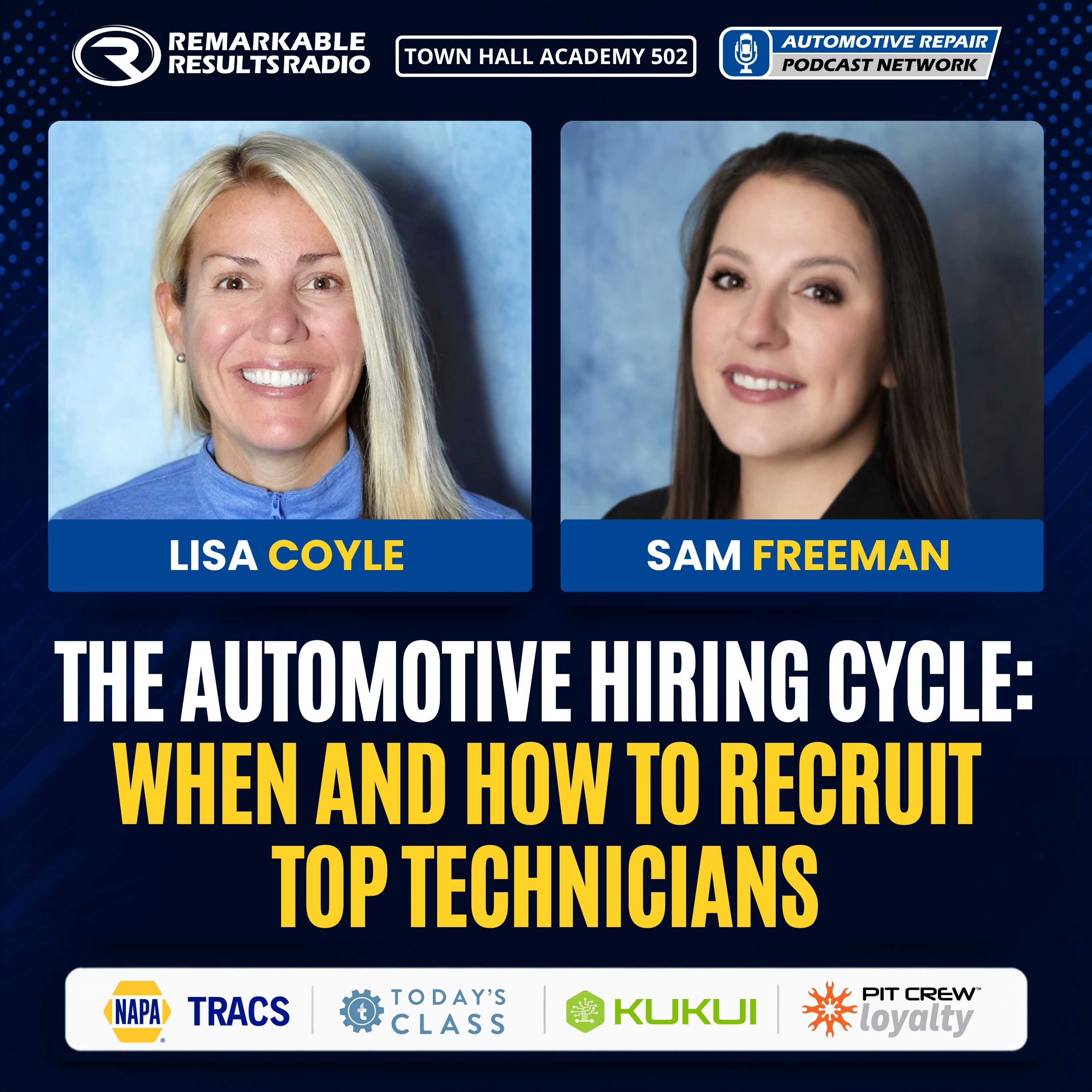
The Automotive Hiring Cycle: When and How to Recruit Top Technicians [THA 502]
Thanks to our Partners: NAPA TRACS, Today's Class, KUKUI, and Pit Crew Loyalty Watch Full Video Episode *]:pointer-events-auto scroll-mt-[calc(var(--header-height)+min(200px,max(70px,20svh)))]" dir="auto" data-turn-id="request-WEB:8e59eec7-a235-4fa3-a072-956fea3fe478-7" data-testid="conversation-turn-4" data-scroll-anchor="false" data-turn="assistant"> *]:pointer-events-auto scroll-mt-[calc(var(--header-height)+min(200px,max(70px,20svh)))]" dir="auto" data-turn-id="request-WEB:49a777bf-d263-4496-bf0b-2eb3a46ac96a-11" data-testid="conversation-turn-24" data-scroll-anchor="false" data-turn="assistant"> What if the best time to recruit your next technician is when your shop isn't looking to hire? Lisa Coyle, CEO of Promotive, and Sam Freeman, Partner Manager at Promotive, reveal why automotive recruiting has a cycle, and why understanding when technicians are looking can give shop owners a significant advantage. Lisa and Sam explain how recruiting data, market timing, candidate behavior, and consistent relationship-building can create a much more proactive hiring strategy. Download the 6 Month Promotive Hiring Insights Report for FREE: https://info.gopromotive.com/RRR What You'll Learn Why technician recruiting has a cycle and why timing matters.Why “post and pray” recruiting puts your shop at a disadvantage.Why finding a top technician can take 60 to 70 days.How local market data can improve your job postings.Why you should recruit even when you don't have an opening.What may really be behind candidate ghosting.Why a counter-offer doesn't have to end the relationship.How consistent communication can prevent first-day no-shows.Why complicated hiring processes can cost you great candidates.How the F.O.R.D. method can make interviews more personal and effective. Great recruiting is about timing, data, and relationships. Don't wait for an empty bay to discover you need a recruiting strategy. Understand when technicians are most likely to consider a move, know what candidates in your market are searching for, simplify your hiring process, and stay connected with good people even when the timing isn't right. Your next great technician may not be looking when you're ready to hire. The opportunity is to build the relationship when they're ready to listen. Promotive has over 40 years of recruiting and automotive experience. If you need qualified technicians and service advisors and want to offload the heavy lifting, visit https://gopromotive.com/ Meet Paige: The Auto Repair Industry’s First 24/7 AI Recruiter [THA 481]: https://remarkableresults.biz/remarkable-results-radio-podcast/a481/ Lisa Coyle, CEO of Promotive Sam Freeman, Partner Manager at Promotive NAPA TRACS will move your shop into the SMS fast lane with onsite training, six days a week of support, and local representation. http://napatracs.com/ Optimize training with Today's Class: In just 5 minutes daily, boost knowledge retention and improve team performance. https://www.todaysclass.com/ Stop juggling multiple marketing tools. KUKUI’s integrated platform delivers 4x better website conversions, automated follow-up, and real-time ROI tracking. https://www.kukui.com/ You’re probably tired of chasing new customers who never return. Pit Crew Loyalty ends the one-and-done cycle, turning first visits into lasting, reliable revenue at https://www.pitcrewloyalty.com/ Connect with the Podcast: Download and Listen on Our Mobile App: https://automotiverepairpodcastnetwork.com/app/Visit the Website:https://remarkableresults.biz/Subscribe on YouTube:https://www.youtube.com/carmcapriottoFollow on Facebook:https://www.facebook.com/RemarkableResultsRadioPodcast/Follow on LinkedIn:https://www.linkedin.com/in/carmcapriotto/Follow on Instagram:https://www.instagram.com/remarkableresultsradiopodcast/Join Our Virtual Toastmasters Club:https://remarkableresults.biz/toastmastersJoin Our Private Facebook Community:https://www.facebook.com/groups/1734687266778976Join our Insider List:https://remarkableresults.biz/insiderAll books mentioned on our podcasts:https://remarkableresults.biz/booksOur Classroom page for personal or team learning:https://remarkableresults.biz/classroomBuy Me a Coffee:https://www.buymeacoffee.com/carmSpecial episode collections:https://remarkableresults.biz/collections The Automotive Repair Podcast Network: https://automotiverepairpodcastnetwork.com/ Remarkable Results Radio Podcastwith Carm Capriotto:https://remarkableresults.biz/<a href="https://mattfanslow.captivate.fm/" target="_blank"...
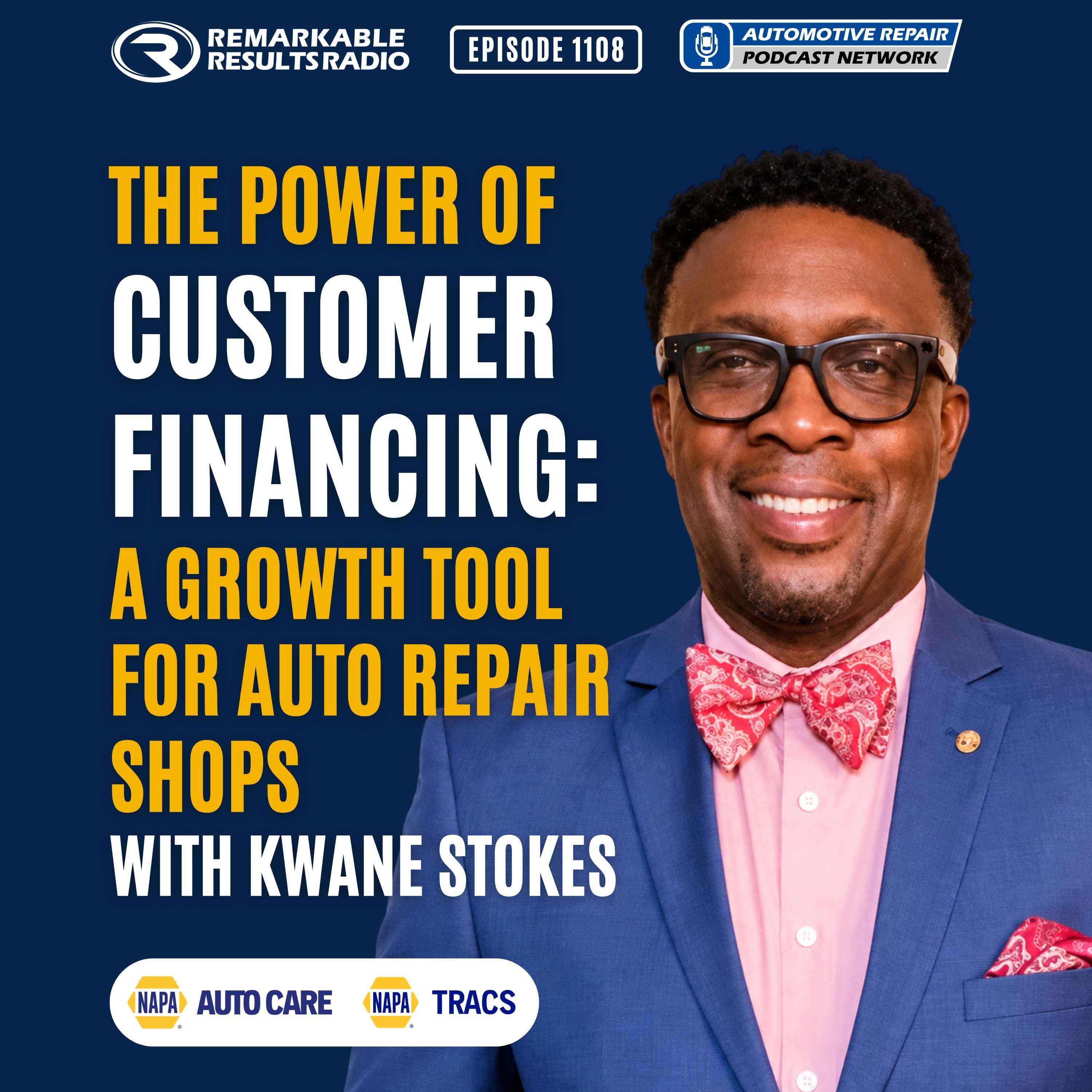
The Power of Financing: A Growth Tool for Auto Repair Shops [RR 1108]
Thanks to our Partners, NAPA Auto Care and NAPA TRACS Watch Full Video Episode What happens when a customer needs a $2,000 repair but doesn’t have the cash available today? That moment can determine whether the vehicle gets repaired, the customer delays a critical service, or they take their business somewhere else. For automotive shops, offering flexible payment options can be more than a convenience. It can be a powerful tool for helping customers say yes to the work their vehicles need. Kwane Stokes, Assistant Vice President and Relationship Manager in the automotive division at Synchrony, explains how the program can help shops remove financial barriers, increase repair opportunities, and create another reason for customers to return. Kwane also addresses why many shops still aren't offering financing and how the biggest obstacle may simply be the assumptions advisors make about a customer's ability or willingness to pay. What You'll Learn Why financing should be presented as a payment option, not something an advisor decides a customer needs.How the program's average first and repeat purchase amounts demonstrate the potential impact on average repair order (ARO).Why assuming a customer can't qualify for credit can cause shops to lose needed repair work.How monthly promotional offers can give shops another reason to communicate with their customers.How advisor incentives and simple training can encourage more consistent presentation of financing.What the upcoming "waterfall" financing model could mean for customers who aren't approved through the primary credit program. The biggest opportunity may not be finding more customers. It may be giving the customers already sitting at your counter more ways to say yes. The key is removing the assumption that you know what a customer can or cannot afford. Present the options, explain them clearly, and let the customer decide what works for their financial situation. For a shop, financing isn't simply about collecting payment. It's another tool for helping customers get the repairs they need while protecting the relationship and keeping the work in your shop. Kwane Stokes, AVP, Relationship Manager, Auto Network, Synchrony Learn more about the benefits of being part of the NAPA family by visiting https://www.napaonline.com/en/auto-care NAPA TRACS will move your shop into the SMS fast lane with on-site training and six days a week of support: http://napatracs.com/ Connect with the Podcast: Download Our Mobile App:https://automotiverepairpodcastnetwork.com/app/Website:https://remarkableresults.biz/YouTube:https://www.youtube.com/carmcapriottoFacebook:https://www.facebook.com/RemarkableResultsRadioPodcast/LinkedIn:https://www.linkedin.com/in/carmcapriotto/Instagram:https://www.instagram.com/remarkableresultsradiopodcast/Join Our Virtual Toastmasters Club:https://remarkableresults.biz/toastmastersJoin Our Private Facebook Community:https://www.facebook.com/groups/1734687266778976Join our Insider List:https://remarkableresults.biz/insiderBooks Page:https://remarkableresults.biz/booksOur Classroom Page:https://remarkableresults.biz/classroomEpisode Collections:https://remarkableresults.biz/collectionsBuy Me a Coffee:https://www.buymeacoffee.com/carm The Automotive Repair Podcast Network: https://automotiverepairpodcastnetwork.com/ Remarkable Results Radio Podcastwith Carm Capriotto:https://remarkableresults.biz/Automotive Field TheorywithMatt Fanslow:https://mattfanslow.captivate.fm/Business by the NumberswithHunt Demarest: https://huntdemarest.captivate.fm/The Auto Repair Marketing Podcastwith Brian and Kim Walker: https://autorepairmarketing.captivate.fm/The Weekly Blitzwith Chris Cotton: https://chriscotton.captivate.fm/Speak Up! Effective Communicationwith Craig O'Neill: https://craigoneill.captivate.fm

Daily Habits That Build a Stronger Auto Repair Shop Culture [THA 501]
Thanks to our Partners: NAPA TRACS, Today's Class, KUKUI, and Pit Crew Loyalty Watch Full Video Episode *]:pointer-events-auto scroll-mt-[calc(var(--header-height)+min(200px,max(70px,20svh)))]" dir="auto" data-turn-id="request-WEB:8e59eec7-a235-4fa3-a072-956fea3fe478-7" data-testid="conversation-turn-4" data-scroll-anchor="false" data-turn="assistant"> *]:pointer-events-auto scroll-mt-[calc(var(--header-height)+min(200px,max(70px,20svh)))]" dir="auto" data-turn-id="request-WEB:49a777bf-d263-4496-bf0b-2eb3a46ac96a-11" data-testid="conversation-turn-24" data-scroll-anchor="false" data-turn="assistant"> What does a strong shop culture look like when you’re the people living it every day? Bree Wismer, Service Advisor and Frontline Culture Leader, and Trevor Hinds, Operations Manager and Dispatcher at Empower Automotive in Traverse City, Michigan, take us inside the daily habits and communication practices that keep their team aligned, productive, and focused on the customer. Rather than approaching culture from the owner's perspective, Bri and Trevor share what happens on the front lines. They explain how Empower Automotive breaks down the traditional divide between the front counter and the bays, keeps everyone on the "same bus," and creates a workplace where every person understands their role, respects the team around them, and contributes to the same goal. What You'll Learn Why the front counter and specialists must operate as one team.How daily huddles and short training sessions keep the team aligned.Why the 1:00 PM check-in can prevent late-day customer surprises.Why a "no-update" update can be one of the most valuable customer communications.How to respond when customers arrive with AI-generated or parts-store diagnoses.How respect, communication, and accountability create confident professionalism. Building a world-class shop culture doesn’t require a massive budget or a complicated organizational overhaul. By committing to these small, consistent actions, you can transform your shop from a high-stress environment into a thriving, unified business that both your team and your customers enjoy. Bree Wismer, Service Advisor, Frontline Culture Leader, Empower Automotive, Traverse City, MI Trevor Hinds, Operations Manager, Dispatcher, Workflow and Culture, Empower Automotive, Traverse City, MI NAPA TRACS will move your shop into the SMS fast lane with onsite training, six days a week of support, and local representation. http://napatracs.com/ Optimize training with Today's Class: In just 5 minutes daily, boost knowledge retention and improve team performance. https://www.todaysclass.com/ Stop juggling multiple marketing tools. KUKUI’s integrated platform delivers 4x better website conversions, automated follow-up, and real-time ROI tracking. https://www.kukui.com/ You’re probably tired of chasing new customers who never return. Pit Crew Loyalty ends the one-and-done cycle, turning first visits into lasting, reliable revenue at https://www.pitcrewloyalty.com/ Connect with the Podcast: Download and Listen on Our Mobile App: https://automotiverepairpodcastnetwork.com/app/Visit the Website:https://remarkableresults.biz/Subscribe on YouTube:https://www.youtube.com/carmcapriottoFollow on Facebook:https://www.facebook.com/RemarkableResultsRadioPodcast/Follow on LinkedIn:https://www.linkedin.com/in/carmcapriotto/Follow on Instagram:https://www.instagram.com/remarkableresultsradiopodcast/Join Our Virtual Toastmasters Club:https://remarkableresults.biz/toastmastersJoin Our Private Facebook Community:https://www.facebook.com/groups/1734687266778976Join our Insider List:https://remarkableresults.biz/insiderAll books mentioned on our podcasts:https://remarkableresults.biz/booksOur Classroom page for personal or team learning:https://remarkableresults.biz/classroomBuy Me a Coffee:https://www.buymeacoffee.com/carmSpecial episode collections:https://remarkableresults.biz/collections The Automotive Repair Podcast Network: https://automotiverepairpodcastnetwork.com/ Remarkable Results Radio Podcastwith Carm Capriotto:https://remarkableresults.biz/Automotive Field Theorywith Matt Fanslow https://mattfanslow.captivate.fm/Business by the Numberswith CPA Hunt Demarest: https://huntdemarest.captivate.fm/The Auto Repair Marketing Podcastwith Brian and Kim Walker:<a...

Rapid-Fire Automotive News: AI, EVs, Autonomous Vehicles, and the $19B Trade School Boom [RR 1107]
Thanks to our Partners, NAPA Auto Care and NAPA TRACS Watch Full Video Episode How quickly is the automotive repair industry changing, and are you ready for what's next? Tom Ham, shop owner and founder of the Automotive Management Network, joins Carm Capriotto for a fast-paced conversation covering 12 major trends shaping the future of auto repair. From autonomous vehicles and solid-state batteries to the changing value of trade careers, AI, government regulation, 3D printing, and vehicle reliability, Tom and Carm explore the technologies and economic shifts shop owners need to understand. What You'll Learn How autonomous vehicles could reshape vehicle safety and the repair industry.What advances in solid-state batteries could mean for EVs and vehicle range.Why trade careers are gaining momentum as technology changes traditional employment.How the technician shortage is creating new opportunities for shops to develop talent.How government regulation and emissions enforcement could affect vehicle owners and repair shops.What current vehicle reliability trends reveal about today's automotive brands.How 3D printing could help shops solve parts availability challenges.Why AI is becoming a powerful tool for reducing friction and improving efficiency.Why shop owners need to stay curious and adapt as automotive technology continues to accelerate. The automotive repair industry is changing faster than ever. The shops that thrive will be the ones willing to understand emerging technology, embrace new tools, develop their people, and continually rethink how they operate. The future isn't coming someday. It's already showing up in the service bay. Tom Ham, Automotive Management Network. Tom’s previous episodes HERE. Learn more about the benefits of being part of the NAPA family by visiting https://www.napaonline.com/en/auto-care NAPA TRACS will move your shop into the SMS fast lane with on-site training and six days a week of support: http://napatracs.com/ Connect with the Podcast: Download Our Mobile App:https://automotiverepairpodcastnetwork.com/app/Website:https://remarkableresults.biz/YouTube:https://www.youtube.com/carmcapriottoFacebook:https://www.facebook.com/RemarkableResultsRadioPodcast/LinkedIn:https://www.linkedin.com/in/carmcapriotto/Instagram:https://www.instagram.com/remarkableresultsradiopodcast/Join Our Virtual Toastmasters Club:https://remarkableresults.biz/toastmastersJoin Our Private Facebook Community:https://www.facebook.com/groups/1734687266778976Join our Insider List:https://remarkableresults.biz/insiderBooks Page:https://remarkableresults.biz/booksOur Classroom Page:https://remarkableresults.biz/classroomEpisode Collections:https://remarkableresults.biz/collectionsBuy Me a Coffee:https://www.buymeacoffee.com/carm The Automotive Repair Podcast Network: https://automotiverepairpodcastnetwork.com/ Remarkable Results Radio Podcastwith Carm Capriotto:https://remarkableresults.biz/Automotive Field TheorywithMatt Fanslow:https://mattfanslow.captivate.fm/Business by the NumberswithHunt Demarest: https://huntdemarest.captivate.fm/The Auto Repair Marketing Podcastwith Brian and Kim Walker: https://autorepairmarketing.captivate.fm/The Weekly Blitzwith Chris Cotton: https://chriscotton.captivate.fm/Speak Up! Effective Communicationwith Craig O'Neill: https://craigoneill.captivate.fm
Related across the catalog

99.08% Diagnostic Accuracy: Inside a Master Tech’s Playbook
Joe Adams interviews Adams Automotive Master Technician Josh Gerbrecht about his journey from technician to top diagnostician, sharing the systems that drove his 99.08% diagnostic accuracy and the big takeaways from a Key-to-Key-to-Callbacks weekend. They discuss the front-office/back-office symbiosis, the Rack Attack inspection process, recruiting and paying technicians their worth, shop tours and hospitality, and how AI could streamline diagnostics and incentivize accuracy over just speed. AutoshopAnswers.com Auto-Shop-Media.com
Why Flat Rate Is Failing Today's Technicians with Dustin Stutzman
Like the show? Show your support by using our sponsorsNeed to update your shop systems and software? Try Tekmetric HERELaunch your tool game to the next level with Launch Tech USA! HEREIn this episode, Dustin Stutzman, a shop foreman and high-efficiency flat-rate technician, shares why he left engineering for the automotive industry and how he became a master technician without a dedicated mentor. Drawing from years in dealership service departments, Dustin explains how flat-rate pay, poor dispatching, and corporate policies often discourage quality repairs and technician development. The conversation explores AI, diagnostic pay, training, dealership culture, and what it will take to retain skilled technicians in the future.Timestamps:00:00 Learning Without Mentors 00:47 From Engineering to Automotive 01:51 Work-Life Balance and Career Values 04:45 AI and the Future of Service Advisors 07:16 Paying Technicians for Video Inspections 11:45 The Shop Foreman Role 14:07 Dispatching Work by Skill Level 17:19 Solving a Cold-Start No-Start Mystery 23:31 Fighting for Diagnostic Pay 24:50 Feeling Appreciated by Great Leadership 30:00 Leaving After Pay Cuts 34:46 Dealer Groups and Industry Consolidation 39:48 Becoming a Chrysler Master Technician 42:40 Life on the Training Road 43:27 Why Dustin Avoided GM 44:30 Diesel Emissions and Warranty Pay 49:02 Getting Diagnostic Time Approved Upfront 55:40 Quoting Worst-Case Repairs 57:53 Service vs. Parts Department Friction 01:03:41 Dispatch Roulette at Dealerships 01:05:15 Demanding Real Diagnostic Data 01:05:46 The Air Filter Diagnostic Lesson 01:11:25 Old-School Electrical Diagnostics 01:13:57 Chrysler Warranty Pay and the Neon Squeak 01:15:19 The 40-Hour Dash Rattle 01:16:46 Brick Road Dash Rattle 01:17:32 One-Shot Repair Success 01:18:06 Foam-Filled Repair Solution 01:19:25 Why Dustin Praises Chrysler WiTech 01:21:09 Preventive Maintenance Matters 01:22:34 Oil Change Reality Check 01:25:19 The Cost of Oil Neglect 01:29:45 Training Technicians Under Flat Rate 01:33:18 The Missing Career Path for New Techs 01:34:39 Learning by Doing 01:37:45 Advocating for Better Pay and Metrics 01:41:20 Dealer Groups and Technician Burnout 01:45:07 The Technician Shortage and Pay Gap 01:50:16 Keeping Great Technicians 01:53:16 Closing Thoughts and Upcoming Events Follow/Subscribe to the show on social media! TikTok - https://www.tiktok.com/@jeffcompton7YouTube - https://www.youtube.com/@TheJadedMechanicFacebook - https://www.facebook.com/profile.php?id=100091347564232

212 - Think Like the Circuit: Mastering Electrical Diagnostics
212 - Think Like the Circuit: Mastering Electrical Diagnostics June 23, 2026 - 01:02:01 Show Summary: Electrical diagnostics become much easier when technicians understand the fundamentals instead of relying on guesswork or the parts cannon. Jim Cokonis and Nick Pope share real shop stories that highlight how critical thinking and a solid understanding of circuits lead to faster and more accurate repairs. They explain how wiring diagrams voltage drop testing and logical troubleshooting can eliminate costly misdiagnoses. The discussion also explores continuous learning teamwork and building stronger communication inside the shop. Finally they challenge technicians to close the gap between thinking they know the answer and proving it with proper testing. Host(s): Kent Bullard, CCO, The Institute for Automotive Business Excellence Nick Pope, Industry Coach, The Institute for Automotive Business Excellence Jim Cokonis, Technical Director, Today's Class Show Highlights: [00:00:00] – Learn why electrical knowledge is essential for every repair today. [00:05:05] – Jim shares a blower motor misdiagnosis that changed his testing approach forever. [00:08:00] – Nick explains how one corroded ground created a lasting lesson. [00:11:45] – A transmission replacement failed because the real problem was electrical. [00:20:05] – Learn how wiring diagrams guide faster and more accurate diagnostics. [00:24:10] – Follow current flow instead of guessing where the fault exists. [00:31:30] – Free circuit simulators help technicians visualize electrical theory and testing. [00:39:20] – Small daily learning habits create top performing technicians over time. [00:44:30] – Think like a circuit to improve communication across the entire shop. [00:49:55] – Strong fundamentals create confident technicians and accurate diagnostics every time. In every business journey, there are defining moments or challenges that build resilience and milestones that fuel growth. We’d love to hear about yours! What lessons, breakthroughs, or pivotal experiences have shaped your path in the automotive industry? Share your story with us at info@wearetheinstitute.com, and you might be featured in an upcoming episode. 👉 Unlock the full experience - watch the full webinar on YouTube: https://youtu.be/iMqCrP4N6JU Don’t miss exclusive insights, expert takeaways, and real talk you won’t hear anywhere else. Hit Subscribe, drop a comment, and share it with someone who needs to hear this! Links & Resources: Want to learn more? Click Here Want a complimentary business health report? Click Here See The Institute's events list: Click Here Want access to our online classes? Click Here ________________________________________ Episode Transcript Disclaimer This transcript was generated using artificial intelligence and may contain errors. If you notice any inaccuracies, please contact us at marketing@wearetheinstitute.com. Episode Transcript: Kent Bullard: Hello everybody, and welcome to today's webinar. We are s- kicking off our technical training series. I gotta tell you, the content that we have today is awesome. We've got some incredible instructors with us and some really fun stuff we're gonna cover. So to get things started, I'd like to introduce the webinar. Here we go. Today we're gonna be covering mastering electrical diagnostics, as well as some critical thinking skills. Where's everybody coming from? I'm out of Utah today. We've got some people on the East Coast. Our trainers, instructors are on the East Coast. Let us know in the chat. We're gonna be watching that as we go through this. Our real goal with this series was to dive into a lot of the technical skills, but at the same time some of the critical skills that you need to be a good technician in the shop, to work well with your the skills that you need to develop, the team that... and relationships you need to develop. And so we had a mashup of technical and business training, some development training here, and it's awesome. I've loved to see how these guys have put this content together. Today what we're gonna do is we're gonna dive into some technical content, some critical thinking skills. At the end of this training, we're gonna open up for a Q&A, and we'll actually hang on a few minutes past, maybe 10, 15 minutes after the hour, to answer any additional questions that you guys might have. So first off, we're gonna be asking some questions throughout, so let's practice this. What tool do you guys tend to start with or rely on more when starting electrical diagnostics? And type in the chat either a one or a two to answer the poll. One, a scan tool, or two, an altimeter. Let us know in the comments section. So looks like we've got Southeastern Tennessee, we've got Wyoming, South Florida. Oh my gosh, Milwaukee, Brookfield, Wisconsin, New Jersey. My goodness. So we've got that poll going. Let us know do you tend to start with a scan tool or with your multimeter when you start electrical diagnostics? At the same time, if you guys have any questions I've been in- involved in a lot of these trainings. I've done-- gone and taught classes. I tend to enjoy open discussion and conversation. Now, in this type of circumstance it can be a little challenging, but hey, that's what I'm here for. I'm gonna be your guys' voice with the instructors. So if you have questions or comments or you wanna add to the dialogue, I strongly urge you guys to let us know in the chat, and I'm gonna answer those questions for you or ask those questions for you so we can get them answered. At the same time, let's keep things positive and constructive. We wanna make sure that questions get answered. We don't wanna, maybe punish somebody who, if they don't know what's going on or they do have those curious questions, that's what this space is for, right? So we wanna keep things positive and constructive and again, take notes, key takeaways, and most important, we want you guys to have a lot of fun. So before we introduce our instructors, what I'd like to ask is, what would you rather leave with today? Actually, do we have poll results for that? Can you post those for the first question? All right. Let's try this one then, guys. What would you rather leave with today? Number one, one big idea that you can take back, or number two, several practical tips that you can deploy in the shop. While you guys answer either one or two in the chat, and I think it's just a one or a two. I'm not quite sure how the poll system works, but there we go. We've got a few there. Several practical tips. Love that. The guys that we have on here, we've got Jim Kokonis and Nick Pope. These guys have been some incredible instructors. I'd love to bring them on and introduce them. I'm very excited for the content they're gonna share with you today. We've got a lot to dive into. Welcome guys. Thank you for joining us. And Jim, I'm gonna hand things over to you. Jim Cokonis: Awesome. Welcome everybody. For those that don't know me, Nick and I had a conversation, and I always start off classes with, "My name's Jim Kokonis, and I don't know everything." We were joking about making the title under my name Eternal Student. But I have a question for you, and this is an official poll, but just give us a yeah or a no. Has anybody in the room ever had their hind end put in a bucket and carried out of the shop by a car that was being difficult? I have. I have, and I'm gonna share a story with you early on. But when we think about electricity, i- is there anything on the car that isn't controlled, monitored or communicated with electrical anymore? You don't, you can't even do suspension work and brake work without understanding electricity and systems and how those components work. I'm seeing some yeses in the chat. W- if you're, if you say no to that, I'm like, "What are you working on? Wrought iron gates? I don't know." We've all been humbled by a car, right? Nick? We've all had that, and what I wanted to share with you is that I had a long time ago in my career, I've got a experience highlights. I was diagnosing a vehicle with an inoperative blower motor, and I had bought one of those new-fangled logic probes. You hook it up to power, and you go around and you touch places on the circuit and right? If you touch something that had power, it goes meep, gives you a green light, and you touch something where it's supposed to be on the ground side of the circuit or the low side of the circuit, it goes merp, and it gives you a red light. So I go to the blower motor, and I get my meep, and I get my merp, and I call a blow- call a blower motor. And I put the blower motor in it, and it didn't fix it. For the longest time I had that logic probe. And it was great for some uses, but I had that thing in my toolbox with the pigtail cut off of it to remind me that electrical testing has other aspects of it that we've gotta keep in mind. So with that said- This slide was just an introduction to that conversation. But here's a, here's an interesting one. This is an example of one of the questions, not how it's presented, but the basic question that's on the platform. And this question is- questions aren't designed to test with today's class. They're designed to teach through the question. This particular question is looking for an understanding, and Nick and I had a conversation about that, and he's gonna chime in here in a minute. But the question basically says, which of the following choices apply to testing a circuit or a device with an ohmmeter? And these are the four options. Now, this is what we call a multi-answer question. And so on the real platform, it's always gonna say select all that apply. And it's gonna indicate through a couple different ways that there's more than one answer here. So the- there are two correct answers on this. And a lot of people get this one wrong, be honest with you. And so when they answer the question, they're gonna get a response. If they get it right, it'll look like this. Now, this is an actual screen capture. And it says that it can determine if a wire is completely broken and it can tell if a device has an open circuit. Then it ... An incorrect answer is it can determine if several strands inside of a wire are broken and it confirms if a device is good. What do you guys think about that? Put a comment in the chat. But Nick, what do you think about this? Nick Pope: Jim, this one really resonates with me. I would be lying if I said this does not trigger a memory that stuck with me most of my career. We've all had those, and this one for me started shortly after high school. I was working at the dealership and I had a customer vehicle with the complaint of a flashing four-wheel drive light, and come to find out I had that classic no communication with the four-by-four module. And upon traveling through the Ford trouble tree, I came to the point where I was presented that I needed to replace the module. And I put the module in, went through the programming process, and lo and behold, it was not repaired. And at that point- I had that gut-wrenching feeling. I was sick to my stomach. I felt horrible. Went back, went through the motions, not once, but twice, and ended up coming to the same result. So then at that point, I was embarrassed, I was frustrated I felt horrible. I, I spoke with my manager, and his automatic response shocked me. He automatically walked me over to the foreman, and the shop foreman came over and wanted to help walk me through this. And that really helped me feel a lot better aside from, the obvious, right? And we got to the realization that there was a corroded wire. So it's... in specific, it was a corroded ground wire. And, I knew right away what I did wrong, and I... it just slipped my mind, and at that point I realized a really valuable lesson that has stuck with me my whole life. And, this ties into, resistance is as only as good as the circuit is that can withstand the load of that circuit. And now this is something that I've been able to carry on and share with, all the people I have worked with throughout my career, and it was a very valuable lesson in so many ways, shapes, and forms. However, it really got me to the point where I understood that I have all of these resources around me, resources and service information, resources with tools, with my experience, with my peers, and I need to use them and I need to think for myself to really know why the failure occurred, how it occurred, if there were any other variables to it, to ensure that it is repaired properly and it does not happen a- again. And the one thing I wanna just point out, Jim, is in this process, not only did I have so many great takeaways that stuck with me my entire career, however, there were people there that were there to support me and help me learn this lesson. And yes, it cost the shop money, however, the silver lining is when we have people around us that are willing to invest in us and lift us up in these moments, it sticks and those are the really valuable things of wanting to continue and grow in our careers as technicians. Jim Cokonis: Thanks, Nick. Costing a shop money. Scott made a comment in chat that says an ohmmeter can only tell you when a circuit is bad. There's some other fancy types of tools and things that we can use to see very small changes, but most technicians when they're using an ohmmeter, and they love to give you... And I know Ford is "Check for continuity on this wire, check for continuity on this wire." It only takes, one or two strands to get an ohmmeter to go, "Yep, beep," and give you a continuity tone. And yet it can cost you money. So when we look at that, th- this is a, this was a real vehicle. And you can put your comments into the chat too. Here was a vehicle that had set multiple codes and the transmission was in limp mode All right? And so I've got a, I've got an example of the codes that were set, and I've got an example of the wiring diagram that's on this slide here. And w- we're not gonna dive into everything here, but this vehicle came in and the shop diagnosed it as a bad transmission, and they replaced the transmission. And it didn't fix the vehicle. And so the vehicle got a new PCM put in it. And the reason I know that is because they called me to program it at the time, and I'm like, "Where are you getting this PCM from?" And at the time, they w- the company they were buying it from would bench program this older GM because they had the tools to do it, and they would do it free of charge because they were buying the PCM from them. So I'm like, "They'll do it for you." So they did that. Unbeknownst to me customer was in a rental car while they were trying to figure this thing out 'cause they didn't get it back in time. So the customer's in a rental car. They put a transmission in it. That didn't fix it. They've had a PCM put in it. That didn't fix it. They had the transmission rebuilder, well-known company, send out a test box, and they ran through phone support and did a whole bunch of tests with this specialty box, and they said, "We're gonna send you another transmission." So now it's had a second transmission put in it, and it's still not fixed. And then I got another phone call. "Can you come out and look at this?" And of course, in their mind you have the factory scan tool for this General Motors vehicle. Can you come out here and see if you can see something that we can't see? And so I went out there. I did use my scan tool, but I used their service information and got a look at this thing. I went out and scanned the vehicle. I came in and went to the service information. I went back out. I found a- an area of the wiring that I was interested in. I found a problem. I took a jumper wire and connected from a fusible link to the output of a specific fuse, and then we took and drove the truck and the transmission was normal. Total elapsed time, 20 minutes. What do you guys think was wrong? Any thoughts? Anybody care to, to venture a guess? Kent Bullard: Nick, what do you think? Nick Pope: Gosh. Jim, could it have been a corroded wire? Jim Cokonis: It could have been. It could have been. I'm gonna highlight an area. You see all these shift solenoids? Down here on the right-hand side of this wiring diagram, if you look at that you see the splice S116, and that the PCM shows that's an ignition feed. So the PCM knows when the ignition is turned on, right? And then that wire feeds all of the shift solenoids. I like what- And then the shift solenoids are controlled by the PCM. Kent Bullard: I was gonna, I was gonna add, Scott said something interesting. He said, "There's three fuses in the world: good, bad, and missing." And he says, "Oh, four now, not seated properly." Jim Cokonis: I think I know Scott. If it, at least I know the name. We don't have faces on here, but anyway. Yeah, Scott. Yeah. It... and you're exactly right. But wait a minute, I'm gonna add a fifth. Incorrectly made fuses that are not fuses, they're pieces of wire that burn up harnesses when they should pop. Okay? And we've seen this in the world as well. So now we can make that into five. The whole sum total of the problem with this thing is this particular vehicle had a specific spot in the ignition switch that completed this circuit. And that's coming from a fuse, and I'm sorry the way this went on here, it cut it off. But that fuse is coming from an output of the ignition switch, and it feeds that transmission power. And all of those codes were all circuit-related electrical codes. And if we think about that, if we understand how electricity works, there was a reason why I looked at the codes, I looked at a wiring diagram, and I went straight to a specific spot on the truck to get to the fuse block because it was an easy place to test That computer is doing a voltage drop test at one point in the circuit. We're feeding it voltage, and it is saying that coming through these solenoids, I don't have enough voltage to control this thing. It's declaring a circuit problem A smoke fuse. Yeah, Michael, definitely a smoke fuse. So that's all the computer's doing when we're checking, con- continual component monitoring. It's looking at powers and grounds, and if we understand electricity and we look at this thing, how many of you guys have ever seen a code that says circuit open or shorted to ground? Wait a minute How can that be? How can it be those two different extremes? Back in the day, the, we didn't run a bunch of extra wires, we didn't have a bunch of extra circuits, and the computer, if it wasn't seeing voltage when it should, then either I'm on the control side of this device, like on, on the ground side of this solenoid, and the voltage can't come through the solenoid, so maybe I have an open in the circuit, or this wire is broken, or this wire is shorted to ground, which is making the voltage drop there, and the computer can't see it because it's only looking at one spot. And so the way I used to describe this is the computer only knows what it can see. If that computer was monitoring this little yellow wire here, and it also had the ability to monitor here and monitor up here and monitor over there, it could tell you exactly where the break was. Oh, I've lost voltage between these two points. But the computer can't do that. That's our job. So how well do we understand electricity? And so just like Nick said, he, when he had that one early in his career, it told a, taught him a lesson. When I misdiagnosed that blower motor, it taught me a lesson. And then, 25, almost 30 years ago, I was going out and doing this type of stuff for other shops, and was one of the first mobile diag and programming guys out there, and I can't tell you how many times you'd get there and this complex problem that had spent, three weeks in the shop and had a customer in a rental car turned out to be a pretty straightforward electrical problem So with that in mind, let's take a look at this one. This is older. Some of you guys will recognize this. But let's say we had a circuit code for fuel injector number five. So we had a P0205 code. If we had that, if we actually had that as a code, what is the most likely area that you would look in? Where would you start? Throw something into the comments Kent Bullard: Michael said "Could I watch a recording of the class?" Yes, we're gonna give recordings afterwards. We'll post those and share those out, Michael. Same with the resources and links. Let us know in the chat, guys. Jim Cokonis: Glad to have you here, Mike Kent Bullard: Nobody yet Jim Cokonis: Nobody, nobody's put anything in- Anybody have any ideas? Look, I'm gonna say something right now. This is a safe space. There will be no teasing, laughing, groaning. We all make mistakes, and I'm not gonna go, ha, you're wrong." That's not what this is about. This is about just, I don't know about you guys, but if you've ever been to a big event or whatever, You'll realize that the networking and talking through things, we think we need to learn hands-on, but actually if we have a conversation about something and we talk ideas and methods through, we actually are gonna retain probably about 60% of those conversations. We have some answers. When the only thing that gets a little bit past that- Kent Bullard: So Jim, it looks like Scott had said injector would be my starting point. Shad said fuse 15 amp, and then Scott also added the rat chewed wiring. Jim Cokonis: Okay. Okay. So remember what I was talking about with a voltage drop test, all right? As opposed to a resistance test, a voltage drop test. When this computer is looking, and I'm sorry, this is not a full good wiring diagram, but I wanted to be really detailed in. This is one of those old sequential fuel injection centralized injectors. This is old school, but I could have picked anything that has sequential fuel injection. When you look at this, each one of these w- pink wires is power to a fuel injector, okay? And then each injector is individually controlled by a specific driver circuit in the computer. So the fact that I'm setting a fuel injector number five circuit code But I'm not setting a circuit code for any of the other injectors Do you think this could be a fuse? Now I know somebody answered fuse, and I'm not picking on them, not at all. But I know a lot of technicians were taught by someone somewhere, always check your fuses. Now there's some validity to that, so I'm not knocking it. But my goodness if we have a situation where four things are fed off the same fuse and three of them are working, we can probably take the idea of the fuse being an issue and move it down in priority. Now- Michael- If it's injector- Michael said test the control side ... number five. Kent Bullard: Huh? Michael said, Test on the control side. Jim Cokonis: Test on the control side or at the device. But Mike, I don't disagree with you, but one of the things you have to realize, and this is why I love wiring diagrams for understanding what I'm gonna do with electricity. This connector point right here at D10, that connection, there's a splice and there's two wires coming right out of that connector. I could actually have a problem where one of them's making connection, and so that's why fuel injector two's not having an issue, but fuel injector five is. So that could be on the feed side. Now, if I go down to this central injection harness and I go along and I probe at E, D, B, H, J, and L, if I can get to those and they all have power, and then I go over here to this black and white wire at pin A and I don't have voltage, I've got it here and I don't have it here. Where's the open? It's at the injector. But if I have power coming out here and I have it all the way to the computer, could I potentially have a bad driver? Could. But if I have it coming out here at pin A on this black and white wire and I don't have it at the computer, now I'm looking for a broken wire on that ground side. Does all this, is all this making sense? Is it, are you seeing like this logical thought process of how we go after it? Nick Pope: Seems like you're going about it the, with the path of least resistance, Jim. Jim Cokonis: Ba-dum-bum. Yes. Yes. We don't want electrical work to be revolting, right? Sorry. This is one. And this cooling fan setup has been around forever. I'm gonna zoom in on this thing a little bit You guys have seen these General Motors cooling fans with the three relays used to control the fans. And if you see, it's got a cooling span low-feed relay, low-speed relay a span a fan speed control relay, that's an interesting term, and then a high-speed relay. And if we look at this there's multiple fuses here, right? There is there's a fuse here that's a 10 amp, and that's on the control side. Then we have this 40 amp fuse that's feeding the fan. That's hot at all times, right? And then we have cool fan high fuse, 40 amp. So we got two 40 amp fuses here. So how does this thing actually work? Here's my two fans down here. Left cooling fan, right cooling fan And I'm not gonna spend a lot of time on this 'cause we don't have it, and I need to get this thing turned over to Nick. But this fan, if I understand this diagram, when this relay, the low-speed relay is turned on, if I trace this, right? The power comes down from this K1 fuse, 40 amp. It goes through this relay and it goes down through this fan Then it comes up and goes up through this relay, and if this relay is normally open, it comes back down and it actually goes through the second fan to ground. So how are the fans wired? Are they in series or are they in parallel? Kent Bullard: In series? Jim Cokonis: They're in series. Okay? So if two identical devices are in series and we understand our electrical theory, they're gonna share source voltage. So if the car is running at 13 and a half volts, each one of these fans, if they're the same size, they're gonna share the voltage. They're gonna run at low speed. And then when we toggle on the switchover relay and the high-speed relay, basically what happens is when we toggle over here, we put the one fan directly to ground, so now it has full source voltage, and the other fan gets fed full source voltage. And so now these things will run at full speed. And I have watched time and time again where somebody will get a vehicle in and it's getting awful warm and the air conditioner doesn't work real well, and they've got one fan that runs all the time When the car gets hot, nothing happens and then one fan comes on high. So what can be wrong? It can be one of the relays, it could be one of the wires, could be one of the fuses, but we have to look at this circuit holistically and go after it. And so with that being said, I'm gonna show you guys a couple of things that you can use. And Kent, do you have the do you have the webpage? I do. The browser? Yep. Drop that in chat for everybody. I have used these simulators from the University of Colorado Boulder to help techs learn electrical and description and operation and theory for a lot of years. I don't even want to talk about it. But I have a couple of these open, and a lot of people have found these helpful. You can actually set up an electrical circuit, and I built this one already, and you can measure the battery voltage And it says 13 and a half volts, and I can actually adjust the battery voltage. And then I can go over and say, okay, with this circuit working, how much voltage is actually reaching the bulb? And I'm showing conventional theory. And oh, it says 13 and a quarter volts because I have the ability to add resistivity, which is the real thing that happens when a wire is carrying current. It's gonna have a little bit of internal resistance, and it's gonna cause a little bit of a drop. If there happened to be too much resistance, I would see that get bigger. I can do a voltage drop directly across a load. And so now out of 13 and a half volts from the battery, this light is getting 12.17. So is that because I've got a problem somewhere, or is that just the normal amount? And I can adjust that a little bit. Hang on a second There, now it's less than a volt lost in the wiring. So you can actually test along and see if there's an issue, and then if there is an issue, it could be because there's additional resistance somewhere Now look what happens when we start testing voltage We see 13 and a half there. We still have seven volts after the bulb. That's because it is taking energy get across that resistance, and that could be bad wire, a bad connection, a bad ground. And so this little simulator can help you have the time to play around with these concepts and prove them to yourself. And by the way, when you see a guy that's new to a scope and he's "I wanna check the injector current with my scope, which wire do I go around?" It's because they don't really understand that the current flow on a series circuit is the same no matter where you check, and this allows you to reinforce those concepts in your head. You guys think that this thing is useful? Kent Bullard: Oh yeah. Jim Cokonis: If you got a, if you've got a person you're trying to help learn electricity, probably one of the best references. Nick, you wanna take it away and talk about putting this all together? Nick Pope: Yeah, absolutely. And building on what you just shared with us, Jim, we had some conversation and electricity's tough to teach. It's tough to understand because you can't see it. So having these illustrations really helps, and it's a really powerful free resource to use. So I encourage those of you with us to, to use these and share these with people All right, so we're gonna talk a little bit about using our minds. And earlier in my story regarding the four-wheel drive module, I talked about the powerful takeaway I had a- about learning to think for myself and using the resources around me. I'd like to go a little bit deeper into that, and we'll just start with some of the items on the left here. So we have our scan tools, our wiring diagrams, service information, oscilloscopes, specialty tools. These are all tools that we can use. Now we do need to spend time to understand how to use them and how they work. And I'm gonna just pick on myself. When I was using the multimeter, I never once even thought about the amount of voltage that's induced into the circuit when I would be testing the resistance, right? And it's a small amount, and that's why when I ran that test to check for resistance that I had an acceptable reading. So those little tiny caveats to this multimeter, and really any tool that we're gonna be using, make a big difference. So it's not something we can just pull out of a toolbox and use. Understanding them understanding how we can read a wiring schematic is huge. Jim did a really good job pointing out how we can use a wiring diagram as a map and we can pinpoint certain areas to, to isolate. If we have several codes that are gonna be related to a certain circuit, that's gonna give us a really good direction to, to jump onto to look at and hopefully find the problem. Those are just resources that we can start to use once we understand them. The other resources I wanna talk about are on the right side. Technical training experience, mentors and peers, real world testing, curiosity and questioning. I can't stress how important it is to be curious and to question things. Take advantage of the situations in the shop and lean on those people that are around you. It really shouldn't be a competition. At the end of the day, we're all in this together and we're all gonna have our strong areas that we are really talented in. However, the more we work together and help build each other up, the better of an atmosphere we're gonna have, the more we're all gonna learn and grow together, and that's the mindset we want. The moment that we close that door on being curious or wanting to not learn or grow anymore is the moment we are stopped dead in our tracks. And with the way the industry has been going for as long as I can remember, it's constantly changing, right? We're always coming up with new innovations. There's new technology, new trends. It's endless. And Jim, what are your thoughts? Do you think that to stay ahead a little bit it's great to just try to stay on the cutting edge, to stay current with technology? Kent Bullard: Jim, I think you're muted, sir Jim Cokonis: Yes, I muted myself. I have a f- a friend that has a nickname called Rural Joe, and some people in the group probably will know who I'm referring to, who, who made the comment about a second 40 hours. And I pushed back on him a little bit that it only takes a little bit of effort to stay at the top of your game. And so the way I look at it, Nick, is Michael Jordan didn't do his practice only on the basketball court. Best golfers in the world still work with co- coaches and they still practice and they have practice sessions and train. And putting the time in to do some of that is how you keep up with the technology and you learn the new technique. But if you go try and pick up that fancy new thing without learning anything about it, it can actually cost you time in the shop. So where do you do that? So yeah, absolutely. I think you've gotta, you gotta put some effort in to stay up on it. Kent Bullard: Do you think it's a give and take? And I'm just gonna make some assumptions, guys, and I hope I'm not to- off base or putting myself out there. But do you think that s- some, in some cases technicians are looking at those questions, those sidebars where I might have somebody who's younger than me is asking these questions, it's taking away from my ability to produce hours, which can hit my, wallet. And I would just add on that, that I think sometimes we can get into... 'Cause I've done it myself. There's times where I've, "Hey, I can't help with this or that because I'm really just trying to get this thing done." But at the same time, that investment of the training, having somebody else with additional resources or knowledge or experience, or even just yourself investing in that additional insight, that frees up efficiency later on. So it's a small investment early on, but you'll make the dividends back later. Do you think that's About right or in that ballpark? Nick Pope: It- Jim Cokonis: Go ahead. I'd like to know what the people in the audience are thinking, but everybody seems to Kent Bullard: be quiet. Michael added it's the back 40, he said, by the way. Jim Cokonis: Yeah, I s- I saw that. It made me chuckle. I'm sure he'll make a meme of it soon Kent Bullard: So Michael a different Michael added, "Brian Pollack is a smart guy. By practicing new tests, he is becoming proficient with them by doing his second 40 hours of learning." Jim Cokonis: Yeah, he Mike knew exactly who I was referring to. And yet this person is also, a single dad and a business owner and everything else, and he's trying to juggle it all like we all are. And we're not telling somebody that if you wanna be, if you wanna be the absolute pinnacle, that you've gotta, work 100 hours a week. I heard a thing a long time ago, Nick, you may actually agree with this, but if you spend even 15 minutes a day doing some independent study or learning in your chosen field, that it's only a few number of years before you're in the top 10%. Nick Pope: Yeah, 100%. And I, building on that, I read a study where if you spend an hour a day working at anything over the course of the year, you're gonna be in, in that top 10%. So I think the trend here that is a commonly shared view is we don't need to spend, 40 hours a week in addition to training and learning. If we want to and we love that, great, go for it. That's awesome. However, we can take off smaller chunks, and those are going to compound and in the long run, in the grand scheme of things, we're gonna be able to maintain and continue to grow. And it doesn't have to be a one-all be-all with one resource. There are many different resources. So those are really wonderful things to take advantage of. But the point of this slide really ultimately is the most important tool that we have is in our minds, right? It's it is our minds. And when we think about that, how are we sharpening that? Jim Cokonis: Against other minds Nick Pope: Exactly Jim Cokonis: So there... how many of the names that are in the chat do you guys recognize? 'Cause I'm recognizing a bunch of these guys. And they are, to my knowledge, they're people who put in the extra time. So I would really be interested in hearing from them what do they think is a good approach to continue the opportunities for these types of conversations, of get-togethers, of building these groups where You know, because I don't know how Nick feels, but I know me. I don't have to be the smartest person in the room. As a matter of fact, I don't really wanna be the smartest person in the room. I wanna be in a room of people who challenge the way I think. I love it when I'm teaching a class and I have a student challenge me because it's like it could be my issue. Maybe I didn't explain it well. Now I have an opportunity to get better with what I'm doing, or my tongue might've gotten in front of my eye teeth and I didn't see what I was saying, and so I said it wrong. If nobody ever speaks up, everybody that was in the class gets hurt by that. I, Kent Bullard: I- Jim Cokonis: And so I wanna know what these guys think about what can we do with... there's 20 groups for owners, or should there be 20 groups for shop techs? Maybe we can handle a 40 group. I don't know. But should there be jam sessions like this that are deliberate with a chosen topic that gives us an opportunity to learn skills from each other? I have a- I'm just brainstorming here. Go ahead. Kent Bullard: I have a thought, Jim. So first off- ... I just wanted to bring in, Michael had said everyone should be attending, the ASTA event that's coming in September, where Jim and Brian are gonna be teaching some great classes. I think, and for me, this has been the differentiator, 'cause I flunked, barely graduated high school, totally flunked out of college. I've never considered myself a very smart guy, but I did surround myself with the tools and the resources, and definitely the people, that if ever I came into a problem, there was resources that I could lean on to help me move past that point. And I think there is a distinct difference between that back 40 that we were talking about, and it has to do with being proactive or reactive, intentional practice versus just reaction. So you're gonna be going through a lot of these things in your general day-to-day. You're gonna encounter these vehicles. You're gonna run through some of these, diagrams and these maps, and you're gonna deal the, with these problems, and those are all opportunities. You're gonna have online sessions like this. That's another opportunity. You're gonna have conversations with people about this specific webinar in your shop. That's another opportunity to gain some competency, to have that micro-learning opportunity, and it's whether or not you're intentional about it. If you are paying attention, if you are leveraging that and understanding this is an opportunity for me to gain a little bit of insight and a little bit of experience, that's where I think you get that compounding effect over time, where you have those opportunities because it's intentional and it's not reactionary. Does that make sense? Jim Cokonis: No, I agree. I just, the, Scott made a comment in the chat that back in the day that's what IATN was, and we used to have different chat rooms, and we used to have the forums and things. And there's still venues like that. But the other thing was there were events. I can remember going to to Toady's house and shop. We called him Toady because we called him Tech of the Year. But a guy that was in South Carolina hosted a whole bunch of people that came from around the country for a jam session one weekend, and we brought different tools and techniques and showed each other things and had fellowship and beverages and learned. So was it vision? No, but it was a very, it was a microcosm of vision. Oh, Tim. Yeah Scott remembers Tim Taylor. Yeah, not that Tim Taylor. But yeah we've been, we've b- we've done events like this, and I guess what I'm looking for is and Big Bird, Michael is out there calling me the Greek philosopher 'cause he knows me too. It's one of those deals where we need to figure out, 'cause What, what is going to change the industry? And I don't, I think the only thing that's gonna do it is us. That's just me. Kent Bullard: Nick, did you have a final thought on- Nick Pope: I do. Absolutely. And I wanna build on your statement, Jim, what is going to change the industry? And I also look at it as, how can we improve the industry? How can we rise above to the occasion, to the challenge, to find the resources, find the people, create the community where it's going to allow everybody to accelerate consistently? I have one more slide that I'd like to talk about, and this is gonna tie the team together in the shop. And this works out really well because we're on the electrical topic, and I want us to just think about for a moment how we can think like a circuit, and we can think about when we're linking our technician through our service advisor through the customer, right? When we have a complete circuit, our communication is clear. At any point, if we run into a resistance issue, that can slow down that process, right? In any of those areas, the technician could have a delay and maybe get caught up looking at something on the vehicle and then delay communication to the advisor, and then that trickles down to the customer, right? Just like on a vehicle, if we have high resistance in a circuit, it's gonna slow down our voltage. And again, the process is delayed. So thinking about this the power of continuity, not only on a car electronically speaking, but in, in our buildings and our businesses, is extremely important and valuable. I do realize that sometimes there are disconnects in really any of these areas. And I- I'm curious, I wanna know for those of you listening and that are with us, in the chat type in, and I want to know if your team is connected or disconnected or has resistance. So type in disconnected, connected, or resistance. I'm curious to know. This is extremely important. And when we're firing on our cylinders, our team dynamic is going to be outstanding, and it's just gonna continue to build a really great environment where we want to be at work every day. So I don't see anybody chiming in, so hopefully you do. I would really love to hear if you are connected, disconnected, or have resistance with your team. Jim, as we get to an end here I wanna share something with you and everyone with us. There are... There's one thing that I'd like to talk about, and it's the space between, and we're gonna look at the space between thinking and knowing. So we've all had multiple issues where we feel we've been here before, we've seen this before. We get that technician intuition where we have a code and a symptom and we just know we've been there. Now we think this is it. It's so tempting to just say, "Gosh, this is just what it needs and I'm gonna send it and we're gonna let it go." So tempting, right? We can get that one hour for our labor diag and move on to the next thing. Most of the time, does that work? I don't know. I'm not gonna say anything there, but I think you guys know where I'm going with that. But on the other side, there's knowing. Knowing isn't always just for you. It should be, but it should be for our customers, it should be for our business. That's the valuable part of doing what we do to the T. The value in going deep to find out the real why even though we feel like we've been there before. It might feel unnecessary, however, it's critical to do that because it's part of what we do. So I just want you to think about the gap between thinking and knowing, and when we close that gap, that really unifies us to a high-level professional, and at the end of the day it's the right thing to do. Jim Cokonis: Agreed. Just tell Scott not to load the parts cannon. He's over here laughing in the chat. Anyway. Nick Pope: The parts. Jim Cokonis: I think Kent Bullard: it's- Yes ... I think it's really important what you're saying here, Nick, when you're saying the space between. I think when we're in that point of, it's chaos at the shop. You've got so much on your plate. We can become reactionary in that we don't think about that gap. We think about either we hit it or we missed it, and that's it. And when we look back, that's what we're looking back towards. It's all past. We missed the mark, and then we feel bad. And by the way, you can't change anything that happened back there. But when you look at the gap, that is a forward-facing thing. Here is where I'm at, here's where I wanna be, and there's an, a space in between I can focus on. That is momentum building. That is progress. If you can focus on the gap, you can ask the right questions, you can leverage the resources available to you, that's how you close the gap and that's how you make progress. Doesn't have to be perfect. You can make mistakes, but then what's the gap, right? Nick Pope: Are learned. Lots of lessons are learned in the gap and the goal is to not make them over and over again. To learn it, the goal is to learn from them and share those with those around us so they can do better than us. Kent Bullard: Love that. Nick Pope: Yes, absolutely. So that's all I have for my slide, everybody. Jim, I'm gonna throw this back to you. Jim Cokonis: I've actually... My presentation portion of that's done. I think Kent had some- Kent Bullard: I was gonna ask- Closing business. Jim Cokonis: Go ahead ... Kent Bullard: so Jim, if there's one thing that you would want the attendees or the students to take away from the electrical training that you covered today, what would that be? Jim Cokonis: The biggest thing that I was trying to point out in that is that anything advanced that we wanna do is all in the basics, and it's that way in everything. If you don't have a solid foundation under a house it's not gonna be strong and it's not gonna stand. You can't build a skyscraper on a sound foundation. And a lot of people get frustrated 'cause they wanna learn the, the high-end moon phase type stuff, and they wanna focus on that. My message is that if you really understand the fundamentals, you can be the person that creates the moon phase tech when you, tech- technique when you need it. But if you're just copying somebody else, I wanna be careful how I say that. If you're just copying somebody else, you haven't internalized the skill yourself. That's it. Kent Bullard: I think that's really insightful, and I wanna go back 'cause I learned quite a lot. I'm not a car guy, so thank you for this. But I really liked, when you were talking about the sequential and connecting the dots. I think sometimes with those problems you're dealing with it's more of that sporadic I'm just trying to solve the problem," and you end up spinning your wheels. You're going in this direction or that direction. I think it's really important to have that base foundation to start with and an end goal, and just to connect the circuit. And if you can follow the path, then you can look at the opportunities or the challenges that you really need to deal with rather than the busy work that might be distracting you, the red herring that might be, pulling you in the wrong direction. And you can save a lot of time, effort, and stress by being a little more strategic in where your attention and focus is when you're dealing with these problems. Anyway that's one of my takeaways, is look at a lot of these challenges as a sequential, right? Go back through the map from the, where you need to, where you're starting from and where you need to be, and then work the map. That was my takeaway. I really appreciated that one. With that said, we're coming up on just a few minutes here, everybody. I wanna talk a little bit about this series and what we're planning with this, and I wanna give a big thank you to Today's Class for helping us put this together. We have another training coming up. Part two is gonna be on the 8th, and it's not just oil. We're gonna talk about understanding modern lubricants and service recommendations, and at the same time talk about, some of the skills necessary on the... to be a good technician, to have a good career in that phase and things that'll help you out be better and put you in a better opportunity. And part three is gonna be the wealthy technician. This is about building values, skills, and a stronger future for yourself. Just to highlight some things with Today's Class, we've had quite a lot of shops who are starting to use it, and a lot of technicians who really appreciate it. And it goes back to some of the things that we mentioned earlier. They have a lot of dynamic content in that it's going to evaluate where you're at, what are the needs, what are the gaps that you have in your skill set, and then help provide the training necessary in very short intervals, so you can get that consistent practice over time. There's a lot of fun gamification. I'm still going through and learning some of the, systems myself. It's really fun to beat my dad in scores and and share that. And no, it's been a, it's been a really good treat to see some of the paths that they have there, 'cause it's not just for technicians. It can be ser- for service advisors and managers, and you can even curate some of the training in your shop and in, with your team. Maybe if you're looking for ASE testing prep and wanna get your, really sharpen your ax on those, they've got a pathway for that as well. If you guys wanna know more information about that I'm gonna go ahead and share... Let's see. We'll go to this next slide here, but I'll share a link there that you guys can get more information on Today's Class. At this time, we're gonna open it up to just questions and takeaways. We're closing things out. We're gonna get to this point here, but any of you here wanna hang out with us for a few more minutes and ask some more pointed questions, some more detailed questions, we've got Jim and Nick here to answer those questions. And just a big thank you to ga- to everybody who participated in this, who joined us for this. Keep an eye out for the other ones. We're really excited for those to come out and yeah. And again, tell us what you guys want training on. You can send that to the link I provided it earlier. But let's see. I'll re-share that link as well. That's gonna be content@todaysclass.com. Any questions? Let's see what we got here. A few comments. Aziz said "Relating DTCS and wiring diagram and the basics of how to work helps a lot. Thanks for revalidating my techniques." I actually, I really appreciate that. Sometimes we just need that recognition and validation that we're doing the right things. Christopher Johnson said, "Know your fundamentals." Awesome. We here for a little bit longer if anybody has any questions Jim Cokonis: Electricity is actually one of my favorite things because it's physics and it's logical And unlike other aspects of life- It's not emotional. It's not emotional. It's not illogical. It can be Kent Bullard: emotional. Jim Cokonis: I'm the only moody one allowed in here. Anyway Thanks, Chad Always learning, lifelong learning. Listen, content@todaysclass.com is an email address. With some planning and knowing we can put together, one of these things and schedule it out. But here's one of the big things for me with training is how do we know we're covering the right stuff, and how do we know if it actually takes? And that's one of the reasons why I'm so excited about this platform with the adaptive learning content, because the forgetting curve is real. You can hear something and you can think you've got it down, and within a few days you're gonna lose 90% of what you heard. If you don't go and reinforce it and lock it down then it disappears. And so that's one of the reasons why I got excited about this concept of blended learning. So we can do an event like this, we can do an in-person jam session, and if it's intentional, we can actually create content that comes back and asks questions to be sure that somebody picked up the key points, that they lock those fundamentals down. And to me, that's the ultimate way to learn is because you have to... and then you can have a situation where somebody has taken some content and they've got a proficiency of understanding the basic terms we're gonna use, so now we don't have to explain the terms and we can get right into the meat of the topic. So if you have any interest in what that can look like in the future, again, send us an email and let's talk about what that looks like. Kent Bullard: I'm more excited to check out some of the simulations. I've had talks about electrical for a w- over the years, and I've never really understood it. This is one of the first times I've actually seen how those charts actually work and the way that the current's gonna flow and all of that. So that was really insightful to see it physically. It's digital, but to physically see you manipulate and show how it is affecting the current was really cool. Jim Cokonis: Awesome. Kent Bullard: I'm excited for the next one, which we're gonna be talking about, fluid dynamics and not just oil, right? Lubricants and service recommendations. You guys have some really good content on that as well. All right with that said, if we don't have any other questions, thank you all so much for being here. Jim Cokonis: And thanks for the comments in the chat too. Good stuff. Kent Bullard: Yeah. Thank you guys for your contribution and joining the conversation. We hope to see you on the next one with even more questions. Nick Pope: Thanks everyone. Bye for now. Kent Bullard: Thank you, Nick. Thank you, Jim. Jim Cokonis: Thank you.
Flat Rate Doesn't Match the Real Repair with Josh Forbes
Like the show? Show your support by using our sponsors. Need to update your shop systems and software? Try Tekmetric HERELaunch your tool game to the next level with Launch Tech USA! HEREIn this episode, Jeff is with Josh Forbes of Maxim Muffler in Winnipeg talks about his unconventional path into the automotive industry. What started with constant breakdowns on his first car—a 1993 Ford Tempo—turned into a career built through hands-on learning, apprenticeship experience, and years of navigating different shop environments. Josh shares lessons from dealership life, the importance of shop culture, why employee appreciation matters, and his concerns about the future of right-to-repair legislation.Timestamps:00:00 Tools and Debt Lessons 00:45 Podcast Introduction 02:44 Shop Schedule and Weather 03:27 First Cars and Fuel Costs 08:22 Tempo Breakdowns That Started It All 12:24 College Training at Fanshawe 14:17 Choosing the Trade Path 17:54 Ford Dealer Quick Lane Reality 24:19 Book Time vs. Real Repairs 36:41 Why He Left the Dealer 39:06 Finding the Right Shop 41:29 The Culture That Changed Everything 45:21 Appreciation Over Pay 52:17 How Bad Culture Breaks Technicians 55:04 Forever Apprentice Mindset 58:44 Trade Pay Gap Debate 01:02:19 DIY Repair Horror Stories 01:07:54 Training Service Writers 01:16:24 The Right to Repair Fight 01:21:22 Quality Control Basics 01:23:46 Training Instead of Punishment 01:27:35 Oil Leak Case Study 01:31:46 Recognition and Longevity 01:37:35 Smart Tool Buying 01:40:05 Diagnostics, Process, and School 01:47:00 Wrap Up and Final Thoughts Follow/Subscribe to the show on social media! TikTok - https://www.tiktok.com/@jeffcompton7YouTube - https://www.youtube.com/@TheJadedMechanicFacebook - https://www.facebook.com/profile.php?id=100091347564232