Turn Your Parts Spend Into Team Rewards with the NAPA Team Tool Rebate [THA 483]
Now playing — Remarkable Results Radio
About this episode
Thanks to our Partners, NAPA TRACS, Today's Class, KUKUI, and Pit Crew Loyalty Watch Full Video Episode *]:pointer-events-auto scroll-mt-[calc(var(--header-height)+min(200px,max(70px,20svh)))]" dir="auto" data-turn-id="request-WEB:8e59eec7-a235-4fa3-a072-956fea3fe478-7" data-testid="conversation-turn-4" data-scroll-anchor="false" data-turn="assistant"> *]:pointer-events-auto…
Key takeaways
- —The NAPA Team Tool Rebate incentivizes shops to invest in their technicians' tools.
- —Effective communication about the rebate is crucial for maximizing its benefits.
- —Shops can use the rebate as a recruitment tool to attract new talent.
- —Celebrating the distribution of tools fosters a positive team culture.
- —The program allows flexibility in how shops allocate funds for tools and equipment.
Frequently asked
- What is the NAPA Team Tool Rebate?
- The NAPA Team Tool Rebate is a program that provides financial incentives for shops to invest in tools for their technicians, enhancing their work experience and productivity.
- How can shops effectively communicate the rebate to their technicians?
- Shops should regularly update their technicians on the rebate status and how much they have earned, ensuring transparency and engagement throughout the year.
- Can the rebate be used for recruiting new technicians?
- Yes, shops can leverage the rebate as a recruitment tool by showcasing their commitment to investing in their team's tools and overall work environment.
▸Full transcript
This is the Automotive Repair Podcast Network. Hey everybody, Carm Capriato, Remarkable Results Radio, and another Town Hall Academy. I got a hell of an episode coming up for you. You're going to learn an awful lot and you're going to understand how important the NAPA Team Tool Rebate is. Thanks so much to NAPA Tracks. Let me tell you something, with everyday education, feet on the street, and you realizing that there's so much more that you have to do with your SMS, NapaTrax is just a great option for you.
And if you're a Napa— I just found out a couple days ago, you don't have to even be in Napa to get NapaTrax. That's the coolest. NapaTrax, N-A-P-A-T-R-A-X dot com. Thanks so much for having us here. Thank you to Sherry and Vision 2026. And I have my conference voice because I spoke a little too long, hard. I was drinking water at the bar.
Yes, I was. But thanks to all of our other great sponsors. Hey, for over 30 years, Napa Trax has made selecting the right shop management system easy by offering the best, most comprehensive SMS in the industry. We'll prove to you that Trax is the single best shop management system in the business. Find Napa Trax on the web at napatrax.com. Ready to optimize with today's class?
Boy, listen to an episode we did with David Boyes. Great program. Roll out a training plan for your automotive shop in just 5 minutes daily. Boost knowledge retention and improve team performance. Start seeing results today. Join your peers at today'sclass.com. Shop owners, stop juggling multiple marketing tools. Kukui's integrated platform— they deliver 4 times better website conversions, automated follow-up, and real-time ROI tracking.
Get industry-leading customer support with Kukui. That's K-U-K-U-I.com. You're probably tired of chasing new customers who never return. We understand. Pit Crew Loyalty ends the one-and-done cycle, turning first visits into lasting, reliable revenue. On the web at pitcrewloyalty.com. Welcome back. Jason Rainey's here with me. Hello, VP, NAPA Auto Care, and a million other things that you said yes to of late. Yeah. Auto Tech Training.
Yeah. Tracks. I know. Major accounts. Major accounts. AAA. And we had this great episode in here with Rob and Matt. And you know what, I would've loved to have been a fly on the water there, or on the wall there. Yeah. Mm-hmm. You'll be able to listen to it. Robin is a lot, isn't he? No, no, no, no, no. Robin is the most excitable guy.
Oh, Robin's never frowns. He's got this perpetual smile. I've never seen someone who loves what he does. That's awesome. Yeah. And so it's all about this whole new rebirth— intelligent, forward-moving thinking, extended reality, augmented reality, all this stuff. He even brought the glasses with him. And oh yeah, oh, I'm telling you, whoever came up with this entire concept of moving into truly the 22nd century by involving the level of education through technology like you are.
Brilliant. The thing that I think is so cool about it is, you know, we've been talking to this next generation for years, right? Cars are technical sensors, rolling computers, and now you're actually taking the technology that they grew up with. Yeah. And applying it to a skill set that can last the next 40 years. 100%. Like, you're bringing it together, and Robin does a really good job of— oof, scary good.
Everything about him is like contagious, like You can't help but not get on board with him. So yeah, he's cool. Lauren Briggs is here, the director of sales and marketing. It's the Team Tool Rebate that we're going to talk about. When we were at NAPA NOW in Las Vegas, you guys came in and talked about it. Yes, we're doing this really cool thing with Team Tool Rebate, and it actually— you went through the end of the year and all the good stuff churned.
Shops end up getting money that they can do things with to buy tools, to engage in and reward their people. You've got the stories to tell. I don't. You're here so that you can tell us what's going on with the Team Tool Rebate. Yeah, I mean, it was amazing getting to see what a lot of our shop owners were able to do for their current technicians that are in their shop, and they're using it as a recruitment tool too going into 2026.
So yeah, we've had a lot of success with it. What's the word? An allowance? That's— yes and no. Think about that. I mean, Yeah, I know you don't get the team tool rebate till the end of the year, but now that you've gotten it and say it's an insane number, like you're gonna talk about in a minute, but say it was like 5 or 6 grand, you got 3 or 4 people.
It's not hard to say as long as we keep our numbers up with NAPA, which would be crazy not to, and you continue to grow, that stash of cash is gonna be there. Yeah, it really solidifies that we're in this for more than just selling parts. I mean, obviously that's what NAPA does, but this is a partnership and We're willing to invest in your team to help you.
You sell tools. Yeah. You need tools to do the job. Since we launched it back at the NAPA NOW conference and then having the first year under our belt. So, let's explain a little bit about the program, right? So, the idea really came by us of trying to really, one, build on culture because we know culture is so important. And obviously the biggest pain stake is for these technicians is the investment they need to make in these tools.
With us having the ability to be a full-line tool and equipment distributor and the launch of this new Carlyle program and all of that, like, why would we not figure that out? That was kind of the vision and the strategy. Now, I will say this, and look, at the end, at the end of the day, people only want to see what comes out of the chimney, you know, when it's done.
It was a ton of work. I mean, for Lauren and the AutoCare team, it's new. Nobody's ever done it before. So how do you distribute the funds? How do you How do you work through all of our sellers? Like, it was a lot. I can't imagine. And so in having been around a while, you know, we are always a little bit slow in our first year of launching anything.
But now that we have that year under our belt, like, we know exactly what we need to improve on. We know exactly what different communication things we need to build on. But I will tell you the coolest part about it was, is as we started distributing the funds, And this was just a timing thing, right? So we released these funds in October, and shops were using it as part of their Christmas parties or their holiday season.
The pictures, and I mean, it looked— they were like rewarding tools. Oh my gosh, yeah, yeah. And I mean, like, big team photos and just Carlisle Venom Green everywhere, Milwaukee Tools, DeWalt. I mean, it was just equipment, like, I mean, it was just exciting. And so we know exactly what we need to improve on for next year. Yep. But now we also have shops saying, okay.
The disappointing piece of it was, is we had a few shops that are like, how did I even get this? That's where we need to build on this, 'cause it's like, well, you didn't really change behavior. Now we know how we can apply to that. Isn't communications in all the layers the toughest thing? Oh my gosh. And you think you've got it nailed down.
We felt like we did a really good job communicating and we found out there was so much room to grow. So that's what we're building on this year is, okay, letting you know throughout the year, this is what you've earned so far. You got 18,000 Auto Cares out there. Yeah. And I'm sure all the information's on the website and it's in the brain of your salespeople.
And I don't know how many you have out there, but let's just say it's a 4-figure number and facing all of your clients. And still, what's this? Yeah, I'm going to twist this whole thing. I'm texting Pete. Yeah, Pete's going to do a walk-in for us and he's going to tell you how he used it, cuz I had dinner with him last night.
You connected with him? Yeah. Okay, this is really cool. As much as this feels unrehearsed, this is truly live because we were really looking for a fourth guest to tell you what he did with his team tool rebate, which Jason says he found out about last night. So he's gonna come in? He's gonna come in. So we're back, and if you're watching on YouTube or any video, you see we found a guest.
It's amazing when the doors knock and you say, oh, it must be an emergency, maybe mom's calling from home, and then you open the door and it's Pete McNeil. Oh my God. And he has no idea why the hell he's here. No, none. It's Pete McNeil's Auto Care, Sandy and Riverton, Utah. I was speaking with them last night. Jason and Lauren came in, and before we even were going to turn on the microphones, Jason says, oh, I got him, he called me back.
He says, but we need to invite him in here and not even tell him why he's here. So if you've been listening to the show up so far, you know what our topic is, but Pete doesn't. That's a cool thing. And I'll give it back to you, Jason. All right, so Pete, the topic is the team tool rebate. We kind of set the stage on why we were doing it.
What we wanted to— What our goals were. What our goal, our purpose was with it. So last night, Pete and I had dinner together with his team. And so they actually took me through how they spent it. And so I wanted Pete to share that story because it is 100% the thought process behind what we wanted to accomplish with it. I'm going to turn it over to him so that he can take you through it.
But Jake brought it up on his phone, a spreadsheet with every one of the guys and all of that. So, so cool. I'm not going to tell the story. That's why he's here. Talk to us, baby. Well, here we go. Yeah, you know, I think that's something that Jake and I have talked about for many, many years, right? Like, we know so much of the decision-making for parts happens on the front side, but the influence is on the back side.
When we found out that there was going to be some type of incentive We were ecstatic, super excited. Our rep came in from our distribution center and let us know that the reward program indeed took place. They started at mid-year. It was a sizable amount of money. And without hesitation, I let Jake know, and he said, "How are we going to do this?"
And in doing so, we decided to come up with a plan that we felt would, number one, be just a great experience for our technicians. And we decided to take 100% and divide it amongst all of our technicians. We gave a certificate because we wanted them to feel like they had earned something, which I feel these guys work so hard that it's time they receive something good.
So not only did we give them a certificate and the amount, we gave them the catalogs and access to everything, and we asked them to put a wishlist together. Of what they think would help them. Now, Jake also took it hard. What can these guys use, right? What would best help them at this stage in their career? So we collaborated and we ended up doing like a presentation ceremony.
We waited for all the tools to show up. We did a separate celebration at each location and we literally put everything out on display and we called each technician up and let them know Here's what you ordered. Here was the excitement. And I got to get this clarification. So I gave you my wish list. They did— why he's here, but Lauren and I can't tell this story.
This is— but I got to understand, they gave you a wish list, but what they didn't know is you bought it. Yeah, they didn't know. Yeah. And so when they showed up at whatever point in time, all of a sudden their wish list came true. Keep that Santa. Yeah, I'll tell you, I do think this is important. It was around that time of year We purposely did not do it as a Christmas gift.
Ah, okay. This was earned. Okay. This was something that we wanted to be a true benefit of their hard work, their commitment, their dedication. So we did Christmas. That was a separate deal, right? We do our gifts. We do something that benefits them then, but this was in and of itself. Listen, I love that. I'm great no matter how shops want to do it, right?
I've been to one of his Christmas parties and it is off the chain. What they do for their team is incredible. And I got a really sweet jacket out of it too, so thank you. But I'm glad to hear you say that because you wanted to make sure that this was completely separate. This was not part of your holiday party that you do.
Yeah, we didn't want this to feel that we were tying it into something else and manipulate it to look like it was different than what it was. Yeah, this was earned. Okay, tell me about the reactions of your people. Oh, I'm telling you, especially the 10-year technicians, they're seasoned, they've got a very large arsenal, right? But there's always that one item that, yeah, if I had a little extra, I would get it.
But I'll tell you what, the ones, the apprentices that we've graduated that are 5 years in, 6 years in, they're still assembling. And as they're learning and Jake's saying, hey, this really would make your job a lot easier, one bought a picoscope. Yep. And those are the game changers, right? And I'll tell you, I think they were surprised because it was all done together.
I think there was a, well, maybe I'm going to get a couple of these items and they'll show up 2 months later. And you know, this was expedited quick. We received everything in about a 2-week period, but we waited until, and guys, we created an email after we did the presentation that they had this allocated money available and we asked them to email their requests.
So we had everything in writing. We kept a list and I love that idea. Hey, let's face it, your shop management system is the single most important tool in your shop, period. NapaTrax has made selecting the right shop management system easy by offering the industry's best, most comprehensive SMS. Now it all starts when a local representative meets with you to learn about your business and how you need to run it.
After all, it's your shop, so it's your choice, and having local representation is a huge plus. Customizing Trax to your business, whether you're a one-person shop or a large multi-bay or a location company, a representative consults with you to help optimize your shop's workflow, efficiency, and profitability. Trax always has the flexibility to do business how you need to do it, which means it can also grow as your business grows.
And unlike the other guys, we'll be there for you after installation with the best training and support in the business. Yes, a learning management system tailored to each role in your company. Simply put, Traxx was designed and built for shop owners just like you. Visit us on the web at napatraxx.com. That's N-A-P-A-T-R-A-X-X dot com. Strengthen your shop's entire team with today's class.
Everyone from technicians to service advisors can access impactful training on their phones in just 5 minutes a day. Opt for solo sessions or ignite friendly competition, challenging team members to climb the leaderboard for the highest score. Our effective daily training ensures measurable progress, helping you develop your team. Train smarter, not harder, with Today's Class and transform your shop and your people. Start seeing results today at todaysclass.com.
Shop owners, we know you are overwhelmed with a flood of missed calls, empty bays, and disconnected marketing tools. Kukui has spent over a decade building one integrated platform for auto repair shops. One login, one dashboard, and mobile-first websites that convert 4 times industry average. Smart, innovative CRM with automated follow-up, 24/7 online booking, and real-time ROI tracking. With 900+ years of combined team experience, we fuel the growth of 2,200+ shops and have influenced $3 billion in revenue.
Stop working harder, start working smarter. Get industry-leading customer support, and book a demo with Kukui. That's K-U-K-U-I.com. You know, most shop owners feel trapped spending on ads while half their first-time customers never come back. It's frustrating. It's exhausting. And it's not your fault. The industry average is 54% one-and-dones. We understand how discouraging that can be. Well, Pit Crew Loyalty changes the story.
Our clients cut that rate by up to 38%, raising lifetime value by more than 50%. Loyalty members visit nearly 3 times more often, creating predictable revenue without extra ad spend. Pit Crew Loyalty, where customers stay and shops thrive. On the web at pitcrewloyalty.com. What I want to know is how did you manage the formula or the split of the money between the team?
Great question. You know what? It didn't take that long for me to determine it. And again, I made sure Jake and I were both aligned. That we took all of our technicians that are full-time and we divided it evenly amongst every technician. Unbelievable. 100%. Brand new people got a percentage of that? Anybody that was a full-time technician. Yeah. What about somebody with you 6 months?
Did they get anything? We actually— if somebody for that year had been with us 6 months, we gave them 50% of that. 50% of that normal amount? Yeah. And you kept working it back till you spent all that money. You wouldn't care at all to tell us how much it was, would you, Pete? I mean, that may be a breach of confidentiality.
I don't mind. Was it substantial? At your level, you're more than happy to— it was your money, you earned it. So if you're comfortable sharing it, it sounds confidential to me. It shows the size of business Pete runs. But if someone could be listening to this to say, wow, Pete earned that, maybe I can. And look what I could do. So before he shares the number, let me just kind of give you how it works, right?
So we give a certain percentage for all of our NAPA Autocare Centers that they're eligible to earn.. But because Pete is a NAPA Autocare Gold Certified shop, he gets an additional rebate towards it. Okay. A higher percentage. A higher percentage. So share the number, 'cause I think it's phenomenal. Yeah, it was just shy of $13,000. Geez. Yeah. That's a lot of tools.
$13 grand that he was able to give back to his technicians to support their skillset. This is the reason why we did it. Yeah. This is what we wanted. And so last night when we were talking about it at dinner, now everybody on the shop's on board because now the process is in place. No question. Right. So they're constantly like, okay, what's our NAPA bill?
Where are we at? How much are we doing with NAPA? And it creates the opportunities, right? Like maybe if we're underperforming in whatever area or with a category line, we can have those conversations because now Pete can come back to us and say, hey, this is impacting my team tool rebate. Right. Or the service advisor second-guessing before— Erica second-guessing before she hits that I have no doubt our technician team, knowing what they received, is absolutely going to impact their support and commitment both on the part side and on the tool side, right?
We've got Carlisle trying to commit. There's a lot of good things going on, but the synergy now is with the technician, right? Where it should have been anyway, right? For a long time. And the fact that it's gone this way, I couldn't be happier. And Pete, we've had this conversation for years, right? Pete and I, Lauren, we're all very close. We're connected.
But the reality of it is, is the parts purchases and the decisions that are made in the shop are done by the technicians, the service writers, and the service managers. You're running the business, right? Your assumption is this is my partner and that's what's happening. But sometimes, yes, things happen. Absolutely. And now, for the first time that I can think of, We have actually created a program that benefits all people working in the shop.
Exactly. Everyone. And so I have a question. When you say all, I don't know if it was Pete or you, Jason, said front of shop, back of shop. Okay. The connectivity there and why it's important that there's a pull and a push. Are any of your service writers in this? It's only technicians, I think I heard you say. Yeah, we purposely made sure it was to support the technicians.
Hey, listen, salespeople have a lot of opportunity. There are other incentives. Okay. So they're in on some other kind of incentive. Right. But to the point, if it's a tune, team, tool rebate, our people need tools. This is how they make their living. But here's the cool thing what Lauren's group has put together. And I say Lauren's group because honestly, and I said it before, it's a lot of work.
We built this thing to be as flexible as it possibly could be, right? To be able to serve the appetite of whatever the shop needs, right? Some folks gave it to service managers. Some folks used it to buy a piece of equipment to benefit the entire shop. Yeah. We had a BDG that actually bought a piece of equipment and gave it to their local Vo-Tech school.
Nice. On behalf of all of that. So it's completely flexible for however each shop owner wants to distribute the funds. That's brilliant. Which is extremely hard in our network of 18,000+ independent shop owners. It would be so cool though to maybe reach out to the Carlisle team or the BDG groups and say, we want these stories to be told. Well, send them up.
Check out the Q2 of Insight Magazine. You're going to read two different stories, one about that business development group and one about our former Shop of the Year, Larry and Kara Rose, and what they did for their team, which is similar to what Pete— what you did. I'm interviewing them in a couple of weeks. Cool. Yeah. Insight Quarter 1 came just before I was leaving, so I didn't have a chance to read it.
Yep, that highlights the Vols Automotive. They're Shop of the Year, and just blanked on his name, our Tech of the Year. Yeah, yeah, there's an article in there from me, Carm's Corner. Yes. Yeah. And thank you for letting me do that. I love to do that. I just look at the pictures. I know, it's a good picture. Ever since I was a kid.
Yeah. Pete, this is fabulous. You got Wrangle to come in here to tell you. It is a great story. And I would hope that if you're listening and you're an auto care and you just said, oh, this is nice, send us that, and you didn't think about what else you could do that would impact the souls that work in your business. Yeah, it's going to be even bigger this year.
Like I mentioned, we're doing more on the communication side so that you know all year what you're building towards. Your team, you know what they're building towards. But then we're working more closely with our tools and equipment suppliers to really bring some cool promotions and good stuff for you guys to make the money go even further for your teams. I really am excited that we finally have something that is a giveback to the technicians.
I mean, it is so hard to give them recognition. It's so hard to do something that's positive. They're working so hard and so diligent in this space. That I thought it was honestly one of the best things that the industry's done in a long, long time. So this is why I was so adamant about it— don't have it be us, right? Like, when Pete was sharing it, like, we can't do justice to what he did, right?
So Pete is a great example of what we're talking about we need in this industry, of mentorship and being just a good human, right? This was our way of being able to help him with that. And he gets full credit for it. But when he's actually attracting new talent to come into his business, he can use this and say, because of my partnership with Napa, I'm able to do X, Y, and Z, and this is how it benefits everyone on the team.
That's taking the ball and running with it, which was exactly what we envisioned with it. And honestly, and I go back to like October and November when it was just so daunting on this team, right? When you hear this, it makes it all worth it. I already knew it was worth it, but then it just really solidifies like, yeah, this was the right move.
Yeah. So I have this wild idea because my brain never sleeps. Here we go. Yeah, I know. And I know that there's an awful lot of shop owners out there that have tool allowances and/or something for their people. It may be monthly, something on this truck or that truck. Here's the idea. The idea is double. Meaning I got this rebate coming in because I supported NAPA and it's $8,000.
I want everybody to know what we're going to do with it. But you know what? I'm moving some of the monies that we're spending in other places on tools and equipment for the company. And I'm going to take that $8,000 and make it $16,000. Yeah. We had some shop owners do that. Really? Yeah. Wow. That's why what we were saying earlier, we were able to actually build this to be flexible, to be whatever, however you want it to be.
It's your gig. When we first rolled out with this, it was Tech Tool Rebate. And our counsel said, well, what if, to the point we were making earlier, what if we've got service writers that also work on their cars and they want to get some tools or, you know, they're toying with going back to the back of the house. And so we changed it to Team Tool Rebate for that exact reason.
So to really enhance the flexibility. Okay. Is it October to October? So year 1, we rolled it back to January. So it was January through September. And then for year 2 and on, it'll be October to through September, they get paid in October. It's nice because the owner needs to get it, know what it is, and figure out what to do with it.
And I love Pete's idea. Don't make it a Christmas gift. It's part of the culture of why you're here. That's what I love about the flexibility, because for some shops, that's a really nice way. That is great. I'm not saying not to. Yeah, but I love the fact that if you're a great Christmas player already, right, don't miss the power that Team Tool Rebate could be.
By including it in Christmas. 100%. Yeah, you know, guys, we do do a tool credit for our technicians. You know, we do it in a ticket format, and we have a couple of tool trucks that they're allowed to redeem that. That's still going to go on. We didn't want this to be the— but this is going to be the celebrated reward, right?
Yeah. And I think that's the difference. Damn. Okay, there's a couple tools I think I need. Hire me. Come on over. So your warranties are going to go through the roof. So I have this really wild thought. Anybody on their wish list, buy something for home because you can buy a tool to bring home, you know, a gun, a Rapid, the things that you'd want to have, maybe a— I don't know, does Carlisle have leaf blowers or stuff like that?
No, they do. Yeah, they have it all. Yeah, that's what I have it all. That's one of the reasons why we were able to do this, because we are a full-line tool and equipment distributor. Yeah, yeah. And that's why even with some shops that elected to have service managers, service writers do it, they did use that as a way to buy Christmas presents for dad.
Yeah. Or whatever. I mean, Milwaukee, Carlisle, like that's the benefit. Imagine this, somebody's listening to this and saying, okay, I gotta get off, off my top dead center and really do something with this because imagine getting a Carlisle catalog and walking around the shop, shaking people's hands and saying, here, we're working toward this. Yeah. You may wanna start looking at that. What we did last year and what our program is to give you something this year.
Let's assume it's not going to be any less. So once you start looking— yeah, so awesome. Well, so here— all right, I'm going to share this one thing because this is what it reminded me of, and I'm going to show my age. So sorry. When I was a kid, Toys R Us— you've never heard of them? You've never heard of them? Oh yeah, we're not that young.
They did a Christmas spree where you could spend 5 minutes in the store and you could load up your cart with everything you wanted in 5 minutes and then you just got it for free. That's kind of what the team tool rebate reminds me of. Like these techs are working in the bay and then all of a sudden somebody drops a Carlisle catalog in front of them.
A spree. Yeah. And just like, hey, you have $800 or whatever it is, like go buy shopping. Yeah. It's so funny. It's so fun. I think if I was a technician and Pete or Jake just walk around and say, hey guys, I just want to tell you, like, here's how much you get. And let's face it, in our world, tools are so cool, right?
Like, there's nothing sexy about a starter or an alternator, right? Techs are like, okay, I gotta have it. Yeah. But you drop the latest and greatest Carlyle widget or Milwaukee tool, they go bananas over it. And so that's what's so fun about it. It's the Tools R Us shopping basket. Exactly, exactly. I love it. If anyone was behind the scenes to figure out what it took to bring on Pete and do this episode, I'm so glad we worked it out so that you could be here.
Oh, it's going to cost me because as soon as we get out of here, I'm so pissed at you. Your Diet Pepsi's sitting right there waiting for it. Oh, perfect. But thank you so much for being here. This was a joy to hear, and I think it's all about the creativity of what you can do with your supplier. And every once in a while, I think we look at things as black and white and they're really colorful, and you need to do things with stuff like that.
Yeah, I agree. Lauren Briggs, Jason Rainey, Pete McNeil, thanks for being here, man. Yeah, thank you. Thank you. Thanks, Napa. Thanks for being on board to listen and learn from the premier automotive repair business podcast, Remarkable Results Radio. Get your episodic education on the ARP N listing app at automotive repair podcast network.com. Also enjoy the podcast on our Carm Capriato YouTube channel.
Carm is all for advancing the professional automotive service industry. Until next time.
More from Remarkable Results Radio

Work Together, Thrive Together, Build a Business You Can Sell [THA 504]
Watch Full Video Episode *]:pointer-events-auto scroll-mt-[calc(var(--header-height)+min(200px,max(70px,20svh)))]" dir="auto" data-turn-id="request-WEB:8e59eec7-a235-4fa3-a072-956fea3fe478-7" data-testid="conversation-turn-4" data-scroll-anchor="false" data-turn="assistant"> *]:pointer-events-auto scroll-mt-[calc(var(--header-height)+min(200px,max(70px,20svh)))]" dir="auto" data-turn-id="request-WEB:49a777bf-d263-4496-bf0b-2eb3a46ac96a-11" data-testid="conversation-turn-24" data-scroll-anchor="false" data-turn="assistant"> What does it take to work alongside someone you love, thrive through the pressures of business ownership, and ultimately build a company that can succeed without you? Amy Castro and Kit Lindsay share a story that goes far beyond the challenges of working together as a couple. It’s about communication, boundaries, complementary strengths, succession, and building a business valuable enough to eventually pass into someone else’s hands. What You’ll Learn How couples and family members can successfully work together in businessWhy complementary strengths can become a competitive advantageHow clear boundaries help separate business conversations from personal relationshipsWhy assumptions can become one of the biggest communication problemsHow Kit identified and developed an internal successorThe importance of Kit’s “3 A’s”: Attitude, Aptitude, and AmbitionWhy succession requires owners to mentor future leaders and give them room to leadHow letting go of ego becomes part of a successful transitionWhy building a business that can continue without you creates options for your future Kit operated Lindsay Transmissions for 37 years before selling it to Cody, an employee who originally joined the shop at age 16 sweeping floors. After Cody expressed interest in ownership, they created a plan to develop his business skills and prepare him for the transition. Kit ultimately carried the note, and Cody paid off the business in four years. A successful family business isn't simply about working together. It's about learning how to thrive together while building something that can eventually succeed without you. Amy and Kit show how communication, boundaries, complementary strengths, mentorship, and the willingness to let go can help turn a family business into something worth passing on. Thanks to our Partners: NAPA TRACS, Today's Class, KUKUI, and Pit Crew Loyalty NAPA TRACS will move your shop into the SMS fast lane with onsite training, six days a week of support, and local representation. http://napatracs.com/ Optimize training with Today's Class: In just 5 minutes daily, boost knowledge retention and improve team performance. https://www.todaysclass.com/ Stop juggling multiple marketing tools. KUKUI’s integrated platform delivers 4x better website conversions, automated follow-up, and real-time ROI tracking. https://www.kukui.com/ You’re probably tired of chasing new customers who never return. Pit Crew Loyalty ends the one-and-done cycle, turning first visits into lasting, reliable revenue at https://www.pitcrewloyalty.com/ Connect with the Podcast: Download and Listen on Our Mobile App: https://automotiverepairpodcastnetwork.com/app/Visit the Website:https://remarkableresults.biz/Subscribe on YouTube:https://www.youtube.com/carmcapriottoFollow on Facebook:https://www.facebook.com/RemarkableResultsRadioPodcast/Follow on LinkedIn:https://www.linkedin.com/in/carmcapriotto/Follow on Instagram:https://www.instagram.com/remarkableresultsradiopodcast/Join Our Virtual Toastmasters Club:https://remarkableresults.biz/toastmastersJoin Our Private Facebook Community:https://www.facebook.com/groups/1734687266778976Join our Insider List:https://remarkableresults.biz/insiderAll books mentioned on our podcasts:https://remarkableresults.biz/booksOur Classroom page for personal or team learning:https://remarkableresults.biz/classroomBuy Me a Coffee:https://www.buymeacoffee.com/carmSpecial episode collections:https://remarkableresults.biz/collections The Automotive Repair Podcast Network: https://automotiverepairpodcastnetwork.com/ Remarkable Results Radio Podcastwith Carm Capriotto:https://remarkableresults.biz/Automotive Field Theorywith Matt Fanslow https://mattfanslow.captivate.fm/<a...

Inside the Role of a Performance and Accountability Team Leader [RR 1110]
Watch Full Video Episode What does a Performance and Accountability Team Leader actually do inside a high-performing auto repair shop? Nate McDonald of Empower Automotive gives us an inside look at a unique leadership position that connects inspections, client experience, team development, performance, and accountability. As Sales Manager, Inspection Team Lead, and Performance & Accountability Lead, Nate isn't managing from behind a desk. He's working alongside his team, performing inspections, shooting videos, checking vehicles, answering questions, coaching younger team members, and looking for opportunities to improve the process. Nate believes accountability becomes easier when you're present. Working side by side with the team creates opportunities for quick conversations, immediate coaching, and reinforcing standards before small issues become bigger ones. What You'll Learn What a Performance and Accountability Team Leader does inside an auto repair shop.Why Nate views his sales responsibility more as hospitality than traditional selling.How working "in the trenches" creates natural coaching opportunities.What Nate has learned from mentoring Gen Z team members.Why mistakes and questions are valuable opportunities for development.How Empower Automotive's daily "Take Five" aligns the entire team before the day begins.How inspections connect the back of the shop with service advisors and the client experience.Why performance numbers are openly discussed with the team.How quick one-on-one conversations reinforce standards and accountability.Why team members should have a voice in improving processes and efficiency. A Performance and Accountability Team Leader doesn't just measure performance. They help create it. Nate's role demonstrates the value of having someone close enough to the work to see what's happening, coach in the moment, reinforce expectations, listen to ideas, and keep the team connected to the purpose behind the process. It's not about waiting for the annual performance review or calling someone into the office every time something goes wrong. Sometimes leadership is a quick conversation behind a vehicle. Sometimes it's answering a question during an inspection. And sometimes it's simply being willing to work alongside your people. Performance and accountability become part of the culture when leadership is present every day. Nate McDonald, Inspection Team Lead and Performance & Accountability Lead, Empower Automotive, Traverse City, Michigan Thanks to our Partners, NAPA Auto Care and NAPA TRACS Learn more about the benefits of being part of the NAPA family by visiting https://www.napaonline.com/en/auto-care NAPA TRACS will move your shop into the SMS fast lane with on-site training and six days a week of support: http://napatracs.com/ Connect with the Podcast: Download Our Mobile App:https://automotiverepairpodcastnetwork.com/app/Website:https://remarkableresults.biz/YouTube:https://www.youtube.com/carmcapriottoFacebook:https://www.facebook.com/RemarkableResultsRadioPodcast/LinkedIn:https://www.linkedin.com/in/carmcapriotto/Instagram:https://www.instagram.com/remarkableresultsradiopodcast/Join Our Virtual Toastmasters Club:https://remarkableresults.biz/toastmastersJoin Our Private Facebook Community:https://www.facebook.com/groups/1734687266778976Join our Insider List:https://remarkableresults.biz/insiderBooks Page:https://remarkableresults.biz/booksOur Classroom Page:https://remarkableresults.biz/classroomEpisode Collections:https://remarkableresults.biz/collectionsBuy Me a Coffee:https://www.buymeacoffee.com/carm The Automotive Repair Podcast Network: https://automotiverepairpodcastnetwork.com/ Remarkable Results Radio Podcastwith Carm Capriotto:https://remarkableresults.biz/Automotive Field TheorywithMatt Fanslow:https://mattfanslow.captivate.fm/Business by the NumberswithHunt Demarest: https://huntdemarest.captivate.fm/The Auto Repair Marketing Podcastwith Brian and Kim Walker: https://autorepairmarketing.captivate.fm/The Weekly Blitzwith Chris Cotton: https://chriscotton.captivate.fm/Speak Up! Effective Communicationwith Craig O'Neill: https://craigoneill.captivate.fm

How to Develop a General Manager for Your Auto Repair Shop [THA 503]
Thanks to our Partners: NAPA TRACS, Today's Class, KUKUI, and Pit Crew Loyalty Watch Full Video Episode *]:pointer-events-auto scroll-mt-[calc(var(--header-height)+min(200px,max(70px,20svh)))]" dir="auto" data-turn-id="request-WEB:8e59eec7-a235-4fa3-a072-956fea3fe478-7" data-testid="conversation-turn-4" data-scroll-anchor="false" data-turn="assistant"> *]:pointer-events-auto scroll-mt-[calc(var(--header-height)+min(200px,max(70px,20svh)))]" dir="auto" data-turn-id="request-WEB:49a777bf-d263-4496-bf0b-2eb3a46ac96a-11" data-testid="conversation-turn-24" data-scroll-anchor="false" data-turn="assistant"> How does a shop owner find, develop, and trust the right person to become their number two? Shawn Gilfillan, owner and CEO of Automotive Magic, and Will Barkiewicz, General Manager and Integrator, share the evolution of a leadership partnership that started when Will applied for a technician position. Shawn quickly recognized something beyond Will's technical abilities. Their values around family, trust, service, and taking care of people aligned. Will eventually moved from running the maintenance center to becoming General Manager over both locations and the Integrator Shawn had been looking for. Their story demonstrates that developing a number two isn't about finding another version of the owner. It's about finding someone with complementary strengths, then building the trust that allows both leaders to grow into their roles. What You'll Learn Why core values can matter more than someone's original job title.How the Visionary-Integrator relationship works within EOS.Why owners shouldn't look for "another me."How responsibility and trust are earned over time.Why a strong General Manager needs the freedom to push back on the owner.How DISC profiles can improve communication and self-awareness.Why standardized protocols create consistency as leadership responsibilities expand.How a "Reboot" mindset turns mistakes into opportunities to improve the business. Finding your number two isn't about finding another you. It's about finding the person who complements you. For Shawn, that meant learning to hand over responsibility and allowing Will to "dance his own dance." For Will, it meant earning trust through communication, accountability, and a willingness to take ownership when things didn't go perfectly. The transformation happens on both sides. The General Manager learns to lead, execute, and protect the vision. The owner learns to let go, become the guide, and gradually move responsibilities off their plate. You don't hand someone the keys to the business overnight. You give them responsibility, build trust, and develop the leadership partnership one step at a time. Shawn Gilfillan, and Will Barkiewicz, Automotive Magic, Kenvil and Lake Hopatcong, NJ. Shawn’s previous episodes HERE NAPA TRACS will move your shop into the SMS fast lane with onsite training, six days a week of support, and local representation. http://napatracs.com/ Optimize training with Today's Class: In just 5 minutes daily, boost knowledge retention and improve team performance. https://www.todaysclass.com/ Stop juggling multiple marketing tools. KUKUI’s integrated platform delivers 4x better website conversions, automated follow-up, and real-time ROI tracking. https://www.kukui.com/ You’re probably tired of chasing new customers who never return. Pit Crew Loyalty ends the one-and-done cycle, turning first visits into lasting, reliable revenue at https://www.pitcrewloyalty.com/ Connect with the Podcast: Download and Listen on Our Mobile App: https://automotiverepairpodcastnetwork.com/app/Visit the Website:https://remarkableresults.biz/Subscribe on YouTube:https://www.youtube.com/carmcapriottoFollow on Facebook:https://www.facebook.com/RemarkableResultsRadioPodcast/Follow on LinkedIn:https://www.linkedin.com/in/carmcapriotto/Follow on Instagram:https://www.instagram.com/remarkableresultsradiopodcast/Join Our Virtual Toastmasters Club:https://remarkableresults.biz/toastmastersJoin Our Private Facebook Community:https://www.facebook.com/groups/1734687266778976Join our Insider List:https://remarkableresults.biz/insiderAll books mentioned on our podcasts:https://remarkableresults.biz/booksOur Classroom page for personal or team learning:https://remarkableresults.biz/classroomBuy Me a Coffee:https://www.buymeacoffee.com/carmSpecial episode collections:https://remarkableresults.biz/collections The Automotive Repair Podcast Network: https://automotiverepairpodcastnetwork.com/ Remarkable Results Radio Podcastwith Carm Capriotto:https://remarkableresults.biz/<a...
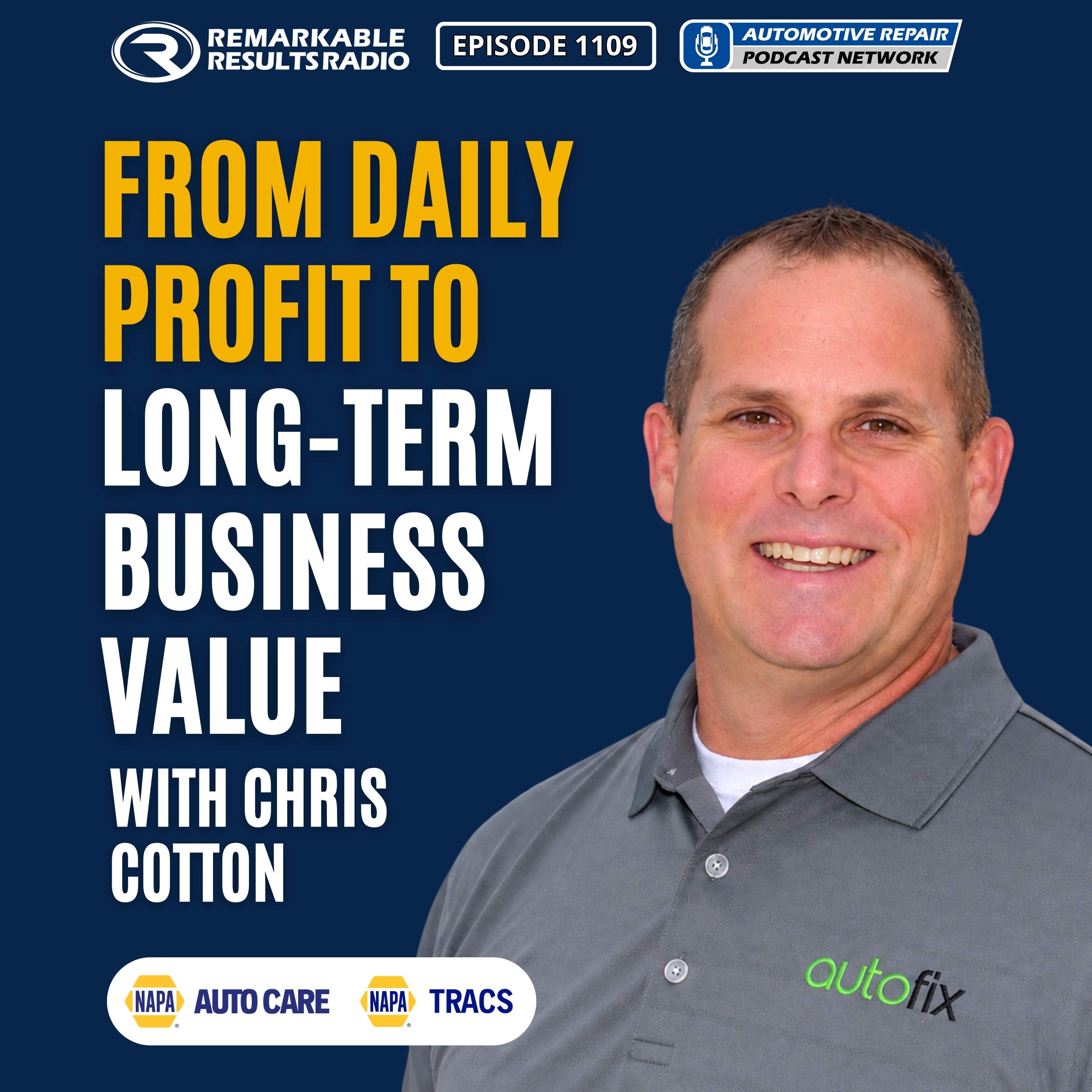
From Daily Profit to Long-Term Business Value [RR 1109]
Thanks to our Partners, NAPA Auto Care and NAPA TRACS Watch Full Video Episode What is your auto repair business really worth, and are you building it to become more valuable every year? Coach Chris Cotton, podcast host on the Automotive Repair Podcast Network, challenges shop owners to look beyond today's sales and profits and start thinking about the long-term value of the business they're building. Many owners spend years on the operational hamster wheel, focused on car count, payroll, production, and this month's bottom line. But when it's time to sell, transition the business to the next generation, or simply step away from daily operations, buyers and banks look much deeper. Chris explains why clean financials, documented systems, owner independence, and intentional succession planning can transform a shop from a business that provides the owner a job into an enterprise with significant transferable value. What You'll Learn Why profitability and business valuation aren't the same thing.What buyers and banks want to see before financing an acquisition.Why removing the owner from daily operations can increase business value.How documented systems and protocols make a shop more transferable.Why clean financial statements and tax records are critical to valuation.Chris Cotton's five stages of shop ownership, from daily survival to eventual exit.How increasing capacity can grow value without necessarily adding locations.Why succession and exit planning should begin years before you're ready to leave. Don't just build a profitable shop. Build a valuable business. Create strong systems. Develop leaders. Clean up the financials. Build capacity. Reduce owner dependence. And understand what your business is worth long before you're ready to sell it. Coaching to Valuation [E269]: https://chriscotton.captivate.fm/episode/cc269 The Weekly Blitz with Chris Cotton: Weekly Inspiration with Business Coach Chris Cotton from AutoFix – Auto Shop Coaching. https://chriscotton.captivate.fm/ Learn more about the benefits of being part of the NAPA family by visiting https://www.napaonline.com/en/auto-care NAPA TRACS will move your shop into the SMS fast lane with on-site training and six days a week of support: http://napatracs.com/ Connect with the Podcast: Download Our Mobile App:https://automotiverepairpodcastnetwork.com/app/Website:https://remarkableresults.biz/YouTube:https://www.youtube.com/carmcapriottoFacebook:https://www.facebook.com/RemarkableResultsRadioPodcast/LinkedIn:https://www.linkedin.com/in/carmcapriotto/Instagram:https://www.instagram.com/remarkableresultsradiopodcast/Join Our Virtual Toastmasters Club:https://remarkableresults.biz/toastmastersJoin Our Private Facebook Community:https://www.facebook.com/groups/1734687266778976Join our Insider List:https://remarkableresults.biz/insiderBooks Page:https://remarkableresults.biz/booksOur Classroom Page:https://remarkableresults.biz/classroomEpisode Collections:https://remarkableresults.biz/collectionsBuy Me a Coffee:https://www.buymeacoffee.com/carm The Automotive Repair Podcast Network: https://automotiverepairpodcastnetwork.com/ Remarkable Results Radio Podcastwith Carm Capriotto:https://remarkableresults.biz/Automotive Field TheorywithMatt Fanslow:https://mattfanslow.captivate.fm/Business by the NumberswithHunt Demarest: https://huntdemarest.captivate.fm/The Auto Repair Marketing Podcastwith Brian and Kim Walker: https://autorepairmarketing.captivate.fm/The Weekly Blitzwith Chris Cotton: https://chriscotton.captivate.fm/Speak Up! Effective Communicationwith Craig O'Neill: https://craigoneill.captivate.fm
Related across the catalog
Episode 285 - Bad Reviews Can Lead To Better Practices With Brett Hunziker
Don't get to the end of this year wishing you had taken action to change your business and your life.Click here to schedule a free discovery call for your business: https://geni.us/IFORABEDon't miss an upcoming event with The Institute: https://geni.us/InstituteEvents2026Shop-Ware gives you the tools to provide your shop with everything needed to become optimally profitable.Click here to schedule a free demo: https://info.shop-ware.com/profitabilityTransform your shop's marketing with the best in the automotive industry, Shop Marketing Pros!Get a free audit of your shop's current marketing by clicking here: https://geni.us/ShopMarketingProsShop owners, are you ready to simplify your business operations? Meet 360 Payments, your one-stop solution for effortless payment processing.Imagine this—no more juggling receipts, staplers, or endless paperwork. With 360 Payments, you get everything integrated into a single, sleek digital platform.Simplify payments. Streamline operations. Check out 360payments.com today!In this episode, the conversation focused on real-world challenges faced by shop owners and technicians, including the complexities of managing customer expectations and navigating negative reviews. One concept discussed was the need for transparent diagnostic processes and detailed communication, especially when customers question pricing or feel they already know the issue with their vehicles. A key theme that emerged was the importance of accurate shop management—covering everything from parts inventory to internal controls in software like Shop-Ware—to ensure profitability and reduce clerical errors.00:00 Out-of-province vehicle inspections06:53 Florida driver's license language law15:54 Construction mistake with leaning structure16:42 Visiting the 9/11 Memorial Museum23:08 Challenges of Replacing Headlights27:58 Car repair frustration and miscommunication32:35 Discussing diagnostic trouble codes37:32 Introducing Whisperflow for Note-Taking47:24 Customer dissatisfaction with tire pricing50:29 Dealer pricing and customer experiences56:11 Adjusting labor rates and pay structure01:01:02 Evaluating Business Efficiency and Labor01:09:15 Old machinist's inventory strategy01:09:52 Buying and selling steel

EVERYTHING You Need to Know about Master Tech to Millionaire + Autoshop Answers
In this crucial & very special episode of Master Tech to Millionaire, Joe Adams & Glenn Piccolo break down the essential terminology, history, and operational secrets of the Auto Hospitality Group to get you totally dialed in. Whether you’re gearing up for the legendary Key to Key to Callbacks weekend, VIP, Courtside, or just want the blueprint on how a master technician scales into a millionaire, we’re decoding it all. Get ready to learn the 8-figure difference between auto repair and auto hospitality, what a "VIP Rack Attack" actually looks like, and why hands-on jobs in "Bay 1" are your biggest opportunities. Stop guessing and start scaling. Hit play to learn the language of million-dollar auto shops, and visit AutoShopAnswers.com to get your business on the fast track. https://autoshopanswers.com

217 - AMA: How the Best Shops are Confident in their Pricing
217 - AMA: How the Best Shops are Confident in their Pricing September 3, 2026 - 01:03:32 Show Summary: Profitable auto repair shops build pricing around financial data instead of fear or competitor rates. Rising technician pay and rapidly advancing vehicle technology make strong margins essential for investing in people training and equipment. Confidence comes from understanding the true cost of doing business and recognizing the value a skilled independent shop provides. Customers are often willing to pay more when they trust the quality and experience behind the service. Strong systems and productive teams also give owners the foundation needed to grow without sacrificing profitability. Long term success requires clean financials clear value and the willingness to charge what the business needs to thrive. Host(s): Lucas Underwood, Shop Owner of L&N Performance Auto Repair and Changing the Industry Podcast Cecil Bullard, Founder of The Institute Show Highlights: [00:01:00] – Rising technician pay makes accurate pricing more important than ever. [00:07:00] – Setting prices based on competitors leaves shop owners flying blind. [00:12:00] – Great technicians use diagnostic data but often ignore business data. [00:19:00] – Confidence means explaining why quality automotive repair costs more. [00:27:00] – Low prices can actually make customers question service quality. [00:31:00] – Build operating reserves before expanding into another shop. [00:37:00] – Create a shared vision to earn staff support for pricing changes. [00:44:00] – Automotive pricing has failed to keep pace with rising costs. [00:53:00] – Independent technicians bring valuable diagnostic skills to complex repairs. [00:59:00] – Clean financials create confidence in what your shop must charge. In every business journey, there are defining moments or challenges that build resilience and milestones that fuel growth. We’d love to hear about yours! What lessons, breakthroughs, or pivotal experiences have shaped your path in the automotive industry? Share your story with us at info@wearetheinstitute.com, and you might be featured in an upcoming episode. 👉 Unlock the full experience - watch the full webinar on YouTube: https://youtu.be/bk5g3FjpoEo Don’t miss exclusive insights, expert takeaways, and real talk you won’t hear anywhere else. Hit Subscribe, drop a comment, and share it with someone who needs to hear this! Links & Resources: Want to learn more? Click Here Want a complimentary business health report? Click Here See The Institute's events list: Click Here Want access to our online classes? Click Here ________________________________________ Episode Transcript Disclaimer This transcript was generated using artificial intelligence and may contain errors. If you notice any inaccuracies, please contact us at marketing@wearetheinstitute.com. Episode Transcript: Lucas Underwood: Good afternoon, everybody. My name is Lucas Underwood from Changing the Industry podcast. I'm a shop owner here in Blowing Rock, North Carolina, own LNN Performance Automotive Repair, and today I have the honor to be joined by Cecil J. Bullard, and we are talking pricing here, uh, on today's show, and we're talking about confidence in pricing. Cecil, buddy, how are you? Cecil Bullard: I'm great. I'm Lucas Underwood: great. You're not a has-been yet? Cecil Bullard: Not yet, brother. I'm a still-was, I think, or maybe never was. I don't know, man. Lucas Underwood: I'm a something, right? Cecil Bullard: I'm something. Somebody knows who I am. Lucas Underwood: Man, I love it, and, and listen, we're talking pricing today, and it's really interesting. I'm, I'm headed up to Kentucky, uh, for the Survive or Thrive Thoroughbred Diesel event in October, and I was working on a presentation for them, and it's really about my story as a shop owner. And for those who don't know, I, I started in diesel performance. I was selling diesel performance parts, and one of the things that we faced in the diesel performance world is they had these MAP prices, and all of these online vendors were selling their parts for MAP prices, and I thought I had to compete with that. And one of the biggest challenges I ever faced as a shop owner was overcoming that fear of charging what I needed to charge. So Cecil, how do we get these shop owners who are listening, these shop owners who are gonna view this later, to the place that they're confident in their pricing? Cecil Bullard: It, it's, it's a, a combination of multiple things obviously. I mean, we, uh, I think if you understand, um ... So let's ... See, this is gonna jump around like it always does. Uh, you keep me on focus. Um- Bet. I'll Lucas Underwood: do what I can. No promises. Cecil Bullard: Right, right now we, we have this, this, uh, techs coming in. Uh, had one yesterday, uh, you know, uh, one of my clients is interviewing a tech, and the guy's saying, "I want 100 grand guaranteed." And, uh, you know, I would tell you two years ago that was probably 65 or 70 maybe. Yeah. And so now it's 100,000. And so we have this, um, uh, you know, the, the, the shortage, right? Lucas Underwood: Yeah. Cecil Bullard: And, uh, we have a demand, and we have, uh, a necessity of probably paying more. So if I understand, you know, what I'm paying and why I'm paying it and what I need to pay, then I also have to relate that to my pricing. Because- Yeah ... um, if I don't charge enough, I don't get paid enough to pay the person that I need to enough to buy the equipment, to buy the training. And y- you know, when I, uh, was, was working as a tech, which is a long time ago, um- Lucas Underwood: Yeah ... Cecil Bullard: and, and people will go, "Oh, wow, did the cars have wooden tires?" Yeah. "Or were they rubber?" I was Lucas Underwood: gonna say, I, I Cecil Bullard: can't believe- They, they were rubber, man ... we had Lucas Underwood: cars that long ago, you Cecil Bullard: know? They were, they were rubber, yeah. But, but, um, you know, classes were, uh, few and far between frankly. Mm-hmm. Uh, mainly manufacturers had classes. We didn't have a lot of the aftermarket stuff like Asta that's coming up where we could get great tech training there or- Yeah you know, great management training. Um, and it wasn't ... But it also was very inexpensive in comparison maybe to what training is today. And the cars, of course, were a lot simpler. So there's this idea that, okay, what I'm doing ... Uh, and I think this might be one of the core problems we have with shop owners. They do not understand the value of what they do- For sure ... their knowledge, right? Yeah. Most of them, you know, uh, we still have a, probably a higher percentage of people in our industry that were not ... You know, they don't have a college degree. They didn't, uh, you know, have a master's degree in, in automotive technology or- Yeah or, you know, engineering or whatever that is. Um, and many of these guys, I had a, again, a conversation, uh, Sunday with one of the clients that, um, you know, he's like, "I, I didn't even graduate high school," right? "I, I, uh, I got into drugs. I went to, I went to prison. Uh, I got out of prison. I started to be a mechanic 'cause I, that's, I could do that." And now he owns a shop, and a pretty successful shop. Now he owns a couple pieces of property. And, but- Lucas Underwood: Yeah ... Cecil Bullard: I think if we don't value what we do- Or we don't see the value in what we do. And I also think that, that we have blinders on as, uh- Mm ... shop owners because all we really see, uh, we, and, and how we interpret what we see is probably, uh, very limited. So I drive down- Lucas Underwood: Yeah, through our lens. Yeah ... Cecil Bullard: I drive down these five streets to get to work, and there are three shops, and I drive by, you know, Billy Bob's shop, who is the cheapest guy in town, and I know that, and man, he's got a lot of cars parked outside that shop. He's always got a lot of cars. And then my phone doesn't seem to be ringing, and it's- Yeah a real, it's a natural leap to go, "Well, my price must be too high," right? Lucas Underwood: For sure. For Cecil Bullard: sure. Uh, as opposed, uh, as opposed to, number one, I don't know what Billy Bob's costs are. Yeah. I don't know if Billy Bob, uh, is paying rent, you know, how much rent. Uh, I don't know what Billy Bob's- Yeah ... paying his technicians. Don't Lucas Underwood: even know if he's doing any marketing. Right? And frankly- Those could all be comebacks, right? Yeah, and, and- Like, we don't know Cecil Bullard: Yeah, and frankly, I don't even know if he's making any money at all, right? He might be losing three grand a month, and- Lucas Underwood: That, that's a- But- That's a great point, right? Because I, I've been- Right there, done that, right? Because I, I, I was the guy riding by the other shops, looking at the other shops saying, "Oh, look how busy they are. Look at what they've got going on," not realizing that some of those cars had been sitting there for weeks. They hadn't- Yeah, for months ... got anything done. Yeah. Right. And, and a, as I dug in and I started talking to these guys, I'm going and talking to them, I'm realizing, hey, listen, they're doing twice the amount of work for the same amount of money. I'd rather have an empty parking lot and make the amount of money I'm making as I would- Cecil Bullard: Oh, yeah, yeah. If I'm not gonna make any money, I'd rather not work. I mean- Lucas Underwood: Exactly ... holy smokes, right? Exactly, and look, here, here's what I keep seeing, and I talk to shop owner after shop owner, and this- You know, David gets frustrated because we keep having this discussion over and over again. And he said- Yeah ... "Why do we keep having this discussion?" I said, "Because all of these techs leave shops and decide to start their own mobile mechanic business. They decide to start their own shop. They go out on their own and they do their own thing. And so we have to continue to teach them because they were uninterested in this when they were technicians. They didn't care." And eventually what happens is we have these new folks coming in, they get burnt, they're trying to figure out, "Why can't I pay my bills? This isn't working for me. What's going on? Why doesn't this work?" And Cecil Bullard: so then we- And by the way, they- when- Go ahead ... when people see this or, or people that are watching, many of them will be barely making a living. You know? Yeah. They, what they have is a bad job that doesn't- Yeah ... pay well. So I work- Lucas Underwood: Exactly. 100% ... Cecil Bullard: I work 70, 80 hours a week, and I, I can't go to my daughter's play and I can't do this and I can't do that, um, because I'm trying to get this car fixed so I have the money to go in the bank to pay the bills. And, and they're- They're payrolls we- ... trapped in this, they're- Yeah ... trapped in this thing, and, uh, they don't understand that, that you don't have to be trapped in that thing. Lucas Underwood: For sure. Right? And, and here's the thing, is, is over and over and over again, I have this discussion. Right? I talk to, to hundreds of shop owners and techs becoming shop owners through the span of a given month, right? Talk to- Yeah ... tons of them. Get a message every single hour throughout every single day- Yeah, every day ... from somebody, right? Cecil Bullard: I'm glad I'm not you, baby. Lucas Underwood: And so what I'm noticing is, is they're all going out and they're setting their prices, and they're using what I like to call the Oreo pricing method. Cecil Bullard: Yeah. Lucas Underwood: So they've got, you know, shop over here's on the high end, shop over here's on the low end, I'm gonna be somewhere in the middle. And I talk to them and I say, "Guys, hey, listen. I don't know if you know this, but you should probably be using data to set your prices. And that data comes from your financials, and otherwise you're flying blind because you don't know if you're pricing yourself correctly or not because you're not using the data. Now yeah, we can give you some numbers that the industry standard is, and we can get you 90% of the way there," but they all panic when you give them those numbers, Cecil. Cecil Bullard: But I'm also- They have a- I'm also, I'm also not sure there's an industry standard because- That's true ... you know, we still have shops, you know, uh, that are probably under $100 an hour in the industry. Yeah. I mean, there's that mobile guy that's out there for 80 bucks an hour. Lucas Underwood: Yeah, yeah. Cecil Bullard: And, uh, I've got shops that are- And thinks he's Lucas Underwood: doing them favors. Thinks he's doing- Yeah, Cecil Bullard: and I've Lucas Underwood: got- ... the guest a favor, man. Come on now. Cecil Bullard: I've got shops that are in the same- General location that are 250 an hour. Yeah. So I don't, I don't know that there's an industry standard. I don't think there is a standard. But- In fact... Yeah. Lucas Underwood: Here, here's the problem though, is that it- standard or no standard, the reality is, is they're setting their price- Survive ... based on feel. Yeah. They're setting their price based on what the market looks like around them and what they suspect the market will bear. And, and I'm telling you, would you go out and say, "I feel like this car needs a $4,000 control module"? No, you wouldn't do that because that's asinine. That's stupid. Why would you take your business, which has the potential to generate hundreds of thousands of dollars of revenue every single year, every single month in some cases- Cecil Bullard: Yeah Lucas Underwood: and take a gamble with it? Why would you do that? You wouldn't do that with a client's car. It just makes Cecil Bullard: no sense to me. Well, you know, we, we don't like... I, I wouldn't go to a doctor that didn't have a degree, and I don't mean this in the sense that mechanic-wise. I'm just saying if I knew the guy was a quack, I wouldn't go there because I don't want somebody- Yeah guessing about my health, right? Lucas Underwood: Yeah. Cecil Bullard: And yet I have this business, and, and my business has done everything for me, right? Lucas Underwood: Yeah. Cecil Bullard: Don't get me wrong, I've also done everything for my business, right? Yeah. But, but my business provides the money that allows me to live the lifestyle, that allows me to help the industry, that allows me to drive a nice truck, that allows me to, you know, have a, a nice coat- Yeah if I want it, that feeds my family. You know, and we can eat steak and, you know, all that. The, the business is the engine that runs your life- Yeah ... in a way, okay? And so I've got this thing that literally can create generational wealth- Mm-hmm ... or it can be a bad job where I work too hard too long and don't, and don't get paid for it. Be a burden take away from Lucas Underwood: my family. Yeah. Cecil Bullard: So, like, I, I'm talking to, uh, another shop a couple of days ago and, and we're talking about, uh, they're gonna- they wanna hire this guy who wants $100,000. And I'm like, "Okay, we can do that," right? Yeah. And I'm like, "Uh, so that's," whatever, it's 50 bucks an hour basically. And, and so, uh, what's our effective labor rate? Well, our effective labor rate's probably not what our po- Our, I think the posted labor rate was between 155 and 175, depending on the kind of car and the job we're doing and- Lucas Underwood: Yeah ... Cecil Bullard: and but the effective labor rate was probably 130, 140. And, and so now you're... I'm doing math saying, "Okay, it's $50." Then I've got 30% load, so it's really 65. And then if the guy comes in and he's only, say, 80% productive, then my cost goes from, say, 65 probably all the way up into the high 80s. Lucas Underwood: Yeah. Cecil Bullard: And now I'm paying out 55% of the labor I brought in- Instead of 40%. And so that difference of that 15% is the difference in my profit, right? Yeah. And it means I don't make money in most shops. Exactly. Yeah. Many shops are, are not even making 5% profit. Lucas Underwood: Hey. Cecil Bullard: And, and so if you're gonna lose 15% because you hired the wrong guy or you didn't price yourself correctly- Yeah ... or you didn't hold the line or you didn't build value, um, and you're gonna end up losing that 15% and only make 4%, then you have a terrible job with terrible hours and terrible pay. Um- Lucas Underwood: With no return on investment. Yeah. And, and he- here's on top of all of that, like when we look at this and we think about the whole strategy here behind setting our pricing and everything else, like profit doesn't happen by accident, okay? Cecil Bullard: No. Lucas Underwood: You're not gonna just walk into your shop one day and say, "I think the number needs to be X", and set that number and be profitable. Now, you might get lucky. Yeah. You might actually become profitable. But without clean books, without good data, without the ability to look and, and dig into the information- It's very unlikely you're gonna be Cecil Bullard: wrong Well, that's the other thing. That's the other thing that makes me a, a little bit crazy. We have these guys that are really great technicians. And- Lucas Underwood: Yeah ... Cecil Bullard: they're great technicians because of, they have the education, they have the hands-on experience, they have the right tools, the right equipment, and they also know how to read the data. Yeah. So, you know, I hook up the car, I get the, this from the scanner. It tr- I track down to the oxygen sensor. I know how to test the oxygen sensor. I know what good is, I know what bad is. I know how to look at a, a wave, uh, uh, form for a injector, and I know what good is and I know what bad is. Yeah. And so they, they do that in their job every day in their life because they think that's important and because it is, but they don't do the same thing in their business. Yeah. They, they literally pull stuff out of the air, or they listen to somebody like me, and they go, "Well, that guy's crazy 'cause he's saying we should be $220 an hour- Yeah. Yeah ... and there's no way we could be... We, every one of our clients- And let emotion drive it ... would run away. Um, you were, you were talking about the, um, the event that's coming up, the diesel event, Thoroughbred. Yeah. Yeah. And, uh, I was at, at Thoroughbred, uh, last year and the previous year. And so the previous year, uh, you know, I did a thing and, and talked about the numbers and all of that. And so the next year I'm there and I, I said, uh, "Is anyone here that joined up with the institute or became a client in the la- you know, from the last meeting?" Yeah. And there's a guy, uh, raised his hand a- and I said, "Okay. Um, if you don't mind me asking, and if you're willing to share, what is your labor rate, uh, when we started a year ago? When you joined the institute, what was your labor rate when you first came to this?" And he said, s- uh, he was like, "$79 an hour." Lucas Underwood: Yeah. Cecil Bullard: Right? And I was like, "Okay. And so I'm assuming that you walked away and you said, 'I'm gonna raise my labor rate.'" And he said, "Yeah." And, and I said, "Okay. If you don't mind me asking, what did you raise it to?" Right? He said, "Well, today we're at $180 an hour." Yeah. A year. Yeah. He went up over $100 an hour a year. Now he was- Didn't lose Lucas Underwood: all of his clients. Cecil Bullard: A- no. And I said, "Okay. A- and so how many clients realistically, just, just be as honest as you can, how many clients did you lose? Did you lose any?" And he went, "Yeah, we lost a few." Right? Yeah. And I said, "Okay. And, and who were they?" He said, "They were the people who would never pay us to do the work." I mean- Yep ... he lost maybe 3% of his clients. Yeah. And at, at 3%, so what? I mean- Exactly ... his labor rate- Lucas Underwood: 100%. Cecil Bullard: Think, think about, think about three guys, let's say they're only doing 70%. So- Mm-hmm ... you got three guys doing about six hours a day. You got 18 hours a day. If your labor rate goes up 100 bucks- Lucas Underwood: Yeah Cecil Bullard: that's $18,000 a day, right? Did I do that right? 1,800, uh, 1,800... It's $18,000 a day in a- uh, additional profit that because your labor rate went up 100 bucks, right? And- A- and most people, they're like, they can't even fathom that, right? They, first of all, they don't run the math. They don't figure it out. They're, they're diagnosing based on emotion, right? Yeah. Yeah. Um- 100%. I, I, uh, you know, I had a cl- if you, if you're in this industry, if you're in, in the industry, I don't care where you are, I don't care who you are today, you're gonna deal with price objections- Lucas Underwood: Yeah ... Cecil Bullard: every time. Lucas Underwood: Absolutely. Cecil Bullard: And, and, and you're gonna deal with a lot of them. Uh, you and I were kinda talking about that before we started. I mean, right now, uh, a lot of people are out of money. They don't know what's going on. The price of gas is, you know, higher than- Yeah ... it should be, blah, blah, blah, blah, blah. What's Trump doing? What's... What, what are the Democrats doing? What are the socialists doing? Um- Yeah. Credit card delinquencies- A lot of them- Lucas Underwood: are through the roof. Yeah. Car loans are through the roof. Delinquencies are through the roof. Cecil Bullard: A- and, and you're gonna deal with price objection. And the problem is, if you don't know how to deal with price objection and, and understand your value and be able to, uh, create value for your client- Yeah ... then you're not gonna win the game. 100%. And, and, and what's gonna h- the other thing that's gonna happen is you're gonna get this emotional response, and the emotional response is, "Wow, I have these people that are beating me up on price. And number one, I, it's uncomfortable for me, and I don't wanna be uncomfortable, so what do I do?" Lucas Underwood: Yeah. Cecil Bullard: "Well, let's lower our price." Yeah. I've shopped in, um, Tennessee- And, uh, the owner was like, "Yeah, we're really struggling right now," blah, blah, blah. Uh, I lowered the price on a, a, uh, several of our jobs, and I'm... I, I just wanna, like, you know... Yeah. Um, and, and what happened was his marketing was bringing the wrong customers in. Yep. It wasn't that- Reaching Lucas Underwood: the wrong people ... Cecil Bullard: we changed the marketing companies, we changed marketing strategies, and all of a sudden the shop is full and people are paying a full price. They're not discounted, right? Lucas Underwood: Yeah. Here, here's the thing is, is you're right, because it is all emotion. And, and- Yes for so long it's been driven by emotion, it's not been driven by data. And one of the things that we fall victim to, and, and I'm gonna tell you one of the greatest David rants of all time, and I was there to witness the telephone call. Because David, say what you want about the guy, he's extraordinarily intelligent, right? Absolutely. And I'm not saying that because he's my best friend. I love David. I'm saying that... Yeah. Yeah. If you really could get David to show you how smart David actually is, it would amaze the people who have negative things to say about him. Yeah. The man is genius level. I would say he's in the top 3% of- He just Cecil Bullard: gets frustrated. Lucas Underwood: Yeah. Cecil Bullard: He... And by the way, if you're really smart, you get frustrated- Yeah ... easier. Lucas Underwood: Exactly, because everything looks easy to you. You're just like- Yeah ... "Why are you this stupid?" Um, and- And then- That's why Cecil Bullard: we're friends, right? And then if you don't learn how to con- It works ... if you don't learn how to control that, it gets you in trouble. So. But, Lucas Underwood: but here's the thing is we, we were riding down the road one day, and this lady is, is fussing about his price. And he said, "I'm sorry, can you help me understand something?" And she said, "What are you talking about?" He said, "Are you an expert in automotive repair?" And she said, "No, I, I, I just own a car." And he said, "Okay, are you an expert in automotive parts?" And she said, "No, I, I, I'm not." And he said, "Okay, are you an expert in automotive diagnostics and testing?" And she said, "No, I'm not." I said, "Do you..." Or she said, "Do I... You know, what, what are you getting at here?" And he said, "I'm asking because I do this for a living. Every single day I make estimates to properly repair automobiles. I, I make sure that I get the torque-to-yield fasteners on. I make sure that I get all the gaskets on. I make sure that I have the part pricing proper so I can stand behind the repair after I'm done." Cecil Bullard: And qu- and a quality part is Lucas Underwood: not a- And a quality part. It's a, I am- And I, I am, I am a professional- Yeah ... at estimating your job. You are not. And I'm not trying to be disrespectful, but I don't need you sitting here telling me what the price should be unless you're an expert in pricing it. Now, if you want a different quality product, go somewhere else." Cecil Bullard: Yeah, 'cause that's not what I do, right? Lucas Underwood: And she stopped and she said, "What do you mean?" He said, "You can, you can go down the street and you can have somebody do this job with poor quality parts, not using the torque-to-yield fasteners, not torquing things to spec, lowering the time using a, a poor quality technician, and you can do that if you want. If you wanna take that risk, that's your business, but you're getting what you pay for." Cecil Bullard: Yeah. Lucas Underwood: And the lady said Just do the work. Cecil Bullard: Oh my. Lucas Underwood: And so- Right. Yeah ... it, it was so interesting because it's a completely different mentality than most shops take. Because the consumer comes to them and says, "I can't believe you're gonna charge that. That seems really expensive." It is really expensive because it's expensive- Yeah ... to fix a modern automobile. Yeah, I mean- But instead what do we do? We quiver, we shake inside, we get upset, our little hearts beat fast and we're like, "Oh, God, what do we do?" Cecil Bullard: So- And- ... I bou- I bought my first truck, um, uh, 40 years ago. And, uh, shortly after I bought, I bought a Toyota truck, and it was, it was kinda basic. It didn't have a lot of- Yeah ... crap in it. And that truck was, I think, uh, like eight grand or something. Seven, eight grand. It was not much. Yeah. And, and like, uh, two months later my wife was pregnant with our first and so I had to get rid of the truck and get something- Yeah that we had back seats in. But, but- Lucas Underwood: Yeah, they didn't like it- Cecil Bullard: I Lucas Underwood: bought a- ... back then when you put them in the back- Cecil Bullard: Right ... in Lucas Underwood: the snow. Cecil Bullard: I, yeah. In Lucas Underwood: Utah. Cecil Bullard: I, yeah. I bou- I bought a, a new truck, uh, about a year and a half ago. It was $82,000. Right? I mean, that comparison, I, I bought my first house. My dad's house was 13,000, my first house was 100,000. Uh, I think, you know, we're paying somewhere between six and 800,000 for houses out here today. Lucas Underwood: Yeah. Cecil Bullard: And, and you know, everything, what, what kills me is kinda this, you know, I, I don't know, I went to, um, uh, Jack in the Box, uh, this morning and got a couple of, uh, croissants, one for me and- Yeah ... and one for Kent. And, and it was 15 bucks. Yeah. And I was like, "Those used to be two bucks a piece." That was the- Exactly ... you know, two years ago it was $4. Lucas Underwood: Yeah. Cecil Bullard: And, a- and you know what I did? I gave them my credit card and I paid for it, right? Lucas Underwood: Exactly. Didn't say a word. Didn't Cecil Bullard: fuss. Didn't- And I didn't say a thing. And- Yeah ... I had to fill up the truck on the way home the other day. It was $4 and, whatever, 38 cents a gallon. Yeah. It was $4.38 a gallon. I got a 32 gallon tank. I mean, it was almost $80 to fill up the truck. And, and you know what I did? Filled up the tank. I ran my card through the machine and paid it and walked away. Yeah. I went to the grocery store, right? And, and eggs were, I don't know, whatever eggs are. Milk was whatever milk was. I spent $400 on, I don't know, a third of a basket of food. Lucas Underwood: Yeah. Cecil Bullard: And, and you know what I did? I paid it and walked out and, and I didn't think about it because that's the way it is. Lucas Underwood: You know, my first business coach taught me a very valuable lesson. He said, um, he said, "You're selling from your wallet." Cecil Bullard: Yeah. Lucas Underwood: And I said, "What do you mean?" He said, "You're selling from your wallet. Everything's from your perspective. And because you're broke, because you're not charging what you need to charge, everything feels expensive. So when you're pricing it, it does feel expensive." And so later on we had this discussion, we're talking about discounts. Because- Yeah ... it, now listen, I, I don't mean to, like, get y'all enraged here. I know it's going to. But here's the thing is like when we talk about this, all these shop owners come up and they say, "No, no, no, my labor rate's $200 an hour. My, my part margin's 60%." Cecil Bullard: Oh, but then they- Lucas Underwood: Why do you have $150,000- Well, they give it away on the other side in discounts? Yeah. Yeah. Right? And, and so he- Cecil Bullard: I see the financials. I'm like, I'm like, "You made t- $2,000 last month, but you had $12,000 in discounts." Lucas Underwood: Right. Exactly. Cecil Bullard: Help, help me understand that, right? Lucas Underwood: And so he- Cecil Bullard: How... Yeah. Lucas Underwood: Well, my, my first coach said to me, he said, um, "I've, I've got a, I've got a rule that you're gonna implement in your shop." And he said, "This is just a set rule. This is what it is." And I said, "What?" He said, "If you feel like giving a damn discount," he said- Yes, absolutely ... "I want you to keep some money in your wallet- Yeah. Cecil Bullard: Big Lucas Underwood: time ... and I want you to go up here and pull that money out of your wallet." I said, "Well, I ain't got no money." He said, "That's my point. You don't have any Cecil Bullard: damn money." And you, and you, and by the way, you never will if you, if you don't stay ahead on the straight. Lucas Underwood: Keep doing what you're doing. Cecil Bullard: Right. Lucas Underwood: And, and- You have to- But see- ... stay ahead on the straight ... we don't think about that, Cecil. We're so- Yeah ... disconnected because we're focused on fixing the car. And, and it, I believe it's a mindset, okay? Because we're back there in the bays and we're turning the wrenches, and in our mind, the, the desired outcome is that car gets fixed. And so we begin to change whatever it takes to get the car fixed. Well, I could lower the quality of the part. I could, I could reduce my labor rate a little bit. I could give them a discount here. Maybe I don't use that part there. Cecil Bullard: No, Lucas Underwood: it's to get the- Because we're technicians, we're- Cecil Bullard: It's not to get the car fixed. And, and I, I understand what you're saying. Lucas Underwood: Yeah. Cecil Bullard: But it's to get the car in, right? I believe that in order to get that car in, I need to bring my price down. I need to be, quote-unquote, price competitive. Except- Tell me what price competitive is. I have shops- Lucas Underwood: Yeah ... Cecil Bullard: I probably have, um, in some areas I have three or four shops that we work with, and the price variance between those shops that are in, within 30 miles of each other can be as much as $60 or $80 an hour. Lucas Underwood: Yeah. Cecil Bullard: And by the way, the shops that are most successful are not the cheaper shops. Yeah. They're the higher price shops. Lucas Underwood: Yep. Cecil Bullard: Because I think the consumer, there's this thing about price. So I'm, I'm in Edmonton doing a, a gig, and there's a Mercedes shop up there, and this is, I don't know, six, eight years ago, pre-COVID. And, uh, the, the lady that ran the Mercedes shop, she was like, "We can't... Nobody is booking, you know, the phone rings, but nobody wants to come into the shop." And they're a Mercedes shop. And I looked at the shop and it was, you know, it was, it was okay. It wasn't, like, filthy, it wasn't terrible, yada, yada. And, and you know, I called the shop, and it wasn't a bad con- It wasn't a great conversation. It wasn't a bad conversation. And I asked her, I said, "Well, what's your labor rate?" Now, by the way, at the time, say eight years ago, my shops up in Edmonton were between 130 and 160. All right? Lucas Underwood: Mm-hmm. Cecil Bullard: And she was 75 bucks an hour. Yeah. And I said, "Okay, if you own a Mercedes, right, and you're not the fourth owner, you know, the guy that- Yeah the, it's the hand-me-down Mercedes that I got that's not fixed, that's t- you know, falling apart- Yeah ... I have no money. If you're the second owner of the Mercedes or the first owner of the Mercedes, and somebody says, "Well, you know, my price is half of what everybody else's is," what's the first thing that comes into your mind? You know, if you, if you saw, I don't know, if you saw, uh, let's say, uh, tamales, right? You got, uh, tamales. You go in the grocery store, and there's two kinds of tamales. Yeah. They, they kind of look the same, but not exactly the same. And one of them for six tamales is 12 bucks, and the other one is three. Which one are you buying? Lucas Underwood: I Cecil Bullard: know, I'm telling you. I'm not buying the, I'm not buying the $3 tamales. That's a, that's a chance that number one, I'm not gonna like them, and number two, it could make me sick, blah, blah, blah. Might have Lucas Underwood: that listeria added in there. I'm, Cecil Bullard: yeah, I'm buying the $12 tamales. It- Between the ch- I- if I'm thinking about price, right? At all. Lucas Underwood: For sure. I, we, we had those cabins, right, where the shop's at, there used to be nine cabins here. Yeah. And for years they were $100 a night, and they were log cabins. Actual log cabins with a kitchen, with a sleeper sofa, and a living room, and a dining room, had a shower and a, a bathroom. Some of them had hot tubs, had a, a bedroom. And the, the occupancy rate stayed in the 40% range, and my parents were, were content with that. It was paying the bills. It wasn't that big of a deal. They're making Cecil Bullard: enough money to pay the overhead. Lucas Underwood: Yeah. My brother came in and decided he was gonna raise the prices, started charging $225 a night, and our occupancy jumped to 80%. Yeah. Nothing else changed. No marketing, no nothing else changed. And people started coming in saying, "I thought there was something wrong with them. I thought they were gross or nasty or something." ' Cecil Bullard: Cause they were, 'cause they were so cheap. Lucas Underwood: Because they were so cheap. Yeah. Yeah. And, and we don't think about that perspective. And I, I'm telling you, I buy things on Amazon, and I'll see two exact comparisons side by side. Like, I'm not gonna get the cheap one 'cause there's a reason it's cheaper, right? Cecil Bullard: Yeah, when I see the cheap, my, my thoughts are, uh, I just bought, uh, uh, some stuff yesterday and I saw the cheap stuff, and I was like, "I, I don't wanna buy that. It's too risky for me." Lucas Underwood: Yeah. Cecil Bullard: Right? It, it might not be... It might be some Chinese whatever, because I don't know. I mean, it looks like the product, but it's, it, it probably isn't. At that price, it can't be, right? Lucas Underwood: How... Uh, so look, here's the thing, because we, we're talking about confidence, right? And, and at the root, we, we know that the pricing has to go up in this industry. We know that- Yes ... beyond a shadow of a doubt. Yeah. There, there's no if, ands, or buts about it. Nope. And because we, we need to be paying our guys more. I don't think anybody debates that. And if you do debate that- Man, come on now. Second of all- Cecil Bullard: If you're, if, if you're not making 15% net profit minimum- Yep ... on your business, and your business isn't designed to make 20% net, then- Oh you're gonna end up with Ford and struggle. Lucas Underwood: Exactly. Absolutely. Cecil Bullard: Go ahead. Sorry. Lucas Underwood: And, and so here's the thing is, is the confidence piece of this. Because we know that the price needs to go up. We don't have to debate that the price needs to go up. How do we get shop owners to the point they're confident in sharing that price? And I, I think there's a, a, a myriad of things, and I, I think that a lot of small business owners tend to be people pleasers, and that's something that I am learning myself to overcome. And, and I'm trying to work on this concept that if you're not happy, I have to be unhappy, too. And I'm growing and developing in that, but I've, I've realized, like, hey, I can't let that person's emotion dictate my emotion. And so when they- What do you think- Go ahead. Cecil Bullard: What do you think the future of automotive repair... Who do you think are gonna be the existing successful shops, say, 10 years from now, right? Lucas Underwood: Well, I know we're gonna have venture capital and private equity with a bunch of big chain shops bought up. Yeah. Yeah. And then there's gonna be a handful of small independents left that, that could overcome the financial challenges associated with small business ownership and automotive repair in the, uh, in the 2030s. Cecil Bullard: It's all about... It will, it will all, it will all be about a couple of things. First of all- Lucas Underwood: Yeah ... Cecil Bullard: it's not about fixing the car. Lucas Underwood: Yeah. Cecil Bullard: You have to fix the car, okay? That, that's a given. That's the base level Lucas Underwood: expectation. Cecil Bullard: That's a, that's a base level. That's not Lucas Underwood: like a... Cecil Bullard: Yeah. Somebody shows up to your shop with their keys and says, "Here you go," they expect you to fix the car, okay? Yeah. It is going to be the, uh, the additional items, the way the customer feels about your service, the way the customer feels about your pricing, the way the customer feels about how you paid attention to them, did you listen to them- Yeah you know, all of those things. And, and by the way, the average person, in fact, I'd tell you 80, 85% of the people will buy the more expensive product if they feel good about the interaction and they feel good about the product. They will always do that. We got a couple questions coming in, so I think- Lucas Underwood: Yeah, I, there's some really good ones in here. Yeah. I've, I've got one, I'm passionate about this one. It says, "How much money should a shop have set aside?" I'm gonna tell you something. The best advice that I was given by anybody before building this new shop was maximize the shop that you have now. Cecil Bullard: Yeah. Lucas Underwood: Don't just decide to move. Don't just think that, and run the numbers and figure out what your max capacity is. And I'm gonna tell you, if I learned anything, I wish I had set on that bad boy for as long as I could, just letting it make money and stacking cash. I would get every single dime of money I can in the bank account, because here's what so many people don't realize about expanding They think when they have that small shop, that when they expand, all of a sudden they're gonna have all this demand and they're gonna be able- Yeah to fill up that new big shop. If you, if you build it, they will Cecil Bullard: come. Lucas Underwood: It does not work that way. Yeah. Right? That doesn't work that way, I promise. Cecil Bullard: Well, yeah, three bays, three bays, low roof, uh- Yeah ... no racks, uh- Exactly ... to, uh, what, 12 bays, uh- Yep ... you know, super high roof. Lot of space. You can get anything you want in, and all of a sudden you think, "Why isn't my shop full?" Lucas Underwood: Yeah. Cecil Bullard: Well, wait a minute, you didn't Lucas Underwood: do all the work. Well, uh, we're making more Cecil Bullard: revenue. Yeah, yeah. Lucas Underwood: That was just the limit of the capacity that we had at the given time. Cecil Bullard: Yeah. Lucas Underwood: And so, I, I Cecil Bullard: would- And so maximize it. Exactly, man. So I have a client... Lucas Underwood: Maximize what you got and stack the cash. Cecil Bullard: So that particular question, I think, I think the answer is ve- it varies. Yeah. First of all, every shop, every shop owner should have a minimum of three months worth of operating capital in a savings account, period. Lucas Underwood: Yeah. Cecil Bullard: Right? That's before I even think about buying another shop. So- Yeah ... uh, I have a client, uh, we're buying shop number three. Mm-hmm. Um, he's been a client now, I would say probably since 2021. Um, when he started with us, he was making three, four grand a month. Uh, we currently have two shops, we made $87,000 in profit last month. Now, he's got half a million dollars in the bank. His machine is generating between, say, 70 and 90,000 every month. Yeah. The machine that he has built. And, uh, and that's, and that's pure profit, right? It's not, "Oh, I'm gonna have to do this with that or that with it." And then it depends on the deal, because he's gonna buy a piece of property for, uh, a million dollars that comes with a shop on it that just hasn't been operating for a bit. So he's got some- Yeah ... expense for marketing, building it up, tools and equipment, et cetera, that if you bought an operational shop, you wouldn't have. And this is not an owner finance carry. Yeah. So if I'm, if I'm, if I'm gonna do owner financing and the owner's gonna carry it, I might need less cash, right? Yeah. Or if I have to buy more equipment, I might need more cash. Or if- Yeah ... if I have to go through and remodel the shop, I, I mean, I don't think anybody that I've dealt with when they bought their next shop didn't spend at least $40,000 in the move. Lucas Underwood: Yeah. Cecil Bullard: Right? Lucas Underwood: And, and at this point, I think 40,000's an undershoot because- Oh, it's way, it's way low ... things have gotten so expensive. I mean- Cecil Bullard: Yeah, you could... I need, my signage is 40 grand, right? Yeah. I mean, if I'm gonna- Yeah, for sure ... put signage on the building. And- Lucas Underwood: And- Cecil Bullard: And, yeah Lucas Underwood: Uh, here, here's the deal about this, is that, that you think, "I'm gonna go buy a shop," or, "I'm gonna go build a shop," and you get these numbers in your head. I promise you, because everybody told me, you can double it. Just double it. Just- Yeah ... right off the number, whatever it is, double that number. And so they told me- And the timeframe ... $2 million, that's what it's gonna be. Yeah. And I didn't believe them. Cecil Bullard: And Lucas Underwood: the timeframe- Cecil Bullard: And so... Exactly. So by the way, not six months, a year. Lucas Underwood: Oh, yeah. Double the money, double the timeframe- Cecil Bullard: Yeah ... Lucas Underwood: and, and then get comfortable with those numbers or even higher numbers than that. Target the lower numbers, sure, but be expecting for it to be way more expensive than you think it's gonna be and take way longer than you think it's gonna take, and be way more uncomfortable, create way more stress. And, and let me tell you something. If you think it's not gonna impact the shop you have now- Yeah ... when you're in the middle of that- Yeah ... you're gonna find out if you grew a team or not. Cecil Bullard: Well, the other thing, I- Lucas Underwood: Because you're gonna be focused on something else. Cecil Bullard: So the other piece of that is if I have a really great team and I have really good systems and processes, I need less money to open the other shop- Yeah because I don't need... Like, the shop I have, if it runs really well, if it runs, uh... You know, if it's very consistent, et cetera, and it's done that for, I don't know, six months, a year, year and a half- Yeah ... and I have a great team there, uh, um, then I need less money to open up the next shop because I'm, I'm, I'm comfortable. I'm putting money- Yeah ... in the bank routinely, et cetera. There was another part of the question, uh, best marketing strategy in a small town. I, I'll tell you the best marketing strategy, period. Do an unbelievable job- Yeah ... for your client. And, and- Treat people well ... and the other thing is, you know, learn how to answer the phone correctly, and learn how to build value from the start. You know, when people- Yeah ... called me and they said, "Hey, Cecil, um, you know, how much for a water pump on a whatever?" I'd say, "You know- Yeah ... I know price is important to you, but before we have that conversation, can I tell you about, you know, Larry's and, and why we do what we do here?" And I never had somebody say, "No, just give me a damn price." Um, I... Then I was able to say, "Look, we... This is our philosophy of taking care of cars. We, we believe that our customers can drive these cars for 10, 15, 20 years and take care of them, and if they do, it's gonna cost them a lot less over the, the lifetime of the- Yeah ... of the vehicle. So every time you come in here, we're gonna inspect the car. We're gonna do a- Yeah ... complete inspection, and every time you come in, someone like me is gonna sit down with you and have a conversation about what you need and, and, and why you need it- I'm gonna be- ... and be able to tell you exactly what it costs- Yeah ... so you can make a, an intelligent decision. For sure. And if that's good, if that sounds good to you, then I have an appointment on Tuesday or Wednesday. And- I think if you create a product that's different than everyone else's product, that's better, that's superior, that you get that, right? The, the, the person, uh, uh, uh, that the, the, the 80% of the population that's gonna value that is gonna value it. The 20%'s always gonna look for the cheapest price. And- Absolutely ... and by the way, they're not my, they're not my, they're not my clients. Lucas Underwood: Exactly. So- Exactly. And, and that's what they're gonna be going after no matter what. You're not gonna please them. And even if you made 50 cents on it, they're gonna be fussing about that. Yeah. Right? And so it, it doesn't work. Now I, I wanna jump into this next question and, and Steve from Wassbalden Motive, Steve, I really hope that we see you at ASTA. Uh, you're in Durham, it's in hometown, so we'd love to see you there. I'm, I'm gonna post a link down here in the comments, and I, I hope that you, uh, see that, Steve. Because I, I think it's important. Because he's asking the question is how do I get my legacy staff to buy in? And I think this is touching- Shoot them Cecil Bullard: all. Shoot Lucas Underwood: them all. There you go. Um- Shoot them Cecil Bullard: all. I, Lucas Underwood: I think it- No, Cecil Bullard: um- ... Lucas Underwood: starts for me with vision. Yeah. And it starts w- with destination. It starts with what we're trying to accomplish, what do we believe, where are we trying to go? Cecil Bullard: What if we really sat down and had a conversation with our staff that said, "Who are we and what do we wanna be?" Yep. "And what's the image that we wanna portray to our clients," right? Lucas Underwood: Exactly. Cecil Bullard: And, and we built that with our staff because, like, I took over a shop, I went in and, you know, within a week I sat everybody down, I said, "Okay, what kind of shop do you wanna work for?" Right? "What do you wanna be? You wanna be a discount shop, you wanna be a tire shop, you wanna be a transmission shop? Do you wanna be, like, a, a top shop in the industry? Do you want the community to look at you as a top shop, or do you care?" Right? And, and everybody in my shop said, "We wanna be a top shop." Yeah. And by the way... So then we started talking about, well, what does a top shop look like? What does it feel like? How, how do they answer the phone? How do they... What's their comeback rate? What's their, you know, what's, what do they charge? Are they on the lower end, are they on the higher end? Yeah. So you, you have to get your team on your side. You have to get your team behind. Like, if I can't value my own pricing- Lucas Underwood: Yeah ... Cecil Bullard: how can I expect my team to value my pricing, right? For Lucas Underwood: sure. 100%. Cecil Bullard: I have to be... My, my dad, and I've said this in a lot of classes and a lot of people, my dad always said I had an over, uh, developed sense of my own self-worth. Yeah. All right? But when I was a, a tech working on cars, I always thought, "Man, we are so cheap." And I've always thought that through the whole thing. Yeah. Even as a coach, I'm like, "Man, there are coaching companies that are a lot more expensive than us. Why are we so cheap?" Um, I'm always thinking that, right? Yeah. And, and what that did at the service counter for we was when we were $158 and everybody else was 100- It made me confident because I thought we should be charging 300, right? Yeah. But- It's, it's kind of the same thing as having that cash in your pocket. Lucas Underwood: Yeah. Cecil Bullard: But when I have cash- Yeah ... in my pocket, I think differently, right? Lucas Underwood: He- here's the thing, i- is for me, right? When we're talking about this staff and we're making this transition, we've never charged any more, especially somebody buying a shop, and they know the fundamentals of shop ownership. They know about financials. They're buying a shop that was from somebody who did not know, and they did not charge appropriately. They didn't have a lot of overhead. Now this person's buying the shop, so they've got payments, they've got all this stuff going into it, and they're trying to retain the legacy staff. And I get how hard that can be, but you can't have a staff member that is the equivalent of the bottom 20% of the clients that cause all the problems. If they believe- Yeah ... that no matter what, you shouldn't be making any more money than you have to make, and no matter what, they know how much you paid for those parts, and you shouldn't be marking those up that much. If that's their mindset, if they have a- Yeah, when- And, and I'm... Look, I mean no disrespect by what I'm getting ready to say. If you have a poor person mindset, you're not gonna fit into that organization well. Not a- If you don't believe people should have money- Cecil Bullard: Not a company, not a company that wants to be exceptional. So the other- Yeah ... thing would be, and, and this is not to tout, say, the institute, but well-trained people. We have a service advisor intensive coming up. You know, it's a- Yeah ... three-day service advisor, and, and after many days with some of the top service advisor trainers, sales trainers, what do we- Yeah ... really came up with? We need confidence. How do we build- Yeah ... confidence in the service advisor- Exactly ... in the product, in the price, in the things we do? Lucas Underwood: Yeah. Cecil Bullard: And, uh, you know, we have a, a big marketing event coming up. We have, uh, the MARS event, which is Marketing for Auto Repair Shops, coming up in October. And, and if you wanna have a great marketing strategy and you wanna learn what you need to do today and what the shops that are winning today- Yeah are doing, that's the place to be. Lucas Underwood: Yeah. Cecil Bullard: So I g- I, I have to, I have to a little bit, you know, sell the, the company and what we do, so. Lucas Underwood: Yeah. Cecil Bullard: Um, Lucas Underwood: uh- Cecil Bullard: Uh, this question comes from Steve ... how do we... A- and the other- Go ahead. Go ahead ... one, one more thing on that, on that legacy stuff If I can't bring them ahead, if I can't get them to think correctly, if I can't get them on the page, you can't have, you know, two people that think that you're too expensive- Yeah and that you can't, you can't make a profit or you shouldn't make a profit, and, you know, five people that wanna be profitable and wanna go. You can't have- Yeah ... slugs with, with, uh, super performers. You just- Yeah, you can't Lucas Underwood: have slugs- You can't do it ... with the racehorses. Cecil Bullard: Yeah. It's not gonna work out. You, you, it won't work. Right? You, you're exactly right. The racehorses will run a lot slower and be upset. Lucas Underwood: And, and look- Cecil Bullard: So- ... Lucas Underwood: I'm, I'm gonna tell you something. I used to be so afraid of letting people go, and, and I made a video this week talking about this as, hey, I get that there's a shortage of... And, and I'm gonna tell you right now, this is gonna upset some people, we don't have a technician shortage, we have a skilled and willing worker shortage across all trades, across all professions. There's a shortage of people who want to actually work. And so I get the fear associated with letting someone go, but that person will become toxic and cancerous inside your business if you keep them. They will start telling people you're too expensive if you keep them. Cecil Bullard: Yeah, even your clients, by the way. Lucas Underwood: Yeah, that's what Cecil Bullard: I'm saying. Will start making excuses for you with your clients. Yeah. Exactly. "Well, got this new, got this new owner. I don't know. He raised the price, and you know, I..." Lucas Underwood: Yep, because it's gotta be somebody's fault besides theirs. Cecil Bullard: But here- Yeah ... but here, let me help you out. I'll give you a discount. That's Lucas Underwood: it. Right? Cecil Bullard: We, I had a, I had a shop- Yeah ... out of, out of Arizona. Um, uh, we, we went in, and they were not profitable. They lost, I don't know, he, he did 2 million, they lost, like, 200 grand. Yeah. And so I said, "Next year, what do you wanna do?" He said, "I wanna do 3 million." I says, "So you wanna lose 300 grand?" Right. You go, "Wait a minute." And, and I said, "Why don't we do a million and a half, make 20% net?" Yeah. And, and we went in and we looked at their coolant flush and their brake flush, and at the time they were, like, $39. Lucas Underwood: They were charging- Cecil Bullard: Yeah ... $39. Now, by the way, this is 10 years ago, but everybody else was charging 100. Yeah. And so we instantly, we went to 79, right? These coolant flushes and brake flushes gotta go to 79. And his two sons are at the counter, and a month later we're looking at the numbers, no margin changes, no nothing. So we start pulling work orders, and what they were doing was discounting the $79 down to 39. Yeah. Right? Lucas Underwood: Yep. Cecil Bullard: People have to understand that, that first of all, we're not the, we're not Billy Bob's Auto down the street. And so I don't know what's going on at Billy Bob's. I do know what's going on at Cecil's, right? That's, that's what we're gonna do. And- Yeah ... this is who we wanna be, and if we wanna be that, this is what we need to look at, this is what we need to look like, this is what we need the education in, this, these are the things we need. And in order to get those things, we have to be able to afford them, so we have to charge X price, whatever X price is. Okay. And I'm not trying to set a price, but I can tell you right now by math, at, in 1980, we were $70 an hour in our shop. Okay? Yeah. And we were one of the higher priced shops in town at that time, because I'd been through a bunch of training. If I had started at $70 an hour in 1980, and I raised my price 3% to today, we'd be like 286 an hour. Right. Yeah. And, and we're not. I mean, I think the last survey I saw, which was one of the TechMetrix surveys, and it was like 150-something, 152 or Lucas Underwood: something. Yeah, that's what I saw as well. Cecil Bullard: Yeah, and- Lucas Underwood: That's what I saw as well Cecil Bullard: We're, we're not gonna survive at 152, nor would we be able to- Yeah, Lucas Underwood: and, and none of the other industries have lagged like we did Cecil Bullard: get the Lucas Underwood: cars fixed Cecil Bullard: and deliver the rest. No. Lucas Underwood: None of the other industries have lagged like we did. Now, here's a really interesting question by Steve, and I, I wanna answer this kind of from the technical aspect first. Okay. Because he says, "Manufacturers are making it increasingly difficult for anyone outside their dealer network to service their vehicles. As independent shops invest more in the tools, technology, and expertise required to keep up, how do they confidently price that capability and convince customers they aren't sacrificing quality by choosing an independent shop?" Now, a couple things. The first thing is, and, and I loved your explanation of this, all you have to do is go to a dealer one time and you realize the experience isn't so great. And so maybe this- I, I wanna... I, Cecil Bullard: I need to clarify something here. The dealer expenses I have, experiences I have had, have mostly been terrible, okay? Yeah. Lucas Underwood: Yeah. Cecil Bullard: I have had a couple of decent dealer experiences. Lucas Underwood: Yeah, for Cecil Bullard: sure. Just not very often, and, and, and few and far between. Yeah. And so I'm not saying all dealers suck, but the dealers I've dealt with suck. Lucas Underwood: Yeah, for sure. Right? And, and maybe this is a good one for Steve, too. Yeah. Is, like, Steve, go, go take your team, give them the money to go somewhere else and get their oil changed at a dealership and let 'em see what the experience is like, and they'll come back and they'll say, "We're amazing." Cecil Bullard: And I think you should do- And they will go to a, once a year you should go to a Quick Lube. Lucas Underwood: Yeah, exactly. Cecil Bullard: And get the Quick Lube experience, and see- So- ... how they do what they do, right? Lucas Underwood: Yeah, absolutely. So, you know, here, here's the first thing that I wanna say to Steve, is I personally believe, based on my relationship with a number of manufacturer guys, I personally believe... And there's, there's some folks in C-suites and manufacturers who have a very different outlook on this. But the engineering teams and the people, the boots on the ground, who are getting us tooling, who are getting us access to the information we need, genuinely want us to be able to work on their automobiles. There's a couple that don't. There's a couple manufacturers who are trying to lock things out. The large majority of the auto manufacturers are trying to provide us access in a meaningful yet secure way. And so the reality of that is it is more expensive. But here's the deal, is the car itself got more expensive to fix? The difference be- I don't think- Go ahead. Cecil Bullard: I, I don't think that it's more expensive than what they would be doing at the dealership. Well- And if you look at the survey data and the customer data, currently the consumer believes that the independent shop is a much better place for them to be. Lucas Underwood: Absolutely. All right? All right. But, but here's the thing. Here, here's where I was going with that, though. Right. Is the difference being the, the automobile got much more expensive to fix because the technology increased tenfold. I was in a meeting, and Mary Barra was there, and it was like 10 years ago, and she said, uh, the technology in the vehicle in the next two years, I think she said, will outpace what we've seen in the past 100 years. Oh, yeah. And then we saw her again at another event, and they said in six months we'd already outpaced that. Like, it happened before we realized it had even happened. Cecil Bullard: And- And we're gonna have self-driving cars on the road. I mean, and we have them now- It- ... but we don't, we don't have a mass. The problem- Fully autonomous, Lucas Underwood: yeah. Cecil Bullard: The problem that they're dealing with is data transfer, so they can't get the, the links good enough. So as the links improve, as the- Well- ... you know, StarNet and all that improves, that will happen better and faster. But it, it... There's gonna come a point in time in the future where we're gonna have a bunch of self-driving cars on the road. For sure. And that technology is not today's technology. That's not what I worked on five years ago. Lucas Underwood: Yeah. Cecil Bullard: Oh, yeah. You know, the- Lucas Underwood: Absolutely. And Cecil Bullard: the technology- Everything has Lucas Underwood: changed so dramatically ... the technology we're seeing in automobile right now has advanced- Yes ... so much in just the past few years, it's unbelievable. And, and here's, here's kinda what I'm getting at, though. Is that the automotive aftermarket, the independent shops have withheld increasing their pricing like they should, while the technology outpaced them. And that technology outpaced a lot of technicians too. And so we, we weren't investing in training of our people, we weren't investing in the tooling for our people, we weren't doing what it took as an industry to keep up. Now, there's a lot of really great shops that have done a fantastic job. You think of Seth Thorsen's shops, you think of, uh, Matt up there in Minnesota. Yeah. You think of these shops that have really put the work in to learn this technology, grow. Brandon Steckler, great educators out here teaching these guys how to take this next technology. And, and somebody commented the other day, and they said, "Lucas, it's voltage drop, it's all the same stuff," right, but it's theory and operation of these systems, understanding how it works, understanding Cecil Bullard: how the networks- It's also, yeah, how, how does the computer talk to itself? How, how, how do the networks talk to each other- It- and how does that data transfer and, a- and that. It, it's, it's changed dramatically in the last five years. Just dramatically. And Lucas Underwood: so, so here's the thing, though, is like as an aftermarket, we just didn't see the value ourselves. The consumer- I- ... sees the value. Cecil Bullard: I also think- Lucas Underwood: If they want their car fixed, they see- Yeah the value. Cecil Bullard: I, I also think that there are, are shop owners that believe that they can just do brake jobs or- Yeah ... I can still do suspension work, and so I'm gonna do that. Yeah. The problem is, is that- You're right up Lucas Underwood: to- ... Cecil Bullard: all of that's getting- ... Lucas Underwood: putting those piston calipers back in. Cecil Bullard: It's all getting... Yeah, it's all getting tied into the computer systems. Yeah. All, everything is being monitored now, and adjusted and changed as the, as the... And it's gonna get worse and worse and worse. Yeah. And I, by worse, I mean there's gonna be more and more opportunity for the peoples that understand the technology. And you said something that I think I gotta, I gotta make a statement about. So the manufacturers of the equipment are gonna continue to wanna sell us equipment. Mm-hmm. Okay? Yeah. So they want us, uh, uh, to do that. We currently work on, I don't know what it was, 78, 79% of the industry. Mm-hmm. So the independents do almost 80% of the work. Um, the dealerships tomorrow, if, if, if there was a law passed that dealerships had to do all the work or even half the work- Lucas Underwood: They couldn't take the- Cecil Bullard: They couldn't do it. Yeah. They're already, some of them are already scheduled out 8 weeks, 10 weeks, 12 weeks. Yeah. Because they also can't get good technicians in their shops, and- Yeah ... they have shops with 42 bays, right? Lucas Underwood: Yeah. Cecil Bullard: And, and, and so I don't fear for us as an industry because of that. I look at, at things like, you know, we just went to STX. What did that cost? Lucas Underwood: Oh, Cecil Bullard: yeah. And if, and if Worldpac decides not to support that because they lost, you know, $2 million putting on STX, now where are we gonna get that training that we need? Yeah. You know, uh, ASTA, the big e- uh, the big event coming up at ASTA, and, and I know that it'll be a great event, but that event should be five times the size it is- Yeah because of the training that's needed. And i- if we don't support that additional training and those equipment manufacturers, they're gonna stop supporting us. Yeah. That's the thing I worry about the most. It, it- That's the thing that keeps me up at night. Lucas Underwood: It's so interesting because I'm, I'm in other industries too, and I go to their trade shows. And, and there's one particular trade show, attendance starts at $1,500 a person- Yeah ... and they put approximately 400,000 people in a convention center, right? Cecil Bullard: Yeah. Lucas Underwood: And you think, at $1,500 a person, and- Cecil Bullard: That's not one of our trade shows in the automotive industry- No ... is it? No, okay. Lucas Underwood: No. Cecil Bullard: Just checking. Lucas Underwood: It's, Cecil Bullard: it's, Lucas Underwood: it is a big trade show. Cecil Bullard: Yeah. Lucas Underwood: And it's for the amusement industry. Yeah. And, and there's people here, and they're learning, and they're developing, and they're growing, and they're... Right? Lots of opportunities, yet we aren't there, yet we have a bigger footprint. We have a bigger presence. Definitely. Why are we not there? And, and I'm gonna tell you something, Steve. You're talking about these dealerships. There, there had long been a belief that the dealerships were the authority in fixing that brand's automobile, and I'm gonna tell you something. They screwed that Cecil Bullard: though. They Lucas Underwood: screwed it. That's gone. Yeah. Cecil Bullard: Yeah, Lucas Underwood: they screwed it. That's gone. They, nobody believes that. Cecil Bullard: When they- Yeah ... when they decided to try to be competitive with the industry. Lucas Underwood: Yeah. Cecil Bullard: So when they, when they, uh, decided not to have all A-Techs... Uh, 25 years ago, if you came in the program, you were gonna be an A-Tech. Yeah. There was no, "We're gonna have 10 C-Techs and one A-Tech." Uh- Yeah ... they couldn't make money because their expenses are so much higher than ours in general, and so they decided, "We need to make money, and we're gonna cut down on A-Techs. So we'll have one A-Tech-" Yeah ... "and we'll have 10 C-Techs, and that's how it's gonna be." Uh, when they decided to compete on tire prices, and when they decided to do quick lubes in their dealerships, they started competing in an area, and they, they lowered, they took themselves off of that, "We're the best" pedestal. They, they did. Yeah, Lucas Underwood: absolutely. Cecil Bullard: And when, when BMW started, uh, using aftermarket parts and going out to- Yeah ... uh, aftermarket suppliers to get a cheaper part for their customers, they don't even understand their market. Are they... Are you kidding me? You know? Well, Lucas Underwood: look, look, I'm gonna give you the hot take, and, and Raleigh's gonna cut this up, and it's gonna go out as a reel. Cecil Bullard: It wouldn't. Yeah. Lucas Underwood: And it's gonna, it's gonna upset a lot of people, so I'm just gonna put this out here. Cecil Bullard: Go, baby, go. Lucas Underwood: All right, here's the deal. I'm gonna tell you what happened, okay? All these technicians were paid unfairly And they were not treated fairly by the dealerships, and there was favoritism, and there was a lot of BS happening in dealerships. They did not see the value in continuing to develop themselves as a diagnostician because the way the pay systems were set up is they could make a whole lot more money hanging parts than they could truly understanding, learning, and growing how to diagnose a modern automobile. Yeah. So they are pattern failure fixers. They do not specialize in deductive reasoning like we see in the aftermarket industry. Now listen, automotive dealer technicians, that is not me talking trash about you. I'm not saying that. You were conditioned by the environment which you were faced with to behave and learn that way. In the independent aftermarket, we have to focus on deductive reasoning, learning, growing, developing at a much higher level. We work on all makes, models, brands of automobiles, and so we do things a lot differently in the aftermarket than you do in the dealership, and we have a lot more skill in the independent aftermarket that fixes cars that the dealerships can't fix. Cecil Bullard: It's a- Lucas Underwood: And so it's about a value thing in that sense. Cecil Bullard: There's another thing that happened, um, and this happened over the past 20 years, and that is, you know, uh, I know the guys that developed the... What's the, uh, mechanic thing where the mechanics would go on and ask questions, and they would have a whole library of- Lucas Underwood: Like IATN or something like diag.ad ... IATN. Cecil Bullard: Yeah. I know the guys. I was, I was... I wasn't involved with it, but I knew the guys. Lucas Underwood: Jeez, you're old, Cecil. No, I Cecil Bullard: am. I Lucas Underwood: wouldn't tell anybody. I wouldn't tell them I'm a diagnost- But- Let me know Scott Brown. Don't tell him you're 70, Cecil. Cecil Bullard: But, but I'm not 70 yet. Um, not yet. I'm not, I'm not dead yet. Um, but, but what's happened over the past, say, 10 years is with... An- and it's gonna happen more and more with AI, is they're looking at pattern failure diagnostic a- as the, as the key because they're saying, "Well, you know, 9 out of 10 times when this kind of a car with this engine, with this transmission has this problem, this is the solution." Lucas Underwood: Yeah. Cecil Bullard: And so now the m- the guys who are technicians at the dealerships, they haven't had to learn how to fix that, that 1 out of 10. Lucas Underwood: Yeah. Cecil Bullard: Right? 'Cause they just don't fix it. They just basically- Yeah ... you know, they throw the towel in and go, "No, thank you." And it goes out to the aftermarket, and in the aftermarket- Mm ... we have to... For some reason, we believe we have to fix the car, right? Yeah. Lucas Underwood: We, we don't send Cecil Bullard: them out. And, uh- Lucas Underwood: What Cecil Bullard: are we doing? No, we, we, we basically don't chase anything away. Uh- Lucas Underwood: Yeah ... Cecil Bullard: e- even though maybe sometimes we probably should. But, but I think that the skill set that we have developed in the aftermarket is a much broader skill set, a much better skill set, and I think it will take us into the future even- Yeah ... even better. So I, I agree with you 100%. I mean, the, the flat rate pay system, I, I... And here you go. Here's another one, right? It's not fair to the employee. It just is not. It's not. It puts all the responsibility of car count and flow and getting the right parts on the employee's shoulders. And it, it, it- I mean, I, I talked to a shop last week and they're like, "You're at 40% productivity." "Oh, well that's fine because I'm paying flat rate." And- Okay, so now you have a bunch of employees that aren't making any money. How do you think they wanna work? How do you- Exactly. What's the... How motivated do you think they are? I'm gonna come to work and make $400 this week, uh- Mm-hmm ... 'cause we, we're only gonna have, you know, six cars that I can work on. Um, and it's not because the cars aren't there, it's because the process of fixing the car and getting the parts here and getting the estimate done and getting the inspection done and getting the diag done, those processes are screwed up. Mm-hmm. We don't have a tech shortage. We have a productivity and process issue problem in our industry. Yeah. And if we fix the productivity and process issues in our business, every shop owner, I guarantee you, would make five times, 10 times more than they currently make- Lucas Underwood: Yeah ... Cecil Bullard: if they fixed that- Yeah ... and got their productivity up. And- Absolutely ... most shop owners are looking at the end and they're going, "Man, I hope I make it to the end of the month, and I hope there's still money left at, on the 1st in the account." Yeah. And they're working their butts off when what they should be doing is running their business and, and fixing those, those productivity and those, those process issues in their, in their business to create the machine that runs the best, right? Yeah. 100%. And I don't think we, we un- I don't think we understand our business in that way, right? Yeah. Lucas Underwood: We, Cecil Bullard: we don't- In this, in this industry. Not as a, as an industry. Lucas Underwood: Yeah. We, we've, we have fallen into the, uh, the trap of seeing our businesses as fixing cars. Yeah. And, and that's one of the issues with being technicians be- that become business owners- Yeah ... is we, we get stuck in the mentality of doing what the business does, and it, there has to be a shift. There has to be a- And, and- ... a view of synergy ... and Cecil Bullard: because it's, because fixing the car for us is relatively easy, right? Yeah. Um, you know, uh, uh, Wayne bought a, a, a used Cadillac and, uh, Escalade and the water pump, uh, was leaking and, and he was like, "Ah, I think I'm gonna do that. It looks pretty easy." So we got a water pump. Ah, easiest water pump I ever put on in my life, right? I mean- Yeah ... I think it took all of 15 minutes to take the water pump off and put the water pump... Took more time to figure out the serpentine belt and how it runs- Yeah, Lucas Underwood: figure how, how Cecil Bullard: to route it ... than, than doing all the rest, right? Mm-hmm. We know how to do that because we've done it a million times. Mm-hmm. Because when I started, I didn't, I, I couldn't have done any of that, right? Lucas Underwood: Yeah. Cecil Bullard: And so our, our, the consumer sees our value when we don't see our value often, and I think we've also trained the consumer to not see us as valuable 'cause we don't value ourselves. Lucas Underwood: Yeah. Cecil Bullard: Okay? Lucas Underwood: Yeah. Cecil Bullard: 100%. And until we fix that, until we, until we realize that, yeah, we probably should be upwards of 200, 250 an hour. And, and I'm not trying to set a price. Please, I'm not trying to. Yeah. Whatever it takes you to make 20% net in your, in your place- Amen ... where you're at, in your region with your costs, that's where you should be. That's what your pricing- Yeah ... should be. But- That's it ... if you don't understand how to figure that out, you need somebody that knows how to figure that out. Lucas Underwood: Amen. And listen- Cecil Bullard: So that you can be profitable ... Lucas Underwood: without clean financials, okay? It's gonna be real hard to have confidence in your pricing. But when you have clean financials, then you realize you ain't making no money, it's a whole lot easier to charge that money. " Cecil Bullard: Lucas, we, I think, I think we gotta go up 15 bucks an hour." I know. "Oh, I don't want to, Cecil." "Yeah, but, but we have to, brother, 'cause there's not money in the bottom line." 'Cause you're not paying your bills. Yeah. Well, yeah. Remember those bills that keep piling up? That's it. They're gonna still be there. Lucas Underwood: That's Cecil Bullard: it. Cecil- So confidence in your, in your product, you know, uh, I think the confidence we have sometimes is even weak that we're gonna fix the car. And so we- Yeah ... you know, even a sales guy sometimes doesn't trust the people behind him. Yeah. And I don't think you can sell when you don't trust the staff behind you to fix the car. Lucas Underwood: Amen. ' Cecil Bullard: Cause you're gonna be the one that takes the heat. And so it's more- Yeah ... than just, well, we should be 300 bucks an hour, so I'm gonna be 200 bucks an hour, or 220- Yeah and I can do that and I'll make money. I, I think it's more than, than, hey, I have a skill set that no one else has, or very few people have, and I have people that have that skill set, and there's value in that skill set, right? Yeah. And what we do and how we do it. And, and I think it's even more than, "Hey, if you go to Billy Bob's Auto down the street, maybe you won't get the same service level or the same quality part or, or those things. But here I know that we're gonna do all those things correctly." Yeah. I think it's also knowing that and feeling comfortable that, that in the end for yourself and the consumer, it's gonna be all right. It's all gonna be okay. Yeah. And if you feel that way, if you feel like no matter what I charge, it doesn't matter. What you charge, it really doesn't matter at all. How you treat the customer and whether or not you can build value in what you charge is everything. Yeah. And if I can do that and I feel good about it, then it, I can be very confident in my pricing, Lucas Underwood: right? You're exactly right. Cecil Bullard: Amen. A- and, and it, also, I have to be willing to send some people home Meaning I have to be willing to say, "You're not my customer. You're not willing to pay my price." You know, the guy comes out, I, I had a, um, a water heater blow up or whatever and leak, and guy comes out and, uh, I could go get a water heater at the time for around 1,100 bucks, and I could lug it in, you know, go down to the thing and lug it down and, you know, go out five times to my toolbox to get the right wrenches and, and all of that and, and, uh, then I could hurt my back trying to lug it out of my basement. And guy came in and, and he said, um, you know, how... I said, "How much for the thing?" He says, it's, I don't know, it was $2,200, 20, 26, whatever it was at the time. And I was like, "Okay, great. When can you have it done?" Right? "Oh, I'll, I, I got a water heater in my truck." Yes. "I'll Lucas Underwood: be done." Just Cecil Bullard: go get the water. "Put the water heater in. There you go." That's it. When we were all done, and I, I paid him, I said, "Now, I, I didn't argue about the price. I don't care about the price. What were you charging per hour?" Yeah. "What was your Lucas Underwood: hourly rate?" Cecil Bullard: Well, let's see. He was there for less than 45 minutes start to finish, and the part, uh, my cost at Home Depot was 11. You know, he paid less than that, and he charged me, I don't know, 22, let's say $2,200. I think it was 26, but he charged me $1,000 for being there for an hour- Yep ... and for driving over, right? Whatever that 15-minute, 10-minute... Uh, by the way, he only lives two blocks from me, 'cause I see his truck- That's it ... outside the house, right? Right. Um, but... And, and people tell me, "Well, Cecil, you lie when you say there are plumbers out there that are 4 or 500 bucks an hour." No, I don't. Lucas Underwood: Yeah. Cecil Bullard: I paid it. I've paid it more than once. That's it. And I'll pay it again tomorrow so I don't have to hurt my back lugging the, you know- Water heater ... heavy water heater out of my thing and, and carrying it away. Yeah. Um, and there are- Oh, that's so true ... lots of people in the world that are willing to, ready to, and able to pay that. Lucas Underwood: Yeah. Cecil Bullard: And they're not willing to, to do it themselves, and they want a quality product. Amen. If you're that person, be confident in what you do. Lucas Underwood: Amen, buddy. Cecil Bullard: You'll Lucas Underwood: sell a lot more crap. And, and we, we as the independent auto repair aftermarket are here to serve you. And Cecil, it has been great being here with you today. I'm excited to do the next one coming up here soon. Cecil Bullard: Always is, brother. Lucas Underwood: That's it, and I can't wait to see you guys next time. Cecil Bullard: Soon. Lucas Underwood: That's it, real soon.
Episode 284 - Managing Stress and Leading a Young Team in the Automotive Industry With Trey Holley
Don't get to the end of this year wishing you had taken action to change your business and your life.Click here to schedule a free discovery call for your business: https://geni.us/IFORABEDon't miss an upcoming event with The Institute: https://geni.us/InstituteEvents2026Shop-Ware gives you the tools to provide your shop with everything needed to become optimally profitable.Click here to schedule a free demo: https://info.shop-ware.com/profitabilityTransform your shop's marketing with the best in the automotive industry, Shop Marketing Pros!Get a free audit of your shop's current marketing by clicking here: https://geni.us/ShopMarketingProsShop owners, are you ready to simplify your business operations? Meet 360 Payments, your one-stop solution for effortless payment processing.Imagine this—no more juggling receipts, staplers, or endless paperwork. With 360 Payments, you get everything integrated into a single, sleek digital platform.Simplify payments. Streamline operations. Check out 360payments.com today!In this episode, Lucas and David are joined by Trey Holley, a shop owner from Thomaston, Georgia. Trey shares his journey from being a lifelong mechanic to learning the ropes of business ownership, highlighting the unique challenges faced in small Southern towns. The conversation touches on the importance of supporting fellow shop owners rather than viewing them purely as competitors, and Trey offers insight into the work-life balance struggles that led him to prioritize both his health and the building of a strong, supportive team.00:00 Atlanta airport's massive scale03:41 Long walks at airports06:27 Thunder Valley racetrack experience10:30 Southern business challenges with generosity13:29 Overwhelmed by business demands19:09 New guy in town setting up20:59 University town business challenges22:34 Building Industry Relationships26:46 Discussing business challenges with spouse31:14 Discussing labor cost strategy35:32 Quality control and final checks38:55 Balancing work and family time40:33 Dealing with family anxiety44:57 Balancing multiple responsibilities47:21 Discovering the Enneagram for Communication49:12 On choosing the right people