Ep 147: Scale Your Business with Culture | Eric Svedberg
With Eric Svedberg
Now playing — The Limitless Leadership Podcast
About this episode
In this episode, Eric Svedberg, owner of European Auto Works and founder of Fuel Coaching, joins the podcast to talk about the importance of coaching…
Key takeaways
- —Having a coach can dramatically change your life and business outcomes.
- —Empowering employees through clear core values and decision-making authority enhances shop culture.
- —Implementing structured systems can help shop owners reduce their workload and focus on growth.
- —Coaching should be approached as a partnership, with the right fit being crucial for success.
- —Big problems can lead to big opportunities and growth in both personal and professional life.
Frequently asked
- What should I look for in a coach?
- It's important to find a coach who aligns with your values and goals, and who has a proven track record of helping others succeed.
- How can I empower my employees effectively?
- Establish clear core values and allow employees to make decisions within set parameters, which fosters accountability and engagement.
- What are some effective systems for managing a shop?
- Implementing structured processes like the 1-3-1 problem-solving method and the 50-500 rule for spending can streamline operations and improve efficiency.
▸Full transcript
You should be wary of a coach that does not have a coach. If I can just say, once I got that coach at age— in my 40s, I forgot the exact age— the, um, the systems that we put in place, the profits I made, the life I had changed dramatically. You want big problems because if you have big problems, you have a big life.
You're listening to the Limitless Leadership Liftoff Podcast, the podcast designed to help automotive repair shops learn how to lead, coach, train, and manage their team better by sharing proven techniques and thought-provoking interviews from industry leaders. Are you ready to transform your leadership skills by tapping into unrecognized potential to achieve limitless results? Let's get ready for liftoff. It's time to go from great to greater.
Here's today's episode. All right everyone, welcome back to another episode of the Limitless Leadership Podcast, joined by a friend of mine, a fellow coach in the industry, owner of Fuel Coaching, and a shop owner as well, European Auto Works. Is that right, Eric? Uh, our guest today is Eric Svedberg. Yeah, am I saying it right? Yeah, you said it. Okay, all right, Eric Svedberg.
Eric, man, thanks for being here. Oh, thanks for having me. Uh, well, Eric, if you would, man, go ahead and share with the audience who you are, what you do, and how you do it. Okay. Eric Svedberg. I've been a shop owner since I was 22. I'm 54 now. Uh, so 30-some years. Started when I was 16. So I've been in the industry many years.
Um, always gave back to the industry. Um, but started to really get more involved in coaching over the last couple years., and it's very rewarding, but owning a shop is also rewarding. Sure. So we're gonna talk about shop ownership coaching as well. By the way, if you need to raise that mic, feel free to, you can, you can raise it as well.
And, um, so I mentioned, you know, you are a, a fellow, a fellow coach in the industry. Uh, you and I both provide coaching services. Um, but share with the audience, uh, what Fuel Coaching is., and we're gonna get, get right into an organic conversation. Promotive is the recruiting engine dedicated to helping modern automotive shops hire better and grow stronger. With deep aftermarket experience, they know shop operations, the technician talent market, and how transformative the right hire can be.
Promotive runs a full hands-on recruiting process. They find active and passive talent, screen candidates with intention, and guide everyone through a clean, professional hiring experience. The result is a pipeline of candidates who are aligned, prepared, and ready to contribute. Shops work with Promotive because they deliver consistency, clarity, and real results. They take on the heavy lifting so shops can stay focused on customers, operations, and growth.
If your shop needs to hire or wants to build a better recruiting pipeline, visit gopromotive.com, start a search, schedule a conversation, and see why so many shops trust Promotive to find the right technicians. Most shops are leaving money on the floor because their existing techs aren't ramping fast enough aren't dispatched to the right jobs and don't have a clear path keeping them engaged and in the bay.
MentorMentee was built to change that. For less than $5 a day per technician, MentorMentee helps increase technician efficiency and measurably improve the two KPIs that matter most, absorption rate and effective labor rate. Their platform gives your junior technicians a structured, transparent career pathway with every skill level mapped, every milestone tracked, and every competency verified. It's proven effective. As one mentor-mentee client shared, they improved key metrics on customer pay work, including a 12% increase in effective labor rate, an 8% increase in hours per repair order, a 26% increase in dollars per repair order, and a 50% reduction in development time for apprentice techs, cutting time to B-level proficiency from 5 years to 2 to 3 years.
According to this client, the program pays for itself. What else can you point to that delivers these operational outcomes more throughput, better bay utilization, and labor gross profit you can see on the P&L. The efficiency gains fund the program. If these numbers are the kind of movement you're trying to make in your shop, use the link in the description to schedule a demo or visit mentormente.com.
Sure, uh, I help business owners, um, scale. I help them be more profitable, build systems, You use the theory of constraints. You know, it usually always falls into either marketing, sales, production, or delivery. So we work on those. Okay. You know, a lot of times it's marketing in the beginning. We got to really get that dialed in, then move on to sales.
A lot of times the production is okay because I mean, shop owners used to be technicians, so they know how to produce work and they've trained their technicians to produce work. So that's It's not always an area that they need help with, but if they do, you know, I'm there. Sure. So, and how long have you owned your shop, European Auto Works?
European Auto Works, that shop is going 7, 8 years. Okay. But I had a shop before that, Automotive Specialists. We specialized in Asian domestic. And before that, I was in the gas station industry. So I had an Amoco station, I had a Shell station, so both full serve, so still auto repair and selling gas. What prompted the change to just auto repair?
When I was an Amoco dealer, I had about 7 years in. I had already sold my Shell station, so I had it, then I sold it. And then BP bought Amoco, and BP did not want full service shops. So they didn't want me and I didn't want them. So I was a perfect marriage. Yeah. So I got ahold of the land lease, you know, with the landowner.
BP's gone, took the pumps, took the tanks. I then rebranded to Automotive Specialists, got my life back. So from being in the gas business where you're 24 hours a day, 7 days a week, That was not for the repair side. The repair side was more 6 days a week. We could then go to a normal 5-day schedule with normal hours. And I got my weekends back.
And since then, you know, unless I wanted to do something at the shop to build the business, I never worked another weekend as far as, you know, fixing cars or anything like that. Okay. So, by the way, folks, if you're listening to this episode, I'm gonna encourage you to watch this episode. You can go to YouTube @thebeardedleader to watch this episode. You can see that Eric and I are doing this episode in person.
We're at the 2025 Apex Show in Las Vegas, Nevada. We're right smack dab in the middle of the, of the trade show, uh, and, and actually it's, it's fairly quiet in comparison to the foot traffic that we've seen over the last couple days. Uh, you know, we're on day 2, we're at the end of day 2 now, and I guess folks are are heading over to SEMA, or they're all at SEMA right now, but, uh, it's actually fairly quiet.
But if you can hear some background noise, that is what you're hearing is the Apex Show. Um, Eric, I'm kind of bouncing all over the place, but, uh, I want to go back to the coaching business for a second. Uh, you said you've been coaching now for a couple years. What prompted you to get into coaching? You're already running a shop, you're already a profitable shop, and then you're thinking, you know what, my, my life isn't, isn't busy already, let me go ahead and just get, get even busier.
This episode is brought to you by Limitless Leadership. Because great teams don't happen by accident, they're led on purpose. If you're tired of wearing all the hats, putting out fires, and wondering why your team won't step up, Limitless Leadership is for you. They help leaders transition from player to coach who develop people and multiply impact through in-person or online leadership training like the Limitless Leadership Blueprint or their Roots to Results coaching method.
Their services are designed to help you tap into unrecognized potential to achieve limitless results and help you create safety and trust in order to provide clarity and direction. So if you're ready to stop managing chaos and start leading with purpose, head to limitlessleadership.co to book a complimentary discovery call today. Leadership grows faster in the right rooms. The auto repair industry is evolving and the shops that win long-term aren't chasing every new trend.
They're choosing what aligns, what works, and what lasts. Tectonic 2026 is where shop owners advisors, and technicians come together to sharpen what actually moves the needle: better leadership, better execution, and a healthier team culture. Whether you're leading the shop, managing the front counter, or turning wrenches in the bay, there's a place for you here. Tektonik is happening April 9th through the 11th in Houston, Texas.
Tickets are on sale now, and Limitless Leadership Podcast listeners can get $500 off standard pricing with code LIMITLESS500. Go to tekmetric.com Tektonik. That's T-E-K T-O-N-I-C, or use the link in the show notes. I was able to systemize the business, so I was only working one day a week at the shop just because I still like going in and, you know, saying hi and doing a few things.
You know, I have a meeting with my manager, you know, every Monday. But really, I joined Dan Martell's group. Yeah. And Buy Back Your Time. Great. And he's the one who got me into coaching. Okay. I was always helping shops. Always. For 20 years, I've helped shops. Yeah. And gave freely of my information. But the coaching is just so much fun, so rewarding, especially when shops get wins, you know, when they improve their systems, when they have those aha moments, you know, you can't put that into words.
What would you say has been one of the more challenging aspects of coaching for you? Getting clients. Okay. There are a lot of great coaching companies out there. And then there's a lot of shop owners that, you know, have bad experiences with coaching companies or feel like they don't need a coaching company. So of course, you know, I'm a small scale because I do it for fun.
I'm not doing it to like support my family. I'm doing it to give back to the industry. I'm doing it to help. Um, I tell people like, hey, if you— I hope I work myself out of a job. I want you to be so successful you don't need me anymore. Yeah. Um, or you need a coach that you're paying a lot more than you're paying me because you've gotten to that level.
Yeah. So, well, you talked about Dan Martell. I know Dan Martell is a, uh, a coaching figure for you. I'm a big believer in everyone having a coach. Uh, I, I, as a coach myself, have my own coach. Um, I think a lot of people, if, if you listen to this podcast before, you know that I have my own coach that I work with on a monthly basis.
Uh, you know that I have my own counselor that I work with on a monthly basis. You also know that I'm married to a licensed professional counselor. Uh, so on a daily basis, I'm getting free counseling all the time, even when I don't want it. But the good news is I need it and she's great at it. And, uh, and by the way, you know, the, the cool thing, uh, for me, Eric, is that As Limitless Leadership is getting more exposure in the industry, I'm able to go to these events like Apex and SEMA and ASTA Expo and Vision and all of these great conferences.
Tools coming up in April, Tectonic coming up in April in Houston. There's, I mean, so many of them. That one's going to be great. I can't wait. I mean, I'm in, you know, I'm a Houstonian, so it's in my backyard. And TechMetric is a sponsor of the podcast. And so Very thankful and blessed for the partnership that we've been able to establish.
Yeah, I had lunch with them, the leadership crew yesterday. Oh yeah, you told me. Yeah, with Sunil, right? Yeah. Yeah, Sunil was recently on the podcast. But all that to say this, in fact, what am I going to say? Where was I going with this? This is what happens when you're day 2 at the end of a conference and I'm on what, the 16th or 17th interview now, and I'm having this squirrel moment again because my brain is mush.
But it happens. It— hey, it happens and it's all good. But, but going back to— I think where I started with was this concept of, of having a coach. Everyone should have a coach. Yes. You should be wary of a coach that does not have a coach. Okay. So I like these. I like these. Share that because— and in fact, I'm not going to explain what you're going to— what you just said.
Elaborate on that. I mean, I have my own opinion on it, but elaborate on that. Well, let's just give you an example. So, you know, Dan Martell's my coach. Yeah. And Dan Martell has two other coaches that he pays a half a million dollars a year to for once a month, one hour a month. Wow. It's wild. And, but here's the thing, knowledge without action is just information and knowledge is power and knowledge can bring you so much, you know, here recently I, I saw this diagram about knowledge, time, and money.
And, you know, knowledge and education kind of fall hand in hand. Knowledge, time, and money. If you want, if you want one, focus on the others, right? If, if you want more knowledge, it's gonna take time and money. If you want more time, it's gonna take knowledge and money. If you want more money, it's gonna take time and knowledge or time and education.
Yeah. And so it's a trifecta. It is. But, but you've, in order to get one, you've gotta get, you gotta start with, with, with two, right? Fair enough. And, um, so anyway, going back to, uh, to, to coaching, I think it's important that we all recognize that we all have blind spots. And if you're listening or watching and you're thinking, Josh, man, you don't know me.
I don't have blind spots. I hate to break it to you, but that's a blind spot. Speak to the listening audience who doesn't believe in coaching. Maybe they've had a bad coaching experience. Maybe coaching, uh, companies in— especially in our industry— have put a bad taste in their mouth. Actually, before I do that, I remembered where I was going with this. I was talking about my wife and how amazing she is as, as a free counselor for me.
She is starting to come to these events, and people are starting to, to meet her. And what I always share is like, if you like me, you're going to love my wife. If you're, if you're listening or, or watching Come and, come and say hi to us, uh, at, at the next event. But if you like me, you're gonna love my wife.
You will see why having a counselor, having a coach can be critical to your success. But going back to the question I, I was bouncing, uh, around on is speak to the listening audience who is like, you know what? I've tried before. It doesn't work. It's a scam. It's a sham. I don't believe in coaching. Coaches are only out to make money.
They're not out to serve me or make an impact. And with you, that's a terrible coach. Well, yeah. And, and Eric, you and I know, man, that that's, it's a limiting belief. It's also not true. True. But sadly, there are some coaching companies and I'm, and, and by the way, I'm not referencing anyone in our industry. Sure, sure. But, but, uh, it can, coaching is a saturated market and coaching can, can put a bad name for other coaches.
Speak, speak to that, that person listening right now. Yeah. Well, you asked a couple things. Excuse me. So you asked, hey, give an example. Well, the example's called me. Okay. I did not have my first coach until I was in my 40s. Okay. So I had my business at age 22 thinking I'd figure it out. Yeah. Like, you know, I don't need somebody like that.
You know, of course I had friends and I had mentors and I asked questions, but I didn't have really anyone pushing me and holding me accountable. So if I can just say, once I got that coach at age, in my 40s, I forgot the exact age, The, um, the systems that we put in place, the profits I made, the life I had changed dramatically.
And I can only imagine what would've happened to my life if I had done that in my early 20s. Right. Yeah. And not waited 20 years. So that's number one. Um, what would I say to someone that said, hey, you know, I have a bad experience with a coach? I think it's like, any relationship, you have to find the right person. That's right.
What I also say is you should not really be tied into a contract that's so rock solid that you can't get out of it. And there are companies out there, I hate to say it, but if you don't believe in that product, why do you need, you know, this contract that you hold, you know, someone accountable to for a year? Sure. I don't have a contract.
I don't either. You know, What I do is I tell my clients, I'm like, look, if this doesn't work out, you know, we're going to stop. You don't have to pay me anymore and we're still going to be friends. Yeah. And I'll still help you. Yeah. Right. You have a question, I'm still going to help you just like I did before I started charging for this.
Yeah. I believe in the industry. The industry has been really good to me. I have a lot of knowledge I think I can give. I think I can help a lot of people make more money, have better systems., be more professional sometimes so that they have better employees, better customers, better net profits. In fact, I'm writing a book on that. Okay. You have the title picked out yet?
Maybe The Professional Advantage. Okay. You know how turning a service-based business more professional leads to higher, uh, profits, better employees, and better customers. Like I just said, something like that is the tagline. I like that. I have not perfected it yet. Usually the title and the subtitle comes at the end. Yeah. Yeah. But that was just one thought. You know, so I, I wrote a book as well.
It's called Leading a Legacy. I'm writing my second one right now. And I, ironically, the, the, the title of the second book came first. Oh, really? I, I've, I've known for years what it was gonna be even before the first one, which I will share later. Not right now. Yeah. But, but, Keep us in suspense. Yeah, everyone is waiting with anticipation. All, all 3 of you are waiting.
So, um, but, uh, you know, you— I like, I like the, the professional advantage. I like the advantage. I like that word because you think about this, you know, go back to coaching. Think about, think about football season, right? We're kind of on the tail end of football season, and by the time, by the time this, this airs, we're on the tail end.
And, and football season, you got a couple teams and maybe they are— let's, let's say they're, they're two teams who are, who are vying for the Super Bowl champion spot, right? They're, they're going for that Lombardi Trophy. And if there are two teams in the Super Bowl, do you think that the team who showed up without a coach would be at a disadvantage?
100%. I mean, so, so if, if that's the case, because I would agree with that as well, it's like if both these teams showed up but only one team had a coach, I would think that that team who had a coach is at an advantage. We're talking about a professional advantage. If you don't have a coach, by the way, you may have not found the right coach, like you said, because if you have a bad experience, that is not, that is not a, uh, it's, it's not apples to apples, oranges to oranges.
If you had a bad experience, I would encourage you to reach out and interview multiple coaches to find out if this coaching company is the right fit for me, but ultimately it will always be advantageous. You talked about how if you didn't have, or rather when you did, uh, hire a coach, how different your life has been. Um, it's not just your professional experience, your personal experience has benefited from this.
W— you know, one of the most rewarding things that I have heard, thankfully multiple times, is how coaching hasn't necessarily just helped them become better leaders in their shop, It's helped them become better husbands, better wives, better, uh, uh, better with their relationships. I, I've, I've had folks tell me that this has saved their marriage and, and I didn't know I was entering into marriage counseling.
I mean, but, but ultimately when you can help someone improve and get better, when the leader gets better, everyone gets better, including their family. Um, very similar. You know, I had a client, um, his wife was working in the industry. With him, you know, in the shop. She hated it. I'm like, you got to get her out of there. I mean, she should go do something she loves.
Why? Why is she stuck in your shop? And he thanks me to this day. Yeah, because their marriage is so good now. That's amazing. And then the other side, you know, you talk about the personal aspect of coaching more than just business, more than just numbers. Over the last 2 weeks, I had 2 clients, just based on the conversation we're having, that we were having, come to tears.
Just had those moments that were just so life-changing. Yeah. That it became very emotional, which, you know, I wasn't expecting that, but I love it. You know, we're all human. You're touching a heart, Eric. I mean, that's, I don't know that I want to say that's a measurement of being an effective coach, but I'm not ready to say that it's not a measurement.
I mean, the fact that you are bringing someone to tears, they're having these epiphanies, these groundbreaking lightbulb kind of moments on a call right in front of your eyes. I mean, that tells me that you're doing something right. So kudos to you for that. I think that's amazing that, that you're experiencing these types of rewards as a coach. That's one of the biggest benefits that I've experienced is like, it's great to help people.
But you know what's a byproduct is the more you help people, I mean, I learned so much from my clients, which has been, which has been an unexpected reward. I'll ask you to share from your own experience. How have you been able to grow while coaching others? Um, I think listening to all the different experiences that the business owners have had. Helps me even in my own business because it'll spur ideas.
Yeah. And I sometimes would talk to someone differently or, or think of a certain idea. So it'll, you know, a client will have an issue that maybe I hadn't had, and then it'll spur an idea and I'll create a system, and then I'll test the system in my own shop. Yeah. Or I'll bounce it off my manager and we test the system.
And then once I tested the system and see if it works, then I go teach the system. Yeah. I like that. I like that. So that's been a lot of fun. It's, it's a bit of a form of verbal processing. I mean, and, and my clients will tell you that we, we do a lot of verbal processing, um, where we're, we're both kind of strategizing, verbally processing things.
We're just talking through things and walking through things, learning together, growing together, seeing what works, seeing what doesn't. We're throwing things against the wall, seeing if it sticks. Sure. But ultimately we're on a path to keep on pushing forward. We're gonna go through something together, but we're gonna grow through something together. And I also feel like this is a form of leadership.
I wanna, I'm gonna segue into the first question I ask every guest on this podcast, which is, what does leadership mean to you, Eric? How would you answer that question? Leadership means to me, um, an act of giving. That you're approachable, that you're fallible, and that the person you're leading understands that, that you do not have to be perfect. Yeah, that's good.
That it's a conversation, it's a relationship, it's culture. So, well, you just said, you just said, I'm, I'll call it a buzzword. I feel like, I mean, which is crazy for me to say this, but culture. To me, culture is, and by the way, buzzword is not like a, not in a negative connotation. Culture. It's a 4-letter word. Well, culture is everything in my opinion.
Like ultimately, like I believe that culture is your core values plus behaviors. Can you speak to the concept of culture creation within a shop? You're working with a shop owner and they're struggling with culture. And that could be in the form of maybe they don't have the right people on the bus. Maybe they have the wrong people on the bus. Maybe they're struggling with communication.
Maybe they're struggling with casting a clear vision or empowering people through delegation. But ultimately all of this encompasses the culture that they're creating and cultivating. How does someone create and cultivate a culture that is a winning culture across an entire team? I think first the owner of the business has to come up with What they believe in, what are their core values?
And then it takes action. So the employees have to see that you actually represent those core values, that you actually do what you say you want them to do, that you treat customers a certain way, that you, if you have a warranty issue, you take care of it. You don't try and fool someone. You don't try and fool a customer. You know, you should make the customer 100% happy by covering whatever the issue was, and the employee sees that, you know.
Um, the— we, when we create our core, core values, we then in the morning huddles would come up with stories like, hey, this happened yesterday and with this customer or this car, and it relates to these 4 core values. I like that. And We did that over and over and over again to really emphasize this is what we stand for, this is why we're here, this is why we do a great job.
It's not all about money. Eric, I appreciate you sharing that. You're talking about the importance, like first and foremost, the importance of core values is we know that core is Latin for heart. So your core values is who you are. This is who I am as a shop owner. This is who we are as a shop, as a business. And I love the fact that you are practicing this concept of we're gonna share stories and examples of how we are living out these core values.
We don't just develop core values and throw 'em, throw 'em on the wall. We truly live these core values. And on our daily huddles, we're gonna talk about the examples that correspond with the core values that we collectively created. Sure. And when I was able to step away from my shop and turn it over to the manager, I just gave this example that, you know, just about an hour and a half ago to someone is when employees were coming to me with questions, I would say, hey, have you consulted the core values and have you done the 1-3-1, which is number 1, what's the problem?
Number, the 3 is what are your 3 best solutions? And the last number one is, what solution do you think we should go with? Yeah. So they would have to leave, come up with that, and come back. So as that went on, after about a week or 10 days, they really stopped coming to me because they started answering their own questions. Because you're empowering them.
Correct. And then after a month, they really didn't come to me. Yeah. So therefore I trained my manager on that. That's how I was able to leave the shop. And, and then trust they're going to do the right thing. And the manager obviously is there, you know? So speak to the listening audience who has a team, but they struggle with this concept of, I'll just say, quote unquote, relinquishing control because that's what they're thinking they need to do when in reality it's all about empowering.
Sure. Through trust and transparency. And so they feel like, I mean, you're talking about being in your shop once a week, they, they're afraid to leave for, for lunch, let alone leave for a day or a few days. There are a lot of people, a lot of business owners like that. Um, I like taking what I want or what the end goal is and working it backwards.
So if I was talking to a shop owner, hey, what's your end goal? Well, you know, I'd love to not spend so much at the shop, so much time at the shop, or I'd love to, you know, be able to go on a 2-week vacation or something like that. So we work that problem backwards and we find out that, you know, the person's a control freak or, you know, can't let go.
And, you know, I like the 80% rule. I mean, if things are running 80%, you know, for the most part, I mean, not profits, but other areas, you know, and the people are doing a great job, keep going with it. Yeah. They feel like it has to be 100%, then, you know, they're a tyrant as a leader, but they have to be able to let go.
They have to empower people. You will never scale if you can't do that ever. I mean, do you think Jeff Bezos is looking at how the boxes are taped? No. I mean, no. No. So why should a shop owner look over every single aspect of their business? Yeah. I mean, that's, that's working in the business versus working on the business. Correct. And a lot of folks are working in the business.
Hey, here's a question for you, Eric. I'm curious of your opinion on this. You talked about the 80% rule. Now what we, what a lot of people know, I mean, I, you're not referencing the 80/20 rule, which is the Pareto principle. The Pareto principle is 80% of the work that you, that you, that you do produces 20% of the results. Right. I have my own 80/20 rule and it's kind of unconventional.
It's, it may be even a little, um, I don't wanna say controversial. I mean, I think a lot of people are gonna be like, what? That's crazy. You're crazy. I'll ask you, he— help, help me understand if I'm crazy or not. Here's how I, I've operated with the, this 80/20 rule for the last decade. Decade or so, even back dating back to my corporate job when I'd bring on new team members at Christian Brothers Automotive is where I, where I came out of.
And the 80/20 rule was, is, is where you are as a leader delivering the job responsibilities through a job description for the folks that you hire. So if, if, if I'm hiring you, Eric, you're, you're a new addition to the team and we're, we're, it's clear and understood what your job responsibilities are on your job description, but you get to spend 80% of your work week devoted to your responsibilities on the job description.
The other 20% is devoted to creativity and innovation. That came from Google. Did it? Yeah. Google started that. Uh, oh, so here's the thing. Maybe Google stole it from me because, because I'm convinced, like, I'm like, this is, I mean, this is something I, I honestly, I'm not kidding. I feel like I created this. A decade ago because it was my own thought process of— I believe that one of the pillars of leadership is creativity and innovation.
I think Google should pay you. Google, Google needs to pay me. Who's in charge of Google? I'm reaching out to Google right now. This is ridiculous. Um, no, I appreciate— I'm good now. I'm gonna— now I'm gonna Google it on Google. When they were creating teams, they said, hey, or, you know, projects, yeah, they're like, hey, 80% time I want you to work on this, but 20% of the time we want you to innovate.
Okay, new things. So that's how so many ideas came from Google, YouTube, and everything else. Man, you just burst my bubble, Eric. It's because it's you, it's not Google. Well, I mean, it's very probable that I Googled some thoughts years ago and like, oh yeah, we should do this. And then I thought that I did it anyway. It was a dream. Hey, it's all good.
You know, a lot of the, a lot of the great practices that I even coach people on and coach myself on is definitely not my own. I mean, I can't take credit for a lot of things. There are no, there are no new ideas. There is no idea. Yeah, that's a good, that's a refurbished. Yeah, you're right. It is. I mean, it's, you know, you start tweaking things, you do make make it your own.
But, uh, man, sad, sad because today is a day that I learned that the 80/20 rule is not, is actually not my idea. Well, when you were asking about the 8% rule, I mean, I'll tell you what Dan Martell says. So Dan Martell says 80% done by someone else is 100% awesome. That's a direct quote. That's fair. Okay. That's fair. It's in his book and he tells us that all the time, which is true.
Yeah. I mean, it, it requires some delegation, but, but I wanna go back and ask like if in, in regards to the 80/20 rule that me and Google created. Yes. Um, I'll ask you, what are your thoughts on a fifth of a work week being spent on trying something and creating something and innovating something? And you might be failing at something, but you also might be creating something that is a game changer for your business.
I love the idea. Um, I don't think all the employees would do it. Um, because not all people are creative. Yeah. Um, yeah. So the ones that are creative, would probably come to you with some awesomeness. Yeah. I'm not saying you should take every idea they come up with and go down every, you know, rabbit hole that someone comes up with. But, you know, if they want to, you know, come to you with an idea, maybe it'll change the industry.
You never know. Maybe you'll have a different hiring practice, practice, or a different way to talk to customers or a different way to market., different way to fix a car. So there, there, there's a lot of great ideas that came from the freedom and flexibility to try something new and maybe even fail. I mean, you think about 20 years ago, no one knew what a DVI was.
Um, you know, no one knew what, what the, what the, the journey of, uh, of a, of a cust— the customer journey looked like. I mean, whether it's from AutoFlow or what have you, like no one knew what these things were 20 years ago until someone thought, you know what? Here's an opportunity, maybe a gap. Yeah. A gap filling, a problem I can identify.
Here are 3 solutions so that you got the 1-3-1, 3 solutions. The one I'm gonna choose, I'm gonna try to, I'm gonna create something, um, that, that helps the customer, uh, experience. Um, that, that helps, uh, you know, X, Y, and Z, whatever it is. Right? Sure. But it, it all started with a thought and someone who was leading Or being led by someone gave someone the freedom and flexibility to, to know that their voice is heard.
Their opinion matters. Their ideas are considered. As leaders, how important is it for us to ensure that every team member feels heard, understood, acknowledged, valued, recognized, cared for, loved, all of the above? Very important. Now, all the employees want it. You know, they'd probably look at you sideways if you said it, you know, but deep down they like it even though they won't admit it.
I can tell you a simple application to what you just said. Okay. So we use the 50-500 rule in my shop. So any employee, if they say, see anything wrong, needs to be fixed, needs to be replaced, needs to be purchased, toner for the printer, something broken on the wall, you know, whatever. They can spend $50 and fix the thing. And then the manager and management can spend up to $500.
Over that, they just ask. Yeah. And it's always probably a yes anyway. But those are the numbers. So everybody's empowered to use their own thoughts, ideas to fix things. So therefore it's not just one or two people making those decisions or handling that. Gotcha. Okay, so this is the 50/500, right? I was thinking $5,500 overall for all the employees, $500 for management.
I like that. Okay. And if that number doesn't work for people, change it to whatever number works. If you want 100, 1,000, or if you want 10, 100. Yeah. No, I like it. So there's been a lot of rules we've talked about. The 80/20 rule, the 1/3/1 rule, the 50/500 rule. Um, this has been great. These are all systems. Yeah. Systems you put in place.
And this is how you scale. This is how you get the business to run on its own. Yeah. Or else, like you talked about earlier, the owner is doing everything. Yeah. And pulling his hair out. Yeah. This is so good. Or her hair. There you go. There you go. Uh, no, this is great, Eric. Uh, so, uh, the, the second question I ask every guest on this podcast is what is the best advice that you've ever received from a coach or a mentor?
You want? Big problems, because if you have big problems, you have a big life. Okay, so go find— tell me more— go find big problems to solve. Okay. And then create a big life from solving those big problems. And it just makes you think differently. It makes you put a zero in front of things. So if you're doing X amount of revenue, what's it look like if you add a zero?
So constantly, whatever you're doing in business, What's it look like if you add a zero? Okay. Okay. I like that. Very good. Uh, so as a coach, I know you have a lot of great words of wisdom. You shared a lot on this, on this episode. Any parting words of wisdom? Any advice you want to share with our listening audience? If you don't have a coach and you're not opposed to the idea, you know, reach out, reach out to different companies, interview them, reach out to me.
I'll have an honest conversation with you. I'm not the right fit for everyone. If I'm the right fit, then great, we can work together. Um, if, uh, if you feel like your net profit isn't where it should be, if you feel like you need help with HR, systems, processes, um, how to price, pricing structure, how to not, you know, discount your way to the bottom, which is what a lot of shops do, um, there's people that can help.
Yeah. How can we find you? Uh, gofuelcoaching.com. You can send me a message. Um, if you want to know how to, say, sell testing over the counter, you know, I have a system for that. I'll give it to you for free. Um, you can find me on Instagram, eric.svedberg. You can find me on Facebook in the groups. Um, you know, I'm in there all the time.
Yeah, just direct message me. If you want, you know, a system for marketing, if you want a system, you know, I have a, a career path accelerator for technicians, you know, that I developed that has helped a lot of shop owners. I can teach that to people. Love it. Yeah, I give a lot of stuff away for free. Yeah. So you can find a lot of resources from Eric Svidberg.
Find him on Facebook, find him on Instagram, find him on my business partner Google. You can Google him because, you know, me and Google created all kinds of resources for everyone. Uh, anyway, hey, it was great, Eric. Hey man, thanks for being here. This was awesome. Yeah, it was. I appreciate you. I appreciate what you do for the industry. Thank you for the way that you serve, the way that you helped, your heart for the industry, man.
We need more people like you. We need more people who, who, who, who see the need, who see the opportunity, who want to change the, the, the narrative of coaching not being a a negative but a positive, and how ultimately coaching can help people tap into unrecognized potential and achieve limitless results. 100%. So thank you again for being here. Thanks for tuning in.
Don't forget to smile today. Tell your loved ones how much they mean to you. I'm Josh Parnell, reminding you to keep leading well.
More from The Limitless Leadership Podcast

Ep 176: How a Near-Crash Paved the Way for His Leadership with Brad Coleman

Ep 175: Why Change Doesn't Have to Be Scary with Joe Flammer

Ep 174: More Leads Won't Fix a Broken Sales Process with Christian Mosley

Ep 173: How to Upskill Leadership Skills in the AI Era with Jacki Lutz
Related across the catalog
Episode 265 - Modern Pay Plans and Efficiency Tips To Fix The Tech Shortage With Eric Svedberg
Don't get to the end of this year wishing you had taken action to change your business and your life.Click here to schedule a free discovery call for your business: https://geni.us/IFORABEDon't miss an upcoming event with The Institute: https://geni.us/InstituteEvents2026Shop-Ware gives you the tools to provide your shop with everything needed to become optimally profitable.Click here to schedule a free demo: https://info.shop-ware.com/profitabilityTransform your shop's marketing with the best in the automotive industry, Shop Marketing Pros!Get a free audit of your shop's current marketing by clicking here: https://geni.us/ShopMarketingProsShop owners, are you ready to simplify your business operations? Meet 360 Payments, your one-stop solution for effortless payment processing.Imagine this—no more juggling receipts, staplers, or endless paperwork. With 360 Payments, you get everything integrated into a single, sleek digital platform.Simplify payments. Streamline operations. Check out 360payments.com today!In this episode, Lucas and David are joined by Eric Svedberg of European Autowerks. Eric shares his journey from starting in the gas station business at 16 to owning and growing a successful automotive shop. The conversation dives deep into the persistent technician shortage, with Eric outlining the challenges in attracting and retaining skilled talent and the evolving pay structures needed to stay competitive. The hosts and Eric also explore strategies for fair compensation, diagnostic testing systems, and the importance of shop culture and communication in bridging the divide between owners and technicians.00:00 Starting at a gas station job04:49 Rebranding to Automotive Specialists09:29 Mac and cheese cart setup11:26 Bellman warns about minibar sensor15:40 Salary expectations for auto techs18:05 Explaining the three-level system21:04 Handling customer pushback25:35 Technician pay discussions26:54 Negotiating a technician's pay raise30:33 Paying employees more than expected34:26 Explaining the production bonus system37:27 Growing demand for skilled technicians41:53 Ensuring seamless parts distribution44:01 Discussing social media dynamics48:42 Dealing with unreliable workers52:06 Understanding different industry perspectives55:27 Dealing with technician issues56:07 Discussing employee accountability
Are You Running Your Shop… Or Is It Running You? | Darin Johnson - Ep 37
You shouldn't have to play detective just to figure out what's happening in your own shop. 😂 If you're ready for all your shop's information in one place, check out Tekmetric HEREConsistency is key - heard that! But, consistency is HARD. That's why I gave up on trying and let the experts handle it. Detect Auto. Let them clean up your estimating process and raise your ARO - like they did for me! CLICK HERE TO BOOK A DEMORunning an auto repair shop is one thing—but what happens when the shop starts running you? In this episode, Tonnika Haynes sits down with Darin Johnson, a one-man shop owner from Great Bend, Kansas, who admits he's working seven days a week, struggles to tell customers no, and hasn't taken a real vacation since 2018. They get into the difficult transition from technician to business owner, why coaching and industry connections have changed Darin's approach, and how raising his labor rate didn't create the customer revolt he feared. Tonnika also gets fired up about boundaries, last-minute customers, “free” tire pressure checks, and why serving your community doesn't mean allowing customers to control your schedule. Darin is heading to ASTA with a mission: build his network, learn how to step away from the shop, find help, and finally create a business that gives him a life outside the bays.Timestamps:00:00 Cold open: “It’s gonna be on one more day”00:19 Downshift intro00:38 Darin still has a FLIP PHONE?!02:10 Meet Darin: Running a one-man repair shop in Kansas02:44 How he accidentally became a shop owner04:27 From hot rods to 25 years in automotive05:39 Does Darin really want to stay a one-man operation?07:06 Heading to ASTA for the first time07:40 Why Darin LEFT his first training event early08:39 Coaching struggles: Knowing what to do vs. actually doing it09:55 The real reason Darin is coming to ASTA10:16 Shop ownership can feel like you’re on an island13:08 Working seven days a week & being married to the shop14:20 The people-pleasing problem15:03 Customers asking about cars at dinner and the grocery store16:27 What happens when the shop becomes your only hobby?20:26 Feeling guilty for taking time away20:57 “Schedule your hats”—including downtime22:59 Darin’s five-year plan: Train someone to replace him23:38 His last REAL vacation was in 201824:34 Open-heart surgery changed how Darin viewed the business25:21 Becoming an owner instead of just a technician28:06 Why 15–20 cars are constantly sitting at the shop28:34 The work Darin has finally started saying NO to30:49 Bringing an accountability partner to training32:42 Why a few unhappy customers can ruin your mindset33:58 Should you just FIRE the worst 5% of your customers?38:02 Tonnika gives Darin his official ASTA assignment40:40 Finding your automotive family42:39 Why Tonnika recommends coaching43:57 Coaching’s impact on Darin’s mindset and mental health45:01 “I wish I would’ve done this 10 years ago”46:04 Why shops that don’t train get left behind46:58 Darin now has the highest labor rate in town47:34 Tonnika’s $12 lawnmower tire era 😂49:00 Learning how to say NO without losing customers49:12 Scheduling your different “hats” as an owner51:10 Customers don’t control your schedule51:44 “It’s been on for two weeks? It can wait another day.”53:05 Your six-month-old check engine light isn’t suddenly my emergency53:50 How “real quick” jobs steal HOURS from your day54:52 Why Tonnika refuses to just throw air in a tire55:32 “My air isn’t free!”56:23 The right way to say no: Give customers another option57:45 Darin’s ASTA challenge & what’s coming in Part 2
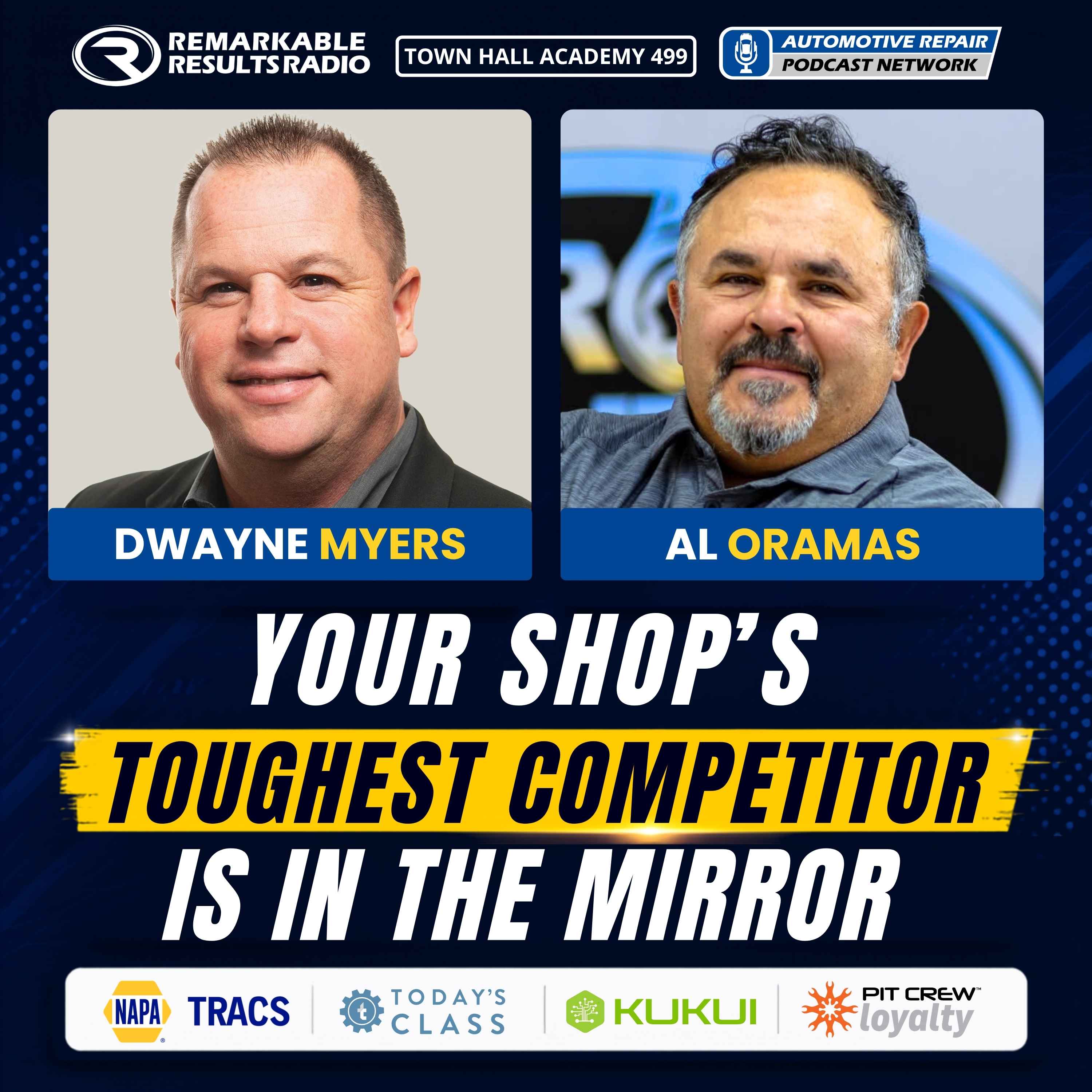
Your Shop’s Toughest Competitor Is in the Mirror [THA 499]
Thanks to our Partners, NAPA TRACS, Today's Class, KUKUI, and Pit Crew Loyalty Watch Full Video Episode *]:pointer-events-auto scroll-mt-[calc(var(--header-height)+min(200px,max(70px,20svh)))]" dir="auto" data-turn-id="request-WEB:8e59eec7-a235-4fa3-a072-956fea3fe478-7" data-testid="conversation-turn-4" data-scroll-anchor="false" data-turn="assistant"> *]:pointer-events-auto scroll-mt-[calc(var(--header-height)+min(200px,max(70px,20svh)))]" dir="auto" data-turn-id="request-WEB:49a777bf-d263-4496-bf0b-2eb3a46ac96a-11" data-testid="conversation-turn-24" data-scroll-anchor="false" data-turn="assistant"> Who is your shop's toughest competitor: the business down the street, or the people inside your own four walls? Carm Capriotto sits down with shop owners Dwayne Myers and Al Oramas to explore internal competition and why the biggest threats to a shop's success often come from within. The conversation challenges owners to stop obsessing over competitors and start examining their own leadership, consistency, processes, and customer experience. What You'll Learn Why operational consistency matters and how small deviations can create chaos.Why owners can't effectively lead from the "engine room."How true delegation requires owners to let go of control and trust their teams.Why "everything speaks" when it comes to the customer experience.How standing at the curb can reveal things owners no longer notice inside their own shops.How simple physical and operational improvements can create meaningful change.Why asking employees what they love and what they would change can reveal the true health of a business. Your greatest competitor may be staring back at you in the mirror. The shops that grow stronger are willing to look inward, challenge their own habits, listen to their teams, and consistently raise the standard. Leadership isn't about controlling every detail; it's about creating the environment, expectations, and trust that allow the entire team to perform at its best. Dwayne Myers, Dynamic Automotive, 8 locations, Maryland. Dwayne’s previous episodes HERE. Al Oramas, Pro Auto Care, 2 locations, Denver and Littleton, CO Optimize training with Today's Class: In just 5 minutes daily, boost knowledge retention and improve team performance. Find Today's Class on the web at https://www.todaysclass.com/ David Boyes, President of ‘Today’s Class” David’s previous episodes HERE Brad Updegraff, Dave’s Ultimate Automotive, 7 locations, Austin, TX. Brad’s previous episodes HERE. Thanks to our Partner, NAPA TRACS NAPA TRACS will move your shop into the SMS fast lane with onsite training and six days a week of support and local representation. Find NAPA TRACS on the Web at http://napatracs.com/ Thanks to our Partner, Today's Class Optimize training with Today's Class: In just 5 minutes daily, boost knowledge retention and improve team performance. Find Today's Class on the web at https://www.todaysclass.com/ Thanks to our Partner, KUKUI Stop juggling multiple marketing tools. KUKUI’s integrated platform delivers 4x better website conversions, automated follow-up, and real-time ROI tracking. Get industry-leading customer support with KUKUI at https://www.kukui.com/ Thanks to our Partner, Pit Crew Loyalty You’re probably tired of chasing new customers who never return. We understand. Pit Crew Loyalty ends the one-and-done cycle, turning first visits into lasting, reliable revenue at https://www.pitcrewloyalty.com/ Connect with the Podcast: Download and Listen on Our Mobile App: https://automotiverepairpodcastnetwork.com/app/Visit the Website:https://remarkableresults.biz/Subscribe on YouTube:https://www.youtube.com/carmcapriottoFollow on Facebook:https://www.facebook.com/RemarkableResultsRadioPodcast/Follow on LinkedIn:https://www.linkedin.com/in/carmcapriotto/Follow on Instagram:https://www.instagram.com/remarkableresultsradiopodcast/Join Our Virtual Toastmasters Club:https://remarkableresults.biz/toastmastersJoin Our Private Facebook Community:https://www.facebook.com/groups/1734687266778976Join our Insider List:https://remarkableresults.biz/insiderAll books mentioned on our podcasts:https://remarkableresults.biz/booksOur Classroom page for personal or team learning:https://remarkableresults.biz/classroomBuy Me a Coffee:https://www.buymeacoffee.com/carmSpecial episode collections:https://remarkableresults.biz/collections...
The Mistake That's Costing Your Shop Money | Nick Yannessa & Chi Wong - Ep 30
Consistency is key - heard that! But, consistency is HARD. That's why I gave up on trying and let the experts handle it. Detect Auto. Let them clean up your estimating process and raise your ARO - like they did for me! CLICK HERE TO BOOK A DEMOAnybody can run a shop. Building one that lasts? That's a whole different story. If you're ready to build smarter systems and a better experience for your team and customers, check out Tekmetric HEREIn this episode, Tonnika welcomes Nick Yannessa & Chi Wong to talk about how they started a auto repair shop. Nick brought up how he thinks it's dangerous to judge customers based on their car or background—presenting recommendations equally is key for success. They all discuss the importance of efficiency and processes, especially for one-person operations, with strategies ranging from shop layout to streamlined part sourcing. The discussion explored how relationships—whether through peer support, coaching, or personal connection with customers—can make or break both morale and business success.Timestamps:00:00 Growing up in the business, judging customers & learning not to assume03:00 The wild origin story of a Philly-area repair friendship07:00 Shop ownership journeys: from dealer frustration to Craigslist finds13:15 Shop expansions, partnerships, and the big pains of growing fast16:30 Management mistakes: Getting hurt by the wrong coaching advice22:30 Why shop friendships (and roasting each other) drive real growth26:00 Breaking out of the tech mindset — why process & sales skills matter35:00 Single bay or big staff? How to thrive as a one-man show41:30 Efficiency hacks: leg surgery for your shop layout47:00 The power of batching tasks, double-dipping on equipment, and finding your warehouse51:00 Bootstrapping a new shop, from free desks to Techmetric (or not)59:00 Real-life sales training: How to pitch brakes and win trust1:12:00 Dealership vs. Indie: Why premium service isn’t just about the brand1:20:00 Body shop margins, insurance games, and why service rocks1:33:00 The secret sauce: Making your shop unforgettable1:39:00 Building trust over time (without a single DVI)1:44:00 Health, happiness, and generational wealth—success beyond KPIs1:46:00 Why driving a free CR-V might beat flexing a Cadillac1:52:00 Building benefits for your people, and leveling up your future1:58:00 Final rants and why you need to be the “dive bar” your customers love