← Diagnostics & Repair
Charging for Diagnostics
How to price and sell diagnostic time — ending the free check-engine-light trap, setting a diagnostic fee, and getting paid for testing.
11 episodes
01

The Institute's Leading Edge PodcastMay 14 · 57 min
205 - The Diagnostic Fee Debate: Ask Me Anything with Cecil Bullard and Lucas Underwood
205 - The Diagnostic Fee Debate: Ask Me Anything with Cecil Bullard and Lucas Underwood May 13, 2026 - 00:56:50 Show Summary: Lucas Underwood and Cecil Bullard explain why diagnostic testing should never be treated as free work. They discuss how weak pay systems and poor communication have lowered the value of technicians across the industry. The conversation compares automotive testing to the medical field and explains why customers should expect to pay for professional diagnostics. They also cover technician growth customer education leadership and the need for stronger professionalism in repair shops. The episode ends with a call for the industry to raise standards and focus on creating long term value. Host(s): Lucas Underwood, Shop Owner of L&N Performance Auto Repair and Changing the Industry Podcast Cecil Bullard, Founder of The Institute Show Highlights: [01:00:25] – Customers understand testing better than diagnostics. [01:03:09] – Proper testing requires skill experience and expensive equipment. [01:04:04] – Shops lose profit when diagnostic time is given away. [01:06:47] – Flat rate pay discourages advanced diagnostic skill development. [01:12:10] – Lucas explains his Level One testing process. [01:14:45] – Cecil compares automotive testing to medical diagnostics. [01:19:22] – Skipping testing leads to poor repairs and wasted money. [01:31:06] – Lucas discusses leadership responsibility and coaching influence. [01:39:40] – Accurate testing saves money and prevents unnecessary repairs. [01:50:16] – The industry must value professionalism and technician expertise. In every business journey, there are defining moments or challenges that build resilience and milestones that fuel growth. We’d love to hear about yours! What lessons, breakthroughs, or pivotal experiences have shaped your path in the automotive industry? Share your story with us at info@wearetheinstitute.com, and you might be featured in an upcoming episode. 👉 Unlock the full experience - watch the full webinar on YouTube: https://youtu.be/cUCa2tz_G1c Don’t miss exclusive insights, expert takeaways, and real talk you won’t hear anywhere else. Hit Subscribe, drop a comment, and share it with someone who needs to hear this! Links & Resources: Want to learn more? Click Here Want a complimentary business health report? Click Here See The Institute's events list: Click Here Want access to our online classes? Click Here ________________________________________ Episode Transcript Disclaimer This transcript was generated using artificial intelligence and may contain errors. If you notice any inaccuracies, please contact us at marketing@wearetheinstitute.com. Episode Transcript: [01:00:00:01 - 01:00:11:22] Lucas Underwood Good afternoon, everybody. My name's Lucas Underwood from Changing the Industry podcast. I'm also a shop owner. And this afternoon, I'm here with the man, the myth, the legend, Mr. Cecil Bullard. Cecil, how you doing, buddy? [01:00:11:22 - 01:00:14:10] Cecil Bullard Howdy, howdy. I'm great, Lucas. As always. [01:00:14:10 - 01:00:24:14] Lucas Underwood Yes, sir. Yes, sir. So we've got some deep dive topics for the day. I'm excited about it because this is a hot button series of topics. So let's dig right into it. [01:00:25:15 - 01:00:53:00] Lucas Underwood Now, now, Cecil, we're talking diagnostics. We're talking testing. We're talking charging for it. But you know something? Very, very early on when I first started kind of working on improving my business, I went to ASTA for the first time and I got into some training classes. It was drilled into my head from the word go. You don't sell diagnostics. You sell testing and testing results in a diagnosis. How do you feel about that, Cecil? [01:00:56:10 - 01:00:56:24] Cecil Bullard Who cares? [01:00:58:05 - 01:01:03:19] Cecil Bullard I don't care. Here's the thing. I mean, I sold diagnostics for, I don't know, 25 years. [01:01:03:19 - 01:01:04:04] Lucas Underwood Yeah. [01:01:04:04 - 01:01:52:00] Cecil Bullard We're going to diagnose your car. Now, testing actually, we keep having these people that come into our industry and they come up with these great new words. And so let's not call it green anymore. Let's call it, I don't know, pumpkin pie or whatever. Who knows? Who cares? Right. And so if you're selling pumpkin posse. Yeah. If you're, if you're selling, if you're, if you're good at selling diagnostics, who cares? Right. This is the one instance where testing probably makes more sense only because the consumer probably understands testing a lot better than they understand diagnostics. Okay. And, and so, you know, I'm, I'm, if I'm going to go to the doctor, they're going to run a series of tests. [01:01:53:03 - 01:02:38:10] Cecil Bullard If those series of tests don't give them the information they need, then they're going to run another series of tests or more tests. And, and so I think that at least because of the medical industry and the, and the work they've done, the testing probably makes more sense at this particular point. And if we made that shift in the industry, would it make it easier for your customers, your clients to understand what you're, what you're doing and why there's a cost to it? And, and the answer is probably yes. So, you know, as far as calling, you know, technicians, mechanics or mechanics technicians or specialists or whatever, I don't care what you call me, you know, just call, make sure you call me. As [01:02:38:10 - 01:02:40:16] Lucas Underwood long as you pay the bill when you're done, I don't care. [01:02:40:16 - 01:02:41:09] Cecil Bullard Yeah. [01:02:41:09 - 01:02:42:09] Lucas Underwood Yeah. [01:02:43:17 - 01:02:44:16] Lucas Underwood Go ahead. Go ahead. [01:02:44:16 - 01:03:09:03] Cecil Bullard I just, we keep coming up with new words, thinking we're going to change the game when we're not really changing the game. The problem is that we don't value ourselves as an industry or our time as technicians or as mechanics and we never have, and we still don't value that time. And that creates a lot of the unrest in our industry and a lot of the financial issues in our industry. [01:03:09:03 - 01:03:45:15] Lucas Underwood I agree a thousand percent Cecil. I completely agree with you. But here, here's where I'm at on the testing thing. Okay. And a couple of thoughts behind this process. When, when I bring a client into my shop, I start with a level one testing routine. Now look, if you've never tested a car, if you've never done the diagnostic process yourself, it is very easy to say, well, hey, I'm just going to wrap that into the price. It's not that big of a deal. No, it's a talent. There is skill associated. There is knowledge associated. There's tooling associated with it. If you've never been the one to do it, you just don't understand how complex the process can be. Okay. [01:03:45:15 - 01:03:52:14] Cecil Bullard I'm talking to a shop yesterday. They have $189 posted labor rate. [01:03:52:14 - 01:03:53:07] Lucas Underwood Yeah. [01:03:53:07 - 01:03:55:29] Cecil Bullard Okay. They have an effective labor rate of 123. [01:03:57:26 - 01:04:00:08] Cecil Bullard Now they're wonder why there's no money in the bank. [01:04:00:08 - 01:04:01:00] Lucas Underwood Yeah. [01:04:01:00 - 01:04:02:13] Cecil Bullard And you know, we're talking about. [01:04:02:13 - 01:04:04:06] Lucas Underwood Everybody they're higher than everybody in town. [01:04:04:06 - 01:05:44:14] Cecil Bullard How many comebacks do you have? Oh, we don't have any, we have hardly any comebacks at all. Okay. And by the way, that's the answer. 99.9% of the time, we don't have any comebacks. Okay. Wonderful. Wonderful. It's not that how many, how many DVI's do you give away without charging that to your customer? Yeah, we do DVI's for free for our clients. Okay. All right. How much, how many times does your master technician, your A-Tech have an hour to quote unquote run tests or diagnose a car and take two days? Oh man, that happens a lot. Okay. Now we've, we've, we've circled in on one of the main reasons that the effective labor rate. And by the way, it's like $27,000 a month for this shop because their effective labor is so far off of their posted rate. And they, their A-Tech is again and again and again. If it's so easy to do this quote unquote diagnosis, anybody can do it in half an hour, anybody can do it in an hour. I cannot, you know, you got these ego tacks out there and I'm going to get blasted, but they're out there and they're like, Oh, well anybody should be able to do that in an hour. You know, we should be able to diagnose this code in an hour that code. And yet hundreds, if not thousands of guys are spending three, four, five, seven, 10 hours on a car, trying to figure out what's really going on. And, and how does that not come together? My ego is being in the way of being profitable and making money. Right? Yeah. Then I'm going to come up to the shop owner who's cheating me. [01:05:44:14 - 01:06:47:25] Lucas Underwood Well, so a couple of things here, right? First of all, let's just, let's put the elephant in the middle of the room and beat it. Okay. Because the reality of the situation is this, the pay systems and the way that we have set up the testing routines have not rewarded technicians. Okay. Now I get that there are thousands of ways to obtain reward and to find meaning and purpose in life, right? We go back to Michael Smith's leadership in the last. It's not all about money. It shouldn't be right. Right. But I'm going to tell you right now, if you don't pay somebody for it, they're not going to develop the skill. Right? I mean, let's just be real about it. You go and you work in the dealership and you get paid 0.25. You get paid 0.5 to go and do said testing that you know is going to take you an hour and a half or two hours to do it. Is it fair? One, no, it's not. B, there's no system. They're, they see them giving it away. Okay. When, when someone sees you giving their work away, it says to them, I don't value this. Well, we've, I don't see value in it. [01:06:47:25 - 01:07:11:22] Cecil Bullard Yeah. That's, that's one of the other issues we've devalued ourselves over and over and over again. And we continue to do that. You've got an owner that used to be a tech and for him or her, it, oh, it was easy for me. You know, every car that came in, I could figure it out in an hour. And, and then, but they're not the one figuring it out. Yeah. I have a, I have some companies that are, um, uh, [01:07:12:29 - 01:09:26:29] Cecil Bullard like restoration. So that what they're doing, there isn't quote unquote a book time for right there. They're sometimes making components and, and taking something off of a vehicle was never intended for this vehicle and, and re retooling it and et cetera. And we're timing materials. So when your timing materials, um, what's better to have the worst tech doing the job or to have the best tech doing the job. And if you do do that, you're going to have to do it. And if you do have the best tech doing the job, is that, is that hurting the shop, but helping the customer? Is that hurting the tech, but helping the client? Right. So yeah, our, our, um, the way we pay and obviously, you know, I'm for a pretty decent base pay. Right. So you're going to be here. You got to know that you're going to have, you know, food at home and a shelter over your head. And once in a while it would be nice if I could take my wife out to dinner or whatever. Right. And you got to know that. And then I think you need to have performance enhancement stuff. And if you are excelling in certain areas in certain ways that I can earn more money, I can make a bigger paycheck. And if you can blend those two, which is what we do, then I think you have the best of both worlds. But, but it doesn't, it will never matter if we don't, if we continue to devalue what we do. We do this techs all the time because, you know, we'll go, "Oh, I know exactly what that is." And then you have to have a lot of money. And I think that's, that's what I think that is. But wait a minute, why do you know exactly what that is? Well, you're some experience. So I have, I don't know, 252 scars on my hands. The reason I know this is because when I'm sitting in church and I'm bored, I'm OCD. So I'm counting the scars. And I've done it a hundred times, right? A thousand times. And where did those 252 scars come from? Working on cars. They came from reaching up under a dash and, and getting cut. And they came from, you know, a bunch of cars. And I think that's, that's, that's the reason why I'm here. sized them as they mostly were. Is because, uh, [01:09:27:29 - 01:09:49:02] Cecil Bullard I work overtime and I had a lot of hard work around them. And then you do the whole thing, pushed into that and I were like, Oh my God, this is terrifying. and, uh, you know, and there at the first time, you're someone else's medical Vancouver department. weren't born with it, right? You, you,u paid for it in blood, sweat and tears. You paid for it in extra hours that you didn't get paid for, you paid for it in real blood. Right? [01:09:50:15 - 01:10:17:11] Cecil Bullard And yet we constantly, we disregard that as technicians. I would say it's epidemic in our industry. And then you have your ATEX who don't understand why the C-TECH can't do it as fast or as good as they can. Right? Well, I don't understand. This is so easy. Well, go back to when you were learning. It wasn't easy when you were learning it. Right? And until we... Absolutely. [01:10:18:16 - 01:10:30:04] Cecil Bullard Until we find a way to kind of value ourselves and our time, that's what we have. Could you imagine a lawyer, like lawyer giving you 30 minutes without charging you? [01:10:30:04 - 01:10:33:09] Lucas Underwood Let me just tell you something. They don't ever. [01:10:33:09 - 01:10:35:01] Cecil Bullard No, they don't. [01:10:35:01 - 01:11:14:29] Lucas Underwood The one I've been working with here recently is fire. I mean, so good. We've got two right now that I work with on pretty much a daily basis. And there's a lot of things that they will just talk to us and say, "All right." And then they roll that into what they're doing. And I understand that, right? Because it's too much to every telephone conversation. Every second. Yeah. But I'm going to tell you right now, I've got a bad one and two good ones. And the two good ones, buddy, I don't even care. I don't flinch when that bill comes in because it's like, a great example is one of them, they're in another state and he calls me the other day and he said, "These people that we're going to battle with." [01:11:16:01 - 01:11:32:03] Lucas Underwood Two years ago, they were in a civil case and they accidentally released a document and I found that document and it is your everything you need to get what you want from them. And it's right there. Yeah. And he went through thousands of documents. [01:11:32:03 - 01:11:36:16] Cecil Bullard A few hundred thousand dollars. I'm like, "Yeah, you're worth your money, man. [01:11:36:16 - 01:11:52:07] Lucas Underwood Whatever you need to do. Send me the bill." Yeah. And so here's the big thing for me and I've dealt with a lot of shop owners and I talked to a lot of techs, a lot of shop owners on a daily basis. I talked to probably six or seven already today. [01:11:53:07 - 01:12:09:14] Lucas Underwood First of all, the main issue that I see is the people who have never done it don't value it because they don't understand it. And so there's a lot of these shop owners who went and they just bought a shop and they just say, "Well, a car goes to tech, tech tells me what to do, car fixed." [01:12:10:14 - 01:12:50:23] Lucas Underwood And all they see is the time associated with it. They don't understand the talent. They don't understand the skill. They don't understand the logistics of what has to happen to properly repair that automobile or to find out what's wrong with it. And so what I started doing in my shop season, and you tell me if this is right or wrong, I start with a level one testing routine. It has one hour on it and they get the basic data. It's a code read, it's fuel trends, it's data acquisition, it's confirm the client's concern, determine where it's at on the car, get me some base data. And if you can figure out in that hour, which about 90% of all cases they're able to, then great. It's an hour. We roll on with it. Typically they're out in half an hour to 45 minutes. [01:12:50:23 - 01:12:59:07] Cecil Bullard And maybe this is just coming in my head at the moment. Maybe what we're really doing in that first hour is creating a testing plan. [01:12:59:07 - 01:13:00:19] Lucas Underwood Well, that's what I was getting ready to say. [01:13:00:19 - 01:13:01:22] Cecil Bullard Or a diagnostic plan. [01:13:01:22 - 01:13:05:20] Lucas Underwood That's exactly what happens if it is something advanced. [01:13:06:21 - 01:13:30:12] Lucas Underwood And so step two, that technician comes to me and they say, Lucas, here's the data I have collected. It tells me that I am looking at an issue that is in X circuit because it says circuit high and I know it's not the component and I know it's not the computer because I've done these two tests. I have to do X to find this. [01:13:30:12 - 01:13:37:01] Cecil Bullard I have to spend this amount of time or I have to run these three tests in order to determine what's really going on. [01:13:37:01 - 01:14:45:03] Lucas Underwood You came back to me with data and you said, here's the test I need to do. Okay. Now, if I go to the doctor, I just want to point this out. If I go to the doctor and I've fallen, I've hit my arm and it's all bruised up and it's all to pieces and I go to that doctor, first of all, I'm going to pay for the visit fee. Okay. So I go into the doctor and they're going to say, Hey, it's a hundred and whatever dollars. The doctor comes in, takes a look and says, Hey, Lucas, I believe you've broken your arm. Now for me to determine the best course of action to correct your concern, I have to do additional testing. That's going to be an X-ray, that's going to be an MRI, that's going to be whatever it is. Now at that point, we'll know what course of action we need to take. Do we have to do surgery? Can we just set it? What do we do next? Right? First of all, they're not giving me an estimate for what's wrong. They're giving me probabilities. They're giving me some idea of where we're headed. But if I went into that doctor's office and they said, man, it looks like your arm hurts. I'm going to have to do some testing. It's going to be about a thousand bucks. Okay. What test are you going to do? Well, I don't know yet. I'm going to figure that out when I get there. I'll let you know. [01:14:45:03 - 01:15:10:13] Cecil Bullard Right. But that's not, that's not kind of how it works. I mean, I was at the doctor yesterday, normal visit. I'm diabetic. So I go twice a year and he says, how are you doing? I paid my $95 coded up, whatever. So he's getting paid, I don't know, $250 for between me and the insurance company. Maybe it's 150 for 10 minutes of his time at most. [01:15:12:09 - 01:16:16:01] Cecil Bullard And he says, oh, well, you're looking great, but I want to send you to this guy because you've got this problem and they need to, we need to figure out what's going on so we can have a course of action. Right. So we know what we're going to do or if we're not going to do anything. And so I paid for him. Now I'm going to go see a quote unquote specialist that will, I'll pay for that visit and then I'll pay for the testing on top of that. And then I'll have a plan to move forward. That's that's you know, we could discuss why are our medical systems out of hand and other things. The process that they do to determine the plan to solve the problem is a good process. They've been doing it for years and years and years. It works. It gets the right answer most of the time, 97% of the time or whatever. Right. And and and we move forward. And yet in our industry, we're like, well, I can't charge anybody for that. [01:16:16:01 - 01:16:23:25] Lucas Underwood Well, I just need to point out to you Cecil. Yeah. That's when you know you over the hill when they start saying, well, we're not going to do anything about this. [01:16:23:25 - 01:16:24:16] Cecil Bullard Yeah. [01:16:25:27 - 01:16:26:03] Lucas Underwood Yeah. [01:16:27:21 - 01:16:30:28] Cecil Bullard Until you can't walk anymore, then we'll think if we need to do something, [01:16:30:28 - 01:16:32:18] Lucas Underwood we'll get you a wheelchair then see. [01:16:32:18 - 01:16:39:16] Cecil Bullard Yeah. Yeah. That'll be great. You can get one of those little things. Yeah. Yeah. Thank you. [01:16:39:16 - 01:16:49:19] Lucas Underwood My dear friend Rick white, when he hurt his back had a scooter that they read him around on at Apex and I've never let that go. I just rubbed it in all the time. [01:16:49:19 - 01:17:00:26] Cecil Bullard You know, I had a, I had a foot surgery three years ago before Apex and I was, I was on a scooter for Apex and yeah, not, not fun. I'm really not fun. [01:17:00:26 - 01:17:18:13] Lucas Underwood I bet not. So look, when we talk about this testing thing, I just want to point something out about this because I think it's so important when we look at that medical field, they see value in the test that they're going to do because they know what test needs to be done. [01:17:19:18 - 01:17:52:23] Lucas Underwood They're in charge of charging you for that test, right? They decide what test has to be done. They put it on there. It gets billed to you and then the thing happens, right? Yeah. I think what happens in our industry is there are so many people who do not understand the service advisor and the owner or the service manager do not understand the skill, the talent, the tools, the ability, the time it takes to properly diagnose an automobile. Well, and so it's, it's different for them to stand up there and say, this is $400, but that's why I do the testing routine. [01:17:52:23 - 01:19:21:25] Cecil Bullard That's part of the problem with our industry. So if we look at, at a doctor, a doctor cannot afford to just go set your arm, right? Yeah. The bone is sticking out. You know, I know I've, I've got the scars to prove it, blah, blah, blah. Bone is sticking out. The doctor says we need to do some testing to find out what's going on because we need a course of action. All right. Now, if they had just set my arm at the time because the bone was sticking out, then I wouldn't have use of my wrist. Okay. Because it was, the bone had shifted when it broke. All right. Now, and they needed to find that out. And, and in the medical field, they cannot afford to set that bone and then later have me sue them or come after them because I know I now, I now no longer have use of my wrist in the automotive field. We don't seem to have a problem with, well, that guy wasn't right. Okay. And we, we even, we even, we propagate this idea that there's too many guys out there that aren't right. Well, yeah, because we're not giving them the tools or the necessity to run the testing to be right or the time when you, when you have a free, Oh, by the way, I have an hour. Man, you've spent three hours on that car. [01:19:22:25 - 01:21:03:07] Cecil Bullard How come, how come? What is it? You know, well, let me pull something out of my behind so that I'll get you off my back. And then, well, wait a minute. That guy was wrong. Now the shop is paying for it or the customer is paying for it or whatever, because we didn't do the testing in the front because we didn't value it because we didn't understand the liability that we have on the other side of that. It's a, it's a problem that is bigger than we think. And it's been going on for a very, very long time. Don't get me wrong. There's some guys out there working on cars that shouldn't be working on cars, but there's a lot of guys, when you put someone in a position for their family to starve or them to cheat, what do you think they're going to do? Let their family starve. Yeah, they have to. Right. And so when you're not charging for your text time and, and I don't know if, if Mike is here or not, but if he is Mike, don't tell me you're not charging for diagnostics. If you raised your labor rate, you are charging for your diagnostics. You're just charging for it in a different way. So now we got that out of the way. All right. But if you're not, if you're not charging for your diagnostic and, and you're asking your tech to do that for free, or you're paying for that yourself somewhere, there's a cost. There's either cost to the customer in poor diagnostics or incorrect answers. There's a cost to the, to the, the owner of the company, the company. And if there's a cost to the company, there's a cost to the employees of the company. And that's one of these things why we have techs constantly complaining about how poorly they're treated. You know, is it fair? [01:21:04:12 - 01:21:29:24] Cecil Bullard You call me, Hey Cecil, I've got this Toyota Camry that, you know, 2014 and it's got this weird blah, blah, blah. What's it going to cost? Right? Oh, well, you know, we're going to need to. We need to do some testing. And so we start at $300 and that'll be applied toward the testing. And if we can solve the problem with that, we'll certainly solve the problem. You come in, it's not even a damn Toyota. [01:21:30:24 - 01:21:46:02] Cecil Bullard Right. Yeah. And you show up with a, I don't know, you show up with a Nissan and you don't even know what you're driving and you want me to tell you on the phone what that price is going to be to fix something that I have no idea what it is or, or anything. [01:21:46:02 - 01:21:55:27] Lucas Underwood But our industry set that expectation, right? Our industry has created that expectation in consumers and, and, and we, you know, Dutch is always bust about us being a commodity. [01:21:55:27 - 01:22:24:05] Cecil Bullard Yeah. We keep propagating that. And you know, some of it is because we have egos and our egos won't let us get out of the way of ourselves. And, and, and some of it is because we don't, we don't get it, right? We really don't understand the, the financial aspects of the business or the, the, uh, uh, liability we have or any of the, you know, a few other things. And, and, and some of it's just probably plain ignorance. [01:22:24:05 - 01:22:43:28] Lucas Underwood Okay. Spicy, spicy perspective coming in here. I think some of it is because we're too stupid to have our own thoughts. So we go and we listen to some big wig coach who is in a metropolitan area who has thousands and thousands of clients that they can pull from. And, and we don't realize that what we're doing is basically market manipulation. [01:22:45:00 - 01:23:01:28] Lucas Underwood And, and we don't care that it devalues our industry as a whole. We don't care that it damages our industry because all we care about is making enough money to sell the shop or do whatever we need to do. We don't care who it upsets. We don't care who it hurts because all we care about is our shop. All we care about is the money. [01:23:01:28 - 01:26:37:16] Cecil Bullard I think, um, when you look at, at, at human beings in general, um, certainly there is the trap of I'm only doing what's best for me. Yeah. Okay. And, uh, right now, you know, someone hangs this sweet carrot of if you get 10 locations, you're going to get 16 X and, uh, and they stay. And by the way, you're going to get a really nice VC company that's going to buy your company for top dollar, and then they're going to take care of all your customers and employees, just like you would. Uh, you know what? I will, I was born at night, but not last night. Okay. So, so yeah, we're. And by the way, should we be doing what's best for us? Right. Yeah. So on the, on the chart of, of, um, uh, what's important, uh, my chart is, is Cecil's relationship with Cecil. Okay. Then it's Cecil's relationship with God. Then it's Cecil's relationship with his family. And then it's Cecil's relationship with his business. And then it's Cecil's relationship with everybody else. Right. And the, and the reason why that has become that over the years, because it wasn't always that was because if I'm not happy with me, I won't be happy with anything else or anybody else. I have to like me. I have to understand me. I have to know that with all the, all the warts and all the other stuff, you know, the temper, the whatever, that I'm a good guy and I'm trying to be a good guy and I'm trying to, you know, et cetera. And so I like me and, and then I need to have a relationship with God, whatever that is, so whatever your. You know, you may say there's no God, Cecil. There's a, there's a being or some science or something. Okay. Whatever that is, you have to have a relationship with it. You have to understand how you fit in the world. Right. And then I got to make my wife, uh, mostly happy. Can't make her all happy. Can't make my kids happy, but I got to do my best for my family. And then it's my business because there's an awful lot of responsibility. So with that nature that we have, are we going to look out for ourselves sometimes more than we probably should? Yeah. You know, I think it's, it's inherent. What, what gets me in our industry is that I almost dread going online anymore because 90% of what I'm hearing is negative. Yeah. And, and I, in this industry, this industry has been good to me. All right. Uh, I was, uh, 19 dropped out of college, came home, started as a tech for my dad. I was making 50,000 the first year I was working as a tech and I got news for you. I didn't know squat. Right. And, and then I became a service advisor and a manager and, and eventually I owned shops and sold those. And then I started a coaching company and now we're, you know, we're expanding and doing other things. And, and the industry has got me here. And got me through, I don't 45 year, 45 tough years with four kids. All right. And, and where else can that happen? You know, someone that drops out of college that really knows very little high, high intelligence, high ego, right? But other than that, not much going for me. Uh, and, and I end up here, this is a great industry. There's more opportunity in our industry right now than there's ever been. And you know what, if your owner is treating you like crap, [01:26:38:18 - 01:26:40:11] Cecil Bullard you know, how many shops need a tech, [01:26:41:11 - 01:26:52:14] Cecil Bullard right? And so don't sit in the, excuse me, do not sit in the pile of shit and then complain how stinky it is. Right. Get out, [01:26:53:14 - 01:27:43:19] Cecil Bullard shower yourself off, go get another job somewhere. Because I know right now I could tell 50 shops, if they could find an ATEC, they'd be paying that ATEC as much, almost as much money as they wanted. And probably a lot more than the average in the industry and, and really giving them a great place to work with all the support they need, all the tools, all the equipment, all the education, all the training, et cetera. And then I understand what you were saying about like the coach. Sometimes we have these companies that are telling you what you want to hear. Yeah. Not what you need to hear. Okay. Absolutely. And, and, and I think, you know, it's probably a good thing that I'm not God, frankly, cause I don't have the patience or the understanding and I might do some, [01:27:44:24 - 01:28:15:15] Cecil Bullard I might do some really crazy bad things because there are people in our industry that, you know, if I had the, if it was up to me, they wouldn't be in our industry, but that competition, that, that knowing that that's out there drives me harder every day, right? Yeah. It makes me want the Institute to do better, to do more, to, to have more impact, to, to help more people be successful. Right. [01:28:15:15 - 01:28:34:29] Lucas Underwood Here's the thing is that those people, okay, let's think about this for a minute. They know, right? Those people are intelligent enough to know what they're doing. They're intelligent enough to know what the outcome is. Um, Mike Allen says he wants a list of people that sees with Smike. Mike's at the very top of it. [01:28:34:29 - 01:28:37:05] Cecil Bullard No, he's not. He's like fifth on the list. [01:28:38:17 - 01:28:38:23] Lucas Underwood Okay. [01:28:39:28 - 01:28:43:19] Lucas Underwood Um, uh, now I need to, oh man, this is going down a dark tunnel here. [01:28:45:20 - 01:28:56:15] Lucas Underwood But I, you know, look, I'm just going to say like, I think that, that those people know, and they know that the impact they're making on the industry. We pick on Mike. Mike really does. [01:28:56:15 - 01:29:01:00] Cecil Bullard Mike's a easy target. Thanks. And thank you for being that target, Mike. [01:29:01:00 - 01:29:09:08] Lucas Underwood Yeah, absolutely. And he's, he is working. I see his efforts behind the scenes all day long of like teaching people and trying to lift them up and, [01:29:09:08 - 01:29:27:23] Cecil Bullard and, but you, you have a big responsibility when you have the ear of the industry. Okay. And if you're going to be an industry influencer, there's a responsibility, not just to provoke, but to educate and to help. [01:29:28:28 - 01:29:39:26] Cecil Bullard Okay. And if you're, if you're provoking for the sake of, um, uh, hits and likes and crap like that, that's problematic. [01:29:39:26 - 01:29:42:05] Lucas Underwood That is not why Mike's doing that. [01:29:42:05 - 01:29:44:15] Cecil Bullard No, I know what Mike's up to. [01:29:44:15 - 01:30:00:18] Lucas Underwood I, yeah, what Mike is up to is he's just trying to meet his brother's level of this success. I mean, his brother was this super successful pilot and he did all these amazing things and Mike has always felt a little bit less than because of that. And so Mike is working really hard to get to the next level. [01:30:00:18 - 01:30:39:16] Cecil Bullard Do you know where we, do you know what we have to compare ourselves to? If you do this, right? You compare yourself to yourself. That's it. Amen. I, if I, I will never be the man my dad was. Okay. Um, he was stronger than I am physically, uh, till the day he died. He, I will never be him. Okay. And there's good and bad about that. And there's a lot of people out there that I admire. Okay. But I'm not going to be them. I hold myself to my own standard, right? It's my standard for me. I don't, yeah. [01:30:39:16 - 01:31:06:00] Lucas Underwood I've got to ask this question. Okay. This has nothing to do with diagnostic testing and it's something that I think I have personally struggled with a little bit, um, and something that I think about often when, when we give advice, right, it's rooted in our belief system. It's rooted in, in who we are, but I take giving advice to other people very seriously, and I take lifting them up and getting them to a better place very seriously, [01:31:07:03 - 01:32:07:05] Lucas Underwood when we look at, at people giving some of this advice and, and I, I think they genuinely believe that they're doing what's right. I think they genuinely believe they're, they're doing the right thing for other people. See, so how do you judge that advice? How do you know that you're leading them in a right direction? Because like these, what I keep seeing is I see these people, they're business owners and they're, they're lost, right? They don't know where to go. They don't know what to do. They don't know. And, and many of them pull from many different facets and they get information from lots of different people. But sometimes someone will attach to a very specific person. And what that person says is the grace and they believe everything they say. My fear is that my belief system may move their morals or their values in a different direction that doesn't align with who they are. And I take that very seriously. But I don't, how do you avoid that as a, as a coach? How do you make sure that you're not infringing on their belief system? [01:32:07:05 - 01:33:31:20] Cecil Bullard Do you, do you remember what I, I, I started out with in, and that is, um, Cecil has to like Cecil and then God and family and et cetera. So, um, you know, I judge the success of what we do with clients by their success, right? And I always said, you know, we, we can influence, um, we can't, I can't make your decisions for you. I can ask you what I can, I can tell you what I would do. Um, I can tell you also as a coach 20 years ago, I was a lot harsher and a lot more imagine that right. Uh, and a lot more, um, you got to do this and you got to do that. There were, there were a lot more definitive statements. All shops should, all people should blah, blah, blah. Uh, those, a lot of those things have disappeared from my, from my vernacular, I look at the, at what the Institute for all the clients that we have served and all the clients we serve and the success that we have. And I judge my success by that success. I also judge my success by being able to look at myself in the mirror in the, in the morning and, and, and like what I see, even though it's, it's a little flabbier, a little older and a little whiter. [01:33:31:20 - 01:33:33:05] Lucas Underwood Well, saggy, the old nine yards. [01:33:33:05 - 01:33:34:09] Cecil Bullard Yeah. All that. [01:33:34:09 - 01:34:34:01] Lucas Underwood There's a, there's a great question that just came up and I'm going to take a stab at this, he's going to pop it up on the screen for us because I'm wondering about the best ways to present a higher cost for Diag to customers. I always have a hard time, especially if we end up having to send it elsewhere because we don't have a special tool or software. We go as far as we can. Then we have to stop sometimes medical field. It's not a big deal to pay a bill to one doctor after they tell you they need to send you to a specialist, but in our industry, it feels like we've just failed. Now, listen, I'm going to tell you that for me, I'm judging that situation very early on. Okay. I'm not taking on things that are out of my wheelhouse and I have learned my lesson. And listen, Cecil, this is something you've seen in my shop. If the advisor is not astute, automatically, if they don't have that technical knowledge, if the manager doesn't have that technical knowledge, it can be very difficult to weed those out. But you have to have a technical team that says, "Hey, I believe this is something that we shouldn't get into. We need to get this out." There's things that require some treatment. [01:34:34:01 - 01:35:55:10] Cecil Bullard But I don't, I would, in a way, I disagree with you because we need to define what our jobs are in the business, right? If I'm the owner and the manager of my company, what's my job? To provide my people with the things they need to be successful, goals, org charts, job descriptions, tools, education, et cetera. Am I the one making the decision as the owner that we're going to take that job or we're not going to take that job? No, I'm not qualified. I haven't worked on cars in 16 years. Okay. There's no grease under my fingernails. There's, you know, the scars I have are well healed and there's no fresh stuff going on. Is it the service advisor's job to make that decision? No, no, no, it's probably not. It's the tech's job. This is beyond our capabilities. And by the way, can the tech do that if we haven't charged some time up front to determine that? And maybe we need to develop a list of specialists in our area that we can say, "We need to send you to a specialist on this type of a car." And not feel bad about doing that because that's what's best for the company. That's what's best for the client and the client's vehicle. It's not to bring it in and try to mess it around and, you know. For sure. [01:35:55:10 - 01:36:32:07] Lucas Underwood But, but I mean, here's, here's the thing. A 1993 Mercedes SL shows up. It's KJET. It's one of the worst injection systems ever built. Somebody's going to yell at me for saying that. It's terrible. It's awful. You look at that car and you say, "Hey, I don't work on cars that are older than 20 years old." "Hey, I don't work on Mercedes that's this type of fuel system." I don't, right? Like there's, if we know, right? If I know there's no way I'm going to work on that car, I know better. I have learned my lesson. I have paid the price for it. I'm not going to take that car. [01:36:32:07 - 01:36:41:12] Cecil Bullard As techs in our industry, we judge ourselves by being the guy that can fix everything and have all the answers. [01:36:41:12 - 01:36:45:10] Lucas Underwood I'm over that Cecil. I am so over that. [01:36:45:10 - 01:36:45:25] Cecil Bullard Me too. [01:36:46:25 - 01:37:06:01] Cecil Bullard Someday, hopefully we mature enough to understand that that's, you know, that there are things in our life that we're never going to do, right? I'm never going to fix every car. I'm not going to fix every client. They won't, you know, I, I've got, believe it or not, there are people that won't listen to me, right? [01:37:07:24 - 01:37:49:25] Cecil Bullard Sometimes I'm like, "God, you've hired us to help you. We're telling you what to do." And yet you won't go do it, right? Right. And again, I can only have influence. So I think, yeah, I think we need to decide kind of upfront what our roles are and what we're willing to do and what we're not willing to do. And the better we make that, the clearer we are, then the better we can focus our business on being more successful as opposed to, you know, all the crap. And I got to tell you, it's, it's really hard when you have no cars in your shop to say no to somebody that's bringing in a Mercedes with a K-Jet system or whatever. Right? [01:37:49:25 - 01:37:56:05] Lucas Underwood No, it's not. So I would rather be broke. I would rather not pay my bills this month. Okay. I'm just telling you. [01:37:56:05 - 01:38:23:07] Cecil Bullard It's hard for most people to, when they think, again, if you think, if you judge yourself on your, your prowess of fixing cars, and now all of a sudden you're making a shift into ownership or something, and you have to judge yourself now on the success of the people that work for you, not, and your clients, not on your own ability to, to fix cars. And that's not an easy shift to make. [01:38:23:07 - 01:38:37:07] Lucas Underwood I agree. And that, that was one of the hardest things for me to do because the things that I saw as easy, the things that I saw as, Hey, just go do this. I recognize other people don't have the same abilities that I had. Now, I don't have the ability anymore. [01:38:38:15 - 01:39:34:28] Lucas Underwood But they were easy for me. And so I would judge the situation based on my knowledge, right? The curse of knowledge. I would talk to clients on the front counter based on what I had experienced and got myself into trouble many times. Now I'm going to tell you, be prepared. Here's where I am with this. What I do is I bring them in for a level one testing routine. And I just explained in 90% of all cases, I'm able to determine the cause or causes of your concern. Other 10% of cases, I may have to refer you to a specialist or do additional testing. I will never, ever, ever change my estimate from this price. You will stay in control of the entire process at all times. But I may come back to you. And if you are one of those 10% cases and let you know, we have to do additional testing or you need to go to a specialist or you comfortable with that. And so I, you know, I made a video last night talking about this until you've been to a shop that throws parts at your car and can't actually fix it. And you just spent $3,500 trying to change all these parts and you still have the same exact problem you went in with. [01:39:35:28 - 01:39:40:05] Lucas Underwood You listen, they have no issue paying for proper testing at that point in time. [01:39:40:05 - 01:40:33:04] Cecil Bullard And those are my clients. The least expensive way to fix your car is to have someone that knows and understands that vehicle, inspect it, do the proper testing, create a diagnostic, a diagnostic process, plan for it and pay for that. That's the least expensive way to fix your car. And this, the stuff we do in our industry, like taking it over to, you know, one of the parts houses and they're going to test it for free and then sell you an oxygen sensor and you're going to bring it in and I'm going to put it on your car. Can't, can't make that work. Right. I, and we, we have to stop as an industry doing those kinds of things. And we have to, and, and those of us that are in the industry that are being affected by that, we should be fighting that tooth and nail. Yeah. Right. [01:40:33:04 - 01:40:54:18] Lucas Underwood Yeah, absolutely. Absolutely. Got an incoming question and I vote. I know which one it is. And it's Mike Allen saying, are you super clear if you have to pump this to a specialist that you're still charging? Yes. Now listen, I've had issues with advisors not being super clear, but I am super clear and I am very, very transparent about that. [01:40:54:18 - 01:41:24:15] Cecil Bullard And what I want to, what I really want to teach my advisors is this. We need to be as clear as, as I mean, crystal clear about what the costs are going to be and what's going to happen with our clients. And by the way, if I want a client to argue with me about the cost, do I want that to happen before I work on the car or after my tech is spent two hours on the car and created a plan, right? And, and what happens a lot is the advisors, we have a lot of. [01:41:25:23 - 01:42:43:22] Cecil Bullard Unqualified salespeople in our industry. We're not really salespeople. Okay. They're not really advisors and, and they're, they might be the nicest people. They might be all kinds of things, but they're not really advisors and they have a fear, I don't want to have this conversation because it's going to be a potential to have that person be mad at me or have that person take their car away or whatever, and they may walk away and not like me. Right. And, and, and so we're vague. We're vague about our answers. We're vague about what we're going to do. We're vague. How many shops have you walked into that have a very good script about Diag and what they do, why they do it, what the costs are, why those costs are the costs and what, what is likely to happen and what could happen. You know, how many shops have that script that your service advisors know and understand. So that customer is right off the bat understanding what's really going to happen and why it needs to happen that way. I would tell you for me, like sales and building value, it's so easy, but it is not easy for the average service advisor because they've been taught how to do that and they don't have the experience to do that. Right. And so we, yeah, we, we need to, yeah, we got to clean that up. [01:42:43:22 - 01:44:28:21] Lucas Underwood You know, look, we, we pick on Mike, but, but let's be honest about why Mike does a lot of what Mike does in this instance. And it's because Mike needs a competitive advantage. He is, he is in a very, very heavily saturated area. There's a lot of shops around him. There's a lot of people around him too, but he uses this as a tool to try and drive more people in the door. He uses it to set himself apart from the rest of the crowd. I use something completely different, right? Like for me, I'm using the fact that we can test anything. I'm using the fact that we have abilities nobody else has. And we have those abilities because we pay our guys to learn this. We pay our guys to go to training. We have this set up so they can develop these skills and we have the equipment and that costs money, right? I understand like in their eyes, a lot of times it's like, Hey, they don't really know that they're still paying for it. They don't understand that it's in the labor rate, but to me, like, I feel like that devalues the industry as a whole. I feel like it makes it look like this should be a free service. You know, just two weeks ago, we had a car in the shop that, that came through and he called somebody else and they, they were going to do the job we were going to do for $700 for $240. And they're telling them about how we're ripping them off. They've never heard of a coolant service. They've never heard of this. They've never heard of that. And then we look at our industry as a whole and it's like, Hey, this guy's over here talking smack on an industry standard just to talk smack about it. I think if we could align ourselves, if we could get our industry moving in a more similar direction, where we're, we're making it better about our actions in our shops, our single shops at a time, we have a chance at getting this industry to where it's seen as a professional industry. [01:44:28:21 - 01:44:34:01] Cecil Bullard So let me ask you, let me ask you a question. I got, I got a couple of points, but let me ask you this question. [01:44:35:22 - 01:44:49:09] Cecil Bullard We're going to go somewhere and have a steak. Yeah. All right. And they've got a, uh, I don't know. It's $120 steak. Yeah. Um, but they also have a $30 steak and they're the same steak. [01:44:49:09 - 01:44:50:04] Lucas Underwood Yeah. [01:44:50:04 - 01:45:00:22] Cecil Bullard Okay. Does that, did, would that even play? I mean, would, would anybody at all look at the $30 steak and think that's the $120 steak? [01:45:01:23 - 01:45:15:16] Cecil Bullard No. Right. So if somebody comes into my shop and we're going to charge them $700 for whatever, right? Uh, Mike, that's my imaginary shop. Okay. Um, I don't own one. I'm thinking of buying one just because you put, you goaded me, [01:45:15:16 - 01:45:18:00] Lucas Underwood but no, I missed this. [01:45:18:00 - 01:45:55:09] Cecil Bullard But, but, um, uh, if I'm 700 and they call and say, this guy is, is saying he doesn't even know, never heard of this and he's going to charge $240 for the same thing, you know, my answer would be it's not the same thing. It can't be the same thing. Because if he, if he knew what he was doing, if he understood his business, if he understood the time it was going to take to properly diagnose and fix this car correctly, he'd be charging you $700 also. And then I want to, I want to play on something you said. Mike uses this for competitive advantage because he's in a saturated place. [01:45:56:13 - 01:47:28:26] Cecil Bullard Boo hoo. I mean, every, you're, you're somewhat unique, right? In your out in the country and you're kind of further away. There's a two thirds of the shops are in saturated places. And there are a lot of guys that aren't using, well, we don't charge for diagnostic as their competitive advantage. And they're doing just fine. I know they're my clients, right? Um, I, I always talk about this stupid book. I'm going to write that Cecil, you don't understand is the title, you know, I love it. You, you don't, you don't understand Cecil. Um, my shop had 41 shops within a mile of it and two dealerships and we were $58 higher than the next shop and we were the busiest shop. We had the happiest clients, the most satisfied. Uh, we, I believe we were the most profitable, although I didn't see all the other shops, P and L's. I did see some of them because I was, you know, that's when I started my coaching career. But, but I, I, I don't need to do that for a competitive advantage. I need to take great care of my clients. I need to help them understand why it costs, what it costs and how they're paying when somebody says, you know, I can get it done for 240 and you're going to charge me 700, you must be ripping me off. I have to say, wait a minute. Time out. No, that's not true. Because if you and I go to the restaurant and I ordered the $120 steak and you order the $30 steak, we're not getting the same steak. Okay. [01:47:30:04 - 01:48:17:23] Cecil Bullard And in, in, intelligently, internally, we understand that emotionally. We don't necessarily get that. We have to help our clients take their understanding and create emotional intelligence around that, uh, with what we, we charge and why we charge it. And I would say that most shop owners understand that we, or at least believe that if the client comes to them, the client is going to get a better repair, a better job, we care more, et cetera. And we should definitely feel that way about it, but a good salesperson helps the client take their emotion, their mental intelligent understanding and create emotional understanding around that. [01:48:17:23 - 01:49:58:04] Lucas Underwood Yeah, absolutely. And I think that if we, if we are not doing that, and so it's your job as a coach to do that for us, it's our job as a business owner to do that for, for your people, for our people and our people's job to do that for the client coming through the door. And I genuinely see that if we don't start taking moves to move our industry in that direction, as far as educating the consumer about the value in what we do, that we are professionals, right? And see that, that, that's the thing that trips me up on this. Because I can look at Mike's shop and say, that's my friend's shop. I love him. I care about him. I want the best for him. And if that's what's working best for him, so be it. He can do whatever he wants. The thing that, that hems me up on that is that I know that it has a detrimental impact to our industry in the longterm, right? There's no ifs, ands, or buts about it. We've seen what it does. We see what the code scan from AutoZone and Advanced Auto Parts does to our industry. And so we know that not charging for that testing makes it look more like a commodity. Right. And I'll never forget. One of these coaches we're talking about was on a podcast a while back and he said, man, he said, I'm a retailer. I'm a retailer. I don't care about the industry. I don't care about any of that. I'm a retailer. I'm here to make money. And I'm like, but, but we're not retail. We're professionals. This is our job. We are here to advise, consult, provide information to the consumer, help them make an informed decision about one of their most expensive purchases that they'll ever make in their lifetime. Right. And it's not just about money to us. [01:49:58:04 - 01:50:16:05] Cecil Bullard And if that customer takes care of their vehicle, that vehicle will service them and service them well for a very, very long time. Now, now here's the, here's the other thing. And I think this is like super important. And we have to stop complaining. [01:50:17:11 - 01:50:48:22] Cecil Bullard We have to stop talking. I'm not, not talking about the bad stuff. And, and, and I can't, whose actions can I, can I change? Luke, Lucas, can I make you do something? No, I can't make you do anything. I can only change my own actions. So we, if we want consumers to understand the value of what we do, we have to start talking like what we do has value, not like what we do is crap. [01:50:49:22 - 01:51:04:17] Cecil Bullard And, and there'll always be some bad guys out there. We can't, we can't help that. We can't make that go away. You know, um, like I said, it's a good thing. I don't have that power because I would do some, [01:51:04:17 - 01:51:06:07] Lucas Underwood there would be some people, uh, [01:51:07:07 - 01:51:08:03] Lucas Underwood burning crisp. [01:51:08:03 - 01:52:23:22] Cecil Bullard Yeah. But, but, but I can be as positive as I can be and work towards a better industry and, and try to bring people together to, to work towards that better industry, I can influence again, what we say on our podcasts and, and how we say it or what we say in our, um, our groups and how we say it, I can influence that hopefully, but I can't change it all. I can only change as much as I can change it and work as hard as I can work. Um, I, we, we, we want to be seen as professionals as an industry. And yet many of us don't act as professionals and we need to, we need to turn that corner. Yeah. Okay. And whatever that takes, I mean, if it's a, if it's a badge that we wear a star on our forehead, a tattoo, whatever, whatever that's going to take, I'm for it. As long as we change the conversation and we start moving towards, you know, becoming in being the professionals that we know we need to be and that we know we should be, that's what we, that's what I'm for. [01:52:23:22 - 01:53:29:05] Lucas Underwood You're exactly right. And I think that it takes experience. I think it takes commitment to trying to do the right thing, focused on doing the right thing. And, and sometimes it has to be, you know, I, and I'm with you, right? Like I've, I've really shifted over the past couple of years from, Hey, I'm primarily focused on our industry and making our industry better, right? But I still have to be able to pay my bills. I still have to be able to take care of myself and my family and I have to be there for them and, and I've seen the impacts through other people's actions of what misaligned, uh, desired outcomes or misaligned intentions can do. And so I recognize that I have to align my, my family, myself, they have to come first, my business has to come first, but still yet, every decision I make in my business, I'm trying my very best to say, how can I improve this industry? How can I make this industry a better place? Because one day I have this vision that I'll maybe my son owns this shop and I want his life as a shop owner to be easier than mine, because I'm not going to lie. This has been a slog. [01:53:30:05 - 01:53:30:11] Lucas Underwood Okay. [01:53:30:11 - 01:55:23:25] Cecil Bullard I'm just saying you like it. I mean, that's the other part. You know, we, we, we go through our lives and, and you know, I, I'm not, I always say I'm not supposed to be in this industry. I wasn't, this wasn't the plan. And, and here I am, you know, 44, 45 years later and here, you know, here I am. And I've been in this industry and, and, uh, it's been good to me. It hasn't been easy. But you know what, the hard part of it has, what's kept it interesting and, and make me strive and all of that. I don't, you know, I don't, I don't think there's a perfect anything and, and, you know, thank you, who, whoever's in charge of the universe for doing that to us so that we, so that we know how to strive and that we continue to strive. Um, I've had a great life. I've enjoyed my life. Uh, I'm going to hopefully enjoy it for another 20, 25 years and, and, uh, continue to try and influence, um, the industry to be as professional as possible. And, uh, I just, I really want to go to the changing the industry blog and all the, the, you know, the group and, and I want to see some people say, man, you know, my owner Lee is just a great guy. And man, this is a great shop that I work in. And there's such great opportunity to be a tech in this industry today. You could almost write your own ticket. And I'd love to see some owners go in there and say, you know what, man, it, it's a struggle, there's some bad weeks and occasionally there's a bad month, but overall, man, what a great industry we work in, because if we can't, if we can't talk about it that way and be that way with it, the public is never going to understand why they pay us a nickel. Yeah. A hundred percent, a hundred percent. If we get, we got to get more positive focused in this industry. [01:55:24:25 - 01:55:45:28] Cecil Bullard And, uh, so look for the, uh, automotive industry initiative coming out soon, which, uh, is the group of, uh, people we put together and we're going to be putting more people into that pile to drive the industry towards more professionalism and towards, um, worse, uh, to be more solidified and more positive. [01:55:46:29 - 01:55:47:03] Cecil Bullard Absolutely. [01:55:47:03 - 01:56:17:17] Lucas Underwood It's going to be great Cecil. Thank you for being here today. Everybody. Thank you for, for being part of the conversation. Our dear friend, David over at inbound is going to get all kinds of diagnostic questions because the email says support at call inbound. So, you know, David, listen, you just answered the best you can. We'll riff off of it next time. Okay. So, uh, you know, I'm really excited about the things that are happening and the moves that we're making and even, even little old Mike Allen over here, his efforts in the industry have been huge as well. [01:56:17:17 - 01:56:21:13] Cecil Bullard I'm going to have to give him a big old wet kiss on the cheek next time I see him. [01:56:21:13 - 01:56:49:14] Lucas Underwood So that's it. He would enjoy that very much. So, uh, but I am so thankful to be here with you today, Cecil, and I can't wait for the next one. We got another one coming up next month and, uh, it's just been a blast. And if you guys have any additional questions, make sure that you email over to the Institute and we'll try and answer those next time on our next AMA with Cecil Buller. Cecil, thank you, sir. Thank you, Lucas. Have a good day, buddy. Love you, brother. Love you, man.
Listen →
02
Confessions of a Shop OwnerMay 19 · 50 min
Ep 92 - Mike Allen and Bryan Pollock | Should Advisors Be On Flat Rate?!?
Tekmetric transformed my shop. Plain and simple. Want that for yours? Touch HEREASTA is coming up September 24-26 in Raleigh. Be there or be square, dog! Register now and use code confess25 for $25.00 off your registration. Sign up HERETurnkey Marketing takes the stress of doing something I'm not good at off my plate. And gives it to someone who is. Click HERE for more.Tired of your shop’s social media looking like every other repair shop on the internet? Stand out with 47 Consulting. Learn more HERESend your service advisor to hands down the BEST service advisor training in the industry (even other coaching companies agree). It's Elite Worldwide's Masters Program. The next one is happening in Dallas Texas, September 10-12. Learn more HEREWhen I used the maintenance tool for the fist time with Detect Auto, my mind was blown. My advisors had the same reaction - and then SO MUCH MORE TIME. Learn more about Detect Auto and book a free demo now!In this episode, Bryan Pollock and Mike Allen take a shot at service advisors. Well...not out of hate, out of a comp on how we treat technicians. Why can shop owners treat techs a certain way, but when they approach advisors with a similar stance, it's the end of the world? Something to chew on. They also dissect the myth that more advisors are always the answer, showing how deep-dive analysis can reveal wasted hours and productivity bottlenecks. And of course, they have some spicy, unfiltered fun, taking swings at industry sacred cows like the “300% rule” and sharing why making your own AI tools (and adopting top-tier shop software like Tekmetric) can boost both sanity and profits.Timestamps:00:00 Kicking off with a classic: Service advisors and efficiency “WTF” moments03:44 Are podcasts ruled by ADHD? (Spoiler: Absolutely)04:36 Lessons from Becky Witt & Hunt Demarest07:13 Techs-to-advisor ratios and what shops get wrong08:52 Where does the advisor’s time really go? Company-wide honesty hour10:07 The “unaccounted for” hours—every shop’s dirty secret12:24 Why mental gear-shifting kills productivity (and everyone’s guilty)14:07 Investing big in software and still doing things “the old way”16:07 Bridging the front-to-back gap: Should advisors have to see every repair?19:31 Switching to Tekmetric: Will Bryan ever actually do it?22:59 Real shop, real talk: One tech per bay and the volume game27:20 Training, conferences, and why small events can outshine the big names29:31 Free diagnostics, efficiency, and why some shops should re-think their value31:35 Can great techs break the rules? The real value of experience34:08 Should customers pay for your learning curve?38:38 Average effort = average pay (and why that’s actually okay)40:49 Diagnostic rates, shop profitability, and the marketing money trap42:45 Getting left behind: AI, chatbots, and the future of shop work43:09 Upcoming class: Build your own AI shop agent & get your hoodie!48:53 Final confessions, hoodie reveals, and a not-so-subtle jab at 300% stores
Listen →
03

Master Tech to MillionaireAugust 27 · 1h 24m
99.08% Diagnostic Accuracy: Inside a Master Tech’s Playbook
Joe Adams interviews Adams Automotive Master Technician Josh Gerbrecht about his journey from technician to top diagnostician, sharing the systems that drove his 99.08% diagnostic accuracy and the big takeaways from a Key-to-Key-to-Callbacks weekend. They discuss the front-office/back-office symbiosis, the Rack Attack inspection process, recruiting and paying technicians their worth, shop tours and hospitality, and how AI could streamline diagnostics and incentivize accuracy over just speed. AutoshopAnswers.com Auto-Shop-Media.com
Listen →
04
The Jaded MechanicAugust 18 · 1h 55m
Why Flat Rate Is Failing Today's Technicians with Dustin Stutzman
Like the show? Show your support by using our sponsorsNeed to update your shop systems and software? Try Tekmetric HERELaunch your tool game to the next level with Launch Tech USA! HEREIn this episode, Dustin Stutzman, a shop foreman and high-efficiency flat-rate technician, shares why he left engineering for the automotive industry and how he became a master technician without a dedicated mentor. Drawing from years in dealership service departments, Dustin explains how flat-rate pay, poor dispatching, and corporate policies often discourage quality repairs and technician development. The conversation explores AI, diagnostic pay, training, dealership culture, and what it will take to retain skilled technicians in the future.Timestamps:00:00 Learning Without Mentors 00:47 From Engineering to Automotive 01:51 Work-Life Balance and Career Values 04:45 AI and the Future of Service Advisors 07:16 Paying Technicians for Video Inspections 11:45 The Shop Foreman Role 14:07 Dispatching Work by Skill Level 17:19 Solving a Cold-Start No-Start Mystery 23:31 Fighting for Diagnostic Pay 24:50 Feeling Appreciated by Great Leadership 30:00 Leaving After Pay Cuts 34:46 Dealer Groups and Industry Consolidation 39:48 Becoming a Chrysler Master Technician 42:40 Life on the Training Road 43:27 Why Dustin Avoided GM 44:30 Diesel Emissions and Warranty Pay 49:02 Getting Diagnostic Time Approved Upfront 55:40 Quoting Worst-Case Repairs 57:53 Service vs. Parts Department Friction 01:03:41 Dispatch Roulette at Dealerships 01:05:15 Demanding Real Diagnostic Data 01:05:46 The Air Filter Diagnostic Lesson 01:11:25 Old-School Electrical Diagnostics 01:13:57 Chrysler Warranty Pay and the Neon Squeak 01:15:19 The 40-Hour Dash Rattle 01:16:46 Brick Road Dash Rattle 01:17:32 One-Shot Repair Success 01:18:06 Foam-Filled Repair Solution 01:19:25 Why Dustin Praises Chrysler WiTech 01:21:09 Preventive Maintenance Matters 01:22:34 Oil Change Reality Check 01:25:19 The Cost of Oil Neglect 01:29:45 Training Technicians Under Flat Rate 01:33:18 The Missing Career Path for New Techs 01:34:39 Learning by Doing 01:37:45 Advocating for Better Pay and Metrics 01:41:20 Dealer Groups and Technician Burnout 01:45:07 The Technician Shortage and Pay Gap 01:50:16 Keeping Great Technicians 01:53:16 Closing Thoughts and Upcoming Events Follow/Subscribe to the show on social media! TikTok - https://www.tiktok.com/@jeffcompton7YouTube - https://www.youtube.com/@TheJadedMechanicFacebook - https://www.facebook.com/profile.php?id=100091347564232
Listen →
05
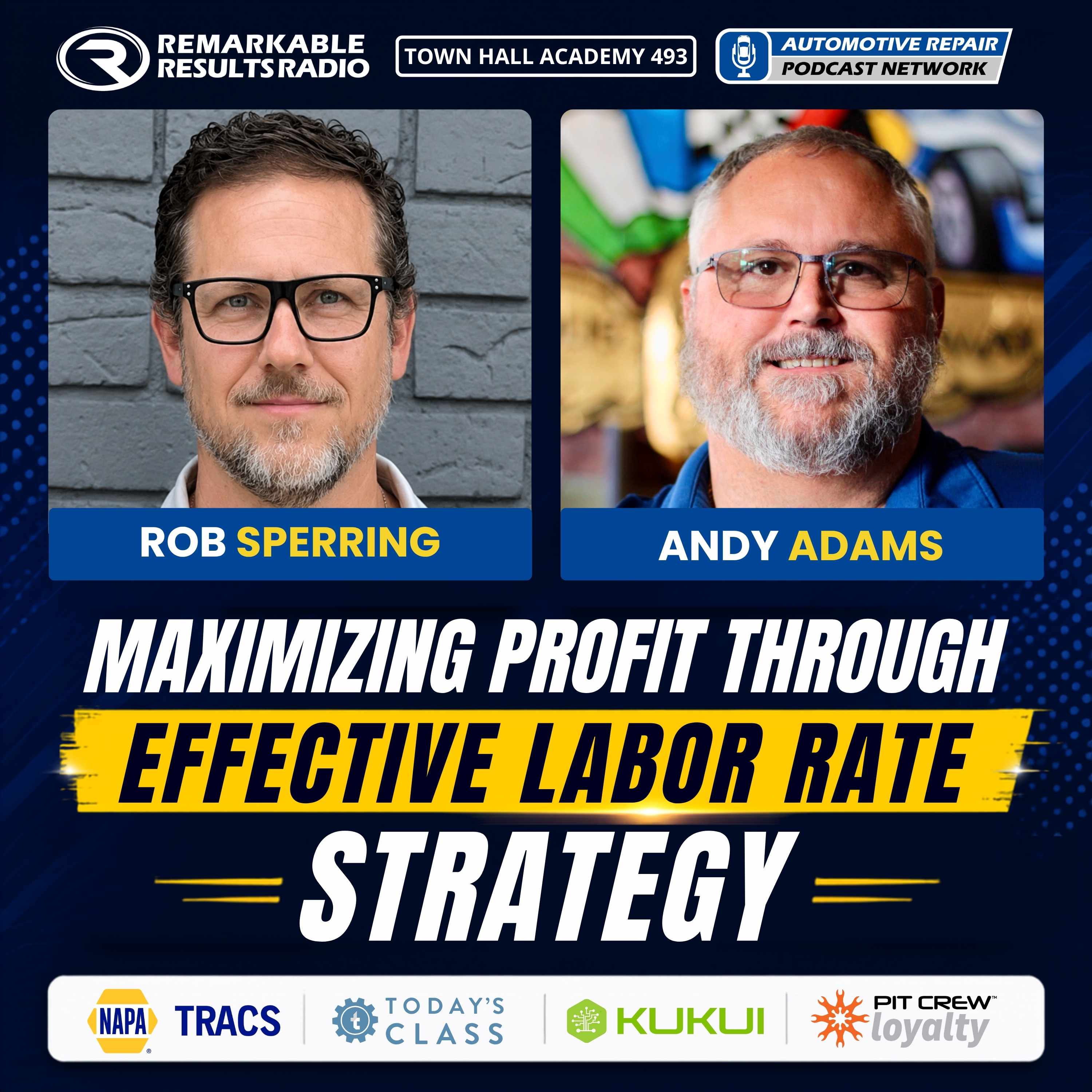
Remarkable Results RadioJuly 10 · 40 min
Maximizing Profit Through Effective Labor Rate Strategy [THA 493]
Thanks to our Partners, NAPA TRACS, Today's Class, KUKUI, and Pit Crew Loyalty Watch Full Video Episode *]:pointer-events-auto scroll-mt-[calc(var(--header-height)+min(200px,max(70px,20svh)))]" dir="auto" data-turn-id="request-WEB:8e59eec7-a235-4fa3-a072-956fea3fe478-7" data-testid="conversation-turn-4" data-scroll-anchor="false" data-turn="assistant"> *]:pointer-events-auto scroll-mt-[calc(var(--header-height)+min(200px,max(70px,20svh)))]" dir="auto" data-turn-id="request-WEB:49a777bf-d263-4496-bf0b-2eb3a46ac96a-11" data-testid="conversation-turn-24" data-scroll-anchor="false" data-turn="assistant"> Your posted labor rate may not be the labor rate you're actually collecting, and that gap could be costing your shop thousands of dollars every month. In this episode, Carm Capriotto is joined by Andy Adams, a shop owner and business coach, and Rob Sperring, a service manager, to explain why the Effective Labor Rate (ELR) is one of the most overlooked yet impactful performance metrics in the auto repair industry. They break down why ELR falls short, how it affects profitability, and the practical steps every shop owner can take to close the gap. What You'll Learn What Effective Labor Rate (ELR) is and why it matters more than your posted door rate.Why healthy shops should collect at least 90 percent of their posted labor rate.How unbilled diagnostic time, underpriced canned jobs, and complimentary inspections reduce profitability.Why excessive discounting, even with good intentions, can quietly erode your bottom line.Why improving ELR creates opportunities to increase technician compensation and strengthen your business.How auditing repair orders can uncover missed labor opportunities and unnecessary discounts.Why updating your labor matrix and canned jobs can immediately improve financial performance.How sharing KPI's (key performance indicators) with your team builds ownership and accountability throughout the shop. Effective Labor Rate is more than a financial matrix; it's a direct measure of how well your shop captures the value of the work it performs. By understanding where labor revenue is being lost and making intentional operational improvements, shop owners can increase profitability, invest in their teams, and build a stronger, more sustainable business. Rob Sperring, Grand Rapids Motorcar, Grand Rapids, MI Andy Adams, Adams Garage, Terre Haute, IN. Coach at Repair Shop of Tomorrow Thanks to our Partner, NAPA TRACS NAPA TRACS will move your shop into the SMS fast lane with onsite training and six days a week of support and local representation. Find NAPA TRACS on the Web at http://napatracs.com/ Thanks to our Partner, Today's Class Optimize training with Today's Class: In just 5 minutes daily, boost knowledge retention and improve team performance. Find Today's Class on the web at https://www.todaysclass.com/ Thanks to our Partner, KUKUI Stop juggling multiple marketing tools. KUKUI’s integrated platform delivers 4x better website conversions, automated follow-up, and real-time ROI tracking. Get industry-leading customer support with KUKUI at https://www.kukui.com/ Thanks to our Partner, Pit Crew Loyalty You’re probably tired of chasing new customers who never return. We understand. Pit Crew Loyalty ends the one-and-done cycle, turning first visits into lasting, reliable revenue at https://www.pitcrewloyalty.com/ Connect with the Podcast: Visit the Website:https://remarkableresults.biz/Subscribe on YouTube:https://www.youtube.com/carmcapriottoFollow on Facebook:https://www.facebook.com/RemarkableResultsRadioPodcast/Follow on LinkedIn:https://www.linkedin.com/in/carmcapriotto/Follow on Instagram:https://www.instagram.com/remarkableresultsradiopodcast/Join Our Virtual Toastmasters Club:https://remarkableresults.biz/toastmastersJoin Our Private Facebook Community:https://www.facebook.com/groups/1734687266778976Join our Insider List:https://remarkableresults.biz/insiderAll books mentioned on our podcasts:https://remarkableresults.biz/booksOur Classroom page for personal or team learning:https://remarkableresults.biz/classroomBuy Me a Coffee:https://www.buymeacoffee.com/carmSpecial episode collections:https://remarkableresults.biz/collections The Automotive Repair Podcast Network: https://automotiverepairpodcastnetwork.com/ Remarkable Results Radio Podcast with Carm Capriotto: Facilitating Wisdom Through Story Telling and Open Discussion. https://remarkableresults.biz/Diagnosing the Aftermarket A to Z: From Diagnostics to Metallica and Mental Health, Matt Fanslow is Lifting the Hood on Life.<a...
Listen →
06
Confessions of a Shop OwnerJune 16 · 54 min
Ep 100 - Andrew Fischer | Why Most Technicians Shouldn't Own a Shop
Tekmetric transformed my shop. Plain and simple. Want that for yours? Touch HEREASTA is coming up September 24-26 in Raleigh. Be there or be square, dog! Register now and use code confess25 for $25.00 off your registration. Sign up HEREIf you're like me and aren't good at marketing, don't do it on your own. Let the experts handle it. Touch HERE for more on Turnkey Marketing.Tired of your shop’s social media looking like every other repair shop on the internet? Stand out with 47 Consulting. Learn more HERESend your service advisor to hands down the BEST service advisor training in the industry (even other coaching companies agree). It's Elite Worldwide's Masters Program. The next one is happening in Dallas Texas, September 10-12. Learn more HERE When I used the maintenance tool for the fist time with Detect Auto, my mind was blown. My advisors had the same reaction - and then SO MUCH MORE TIME. Learn more about Detect Auto and book a free demo now!This episode is Mikeless - just how we like it. HA! Today Bryan rides solo at TOOLS 2026 and talks dynamics between technicians and service advisors Andrew Fischer. They bring up the importance of fundamentals and communication—technicians often overlook basic testing but expect to dive into advanced diagnostics, leading to costly mistakes and frustration. They also talk about ego and misunderstanding: both between team members in the shop and toward customers, highlighting how crucial it is to clearly explain repairs and processes, not just rely on expertise. Timestamps:00:00 The real hardest job in the shop: service advisor confessions03:08 Training struggles, being away from family, and the reality of evening classes05:02 Why owners MUST vet what you’re paying for in auto training07:11 Technicians skipping fundamentals—and how it comes back to bite your shop10:20 Ego, ignorance, and the "alphabet soup" of tech skill levels13:13 Fast techs vs fixed cars: the hidden cost of comebacks and efficiency16:19 Communicating diagnostics: where most techs screw up (and how AI helps)19:06 Why the front counter is pure chaos—and techs can’t handle customers21:13 Explaining diagnoses in a way anyone can understand (with help from AI)25:26 The service advisor’s secret: what customers REALLY want to know28:12 The "zip code" analogy for why testing matters30:28 Shops that charge for time vs selling fixed vehicles—who really wins?32:40 Real-life story: four shops, still not fixed (and how a dead battery fooled them all)34:35 What to do when you just can’t fix the car (real talk and lessons learned)41:33 The problem with technician forums & why the smartest avoid them44:28 Why most technicians will never be ready for business ownership47:46 Full circle: gratitude, getting humbled, and growing as a leader50:02 What every technician NEEDS to understand before running a shop
Listen →
07

Remarkable Results RadioMay 26 · 34 min
From Guesswork to Process: Modern Diagnostic Strategies for Auto Repair Shops [RR 1093]
Thanks to our Partners, NAPA Auto Care and NAPA TRACS Watch Full Video Episode Recorded live at the 2026 TST Big Event, Carm Capriotto sits down with automotive trainer Ken Zanders to discuss the importance of ongoing technical education, building efficient diagnostic processes, and adapting to rapidly evolving vehicle technology. Ken explains why too many shops still rely on a chaotic “grocery list” approach to repairs and how a structured diagnostic strategy can dramatically improve technician efficiency, profitability, and customer trust. What You’ll Learn Why inefficient diagnostic habits directly reduce technician productivity, shop profitability, and overall earning potential.The importance of following a structured diagnostic workflow instead of guessing and replacing parts.How electronic relative compression testing with a lab scope and amperage probe can reduce diagnostic time from hours to minutes.How modern vehicle technologies like GM’s Vehicle Intelligence Platform (VIP) and Over-The-Air (OTA) updates are changing diagnostics and repair procedures.Why continuous education is no longer optional for automotive professionals working on today’s advanced vehicle systems. The biggest takeaway from this episode is that repair shops cannot afford to operate in constant chaos and guesswork. A reactive “grocery list” approach to diagnostics leads to wasted time, unnecessary parts replacement, lower profits, and poor customer outcomes. To succeed in today’s increasingly complex automotive industry, shop owners must create a year-round training strategy that helps technicians diagnose efficiently, think critically, and continuously improve their skills. Structured processes, modern testing methods, and ongoing education are no longer advantages; they are necessities for survival and growth. TST Big Event: https://tstseminars.org/ Ken Zanders, Dorman Training Don’t Base Your Success On Probability – Ken Zanders [RR 822]: https://remarkableresults.biz/remarkable-results-radio-podcast/e822/ Thanks to our Partners, NAPA Auto Care and NAPA TRACS Learn more about NAPA Auto Care and the benefits of being part of the NAPA family by visiting https://www.napaonline.com/en/auto-care NAPA TRACS will move your shop into the SMS fast lane with onsite training and six days a week of support and local representation. Find NAPA TRACS on the Web at http://napatracs.com/ Connect with the Podcast: Visit the Website: https://remarkableresults.biz/ Subscribe on YouTube: https://www.youtube.com/carmcapriotto Follow on Facebook: https://www.facebook.com/RemarkableResultsRadioPodcast/ Follow on LinkedIn: https://www.linkedin.com/in/carmcapriotto/ Follow on Instagram: https://www.instagram.com/remarkableresultsradiopodcast/ Join Our Virtual Toastmasters Club: https://remarkableresults.biz/toastmasters Join Our Private Facebook Community: https://www.facebook.com/groups/1734687266778976 Join our Insider List: https://remarkableresults.biz/insider All books mentioned on our podcasts: https://remarkableresults.biz/books Our Classroom page for personal or team learning: https://remarkableresults.biz/classroom Special episode collections: https://remarkableresults.biz/collections Buy Me a Coffee: https://www.buymeacoffee.com/carm The Automotive Repair Podcast Network: https://automotiverepairpodcastnetwork.com/ Remarkable Results Radio Podcast with Carm Capriotto: Advancing the Aftermarket by Facilitating Wisdom Through Story Telling and Open Discussion. https://remarkableresults.biz/ Diagnosing the Aftermarket A to Z with Matt Fanslow: From Diagnostics to Metallica and Mental Health, Matt Fanslow is Lifting the Hood on Life. https://mattfanslow.captivate.fm/ Business by the Numbers with Hunt Demarest: Understand the Numbers of Your Business with CPA Hunt Demarest. https://huntdemarest.captivate.fm/ The Auto Repair Marketing Podcast with Kim and Brian Walker: Marketing Experts Brian & Kim Walker Work with Shop Owners to Take it to the Next Level. https://autorepairmarketing.captivate.fm/ The Weekly Blitz with Chris Cotton: Weekly Inspiration with Business Coach Chris Cotton from AutoFix - Auto Shop Coaching. https://chriscotton.captivate.fm/ Speak Up! Effective Communication with Craig O'Neill: Develop Interpersonal and Professional Communication Skills when Speaking to Audiences of Any Size. https://craigoneill.captivate.fm <a...
Listen →
08

Remarkable Results RadioApril 28 · 38 min
Detective Mind Mapping: A Forensic Approach to Automotive Diagnostics [RR 1089]
Thanks to our Partners, NAPA Auto Care and NAPA TRACS Watch Full Video Episode Recorded live at the TST Big Event 2026, host Carm Capriotto sits down with Andrew Fischer, shop manager at Cergizan's Auto and Truck Repair in Northwest Indiana, and an industry trainer. Andrew shares his disciplined, process-driven approach to diagnostics, his passion for technician development, and why shop culture plays a defining role in long-term success. From daily habits to big-picture philosophy, this conversation is a roadmap for building more confident, capable technicians. What You’ll Learn: Why committing to at least 40 hours of continuous education each year can dramatically reduce comebacks and improve shop performanceHow to build learning into daily routines: whether through short practice sessions, webinars, or online training resourcesThe power of Standard Operating Procedures (SOPs) and why “going rogue” in diagnostics leads to inefficiencyHow Andrew’s “detective mind mapping” technique helps technicians visually organize problems and accelerate accurate diagnosesWhy revisiting foundational knowledge is critical and how ego often prevents technicians from mastering the basicsHow embracing failure strengthens diagnostic ability and builds real-world expertiseThe importance of capturing and studying “known good” vehicle data to improve accuracy on future repairs Great diagnostics is about discipline, process, and constant learning. Shops that invest in their people, reinforce foundational skills, and create a culture where failure fuels growth will not only solve problems faster but build stronger, more resilient teams. TST Big Event: https://tstseminars.org/ Andrew Fischer, Cergizan's Auto and Truck Repair, Burns Harbor, IN. Fischer Automotive Consulting and Training Services: factsautomotive@gmail.com Photography by Joe Manna Thanks to our Partners, NAPA Auto Care and NAPA TRACS Learn more about NAPA Auto Care and the benefits of being part of the NAPA family by visiting https://www.napaonline.com/en/auto-care NAPA TRACS will move your shop into the SMS fast lane with onsite training and six days a week of support and local representation. Find NAPA TRACS on the Web at http://napatracs.com/ Connect with the Podcast: Visit the Website:https://remarkableresults.biz/Subscribe on YouTube:https://www.youtube.com/carmcapriottoFollow on Facebook:https://www.facebook.com/RemarkableResultsRadioPodcast/Follow on LinkedIn:https://www.linkedin.com/in/carmcapriotto/Follow on Instagram:https://www.instagram.com/remarkableresultsradiopodcast/Join Our Virtual Toastmasters Club:https://remarkableresults.biz/toastmastersJoin Our Private Facebook Community:https://www.facebook.com/groups/1734687266778976Join our Insider List:https://remarkableresults.biz/insiderAll books mentioned on our podcasts:https://remarkableresults.biz/booksOur Classroom page for personal or team learning:https://remarkableresults.biz/classroomBuy Me a Coffee:https://www.buymeacoffee.com/carmSpecial episode collections:https://remarkableresults.biz/collections The Automotive Repair Podcast Network: https://automotiverepairpodcastnetwork.com/ Remarkable Results Radio Podcastwith Carm Capriotto: Advancing the Aftermarket by Facilitating Wisdom Through Story Telling and Open Discussion.https://remarkableresults.biz/Diagnosing the Aftermarket A to Zwith Matt Fanslow: From Diagnostics to Metallica and Mental Health, Matt Fanslow is Lifting the Hood on Life.https://mattfanslow.captivate.fm/Business by the Numberswith Hunt Demarest: Understand the Numbers of Your Business with CPA Hunt Demarest.https://huntdemarest.captivate.fm/The Auto Repair Marketing Podcastwith Kim and Brian Walker: Marketing Experts Brian & Kim Walker Work with Shop Owners to Take it to the Next Level.https://autorepairmarketing.captivate.fm/The Weekly Blitzwith Chris Cotton: Weekly Inspiration with Business Coach Chris Cotton from AutoFix - Auto Shop Coaching.https://chriscotton.captivate.fm/Speak Up! Effective Communicationwith Craig O'Neill: Develop Interpersonal and Professional Communication Skills when Speaking to Audiences of Any Size.https://craigoneill.captivate.fm
Listen →
09
The Jaded MechanicApril 14 · 1h 39m
Fleet Work vs Auto Repair and Why Mental Health Needs More Attention | Riley Spence
Like the show? Show your support by using our sponsorsNeed to update your shop systems and software? Try Tekmetric HERELaunch your tool game to the next level with Launch Tech USA! HEREIn this episode, Jeff sits down with Riley Spence to talk about his move from the dealership world to working on a fleet for a construction company out in remote Labrador. Riley shares what it’s really like dealing with tough northern conditions, from tracking down parts to handling low-quality fuel. They also speak on mental health, the importance of having a strong community in the industry, and why continuing to learn and connect with others matters so much as a technician.Timestamps:00:00 Getting a second chance09:54 Managing equipment in dusty conditions12:40 Issues with quick lube services20:20 Dealing with self-doubt and burnout23:22 Challenges of being an apprentice27:34 Managing tough diagnostic situations36:13 Reflecting on career burnout37:37 Why I avoid working at dealerships45:19 Learning from skilled coworkers49:50 Reality of heavy equipment trades55:32 Pursuing skills over big money01:03:27 Outdated info in truck systems01:05:47 Fleet maintenance and master switches01:10:14 Frustrations with car parts stores01:15:45 Auto repair process improvements01:20:11 Discussing challenges in key programming01:29:34 Meeting online friends in person01:31:01 Managing questions during courses01:36:20 Advice on understanding older people Follow/Subscribe to the show on social media! TikTok - https://www.tiktok.com/@jeffcompton7YouTube - https://www.youtube.com/@TheJadedMechanicFacebook - https://www.facebook.com/profile.php?id=100091347564232
Listen →
10
Changing the Industry PodcastApril 13 · 55 min
Episode 264 - The Value of Diagnostics, Hands-On Classes, & Finding Happiness With Tim Iezzi & Ira Waldman
Don't get to the end of this year wishing you had taken action to change your business and your life.Click here to schedule a free discovery call for your business: https://geni.us/IFORABEDon't miss an upcoming event with The Institute: https://geni.us/InstituteEvents2026Shop-Ware gives you the tools to provide your shop with everything needed to become optimally profitable.Click here to schedule a free demo: https://info.shop-ware.com/profitabilityTransform your shop's marketing with the best in the automotive industry, Shop Marketing Pros!Get a free audit of your shop's current marketing by clicking here: https://geni.us/ShopMarketingProsShop owners, are you ready to simplify your business operations? Meet 360 Payments, your one-stop solution for effortless payment processing.Imagine this—no more juggling receipts, staplers, or endless paperwork. With 360 Payments, you get everything integrated into a single, sleek digital platform.Simplify payments. Streamline operations. Check out 360payments.com today!In this episode, Lucas Underwood and David Roman are joined by Ira Waldman and Tim Iezzi, who share their experiences with technical training and diagnostics in the automotive industry. Ira Waldman explains the value of comprehensive accident investigations and how data pulled from vehicles is increasingly crucial for liability and repairs. Tim Iezzi and Ira Waldman detail their hands-on training classes, emphasizing the importance of practicing with equipment to build real skills. Throughout the conversation, the group discusses challenges facing trainers—including undervaluation and barriers to fair compensation—while reflecting on what true success looks like in the industry.00:00 Consulting work and accident investigations04:58 Calibration data and liability concerns08:48 Lab scope training launch11:32 Practicing lab scope basics15:25 Common mistakes using scopes19:03 Importance of planning and tools20:10 Teaching procedural oil change steps24:46 Improving technician education27:00 Training value and budget changes32:48 Challenges faced by fitness trainers36:16 Launching the training company39:46 Impact of low-cost car markets41:29 Covid’s impact on auto repairs47:30 Troubleshooting equipment issues50:25 Defining personal success52:21 Interviewing successful people54:28 Thanking the audience
Listen →
11
Repair Shop ReckoningApril 3 · 44 min
Breaking Down The Cost Of Doing Business
Most shop owners don’t have a pricing problem. They have a numbers problem and it’s costing them more than they realize. In this episode, Kevin breaks down what actually happens to every dollar that comes into a shop and why so many owners are busy,...
Listen →
Questions answered on charging for diagnostics
Practical questions on charging for diagnostics, answered across the catalog — each linked to the episode it came from.
- Why is it important to charge for diagnostics?
- Charging for diagnostics ensures that technicians are compensated for their time and expertise, which helps maintain the quality of service and the financial health of the shop. From: 205 - The Diagnostic Fee Debate: Ask Me Anything with Cecil Bullard and Lucas Underwood →
- How can I effectively communicate diagnostic costs to customers?
- Be transparent about the testing process and its importance, similar to how medical professionals explain the need for tests to determine a diagnosis. From: 205 - The Diagnostic Fee Debate: Ask Me Anything with Cecil Bullard and Lucas Underwood →
- What should I do if a customer compares my diagnostic fee to a lower price from another shop?
- Explain that the quality of service and the thoroughness of diagnostics differ, just like comparing different quality steaks at a restaurant. From: 205 - The Diagnostic Fee Debate: Ask Me Anything with Cecil Bullard and Lucas Underwood →
- How can I improve the efficiency of my service advisors?
- Consider implementing training programs that focus on using available tools and software effectively. Regular performance monitoring can also help identify areas for improvement. From: Ep 92 - Mike Allen and Bryan Pollock | Should Advisors Be On Flat Rate?!? →
- What role does technology play in shop management?
- Modern technology, such as shop management software, can streamline processes, reduce downtime, and improve communication between technicians and service advisors. From: Ep 92 - Mike Allen and Bryan Pollock | Should Advisors Be On Flat Rate?!? →
- What is the ideal technician-to-advisor ratio?
- A ratio of 2 to 2.5 technicians per service advisor is generally considered optimal for maintaining efficiency and productivity in a shop. From: Ep 92 - Mike Allen and Bryan Pollock | Should Advisors Be On Flat Rate?!? →
- What is the importance of collaboration between service advisors and technicians?
- Collaboration ensures that both parties are aligned in their goals, leading to better communication and a smoother workflow, ultimately resulting in higher customer satisfaction. From: 99.08% Diagnostic Accuracy: Inside a Master Tech’s Playbook →
- How can technicians improve their diagnostic accuracy?
- Technicians can improve their accuracy by gathering comprehensive information, verifying customer concerns, and following a structured diagnostic process. From: 99.08% Diagnostic Accuracy: Inside a Master Tech’s Playbook →
- What role does shop cleanliness play in technician performance?
- A clean and organized workspace not only enhances the technician's pride in their work but also contributes to a more efficient workflow and better customer impressions during shop tours. From: 99.08% Diagnostic Accuracy: Inside a Master Tech’s Playbook →
- What are the challenges faced by new technicians in the automotive industry?
- New technicians often struggle with the fast-paced, flat rate environment that prioritizes speed over thorough training. This can lead to gaps in their understanding of diagnostics and repair processes. From: Why Flat Rate Is Failing Today's Technicians with Dustin Stutzman →
- How can technicians effectively advocate for better pay?
- Technicians should keep detailed records of their work, including successful diagnostics and repairs, to present a strong case for their value during pay negotiations. From: Why Flat Rate Is Failing Today's Technicians with Dustin Stutzman →
- What role does a supportive work culture play in technician retention?
- A supportive work culture encourages open communication, mentorship, and recognition of contributions, which can help retain skilled technicians and improve overall job satisfaction. From: Why Flat Rate Is Failing Today's Technicians with Dustin Stutzman →
- What is Effective Labor Rate (ELR)?
- ELR is the actual amount charged to customers for labor divided by the total hours billed. It reflects how effectively a shop is charging for labor. From: Maximizing Profit Through Effective Labor Rate Strategy [THA 493] →
- How can I improve my shop's ELR?
- Start by tracking billable hours accurately and ensuring that all technician time is charged appropriately. Regular audits of repair orders can help identify gaps. From: Maximizing Profit Through Effective Labor Rate Strategy [THA 493] →
- Why is ELR important for shop profitability?
- A higher ELR means more revenue generated from labor, which can significantly impact overall profitability and help cover rising technician wages. From: Maximizing Profit Through Effective Labor Rate Strategy [THA 493] →
- What are the key challenges service advisors face?
- Service advisors often deal with difficult customer interactions and must effectively communicate technical issues in a way that customers can understand. From: Ep 100 - Andrew Fischer | Why Most Technicians Shouldn't Own a Shop →
- How can technicians improve their diagnostic skills?
- Technicians should focus on mastering the fundamentals and seek training that addresses their specific weaknesses rather than just their interests. From: Ep 100 - Andrew Fischer | Why Most Technicians Shouldn't Own a Shop →
- Why is communication important in a shop environment?
- Clear communication ensures that service advisors can accurately convey diagnostic information to customers, which helps in building trust and improving service outcomes. From: Ep 100 - Andrew Fischer | Why Most Technicians Shouldn't Own a Shop →
- Why is continuous education important for technicians?
- Continuous education helps technicians stay current with new technologies and repair techniques, which is essential for maintaining efficiency and quality in repairs. From: From Guesswork to Process: Modern Diagnostic Strategies for Auto Repair Shops [RR 1093] →
- How can shop owners encourage their technicians to pursue training?
- Shop owners can create a training game plan, offer incentives for attending classes, and bring in instructors for on-site training to make education more accessible. From: From Guesswork to Process: Modern Diagnostic Strategies for Auto Repair Shops [RR 1093] →
- What is the benefit of using electronic testing methods?
- Electronic testing methods can save time and improve diagnostic accuracy, allowing technicians to identify issues more quickly without disassembling components. From: From Guesswork to Process: Modern Diagnostic Strategies for Auto Repair Shops [RR 1093] →
- How many hours of training should technicians complete each year?
- Technicians should aim for a minimum of 40 hours of training annually, but more is encouraged to stay updated with industry changes. From: Detective Mind Mapping: A Forensic Approach to Automotive Diagnostics [RR 1089] →
- What is the benefit of a systematic approach to diagnostics?
- A systematic approach helps technicians efficiently narrow down issues, reducing diagnostic time and improving accuracy in repairs. From: Detective Mind Mapping: A Forensic Approach to Automotive Diagnostics [RR 1089] →
- How can shop owners support their technicians' education?
- Shop owners can support education by providing time for training, attending classes with their technicians, and creating a culture that values continuous learning. From: Detective Mind Mapping: A Forensic Approach to Automotive Diagnostics [RR 1089] →
Weekly digest
The week's best automotive podcasts
Into Charging for Diagnostics? You'll likely enjoy the digest — one email a week with the latest automotive aftermarket podcasts from across the industry, Charging for Diagnostics and beyond. No spam, unsubscribe anytime.