$910K in 1 Month From a 9-Bay Goodyear?! | The Woodlands Hammer Panel
Now playing — Master Tech to Millionaire
About this episode
The Adams Automotive - Woodlands team debriefs a record-breaking $910,000 month. They unpack the numbers — high service revenue, strong gross profit, and an unprecedented…
Key takeaways
- —Achieving high revenue requires a focus on service, not just tire sales.
- —Building a team of A players significantly boosts performance and profitability.
- —Effective communication and teamwork are essential for closing sales and managing workflow.
- —Customer relationships are built through understanding their needs and providing tailored solutions.
- —Maintaining a high level of efficiency in the shop directly impacts revenue and customer satisfaction.
Frequently asked
- What strategies contributed to achieving $910,000 in revenue?
- The key strategies included focusing on service sales, maintaining high bay efficiency, and ensuring a strong team of A players who are committed to winning.
- How important is customer engagement in the sales process?
- Customer engagement is crucial; understanding their pain points and building rapport during shop tours can significantly increase sales and customer satisfaction.
- What role does teamwork play in achieving high performance in the shop?
- Teamwork is vital as it allows for effective collaboration, ensuring that all members are aligned towards common goals, which ultimately drives higher revenue and better service.
▸Full transcript
Good morning. We are coming at you live on episode whatever on, uh, Master Tech to Millionaire. We are debriefing— this is a special episode because we're debriefing what we believe to be the all-time record in the history of the universe for automotive aftermarket retail repair. 9 bays, $910,000 at the Adams Automotive Woodlands location. Give it up for you guys. Yeah, so we are going to go through the numbers today, uh, and kind of do a roundtable on best practices and how we did it and just Debrief, it's like, I mean, you guys won the Super Bowl.
Yeah, not only did you win the Super Bowl, you beat Tom Brady by 50 points. It's like a, it's a, it's a world-class dominating form. So from the top, $910,000, 95% of that revenue is gonna be service, not tires. I want that to be clear because I've heard billion-dollar stores, but they do like 70% of their businesses in tires. 60.1%, no, 60.8% gross profit.
$553,000 in gross profit, 706 cars, $1,290 average ticket, uh, bay efficiency coupon. What was our bay efficiency last month? Uh, $100,000 a bay. Okay, that's pretty good. So, uh, I believe it's the best net operating income in the world. Everybody talks about EBITDA, um, and, you know, Charlie Munger, Warren Buffett, Todd Hayes, they say, uh, that translates to fake money. That's not real money.
NOI, real money, $300,000 to the bottom. That's with big rent. We got $25,000 rent, we got big corporate, we got big recruiting, we got big auto advancers. You got big technician training, we got big call center. We think about that and we still put a ton of money into the bottom line. I don't think I've ever heard of a store in the history of the world doing $300K to the bottom.
Give it up for you guys. So formula, how do you do that? Going around the horn, JT, you got, uh, 209 tickets, $1,600 average ticket, a Ferrari. Uh, 61%. You got Big Cat, 218 tickets, $1,500 average ticket, 64%. You got Sweet Lou, $180K, 163 tickets, $1,100 average tickets, 66%. And by far the best customer service. Amen. Can I get an amen? Amen on that.
Great job. Oh man, you got Donnie touching $900,000 with the cars at the Speed Rack, Speed of Service, Octodon. He does everything. Give it up for Donnie. What's up? You got Alex touching all the tickets and just freaking making it happen, being part of the team. One more time for Alex. Boom. All right, so we'll, we'll hear from everybody on the pod, but I guess we'll start with Qpine.
You ran this store for 2 years and still kind of are— you're still kind of daddy at this shop. So, uh, always daddy. You want to just give it to your— take it easy. Big daddy. You want to give me your thoughts on, um, you know, 2025 it did $7 million. Well, $6.99 million. Yeah, I had to touch you. I'm sorry. Yeah, we're, we're going for $7 million.
Hey, Roundup, You did $7 million with $1.2 million to the bottom. That's like 16% or something. And we learned from Tommy Mello, revenues are for vanity, profit is for sanity. Todd Hayes, gross without net is gross. 2025 was a record year, but 2026 is going to literally destroy that. So any thoughts on just the difference? People, profitability, the whole deal? Yeah, well, I know I was chasing $700K in revenue per month, With that, I started adding more people.
Okay. And I started flooding our store with guys that were B players. And once I had realized, I think it was July of what, '25, you and I, or '24, that B players were killing us, we went full throttle into A players only. We went lean. We, you know, we have, this is our team right here. Very, you know, for 900, 800 cars, it's very short staff, but we do get, still give great service.
So we're not understaffed. But when you have A players only, I realized we, our ticket averages went way up. It went from, I want to say when I first started, we were in the $700K range or $700 ticket average to now we did $1,290 in ticket average. I won. I'm not a loser and I don't like being a second, right? Like, so it's like, you know, when people are beating me, I take it very personal.
It's the only stress in my life is the fear of losing. And if you ask these guys, I'll walk in, we literally can do $910,000 in revenue in the very, the end of the night. I'm like, all right guys, we should have done 950. You know, it's like, you know, like that's how our mindset is. I remember when we did, what was it, 683?
Yeah. And that was, you know, a little while back, but we wanted 700 really bad. I think we were waiting on a Maserati. Yeah. You know, and not one, that's what I love this team so much about is it's all winners. They all want the same thing is no one said bye to each other that night. Record month. You guys remember that?
Yeah. I was like, no one cared about 683. Everyone cared about the 700. But I would say the biggest part of the net is we were doing a lot of high revenue, but the net was in the 16% range and I want to be 20, 25, 30. I wanted 20 at the time because I was like, 20 just sounded better. And so this year our goal has been 20, 25.
And now that I see the $900 at 30% profit, that's the new goal. You know, anything less than that's a loss, you know, and it's— and we'll all hear about it, you know. So I don't know. I just think knowing your team, having 8 players is definitely— the people is the biggest thing, you know, I would say is the way that I would think is the biggest change is getting actual 8 players.
So you said I'm not a loser. Yeah, that part. Look, there's, there's a Winners like to win and winners like to be around winners. People say, you might say we take it too seriously. And I've had people ask me in interviews about work-life balance and what's the time off and what's the whole thing? It's like, we believe in our company that winning is intoxicating and it's the thing that gets you going in the morning.
And I think there's a really successful guy named Elon Musk, if you've ever heard of him. He says that A players, I hate being around fuzzy thinkers. And I see Felix nodding his head. So Felix, you've been doing this 15 years or however long. What do you feel like that means in your head? Like, you've been doing this a long time. You've seen a lot of probably B players come through our company and there's no B players in the building right now.
Correct. What do you think the difference is when you can just freaking move and fly around the shop versus having to kind of move through the friction of, of having maybe B players on the team? No, I mean, there's— it's a huge difference, like night and day, right? So like leaps and bounds. So, um, I listened to that podcast and probably repeats in a lot of his books, but, you know, we did definitely did listen to it.
But I think that all these guys in this room, uh, all these guys in this room are catching the long ball or they're, or they're taking the kickoff to the house, you know. So what I mean by that is when you— for me, the way I interpret it is no fuzzy thinkers, clear direction, concise. We all know what the goal is. We all know where we want to be.
You know, I mean, being off yesterday, I know that Joe and William are here because they're going to put up $30K easy, right? So we all know which way we're going. We all know the goal. And, and I like the direction. And that stems from the top. That stems from the top, right? Todd, you and then definitely Mike not making that No fuzziness at all with that.
This is the goal, this is what we're doing, this is where we're going. If you can't do it, check please, you know what I mean? Yeah. What's it like working for Mike? Oh, he's pretty easy on you guys, I think. Yeah, working for Mikey is, uh, it's, uh, you might use the term, uh, bittersweet, but it, uh, it's the ultimate compliment. What's it like working for Mike?
Yeah, so, uh, um I mean, I remember when he started and then I remember when I came here from our location and it's just been a rocket ship ever since. We're constantly, man, we're constantly chasing the nugget. We're constantly grinding after it. And he pushes, pushes, pushes, but he loves too, man. And like Todd has that saying, is like polishing the crown, which is us as a whole, as Otto Hospitality Group.
But, um, he, he, it's not lost on us that, that we're his gems in his crown. Like, then he, he reminds us of that. So he expects a lot. He demands a lot. He won't, he won't settle for less than a lot. Um, but, but he gives us all back personally, probably. I know. I mean, speaking for me and everyone agreed 100 times.
So demands, um, he's relentlessly demanding, but he'll, he'll die for you pretty much. Certainly. Y'all have any thoughts on work for QCon? Or Todd or anybody? I got, I got something. Yeah, go for it. So I, you know, I mean, obviously, you know, Q, you know, he's a go-getter, you know, with his background, uh, playing sports. I have a sports background as well.
Um, you know, he, he sees the, the, the serious potential with this team, so he's, he's chasing the championship. We're trying to, you know, get there as well, win the championship. So I mean, he's always going to motivate, he's always going to push, push and push because he knows what we're capable of doing. And I mean, it's a good feeling when you have a leader here that is pushing the team to get to levels that the company has never gotten to, right?
In terms of what we have here in this shop. And that's motivating in itself. So when I see him right there on the front line, we're right there with them to make stuff happen and to get to those goals that we need to get to and accomplish what we need to accomplish as a team. So I think that You know, that's a, that's a beautiful attribute to have right there.
And, you know, obviously, uh, when you see that, it's like you got to follow, dude, you know. And then, and, and in turn, we're gonna push for him, he's gonna push for us, and we're gonna make things happen. That's what it's all about. Let's freaking go. So, okay, so you guys are, uh, super involved in our Courtside Training Program, right? Which I've actually never been to because my boss Todd Hayes is making me work every weekend at Key to Key.
Yeah, love you, Todd. No, I'm kidding. No, but I really want to be here. I've heard nothing but crazy feedback of how excellent the training is, and part of it's just being in the trenches. So you guys do a Hammer Panel every month, right? And for those of you that aren't inclined or aren't in the loop, it's basically the owners that have come through Courtside and they've come through Key to Key multiple times.
Probably by the time they get here, they're kind of asking you guys questions and picking your brain, is there anything that sticks out to you guys? Probably 6 months into it, uh, any common themes that these guys, these owners ask you guys every month? What are they trying to learn when they come through? I mean, I, I see it as the question that we get asked every single courtside is how do we do it?
You know, how do we, uh, you know, get to these numbers? How do we work as a team as a whole? And I mean, really, at the end of the day, it's just, you know, just doing it, just, just working as a team, you know? I mean, we're gonna have situations where we get into it, right? We're here 15 hours a day.
We have a lot of egos, a lot of ego. We're all alphas at the end of the day, but it's just when we do get into our little beefs or whatever, or back and forth nonsense, we get past that and then come back together as a team. So that's really what it's about, is just coming back together as a team and knowing what we need to accomplish.
Because if we're not getting back together as a team or we're not accomplishing what we need to, then it becomes more of a serious situation at that point, you know. So now, now we got to evaluate. You're hilarious. He said, well, the main question is how do we do it? And, and we just, we just do it. It's like, it's like Michael Jordan, like, hey Shaq, how do you dunk?
How do you break the backboard? I'll just do it. Um, man, but okay, so that's something we talk about all the time in, in training and in our management meetings is like You know, I hear this all the time from people. They're like, what's the hardest decision you've ever had to make running a business? And it's like, man, we had to fire our top sales guy because they were bad for company culture.
I hear that all the time and I'm like, dude, that's terrible. You just couldn't manage them. Like you said it, you're an alpha and you're in a room full of other people that are top performers. And guess what happens when you're a top performer? You have a huge ego and you know you're the best and you cause problems. Like the freaking Bulls, you know, Dennis Rodman, Scottie Pippen, Michael Jordan.
You think those guys are easy to manage? You know, do you think that Antonio Brown or Rob Gronkowski— Rob Gronkowski's at the club at 3 a.m.? Yeah. And that's— I'm not glorifying that, but I'm saying when you're the best of the best, I think it's generally difficult to for B-player managers or B-player owners. And let's be honest, a lot of owners are B-players, uh, to kind of corral that and, and point them in the right direction.
I think, Coupon, you have a superpower of being able to do that. And it's— what's your word? Step on throats. Yeah, I think you've got a particular superpower of being able to, um, kind of extract that, uh, that talent out of people and get them rolling in the right direction. So do you have any thoughts on that? How do you How is that possible?
How do you, how do you keep these guys in their lane? Well, you have, you can't keep them in their lane, right? That's the first thing people do is, uh, we did an exercise a few years ago where I saw it online where you, you, you just go up to a guy, you don't say anything, and you put his hands up and you guys, you push each other.
Got it. Right. And I've always learned if you push a guy and you keep them in a box, they always push back, you know? So one, you have to, you have to let these guys learn from their mistakes. That's how you're going to get them to develop faster. Right. Also, I believe in— I've been on high-level sports teams. They're all crazy. Like, they're all crazy.
No one wins without crazy people. You know, even the Spurs, we all think they're the— on the court, they're the nicest team in the world, but they had off-court scandals. Right. Like, so there is— every great sports championship team is always having those issues when it comes in here. Yeah, I let these guys They've argued and stuff, but if you look at 3 years ago to now, they're completely different people.
So I try not to interfere every single time with them. And I mean, I enjoy it. I think it's kind of fun. Winning is fun at the end of the day. They're natural-born winners. I didn't teach these guys how to win. These guys came in as winners. So yeah, I don't know. I would say definitely do not get rid of them. You know, that's, I mean, people have, and thank you everyone that did that for me, you know?
So it's, but it's like these guys are, these are great guys, right? And you're missing out on more than just sales guys that work for you. You know, we're one team that all understand at the end of the day that winning, as Todd says, winning is fun, is the most important thing. So don't get rid of these guys. I know we talked in Courtside, I forgot everyone's name, the person, but he was going to get rid of his best person.
And Charlie talked to him about it and was like, those are his numbers. Yeah. Maybe just hold off for a couple months. And, and after he, so he ended up keeping them and record month, record month, record month in a row, you know, with that guy as their leading sales guy, you know? And so I've heard, uh, I don't know if I'm supposed to say him, Gary Vee say, he always says online, I see on TikTok, get rid of your toxic people, get rid of your guys that create cancer.
You know, I look at it, well, I'm the doctor. Yeah, I'm gonna eliminate the cancer is what I'm gonna do. I'm gonna help them overcome it, you know, and beat cancer. So all my guys are in remission. You know? Yeah, correct. Yeah, 100%. So that's how I look at it. 100%, dude. And Todd, I've watched Todd has this superpower where he's like, just talk to him.
Like, you're telling me he's your top sales guy and he's causing cancer in the shop? Have you talked to him? No, it's like, it's very simple. Todd is direct, is extremely direct, and I think he taught you that. He taught me that. I think you guys have probably all experienced— I know for a fact you've experienced it. I know you've experienced that.
Yeah, like Todd is going to tell you exactly what he needs out of you, and he's going to basically say, look, I'm going to provide a workplace where you can make a lot of money and take care of your family and win and be on a winning team, but we expect a lot, and we're gonna have a lot of fun doing it.
And if there's an issue, we're going to talk about it because the worst thing you can do is just let it fester and it's like a resentment bomb and then people hate each other and then it's like this nightmare. So yeah, let's get into like more of the core pillars of the concept for like how we kind of drive that sort of revenue.
Something we talk a lot about in training is our shop tour, kind of building the rapport, building a relationship with the customer. A lot of people think the sale is building the ticket and selling the repair, but it's really not. It's really finding a relationship with the customer. And I think, Lou, I think you're probably one of the best in the business at figuring out the objections ahead of time, identifying the customer's pain, building that relationship.
I've watched you turn like no chance digits into like $8,000. Yeah. And I think everybody here can agree that the random jumbo, Hollywood's really good at that. David, you know, you're one of the best of the best at doing that. So how do you feel? Would you say that I'm accurate in saying that? And how do you approach a shop tour when you get these customers coming in?
Yeah, I love a shop tour. I mean, because that really allows you to, you know, brag about your team, brag about the company, you know, just really share the passion and why we come here every day motivated. So I love a shop tour for that. And not only that, when I do a shop tour, it's, you know, like I said, bragging about my team.
I get to see this beautiful face, big smiles. I can see that beautiful man, big smiles, right? I get to see Donnie, I can see everybody. So I brag about everybody, you know? And so I love, that's what I love the most about a shop tour because everybody's big smiles and everybody just turns on that switch when they need to. And then I also like a shop tour because it allows you to understand the customer, understand where they're going with the vehicle, understand what it's for, what their plans are for, all those exploratory questions really help you establish a good relationship in that 10-minute shop tour.
And, at the end of the day, when it comes to starting the process and what we do, when I make that first phone call, it's so easy, it's seamless because they understand we're on the same page and I understand exactly what they need to hear. So, when it comes to objectives, I mean, I really don't have any in those moments because I'm hitting every bullseye as they come depending on the conversation and just maneuvering how I need to.
So I love a shop tour because it really just allows you to understand the customer and what they want out of their vehicle. And then with the service and the team and the bragging rights and everything that we have here, it just makes everything super easy. So you said 10 minutes? Yeah. So you're talking to the customer for 10 minutes? Yeah. I, I think most amateurs on the shop tour, they just like talk 90% of the time and they kind of like get the brochure out.
Yeah. No, no. And I think you're really good at I try to train our team like you're trying to ask, like you said, exploratory questions. Yeah. Identify the pain. So 10 minutes, what are you talking about for 10 minutes? How do you— I, I ask personal questions. I want to know where, you know, where they, you know, where's they, you know, where, where were they going before?
How long were they there? Are they new to the area? You know, this vehicle, how long have you had it? You know, you know, what's your history with the vehicle? You know, even when they start talking about other shops, well, what was going on there? What, you know, what were the issues with these other, you know, locations? Why do you want to keep this vehicle another 5 to 10 years?
Why do you want to get rid of it in a year? What's the problem? So, I mean, it takes a good 10 minutes to go through all that. And then I just like to hear them. A lot of times you do a shop tour, you're talking, talking, talking. So I just ask the right questions and let them talk. And then before you know it, it goes from like this at the counter to big smiles and thanking you.
And before you know it, the whole team reads me. They know when I'm doing a— they know when that shop tour is flowing. So before you know it, Donnie has a shuttle at the drive. And so he knows I'm about to lead him right to that shuttle and get him home. So I mean, it just allows you to allow the customer to open up, and then that's your job to take in all that information and then help that customer provide that service.
And that's why, I mean, a shop tour is amazing. It's a superpower. Without that, I mean, that's the process. I mean, that's the first step. I don't even know if me and you have explicitly talked about it, but you've kind of just highlighted exactly what my thesis is. I talked to Champ Warren on a previous podcast, us about, uh, identifying the customer pain.
Yeah. And in our world, you said it— what shop have they been going to? Yeah. What's the problem? Yeah. Because he says that amateur salespeople sell and pros solve. Yes. And I'm trying to identify your pain. So each customer might have a different pain point. It might be price, it might be warranty, it might be quality of service, might be speed. Yeah, customers want speed.
Um, it might be, you know, their daughter's going to College Station and they need it in tip-top shape, and they like, you know, They need this car to get to and from work. And so when we get a new customer, we understand that they didn't just come in because we sent them a mailer. You know, a good customer's probably been taking their car somewhere for like 10, 20 years or whatever, or the dealer.
And I've got to figure out, why did you fire that last shop? You fired the last provider and there's got to be a reason. So we've got to identify the pain, basically. Why did they fire their last shop? Was it the price? Was it Uh, the time? Was it the, uh, technician took advantage of their daughter's car or they lied to their wife?
But what was the pain? And then what changed? What, uh, what I've heard from other professional salespeople is you ask them like, oh man, is there anything that that company could have done to make it right? Yeah. And you literally are extracting the customer. You might not even know you're doing this, but this is why you're so good at it, is you're literally trying to extract the exact way that the customer needs to be closed out of them.
Exactly. It's What— why did you fire that last shop and how could they have closed you? That's exactly what you're asking them. That's exactly what it is. Write it down. And then you— when you're— you said it, you have no objections because you are, you are feeding that data back into the script. It's like, we're going to get this taken care of for you.
Your daughter's going to be safe on the road back to College Station. You know, I'll call you with an update when the parts get here. Versus, are you sitting down? It's going to be really bad. Yes, exactly. It's like a throw punch or something like that. Exactly. Yeah, yeah, I'm really good at that. Big Cat, I think you're one of the best in the business at the meet and greet and having the big smile.
Do you have any thought— you love the shop tour too. You love— I got a story out there, so I just thought about it, but you love abusing me. Yeah, every chance I get. If I'm ever in the shop, you're always— you're leveraging me to talk to customers. So any thoughts on the shop tour? Yeah, I love the shop tour. Shop tour, new customer induction.
Uh, come to Courtside. We're going to teach you it personally. You can go one-on-one with me, William, and all these guys. But shameless plug. But, um, true. Um, the shop tour, uh, new customer induction, I, I love it. And done right, like William said, the sales are already there. This— the sales are extracting data, which we do all the time, and giving back into them.
I lay it right down in front of them. It's so easy. And William has taught me so much about about the shop tour, rounding the bases and setting up the next call. Yes. And, you know, and layering all that together, it's beautiful. And when Joe Adams or any of the owners are in the shop, I use Joe Adams all the time on the shop tour, you know, because everyone loves to— they love to know, they love to know the boss, they love to know the boss, they love to know— I'm just a, I'm just a mouthpiece, right?
But they love to know the people in case it goes bad, right? They're anticipating it to go bad. So I understand the technicians. I introduce them to the to the GMP, and when Joe Adams is in the shop, I always grab him and say, "Let me introduce you to Mr. Joe Adams himself." You know, here he is. And so Joe Adams comes in, big smile, great hair, right?
Let us you know. Great. It's my my parents' company. I'm just you know here. Let me know if you know Big Cat gives you a hard time. And then I say, "Okay, thank you. That'll be four thousand six hundred eighty four dollars," right? And they're like, "Okay, where do I sign?" You know, so that's the story that he's talking about. But, um, new customer induction, shop tours, it's just if you can buy into those, right, because people are going to buy into you, it makes your job so much easier.
And I don't want to work any harder, you know, I don't want to work any harder. I think it's 80% of the sale, man. I think that's that building that rapport, that 5 minutes is 80% of the sale. So the story he's talking about is so funny. Uh, this is probably 3 years ago at this point. You're talking to this customer and he's like an older guy and, and you, I thought you'd already sold it.
Yeah. And you brought me into the waiting room and you're like, you know, we're chopping it up and we're talking. And then in the middle of our conversation with this customer, you literally stepped in between me and the customer. Like, it's like you blocked me, you, you, you, uh, you boxed me out. And I was like, oh, I like realized what was happening.
And you're like, so anyway, it's going to be $4,162. The parts are on the way. And I like backed up and he was like, okay, yeah, go ahead and get started on it. I was like, You just abused me, man. I thought this was a genuine relationship. Just gotta go for the close, right? Oh my gosh, man. Let's keep moving around the booth.
So, um, Donnie Davis, dude. Yes, sir. Let's give it up for Donnie Davis. I've worked with you in Mike, man. Work ethic, what a stud. Um, I think speed of service is like one of the key, key pillars of the concept, and PMI lease cars super fast. Um, I think we can all agree that The Octodon is one of the best in the business at keeping the factory moving and the general service techs we have here.
Give it up for our GSs. Oh, how important is speed of service in the shop? 900K out of 9 bays is a joke. It's everything. Yeah, it really is. I mean, we constantly train the GSs. We're always, you know, focusing on bay efficiency. So it's everything. It really is to be able to push 900 out of 8 bays essentially because we have the speed rack and the alignment rack.
We have to be precise on everything that we do. Yeah, and I'm kind of making fun of— I don't want to make fun of the industry, that's not what I'm trying to do, but I'm, you know, we believe the industry's got kind of a ton of funky KPIs that, uh, that allows them to manage shops from a spreadsheet. They look at bay efficiency, effective labor rate, you know, they look at, uh, just all sorts of stuff that we don't really focus on.
We really only focus on revenue, gross profit, net operating income, and then we look at car count and ticket average. And when people ask us what our bay efficiency is, we just basically say, we don't know, 100,000 a bay. And this is like, and we used to say because of Charlie doing 400,000 out of 4 bays, but now you guys get to brag about doing 900,000 out of 9 bays.
So 4 cars an hour, $1,000 ticket average, $40,000 a day. Y'all actually did $37,800 for the last 20 days in a row on average, which is crazy. So, uh, Donnie, a little bit more color on, uh, like, what does your job actually look like? Like, the speed rack is one of the hardest parts to implement after training. Like, owners are like, how do I— how do I— like, like, anybody can go home and just start answering the phone and saying yes.
Anybody can start reading ChatGPT to customers and, uh, and selling jobs with positive and negative selling. Anybody can take good pictures and videos. But for some reason, the speed rack is very difficult to implement because they're so used to dispatching it to technicians. Yeah, just some more color on what's it like to PMI cars super fast and, and how does your workflow look every day?
So more color on that. I mean, essentially no car bypasses SpeedRec, right? Yeah. Everything hits Bay 1 or Bay 2 depending on, you know, what type of vehicle it is. And I mean, we just constantly train on it. That's— I mean, really, that's all it is. We train on what to look for. We know what cars have which problems. So it's pretty much that.
Yeah, that's actually so funny. Todd always makes a joke. He's like, this is not hard. No, you open the hood and you look at it. Yeah. And then you lift it up to a mid-rise and you look at it. Then you lift it up to a full rise and you look at it, you know. And the more you do it, it's— it does get easy.
It's like You know, it's— the cars are predictable. A 3.6-liter Jeep has the same with an oil leak. We all know what that's going to be. You know, the, uh, the cars are predictable. They come in off the same factory floor, they break in the same way, and the more you do it, the more efficient you get. And another thing you said is every car goes through the speed rack every single time.
We had a car here like a year or two ago that, um, had just left the day before. So I'm gonna PMI? We always PMI. It was, uh, they bought tires and they came back the next day to install them, and we re-PMI'd the car so that we have no decision fatigue, to not have to think about it. And the axle was completely busted.
$1,900. Was this your ticket? Yeah, it was a Range Rover. No, was that— yeah, it was a Range Rover. And it was— sorry, it was Donald. It was a $1,900 ticket, and we asked the customer, we're like, how did we miss that on the PMI yesterday? We asked the customer like, hey, did you hit anything in the road? And sure enough, she had busted up a curb.
And she was like, yeah, I think I hit a curb going really fast. And the point is, if we wouldn't have PMI'd that car because we were lazy and we said, oh, it was just in here yesterday, hotel low mileage or whatever, we would've missed a safety concern on the customer's car. And the money is just a byproduct if we actually run the process.
So man, PMIing cars, it's really not that hard. You just have to train on it every single day. Every car goes through the speed rack, whether it's a check engine light or a tire pressure check. It's got to go through the speed rack. I'm going to take all my pictures and videos and then I'm going to move it to the parking lot or to the technician.
That's it. Wow. It's actually not that hard. That's crazy. Okay, next, Big Cat. How important is the back of the house? I mean, our techs are making a lot of money in this shop and there's a lot of good ones and they are posting big hours. How important is it to have good techs to flush the swamp? They're everything. So when we were last month running the $900K, Um, I was talking to Joe because we're always just, you know, floating ideas and, you know, being efficient.
And I came up with a slogan that says— we're not slogan much— like, man, the commitment from the back of the house has to match the commitment of the front. It has to, right? Because super efficient to get everything done is not just these hammer guys up front, you know. They have to be able to produce and push out. So having the back of the house that is bought in to you, the dream, the vision, right?
It really truly is unlimited hours as long as they want to, as long as they all have keys, as long as they want to be here. The doors are open, the lights are on, the AC's pumping. But understanding their strengths and weaknesses is also very, very important. Right. And being optimizing every bay and, and like I said, just talking to them. Yeah.
Mike, Mikey Quinn does that really great. He's probably better to answer that question, but just talking to him when he comes in Smiling, just, man, hey, how you doing, right? We're talking about caring and feeding into them, and then it's all hands on deck and they, and they, and they push. But you have to have the back house that has to match the commitment.
The same when you, when you guys do question, uh, check mark, question mark, the same mentality about A players, B players. It has to be the same for the back. Yeah, I mean, it has to be. You have to have your lead horses, right? And then there's a team that you have to have people and strategic positions to win, and the money is all going to fall in line.
This is something I've talked to Glenn Piccolo about a lot, as he used to kind of fall victim to like, oh, we have 50 bays, like we can afford to kind of have maybe some slower technicians as long as the work is good. And, you know, we've kind of switched our philosophy on that. Having a hungry technician who needs to be fed and wants to get that work out, that really pushes the envelope.
So I want to talk to you, Q-Find, about— you've got this maniacal sense of urgency to push the technicians to get work out as fast as possible, which I really think, like, when the technicians are putting pressure on the front of the house to, you know, the front of the house— or not pressure, when the technicians are open for business, I think you guys sell better because you're like, oh, absolutely, let me get this done today.
Absolutely, my technician's wide open. Um, versus if they're slow and jammed up and backed up, you just don't have that confidence that the customer's going to get their car back this week, you know. So keep in mind, how do you You push the techs to keep working. You push them as well. And it's not in a cracking the whip way, it's in a, you stay on 'em to make sure that they're being maximum productive.
Because there's nothing worse than a technician who doesn't really have organizational skills or good work ethic, and they have a pay period and then they're complaining about their hours. And it's like, really, the parts were here, You know, we sold a lot of work, we sold $900,000, you got low hours. Like, what is it? So how do you, how do you kind of apply the pressure to the back of the house in a healthy way?
Well, when I get here, every time I see them, I go say hello to them, you know, and I see where they're at with things. So you could probably talk to a lot of your technicians in the shop and they don't know what's going on with the 3, 4, 5, 6, 7 tickets they have, right? They just know that they're working on one and they got to finish it.
Okay. So I'll typically go there, see what they got, see where their parts are at for them, and then I'll manage their workflow. Because technicians are not going to manage their workflow. They can manage one car out of their shops. You know, it's easy. You just have one car, you know. But at the end of the day, I mean, one of our top tech will have 12 cars, you know, like how is he supposed to know which car goes out next?
So I manage that for him. I do have to give a shout out to Todd Hayes. We did get AC last month. We had a full month of AC, $900,000. We forget up front that we're sitting in air conditioning. Yeah, it's mentally draining, but we forget that these guys are sitting in 105-degree weather. I mean, it's very, very difficult. Do yard work for an hour at your house on the weekend and see how tired you are.
So I think that was a major game changer for us as well. So thank you for that. But it's really managing. They need as much attention as the front of the house. You can't just throw them back here and act like they're just your laborers. They're not laborers. Everyone's very important. And so we need each other, but these guys kind of manage the flow up front.
I'll get with them, you know, check on their tickets, and then I'll go to the back and see where we're at with things, you know, because communication from them to the front is not always the best. So if you're not managing them as well, you just kind of lose control. And like what you said, these guys now, they don't— they can't sell with passion because they don't know, like if they see 7 keys on someone's box and they got to sell struts and fluids, They're like, man, I don't know.
Well, this technician's got a— he's got 8 jobs ahead of that, you know, and they can't really sell it and say, I can get it out today, you know. Now we're giving loaners away when you don't need to, you know. But, uh, but you got to manage— you got to treat them in back just like the front, you know, and manage them together.
100%. Yeah, man, you're a good technician. Like, they have to work. People say, like, what's more important than a salesperson or the technician? And I always lean like, well, nothing happens if you don't sell anything. I don't care how good of a technician you are, but man, a group. They, they work together, and a really quality technician influences the quality of a salesperson 100%.
Uh, all right, let's keep moving. Yeah, what do you want to say though? Like, imagine you selling all the work and you don't have any technicians to get it out. Yeah, it is like it doesn't matter. Like, at the end of the day, everyone's job is— when you're doing— I'm telling, like, when you're doing $900,000 in a shop this size, every position is so freaking important.
Yeah, like at the highest level. Not just— you can't have a $900K, you can't have one guy off his game all month long. Yeah, like everyone has to be on their game at the highest level, and that's how you win, dude. $900K is so stupid. Let me just add some of that real quick, real quickly, because, uh, the theme and the topic about the fuzzy thinking, and you said— and I was thinking about like Joe or myself or William.
Joe can sell anything. He could sell anything. We always talk about 10x. If he has a superstar technician behind him. And so that's what we were talking about, right? Just the confidence to step into that and then crank it over the field, you know, and to give it everything you got when you know that you have an A-player technician that's going to fix the Ferrari.
Yeah, that's going to fix the Maserati, that's going to put the struts on the GMC. That just gives your confidence at a whole new level. What do you mean 10x? Well, uh, I mean, you're going to increase— I mean, increase the sales, right? Yeah, you're going to step into it with full confidence of that sale knowing I can get this done today, I can fix your 550 Ferrari, it's going to be completely right, I'm going do the timing.
This is what we're going to do it. And it just— as opposed to going in and, you know, limp-wristed, or, you know, not standing up during the phone call, or, you know, not, not speaking with your chest out, or not having, you know, bass and passing and inflection in your voice. Just knowing exactly what you're talking about, right? So we're gonna go ahead and bleep out the part about the Ferrari.
So Todd, don't listen to that part. But these guys did $900K, so players get privileges. Dude, $900K is so stupid. I just keep thinking about that. That's $300,000 to the bottom. That's, you know, I hear it in the industry, they teach like $100,000, 10% to the bottom. That's $10,000 a month. We can do that unlimited. That'd be like 30 of those stores.
That'd be like doing $3 million out of 30 stores and having a terrible company culture. Or you could just have a ton of A players. That is so satisfying. That's crazy. And I love that you're saying this, and I'm gonna— let me just like— the people— because I don't want people to just think, oh, this store, tons of cars. We had a $1,300 ticket average, right, at a high profit.
So they didn't just show up to work and just go through the motions. They came into work— all of them came on their day off to win. All of our technicians showed up in the last week on their days off to win. So it's not, not a front of the house thing. It's not just a back of the house thing. It's everyone's literally showing up because everyone has the same goal and that's to win.
Right. And I mean, I don't know if we have— how many people we got here? 16. 16 total people. 13 of them came in on their day off. Right. That's incredible. And it wasn't mandatory. We didn't even— we didn't ask half of the guys to come in. They just showed up. That's how important winning is. But you don't get $900K and $300,000 net profit by just going through the motions and showing up to work.
These guys all want to win, and that's why you need guys that are A-players front and back like Felix was saying. Dude, I was talking to a guy on an interview yesterday, on a phone interview, and I was like, what have you heard about our company? And he's like, well, I don't want to say overworked, but I've heard there's not really work-life balance.
And I'm just like, you're right. You are right. That is true. But It's the Patriots. Like, one, we pay a lot of money and we, you know, have to make a lot of money to be able to pay a lot of money. But at the end of the day, what keeps people going for a career? It's winning. Like, Tom Brady would give anything to go back out on the field and play at the highest level and win again.
And dude, like, Tom Brady does not have work-life balance. Like, he just doesn't. And that's not like a bad thing. If you're out there saying, man, dude, I don't know if I want to work that much, like, then that's fine. But the expectation is for it to be the all-time best in the world. Think about that. The people in this room, that is so crazy.
I get chills thinking about it. All-time best in the world at what you do. Work-life balance. The two do not go hand in hand. You think Tiger Woods has work-life balance, or do you think he's freaking grinding range balls and hitting putts till midnight? You know, like, his— like, that's it. And so don't— you can't expect an outsized return with a middle of the fairway, like, with the middle of the road.
And like, you have to— like, Arnold Schwarzenegger is not becoming who he is by putting in by working out 2 times a week. And that's it. And so when I was talking to him, I was like, you're right. Like, that's probably not the major selling point of our company, but you're working 40 hours a week hating your life. And I'm working 60 to 100 hours a week having the time of my life because I'm winning.
And it doesn't feel like work. And yes, you work a lot of hours, but at the end of the day, I feel incredibly obligated to pass on the resources that my family has to people in our company and in our community. And winning changes your family's life. And I think you guys could probably attest to that. I think there's people in this room that it changes your family's life.
I've seen people show me pictures of their kids at this store, at other stores. I think I've seen— I think I know I've seen young people come into our business and they grow, dude. I was listening to Cliff's podcast the other day. He's like, people from where I'm from don't get opportunities like this. And you get that picture of him with the big key in front of his house, you know, and like, that is just the coolest thing in the world.
And you don't get that from 35 hours a week part-time gig. Like, it's just nothing like it. If you can figure out how to do that, then that's great. But what I'm trying to say is we care so deeply about the work because we know that the work produces opportunities for people and opportunities for people to grow. And you have to have an opportunity for somebody to grow to get somebody like you guys in the room.
Otherwise, you just go work at a chain, national chain, and you pull a shift for 15 years. And what did you even learn? You got a salary for 15 years and then you're— nothing's changed. Or you get to work here, kill it, work a ton of hours, but have a lot of fun, make a lot of money. And then a year, 2 years, 10 years goes by, And you literally are learning from Todd Hayes, from Mike Quinn, from our team.
So 90% of the guys last month had their biggest paychecks of their lives. Of their life. Yeah. Like significantly bigger. And I couldn't be happier for them, right? Because it obviously paid off. But I mean, when I'm looking at the payroll and I'm like, wow, that's a lot of money. And I'm so happy because now these guys can go maybe go on a little vacation or whatever they want to do with their family.
The families are, I'm sure, happy too. Mine was. So, but, uh, but that, you know, it's not like, oh, you have a little bit of overtime, I gotta— you can't work. It's like, take that overtime, let's get $900, you know, because we're gonna make more, you know. So, um, I was very happy, you know. I'm still happy. Even more importantly though, it's a psychology of winning.
Yeah. It's like, I was talking to a general service technician at the Blaylock location the other day, and he's a young guy And everybody in the industry knows general service technicians are entry-level, hourly paid. They're not your highest paid people in the shop. And he's busting tail. And I'm like, what do you like work— why do you work so hard? Why do you like working here?
What's your favorite thing? Is there anything we could do better? He says, honestly, not really. Everybody's just on it here. We're here to win. And it's like that to me, a guy who's been treated like garbage, changing oil, getting paid nothing for some national chain, and he's a number, and he somehow ends up in our company by the grace of God. And then 6 months goes by and he's like, we killed it today.
Like that, he's going home to his family. He's like, dude, we killed it. We did $40,000. Like that, literally. And I've watched it change people where it's like, damn, working is fun. Dang, I'm finding community in my career. I'm finding community at the people at work. And it's like the saying goes, show me your friends, I'll show you your future. If you hang around with 4 losers, you're going to be the 5th.
If you hang around with 4 millionaires, you're going to be the 5th. And I think just being in a community where people are on it, they care about their career, they care about their family, they don't get into trouble, and you win every day, just fundamentally changes your marriage at home. It changes your life and it changes your perspective on who you are.
And so I'm just really passionate about that. You guys are winners. It's not a work-life balance deal though. To have an outsized return, Todd talks about generational wealth. It's not the lottery. It's like we put a lot of work in, we have super high expectations, but man, we have a lot of fun and I really think it changes people's lives. So I'll get off my soapbox.
We'll clap one more time down there. I've got customers coming in, but I want to wrap up with a couple more things, key pillars of concept. I want to talk about, um, second voice and then invoice review, and then we'll wrap it up. JT, second voice, dude, I want to tell a story. Um, actually, I've been talking for a while. You guys, I think, second voiced turnover tag teamed more this last month than ever, uh, if I had to guess.
Do you have any— you guys have any thoughts on that? You can start. So, I mean, yeah, I mean, as far as the second voice, well, one, strategizing the ticket first initially. And just kind of coming up with the plan. Now, if that advisor, for whatever reason, can't get the customer to authorize, and then we soft retreat. Second voice, extremely important just because the power of the second voice in terms of, you were talking about psychological, right?
In a customer's mind, if they're hearing it from one person, then hearing it from a second person, they know the severity of what needs to be done, right? They know, hey, that control arm, that ball joint's about to pop out, it needs to be done. So I think that there's a lot of power in that second voice, not to mention you have a powerful salesperson that comes in and then you have a second powerful salesperson that comes in to try to convince the customer to get the repair done.
I mean, just that in itself is what always puts that customer in saying yes. That's how I look at it. It's one of those things that You know, just, just the power of the second voice, which I never really— I don't say I never really believed in it, but after seeing it, seeing it in action so many times now, I'm a strong believer in it because it's just, it's just extremely important.
And everybody has their different sales tactics and so forth. So for the most part, yeah, every time we've tag teamed a job, I mean, 95% of the time we're closing the deal. I mean, I know Donnie, he's great at tag teaming himself. I mean, Felix, He's a star at that. I've tag-teamed a number of tickets for William and vice versa. So I mean, we have a powerful sales team here.
So if one guy can't close the deal, more likely that other guy is. That's just how it is. Like, pass the ball. Yeah, correct. Yeah, it's, it's— I think sometimes customers just want to do a dance too. They just want to dance, you know. They just want to like go home and feel like they got a good deal, or like they got, you know, they made it, made us work for it, you know.
And I'll point to this, uh, story from last month. I think it was the most important end sale of the month because it painted a picture for me, um, of Big Cat was selling a $4,000 job and, um, the customer was like, man, $3,000, that's it. And it's like the worst thing you can do is just drop your pants, that's what we call it.
Like just, yeah, $3,000, all right man, let's get it done. Because you hear $3,000, you know you still got some good gross profit and you want to get the deal done, correct? Rack and pinion, it's gravy, whatever. But Felix was about to go back in there And I watched you work that deal. I was like, this is his deal. I thought it was the best thing for that ticket for you to go back in there, but Q Pine forced you.
I watched it. I was crazy. He literally forced you to pass the ball to JT. And JT, I think you got the deal for $3,600. Yeah. Yeah. It was like a laydown, right? Yeah. I went in for the slam dunk, man. Well, one, it's all about recognizing your team, right? And Q's mentioned that, I can tell you a number of times. So in addition to following Todd's process, right?
It's a proven process time and time and time again. So when, uh, you know, when he said, dude, go ahead, second swing that, I knew what I had to do. Instead of, you know, dropping it $1,000 or whatever, we're going to cut a customer a deal always, you know, that's what we're here for, right? Family-owned and operated, we're here to take care of our customers.
But, uh, I know I'm gonna go in with severe, you know, huge confidence and close that deal. And that's something that, uh, you know, obviously Q recognized that needed to be done. And yeah, I went in there you know, chopped it up with the guy for a little bit and yeah, closed the deal on that. And he was, he was, I mean, you had even mentioned that he left laughing and giggling.
Thank you everybody. He's like, thank y'all, man, appreciate it. I'm in the loaner, you know. It's like, but, but the point of that sale was Big Cat passed the ball and it was not about that sale, it was the point of it. And you kept saying this. Yeah. So, and Felix, first off, Felix would have sold it. Yeah. Like, he would have sold it maybe for $4,000, I don't know, you know.
But at the end of the day, uh, When I look at a team, what's that? No discounts. Yeah. Yeah. None. Nothing. Hey, is that coming outta your paycheck? So the way I look at it is, being a basketball player, our rule was always, if you get a steal and you got a guy in front of you on your team, but you can either go make the layup yourself or you can pass it to your teammate who can dunk it.
Correct. And it's like, what's going to get you more hyped? Yeah. Passing the ball and letting someone slam that. The crowd is going crazy. Your team's going crazy. It deflates Hates the defense. So I'm, I'm like, I'm looking at it like, that's more fun. That was more fun for me. That was probably more fun for you. It's crazy. You know, these guys eventually have more fun.
I had to take me and Felix went for a little walk to understand, but he under— he understands. It's— we all share it. But it's, uh, there's nothing— as Todd said, there's nothing better than teamwork that makes the dream work, you know. And so, and if you're not gonna tag team, uh, voluntarily, um, that's when, you know, we said Big Daddy steps in.
Yeah, so that's when he steps in and makes it, makes it happen. Okay, so I want to chime in on that because— so I think we're talking about like, we're talking about the candles right now. Yeah. And that's what we're talking about, right? Well, the tag team, Power of Second Voice, Slam Dunk, and the thing. But I want to go a little bit deeper than that because for me, and I think, and I know 100% why Koon was doing it, and you were questioning there, it wasn't, it wasn't for the $3,600.
It was for the $911,000. Yeah, 100%. It wasn't for the $3,600. It was for the $911,000 because he knows gosh darn well I was going to sell it. He knows what JT was going to sell it. He knows Donnie would have gone there. So he would have gotten in there and sold it because he went— anybody. It was for the $911,000. It was for the— what we started the theme of this, of this is the constant chasing of the crown, the constant and be better.
So Felix, you're looking here, but I'm looking here. And so he never misses an opportunity to tweak the team, to call an audible, to make it better, because he's got a championship mindset. That's what he came from. And so at times your players don't understand it, right? Because they're running down the court and they're sweaty and they're twisting their ankle and they don't understand it.
And they, they, you know, you called the play for them a second ago and now all of a sudden, right? And so it's times you're there, you're having a puff and you just don't get it, right? When you breathe and don't rack up, you know, react on emotion, and then you understand it's for the $911,000. Like, you're about to shoot the 3 and you got, you know, Wembanyama in your face, and you're probably gonna make it because you're a stud, and you got Shaq under the goal, and it's like, pass the ball.
It's less— it's more the principle, correct? And Mike said this, he was like, it's more the principle. If I don't make them execute the concept and run the play when I'm here, how do I know that when I'm not here? Because you're overseeing multiple units now Um, that they're gonna run the play. It's like more— and, and, and Gregg Popovich, Spurs coach, talks about this all the time.
He's like, I don't even care if the ball goes in as long as the shot was a good shot. It was an open look. It's— Nick Saban talks about this process-oriented thinking. He's like so not concerned with the outcome. He thinks probabilistically. It's like, what is the optimal process? And as long as we stick to the process, The numbers will take care of themselves.
So it's like the process yields $911K and I'm not going to allow Big Cat to deviate from this process, even though it'll probably work out this one time. Because at the end of the day, if I allow that to keep happening, $911K doesn't happen. So you're exactly right. Yeah. And then I don't know if you guys have seen like ESPN where they talk, Phil Jackson is talking about Kobe and Shaq and he's telling Kobe in a game multiple times, hey, pass the big fellow the ball, you're losing him.
Pass him the ball, you're losing him. Guess what happened? He didn't pass him the ball. Guess what? They lost him. Yeah, that's what— Lakers didn't win championships for years. Guess who did though? Shaq in Miami. Yeah, right. So like, that's what could happen. This is the greatest team ever assembled in auto repair, you know? Like, so like, I don't want to lose this.
Like, this is, this is something special, you know? You're not— this may never happen again, you know? You don't know. But then the day we're passing the ball because we're not losing checks, of course. You know, so I mean, I don't know if you guys know that story, but that's why Shaq left is because Kobe didn't pass the ball. So we passed the ball here.
Yeah, that's freaking sick. Yeah, uh, it's one of my favorite episodes, Master Detective Millionaire. I think we're up on time, but congratulations you guys one more time on all-time $900,000. Yeah, man, well, we will see you guys next time. Come into Courtside, shameless plug, watch these guys live in action. We're gonna do a 50 burger today. We're live in the shop today.
Next stop, $1 million. Well, I think we're gonna have part 2 when they release the PNL on the $300K. Oh yeah, yeah, yeah. Just that we gotta— that'll be the trash talk one though. Yeah. We'll see you next time. Good luck with these guys. There you go. For more information, reach out to Todd Westerland at 925-980-8012 or visit autoshopanswers.com. You can get more information about key-to-key to callbacks, courtside.
We have a VIP rack attack day where you spend an entire day in the trenches with our team learning this perfected business model. Uh, we offer leadership classes, we have an AI academy, and also get more information about auto shop callbacks. Uh, we have auto tech training. We are literally your one-stop shop. Once again, that number for Todd Westerland is 925-980-8012.
More from Master Tech to Millionaire

Charlie Zlatkos & How a Master Tech Became a Millionaire
Joe Adams interviews Charlie Zlatkos about his journey from a hands-on master technician to a successful multi-shop owner. Charlie shares the early struggles, the turning points with mentors like Todd Hayes, and how he learned systems, leadership and customer-first service to build a thriving business. This episode highlights hard work, the importance of treating the customer as the source of everything, the need for repeatable systems, and how training and servant leadership turned a one-man shop into a multi-million dollar operation. AutoShopAnswers.com Auto-Shop-Media.com YouTube
Autoshop Ministries K2K Sermon 10/25/26 - Planted to Flourish
Pastor DeVante explains what it means to be "planted" in the house of the Lord—how consistency, deep roots, and the right spiritual environment help you flourish through every season. He introduces a daily devotional, encourages small daily habits, and invites listeners to commit to Christ and a Bible-based community so they can grow, bear fruit, and find lasting peace.
Mastering Objections: Turn ‘No’ into a Lifetime Customer
Become an objection MASTER as Joe and Glenn break down how to overcome common customer objections; using shop tours, empathy, the feel-felt-found method, assumption of sale, urgency, and conviction. They explain how to avoid objections by building trust up front and how to recover when you’re put on defense. Listeners get practical scripts and tactics — calling the competition, offering financing, demonstrating value versus price, and using the “second voice” — all aimed at turning hesitant customers into repeat, high-value clients. Autoshop Answers 925-980-8012 Autoshop Media
Autoshop Ministries Episode 14 - Break the Self‑Sabotage Cycle
Pastor DeVante Tidwell explores why people hold themselves back — from gluttony, overspending, and workaholism to not asking for help — and how shame and feelings of unworthiness fuel self‑sabotage. The episode offers practical reframes, examples from Scripture of broken people God used, and a clear invitation to receive God’s grace. It ends with a short prayer and encouragement to stop medicating pain and begin healing at the root.
Related across the catalog

Daily Habits That Build a Stronger Auto Repair Shop Culture [THA 501]
Thanks to our Partners: NAPA TRACS, Today's Class, KUKUI, and Pit Crew Loyalty Watch Full Video Episode *]:pointer-events-auto scroll-mt-[calc(var(--header-height)+min(200px,max(70px,20svh)))]" dir="auto" data-turn-id="request-WEB:8e59eec7-a235-4fa3-a072-956fea3fe478-7" data-testid="conversation-turn-4" data-scroll-anchor="false" data-turn="assistant"> *]:pointer-events-auto scroll-mt-[calc(var(--header-height)+min(200px,max(70px,20svh)))]" dir="auto" data-turn-id="request-WEB:49a777bf-d263-4496-bf0b-2eb3a46ac96a-11" data-testid="conversation-turn-24" data-scroll-anchor="false" data-turn="assistant"> What does a strong shop culture look like when you’re the people living it every day? Bree Wismer, Service Advisor and Frontline Culture Leader, and Trevor Hinds, Operations Manager and Dispatcher at Empower Automotive in Traverse City, Michigan, take us inside the daily habits and communication practices that keep their team aligned, productive, and focused on the customer. Rather than approaching culture from the owner's perspective, Bri and Trevor share what happens on the front lines. They explain how Empower Automotive breaks down the traditional divide between the front counter and the bays, keeps everyone on the "same bus," and creates a workplace where every person understands their role, respects the team around them, and contributes to the same goal. What You'll Learn Why the front counter and specialists must operate as one team.How daily huddles and short training sessions keep the team aligned.Why the 1:00 PM check-in can prevent late-day customer surprises.Why a "no-update" update can be one of the most valuable customer communications.How to respond when customers arrive with AI-generated or parts-store diagnoses.How respect, communication, and accountability create confident professionalism. Building a world-class shop culture doesn’t require a massive budget or a complicated organizational overhaul. By committing to these small, consistent actions, you can transform your shop from a high-stress environment into a thriving, unified business that both your team and your customers enjoy. Bree Wismer, Service Advisor, Frontline Culture Leader, Empower Automotive, Traverse City, MI Trevor Hinds, Operations Manager, Dispatcher, Workflow and Culture, Empower Automotive, Traverse City, MI NAPA TRACS will move your shop into the SMS fast lane with onsite training, six days a week of support, and local representation. http://napatracs.com/ Optimize training with Today's Class: In just 5 minutes daily, boost knowledge retention and improve team performance. https://www.todaysclass.com/ Stop juggling multiple marketing tools. KUKUI’s integrated platform delivers 4x better website conversions, automated follow-up, and real-time ROI tracking. https://www.kukui.com/ You’re probably tired of chasing new customers who never return. Pit Crew Loyalty ends the one-and-done cycle, turning first visits into lasting, reliable revenue at https://www.pitcrewloyalty.com/ Connect with the Podcast: Download and Listen on Our Mobile App: https://automotiverepairpodcastnetwork.com/app/Visit the Website:https://remarkableresults.biz/Subscribe on YouTube:https://www.youtube.com/carmcapriottoFollow on Facebook:https://www.facebook.com/RemarkableResultsRadioPodcast/Follow on LinkedIn:https://www.linkedin.com/in/carmcapriotto/Follow on Instagram:https://www.instagram.com/remarkableresultsradiopodcast/Join Our Virtual Toastmasters Club:https://remarkableresults.biz/toastmastersJoin Our Private Facebook Community:https://www.facebook.com/groups/1734687266778976Join our Insider List:https://remarkableresults.biz/insiderAll books mentioned on our podcasts:https://remarkableresults.biz/booksOur Classroom page for personal or team learning:https://remarkableresults.biz/classroomBuy Me a Coffee:https://www.buymeacoffee.com/carmSpecial episode collections:https://remarkableresults.biz/collections The Automotive Repair Podcast Network: https://automotiverepairpodcastnetwork.com/ Remarkable Results Radio Podcastwith Carm Capriotto:https://remarkableresults.biz/Automotive Field Theorywith Matt Fanslow https://mattfanslow.captivate.fm/Business by the Numberswith CPA Hunt Demarest: https://huntdemarest.captivate.fm/The Auto Repair Marketing Podcastwith Brian and Kim Walker:<a...
Episode 284 - Managing Stress and Leading a Young Team in the Automotive Industry With Trey Holley
Don't get to the end of this year wishing you had taken action to change your business and your life.Click here to schedule a free discovery call for your business: https://geni.us/IFORABEDon't miss an upcoming event with The Institute: https://geni.us/InstituteEvents2026Shop-Ware gives you the tools to provide your shop with everything needed to become optimally profitable.Click here to schedule a free demo: https://info.shop-ware.com/profitabilityTransform your shop's marketing with the best in the automotive industry, Shop Marketing Pros!Get a free audit of your shop's current marketing by clicking here: https://geni.us/ShopMarketingProsShop owners, are you ready to simplify your business operations? Meet 360 Payments, your one-stop solution for effortless payment processing.Imagine this—no more juggling receipts, staplers, or endless paperwork. With 360 Payments, you get everything integrated into a single, sleek digital platform.Simplify payments. Streamline operations. Check out 360payments.com today!In this episode, Lucas and David are joined by Trey Holley, a shop owner from Thomaston, Georgia. Trey shares his journey from being a lifelong mechanic to learning the ropes of business ownership, highlighting the unique challenges faced in small Southern towns. The conversation touches on the importance of supporting fellow shop owners rather than viewing them purely as competitors, and Trey offers insight into the work-life balance struggles that led him to prioritize both his health and the building of a strong, supportive team.00:00 Atlanta airport's massive scale03:41 Long walks at airports06:27 Thunder Valley racetrack experience10:30 Southern business challenges with generosity13:29 Overwhelmed by business demands19:09 New guy in town setting up20:59 University town business challenges22:34 Building Industry Relationships26:46 Discussing business challenges with spouse31:14 Discussing labor cost strategy35:32 Quality control and final checks38:55 Balancing work and family time40:33 Dealing with family anxiety44:57 Balancing multiple responsibilities47:21 Discovering the Enneagram for Communication49:12 On choosing the right people
Are You Running Your Shop… Or Is It Running You? | Darin Johnson - Ep 37
Rick White was my VERY FIRST business coach, and trust me when I say he helped me get my shop-owner life together! 😂 Now I’m proud to have 180Biz presenting Downshift, so head to 180Biz.com and book your FREE strategy session with Rick because, honey, you don’t know what you don’t know!Y’all, if you missed the first Tektonic, you missed a GOOD one, but you've got another chance! 😂 Tekmetric is going even BIGGER in Houston, Texas, April 1–3, 2027, so head to Tekmetric.com/Tektonic and get registered because you're NOT missing out twice!Consistency is key - heard that! But, consistency is HARD. That's why I gave up on trying and let the experts handle it. Detect Auto. Let them clean up your estimating process and raise your ARO - like they did for me! CLICK HERE TO BOOK A DEMOYour techs don’t need another YouTube rabbit hole—they need real answers to the problem in front of them. SWAT Training and Diagnostics brings the tech support and hands-on, virtual, and just-in-time training to help them fix today’s car and be ready for the next one - LEARN MORE HERERunning an auto repair shop is one thing—but what happens when the shop starts running you? In this episode, Tonnika Haynes sits down with Darin Johnson, a one-man shop owner from Great Bend, Kansas, who admits he's working seven days a week, struggles to tell customers no, and hasn't taken a real vacation since 2018. They get into the difficult transition from technician to business owner, why coaching and industry connections have changed Darin's approach, and how raising his labor rate didn't create the customer revolt he feared. Tonnika also gets fired up about boundaries, last-minute customers, “free” tire pressure checks, and why serving your community doesn't mean allowing customers to control your schedule. Darin is heading to ASTA with a mission: build his network, learn how to step away from the shop, find help, and finally create a business that gives him a life outside the bays.Timestamps:00:00 Cold open: “It’s gonna be on one more day”00:19 Downshift intro00:38 Darin still has a FLIP PHONE?!02:10 Meet Darin: Running a one-man repair shop in Kansas02:44 How he accidentally became a shop owner04:27 From hot rods to 25 years in automotive05:39 Does Darin really want to stay a one-man operation?07:06 Heading to ASTA for the first time07:40 Why Darin LEFT his first training event early08:39 Coaching struggles: Knowing what to do vs. actually doing it09:55 The real reason Darin is coming to ASTA10:16 Shop ownership can feel like you’re on an island13:08 Working seven days a week & being married to the shop14:20 The people-pleasing problem15:03 Customers asking about cars at dinner and the grocery store16:27 What happens when the shop becomes your only hobby?20:26 Feeling guilty for taking time away20:57 “Schedule your hats”—including downtime22:59 Darin’s five-year plan: Train someone to replace him23:38 His last REAL vacation was in 201824:34 Open-heart surgery changed how Darin viewed the business25:21 Becoming an owner instead of just a technician28:06 Why 15–20 cars are constantly sitting at the shop28:34 The work Darin has finally started saying NO to30:49 Bringing an accountability partner to training32:42 Why a few unhappy customers can ruin your mindset33:58 Should you just FIRE the worst 5% of your customers?38:02 Tonnika gives Darin his official ASTA assignment40:40 Finding your automotive family42:39 Why Tonnika recommends coaching43:57 Coaching’s impact on Darin’s mindset and mental health45:01 “I wish I would’ve done this 10 years ago”46:04 Why shops that don’t train get left behind46:58 Darin now has the highest labor rate in town47:34 Tonnika’s $12 lawnmower tire era 😂49:00 Learning how to say NO without losing customers49:12 Scheduling your different “hats” as an owner51:10 Customers don’t control your schedule51:44 “It’s been on for two weeks? It can wait another day.”53:05 Your six-month-old check engine light isn’t suddenly my emergency53:50 How “real quick” jobs steal HOURS from your day54:52 Why Tonnika refuses to just throw air in a tire55:32 “My air isn’t free!”56:23 The right way to say no: Give customers another option57:45 Darin’s ASTA challenge & what’s coming in Part 2
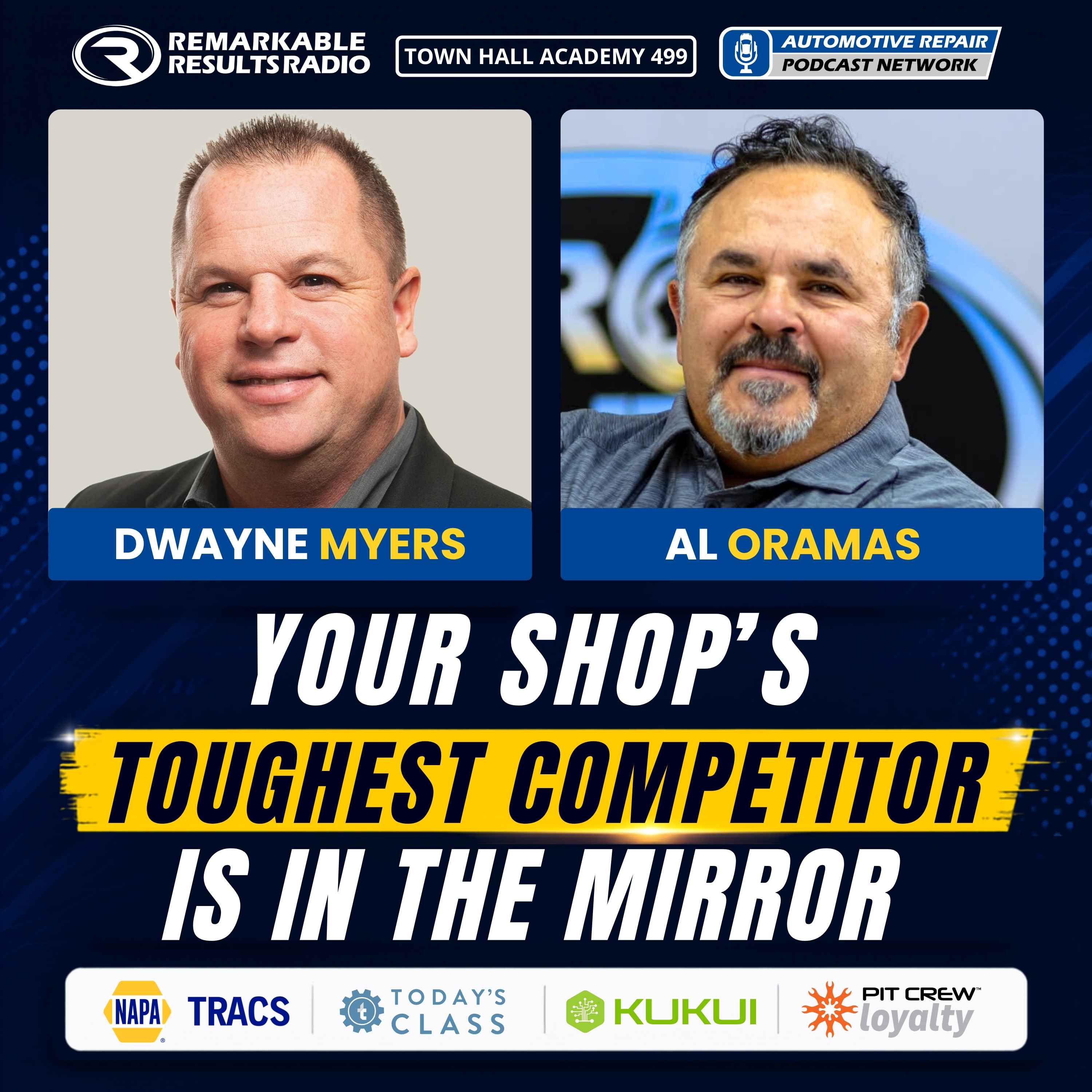
Your Shop’s Toughest Competitor Is in the Mirror [THA 499]
Thanks to our Partners, NAPA TRACS, Today's Class, KUKUI, and Pit Crew Loyalty Watch Full Video Episode *]:pointer-events-auto scroll-mt-[calc(var(--header-height)+min(200px,max(70px,20svh)))]" dir="auto" data-turn-id="request-WEB:8e59eec7-a235-4fa3-a072-956fea3fe478-7" data-testid="conversation-turn-4" data-scroll-anchor="false" data-turn="assistant"> *]:pointer-events-auto scroll-mt-[calc(var(--header-height)+min(200px,max(70px,20svh)))]" dir="auto" data-turn-id="request-WEB:49a777bf-d263-4496-bf0b-2eb3a46ac96a-11" data-testid="conversation-turn-24" data-scroll-anchor="false" data-turn="assistant"> Who is your shop's toughest competitor: the business down the street, or the people inside your own four walls? Carm Capriotto sits down with shop owners Dwayne Myers and Al Oramas to explore internal competition and why the biggest threats to a shop's success often come from within. The conversation challenges owners to stop obsessing over competitors and start examining their own leadership, consistency, processes, and customer experience. What You'll Learn Why operational consistency matters and how small deviations can create chaos.Why owners can't effectively lead from the "engine room."How true delegation requires owners to let go of control and trust their teams.Why "everything speaks" when it comes to the customer experience.How standing at the curb can reveal things owners no longer notice inside their own shops.How simple physical and operational improvements can create meaningful change.Why asking employees what they love and what they would change can reveal the true health of a business. Your greatest competitor may be staring back at you in the mirror. The shops that grow stronger are willing to look inward, challenge their own habits, listen to their teams, and consistently raise the standard. Leadership isn't about controlling every detail; it's about creating the environment, expectations, and trust that allow the entire team to perform at its best. Dwayne Myers, Dynamic Automotive, 8 locations, Maryland. Dwayne’s previous episodes HERE. Al Oramas, Pro Auto Care, 2 locations, Denver and Littleton, CO Optimize training with Today's Class: In just 5 minutes daily, boost knowledge retention and improve team performance. Find Today's Class on the web at https://www.todaysclass.com/ David Boyes, President of ‘Today’s Class” David’s previous episodes HERE Brad Updegraff, Dave’s Ultimate Automotive, 7 locations, Austin, TX. Brad’s previous episodes HERE. Thanks to our Partner, NAPA TRACS NAPA TRACS will move your shop into the SMS fast lane with onsite training and six days a week of support and local representation. Find NAPA TRACS on the Web at http://napatracs.com/ Thanks to our Partner, Today's Class Optimize training with Today's Class: In just 5 minutes daily, boost knowledge retention and improve team performance. Find Today's Class on the web at https://www.todaysclass.com/ Thanks to our Partner, KUKUI Stop juggling multiple marketing tools. KUKUI’s integrated platform delivers 4x better website conversions, automated follow-up, and real-time ROI tracking. Get industry-leading customer support with KUKUI at https://www.kukui.com/ Thanks to our Partner, Pit Crew Loyalty You’re probably tired of chasing new customers who never return. We understand. Pit Crew Loyalty ends the one-and-done cycle, turning first visits into lasting, reliable revenue at https://www.pitcrewloyalty.com/ Connect with the Podcast: Download and Listen on Our Mobile App: https://automotiverepairpodcastnetwork.com/app/Visit the Website:https://remarkableresults.biz/Subscribe on YouTube:https://www.youtube.com/carmcapriottoFollow on Facebook:https://www.facebook.com/RemarkableResultsRadioPodcast/Follow on LinkedIn:https://www.linkedin.com/in/carmcapriotto/Follow on Instagram:https://www.instagram.com/remarkableresultsradiopodcast/Join Our Virtual Toastmasters Club:https://remarkableresults.biz/toastmastersJoin Our Private Facebook Community:https://www.facebook.com/groups/1734687266778976Join our Insider List:https://remarkableresults.biz/insiderAll books mentioned on our podcasts:https://remarkableresults.biz/booksOur Classroom page for personal or team learning:https://remarkableresults.biz/classroomBuy Me a Coffee:https://www.buymeacoffee.com/carmSpecial episode collections:https://remarkableresults.biz/collections...