Own Your Shop. Own Your Life. The Path To Freedom
Now playing — Repair Shop Reckoning
Summary
In this episode of Repair Shop Reckoning, Kevin takes the conversation beyond numbers and into what every shop owner is really chasing… freedom. Freedom from chaos. Freedom from bad customers. Freedom from living week to week. Freedom from having to...
About this episode
In this episode of Repair Shop Reckoning, Kevin takes the conversation beyond numbers and into what every shop owner is really chasing… freedom.Freedom from chaos.Freedom…
Key takeaways
- —Understanding your shop's financials is crucial for profitability and freedom.
- —Establishing clear policies and procedures helps maintain operational control.
- —Consulting can provide significant value, but results take time and commitment.
- —Integrity in business practices builds trust and long-term relationships with customers.
- —Being authentic and true to your values can lead to greater success and satisfaction.
Frequently asked
- What should shop owners focus on to improve their business?
- Shop owners should focus on understanding their financials, establishing clear policies, and ensuring their team is well-trained to maintain operational efficiency.
- How can I ensure my shop remains profitable?
- To ensure profitability, shop owners need to know their costs, set appropriate pricing, and avoid compromising on quality or integrity for short-term gains.
- What is the importance of having a strong brand message?
- A strong brand message helps attract the right customers and sets clear expectations, which is essential for building a loyal customer base.
▸Full transcript
Welcome to Repair Shop Reckoning: From Chaos to Control. Because too many shops today are running on chaos. Phones ringing, technicians frustrated, front counters overwhelmed, owners buried in problems with nobody to call. Kevin Brown has spent over 30 years in the trenches learning how to take that chaos and turn it into control. Shop owner, operator, consultant, leader. Through industry shifts, insurance games, bad hires, great hires, and lessons learned the hard way.
This isn't theory. This isn't corporate training fluff. This is real shop experience, unfiltered. On this show, Kevin breaks down what actually works— running profitable shops, front counter control, training technicians, negotiating with insurance companies, building systems that make your shop run instead of burn, and the mistakes that quietly bankrupt shop owners every single day. No corporate scripts, no sugarcoating. And yeah, somebody might get offended.
That's okay. Disney's two doors down. But if you want the truth about this industry, buckle up. This is Repair Shop Reckoning: From Chaos to Control. Let's get started. Welcome back to Repair Shop Reckoning: From Chaos to Control. So I want— we've been talking about the last few weeks. We went through P&L, then we went to P&L deep dive, then we went budget.
So then we went after budgets, we went to balance sheets. So now I'm kind of like, okay, I'm going to give that all a break and let these people soak this all in on YouTube, watch it all. Because quite frankly, it's confusing. So I wanted to go back to something that's been on my mind, kind of fucking irritates me. So I'm just going to just— I have my notes once again, so I don't babble.
I don't need to read them. I pretty much know what I'm going to say because I can spit bullshit like the best of them. You could ask the people online that hate me. You know, I got some guy that tells everybody that I don't even have a shop. I'm just out here fucking running my mouth. And then another guy yesterday told me, um, what'd he say?
I don't know if you've seen the post. Basically, he said that all I talk about is negative stuff. Every one of my videos is negative stuff. Every one. It's my simple response back to him is, you guys can go read it because It was my usual nice self because I just got so sick of— you could literally say, you know, I saved a little puppy from drowning in the river and I almost lost my life doing it.
And guys would be on there like, yeah, but the 4 more died, you know, 4 streets down and you didn't do nothing. You're a horrible person. Like, there's no winning online. Yeah. And you kind of wonder why people on social media or some of these influencers end up killing themselves. These motherfuckers on their keyboard could be savage. But the beauty of me, I don't really give a shit what they have to say.
Yeah. Okay. How many times have I been flamed for telling that guy guy has his head up his ass for not putting a cotter key. And I firmly fucking believe it. I don't care what anybody says, okay? My thought is, I always ask these guys, always that have an opinion, what's the name of your shop? Do you know how many of them answer me?
Zero. Because what they are is a guy on the other end of the line, or on the other end of the keyboard, or wherever on TikTok, Facebook, or everything, with an opinion. That's all it is, is an opinion. Because they've never done anything in their life, but they always got to sit there and give advice, okay? It's like Dave Ramsey says, don't take advice from your broke brother-in-law.
Don't take financial advice from your broke brother-in-law. Okay. That's the bottom line. So this leads me into something that's been irritating me. I've been talking to you about it. You know, I started this podcast over a year ago in December. It was a year. Yep. Mark, right? Yep. And I started this podcast just basically because I wanted to start a podcast. I started out at that place in Brighton.
We didn't like them. So we said, fuck it. We built our own studio and here we are. Right. And it's grown. And obviously what I said has a lot of the stuff, what I say, obviously fricking people listen. We have a lot of viewers, right? We're smashing, you know, almost 30,000 and almost 40,000, I think. And we just went over 1,000 on YouTube, which I'll tell you what, that, that right there is tough.
Yeah. You know, getting to TikTok, I don't remember our numbers. What, TikTok's 29,000? TikTok, we only took from December to, uh, to May, only a few months to get over the 10,000 mark. And now we're at like over 30,000. 29,000. And I know Facebook's going on to 40, maybe. 40? Yep, 40. Yep. Okay. And Instagram, 18K? Yeah, whatever, 19 now. Yeah, yeah.
Okay, so obviously people like what we have to say because we have a lot of followers. We get a lot of people going, thank you very much, your information is, is great. And you know, around my neighborhood, it's kind of funny, I talk to— go to the shops or go pick up parts at the dealer for the guys or whatever, these people all know me.
It's kind of weird. You're like, hey, you're the guy. Hey Kevin, yeah, we see your podcast. We talk. My brother's shop you know, which is like 150 miles away. They know me. It's kind of cool. I get messages from all over the world. And one thing I do, people send me messages like, hey, can I pay you to talk to me? And I said, no, send me your number.
I call them, I go, what's up? Hey, I have problems with this or that. How much would you charge me? I'm not going to charge you nothing to talk to you on the phone for a few minutes. I'm not here to fricking kill people. Yeah. Okay. What's your problem? What about marketing? And I help them. Okay. And a lot of them said, hey, he's helped me.
And I've talked to a lot of them, right? Now, if they want me to look at their numbers and stuff like that, I have them send it all over and then I obviously charge money to go through their books, right? Only makes sense. But, you know, just to talk to somebody on the phone, I talk to these guys and I've seen other influencers talk about like, you know, we do this, we can't just do this.
And I understand if you're an influencer that's a mechanic about fixing stuff. Yeah. You're not going to want everybody calling you and their brother going, hey, I have this check engine light, this code, can you help me? I can understand how that gets old. But keep in mind, people, don't be so arrogant and forget that these people are the guys clicking on your videos and getting you your 2 or 3 cents a video.
Now, to preface this whole podcast, I want everybody to be completely clear. The money we make on social media, me and Jason split it. We just frickin split it. Okay? It's not life-changing money. I'm sure someday if we were MrBeast, it would be life-changing money. Yeah. Okay. But we're a frickin small podcast with, you know, we don't even have 100,000 viewers on one platform altogether.
We're getting close, right? Yep. We get a million views plus some months on one platform alone. Yeah, I think we're at 890-some thousand already on Facebook, right? Yep. But it's not life-changing money. And we've had people go, oh, you're frickin— yeah, because you're doing this because you know all the money you're making on social media. Okay. It's under $1,000 a month for all the platforms.
Am I lying? No. Okay. And we're splitting it and we're splitting it and we're sitting in here coming in here once a week. And regardless of what people say, it takes time to do a podcast. It takes time to do what we do. Editing and all the bullshit. Yep. Okay. Yeah. So I didn't plan on this going anywhere. Then guys started calling me.
I started talking to them. My first guy was Tim Jackson. We drove down to Arkansas. We spent 2 days down there. We went through up one side of him and down the other, his books and his employees, his shop and everything. We came up with a plan. We gave him a price. He did it. We fixed his shop. He's profitable. He's running great.
His people are still happy. Everything's going good. 6 clients later, I have 6 on the books right now. All of them are doing what? Much better. And we can get anybody. I can get guys on here. I had a guy call me last night. One of my clients said, I have a problem. I have a lot of money in my bank account and I've never had this much money.
I'm paying my bills and stuff like that. What do I do here? And I said, you know what, dude, I'm proud of you. Like, you were a fucking disaster. You were a disaster. Your family. I've changed your life. And it's not even about the money for me. It's a byproduct. The money's a byproduct of what I do. I like going to their shops and going, okay, I can fix this.
I'm going to go ahead and do this. And let's talk about this. It's fun for me, right? Someday it'll get fucking boring and I'll stop doing it. That's just the bottom line. That's me. You see me start a vintage motorcycle company. I ran it for a couple of years. I'm like, yeah, this is fucking boring. I sold everything off and moved on to something else.
Um, but I like helping people and this isn't, like I said, I'm not doing it for free. So yes, obviously I'm making money. So don't ever make that mistake that I'm out here doing this for free. Not doing Mother Teresa's work. Work, right? Exactly. I'm not Mother Teresa. Exactly, Mother Teresa's work. But I like the idea of helping people and changing people's lives.
Okay, I'm not saying I have a hero complex, you know, here I am, you know, to save the day. Not at all. But you could take what you learned and go to somebody's place. Yeah. And do it. But take this into consideration, everybody. How can I leave 2 shops and leave for 2 or 3 days in a row or a week at a time and the shop still go and make money?
Oh, maybe because I have policies and procedures and my people are trained and they do their job right. So none of this is bullshit. This is all provable. And I always tell people, call Motor City Truck Collision or Garrett Auto and Truck Service if you have a problem, you think I'm full of shit, and ask them, how is Kevin? Ask any of them.
I, I fucking challenge you. And I've had people call the shops and my guys tell them, if you do your job, it's great. If you don't do your job, you get freaking training. You know? Yeah. Um, we've come up with training once a week with my guys. You know, there's, it's not like I know everything and I'm, I'm evolving through this whole thing too.
I'm coming up with stuff like, wow, I had never thought of that or this or that. So this is a learning experience for me too. And I can't act like, yeah, I'm the coach or I'm the consultant that knows every fucking thing. Cause I don't. And anybody who comes into your shop, that's a consultant that says, oh yeah, I know everything. They're full of fucking shit because I still go out on the road and I look at something and the guy in the shop goes, I go, That's a pretty good fucking idea.
Yep. You know, like one of my clients, Bill Griffin, he had fucking walkie-talkies. Yeah. I walked in, I'm like, what's up with that? He's like, they're walkie-talkies, save lives. Well, years ago we had Nextel and they were great around the shop, right? Just kind of— they kind of faded out and I forgot about it. I went to Bill's, one of my clients, and he freaking got walkie-talkies.
I'm like, where'd you get them? He's like, Amazon. I order them for both shops. They're fucking great. So then I told freaking one of my other clients, I go, dude, get walkie-talkies, they're life-changing. He's like, oh my God. Okay, so I'm not so freaking proud to say I know everything. My idea was to get everybody walkie-talkies. It wasn't my idea. I seen it, I'm like, great idea, good job.
Never even thought about it. We used to, but shit happens, right? So, you know, I'm sitting there going, now something else has kind of happened to me, and it's kind of interesting. Like, I had some pretty big ballers hit my freaking podcast or slide into my DMs, as the children would say. And want to talk to me about sponsors. And I'm like, huh?
So I started talking to you. I talked about you, about it, because you have experience with it. I'm like, so you got these people that want to do sponsors and stuff like that, and I'm not interested. And I told one of them, I said, you can get me clients and stuff like that. I could put your logo on my YouTube videos and stuff like that.
But besides me going to trade shows, and I don't fucking want no part of that bullshit. Okay. That's not me. Okay. And how did I get to this point in my life? Okay. One thing I will tell you, if you know your numbers and you run your business correctly and you make money, you're not beholden to anybody. Yeah. Okay. I don't have to do anything.
It's freedom. It's financial freedom. It's frickin mental freedom. I don't have to wear another man's logo on my chest regardless of what he's paying me money. He's going to sway the way I think. At that point, I'm not saying everybody's a sellout. I'm not saying that at all. But there's something different if some guy's going to go, hey, I'm going to pay you to put my logo on your chest and talk about my product, da da da da da.
And I don't like this, what you say. I don't like what you say. Irregardless of what you're going to say, something in today's world that you're going to offend somebody and I don't give a fuck. The bottom line is people are going to get offended. Okay? Motherfuckers don't even know what the women's bathroom and the men's bathroom are nowadays. So they are going to get offended.
They're going to get offended by guys like me. Now you wonder why your grandpa was so fucking pissed off when he died. The world has changed before his eyes. Yeah, we got people, and I've said this before, that sit in a fucking garage and want you to call them a car. That's mental fucking illness. If you're born a fucking man, you're a man.
If you're born a woman, you're a fucking woman. That's just the way it is. I don't care. I'm not playing part in the mental sickness that's going on in the world, okay? And in my mind, I am 100% authentic. I misspeak, I swear like a sailor, I say what I feel. Some people can't handle it, but the people who can handle it like my podcast.
The fucking little pussies that don't like it sit there and say shit on me. And you know how much sleep I've lost over the people saying shit on my podcast or saying shit on my, uh, videos and stuff, how what I said and I can't believe it? Fucking zero. As a matter of fact, You didn't know how to take it when we got started.
We put that one video and it's got a million views. When we first started working together, tell that story, how you called me. Well, it's so funny because like I had a feeling that you weren't going to give a fuck, but at the same time, like other clients I'd work with, like it was like an avalanche, you know? Like I remember there was like 2 comments that popped up and like people were kind of flaming you.
And I was like, and I said like, oh, those are the broke people. Like, and it's true. Those are the broke people. They don't own their shops. They have an idea of what it would be like if they owned their shop, blah, blah, blah, blah, blah.. But I was like, oh crap. Like, this is more than just two. This is like, it kept on going and going and going.
And it got a million views within a few days. And I, I remember calling you up like, hey, do you see that video? And you're like, yeah, isn't it great? And I was like, oh, I was hoping that's the way you'd respond. And then, and then we even like, you know, you talk about kind of doing this on accident. We would like go find the videos that would like go out there and flame people out.
And those were really what started everything out. It was, it wasn't even adding the value. It was like, here's some videos that you're gonna probably get pissed about, right? And, you know, early on, let's face facts, we kind of knew what we were doing but kind of didn't know what we were doing. So we're putting these videos out, and if you watch a clip, you're like, man, fucking Kevin looks like a real asshole.
But then people would go and watch the entire podcast and go, oh yeah, because a couple of the bigger influencers said, yeah, I had to go watch that and understand what was really going on. And after I watched the whole thing, that made a lot of sense. Well, one, we've gotten much better at explaining context because people obviously have put that in the comments— context, right?
And so you try to fit it into that clip. But, uh, but two, um, it's like, it's just what's getting under people's skin and making them react. Yeah, totally. It really is. And it's like, you know, let's face it, you think everybody puts their videos on social media to look like freaking Mother Teresa? They put this stuff up that's the most gonna get the most clicks, the most fricking traction, right?
It's like a movie trailer. You're gonna put out the most climactic scenes in the, the out there for the trailer to pull people in to watch it. And that's really what we wanted to ultimately do is for people to watch the podcast because then they're gonna get the most value out of it. And so if it takes a video that pisses them off to do it, cool.
I totally agree on that. You know, um, so my thing is like, let's go back to the very beginning when I wanted to start. I've always preached to people, if you know your numbers on the front end and then you go through the QuickBooks thing and you know what, on the back end, you're gonna know exactly what's going on in your business and what you can afford, what you cannot afford.
That's why we did the whole financial thing. And when you get to the point where your business is making you money and you're able to do your bills and you're profitable and stuff, you could actually pay, you could pay your people. It changes your life and it gives you freedom in more than one aspect. It gives you financial freedom. It gives you mental freedom.
Okay. Think about this. If your shop's not making any money, in your mind, you're not thinking about the numbers. You're thinking, okay, I need to work harder, more hours, and it'll all work out. I have guys tell me all the time, well, I can go make more money. Well, wait a second there, buddy. You're working 60 hours a week, so you're going to bump it up to 70 and you're really not making any profit.
Nothing's sticking at your bottom line. So you're really not even— you don't even have no money. You're only surviving. Yeah. Your bank account's empty. You can't make payroll next week, but you're working 70 hours a week and you're doing these bills, but you can't pay payroll. What's going on here? Maybe stop and think about it, guys, that you're not making any money.
So therefore, You have no money. So your idea in your mind is because your grandpa always told you, roll up your sleeves and go up there and do some more work and it'll all be fine. That's not true. If you're losing money and you work more and do more work, you're losing money. More money, more money, more money. I have a really funny story about our client, client, The Good Fat Life.
Oh my God, dude. Yesterday she's like, I'm going over her price for her magazine. It's $50 for the year. And I was like, how are you even covering costs for $50 a year? You're printing off this beautiful magazine, right? Like, uh, you're printing off this beautiful magazine. She sends these gifts, 8 gifts throughout the year that the magazines don't come out. She sends the clients these gifts.
I was like, just for shipping alone, how much does that cost you? She's like, $40 just for that. So you're charging $50 per year and just to ship the product, it's costing you $40 for the year. And that's not counting production, production of the magazine and cost of the gift. And she's like, no, I'm losing money. And I was like, you need to raise that pricing.
She's like, no, I just need to sell more. I'm like, but if you sell more, you're going to lose more. Like, it's the math. Like, you can't sell more and come out in this situation. You're going to lose more money. Right. But it's not— she's not alone. No, no, she's not alone. And I'm going to tell you what, I see it happening all the time.
And, uh, And a lot of my customers, a lot of my consulting clients and guests, guys, by the way, the guys who say you do consulting. Yes, I do consulting. Oh my fucking God. It says training. It says consulting. Like, a lot of these guys have not even had to market, had to do nothing besides we just showed them how to bill the actual estimates and get them approved at a profit margin.
And we haven't even gotten to— I only got one client who we've gotten all the way to the QuickBooks. Now we got a bookkeeper in there actually fixing everything. It's taken almost a year to fix his QuickBooks. It was so fucked up. It took Maria at Shindle Rock and Sarah a year to go through all this stuff. And he's a guy we saved over $100,000 on taxes.
Remember all that? Yep. Just by actually knowing the right people, me plugging them in, we got everything. Now we got a bookkeeper going through and tidying everything up. Now we're setting up processes, so it's going to be all automated offsite for him, billing and stuff like that. He really is going to have a hard time in-house because his people are older. So they're going to monitor it, but check runs will be done in-house.
But we're going to have a bookkeeper take care of all the books. It's like he's going to take care of the money side of it. But that's taken a year. So if anybody thinks they're going to hire a consultant, they're going to get everything done in 4 months, it's wrong. Because the number one thing that I have going on with these people is I feel like I fucking have to nag them all the time.
Because the problem is I'm now starting to get better because I'm settling their shops down. There's not so much chaos. They actually don't have time to do it. Now, every one of them so far, every one of my clients is working less hours and making money now, except for one who doesn't fucking listen. Thinks he knows better. Always has an excuse why he doesn't do it.
Always going to talk to his team about everything, but never does it. And I tell him, you know what? You're wasting your fucking money because you're paying me every week. I do this or do that and you don't fucking do nothing. You have nothing but excuses. Do we really need to keep going down this road? Because I'm wasting my fucking time. I don't need the aggravation.
The aggravation is not worth it. I don't care about the money if the aggravation becomes higher to me. If I feel like I'm fucking somebody because I'm not doing what I'm getting paid to do, I'm really not interested. I don't need the money that bad. Yep. You know, I'd rather put the effort into somebody else that wants to change, you know. So, you know, one thing I've always done, I've always stayed consistent no matter what.
If you watch the first podcast to now, I've always been the same guy, okay? I've not changed. I don't Maybe— oh, there's my phone. You said it was going to irritate us and it did. I've never changed the way I do things, the way I talk and stuff like that. And I'm not for everybody. Okay. There's other coaching, coaching guys and all that stuff that, you know, are more professional and use big words and have a podcast and all that stuff and, and have very, you know, scripted videos and all that stuff.
We literally come in here. And do a podcast and cut clips out. I freestyle lately, like the last, what, 8 podcasts, 6 podcasts? You're like, you should probably just have notes because it keeps you in line. Yeah. Because I do move everything, do everything fast, as we all know. So I just get rambling and just kind of go right on through everything, you know.
So, you know, so see, I've already— I'm already past this. Yeah, yeah, yeah. No, no, I totally get it because like it's easy to one idea and all of a sudden you're into another idea and. Right. So, you know, I've got multiple shops that have gone through my program. They're making more money than they ever have. We've changed their lives. You know, we've changed their businesses.
We've changed how they think. We've changed their families' lives and their lives. So, which that makes me happy, you know? Um, I already read this shit. So back to the sponsorship offers. Uh, I, I'll do a sponsorship, but if you ever see my logo or somebody else's logo on my chest, let me tell you something. They're not telling me what I'm going to say.
There's already pre-negotiated contract, whatever you want to say, before I put somebody's shit on my chest. If they're going to pay me, I'm going to say what I want. I'm going to act the way I want, and my ideas are going to come out of my mouth. If they don't like it, I don't care. Okay. I don't care who you are or what you say.
If you're wearing another man's logo on your chest, okay. And he's paying you, he has say. Okay, it's like Gary Vee says, if you're 20 years old and taking money from your mom and dad, you don't have a fucking opinion. Shut the fuck up and thank them. Yep. Okay, that kind of goes with the sponsor, right? If somebody's paying you— okay, and let's give this a— let's, let's go ahead and put the big picture.
How many of these athletes fuck up? They're making big money with Nike, Reebok, whatever. Yeah, and they fuck up. What happens? That money's gone, and those sponsors are like, we out. Yep. We don't need it. Yep. Oh, the public won't like it. Half our fan base will be back. Ooh, he said what? He drank what? Okay. It crashes. So my thing is I own my brand.
I own Repair Shop Wrecking. I don't have to fricking be beholden to anybody. How did I do that? It's called financial freedom. Like I've said 100 times, you can walk out that door and shut these cameras and shut these lights. I don't even have to open that door for the next year and my life would not change a bit. Yep. And I'm not bragging, but what I'm trying to convey to people is if you get your shop running right and you know your numbers, and I don't care if you hire me or hire another coach, whatever fits the mold, right?
Hire somebody to get you to actually achieve something instead of going to work every day and working more and more and more hours and making less and less money and struggling. Get somebody to help you get freedom, get financial freedom. Like how many of these guys right now, their credit cards are maxed out. They have no money in their bank account. Um, they, they, they have money, but unfortunately they didn't bill their customers.
So their money is in their, uh, their customers' bank accounts. You know, their car payments are past due and they don't know what to do. And they're scared to death to pick up the phone and call somebody to help them. So we started this podcast out of me just talking about shops. Now it's morphed into we help people. Okay. And once again, I'll just say, I'm not for everybody, but I will tell you the real freedom comes when you have enough money not to have to answer somebody.
And enough money for some people is not enough money for other people. Well, and you talk about freedom and it's the freedom is like when a big company out there calls you, like tracks you down, finds your number, calls you. And the first thing you tell them is, this is what I say. I'm not, I'm not, bending my— they're offering you a sponsorship.
I'm not bending who I am. You know, I'm not changing. I say fuck, I say these things. I'm not bending who I am. You know, you're like almost trying not to sell them, like telling them. And then I love that, like whether it's somebody that reached out to you on social media or one of these companies, they all say, well, you are the guy on the videos, you know, like you match the brand.
It's not smoke. Yeah. The one person that is really, really, really huge, if I say the word, everybody should know who it is. And I'm like, yeah, I'm not interested in fricking fitting into your mold. Yep. I am not your guy. Yep. I like your product. I use your product, but I'm not here to sell something for you the way you want me to sell it.
Yep. Can you imagine the fucking— they get my hair parted to the side, I got a fucking wig on, a fucking tie, a suit. I'm here to tell you, fuck all that. Yeah, I can't picture you trying to be somebody else, right? You know, our, our, you know, a lot of our, uh, our users have a lot of hair. They all look like Elvis here.
I come with an Elvis Presley fucking wig on or something. Come on. And you know what, you could see, yeah, some of these people that are sponsored, they make more money being sponsored than they do with the actual sports. That's right. Yep. Um, I guess if I was an NBA player or something like that or whatever and I could get $85 million Would I bend on who I am?
Probably not. No, I'm just not that guy. I'm just, you know, irregardless, like there's certain hard stops in my life that I just would not compromise on. I never have. You can have my mom on here and go, oh my God, he just has his own fricking agenda and he just will not listen. Um, I don't even know how more to convey it to people is like, if you do what you feel is right, your life a little, be a little bit easier.
If you try to be somebody you're not, it always catches up with you. Absolutely does. You know, I have all kinds of stuff go on. Like I had a guy the Tuesday, you know, we send links through Shopware out for people to approve estimates. So one of the big things is we always say click here to read this so you can read it.
Well, a lot of times these guys scroll on the bottom line and see the bottom line. And they freak out. So this guy calls and he's freaking out and I just happen to walk by and he's screaming at fricking Phil and Lincoln. He's on speakerphone and they're fricking yelling back because the guy's just being unreasonable. I told everybody, stop. I walked around, hung up on the guy.
They're like, what are you doing? I go, fuck that. We're not, we're not going to listen to the guy yell. So he called back and I answered the phone. He starts yelling again. I said, listen, when you're done being a fucking asshole, I'll talk to you. I hung up again. I said, do not answer the phone. I'm going to my office. No callback.
So I'm going walking up front and the phone rings and Lincoln's like, he's on the phone. I come up, he's like, this boss man? I'm like, this is boss man. This is Kevin. That's what you're going to address me to. He's like, okay. And I went through the whole thing. I said, this is what your truck needs. This is what you were told.
If you took the time to read, we laid it all out. Okay. You need a left tie rod. It's loose. Your kingpins have not been greased. It's got memory steers, a Zuzu truck. Your drag link is ready to fall off. I said, you told our guys that you had it aligned at another shop and it still didn't drive right, right? Yes, I did.
I said, there you should know right there. And his— so he's like, well, you know, I don't have the money, blah, blah, blah. I'm like, that's fine. I said, come and pick it up then. No hard feelings. Everything's documented. There's pictures and everything. I'll come there. I'll be there. So we started— he started being shitty. I said, come, I'll be here. Ask for Kevin.
So about 45 minutes later, him and another guy walk in. And I'm like, hey, what's going on? He's like, I'm here to pick up the truck. All fucking pissed off. I'm like, man, why are you so fucking pissed off? I go, you asked us to do a thorough inspection. We did a thorough inspection. We possibly saved people's lives because the truck got memory steering.
His driver's like, yeah, this thing's crazy to drive. Like, it's all over the road. It's, you know, it's sticky. You know, anybody who does not know what memory steering, the zuzu, is, the kingpins have never been greased, so they're seized. So if you go around a corner, you turn left and let go of the steering wheel, the motherfucker keeps going left. It has no steering return.
Okay. Okay. So it's dangerous. So you're always driving the thing down the road and it's got a loose tie rod and the drag links loose. So it's really bad. Like, it's like you hit a bump, it's all over the road. Yeah. And I go, what, where did you flame out? I go, what pissed you off so bad? He's like, I'm going to tell you what, your guy told me $1,000 for kingpins.
I said, nope, we already listened to the video and I already had it queued up. I played it. He said the kingpins are going to be in the thousands depending if the axle is damaged because they've been worn out, blah, blah, blah, blah, blah. Oh, I said, yeah. So you yelling and saying, yelling at Phil, and that's how it started. He told him it was gonna be $1,000.
He said in the thousands, which I told Phil, I go, you shouldn't have told them any price. We don't give prices. So he kind of caught you and whatever. So the guy's like, well, what does it need? And I, so I went through the whole list with him and I said, listen, no matter how you take the feelings out of this, the feelings don't matter.
I said, the bottom line is your truck needs this. Okay, you see the pictures, you know it drives bad. You head to another place, they align it. They clearly didn't know what the fuck they were doing because they aligned a truck with loose front end parts, which is a big no-no. I said, so you could do what you want. You can get mad.
This can be personal. You could say you hate us. You could hate me because you don't like the way I talk. My guys were yelling at you. I said, but the bottom line is at the end of the day, your truck still needs repair. Correct? Yes. Can you give me a deal? No. Will you give me a discount? No. Well, I'm just going to take the truck.
That's fine. Pay us the fee for checking it all out. Take your truck. We'll give you the report. So at least, you know, if you can go get it done cheaper somewhere, no problem. How quick could you get it done? My guys are looking at each other going, are you fucking kidding me? And I go, if we order the parts, they have them all in stock.
We could probably have it done in a couple of days. He goes, well, I have a problem with my liftgate. Will you go out and look at it? I go, no. He goes, no? I go, no. He goes, you won't go out and look at it? I go, no. I go, I'll go look at it for fucking money. I go, but you're screaming and yelling.
I said, I'm not going to go out there and look. He says, well, let me call my partner. I said, okay. So he calls his partner, he comes back and he says, I think we're going to go ahead and do it. Will you look at the liftgate? I go, you want me to write it up for an hour on the liftgate to check it out?
He goes, yeah. I go, okay, write it up for an hour. Lincoln, add an hour to it and write it all up. It's a hard time doing this and this and this. And I talked to him and he's like, okay, okay. I go, you do realize that the DOT is expired on your truck too? I go, so you doing all this work and stuff like that?
I go, if you get pulled over, you're gonna be in trouble. I go, wanna put a DOT on it? Yeah, we should probably do a DOT. So I put a DOT on it. You upsold him. So I upsold him and we get all done. And he's like, will you trade me for a refrigerator? I go, no. I go, I got a huge refrigerator at my $2 million house.
And we're laughing at the time now. And he's like, $2 million house. I go, yeah, how do you think I got a $2 million house? Selling kingpins. And then he's laughing. He's like, will you go out and look at my kid? Now that we're friends, yes. So I put my arm around. He's like, man, I'm really sorry. I just got so fucking irritated, so pissed off because of the price and this and that.
He's like, I get everything's expensive. He's like, you know, but I don't know what to say. I'm like, I'm not worried about it. But, you know, me being who I am, being crass and fucking telling the guy, I don't know what the fuck to tell you, and this and that. I sold him the job plus 2 more hours and he's happy. And he gave us a deposit and you can call Lincoln and Phil.
They're like, what the fuck just happened? Because this has happened over the years. You know, these guys flame out and once I bring them down to fricking ground zero and explain to them, hey, this is an emotional thing for you. That's fine. But at the end of the day, the truck is dangerous. You're going to kill somebody. And that's where it goes to the back where I was pissed off about that cotter key and the technician and people, you know, tagged me and wanted to trash me.
The bottom line is I'm going to tell you exactly what's up. There's no guessing. I'm not being rude, I'm not being mean, I'm telling you the fucking truth. And the problem with the United States of America, nobody wants to hear the fucking truth. ChatGPT won't even tell you the fucking truth. No, it glazes you. It glazes you. It does. Like, you know, how do I look?
Oh, you look good. That's a lying fucking mirror. It's like, you see these people nowadays, it's like they got the standard issue fucking purple hair, nose septum, sweatpants and stuff. They must go to their mirror. How do I look to go out in public? Fantastic. Oh, you look like fucking Miss America. You know what I'm saying? Like, nobody hears the truth. And I think there's so much big money with corporations now controlling little people.
How do you know what the truth really is? Okay, like, look at the bullshit that goes on online with Tesla. The AI videos are insane. Like, there's an AI video that popped up. Look at this guy, did not plug his Cybertruck and drove away from the charging station. It started chasing, blows up. So anybody that has a Tesla knows that with the charger plugged in, the thing will not go in gear.
It errors out. Also, they know that, uh, what was the other thing Teslas won't do? Oh, people driving down the road, generators plugged into them. That wouldn't work. This all AI because they hate Elon Musk. Yeah. So there's, there's sponsored people that hate Elon Musk to do videos, you know. But let's bring this back to reality, is like, okay, be who you are.
And a lot of times people, you'll find like-minded people. Yeah. Your customers will actually freaking know what kind of person you are. Like, I sit up front and I talk to some of these customers sometimes, you know, some of these customers I've known for 30 years. So they, hey, is Kevin here? I'm like, oh, hey, Mark. You know, Mark from, he used to own a company like MC Cartridge, and now he's retired.
They sold the company. His dad died and he works for another company. He still comes back. You know, I go up and talk to him. You know what I'm saying? Yeah. These guys know exactly who I am, how I am, and who I am. There's no— and do I offend people? Absolutely. Do people not come back? Absolutely. Well, they're not our, they're not our people.
We look for professional buyers and we get rid of the knuckleheads. Yeah. Okay. If you come in and you start questioning why we're putting two calipers on your truck because your business partner whose brother's a mechanic said you only need one, that's not our customer. Okay. If you look on Garrett Auto and Truck's website, we've We talk about customer service, satisfaction, 100% accurate work every time, blah, blah, blah.
If you go to Motor City Truck Collisions, we'd say we are not the cheapest place around. We do quality work. Okay? Know your message, have your message out there, guys. And the problem is some of these shop owners don't know what their message is because they're out in the back with their head underneath the hood of a car trying to survive. And we talked about brands a few weeks ago.
These guys don't even have a brand because they don't even know. And then that's where we kind of led into this, you know, where we're going to start this course if we ever get it finished, because it's just one thing after another. Um, let's make sure we're adding the value, right? We're like perfectionists. Yeah. We're adding value to it. Exactly. Because we're not happy with the way it was.
We want to think we want people to get their money's worth. Right. Um, so we, as a business, we know our message. We know what to say. We know how we're supposed to answer the phone. Help people. We want people to understand how— who we are. We want to be professional. A lot of the guys don't do that, and it always goes back to one thing: they're not making any money, so they're always in emergency mode.
Yep. Do you know what I mean? Scarcity mindset, right? It's like they're going down a hill in North Carolina, down the side of a mountain. You just got back from Pigeon Forge. Yep. Can you imagine going down one of them hills and your brakes are fucking go out in your car, right? Oh my God, you're in emergency mode, right? Yeah. Imagine driving that road every day like that in emergency road or emergency mode.
Yeah, holy shit, right? Yeah, everything's like, holy shit, we're gonna die. Yep. And that's no different than these guys that are not running their businesses correctly by the numbers. They don't know, they have no procedures, policies in place. They do it by how they feel that day. Okay, you know, they have these flat rate guys. Hey, you pull this in, do this.
And oh, by the way, Mrs. Smith just shows up. Her, I think her alternator's bad. I Pull it in, check it all out and let me know what happens. And then, oh, oh, it's just a loose battery cable. The technician tightens it up. Okay, thank you, Mrs. Smith. The business owner lets her go because he wants to be a fucking hero. And that guy just worked for free.
Then it spirals down to the guys online going, we're getting fucked on flat rate. We're not getting paid. We go to work, we're not getting paid. It always goes back to the business owner not doing his job. Yep. As a business owner, he thinks that he needs to be a referee or take care of the customers, give discounts and not know his numbers.
How can you give somebody a discount when you don't even know how much something costs? I've said that a million times. I would hope it would resonate with people. And this all goes back to knowing your brand, sticking to who you are, and getting financial freedom. The number one thing to do is get to know your numbers. I mean, can you think of anything more important in a business?
No. Because again, like, then what's— what you're getting out of one, your numbers and knowing your value, is you can and you can talk to people a certain way, and it's not being rude, it's being like straight to the point. It's not having to fluff it. No, and I am 100% believe in everything I do and everything I say in my companies, and my people do.
Yeah. If they don't, we have a training about it. Yep. What's the problem? Why do you have trouble selling this? Well, uh, uh, you know, I don't know this. Let's have a training. We just had a problem with front end alignments. You know, one of the younger guys went to do an alignment. His old shop he used to work at, they were like, you get 1.1 hours to do an alignment.
That includes major angle adjustments, camber, caster, and set the tow. Well, at my shop we don't do that. We pull it in. Well, first thing we do is we check the air in the tires, fill it up. We go out and drive the vehicle, make sure there's not no front end noises, no pulls, no worn out parts, no wanders, whatever you wanna say.
Then we bring it in, we put it on the alignment rack, we raise it up, we check the front end. If there's loose front end parts at that point, they're estimated. Okay, there's a process for that. Yeah. Well, it got brought in, they drove it, it wouldn't drive very good. They brought it in, raised up, it had all new front end parts on it.
Instead of the young guy saying, okay, hang on, son, this thing's gonna need camber caster adjustments. 'Cause whoever put it together didn't know what they're doing. Didn't clean up where the adjusters go. It was a Chevrolet van. They, it was all rusty and stuff, so they wouldn't move no matter what. And they didn't set 'em in the middle or kind of look at the old control arms and say, okay, we're gonna set 'em kind of where they are.
On the oil control arms. They put them both fricking whack. So the front end of the thing's jacked up. So instead of him saying, hey, this thing wasn't greased, they didn't clean this stuff up, blah, blah, blah, blah. He tried to be a hero. Ah, cause that's what he learned at the other shop. He spent like 3 hours till we realized that it had to be done that day.
And you know, the service advisor came out and said, is this gonna be done? No, I can't get this adjusted stuff. And I was happening to be leaving. I'm like, what's going on with it? Now he showed me, I'm like, dude, I told the service guy to call the customer, tell them this is what happened. It's not together right. Tomorrow morning we're gonna give them a proper estimate.
It's got to be taken apart. Everything's had to be cleaned up. We're gonna put new cams in there cuz these are all screwed up now and the one's bent and the bolts are rounded off and everything else from us trying to deal with something we shouldn't have dealt with. We should have charged them. This is not on us. This is on them.
And, uh, called the customer. The customer understood. The next day he put the new cams in it, cleaned everything up. I went back there. Me and Jason went back there, we adjusted it like butter. Everything was good to go. Gave it to the customer, showed him the pictures and everything. He's like, oh my God, this thing drives great now. Cause I took him for a ride.
He's like, it's never driven this good. I go, yeah. And I showed him and he understood. Yeah. But that was a learning situation. So guess what happened yesterday afternoon? We had a training on alignments and what we should do and what we shouldn't do. So the customer gets every expectation made. Yeah. Is it going to be cheap? No. Are people going to say you charge extra for adjusting angles?
Absolutely. No doubt about it. I don't care if you're Superman, you couldn't have taken them cams out of that thing and cleaned it all up and did all this stuff, you know, in an hour, 1.1 hours. It's just not happening. And keep in mind, my guys are hourly. Yeah. So I was taking all the risk. So all the extra time he spent, guess what, guys?
It costs the shop. So guess what? We were losing money because if we make $50 an hour, we sell 1 hour worth of labor, we have $50 profit in a labor hour. You know, they're going to say, oh, your guy makes half. I'm using round numbers. We just charge $100 for labor an hour, $50 to the mechanic, and you'll say $50 profit.
What happens if he goes 3 hours? You're losing money. That profit is gone. Okay. Now, once again, that's $50. I know everybody's going to say mechanics need to make half the, half the hourly rate because, you know, we know we're mechanics. Okay. But you know, my point to this whole thing is, guys, know your numbers and know your value. And that goes into being sponsored.
Yeah. Okay. If you don't know your value, you're going to let somebody buy you, right? If your value is way up there and you're like, yeah, I'm not bending on anything. And I won't bend on quality. I won't bend on jobs or anything. I had a guy come in here today to buy electric brakes, 12x2, 6,000-pound axle. He says, my company doesn't want to put these, put new drums on.
I said, well, I'm not selling you the backing plates. He said, why do you care? I said, because you're going to go ahead and put these on, these shitty drums. They're not going to work. They're going to overheat the new brakes. You're going to want me to warranty it. I'm not interested. So either buy all the stuff to do the job right or go somewhere else and do it.
I'm not being rude to you, but I could see a potential problem. Yep. He went outside, called this company. They said, yep, you better buy the drums then. He came in, he bought the drums. Okay. A guy who was hard up, who needed that money, What would have happened there? He would have said, fucking 4 brakes, that's $400. Yep. I'm going to— yeah, you want bearings?
Sure. You don't really need bearings. Let's just buy the seals because, you know, I need to sell something. So all of a sudden it's $420. He puts the 4 backing plates on. 2 days later, the guy calls him and says, you know, the bearings burnt up. The brakes are— you sold me are shit. Well, we all know it was the drums anyway.
How can we convince him that the drums were the problem? He's not going to admit it. Now he wants a warranty. Now you get a bad review. Now you're this. Now you're that blah, blah, blah, blah, blah. Instead, I said, listen, it's not worth the aggravation for me to sell you these parts for you to destroy them and cause a big fight.
Yep. So in me being confident and being profitable, we looked at a customer and said, Mr. Customer, you don't have the education or the know-how to talk about what you're doing. You're not— you should have looked at your boss. If you're the mechanic you say you are and say, we got to put drums on this thing, we can't put brand new brakes on this electric brake trailer when the drum faces literally had chunks out of them.
Were the magnet rides. So the minute it went by the chunk, it was going to mess the magnet up and— oh my God, it was going to hit the brakes, hit the brakes. It was going to be a mess, right? I, by being profitable, knowing what I'm doing, my people know what they're doing, we would— we just said no, we won't sell you the brakes.
And we end up selling the whole job and it was $900-some. Was I aiming to sell the guy $900 versus $500 or $400? Absolutely not. What I was aiming to do is give him what he needed I'm the professional. I'm the guy who sells brakes. This is what you need. If you don't want to do it right, I understand. We're not for everybody.
Go somewhere else where they'll do it. And I'm pretty much sure any electric brake place they would have went into that sold trailer parts would have looked at them and said, you can't put them in there. But think about this. Think about a shop, trailer repair shop that has not enough money to highly pay their staff. So they had the high school kid come in there and got— and the older guy comes in and says, we're not buying the drums.
High school kid's not gonna look at him and go, no, you have to. He said, okay. He would have sold them the drums. Yep. And that, or sold them the backing plates. And then it would have had a problem and they would have came back and the owner would have been like, what the fuck? You know? And he's the kid that sold it is making $10 an hour and has no fricking skills whatsoever, or not to know, or the balls to even say, hey.
Yeah. He's not gonna say that. Right. So if you, if you know, your value and you're profitable, you could look at people and go, we're not going to do that. And how many places have you go, they'll take your money and they don't even know what to say. They're just like, well, we gotta have— we got— we need it, we need it.
I can remember, I'm not gonna lie to you guys, I remember back in the day some of the jobs we would do, and it was not long ago here at Motor City, it'd be December. Yeah, before our marketing was fixed, it was slow. I remember, um, one of our construction companies came in, their fifth wheel plate on their, uh, 210, 53-foot, uh, trailer was freaking rotted out.
We didn't have much to do. I didn't really want to do the job. It ended up being like $30 grand. It took us like the whole month of December. We did it. Yeah, it was horrible. Wow. Horrible job. But we're like, yeah, you got to kind of do that. But now we got our marketing fixed and our parking lot's full. I can kind of pick and choose what jobs I want to do.
I just don't do the loss leader jobs just to do the loss leader jobs now. Do you know what I'm saying? Like, I know where they should be as far as when we price them and we kind of keep them there so we are profitable. Knowing your numbers is one thing. Now, having— not having enough work to maybe do something a little bit cheaper, lower than you normally would, but you're still making money is a whole different story.
But what if you don't even know what it's costing you, right? You're going blind, right? So what if that job say it was a $30,000 job and that was the only job I did in December and my costs were $90,000. Do you know what I'm saying? Like, you're just trading dollars, you're losing money, you're trading dollars. Like, you barely even made a third of what you should.
You know, I'm not going to say we can obviously charge a guy $90,000 to fix a trailer, but it was just kind of a picture, you know? Like, if a job costs you your cost of goods sold, like we talked about the $100 bill, right? It's $40 to do the job. And you get to keep 60% of it, right? $60 out of that job.
What if the cost of goods went up to frickin' 90 and you're making 1%? Do you know what I'm saying? Like $99 to make 1%. There's, there's a lot of different variables that knowing your numbers is really going to change the outcome. And I'm repeating this because we're kind of right coming off of what we talked about. If you don't know what your, what your costs are, what your profit margin should be and what you're keeping, because you're looking at your budget and all that stuff, This is a real big problem.
So, and then you find yourself, uh, it's the opposite of freedom. You're a slave to the dollar. Yep. When a company calls you and says, I'll give you a sponsorship, but you gotta change who you are, you're like, yes, sir. No. When a customer says, will you put these, these brakes on? Uh, even though you know they're gonna be back and it's gonna be a bunch of problems, or you're gonna get these bad reviews, you're like, absolutely.
Because you're just counting the dollar. You're a slave to the dollar. Yeah. And you know what Grant Cardone says? Scared money don't make money. And that happens a lot. People are scared money. They're scared. So they don't really know what to do. It's kind of like, you know, one of my clients said, man, it was a real big deal. Like I said to, you know, uh, get you to come to us.
It was really scary, but now I'm glad it happened. But you know, he took the leap of faith. You know, a lot of these guys are thinking that, you know, they can't afford to do anything. They're just stuck. There's no help out there. No matter what, everybody's a cold heartless prick that's going to try to charge him a million dollars and do nothing.
You know, that's not what we do. Yep. You know what I'm saying? And, uh, so just to recap this, you know, my thing is know who you are and don't compromise. That'll get you somewhere in business and in life, right? People know me, they're like— my wife always says, he's black or white, he does not have a gray area. She's like, it's, it's like either yes or no with him.
Yep. She, she always says that because people are like, you know, my kids Well, I'm going to make a deal with Dad. Like, my one son borrowed money and he's like, Dad doesn't say thanks when I pay him back every week. My wife's like, that's not the fucking deal. He loaned you the money, you pay him back. Do you think he's going to call you up and go, good job, you made a fucking deal, you're living up to it?
Does the mortgage company call you up and say, great job, Kevin? Right, exactly. That's what she said. She said, if you really want to know how he feels, don't pay him one week. But it's either black or white with me. It sucks sometimes. It's like, you know, I can't help the way I'm wired. You know, women deal in emotions, men deal in facts.
Yeah. Do you know what I mean? And then some men nowadays deal in emotion when it comes to certain things. They can't handle it, you know? Yeah. I mean, it just seems like everybody's getting softer and softer as we go on in the world. So my thing is be confident, believe in what you sell. Believe in what you say and stick by it.
Don't bend. It might cost you money, but I'll tell you what, if nobody owns you, it's a great feeling. Get to know your numbers on the front end, doing your estimates, and on the back end so your shop is profitable and you can fricking run your shop on your terms, not somebody else's. You know, you ever see these customers that come in and go, I'll give you X if you do it today, or I'll give you Y if you do it today.
You know, we always say, that's great that you're willing to pay more, but unfortunately the guy has been waiting a week. We would be assholes if we put you in front of him for money, and we're not doing that. But imagine if we weren't profitable, we needed that money. Because I'll tell you a little secret— bend your integrity. Yes, my old boss would take a freaking brake job in, in front of somebody's engine job that had been waiting for 3 weeks, but he needed that money.
So he would sit there and pull that brake job in, you know, and lie to the other customer because he needed that money right away because he didn't run his shop right. Yep. And I was there and I watched it. It'd be like, what Fuck, you know, I gotta lie again to this guy, you know, and we just don't do it. We go right in line.
And you know, you have to have your position, your SOPs in place, your rules in place, your policies, all that for your people to know what they're doing and know what you're talking about when you talk to your customers, train your people. I mean, this was kind of a mixed bag of a lot of good information if you ask me. Um, a potpourri.
Yeah, a potpourri. Potpourri. Yeah, it smells good too. Yeah. I'm sure there's gonna be somebody that says, oh my God, what a dick, but whatever. Whatever. I'm self-made and I'm not bought and paid for by a corporation. And you're not for everybody. Nope. Great. Why are you still listening? It's been an hour. Yeah. Why would you wait till like 1 hour and 2 minutes to tell me you didn't like that part of the podcast?
You ever know them guys that call you like, oh, I didn't like the glitch at 1 minute and 15 minutes. Like, okay. It's like the people that eat the whole meal at the restaurant and then complain about it and try to get their money back. 'Cause they're not paying any money for the podcast. If anybody doesn't think that big corporations are not a problem in America in controlling us little guys, you're crazy.
Just look at politicians. Look at politicians. I was watching a video, a little funny story on a guy that details airplanes. And he said something that really made me curious. He said, I got a call from a politician that one of his wings was dirty. Somebody made a comment. So I'm out here cleaning his plane. He's like, you know what? These politicians don't give a shit how much money you charge them, they just pay it.
How the fuck is that? If these guys make $150,000, $250,000 a year and they don't care, a guy comes out and charges them stupid amount of money to clean their plane. First off, they have a plane and they're making $150,000. Like, that in itself, they're not affording that on $150,000 a year. And I know guys that have their own planes and they say that is the one bill that comes around every month.
I think to myself, holy fucking shit, that's expensive. And these are guys that I know that are billionaires, and they say that's expensive. Fuel. And politicians are like, I don't give a shit how much it costs, go ahead and clean her up. You're a public servant, you're not worried about your airplane being clean, just one of your passengers. There's probably a fucking stripper.
So when your corporate sponsors, uh, as a politician tell you to vote this way, do you say no? Yeah, imagine that, huh? No, because you're bought, you're paid for, you have no freedom, you're a slave to them, right? Could I probably make a lot of money if some of these people— if I, if I would have said absolutely, let's talk about it?
Yeah, probably. Would it change my life? Probably not. We all know I'm rich because I made my money on the back of flat rate tax and upcharging parts, right? Not letting people bring their own parts. I don't let people bring their own parts. I fuck every flat rate guy I can. That's how I got all my money, guys. And you know, just an update, we have not done the update on the, um, moving the guys hourly.
Oh yeah, they're still producing the same amount of money, same amount of hours. Yeah, they've just moved around. The hours have just moved around. Jason's training longer and harder with these guys, so they're learning more, but their hours have gone up. His have gone down a little bit, but the average is still exactly the same. That's awesome. That's teamwork. That's a team of guys that care.
Okay. All my guys here, same way. They're all hourly, but their efficiency last, last month was 106%. Okay. So I'm completely okay with that. I'm not greedy. Yeah. You know, I'm 55 years old. I mean, why can't you get 120? Yeah, exactly. You know, some of the things. So, you know, I guess that was pretty much— I kind of ran through the whole thing.
Yeah. And that's what Repair Shop Reckoning is. You know, so my thing is we've done everything. This is fun. What we get to do every week is fun, I think. Yeah. This is kind of one of the things I don't really consider a job. Yeah. You know what I mean? I just think it's fun. And I think— well, and it's a life-changing thing.
It's like when the $100,000 tax bill gets you wiped out, right? Or the, oh my God, I've got a problem. I've got money in my bank account and I'm paying my bills. I don't know what to do. You know, like that's That's fun stuff. And it honestly, I swear to God to you, it like touches me. Like it's like, wow. I don't cry, don't get me wrong, but I'm like, it makes you feel good.
Yeah. It makes me feel good that I can help people. Yep. And I'm not saying, guys, once again, I'm not saying that I'm Mother Teresa and I'm flying here and there like Mary fucking Poppins and doing shit for free. I charge a healthy buck, but I am not a corporation. You get what you see is what you get. When you call me and all my clients can attest to this, When you call me, I pick up the phone and go, what's up?
I don't go, oh, you reached Kevin's voicemail. I'll call you back next Tuesday because it's not our time to talk. Yeah, I talk to these guys sometimes on their way home from work. I talked to one guy like 10 o'clock, 9:40 last night because I said, you're doing a job interview, call me afterwards. He's like, really? It'll be late. I don't care.
He called me and said, I hired him. I said, good for you, man. I said, that was the next step for you need to do. Now let's get him trained. On the way to work this morning at 7 o'clock, I called a guy at a different time zone. It was 6. Hello? I go, you're not up? I said, let's talk. All right, sir.
And I went right through the thing with him, like, and I told him, you're not doing this, you're not doing this. I'm not here to hold your fucking hand. I said, you pay me every week, don't you? Yeah. I said, why don't you take advantage? I know, I know. So good morning call. Yeah, you know, I call these guys and I talk to these guys, and, uh, you know, I like what I do, and I think it's going to get bigger and bigger to the point where I don't know what we'll do.
You know, cause right now I'm at capacity. It's kind of hard when you're running two shops of my own. Not that I really, but I still have to do my day-to-day stuff, my numbers and stuff like that. You know what I mean? And that was, we just got done paying all our taxes and had to pay Lincoln's taxes with him yesterday, show him how to do that on his business.
And you know, it's, uh, it's eye-opening. And I think that, uh, I think shop owners, I don't think that this business, I'm going to end with this. You got guys out there in a podcast that always just have, have bad technicians on and say this business is just gloom and doom and horrible. I agree this business has problems, no doubt about it.
But think about this, guys. If there's a technician shortage and there's this shortage and that shortage in this business, number one, you should make enough money to take care of your guys, okay? So you can keep your shop. And number two, if people are leaving the business, what is that doing to the shops that are still healthy? They're making them healthier. Healthier.
Right? Because as people, these shops keep getting richer, keep getting going, going away, these other shops just keep getting better and better, you know. And there's, there's technicians out there that are good. Okay, like I said, we're not going to get into this because we'll do a whole different thing on how to negotiate, you know, a job if you're a technician. That's a good topic.
Yep. Um, these shops that are closing, they have guys that are probably pretty decent that have stuck with them just because. I know a guy that was an alcoholic that stayed at a body shop called A&M Collision. This guy could paint. His name was Jimmy. He paint like a motherfucker. He was the best painter around. He stayed to the point because he was so loyal to his boss, Tom Mason, who ended up becoming a cokehead and everything else and taking a body shop that was Premier Body Shop and crashing.
He stayed there for 3 years afterwards, getting promises of a paycheck. He'd pay him maybe once a week or once a month, and he owed him 3 weeks. And this guy ended up losing his house almost and everything else. He finally— that business ended up closing. Went bankrupt and closing. It was A&M Collision. And this kid Jimmy, he went to a place called Farming Hills Collision.
He quit drinking and died. This guy used to drink during the day. He stayed at A&M because alcoholism was so heavy that he could drink during the day. His boss didn't say anything to him. That's why he'd work for free, essentially. So yeah, and that was a guy that, you know, stayed at the shop that was a really talented guy that if somebody, the right person, would have got him like Scott did over at Farming Hills Collision and got the guy to stop drinking and and started bringing them up.
Unfortunately, it was too late. Yeah, but if you would have found somebody that took care of them, you know, there's a lot of guys that are out there that are good people. They just have problems and you can navigate them and deal with them and you could treat them pretty good and bring them around and they would do a good job for you.
But the problem is you have to be able to run your shop. You have to be profitable enough to actually hire these guys because, you know, think about it. You watch Elon Musk. That's the richest man in the world now. He sounds like a fucking bumbling idiot when he talks. Like he's really hard to watch. Yeah, he is. His mind is moving so fast.
It's not coming out of his mouth fast enough. So he's stuttering and— Yep. Okay. There's a lot of guys like me that didn't do good in school. You didn't do good in school. You talk about the sports numbers and stuff like that. Yeah. There's guys out there just like us that are just looking for that right place and you guys could do it.
Yep. I was that guy and I own two shops now. I bought the shop, one of the shops I started at. Do you know what I'm saying? It's like, you can do it guys. And once again, this is a mixed bag of everything. I'm just kind of pouring my heart out over this whole thing. Just because it's something to fucking do. Yeah.
But you know what I mean? I mean, do you have anything you want to add to any of this? No, I think that's really awesome. And I do think even though there's a mixed bag, it's really holding true and being able to have that integrity, having a value to your business to where you know what you're offering and you can be confident about it.
And then the other thing is, is when we're talking about like the scarcity and if you're worried about being broke, Are you being that leader and that person that is taking care of the Jimmies out there? Because if you're thinking about your money, if you're constantly worried, you're not showing up as that leader that's really making an impact in Jimmy's life. I told Lincoln this, I told my son this, 18-year-old.
I said, you do realize if you're not leading your people and you're out there with them, you're just taking a walk. You have to lead your people. You don't have to whip them, but you lead them. Yep. Lead by example. The things you shouldn't— the things I don't do because I'm leading by example, right? I can't go in. I said, I'm going to tell you this.
I'm going to end this podcast today. I fucking broke one of my policies and it almost cost me $1,200. Every once in a while I fuck up, boys. Yeah. Today was the day. The guys were at lunch. Guy walked in, said, I'm here to pick up my trailer. I said, okay. I took him in the office. I said, what's the name? I looked and I did.
I hovered over his thing. I'm like, oh, it's okay. It's paid. But I didn't pay attention. It went gray, and then I went back and had a glitch and went green. So I'm like, oh, he paid, right? I printed his repair order. I had him sign it. I never looked at the total. He sold us like $1,187. I said, thank you very much.
He left. Jim comes in. He's like, uh, you didn't collect any money from this guy. I'm like, oh shit. He's like, look. I'm like, oh fuck. So So I walked out to the shop and I told Pat, I said, Pat, he said, yes. Remember last week when I yelled at you about not checking that tire because it's procedure? He said, yeah. I said, remember how pissed off you were?
I go, yeah. He goes, yeah. I go, guess what I just did? He goes, what? I go, I fucked up. I didn't follow procedure and it only cost me $1,200. He goes, why are you telling me this? I said, because I think you fucking people need to know that I fuck up too. I'm not perfect. I said, but what's the one thing that we both did?
We broke fucking policy. When you go outside, you color outside the lines, it's a problem. Yep. We picked up the phone, sent the guy a link. He fucking paid us. We were good to go. He paid us. But ending in that, I fuck up too. I'm human. Yep. But it's coming back and having the strength to be able to say, hey, to your guys, look at this, I fucked up.
Yeah. Because it's teaching the overall point is that you're the common denominator is you broke policy, whether you're the owner or you're an employee on the team. Whoever breaks the policy, it's the same sin. Yeah. And then they start teasing me. Well, you need to go in the bathroom and yell at yourself. You broke policy! Go in there and slap yourself. Sorry, you broke policy!
What is wrong with you? I can't babysit you all the time. We have policies for a reason. They're all teasing me. I'm like, yeah, I get it, guys. Fuck off. All right, guys, thanks for watching. All right, that's gonna do it for this episode of Repair Shop Reckoning. If this helped you, please make sure to subscribe so you don't miss what's coming next.
We drop real conversations, real systems, and real solutions every week. We'll see you back here next time on Repair Shop Reckoning.
More from Repair Shop Reckoning

The Decision You're Avoiding Is Costing Your Shop
Every decision costs you something. But the decisions you refuse to make might be costing you everything. Running an auto repair shop isn't just about fixing vehicles, managing employees, or keeping customers happy. It's about making decisions. And...

Stop Apologizing for Your Prices. Start Selling Your Value.
Your customer says you're too expensive. The shop down the street is cheaper. The parts store will scan their car for free. And suddenly, your service advisor is standing at the front counter trying to justify a $2,400 repair. Sound familiar? In this...

America Still Needs More Men...The Real Cost Of Integrity
Integrity Is Expensive: The Price of Doing What's Right Everybody loves talking about integrity. They'll put it on their website, hang it on the wall, and tell customers it's what their business stands for. But what happens when integrity costs you...
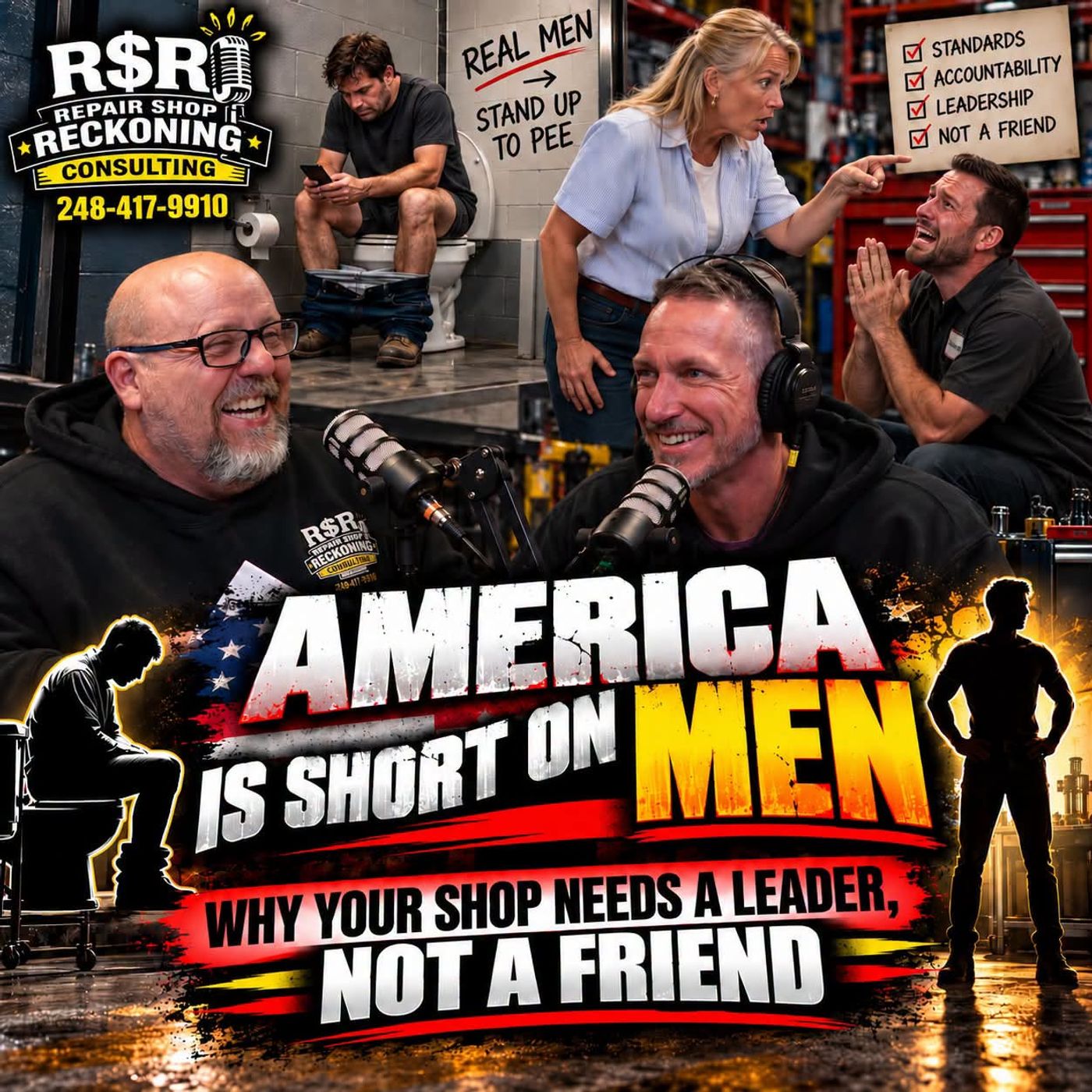
America Is Short On Men...Why Your Shop Needs A Leader Not A Friend
America isn't short on males. It's short on men willing to take responsibility. In this 1st of 2 episodes of Repair Shop Reckoning, Kevin Brown and Jason Tracey get into what leadership actually looks like when you're the one responsible for the...
Related across the catalog
I Spent 10 Years Stuck at $1.7M, Now I'm About To Hit $5M (How I Did It) | EP12 | Shop Fix Academy Podcast
For ten years, Wayne Watson's shop hit the same wall — $1.5M to $1.7M in revenue, eight bays, no way through. He'd been in business since 1993, tried everything, and still couldn't crack $2 million. Then something shifted. Today he runs 18 bays, did $4M last year, and his team is already gunning for $6M. He explains how he spent years managing the wrong numbers: parts percentage, GP benchmarks, shop supplies, before discovering where the real breakthrough was hiding and the reframe that reordered how he sees his entire business: that the difference between broke and profitable usually comes down to three or four cars a day.Get the structure, coaching, and accountability to take control of your numbers and build a more profitable shop with Shop Fix LITE. https://shopfixacademy.com/shop-fix-lite?utm_source=sfa-podcast&utm_medium=podcast&utm_campaign=join-lite&utm_content=ctaLearn alongside operators who have overcome the same financial, leadership, and operational challenges you’re facing at a Shop Fix Academy Event.https://shopfixacademy.com/upcoming-events?utm_source=sfa-podcast&utm_medium=podcast&utm_campaign=sfa-events-2026&utm_content=cta Stop tracking numbers without knowing what to do next, watch From Guesswork to Growth and learn the metrics that actually drive profit.https://shopfixacademy.com/guessworktogrowth?utm_source=sfa-podcast&utm_medium=podcast&utm_campaign=fromguessworktogrowth&utm_content=cta
Your Shop Isn't Scaling Past $1M For These 5 Reasons...
The average U.S. auto repair shop profits under $600K, however the average Shop Fix Academy grown shop profits $2.4M. Guy Roberts and Michael “The Berg” Rosenberger cover 5 proven strategies that explain why so many owners still can’t break the $1M ceiling. This is not a car count problem. It is a leadership, people, systems, and capacity problem. Learn whether or not a $1M manager can actually lead a $2M store, why the employees who helped you reach your first million may not be the ones who can help you double profits, and how hiring more bodies can double overhead without moving production. They unpack the “Front of The Step, Back of The Step” model every growing shop owner needs to understand. Stay tuned to get the right people producing at the right level, and scale a $1M shop into a $2M operation without crushing cash flow along the way.Ready to break through your next growth ceiling? Shop Fix PRO gives you 1:1 coaching, proven systems, and a community of experienced shop owners to help you build a stronger, more profitable business.https://shopfixacademy.com/shop-fix-pro?utm_source=sfa-podcast&utm_medium=podcast&utm_campaign=join-pro&utm_content=ctaExplore free replays, practical guides, and proven resources designed to help you improve profitability, strengthen your team, and grow your shop with confidence.https://shopfixacademy.com/replays-and-guides?utm_source=sfa-podcast&utm_medium=podcast&utm_campaign=shopfix-resources&utm_content=ctaThe best shop owners never stop learning. Explore upcoming Shop Fix Academy events and find the training that's right for you and your team.https://shopfixacademy.com/upcoming-events?utm_source=sfa-podcast&utm_medium=podcast&utm_campaign=sfa-events-2026&utm_content=cta
My Shop Was $1M In Debt: How I Got Out Of It | EP9 | Shop Fix Academy Podcast
$1 million in debt, a full parking lot, and no idea where the money was going.In this episode, Ryan Hillenbrand sits down with Guy Roberts and Michael Rosenberger to break down how he clawed out of 7-figures of debt without shutting the doors.Ryan shares the hard lessons that forced him to stop running on gut instinct and start facing his numbers every single day. They get into why cash in the bank doesn't mean you're profitable, how growth can make a shop in debt even more dangerous, and why copying every other shop in town keeps you stuck and broke.Learn the secrets of productivity, labor, parts, inspections, payroll, and the daily habits that move a shop from drowning in debt to producing real profit.Get the structure, coaching, and accountability to take control of your numbers with Shop Fix LITE https://shopfixacademy.com/shop-fix-lite?utm_source=sfapodcast&utm_medium=podcast&utm_campaign=join-lite&utm_content=cta-textlinkExplore free guides, training replays, and practical resources to help you build a more profitable shop. https://shopfixacademy.com/replays-and-guides?utm_source=youtube&utm_medium=podcast&utm_campaign=sfa-podcast&utm_content=ctaExplore Shop Fix Academy Events led by operators who have overcome the same financial, leadership, and operational challenges you're facing now. https://shopfixacademy.com/upcoming-events?utm_source=sfa-podcast&utm_medium=podcast&utm_campaign=sfa-events-2026&utm_content=cta-textlink

215 - Ask Me Anything: Car Count vs. Profit - Why More Cars Doesn't Always Mean More Profit
215 - Ask Me Anything: Car Count vs. Profit - Why More Cars Doesn't Always Mean More Profit August 5, 2026 - 00:53:54 Show Summary: Higher car count does not always create higher profit. Excess volume can lower repair order averages and increase mistakes while exhausting the team. Strong financial data helps owners find the right workload for their business model. Shops should improve margins and workflow before investing in more marketing or staff. Host(s): Lucas Underwood, Shop Owner of L&N Performance Auto Repair and Changing the Industry Podcast Cecil Bullard, Founder of The Institute Show Highlights: [00:01:00] – Higher repair orders can create less stress and a better client experience. [00:04:00] – Strong sales mean little when the business still loses money. [00:09:00] – Last minute work can disrupt promises and increase costly mistakes. [00:15:00] – Excess car count often lowers sales and employee satisfaction. [00:18:00] – Every shop must find the workload that supports its model. [00:20:00] – Clean financial data helps owners make sound business decisions. [00:22:00] – Fix weak margins before spending money to attract more clients. [00:28:00] – A thoughtful response can protect workflow without rejecting the customer. [00:42:00] – Adding technicians without strong processes can create greater chaos. [00:49:00] – Clear goals and accountability help employees understand how to succeed. In every business journey, there are defining moments or challenges that build resilience and milestones that fuel growth. We’d love to hear about yours! What lessons, breakthroughs, or pivotal experiences have shaped your path in the automotive industry? Share your story with us at info@wearetheinstitute.com, and you might be featured in an upcoming episode. 👉 Unlock the full experience - watch the full webinar on YouTube: https://youtu.be/7M70n_DfTDg Don’t miss exclusive insights, expert takeaways, and real talk you won’t hear anywhere else. Hit Subscribe, drop a comment, and share it with someone who needs to hear this! Links & Resources: Want to learn more? Click Here Want a complimentary business health report? Click Here See The Institute's events list: Click Here Want access to our online classes? Click Here ________________________________________ Episode Transcript Disclaimer This transcript was generated using artificial intelligence and may contain errors. If you notice any inaccuracies, please contact us at marketing@wearetheinstitute.com. Episode Transcript: Ask Me Anything Car Count vs. Profit - Why More Cars Doesn't Always Mean More Profit Lucas Underwood: What is up, everybody? Hey, y'all. It's Lucas Underwood from the Changing the Industry podcast and L&M Performance here in Blowing Rock, North Carolina. I am joined today by the one, the only, Mr. Cecil Bullard. We're gonna be talking about car count versus profit. Cecil, how are you today, buddy? Cecil Bullard: I'm doing fantastic as usual, Lucas. Lucas Underwood: Very good. Very good. So Cecil, one of the, one of the things I'll never forget, I taught a class at a industry event one time, and I had been in another class where the person was talking about do whatever it takes to get them in the door, and they'd been in a shop, and they were in their own shop, and the, the advisor had turned down a car at 4:00 in the afternoon that came in for a coupon oil change and wanted to wait. And so she chased the person back out into the parking lot and said, "No, no, no, no, no, we'll get you in. We'll make it work. I'm gonna pull a technician off something else. I'm gonna put them on this," and fired an advisor over it. And I've, I'd been in that class, and I'm talking about that in this training, and that person was sitting in the back of the class and I didn't see Cecil Bullard: him. Yeah. Lucas Underwood: And, and the thing that I said about it was this, is I said, "Listen, one of the most impactful things that I've ever experienced was being on the other side of an experience like that as an advisor, as a technician, what it feels like to feel that kind of pressure and why we shouldn't do that to our people And so I know there's been a massive movement, movement in the industry that's pushing people to say yes to every car that comes in the door. Doesn't matter what it is, just more cars, more cars, more cars, more cars. And I have had a very, very different experience than that. I am someone who has experienced a higher ARO with less stress and less pressure on our people, a better experience for the client, and I have found that that works best for me. And I'm not saying it works best for every organization, but I wanted to dig in with you and talk a little bit about this. Are you a say yes to every car man, or are you a balanced car count and balanced ARO man? Help me understand. Cecil Bullard: I think there's a, I think there's both, frankly. Um- Okay ... it, it has to make common sense, and I think you're really talking about two different things. So first of all- Yeah ... you know, before you fire someone for not doing what you want, does the person really understand what you want, right? Yeah. I mean, is that, is that well defined? Did the guy know that no matter what, I have to bring that car in? Uh, you know, so at 4:00, your service advisor made a decision. He'd made promises to other customers that they would have their cars. Yeah. And instead, now you're jumping in the middle of that and you're saying, "Well, I'm gonna fire this guy because he turned down a, a discount oil change or whatever." Yeah. Maybe a dis- and it- maybe a dis- you know, the guys, the discount oil change guys would say, "Well, yeah, but we do discount oil changes 'cause it leads to other sales." Lucas Underwood: Right. Cecil Bullard: But so that's one thing, you know? I- I- is the person who works at your counter... Um, I, I was in, uh, North Carolina. You saw me last week. I was on the road- Yeah ... for four da- after one of my meetings, and this happens a lot, one of the kids came up, young guy, uh, looked like he was about 14, but he was probably in his 20s, and he's like, "I'm a third generation. My dad runs the shop, but, but you know, my dad, he's getting in the middle of everything. It's really hard." And, and, uh, I, I always say you work for someone, they write you a check- You have to make a decision about what you're willing to put up with or not put up with, right? For sure. As an, as an employee, right? Lucas Underwood: Yep. Cecil Bullard: And so when you decide that I, I wanna work here and I wanna take the check, i- in a way you also decide I'm gonna follow the rules of the company, whatever those are. Yeah. Whether Cecil agrees with them or Lucas agrees with them or, or whatever. None of that really matters. What matters is that the person that's writing you a check is, is basically saying, "This is how I wanna do it," right? Lucas Underwood: Right. Cecil Bullard: And, you know, behind the scenes, we can have all the arguments we want. We can sit down and go, "I don't think that's correct." Um, a- a- but until the owner changes their mind about how we do this, then you gotta do- That's how business Lucas Underwood: runs ... Cecil Bullard: you gotta do how, what the owner wants. And so if that employee got terminated legitimately because- Yeah he knew better, then I'm, I'm fine with that. I, I, I think we have a craziness in our industry. I think we've all lost our minds because You know, you, you look at car count, car count. I mean, that's everybody's... That's like the mantra, right? More cars, more cars. I'll make money if I have more cars. Yeah. Well, that's, that's not necessarily true. It's never been true, frankly. Lucas Underwood: Right. Cecil Bullard: Right. You know, we have these shops. I mean, I can't tell you how many times, you know, having done seminars in the industry for well over 20 years and, and, and worked with automotive- thousands of automotive shops, we have these shops that come in, they're doing $2 million a year worth of business and losing money. Lucas Underwood: Yeah. Cecil Bullard: And, and so... And we also have shops, frankly, that are doing, you know, uh, 700,000 and losing money, and, and I'm pretty sure there's shops out there doing 10 million and losing money. Yeah. Uh, there's a balance and there's a way to run your business that is successful, right? Yep. Lucas Underwood: Absolutely. 100%. So- And, and look, h- I, I'm gonna, I'm gonna take a play directly from the Cecil Bullard playbook, okay? Hey- I'm gonna pull the play straight out of the playbook because you said something that I think we need to address right here and right now, okay? We Cecil Bullard: lost our minds in our industry? Lucas Underwood: Well, I mean, you would've had to have had one to have lost it, okay? You have to have something to lose it. So, I, the industry in that sense, we're in trouble. But, you know, th- this brings up something that's completely off-topic and, and I'm just gonna ask you what you think about it. There's all these technicians who are really upset right now, right? They're, they're very disgruntled, and it's primarily in the dealership space, right? You know I make these videos and they come out- Yeah every single Tuesday, Thursday, Saturday and Sunday. Yeah. And these videos come out, and all these dealership guys get so upset and so mad because they think that I'm talking about the dealership space. And I keep saying to them, like, you set the terms for what you're willing to accept in that, that job, in that role as an employee, and if you don't like the job, for God's sakes, leave. Cecil Bullard: Yeah, there's- And if Lucas Underwood: everybody leaves- Cecil Bullard: There's so many... There, I mean, you know, I, I think if you got a thousand shop owners in a room and you said, "How many of you need a good technician in your shop?" You know, 999 hands would go up, right? Yeah. Um, the, the... And, and yet we have these techs that are so miserable in their lives, in their sh- in the shop that they're at, and the, bec- the owner doesn't pay me, doesn't appreciate me, doesn't whatever, or she doesn't- Yeah or whatever. Okay, Lucas Underwood: cool. Why Cecil Bullard: are you there? Go somewhere else. Right. I mean, holy, holy crap. Um, yeah. I'm with you, man. I mean- I am like, uh... And I was t- I talk about the level of incompetence you're willing to accept. I, I do that- Yeah ... with owners because, you know, nobody's gonna be Cecil, right? Yeah. And by the way, in Cecil's head, in my brain, I think I do it right all the time. Right. Yeah. I mean, there's a piece of me that knows that's not true, right? But we're all a little- Sure ... insane in some ways, and we think that, you know, we, we know how to do things, and we think that our way is the right way. And, and, but as an owner, I'm gonna work twice as hard as pretty much anybody else, you know? Yeah. If it... I, I was talking to one of our, um, our marketing people. I, I used to print our workbooks, and I used to write our workbooks, and I used to edit our workbooks. Yeah. And, excuse me. I don't, I don't do that now, but I was, I was talking to her and I said, "You know, I used to be here at 2:00 in the morning-" Lucas Underwood: Yeah Cecil Bullard: printing workbooks because I had a class the next day that I needed the workbooks for- Uh ... and putting them together. 100%. And now I'm really glad I don't have to do that. Lucas Underwood: But- We, you know, we got a, we got a review the other day b- at the family business, and it said, "The owner was in there serving food." And I wanted to reply and say, "Yeah, because, like, I gotta do whatever I gotta do." 'Cause Cecil Bullard: everybody quit, and, and I'm in trouble, and I c- I'm the only one. Otherwise, I wouldn't be there. Lucas Underwood: Right. I've gotta do what I gotta do, right? Yeah. Like, this is how we're gonna survive. And, and I, uh... What is it that old Dutch always says? Like, "I'm paying for the blessings of tomorrow with the sacrifices of today." Of today. Whatever it takes. But Cecil Bullard: we a- you know, a- and so you, you create the level of incompetence. And I would say from an owner's point or a manager's point, you say, "Okay, in that position, I'm willing to accept 3% warranty," right? Yeah. So I've got a tech, I'm willing to accept 35 hours a week as a, okay, that's, like, you, you, you hit 35, you're, you're still in my good graces. You- Lucas Underwood: Right ... Cecil Bullard: you only have 3% warranty, you're still in my good graces. But, but also employees have to do the same thing. I mean, you have to decide, what am I willing to put up with? Am I willing to put up with- Yeah ... crappy pay? Well, if you do, and you take the check, and you keep taking the check- Lucas Underwood: Ain't Cecil Bullard: nothing gonna change then shut up. Right? Right. I mean, stop bitching about it. And we're, we're a, an interesting industry. Like you said, maybe we never had a mind, but- Lucas Underwood: Yeah ... Cecil Bullard: you know, we, we, we constantly eat our tails, you know? Yeah. We constantly bitch and bitch and bitch, and, and we don't W- I don't even think we fully understand. So, you know, I'm pretty sure if, um, if, uh, uh, Aaron Stokes was still alive and, and we had Aaron on this, Aaron would be saying, "Yeah, you say yes, and you say yes because of this, this, and this," right? Yeah. Because that was w- that's one of their philosophies, was that yes philosophy. And on the same time, I would be saying Yeah, but sometimes you gotta say no. Yeah. Because you've already made promises to other customers because you're pulling a guy off of a $5,000 job that he could finish up- Lucas Underwood: For a $29 Cecil Bullard: oil change ... and you're gonna have him do a, an oil change where you're gonna lose $35. Lucas Underwood: Yeah. Cecil Bullard: And then he's gotta come back to the $5,000 job, and he's gotta get his head back in the game. So now you've increased the odds of, of mistakes happening, comebacks, et cetera. And so I think there's a point where you say to the customer, "Look, you know, we, we would love to do that oil change for you, absolutely. Only I can't do it tonight, right now, because my techs are all tied up on other jobs, and we've made promises to customers." Absolutely. "And I'm pretty sure if you were one of those customers who I made a promise to, you would not want me pulling the tech off of your car to do someone else's- To, to do that ... service or whatever it is, right?" I, I think- And it's not even about a $29 oil change. If it was a $300 oil change, I still wouldn't pull my guy off of a $5,000 job- Yeah at 4:00 to do that oil change. Lucas Underwood: I, I think it's easy, right? Like, so, so my vision of leadership is, is my job is to create a awesome environment for my internal customers, my employees. Right. And, and currently I'm not in the shop that much, so it is my managers' job to create an amazing experience for them, and then they in turn create an amazing experience. The desired outcome is a safely and properly repaired automobile for our consumer that is safe and reliable for them and their families. Or that, that's what we're trying to accomplish, and we have the guardrails which say, "Here is the, the metrics of profitability that we expect, and so you guys stay within these guardrails. Here's where you're going. This is the roadmap. This is what we want." You saw the roadmap. Well- I've, I've got it on the whiteboard, right? Cecil Bullard: Yeah. And so- And you're also not, you're not setting yourself up for success here, right? I'm, I'm bringing a, a $29 oil change. So I'm working with, uh, big old tire guys, uh, not, not the big company, but a guy who owns three locations. Yeah. And we're doing free tire rotations and free brake inspections. Yeah. We're doing hundreds of them. You know what we're selling? Probably Lucas Underwood: nothing. Nothing, Cecil Bullard: right? Lucas Underwood: Right. Cecil Bullard: Because we're so busy doing the tire rotations and brake inspections, we forget to look at the car. We don't have time to get to the Lucas Underwood: actual work Cecil Bullard: that they could approve. We, we forget to estimate the work and, and we don't have time to have a conversation with the customer. Yeah. And so I'm, I'm literally going... I said, "Why, why do you guys do free brake, uh, you know, inspections, free tire rotations?" Yeah. He said, "So we can look at the car." Well, you forgot that- Does it matter if you're not getting the end of it? somewhere along the... Yeah. So now I'm gonna bring this, this oil change in, and we'll get to that question in just a second, but I, I just have to make the point. I'm gonna bring this guy in at 4:00. It's a waiter, you know? Yeah. Uh, we're gonna service the car, and if I have a good technician do a good inspection, we're 35, 45, 50 minutes in. So now we're pushing 5:00 Then we will find stuff on this car that needs to be talked about. Customer may not buy it, but it needs to be talked about. The whole reason I'm doing the cheap oil change is to get the guy in so I can look at the car and try to sell him the things that he really needs, right? Lucas Underwood: Yeah. Cecil Bullard: Except now it's close to 5:00. Is that customer gonna sit for another 15, 20 minutes while- Lucas Underwood: Yeah ... Cecil Bullard: my service advisor estimates the work, and then is he gonna sit for another 15 or 20 minutes with my service advisor after that to discuss what he needs- In- ... so that he can make a good decision? Lucas Underwood: In this instance, the, the, their theory was is like just, just find one thing wrong with the car that will make them leave it, and then do an inspection and provide the inspection later. I didn't feel like that was very kosher. Cecil Bullard: It's not my, it's not the way that I would- Lucas Underwood: No, I didn't feel like Cecil Bullard: it ... I would approach it. And it's certainly, it's certainly not the way that I would teach. I don't wanna have three phone calls with you, right? Yeah. Or three meetings. I don't wanna find one thing and say, "Oh my God, your, y- you know, your oil leak is coming out of the, the whatever timing cover so badly, we've gotta do your timing cover, and it's gonna cost X, Y, Z." And you go, "Okay, you know, I've seen the leaks. Do it." Yeah. And then you leave And then I go, "Oh, and now we've had time to check the car over, so here's another $5,000 worth of crap." Right. I don't wanna have that. I wanna have one conversation. I don't wanna have three or two, right? Right. I may have two because when we get in the middle of stuff, uh- Yeah we may find something- My vein's gonna have to- ... that are related that, that we can't see at that point in time with a basic inspection. But I certainly don't wanna have three conversations. And- Lucas Underwood: Yeah ... Cecil Bullard: and I think you're, um... Everything is i- with a client is about how does that client feel about us, right? Lucas Underwood: Yeah. Cecil Bullard: And that experience with us. And, and so by telling him yes, I made him feel good, okay? So yeah. Tell him, any, anytime you tell someone, "No, I, I really can't do that," if that's all you say, you're in trouble, right? Lucas Underwood: Yeah. Cecil Bullard: Or no. Uh, nobody wants to hear no, right? Yeah. "Oh, my gosh, I would love to do that for you right now, but unfortunately there's just not enough time, and if we did it right now, we wouldn't do you a justice. We wouldn't be able to-" Yeah "... inspect the car. We wouldn't be able to tell you about what's going on with the car. You would not have the information you need to make intelligent decisions, and my whole job is making sure that you have the information you need to make the right decisions about Lucas Underwood: your car." Is advising you, being your advocate. Cecil Bullard: That, that's what I do, right? Yeah. And so this, this yes mentality and this car count thing of just driving as many cars through. We... I watch... I'm a numbers guy. You, y- everyone in the industry kinda knows, you know? Cecil understands the numbers or thinks he does. And- Yeah and I watch shops drive car count, and as they drive car count, I watch sales go down. I watch- Yep ... average repair- Yes ... orders go down. I watch mistakes go up. Employee satisfaction Lucas Underwood: go down. Cecil Bullard: Yeah. The whole nine yards. Employees are, are running around- Yep ... like chickens with their head cut off. Yep. There's a lot more inefficiencies that, that happen in the business. Yeah. And so if you, if you run a shop and you really pay attention, you'll learn where your sweet spots are, right? Yeah. Where does the shop make m- the most money? Where does the shop create the most happy clients? Where does the shop create the best average repair order? You know? Yeah. Those things that matter to me. And then where does the shop create the most profit? Because y- I, I have to, I have to be profitable here i, in the short term, and frankly, in the long term. Yeah. Otherwise, I, I have to go work f- For somebody else, and I'm not employable Lucas Underwood: Right. I, I'm the same way, and I, I think it's important, right? O- one of the things that I'm bad for doing is painting with a broad brush. Yeah. If you own, own a tire store, right? And, and you can turn hundreds of tires a day, that, that's a different model than what we're discussing. We're not talking about a high volume just tire store or something like that. That's a very different model. But even then, these same practices work in that tire store the same way they work in, in a mechanical shop. Cecil Bullard: And- Most of, most of the tire guys that I know are- Mm-hmm ... probably doing 50% tires, 50% um- Mechanical ... at least. Yeah. I mean, I know there's some that are 70% tires, 30% service, but I don't know of- Yeah ... any tires, uh, other than maybe discount tires, that are only doing tires. Just tires. Yeah And not getting into any of the service at all. Um- Lucas Underwood: Well, you know, I, I thought, I was, I've talked with Mark Ponz a lot. Brilliant, brilliant businessman, right? And, and one of the things that I always learned from Mark was, was, "Hey, watch the way we do tire business," and then we kinda shift gears in the mechanical business. You have to. It runs a little bit differently, right? Cecil Bullard: It's a different business, right. Lucas Underwood: And so you've got your tire team that's out here just nailing the tires out, and that's what they do every single day. And, and I've, I've, because of ASEA, I've had some amazing opportunities to work with some of the best tire men in the entire country. Cecil Bullard: Yeah. Lucas Underwood: And, and I always, I was the guy saying like, "You can't make it with tires." How do you make it? And then I meet Mark Ponz and I'm like, "Whoof. He did more than make it with tires." Cecil Bullard: Holy smokes, you can make a lot of money with tires. Yes. But- Lucas Underwood: Yes ... Cecil Bullard: it's a different margin, it's a different business. Lucas Underwood: Yeah. And it, it's ran differently. Cecil Bullard: Yeah. Lucas Underwood: And so, you know, I found my sweet spot to be three cars a day per tech, somewhere between $900 and $1,100 on my ARO. That, that's my sweet spot. That's where we run. That's where things work. We get too much higher than that, we start getting into very complex jobs. And, and listen, I talk to a lot of shop owners, "I got a $3,000 ARO. That's too high." And they're like, "What are you talking about that's too high?" Well, Cecil Bullard: if, if you're a diesel shop, it's not. For sure. If you're a European shop, you're pushing the edge. But- For Lucas Underwood: sure ... Cecil Bullard: but if you're a general repair shop, it's, it's too high, right? Lucas Underwood: Exactly. It means you're Cecil Bullard: doing engines and transmissions all day. It also means you're doing a lot of heavy duty work. Engine repair. And if you're doing a lot of heavy duty work, the margins and the matrixes that- You currently would have in place normally that would be taught to you will never work for your business- Yeah to make the profit you need. Lucas Underwood: Exactly. Right. You're 100% right. You're 100% right. And, and I think that's why, you know, it's like when I talk to folks about coaching with the Institute, I'm always saying, "Listen, there is no cookie cutter model that fits every shop." Like, this is a- I think there, Cecil Bullard: I think there is, frankly. I mean, if you say, "I'm a tire store," there's a model that works best. Yeah. If you say, "I'm a- I don't Lucas Underwood: disagree ... Cecil Bullard: I'm a discount store-" I don't disagree with that ... there's, there's a model that works best. Yeah. But, you know, I was... A- and again, I, I have never run a discount store, so I've never done- Yeah ... a cheap oil change or anything cheap. Or frankly- Right ... I'm, I never, when I was running shops, I never was a discounter. So- Yeah ... I don't understand that model. And I know some guys, however, that run really discount. Yeah. I've known some guys in my life. And, and their model works for them, only their techs are usually, uh, pretty transient because- Yeah they're just- Discount model, that's it ... they're not paying them enough, and they're running too many cars through, and that's, their service advisors can be somewhat transient in that business, and their customers can be somewhat transient in that business. Yeah. So the other part of that is if I'm running a discount model, I have to keep really hounding- Yeah marketing. Tha- those are the guys that are also saying you need to send out 10,000 to 40,000 mailers every month so you can bring- Yeah ... these oil changes in, so you can do enough business to- Here- ... you know, to be profitable. Lucas Underwood: Here, here's my thing, though, okay? When, when we look at the numbers, right? When we look at the financials, because I talk to Eric Jordan all the time at Geisen. Cecil Bullard: Yeah, yeah. Lucas Underwood: And I'm like, "Dude, I... You know where I was at, I didn't have clean numbers." I, I ran through a, a spell where we didn't have good bookkeeping and, and our numbers were a mess. Cecil Bullard: Yeah. Lucas Underwood: And it's impossible to run a business without good clean numbers, right? And so what I'm saying, though, Cecil, is that without good clean numbers, without good clean data, there is no model that's gonna work. And I think that when they have good numbers, that GP number that you have to hit every single month to pay the bill- Cecil Bullard: Yeah ... Lucas Underwood: what, what the shop down the street's charging- They don't, they don't- ... is irrelevant to you. Cecil Bullard: Yeah. They also- Lucas Underwood: What you have to make is what you have to make. Cecil Bullard: If you don't have clean numbers, you make mistakes. Yeah. And you make bad decisions. So, you know, imagine- I've made bad Lucas Underwood: decisions with clean numbers, Cecil. Cecil Bullard: Yeah. Right, yeah. But, but, you know, imagine that we brought a new car in or a, you know- Yeah ... a four-year-old whatever, and we didn't have a scanner, and we couldn't get the data- Yeah ... out of the car, and so now what are we doing? Now, now it's the, you know, well, I, I, based on my experience, I think, or- Lucas Underwood: Yeah ... Cecil Bullard: you know, my tech is saying, "Let's- Yeah ... place re- let's rep- replace these six parts. Maybe that's gonna solve the problem." Yeah. I, I don't wanna be that company. I wanna be the company that says, "I know exactly what's going on with your, with your business, and- Yeah these are the three or the five things that we can do that will really improve your business and- Yeah ... put more money in your bottom line, create more happy, happier employees, happier- uh, clients, et cetera. For sure. Um, we do have a question. Let's- Yeah. Kyle ... let's get to the question. 2020, Kyle. I know that this is supposed to be ask me questions, so, and I've al- I have kinda read the question, but I'll let you read it. I read it myself, so. Yeah. " Lucas Underwood: I'm a mobile programming and testing company netting 8% currently." Now, Kyle is a, a fairly new company, very proud of him, doing awesome things. "My GP's 55% per RO, but my car count is only about 10 per week, so two a day. Should my next step be more investment into marketing or jump into coaching to maximize what I currently have?" Cecil, what do you think? Cecil Bullard: Well, I would, I, I, I would lean on the coaching side, and here's why. Lucas Underwood: Yeah. Y- Cecil Bullard: you're supposed to be making net 20, and your gross profit is off by, uh, what is that? 12, 14 points. Yeah. I mean, I need 62 to 64% GP. Lucas Underwood: Yep. Cecil Bullard: And I need to know where that's missing. For sure. And what I have to do to get that. So you can bring more cars in at this point, and you'll st- and, and if you maintain a, a net eight, you're just gonna... If you wanna make tw- you know, the 200 K you told- A higher Lucas Underwood: net eight. Cecil Bullard: I wanna make, I don't know, I wanna make $200,000. At 8%, $200,000 is an awful lot of cars to work on, an awful, awful lot of places to make mistakes, and a lo- awful lot of liability. Yeah. At 20%, you know, $200,000 is a lot less cars, it's a lot less liability, and a lot less places to make mistakes. I- So for me, I, I'm, I might do both. It, it would depend on, you know... I mean, 8%, if you're doing, you know, 10,000 a month, okay, I'm making 8%, that's, in my opinion, that ain't enough to survive. You know, if you're doing 100,000, you might do both. You might, you know, get coaching, improve your margins, figure out where your business is going wrong, and then while you're doing that, you might improve car count and put a few more, you know, butts in seats so that I can make 20% on more people instead of 8%. Lucas Underwood: So here, here's my perspective, okay? So, so thing number one for me here Is that you're exactly right, and my reasoning's a little bit different. I would want to fix my net and I would want to fix my gross profit- Gross Cecil Bullard: profit ... Lucas Underwood: first before I started stacking more clients in the door, because now I'm gonna have more attrition because I'm changing my model midstream as opposed to narrowing down and polishing my model right now and getting my model right before I start presenting it to more people, right? Well, then- So, so I can set the expectation early. Cecil Bullard: Yeah. And if you, if you do that, you'll have happier clients that will continue- Yeah ... to use you and come back. And- Lucas Underwood: I Cecil Bullard: agree ... this is a mo- mobile programming guy, so his client is probably not, uh, like the end user. This m- he may be working with more shops. I mean, there's- Yep definitely more information I'd need in order to- For sure ... evaluate him. And, and he is- These are the five Lucas Underwood: things ... he's working with a lot of shops. Right. Cecil Bullard: Yeah. And, Lucas Underwood: and I think he's doing some mobile diag too. Cecil Bullard: Yeah. Lucas Underwood: But so here- But you're- ... here's the next question to that though, right? Okay. Because I think there's a lot of mobile diag guys out there, there's a lot of mobile techs out there, and, and that does lead us to that next question is, hey- Like I, I'm not... If I do a DVI, how am I gonna upsell something? Because I'm really just coming out to do the diag and program the vehicle. Cecil Bullard: Well, in, if I'm working with other shops, I'm not doing a DVI. We're, we, we are just there to fill a, a place. That's why- Yeah ... I never liked, like, uh, being the alignment guy for the 10 shops around me. Um- Yeah ... because when the car comes in, I see things that- Lucas Underwood: Wasted Cecil Bullard: opportunities ... that the customer should be talking. We, w- we need, I, I feel like- Yeah ... oh, my God, why aren't they telling the customer that, you know, your upper control arm bushings are falling out of the car, and- Lucas Underwood: Yeah ... Cecil Bullard: you c- I can't even align it, right? It, I, uh, uh, but it, I have different roles in, in different places. And, and if I am coming out to do programming and I'm the, I'm at the end user, the, you know, the client who owns the car, and I do a DVI, I might have an opportunity to sell additional stuff. But do I have the tools with me? You know, do I have the parts there? You know, do I have the equipment? Can I do it wherever I'm at, or do I have a place where I can take it and do it? I mean, there's a lot of additional questions and information, you know, depending on the model that you wanna build, right? I- And- Lucas Underwood: Yeah. I- ... Cecil Bullard: I don't think you should run three different models. I think you need to find the model that's gonna work the best for you, and that's the model that you wanna run, and you wanna run it as, a- as, as well as it can be run. Right? Lucas Underwood: I, I don't know anything about the mobile business, and I'm not gonna pretend to. But I, I think if it were me, right, what I would be doing is I'd be working with professional shops, and I'd say, "Hey, what I'll do, you guys get the cars you need programmed lined up. You get everything you need. In other words, do you have multiple cars that are gonna need programming? Do you have things? Try and get those all scheduled on a day for me. I'll come out, and I'll get the repairs made if you need me to do repairs. Whatever. I'll get diags done. But get me a day's worth of work," right? Cecil Bullard: Yeah, yeah, yeah, because I can't be moving around. I'm losing- Exactly ... my time, and time has to be billable no matter what. So either I gotta- Exactly ... charge... If, if I'm, if I'm working with five shops in a day- And I'm traveling around I have to shop Lucas Underwood: to shop, I spend as much Cecil Bullard: time and gas money Lucas Underwood: moving Cecil Bullard: Am I charging enough? Yeah, do, am I charging enough to cover the vehicle, the, the expenses- Yeah ... the, the gas, the rent, the, uh, excuse me, the utilities, the payment, whatever, uh- Yeah you know, or... Utilities, holy smokes. You know, I bet I'm, I'm thinking one thing, and it c- what comes out of my mouth is something else sometimes. Um- Lucas Underwood: We're used to it, Stace, so it's fine. Cecil Bullard: Yeah, it's all right. Guy's losing his mind. Um- You Lucas Underwood: never had one ... Cecil Bullard: and never had one in the first place. Um, but am I charging enough? And- Yeah ... and by the way, if I'm going to one shop and I'm gonna be there all day, that cost, uh, can be less for that shop than if I'm going to five shops. If I'm going to five shops- Yeah ... I have to cover all the traveling time and all the expenses that go with it. I've gotta charge more, otherwise I only make 8% or I only make 3% or whatever. I don't make my 20%, and I need my 20%. Lucas Underwood: I, I, I think, you know, to summarize basically where we've gone with this is, is like, the, the base numbers, the 55 and the 8%, are not fixed by increasing car count. Mm-hmm. So we fix those numbers first. Cecil Bullard: Yep. Lucas Underwood: And then, like, we, we get some of that dialed in, and we get the model dialed in, we get the efficiency dialed in, and then we work on marketing to bring more in if we need it at that point. But that's, I, I, that's how I would take it. Yeah. Cecil Bullard: So imagine you were, say, building houses, and you weren't charging enough, plus you maybe weren't building the house in a correct manner. All right? Yeah. So, and I, I build more houses, I create more liability- Lucas Underwood: Yeah ... Cecil Bullard: that la- later I may have to go back and fix, repair, whatever. Um, I think you always wanna fix the model first. And, and there- Sure ... is a point, you know, hey, I'm a guy. I, I wanna start a business. I don't know what I don't know. Uh, I'm gonna get in there, and I'm gonna work my butt off and, and all of that, but there's a point in that where you have to say to yourself, "I want this to run well- Yeah and I want this, you know, I want... And so I need to know what it really takes to run it well, because I don't wanna work, you know, 12 hours a day, uh, in order to make the money I need to take care of my family or to- Yeah ... you know, take..." So yeah, I, I mean- A- and that, back to the... Okay, so I hope we answered that well enough, Kyle- Yeah, I think so and thank you so much. Thank you so much for that, that question. Um, and, uh, you know, back to this yes mentality, I told you I'm, I'm of both worlds, so I don't wanna tell a customer no, no matter what. Yeah. I, I really don't. But sometimes I have to say, "Yes, but..." Right? Lucas Underwood: Right. " Cecil Bullard: Yeah, we'd absolutely love to take care of that for you. However," right, "this is the situation." Uh, I always try to, um, to create some, uh, empathy, uh- Yeah ... around what's, what's going on in my world. Yeah. And, and by the way, if I get a guy that comes in who's really pissed off because at 4:00 I can't stop everything and change his oil- This is Lucas Underwood: somebody I want in my shop. Cecil Bullard: Yeah, and is that the guy I wanna work with? Yeah. And the answer is no. N- for me, the answer is- Lucas Underwood: Yeah ... Cecil Bullard: uh, uh, unequivocally no. Lucas Underwood: So, so many of these shop owners, okay, and, and I'm gonna be really blunt here, and I'm not talking about the Institute. You blunt? Wait a minute. Yeah, I know, right? I'm not talking about the Institute when I say what I'm gonna say, okay? Cecil Bullard: Okay. Lucas Underwood: But so many of these shop owners, they go to a class somewhere, and somebody gives them these ideas of what to do. Now, listen, I, I've been this guy. I've been disconnected from the front counter. I've been disconnected from the base, and I go to a class, and this person recommends... And, and I'm gonna tell you, why do you think coaches have got such a bad name? There's, there is a coach that, that if you go on TikTok and search his name, it's technicians cussing him. Like, every TikTok video is people just cussing this guy out, right? And it, it's, it's that they have become so disconnected from what it's like to do the job. Now listen- I think what happens is, is that owner has been struggling for a long time. I've told you about this in my personal life before, that I spent so many years fighting and just climbing and trying to get things right and dealing with the stress and the upset client and all the things, that the minute somebody was willing to walk in that front door and take that pressure off of me, I'm like, "Here you go. It's yours. Take it. Do whatever you want with it. I don't care." Right? Cecil Bullard: Like- Well, would you... I mean, if you're gonna listen to someone- Yeah ... give you advice, right? Lucas Underwood: Yeah. Cecil Bullard: Um, uh, you know, uh, am I going to do some research on that person or that company- Lucas Underwood: Absolutely ... Cecil Bullard: and, and find out- Lucas Underwood: Absolutely ... Cecil Bullard: you know, you know, what their clients are, are saying and, and, you know, where did that person get his education? You know- For sure ... what, what's the, where's the- Lucas Underwood: What's Cecil Bullard: their experience? Uh, as they said in What Are the Bona Fides, right? You know- Yeah ... um, uh, in, in whatever movie- Right ... I can't remember the title to, but, um, i- or are, are you just, uh... At one of our events, and again, I'm gonna be brutal but not name their name. Lucas Underwood: Right. Cecil Bullard: You know, last year, um, chose speakers based on the title of their thing. Lucas Underwood: Yeah. Cecil Bullard: And, and they got a- Never Lucas Underwood: actually inspected the class or anything. Cecil Bullard: They got a lot of complaints. Uh, uh- Yeah ... and I heard a lot of feedback from people saying, "Wow, I, you know, in 20 minutes I walked out of that class." Yeah. And, and so do you wanna ha- I, I'm not saying we don't wanna have new people in the industry, 'cause we do. We wanna bring new people in, but do you wanna have people that, that have no bona fides, no, no qualifications? Just, they're just basically- Well- The, the thing I hate about the internet is they're able to say, "I'm the expert on this," and all of a sudden- Exactly everybody believes they're the expert on this- 100%. Lucas Underwood: 100% ... Cecil Bullard: even though they don't have the experience. They don't- Well- ... have the, the basic knowledge to really- E- ... be the expert. Lucas Underwood: Here's my beef though, right, is like they, they can come in and say whatever they want and, and it's, it's like a lot of what's being taught in the industry right now has consequences that, that we're not paying for yet. And I believe there were a lot of things taught over the past however many years that we're paying for the consequences right now, right? Like, there's a lot of things that we're paying for that were done years ago, and this is just how the industry works, and now we're paying the price for it. We don't have any techs, and all of these problems and all this stuff's coming up, right? And so when I... I guess what I was saying about, like, they're teaching these things, but they've never been on that side of the counter. And so it's like the shop owner comes back and says, "Hey guys, we're gonna start doing this." Well, let me ask you, Mr. Shop Owner, how many years has it been since you've sat on that front counter? How many years has it been since you were the one getting the butt chewing because you did something that was shady or was... Right? Like, have you disconnected yourself from the, the experience? Have you disconnected yourself from the consumer, the advisor, the technician? So I'm gonna- Because many of the guys we teach- Cecil Bullard: Yeah Lucas Underwood: were technicians, they were advisors. And- Cecil Bullard: Yeah, but I'm gonna, I'm gonna, I'm gonna kick you in the teeth here. Lucas Underwood: Okay. I like it. Do it. Cecil Bullard: Just because you sat on the front c- on the front counter- Lucas Underwood: Mm-hmm ... Cecil Bullard: doesn't mean that you learned anything. Lucas Underwood: Of course. Cecil Bullard: So, so I think, um, like having a technician who becomes a service advisor, I would rather have a service advisor who was never a technician. Yeah, I- And I know a lot of shop owners are gonna go, "Man, you're crazy, Cecil." But there's bad habits that you learn as a tech- Yes, absolutely ... that are great habits when you're a tech, but when you're a salesperson, service advisor- They're terrible ... they're not good habits, right? Lucas Underwood: Yeah. Cecil Bullard: And, and so that's one thing. One thing is, okay, so you did it for 20 years. So what, right? And, and I know, you know, that's some of my bona fides. I used... You know, I- Yeah ... I did this. This is... I've, I've, I've run business, been successful, et cetera. I, I believe I've learned a lot of things that, that maybe many shop owners don't really know and understand. Here's, here's the other part of this. There are things that need to be taught to a tech that a service advisor should not be taught. Yeah. There are things that a service advisor needs to know that a tech shouldn't know, and, and there are things that a manager needs to know that are different than a service advisor, and there are things that an owner needs to know that are a, a lot different, and not all of those will, you will learn by being on the counter or by running the business, right? For Lucas Underwood: sure. Cecil Bullard: And, and listen- We... I've got guys that has, have been doing this for 30 years. I see them all the time. They come up and they're like, "Yes, I've been, I've had a shop for 30 years" and, and their business is worth $150,000 all in. And they, and they have no money. Right? A- and but they've been working at this for 30 years. Lucas Underwood: We've always done it this way. Yeah. But, but here's my point, though, is, is where I'm going with this is a little bit different. Where I'm going with this is it's been so long since you've sat on that front counter, and your policies and procedures are causing problems for the front counter that you don't even see. Cecil Bullard: I, I cannot use my policies and procedures when I was running a shop 15 years ago for a shop today. Yeah. Exactly. Lucas Underwood: Um- Cecil Bullard: Exactly ... and, and we don't teach that, you know? Lucas Underwood: Yeah. Cecil Bullard: It might be a good place for you to start, because you can see what a policy and procedure should, should look like. Lucas Underwood: Yeah. Cecil Bullard: But to take my policy, even my sche- the way I scheduled- Lucas Underwood: Yeah, Cecil Bullard: completely different um, uh, today, I think it's a bit different, right? I, i- it has to be modified. But- And that, another thing you want your coach to be is somewhat flexible on certain things, because- Yeah ... if they're not, they're gonna teach you what they learned 25 years ago, right? And- Well, Lucas Underwood: I, I mean, I guess my point in that, though, is let, let's, let's go back to the example given, okay? Of, hey, we're gonna have this situation where we bring this car in, and they've got a coupon, so we just wanna get the car in to convert it into a car that we can turn into a higher ARO, right? Now, I've got an advisor who's at the end of the day. Yeah. They're trying to make all of their telephone calls, they're trying to update all of their clients, they're trying to get everything cleaned up. Cecil Bullard: Once finished the 15 tickets that are going on- Exactly ... they get the money in the bank, et cetera. Lucas Underwood: Trying to make sure- Right ... the shop looks good, trying to get everybody wound down. They're, they're in the end of the day. They're phasing it out. They're getting ready to bookend the day. Plan tomorrow, right? Cecil Bullard: Right. Lucas Underwood: And now I've got a technician who's in the middle of a job, he's got an hour left, and I'm going back and I'm saying, "Hey, I need you to stop what you're doing. I need you to inspect this car. I need you to do an oil change right now. I need you to pull this thing in right now." And plus you're asking the advisor to go to that client, write an estimate for something simple, something that needs to be dealt with right now. It's a big deal to get the car to stay, and now I'm arranging a ride for this person, right? So the- Now you wanna talk about disgruntled, think about how that disrupts every single person in the shop's day. I've disrupted a porter, I've disrupted an advisor, I've disrupted a client, I've disrupted a technician. Cecil Bullard: I've disrupted my profits. Yes. I've disrupted my, my workflow. Lucas Underwood: Absolutely. Cecil Bullard: You know, one of the biggest, one of the biggest expenses in the automotive industry, the biggest cost and, and where we're losing the most money is that we do not have good workflow. Yeah. So the productivity issue, and we have a... Because of that we have a lot of techs complaining 'cause they can't get paid. If they're on flat rate and we don't have productivity, and it is the fault of the business because of our flow, um, then they got a, they got a legitimate complaint, right? Lucas Underwood: Yeah. Cecil Bullard: And, and what we're doing, I have a class called Stack the Deck, and what we're doing is stacking the deck against us. Yeah. We're not stacking it in our favor, Lucas Underwood: right? Right. Cecil Bullard: And so we're doing... By, by bringing that car in at the, at the last minute, we're doing everyone a disservice. Everybody. Lucas Underwood: Yeah. Cecil Bullard: The, the client, the car, the service advisor, the tech that's gonna have to be pulled off, and, and we're creating kind of hatt- havoc and, and bad attitudes. Lucas Underwood: Chaos. Yeah. Cecil Bullard: And, and if we create, you know, bad attitude and havoc in our, and chaos in our business, then what are our results gonna be? Lucas Underwood: Yeah. Cecil Bullard: Okay? Exactly. And you can beat guys only so long. You know, you, you can- Yeah ... be a forceful manager and, and use the whip or the, you know, the, the prod or whatever only so long when guys say, "Uh, no more of this." It is not a long-term strategy for running a good business that's gonna last long-term and be profitable long-term. It's just not a good strategy. Lucas Underwood: Yeah. Yeah. I think you're exactly right, and, and I think that that's where it comes back to me that, that if I build a workflow That is prioritizing profit over the car count, right? Because I, I don't believe in the, the high car count numbers. I- now let me tell you something. I, I had an epiphany a few years back because I was in three bays. You've seen the shop. Cecil Bullard: Mm-hmm. Lucas Underwood: I was in three bays, and it didn't take a lot- With Cecil Bullard: no ceiling. I mean, nine feet- Yeah ... or eight and a half feet or whatever. Yep. Yeah. Lucas Underwood: It didn't take that much to fill that shop, and it didn't take that much to pay that shop's bills. Cecil Bullard: Yeah. Lucas Underwood: And then you've seen the new shop, and I, I, I'm, I don't even have to tell you, it takes a lot to pay its bills, right? Cecil Bullard: Yes, sir. Lucas Underwood: And so I have a whole new appreciation for people who try and drive car count. Like I get it. I get it. Cecil Bullard: I had a... In the, in the class, I had a, a guy come up and he's like, "Hey, I'm just, I'm just me, and, uh, what should I do now?" And I'm like, "Well, first of all, I, I don't know enough information." Yeah. "But second of all, when it's just you in one bay, you're gonna have the least expense, but you're gonna make the most money." It's gonna be hard because, you know, you gotta be the service advisor. You gotta, you know, when you've gotta answer the phone- Yeah ... you have Lucas Underwood: to stop what you're doing- Maybe you can stack Cecil Bullard: that bank account full like that ... blah, blah, blah. But you, you can. Yeah. I also have to... Kent made a comment that, um, it requires you to hold the stick. Somebody has to hold the stick. Yeah. And my answer is, "It doesn't require me to hold the stick. It requires the stick to be held- Yeah ... and held by somebody that, that knows what, what they're holding and knows what they need to do, right?" Yeah. Flying a plane, I don't wanna put my, you know, uh, 13-year-old grandson flying a plane. He's no experience. I put the stick in his hand, we're probably in trouble. You know, I want, I want a pilot, I want Dutch at the- Lucas Underwood: Exactly ... Cecil Bullard: you know, behind the wheel, right? Lucas Underwood: Well, you know, it's funny you say that because I was getting ready to bring him up. I, I was talking to him years ago. I was really frustrated about the way the shop was going, and he said, "Son, let me tell you something" He said, "When I worked for the airline," he said, "it does not matter who flies that plane or who does what on that plane." He said, "Because I was the left seat captain, that was my job." He said, "I could let anybody I wanted fly the plane. For God's sakes, I could let a passenger fly it." Cecil Bullard: Yeah, but he- "But I Lucas Underwood: could give them- Cecil Bullard: But he's responsible ultimately for what happens on that plane ... Lucas Underwood: I could give them all the authority in the world- Yeah to fly the plane, but ultimately it was still my responsibility." Good luck. And I said, "What does that have to do with me?" He said, "You're letting a bunch of bimbos fly your plane." Yeah. Cecil Bullard: People who don't know. Lucas Underwood: Like- Cecil Bullard: That's like, that's like- You know? It's like- ... going to coaching and, and going to classes- Yeah with people who, who have a nice internet presence who don't really have the, the experience or the knowledge to really help you out. Lucas Underwood: Yeah, 100%. Cecil Bullard: You know? And, and, and- I, I see these, some of these new coaches come on and they say things and I'm like, "Well, that sounds really pretty, but-" Lucas Underwood: Yeah ... Cecil Bullard: you know, it i- i- it's not meaningful or impactful. It just sounds pretty. Lucas Underwood: Right. Okay, we've got a question here. Um, Steve from Wasp Automotive: "My question is how do you decide when adding capacity, another tech, actually helps profit versus creating more chaos?" Been there, done that. It's all in the numbers. It's all in your financials. Ha- I, what do you say, Cecil? What Cecil Bullard: do you- I think, um, I think you look at your business and you say to yourself, uh, you know, like, "I've got three techs. I have one service advisor. I'm probably... My flow is now starting to get affected because one service advisor, three techs." Lucas Underwood: That's Cecil Bullard: for sure. Uh, and 11, 12 cars a day, maybe 15 if you're running a lower ARO model, and that service advisor can't talk to all those people, answer all those phones, deal with everything that's happening and make that happen. So you say to yourself- Yeah ... "Okay, um, I'm gonna add a fourth, uh, uh, tech," before you really have your service advisor stuff really set up. So, you know, I'm, if I'm adding a fourth tech, I'm, I'm certainly probably at that point adding a second service advisor. And if you're, if you're willing, if you have your systems and processes down and your shop is efficient, the, if you have a, a decent ARO, if you, if you know your inspection process and your sales process is good, then let's add a tech. But if you're, if you're adding a tech because you feel like we're, we're stacked too deep and I can't get the work out, then y- y- Yeah ... it's not the tech you need, it's the process you need. Lucas Underwood: So- Right? ... w- what I do in my shop, okay, let me give you a rundown of how I do my daily planning, my weekly planning. Yeah. Is I'm monitoring how much work we have in the shop at any given time. So I know how many hours and I know how many dollars I have in the shop, and I'm saying, "Okay, I know what my typical sales per build hour are, and does that line up with the financial model we've put in place for the shop?" And so if I'm consistently at that number, I can take my hours and I can say, my technicians should be able to turn eight hours a day. There's gonna be days they're a little bit less, there's gonna be days they're a little bit more, but if I have X number of hours and it gives me a runway, because I view this like my runway, right? Like, how far can I go? And I run this shop somewhere between five and seven days out, is, is typically where it falls, right? Yeah. I wanna have between new appointments coming in, right, because I know my average hours per repair order, new appointments coming in versus the work that I have here right now. How much work would that give me, right? And a lot of guys come back and say, "How could you judge what a new appointment's gonna be?" Because it's my average hours per repair order. That's what we always run. It doesn't go up and down hours. It goes up and down five, 10, 15 minutes. It goes up, down .1, .2. It's not a huge swing. Cecil Bullard: Yeah. Lucas Underwood: And so now I'm looking at the shop and I'm saying, "Okay- If that is the case and I have this much work and I'm billing this much, is the work getting done? No, it's not. Okay, well now I have an efficiency problem in the shop. Cecil Bullard: Maybe. Maybe- Okay, the work... Go ahead. Maybe it's an efficiency problem in the shop. Maybe it's a, I have too many clients and I need another tech, right? So- Lucas Underwood: Well, I guess, I guess what I'm saying though is if, if I'm in that situation, right? So if I've got that number and my number is, is each tech should be able to do eight hours a day, and I am not moving that number through the shop, and I go and I look and I find out, hey, I got four hours per day per tech, that's an efficiency problem. And by the way, that's a- Adding another tech Cecil Bullard: will not fix that problem don't hire another tech. Yeah, because now you're gonna have- Unless you- Now you're gonna have five guys doing three hours- Doing four hours a day ... or whatever. So yeah. And, and all the marketing, all the money you've spent on that and everything else- Yep ... is just gonna go by the Lucas Underwood: wayside. 100%. So- But I'm gonna maximize what I have, I guess is my point. I'm, I'm, I, it, it's ran by the numbers. There's a formula. I Cecil Bullard: think, I think if you're smart, you're always maximizing what you have. And so- Yeah ... um, you know, you're, the question that I ask every day is, is why not, right? W- why- Yeah ... aren't we? Why, why, why isn't the institute growing faster? Why are we not, uh, signing up more people? Why are we, you know, whatever, whatever it is. Because the answer to that question is the answer I need to, in order to really move my head- Yeah ... right? Lucas Underwood: Yeah. Cecil Bullard: Sure. And, and so if you're, if you're saying, you know, I've got, um, six hours of productivity out of my s- out of my techs- And now I'm gonna hire another tech because I have too many cars. Well, m- maybe your price isn't high enough to, you know- Yeah ... maybe your price needs to be a little higher. Uh, so th- that's a way that you might manage car count. So we're booked three weeks out. Well, booked three weeks out is, is not okay, and what, what often happens is I, I have customers come in today, and they were scheduled for whatever, and then we found $4,000 worth of stuff they need, and they wanna buy it- Get bumped I said, "I can't, I can't do it today." Lucas Underwood: Yeah. Cecil Bullard: So they get bumped a week and a half out, two weeks out. And then the other problem is if I'm, if I'm scheduling that way, and, and I have new people that are, that I'm... They don't know who I am. Yeah. So they're calling for a first time. I need to get those people in either today or tomorrow. Yeah. I cannot- If you wanna retain that ... schedule those people. Yeah. Otherwise, that money I spent is wasted money. Yeah. And, and so, you know, there, again, there's these balancing and tipping points in your business that if you really understand the business and you're watching the numbers as, as Ken says, you know, if you know where you're going and you're, you know, you got s- your hand on the stick, and you got the data that you need- Yeah then all of a sudden, I'm making better decisions, and so I know what to do when I need to do it. And then- For sure. Lucas Underwood: Absolutely ... I Cecil Bullard: think, I think everybody should have mentors or coaches. Uh, y- you know, mentors, uh, uh, many of... Some of those are paid because you, that's what you hired them for. Yeah. And they might be your coach, and some of those are not. I mean, you know, I'll, I'll call you occasionally for something and say, "Hey, Lucas, what do you think about this?" Because- For sure ... frankly, I look at you in s- some areas as that guy where I can call you and get some good information. Right. Um, and, a- a- I just think we have so many people in our industry that they just don't know enough about the business and how- Yeah the business runs to make the best decisions, and so they keep running into the wall. Lucas Underwood: They were really good at fixing cars, and they were really good at maybe selling service. Cecil Bullard: Yeah. Lucas Underwood: But they weren't good at running the business that fixes cars and sells service. Cecil Bullard: Well, Lucas Underwood: how many- There's a d- there's a difference. Cecil Bullard: Yeah. And then, you know, how, how about how do I manage these people? I mean, I can't tell you how many times I've heard, "Well, my guys won't do good inspections," or, "They won't take-" "... 20 pictures of the car," or whatever. Ah. And, and, and I'm, I'm like, part of me is, is flabbergasted, right? Yeah. Part of me is like, how, how do you have people that won't do what you need them to do, and you keep writing them a check every, every week- Yeah right, or every two weeks? And, and then part of me is, is angry, like- Lucas Underwood: Yeah ... Cecil Bullard: are you, are you really that dumb that you, you can't figure this out, and, and manage people, and make sure that you're getting, you know, what you need out of your staff? And, and so I, the... I'm always two people in my head, you know? I'm just always. But they keep doing the same thing over and over. Yeah. And they keep thinking they're gonna get different results. Lucas Underwood: You know- Cecil Bullard: It's insanity ... Lucas Underwood: here, here's what stands out to me, because you know I've been working at the other end dealing with- Mm-hmm ... with much younger employees, right? Cecil Bullard: Yep. Lucas Underwood: And I had one a while back come up to me and said, "I really appreciate you holding me accountable." And I said, "What are you talking about?" And they said, "Nobody has ever said to me, 'Why didn't you accomplish this thing?'" And they just acted like I was gonna be upset or was gonna be mad if somebody came and said, "What about?" And they said, "The problem was is I never knew if I was winning or losing. And so I need somebody to tell me I'm doing good or I'm not doing good- Yeah so I understand where I need to go, but that's not happening anywhere else I've been." And see- Cecil Bullard: Well, it doesn't... In most places it does not happen, my friend. Lucas Underwood: Yeah. Cecil Bullard: And so- Lucas Underwood: Exactly ... Cecil Bullard: you know, we, we don't have goals. I'll, I'll go into a shop and say, "Well, what are your goals for your techs? How do they win," right? "Well, uh, they do a lot of work and they don't have any comebacks." Well, first of all, not having any comebacks is ridiculous because you can't work on cars without having a comeback. Lucas Underwood: You figure that Cecil Bullard: one out, buddy. Second of all, what's a lot? What's a lot of work, right? I mean- Yeah ... a lot of work is, is 10 hours a day. I mean- Yeah ... uh, people need... If you hold people accountable, if they understand, if you're fair, meaning- Yeah ... they know what their target is, they know what they have to do, and then you hold them accountable, they're very happy. They're happier than they can ever be. Yeah. It's the people that don't have any direction, that don't know if they're winning, you know, every two years, every three years they move to another shop hoping that they can find that thing that they don't have, and the thing that they don't have is goals, targets, accountability, and winning. I mean, those are the things you absolutely have to have to be a happy human being, right? Lucas Underwood: Yeah. Cecil Bullard: If not, it wears at you and it wears at you until what you do is you go online and you just bitch, right? Lucas Underwood: Yeah. Cecil Bullard: And, and so we got a lot of online complaining going on. Lucas Underwood: Yep. Cecil Bullard: Um- Lucas Underwood: The, the quickest way to a depressing life is unmet expectations. Yeah. And the only human being capable of setting your expectations is you. Is Cecil Bullard: that right? Well, and that's the other thing I think we all... You know, I, I always say, um, managers need to manage, meaning- Lucas Underwood: Yeah ... Cecil Bullard: you know, you... When I was a tech, I kept track of every hour I billed, okay? Now, the reason I was keeping track of every hour I billed was not because I d- I thought my company was gonna not pay me for it. The reason I kept track of every hour was because every day was a competition against yesterday. Lucas Underwood: Yeah. Cecil Bullard: So if I did seven hours yesterday, today I wanna do eight. And, you know, I, I, I'm competing against myself. In, in a way, part of my life has been managing myself because if somebody else- Yeah ... doesn't create the expectations for me, I create the expectations. Lucas Underwood: Amen. Cecil Bullard: Because I need the- The dopamine or whatever that comes from being successful. Lucas Underwood: Amen, Cecil Bullard: buddy. Uh, if not, at the end of the day, you watch me. I'm sitting watching TV doing this because- That's it ... I wasn't successful today, right? I di- I didn't- Yeah ... make anything happen. Lucas Underwood: Kent says, "Complaining can make the problem feel bigger it is to the point it feels insurmountable." Um, I- Cecil Bullard: Yeah, it happens all, all, all the time in this, in this industry ... Lucas Underwood: somebody told me one time that human beings can be in love with their problems. They can make their problems their identity, and so I think that Cecil Bullard: that's- Well, think, think about this. As a technician, I'm a problem solver. Lucas Underwood: Yeah. Cecil Bullard: Right? And problems are brought to me all day long, but all of a sudden- Yeah I become a salesperson or I become a manager, sol- creating problems so that I have problems to solve, right? Lucas Underwood: Amen. Cecil Bullard: And, you know, don't get me wrong, you'll... A- as a salesperson you'll have plenty of problems to solve. As a manager you'll have ple- plenty of problems to solve, but we have a lot of people in, in the industry that are creating their own nightmares- Lucas Underwood: Yes Cecil Bullard: and then they're living in them, and then they're complaining about them. Yeah. And, and, and my mind is like, "Okay, fix it." Lucas Underwood: Right? Exactly. Exactly. Cecil Bullard: It might not be easy. It might not be quick, but fix it. Stop doing what you're doing today. Start learning how to do something just a little bit different and, and because you keep going the same way, you keep getting the same thing. Lucas Underwood: That's exactly right. If you continue to do the same thing and expect different results, that is the definition- Is Cecil Bullard: insanity ... of Lucas Underwood: insanity. Cecil Bullard: Yes, sir. Lucas Underwood: Cecil, thank you for being here today. Cecil Bullard: Yes, sir. Well, thank you. I love these things. And- Yes, sir ... uh, thank you for those of you that participated and, uh, and asked questions, and we'll be back again soon I'm sure. Lucas Underwood: That's it. Well, I guess another month and we'll be back Cecil Bullard: here. Another month, and we'll make your head Lucas Underwood: hurt one more time. Another AMA. Yeah. Waiting to hear y'all's questions. Cecil, see you next time, buddy. Cecil Bullard: Love you, brother. Lucas Underwood: Love you, brother.