I FIRED My Top Performers and Reached $5.6M | EP6 | The Shop Fix Academy Podcast
Now playing — Shop Fix Academy Podcast
About this episode
With a growing shop, a great local reputation and a team that ran the business without him, Allen Baughman thought he'd finally built the dream…
Key takeaways
- —Building a strong team culture is essential for shop success.
- —Aligning team goals with business objectives can drive growth.
- —Leadership requires confidence and clarity in vision.
- —Regular one-on-one meetings with team members can enhance their personal and professional development.
- —Transitioning back to hands-on work can help leaders reconnect with their team.
Frequently asked
- What was the key to Alan's shop growth?
- The key to Alan's shop growth was aligning the team's goals with the business objectives and fostering a strong team culture.
- How did Alan handle leadership challenges?
- Alan addressed leadership challenges by taking a step back, reassessing his team's dynamics, and ultimately resetting the culture to ensure everyone was aligned with the shop's vision.
- What role did coaching play in Alan's journey?
- Coaching provided Alan with guidance and support, helping him navigate challenges and improve his leadership skills, which were crucial for the shop's transformation.
▸Full transcript
They in fact had been telling everybody to leave. But the foreman specifically, our camera caught the whole conversation and just said some of the most horrible, vile things about me. That's all me and my coach talked about for 6 months, and I just got fed up with it. I was just tired of it. Went from $1 million to $2.2 million. What did you do last year?
We did $5.6 million last year. I brought $5. Welcome to the ShopFix Academy podcast. Today we have Mr. Alan Buffman. I think I got that correct. And of course, Guy. Guy and Berg, the Berg. We're talking to Alan this morning. Alan, buddy, tell us about your shop. We have a, uh, 12,500 square foot facility in McKinney, Texas. Yeah, we've got 17 technicians, 5 service advisors, a general manager.
Um, 17 technicians? 17 technicians. Wow, that's 1-7. 1-7. 1-7. Yep. Texas, everything's big in Texas. Yeah, yeah, we've got 16 bays, so one extra tech. So, oh wow, that's then a little opposite of what I normally am used to. That's awesome. You have so many people that are out because of vacation and different things, it's like without having, uh, an extra person— I mean, even with the extra person, we still have somebody out almost every day.
Yeah, just based on the vacation that we offer. So yeah, with that many people, it's a challenge. You didn't just start at a shop like Tell us about your background. So I started mobile. I, uh, I was at a dealership, and like most shop owners that, that I meet, they had a technician background and normal, you know, dealership politics, as they call them.
Um, I was ready to, to mark out on my own, and I, uh, um, called every family friend member I had, said, hey, I'm, I'm going out on my own, I'm going to do mobile service, call me if you need anything. And, uh, that kept me busy for, for a year and a half before, uh, I was able to purchase the shop.
Oh, wow. So mobile for 18 months, a year and a half, and then you purchased a store. Yeah. Yeah. It was a move. Well, yeah, it was a well-known shop in the community and had a great reputation, but very small. I didn't realize how small until I got to meet him and realized he only had one guy working for him. Wow. And so I went in there and just asked for advice on starting a shop.
One thing led to another and he was ready to get out. I was ready to get in and it was the perfect timing. So. Wow. Wow. And is that the facility you have today? That is the facility I have today. Oh, wow. Okay. Pump the brakes. Okay. So it wasn't 17 lifts then, was it? No. Goodness, no. Because that one guy, 17 lifts, there's a big echo in the room, right?
Yeah. Yeah, it was— he was leasing the property at that time. We've since purchased it and we've been able to expand. But it was kind of like a strip mall, right? And so he had 2 of the 5 sections available in it. Okay. So how many lifts in that? And he had 5. 5 lifts. One guy. Yeah. It was all backwards. I mean, if you could think of a jimmy-rigged way to put the shop together, it was that.
So we, we came in and, and did some quick upgrades and started adding people. Awesome. Okay, so what'd you do the first year? So you've got the store, what was the first year like? Yes, the first year we did about a million in sales, just, just barely over. I think $13,000 over to be exact. But that was our first year, and I think I had hired 2 techs by the end of that first year.
Okay, so you were 2 techs, how many advisors? Just me. You? Yeah. So 3 people? Yep. It's pretty impressive. $1 million. Very impressive. That's good. And, uh, somewhere in there, there was a shift in you, in the shop. Walk everybody through what that shift was. Well, I always wanted to be successful and like knew that I wanted to have a lot more.
The thought of, of just staying one or two guys like never even crossed my mind. It was like, I need to have like 10 at least, right? And, um, I was lucky enough to have some really good friends and mentors around me that were good business people and And they encouraged me that the key to, to more was good people, right? So, um, we got up to 4 or 5 technicians, and then I brought one of my technicians in to be manager service advisor.
And, uh, I kind of took more of the, the ownership role and would help out on the front counter as needed, but then started focusing more on, on hiring people and learning how to do books and, and all that. So talk about your team at that point. So you've got 5 techs, right? And then you've got the service advisor up front and you helping.
So was it dream team at that point or was it, you know, tell us about it. I would have thought it was at that time, right? Probably not, huh? And you hear guys talk about a lot, but the people that they thought were great back then wouldn't even make their team today. Definitely. I was just happy to have people working for me that like, I was like, they believe in me.
They show up every day. They did not. We, uh, um, things went on and, and, you know, normal, um, failures in leadership and just trying to make everybody happy and appease them, um, put me in a pretty, pretty difficult spot. And we were also expanding at the time, right? So I didn't— I was, I was scared to make any decisions because I knew I needed people because I was taking over the next lease.
And, um, we had a whole fire in the building. That's a whole nother story. Like a real fire? Like a real fire. Like the building smoke was coming out. Wow. Yeah, it was wild. On Sunday morning I got a call and I'm like, I better answer this. And it was, it was a bad situation. So we took that over, which then gave us the opportunity to possibly take more.
And the whole thing just kind of devolved into opportunity to buy the shop later on. It was like the perfect storm. And I kind of tried to squeeze in there and be like, oh, you ready to sell this thing or what? And it worked out real well. So let's kind of connect the dots here. Do you feel like now you have a dream team?
Oh, definitely. Yeah. There was a, there was a huge event, you know, the catalyst that made me overcome and I was— it was December time, December, January of 2024. I was in the middle of processing or purchasing a building. So we're, you know, under contract, going through due diligence, all those different pieces of it. I get wind that if you're going to go start another shop, you should never look up shop software options on your computer at work.
Turns out it puts ads on there, right? And I was like, I don't remember looking up ShopMonkey or any of these other things. Right. And edit that out. Yeah. No, it's okay. I'm just kidding, man. So I didn't— I didn't— I was like, something's going on. And then one of my guys came to me, he's like, hey, they've been asking me for money, this, that, the other thing.
They're going to start their own shop. And it was my foreman and my manager at the time who I was like fully invested in. I mean, I was like, you guys make the decisions. I was getting their input on everything and letting them make most of the decisions. That's what a good leader does. That's how I don't micromanage. I just allow them to determine the, the culture and the attitude and where we're going with the shop because they've been doing it a long time.
Right. And so there was a lot of me that just took a backseat to them and their experience and allowed them to, to run the show and then found that out. And I couldn't be mad at them. I wanted to do that too. I'm not upset that you want to start your own shop. Like, I get those feelings. A couple of days or a couple of months into it, February, we had just closed on the property and me and my family were going out of town for a vacation.
And they were hanging around late on a Friday night. And I was like, this is really strange. You shouldn't be— we closed at 5 at that time. It was like 5:50, 5:55, like right about to be 6. I'm like, these guys should be gone. Like, I knew the work was done. What are you hanging around for? Yeah. So I'm like, all right, guys, I'm going to go.
I jump in the truck and I'm like, you know, I know they're probably going to be talking about this new shop that they want to do. And funny story was my wife had just figured out our cameras had audio. I had no idea, like 2 weeks earlier. Right. So you want to talk about it like God timing and stuff. Yeah. And so I jump on there and our camera caught the whole conversation and just said some of the most horrible, vile things about me.
But then I figured out why I couldn't seem to keep any of the people. I mean, I hire people, I give them a raise when they came on, they'd start making more money than ever. The first couple of weeks, you're like, man, this is great. I'm making great money. And then a month or two, they were gone to some other endeavor that just made no sense according to what they did.
They had told me, right? That's when during this conversation that I'm eavesdropping on, these guys found out that they, they in fact had been telling everybody to leave. The foreman specifically had been telling them that it was a sinking ship and that you can't excel at all. And of course, he was responsible for training. So why is he telling techs they can't get better under his leadership?
Wow. I was like, man, I'll never get over that one, I guess. But so, so that all happened. And so, I mean, I'm just— I head home and me and my wife, I just told her everything. I'm like, I can't believe this. Like, put all this trust and faith in these guys. I mean, like, genuinely loved and cared about these guys. And so we kind of knew what we had to do, but decided to go on vacation and we deal with it when we got back, that the world wasn't going to end by us prioritizing family.
So I come back Friday and I— right at the end of the day, I say, hey guys, why don't you come over here? So I kind of know about everything. We don't need to get into it, but obviously you don't want to be here. Have a nice day. And that was the— this is your manager and your foreman. My manager and my foreman.
Yeah, I did it one at a time, but okay. Yeah, they— so neither one of them, you know, the foreman did not take it well, had to threaten to call the cops and stuff. But one guy ended up walking with them, which left me at that time, I think I had 10 bays at that time and I had 4 people. Wow. It was— so I put my mechanic monkey clothes back on and I decided that I'd be turning wrenches for a while.
Yeah, I had hired a general manager right before I had let them go because I knew I was going to need one. So I had him and a service advisor up front with 4 technicians in the back. And I just decided from that point forward that nobody else was going to decide who runs the shop, that I'm, I'm the only one that gets to, to make those decisions.
And that if people aren't interested or they have other ideas, it wasn't that the guys were wrong in their decisions of what they want. They just want to keep it small and family oriented, like, you know, mom and pop. I wanted much more for my family. So they're throttling back. Yeah. The growth of your shop because of what they wanted. Yeah. They were very comfortable with 4 to 6 people, but every time I started 7, 8, it was just too much and it would, it would cause them to do what they did.
Yeah. So they were the keepers of the culture at the time. Definitely. And you had to do a reset and completely got rid of all of your leadership in your store. You became the leadership and you really, you humbled yourself first. Yeah. And you put on those technician clothes and started turning wrenches again, which great job on that. There's not a lot of shop owners that would go back to that, but, but you did what you had to do.
Yeah. And through this time, like, when did you, when did you hire a coach? The former manager convinced me to do salary about 7, 8 months before they— I let them go. So June of 2023, they had convinced me to switch everybody's salary. I love flat rate. I mean, I'm a tech. That's what attracted me to this industry was the idea of getting to write my own pay paycheck.
And so when they were like, hey, let's go salary, I argued with them for so long. Finally, I just let them do it, right? So I said, that's fine. Well, what do you do when you switch pay plans on people? You give them a raise to make it easier on them, correct? That's what I thought you'd do. So I gave them a raise to go to salary, and then that 6-month period from June of '23 to December of '23 is the only time since I've owned a business where I didn't make profit of some sort.
Wow, right? Wow. So, and I had hired— there was like something nagging at me, right? Holy Spirit moment, whatever you want to call it, is If I'm going to switch everybody to salary, I know what I should probably go join ShopFix. And so I literally joined ShopFix like a week after moving people to salary. Oops. Yeah. So, but that's all me and my coach talked about for 6 months and I just got fed up with it.
I was just tired of it. And finally in December, I'm looking over everything and I'm like, I didn't make any money. What is going on? And so I switched everybody to flat rate without telling my coach. We jump on our next call. I'm like, everybody's on flat rate. Don't bring it up again. I'm finally back. That's awesome. Awesome. Did you lose anybody because of moving to flat rate?
No, no, we didn't lose anybody. Of course, when you give a raise going back to flat rate, so everybody got like a 20 to 30% raise from going to salary to flat rate. It was expensive for me. Sure. What was the lesson there? You know, painful. Sometimes you got to pay for it. Yes. Alan, I know you, you've got a coach. You got ShopFix as your coach back in '23.
Talk to us about the, the conferences that are in ShopFix and, and how they've changed your life and perspective? Yeah, I wish I would have started going to them sooner. It took a while for my coach to talk me into coming. I had small kids, and every time— I haven't missed one since except for when a baby was born during one. But it changed everything for me, getting around a group of people who understood what I understood.
It's one thing to be on a Zoom call or to have a coaching call. It's a whole nother thing to be in the room and to get to hear the same inspirational speech from the main stage and from things that pertain directly to my day-to-day. Day and what is going to change things for me in a community that understands. Guys, Shop Hackers, we have our biggest conference happening here in Murfreesboro, Tennessee, August 8th and 9th.
It is 3 weeks out. You do not want to miss out on this. Get your tickets, be in the room, join us, and we'll see you there. So the culture reset, you put everybody back on a performance pay plan, And that was in '23. So beginning of '24. And what sales were you doing at the end of '23? At the end of '23, we did $2.2 million.
$2.2 million. Yeah. Okay. And since then, like, walk us through the last few years. Just quick summary. Yeah. So we've taken off like a rocket ship. So we went from those 4 guys and not being able to keep anybody to we— I still haven't lost anybody that I wanted to keep. So they either were encouraged to find employment elsewhere because they couldn't— they weren't meeting the standards.
Or we had one guy who left and he came back within 60 days and it was— he was driving a long way. But yeah, so we've, we've, we've now got a huge team. We've got great performers and guys who go out of their way to help each other and the mission, the customers, and what we're ultimately there to do. So, so how do you handle it differently?
Initially, you— what you thought was allowing your team to do their thing, right, and, and not be a micromanager. But now you've developed a culture, you've found the right people, you've got the right team. So now how, as an owner, do you handle them differently? What's, what's your oversight look like? Yeah, I think that having a goal in mind that everybody's aligned to is, has been the key for me.
I give an example when I bring people on the team about like parallel lines, is that I want to move in unison with them. I want to move in parallel on the same path, right? So if something benefits me, I want to benefit them. If it hurts me, I want to hurt them so that we're moving together the whole time in the same direction.
And what I found in the old way was I had a lot of these relationships where they wanted to go this way and I wanted to go that way, and I wouldn't do anything to correct or to remind them these are the boundaries. You know, Aaron talked about bumpers and whatnot, right? And so I would just try to convince them my way was right.
I would not Say like, hey, that's great that you want to do that, but you can't work here if you want to do that. Like, you need to find different— doesn't align with what this shop is doing, right? Doesn't align. Exactly. And so whether, whether I move because this is a better direction or whether they move, we need to be in unison.
And that has made a huge difference where I just don't compromise on the things that I know make us successful. Great analogy. The number one thing that I found when you're crossing lines, when you're intersecting paths and have different things, there's that gap in front, right? Of with the intersection, like one person's usually getting a better deal than the other all the way up until the intersection, and then the other person gets a better deal than, than the person who originally started off and agreed to the plan.
And that's where I found all the bitterness starts to set in, is like all this bitterness starts to set in. You start having the relational, um, differences that you just can't seem to overcome and don't make sense. And then as soon as, uh, the relationship, it, it basically has to end, and it's usually not pretty when it ends that way, rather than just ending it back here and going, hey, we're just going to different directions, man, best of luck to you finding something else.
If I can ever be a resource to you later, no big deal. I've had much more success with that and being able to maintain relationships that were productive. Yeah, it doesn't have to be an argument, right? It, it's just, uh, hey, this is where we're going, you know, you can come on board with us or no hard feelings. Exactly. Go chase your dream.
And I, and I— you talked about somebody leaving and then coming back 60 days later. Yeah. Did that happen often, like where you had people that were not going on the same path as you that ended up realizing grass isn't greener? He was right. No, I haven't had— he's the only one, right? Okay. And he was driving over an hour one way to work.
So we were kind of like, man, I totally understand you want to work 5 minutes from your house. It just didn't make any money. So, um, no, we haven't had any— anybody in particular. Um, typically we, we really focus on how can this place serve you. I understand that I'm not their first priority, nor should I. That wouldn't be a healthy relationship.
I'm 3, 4 down the line, right? Yeah. And I found that the more that I encourage and promote what should be priorities in their life, their wives tend to like us a lot more. And then their wives really like them working for us or their, their spouse. Right. So it gave them a lot of flexibility and freedom to do the things that were most important to them.
The more that I supported their priorities, the main thing is the insecurity that I walked with. I look back at the insecurity that I operated with when I first started that allowed for other people to step in with their confidence. Uh, I think that had I just been more confident in what I wanted to accomplish and what was in my vision and dream, everybody would have been better off for it.
And so when I think about boss versus leaders, it's security. Are you confident enough in what you want to do, where you want to go, and where you want to take things that you don't need to get involved into silly joking, um, into immature conversations, but that you can stay above, a level above, and, and keep focused on the future vision. When somebody wants to make a joke at your expense, are you able to laugh at it, or do you, do you now need to cut them down?
Is it okay to be the butt of the joke? I mean, those are some, some small but very practical things that change the way that I saw my position in their eyes. The thing people need is an inspirational figure in their life. For me, that was Aaron Stokes. I mean, changed the way that I saw life and what I thought I could get out of life and more so provide to my family and other people.
And not everybody has the opportunity for a character like that. And so we have to rise up to be that for whoever's in our circle of influence, right? For whoever we have a platform with. And so the high level of integrity and standard is super important. Because you're constantly being watched in ways that I didn't know. And, you know, at Christmas parties and different things, wives will come talk to my wife and be like, you don't know how your, your husband's changed my family life and the things he's encouraged them to do.
And I'm like, I don't remember saying anything. Like, we didn't have some deep heart-to-heart that I'm like, this is what you need to do to be a good father. It's just through the standard that you live out, more people learn from what you do than, than what you say. And I feel like when I made the shift of signing paychecks to I'm going to make sure that their life is better when they're done working for me, whether that's through my decision, their decision, or retirement.
Right. Their life's going to be better for working at this place. That's awesome. So we do a one-on-one meeting. I do it personally with each, each team member each quarter, and it has nothing to do with the business. It has everything to do with them and their lives. And so I get to go do coaching, I get to go do self-improvement and workshops, all kinds of fun stuff, right?
And meet with other business owners because they're there. And I thought, man, what if I would have had this when I was working for a dealership, when I was working for somebody else? What if somebody would have taken the time to tell— talk to me about setting goals and action steps and, you know, short-term, long-term goals? And it's like, it's not difficult stuff, but just plan myself for the life that I want to live.
And so I decided that I would do that for my guys because I obviously can't send and pay and, and for them to be able to go do it on their own for each person with 28 people on my team. Um, I, I needed to be able to fulfill some of those things for them. So give us an example of what that looks like.
Like, give us one example of what that looks like for your team. Yeah, so we'll sit down and, uh, if they want to— a lot of the guys want to buy a home, right? We have 2 or 3 guys that are younger and, and haven't bought their first home. And so I will walk through, okay, well, what are you making? What's your wife making?
Where's your debt? Um, let's talk about what you need to do. Have you applied for a loan? Here's the steps to do it. What What can we eliminate? You know, and half the time these guys' rents are more than what a mortgage would cost. Sure. Yeah. And so it's like, dude, your cash flow, you just simply need to make a decision and, and apply.
And they're like, I didn't know you could do that. I thought you had to have $100,000. Like, no, dude, you can get 0% down on homes these days. Like, it's no big deal. But nobody ever sat down and told them that, right? I mean, the things that, that I took for granted growing up in a, what I would call a healthy home with, with people to be able to ask these questions or things that were shared with me is not the normal for most people.
Most people don't talk about balancing checkbooks and budgets and, and dealing with, um, financing homes. So just giving them an opportunity to, to do that. Super valuable, man. That's, that's really great. And, and like you said, that, that pulls the wife in. You know, it's like, this guy really cares about us. He's not doing things for us, but he's helping us learn, you know, to you know, to marry their vision as a family up to your vision.
Their dreams and goals have to be able to fit with inside, inside of our organization, right? Correct. Sure. And so even if they outgrow us, I'm totally cool with that because I'll just get the opportunity to do it with somebody else. Absolutely. And so if they need to outgrow us, hey, no problem. But my goal is to grow fast enough that all their dreams and goals and visions can fit inside of ours, right?
Partnered with a very healthy attitude. It's awesome. When you do hire someone, like let's say somebody moves along like you just said, they've outgrown you and you've got somebody coming in, do you feel like the culture you've established protects from anyone. I mean, because we all know we interview people and we, we screw up on our interview, and it's like, I thought he was this kind of person or she was this kind of person, and they're not.
Talk about how your team protects that culture. Yeah, yeah. The whole interview and finding out the right fit has never worked out for me. Like, I can't tell in an interview. Um, I like to find out in the first 30 days, and the team's essential to that, and they will figure out much quicker than I, I can. Yes. Are they honest? Do they, you know, hide stuff when they make mistakes?
Are they quick to come and get help? Are they? And so if they're not doing things that promote our values of integrity and honesty and diligence, then they're just not going to make it. Because I tell everybody, you know, we're all represented by the same brand, right? And at the end of the day, if one of us is a bad apple, then it's making it more difficult for everybody else because that reputation is getting out there.
Very easy to undo a good reputation. Very hard to keep a good reputation. Yes. And so we don't want to risk it. And so I ask everybody, you're not being a rat, you're not tattletaling. These things need to be brought up so that we can train or encourage them to find employment somewhere else. So with, with that culture shift and you protected the culture, the second you shifted to their dreams to meet your dreams, culture completely shifted.
Absolutely. Went from $1 million to $2.2 million. What did you do last year? We did $5.6 million last year. Wow. And we, we didn't have our full facility last year, so. Wow. We're tracking to do close to $8 million this year. Wow. Congratulations, man. That's great. Awesome. Thank you. Great job. Can I borrow $5? Yeah, I ask you. I probably ask enough people about for $5.
It's my plan. Yeah, it's my retirement. There you go. Alan, thanks so much for being on here today. I learned a couple of things. Absolutely fantastic. Just seeing that shift in you from as a, you know, bad leader to the good leader, the shift in your culture and the performance followed dramatically afterwards. Great job. Thank you. Texas neighbors. Very close. Yes, sir.
Yeah, it's great to— great to have you on here. Thank you so much. Appreciate it. Thanks for having me. I really appreciate it. Absolutely.
More from Shop Fix Academy Podcast
Super Tech OR Owner: My 15 Year Struggle & How I Fixed It | EP13 | Shop Fix Academy Podcast
90 hours a week, elite technician credentials, and a growing shop... but Eric Walker was still failing as an owner. Why? He couldn't grow long term while carrying the whole auto shop on his back. The cars were being fixed, but nobody’s work was ever good enough. So the “super tech” kept stepping in, taking over, and teaching his team to depend on him. In this episode, Guy Roberts and Michael "The Berg" Rosenberger dig into the shift from technician identity to actual ownership. Learn the moment Eric realized his standards were holding his people back, why letting a technician struggle can actually reduce the owner’s struggle, and why the guy with the quickest answer can become the biggest bottleneck in the building. Your job is no longer to be the hero who fixes every car themselves. Your job is to build people who can solve problems without you. Eric spent more than a decade carrying the load. Today, his auto shop has a 13 person team rowing in the same direction even when he isn’t there.Stop searching for better technicians and start developing the ones you have with Tech Fix.https://shopfixacademy.com/tech-fix?utm_source=sfa-podcast&utm_medium=podcast&utm_campaign=join-tech-fix&utm_content=ctaGet the structure and support to stop carrying your entire shop yourself with Shop Fix LITE.https://shopfixacademy.com/shop-fix-lite?utm_source=sfa-podcast&utm_medium=podcast&utm_campaign=join-lite&utm_content=ctaLearn how top shop owners build teams that perform without everything falling back on you with our free Replays & Guides.https://shopfixacademy.com/replays-and-guides?utm_source=sfa-podcast&utm_medium=podcast&utm_campaign=shopfix-resources&utm_content=cta
I Spent 10 Years Stuck at $1.7M, Now I'm About To Hit $5M (How I Did It) | EP12 | Shop Fix Academy Podcast
For ten years, Wayne Watson's shop hit the same wall — $1.5M to $1.7M in revenue, eight bays, no way through. He'd been in business since 1993, tried everything, and still couldn't crack $2 million. Then something shifted. Today he runs 18 bays, did $4M last year, and his team is already gunning for $6M. He explains how he spent years managing the wrong numbers: parts percentage, GP benchmarks, shop supplies, before discovering where the real breakthrough was hiding and the reframe that reordered how he sees his entire business: that the difference between broke and profitable usually comes down to three or four cars a day.Get the structure, coaching, and accountability to take control of your numbers and build a more profitable shop with Shop Fix LITE. https://shopfixacademy.com/shop-fix-lite?utm_source=sfa-podcast&utm_medium=podcast&utm_campaign=join-lite&utm_content=ctaLearn alongside operators who have overcome the same financial, leadership, and operational challenges you’re facing at a Shop Fix Academy Event.https://shopfixacademy.com/upcoming-events?utm_source=sfa-podcast&utm_medium=podcast&utm_campaign=sfa-events-2026&utm_content=cta Stop tracking numbers without knowing what to do next, watch From Guesswork to Growth and learn the metrics that actually drive profit.https://shopfixacademy.com/guessworktogrowth?utm_source=sfa-podcast&utm_medium=podcast&utm_campaign=fromguessworktogrowth&utm_content=cta
From Harsh Truths In Mentorship To Reaching A $14M Operation | EP11 | Shop Fix Academy Podcast
Hard conversations don’t hold you back, they expose what has to change if you want to grow.In this episode, multi-shop owner Adam Preusser sits down with Guy Roberts and Michael "The Berg" Rosenberger to talk about the kind of mentorship that doesn’t just tell you what you want to hear. This conversation gets into why real growth often starts with accountability, covering the relationships that challenged Adam's thinking and expanded what he believed was possible. He shares what he learned from the mentors who pushed back, why surrounding yourself with people who simply agree with you can keep you stuck, and how those hard-earned lessons helped shape the owner he became while building an operation now profiting roughly $14M annually. Learn why the right mentor should challenge you, accountability has to come before growth, and you need to hear the harsh truths you've been avoiding.Join Shop Fix LITE and learn alongside experienced coaches and a community of shop owners committed to building stronger, more profitable businesses.https://shopfixacademy.com/shop-fix-lite?utm_source=sfa-podcast&utm_medium=podcast&utm_campaign=join-lite&utm_content=ctaAccess free guides, training, and on-demand replays from Shop Fix Academy to keep growing long after this episode ends.https://shopfixacademy.com/replays-and-guides?utm_source=sfa-podcast&utm_medium=podcast&utm_campaign=shopfix-resources&utm_content=ctaThere's something different about learning in a room full of shop owners who are solving the same challenges you are.https://shopfixacademy.com/upcoming-events?utm_source=sfa-podcast&utm_medium=podcast&utm_campaign=sfa-events-2026&utm_content=cta
Your Shop Isn't Scaling Past $1M For These 5 Reasons...
The average U.S. auto repair shop profits under $600K, however the average Shop Fix Academy grown shop profits $2.4M. Guy Roberts and Michael “The Berg” Rosenberger cover 5 proven strategies that explain why so many owners still can’t break the $1M ceiling. This is not a car count problem. It is a leadership, people, systems, and capacity problem. Learn whether or not a $1M manager can actually lead a $2M store, why the employees who helped you reach your first million may not be the ones who can help you double profits, and how hiring more bodies can double overhead without moving production. They unpack the “Front of The Step, Back of The Step” model every growing shop owner needs to understand. Stay tuned to get the right people producing at the right level, and scale a $1M shop into a $2M operation without crushing cash flow along the way.Ready to break through your next growth ceiling? Shop Fix PRO gives you 1:1 coaching, proven systems, and a community of experienced shop owners to help you build a stronger, more profitable business.https://shopfixacademy.com/shop-fix-pro?utm_source=sfa-podcast&utm_medium=podcast&utm_campaign=join-pro&utm_content=ctaExplore free replays, practical guides, and proven resources designed to help you improve profitability, strengthen your team, and grow your shop with confidence.https://shopfixacademy.com/replays-and-guides?utm_source=sfa-podcast&utm_medium=podcast&utm_campaign=shopfix-resources&utm_content=ctaThe best shop owners never stop learning. Explore upcoming Shop Fix Academy events and find the training that's right for you and your team.https://shopfixacademy.com/upcoming-events?utm_source=sfa-podcast&utm_medium=podcast&utm_campaign=sfa-events-2026&utm_content=cta
Related across the catalog
Are You Running Your Shop… Or Is It Running You? | Darin Johnson - Ep 37
You shouldn't have to play detective just to figure out what's happening in your own shop. 😂 If you're ready for all your shop's information in one place, check out Tekmetric HEREConsistency is key - heard that! But, consistency is HARD. That's why I gave up on trying and let the experts handle it. Detect Auto. Let them clean up your estimating process and raise your ARO - like they did for me! CLICK HERE TO BOOK A DEMORunning an auto repair shop is one thing—but what happens when the shop starts running you? In this episode, Tonnika Haynes sits down with Darin Johnson, a one-man shop owner from Great Bend, Kansas, who admits he's working seven days a week, struggles to tell customers no, and hasn't taken a real vacation since 2018. They get into the difficult transition from technician to business owner, why coaching and industry connections have changed Darin's approach, and how raising his labor rate didn't create the customer revolt he feared. Tonnika also gets fired up about boundaries, last-minute customers, “free” tire pressure checks, and why serving your community doesn't mean allowing customers to control your schedule. Darin is heading to ASTA with a mission: build his network, learn how to step away from the shop, find help, and finally create a business that gives him a life outside the bays.Timestamps:00:00 Cold open: “It’s gonna be on one more day”00:19 Downshift intro00:38 Darin still has a FLIP PHONE?!02:10 Meet Darin: Running a one-man repair shop in Kansas02:44 How he accidentally became a shop owner04:27 From hot rods to 25 years in automotive05:39 Does Darin really want to stay a one-man operation?07:06 Heading to ASTA for the first time07:40 Why Darin LEFT his first training event early08:39 Coaching struggles: Knowing what to do vs. actually doing it09:55 The real reason Darin is coming to ASTA10:16 Shop ownership can feel like you’re on an island13:08 Working seven days a week & being married to the shop14:20 The people-pleasing problem15:03 Customers asking about cars at dinner and the grocery store16:27 What happens when the shop becomes your only hobby?20:26 Feeling guilty for taking time away20:57 “Schedule your hats”—including downtime22:59 Darin’s five-year plan: Train someone to replace him23:38 His last REAL vacation was in 201824:34 Open-heart surgery changed how Darin viewed the business25:21 Becoming an owner instead of just a technician28:06 Why 15–20 cars are constantly sitting at the shop28:34 The work Darin has finally started saying NO to30:49 Bringing an accountability partner to training32:42 Why a few unhappy customers can ruin your mindset33:58 Should you just FIRE the worst 5% of your customers?38:02 Tonnika gives Darin his official ASTA assignment40:40 Finding your automotive family42:39 Why Tonnika recommends coaching43:57 Coaching’s impact on Darin’s mindset and mental health45:01 “I wish I would’ve done this 10 years ago”46:04 Why shops that don’t train get left behind46:58 Darin now has the highest labor rate in town47:34 Tonnika’s $12 lawnmower tire era 😂49:00 Learning how to say NO without losing customers49:12 Scheduling your different “hats” as an owner51:10 Customers don’t control your schedule51:44 “It’s been on for two weeks? It can wait another day.”53:05 Your six-month-old check engine light isn’t suddenly my emergency53:50 How “real quick” jobs steal HOURS from your day54:52 Why Tonnika refuses to just throw air in a tire55:32 “My air isn’t free!”56:23 The right way to say no: Give customers another option57:45 Darin’s ASTA challenge & what’s coming in Part 2
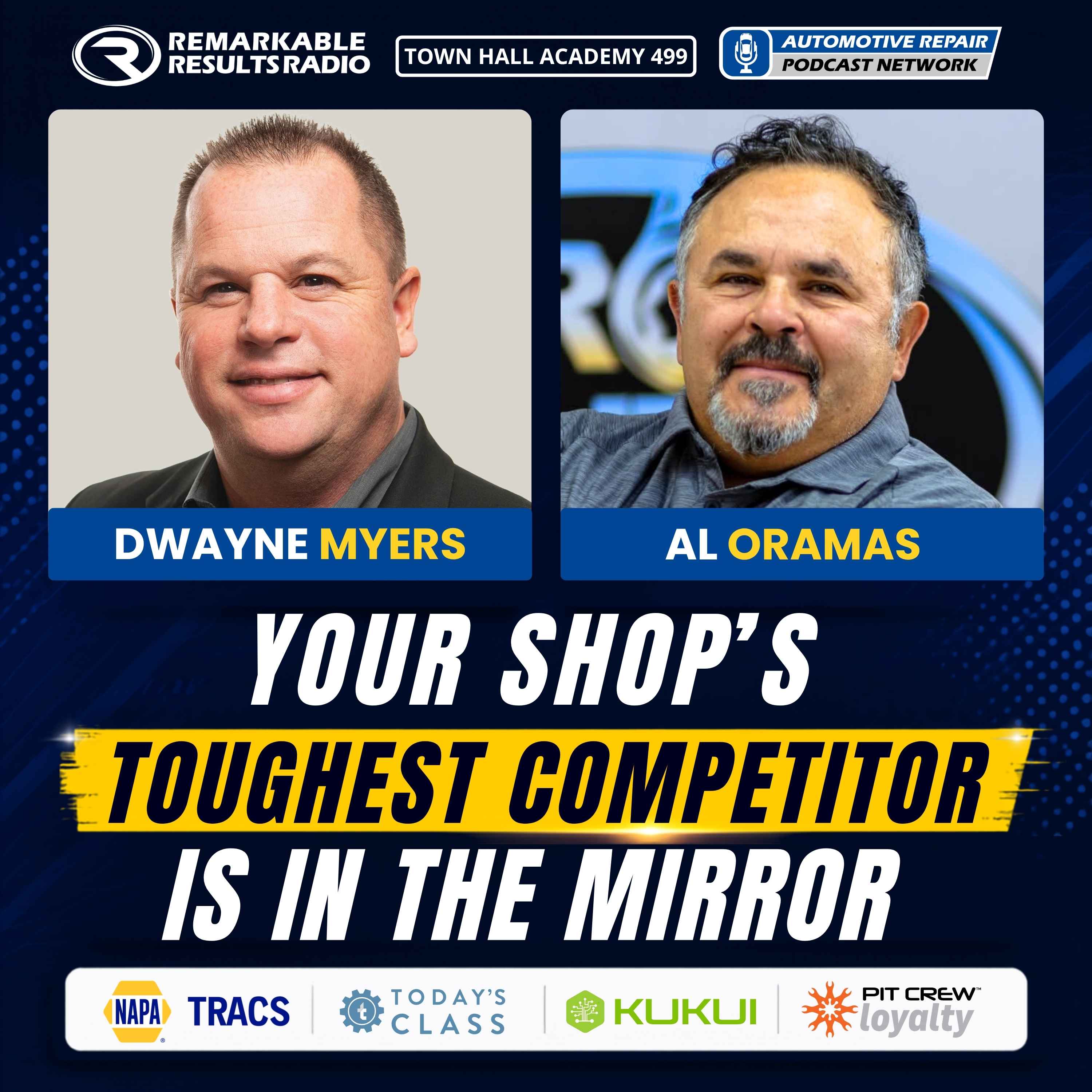
Your Shop’s Toughest Competitor Is in the Mirror [THA 499]
Thanks to our Partners, NAPA TRACS, Today's Class, KUKUI, and Pit Crew Loyalty Watch Full Video Episode *]:pointer-events-auto scroll-mt-[calc(var(--header-height)+min(200px,max(70px,20svh)))]" dir="auto" data-turn-id="request-WEB:8e59eec7-a235-4fa3-a072-956fea3fe478-7" data-testid="conversation-turn-4" data-scroll-anchor="false" data-turn="assistant"> *]:pointer-events-auto scroll-mt-[calc(var(--header-height)+min(200px,max(70px,20svh)))]" dir="auto" data-turn-id="request-WEB:49a777bf-d263-4496-bf0b-2eb3a46ac96a-11" data-testid="conversation-turn-24" data-scroll-anchor="false" data-turn="assistant"> Who is your shop's toughest competitor: the business down the street, or the people inside your own four walls? Carm Capriotto sits down with shop owners Dwayne Myers and Al Oramas to explore internal competition and why the biggest threats to a shop's success often come from within. The conversation challenges owners to stop obsessing over competitors and start examining their own leadership, consistency, processes, and customer experience. What You'll Learn Why operational consistency matters and how small deviations can create chaos.Why owners can't effectively lead from the "engine room."How true delegation requires owners to let go of control and trust their teams.Why "everything speaks" when it comes to the customer experience.How standing at the curb can reveal things owners no longer notice inside their own shops.How simple physical and operational improvements can create meaningful change.Why asking employees what they love and what they would change can reveal the true health of a business. Your greatest competitor may be staring back at you in the mirror. The shops that grow stronger are willing to look inward, challenge their own habits, listen to their teams, and consistently raise the standard. Leadership isn't about controlling every detail; it's about creating the environment, expectations, and trust that allow the entire team to perform at its best. Dwayne Myers, Dynamic Automotive, 8 locations, Maryland. Dwayne’s previous episodes HERE. Al Oramas, Pro Auto Care, 2 locations, Denver and Littleton, CO Optimize training with Today's Class: In just 5 minutes daily, boost knowledge retention and improve team performance. Find Today's Class on the web at https://www.todaysclass.com/ David Boyes, President of ‘Today’s Class” David’s previous episodes HERE Brad Updegraff, Dave’s Ultimate Automotive, 7 locations, Austin, TX. Brad’s previous episodes HERE. Thanks to our Partner, NAPA TRACS NAPA TRACS will move your shop into the SMS fast lane with onsite training and six days a week of support and local representation. Find NAPA TRACS on the Web at http://napatracs.com/ Thanks to our Partner, Today's Class Optimize training with Today's Class: In just 5 minutes daily, boost knowledge retention and improve team performance. Find Today's Class on the web at https://www.todaysclass.com/ Thanks to our Partner, KUKUI Stop juggling multiple marketing tools. KUKUI’s integrated platform delivers 4x better website conversions, automated follow-up, and real-time ROI tracking. Get industry-leading customer support with KUKUI at https://www.kukui.com/ Thanks to our Partner, Pit Crew Loyalty You’re probably tired of chasing new customers who never return. We understand. Pit Crew Loyalty ends the one-and-done cycle, turning first visits into lasting, reliable revenue at https://www.pitcrewloyalty.com/ Connect with the Podcast: Download and Listen on Our Mobile App: https://automotiverepairpodcastnetwork.com/app/Visit the Website:https://remarkableresults.biz/Subscribe on YouTube:https://www.youtube.com/carmcapriottoFollow on Facebook:https://www.facebook.com/RemarkableResultsRadioPodcast/Follow on LinkedIn:https://www.linkedin.com/in/carmcapriotto/Follow on Instagram:https://www.instagram.com/remarkableresultsradiopodcast/Join Our Virtual Toastmasters Club:https://remarkableresults.biz/toastmastersJoin Our Private Facebook Community:https://www.facebook.com/groups/1734687266778976Join our Insider List:https://remarkableresults.biz/insiderAll books mentioned on our podcasts:https://remarkableresults.biz/booksOur Classroom page for personal or team learning:https://remarkableresults.biz/classroomBuy Me a Coffee:https://www.buymeacoffee.com/carmSpecial episode collections:https://remarkableresults.biz/collections...
The Mistake That's Costing Your Shop Money | Nick Yannessa & Chi Wong - Ep 30
Consistency is key - heard that! But, consistency is HARD. That's why I gave up on trying and let the experts handle it. Detect Auto. Let them clean up your estimating process and raise your ARO - like they did for me! CLICK HERE TO BOOK A DEMOAnybody can run a shop. Building one that lasts? That's a whole different story. If you're ready to build smarter systems and a better experience for your team and customers, check out Tekmetric HEREIn this episode, Tonnika welcomes Nick Yannessa & Chi Wong to talk about how they started a auto repair shop. Nick brought up how he thinks it's dangerous to judge customers based on their car or background—presenting recommendations equally is key for success. They all discuss the importance of efficiency and processes, especially for one-person operations, with strategies ranging from shop layout to streamlined part sourcing. The discussion explored how relationships—whether through peer support, coaching, or personal connection with customers—can make or break both morale and business success.Timestamps:00:00 Growing up in the business, judging customers & learning not to assume03:00 The wild origin story of a Philly-area repair friendship07:00 Shop ownership journeys: from dealer frustration to Craigslist finds13:15 Shop expansions, partnerships, and the big pains of growing fast16:30 Management mistakes: Getting hurt by the wrong coaching advice22:30 Why shop friendships (and roasting each other) drive real growth26:00 Breaking out of the tech mindset — why process & sales skills matter35:00 Single bay or big staff? How to thrive as a one-man show41:30 Efficiency hacks: leg surgery for your shop layout47:00 The power of batching tasks, double-dipping on equipment, and finding your warehouse51:00 Bootstrapping a new shop, from free desks to Techmetric (or not)59:00 Real-life sales training: How to pitch brakes and win trust1:12:00 Dealership vs. Indie: Why premium service isn’t just about the brand1:20:00 Body shop margins, insurance games, and why service rocks1:33:00 The secret sauce: Making your shop unforgettable1:39:00 Building trust over time (without a single DVI)1:44:00 Health, happiness, and generational wealth—success beyond KPIs1:46:00 Why driving a free CR-V might beat flexing a Cadillac1:52:00 Building benefits for your people, and leveling up your future1:58:00 Final rants and why you need to be the “dive bar” your customers love
What Nobody Warns You About Shop Ownership | Andrew Klement & Caleb McElmurry - Ep 28
You shouldn't have to play detective just to figure out what's happening in your own shop. 😂 If you're ready for all your shop's information in one place, check out Tekmetric HEREConsistency is key - heard that! But, consistency is HARD. That's why I gave up on trying and let the experts handle it. Detect Auto. Let them clean up your estimating process and raise your ARO - like they did for me! CLICK HERE TO BOOK A DEMOIn this episode, Tonnika Haynes sits down with Andrew Klement and Caleb McElmurry to dive into the realities of young shop ownership in the automotive industry. Andrew and Caleb talk candidly about their rough starts, the importance of being profitable (and actually charging the right prices), and how building a supportive community has made all the difference.Timestamps:00:00 Young shop owners introduce themselves, plant mom stories, and moving from mobile to brick-and-mortar04:36 Caleb describes his dealership beginnings, lessons from a used car lot, and why integrity matters06:35 Andrew shares his “started from the lawnmower” story, learning on the job, and meeting the right mentors12:27 Why both left bad bosses and how they leveled up their skills13:55 Building a customer base: overcoming $20 repair mindsets and finding the right clients17:15 The hardest part of moving from technician to owner—payroll, pricing, and pressure21:21 Learning to price (and value!) your work: Big mistakes shop owners make25:28 What it actually means to take care of your community—and yourself34:12 Balancing family and business: honest talk about shop life with kids39:16 The shop mistake neither will EVER repeat again43:03 Coaching, community, and why there’s no single right way to win in this business57:00 Are you building a legacy? Talking new generations and what it means for your shop1:01:50 What to know before you open your own shop (spoiler: it’s harder than you think!)1:16:10 Why undercharging and sacrificing profit is hurting everyone in the industry1:21:55 Being proud of what you’ve built—yes, you deserve that truck!1:29:12 Marketing in small towns & finding the customers who value your shop1:33:09 There’s more than one way to run a shop—and that’s okay1:39:09 Real talk: mental health, community, and lifting each other up in the industry1:44:01 Wrapping up: finding your people, making it your own, and why the journey is worth it