← Industry Trends
Technology & AI in the Shop
Where the shop is headed — AI tools, automation, and the technology trends reshaping how independent repair shops operate.
40 episodes
01

Repair Shop ReckoningJuly 17 · 41 min
Adapt or Die: Using AI To Take Control Of Your Shop
Every major shift in business creates two kinds of shop owners. The ones who wait until everyone else has already figured it out. And the ones who adapt early, learn the system, and create an advantage long before the rest of the industry catches up....
Listen →
02
Changing the Industry PodcastJuly 13 · 1h 4m
Episode 277 - Building Better Workflows and Navigating AI With Ash Kaplan of Golden Hour Garage
Don't get to the end of this year wishing you had taken action to change your business and your life.Click here to schedule a free discovery call for your business: https://geni.us/IFORABEDon't miss an upcoming event with The Institute: https://geni.us/InstituteEvents2026Shop-Ware gives you the tools to provide your shop with everything needed to become optimally profitable.Click here to schedule a free demo: https://info.shop-ware.com/profitabilityTransform your shop's marketing with the best in the automotive industry, Shop Marketing Pros!Get a free audit of your shop's current marketing by clicking here: https://geni.us/ShopMarketingProsShop owners, are you ready to simplify your business operations? Meet 360 Payments, your one-stop solution for effortless payment processing.Imagine this—no more juggling receipts, staplers, or endless paperwork. With 360 Payments, you get everything integrated into a single, sleek digital platform.Simplify payments. Streamline operations. Check out 360payments.com today!In this episode, Lucas and David are joined by Ash Kaplan, owner of Golden Hour Garage. Ash shares her journey growing up in the automotive industry, how she built her niche helping struggling shops streamline workflow, and why process consistency is essential for shop success. The conversation also explores the impact of AI and automation in automotive repair, emphasizing the ongoing need for human expertise and genuine customer relationships.00:00 Visual calendar time zone issue10:32 Building workflows for struggling shops12:27 Finding a solution for consistency17:50 Explaining the company name25:15 Documenting a car recall dispute30:36 Employee motivation and compensation issues32:59 Overcoming belief in others39:15 Lessons on gullibility from father47:26 Weekly and Quarterly Accountability Meetings52:34 Building internal talent for growth56:56 Discussing AI sustainability issues59:31 AI's Impact on Job Markets01:07:20 AI in automotive service shops
Listen →
03

The Institute's Leading Edge PodcastJuly 9 · 1h 0m
211 - It's Not Just Oil: Understanding Modern Lubricants & Service Recommendations
211 - It's Not Just Oil: Understanding Modern Lubricants & Service Recommendations July 8, 2026 - 01:00:14 Show Summary: Modern engine oil is far more than a viscosity rating. Jim Cokonis and Nick Pope explain why manufacturer specifications additives and certifications matter just as much as the oil weight. They break down how oil life monitoring systems actually work why using the wrong lubricant can void warranties and how service information protects both the shop and the customer. The discussion also explores brake fluid engine design and the importance of staying curious as vehicle technology continues to evolve. Host(s): Kent Bullard, CCO, The Institute for Automotive Business Excellence Nick Pope, Industry Coach, The Institute for Automotive Business Excellence Jim Cokonis, Technical Director, Today's Class Show Highlights: [00:00:00] – Modern lubricants require facts over myths and better technical decision making. [00:05:00] – Oil weight alone never determines the best protection for an engine. [00:11:00] – Wrong oil specifications can void warranties and cost thousands. [00:21:00] – Reading oil certifications helps match products to manufacturer requirements. [00:29:00] – Lubricant standards vary because every engine has different engineering priorities. [00:35:00] – Service information beats assumptions when selecting the correct lubricant. [00:42:00] – Even oil filter installation procedures can vary by manufacturer. [00:49:00] – Modern engines rely on advanced lubrication systems and specialized oil formulations. [00:53:00] – Oil life monitors calculate service intervals using real operating conditions. [00:57:00] – Confidence grows through experience but curiosity keeps technicians improving. In every business journey, there are defining moments or challenges that build resilience and milestones that fuel growth. We’d love to hear about yours! What lessons, breakthroughs, or pivotal experiences have shaped your path in the automotive industry? Share your story with us at info@wearetheinstitute.com, and you might be featured in an upcoming episode. 👉 Unlock the full experience - watch the full webinar on YouTube: https://youtu.be/fhJAnd9ZKI8 Don’t miss exclusive insights, expert takeaways, and real talk you won’t hear anywhere else. Hit Subscribe, drop a comment, and share it with someone who needs to hear this! Links & Resources: Want to learn more? Click Here Want a complimentary business health report? Click Here See The Institute's events list: Click Here Want access to our online classes? Click Here ________________________________________ Episode Transcript Disclaimer This transcript was generated using artificial intelligence and may contain errors. If you notice any inaccuracies, please contact us at marketing@wearetheinstitute.com. Episode Transcript: Kent Bullard: Hello everybody, and I am excited to welcome you back to our technical webinar series for you technical, uh, gearheads out there. Very excited to cover some great content today. Today we're gonna be talking about lubricants, the services there, uh, a lot of great stuff. What I'd love to do is just invite some fantastic trainers, Nick and Jim, on stage with us. They've got some fantastic content for you, uh, talking about oil lubricants plus the service recommendations. It's not just about oil. Nick, Jim, welcome to the stage. Nick Pope: Glad to be here. Thank you, Ken. Glad to be here. Kent Bullard: Hello everybody. Uh, just so that we can get some ground rules laid down, uh, our goal with this series really is to, to provide some of the technical skills plus the critical thinking skills that'll help you be better at your job. There's a few things that we wanna keep in mind as we go forward into this. The first is that we're gonna be asking some questions, and we would love your participation. Those of you out there, let me know that your chat is working, 'cause this is how we'll do the polls later on, by giving me a one, two, or a three in the comments section. As we put these polls on screen, they're gonna have some answers to different questions, and the best way for us to see those is to just answer one, two, or three in the chat. Are you guys excited for some of the content you're covering today? Nick Pope: Absolutely. Jim Cokonis: Absolutely. Kent Bullard: Wonderful. Anybody out there in the, in the comments? Michael, I saw you, uh, jump in there. Let us know you guys are here. Hi, everyone. Um, as we get into it, I wanna make sure that we are, uh... We got a comment that said, "Sound stop," by the way. Uh, just to make sure that we keep things positive and constructive, there's a lot of things we're gonna cover today. Make sure that you guys are, uh, taking notes, taking key takeaways here, but most importantly, we wanna have a lot of fun with this. Tyler, I see you in the chat there. Michael. Awesome. With that said, I'm gonna give the time over to the, to the real experts here, to Nick and Jim Jim Cokonis: I just put a, uh, comment out there that says please ask questions, and we'll get to them as time allows. Because Nick, I think you'd agree, we would much rather speak with everyone than at them for- Nick Pope: I, I do agree. I, I think that we should make this conversational, have some good takeaways at the end of it, but by all means, everybody, please chime in with any questions, experiences, stories. We would love to hear about them. Kent Bullard: As we go into this, I'll be your guys' voice, uh, for the audience. I'm gonna be monitoring the comments for the most part as these guys go into this content. Uh, just we're here to help Jim Cokonis: So that being said, disclaimers. Um, I don't get into... In this short of a format, we're not gonna get into the difference between cenostoke and cenopoise and, and all those, um, terms of the tribologist. There you go. There's a piece of homework if you don't know what a, what a tribologist is- Tribologist ... you can go look that one up. Had the opportunity to speak to a couple of them. They're fascinating people, uh, and they're full of good information. But what we wanna do is, one of the things that I have enjoyed in my career, Nick, I don't know about you, is, is busting myths. Um, sometimes we hear things and information gets passed along by rote, and then we go look up information and look up data, and we go, "Well, that doesn't work the way I thought it did." And so we're not trying to call anybody out, tell you what oil to use, or anything else. Um, this is us calling ourselves, and hopefully everyone else, up to, you know, increase the level of professionalism and fact-driven decision-making as we take care of the motoring public. So you got anything to add to that, Nick? I mean... Nick Pope: I do. You know, we're just talking about oil right now, however, this is universally applicable to all fluids, right? Jim, I remember way back when Ford came out with Mercon V and, you know, they superseded it where you could use it to, uh, any product that used Mercon. And, you know, this is a really good informational s- you know, uh, part of our series where we're gonna really talk about concepts that are going to apply to other fluids, and there will be a lot of takeaways. You know, for me personally, I'll show some vulnerability. I've been in positions where I thought something and I was completely wrong. And, um, you know, for me, the takeaway was I, I learned that I was wrong, and I was aware more moving forward where I needed to keep up with things to keep on that cutting edge. Jim Cokonis: I have a, I have a good friend of mine says, "You know, I was about 10 years into the business and I was getting to the point where I was getting pretty confident and I was learning a lot of things, and I thought it all... I had everything figured out." And he said, "The longer I go, the more I realize I don't know." So that's that perpetual student. Um, l- so now that we've gone through that disclaimer, let's get back over into some of the things that we're going to talk about. Um- We're gonna talk about oil life because it's a big topic out in the field, and, you know, what manufacturers recommend, and I hear the chatter all the time. Um, but can oil last 10,000 miles? Do the maintenance systems work? How do they work? Are there any differences between them? You know, is the maintenance minder on a Mercedes the same as it is on a Toyota? Here, preview. No. Um, oil is oil. Just put that stuff in it. If it says 530 on the cap, put some 530 bottles in it and you're good to go. Is that true? Um, what are the facts? How, how important is the weight of the oil compared to the specifications that the oil meets? And then what does the car know? A lot of modern cars know a lot of things, and some of these sy-systems are quite sophisticated. But there's also things in service information that give us the details behind those recommendations, and we're gonna share some of those, uh, with you as well. So I'm just curious, I don't know if you have a poll for this one, Kent, but have you all ever had a conversation like this in your shop? Yes? No? Um, oil doesn't last that long. The manufacturers aren't building cars to last. They wanna sell you a new car, so they don't care if it, you know, if the oil doesn't last that long and the engine life isn't there. Um, cars will run low on oil before the service interval is reached. Can that be true? Yeah. Could it be because of the oil we put in it? There's a question, and I'm letting that sit out there for a minute. Um, I talked to a tribologist one time because one of the oils that I have been using for years personally, I'm not gonna even tell you what it is, but I'm like, it's a product and the base stock of it is what is used to lubricate jet turbines And then it has additive in it, and one of the additives that it has is ZDDP. Well, if you know anything about what's going on with oil additives and the formulations, you know that ZDDP is something that we have to add to motor oils these days if we're running an old flat tappet cam, like on an old small block or an old Ford. And one of the reasons we've taken the zinc products out of oil is because it can poison catalysts and poison O2 sensors, make them inoperative. So of course we're gonna get check engine lights. It can also, uh, you know, shorten the life of a cat. And so I asked this tribologist, I said, "How can you recommend this oil for a emission-controlled vehicle when it has an admittedly high level of ZDDP?" And here was the answer I got. Nick, tell me what you think about this if you, if you were to listen to this guy. He said, "Look at the flash point-" Yeah ... which is where the oil starts to smoke. If any of you guys are into cooking, you know that certain oils can take higher heat before they start to smoke and burn. Same thing with motor oils. Okay. What the motor oil is made out of and how well it's refined have an impact on what's called flash point. And he says, "If the oil doesn't flash off, the zinc doesn't escape." And that was the answer he gave me. What do you think about that? Nick Pope: I think that makes a lot of sense, and I would love to meet this guy. I'm sure you had some really other key takeaways from him. Do you have any more that stand out aside from that? Jim Cokonis: I had another conversation with another tribologist who built a different product. I won't get into all that. But he was explaining that certain people use products designed for hydrodynamic lubrication, which means, like, y- you know, in a, on a crankshaft, we want hydrodynamic lubrication. We wanna float the parts on a thin film of oil to maintain separation. If the pressures and the intensity ever go beyond that, then we have a situation where we need boundary layer lubrication, and the additives and the formulation of the lubricant are different depending on what we're trying to do. He says, "So if you use a product designed for hydrodynamic lubrication, like motor oil, in an area where the product doesn't have an oil pump and the ability to flow the oil in to maintain that layer, then you don't have the boundary layer lubrication to prevent wear." And since I was using that on some pretty specialized pieces of equipment, that was an education, too. And helped me understand why some people were erroneously using and recommending products because they weren't right for the application. There's another one. Um- Nick Pope: That, that's a good one. And have you ever ran across anything where somebody unconsciously used the wrong type of oil with, uh, having any type of long-term mechanical- That's a- ramifications? Jim Cokonis: That, that's a good one. Um, years ago I was doing a series of maintenance classes for a large organization, and the management team at this particular region, they shared with me that they had a relatively new European vehicle that they were doing all the service work on. Had a r- you know, consistent customer, they trusted them. They did all the work, and they were doing the oil changes on this vehicle, and with relatively low mileage, it developed an engine noise. They took it to the dealership And the dealership said, "We need to see all your service records." Kent Bullard: Mm. Jim Cokonis: And when they looked at the service records, and they looked at the oil that was on all the oil change intervals, the oil was changed within the intervals. It did not meet the specifications for that engine, and the manufacturer voided the warranty on the entire vehicle. Kent Bullard: Wow. Jim Cokonis: Yeah, yeah. Say that backwards. Wow. Wow. Okay. Um, so when you have a situation like that, and they want to take care of their client, of course, they're like, "What do we need to do?" And basically, the manufacturer and the dealer came back and said, "We have to install a new factory engine, and it has to be done at the dealership." And they paid for it, and it was a $15,000 lesson 15 years ago. Kent Bullard: So it's, it's essentially like you just installed the wrong part. Jim Cokonis: Yes. You're allowed to use things that meet the specification that aren't purchased from the dealer, but they have to meet the specification. And the oil that they were using did not. Um, other conversations came up about, you know, transmission fluid, and a lot of places like to use universal transmission fluid. And when you really dig into it and you look at it, and the- you'll see for this transmission, it's okay for top off, but you can't service the whole thing because something will happen with... You know, the additive package isn't right for that transmission. Or you'll also see things like, um, approved for use in this particular application once it's out of warranty. Think about that. Nick Pope: Mm-hmm. Jim Cokonis: So what are they saying? Well, they haven't had the- They're saying they haven't had the, they haven't had the independent testing done to prove, they're confident that it'll work, but they haven't had the independent testing done. Now, if I'm running a shop and I wanna take care of a client's car and I don't wanna get into a contest about who's right and who's wrong, I'm gonna go, "Okay, let me go find something that actually has the approval for that particular product." Make sense? Nick Pope: Yeah, it makes sense. You know, they're, again, kinda circling back to a comment that we alluded to on our first webinar, there's the difference between thinking and knowing, right? I think this is the right oil, but do I know it? And now, you know, uh, as things continue to evolve in our industry, right, that puts us in a position where we need to kind of run along that and, you know, continue to grow ourselves as technicians to keep on that cutting edge. I think about, uh... Go ahead, Kent. Kent Bullard: Oh, I was just gonna ask a, a question. Do you think that depending on the types of vehicles they're working on, they might make the assumption that taking this degree of, of due diligence or looking at these specialty, you know, lubricants and oils, that it is only meant for, like, performance vehicles? Mm-mm. No? Jim Cokonis: No. Um, there, there are non-performance vehicles and we, we've got a slide coming up here very shortly, um, that will get into some of that. And so when we talk about lubricants and fluids for vehicles, everything's got to align. Okay? The type of oil that's being used, its viscosity and performance is going to be different for the way the manufacturers designed that particular motor. And if we look at new engines, they don't have the passage sides and the, the same tolerances and clearances as some of the older products. And so if we try and run some of the older lubricant technologies in those engines, they are not gonna be able to get there. A lot of the wear happens on startup, and if the oil that you're running doesn't have the viscosity to get this thing lubricated fast enough, um, you're, you're gonna cause excessive wear on startup. And so, you know, everybody likes to say these oils are too thin. Well, one of the things we need to do in our minds is realize that the weight of the oil has a whole lot less to do with how well it lubricates than the actual makeup of the components and the type of machine work and everything else. So think about this. You can have a rotary pump, you can have a rotary pump with a clearance of two microns, which is thinner than a human hair, lubricated by diesel fuel. Diesel fuel is not thick. But it lubricates that component spinning at, you know, whatever relative to engine speed Now, if the diesel fuel doesn't have the right lubricity in it or we have a filtration system that isn't keeping it clean enough, then we'll have a situation where we'll end up getting wear and damage. So, you know, the viscosity is not necessarily what drives the lubrication. If you have water on the road, water is not thick. But if there's enough water standing, you can hit that with a 8,000-pound vehicle and hydroplane. You think there's hydrodynamic lubrication? You bet there is. So when we look at this, it's gotta be the material. It's gotta be design and tolerance. It's gotta be the filtration. The lubrication system may have some special things that are done, um, to it to help it handle the changes in loads. Um, what's the structure of the oil? How well refined is it? Um, one of the things I have said for a long, long time is that many of the oils that we sell in the United States as fully synthetic oils can't be sold other places in the country as fully synthetic because-- Or other places in the world. Other places in the world, fully synthetic means that it's gotta be Group IV or Group V base stock, which means it's fully formulated from chemical reactions. It's not made from dead dinosaurs. Um, so one of the interesting things that I learned in doing my research is that Group IV PAO oils are extremely durable. But the trick is, some of the additives that we use won't mix with PAO oil. So many fully synthetic oils are a blend of Group IV and Group V because the ester oils, the Group V fully synthetic oils, they will pick up the things that are used as additives to mix it in and make sure it's distributed throughout the motor. And so that brings us to that last piece of additives, and the additives are the key to success. And here's another interesting thing that I have heard from tribologists, and I'm, and I mean from multiple different companies Not all additives are, um, compatible. And you can add, quote, "an additive package" to a, an oil that's appropriate for the vehicle, and it can nullify the benefits of what that formulation met. Mm. And so I've always been personally hesitant to use, um, motor oil additives, personally. Now, I'm not telling anybody what to do, and you've gotta have your own conversations with your own suppliers, um, and make sure that what you're using is compatible with... The whole system's gotta work together. Does that make sense? Did I say that right, Nick? Nick Pope: It, it does make sense. And, you know, the, the tricky part to this is whether we use the right oil or not, there's not going to be an instant sign of failure in most cases, right? And when we think about the long-term picture, you know, um, d- I like to look at it this way. You know, we think about how we may have a certain water source that we drink on a regular basis, and over the series of time, we may start to not feel as good as we did once, you know, ever since we started drinking from this water source. And, you know, when we think about it with oil, it's, it's, it's the same thing, right? Over th- a series of time, the engine may be impacted in a negative way if we put the wrong engine oil in it. And- Circling back to why we do this, we do this to serve our customers, right? We hold ourselves to a high quality to, to be the professionals in our industry, right? That's, that's an honor and a privilege every single day. So we have to look at the long-term picture as well, and I think that's why this is really important that we're having these conversations. And, and Jim, you know, that, that engine story that you shared really, uh, stood out to me, right? Um, you know, the fact that it voided a warranty. Gosh, could you imagine if you had a vehicle that you were taken to a, a, a repair shop or, you know, a quick lube and they were putting the wrong oil in over and over again, and you had an engine issue, thought it was under warranty, and then bam, got hit on the head with a $15,000 bill? Oof. I, I would lose it, man. Jim Cokonis: Yeah. Oof, oof indeed. Kent Bullard: And at this, at the same time, who should be on the hook for that? Nick Pope: Right. Jim Cokonis: Yep. Well, I've always looked at it like this. We're the professional. Exactly. Absolutely. It's our job to know. It's our job to know. Um, so I actually went and just took some pictures of bottles because I find them fascinating, and so... Nick Pope: What kind of bottles, Jim? Jim Cokonis: Ha. Oil bottles. Oil bottles. Got Nick Pope: it. Jim Cokonis: Um, so this is one. This is Mobil 1 Extended Performance, and I love it says, "Protects for 20,000 miles guaranteed," with a little asterisk. Well, guaranteed how and what? And I'm not gonna get into all that, but this particular bottle carries the dexos1 Gen 3 approval. Okay? And then also on the, on the right side over here in this section, hopefully that shows up a little bit better, um- It talks about meets or exceeds the requirements of ILSAC GF-6A, API SP, SN-plus, SN and SM. Okay? So then it says it, it, it meets or exceeds the requirements of Chrysler, couple different Chrysler specs, and a Ford spec. And then recommended by ExxonMobil for use in applications requiring this other Ford spec, two of them there. And then it says, "Has the following builder approvals," the, the Dexos 1 Gen 3, and the Honda Acura HTO06. And so if I'm looking for things, I'm definitely gonna use this in anything that has these, these, these upper spe- specs with the Chrysler, um, 6395 and 13340 and the Ford, uh, M2C961. Um, but the 946, I'm relying on ExxonMobil for that. Now, I'm not telling you you shouldn't use it, because they may just not have gotten the individual approval on that yet. But if I'm trying to be sure on something that's under warranty, um, I may look for something that actually holds that approval. And then that's a bottle of 5-30, right? And so it has an API service of SP. Well, let's take a look at another bottle of 5-30. This is from Pennzoil, and it says it's full synthetic, 20,000-mile protection guarantee. But if we look at this one, it holds GF-7A, API SQ. It holds some, some Chrysler and Ford, um, formulated to meet or exceed But it doesn't carry the GM dexos spec. Okay? Now, maybe they've chosen not to pay for the m- the, the logo and the certification from General Motors on this one. What does that really mean to us? And so when we look at that, you know, these two side by side, when we look at them, we can determine, well, what, what will this work well in? What's the, uh, you know, what's, what's the best application for what I'm working on? So then I'm gonna show you guys a website that I use to visually do some of this. Now, there's kind of a disclaimer on this website, and it says it's designed to really compare performance within a specific standard and not necessarily to compare across standard systems. But I think there is a lot of things that we can learn from looking at some of these performance specifications. And Mike Kortaba, k- how do I... I need to figure out how to say your name, my friend. Um, Michael Kotarba? Did I do it right that time? Give me a thumbs up. Michael Kent Bullard: K. Jim Cokonis: Mike K. There we go. He says, you know, take a look, and we had this one oil that said it was SN or SN Plus. And if we look at API's standards, this is a graphic that looks at, um, eight specific sections of Oil performance. These are some standards, and I actually have all this information in the presentation. Excuse me. And so I'm just gonna pick, um, let's pick SN Plus. And if we look at how this oil is formulated, it's designed, and this is way better than some of the old oils. L- l- look at this performance standard for API SJ. It's like it puts a little splat in the middle, and the farther out you go from a zero to a 10, it's how, how well it performs those tasks under testing. That's what this is supposed to represent, okay? But if we look at this one and we say, "Okay, um, let's compare that to GM Dexos 1 Gen 3." Hmm Which one of those am I more focused on making sure the oil meets? I think when I look at this for fuel economy and oxidative thickening and the ability to control deposits and sludge, I would think that, that, that particular, um, certification would be important for the engine that I'm working with. Okay? Then we can look at some of the others too. Um, I think Mike said look at some of the ACEA ratings, right? And we can look at some of the newer ones from 2023. Hmm Okay? Do we see where some of these European standards may focus more on the durability and the oil life from a standpoint of conserving resources? And then we can look at Some of the Ford specifications. Now, I don't have all the Ford specifications here, but Ford runs an extended oil life monitor on several things, and let's look at some of those. Oh, look at that. That particular oil, I can tell you by looking at it, that's probably one of the diesel specification oils. And the reason I say that is because this is a oil that doesn't really go after, um, low-speed pre-ignition, and we'll talk about what that is. But it does weigh in pretty heavily on ac- uh, aftertreatment capability, which is typically something that's gonna happen on diesels. And then we can look at this particular oil, and obviously this would probably be one of the ones that Ford uses, and I don't have all these memorized off the top of my head, but that's a different performance standard, and Ford is probably using that on some of their boosted applications because they're targeting low-speed pre-ignition, which can cause almost instantaneous damage to an engine. What do you guys think of this? Is this kind of fascinating? If you've never looked at these... Let's take a look at some of the Mercedes ones. Mercedes is one that's known for running some pretty extended oil change intervals, and look at how far out on the charts they're targeting for performance with wear and so forth, but they're not really pushing their low-speed pre-ignition. Is Mercedes running a lot of boosted applications, or are they running a lot of naturally aspirated stuff? And that's the type of things that we need to look for, okay? Nick, does that bring up any questions for you? Nick Pope: Yeah, absolutely. I have one question. And, you know, looking at the Lubrizol website, what happens if we have a manufacturer who, you know, just we'll say has a specific oil for a 2009 model year and, you know, a newer model, you know, 10 years later has c- a wider band of coverage, right? Um, where it'll cover that span but then have some additional areas that it covers as well. Are we able to use that oil on the newer model, uh, vehicle? Jim Cokonis: Can you, can you run that by me one more time? Absolutely. I was read- I was read- I was reading a comment. I'm sorry, Kent. Uh, I see these comments- No, I was, I was just- ... popping up and I'm like, this is, this is some f- Yeah ... and I know a couple of these guys, so th- these are definitely kind of conversations that, that we get into. Um. Nick Pope: So, so- Jim Cokonis: Run that question by me one more time, Nick ... Nick Pope: so if we have a, an older model vehicle, right? And, um, we'll just pick on Mercedes. Now, looking ahead, you know, on this Lubrizol website, you were showing the coverage, you know, in the specific areas that, you know, the oil has its, you know, key purpose in. If we're gonna use, consider using, um, a newer oil that maybe has a wider span of coverage, can we use that on an older vehicle if it hits the mark on the initial requirements, but then in addition to- So Jim Cokonis: that's a, that's a great question ... covers wider areas? That's a great question. I got a specific one that I'm somewhat aware of, even though I'm not a, a European specialist. Um, so BMW. BMW, a long time ago, and I'm gonna, I'm gonna get rid of... Let's see, I'm gonna get rid of this API one, and I think I had Then I have a Ford or I think I had GM up here I'm just gonna clean the chart up. Okay? And a long time ago, ago, BMW Long Life 01, right? Um, and these were the years that they were put out. So if you go back to 1998, this was the performance standard. If you come to '01, this is the performance standard. If you come to Lo- Long Life '04, this is the performance standard. Can you see where as they got newer, they're covering what they used to require and then more in performance? Nick Pope: Yes. Jim Cokonis: And so a lot of folks will say, when you look at the BMW, they will tell you that their newest standard is backwards compatible to all the others So if you have a vehicle that calls for, you know, the 22FE++ from 2022, it covers the performance standards of all the previous ones. The only real interesting factor though is that when you look at these older, um, oils, and I would need to do some, some double-checking here, I would, you can see that the older oils were more in the high temperature, high shear category because they're above 3-5. Whereas the newest standard is only just above 2 because look, it goes out and goes after fuel economy more, so it's less, um, less of a high shear oil because they went more after flowability to reduce the pumping losses, uh, from, from driving a pump to run that heavier oil. Make sense? So yeah, there's, there's definitely some research to do in this, and the beauty about it is a lot of us have repeat clients. So with repeat clients, we, you know, we have all these great, um, we have all this great service information systems and we can put in the specs on what car takes what these days, and it's pretty easy to do. So once we look it up once, the next time that car comes in, we can have the standard written right into our service information for what that car has. Just be sure to check, um, service information every once in a while because they change things. So let's talk about changing things. Kent Bullard: Um- Well, before we get into that, I- Yeah have two things. One, uh, Nick, I think you had a poll for everybody out there, and then I wanna get to Jacob's comment. Nick Pope: Yeah. So, uh, let's try to get some engagement here, everybody. I, uh, we're curious, how often do you check the manufacturer's exact oil spec prior to adding oil to the vehicle? Kent Bullard: Remember, you can answer with a one, a two, or a three in the comment section. Number one is every time, number two is occasionally, and number three is rarely As you guys are answering that, I think it's really poignant to what Jacob was asking, right? So we can even, as, as you guys are answering this, this, uh, poll, I'd love to highlight this. Jacob said, "In fact, it's an overwhelming, uh, proposition. You can't fathom the amount of time it would take to cross-reference and catalog oil needs for every car that comes through our small independent repair facility." Nick, what do you think about that? Nick Pope: I think that's fair. I, you know, it is a lot, right? Um, and like anything though, once we go through the motions and set the stage, then it's just gonna be fine-tuning, right? We're gonna maintain it as things change. We're gonna make adjustments. So again, you know, when we look at the big picture in the grand scheme of things, we are, you know, here to serve our customers as professionals, and we have to put in the work to, to meet that mark Kent Bullard: We have one answer here already saying every single time. Uh, Gary, I'd love to know how much time does it actually take you to do this and, and do you find that it is a, uh, time sink for you? I mean, I think as you're running a, an independent small shop, e- every second counts when you're trying to be productive, right? Jim Cokonis: Mm-hmm. And, and for Jacob and everybody else, um, even if you're on Facebook, um, the comments do come through into StreamYard because it's a pretty, pretty sophisticated piece of software. It bring, it brings it through. Um- Kent Bullard: Yeah, Jim Cokonis: even Mike said that we're always looking every time Look it up and turn to the information. Yep. Kent Bullard: Yep. And it goes back to that comment you were saying earlier, Jim, about we are the professional. So what does it really mean to be the professional? If I were going to the doctor and the doctor wasn't checking the type of medication that they were trying to put in me, and it's like, "Oh, we're just gonna use the standard one," but didn't know that I might be diabetic or something, I mean, that would be a cause for concern, right? No. I'm trusting that doctor to make the best recommendation for me to keep this thing ticking, right? Jim Cokonis: Yep. So this is, this is an example, and you can see how easy it is to go for an extended period of time on this type of a topic. Um, but you know, we used to have issues with when GM first went to Dex-Cool and some of the problems that we had with Dex-Cool, and some of it was cooling system design, but it wasn't the chemistry of the coolant. It was the misunderstanding of the chemistry of the coolant that caused the issues, because hybrid organic acid technologies were used in European vehicles for many years prior to that, and they didn't have that issue. Um, part of it is, "I ain't got any orange, put some green in it." Well, you just ruined it. Um, so you know, that's just, that's just the way it goes. And this one is one that's near and dear to my heart, um, because we've seen changes, we've seen changes in technologies now, and this one isn't new, right? In the US, the, the, the federal motor vehicle safety standards talk about DOT 3, DOT 4, and DOT 5, and DOT 5.1. But what we don't talk about are the international standards organizations or ISO class, like DOT 6 type of thing. And so this is an example, and I know some of you folks have seen these conversations, but I'm just gonna point out one spec. Max kinematic viscosity at cold temperature Um, but you'll notice that, and, and this has a lot to do with, with the, the, the specifications for oil too. So look at this. Kinematic viscosity of DOT 3 cold is 1,500. DOT 4 is 1,800, and DOT 4 has a higher boiling point. ISO class 6 or like the Ford low viscosity DOT 4 are 750 When they're cold. Okay? But look at them. They all hit the same minimum when they're hot. The magic of chemistry. So look at it this way. Look at it this way. How many of you have seen the arguments on the interwebs about calibration and what tool you're using and, you know, what target you're using and all that stuff about whether or not that ADAS system and that automatic emergency braking are gonna work? And then we don't look up the fluid specifications for the brake fluid, and when the vehicle's cold, the brake fluid is thicker than what the system is programmed to use. Do you think the brakes can apply and release as fast with DOT 3 or DOT 4 in it as it would with ISO Class 6? Probably ain't gonna happen. Okay? And so we worry about all these things, but then we're not putting in the right fluids to actually make the system work, and those are the types of things that have always been wake-up calls to me, like, "Whoa, I didn't realize there was this much of a difference." So- I- Let's, let... Go ahead. Kent Bullard: I wanna, I wanna just, uh, highlight Gary, uh, Gary's comment here, uh, just the end part of it, 'cause he was talking about how he manages it in his, in his small shop. But he says, uh, you know, they have the service advisor check, and then he can verify. But I love this: "The time to verify is less than a new engine or a lawsuit." Jim Cokonis: I- that is a beautiful comment. Kent Bullard: Yeah. Jim Cokonis: It's wonderful. That's a beautiful comment. Thank you, Gary. Yeah. We, we, we, I think we should, uh, I think we should put that one up as a- Kent Bullard: We should re- ... as a post over top of a video ... retitle, retitle this training that right there. Jim Cokonis: Well, G- Gary, you'll probably get a kick out of this. I have said for decades, "Why is there never time to do it right, but there's always time to do it over?" I have never understood that. Let's, let's do it right the first time, and then we don't have to do it again, and again, and again. Um- Yeah ... so Kent, did we have a poll question on, uh- We did ... what would you do with an oil filter? Put that one up. Kent Bullard: All right, everybody. I wanna see some engagement here. We've tried this. We've tested it. Those of you out there, we've got one more question for you, one more poll for you, and we'd love to know: When installing a filter on a late-model Ford, which option may be true? You can answer one, no lubrication, tighten to spec; number two, lubricate the filter with anti-seize; or number three, lubricate the filter with grease. Let us know with a one, two, or three in the comment section. Jim Cokonis: And now I am going to share with you That this is a question that is on the Today's Class platform about lubrication services on vehicles. And there was a learner that called this out and said, "Absolutely not. You lubricate every filter every time." Um, and they actually selected to lubricate the filter with anti-seize. Um, I don't know if you realize it, but anti-seize has finely ground metal, and I'm not gonna put that anywhere near my oil system if I can avoid it. Um, but We were doing research, and this was something we learned within the last year. There are certain Ford, and I'm, I'm giving the answer away, and I'm sorry, Kent, but- Nick Pope: No, that's Jim Cokonis: fine. I Nick Pope: love it. Um- Jim, you're just really excited about this. Jim Cokonis: I can feel it. Th- th- this one, this one just tickles me to no end because, uh, I actually posted this on our platform and, and got a ton of engagement on it. A lot of people say, "And that's Ford being Ford, and they're wrong. You lubricate every filter every time." And then had a user that actually had some factory training, and here's what they said. "When we lubricate threads and surfaces, the mechanical advantage allows us, with the same force, to put a larger clamping load on." Well, some of these engines are running adapters that are made out of aluminum because we're all trying to save weight. And what they found was when people lubricate them and tighten them down farther than they should because they don't stop at the three-quarter, half to three-quarters of a turn, they actually tighten it down hard enough to pull on that housing, distort it, and create a leak which causes a, um, Jacob says, "I'm a fan of Gotcha Moment." But it causes it to warp the housing and create a leak, and it's not every Ford vehi- vehicle. And so the lesson for me out of this, Nick, is if I'm working on a vehicle that I don't know, I don't apply the knowledge that I had from the vehicles I did know to this new thing. I'm going to service information. Nick Pope: Yeah, and that's a really good point that you just made at the end, Jim, and, and it's one of the nuances to Just the daily changes in our industry. There's so many new changes, there's new, new variables, and as things continue to evolve and, uh, innovation excels at such a rapid rate. It- I love how you put it, though. You know, if it's something you haven't done, you're gonna do your research on it because odds are there could be a similarity with that amongst other things in a way you've been doing things for your whole career, or there could be something new that you're gonna be able to take away and usually in those moments, those things tend to stick with me the most. How about you? Right? Jim Cokonis: Yeah, the, uh... Well, we, we, we have a whole class we teach on it called, We Didn't Know And How To Find Out. Um, and it's all based around looking at service information because, you know, we, Nick Pope: we, Jim Cokonis: there's some stuff I didn't know. And I was taught this by a guy named Matt Ragsdale on, um, IATN decades ago, and this guy had one of these memories where somebody would post about how an EGR system works and he would d- he would respond, yeah, um, he would respond, "Not on that vehicle." And everybody thought he was a jerk because he was very precise and said just not on that vehicle. Well, what did he mean? And then they would push him on it and be like, "Well, that's doesn't help at all." And he'd like, "Look, get more training. That vehicle in month six they had a design and production change and it now behaves this way. It doesn't behave like they did for the last eight years." And he knew that stuff because he'd looked it up, it, it rocked his world, he locked it in, and he would now look at production dates before he decided which system he had. And I see this all the time with technicians. You know, "What do you think could be going on with this EVAP system?" And I'd be like, "What type of system does it have on it?" Yeah. And that's gonna determine how I'm going to test it and what it's gonna behave like. And so all of these things are a key. And then we look at things like 0-16 and 0-8 oil, and we go, "There's no way that's gonna work, and this engine is not gonna last." Well, I got news for you. The Japanese standards oils, the, the JASO system I think is what it is, they've been working directly with the manufacturer. The, the, the, the tribologists from ENEOS have been working directly with the tribologists in Japan for over a decade on formulating these oils. And these are not class four and five. They are a high grade of class three, highly refined- And then the additive package does everything to get the performance standards out of it. Okay? So this is not just something like, "Oh, we're gonna put thin stuff in it to get better gas mileage, and we don't care if it blows up in 10,000 miles." They actually have the data to show it. Okay? And so these engines- And you just don't- Ken, I know, I know we're kinda going long here. Um, Nick Pope: and I'm- Ken, you just opened up a door, man. Jim Cokonis: Oh, I opened up a huge door. Nick Pope: This doesn't even just pertain to oil. I mean, literally look at... You started to dive into it a little bit talking about EVAP systems. But again, you know, an EVAP system is an EVAP system. However, when we start to dive into different, you know, manufacturers, and then we dive into, you know, different makes and models under that umbrella, th- not, they're not always going to be the same. Kent Bullard: Yep. I think, I think this is an important thing to say, you know, 'cause I even, uh, all of us do this as we fall into certain habits and rhythms where, you know, you've got the work of the day, you've got things coming on, you know, on your plate, and it's a lot easier to just assume it's gonna be similar to the previous work that you've done, instead of taking a moment and pausing and saying, "Hey, I, I think I need to just look this up or, or just verify." Uh, again, back to what you had said in the previous, you know, series where we said, you know, the difference between. So I, I think that's also what distinguishes us as professionals, is that we do take the extra time to make sure, to verify, to ask the right questions Jim Cokonis: So this engine came out in the Toyota Camry in, like, '17, and this thing's completely different. And, you know, this engine can switch between Atkinson and Otto cycle, and it can do it during startup conditions. And instead of waiting for oil to warm up and all those things to make the VVT work on the intake cam efficiently, um, they use electric phasing. And so they can actually phase the intake cam where they want for premium operation before everything's fully up to temperature. Um, this, this thing has a two-stage oil pump system, so when they don't need it, they don't have a heavy load demand on it, um, they can run the oil pump at a lower output, and then when the, the loads get really high, they can step up the oil volume and deliver that lubrication and make that 0-16 or 0-8 work in that engine. Kent Bullard: Hmm. Jim Cokonis: Okay? So, um, we're probably gonna put this out as a, as a video, aren't we, Kent? Kent Bullard: Oh, yeah. Jim Cokonis: So this, this will be available. Um, and there's a bunch of terms. If you actually go onto the Lubrizol website, they will explain all their terms for the difference between soot thickening and oxidative thickening and what they do for fuel economy and aftertreatment, and, um, protection against low-speed pre-ignition, and that has to do a lot with additives and so forth that can trigger that sudden explosion, which is not combustion. It's an actual explosion. So all those terms are out there. But what I wanted to get to and make sure we covered, um, I've already covered that not all additives are compatible. Kent Bullard: Mm-hmm. Jim Cokonis: But all of these, uh, terms will be available, and maybe we'll even link a, a document to it that you guys can grab. Kent Bullard: But Jim Cokonis: some- Kent Bullard: I think that's a fantastic idea Jim Cokonis: some of the, um, some of the specifications for oils, like when we look at these, specifically these diesel oils, here's, uh, Motorcraft's oil. Look at the protection level that they put on the oil that, like, goes in the new six seven. Okay? And this has both, um- It also carries not only the Ford protection, but it shows Cummins, Volvo, um, and I forget, I think, let's see. Yeah, the Volvo and Mack, um, and the Cummins specification on it. When you look at these, they are definitely going after deposits and thickening and after-treatment capability and bore protection with these oils. Okay? It... But if you look at them, every one of them is a very heavy oil, and that is why when you look at them, they are not built for fuel economy. Because that's not what the diesel needs to live. Okay? So then we get into, well, how do these systems actually work? And this is really what I wanted to cover. Um, Ford starts with a baseline of 10,000 miles and a one-year timeline. So their system is smart. It's not just a dumb countdown timer. And talking to people who actually have these trucks and drive them in a certain area of the country, and even when they do similar things, they will notice vastly different flags for oil service based on how they're using the truck, what the temperature is, how much idling they do. So in cold weather, they'll cut down on the amount of time that it says the oil's okay. Look, look at this one I highlighted, flex fuel. If you run flex fuel in a Toyota that has a 10,000-mile service interval, they tell you to cut it down to five, because there's something about flex fuel and what it does to the structure of the oil, it degrades the oil a lot faster. So you're burning more fuel because it's at more alcohol and you're degrading your oil faster. Even though it may be a little bit less expensive, are you really saving any money? But, um, oil dilution, torque, right, load. One of the, one of the things about GM that I read a long time ago, they start with a 7,500 mile limit, and they look at engine temperature, ambient temperature, load. Some of them even looked at the n- amount of grams of airflow consumed to determine how fast the oil is degrading. Okay? So dusty conditions, right? And then some of them that had a oil level sensor in them, if it was low and you added a quart, if you went in and looked at the data, it would actually add some life back in because it saw another quart of oil added to it. Okay? When it's low, it gr- it degrades faster, and the variations can be huge. Under one... You know, the same vehicle driven in one climate by the same driver would go 6,500 miles. That same driver goes to a different climate, higher temperatures, driving, you know, pulling a load or whatever, and it drops and flags an oil change at 3,800. Mm. So it is, it is not a dumb system Mercedes, they're doing the same thing. Driving conditions, RPM, temperature, cold starts, idle time. They also add a sensor like BMW does. Okay? They can also detect added oil and adjust the algorithm. Something like Toyota is a simple mileage tracker, right? But look at this, if you're towing, you should reduce the service interval on the ones with the... And this is specifically to the ones with the 10,000-mile range on them. If you are driving with a rooftop carrier. So do you notice that kind of stuff when a client comes in? How often do you put your kayaks on top of your car? You shouldn't go that long on your oil service, right? Repeated short trips. So this is where we have to talk with a client and see what's going on. So this, this is what this really breaks it down to. What does the car not know? The car doesn't know what we poured in the crankcase, and so it's up to us to put the right stuff in the vehicle for its requirements. Kent Bullard: Mm. Jim Cokonis: Is that, is that... Any of you guys have any, anything to add to that in the comments? I mean, that's, that's what our job is. Figure out what's supposed to be there. And yes, I used AI to generate this nice young lady going around and looking at the bottles to pick the right thing, so. Nick Pope: Well, in, in, in summing it up, I think for me one of the biggest takeaways above and beyond the, the technical aspect of everything, Jim, and you did a phenomenal job by the way. I can tell that you, uh, you were really... I'm gonna put this as nice as I can. You were really riding that oil wave. You really were. You were, you were dialed in. Jim Cokonis: I was trying- And- ... to prevent that boundary breakdown. Nick Pope: Yeah. Yeah. Well, oil gives you a lot of purpose, and I admire that about you. Jim Cokonis: It's slick. Nick Pope: Our, but our, our, our experience as, you know, technicians and really just people in this industry, right, it, it should increase our confidence over time. However, it, it should never reduce our curiosity, right? So I, I want everyone to think about that for a moment, because, you know, the moment we lose our curiosity is, is a slippery slope, because that leads us down a path of a point where we may lose, um, our, our edge, right? We may become to a point where we might just be comfortable with where we are, and, and curiosity is what engages us to want to pick up on these little things. And, you know, if we take things off in, in smaller bites, right, those small chunks that we bite off over the series of a month, a year, whatever the case may be, that's gonna stack up into a lot of additional knowledge in the over, you know, all grand scheme of things. Jim Cokonis: Beautifully put. Kent Bullard: I'd love to, to wrap this up. I actually wanna answer... Well, I don't have to answer 'cause Jacob did, but Michael said, "Why did the manufacturers remove transmission and engine dipsticks, those types of things?" And Jacob said, "Beautifully put, because we should no longer depend on the consumers to maintain their vehicles due to the current complexity of the systems." Exactly right. You guys are the professionals. And I do wanna give a big thank you to today's class for working with us on this series. We've got one more in the tank. We're really happy, uh, for those who came and, and wanna come back. I wanna talk, take just a second to talk about today's class, 'cause we have thousands of technicians who are continuing to improve, uh, their skills. They are, uh, mastering today's technologies. There's a lot of incredible dynamic learning that you can do on that platform in small daily bites so that you can maintain your edge as you go forward, uh, and tackle oil, which I had no idea how complex and how valuable these systems are. So thank you Jim and, and Nick for sharing a lot of this with us. Um, if those of you are out there and wanna learn more about today's class or about oil, I think it's, uh, prudent of us to put together a PDF and share some of this recorded out for you guys, and if you want any more from us, uh, let us know at... In fact, just email me directly, kent@wearetheinstitute.com. Thank you guys all for being here, and we'll hope to see you on the next one. Jim Cokonis: Have a great afternoon everyone.
Listen →
04
Remarkable Results RadioJuly 7 · 38 min
Selling to the Curb: How AI Turned More Calls into Customers [RR 1099]
Thanks to our Partners, NAPA Auto Care and NAPA TRACS Watch Full Video Episode What does it take to build one of the fastest-growing auto repair businesses while leveraging artificial intelligence to improve performance at every level? In this episode, Carm Capriotto welcomes Jesse Jackson, Founder and CEO of Mango Automotive, to discuss how she scaled from zero to eight locations in less than five years. Jesse shares the leadership lessons learned through rapid growth, how custom AI tools are helping improve customer experience and operational consistency, and why she believes it's time to rethink how independent shop owners plan their exit from the industry. What You'll Learn How Mango Automotive expanded from a startup to eight locations through strategic acquisitions.The leadership challenges that come with rapid growth and why building a corporate support team became essential.The three cultural principles that drive employee engagement: never yell, bonus well, and have fun.How AI is being used to measure standard operating procedures and improve accountability.Why analyzing phone conversations with AI helps advisors convert more callers into customers.How providing realistic price ranges over the phone can improve appointment conversion rates.How AI-driven follow-up processes dramatically increased maintenance rebooking rates.Practical ways any shop owner can use tools like ChatGPT or Claude to evaluate service advisor performance without spending hours reviewing phone calls.Why thousands of shop owners approaching retirement may be leaving significant business value on the table.How Jesse's cooperative exit model could help independent shop owners achieve substantially higher business valuations than traditional private equity acquisitions. Artificial intelligence isn't replacing great leadership; it's making great operators even better. Combined with a strong culture, measurable processes, and innovative thinking about business ownership, AI can help repair shops improve customer experience, scale more effectively, and create greater long-term value for both. Jesse Jackson, CEO, Mango Automotive, 8 locations Learn more about NAPA Auto Care and the benefits of being part of the NAPA family by visiting https://www.napaonline.com/en/auto-care NAPA TRACS will move your shop into the SMS fast lane with onsite training and six days a week of support and local representation. Find NAPA TRACS on the Web at http://napatracs.com/ Connect with the Podcast: Visit the Website:https://remarkableresults.biz/Subscribe on YouTube:https://www.youtube.com/carmcapriottoFollow on Facebook:https://www.facebook.com/RemarkableResultsRadioPodcast/Follow on LinkedIn:https://www.linkedin.com/in/carmcapriotto/Follow on Instagram:https://www.instagram.com/remarkableresultsradiopodcast/Join Our Virtual Toastmasters Club:https://remarkableresults.biz/toastmastersJoin Our Private Facebook Community:https://www.facebook.com/groups/1734687266778976Join our Insider List:https://remarkableresults.biz/insiderAll books mentioned on our podcasts:https://remarkableresults.biz/booksOur Classroom page for personal or team learning:https://remarkableresults.biz/classroomSpecial episode collections:https://remarkableresults.biz/collectionsBuy Me a Coffee:https://www.buymeacoffee.com/carm The Automotive Repair Podcast Network: https://automotiverepairpodcastnetwork.com/ Remarkable Results Radio Podcastwith Carm Capriotto:Facilitating Wisdom Through Story Telling and Open Discussion.https://remarkableresults.biz/Diagnosing the Aftermarket A to Z:From Diagnostics to Metallica and Mental Health, Matt Fanslow is Lifting the Hood on Life.https://mattfanslow.captivate.fm/Business by the Numbers: Understand the Numbers of Your Business with CPA Hunt Demarest.https://huntdemarest.captivate.fm/The Auto Repair Marketing Podcast: Marketing Experts Brian & Kim Walker Work with Shop Owners to Take it to the Next Level.https://autorepairmarketing.captivate.fm/The Weekly Blitz: Weekly Inspiration with Business Coach Chris Cotton from AutoFix - Auto Shop Coaching.https://chriscotton.captivate.fm/Speak Up! Effective Communication: Develop Interpersonal and Professional Communication Skills with Craig O'Neill.https://craigoneill.captivate.fm
Listen →
05

Remarkable Results RadioJuly 3 · 42 min
AI Search Visibility: How Customers Find Your Auto Repair Shop [THA 492]
Thanks to our Partners, NAPA TRACS, Today's Class, KUKUI, and Pit Crew Loyalty Watch Full Video Episode *]:pointer-events-auto scroll-mt-[calc(var(--header-height)+min(200px,max(70px,20svh)))]" dir="auto" data-turn-id="request-WEB:8e59eec7-a235-4fa3-a072-956fea3fe478-7" data-testid="conversation-turn-4" data-scroll-anchor="false" data-turn="assistant"> *]:pointer-events-auto scroll-mt-[calc(var(--header-height)+min(200px,max(70px,20svh)))]" dir="auto" data-turn-id="request-WEB:49a777bf-d263-4496-bf0b-2eb3a46ac96a-11" data-testid="conversation-turn-24" data-scroll-anchor="false" data-turn="assistant"> Artificial intelligence is rapidly changing how consumers search for auto repair services, and shop owners who don't adapt risk becoming invisible online. Carm Capriotto welcomes Heather Myers, Chief Technology Officer at KUKUI, and Connor Tracy, Director of Partner Development at KUKUI, to explain how AI-powered search is transforming local marketing. They separate fact from fiction, share practical strategies for improving AI visibility, and explain why strong marketing fundamentals remain the key to long-term success. What You'll Learn Why optimizing your Google Business Profile remains the most important step for local AI search visibility.How AI platforms like ChatGPT and Google's Gemini use consistent business listings to recommend local repair shops.Why maintaining accurate Name, Address, and Phone (NAP) information across online directories is more critical than ever.How AI now crawls social media platforms for business information and why authentic, human-created content improves discoverability.What "Google jail" is, how AI is filtering reviews, and why violating Google's review policies can seriously damage your online presence.Why review gating and incentivized reviews can put your business at risk.How to use AI effectively by following the principle of "trust but verify."Why better prompting leads to better AI-generated results and how to avoid incomplete or misleading responses. AI is changing the way customers find and evaluate repair shops, but success still depends on the fundamentals. Accurate business listings, a well-maintained Google Business Profile, authentic content, ethical review practices, and thoughtful use of AI tools will position your shop to earn trust, improve visibility, and convert online searches into paying customers. Heather Myers, Chief Technology Officer at KUKUI Connor Tracy, Director of Partner Development at KUKUI, Listen to Connor's other episodes HERE Thanks to our Partner, NAPA TRACS NAPA TRACS will move your shop into the SMS fast lane with onsite training and six days a week of support and local representation. Find NAPA TRACS on the Web at http://napatracs.com/ Thanks to our Partner, Today's Class Optimize training with Today's Class: In just 5 minutes daily, boost knowledge retention and improve team performance. Find Today's Class on the web at https://www.todaysclass.com/ Thanks to our Partner, KUKUI Stop juggling multiple marketing tools. KUKUI’s integrated platform delivers 4x better website conversions, automated follow-up, and real-time ROI tracking. Get industry-leading customer support with KUKUI at https://www.kukui.com/ Thanks to our Partner, Pit Crew Loyalty You’re probably tired of chasing new customers who never return. We understand. Pit Crew Loyalty ends the one-and-done cycle, turning first visits into lasting, reliable revenue at https://www.pitcrewloyalty.com/ Connect with the Podcast: Visit the Website:https://remarkableresults.biz/Subscribe on YouTube:https://www.youtube.com/carmcapriottoFollow on Facebook:https://www.facebook.com/RemarkableResultsRadioPodcast/Follow on LinkedIn:https://www.linkedin.com/in/carmcapriotto/Follow on Instagram:https://www.instagram.com/remarkableresultsradiopodcast/Join Our Virtual Toastmasters Club:https://remarkableresults.biz/toastmastersJoin Our Private Facebook Community:https://www.facebook.com/groups/1734687266778976Join our Insider List:https://remarkableresults.biz/insiderAll books mentioned on our podcasts:https://remarkableresults.biz/booksOur Classroom page for personal or team learning:https://remarkableresults.biz/classroomBuy Me a Coffee:https://www.buymeacoffee.com/carmSpecial episode collections:https://remarkableresults.biz/collections The Automotive Repair Podcast Network: https://automotiverepairpodcastnetwork.com/ Remarkable Results Radio Podcast with Carm Capriotto: Facilitating Wisdom Through Story Telling and Open Discussion. https://remarkableresults.biz/Diagnosing the Aftermarket A to
Listen →
06
Remarkable Results RadioJune 5 · 57 min
From Data to Loyalty: How AI and Hospitality Are Redefining Shop Growth [THA 488]
Thanks to our Partners, NAPA TRACS, Today's Class, KUKUI, and Pit Crew Loyalty Watch Full Video Episode What happens when artificial intelligence meets world-class customer hospitality? In this episode of Remarkable Results Radio, host Carm Capriotto welcomes Mike DelaCruz, CEO of Overdryve Marketing, and Michelle Tansey, co-founder of Euro Clinic, for a forward-thinking discussion on how auto repair shops can use AI, data, and intentional customer experiences to build stronger businesses. From using AI as a strategic business assistant to creating a luxury-level customer journey that rivals brands like Ritz-Carlton and Nordstrom, Mike and Michelle share practical insights on what separates average shops from elite operations. They explain how predictive marketing, operational excellence, and deeply embedded core values can transform customer retention and long-term profitability. What You'll Learn How AI can serve as your shop's "big brain" to improve decision-making and uncover blind spots.How predictive marketing can forecast car count, identify customer churn, and improve campaign performance.The concept of the "NASA Shop" and what elite automotive operations do differently.How Euro Clinic creates unforgettable customer experiences through personalized hospitality.The importance of building systems and processes around your shop's core values.Why strong operations must come before marketing success.How small communication changes can dramatically improve customer trust and confidence.The role data plays in making better business decisions and reducing emotional guesswork. The future belongs to shops that combine technology with humanity. AI can provide unprecedented insight into customer behavior and business performance, but lasting success still comes from exceptional service, consistent operations, and a culture built around caring for people. The shops that embrace both innovation and hospitality will be the ones that stand out, retain customers, and thrive in the years ahead. Mike DelaCruz, CEO Overdryve Marketing *]:pointer-events-auto scroll-mt-[calc(var(--header-height)+min(200px,max(70px,20svh)))]" dir="auto" data-turn-id="request-WEB:8e59eec7-a235-4fa3-a072-956fea3fe478-7" data-testid="conversation-turn-4" data-scroll-anchor="false" data-turn="assistant"> *]:pointer-events-auto scroll-mt-[calc(var(--header-height)+min(200px,max(70px,20svh)))]" dir="auto" data-turn-id="request-WEB:49a777bf-d263-4496-bf0b-2eb3a46ac96a-11" data-testid="conversation-turn-24" data-scroll-anchor="false" data-turn="assistant"> Michelle Tansey, Euro Clinic, Santa Clara, CA. Thanks to our Partner, NAPA TRACS NAPA TRACS will move your shop into the SMS fast lane with onsite training and six days a week of support and local representation. Find NAPA TRACS on the Web at http://napatracs.com/ Thanks to our Partner, Today's Class Optimize training with Today's Class: In just 5 minutes daily, boost knowledge retention and improve team performance. Find Today's Class on the web at https://www.todaysclass.com/ Thanks to our Partner, KUKUI Stop juggling multiple marketing tools. KUKUI’s integrated platform delivers 4x better website conversions, automated follow-up, and real-time ROI tracking. Get industry-leading customer support with KUKUI at https://www.kukui.com/ Thanks to our Partner, Pit Crew Loyalty You’re probably tired of chasing new customers who never return. We understand. Pit Crew Loyalty ends the one-and-done cycle, turning first visits into lasting, reliable revenue at https://www.pitcrewloyalty.com/ Connect with the Podcast: Visit the Website:https://remarkableresults.biz/Subscribe on YouTube:https://www.youtube.com/carmcapriottoFollow on Facebook:https://www.facebook.com/RemarkableResultsRadioPodcast/Follow on LinkedIn:https://www.linkedin.com/in/carmcapriotto/Follow on Instagram:https://www.instagram.com/remarkableresultsradiopodcast/Join Our Virtual Toastmasters Club:https://remarkableresults.biz/toastmastersJoin Our Private Facebook Community:https://www.facebook.com/groups/1734687266778976Join our Insider List:https://remarkableresults.biz/insiderAll books mentioned on our podcasts:https://remarkableresults.biz/booksOur Classroom page for personal or team learning:https://remarkableresults.biz/classroomBuy Me a Coffee:https://www.buymeacoffee.com/carmSpecial episode collections:https://remarkableresults.biz/collections The Automotive Repair Podcast Network: https://automotiverepairpodcastnetwork.com/ Remarkable Results Radio Podcastwith Carm Capriotto: Advancing the Aftermarket by Facilitating Wisdom Through Story...
Listen →
07
The Jaded MechanicJune 2 · 1h 48m
Why Shops Lose Technicians Overnight | Lisa Coyle and Kat Ayers from Promotive
Like the show? Show your support by using our sponsors. Need to update your shop systems and software? Try Tekmetric HERELaunch your tool game to the next level with Launch Tech USA! HEREIn this episode, Jeff Compton talks with Promotive’s Lisa Coyle and Kat Ayers about what’s changing in technician hiring, including their AI virtual recruiter and how it helps shops with consistency, speed-to-lead, and 24/7 candidate screening. They discuss common hiring bias, why resumes often don’t reflect real skill, how to interpret job hopping, and why following application instructions matters. The episode also covers shop culture and leadership as key retention drivers, how slow follow-up hurts candidate experience, and what Promotive is building next—expanded platform features, more automation, and plans to move into the Canadian market.Timestamps:0:00 Podcast Kickoff00:28 Fishing and Seafood Talk03:10 Bass Tournaments and Hockey06:30 What’s New at Promotive08:06 AI Recruiting Benefits11:13 Bias and Hiring Fairness20:03 Resume Gaps and Progress22:58 Following Instructions Matters24:43 Job Hopping Explained29:56 Walk-In Resumes vs Process34:35 Call Screen Limits36:23 Tagging Resumes For Future37:59 Techs Becoming Advisors42:56 Trade Shows And Outreach48:26 Cold Calls And Data52:42 Industry Negativity And AI01:00:20 Robots Costs And Culture01:06:41 Leadership Questions And Nepotism01:10:20 Multi Interview Triangulation01:12:13 Candidate Experience Matters01:16:11 Rehiring and Keeping Benches01:21:27 Job Searching Is Normal01:24:41 Legacy Over Resentment01:29:13 Plan B and Hard Questions01:32:02 What Have You Done Today01:34:14 Promotive Roadmap and Events01:37:18 Canada Expansion and Languages01:39:44 Hockey Talk and Show Circuit01:44:35 Final Thanks and Wrap Up Follow/Subscribe to the show on social media! TikTok - https://www.tiktok.com/@jeffcompton7YouTube - https://www.youtube.com/@TheJadedMechanicFacebook - https://www.facebook.com/profile.php?id=100091347564232
Listen →
08
Remarkable Results RadioMay 19 · 52 min
The AI-Driven Auto Repair Leader: Using Technology as Your Strategic Thought Partner [RR 1092]
Thanks to our Partners, NAPA Auto Care and NAPA TRACS Watch Full Video Episode In this forward-looking conversation, Carm Capriotto and Chris Cloutier, CEO of AutoFlow and owner of three Golden Rule Auto Care locations, explore how artificial intelligence is rapidly transforming the automotive repair industry; not as a replacement for people, but as a powerful tool that helps shop owners lead smarter, communicate better, and operate more professionally. Chris shares firsthand experiences using AI inside both his software company and his repair shops, revealing how the technology can dramatically reduce time spent on leadership and administrative tasks while improving workflow efficiency and customer communication. From refining technician notes to helping build business plans and expansion strategies, AI is becoming what Chris describes as a 'thought partner' for today’s shop owner. What You’ll Learn: Why AI should be viewed as a strategic business partner, not a threat to the automotive repair professionHow effective prompting and providing context can dramatically improve AI-generated resultsWays AI can streamline major business tasks such as SBA loan preparation, SWOT analyses, and growth planningHow AI-powered technician note rewrites improve customer communication and strengthen professionalismWhy clear, polished communication acts as a “curtain of professionalism” that builds customer trustHow AI can help bridge language barriers by translating repair orders and inspection resultsThe risks and humor of “AI versus AI” hiring practices, where both employers and applicants rely heavily on artificial intelligenceWhy Chris believes today is the least expensive AI will ever be, and why shop owners should begin learning it now The biggest takeaway from this episode is simple: AI will not replace highly skilled automotive professionals, but it will absolutely enhance the shops that learn how to use it effectively. From improving efficiency and communication to elevating the image of professionalism, AI offers tremendous advantages for modern repair businesses. However, Carm and Chris emphasize one critical principle throughout the conversation: trust, but verify. Just like quality control in the service bays, AI-generated information should always be reviewed carefully before being shared with customers or used to make important business decisions. Chris Cloutier, Golden Rule Auto Care, and CEO of Autoflow. Listen to Chris' other episodes HERE Thanks to our Partners, NAPA Auto Care and NAPA TRACS Learn more about NAPA Auto Care and the benefits of being part of the NAPA family by visiting https://www.napaonline.com/en/auto-care NAPA TRACS will move your shop into the SMS fast lane with onsite training and six days a week of support and local representation. Find NAPA TRACS on the Web at http://napatracs.com/ Connect with the Podcast: Visit the Website: https://remarkableresults.biz/ Subscribe on YouTube: https://www.youtube.com/carmcapriotto Follow on Facebook: https://www.facebook.com/RemarkableResultsRadioPodcast/ Follow on LinkedIn: https://www.linkedin.com/in/carmcapriotto/ Follow on Instagram: https://www.instagram.com/remarkableresultsradiopodcast/ Join Our Virtual Toastmasters Club: https://remarkableresults.biz/toastmasters Join Our Private Facebook Community: https://www.facebook.com/groups/1734687266778976 Join our Insider List: https://remarkableresults.biz/insider All books mentioned on our podcasts: https://remarkableresults.biz/books Our Classroom page for personal or team learning: https://remarkableresults.biz/classroom Special episode collections: https://remarkableresults.biz/collections Buy Me a Coffee: https://www.buymeacoffee.com/carm The Automotive Repair Podcast Network: https://automotiverepairpodcastnetwork.com/ Remarkable Results Radio Podcast with Carm Capriotto: Advancing the Aftermarket by Facilitating Wisdom Through Story Telling and Open Discussion. https://remarkableresults.biz/ Diagnosing the Aftermarket A to Z with Matt Fanslow: From Diagnostics to Metallica and Mental Health, Matt Fanslow is Lifting the Hood on Life. https://mattfanslow.captivate.fm/ Business by the Numbers with Hunt Demarest: Understand the Numbers of Your Business with CPA Hunt Demarest. https://huntdemarest.captivate.fm/ The Auto Repair Marketing Podcast with Kim and Brian Walker: Marketing Experts Brian & Kim Walker Work with Shop Owners to Take it to the Next Level. https://autorepairmarketing.captivate.fm/ The Weekly Blitz with Chris Cotton: Weekly Inspiration with Business Coach Chris Cotton from AutoFix - Auto Shop Coaching. https://chriscotton.captivate.fm/ Speak Up! Effective Communication with Craig O'Neill: Develop Interpersonal and Professional Communication Skills when Speaking to Audiences of Any Size.<a...
Listen →
09
Remarkable Results RadioMay 12 · 38 min
15 Headlines in 30 Minutes: Rapid Fire Automotive News For Shop Owners [RR 1091]
Thanks to our Partners, NAPA Auto Care and NAPA TRACS Watch Full Video Episode In this fast-paced episode, shop owner and founder of the Automotive Management Network, Tom Ham, breaks down 15 major industry headlines in just 30 minutes, offering insight into the rapid changes reshaping automotive service, technology, and consumer behavior. From artificial intelligence and electric vehicles to rising car ownership costs and the exploding demand for automotive repair, this conversation connects today’s news with what it means for shop owners, technicians, and the future of the industry. Along the way, Ham also shares several quirky and entertaining stories making waves across the automotive world. What You’ll Learn Why major tech companies are investing heavily in AI and what that could mean for jobs, pricing, and the future workforceHow rising vehicle prices and soaring monthly payments are changing consumer behaviorWhy maintaining and repairing existing vehicles is becoming a smarter financial decision for driversHow the average age of vehicles on the road is creating unprecedented growth opportunities for auto repair shopsWhy automotive specialists and skilled trades are becoming some of the most valuable careers in the economyWhat slowing EV sales mean for automakers and the growing demand for EV-trained techniciansHow repair shops can benefit from changing economic trends, including larger tax refunds and deferred maintenanceFun and unusual industry stories, including remote-controlled vehicle heaters, backup camera cleaning devices, and vintage vehicle restoration programs The automotive industry is entering one of the most profitable and transformative periods in its history. While technology, AI, and shifting consumer habits continue to disrupt traditional industries, the need for skilled automotive professionals is only increasing. As vehicles stay on the road longer and repair demand rises, shops that adapt, invest in training, and embrace emerging opportunities will be positioned for long-term success. Tom Ham, Automotive Management Network. Tom’s previous episodes HERE. Running a shop is a never-ending cycle of preventing problems and looking for solutions. Automotive Management Network is a 15,000+ member Website full of high-value documents, resources, and tips. Being a member gives you quick access to all the information you need to run a smooth, profitable shop. https://www.automotivemanagementnetwork.com/ https://laborratetracker.com/ Thanks to our Partners, NAPA Auto Care and NAPA TRACS Learn more about NAPA Auto Care and the benefits of being part of the NAPA family by visiting https://www.napaonline.com/en/auto-care NAPA TRACS will move your shop into the SMS fast lane with onsite training and six days a week of support and local representation. Find NAPA TRACS on the Web at http://napatracs.com/ Connect with the Podcast: Visit the Website:https://remarkableresults.biz/Subscribe on YouTube:https://www.youtube.com/carmcapriottoFollow on Facebook:https://www.facebook.com/RemarkableResultsRadioPodcast/Follow on LinkedIn:https://www.linkedin.com/in/carmcapriotto/Follow on Instagram:https://www.instagram.com/remarkableresultsradiopodcast/Join Our Virtual Toastmasters Club:https://remarkableresults.biz/toastmastersJoin Our Private Facebook Community:https://www.facebook.com/groups/1734687266778976Join our Insider List:https://remarkableresults.biz/insiderAll books mentioned on our podcasts:https://remarkableresults.biz/booksOur Classroom page for personal or team learning:https://remarkableresults.biz/classroomBuy Me a Coffee:https://www.buymeacoffee.com/carmSpecial episode collections:https://remarkableresults.biz/collections The Automotive Repair Podcast Network: https://automotiverepairpodcastnetwork.com/ Remarkable Results Radio Podcastwith Carm Capriotto: Advancing the Aftermarket by Facilitating Wisdom Through Story Telling and Open Discussion.https://remarkableresults.biz/Diagnosing the Aftermarket A to Zwith Matt Fanslow: From Diagnostics to Metallica and Mental Health, Matt Fanslow is Lifting the Hood on Life.https://mattfanslow.captivate.fm/Business by the Numberswith Hunt Demarest: Understand the Numbers of Your Business with CPA Hunt Demarest.https://huntdemarest.captivate.fm/The Auto Repair Marketing Podcastwith Kim and Brian Walker: Marketing Experts Brian & Kim Walker Work with Shop Owners to Take it to the Next Level.https://autorepairmarketing.captivate.fm/The Weekly Blitzwith Chris Cotton: Weekly Inspiration with Business Coach Chris Cotton from AutoFix - Auto Shop Coaching.https://chriscotton.captivate.fm/Speak Up! Effective Communicationwith Craig O'Neill: Develop Interpersonal and Professional Communication Skills when Speaking to Audiences of Any Size.https://craigoneill.captivate.fm ...
Listen →
10

The Institute's Leading Edge PodcastMay 8 · 1h 0m
204 - Part 1: Using AI in Your Shop to Increase Performance
204 - Part 1: Using AI in Your Shop to Increase Performance May 6th, 2026 - 00:59:50 Show Summary: Artificial intelligence is reshaping how auto repair shops operate in practical ways. Jonathan Seitzer shares how AI can improve communication analyze data and save time on daily tasks. He explains a simple framework of rent it feed it and put it to work to help shop owners get started. AI is positioned as a tool that multiplies performance not replaces people. Real demos show how shops can create better customer messaging and gain insights from their data in minutes. The conversation also highlights the need to review AI outputs and use it responsibly. It closes with a look ahead at AI agents and how owners can begin experimenting today. Host(s): Jimmy Lea, VP of Business Development Guest(s): Jonathan Seitzer, Owner, Dempsey’s Service Center Show Highlights: [00:00:00] – Introduction to AI use in daily auto shop operations. [00:02:35] – Background in finance and technology applied to auto repair business. [00:06:20] – Three ways to use AI rent it feed it put to work. [00:08:17] – AI acts as multiplier not replacement for shop owners. [00:10:21] – Simple AI tools improve customer communication and service descriptions. [00:15:02] – Always check AI outputs since mistakes and errors can happen. [00:19:00] – AI helps create clear customer talk tracks from technician notes. [00:30:16] – AI quickly analyzes parts data saving hours of manual work. [00:37:31] – AI summarizes content into audio saving time each day. [00:45:21] – Use AI internally while maintaining trust with customers. In every business journey, there are defining moments or challenges that build resilience and milestones that fuel growth. We’d love to hear about yours! What lessons, breakthroughs, or pivotal experiences have shaped your path in the automotive industry? Share your story with us at info@wearetheinstitute.com, and you might be featured in an upcoming episode. 👉 Unlock the full experience - watch the full webinar on YouTube: https://youtu.be/8_dcnz_4csE Don’t miss exclusive insights, expert takeaways, and real talk you won’t hear anywhere else. Hit Subscribe, drop a comment, and share it with someone who needs to hear this! Links & Resources: Want to learn more? Click Here Want a complimentary business health report? Click Here See The Institute's events list: Click Here Want access to our online classes? Click Here ________________________________________ Episode Transcript Disclaimer This transcript was generated using artificial intelligence and may contain errors. If you notice any inaccuracies, please contact us at marketing@wearetheinstitute.com. Episode Transcript: Jimmy Lea: Hey, good afternoon, friends. Depending on where, when you are joining us, it could be morning, afternoon, or evening. Good to see you, my friend. I'm glad you're here. Glad we are gonna have this conversation today as we talk about the future of our industry, and how does artificial intelligence really fit into our day-to-day operations? What does that look like? This is gonna be an interactive conversation. What do I mean by that? No, you're not gonna come on camera. No, we're not gonna unmute your microphone. Go to the comments section. We're live streaming on Facebook and YouTube and StreamYard. Go to that comments section and type in there your questions, comments, or concerns. In fact, go into that comments section and type in where you're joining us from, the name of your shop. Love to give you a shout-out as we talk about this industry that we love that's doing so well for us. And yeah, drop in your name and where you're joining us from because it's super exciting to be here with you, friends. It's super exciting. First and foremost is the current coach for our guest, Mr. Wayne Marshall, CEO of GEAR Group Holding, and he is joining us from Iowa. Good to have you with us, Wayne. Thank you for being here, brother. Also Steve from B&C Auto Center in San Jose, California. We've got Peggy from High Street Auto Repair, Jefferson City, Missouri. Jeff from Miller's Automotive, Orange Park, Florida. Jeff Byrne from German Tech Motorworks, Louisville, Kentucky. And let's see, Fernando, Rohrehard Park Transmission, Northern California. Evans from Evans & Lukes in Columbus, Ohio. Evan, good to see you again, brother. How you doing? Oh, that's awesome. And Justin Pepper, Quality Auto Repair here in Oklahoma City, Oklahoma. Nice. Glad you guys are here. Thank you for those who are vocal and know where that comments button is. This is gonna be so much fun. We're gonna have such a great conversation here. Joining me today is John from... Oh, one more shout-out. Todd from Atlanta Speedworks in Gainesville, Georgia. John joins us today from, where are you joining us from? Jonathan Seitzer: Newark, Delaware, Dempsey Service Center. Jimmy Lea: Dempsey Service Center. And John is a very recent purchaser, a recent joining the ranks of ownership, of shop ownership, and he joins us from computer industry, the computer world. What's your background, John? What qualifies you as a computer surgeon? Jonathan Seitzer: Prior to my move to the automotive industry, I was the head of product at Moody's Analytics for some of their suite of compliance products for, for their banking and government services. Prior to that I was at JPMorgan Chase for 10 years in various technology roles. I am not a developer. I live in the product and business analysis world. So for those of you shop owners out there, you should think of me a little bit like a service advisor in my last life. My job was to stand between my customers and my my software developers, help understand what the customer needed it, translated it into something the software developers could build, and then get that information back to the customer when we had a solution for 'em. Jimmy Lea: I love it. I love it, Jon. This is awesome. Love that you come from the world of computers, and I guess technically we could call you a financial whiz. Jonathan Seitzer: You c- you can call me all sorts of things. Jimmy Lea: Yeah. I heard JP Morgan Chase and a lot of financial institutions you were talking about. Congrats on that, that career, that lifespan that you had there in, in that industry. And oh, my gosh, look, we've got a few more shout-outs. Brandon from Pete's in Topeka, Kansas. Todd Compton's Automotive in Charlotte, North Carolina, and Lance Lupe joining us from... Lance, I, I can never remember where you're at. I think he's in New York. It might be New Jersey. I think it's New Jersey. Anyways, Lance is here with us as well. Jon so excited with your background. We had a great conversation at MARS in last October. Looking forward to another MARS conference, Marketing for Automotive Repair Shops, coming this October. Our conversation last October, we talked about, you talked about, hey, you know what? I do a lot with AI. I do a lot with the large language learning, and I really would love to share this with others in our industry and h- how they can use it, and what would make a difference for them. So let's help everybody else catch up to the conversation you and I had, Jonathan. How is it that you're using AI in your day-to-day? What are you doing? Jonathan Seitzer: So there's all sorts of different things. I'll actually, I have some demos we'll be showing in just a minute, but how about we head into the the presentation, and I'll walk you through the whole thing. Jimmy Lea: Yeah. The floor is yours, brother. Hey, so everybody, as you're listening to Jon, you've got questions, go ahead and type them into the box because as Jon is doing this demo on the different AI systems, it takes a minute to process, so that's a good opportunity for us to ask questions. So keep those questions coming in that comments box All right. Jonathan Seitzer: Awesome. Thank you, Jimmy. So hello everybody. Welcome. As said, my name is John Seitzler. I am the owner of Dempsey Service Center. We have been in business for 40 years here in Newark, Delaware. But as I said earlier prior to that I was... I've spent the last 15 years on Wall Street in various product and technology roles. And what qualifies me to talk to you all a little bit about AI is actually during my last stop, I was lucky enough in to release two different AI products to the market. One back in 2019 when we weren't really talking about AI all that much, and then again right before I left in 2025 we released our first agentic AI product into the market. I've got a fair bit of experience with AI knowing what it does, more importantly, what it doesn't do. And I just wanna get that information to you guys here. The fun part about this for me is I'm not here to sell you guys anything. I'm just here to help, and at the end of the thing I'll get you all my email. So in the event that you have questions, if you need help, if you're thinking about it, you want somebody to bounce an idea off, reach out. I am I am available. I look at AI in three different ways. There are three things you can do with AI as a shop owner. That's you can rent it, you can feed it, and you can put it to work. Now, in this demo, what we're going to do is I'm gonna... We're gonna talk about the first two. Put it to work is a big conversation. There's a lot of different things you can do, and there's a lot of different hurdles and jumps that you have to make to do it in a way where you can trust it. So we're gonna split that one out into another webinar in a couple weeks, so I hope to see a lot of you guys back there as we're doing that. But I think this diagram right here kinda, kinda illustrates, the amount of effort that goes into each one of this. Rent it, small and easy. Feed it, not as big as put it to work, but bigger than rent it. You're still gonna have to do some work. You're going to have to do some learning. And then when it's time to put it to work you have to decide really is the time commitment I'm going to spend making this happen worth what I'm going to get out of it? And some of you are going to say no, and I want you guys to know that's okay. I know everybody hears everything about AI. It's all over the news. It's everywhere. That do- and there's a fear of we might get left behind. AI is helpful AI is incredibly helpful. It can make you much more efficient. It can help you unearth things. But I think the big thing I want to get out of this to you is to help understand what the role of the AI in your shop actually could be. AI is not going to replace I don't think very many people here in the automotive industry. The, all of the whys for that is a larger conversation than I've got here. But w- how you guys should think of AI is not as, "Oh, this is, maybe I can replace one of my vendors at some point. Maybe I can replace, w- my service advisor," something like that. No. AI, or at least the way I use AI, is as a multiplier. AID, AI is PEDs for the shop owner that understands their operations and their data. It will make you... It will take a good shop owner and make them great. Y- you cannot at any point go I'm not doing, I'm not doing well. Let's chuck some AI at it, and everything's going to be fixed." It just doesn't work that way. So all that said, let's talk about the easiest thing you can do today with AI, and that's rent it. Now, what do I mean by rent it? Rent it is you all as shop owners pay for a number of services. And right now, because AI is a fantabulous buzzword, and every one of these services that you pay for, especially if they are a publicly traded company, is they're going in front of their investors, and their investors are saying, "What are you doing with AI?" And all of these companies are trying to figure out where AI fits within the products and services that they sell. So if you use QuickBooks, there's an AI assistant. If you used any of the Google Workspace or Microsoft Office products, there is an AI in there. Your shop management system, more than likely at this point, has an AI in there in some ways, and some of the uses are big, right? AI and Microsoft Excel as somebody who literally made his career at the start in Microsoft Excel coding stuff because, my old bosses who were around before Excel didn't wanna learn it AI can make, AI can do wild things in Microsoft Excel. Do I use a lot of them? No, 'cause I don't really need them. You know what I use when I rent AI the most? It's this that you see on my screen. So my shop management system has a a little improve button that I can use when my techs send me- what on the right, which is a very sparsely worded, all caps missing some verbs sometimes write-up about whatever it is that they're working on. Now, in the past, what we might have done was just copied and pasted that, and that's what the customer got to see, right? J- on their invoice. Now, what we can do is I can hit an Improve button, and it's going to run through that. It's going to try to determine the context, it's going to spit out just a nice paragraph. Is that the world's biggest time saver? No. Does it lead to a better experience for my customers? Yes. So I wind up using I wind up using that in the rented category, honest to God, more than anything else we're going to talk about today because I have, a fair number of techs, and none of my technicians like using anything other than short paragraphs in all caps locks. That's rented. Why is rented important? So when we talk about what my past life, right? My past life was f- my whole job was figuring out, "How do I put this into my tools?" So when you're renting your AI, one, you're not, it's not costing you really anything else because you're already, you're getting it as part of the service. Two, the AI that you are using has been thoroughly vetted, in many cases, by a team of people who are just like I used to be, whose whole job is to figure this stuff out and test it in every way. So the risk of you using it is much, much lower. That's an important thing to understand about AI is AI is not deterministic. It's probabilistic. And what I mean by deterministic versus probabilistic is AI uses probability to deter- to figure out what the next word it's going to say as it's writing a sentence to you. This, it's all math. Deterministic is literally, I flip a switch and the light goes off. I flip the switch, light goes on. It's determined. It will never be, it will always be one of those two things. The light goes off or the light goes on, and if it doesn't do one of those things, that means your light bulb's broken. So that's rented. Simplest thing you can do. The return on it isn't as big, but it can make your life easier if you're using things like the QuickBooks Assistant, or it do- it might do something as simple as make the invoices that your customers see a little bit better. Things you need to do when you're when you're renting it is, first off- Look through your tools. Who's offering this to you and where are they offering it? Determine the features they're offering, right? A feature in my shop management thing that cleans up things, that's super useful. Maybe they add AI somewhere else and I have to think do I really want AI there? Do I want something that could make mistakes that I'm not supervising in use? So explore your tools, identify your features, and then start playing with it. Again, these are part of the tools that you are already paying for. You can afford to experiment. You're not-- you don't have to go out and buy a subscription or learn how to use a Claude code or a OpenAI codex or a Google Antigravity. You have them here and ready for you. They're in the tools as you understand them. It just changes a little bit your process, and you can decide, is this worth changing up my process for? Things to watch out. The quality of the AI varies by the vendor. Not all AI is created equal. The more powerful the model, typically the more expensive it is to serve. A lot of times what your your vendor that's offering you an AI product isn't using the most powerful model out there. They might be using something open source. So all things AI, and if you get nothing else from this, get this audit it. Check it for mistakes, especially when you're starting out. I was even prepping for this. I was running a couple demos on my side and it made, a couple of boneheaded decisions and spit out some information that wasn't right. So you've always got to check it. Then additionally, as you start to implement it, you should have experienced people working at your shop wherever you're using this stuff, looking at it before it goes out. If AI is cleaning up your emails or your or, service descriptions on your invoices, that doesn't absolve your service advisor of looking at the invoice before they fire it off to the customer. And then also you have to assume anybody who's used ChatGPT I like to say AI has an accent. ChatGPT especially has an accent. If you have somebody that's used AI a lot, you can tell when AI writes something and the way to get around that is to teach AI how to write like you want it to write. If you just let it go, people are going to be able to tell. I can tell definitely. All right. Here's where we're gonna have some fun. I have a few different demos we're gonna get to run through for here. And let's first talk about feed it, right? Feed it is what we think about AI how we've been using it a lot these last few years, right? You would log into a browser, there would be your AI chatbot, you could type your question, your comment, your whatever, and it would output some type of result. As they got more advanced, you started to be able to attach things to it to offer it additional context. And so it went from, "Tell me about the history of the moon landing," to, "I have a spreadsheet, I'm gonna attach the spreadsheet. Tell me about my spreadsheet." So this is the second piece where you can start to get real value out of AI, is you have systems that generate data. Why not use your-- these chatbots, these AIs, to help you understand your data? There's, me as a person who came from a technology background and moved into automotive with no real experience in automotive at all, outside of being a, an enthusiast my shop management system produces so much more data than, even I could process. Without this stuff, I'd be hours a week crafting pivot tables and running analysis just to try and understand where we are, where things I can literally do in minutes, if not seconds. And I'll show that to you as we move forward, right? So you can use things like your customer feedback, your service histories, your repair orders, your parts inventories to get real good analysis out of these tools. So let's go on a ride, folks. I have no, no idea what's about to happen. This should work. So let's start with our first demo, and I think this is the most fun. Like I said, I was prior to this, I worked in technology. I do not have a background in automotives. I am a shop owner that does not know anything about how to fix cars, and I had never written service before I took over this shop just a few months ago, right? So a couple of weeks ago, when my service advisor wanted to go on vacation with his family for a week and I only have one service advisor guess what? Time to learn how to write some service. And as somebody who doesn't, who, One of my technicians will come to me and say, "This is what I need and this is what's wrong." I understand it in theory, but less in concept. So I developed a script that I used to help take what the technicians were recommending to me and give me a talk track that I could use to customers. So when I was talking to my customers, they didn't necessarily know how way in over my head I was. So this i- these are my service writer instructions, not for my actual service writer, but for my AI service writer. This is when you're feeding it or yeah, when you're feeding it, sometimes the thing you want to do is just ask your questions, but sometimes what you want to do is you want to give your AI a role and give it some guardrails to lower your risk that the AI is going to go farther than you want, or worst case, make up something that isn't actually true. Thing to understand about these things is they want... Want is a bad word. I don't like anthropomor- morphizing machines, but the AI is designed to try and be helpful. It wants to get you an answer to your question, and sometimes when it can't find one, it just makes one up. Or if it can't find a piece of data, it makes one up. I told you earlier it did something boneheaded. When I was testing this it, I gave it a vehicle, and it decided that the odometer reading on the vehicle was 253,000 miles for a Ford Mustang GT, which would make it the greatest Mustang GT in the world. So in this case, I am giving my AI a set of instructions that it's going to use to help me come up with a talk track for my thing, but here are the rules, right? So I give it the set of instructions. I give it what's going to happen, "Hey, these are the steps you have to follow." I tell it what a service writer does. I tell it what to consider here for their talk track. And then this is important. When I told you AI has a accent, this is how I scrub the accent and I tell AI to talk like I want it to. So I've come up with a brand voice and rules for my brand here in, at Dempsey's, and I give that to the AI and I tell it, "You gotta... Here's what your tone is supposed to be. You are not allowed to do this. You are not allowed to use jargon. You are going to present the findings honestly. You're going to avoid certain words. You're going to recommend certain things if they need to." We do have financing, right? "You're going to tell them about our warranty." Then I tell it how I want it to structure the response, and then here's the u- last thing, I tell it what it is absolutely not allowed to do, what not to do. You can't include pricing. You don't get to invent a finding that isn't in the RO. You don't get to diagnose anything that the technician didn't say, and you don't get to tell the customer what to do. So now how does this work? This is always available to me, so I'm going to copy it. I'm going to come back to my repair order, and there's a bunch of different ways to do this, but this is the way I like I like to use this, is I u- I pay for Gemini's Gemini's AI. So Gemini is Google's large language model. And at the tier I use, I get a little thing in my browser that I can do this, and it says, "Hey, how can I help?" And when you do this in the browser, what it's doing is it's sharing my browser with the AI. So now the AI can see basically everything I can see, right? And now I'm just going to paste in... Nope, definitely not gonna do that one. I am going to paste in my instructions. And then this is also another important one. You typically get options with your AI what kind of model do you want, right? You almost never want to use this. This is basically the free AI. Free AI is bad, and I'll go into this a little later, but free AI is typically the lowest capability. It thinks the least amount, it gives you the fastest response, and it gives you the least accurate response. There's a time and a place for this but in most cases I use thinking. So I've given it my thing, and we're gonna let it think. And while it does that, Jimmy, do we have any questions? Jimmy Lea: N- none questions that have come through yet. But I'm absolutely fascinated. When you designed the voice of your service advisor, did you use your LLM to design that language for your service advisor voice? Jonathan Seitzer: Yes. Yes. Okay. So I created... So I've Russian nesting dolled my my brand voice. I used an LLM to come up with my initial brand voice document. Yeah. So it, it contains all the rules of the brand, and I ha- I do that by having the AI interview me about what I want and then telling it I want a brand voice document, and it gives me something there, because I'm not, I don't have a marketing background. I don't know how to create a brand voice. Okay. And then what I do is I share that document again with the AI, and I'm telling it what I'm trying to accomplish. I, my service writer's going on vacation. I don't I need to understand, I don't understand cars super well. I need to be able to give the customer- the information about their repair and their estimate. Here's, these... This is what I want. Here's my brand voice document. Write me a list of instructions and it- make sure you incorporate the brand voice. Jimmy Lea: Nice. I love that. So even in your instructions, you were talking about your service advisors leaving. Eh, let's say the service advisor is still there, we've got a brand new service advisor or we want to have a voice that is able to speak to a client or a customer in a, in easy terms and not speak down to them, but speak on a level that they're gonna be able to understand. That could be part of the instruction for the service advisor voice as well, correct? Jonathan Seitzer: Yes. Yes, absolutely. And it is part of it is part of mine, right? When we're talking about, warm, straightforward, neighborly, no pressure, you're an expert neighbor who explains things clearly 'cause you genuinely care. Jimmy Lea: Yeah. Jonathan Seitzer: Yeah. And that ensures what I get back should be to that level. But also, what did I say earlier? We're not just blindly trusting this. Jimmy Lea: Yeah. Jonathan Seitzer: So we're going to look. So here's what we have, right? Jimmy Lea: And one more question here before you go into this. Jonathan Seitzer: Sure. Jimmy Lea: Do you find that as you continue to use this LLM and as you continue to feed it with information, does it improve in its voice and tone and become more refined as to past inputs versus no? No, sweet. Jonathan Seitzer: No. This is very important when you're dealing with LLMs. These things don't learn. So the moment I push this button right here and it spouts- Yeah ... out a new one, it's forgotten it's ever told me anything. Jimmy Lea: Oh. Jonathan Seitzer: Yes. So there are certain applications now. So ChatGPT, Claude they do retain some memory. Okay. You can say, "Hey, remember this about me." So Claude's always going to remember that my name's John, that I own a shop, that I'm in New York, that I have a dog named Chrissy, that kind of stuff. But it's not... The AI does not improve itself, right? That's what all, y- that's what all these LLM companies are spending billions and billions of dollars trying to get to. It's not self-improving. It doesn't remember. If this thing spat out something that was totally awful, what I would probably do is I would figure out w- where and why, and then I would have to come back here and tinker with these instructions. Jimmy Lea: Change your instructions, yeah. A question's coming from John. Is there any way for you to share your instructions that you're using with Claude? And I think the answer is yes. However, the deeper answer or should be maybe... Jonathan Seitzer: Create your brand voice. Jimmy Lea: Create your brand voice. Have that interview with your ChatGPT or with your Claude and have chat ask you all those questions so that it comes through for you. Jonathan Seitzer: Yes. And you can do... y- I'm sure a lot of people are saying how do I do that?" You... These things are, it's... Once you get the hang of talking to this- Yeah ... it's wild how fast it unlocks. So how do you do it? Jimmy Lea: Yeah. Jonathan Seitzer: You ask, "Interview me. I need a brand voice document for my auto repair shop." You give it as much context as you can. "Interview me to get the thing." And it will quest- one question at a time, ask you questions. Jimmy Lea: Yeah. No, that's exactly it. Yeah the answer is yes. However, have your own Jonathan Seitzer: interview. If y- if I, if you use, if I send you my stuff, you're using my brand voice, which I think I have a great brand voice, but that doesn't mean it's yours. Jimmy Lea: Yeah, no. And I know, John, I know, John, you're gonna have a great conversation with your ChatGPT and have it interview you what kind of voice you want. And brand voice is the keyword that you wanna use there, John. Yes. So maybe what we c- develop here, Jonathan is some guidelines for them creating their brand voice. But anyways let's go back to what you're showing here, because- Sure ... this is where it gets exciting in putting this information into the point of sale system. Jonathan Seitzer: Yep. So here it's welcoming me to Dempsey's, so there's something in there that made... I wrote that told it I'm brand new. But yep, here we go. Here's our first mistake, right? This is not a 23,000 mile Mustang. You see there's nothing on the here that tells you it's a 23,000 Mustang. And again, we used the big, we used the more complex- Jimmy Lea: Don't create information ... marketing. You told it not- Yes ... to make stuff up, but it still made it up. Jonathan Seitzer: Yes. But now it's looked at the, it's looked at the thing, right? It tells you what's completed and approved, so here are all the recommendations it's got, and now it's going to go through each of the recommendations, and it's gonna, So f- the first thing it's gonna do, it's gonna tell me what the fix is, right? So we're gonna walk through this, then it's gonna give me the customer talk track. These are actual phrases I can use on the phone with the customer. "Our technicians noticed the drive belt showing signs of age," things like that. And then it's going to talk about what our recommendation is, why it's important, and what happens if we wait, right? Yeah. And for a solid week, and for those of you who don't know if you are s- if you're a single owner shop with a single service writer- Yeah ... the fastest way to make your phone ring is to send your service writer on vacation for a week. We did almost a record amount of cars. And it was John sitting at a desk waiting for Gemini and Claude to spit out the, trying to talk. And I actually, one of my parts distributors said I closed a lot of sales that week, so it was good. Congratulations. We still managed. All right, so that's that's our first demo here. Let's do- Let's do some analysis, right? Yeah. All so now we're going to go directly into Claude itself. Give me just a second to pull up my demo file, and we're gonna do a parts... We're gonna do some parts information. You guys aren't... You'll see this change in the Claude screen. I'm dropping two I'm dropping two CSVs. So I'm dropping some parts data from my from my shop management system. And now- So Jimmy Lea: this isn't the whole catalog from your parts supplier, this is what you've used- Yes ... Jonathan Seitzer: in the past. This is parts data for the shop that, have come in, have come out. So basically now I need to tell the AI what I want. Here's why we're doing this. I need to get some information to my accountant. Can you look at the provided data and let me know what my parts inventory cost was at the end of February, March, and April? Break the cost into parts, tires, fluids, and batteries. Jimmy Lea: So that was all voice dictated. Yes. You used just the microphone s-... Okay. Jonathan Seitzer: Yes. So I have a little program on the thing. I push a button, it records my voice. A lot of computers have this built in. I use a paid one just 'cause it's a little better, and guess what guess what's undergirding it? AI. Yeah. Jimmy Lea: Yeah. Jonathan Seitzer: So here we go. So this is what I want. Tell me what my pa- I gotta get my accountant what my on-hand inventory co- or price was. So we're gonna let it think for a little bit. And yeah, do anybody have any type of questions or anything we can go through as this thinks? 'Cause now we're at the part where this is probably gonna take a little bit of time, 'cause we're asking it to do a lot of different things and generate a lot of different information. Jimmy Lea: Yeah. So right now the process it's going through is opening each of these files and- ... looking into the dates, the parts, the costs. Jonathan Seitzer: Yes. Jimmy Lea: And it's trying to answer the question you've asked. So it's crunching a lot of data, and I'm assuming you've probably got hundreds of lines of data that it's crunching through. Jonathan Seitzer: Yes. Yeah. This is, every part we've ordered or has gone in or out the door since February 1st. Jimmy Lea: Wow. Jonathan Seitzer: So- This Jimmy Lea: could take a minute. Jonathan Seitzer: It's... You'd be surprised. I, my guess is probably... So right now it's tr- it's understanding the structure. Yeah, my guess is it's gonna take a minute or two. Yeah ... and anoth- that's another thing to get, to get used to as you're using these more advanced models. So there are basic models, there are thinking models, and then there's ways to make thinking models think longer. As you're using more and more complexity within your models, as you're turning on more features, if you're on these paid plans, you have usage limits. And somewhere depending on how much you pay it's, you're gonna hit your usage. Jimmy Lea: Got a question here from Sierra. She's asking, "Is this dir- linked directly into your shop management system, or do you have it upload all of the documents first, and then it does its searches?" Jonathan Seitzer: So I uploaded all the document for this demo. So I have an AI that is linked directly into my shop management system, or parallel linked via a public API. But we'll get more into that in two weeks. This is where the, I'm willing to spend nine hours on a Saturday building a connector into my shop system 'cause I'm a dork. Jimmy Lea: N- nerd. The preferred term is nerd. You're a nerd- Oh ... and we love nerds. Nerds are awesome. They're amazing. It keeps the world spinning, yes. Jonathan Seitzer: But yes. Jimmy Lea: So you love to nerd out on developing... this is your hobby. This is your go-to. This is your fun time. This is relaxing for you. Jonathan Seitzer: Yes. Yeah, this is I like building software and I... I like building software and I like building things that, that help me understand kinda what I've jumped into. 'Cause I can't stress this enough, I have not been working on cars for the last 15 years. Yeah. Or been a small business owner, or done anything that I do day to day anymore. Jimmy Lea: Wow. Wow. I'm glad you have this as a hobby. This is so much fun. This is where AI is going to assist the humans, and AI is gonna assist us to become better. I think it's gonna elevate us as a human race. Jonathan Seitzer: Yeah. So while that thinks, let's do another one. So we'll jump into Gemini. And so everybody knows, my AIs of choice are Claude and Gemini. I've used ChatGPT. I have no problems with with it. Actually, ChatGPT's new model, I'm told, is spectacular, which was just released in these last couple of weeks. It's just a matter of, the, there, you can only pay for so many things, and for what I use Claude for- Yeah ... it just makes more sense for me. But you can do this across just about any one. There's, and, there's a lot of, i- as you get more into this, there's a lot of, "Oh this model's good, and this model's good." The ranking changes week to week, right? Anthropic's on top now. Three months ago everybody was saying Google had ended the debate. Yeah. Don't, you don't have to do exactly what I'm doing. But here, let's we can... and the beauty of this is we can kick off parallel demos. So allow me to pull my folder here. Let's do something a little easier here. Jimmy Lea: I thought that said disco. Jonathan Seitzer: So this, here's what I wanna do. I've just joined a local chamber of commerce, and they're sending me a welcome packet. Can you read it and give me a list of action items I should do in the next five, 10, and 30 days? Jimmy Lea: That's hilarious. Jonathan Seitzer: Jimmy, do you- That's awesome ... read PDFs anymore? What are you, Amish? Jimmy Lea: Evidently. Jonathan Seitzer: I'm new to all this. I can't be, I can't be bothered to open and read PDFs. Jimmy Lea: I love it. Okay, go back to the other one. Did Claude finish? Jonathan Seitzer: Claude did finished. Okay. Don't contain ending inventory. So yeah, this is where it gets funny. So this is where it'll start to quibble with me, right? On-hand, list of every SKUs. So now it's given me... Here we go. So this is my... We'll ignore February 'cause that was half a month. But yeah, so now I can, to my accountant, I can say this was my parts on-hand cost and please get that to my ba- get that on my balance sheet," right? And, three minutes. Jimmy Lea: Wow. Jonathan Seitzer: Yeah. Jimmy Lea: Yeah, that's great. The other things you would have had to have done is gone into your Excel file and been an Excel wizard. Which I'm a pretty good Excel wizard. I know a couple of people that are better than me. But yeah, it wouldn't have taken me three minutes. It would've taken me a heck of a lot longer than three minutes. Or- I click on data. Jonathan Seitzer: Yeah. Or I would have had to have I would have had to have pulled Excel files for February, for March, for data, and now I just all in one throw it into the thing. I don't have to spend a bunch of time playing around in pivot tables. Jimmy Lea: Yeah. Jonathan Seitzer: And now I've got something. Now, obviously, double-check it. Yeah. I, I would, I've so I, I know this one works 'cause I've done it before. I've double-checked the numbers, so I know when I ask Claude this thing, 99% chance I'm going to get it right. Jimmy Lea: Nice. Nice. Jonathan Seitzer: All right. So there's that one. There's this one. And here we go. First five days, right? Oh my God. Things to do. Here's what to get done in 10 days. Here's 30. Now, in the next webinar, I can show you how to then fire this into your to-do list or project management tool, like a, an Asana or a Trello or something like that. And now it's not just a thing that lives on a web browser on my computer, it's on my phone in my app that I can go, I watched the video, click. Jimmy Lea: Love it. Jonathan Seitzer: And... Jimmy Lea: And you didn't have to read the PDF, Mr. Thomas. Jonathan Seitzer: Oh, gosh, no. It's, yes. Think of the time, think of the time savings. Now- Jimmy Lea: Oh, yeah ... Jonathan Seitzer: w- we joke now because it's, it's one PDF and who can't read one PDF? I'm, maybe I'm unique in this. I get between 15 and 30 newsletters a day- Yeah across technology, politics, economics, yeah, all the stuff I used to have to pay attention to that I still like paying attention to. I don't have time to read 'em all every day, so I have a tool that collates all of them and then turns them into a 20-minute podcast for me to listen to. Jimmy Lea: Oh my gosh. So you're, so you've customized 15 newsletters into one single podcast, and you listen to it while you drive home from work. Jonathan Seitzer: Yeah. So I do it twice a day. So I have a morning one and I have an evening one. So I listen to the evening one after, while I'm making dinner. I listen to the morning one as I'm finishing up my morning paperwork here and walking around and checking on things. Jimmy Lea: I love it. You're such a nerd. Jonathan Seitzer: I know. But it's Jimmy Lea: all- I'm glad I know you, John ... it's- I'm glad you're part of this industry. I'm glad you're helping share this with the rest of the world. Thank you. And the other John wanna know how it works. Jonathan Seitzer: It's all about buying back minutes, right? Time- Yeah ... and time is truly the only finite thing that we have. Jimmy Lea: Yeah. Jonathan Seitzer: And if it, if 20 newsletter I want to read my 20 newsletters. Jimmy Lea: Yeah. Jonathan Seitzer: I don't have the, I don't have two hours to do it every day. So- Jimmy Lea: Yeah ... Jonathan Seitzer: but I got 20 minutes to listen. Jimmy Lea: Yeah. Oh, for sure. For sure, especially while you're multitasking, you're driving, you're building making dinner. Yeah. All right. So what else are you gonna show us? Jonathan Seitzer: All right. So this last one is just a variant of the one that we did, but it's a lot more shop oriented. So here I am attaching one, two, three, four, five, six files for the month of March. How do I wanna say this? I need to understand better how my month went. Please show me a breakdown of my top five services by make, model, and category, as well as the revenue generated for each. Jimmy Lea: Wait a second, Jonathan. You could also do this for an entire year to discover your most profitable vehicles as well too, right? Jonathan Seitzer: So that's actually a really good- call out. So technically, yes, but when you're dealing with these AIs, another fun thing to keep in to keep in mind is that the AI can only take so much contact, context. So what is context? Context is everything that's going into this conversation. So these conversations, like the AI's not really having, we're not having a chat, right? If I go away for four days and then come back to this chat in this window and answer a question, what's going to happen is the entire conversation is going to get sent back into the cloud. The LLM's going to reread the whole thing. Again, like I said, this has no memory. So every time you're having a long con- a conversation with AI, it's basically sending the whole conversation back and then returning the whole conversation back with a response. So the longer the conversation you have, the more you're filling up this context window of however many million tokens or hundreds of thousands of tokens, and once you hit that window, the AI will start to... it starts to get weird after a while. It's, it becomes more prone to making making mistakes because it just can't... It doesn't have the capacity to remember everything. So if you're ever on Claude and you're having a long conversation with Claude, and that it's compacting, that's where it's suddenly, it's taking that context, throwing out what it thinks it can, and trying to keep the relevant points to keep the conversation going. So when I say, "Oh, yeah, could I throw this for a whole year?" Yes, but I don't know how well... that just might be too much for the AI. So typically what I do is every month I run one of these. And at the end of every week I run one of these, and I pull top-line metrics out for the week, and I keep that in a tracker like its own Excel document, and now I can, at the end of the year, I can point the AI at that Excel document and tell it to give me yearly insights without overloading the context and risking you're gonna get some bad information back. Jimmy Lea: Nice. Nice. Oh, that's awesome. All right. Jonathan Seitzer: So what- But yeah, look how fast this, look how fast this one came back, right? Here we are, top five service categories, repair versus inspection versus o- over the counter versus our snowplow business. We had 57 Fords, 33 unique, then Chevy, Dodge, Jeep and then we've got... that's, yeah that was an engine. So here's the actual, this is the fun... here's where you get insights, right? Jeep, revenue we had 10 unique ROs, but look at the revenue, right? So Jeeps are my unicorns. I don't get as many Jeeps as compared to Fords and Chevys, but the revenue, way up there, right? My- Yeah. So I know per ticket when I see a Jeep come in, oh, there's a chance this is going to be a much higher ticket for my shop, and that way I know. I know with three months of data that Jeeps and Silverados are what keep the lights on here. But as a snowplow seller also, I also know I have a lot of Silverados in this area, so when it's time for me to make my order for what type of snowplow mount kits am I making this year, I'm skewing to what I know I have a lot of, and I know I have a lot of because the da- I've got the data in this thing and it's summarizing it very cleanly for me. Jimmy Lea: Oh, yeah. Jonathan Seitzer: So yeah. So that is that is my presentation. Nice. Our little... Or those are our live things, Jimmy Lea: yeah. Jonathan Seitzer: What time are... 1:48. All right. I can get through the rest of this pretty quick. All right. So again to summarize our feed it section make sure you're using the right tools that your shop needs. Start with the big ones, but I can't stress this enough, you're gonna have to pay out of pocket. Start with the $20 models, see where it gets you. Up your spend as you find value. Jimmy Lea: Yeah. Jonathan Seitzer: Can't use that one. Don't throw your payroll data into this. The, the, these are going into the cloud. And also make sure that your that what you're getting back is accurate. You gotta check its work the first couple times, and that's not, I don't think, an unreasonable thing, right? You wouldn't hire a human and just let him go. Same thing here. In two weeks we're going to talk about the next evolution of this. The word you're probably hearing a lot now is agents. If you think of AI as a giant brain, think of agents as arms and legs. So we'll be talking about that in the next thing. But this is one important thing I wanna give to you guys before and, forgive me if I'm about to be a little vulnerable here. Jimmy Lea: Okay. Jonathan Seitzer: On the screen is the email you get from your company when you're laid off. So this was mine. Jimmy Lea: Oh. Jonathan Seitzer: Though, if you wonder why I'm not on Wall Street anymore, this is why. Now, AI did not take my job. I did not get laid off because of AI, and honestly, blessing in disguise 'cause now I have this cool new job. But there are a lot of people, and this is incredibly important I think, this is somebody who was an auto repair customer much longer than he's been an auto repair owner. If you live in an urban center with a large white collar population, understand that a lot of them are worried that this is coming. So when I'm using AI in my shop, and I am using AI a lot, you guys have all seen this, it's never customer-facing. I'm using it to make me better, but you saw my brand voice, right? I don't want my customer to ever think that they're dealing with an AI. 'Cause I think they n- you know, I think where I live, where there's a large white collar population, there's a lot of people that are worried about this. So by all means, use AI to increase, to make yourself a Superman inside your shop. Jimmy Lea: Yeah. Jonathan Seitzer: But be aware that people that, your customers probably have opinions about this, and use it use it for you. Don't push it to them if you're not sure they're, how they're going to take it. And that's my last thing. Jimmy Lea: Oh, man. I love it. I love it. A great shout-out here from Wayne. "Great job. AI's not gonna replace people, but love how it multiplies the effectiveness of the staff and the effectiveness of you as an owner and the effectiveness of your service advisor." It's really gonna help those relationships and those communications to happen at a much, a m- much better level. Jonathan Seitzer: Yes. Definitely. Jimmy Lea: Dude, John, this is awesome. Question here coming from... k- question, comment. It's more of a shout-out from Joshua. "There are solutions for connecting directly to your SMS." This is, in his estimation the best and easiest approach. Jonathan Seitzer: Y- I think it depends on your SMS. Like in my case to connect to mine, I had to talk to the I had to talk to them. I had to tell them what I was doing. I had to, make sure that they understood I w- I was building something for me, not something I'm trying to take to market. Yeah ... but y- you're right. Some of these SMSs, I think as we get more into it, they're going to start, it'll move into that rented space, where maybe from inside the SMS you can start to get a lot of this information. But there are ways to connect. Your mileage may vary depending on who your user is. Mine took a little bit of elbow grease. Jimmy Lea: Yeah. Yeah. No, that's phenomenal. That's phenomenal. Great information, John. Thank you. This opening up, opens up a whole new world of possibilities for what we should look at as we go down this road with AI. My daughter, she came to me and she says, "Man, I'm really worried about AI. I think it's gonna replace my job." And I said it's not gonna replace your job, but the person who does understand how to use AI is the person that's gonna replace your job." Jonathan Seitzer: Yeah. And one of the things I liked to stress back in my old life is right now there are no old graybeards of the AI world, the way there are in just about every industry. The- Yeah ... those of you, those of us who are using it and figuring it out and charting the course, we're the ones who decide how it winds up going and what it winds up being good at. Jimmy Lea: Oh, for sure. For sure. John, this is gonna be awesome, man. Any advice going into our next webinar, any advice for what people can do to prepare? Jonathan Seitzer: I would research things like ChatGPT's Codex or Claude Code and CoWork. Those are the two most accessible kind of agent harnesses out there. What I would advise against is Claude, or not Claude OpenClaude, something like that, Hermes Agent, some of these open source plug your agent in. Please don't go out and buy like a MacBook Neo or a Mac mini, if God help you, you could even get a Mac mini anymore. These agents are the reason why you can't buy Mac minis right now or a Studio Ultra. The next piece is, so I would say this, if you know what the terminal is on your computer the next webs- the next website or the next web- webinar's gonna be very useful. If if you've never coded anything or you're not super, I'll do what I can to show you guys where it is and how it goes. But the next stuff is all nice to have fun extras, but don't feel like the next one you gotta, it's all stuff you gotta do. You're not missing out if you don't do this. And it comes with work. It like, how important is your Saturday? Me? Well- Not super much, but... Jimmy Lea: but this is your hobby. This is what you're doing. Exactly. This is your relaxing enjoyment time. Jonathan Seitzer: Yes. Jimmy Lea: So what I'm hearing you say is let's get into a ChatGPT and have a conversation. Yes. And for the other Johns of the world, have a conversation, have chat interview you about what you want your brand voice to be- Jonathan Seitzer: Yes Jimmy Lea: so that you can create a prompt for other LLMs to use as your brand voice as you're talking to them Jonathan Seitzer: Yep. Jimmy Lea: So beyond them creating a brand voice and getting ready for two weeks down the road, open ChatGPT, have a conversation. Open Claude, if that's the one you wanna use. Open Gemini, if that's the one you wanna use, and have a conversation preparing for what we're gonna do in two weeks. Is that... Are we gonna go through setting up an AI agent here in two weeks? Jonathan Seitzer: I, I can... So cl- that's where the Claude code. So Claude Claude Cowork is like a out of the box agent, right? And you just kinda have to point it at a spot on your computer to go. Like a full setup. Now I've got full dork, integrated agent on a server somewhere else that I talk to in Slack. Y- we're not gonna do that. But- Oh, s- Yeah ... Jimmy Lea: you are such a nerd. This is awesome. Oh, Jonathan Seitzer: yeah. Yeah. Oh, I see a comment from Jeff. You heard at a conference Claude is better. I said this earlier. It's, it bears repeating. Claude is winning now. Gemini was winning a month and a half ago. ChatGPT will have its moment again in the sun. Use the one you get the most value from and the one that you're comfortable paying whatever the price is to use it. My preference is Claude. I like the answers it outputs the most. Some people really like the way ChatGPT sounds or comes back to them. They like the quality of the answers. It really is a pers- preference. There, Claude, ChatGPT, Gemini whatever you pick, you're not you're not losing out too much I don't think. I think you're gonna get roughly, especially if what you're getting it, looking for is data back, you're going to get roughly the same quality of answers if you're using the paid versions. As long as you're using the paid version you stick. Jimmy Lea: Yeah ... Jonathan Seitzer: peggy. Jimmy Lea: Yeah. Last question right here with Peggy. Where can- Jonathan Seitzer: YouTube University ... Jimmy Lea: AI answers for simple tasks like emails and calendars, et cetera. She didn't even know where to start, so this is for the total novice. Where can she start? Jonathan Seitzer: So there's a great channel on YouTube. Search a person named Elliot Prince. He's he's a British guy. He does a lot of stuff with Claude Cowork. He's got a bunch of videos of, like, where to start, here's what it does, here's what you can do. And also he makes his prompts and his lessons available publicly. Beware when you're on YouTube, a lot of these YouTube channels are really designed to get you to sign up for their paywalled course. That hasn't been the case I've seen with that one, and that one was really helpful as I was transitioning from Gemini more into Claude. Jimmy Lea: Yeah. And he's even taking the stance now that he's been with Claude for so long, he's now looking at ChatGPT and saying, "Oh, my gosh it's improved so much." I've gotta dig back into this to dig more into it. Yeah. So he's, even he's going through those gyrations of- Jonathan Seitzer: Yeah ... Jimmy Lea: they're constantly improving. Jonathan Seitzer: Yep. Jimmy Lea: Oh, that's awesome. Yep. That's awesome. For those of you who are listening thank you for joining us. John, thank you for joining. Thank you for sharing your nerd wisdom. We, we need people like you in the world, and in fact, we need all sorts of people. It's great that we're not all rubber stamp identical of each other. We are all different in this world, which makes us great. So thank you, John. I really appreciate it. Jonathan Seitzer: Thank you, all. It's been a pleasure. Jimmy Lea: Yeah. And for the rest of you who are listening, we we at the Institute, we are a coaching training company. We're a coaching training business. We're here to help you take those next steps, like we did with John when he bought a shop and didn't know what to do. We were able to step in. He hired us as his coach and his mentor. We even started coaching him prior to him buying the shop. So that's how valuable the, and important a coach can be to you and to your business to help take it to those next levels. So if you found this information valuable, if you found it interesting, understand this is the tip of the iceberg. There's so much more that we can do and that we can do together. Reach out. We'd love to have a conversation with you and to talk about your shop and your situation, 'cause yours is gonna be different than John's. Let's have a conversation to talk about what you can do to build the best business you can possibly build. My name is Jimmie Lee. I'm with the Institute for Automotive Business Excellence. So excited to be here with you today, and look forward to having our next conversation. Talk to you soon.
Listen →
11

Shop Soup PodcastApril 24 · 34 min
EP25: Will AI Eliminate Jobs Or Enhance Them? A Review Of A Michael Stelzner Interview
Welcome to ShopSoup Podcast! Download and listen to our show on Apple, Google, Spotify and all other favorite streams.n this episode, I have a recap of not just the Tektonic event in Houston, but I listened and watched Michael Stelzner talk about the impact that AI will have on the future work force. Will copywriters become extinct? Will Service Advisors go the way of the dial phone? You might find it surprising to hear.SummaryGreg Buckley discusses the recent Tech Tonic event, the impact of AI on the automotive industry, and the future of technology in business. Insights include AI's role in efficiency, job evolution, and industry innovation.Key TopicsAI's impact on automotive industryEfficiency and automation in shopsIndustry evolution and future trendsTakeawaysAI will significantly improve shop efficiency and profitability.Automation can free up staff to focus on customer relationships.Industry leaders are embracing AI as a tool for growth, not a threat.Change is constant; adapting to new technology is essential.Transparency about AI use can enhance customer trust.Sound bites"Welcome to Shop Soup, a unique episode.""I'm excited about AI's role in our future.""Change is constant; we must adapt."Chapters00:00 Tech Tonic: A Premier Event Recap04:50 Embracing AI in the Automotive Industry10:08 AI's Impact on Job Efficiency and Relationships20:17 Navigating the Future of AI in BusinessResourcesTech Tonic 2023 Event - https://www.tekmetric.comMichael Stelzner - Social Media Examiner - https://www.socialmediaexaminer.com/michael-stelzner/
Listen →
12

Repair Shop ReckoningAugust 28 · 1h 13m
The Kids In The Hall: The Outcasts Who Keep America Running
What if the kids who never fit the system were exactly the ones built to fix it? This week on Repair Shop Reckoning, Kevin Brown gets more personal than usual. After using AI to explore patterns and tendencies he has noticed in himself his entire...
Listen →
13
Downshift with TonnikaAugust 27 · 1h 23m
Shop Owners: Maybe YOU'RE the Problem | Tristin Sweeney - 38
Running a shop is hard enough—you don't need your software making it harder. 😂 If you're ready for more clarity, better organization, and a smoother experience for both your team and your customers, check out Tekmetric HEREConsistency is key - heard that! But, consistency is HARD. That's why I gave up on trying and let the experts handle it. Detect Auto. Let them clean up your estimating process and raise your ARO - like they did for me! CLICK HERE TO BOOK A DEMOAt 29 years old, Tristin Sweeney is running an auto repair shop, building automotive technology, and questioning some of the industry's favorite excuses. In this episode, Tonnika Haynes talks with Tristin about his unconventional path from the startup world into automotive, acquiring Honest Automotive, building Shift, and why owning a shop became the ultimate testing ground for solving real industry problems. But things get spicy when they tackle the supposed technician shortage, outdated hiring practices, shop owners blaming younger generations, and why good employees may be leaving shops that refuse to change. They also dig into AI, technician training, communication, leadership, burnout, and why new technology should solve problems instead of creating more work. If you're a shop owner who keeps saying, “Nobody wants to work anymore,” this conversation might make you look in the mirror.Timestamps:00:00 Why automotive has become unattractive to work in00:23 Downshift intro00:42 Meet Tristin Sweeney: 29, busy, and obsessed with automotive01:23 Audi, Volkswagens, and where the car obsession started03:15 Can you be a great service advisor without knowing cars?04:40 There are more automotive careers than turning wrenches06:26 From tech startups to the automotive industry07:17 Getting laid off, joining ShopGenie, and finding his industry09:17 Running TWO automotive businesses at 2910:11 How Tristin bought Honest Automotive after finding it on Facebook14:01 Has shop ownership given him gray hair yet?14:32 Building a shop around passion and customer experience16:21 Honest Automotive is also Tristin’s “laboratory”16:48 How Shift Automotive was born18:19 Building software from the problems that drive shop owners crazy19:10 Technology problem or people problem?20:17 How does someone working 60–70 hours a week avoid burnout?22:55 Success isn’t worth burning yourself out by 3023:19 Tonnika gets VERY personal about Tristin having kids 😂25:32 Why Tristin is committed to automotive for the long haul28:53 Shift grows to more than 150 shops30:02 Why simply SHOWING UP can change your career31:21 The “Gen Z stare” and learning how to communicate33:34 Get in rooms where you’re uncomfortable37:04 What will automotive look like 10 years from now?41:11 Shop owners who ignore AI WILL get left behind42:43 How should shops prepare technicians for new technology?43:27 Does every tech need to understand the newest cars right now?45:48 Why the next generation matters more than ever47:58 What does a technician actually need to “look like”?48:48 Is the technician shortage actually a hiring problem?49:48 How many great technicians are shops overlooking?50:48 “I hire people. I don’t hire jobs.”52:00 Why automotive can be an unattractive place to work54:18 Great shops generally aren’t struggling to find applicants54:51 The talent is out there—and some of them want to leave their current shop55:55 If recruiters can steal your technicians, that’s a YOU problem56:04 Most shop problems start with the owner57:30 Accepting criticism from your employees—even your own son58:03 Old-school leadership vs. the way Tonnika leads today59:33 The macaroni-and-cheese recipe for evolving a family business1:01:47 Is treating every employee differently “coddling”?1:03:50 Why one universal pay plan doesn’t work for everyone1:04:39 Flexible schedules, flat rate, salary, and what actually motivates people1:07:08 Shop owners who refuse to compromise may lose great technicians1:07:56 Bad bosses create the next generation of bad bosses1:08:21 Why leadership and communication have to be learned1:13:00 Stop micromanaging every detail of your shop1:14:22 “Granddad did it that way” isn’t a good enough reason anymore1:15:28 The Carfax data debate gets spicy 😂1:16:24 What Carfax actually gets from your shop1:17:47 Tonnika’s grandfather discovers OnStar and thinks “they’re coming for him”1:19:03 Technology fear usually comes from misunderstanding1:19:45 Tristin’s legacy: Leave automotive better than he found it1:20:00 Where to find Honest Automotive and Shift Automotive1:21:22 Closing, AI hot takes, and what’s next
Listen →
14

The Limitless Leadership PodcastAugust 26 · 33 min
Ep 173: How to Upskill Leadership Skills in the AI Era with Jacki Lutz
Listen →
15
The Jaded MechanicAugust 18 · 1h 55m
Why Flat Rate Is Failing Today's Technicians with Dustin Stutzman
Like the show? Show your support by using our sponsorsNeed to update your shop systems and software? Try Tekmetric HERELaunch your tool game to the next level with Launch Tech USA! HEREIn this episode, Dustin Stutzman, a shop foreman and high-efficiency flat-rate technician, shares why he left engineering for the automotive industry and how he became a master technician without a dedicated mentor. Drawing from years in dealership service departments, Dustin explains how flat-rate pay, poor dispatching, and corporate policies often discourage quality repairs and technician development. The conversation explores AI, diagnostic pay, training, dealership culture, and what it will take to retain skilled technicians in the future.Timestamps:00:00 Learning Without Mentors 00:47 From Engineering to Automotive 01:51 Work-Life Balance and Career Values 04:45 AI and the Future of Service Advisors 07:16 Paying Technicians for Video Inspections 11:45 The Shop Foreman Role 14:07 Dispatching Work by Skill Level 17:19 Solving a Cold-Start No-Start Mystery 23:31 Fighting for Diagnostic Pay 24:50 Feeling Appreciated by Great Leadership 30:00 Leaving After Pay Cuts 34:46 Dealer Groups and Industry Consolidation 39:48 Becoming a Chrysler Master Technician 42:40 Life on the Training Road 43:27 Why Dustin Avoided GM 44:30 Diesel Emissions and Warranty Pay 49:02 Getting Diagnostic Time Approved Upfront 55:40 Quoting Worst-Case Repairs 57:53 Service vs. Parts Department Friction 01:03:41 Dispatch Roulette at Dealerships 01:05:15 Demanding Real Diagnostic Data 01:05:46 The Air Filter Diagnostic Lesson 01:11:25 Old-School Electrical Diagnostics 01:13:57 Chrysler Warranty Pay and the Neon Squeak 01:15:19 The 40-Hour Dash Rattle 01:16:46 Brick Road Dash Rattle 01:17:32 One-Shot Repair Success 01:18:06 Foam-Filled Repair Solution 01:19:25 Why Dustin Praises Chrysler WiTech 01:21:09 Preventive Maintenance Matters 01:22:34 Oil Change Reality Check 01:25:19 The Cost of Oil Neglect 01:29:45 Training Technicians Under Flat Rate 01:33:18 The Missing Career Path for New Techs 01:34:39 Learning by Doing 01:37:45 Advocating for Better Pay and Metrics 01:41:20 Dealer Groups and Technician Burnout 01:45:07 The Technician Shortage and Pay Gap 01:50:16 Keeping Great Technicians 01:53:16 Closing Thoughts and Upcoming Events Follow/Subscribe to the show on social media! TikTok - https://www.tiktok.com/@jeffcompton7YouTube - https://www.youtube.com/@TheJadedMechanicFacebook - https://www.facebook.com/profile.php?id=100091347564232
Listen →
16
Changing the Industry PodcastAugust 17 · 1h 9m
Episode 282 - AI, Recruiting, Shop Culture, and the Drive for Better Hires with Promotive
Don't get to the end of this year wishing you had taken action to change your business and your life.Click here to schedule a free discovery call for your business: https://geni.us/IFORABEDon't miss an upcoming event with The Institute: https://geni.us/InstituteEvents2026Shop-Ware gives you the tools to provide your shop with everything needed to become optimally profitable.Click here to schedule a free demo: https://info.shop-ware.com/profitabilityTransform your shop's marketing with the best in the automotive industry, Shop Marketing Pros!Get a free audit of your shop's current marketing by clicking here: https://geni.us/ShopMarketingProsShop owners, are you ready to simplify your business operations? Meet 360 Payments, your one-stop solution for effortless payment processing.Imagine this—no more juggling receipts, staplers, or endless paperwork. With 360 Payments, you get everything integrated into a single, sleek digital platform.Simplify payments. Streamline operations. Check out 360payments.com today!In this episode, Lucas Underwood and David Roman are joined by Sam Freeman, Alexandra Pare, and Daniel Ekstrand from Promotive. The group demos “Paige,” Promotive’s AI-powered virtual recruiter, showcasing how AI is transforming the hiring and prescreening process in the automotive industry. The conversation dives into current industry trends, including why technicians are leaving dealerships for independent shops and the top reasons candidates are looking for new positions. They also get candid about the frustrations of online reviews, sharing stories and strategies shop owners use to respond to feedback—both good and bad.00:00 Overview of Promotive's Services11:55 Managing morning priority calls15:43 Handling Language and Mumbling Issues18:44 Automated messaging for applicants27:21 Icy disaster during bachelor party32:58 Early adoption of Facebook and DVI37:41 Missed email confusion42:59 Hotel room negotiation challenge44:38 A quick conference trip52:30 Challenges of running a car shop59:36 Trying the Worst BBQ in KC01:03:25 Handling negative feedback01:07:19 Feedback on Uber improvements
Listen →
17

The Institute's Leading Edge PodcastJuly 23 · 1h 0m
213 - The Wealthy Tech: Building Value, Skills, and a Stronger Future
213 - The Wealthy Tech: Building Value, Skills, and a Stronger Future July 22, 2026 - 00:59:59 Show Summary: A technician’s greatest long term asset is the knowledge they build throughout their career. Intentional learning helps strengthen confidence and improve problem solving while creating more opportunities for growth. Experience becomes valuable when technicians review mistakes and use those lessons to improve future performance. Small efforts repeated over time can produce major gains in efficiency and skill. The right tools support the work but knowledge determines how effectively those tools are used. Technicians who continue learning become more adaptable and more valuable in a changing industry. Host(s): Kent Bullard, CCO, The Institute for Automotive Business Excellence Nick Pope, Industry Coach, The Institute for Automotive Business Excellence Jim Cokonis, Technical Director, Today's Class Show Highlights: [00:00:00] – Technician wealth includes skill value satisfaction income and opportunity. [00:05:42] – Growth begins when you seek people who challenge your thinking. [00:10:12] – Experience creates wisdom when mistakes become useful lessons. [00:15:02] – Every workday provides another chance to improve your skills. [00:18:27] – Intentional practice transforms routine work into professional growth. [00:23:36] – Confidence comes from knowing how to find solutions. [00:29:08] – Focused daily learning can quickly strengthen technical ability. [00:34:04] – Repetition improves efficiency productivity confidence and performance. [00:42:06] – Tools support the repair while knowledge creates lasting value. [00:47:02] – Investing in yourself creates the strongest long term return. In every business journey, there are defining moments or challenges that build resilience and milestones that fuel growth. We’d love to hear about yours! What lessons, breakthroughs, or pivotal experiences have shaped your path in the automotive industry? Share your story with us at info@wearetheinstitute.com, and you might be featured in an upcoming episode. 👉 Unlock the full experience - watch the full webinar on YouTube: https://youtu.be/UUqQdK1xqPM Don’t miss exclusive insights, expert takeaways, and real talk you won’t hear anywhere else. Hit Subscribe, drop a comment, and share it with someone who needs to hear this! Links & Resources: Want to learn more? Click Here Want a complimentary business health report? Click Here See The Institute's events list: Click Here Want access to our online classes? Click Here ________________________________________ Episode Transcript Disclaimer This transcript was generated using artificial intelligence and may contain errors. If you notice any inaccuracies, please contact us at marketing@wearetheinstitute.com. Episode Transcript: Kent Bullard: Hello everybody. I am so excited for the topic we're gonna cover today, the wealthy technician. Today we're gonna dive into building your skills, building your value as a technician in the marketplace, and really building a solid future for you. Today we've got Nick Pope and Jim Kokonis, both incredible instructors. And I couldn't be more proud to work alongside these gentlemen today. Gentlemen, welcome to the webinar. Good Jim Cokonis: morning, Kent. Everybody. Nick Pope: Good morning, Kent. Good morning everyone. Thanks for having us. Before we- I was... real quick, as Kent said w- we're gonna be covering the wealthy technician, and we wanted to just quick touch base on what defines wealthy. Jim, what are some thoughts that come to your mind right away? Jim Cokonis: I guess that depends on the person. But value, skill, job satisfaction, pay, all of it. Nick Pope: Yeah, I like that. And you said value and building on that. Value creates opportunity. So Kent, could you please take this away? I- Kent Bullard: yeah, I honestly, just coming back to this wealthy. Wealthy has several different definitions, and I know that we're gonna cover a few of those today. Let's jump into our, this next slide here and kick this thing off So before we get started, we know we've got a lot of you out there. I think we ended up having 40 to 45. Let us know that you guys are here in the chat, and I'd love for you guys to introduce yourselves. So what's your role? Where are you from? And think about this, name one thing that you've been able to do this year that made you a more valuable technician. As you guys are answering those questions in the chat I wanna cover some ground rules for this webinar. If you guys have any questions, please ask them in the chat. I'm gonna be your voice for this webinar. I'm gonna be p- paying attention to the comments and asking Nick and Jim your questions. Let's keep it as positive and constructive as we can. I know that sometimes these conversations can get very heated. We're very passionate. We care deeply, but let's try to put this in a positive forward perspective. And take notes, key takeaways, and most importantly, like all of us were having before we started this webinar, is to have fun. Nick, I'm gonna hand it back to you, sir. Nick Pope: Perfect. Thank you, Kent. So as we talk about what builds a, a valuable technician, Jim made some ex-excellent points and, the, the one thing that really stands out to me is every day we have the opportunity to build on where we were. And as we move on to our next slide here, we're gonna talk a little bit deeper about that. There's many areas that we can dive into, but before we do that, I want to start out with a little bit of a story. And, t-to take back myself in time, back when I was an early technician, a lot of what I knew then I do not know now, right? Over time, there are things that we're going to pick up along the way, but when we're at a certain point in our lives, we really don't have the capacity to look at things through a certain perspective. And what I mean by that is for most of us that were, or are right now young- ... early technicians, we're learning the ropes, right? We may be in a new role in a new business and understanding what the dynamic is there. Where do we fit in? We may have a family, and we're trying to figure out how to be, a good husband or a good wife and then, a good father or a good mother. Our focus is on a lot of other things, and a lot of the time, naturally, we're just trying to make a living to get by, and that's extremely understandable. Now, the one thing that I wish I would have known then that I know now is if I would've just opened my mind a little bit earlier, sooner in my career, I would've had the ability to learn a little bit more that would really add up over time. Just a little bit, versus just doing the same thing over and over again. Jim, can you think of a story back in your time when you can put yourself back into, in your early careers as a, or your early career as a technician when you were first starting out? What was your mindset like then? Jim Cokonis: My first job out of trade school was working in a fuel injection shop. And That that environment where one piece of dust can ruin a rebuild or destroy a piece of equipment gave me an extreme attention to detail and cleanliness. And it took me a long time to figure out that w- the way I need to do a fuel injection pump is different from what I need to do on an engine rebuild or a transmission repair. Because I would use the same really detail-oriented, super clean approach to everything I was doing, and there comes a point when you hit a spot where the customer's not willing to pay for that attention to detail on that job. So I had to learn that pretty early on in my career. Nick Pope: Yeah. Was it ever a thought in your mind to get yourself in a place to expand your mind and challenge yourself and find new things that you can use and apply in your career. Jim Cokonis: Wow. Okay, here's a quote we haven't talked about in the past, Nick, but, I heard a piece of advice from somebody a long time ago that says, "If you wanna keep growing, if you find you're the smartest person in the room, find another room." And I still find it very easy to be in a room where people are smarter than me. And I seek that out because, I like to be challenged and learning something every day. Even with all these experience highlights I still try to learn something every day. So yeah, I definitely would challenge myself, take on something new. Nick Pope: Yeah, I love that. Nick. And, yeah. Kent Bullard: Nick, we've got a question for you, by the way. Sure. From Michael on Facebook. Do you think you, younger Nick, would have listened? He says that, "I think this industry has to have some pivoting moments to even prepare their minds for that upgrade." Nick Pope: That's a great question. And I really think that if I was exposed to it in a way where it struck curiosity within me, yes. I was not, and, that's a big driving force why we're here right now, quite frankly to begin. But I only knew what I knew, and, I was surrounded by people who were very skilled. I had some great mentors that really elevated my game. As Jim stated, the, the people around you are going to shape you in one way, shape, or form. And ideally, it is a, a great honor to be around people that are extremely knowledgeable because you can pick up so much. You don't realize what you catch when you're around people of that stature and it's priceless. The moment you understand what's happening and you pick that up, and you're intentional about really paying attention to the details of how they carry themselves, how they think, how they respond upon certain situations and approach things, how they use the resources around them it's remarkable. Yeah, I th- I like to think if younger Nick had someone that planted that seed or maybe knocked me on the head and said, "Hey, we gotta look at it this way," I probably would've at least thought about it, right? So great question. Kent Bullard: At least in, in my perspective I didn't have to have an older Kent. I had other people that were there for younger Kent that really helped me on my own path, I take a bit of appreciation for that. So Nick, we've got a few of these Jim Cokonis: your environment will impact you good or bad. Choose your environment wisely. Kent Bullard: So Nick, you've got a couple of these things here listed for what builds a valuable technician. Nick Pope: Yep. There are just a few examples here. There are definitely going to be more, but these are a few areas that are going to work uniquely together. They're going to be combined. They're compounding quite a bit over, the course of a day into over a long period of time. So as we invest into ourselves and grow our knowledge we are hopefully gonna be in a position where we can take that and apply it into what we do. So the value of that is ultimately not only going to reflect, our role and our ability to be successful, but it's also hopefully going to impact our income, right? When we see wealthy, automatically we're going to think money. That's what I think when I hear it, but there's way more to it than that. And, circling back, the, the wealth really in our career is really what lies in between our ears. Our knowledge is going to take us places and as we continually grow that, we have the ability to stay on top of the trends within our industry and keep up it with, as things are evolving. And also just keep up with if we're working in independent shops, right? There's a large array of vehicles we're working on and that's a lot in its own. So ultimately it's endless and we can look at that two ways. We can look at it as, yeah, it's overwhelming, it's a lot or we can view it as this is great because there's always going to be something new to learn. We're ultimately challenged in the environment we're in, which is the ideal environment is to be challenged. Experience. Jim, how do you think experience factors into, building value within ourselves as technicians? Jim Cokonis: For me, I've always taken experience to grow wisdom. I've... Have you ever had your butt put in a bucket by a car and carried out of the shop? Nick Pope: Yeah, more times than I can count. Jim Cokonis: Yeah, that's experience. That's experience, and am I willing to take that and learn from it to not... To me, the craziest thing that you can do is continue to make the same mistake and get frustrated by it. If a method I tried didn't work we used to have this saying called "Fix the car backwards to learn forwards." So review what you did, what didn't go well today, what did go well today, and use that experience to practice in your mind to set your head up for the next time you see that. So that's what experience does for me. It helps my problem-solving. And there- Yeah ... there you go. There's a couple that tie together. Three, the three first, knowledge, experience, and problem-solving all feed off of each other. Nick Pope: Yeah, absolutely. And we could probably even tie consistency in there, 'cause that's happening over and over again, right? And I love how you said, what you said about experience because when we think about experience, what is it? It's in the h- it's in history, right? It's our past, which is ultimately our history, and what's done is done, but what's done is done as a reference for us to examine and articulate, what worked well, what didn't work. Kent Bullard: It's through those repetitions that you build that, that kind of, library of, "Hey, I've solved this problem in the past. This is what I did. I can use this in this new situation." I like what Joe said here, just relevant to building value. He said, "I was a tech at the beginning of my career. Now I oversee several Bosch auto service shops with apprentice technicians, and I wanna help them become certified master techs." So I think sometimes, especially we go back to that conversation of the technician coming out of out of the trade school. It's like, what does their field of view look like? Is it just finding a job so I can take care of myself, or is it this long-term, where's the road actually go? I see, a lot of technicians are in positions now in their careers that, that aren't working on cars. They might be, on a webinar teaching others, Nick Pope: yeah. Kent Bullard: Joe, thank you for the comment. Nick Pope: Yeah, Joe, that's- Just- ... amazing, and that sparked one thing on in my mind, Kent, when you said road, and with Joe's statement that we just saw, right now we have the opportunity to really, rise up. If we are senior level technicians, if we have a lot of experience if we're a foreman, a mentor, whatever the case may be. But there's an old saying "If you wanna know the road ahead, ask those coming back." And when I was young- ... I wish I would've had somebody that was already coming back that was intentional about trying to guide me, right? Nowadays, we have that opportunity and think about just the position that we're in where we can really build people up with knowing what we know, right? Experience, you cannot teach that from a book Kent Bullard: I love that quote Nick Pope: When we talk about measurable goals and results, those are gonna be tied together, and, these might be ind- individual goals where we're working on a certain area where we can improve upon. Maybe it's something new. When we talk about, results results are generally not gonna lie if we're measuring them accurately and we're being honest with ourselves as we monitor them. And it's good to measure, our progress because it's going to motivate us. It's gonna give us live, tangible data where we know where we are. And if we have to make any adjustments along the way, we can do that and that'll increase our ability to improve in all of these areas that you see here a-and then some. I'm gonna move on here. Go ahead, Kent Before we go to the next slide, I'm just curious 'cause as we're talking about going and experiencing new problems, solving new problems, does Joe... Joe, if you're still listening, do you find being a mentor is a new challenge that you're going through right now? Kent Bullard: And do you see that the experience you've had is helping you through that? I'd love to know in the comments Jim Cokonis: Give him a little while to type that out and keep rolling. Nick Pope: We... There we go. He Jim Cokonis: says yes. Straightforward answer. I love Nick Pope: it. I like it. Nice and direct. As we, forward think a little bit here, and we shift gears, what does our opportunity look like? And, as we talk about opportunity, we can really break it down. So for example, if we have 250 days out of the year that we're working over the span of 10 years, that's 2,500 opportunities that we have. 25 opportunities that we have while we're already at work, where we're making a living, doing what we do. But yes, we're going to get better by doing a lot of the same things day in and day out. However, what if, each day we spent a little bit of time being intentional about trying to learn something new and try something new while we're getting in the repetition, while we're making a living, while we're serving our customers Kent Bullard: When you put it like that it's almost a... Sorry to butt in, guys. No, you're good. It's almost a bit of a grace, right? Because maybe I'm not able to leverage every single day, but at the same time, there's hope because tomorrow's another day that I have a new opportunity to learn and grow, rather than saying I didn't learn today, so I'm just gonna stop trying." I, I remember somebody saying that you don't get fat eating one hamburger, and you don't get skinny eating one salad, right? So you've gotta... It's the multitude over a period of time. So if you end up having a cheeseburger on a Friday don't beat yourself up. Come back tomorrow better. Jim Cokonis: Find a better cheeseburger? Yeah. Sorry. Wagyu. You know- so I got a question for you, Nick. When you put something- Yeah ... like this up here- why can't I just learn from doing the job? Why-- W- I'm playing the game every day. Why can't I learn from playing the game? Nick Pope: I don't think that-- I think the real question is, how can I learn by playing the game? Because ultimately we're learning every day, right? We might not really realize it, but when we're in the daily grind we are going to face new things. There's gonna be a car that comes in with an electrical issue that we have not encountered before, right? So we are learning, but are we intentional about it? Meaning if I have an example that comes to mind it's an electrical issue I've had in the past, and we'll just say we have a We'll just make it simple. We have an electrical issue with a, a lighting system, right? We've been down this road before, and automatically we might already know, what the answer is. Do we really know? And when we shift our mind and when we try to create that with a little bit more of an open mindset, we are going to automatically put ourselves in position to learn with the understanding that we do not know, even though we have walked that path before. Does that make sense, Jim? Kent Bullard: It I see it Oh, I was gonna add on, or is that all right, Jim? Jim Cokonis: Go ahead. Kent Bullard: I feel like it's not okay. Jim Cokonis: No, Kent Bullard: it's... Go ahead. I've got my thought in my head. I feel like it has to be, it has to be intentional because when we get in the habits, when you get in the, the, I'm just doing the work, I'm just doing the work, you can turn off... And not to say that those of you aren't doing that out there, but you can turn off your brain, 'cause this is work I've done. This is work I'm used to. This is work. And you fall into those habits rather than having something that is a little more like you said, intentional. It's introspective. What are the things I'm doing specifically that I know that I can improve on, right? It's like going from, hey, I play basketball on the weekends, to somebody who's professionally playing. They're tracking how many assists they have, how many layups they have, how many, three three-pointers they shoot, those types of things Jim? Jim Cokonis: That you just, there, you segued right in. So there you are standing on two wheels going, "Neow." Professional athletes still work with coaches. They track their stats. And everything I've ever taught, I tell people, "Train your weak side. Train your places where you struggle so that you don't struggle and your performance comes up." And if a person's playing baseball and they struggle against left-handed pitchers, I'm gonna take practice from a left-handed pitcher until I can start to figure out how to see the ball come in the direction it's gonna come against that pitcher. If I go out in a game and I'm starting trying to throw a bunch of three-pointers and I can't hit it then all I'm doing is wasting time and offering a, a better opportunity for a turnover. I'm gonna practice my three-pointers when I'm not in the game. And so if you wanna learn a system, if you wanna learn a vehicle, to some extent we have to be able to do that on the fly at the car. I call it just-in-time training, JITT. You gotta know your JITT. And we have to have the ability to do that, but that gets easier if we already have the skills to look up service information, to comprehend it quickly, and to do all these things. A lot of us as techs, maybe we weren't that enamored in school and, we didn't like math, we didn't like science, and we didn't like to read. Okay, let's go be auto mechanics. And then the reality is we get out there, and what do we have to do? We've gotta read and comprehend technical information that may be at a upper high school or collegiate level. I've actually run Ford OBD information into an analyzer, and it came back that it was 12th grade or collegiate level. And if we struggle to read that, we gotta practice that, and we gotta get better with that because the faster we can digest that information and turn it into knowledge, then we can apply it. And that helps us get through the job faster. Kind of- So maybe my personal goal is to get better at reading I like some of the comments coming in. Andrew Condontzet said, "I wouldn't say that it's about learning every day," because you're right, not every day has those learning experiences, but what I tell our young techs is that every day you need to be 10% better every day. Kent Bullard: Sean, I love what Sean says because this goes back to it can't just be in the moment. You've gotta have some external feedback. I would rather learn from someone else's mistake than from my own. And then Joseph Joe said, "Great point on coaching. Doctors say they have a practice." I think that applies for our shops also, especially with the new products and technologies coming down the pipeline. We have so m- many more advancements, and they're getting faster and quicker and more every day Jim Cokonis: that, I like Joe's response because I used to tell people, they'd say, "What do you do for a living?" I'd say, "I'm a practicing technician." Kent Bullard: That's all it is. Nick Pope: There's a lot of truth to, to having that mindset. We never... let, let's circle back. We don't want to have our lid too low where we're not gonna be able to grow, right? So we wanna keep it- ... as high as we possibly can so we can continue to expand our capacity. Now, when we look at, just measuring, our workdays, right? We have 2,500 workdays, 2,500 opportunities and yes, every day we would love to get better. We would love to learn more every day. Whatever that case may be, whether we have training outside of work, whether we have a mentor that we're working with while we're in work the goal is to have some kind of system in place where we're just intentional about closing the gap on the areas that we need to improve upon. And Jim makes an extremely valid point. It may not directly mean, something to a system in the shop that we're struggling with. Most likely it will be, but what if, the biggest gap we can close right now is maybe improving how we comprehend things or how we read or understand information? Because as things continue to change, most of our resources are written documents and wiring schematics which change occasionally as well. So continuing to just understand that content throughout those resources is extremely massive. And not to go too deep into it, but I do wanna just plant this seed that everybody does learn differently. Everybody does hear things differently. And- ... it's good to keep that open mind as we begin to, coach a technician or if we're a technician that is being coached. If you don't understand something, ask questions. Make sure that we're receiving the information in a way that it is sinking in and we truly understand it, otherwise we're not going to be able to move forward and progress. Kent Bullard: That's right. You gotta have that feedback, which I think takes us to our next slide. Nick Pope: So when we talk about feedback and live data and, when we look at, data logger on vehicles, right? We're looking at live information and, let's just take that. We understand what that is, when we're looking at a car. But let's look under our hoods and think about, a few things and ask ourselves if we've been paying attention to this. Because again, as I alluded to earlier, we're all at different points in our lives, and wherever we are, we may not have had the exposure to this. And, we're-- we can look at, where is our knowledge level? How do we measure that? What does that look like? And confidence, confidence is gonna tie into so many things. And in our industry, we're most likely going to be presented with vehicles that have issues we may have not seen before. And- ... and that's okay, but how confident are we when we get a vehicle in our bay with a problem that we've never really ran into, right? And that's a testament to us, and it-it's not that we have to have all of the answers, but the real question is: Do we have the tools and the knowledge to find them? And then we can take a look at adaptability is another really important one, and that's really going to tie into, to our confidence, right? How adaptable are we to go from, being super efficient at general line work with steering and suspension and brakes and then jumping into, diagnosing we'll just say any networking issues, for example, right? There's a huge gap there. But, are we able to do that? Are we adaptable? Where are the low-hanging fruits that we can trim to get to the point where we need to be? And the most important thing is we just need to be honest with ourselves because nobody knows everything. And Jim, we've, we have talked about this before, but, when we have the mindset that we only know what we know, how does that help us as a technician? Jim Cokonis: We've had a lot of conversations, Nick. I'm trying to... I gotta know what I know, but I also have to know what I don't know. That's where wisdom comes from. So if I don't know what I don't know and I get a new vehicle in and I'm doing brakes on it I've been doing brakes for X number of years, maybe decades. And maybe I never learned that you gotta open the bleeder screws before you push a caliper back, and I shove the pistons back on a caliper, and I just trashed the ABS unit on a GM because I didn't read service information on that model to the point where GM had to put a bulletin out to inform their technicians that they were causing warranty issues on these cars 'cause they were doing it wrong. But knowing what I don't know when I get something new in front of me and having the ability to go to that service information real quick that's gonna keep me from having the mistake because I'm gonna go learn something. Did, did I answer your question? Nick Pope: Yeah. Yeah, absolutely. You're... I agree with you after we get off this webinar today, write this question down and, ask yourself if you're paying attention to the live data i- in your career. And write down some areas that are important to you, and here are some examples that are extremely universally related. However, we're all at different places, so whatever resonates with you, I encourage you to take some notes on that. Jim Cokonis: Love it. I like that you have mindset as determined, not stubborn. Nick Pope: Yeah. It is an option, but right now I think you were looking at this and using it, Jim. If I don't remember, ... forgive me, but I think you are determined. Jim Cokonis: Am I? Nick Pope: You are. So we're gonna talk a little bit ab- See Jim Cokonis: you're be- you're being a lot nicer here. One person in the comments said 10% every day, and you're only asking for one. Nick Pope: 1% of knowledge. He said 10% of i- I think just getting better every day. Okay. And but I- Yeah, there we go ... I caught that right away, and I'm like, "I love this guy. He's shooting high." Jim Cokonis: That's it. Nick Pope: Shoot high, baby. Jim Cokonis: I- Nick, the thing I said to you, and the thing I'll say to everybody here, right? We've all gotten those jobs. Maybe we had a job that didn't go real well, and we get one of those in the bay, and we spend the first 15 minutes going, "I really hate doing these," and Nick Pope: ra," Jim Cokonis: right? Because we're human, and we can get that stinking thinking which gives us a hardening of the attitudes. I love Zig Ziglar. He used to say stuff like that. But if we just go, "Let's get started." A journey of a thousand miles starts with a first step. So start taking things apart. Start looking at it. Get the service information. Look at the procedure. Maybe I did something that cost me time the last time. Just- I- ... just get going. Kent Bullard: Do something. I'm of the mind that rather, I'd rather make a mistake than not make a decision at all, because at least the, there's movement and there's feedback, right? So if I make a mistake, I can backtrack and go in the di- in a different direction. If I don't move, then I don't move. Just don't take the crank bolt out on that Ford. But anyway. I won't now, 'cause now I know. Nick Pope: Or take it out and have it towed into yours truly. We're here to help. There you go. When we talk about- Jim Cokonis: Does this take- im- Does this take four hours a day to do this? Do you have to have four hours a day dedicated to... some- somebody that's pretty, pretty well-known said that your skillset's really gonna get better in the second 40 hours. I won't call him out per- personally, but I hope this, this is one of the clips that gets made. He talked about the second 40 hours and got a lot of pushback. But is it really the second 40 hours? There's... Or are there any studies that say, if you wanna go from here to here So many minutes a day in your chosen field, focused and learning, within a number of years you'll be in the top percentage of knowledge in your field. Nick Pope: One study that I do know that has been done as of late they say one hour per day of dedicated time to learning whatever it is, new. If you want to learn how to play the guitar, for example, great, one hour a day for 365 days, Jim Cokonis: you're- It's gonna be intentional though ... Nick Pope: it's intentional learning, but you're going to be way up there as far as your skill set and knowledge in that. So you're-- I agree with you, Jim, you're right. And and the message here is not go and spend an hour a day at learning how to improve at, maybe using an oscilloscope, whatever the case may be. If you wanna do that, yeah, absolutely do that, but the key is you have to want it. You have to make that decision, and it has to be for the right reasons. And that's the most important thing, otherwise it's not going to be real or effective. Cameron, you make a really good point, and I love your mindset about staying positive when you're approaching something where you may have low confidence at the beginning. And I'm really glad you brought that up and shared your comment with us because the truth is where our mind goes is, a lot of times, is ultimately what's gonna dictate what the outcome is. So if we're gonna go into something, fearing failure, and failure is the only thing that's on our mind, we're most likely setting ourselves up to failer-- to fail. And if we're aware of our low confidence, that's fine. And how you're handling this is just remarkable. Keep doing what you're doing and share that with your team 'cause these are the little things that we're not gonna pick up in shop information. Last time I checked, there's no warnings on removing crank bolts from Ford to, tell you to be positive before you take this out without doing certain things. I'm gonna just jump forward and we're gonna talk a little bit about, how we can use information and understanding to create knowledge. One of the biggest common misconceptions that I believe when we're just talking about learning is when we think we have the information, a lot of times that doesn't mean that we ultimately have the knowledge, right? We might have read something or saw something or watched something on a video which is great. It's information. But how are we Getting ourselves to the point where we can really understand it, where we can apply it, right? If you've worked with somebody before maybe you've been on the receiving end and someone has just walked you through something new you have not done, and they ask to confirm that you understand, "Do you understand?" Or, "Do you have any questions?" And unconsciously, most of the time, we, we-- we'll answer, "No, I got it," because we just saw it. We think we have it. And, there's really no easy way to put this, but the truth is, do you really understand it, though? So when we talk about information, we're learning the what, right? So we're getting the facts, we're getting the data, we're getting the details. That's the what. But the real factor in this, what really ties it all together is the why. The why is gonna create that understanding and the why is for us to figure out. The why has to be intentionally driven and that's really gonna create that connection, and then we're gonna understand how to do it, and then we can go do it The only other area I wanted to just point out is don't take the information here to heart. This is just speculation with the multiplier here. Technically, when I did the math, if we have two hundred and fifty opportunities over the course of the year, it's about twenty-six times improvement if we spend fifteen minutes a day on intentional learning. But what I wanted to just point out is, how growth multiplies, right? And you can see over a series of time it really starts to trend in the right direction. It's a small amount, right? So just imagine if it's even more than this. It's gonna be quite substantial. So the goal is, whatever the opportunity may be, we're gonna be able to learn, we're gonna be able to apply what we learned a-a-and grow. And it's a cycle that is extremely repeatable Jim Cokonis: That next slide you have, I think that I teach the continual improvement cycle of, for problem-solving, and you basically have a learning cycle here that reinfor- you know, the different parts of it reinforces it. It's, it doesn't have a beginning and an end. It really doesn't. So go ahead and get into this, because this slide, And, the, the one-two after this I think we really need to cover before we wrap up. Nick Pope: Yeah. And a lot of this information we have covered, we're tying things together now to send her home. But, when we talk about repetition, right? The power of repetition is incredible. That's really where we go. We're going to get increases in our efficiency. We're gonna build our confidence. We are going to build our proficiency, our productivity. As long as we're doing, as long as we're hitting the mark, right? We're hitting the quality mark. We're not having comebacks. Yeah, there's things that are out of our control, and at the point, at that point, that's just what it is at the end of the day. There's never going to be perfection, but, we can aim high and wherever we land we adjust and we go back at it again. But, we have the ability to continually, use repetition to improve what we're already doing. But in addition to, we can tie in our intentional learning to that, which is really going to multiply our growth. It's gonna really give us, a little bit more wing under our wings to elevate our careers and have such a large impact across the board. So as we continue to climb and learn, in different areas that we're not completely competent in or continue in areas that we might think we are, but there's areas we maybe can learn a little bit better upon or catch up on something new that's just coming out. Whatever the case is, there's always going to be something and that's a beautiful thing. And the key here is together, we can continually grow over the period of time by creating this cycle. And like Jim said, it never ends, right? So there's going to be different levels as we go, but it's a constant cycle. This- It truly never ends. Kent Bullard: This goes back to something that you said earlier, Jim, where you're talking about, those, those additional hours and doing it an additional hour every day. There's a lot of studies that show-- This is why video games are being used heavily in education now, is because it's not about, hey, here's the insight, here's the stuff you need to learn, and here's all of this information. It has to go through a cycle of presen-presenting that information, gaining some competency and understanding, enough so that you can apply it. And once applied, you can see the feedback of that execution, which informs your next move, and it's the repetition of that cycle that builds competence Right? Is gaining that insight applying it, seeing the results, and then getting more information. You've got that there where you've got proficiency, efficiency, productivity, and confidence. What you're doing is you have to go through that cycle of application and insight to gain the competence, right? So you could sit in a class for four hours, but if I can't go and do something with that and apply it and see if it got the result I was hoping to get, I'm not gonna gain that, that confidence I was hoping to get from that insight. Nick Pope: Yeah, and, and I, can I s- can I share a hack for people who may struggle to be disciplined and learn? A lot of us techs have a We have a tick, we have a thing that we're normal. H- how many of you people, how many people in the audience have struggled to sit down and read a book or something like that? Jim Cokonis: But if you find something that interests you, you'll look up and four hours went by. Okay? So bring that last slide back up It's just an example, but if you are struggling to get started with learning to be disciplined in this, I encourage you, there's something about adults. Adults learn different than children, and we will be drawn to things that we're interested in. That's what the algorithms do on social media and everything. They find things you're interested in, they feed it to you so you get hooked. Do it with yourself. Pick it. Okay? So find something that you're interested in. Maybe you're not really good at electrical work, or you got bit by electrical work and now you're interested in figuring out why. That's when you're ready to learn electrical, not when you're sitting in class being taught that, volts and amps and ohms and resistance and all that stuff. You're "Oh my goodness just tell me how to fix the car." But when you get interested in something and you're like, "Why did I misdiagnose this blower motor?" And then you find something, you find that there's this relationship, and you go print out that formula and you stick it on the toolbox on that pull-out drawer where we can write up invoices, and every time you pull that drawer out, you see that formula, guess what? It's gonna stick in your head, right? And then you'll be able to do it from memory. So find something you're interested in to start with, and then once you do that, start looking for how things are related. Because I used to teach guys, "Look, electricity is fluid dynamics, and that applies to a fuel injection, it applies to hydraulics, and it applies to air flow in an engine." Okay? So if I have pressure through resistance, over time I get flow. And that's how a f- an old Ford DPFE sensor used to work. I used to draw it up as a series circuit and teach guys how it worked, and they went like, "Oh. Oh." So once you learn one thing really and you start seeing those common concepts, and you can start applying it to the brake job. Why do I step on the brakes and it dogs to the left, and then when I let up it dogs to the right? I've got an imbalance in application and release. What could cause that? I started asking myself better questions. Sorry. Yes. I'm on fire today, Nick. I apologize. It got my brain going. I figured I'd share it. No, let's go. Nick Pope: Glad you jumped in. Kent Bullard: No you made something- You had me going ... you made a really good point, Jim, in that not only do we have to learn this new stuff, but we have to find relevant examples where we can apply it in our own life. In talking about, "Yeah, I gotta get the work done, but why did I get the work done that way, and why do I need to pay attention to this?" Because it's gonna help me in the future. It's taking that insight and applying it to real world situations where you can execute and you gain that insight Nick Pope: Yeah. And in closing, one thing that sparked my interest here was there's more than one way to skin a cat. There's more than one way to cook a steak. There's always, other things that we can learn from other people around us. So keep your mind open because you might be able to take something away that could help you do what you're doing already just a little bit better. And, you know- That's right ... as we think about, how repetition makes us faster, right? It's gonna increase our efficiency. By combining that with intentional learning, it's going to make us better. This'll be just one quick slide, and the picture that we're painting here is we have one day, we have one decision, and we have one step forward. So over the course, we have, again, over the year, hypothetically, 250 opportunities. Each one is gonna count. You have the choice, right? You have the decision to make them count So Jim- Kent Bullard: Ooh. ... Nick Pope: Jim is really excited to talk about this slide. And, we've been... You probably noticed a little bit of a trend here. We've been talking about knowledge a little bit, right? And it's so important, right? It's extremely important in our careers, in our lives. This goes beyond the shop. It truly does. However, we wanna be in a position as professionals in whatever it is we do where we are valuable, right? In my opinion, nobody is replaceable, period, end of story. Now, we're gonna leave that at that because that's not what we're here to talk about but my point is we can invest in ourselves It doesn't have to be every day. It can be, designated to certain times, whatever the case may be. But the, the thing here is, what can we carry with us every day? I don't think I can carry my toolbox with me every day. I know we have toolboxes that have brakes and steering and suspension on them and that's awesome. Tow hitches. Yeah. It's extremely great, right? Toolboxes on wheels in our cars, wonderful. However, the tools help us get the job done. There's no question or doubt about that we need those tools. However, the most important part or asset to us is in our mind and we talk about interest. Jim, have you ever spent a lot of money on a tool truck? Have you ever financed anything, perhaps? Jim Cokonis: Oh, I have. I have. Yeah. But I always paid it quickly. Nick Pope: Yeah. Because Jim Cokonis: the, the- why did you pay it Nick Pope: quickly? Jim Cokonis: Because the, the amount of interest on the payments off of most of the tool trucks is almost like going for a payday loan. Nick Pope: Yeah. Jim Cokonis: But here's, here's the thing. Is it nice... And I'm specifically speaking to younger techs, and I'm not calling anybody out if you've made different decisions. I got a friend that has a toolbox so big he has a snowmobile mounted on top of it. But if we think about this, it's nice to have a nice toolbox. It's nice to have everything organized, and there will come a point in your career when organization of the toolbox, arrangement of tools, ability to do inventory quickly, will save you time over the course of the day, the week, the month, the year. And that's absolutely true. But you I worked for many years out of a repo'd Snap-on bottom box and a factory paint blem top box that I got for a graduation present, and it took me a long time before I bought a really nice, large, one of the largest roll cabinets they made at the time and paid it off quickly. But here's what I'll say about toolboxes. I love 'em. I love good tool storage. I like organization. I have not figured out how to plug that box up to a car and fix it yet. And so I had five scan tools before I bought a fancy s- fancy toolbox, okay? So the other thing that I learned in my career after a period of time, do I buy the whole rack of sockets? There was a time when I pre-delivered Kubota tractors, and there was one giant half-inch drive Allen wrench I needed to check the front differential for factory fill. I didn't buy the whole rack of half-inch Allen wrenches. I bought that one, and I still have it. I didn't buy all the large Allen drives. I bought the 17 millimeter for checking the diffs on certain vehicles, and that saved me a lot of money over the years. And that, that's what allowed me to buy some of the s- the tools and the scopes and the scan tools and things that I had, and I would get called to look at vehicles that other people couldn't get into because I had the equipment. Because getting the right kind of equipment drove my knowledge, and my knowledge drove my proficiency, and that actually made me wealthy in several ways. So if you're new to this, tools are fantastic. Buy judiciously and- ... put the money into yourself. Does that make sense? Kent Bullard: I'd love to, I'd love to add to this, Jim 'cause we do have a bunch of conver- comments coming in, but from my own part of this, it's like, look, y- you want to invest in the tools. Those are things that you can use your experience and your hands your body to go and fix the car. Like you said, I can't plug the, the toolbox into the car, and it's really our knowledge and experience that can make those tools valuable. What I've seen is that we can get transfixed on just building our tools and saying our tools is our value, and that's not necessarily true. You have to have both. You have to have the right tools to work on the vehicles, and you have right tools to do the job, but it's not gonna work unless you've got the experience, the knowledge, and the know-how. And you have to have both of those things. So don't lose sight of investing in your own skills and talents for investing in tools. James said something really great. He said, "In the beginning of this journey, the feedback was generally negative with our technicians, but it was a requirement that was implemented." I'm assuming training. Fast-forward to today, they have more interest in discussing topics and one has decided to pursue ASE certification. We lost Joe apparently on some of this, and I think that's par for the course. You've got a lot of technicians who've invested, thousand- hundreds of thousands of dollars in their tools. Andrew said it's for the free stickers." Cameron said "The day you stop learning is the day that you die." I truly believe that there. And then Joe said, "Very good information. Share this information with the shops." Joe, we'll connect with you after this. Yeah. Nick Pope: So the, it's clear, we're pushing that the greatest investment is in yourself. And the, the truth is, tools wear out. Knowledge is going to pay forever as long as we continue to nurture that and grow. So I wanna just talk a little bit about opportunity, right? We've talked a lot about opportunity and, if our shop is willing to invest in us and give us the opportunity outside of, the walls of our shop, or if we're looking into any type of training, within whatever the case may be, are we willing to embrace that and really take on that opportunity to the point where we see the value in it for us, for our career even going a little bit deeper- Jim Cokonis: is this... I'm sorry to cut you off, but is this like a 401? If the shop's gonna put money into the 401, is, if it's gonna match what we put in, are we willing to put in our level to get the extra? Is like that, actually. So this is kinda like the reverse of that. Kent Bullard: Oh Jim Cokonis: my gosh, that's Kent Bullard: such a brilliant analogy, Jim. Jim Cokonis: Don't tell Kent Bullard: anybody. I love that. No, I love that. Jim Cokonis: It just came into my head. I'm like, "Ah, this is like a 401." Nick Pope: Y- absolutely. Here's the thing. If, for one, if it's not costing us anything but our time and our energy, that's great. And whatever the cost may be, the value is something that we're gonna be able to carry with us, hopefully forever, right? And then multiply that around the people that work alongside us. But the point is, are you gonna multiply that investment? And, the caveat here is we talk about compound in- interest with tools- ... on a tool truck, right? Where is that money going, and is it adding value to us? If we're paying all that extra money and interest we're losing money. Jim Cokonis: Yeah. Nick Pope: And now let's flip it and go the other way. And Jim, your analogy's spot on. We can multiply the investment that's put into us for ourselves. So- Jim Cokonis: So can I kinda tie something together, Kent? And this'll kinda lead into what you wanna get to. Beautiful. You talked about how they're using video games and b- believe it or not, flight simulators were what really taught education and industry that gamification of training works. Okay? And everybody knows that most people know that I'm with Today's Class, and we have an app that delivers content. So many questions a day. It's designed to be, just a daily little hit of training that's related to your job role, and it really focuses on foundation and core content, and then throws some interesting things out from time to time And it gets the shop talking, and some shops run contests with the points because you get so many points for a correct answer, but you don't get as many points for an incorrect answer. But you have the opportunity to learn something right there. Because we'll explain it. We don't just go, "Eh, you failed." It's like, "Here's why." All right? So we gamify it, and it's still interesting because y- you'll ask a question about putting, dielectric grease on a connector for an ignition coil, and you'll get a lot of people that push back on that concept. "You can't put dielectric grease in the contacts." And I can't do this, but I will tell you all, I created a video that supported the practice with technical service bulletins and diagnostic charts from General Motors, part numbers from Toyota, BMW, Mercedes-Benz, Ford, for dielectric grease exactly for the purpose of preventing terminal fretting on connectors even though they're inside of a w- a weather pack fitting. And The question was designed to teach that piece of knowledge. But it is amazing how many people just go, "That's absolutely not true. You can't do that." And it's just you should really write this up and send it to all the engineers at these companies, because they're lost." But there's always opportunities to learn. Did you guys know that some Ford oil filters require no lubrication when you s- tighten them down? And it's like, what? And it's because some of them are on aluminum housings. Fords and Chryslers are on aluminum housings, and if you lube them up and you tighten them down too much, you warp the housing and you cause a leak. I didn't know that, not until we were doing research, and that's something I learned. I'm like, "Wow, I'm gonna share this in a question." That one gets a lot of angst too, but it's an opportunity to learn and it's a game. It's not a test, it's a game. Kent Bullard: I think this, this puts us near this end, end part here Jim. We started this series with an idea of just introducing some different concepts with the technical training that we move along. Investing in yourself, growing yourself. I know that the focus of today's class is building careers, and that's what we wanna do at the institute as well, is build lifelong meaningful careers. So I wanted to give a, a big thanks to today's class for helping us out with this webinar. And just to reinforce what Jim was saying today's class is Gear Group's daily training platform designed to help shops and technicians really build their knowledge and their capabilities through that consistent learning. Rather than relying solely on those occasional classes or events or webinars, like we're doing here, today's class delivers that training through personalized three to five-minute sessions each day that fit naturally into your guys' workflow just like the comment said there. The platform includes technical training for technicians, but we also have been working to and we have content now for service advisors, managers, and other team members as well, so the whole shop can get invested in this continuous growth and development every day. This experience is designed to keep everybody engaged through the daily participation, gamification, like you said, rewards, and personalized learning paths that you can customize with your shop. Today's class helps those technicians reinforce comprehension, build your confidence, and grow your performance and value as a technician one day at a time. You guys can schedule a, a free demo today, and I'm gonna put the link in the chat. If you guys are interested for a, a free demo, just to check out the training, it's incredible. Any questions, we'll hang out for a few minutes here. If we have any more questions for this. Nick, final thoughts? Nick Pope: Thanks for everyone for taking the time to, to be here today. And, in closing the the big takeaway I hope that you have is that the greatest investment that you will ever make is in yourself. So keep building every day. Jim Cokonis: Awesome. Thanks, Nick. Thanks, Kent. Kent Bullard: And thank you guys- Thank you, Jim and Kent everyone in the comments who attended here. Keep an eye out. Pay attention to the institute, to today's class, to GEAR Group. We're gonna be posting on social, and I guarantee you with the success of these webinars, we're gonna bring some new and incredible things to you guys very soon
Listen →
18
Confessions of a Shop OwnerJune 30 · 42 min
Ep 104 - Jordan Mosely | The Truth About Scaling an Auto Repair Business
Tekmetric transformed my shop. Plain and simple. Want that for yours? Touch HEREASTA is coming up September 24-26 in Raleigh. Be there or be square, dog! Register now and use code confess25 for $25.00 off your registration. Sign up HEREIf you're like me and aren't good at marketing, don't do it on your own. Let the experts handle it. Touch HERE for more on Turnkey Marketing.Tired of your shop’s social media looking like every other repair shop on the internet? Stand out with 47 Consulting. Learn more HERESend your service advisor to hands down the BEST service advisor training in the industry (even other coaching companies agree). It's Elite Worldwide's Masters Program. The next one is happening in Dallas Texas, September 10-12. Learn more HERE When I used the maintenance tool for the fist time with Detect Auto, my mind was blown. My advisors had the same reaction - and then SO MUCH MORE TIME. Learn more about Detect Auto and book a free demo now!In this episode, Mike Allen sits down with Jordan Mosely to talk about growth, technology, and the realities of running a multi-location business. Jordan shares how sticking to a proven playbook has helped him scale his quick lube and hybrid locations, and explains why obsessing over small cost details—like labor and materials—makes a huge impact on the bottom line. The conversation also dives into the pain (and promise) of current AI and software integrations, when Mike and Jordan both agree that the right technology is important, but execution, adaptation, and focusing on the basics are what truly drive success.Timestamps:00:00 Covered wagons and old-school shop software02:14 What really goes down at shop events and happy hours03:15 Playbooks and the secret to sticking with a process04:14 The quick lube model vs. full-service auto repair05:48 Learning from industry “gurus” and finding what works06:38 Car wash business models and subscription secrets08:09 Breaking down car wash economics and margins09:26 Pennies make the profit: expense structure and labor10:22 Why every phone call counts—and how much fumbled calls really cost12:04 AI cameras, call reviews, and upgrading shop tech12:41 Why onboarding new AI tools is painful (but worth it)14:00 Using Rilla, custom AI, and making tech work for your team16:28 Are unified shop platforms possible—or is it always 19 subscriptions?18:42 The challenges of double-entry and why Tekmetric stands out20:54 Tectonic event review: what a professional trade show looks like22:24 Fixing cars vs. trying to code your own AI: why you should pick a lane24:00 Confessions about chaos, change—and the need for therapy26:14 Dealing with online haters in the auto industry27:16 Remote and virtual advisors: the future, or a flop?30:07 The “sales hammer” model and selling from afar31:49 What happens when you try to run a fully remote shop32:35 Why execution is everything for new shop models34:42 20 groups, private equity, and the independent shop owner line36:44 Why big shop owners show up at trade shows38:14 Confession time: Subaru oil change disasters and red flags39:25 High turnover in quick lube—onboarding and training struggles40:05 Why you need to launch that training, even if it’s not perfect41:57 What’s next: acquiring more stores, riding the oil price wave, and 1% daily improvement
Listen →
19

Master Tech to MillionaireJune 25 · 1h 5m
A.I. Native Auto Hospitality - The Future of Customer-First Auto Repair
Joe Adams interviews Michael Floyd, Chief AI Officer at Auto Hospitality Group, about using generative AI (ChatGPT, Codex, Claude) to automate repetitive shop workflows—like splicing customer videos, transcribing and scoring calls, and connecting Techmetric with accounting tools. They explain how giving context turns AI into a powerful assistant and share concrete wins such as improved booking rates and operational visibility. The episode also discusses back-office risk management, practical starting points for shop owners using out-of-the-box tools, and how the Auto Hospitality Group trains shops to become AI-native to prioritize hospitality and human service. AutoshopAnswers.com Auto-Shop-Media.com
Listen →
20
Master Tech to MillionaireJune 23 · 47 min
From $2,600 to $260,000: Key-to-Key Transformations - Bonus Zoom Episode 10
Glenn Piccolo and guests debrief an action-packed weekend in Houston covering Key-to-Key, Courtside and the Back Office Blueprint, sharing emotional success stories of shops that dramatically increased revenue and profit using Todd Hayes’ proven concept. They highlight hands-on VIP Rack Attack days, back-office systems, Todd Math, AI and leadership classes, and practical takeaways—saying “yes” on the phone, daily Take Fives, strong visuals, and consistent implementation—to help shops scale profit and build lasting value. AutoshopAnswers.com Auto-Shop-Media.com
Listen →
21
Downshift with TonnikaJune 11 · 1h 2m
How Failure Can Lead to Huge Success | Josh Oberlander - Ep 18
Consistency is key - heard that! But, consistency is HARD. That's why I gave up on trying and let the experts handle it. Detect Auto. Let them clean up your estimating process and raise your ARO - like they did for me! CLICK HERE TO BOOK A DEMOAnybody can run a shop. Building one that lasts? That's a whole different story. If you're ready to build smarter systems and a better experience for your team and customers, check out Tekmetric HEREIn this episode, Josh Oberlander, co-founder of Detect Auto, sits down with Tonnika Haynes and Ash Kaplan to share his unconventional path into the automotive industry, including how failed ventures and persistent learning led him to build software that makes shops more efficient. Josh talks about the importance of mentorship and coaching—how having the right guidance can help you focus on what really matters in growing your business. The episode rounds out with an honest discussion about balancing entrepreneurship with life’s pressures, and Josh introduces some exciting new tools from Detect Auto designed to help shop owners build consistency and deeper customer relationships. Timestamps:00:00 – Kicking Off: Why Your Business Is Your Lifeline01:44 – Meet Josh Oberlander: From Trees to AI Tools02:38 – The Hard Road: Failure, Pivoting, and Finding the Right Problem04:44 – Building the Team: Partnering with "Brainiacs"06:26 – Lessons from Selling to Real Shops (and Failing Fast)09:14 – First Success Stories: Finding Shops Willing to Take a Chance10:07 – What Entrepreneurs Really Underestimate11:16 – Industry Respect: How Josh’s Perspective Changed12:09 – The Trust Issue: Why Car Repairs Need More Love14:19 – Starting a Business Scared? Real Talk from the Trenches17:05 – Wearing All the Hats: The Truth About Going Solo18:03 – Shifting from Fear to Excitement as You Grow19:36 – The Power (and Price) of Coaching & Mentorship21:51 – You Don’t Need a Fancy Coach to Level Up—Best Practices & Books23:48 – Why Focus Wins: Consistency, Habits, and Not Burning Out25:59 – Small Habits, Big Impact: The Magic of “Making Your Bed”28:26 – Motivation, Mindset, and Getting Real About Priorities32:01 – Don’t Let Social Media Rush Your Timeline35:49 – Building a Business That Lets You Be Present for Life39:01 – What’s Next for Detect Auto? AI, Tools, and 1-Year Plans41:22 – Will AI Replace Service Advisors? The Real Answer43:05 – How Relationship Building Wins Over Tech44:38 – Josh’s Live Pitch: What Detect Auto Actually Does49:34 – Maintenance Sales: Why Most Shops Get Stuck (and How to Fix It)54:53 – Training, Coaching, and Raising the Industry Standard56:09 – Tech Teaser: Tackling Language Barriers & Inspection Apps60:34 – Try Detect Auto Free + Final Words from Tonnika & Josh
Listen →
22
The Jaded MechanicJune 9 · 1h 8m
From Tech to Service Advisor: Training, & Shop Leadership with Cody Kirkessner
Like the show? Show your support by using our sponsors.Need to update your shop systems and software? Try Tekmetric HERELaunch your tool game to the next level with Launch Tech USA! HERERecorded at Tools in Hershey, PA, Jeff Compton features Cody Kirkenester of Fadely’s Auto Masters. After 15 years as a technician and shop foreman, Cody transitioned into the service advisor and shop manager role. He shares his journey into the automotive industry, the training culture that helped shape his career, and a memorable diagnostic breakthrough using a lab scope. Cody also discusses mentoring technicians, managing customer relationships, parts quality challenges, AI in the shop, and one of his fears.Timestamps 00:00 Meet Cody Kirkenester 00:56 From Tech to Advisor 02:27 Early Car Obsession 04:25 School and First Shops 07:40 Joining Faidley’s Auto 08:33 Training Culture 12:31 Diagnostic Breakthrough 15:08 Corvettes and Specialty Cars 20:16 Team Development and Mentoring 28:09 Moving Into Management 38:45 Challenges of Being a Service Advisor 47:51 Parts Quality Issues 51:43 Recruiting Young Talent 55:55 Scopes and AI Tools 58:44 Succession Planning 01:01:20 Legacy and Leadership 01:07:41 Wrap Up and Next Steps Follow/Subscribe to the show on social media! TikTok - https://www.tiktok.com/@jeffcompton7YouTube - https://www.youtube.com/@TheJadedMechanicFacebook - https://www.facebook.com/profile.php?id=100091347564232
Listen →
23
Confessions of a Shop OwnerJune 5 · 1h 0m
Ep 97 - Tektonic 2026 Coaches Panel | Flat Rate, Technician Shortage, Performance Based Pay
Tekmetric opened my eyes to just how much a good SMS will do for a shop. Their software is top of the line, and with them, so is my shop. Try them for yourself HEREASTA is coming up September 24-26 in Raleigh. Be there or be square, dog! Register now and use code Confess25 for $25.00 off your registration. Sign up HEREMy marketing before and after signing up with Turnkey Marketing is pretty scary. In a good way. Get your marketing right today HERETired of your shop’s social media looking like every other repair shop on the internet? Stand out with 47 Consulting. Learn more HERE Make your techs happier with Detect Auto. They'll stop getting "check noise" or "check vibration" from advisors with the customer concern tool. It will CHANGE YOUR LIFE. Book a demo HERESend your service advisor to hands down the BEST service advisor training in the industry (even other coaching companies agree). It's Elite Worldwide's Masters Program. The next one is happening in Dallas Texas, September 10-12. Learn more HEREThis episode was recorded at Tektonic 2026. Thank you to Tekmetric for allowing us to use this recording for an episode. Want to go to Tektonic 2027? Register HEREToday, Mike Allen leads a lively panel of coaches as they tackle some of the auto repair industry's most daunting topics. Things like flat rate and how compensation models impact recruitment, motivation, and shop culture. They also confront the persistent undervaluing of the industry, pointing out the urgent need for better marketing and self-regulation if auto repair is to attract the next generation. Plus, the coaches don’t hold back as they discuss private equity’s growing influence—offering straight talk on exit strategies, business legacy, and the real impact on teams left behind. Tekmetric opened my eyes to just how much a good SMS will do for a shop. Their software is top of the line, and with them, so is my shop. Try them for yourself HEREMy marketing before and after signing up with Turnkey Marketing is pretty scary. In a good way. Get your marketing right today HEREMake your techs happier with Detect Auto. They'll stop getting "check noise" or "check vibration" from advisors with the customer concern tool. It will CHANGE YOUR LIFE. Book a demo HEREFor years I thought I could handle the hiring process on my own. But, after far too many bad hires, it was clear I needed help. Promotive came through for me with a rock star hire in just a few days and I couldn't be happier. Swallow your pride and bring in Promotive for that open position you have at your shop today. You can thank me later. Learn more HEREAI for Shop Owners: Open the Hood of the Future is happening June 12-13 at Carfix in Raleigh, NC. Use AI to your advantage! Register HERETimestamps:00:00 Why is the auto industry undervalued? The real story behind pay and standards01:06 Flat rate pay: Is it tradition, incentive, or what’s driving the “tech shortage”?02:44 Hourly vs. flat rate vs. blended: Can we finally pay techs what they’re worth?04:06 What performance-based pay REALLY looks like in the real world07:03 Is there even a tech shortage, or just a leadership and culture failure?09:09 Recruiting top techs: Why should someone work for YOUR shop?11:05 Employees want more than money—how culture and environment win12:33 Why we can’t afford to be “broke” shop owners (& why most of us are)13:28 Are we destroying our own value? Party clowns vs. techs and the marketing gap15:56 Leadership confession: We got into cars, NOT for people, and it’s catching up16:26 How to reach the next generation of automotive stars17:17 One shop’s youth welding program that sparks real careers18:06 Why trades like welding are beating automotive for young talent20:03 How do we market the industry and reach parents, not just students?23:39 Got Milk? Why we need a national campaign to sell the value of this business24:53 Raising your labor rate: Genius or a recipe for backlash if you don’t raise value28:28 What customers are REALLY paying for—and how service changes the game30:13 Making your shop irresistible: Clean, beautiful, equipped, and worth the price31:42 You don’t need to wait to raise value—start by fixing your shop now34:36 Relationships and trust: The foundation for customer and team loyalty36:24 The biggest profit leak no one talks about: productivity loss39:35 Private equity: Golden parachute or community killer for auto shops?41:54 What’s your exit plan? How to think years ahead (and why it matters)45:45 Should coaches own shops? The truth about what makes a great coach51:39 Leadership, engagement, and communication: The four pillars of high-performing teams55:54 AI, DVI, and service advisors: The NEXT revolution in customer experience58:04 Why hospitality always wins—technology tools are only part of the story
Listen →
24

Master Tech to MillionaireMay 29 · 1h 3m
Why Most Shop Owners Never Become Millionaires
Todd Hayes and Glenn Piccolo debrief a powerful weekend of training—covering Courtside, Key2Key's first Vegas event—sharing how auto hospitality, take-fives, and relentless phone skills drove record weekends and consistent growth. They discuss practical strategies for opening weekends, improving close rates, recruiting top techs, using AI and video tools, and preparing for private equity to scale service businesses. https://youtu.be/3Ob32qawL5Y autoshopanswers.com auto-shop-media.com
Listen →
25
Confessions of a Shop OwnerMay 26 · 51 min
Ep 94 - Coaching Call #17 | The Secret to a "Perfect" Day at the Shop
Keep shop management, payments, marketing (all the things) all in one place with Tekmetric. It will CHANGE YOUR LIFE. Click HEREASTA is coming up September 24-26 in Raleigh. Be there or be square, dog! Register now and use code confess25 for $25.00 off your registration. Sign up HERETurnkey Marketing has made my life SOOO much simpler, AND they've helped keep the phone ringing. Do you need these two things too? Learn more HERETired of your shop’s social media looking like every other repair shop on the internet? Stand out with 47 Consulting. Learn more HEREWhen I used the maintenance tool for the fist time with Detect Auto, my mind was blown. My advisors had the same reaction - and then SO MUCH MORE TIME. Learn more about Detect Auto and book a free demo now!Elite Worldwide's Ignite 2027 is coming up in February and NOW is the time to sign up. It's happening in Vegas February 4-6 and it will be the best 3 days of your shops year when you attend. Learn now HEREIn this episode, Mike and Matt talk about daily shop performance and the importance of defining what a "perfect day" looks like for the team. One concept Matt brought up was the need to move away from subjective evaluations and instead implement objective, binary metrics—like technician hours worked, appointments attended, and gross profit targets—for more effective management. One trick for shop owners is to use actionable mid-day check-ins to quickly identify and respond to potential issues, raising the floor on performance rather than merely chasing bigger highs. Timestamps:00:00 Setting the Standard: Defining a "Perfect Day" in Shop Management01:46 Upcoming AI Training Class: Why Early Adoption Means Opportunity04:13 Building the Event Calendar: Fall Shows, Course Selection & Hospitality Suite05:47 April Recap: Revenue, Profit, and Running a Leaner Team07:27 Unlocking the Numbers: ARO, Close Ratio & Tech Metric Deep Dive08:10 The DVI Dilemma: Why Process Slippage Hurts Your Bottom Line10:06 Only One-Third of Customers See Your DVI?! Here's Why That Matters12:06 Triggers for Action: When to Audit and How to Respond13:01 The "Perfect Day Plan" and Real-World Contingencies15:47 Scorecarding the Day: Checks at 10AM, 2PM, and Raising the Floor18:00 Subjective vs. Objective Reporting: What REALLY Tells the Story21:25 The Problem with Overreporting & What Data Actually Matters23:21 Real-World Action Plans: Handling Cancellations, No-Shows & Dead Days25:21 VIP Customers, Deferred Work, and Making Today Count27:01 Maximizing Opportunity: Not All Cars (or Customers) Are Equal28:35 Do You Exclude State Inspections From Your Numbers? The Truth Behind the Data30:03 Stepping Beyond Express Lube: Changing What Business You’re In32:01 Retention Rates & Why That Second Visit is GOLD35:10 Turning State Inspections into Repeat Business: The REAL Strategy40:14 Role Playing, AI in Training, and How Owners Stay Sharp42:22 Overcoming Price Objections: Getting Down to What Matters Most44:10 Fly With the Eagles & Masters Training: What’s Coming Next47:47 Hosting at ASTA Expo: Deep Dive, Hot Topics & Real Owner Conversation
Listen →
26
Confessions of a Shop OwnerMay 22 · 51 min
Ep 93 - Brad McAllister & Jay Power | $24K/Month More at the Shop with Analytics?
Tekmetric opened my eyes to just how much a good SMS will do for a shop. Their software is top of the line, and with them, so is my shop. Try them for yourself HEREASTA is coming up September 24-26 in Raleigh. Be there or be square, dog! Register now and use code Confess25 for $25.00 off your registration. Sign up HEREMy marketing before and after signing up with Turnkey Marketing is pretty scary. In a good way. Get your marketing right today HERETired of your shop’s social media looking like every other repair shop on the internet? Stand out with 47 Consulting. Learn more HERE Make your techs happier with Detect Auto. They'll stop getting "check noise" or "check vibration" from advisors with the customer concern tool. It will CHANGE YOUR LIFE. Book a demo HERESend your service advisor to hands down the BEST service advisor training in the industry (even other coaching companies agree). It's Elite Worldwide's Masters Program. The next one is happening in Dallas Texas, September 10-12. Learn more HEREBrad McAllister & Jay Power from OktoRocket join Mike to dig into the power of analytics for shop owners. They break down how tracking call conversions can translate into serious revenue, revealing that just a 6% bump in close ratio could mean an extra $24,475 per month. The guys also share their take on leaderboard motivation—why it can drive some team members and demotivate others—and discuss the relentless advance of AI-powered features like agent assist and Rocket Shield to keep shops ahead of the curve.Get the OktoRocket 2025 Industry Report HERE Timestamps:00:00 Game-changing stats to motivate your business growth01:17 Tektonic 2026: Rooftop parties, Texas-shaped pools, and industry networking03:00 Turtle races and finding your pace in a crowded event05:05 Meet the OktoRocket team and their journey from shop floor to SaaS leaders05:37 How OktoRocket connects, analyzes, and grows shops of every size08:25 Tools for shops, marketing companies, and analyzing your campaigns10:17 Decoding call conversion, inbound sales, and the analytics that matter most12:11 Should you use leaderboards? Shop culture, competition, and motivation dilemmas16:41 What makes great management & using data to coach your people17:14 Drill down into conversions: marketing calls, repair orders, and tracking ROI22:44 Tagging high-value customers—Are your ads bringing the right cars to your bay?24:29 The real numbers: Industry report highlight reel and surprises28:28 Close rates are dropping—what does it mean for your shop in 2025?31:38 Just a 6-point close rate boost could net $24k/month—here’s how32:49 Real talk on gross profit, compensation, and fixing margins34:46 OktoRocket’s founders share their shop careers and why they built it40:45 Staying ahead with rapid dev, AI, and never getting outcompeted44:27 New tech rolling out: AI phone agents, Rocket Shield, and beyond47:37 Your wish list: Real-time scripts and objection handling coming soon?
Listen →
27
Confessions of a Shop OwnerMay 19 · 50 min
Ep 92 - Mike Allen and Bryan Pollock | Should Advisors Be On Flat Rate?!?
Tekmetric transformed my shop. Plain and simple. Want that for yours? Touch HEREASTA is coming up September 24-26 in Raleigh. Be there or be square, dog! Register now and use code confess25 for $25.00 off your registration. Sign up HERETurnkey Marketing takes the stress of doing something I'm not good at off my plate. And gives it to someone who is. Click HERE for more.Tired of your shop’s social media looking like every other repair shop on the internet? Stand out with 47 Consulting. Learn more HERESend your service advisor to hands down the BEST service advisor training in the industry (even other coaching companies agree). It's Elite Worldwide's Masters Program. The next one is happening in Dallas Texas, September 10-12. Learn more HEREWhen I used the maintenance tool for the fist time with Detect Auto, my mind was blown. My advisors had the same reaction - and then SO MUCH MORE TIME. Learn more about Detect Auto and book a free demo now!In this episode, Bryan Pollock and Mike Allen take a shot at service advisors. Well...not out of hate, out of a comp on how we treat technicians. Why can shop owners treat techs a certain way, but when they approach advisors with a similar stance, it's the end of the world? Something to chew on. They also dissect the myth that more advisors are always the answer, showing how deep-dive analysis can reveal wasted hours and productivity bottlenecks. And of course, they have some spicy, unfiltered fun, taking swings at industry sacred cows like the “300% rule” and sharing why making your own AI tools (and adopting top-tier shop software like Tekmetric) can boost both sanity and profits.Timestamps:00:00 Kicking off with a classic: Service advisors and efficiency “WTF” moments03:44 Are podcasts ruled by ADHD? (Spoiler: Absolutely)04:36 Lessons from Becky Witt & Hunt Demarest07:13 Techs-to-advisor ratios and what shops get wrong08:52 Where does the advisor’s time really go? Company-wide honesty hour10:07 The “unaccounted for” hours—every shop’s dirty secret12:24 Why mental gear-shifting kills productivity (and everyone’s guilty)14:07 Investing big in software and still doing things “the old way”16:07 Bridging the front-to-back gap: Should advisors have to see every repair?19:31 Switching to Tekmetric: Will Bryan ever actually do it?22:59 Real shop, real talk: One tech per bay and the volume game27:20 Training, conferences, and why small events can outshine the big names29:31 Free diagnostics, efficiency, and why some shops should re-think their value31:35 Can great techs break the rules? The real value of experience34:08 Should customers pay for your learning curve?38:38 Average effort = average pay (and why that’s actually okay)40:49 Diagnostic rates, shop profitability, and the marketing money trap42:45 Getting left behind: AI, chatbots, and the future of shop work43:09 Upcoming class: Build your own AI shop agent & get your hoodie!48:53 Final confessions, hoodie reveals, and a not-so-subtle jab at 300% stores
Listen →
28
Repair Shop ReckoningMay 15 · 52 min
We’re Not in Business to Lose Money
In this episode of Repair Shop Reckoning, Kevin sits down with Anthony Rendino from A/R Customs and Collision to talk about the reality of running an independent body shop in today’s insurance-driven world. This conversation goes deep into what most...
Listen →
29
Confessions of a Shop OwnerMay 15 · 51 min
Ep 91 - Greg Buckley & Dan Thieken | Repair Shops That Sell Tires and Use A.I. Are Winning
Tekmetric transformed my shop. Plain and simple. Want that for yours? Touch HEREASTA is coming up September 24-26 in Raleigh. Be there or be square, dog! Register now and use code confess25 for $25.00 off your registration. Sign up HEREIf you're like me and aren't good at marketing, don't do it on your own. Let the experts handle it. Touch HERE for more on Turnkey Marketing.Tired of your shop’s social media looking like every other repair shop on the internet? Stand out with 47 Consulting. Learn more HERESend your service advisor to hands down the BEST service advisor training in the industry (even other coaching companies agree). It's Elite Worldwide's Masters Program. The next one is happening in Dallas Texas, September 10-12. Learn more HERE When I used the maintenance tool for the fist time with Detect Auto, my mind was blown. My advisors had the same reaction - and then SO MUCH MORE TIME. Learn more about Detect Auto and book a free demo now!In this episode, Mike Allen, Greg Buckley and Dan Theiken break down the nuts and bolts of tire sales, sharing strategies for maximizing profits without getting buried in equipment costs. Greg dives into how strong local marketing (along with a well-branded shop van) has helped his shop stand out in a busy market. The crew also explores the fast-moving shift toward AI in the automotive aftermarket, from building smarter workflow tools to the dream of AI-powered estimating. Timestamps00:00 Does selling tires boost suspension work?03:00 Upcoming AI workshop & live shenanigans05:17 International golf trips, shop talk, and bourbon07:49 Who’s who: Meet Greg Buckley & Dan Theiken10:30 Tire sales strategy: Margins, GP/hour & labor costs13:03 Affordable tire equipment for small shops15:59 Managing tire inventory without a giant warehouse17:50 Tire protection plans, TPMS, and upsell opportunities19:43 Growing tire sales in different markets21:02 Local marketing, rolling billboards, and community outreach23:54 Shop expansion, buying land, and creative waiting rooms26:06 What AI is doing to the auto industry—real talk27:30 Building custom AI tools for shop owners29:39 How prompt writing is becoming a must-have skill31:30 Using AI (and Tekmetric!) for smarter shop management34:56 AI-generated content for training and onboarding35:55 Replit, podcasting, and next-gen marketing36:56 Songwriting, creativity, and AI tools like Suno41:01 AI’s impact on creative arts (and your Spotify playlist)42:10 AI avatars, digital influencers, and the automotive connection43:42 The AI “holy grail”: Instant estimates and DVIs44:42 Comparing shops: How AI is shifting sales and workflow46:55 Shop advisor roles, relationship-building, and speed47:33 Integration overload: The single-source dream48:16 Soup Radio: Building a multi-location media presence
Listen →
30

Remarkable Results RadioMay 8 · 57 min
Why ADAS Calibrations Are Being Ignored in Auto Repair Shops [THA 484]
Thanks to our Partners, NAPA TRACS, Today's Class, KUKUI, and Pit Crew Loyalty Watch Full Video Episode *]:pointer-events-auto scroll-mt-[calc(var(--header-height)+min(200px,max(70px,20svh)))]" dir="auto" data-turn-id="request-WEB:8e59eec7-a235-4fa3-a072-956fea3fe478-7" data-testid="conversation-turn-4" data-scroll-anchor="false" data-turn="assistant"> *]:pointer-events-auto scroll-mt-[calc(var(--header-height)+min(200px,max(70px,20svh)))]" dir="auto" data-turn-id="request-WEB:49a777bf-d263-4496-bf0b-2eb3a46ac96a-11" data-testid="conversation-turn-24" data-scroll-anchor="false" data-turn="assistant"> Recorded live at the 2026 TST Big Event, host Carm Capriato sits down with shop owners and industry trainers Keith and Liz Perkins for a candid conversation about the evolving future of automotive repair. From the growing demand for private, hands-on training to the dangerous misconceptions surrounding vehicle calibrations, Keith and Liz share hard-earned insights from the front lines of the industry. They also pull back the curtain on how they successfully balance multiple businesses, a family farm, and life as entrepreneurial partners, all while staying deeply committed to technician development and industry advancement. What You’ll Learn: Why more shop owners are bringing trainers directly into their facilities for personalized, hands-on educationHow the flat-rate pay system can unintentionally discourage accurate diagnostics and proper repairsThe critical importance of vehicle calibrations and why skipping them creates major safety concernsA real-world story of how Keith and Liz challenged a dealership that failed to properly calibrate a vehicle after repairsHow Keith’s mobile diagnostics team operates as the “Navy SEALs” of the automotive industry, tackling the most complex repair challengesThe productivity systems, AI tools, and organizational habits that Keith and Liz use to manage multiple businesses and family responsibilitiesTheir perspective on partnership, marriage, and entrepreneurship, including why success is rarely a perfect 50/50 splitUpdates from the NASTF board, including a new mobile app designed to simplify D1 security processes This episode is a powerful reminder that professionalism in the automotive industry extends far beyond fixing vehicles. It requires continuous education, accountability, clear communication, and a commitment to doing the job correctly, even when it’s difficult or inconvenient. Keith and Liz Perkins demonstrate how technical excellence, strong systems, and true partnership can create lasting impact both inside and outside the shop. TST Big Event: https://tstseminars.org/ Liz and Keith Perkins, Previous episode HERE. L1 Automotive: https://www.l1diagnostics.com/ L1 Automotive Training: https://l1training.com/ Thanks to our Partner, NAPA TRACS *]:pointer-events-auto scroll-mt-[calc(var(--header-height)+min(200px,max(70px,20svh)))]" dir="auto" data-turn-id="request-WEB:49a777bf-d263-4496-bf0b-2eb3a46ac96a-15" data-testid="conversation-turn-32" data-scroll-anchor="true" data-turn="assistant"> NAPA TRACS will move your shop into the SMS fast lane with onsite training and six days a week of support and local representation. Find NAPA TRACS on the Web at http://napatracs.com/ Thanks to our Partner, Today's Class Optimize training with Today's Class: In just 5 minutes daily, boost knowledge retention and improve team performance. Find Today's Class on the web at https://www.todaysclass.com/ Thanks to our Partner, KUKUI Stop juggling multiple marketing tools. KUKUI’s integrated platform delivers 4x better website conversions, automated follow-up, and real-time ROI tracking. Get industry-leading customer support with KUKUI at https://www.kukui.com/ Thanks to our Partner, Pit Crew Loyalty You’re probably tired of chasing new customers who never return. We understand. Pit Crew Loyalty ends the one-and-done cycle, turning first visits into lasting, reliable revenue at https://www.pitcrewloyalty.com/ Connect with the Podcast: ...
Listen →
31
Shop Soup PodcastMay 5 · 1h 4m
EP26: ShopSoup Goes Into Overdryve With Mike DelaCruz
Welcome to ShopSoup! In Episode 26, I get to talk with Mike DelaCruz, CEO of Overdryve, a marekting agency that helps shops understand their marketing reach and performance with insight and precision. Mike and I go back a ways and we talk about how we've both grown from the DemandForce days when we first met. We share some laughs, great stories and more on this episode of ShopSoup.In this engaging conversation, Greg Buckley and Mike DelaCruz explore the evolution of the automotive industry, the impact of AI, community involvement, and personal growth. Discover practical insights on marketing, leadership, and balancing life and work from two industry veterans.KEYWORDSauto industry, AI in marketing, community engagement, leadership, personal growth, marketing strategies, automotive repair, industry innovationKEY TOPICSAI integration in marketing and operationsCommunity involvement and brand buildingLeadership and personal growth in the auto industryKEY FRAMEWORKSCustomer Connection ModelAI-Driven Marketing Operating SystemACTION ITEMSImplement community engagement strategies based on local demographicsUse AI tools to forecast and monitor marketing performanceTrain staff with scripts and coaching for customer interactionsSOUND BITES"Learn three things about every new customer.""Love what I do and it gives me peace.""Industry has given us so many good things."Chapters00:00 Introduction and Personal Reflections03:38 The Birth of Overdrive and Its Mission09:10 AI in Marketing: Transforming Strategies14:52 Overcoming Fear of AI in the Industry18:33 The Importance of Customer Relationships27:52 Balancing Acquisition and Retention Strategies34:20 Personal Life and Finding Balance37:10 The Balance of Martial Arts and Life37:36 Building Confidence Through Self-Defense39:13 The Therapeutic Benefits of Physical Activity39:53 Inspiration from Community and Personal Growth42:19 Navigating Business Relationships and Ethics43:12 Strategic Marketing in Competitive Areas46:09 Understanding Community Needs for Effective Marketing47:53 The Importance of Community Engagement50:21 Giving Back: The Emotional Rewards of Community Involvement54:07 Personal Reflections and Family Achievements57:43 The Value of Human Connection in Business59:53 Mentorship and Industry ContributionsRESEOURCESSteve Jobs Stanford Speech - https://www.youtube.com/watch?v=UF8uR6Z6KLcAuto Care Association - https://www.autocare.orgGrog (AI platform) - https://grog.aiChatGPT (OpenAI) - https://openai.com/blog/chatgptPlug and Play Silicon Valley - https://www.plugandplaytechcenter.comGUEST LINKSLinkedIn - https://linkedin.com/in/mikedelacruzTwitter - https://twitter.com/mikedelacruzWebsite - https://overdryve.com
Listen →
32
Confessions of a Shop OwnerMay 5 · 53 min
Ep 88 - Ashley Butler & Rochelle Gotsdiner | Scale Your Repair Shop by Doing This
Tekmetric transformed my shop. Plain and simple. Want that for yours? Touch HEREASTA is coming up September 24-26 in Raleigh. Be there or be square, dog! Register now and use code confess25 for $25.00 off your registration. Sign up HERETurnkey Marketing takes the stress of doing something I'm not good at off my plate. And gives it to someone who is. Click HERE for more.Tired of your shop’s social media looking like every other repair shop on the internet? Stand out with 47 Consulting. Learn more HERESend your service advisor to hands down the BEST service advisor training in the industry (even other coaching companies agree). It's Elite Worldwide's Masters Program. The next one is happening in Dallas Texas, September 10-12. Learn more HEREWhen I used the maintenance tool for the fist time with Detect Auto, my mind was blown. My advisors had the same reaction - and then SO MUCH MORE TIME. Learn more about Detect Auto and book a free demo now!Today, Ashley Butler and Rochelle Gotsdiner join Mike Allen to break down how to scale your repair shop through strong processes. Ashley shares how clear communication and consistent customer updates can set your shop apart—because most of your competitors get it wrong daily. They also chat about how embracing AI and innovative training methods can solve the industry’s notorious people problem and unlock serious growth.Timestamps: 00:00 Why “saying yes” matters and how to stop losing business03:56 Ashley Butler introduces her shop story and scaling to 14 stores04:46 How Ashley Butler structures her week for maximum impact08:42 Succession planning, family business, and running on “auto-pilot”10:18 The secrets to working with your spouse without disaster12:05 Turning crisis into opportunity: Creating a top-tier training center14:51 On a mission for talent: Training novices into flat-rate techs15:56 Why community involvement and university ties pay off18:18 Maximizing space, remodeling battles, and why your waiting room matters20:39 The “speed” advantage: Serving customers before they even ask27:31 Game-changing customer communication habits—so the phone never rings at 3pm32:22 Trust, integrity, and what it really takes to keep your reputation bulletproof35:14 Shop processes, procedures, and how competitors make you look good35:59 Integrating AI into shop training and HR: first steps and big potential41:10 How anyone can build custom AI tools for their shop43:35 Private equity, big chains, and why it’s opportunity (not threat!) for indies46:11 Guerrilla recruiting: real-world tactics for poaching top techs and advisors49:57 Shop owner black belt: Using networks and timing to score the best deals51:26 Why perfect policies don’t exist (and that’s okay!)
Listen →
33
Confessions of a Shop OwnerApril 28 · 54 min
Ep 87 - Coaching Call #16 | Maximize Repair Orders with Prebuilt Tickets
Tekmetric transformed my shop. Plain and simple. Want that for yours? Touch HEREASTA is coming up September 24-26 in Raleigh. Be there or be square, dog! Register now and use code confess25 for $25.00 off your registration. Sign up HEREIf you're like me and aren't good at marketing, don't do it on your own. Let the experts handle it. Touch HERE for more on Turnkey Marketing.Tired of your shop’s social media looking like every other repair shop on the internet? Stand out with 47 Consulting. Learn more HERESend your service advisor to hands down the BEST service advisor training in the industry (even other coaching companies agree). It's Elite Worldwide's Masters Program. The next one is happening in Dallas Texas, September 10-12. Learn more HERE When I used the maintenance tool for the fist time with Detect Auto, my mind was blown. My advisors had the same reaction - and then SO MUCH MORE TIME. Learn more about Detect Auto and book a free demo now!In this episode, Matt Lofton and Mike Allen talk through Mike's shop's performance in March. Matt talks about the importance of pre-building estimates and leveraging tools like Detect Auto to maximize tech average quote and streamline workflow. Mat also shares his approach to combating misleading "vanity flush" services in the market, emphasizing transparent communication with customers.Timestamps: 00:00 – The “Vanity Flush” Confession: Why $99 Services Aren’t What You Think02:24 – eBay Hero Cards, Shop Swag, and Why Autographs Still Matter04:14 – Record First Quarter, March Recap, and Looking Ahead05:50 – Fly With the Eagles Recap: What High Performers are Learning08:52 – DIY Shop AI: How to Create Your Own AI Agents and Save Big12:03 – Struggling with Close Rates? Blame (or Bless) Your Advisor14:09 – Prebuilding Estimates for Maximum Tech ARO16:13 – Setting Up Customers: Deferred Work, Maintenance, and Upsells17:33 – BG Programs, Fluid Service Sales, and Overcoming Industry Myths20:01 – How Corporate Store Pricing Drives Shortcuts (and Dirty Tricks)23:05 – Value-Add vs. Price-Only: The Ruth’s Chris Cheeseburger Analogy24:49 – How to Fill Tomorrow’s Bays with Opportunity, Not Just Oil Changes28:16 – The Pit Stop Program: Getting Customers Back 4x Fast30:48 – The Loyalty Cliff: Retaining vs. Losing First-Time Customers33:12 – Risky Repairs and the Real Cost of Saying “Yes”39:45 – Ritz Carlton vs. Motel 6: Finding Your Shop’s Sweet Spot43:04 – Social Media “Rage Bait”: Marketing Tactics and Lessons Learned44:58 – Worry About Your Own Shop! Why Community Trumps Competition48:21 – Peer Groups and Getting Ahead—Why You Shouldn’t Go It Alone
Listen →
34
Master Tech to MillionaireApril 27 · 42 min
How One Weekend Can Rewrite Your Shop's Future - Bonus Zoom Episode 2
Glenn Piccolo with Adams Automotive hosts this bonus Master Tech to Millionaire episode presented by Autoshop Answers, recapping an electrifying weekend in Houston featuring Key to Key, Courtside, and VIP Rack Attack sessions. Industry Leaders from around the country discuss Todd Hayes’ perfected business model, the power of consistent implementation (morning Take Fives), simple high-impact steps — say yes on the phone, professional pictures/videos — and how relentless training drives predictable growth. Practical next steps, real success stories, and program details (Key to Key, Courtside, AI Academy, VIP Rack Attack) are shared to help shop owners start implementing and transform their business.
Listen →
35
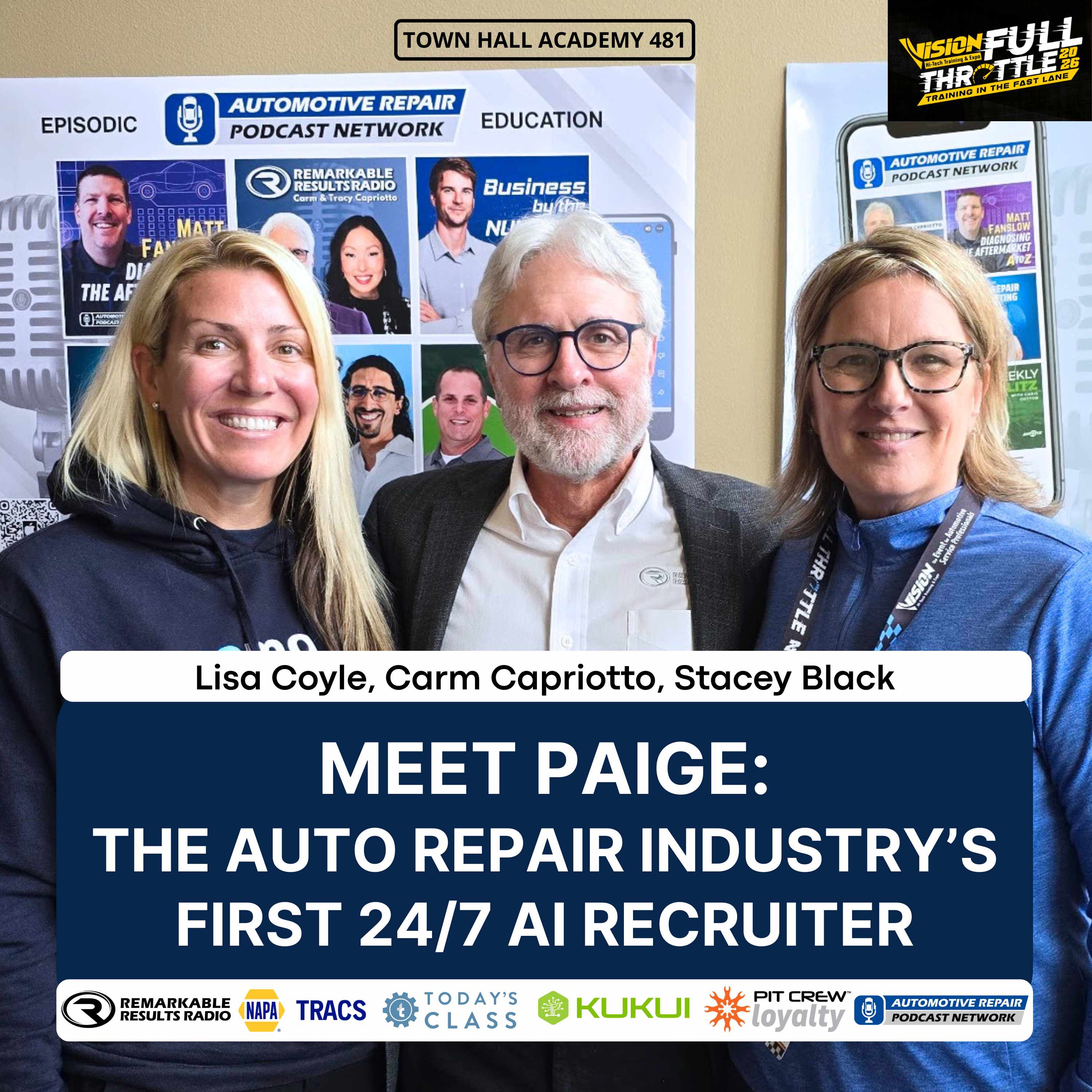
Remarkable Results RadioApril 17 · 42 min
Meet Paige: The Auto Repair Industry’s First 24/7 AI Recruiter [THA 481]
Thanks to our Partners, NAPA TRACS, Today's Class, KUKUI, and Pit Crew Loyalty Watch Full Video Episode *]:pointer-events-auto scroll-mt-[calc(var(--header-height)+min(200px,max(70px,20svh)))]" dir="auto" data-turn-id="request-WEB:8e59eec7-a235-4fa3-a072-956fea3fe478-7" data-testid="conversation-turn-4" data-scroll-anchor="false" data-turn="assistant"> *]:pointer-events-auto scroll-mt-[calc(var(--header-height)+min(200px,max(70px,20svh)))]" dir="auto" data-turn-id="request-WEB:49a777bf-d263-4496-bf0b-2eb3a46ac96a-11" data-testid="conversation-turn-24" data-scroll-anchor="false" data-turn="assistant"> Recorded live at the VISION 2026, this episode of Remarkable Results Radio features host Carm Capriotto in conversation with Lisa Coyle, Co-founder and CEO of Promotive, and Stacey Black, Account Manager at Promotive. Together, they unpack one of the most urgent challenges facing the automotive repair industry today: how to attract, hire, and retain top talent in an increasingly competitive and fast-moving market. What the Episode Covers: The “Ghosting” Problem in Hiring: Why candidates are applying to 15-20 shops at onceHow speed of response determines who wins the hireThe growing impact of declining soft skills like communication and accountability The Role of Shop Culture in Retention Why culture must be intentional, not assumedSimple, low-cost ways to build connection and loyaltyIdeas like celebrating milestones, supporting families, and investing in trainingHow strong culture reduces turnover and attracts better talent Introducing “Paige” The Industry's First AI-Powered Recruiting Promotive’s virtual recruiter designed for the automotive industryInstantly engages candidates via text after they applyConducts a guided, conversational pre-screening interviewCaptures key data: experience, commute, current benefits, and pay expectations A Live Demo of AI in Action Carm roleplays as a technician to demonstrate Paige’s capabilitiesShows how natural, fast, and effective the process is The 24/7 Hiring Advantage Why candidates often apply after hours, and how Paige captures them in that momentReal-world success, including dozens of completed interviews over a holiday weekendFaster engagement leads to fewer drop-offs and better-qualified candidates Hiring today requires more than posting a job and waiting. The shops that succeed are the ones that move quickly, communicate clearly, and create a culture people want to be part of. By combining intentional leadership with innovative tools like AI recruiting, you can reduce friction in the hiring process, improve retention, and ultimately build a stronger, more committed team. *]:pointer-events-auto scroll-mt-[calc(var(--header-height)+min(200px,max(70px,20svh)))]" dir="auto" data-turn-id="request-WEB:49a777bf-d263-4496-bf0b-2eb3a46ac96a-15" data-testid="conversation-turn-32" data-scroll-anchor="true" data-turn="assistant"> VISION Hi-Tech Training and Expo: https://visionkc.com/ Promotive has over 40 years of recruiting and automotive experience. If you need qualified technicians and service advisors and want to offload the heavy lifting, visit https://gopromotive.com/ Lisa Coyle and Stacey Black, https://gopromotive.com/ Thanks to our Partner, NAPA TRACS NAPA TRACS will move your shop into the SMS fast lane with onsite training and six days a week of support and local representation. Find NAPA TRACS on the Web at http://napatracs.com/ Thanks to our Partner, Today's Class Optimize training with Today's Class: In just 5 minutes daily, boost knowledge retention and improve team performance. Find Today's Class on the web at <a href="https://www.todaysclass.com/" target="_blank"...
Listen →
36
Downshift with TonnikaApril 16 · 1h 3m
Women Are Impacting Auto Repair! | Coralee Zueff - Episode 8
Consistency is key - heard that! But, consistency is HARD. That's why I gave up on trying and let the experts handle it. Detect Auto. Let them clean up your estimating process and raise your ARO - like they did for me! CLICK HERE TO BOOK A DEMOAnybody can run a shop. Building one that lasts? That's a whole different story. If you're ready to build smarter systems and a better experience for your team and customers, check out Tekmetric HEREIn this episode, Coralee Zueff joins Tonnika Haynes and Ash Kaplan to share her journey in the automotive industry, reflecting on how her passion for racing and cars led her from technician to acclaimed author and trainer. Their conversation highlights the importance of building genuine customer relationships at the service counter, with Tonnika and Ash emphasizing how personal connection and communication drive trust and success far beyond KPIs. Find more about Coralee's book here00:00 – Why it’s RARE for everything to run perfectly in the shop01:00 – North Carolina cold vs. Canadian “lost snow”03:02 – Meet Coralee: 24 years in the automotive game04:13 – From car enthusiast teen to Red Seal technician07:03 – Writing the next resource for women in the trades08:22 – Why stories matter for the next generation of women10:07 – The power of mentorship and finding your “Automotive Auntie”12:21 – Advice for your younger self: embrace the winding road14:00 – Passion for hands-on work and leadership lessons from water parks16:00 – The reality and value of remote estimating17:36 – Building powerhouse teams: train from scratch or hire experience?19:27 – How service advisors from all backgrounds are raising the bar21:32 – Training tips: one successful thing at a time23:09 – Canadian in Texas: adventures at the Texas Two Step28:36 – Finding community as a woman in a male-dominated industry33:22 – No makeup, no judgment: the power of women’s retreats35:36 – Autocross, drifting, and motorcycles—track life confessions39:41 – Shop race cars and the benefits of getting employees out racing40:13 – All-girls high school racing teams and changing the pipeline41:43 – Will AI take our jobs? Not if people still need people44:11 – How spending just 15 more minutes with each customer pays off46:33 – Frontline service tips: name recognition and building trust49:01 – Why the best advisors might be bartenders51:21 – Setting expectations: the art of handling upset customers54:03 – Downshift: Slow down for more meaningful growth55:10 – Coralee on learning to say NO – and loving it58:03 – Take an extra day, enjoy the journey59:09 – Where to find Coralee’s books and training
Listen →
37
Confessions of a Shop OwnerApril 7 · 59 min
Ep 84 - Keith Perkins and Seth Thorson | Will AI Replace Technicians?
Tekmetric transformed my shop. Plain and simple. Want that for yours? Touch HEREASTA is coming up September 24-26 in Raleigh. Be there or be square, dog! Register now and use code confess25 for $25.00 off your registration. Sign up HERETurnkey Marketing takes the stress of doing something I'm not good at off my plate. And gives it to someone who is. Click HERE for more.Tired of your shop’s social media looking like every other repair shop on the internet? Stand out with 47 Consulting. Learn more HERESend your service advisor to hands down the BEST service advisor training in the industry (even other coaching companies agree). It's Elite Worldwide's Masters Program. The next one is happening in Dallas Texas, September 10-12. Learn more HEREWhen I used the maintenance tool for the fist time with Detect Auto, my mind was blown. My advisors had the same reaction - and then SO MUCH MORE TIME. Learn more about Detect Auto and book a free demo now!Seth Thorson and Keith Perkins own shops and are both on the NASTF board. Today, they talk about AI and how shop owners can leverage Chat GPTs and Chrome extensions to streamline operations and keep their customer data protected. Keith weighs in on the future of technician roles, pointing out that while robotics and AI may eventually change the landscape, hands-on skills and adaptability will be critical for years to come.Timestamps: 00:00 Techs replaced by AI?06:25 AI and data ownership09:41 Learning the GTP foundation10:18 Teaching effective coding practices13:15 Teaching basic and premium features17:19 Using AI to access online data20:20 Circuit City vs. Best Buy insights25:37 Son considering trade school program31:28 Starting with the basics35:48 Putting in extra effort37:22 Learning through hard work42:59 Michael Brody-Waite's leadership approach43:38 Seth's class for shop owners49:18 Concerns about AI and human thinking51:12 NAPA's augmented reality training53:32 Balancing textbook learning and hands-on56:37 Mike's 90-day check-in
Listen →
38
The Limitless Leadership PodcastApril 2 · 41 min
Ep 142: How People-First Leadership Drives Shop Performance with Chris Cloutier
Listen →
39
Confessions of a Shop OwnerMarch 31 · 39 min
Ep 83 - Hunt Demarest | How to Actually Make Money in Auto Repair
Tekmetric transformed my shop. Plain and simple. Want that for yours? Touch HEREASTA is coming up September 24-26 in Raleigh. Be there or be square, dog! Register now and use code confess25 for $25.00 off your registration. Sign up HEREIf you're like me and aren't good at marketing, don't do it on your own. Let the experts handle it. Touch HERE for more on Turnkey Marketing.Tired of your shop’s social media looking like every other repair shop on the internet? Stand out with 47 Consulting. Learn more HERESend your service advisor to hands down the BEST service advisor training in the industry (even other coaching companies agree). It's Elite Worldwide's Masters Program. The next one is happening in Dallas Texas, September 10-12. Learn more HERE When I used the maintenance tool for the fist time with Detect Auto, my mind was blown. My advisors had the same reaction - and then SO MUCH MORE TIME. Learn more about Detect Auto and book a free demo now!Hunt Demarest is a CPA with Paar, Melis, and Associates. Today, he joins Mike to talk shop financials, tax credits, and private equity. Hunt breaks down why consistent improvement—just 3% better each quarter—is more sustainable than chasing explosive growth. He offers a candid warning about risky investments, sharing his own hard lesson with a too-good-to-be-true real estate scheme. Finally, Hunt dives into the rise of private equity buying up repair shops, explaining how that's driving up valuations and changing the market for owners looking to sell. Timestamps:00:00 Incremental improvement beats unrealistic growth—why 3% better every quarter wins01:10 Teaching personal finance at Vision 2026 (and why accountants don’t read your Social Security statements)02:07 The truth about R&D tax credits and audit nightmares03:44 What you must ask before taking any credit—defending yourself at audit time05:03 Hunt’s background: how he got into auto repair accounting08:08 Will AI replace your bookkeeper or CPA? Real talk, not hype10:32 Why shop owners need to understand financial statements & what current ratio means for your cash12:18 Managing AR, cash flow, and the case for paying vendors weekly14:43 Shop profitability: 8 months out of 12 is the norm, not the exception15:43 Trends: The scale and extremes of shop margins have changed MASSIVELY17:21 Labor rates at $386/hr and what actually drives profit18:54 The 20% net profit “gold standard”—and who really gets there19:34 Why comparing owner compensation plus net income tells the real story21:26 What’s the average net profit for shops? (Spoiler: it’s better than you think)22:15 Beware public “industry average” surveys—actual profits vs. reported tax returns23:01 Why working with an industry-specialized CPA beats a generic accountant every time24:14 The inner circle: who should be on your financial “advisory board”25:00 The most common (and WRONG) beliefs about shop accounting29:53 Hunt’s biggest personal mistake: the $25k investment gone wrong (and what to learn from it)32:10 Private equity: what’s happening, who’s buying, and what it means for YOUR exit36:10 Should you sell now? How PE offers stack up vs. passing to family37:06 Why PE doesn’t care about your P&L—sometimes it’s all about your customer count38:02 Final thoughts, lessons learned, and why even the pros get it wrong sometimes
Listen →
40
Changing the Industry PodcastMarch 30 · 1h 0m
Episode 262 - When Generations Collide - Growing an Auto Shop with Family Values With Matt Clarke
Don't get to the end of this year wishing you had taken action to change your business and your life.Click here to schedule a free discovery call for your business: https://geni.us/IFORABEDon't miss an upcoming event with The Institute: https://geni.us/InstituteEvents2026Shop-Ware gives you the tools to provide your shop with everything needed to become optimally profitable.Click here to schedule a free demo: https://info.shop-ware.com/profitabilityTransform your shop's marketing with the best in the automotive industry, Shop Marketing Pros!Get a free audit of your shop's current marketing by clicking here: https://geni.us/ShopMarketingProsShop owners, are you ready to simplify your business operations? Meet 360 Payments, your one-stop solution for effortless payment processing.Imagine this—no more juggling receipts, staplers, or endless paperwork. With 360 Payments, you get everything integrated into a single, sleek digital platform.Simplify payments. Streamline operations. Check out 360payments.com today!In this episode, Lucas and David are joined by Matt Clarke of Clark Automotive. Matt shares his journey back to his family's auto repair business, emphasizing the importance of refining operations and focusing on delivering high-quality service rather than chasing high car counts. The group discusses the evolving role of business coaching and training, including the value of accountability partners and the need to adapt to new technology in the industry.00:00 Trade Show Costs Are Ridiculous03:47 Union Inefficiency and Consequences09:13 "Prioritizing Quality Over Quantity"11:58 "Evolving Business Learning Challenges"14:35 "Epiphany in Management Training"18:14 "Refining Craft, Scaling Doubts"22:03 Choosing the Right Coach24:48 "Struggling with Accountability"28:06 "Unexpected Family Connections"33:15 "AI-Generated Estimate Dispute"37:26 "Balancing AI and Personal Touch"39:32 "Fitness, Gear, AI, and Darkness"44:37 "Unfiltered Critique of a Guru"45:20 "Mastery vs. Fake Expertise"48:44 "Adapting Teaching to Audience"54:39 "EV Market Resistance Analyzed"56:42 "Building Growth and Connections"58:38 "Vespa Culture: New York Only"
Listen →
Weekly digest
The week's best automotive podcasts
Into Technology & AI in the Shop? You'll likely enjoy the digest — one email a week with the latest automotive aftermarket podcasts from across the industry, Technology & AI in the Shop and beyond. No spam, unsubscribe anytime.