← Customer Experience
Building Trust & Transparency
Overcoming mechanic distrust — transparency, clear pricing, and the trust-building practices that turn first-timers into lifelong customers.
32 episodes
01
The Limitless Leadership PodcastApril 2 · 41 min
Ep 142: How People-First Leadership Drives Shop Performance with Chris Cloutier
Listen →
02

Shop Soup PodcastMay 12 · 1h 19m
EP27: His Life Wouldn't Change Until His Name Was On The Building. With Andrew Dominguez Of Asher Auto Group
Welcome To ShopSoup Podcast. On Episode 27, I sit down with Andrew Dominguez of Asher Auto Group that includes Asher Automotive and DTX Automotive. Two dynamic shops that are a result of Andrews determination to provide growth and opportunities for his team members.SUMMARYIn this inspiring interview, Andrew Dominguez shares his journey from a young dealership employee to successful auto shop owner. He discusses overcoming challenges, building trust with customers, leadership, and strategic growth in the auto industry.KEYWORDSauto industry, entrepreneurship, leadership, business growth, customer trust, auto repair, dealership, small business, success storyKEY TOPICSAndrew's early start in auto industryBuilding customer trust and loyaltyLeadership and team developmentScaling multiple auto repair locationsSOUND BITES"People buy from those they trust""Uniform service is a leadership issue""Success is about giving value to others"CHAPTERS00:00 Introduction to Andrew Dominguez's Journey02:47 Early Career and Lessons Learned05:25 Transitioning to a Bigger Dealership08:34 Climbing the Ranks and Facing Challenges11:30 Desire for Independence and Entrepreneurship14:05 Building Relationships and Customer Trust17:00 The Decision to Start His Own Business19:48 Navigating Challenges and Building a Brand22:41 Personal Life and Support System28:04 The Impact of Tough Love30:45 Lessons from Loss and Leadership32:47 Taking Risks for Growth35:50 Navigating Partnerships and Challenges38:40 Building a Team and Expanding Opportunities40:33 The Role of Coaching in Business Success44:31 Learning from Mistakes and Adjusting Strategies48:13 Understanding Business Dynamics and Financing49:58 The Old vs. New Business Mindset52:18 Empowering the Next Generation of Technicians53:16 The Importance of Transparency in Leadership55:46 Balancing Family and Business Life58:39 Finding Hobbies and Personal Time59:57 Navigating Work-Life Integration01:04:38 The Evolving Nature of Success01:07:18 Future Aspirations and Growth StrategiesRESOURCESAuto Service Leaders Conference 2026 - https://theaslconference.comAuto Service Leaders - https://autoserviceleaders.comAndrew Dominguez's LinkedIn - https://www.linkedin.com/in/andrewdominguezAsher Automotive - https://asherautorepair.com/DTX Automotive - https://dtxautomotive.com/Guest LinksLinkedIn - https://www.linkedin.com/in/andrewdominguez
Listen →
03

Remarkable Results RadioAugust 25 · 31 min
Top 5 Qualities of a Genuine Service Advisor [RR 1106]
Thanks to our Partners, NAPA Auto Care and NAPA TRACS Watch Full Video Episode What makes a good service advisor great? Levi Linseman, performance coach at Autoflow, shares the five human qualities that separate a good service advisor from a truly trusted professional. With 25 years of automotive experience, including 15 years at the service desk, Levi explains why eye contact, a smile, warmth, caring, and humility can turn everyday transactions into long-term customer relationships. The conversation also explores sophisticated professionalism, the role of AI in the customer experience, proactive communication, hiring for coachability, and why the best advisors know when to simply say, "I don't know." What You'll Learn The 5 qualities that define a genuine service advisor.How admitting mistakes can actually increase customer trust.Why AI should support the service advisor, not replace the human connection.How digital vehicle inspections can improve transparency and communication.Why coachability and continuous learning are essential for advisors.How proactive communication reduces customer anxiety.Why setting clear expectations can dramatically improve the customer experience.What shop owners should look for when hiring their next service advisor. Great service advisors do more than sell repairs. They build trust, reduce anxiety, communicate with honesty, and make customers feel cared for. Technology can make the process more efficient, but genuine human connection remains one of the most powerful advantages a shop can offer. Levi Linseman, Performance Coach, Autoflow Learn more about the benefits of being part of the NAPA family by visiting https://www.napaonline.com/en/auto-care NAPA TRACS will move your shop into the SMS fast lane with on-site training and six days a week of support: http://napatracs.com/ Connect with the Podcast: Download Our Mobile App:https://automotiverepairpodcastnetwork.com/app/Website:https://remarkableresults.biz/YouTube:https://www.youtube.com/carmcapriottoFacebook:https://www.facebook.com/RemarkableResultsRadioPodcast/LinkedIn:https://www.linkedin.com/in/carmcapriotto/Instagram:https://www.instagram.com/remarkableresultsradiopodcast/Join Our Virtual Toastmasters Club:https://remarkableresults.biz/toastmastersJoin Our Private Facebook Community:https://www.facebook.com/groups/1734687266778976Join our Insider List:https://remarkableresults.biz/insiderBooks Page:https://remarkableresults.biz/booksOur Classroom Page:https://remarkableresults.biz/classroomEpisode Collections:https://remarkableresults.biz/collectionsBuy Me a Coffee:https://www.buymeacoffee.com/carm The Automotive Repair Podcast Network: https://automotiverepairpodcastnetwork.com/ Remarkable Results Radio Podcastwith Carm Capriotto:https://remarkableresults.biz/Automotive Field TheorywithMatt Fanslow:https://mattfanslow.captivate.fm/Business by the NumberswithHunt Demarest: https://huntdemarest.captivate.fm/The Auto Repair Marketing Podcastwith Brian and Kim Walker: https://autorepairmarketing.captivate.fm/The Weekly Blitzwith Chris Cotton: https://chriscotton.captivate.fm/Speak Up! Effective Communicationwith Craig O'Neill: https://craigoneill.captivate.fm
Listen →
04
Downshift with TonnikaJuly 4 · 18 min
Why Busy Shops Stay Broke | Josh Oberlander | Ep 25
You shouldn't have to play detective just to figure out what's happening in your own shop. 😂 If you're ready for all your shop's information in one place, check out Tekmetric HEREConsistency is key - heard that! But, consistency is HARD. That's why I gave up on trying and let the experts handle it. Detect Auto. Let them clean up your estimating process and raise your ARO - like they did for me! CLICK HERE TO BOOK A DEMOIn this episode, Tonnika Haynes and Josh Oberlander break down why slowing down and focusing on process can actually turbocharge your shop’s growth. Tonnika shares hard-won lessons about moving from high car count and burnout to prioritizing quality over quantity, showing how DVIs (with more photos!) increase both trust and repair order value. Josh jumps in with actionable advice on building team buy-in, gamifying new processes, and leading from the top. Timestamps:00:00 Leading from the top: Why technicians and advisors must buy in00:35 The untapped power of free training for shop owners01:17 Doing less for more: Getting profitable work from fewer cars02:16 Maximizing ARO by slowing down and focusing on DVIs03:07 The quick lube trap: Saying yes to everything vs. building real value03:23 Photos = trust: How transparent DVIs win more jobs03:34 Josh shares shop success with upping DVI photo counts04:04 Protecting your shop with good photos (and covering your … liability)05:01 Why busy shops are still "broke"—the cost of missing training & coaching06:10 Saying 'no for now': The hardest lesson for shop owners06:41 Why oil changes almost never build loyalty (and what to focus on instead)06:53 Coaching your team: Breaking through resistance to DVI and new processes08:04 Gamifying buy-in: Whiteboards, numbers, and making it a challenge09:20 The 60- or 90-day challenge: Real tracking for real results10:00 Why photo & video DVIs build trust—and prevent burnout11:19 Video in the shop: When and why you want to use it12:08 Technicians, not actors: Keeping DVI videos authentic12:25 The magic of just one extra hour per ticket12:36 Team buy-in starts at the top—stop relying on "because I said so"13:18 Creating a culture of “disagree and commit”14:20 How team input drives goals, ownership, and commitment15:08 Buy-in that sticks: When your team runs the shop without you15:53 Setting the next big goal (and getting your team hyped!)16:06 The never-ending work of real leadership17:01 The payoff of openness: Why your team should know the numbers
Listen →
05

Remarkable Results RadioJune 19 · 51 min
Why Auto Repair Specialists Leave Our Industry (And How Shop Owners Can Keep Them) [THA 490]
Thanks to our Partners, NAPA TRACS, Today's Class, KUKUI, and Pit Crew Loyalty Watch Full Video Episode *]:pointer-events-auto scroll-mt-[calc(var(--header-height)+min(200px,max(70px,20svh)))]" dir="auto" data-turn-id="request-WEB:8e59eec7-a235-4fa3-a072-956fea3fe478-7" data-testid="conversation-turn-4" data-scroll-anchor="false" data-turn="assistant"> *]:pointer-events-auto scroll-mt-[calc(var(--header-height)+min(200px,max(70px,20svh)))]" dir="auto" data-turn-id="request-WEB:49a777bf-d263-4496-bf0b-2eb3a46ac96a-11" data-testid="conversation-turn-24" data-scroll-anchor="false" data-turn="assistant"> Why do talented automotive technicians leave the automotive industry, and what can shop owners do to keep them? Host Carm Capriotto is joined by Technical Specialist Matt Fanslow and Technician Find CEO Chris Lawson to explore what it takes to attract, hire, and retain top talent in today's automotive repair industry. The conversation examines industry professionalism, workplace culture, compensation, employee engagement, and proactive recruiting strategies that help shops become destinations for exceptional technicians. What You'll Learn Why elevating the image of automotive professionals is critical to attracting the next generation of talentThe three primary reasons technicians leave shops: lack of respect, limited growth opportunities, and compensation concernsHow financial transparency can build trust, ownership, and a stronger team cultureThe difference between a shop's "official game" and its "shadow game," and why understanding both mattersPractical ways to gather meaningful employee feedback and turn ideas into actionHow leaders can remove obstacles that prevent technicians from finding joy and fulfillment in their workWhy relationships with tool truck drivers can become a valuable recruiting resourceHow a shop's appearance and reputation can influence whether top candidates choose to work there Finding and keeping great technicians requires more than competitive pay. Shops that create a culture of respect, provide clear growth opportunities, communicate openly, and actively remove workplace frustrations are far more likely to attract and retain top performers. The most successful shop owners don't wait for talent to find them, they intentionally build workplaces where skilled professionals want to stay and grow. Matt Fanslow, Riverside Automotive, Red Wing, MN, Diagnosing the Aftermarket A to Z Podcast: https://mattfanslow.captivate.fm/ Chris Lawson, TechnicianFind.Com. Listen to Chris' other episodes HERE Love your shop? Stay, but stay ready. Auto techs join to level up, find good shops, and keep tabs on top indie jobs nationwide. Techs only. No BS. Independent Wrench Jobs: https://www.skool.com/independentwrenchjobs Thanks to our Partner, NAPA TRACS NAPA TRACS will move your shop into the SMS fast lane with onsite training and six days a week of support and local representation. Find NAPA TRACS on the Web at http://napatracs.com/ Thanks to our Partner, Today's Class Optimize training with Today's Class: In just 5 minutes daily, boost knowledge retention and improve team performance. Find Today's Class on the web at https://www.todaysclass.com/ Thanks to our Partner, KUKUI Stop juggling multiple marketing tools. KUKUI’s integrated platform delivers 4x better website conversions, automated follow-up, and real-time ROI tracking. Get industry-leading customer support with KUKUI at https://www.kukui.com/ Thanks to our Partner, Pit Crew Loyalty You’re probably tired of chasing new customers who never return. We understand. Pit Crew Loyalty ends the one-and-done cycle, turning first visits into lasting, reliable revenue at https://www.pitcrewloyalty.com/ Connect with the Podcast: Visit the Website:https://remarkableresults.biz/Subscribe on YouTube:https://www.youtube.com/carmcapriottoFollow on Facebook:https://www.facebook.com/RemarkableResultsRadioPodcast/Follow on LinkedIn:https://www.linkedin.com/in/carmcapriotto/Follow on Instagram:https://www.instagram.com/remarkableresultsradiopodcast/Join Our Virtual Toastmasters Club:https://remarkableresults.biz/toastmastersJoin Our Private Facebook Community:https://www.facebook.com/groups/1734687266778976Join our Insider List:https://remarkableresults.biz/insiderAll books mentioned on our podcasts:https://remarkableresults.biz/booksOur Classroom page for personal or team learning:https://remarkableresults.biz/classroomBuy Me a Coffee:https://www.buymeacoffee.com/carmSpecial episode collections:https://remarkableresults.biz/collections The Automotive Repair Podcast Network:
Listen →
06
The Jaded MechanicMay 5 · 1h 50m
ADAS and Electric Vehicles Are Changing Auto Repair | Marco Palumbo
Like the show? Show your support by using our sponsorsNeed to update your shop systems and software? Try Tekmetric HERELaunch your tool game to the next level with Launch Tech USA! HEREIn this episode, Marco Palumbo shares his journey from technician to owner of Maxim Tire and Muffler in Winnipeg. He discusses the challenges of adapting to new automotive technologies, such as ADAS and electric vehicles, and the investments required in equipment, training, and staff. Marco also emphasizes the value of transparent customer service and community reputation, demonstrating how taking care of customers builds long-term loyalty and success.Timestamps:00:00 Meeting Mark and first impressions05:28 Importance of mentoring in shops12:13 Success with TikTok marketing17:38 Discussing car calibration and trust21:54 Unexpected car repair costs29:15 Dealerships vs. aftermarket dynamics34:45 Engaging waiting customers in showroom42:20 Oxygen sensor issues and specialization45:49 Tesla service challenges in smaller cities52:46 Celebrating Mark's impact56:16 Challenges with tech skills and training58:56 Managing training logistics01:04:09 Troubleshooting car electrical issues01:10:47 Managing customer service expectations01:16:04 Challenges with car part repairs01:24:28 Facing time management challenges01:28:24 Advocating for customer transparency01:34:09 Unresolved car maintenance issues01:37:26 Customer requests and shop policy01:42:08 Charging for technical auto repairs01:47:39 Recognizing Marco's passion and impact Follow/Subscribe to the show on social media! TikTok - https://www.tiktok.com/@jeffcompton7YouTube - https://www.youtube.com/@TheJadedMechanicFacebook - https://www.facebook.com/profile.php?id=100091347564232
Listen →
07

The Institute's Leading Edge PodcastAugust 26 · 55 min
216 - Coach the Call: Using AI Insights to Develop Stronger Service Advisors
216 - Coach the Call: Using AI Insights to Develop Stronger Service Advisors August 26th, 2026 - 00:54:51 Show Summary: Strong phone skills can turn more incoming calls into appointments while building trust from the first interaction. Consistent call reviews give service advisors a clear path to improve without making coaching feel like punishment. AI call analysis reduces the time required to find useful coaching opportunities and helps owners identify patterns across their team. Positive reinforcement also matters because great calls give advisors examples they can repeat. Simple habits like smiling asking for the appointment and using the customer’s name can dramatically improve the experience. Better phone performance ultimately supports stronger customer relationships higher appointment conversion and long term shop growth. Host(s): Jimmy Lea, VP of Business Development Guest(s): David Boyd, Founder & CEO of Callinbound Tonnika Haynes, Owner of Browns Automotive, Downshift with Tonnika Haynes Show Highlights: [00:04:00] – Listening to real calls reveals missed opportunities that owners rarely see. [00:10:00] – AI identifies coachable calls without hours of manual review. [00:14:00] – Consistent coaching creates awareness before advisors answer each call. [00:17:00] – Replace a hard no with a plan focused on customer needs. [00:24:00] – Help advisors self coach instead of simply pointing out mistakes. [00:28:00] – Every missed appointment can represent significant lost customer value. [00:34:00] – Asking for the customer’s name immediately creates a stronger connection. [00:39:00] – Scheduled call reviews make coaching normal instead of threatening. [00:43:00] – Asking for appointments helped turn successful marketing into a fuller calendar. [00:49:00] – Call tracking connects marketing performance with actual appointment conversion. In every business journey, there are defining moments or challenges that build resilience and milestones that fuel growth. We’d love to hear about yours! What lessons, breakthroughs, or pivotal experiences have shaped your path in the automotive industry? Share your story with us at info@wearetheinstitute.com, and you might be featured in an upcoming episode. 👉 Unlock the full experience - watch the full webinar on YouTube: https://youtu.be/fv9ewVBoSks Don’t miss exclusive insights, expert takeaways, and real talk you won’t hear anywhere else. Hit Subscribe, drop a comment, and share it with someone who needs to hear this! Links & Resources: Want to learn more? Click Here Want a complimentary business health report? Click Here See The Institute's events list: Click Here Want access to our online classes? Click Here ________________________________________ Episode Transcript Disclaimer This transcript was generated using artificial intelligence and may contain errors. If you notice any inaccuracies, please contact us at marketing@wearetheinstitute.com. Episode Transcript: Jimmy Lea: Good morning, good afternoon, good evening, or good night. Thank you for joining. So excited for us to have this conversation today with some really good friends. Everyone, this is to be an interactive webinar. So you're sitting there, you've got questions, you've got concerns, type them into the chat. We wanna be able to ask those questions of our panel today as we are talking about a very interesting topic. And with us today, first, is our good friend, Mr. David Boyd of Inbound Communication. David, how the heck are you, brother? David Boyes: I'm great. I, I, uh, I fully intended to have my jacket on, Jimmy. Jimmy Lea: Man. David Boyes: So excited to be here. We Jimmy Lea: coordinated on this and everything. David Boyes: I know. I, uh- Next time ... I, I was, I was lucky as, as busy as we've been at Call Inbound to, uh, uh, get up and, and organize and dress today. So I really, uh, it's always great to see you and of course, um, uh, we got to visit a little bit out at, uh, Worldpac STX and, uh, man, I tell you what, your wardrobe is always top notch. Jimmy Lea: Hey, thank you. Thank you. We're glad you are dressed today, just don't stand up. Thank you very much. David Boyes: Great. Jimmy Lea: And joining for us in our conversation today, David, is Tanika, Tanika Hayes with, uh, Haynes with Browns Automotive. Tanika, how the heck are you, sister? Tonnika Haynes: I'm doing good, guys. What's going on? Jimmy Lea: Staying alive. Good to see you. Great to see you. Also at STX, what did you think of the, the conference there with Worldpac? Tonnika Haynes: It, it was really, really good. I was not prepared for the size of it. There was a lot of people. People were peopling. So, um, once I got adjusted to all of the crowds and everything, I enjoyed it. I hadn't sat in a class in a really long time, like at an expo. Ooh. I'm usually just walking around and being nosy, but I picked up some good nuggets, so it was great. Jimmy Lea: Beautiful. That's awesome. Well, if, if the STX was a large conference to you, I would suggest that you really prepare yourself months in advance if ever you come out to SEMA and Apex in Las Vegas. Tonnika Haynes: I will be there this year. Oh, good. I keep hear- hearing that, so I don't know what meds I need to be on to take, To take it all in. But Jimmy Lea: we'll- You- Tonnika Haynes: I'm excited about it ... Jimmy Lea: we, we will talk about that because there is more than you can see within a week, and you really only have three days at Apex, four days at SEMA. You want to map out where you're gonna go, who you're gonna talk to, who you're gonna see- And for you, Taneka, schedule some time to sit down and chill Tonnika Haynes: Yeah. I'm gonna have to definitely do that. You're talking about, um, scheduling times. I'm gonna schedule time to go sit in the corner and recoup. Uh-huh. So where's Taneka? She's in the corner. Jimmy Lea: Yep, and, and I- It's David Boyes: scheduled time ... Jimmy Lea: I, I'm gonna work with you on that because I know the corners, I know the places where you can go and, and find some solitude. Tonnika Haynes: All right. Jimmy Lea: I am. Well, our conversation today is in preparation for making your shop better David, I'm gonna kick it over to you, brother. Let's start this conversation with Taneka. David Boyes: Yeah. Let's, uh, let- let's kinda move into this. You know, we're, uh, talking about communication, and there are so many facets that impact the customer experience. I think that it's important to know that, you know, there are tools and there are, uh, from an owner or, and manager's perspective and from a service provider's perspective, there are ways that we rally around making communication better. Um, you know, one of the things that is common at all shops is, uh, the customer phone call. Tonnika Haynes: Oh, yeah. David Boyes: So you winced a little bit. Tonnika Haynes: Yeah. David Boyes: Uh, how many times do we, you know, talk about our phone skills, uh, getting better on the phone, understanding the customer, understanding their needs, addressing their needs? And there's so much, you know, revolves around, uh, the phone calls and, and the way that our advisors and our front office team handles these. Maybe you have a CSR, maybe you have, you know, a service manager. Um, but people are, are answering calls all day long, and this becomes important that we understand who's answering the phone- Mm-hmm ... how they're communicating, what, what's the message that's being shared. Every time that phone rings, uh, that, you know, we like to say that's money calling. So Taneka, let me just ask you, you know, what, what are some of the challenges that you see or the, uh, the successes that you have with your team when it comes to managing and, and, uh, getting better on our phones? Tonnika Haynes: I wanna start by saying, um, I think I listened to my first phone call at my meeting with Jen- Jennifer, with the Institute. I'm currently coaching with the Institute, and that is life-changing- Yeah ... to listen to your team answer the phone. So if anybody's out there and they have not done that, they have not listened in on a phone call, figure out a way to do it. I don't know if it's gonna be a little paper cup and a string, but figure out how to do it. Um, and then I, listening to my own phone calls, and I- I'm the boss, right? I still cringe. And so you never know what's missing from those phone calls, what, what, what is standing out. You know, my team, we would not even ask for the appointment. Like, "Would you like to bring this in today?" You know- Oh ... you ask all the questions, they go through the scripts, but then we found that they were not saying, "Hey, would you like to get that done? Would you like to bring that in today or tomorrow? What works for you?" They were leaving it all to the client to say- Jimmy Lea: Mm-hmm ... " Tonnika Haynes: What's next? What's next?" Hmm. So they were answering the phone, and they were s- being very polite, but they were not closing. They didn't have a lot of words with closing. And so with inbound, I've been able to coach- You know, when you listen to yourself and you're like, "Ooh, ooh." And you can say, "Do you see what you did there?" Or even, 'cause you know, the team can listen to their own phone calls. "Oh, I see what I did there. I see where I dropped the ball." So that was, opened up a whole bunch of eyeballs around here. Well- It's like, "Oh, it's Monday, it's time to listen to phone calls." Like, "Ah." But you just increasingly get better over time. Jimmy Lea: Oh, it's so true. And, and the ability, Taneka, the ability to have calls from today- Tonnika Haynes: Mm-hmm ... Jimmy Lea: or from yesterday or, or even the day before. Uh, there was a time a decade ago when we would have to listen, as coaches, we would listen to calls. Listen, listen, listen, listen, listen, listen, listen. We're trying to find a coaching call, a call that is coachable, and this might be a call from two weeks ago, three weeks ago. Mm. The advisors are going, "Dude, oh man, that's forever ago. No, man, I, I don't do that anymore. I'm not like that." But David, I, I think you kind of solved a bit of that problem with your phone services. David Boyes: Yeah, thanks. It, you know, it's, it's important to, to recognize. I think every owner I've ever talked with has a similar issue. It's... And a lot of it rev- revolves around time, right? Are, are we aware of what's actually happening- Jimmy Lea: Yeah ... David Boyes: on the front line? Mm-hmm. And, uh, some of it is, uh, I wanna keep this a little bit at arm's length because I, I can tell you as an owner, I will have an emotional response when I listen to that phone call. And Taniki, you brought up a great point. For owners and managers here that are on the phone, please listen to your own calls. Yeah. Do it at least one time. Tonnika Haynes: Yeah. David Boyes: Well, twice. Have to Tonnika Haynes: bite the bullet. Just do it. David Boyes: Yeah. Just do it. And, Tonnika Haynes: and, and be ready. Just like- ... just like, "Oh, that is me." Yeah, that is you. David Boyes: Do it- Yeah do it twice because the first time that you listen to a call, uh, it's gonna just be weird, right? So listening to myself on recordings is always weird, but there's this heavy lift of time, right? Am, am I aware of what's actually happening on the front line, and how are we interacting with customers? And then do I have, do I have a mechanism to understand what's my expectation? As an owner, um, you know, it, it's important to establish that expectation. Maybe you're working with a call coach, maybe you've been in trainings yourself. It's, it's ideal to have a method by which you're going to measure your call handlers. And, um, you know, we wanna be professional. We want to build confidence and, and build rapport with these customers. It doesn't have to be fast, but typically- Mm-hmm ... you know, an incoming call from a customer is likely an appointment setting call or a status call. We're gonna set that status call, uh, bucket aside for a second 'cause we wanna be in front of, uh, status calls instead of having customers call us. But if you're listening to these and you have that rhythm around it, uh, we understand how these small habits can build on one another. Am I, am I smiling when I answer the phone? There's something physically that hap- When I, when I physically smile, there's something that is noticeable in the way that I'm communicating. And, uh, am I, am I clear? So what are the expectations? You know, uh, if you watch your advisors, I have, uh, my little cordless handset here. If they tuck their phone in like this, and, and you know, they're, they're trying to multitask Listen to those calls because likely it's very, very difficult to hear on the other side of this. So listening to calls, uh, helps us understand how, you know, how we conduct ourselves, how we conduct business, how am I representing the business that I, you know, that I'm working at as a professional. But also, what is the customer hearing and what is the customer's experience? So, um, these are, uh, important points, and it starts by listening. Jimmy, you brought up a, um, an important aspect here. Historically, we would listen to call after call after call after call to try to find something I can use to coach. So Taneka, you might do this. You've got a call recording system. It doesn't do much but just record those calls, and now I have to go through this, this process to identify a coachable opportunity. And this is now I think where we can move effectively into technology, right? We all hear so much about AI today, and what's really nice about, uh, having, you know, a, a phone system that records is now you have an asset, and you can use that asset to do something more with it. And we can use AI to help that heavy lift of time and, you know, take 90% of the time requirement off. So instead of having to spend 30 minutes, I might have to spend two or three minutes to take that call, sit down with my service advisor, go through this, and have a meaningful, constructive conversation about the things that work well. Jimmy Lea: Yeah. I, I love, David, that your software makes it so easy to find these coachable calls so much faster. A- and Taneka, that's just gotta be a lifesaver for you as well, coaching your service advisors. Tonnika Haynes: It is. I remember, um, speaking with a friend, fellow shop owner, and he's like, "I need you to set aside a time." And so what I did is on my calendar, on Wednesday, that's the day that I sit down and we go over phone calls. And so, you know, you got the dashboard, and that dashboard will say, "This is a coachable call. This is a coachable call." And it is a habit for me as the owner/manager, um, to make sure that I'm staying on top of it all the time because we'll slip into old habits, right? So me listening to the calls and bringing the service advisor or, um, or bring Jay in and say, "Hey, let's listen to this. Let's see how we can get better." You know, you continuously improve on it, and you don't slide back into old habits. Because I'm not on the phone as much anymore. If I have to answer the phone, I know personally, and everything's at stake for me, I slide back into old habits. So we all are capable of it, and so having that dashboard in front of us and said, "Hey, this is a call you need to look at," the service advisor or the person answering the phone does not feel like they're being picked on, but they're being improved upon. So, "Look, I'm just lifting you up. This is what we can do. Do you see how we can make this better?" And it's a we, it's a us, it's coachable, it's there, it's real, and, um, I really enjoy th- that part of the dashboard. Jimmy Lea: Oh, I love that. How often, Taneka, do you send, "This is a really good call"? This is a really good call. I Tonnika Haynes: like a really good call How often do you send that to the team? You know what? Yeah. I probably should do that more. But when I see a good call, I, I, I like to share it. And when I get a good review, like I l- literally just got a good review based off of a bad situation that we were able to turn around with proper communication, and the customer l- literally said, he's like, "The communication... The problem was still there," he said, "but the way they handled it and the communication was key." So he was not satisfied when he left, but the way that we dealt with it afterwards, and that recording of how we guided him through the process, and how we, you know, we apologized, we came up with a plan, apologized again, and kept it moving, and that was a great coachable call. It's like, this is how you handle a bad situation. Look how we won here. So yeah, those are just as important as the, as the losses, as the bad calls. "Hey, this is a good call. G- this is a good call." That balance is super important. Yeah, it balances it. Yeah. And then, you know, it's like, okay, I did that right. Even when that client is a client that does not belong to you, and you can hear them tell the customer, it's like, "Hey, you know what? Appreciate your call, but this isn't the place for you." And that's not the word for word, but, "Hey, you handled that good. Thank you for saving us from a nightmare." Jimmy Lea: Yeah. Tonnika Haynes: Amen. Share it with your team. So you gotta share the wins and the, the misses. Jimmy Lea: Yeah. And, and, uh, for a lot of people, I think they struggle in the creative. So if they can hear it, that it's already been done, they can duplicate. Sure. They can mimic. They can do the same thing over and over and over again. So the more we send these beautiful calls, "Oh my gosh, you guys did so well on this phone call. I, I love this part, this part, and this part," they're able to duplicate that, and they'll do it over and over and over again. And then, then you're- The mistakes that are being made become much less because you're showing, you're, uh, mirroring to them these are the really good calls that we wanna hear. Tonnika Haynes: And, and sharing that when you're going over a call, you got the good call here, we can work on this call, but this is another good call. You know, we talk about giving that sandwich. Yeah. And so that's another opportunity you can give that good sandwich. So when it's time to come in on Wednesdays and listen to your phone calls, you're like, "Ooh, I know I got one coming and I think I know which one it is." And then you're like, "Yeah, but you got this one too, so you won here, and, uh, we missed on this one, but next time it's not happening." Right? Right. So it's, you know, it's all in coaching. Jimmy Lea: Oh, David Boyes: it's so true. You just said something that's super important, and, uh, ooh, I think I know which one this is. Tonnika Haynes: Yeah. David Boyes: Um, there, there's a lot to unpack there. I, I, I love the, the good with the bad. We'll talk about that more too, but, um, creating the awareness. So consistency wins, and, um, I'll say it again, be consistent with the process because consistency wins. And when you have that rhythm where it's familiar and it's expected, we're gonna sit down and we're gonna listen to calls, we're gonna go through this, identify the opportunities, um, it's not good and bad calls, it's, you know, it, it, uh, we call them top calls or champion calls and coachable calls. So a coachable call isn't inherently bad. Maybe we even got an appointment. Tonnika Haynes: Mm. David Boyes: Right? But there's, there's opportunities. So, uh, when we have that rhythm and it's expected, what's really important about what you just said is the awareness. So when I go to pick up that phone, is this the call that Tanika's gonna be talking with me about tomorrow or, you know, Wednesday, whatever our rhythm is? It, it will begin to create that moment of pause that as an a- an advisor when I'm picking up that phone, I can take that breath. Yeah. I can, I can, uh, let that, uh, you know, that technician that just blew me up Tonnika Haynes: Let 'em David Boyes: go. I can let that slide off. I can shake that off. Yeah. And I can focus for a moment to make sure that that customer knows right at this moment they are absolutely the most important person to me right now. Tonnika Haynes: Mm-hmm. David Boyes: So that's an important message to convey over the phone, our, uh, the, you know, the way that we speak, the words that we use, my en- excitement and enthusiasm about being on that call all comes through. So as we get through this rhythm and we develop the consistency and it becomes normal, now I've got that awareness on my team that, hey, this next call I'm taking, I'm gonna have the moment of pause to focus because this might be the next one that, that we're reviewing. I want this to be a positive call that, that Tanika's coming to me and saying, "You did really well on this one. Let's continue to develop this," and, you know, replicate the things that are working well. Instead of, "Hey, there's some opportunity here. You know, you didn't ask for the appointment. You were, you know, pricing over the phone. You said 'no'." No comes out in a lot of ways, doesn't it, Tanika? Where- Tonnika Haynes: Oh, yeah ... we, David Boyes: we might be telling somebody, uh, "You know, I'm really busy right", or, or, or "W- we, we're really busy right now, I can't get you in until Friday." Tonnika Haynes: Yeah. David Boyes: That's, that's, we might as well just say, "No, I can't help you." Yeah. Tonnika Haynes: Yeah. You, that's, that's all they heard was the no. Um, even if you give... And, uh, everybody knows that I'm, I'm big on nos. Like, I can give you a no where there's some healthy nos, but then there's some nos and you have the customer saying, "Hey, um, m- my brakes are making the noise and it just started." And he's like, "Oh, no, I can't see you till Friday." He's like, "Yeah, but I'm gonna die before Friday. I wanna see somebody now." Um, so you don't, you have to learn how to coach them and say, "Yes, so bring that in. Let's take a look at what you've got, and then we'll come up with a plan." You didn't promise that it was gonna be today or tomorrow, but you said, "Bring it in. I'm worried about your safety. Let's see what you've got." Yeah. "Let's see if you should really be concerned about that check engine light. It might be a EVAP code." They don't know that, "But go ahead and bring them in." So and then you, like you said, the cadence in it. This, I'm not gonna make you any promises over the phone, and I would literally say that. "Hey, I don't wanna disappoint you by making a promise that I can't keep. So don't- Yeah ... don't make me, don't put me in that hole. But I need you to go ahead and bring that in to me as soon as you can. Um, and let's scan it. Let's see what you've got, and let's see if you should really be worried, if you can make that trip or we need to bring you in right away. We will help you come up with a plan." So just that solid no. "No, I'll see you Friday." Jimmy Lea: He, " Tonnika Haynes: Meh. No you won't." Yeah. Like, so that's support. That's Jimmy Lea: my- David Boyes: It, it becomes very collaborative in what you just said. Hey, let, let's make this about you, let's make this about your safety and your confidence to drive that vehicle. Maybe you gotta get across town and your commute is 30 minutes. Let's make sure that your vehicle is safe, and then once you're here and we make sure you're safe, let's talk about, uh, when we're gonna have that on the schedule. We'll get that vehicle in Tonnika Haynes: and prepared. Yeah. What are the next steps? Yeah. So let's go ahead and get- let's get your nerves calm- Mm-hmm ... and then let's come up with the next step. Let's come up with a plan. Us, us, us, we, we, we. So Jimmy Lea: yeah. Yeah. Oh, I love it. I love it. And, uh, you talk about s- building a solid foundation for this, the solid foundation for their skills so that the, the ongoing training you're doing really builds on that foundation. Uh, we've got a three-day service advisor with the institute. We're gonna give a shout-out to the institute here right now. So everybody grab out your smartphones, scan the QR code if your service advisor needs a solid foundation. Thank you, David. If you need a solid foundation- Registered now ... and you need to start with... Yeah, get registered. I know you've been to a couple of these, David, 'cause- I have you've talked about all the skills here just really, really well. If your service advisor needs that and you need to go from zero to hero very quickly, this is an intensive that you wanna send your service advisor to, and it will be at headquarters in Ogden, Utah. Fly right into Salt Lake, and, uh, and we got you set up there in Ogden. So, yes, David Boyes: scan that. It's a beautiful drive up from the airport. This class is, uh, it, it, it will help establish the, the fundamentals to build on. Yeah. So you come here, it's, you know, it's boot camp, right? We're, we're going to make sure that we're establishing the expectation and give you something to build on as the owner. Send your service advisors in here. Uh, they'll get those fundamentals, and then you'll have, you know, these, these mechanisms, uh, to improve them over time. I promise you it'll be a, a real game changer for your frontline. Tonnika Haynes: Well, you know what? Beautiful. I wanna piggyback on that. Um, and I wasn't coached to saying this. If they've already been, send them again. Jimmy Lea: There you go. Mm. Tonnika Haynes: Send them again, because here's the thing that I know, and I'm just gonna make it simple. I want you to think about your favorite movie. Like when, when I was in the 20s, for me it was Friday, the movie Friday. And then we watched that movie every Friday after work with the crew that I worked with, and it was just the most ignorant movie and the best movie for my generation. Each time I watched that movie, I would see a different thing. So I want you to think about your favorite movie and, or v- your favorite comedy. Each time you'd watch it, you would pick up something else. So it was like, "Oh, I didn't see that that last time." So even when it comes to training, "Hey, I did this three-day class and I did it a year ago. I grew." Jimmy Lea: Do it again. Yeah. Tonnika Haynes: Do it again. Do it again. You, you're never too mu- uh, there's never too much coaching. So just do it again and you'll see it from a different angle. I just wanted to say that. Yeah, 'cause, um, there's been some classes that I, I take, and not just this one, but other classes, like, let me take that class again. Yeah. And you're like, "Aha. I didn't remember that from last time." Yeah. I didn't implement that from last time, 'cause we, you guys tell us, and coaches will tell you, "Just go and implement one thing. One thing." I mean, watch those changes, and then the next time you take the class, let's do one more thing, maybe two, and get, get a little bit better. Right. Jimmy Lea: Yeah. So speaking of training, ASTA, A-S-T-A, is coming up here real soon, Taneka. Real Tonnika Haynes: soon. We're less than 30 Jimmy Lea: days out. Let's give them a shout-out. Tonnika Haynes: Shout out to ASTA. Those are the people, not the people that made me, but it's my just one, my just one thing that I took away from there each time has helped build me to where I am. And I am, I cannot say I would not be where I was without them. But I would not be where I was, where I am without them. From those, those people that I met, the village that I met, meeting you, meeting my first coach, just meeting my, my industry brothers and sisters that I can call on at any time when I'm about to flip out, or when I have a win. 'Cause you know as owners and when, when you're a little higher, you can't share your wins with everybody without some jealousy. True. Yeah. So when you have a win and you have that community to call on. Mm-hmm. So yeah, ASTA is the place to be, September 24th to 26th, right here in Raleigh, North Carolina. So I hope somebody shows up. And, uh, I wanna meet some... Well, I know Jim. I'll be there. Jimmy will be there. You will not miss him. David Boyes: He'll have the jacket. Tonnika Haynes: He will have plenty of jackets on. It is a fun atmosphere, lots of community, lots of learning and growing. Jimmy Lea: Yeah. Yeah. We're gonna have a jacket war, so anybody who wants to play. David, you're bringing your jacket, so David Boyes: who wore Jimmy Lea: it best? Yes. Yeah. David Boyes: Yeah. I, I wanted to make sure that we were gonna f- uh, be able to carve out some time to do the who wore it best. Tonnika Haynes: Oh, David Boyes: always. I think, so B- Benji will be involved. Brett will probably be involved, right? Mm-hmm. And, uh, you, you two- Mike Allen ... Mike, okay, Mike, yep. Tonnika Haynes: I, I, I feel like we should have a girls version of this, 'cause you know, if the women got involved- Jimmy Lea: We always lose Tonnika Haynes: I mean, we would just throw you guys under the bus. Jimmy Lea: It's true. We tried that, Tanika, and you swept it. Yeah. You swept it. There, there was no- Tonnika Haynes: I don't wanna do that to you guys ... competing with Jimmy Lea: Tanika. Tonnika Haynes: I don't wanna do... Yeah, I don't wanna do that to you, so we'll, we'll figure it out. Maybe I'll make a f- couple phone calls and text messages and see what's up. David Boyes: Yeah. Speaking of phone calls. Speaking of phone calls. Tonnika Haynes: Throw that back in. David Boyes: I have a question for you. Yeah. Yeah. That's, hey, I couldn't have asked for a better softball there, but that's great. Um- ... thinking, thinking about the coaching process, you know, I, I, I had mentioned before it can seem a little uncomfortable, even as an owner. You know, listen to two calls, because that first one, you're gonna be so- Mm-hmm ... consumed by how weird I sound on the phone, right? So, but when you, when you started this with your team, what, how was it received? What were some of the, the challenges, uh, do, you know, h- what feedback did you get about listening to calls and going through the analysis? Tonnika Haynes: So I wanna say that when I first did it in, in coaching, so in a group setting, and you're listening to your team, so they call in, they have to do a call and they'll record a call. And so it's like, "Oh, well this time she did this, and this is the excuse." You wanna come up with excuses. You wanna defend- Right yourself. I wanna defend my shop. And so that service advisor's gonna wanna defend him or herself. Like, "Oh, well, you know, that customer and this was that." I was like, "No." So you get past that, and it's like, okay, like I said, you give the sandwich. Okay, so this is a great call. You tell me what you could have done, could have done better in this call. Right. 'Cause I don't wanna be in... 'Cause if you go into attack mode and say, "Oh, you should do this better, and you didn't follow the script, and you, you, you, you, you," you're gonna get somebody that's gonna put up a guard and be like, "Whoa, whoa, whoa. I did my best." So I'll say, "I know you did your best on this, this one call, and you did a great job on this call. What happened, brother?" Balls in your court. Tell me how you can improve on this. Mm. What do you need from me to help you improve here? Was there a distraction? What was, what was the problem? So I kinda feel like I can teach them to self-coach. Jimmy Lea: Yep. Tonnika Haynes: I'm, I'ma give you a whole toolbox. You've got this toolbox. You know what a good call to- sounds like. Like, you also have a mirror. There's a mirror right there. Look at yourself. You've got reminders. I've got sticky note reminders on each, each person saying, "Don't forget to ask for the sale." What happened? "Oh, man, I was distracted, I sh- I should've..." Yep, you should've put the mouse down. You should've put the mouse down. So usually people will first get defensive, same. Mm-hmm. Um, then the defense mechanism starts to come down. Say, "All right, okay, so how do we fix this so next time I cannot find a bad phone call?" Jimmy Lea: Bingo. David Boyes: Yeah. Jimmy Lea: I love it. It, yeah. I love that you have a mirror there and you have sticky notes there helping as well, Taneka. Tonnika Haynes: Yeah. Jimmy Lea: Yeah. That's, that's so good. ' Tonnika Haynes: Cause we forget. And- And it's okay- Oh, we do ... 'cause we get busy. But the Jimmy Lea: more Tonnika Haynes: we work on it- And I, Jimmy Lea: I, you... I'm certain that you guys have heard this before, that a fake smile is better than a real frown. Tonnika Haynes: Yes. David Boyes: Yep. Tonnika Haynes: Yes. And I'm really good at that. And so I've learned that because I've been doing it a very long time, so people know that I can really make you... I could, like, really fuss you out, and I would sound so sweet 'cause I'm smiling at you the whole time. "Well, you know what, Jamie? I think that was the stupidest thing you've ever said." Jimmy Lea: And if you do it with a smile, you can Tonnika Haynes: get away with it. And you're doing it with a smile and, and when you're shaking your head. So that smile makes a difference. And when I'm- It does ... picking up the phone out of an emergency, if they are busy up front and I'll see that phone ringing, and I pick it up and I'm not ready personally, I'm not ready to answer that phone, and it's a client that knows me, and I'm not smiling, I will get a, "Hey, Taneka, what's wrong?" You Jimmy Lea: okay? 'Cause Tonnika Haynes: they, "You okay?" And I'll say, "Oh, I'm sorry. I was distracted." 'Cause that's usually what happens, you're distracted, or that service, that, um, technician just rubbed you the wrong way or something's happened at home. So but once you put that smile on- You just fake it till you make it. And now you, I usually don't like to say that, but sometimes you do have to fake it till you make it. Like, yeah, absolutely. And use those words of, those positive words. Absolutely. Let's look into that for you. Yeah. Yeah. Jimmy Lea: Sure. I love it. Love it. We talk about the phone call and how much it's worth. Uh, Bimmer PhD Motorsports is saying, "Can we dig into that a little bit?" How much does it cost to get that phone to ring? How much does it cost to acquire a new customer? You talk about the mindset and you talk about the service advisor- Mm-hmm ... and the smile that's needed to be there, fake or real. How much is that phone call worth, Tanika? Have you analyzed any of that in your shop? Tonnika Haynes: So that was actually a, um, something we did in the 20 group with my coach Jen. We went through that and we calculated how much it costs to sh- get that phone to ring. And I really wish I was prepared and I had that number for you. But once you realize that number, share it with your team. Jimmy Lea: Yeah. Tonnika Haynes: And then, uh, the institute probably has, um, a blueprint on how to figure that out. So you're looking at how much your website is, your Go- Google ads, any form of marketing that you have out there, down to the phone bill. Jimmy Lea: Yeah. Tonnika Haynes: How much does it cost to make that phone ring? And once you see it as the owner, you're gonna be like, "Whoa." And you share that with the team. Like, every time that phone rings, it costs me this. And then also think about your ARO. Jimmy Lea: Mm-hmm. Bingo. Tonnika Haynes: And every time- Yep, yep ... we do not get a y- yes, and we don't get that client through the door, we lost $850. Potential $850, potential $1,100. Jimmy Lea: Yep. Tonnika Haynes: So once we start thinking about, you know, everything, everything's not about money. It is That Jimmy Lea: we keep score. Tonnika Haynes: It is how we keep score. Yeah. Like, you know, we, we talk about we've got the metrics on the dashboard. Numbers don't lie. People do. Your emotions will. David Boyes: Yeah. Tonnika Haynes: It costs me $75 every time that phone rings. Mm-hmm. And when you ring it, and when you land that deal, that's a potential 850, or whatever your ARO is, or whatever- Yeah ... that's what it is. And that's, and how long does it take to get that one client to get through the door? Yeah. And also think about how long you can hold onto them as a client. How many years Jimmy Lea: are you gonna- Tonnika Haynes: What's the lifetime value of the client? What's the lifetime of that client? Jimmy Lea: Yeah. Tonnika Haynes: So that smile when you answer the phone, yeah, that's worth a lot of money. Jimmy Lea: Tens of thousands of dollars. Tonnika Haynes: Tens of thousands. So go ahead and put your Vaseline on your teeth- Jimmy Lea: Mm-hmm ... Tonnika Haynes: and, and start a- smiling. Jimmy Lea: Yeah. That's an old theater trick. Yes. Are you a, are you a musical theater person? Tonnika Haynes: No, but I just know about- Where are you pulling that from? ... Vaseline on your teeth and, 'cause you get tired of smiling. You, you know, at the conference, you have this whole muscle thing. You're like... Jimmy Lea: Uh, yeah. Tonnika Haynes: Keep s- keep, just keep smiling, smiling, smiling. Jimmy Lea: That's right, David Boyes: Dorothy. Those are important numbers, uh, to know how much does it cost to get that phone to ring. Tonnika Haynes: Mm-hmm. David Boyes: Uh, in some cases it can be, uh, you know, several hundred dollars depending on really all of those factors around generating those phone calls, and then what that ties into when the phone does ring, um, and we don't ask for the appointment. Has that $850 or $1,100 just walked over to my competitor across town? Yeah. But it also sets the stage when we're talking about coaching and development to bring it back to what's in it for me. As a service advisor, you know, most high performing shops are incentivizing their advisors on these, you know, these GP numbers and, you know, there might be other metrics on Google reviews, maybe have spiffs for these different things. It all requires us to generate the appointments and get those vehicles in so that we can have an inspection and we can, you know, generate the, the estimate and ultimately have a sale, and then make this an amazing experience for the customer so they're gonna come back next time. Tonnika Haynes: Mm-hmm. David Boyes: Uh, at the very front end of the phone call, you know, it, it takes X number of dollars to make the phone ring. When that phone rings, the customer, if they're a first time caller- Uh, they're likely y- we as, as a business are likely setting the stage within that first 15 to 20 seconds for the length of our relationship. So based on those initial interactions, we're going to begin setting the stage of how well this customer visit is going to go, uh, how much that we're developing trust with this customer. Do they trust me as an advisor? Do they trust this business, that we're experts and we're gonna help them, and we're gonna do so in a, in a fair and meaningful way? And then also, uh, we're going to set that basis for a repeat customer. Jimmy Lea: Mm-hmm. David Boyes: So that, that's where we get into the, the longevity of our relationship. Interestingly enough, so much of this happens at the very first moments of that very first phone call. And when we acknowledge that as a service advisor, I'm like, "Oh, that does tie back to the paycheck I get." As a business owner, "Wow, that ties back into the stickiness of my customers." I love, you know, repeat customers. I love repeat business. So we wanna drive these skills up front. Uh, Taneka, you talked about, you know, sitting down and going through, um, some of these calls and the, the service advisor reaction. Have you really developed and, you know, share your expectations on how you'd like the, the phone answered? I'm not asking about a script. Tonnika Haynes: Mm-hmm. David Boyes: But like that flow, right? We don't wanna create robots. Right. What have you done at, when you, you know, train and develop your team on here's what I would like to hear from you? Tonnika Haynes: So I haven't honed that in 100%, but I, I do know that we wanna thank them for calling. David Boyes: Mm-hmm. Tonnika Haynes: We wanna know how did you find out about us? Great. Is this your first time calling? How'd you hear about us? So, so we can track that, right? Yeah. Was it a repeat? Was it a neighbor? Was it a Google? How did you... Was it a postcard? How did you hear about me? Um, what can I help you with, and how soon can I get to it? Can you bring that in today or tomorrow? And, um, and smile. So I have these little things that I want them to say that's on the side- Yeah ... of their computer, and I don't want you to sit there and read and just say, "Oh, well, yes, sir, how can I help you today?" I want it to flow naturally because that's who we are as a shop. We- we're not a scripted shop. We're, we're a bunch of goofy people, actually. People. We just happen to fix cars. Um, and that's who we are. Yeah. And I want that to come through. I want you to be friendly. I want you to re- when they come in with the cat or the dog or whatever, please not a cat, but the dog. I want you to put in the notes, this is, this is that customer's name and this is what their dog's name. If they refer to their, their car, "My car's name is Pearline." If you called my car by his name, I'm not taking it nowhere else So I want you to build that relationship. And so I don't have a script and I don't have a formula yet, and maybe I should work on that. And, um, we do have like a SOP. Yeah. Probably should do a better job at that. But then what you just said made me raise my eyebrow, like, I should do better with that. But we do have some things that I'm, that are non-negotiables. David Boyes: You've got your flow there, which is great. Mm-hmm. And I think you're, you're doing better in that than, than- Yeah ... uh, some owners that, that we talk with. I encourage, I encourage everybody to have a flow, right? Yeah. We, we wanna kind of go through the conversation. I'll tell you the number one, um, deficit that I hear within the first probably 10 seconds of a phone call is asking for the customer name, right? So- Right ... "Thank you for calling ABC Automotive. How may I help you? Um, yeah, I can help you with that. My name's David. What's your name?" Jimmy Lea: Mm. David Boyes: It's so simple. Yeah. And, uh, I listen to call after call after call. I mean, these, they, they pop out because of our AI call analysis, but where we go through this whole process and we've had a 90-second call or a two-minute-long phone call, and at no point ask the customer name. Tonnika Haynes: Right. And then you assume that the name on a caller ID is their name. David Boyes: Mm-hmm. Right. Tonnika Haynes: That, that's a problem, too. I know that we were doing... I was doing it as well. Yeah. I would do it as well. David Boyes: Yeah. Tonnika Haynes: But, um, and, and with that, I had a little challenge saying, "Hey, I want to see you guys' name on the, the review." Yeah. And it really bothers me when a client calls to check on their car, and I have to, have to answer the phone, "Hey, who was your service advisor?" "Uh, I don't know." What? David Boyes: Mm. Tonnika Haynes: They need to know your name. David Boyes: Mm. Tonnika Haynes: So I had to make sure that everybody had their own business cards when the car was dropped off. "Hey, my name is Stuart. This is who you should call to check on your car. Everybody here can help you, but I'm the main person." So I think a lot of people just don't do that, and say, "Hey, well, my name's Tanika. Who am I speaking with?" Great. "Have you been here with us before?" David Boyes: Mm-hmm. Tonnika Haynes: You know, if it doesn't pop up on the caller ID, "Have you been here with us before?" Yeah. But the caller ID pop up, that's a game changer. Am I skipping ahead? Should we not go that far yet? David Boyes: No, you're fine. Yeah. Tonnika Haynes: Thank you, David. Yeah, just be ready. Yeah, be ready when, when David Voigts calls Brown's Automotive, and you call and say, "Brown's Automotive. This is Tanika. Hey, David, how can I help you today?" What is that? What are you doing? You knew I was calling. You know, like- Yeah ... yeah, caller ID exists. People forget about that. David Boyes: Yeah. Tonnika Haynes: But- They do. They do. But it, it's just extra special. Yeah. And that's what the caller ID... I know one thing I do when the customer's walking in, and if I know I have a blue Toyota Coro- Corolla coming in at 9:00. "Who is this coming in?" Yeah. "Hey, Mrs. Such-and-such. Good morning. Oh, hey." Instead of saying, "Can I help you?" Yes, you can help me. That's why I walked through the door. David Boyes: Mm-hmm. " Tonnika Haynes: Hey, M- hey, Mary David Boyes: Jane." Or, "Hang on a second. I'll be with you in a second." Tonnika Haynes: Yeah. No. David Boyes: Don't do that. Tonnika Haynes: Don't do that. David Boyes: Yeah. Tonnika Haynes: So, um, there's a lot to be said about customer service, and there's a lot to be said about s- calling people by their name. Jimmy Lea: Amen. Tonnika Haynes: Yeah. David Boyes: It creates familiarity. Yes. And, uh, when, when we have familiarity, we have a relationship. Mm-hmm. It's in- it's potentially implied. But people love to do business with, with the, the folks that they have a relationship with. Mm-hmm. And they're inclined... You know, this is the fun thing about consumer behavior and human behavior, is when I have a great experience, I wanna rally my friends around that too. I want to include them in the joy that I get to experience when I come see Tanika and her team. Yeah. So I'm gonna- I, I'm gonna be much more likely to tell folks about it. If I have a meh- Meh ... average experience, it's probably not gonna come up in conversation. I'm not gonna stick my neck out there. But, um, how do we do that? Well, we address people by their name. We know when they're calling, right? I might even be pulling that up in my shop management system or my CRM. Just the s- the second the phone rings, it's gonna pop and present that information. "Yeah, I saw you were in three, three months ago, and we had looked at, you know, X, Y, Z on your vehicle. Should we add, add some additional time to take care of that this time?" Right? It, we have an awareness. They have confidence in us. We know them as a person. We know their vehicles. And now we're, we're joining together with our customers. Mm-hmm. Yeah. Uh, at, at a common goal, right? And it comes back to their safety. Well, Tonnika Haynes: so what'll happen is you'll get a client, and, um... Sorry about the background noise. That's all right. You'll get a client, and they're not thinking about their car. They, they, they've grown to love you. They've grown to know you. They know you by your name. And then you made the recommendations last time. They trust you enough that they are just gonna be like, "Okay, whatever. I'll talk to you about it next time. Tanika's gonna remember that for me." Say, "Hey, Miss Mary Jane, you remember we talked about..." "I don't remember we talking about." "Well, here's a copy. I'm gonna send that over to you. We're gonna look at it, these things again." Yeah. It's just like having a whole system, and then you become that person. It's like I don't have to remember what my car needs 'cause Tanika and her team have the history, and they know me by my name. David Boyes: Mm-hmm. Tonnika Haynes: Right. And they're gonna take care of me. David Boyes: The paradigm shift there is I, you know, as a service advisor, I'm the expert. Tonnika Haynes: Mm-hmm. David Boyes: As the service manager, I'm the expert, right? You've come to me because of our and my expertise, and I'm sharing the belief that you wanna be safe and you wanna care for your vehicle. So allow me to make these recommendations. Allow me to, to keep that, those notes about our previous interactions so that when we meet to, when we meet again, we can make sure that w- you know, we're, we're not starting from zero- Tonnika Haynes: Mm-hmm David Boyes: that we already have this information available, and we're going to improve that experience. Tonnika Haynes: Yeah. David Boyes: Um, on the, on the call coaching side of it, um, you know, I, I think at some level you've kinda normalized it in your shop, and I'd love to learn more about how, you know, how did you do that? It's, it's not typical, I would say, that people are just, like, rallying around, "Let's listen to calls," right? 'Cause part of it is, you know, the exposure or this kind of fear of judgment. But once you normalize that and make it consistent, um, I'd love to know how you've done that and, and keep the, uh, the Big Brother mentality out the door. Tonnika Haynes: Well, I don't, well, we've got cameras, and we've got these things recording the calls. And, and first of all, these calls are not being recorded to get you. These calls are recor- Yeah ... recorded to cover your butts from that crazy person that swear they didn't say it. Mm-hmm. These calls are recorded to make you better. Um, I remember Chad say, "Hey, just put it on the calendar. Just put it on the calendar." It's like ha- having that one-on-one for the first time. Nobody knows what to say or to do. I'm not trying to attack you. I'm just trying to make you better. So let's just... I listened to my call. Be vulnerable. Me. Hey, Jimmy Lea: Yeah ... Tonnika Haynes: you don't wanna listen to your call. I didn't wanna listen to my own call. But let's, let's do this. It's just on the calendar. And like I said, the defense will just break down a little bit at a time, and I found that with my one-on-ones again. Like, we do a first Monday one-on-one. If I was late or if I skipped the one-on-one, they're like, "Well, why did, I didn't get my one-on-one. Am I in trouble?" They look forward to it. Everybody wants positive reinforcement. Amen. So if you keep it positive, and then some- like, "Hey, I looked at 10 of your calls, and out of the 10, only 3 of them were coachable." Or, "Hey, you remember when we started out, how you would have, like, a 11 bad calls out of 20? Dude, you only got two this time." So make sure we measure it, okay? Schedule it, measure it, keep it going. Know you're uncomfortable, they're uncomfortable, and just say- I don't wanna do this. Nobody wants to do it. Nobody wants to lift that... Well, a lot of people don't wanna lift the heaviest weight for the muscle gain. Mm-hmm. It's gonna be painful, but it's gonna get easier. It's gonna be easier for me and you as the coach and the coachee, or is it a coachee? Whatever. So, I mean, it, it's... I don't know if there's an easy way to put it, but I just know that you just keep doing it, you be consistent, and you let them know if you're uncomfortable. Like I hear shop owners say, "How do you start this one-on-one stuff? How do you start this coaching stuff?" You just start it. And you're just like, "Ooh, hey, I don't know what I'm doing either. Let's do this together." Yeah. "Let's, let's get better together." Like, I'm listening to my calls too. We're all getting better together. So I would just say start it, put it on a schedule, make it, make it pop up, show up. Yeah. Wednesday, coaching calls. Jimmy, one of the- Schedule it. It's ready to go. David Boyes: Yeah. That, that's perfect. I, I, I love the perspective too. And Jimmy, one of the, you know, the things that I share with owners consistently is be consistent. Mm-hmm. So I think the, the technology drives that, right? We're delivering an email with, you know, here, here's a, a top call, here's a coachable call. Here's some additional information. So delivering that is important, and the technology really helps us drive that consistency in this case. So, um, when that, that email comes out, here's a call example, you don't have to do anything with that today, or you can. If you don't, there's another one tomorrow, right? Mm-hmm. And we wanna create that normalcy. And th- this is the part that drives change, is one, you know, we're, we're making this normal. Yep. And Tanika, you were just talking about that, right? We're gonna put this on the calendar. People begin to expect it, right? It becomes normal for them, and that's a super important milestone in the coaching, training, and development process, is that sense of normalcy in the shop. And then, um, u- understanding the expectations and, you know, where do we have the opportunities. Um, Tanika, you know, one, one thought that comes to mind here is, you know, you'd mentioned at the beginning, like ask for the appointment. As you began doing this, you know, what, what did you begin to understand and, and see happening across, you know, the phone calls and across your organization? What patterns began to emerge? And really, what's that aha moment you had where you're like, "This is bringing value to me while I'm bringing value to my team"? Tonnika Haynes: Ooh, that's a good question. So when we start asking for the appointment, you know what? The calendar filled up. David Boyes: Yeah. Tonnika Haynes: Yeah. So the marketing was working. And, um, but the big aha moment... Ooh, that's a good question, Dave. You got me on that one. Should have text me that before you asked me that one. I'd been ready. David Boyes: My Tonnika Haynes: apologies. Phone with you. Aha moments with phone calls. I don't know. I, I really, I can't answer that one for you, but what I do wanna say before I forget the chance, don't get the chance to say it, when they're sitting beside each other up front and they're lis- 'cause they're, everybody can hear everybody's phone calls. Mm-hmm. I can hear them say, "That was a good one. What was that one about?" Or like Stuart would tell Hailey, he's like, "She's, she's had a lot of good phone calls here lately. I can hear the change in the way she's handling the phone calls." So again, um, may have got a little bit off subject, but them helping each other and encouraging each other. Maybe they can only hear one end of the phone call, but there's some key words like, "Oh, you killed that one." Jimmy Lea: Yeah. " Tonnika Haynes: You killed that one." Or making that sale on the phone call. Yeah. "I heard how you delivered that BVI. I heard that delivery. You gave them the good sandwich," and they said yes. Like this morning, she was like, "She said yes to everything." It's like, "God, it's working." Imagine that. Love it. Imagine doing a training, following the instructions, and it actually working. Jimmy Lea: Yeah. Gotta David Boyes: love that. It really is the aha moment too, right? Tonnika Haynes: Yeah. David Boyes: You're, you're going through, you're driving consistency. You have, you know, some form of flow and expectations, and you're learning from one another. I love the fact that- Mm-hmm ... they're listening at least to one side of each other's conversations- Right ... in real time. Tonnika Haynes: I David Boyes: think I'm lucky Tonnika Haynes: with that- And then getting to populate from that ... with my team. David Boyes: Yeah. Tonnika Haynes: I think I'm lucky with my, 'cause they're, they're not in competition, and, um, it's like how do you keep them... I don't know. God blessed me with that, but I'm just lucky that way. But encouraging each other- So. Jimmy Lea: It's good. That's good, Tanika. You, you've set up a solid culture there, solid people. They've got great results. You're listening to the phone calls. Consistency, like David's talking about. You know, um, hearing one side of the conversation helps a little bit, but if you, if you, as an owner, if you're only listening to half the conversation and you are not booked up three, four, five, six, seven, eight days in advance, chances are you're missing the other half of the conversation, and you need to listen to it. So you do need a device, a program, a, a hardware. You need a, a phone system that allows you to listen to all sides- Mm-hmm ... of the conversation. You've g- just gotta be able to do that. You gotta be able to do that. Now I'm gonna give another shout-out here as we work in our marketing. So a lot of times I hear shops talking about their marketing. "Well, my marketing's not working. I'm not... It's not working. It's not working." A lot of times it comes back to the phone call. Mm-hmm. How well is the phone call being handled or treated from an advisor? But speaking to the marketing part, we've got a shout-out here for the institute is holding a marketing intensive this October 26, 27, 28. Tanika, I just got off the phone with Brett Faidley. He is signed up. He is coming out for Mars Conference, so if you wanna get signed up as well, sister, we'd love to have you out here. Tonnika Haynes: I gotta get a real flashy jacket for that one. Jimmy Lea: Uh-huh. Tonnika Haynes: Pull out my Jimmy Lea: rhinestones. Right behind that Mars Conference. So if you got your smartphone there in front of you, grab out your smartphone, turn on your camera. There's the QR code right there. Oh, man. Flash the QR code and get registered. The, the, uh, the Mars Conference is going to be awesome. It is a conference where when you are done with the workshops, it's a three-day conference. When you're done with that three-day conference, you have 2027 mapped out, ready to go, and you know what you're gonna be doing month to month throughout that whole next year. It's super awesome. I, I love the Mars Conference. David Boyes: I do too. So Jimmy Lea: come- David Boyes: I was at the last one. Excited to be there. I'm, let me just say I was there as a participant at the last Mars Conference. Tonnika Haynes: Mm-hmm. David Boyes: And, uh, one, getting to, you know, to interact with so many, uh, friends across the industry was great, but also, uh, you know, I, I, I don't own a shop. I own a, uh, communication business. I took so much away from that that I immediately applied. I can speak from my own experience. Uh, and I know, uh, you know, many of the participants there that took those components right back to their shop and made immediate changes. So it is, uh, it's not just a, um, it's not just a workshop where you're gonna come away with a flashy workbook and put that in a dusty cabinet somewhere and never do anything with it. I promise you, you attend the Mars Conference, and, uh, you will come away energized and ready to make a real difference in your shop Jimmy Lea: Yep, for sure. For sure. Tonnika Haynes: All right. Like I s- I'm never gonna be at work if I keep coming, following you around, Jimmy. David Boyes: Just imagine your wardrobe, though. Tonnika Haynes: Oh, I know. It'd be so good. Jimmy Lea: It'd be so good. Tonnika Haynes: But no, we'll see. I, I'm thinking about that. I thought about what we talked about the other day, but we're not gonna get off subject 'cause I do that a lot. David Boyes: It can happen. Jimmy Lea: Yeah. David, what else? What else can we talk about with phones, phone systems, programs? Um, can we track our marketing using your phone system? David Boyes: Yeah. Uh, just on that very note, you know, the, uh, uh, we'll talk about this a little bit this year at Mars as well, but, you know, market tracking is important, right? We, we spend a lot of money, and understanding the performance, uh, is important. So with our phone system, you know, we can provide, uh, market tracking numbers if you have different campaigns, mailers, text messaging, website, uh, related, uh, leads that you're generating. Um, we can certainly provide unique numbers. The customer experience is the same, and the, um, you know, the shop experience is the same, except you have all of this additional data about, you know, how many calls were generated. So that's important to know, and, uh, it's also important to, uh, use that as a, you know, a good baseline of information about your capacity to manage phone calls in your shop. So when we look at some of the, uh, the other performance metrics, how long does it take us to answer the phone? Are we answering the phone, right? Jimmy Lea: Mm. David Boyes: In order to ask somebody for the appointment, we have to first answer the phone. Uh, and if you're spending this money on marketing campaigns, there are a variety of reasons, and I'll just tell you one example that I hear often from owners is, you know, they put out a marketing number and they, you know, advisors, uh, might believe that it's, you know, it's generating bad leads, something like that, so they won't answer that phone. Um, but we wanna, we wanna understand, uh, the behavior of what's going on. Is it something that we can control? Um, are, are we effective in the marketing campaign? What information do I have around that? And then additionally, uh, running that into the call analysis, uh, so that we understand are we, are we converting these, right? If we're generating the leads, are we actually generating appointments? And then, uh, from that point, if you know you have the appointment, you can measure your performance, uh, go forward. So there's a lot of data that we can capture, um, other than just sending in all of these phone calls to the main number. Jimmy Lea: I love it. David Boyes: Mm-hmm. Jimmy Lea: I love it. I love the, the phone is such a powerful tool. I love when we can multitask that tool and do multiple things with the, the same tool. Very cool. Very cool. But i- if there a- any questions, comments, concerns from our audience, we would love for you to type those in. If there's questions for David or questions for Tamika, go ahead and type those into the comments section. While they're doing that, I will say if you are trying to keep up with me, good luck. But you can find it on our website. The website page is, uh, wearetheinstitute.com/events. That's all of the events that are coming up here in the very near future where you will see the institute participating and locking arms with the industry to help elevate the industry. Our motto, our mantra is, better business, better life, better industry. We're gonna lock arms with you as a shop owner so that you have a better business. The net result of you having a better business is that you have a better life. Tonnika Haynes: Mm-hmm. Jimmy Lea: And not just you have a better life, your advisors have a better life, your technicians have a better life. Your, uh, your partners have a better life. Your spouse Your advisors' significant others, their spouses, uh, their, their technicians and their spouses, the, and their children. Everyone elevates, everyone breathes better, everyone sees a bluer sky and greener grass when we have a better business, a better life, and our commitment is that we will help this become a better industry. Looks like there's a couple of comments that did come through. Oh, no, that's Raleigh posting out the webpage for the events. Yeah. Uh, super awesome. Super awesome. Uh, last final thoughts, final ideas. David, we'll start with you. Tanika, then to you. Yeah. That we can help this industry grow. David Boyes: Tanika, thank you for joining today and, and sharing your experience. It's super valuable for, for me as a provider to our industry that, uh, we understand how we're driving impact. So thank you again for that. Thank you for your trust and support. For the, uh, the audience, uh, Call Inbound is our company, callinbound.com. Uh, we provide communication services, uh, call tracking information, uh, advisor call handling performance metrics, and AI call analysis. But above all, we're part of the industry, right? So, uh, I got my start with, uh, with the institute in a 20 group. Got, you know, very ingrained in the industry, uh, while I was building my company. And, um, you know, I'm proud to say that I'm part of the, uh, not just the automotive aftermarket, but the, the service repair industry. Thank you, Tonnika Haynes: gentlemen. I wanna make, make sure you know that I appreciate your company. Um, I don't know how many employees you have, but it seems like they're all just sitting in the same room waiting to help. I can send an email and I get a response so quickly, and it's always been consistent great service, so I do appreciate that. And, uh, anybody that's on the fence, whether you, you know, I'm like, "I don't wanna listen to phone calls, that's just another thing for me to need to..." Do it. Listen to the phone calls. Start with yourself. Start with yourself as the owner. I always say start, start with yourself. I always assume that I'm the problem, then I can work from there. Listen to your phone calls, and if you think you're good and then you listen to them, you realize how bad you are, think about how bad your team is if you're not coaching them. So get them in coaching call services or what- whatever. Listen to the phone calls. Get everything in order. And not only will you make better sales and better connections, more appointments, but I really truly believe that it could save you a lot of heartache. Yeah, they record bad calls, too. Bad calls from the other end that you're, you know, that you need, I hate to say for court, but anything. It's like, "Hey, sir, we've got that call recorded and that didn't go quite the way you're saying it's gonna go." So that's another part to it that could, that could be very important in your shop. We call that David Boyes: the replay booth. Tonnika Haynes: Yeah. Jimmy Lea: Yeah. Yeah. David Boyes: We'll take that to the replay booth. Tonnika Haynes: Yeah. Jimmy Lea: It, it, it's an important to CYA. Exactly. You gotta cover your own behind. Tonnika Haynes: There's a great... That's a great tool for that. Jimmy Lea: Yep. Yep. Yep, for sure. Well, with that, thank you very much. David, thank you for being here. Taneka, thank you very much for being here. Tonnika Haynes: Any Jimmy Lea: time. Look forward to seeing both of you very soon at our next conference, and to give you a big hug and say hello. Uh, bring your best jackets, David. Say Tonnika Haynes: less. Gotcha. Say less. Back in the David Boyes: studio. Jimmy Lea: Yes, yes. Very much looking forward to working with all of you in the very near future. And for everyone that is listening, thank you so much for joining us today as we talk about building a better business, a better life, and a better industry. My name is Jimmie Lee. I'm with the Institute for Automotive Business Excellence, and we're here to lock arms with you and make a difference. Click on it. Come find us. We're here to help. How can we help you? Let's make a difference. Talk to you soon.
Listen →
08
Repair Shop ReckoningJuly 24 · 37 min
Don't Send Your Service Advisor Into A Battle Unarmed
Your service advisor may be the gatekeeper of your entire business, but have you actually trained them to protect it? In Part One of this two-part Repair Shop Reckoning conversation, Kevin Brown and Jason Tracey break down one of the most expensive...
Listen →
09
The Limitless Leadership PodcastJuly 23 · 37 min
Ep 166: Why Great Leaders Give People Permission to Fail with Ron Helmer
Listen →
10

Master Tech to MillionaireJuly 21 · 1h 20m
Using the Shop Tour to Identify Pain & Close the Deal
Joe Adams hosts a legendary wealth management advisor, exploring and breaking down the Sandler sales approach—professionals solve by identifying pain, quantifying it, and personalizing solutions—so shops can build trust and close more business. The episode also covers wealth-building basics: start early, buy assets not liabilities, use compounding, diversify outside the business, and plan estate and insurance strategies to protect family wealth and prepare for an exit. AutoshopAnswers.com Auto-Shop-Media.com
Listen →
11
Downshift with TonnikaJuly 21 · 2h 0m
The Mistake That's Costing Your Shop Money | Nick Yannessa & Chi Wong - Ep 30
Consistency is key - heard that! But, consistency is HARD. That's why I gave up on trying and let the experts handle it. Detect Auto. Let them clean up your estimating process and raise your ARO - like they did for me! CLICK HERE TO BOOK A DEMOAnybody can run a shop. Building one that lasts? That's a whole different story. If you're ready to build smarter systems and a better experience for your team and customers, check out Tekmetric HEREIn this episode, Tonnika welcomes Nick Yannessa & Chi Wong to talk about how they started a auto repair shop. Nick brought up how he thinks it's dangerous to judge customers based on their car or background—presenting recommendations equally is key for success. They all discuss the importance of efficiency and processes, especially for one-person operations, with strategies ranging from shop layout to streamlined part sourcing. The discussion explored how relationships—whether through peer support, coaching, or personal connection with customers—can make or break both morale and business success.Timestamps:00:00 Growing up in the business, judging customers & learning not to assume03:00 The wild origin story of a Philly-area repair friendship07:00 Shop ownership journeys: from dealer frustration to Craigslist finds13:15 Shop expansions, partnerships, and the big pains of growing fast16:30 Management mistakes: Getting hurt by the wrong coaching advice22:30 Why shop friendships (and roasting each other) drive real growth26:00 Breaking out of the tech mindset — why process & sales skills matter35:00 Single bay or big staff? How to thrive as a one-man show41:30 Efficiency hacks: leg surgery for your shop layout47:00 The power of batching tasks, double-dipping on equipment, and finding your warehouse51:00 Bootstrapping a new shop, from free desks to Techmetric (or not)59:00 Real-life sales training: How to pitch brakes and win trust1:12:00 Dealership vs. Indie: Why premium service isn’t just about the brand1:20:00 Body shop margins, insurance games, and why service rocks1:33:00 The secret sauce: Making your shop unforgettable1:39:00 Building trust over time (without a single DVI)1:44:00 Health, happiness, and generational wealth—success beyond KPIs1:46:00 Why driving a free CR-V might beat flexing a Cadillac1:52:00 Building benefits for your people, and leveling up your future1:58:00 Final rants and why you need to be the “dive bar” your customers love
Listen →
12

Remarkable Results RadioJuly 21 · 49 min
Deferred Work: The Most Overlooked Growth Opportunity in Auto Repair [RR 1101]
Thanks to our Partners, NAPA Auto Care and NAPA TRACS Watch Full Video Episode Most auto repair shops are sitting on a goldmine of untapped revenue without realizing it. In this episode, Carm Capriotto welcomes Jimmy Alauria of 3A Automotive & Diesel Repair to discuss how deferred work can become one of your shop's most effective growth strategies. By pulling just two years of data from his shop's database, he discovered $3.3 million in potential revenue from deferred services. From better customer communication to smarter follow-up systems, Jimmy explains how to turn yesterday's declined repairs into tomorrow's repair orders. What You'll Learn Why your customer database is one of your shop's most valuable assets.How deferred work can create significant new revenue without increasing car count.Why shops should schedule the next appointment before the customer leaves.While DVIs provide excellent transparency, their primary goal should be to educate the customer and help them plan, rather than to force an immediate $5,000 repair order. Jimmy notes that customers decline work not necessarily because they lack trust, but because they need time to budgeHow categorizing repairs by safety, reliability, maintenance, and appearance improves customer understanding.Understanding the customer's personal "car goals," whether they love the car and want to avoid a new car payment, or they hate the car and want to trade it in, is also critical to framing recommendations effectively.The shortcomings of traditional CRM follow-up systems and how AI can improve communication.How AI helps prioritize repairs and translates technical repair language into customer-friendly messaging that drives response. Deferred work isn't lost business; it's future opportunity. By building better follow-up processes, educating customers, and using technology to communicate more effectively, shops can strengthen relationships, improve customer retention, and unlock substantial revenue already waiting in their database. Jimmy Alauria, 3A Automotive and Diesel Repair, Phoenix, AZ. Jimmy’s previous episodes HERE Learn more about NAPA Auto Care and the benefits of being part of the NAPA family by visiting https://remarkableresultsradiopodcast.captivate.fm/napaautocare NAPA TRACS will move your shop into the SMS fast lane with onsite training and six days a week of support and local representation. Find NAPA TRACS on the Web at http://napatracs.com/ Connect with the Podcast: Download and Listen on Our Mobile App:https://automotiverepairpodcastnetwork.com/app/Visit the Website:https://remarkableresults.biz/Subscribe on YouTube:https://www.youtube.com/carmcapriottoFollow on Facebook:https://www.facebook.com/RemarkableResultsRadioPodcast/Follow on LinkedIn:https://www.linkedin.com/in/carmcapriotto/Follow on Instagram:https://www.instagram.com/remarkableresultsradiopodcast/Join Our Virtual Toastmasters Club:https://remarkableresults.biz/toastmastersJoin Our Private Facebook Community:https://www.facebook.com/groups/1734687266778976Join our Insider List:https://remarkableresults.biz/insiderAll books mentioned on our podcasts:https://remarkableresults.biz/booksOur Classroom page for personal or team learning:https://remarkableresults.biz/classroomSpecial episode collections:https://remarkableresults.biz/collectionsBuy Me a Coffee:https://www.buymeacoffee.com/carm The Automotive Repair Podcast Network: https://automotiverepairpodcastnetwork.com/ Remarkable Results Radio Podcastwith Carm Capriotto:Facilitating Wisdom Through Story Telling and Open Discussion.https://remarkableresults.biz/Diagnosing the Aftermarket A to Z:From Diagnostics to Metallica and Mental Health, Matt Fanslow is Lifting the Hood on Life.https://mattfanslow.captivate.fm/Business by the Numbers: Understand the Numbers of Your Business with CPA Hunt Demarest.https://huntdemarest.captivate.fm/The Auto Repair Marketing Podcast: Marketing Experts Brian & Kim Walker Work with Shop Owners to Take it to the Next Level.https://autorepairmarketing.captivate.fm/The Weekly Blitz: Weekly Inspiration with Business Coach Chris Cotton from AutoFix - Auto Shop Coaching.https://chriscotton.captivate.fm/Speak Up! Effective Communication: Develop Interpersonal and Professional Communication Skills with Craig O'Neill.https://craigoneill.captivate.fm
Listen →
13

Remarkable Results RadioJuly 3 · 42 min
AI Search Visibility: How Customers Find Your Auto Repair Shop [THA 492]
Thanks to our Partners, NAPA TRACS, Today's Class, KUKUI, and Pit Crew Loyalty Watch Full Video Episode *]:pointer-events-auto scroll-mt-[calc(var(--header-height)+min(200px,max(70px,20svh)))]" dir="auto" data-turn-id="request-WEB:8e59eec7-a235-4fa3-a072-956fea3fe478-7" data-testid="conversation-turn-4" data-scroll-anchor="false" data-turn="assistant"> *]:pointer-events-auto scroll-mt-[calc(var(--header-height)+min(200px,max(70px,20svh)))]" dir="auto" data-turn-id="request-WEB:49a777bf-d263-4496-bf0b-2eb3a46ac96a-11" data-testid="conversation-turn-24" data-scroll-anchor="false" data-turn="assistant"> Artificial intelligence is rapidly changing how consumers search for auto repair services, and shop owners who don't adapt risk becoming invisible online. Carm Capriotto welcomes Heather Myers, Chief Technology Officer at KUKUI, and Connor Tracy, Director of Partner Development at KUKUI, to explain how AI-powered search is transforming local marketing. They separate fact from fiction, share practical strategies for improving AI visibility, and explain why strong marketing fundamentals remain the key to long-term success. What You'll Learn Why optimizing your Google Business Profile remains the most important step for local AI search visibility.How AI platforms like ChatGPT and Google's Gemini use consistent business listings to recommend local repair shops.Why maintaining accurate Name, Address, and Phone (NAP) information across online directories is more critical than ever.How AI now crawls social media platforms for business information and why authentic, human-created content improves discoverability.What "Google jail" is, how AI is filtering reviews, and why violating Google's review policies can seriously damage your online presence.Why review gating and incentivized reviews can put your business at risk.How to use AI effectively by following the principle of "trust but verify."Why better prompting leads to better AI-generated results and how to avoid incomplete or misleading responses. AI is changing the way customers find and evaluate repair shops, but success still depends on the fundamentals. Accurate business listings, a well-maintained Google Business Profile, authentic content, ethical review practices, and thoughtful use of AI tools will position your shop to earn trust, improve visibility, and convert online searches into paying customers. Heather Myers, Chief Technology Officer at KUKUI Connor Tracy, Director of Partner Development at KUKUI, Listen to Connor's other episodes HERE Thanks to our Partner, NAPA TRACS NAPA TRACS will move your shop into the SMS fast lane with onsite training and six days a week of support and local representation. Find NAPA TRACS on the Web at http://napatracs.com/ Thanks to our Partner, Today's Class Optimize training with Today's Class: In just 5 minutes daily, boost knowledge retention and improve team performance. Find Today's Class on the web at https://www.todaysclass.com/ Thanks to our Partner, KUKUI Stop juggling multiple marketing tools. KUKUI’s integrated platform delivers 4x better website conversions, automated follow-up, and real-time ROI tracking. Get industry-leading customer support with KUKUI at https://www.kukui.com/ Thanks to our Partner, Pit Crew Loyalty You’re probably tired of chasing new customers who never return. We understand. Pit Crew Loyalty ends the one-and-done cycle, turning first visits into lasting, reliable revenue at https://www.pitcrewloyalty.com/ Connect with the Podcast: Visit the Website:https://remarkableresults.biz/Subscribe on YouTube:https://www.youtube.com/carmcapriottoFollow on Facebook:https://www.facebook.com/RemarkableResultsRadioPodcast/Follow on LinkedIn:https://www.linkedin.com/in/carmcapriotto/Follow on Instagram:https://www.instagram.com/remarkableresultsradiopodcast/Join Our Virtual Toastmasters Club:https://remarkableresults.biz/toastmastersJoin Our Private Facebook Community:https://www.facebook.com/groups/1734687266778976Join our Insider List:https://remarkableresults.biz/insiderAll books mentioned on our podcasts:https://remarkableresults.biz/booksOur Classroom page for personal or team learning:https://remarkableresults.biz/classroomBuy Me a Coffee:https://www.buymeacoffee.com/carmSpecial episode collections:https://remarkableresults.biz/collections The Automotive Repair Podcast Network: https://automotiverepairpodcastnetwork.com/ Remarkable Results Radio Podcast with Carm Capriotto: Facilitating Wisdom Through Story Telling and Open Discussion. https://remarkableresults.biz/Diagnosing the Aftermarket A to
Listen →
14
The Limitless Leadership PodcastJuly 1 · 40 min
Ep 161: The Leadership Lessons Behind Building a Trades Business with Evan Richard
Listen →
15
Downshift with TonnikaJune 30 · 1h 2m
Your Shop Might Be Driving Customers Away | Jessica Watkins - Ep 23
Consistency is key - heard that! But, consistency is HARD. That's why I gave up on trying and let the experts handle it. Detect Auto. Let them clean up your estimating process and raise your ARO - like they did for me! CLICK HERE TO BOOK A DEMOAnybody can run a shop. Building one that lasts? That's a whole different story. If you're ready to build smarter systems and a better experience for your team and customers, check out Tekmetric HEREIn this episode, Jessica Watkins tells Tonnika and Ash about her time in marketing and how she got into the automotive industry. They bring up the challenges women face, from working in shops without AC or clean bathrooms to building customer-centered businesses. Learn from the ladies on how shop owners can make their spaces more inviting for women and why curb appeal, safety, and clean facilities truly matter.Timestamps:00:00 When shops refuse to upgrade: The pain of paper tickets01:04 Is it hot in here? Real talk about shop air conditioning (or the lack of it!)02:04 Jessica’s origin story: Tripling sales & demanding more05:18 Why clean bathrooms and AC matter for customer (and staff!) happiness07:16 The surprising power of shop curb appeal10:22 Making the automotive industry friendlier for women12:10 How Ash built Golden Hour Garage to make shop life easier14:35 The little things that build trust and boost your brand17:50 Want higher prices? Start by raising your standards20:12 Why your marketing matters (and how not to suck at it)22:46 Nosy people are your next customers. Get visible!25:41 Safety first: Creating a shop environment everyone feels safe in28:40 What women notice that shop owners miss31:14 True service stories: When a shop loses a customer for good36:29 Why front counter greetings and clean lobbies can’t be ignored40:13 The secret to staff training and customer loyalty43:06 Confessions & how to encourage more women to join the shop life47:25 Lessons (and laughs) from real shop experiences54:00 How to connect with Jessica and get solutions for YOUR shop!
Listen →
16
Confessions of a Shop OwnerJune 19 · 54 min
Ep 101 - Matt Curry & Richard Tonetti | The Secret Behind an $40 Million Auto Repair Business
Tekmetric transformed my shop. Plain and simple. Want that for yours? Touch HEREASTA is coming up September 24-26 in Raleigh. Be there or be square, dog! Register now and use code confess25 for $25.00 off your registration. Sign up HERETurnkey Marketing takes the stress of doing something I'm not good at off my plate. And gives it to someone who is. Click HERE for more.Tired of your shop’s social media looking like every other repair shop on the internet? Stand out with 47 Consulting. Learn more HERESend your service advisor to hands down the BEST service advisor training in the industry (even other coaching companies agree). It's Elite Worldwide's Masters Program. The next one is happening in Dallas Texas, September 10-12. Learn more HEREWhen I used the maintenance tool for the fist time with Detect Auto, my mind was blown. My advisors had the same reaction - and then SO MUCH MORE TIME. Learn more about Detect Auto and book a free demo now!What does it take to build a high-performing automotive business that continues to grow while maintaining a strong culture?In this episode, Mike Allen sits down with Matt Curry and Richard Tonetti from Craftsman Auto Care to discuss the systems, leadership philosophies, and growth strategies that helped build one of the industry's most respected shop groups. Matt shares lessons learned from growing to 10 locations and $18 million in revenue, including the importance of culture, leadership, sales training, digital inspections, and customer reviews. Timestamps:00:00 The $1 Raise That Changed Everything01:14 Are 4-Day Workweeks Actually Hurting Your Business?03:41 Why “Money Motivated” Isn’t a Dirty Word06:46 From Tire Changer to VP: Growth Stories from the Shop Floor07:16 Matt’s Path: 10 Stores, $18 Million, and a Comeback09:13 The Secret Sauce: Buying Distressed Shops & Turning Them Around10:36 How to Hit $1,000 Average ROs (and Why Volume Per Bay Matters)11:02 The Turning Point: Digital Inspections & Sales Training13:29 Being the Best Shop Cheerleader—Even on Bad Days14:11 Making the Hard Work Fun (Yes, It’s Possible!)19:00 Sales Scripts, Objection Handling, and The “One More Thing” Rule20:05 How to Hire the Perfect Counter Person (It’s Not About Automotive Experience!)22:49 Culture vs. Corporate: Why Good Techs Never Leave25:15 Google Review Domination: Building Trust and Cutting Marketing Costs28:20 Spiffs, Friendly Competition, and Making Reviews a Shop Habit32:10 Small Gestures, Big Impact: The Stuffed Animal Touch35:13 Why Internal Competition Works—But Only with the Right Culture37:46 When Growth Kills Culture (And How to Avoid It)40:36 Can Independents Still Win? Opportunity in a Corporate, Tech-Heavy Landscape43:27 The Blueprint: Build Slow, Build Right, Stay Nimble45:17 Level Up: Giving Back and Training the Next Generation47:04 Growing Your Own Techs & Locking Down Quarter-Million Dollar Talent
Listen →
17
Downshift with TonnikaJune 18 · 51 min
The Hiring Mistake Shop Owners Keep Making | Sara Fraser & Chrisi Falco - Ep 20
Consistency is key - heard that! But, consistency is HARD. That's why I gave up on trying and let the experts handle it. Detect Auto. Let them clean up your estimating process and raise your ARO - like they did for me! CLICK HERE TO BOOK A DEMOAnybody can run a shop. Building one that lasts? That's a whole different story. If you're ready to build smarter systems and a better experience for your team and customers, check out Tekmetric HEREIn this episode, Tonnika Haynes sits down with Sara Fraser and Chrisi Falco from Auto Ignite Management (AIM) to talk all things hiring. Chrissy shares why finding the right fit is about making genuine connections—not just filling a seat. The conversation dives into the challenges of matching candidates and shops, the importance of clear communication (ditch the tech jargon!), and why letting go as a shop owner is crucial for real growth.Timestamps:00:00 Why working 50 cars a day is a no 01:00 Meet the AIM team: Industry roots, passion for matchmaking, and growing connections03:10 Are there really no techs? Why it’s about relationships, not shortages05:50 Should you keep a “bench” of techs? The ethics of recruiting & shop loyalty07:00 Why Chrisi refuses to work with just any shop—setting a high bar for culture08:30 What are you even offering? Shop owner introspection and culture checklists10:00 Women connecting in auto care: From awkward networking to authentic friendships12:15 Real talk on imposter syndrome and why even “superstars” get nervous14:35 Learning to follow up, build real connections & support the women in your network17:30 Teaching shop teams: Building trust (not confusion) with your customers19:00 Communicating repairs like a human—forget the tech jargon21:00 When the dealership totally misses your actual problem (and how to do better)24:00 Interview horror stories: “Honey, darling, babe”—and why culture fit matters27:00 Price matching, value selling, and the scary jump from dealership to independent31:00 Why coaching & confidence count more than the perfect resume34:00 Real interview answers that make (and break) a candidate38:00 Letting go: Why shop owners struggle to step back (and why you should!)41:30 Building a team that actually lets you leave—while your shop THRIVES45:00 You’ve earned your break, boss—embracing leadership, legacy, and life outside the bay49:00 AIM’s not just recruiters—they’re your matchmakers for growth
Listen →
18
Shop Soup PodcastJune 18 · 55 min
EP28: Tenets For A Successful Small Business: With Brent Garrett CEO Of Sirius Plumbing And Heating
Welcome to ShopSoup Podcast @SoupRadio247 In this episode, Brent Garrett shares insights from his book '30 Days of a Better Business,' discussing leadership, business growth, and creating a positive company culture. Greg and Brent explore strategies for small business success, team building, and personal development.Keywordssmall business, leadership, business growth, company culture, entrepreneurship, coaching, team building, business strategyKey topicsBusiness growth strategiesLeadership and team developmentCreating a positive company cultureThe importance of vision and mission statementsManaging the messy middle of business growthBuilding trust and employee engagementUsing Maslow's hierarchy for understanding customer and employee needsThe role of coaching and mentorship in businessSound bites"Slow and steady wins the race.""Trust is the foundation of client relationships.""Make lives better for your team, customers, and vendors."Chapters00:00 Introduction to Brent Garrett and His Journey02:31 The Essence of Small Business Ownership05:10 The Narrative of 'Thirty Days of a Better Business'08:00 Mentorship and Learning from Mistakes10:59 The Importance of Client Experience13:45 Building Relationships in Business16:21 The Value of Younger Generations in Business19:15 Navigating the 'Messy Middle' of Business22:24 Vision and Mission Statements in Business24:46 Strategies for Achieving Business Goals29:00 Navigating the Journey: Vision and Mission30:56 Understanding Needs: Maslow's Hierarchy in Leadership35:17 Burnout vs. Fatigue: Supporting Team Members41:01 Building a Positive Culture: The Power of Gratitude48:23 Coaching for Growth: Empowering Small Business Owners51:19 The Road Ahead: Applying Lessons from the BookGet Your Free Copy of Brent's Book30 Days of a Better Business by Brent Garrett - https://www.amazon.com/s?k=30+Days+of+a+Better+Business+Brent+GarrettThe Skilled Trades Coach - https://www.skilledtradescoach.comLinkedIn - https://www.linkedin.com/in/brentgarrettWebsite - https://www.skilledtradescoach.com
Listen →
19
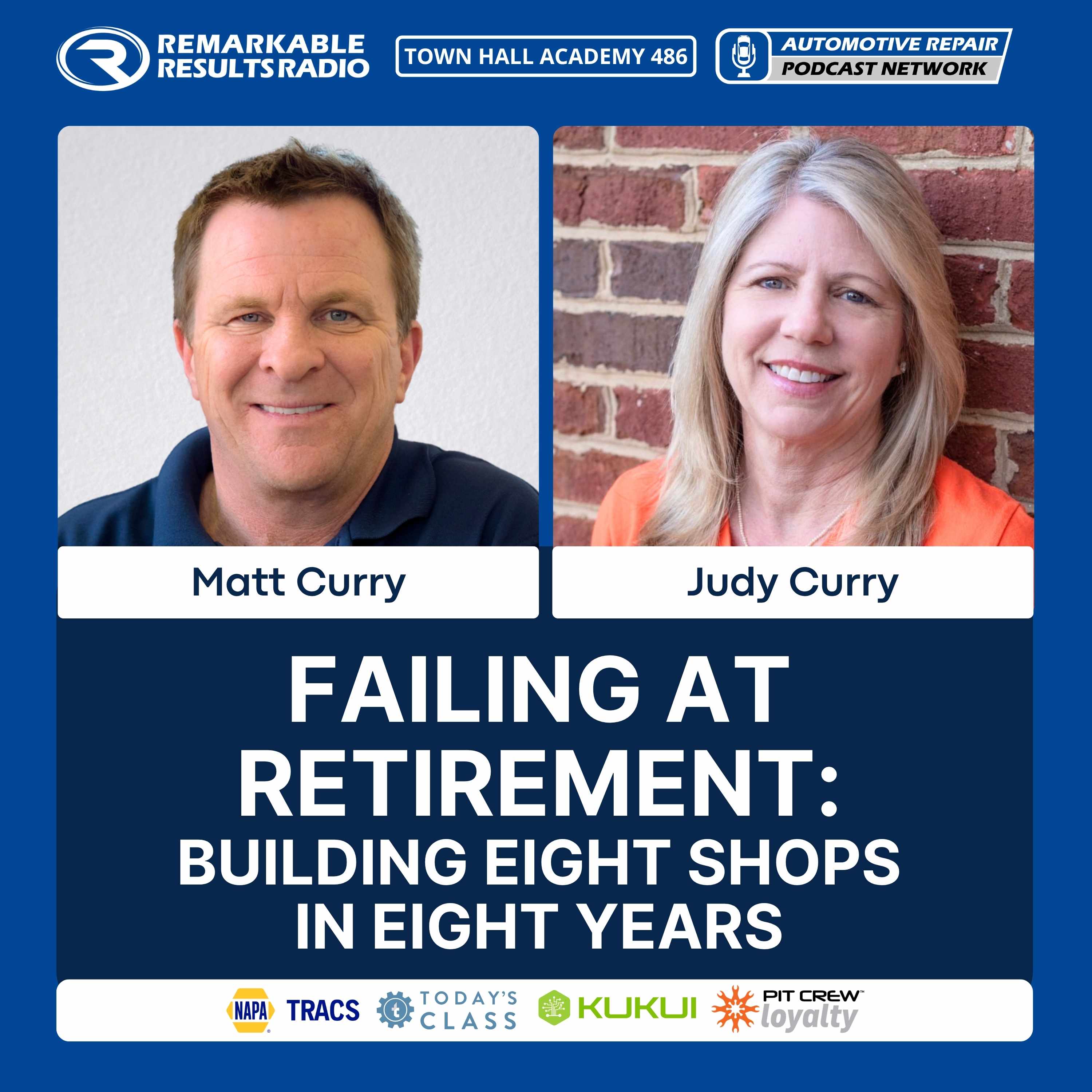
Remarkable Results RadioMay 22 · 52 min
Failing at Retirement: Building Eight Shops in Eight Years [THA 486]
Thanks to our Partners, NAPA TRACS, Today's Class, KUKUI, and Pit Crew Loyalty Watch Full Video Episode *]:pointer-events-auto scroll-mt-[calc(var(--header-height)+min(200px,max(70px,20svh)))]" dir="auto" data-turn-id="request-WEB:8e59eec7-a235-4fa3-a072-956fea3fe478-7" data-testid="conversation-turn-4" data-scroll-anchor="false" data-turn="assistant"> *]:pointer-events-auto scroll-mt-[calc(var(--header-height)+min(200px,max(70px,20svh)))]" dir="auto" data-turn-id="request-WEB:49a777bf-d263-4496-bf0b-2eb3a46ac96a-11" data-testid="conversation-turn-24" data-scroll-anchor="false" data-turn="assistant"> *]:pointer-events-auto R6Vx5W_threadScrollVars scroll-mb-[calc(var(--scroll-root-safe-area-inset-bottom,0px)+var(--thread-response-height))] scroll-mt-[calc(var(--header-height)+min(200px,max(70px,20svh)))]" dir="auto" data-turn-id="request-WEB:8a36a74e-94b9-45d2-82f2-3a0e09cdfefe-1" data-turn-id-container="request-WEB:8a36a74e-94b9-45d2-82f2-3a0e09cdfefe-1" data-testid="conversation-turn-4" data-scroll-anchor="false" data-turn="assistant"> Carm Capriotto talks with Matt Curry and Judy Curry of Craftsman's Auto Care about building one of the automotive industry’s most respected multi-shop operations twice. After growing Curry’s Auto Service to 10 locations and retiring in 2013, the Currys returned to the industry with a new vision, launching eight Craftsman’s Auto Care locations in eight years. Matt shares his role as the visionary leader driving momentum and ideas, while Judy explains how operational discipline, marketing, and customer experience keep the business grounded and scalable. The conversation explores their “5 Ps” philosophy: People, Policies, Processes, Procedures, and Profits, along with their commitment to employee development, strong culture, customer transparency, and community involvement. The Currys also discuss how Digital Vehicle Inspections and an intentional customer experience helped them earn nearly 10,000 five-star Google reviews. What You’ll Learn How Matt and Judy Curry scaled multiple successful shop operationsWhy leadership balance and “staying in your lane” mattersThe “5 Ps” framework for building a strong shop cultureHow employee investment drives long-term successWhy transparency and DVIs build customer trustHow culture and customer experience fuel growth and retention Sustainable growth in automotive repair comes from more than technical expertise. It requires intentional leadership, strong systems, a healthy culture, and a commitment to both employees and customers. Matt and Judy Curry, Craftsman Auto Care, 8 locations, Virginia Thanks to our Partner, NAPA TRACS NAPA TRACS will move your shop into the SMS fast lane with onsite training and six days a week of support and local representation. Find NAPA TRACS on the Web at http://napatracs.com/ Thanks to our Partner, Today's Class Optimize training with Today's Class: In just 5 minutes daily, boost knowledge retention and improve team performance. Find Today's Class on the web at https://www.todaysclass.com/ Thanks to our Partner, KUKUI Stop juggling multiple marketing tools. KUKUI’s integrated platform delivers 4x better website conversions, automated follow-up, and real-time ROI tracking. Get industry-leading customer support with KUKUI at https://www.kukui.com/ Thanks to our Partner, Pit Crew Loyalty You’re probably tired of chasing new customers who never return. We understand. Pit Crew Loyalty ends the one-and-done cycle, turning first visits into lasting, reliable revenue at https://www.pitcrewloyalty.com/ Connect with the Podcast: ...
Listen →
20

The Institute's Leading Edge PodcastMay 14 · 57 min
205 - The Diagnostic Fee Debate: Ask Me Anything with Cecil Bullard and Lucas Underwood
205 - The Diagnostic Fee Debate: Ask Me Anything with Cecil Bullard and Lucas Underwood May 13, 2026 - 00:56:50 Show Summary: Lucas Underwood and Cecil Bullard explain why diagnostic testing should never be treated as free work. They discuss how weak pay systems and poor communication have lowered the value of technicians across the industry. The conversation compares automotive testing to the medical field and explains why customers should expect to pay for professional diagnostics. They also cover technician growth customer education leadership and the need for stronger professionalism in repair shops. The episode ends with a call for the industry to raise standards and focus on creating long term value. Host(s): Lucas Underwood, Shop Owner of L&N Performance Auto Repair and Changing the Industry Podcast Cecil Bullard, Founder of The Institute Show Highlights: [01:00:25] – Customers understand testing better than diagnostics. [01:03:09] – Proper testing requires skill experience and expensive equipment. [01:04:04] – Shops lose profit when diagnostic time is given away. [01:06:47] – Flat rate pay discourages advanced diagnostic skill development. [01:12:10] – Lucas explains his Level One testing process. [01:14:45] – Cecil compares automotive testing to medical diagnostics. [01:19:22] – Skipping testing leads to poor repairs and wasted money. [01:31:06] – Lucas discusses leadership responsibility and coaching influence. [01:39:40] – Accurate testing saves money and prevents unnecessary repairs. [01:50:16] – The industry must value professionalism and technician expertise. In every business journey, there are defining moments or challenges that build resilience and milestones that fuel growth. We’d love to hear about yours! What lessons, breakthroughs, or pivotal experiences have shaped your path in the automotive industry? Share your story with us at info@wearetheinstitute.com, and you might be featured in an upcoming episode. 👉 Unlock the full experience - watch the full webinar on YouTube: https://youtu.be/cUCa2tz_G1c Don’t miss exclusive insights, expert takeaways, and real talk you won’t hear anywhere else. Hit Subscribe, drop a comment, and share it with someone who needs to hear this! Links & Resources: Want to learn more? Click Here Want a complimentary business health report? Click Here See The Institute's events list: Click Here Want access to our online classes? Click Here ________________________________________ Episode Transcript Disclaimer This transcript was generated using artificial intelligence and may contain errors. If you notice any inaccuracies, please contact us at marketing@wearetheinstitute.com. Episode Transcript: [01:00:00:01 - 01:00:11:22] Lucas Underwood Good afternoon, everybody. My name's Lucas Underwood from Changing the Industry podcast. I'm also a shop owner. And this afternoon, I'm here with the man, the myth, the legend, Mr. Cecil Bullard. Cecil, how you doing, buddy? [01:00:11:22 - 01:00:14:10] Cecil Bullard Howdy, howdy. I'm great, Lucas. As always. [01:00:14:10 - 01:00:24:14] Lucas Underwood Yes, sir. Yes, sir. So we've got some deep dive topics for the day. I'm excited about it because this is a hot button series of topics. So let's dig right into it. [01:00:25:15 - 01:00:53:00] Lucas Underwood Now, now, Cecil, we're talking diagnostics. We're talking testing. We're talking charging for it. But you know something? Very, very early on when I first started kind of working on improving my business, I went to ASTA for the first time and I got into some training classes. It was drilled into my head from the word go. You don't sell diagnostics. You sell testing and testing results in a diagnosis. How do you feel about that, Cecil? [01:00:56:10 - 01:00:56:24] Cecil Bullard Who cares? [01:00:58:05 - 01:01:03:19] Cecil Bullard I don't care. Here's the thing. I mean, I sold diagnostics for, I don't know, 25 years. [01:01:03:19 - 01:01:04:04] Lucas Underwood Yeah. [01:01:04:04 - 01:01:52:00] Cecil Bullard We're going to diagnose your car. Now, testing actually, we keep having these people that come into our industry and they come up with these great new words. And so let's not call it green anymore. Let's call it, I don't know, pumpkin pie or whatever. Who knows? Who cares? Right. And so if you're selling pumpkin posse. Yeah. If you're, if you're selling, if you're, if you're good at selling diagnostics, who cares? Right. This is the one instance where testing probably makes more sense only because the consumer probably understands testing a lot better than they understand diagnostics. Okay. And, and so, you know, I'm, I'm, if I'm going to go to the doctor, they're going to run a series of tests. [01:01:53:03 - 01:02:38:10] Cecil Bullard If those series of tests don't give them the information they need, then they're going to run another series of tests or more tests. And, and so I think that at least because of the medical industry and the, and the work they've done, the testing probably makes more sense at this particular point. And if we made that shift in the industry, would it make it easier for your customers, your clients to understand what you're, what you're doing and why there's a cost to it? And, and the answer is probably yes. So, you know, as far as calling, you know, technicians, mechanics or mechanics technicians or specialists or whatever, I don't care what you call me, you know, just call, make sure you call me. As [01:02:38:10 - 01:02:40:16] Lucas Underwood long as you pay the bill when you're done, I don't care. [01:02:40:16 - 01:02:41:09] Cecil Bullard Yeah. [01:02:41:09 - 01:02:42:09] Lucas Underwood Yeah. [01:02:43:17 - 01:02:44:16] Lucas Underwood Go ahead. Go ahead. [01:02:44:16 - 01:03:09:03] Cecil Bullard I just, we keep coming up with new words, thinking we're going to change the game when we're not really changing the game. The problem is that we don't value ourselves as an industry or our time as technicians or as mechanics and we never have, and we still don't value that time. And that creates a lot of the unrest in our industry and a lot of the financial issues in our industry. [01:03:09:03 - 01:03:45:15] Lucas Underwood I agree a thousand percent Cecil. I completely agree with you. But here, here's where I'm at on the testing thing. Okay. And a couple of thoughts behind this process. When, when I bring a client into my shop, I start with a level one testing routine. Now look, if you've never tested a car, if you've never done the diagnostic process yourself, it is very easy to say, well, hey, I'm just going to wrap that into the price. It's not that big of a deal. No, it's a talent. There is skill associated. There is knowledge associated. There's tooling associated with it. If you've never been the one to do it, you just don't understand how complex the process can be. Okay. [01:03:45:15 - 01:03:52:14] Cecil Bullard I'm talking to a shop yesterday. They have $189 posted labor rate. [01:03:52:14 - 01:03:53:07] Lucas Underwood Yeah. [01:03:53:07 - 01:03:55:29] Cecil Bullard Okay. They have an effective labor rate of 123. [01:03:57:26 - 01:04:00:08] Cecil Bullard Now they're wonder why there's no money in the bank. [01:04:00:08 - 01:04:01:00] Lucas Underwood Yeah. [01:04:01:00 - 01:04:02:13] Cecil Bullard And you know, we're talking about. [01:04:02:13 - 01:04:04:06] Lucas Underwood Everybody they're higher than everybody in town. [01:04:04:06 - 01:05:44:14] Cecil Bullard How many comebacks do you have? Oh, we don't have any, we have hardly any comebacks at all. Okay. And by the way, that's the answer. 99.9% of the time, we don't have any comebacks. Okay. Wonderful. Wonderful. It's not that how many, how many DVI's do you give away without charging that to your customer? Yeah, we do DVI's for free for our clients. Okay. All right. How much, how many times does your master technician, your A-Tech have an hour to quote unquote run tests or diagnose a car and take two days? Oh man, that happens a lot. Okay. Now we've, we've, we've circled in on one of the main reasons that the effective labor rate. And by the way, it's like $27,000 a month for this shop because their effective labor is so far off of their posted rate. And they, their A-Tech is again and again and again. If it's so easy to do this quote unquote diagnosis, anybody can do it in half an hour, anybody can do it in an hour. I cannot, you know, you got these ego tacks out there and I'm going to get blasted, but they're out there and they're like, Oh, well anybody should be able to do that in an hour. You know, we should be able to diagnose this code in an hour that code. And yet hundreds, if not thousands of guys are spending three, four, five, seven, 10 hours on a car, trying to figure out what's really going on. And, and how does that not come together? My ego is being in the way of being profitable and making money. Right? Yeah. Then I'm going to come up to the shop owner who's cheating me. [01:05:44:14 - 01:06:47:25] Lucas Underwood Well, so a couple of things here, right? First of all, let's just, let's put the elephant in the middle of the room and beat it. Okay. Because the reality of the situation is this, the pay systems and the way that we have set up the testing routines have not rewarded technicians. Okay. Now I get that there are thousands of ways to obtain reward and to find meaning and purpose in life, right? We go back to Michael Smith's leadership in the last. It's not all about money. It shouldn't be right. Right. But I'm going to tell you right now, if you don't pay somebody for it, they're not going to develop the skill. Right? I mean, let's just be real about it. You go and you work in the dealership and you get paid 0.25. You get paid 0.5 to go and do said testing that you know is going to take you an hour and a half or two hours to do it. Is it fair? One, no, it's not. B, there's no system. They're, they see them giving it away. Okay. When, when someone sees you giving their work away, it says to them, I don't value this. Well, we've, I don't see value in it. [01:06:47:25 - 01:07:11:22] Cecil Bullard Yeah. That's, that's one of the other issues we've devalued ourselves over and over and over again. And we continue to do that. You've got an owner that used to be a tech and for him or her, it, oh, it was easy for me. You know, every car that came in, I could figure it out in an hour. And, and then, but they're not the one figuring it out. Yeah. I have a, I have some companies that are, um, uh, [01:07:12:29 - 01:09:26:29] Cecil Bullard like restoration. So that what they're doing, there isn't quote unquote a book time for right there. They're sometimes making components and, and taking something off of a vehicle was never intended for this vehicle and, and re retooling it and et cetera. And we're timing materials. So when your timing materials, um, what's better to have the worst tech doing the job or to have the best tech doing the job. And if you do do that, you're going to have to do it. And if you do have the best tech doing the job, is that, is that hurting the shop, but helping the customer? Is that hurting the tech, but helping the client? Right. So yeah, our, our, um, the way we pay and obviously, you know, I'm for a pretty decent base pay. Right. So you're going to be here. You got to know that you're going to have, you know, food at home and a shelter over your head. And once in a while it would be nice if I could take my wife out to dinner or whatever. Right. And you got to know that. And then I think you need to have performance enhancement stuff. And if you are excelling in certain areas in certain ways that I can earn more money, I can make a bigger paycheck. And if you can blend those two, which is what we do, then I think you have the best of both worlds. But, but it doesn't, it will never matter if we don't, if we continue to devalue what we do. We do this techs all the time because, you know, we'll go, "Oh, I know exactly what that is." And then you have to have a lot of money. And I think that's, that's what I think that is. But wait a minute, why do you know exactly what that is? Well, you're some experience. So I have, I don't know, 252 scars on my hands. The reason I know this is because when I'm sitting in church and I'm bored, I'm OCD. So I'm counting the scars. And I've done it a hundred times, right? A thousand times. And where did those 252 scars come from? Working on cars. They came from reaching up under a dash and, and getting cut. And they came from, you know, a bunch of cars. And I think that's, that's, that's the reason why I'm here. sized them as they mostly were. Is because, uh, [01:09:27:29 - 01:09:49:02] Cecil Bullard I work overtime and I had a lot of hard work around them. And then you do the whole thing, pushed into that and I were like, Oh my God, this is terrifying. and, uh, you know, and there at the first time, you're someone else's medical Vancouver department. weren't born with it, right? You, you,u paid for it in blood, sweat and tears. You paid for it in extra hours that you didn't get paid for, you paid for it in real blood. Right? [01:09:50:15 - 01:10:17:11] Cecil Bullard And yet we constantly, we disregard that as technicians. I would say it's epidemic in our industry. And then you have your ATEX who don't understand why the C-TECH can't do it as fast or as good as they can. Right? Well, I don't understand. This is so easy. Well, go back to when you were learning. It wasn't easy when you were learning it. Right? And until we... Absolutely. [01:10:18:16 - 01:10:30:04] Cecil Bullard Until we find a way to kind of value ourselves and our time, that's what we have. Could you imagine a lawyer, like lawyer giving you 30 minutes without charging you? [01:10:30:04 - 01:10:33:09] Lucas Underwood Let me just tell you something. They don't ever. [01:10:33:09 - 01:10:35:01] Cecil Bullard No, they don't. [01:10:35:01 - 01:11:14:29] Lucas Underwood The one I've been working with here recently is fire. I mean, so good. We've got two right now that I work with on pretty much a daily basis. And there's a lot of things that they will just talk to us and say, "All right." And then they roll that into what they're doing. And I understand that, right? Because it's too much to every telephone conversation. Every second. Yeah. But I'm going to tell you right now, I've got a bad one and two good ones. And the two good ones, buddy, I don't even care. I don't flinch when that bill comes in because it's like, a great example is one of them, they're in another state and he calls me the other day and he said, "These people that we're going to battle with." [01:11:16:01 - 01:11:32:03] Lucas Underwood Two years ago, they were in a civil case and they accidentally released a document and I found that document and it is your everything you need to get what you want from them. And it's right there. Yeah. And he went through thousands of documents. [01:11:32:03 - 01:11:36:16] Cecil Bullard A few hundred thousand dollars. I'm like, "Yeah, you're worth your money, man. [01:11:36:16 - 01:11:52:07] Lucas Underwood Whatever you need to do. Send me the bill." Yeah. And so here's the big thing for me and I've dealt with a lot of shop owners and I talked to a lot of techs, a lot of shop owners on a daily basis. I talked to probably six or seven already today. [01:11:53:07 - 01:12:09:14] Lucas Underwood First of all, the main issue that I see is the people who have never done it don't value it because they don't understand it. And so there's a lot of these shop owners who went and they just bought a shop and they just say, "Well, a car goes to tech, tech tells me what to do, car fixed." [01:12:10:14 - 01:12:50:23] Lucas Underwood And all they see is the time associated with it. They don't understand the talent. They don't understand the skill. They don't understand the logistics of what has to happen to properly repair that automobile or to find out what's wrong with it. And so what I started doing in my shop season, and you tell me if this is right or wrong, I start with a level one testing routine. It has one hour on it and they get the basic data. It's a code read, it's fuel trends, it's data acquisition, it's confirm the client's concern, determine where it's at on the car, get me some base data. And if you can figure out in that hour, which about 90% of all cases they're able to, then great. It's an hour. We roll on with it. Typically they're out in half an hour to 45 minutes. [01:12:50:23 - 01:12:59:07] Cecil Bullard And maybe this is just coming in my head at the moment. Maybe what we're really doing in that first hour is creating a testing plan. [01:12:59:07 - 01:13:00:19] Lucas Underwood Well, that's what I was getting ready to say. [01:13:00:19 - 01:13:01:22] Cecil Bullard Or a diagnostic plan. [01:13:01:22 - 01:13:05:20] Lucas Underwood That's exactly what happens if it is something advanced. [01:13:06:21 - 01:13:30:12] Lucas Underwood And so step two, that technician comes to me and they say, Lucas, here's the data I have collected. It tells me that I am looking at an issue that is in X circuit because it says circuit high and I know it's not the component and I know it's not the computer because I've done these two tests. I have to do X to find this. [01:13:30:12 - 01:13:37:01] Cecil Bullard I have to spend this amount of time or I have to run these three tests in order to determine what's really going on. [01:13:37:01 - 01:14:45:03] Lucas Underwood You came back to me with data and you said, here's the test I need to do. Okay. Now, if I go to the doctor, I just want to point this out. If I go to the doctor and I've fallen, I've hit my arm and it's all bruised up and it's all to pieces and I go to that doctor, first of all, I'm going to pay for the visit fee. Okay. So I go into the doctor and they're going to say, Hey, it's a hundred and whatever dollars. The doctor comes in, takes a look and says, Hey, Lucas, I believe you've broken your arm. Now for me to determine the best course of action to correct your concern, I have to do additional testing. That's going to be an X-ray, that's going to be an MRI, that's going to be whatever it is. Now at that point, we'll know what course of action we need to take. Do we have to do surgery? Can we just set it? What do we do next? Right? First of all, they're not giving me an estimate for what's wrong. They're giving me probabilities. They're giving me some idea of where we're headed. But if I went into that doctor's office and they said, man, it looks like your arm hurts. I'm going to have to do some testing. It's going to be about a thousand bucks. Okay. What test are you going to do? Well, I don't know yet. I'm going to figure that out when I get there. I'll let you know. [01:14:45:03 - 01:15:10:13] Cecil Bullard Right. But that's not, that's not kind of how it works. I mean, I was at the doctor yesterday, normal visit. I'm diabetic. So I go twice a year and he says, how are you doing? I paid my $95 coded up, whatever. So he's getting paid, I don't know, $250 for between me and the insurance company. Maybe it's 150 for 10 minutes of his time at most. [01:15:12:09 - 01:16:16:01] Cecil Bullard And he says, oh, well, you're looking great, but I want to send you to this guy because you've got this problem and they need to, we need to figure out what's going on so we can have a course of action. Right. So we know what we're going to do or if we're not going to do anything. And so I paid for him. Now I'm going to go see a quote unquote specialist that will, I'll pay for that visit and then I'll pay for the testing on top of that. And then I'll have a plan to move forward. That's that's you know, we could discuss why are our medical systems out of hand and other things. The process that they do to determine the plan to solve the problem is a good process. They've been doing it for years and years and years. It works. It gets the right answer most of the time, 97% of the time or whatever. Right. And and and we move forward. And yet in our industry, we're like, well, I can't charge anybody for that. [01:16:16:01 - 01:16:23:25] Lucas Underwood Well, I just need to point out to you Cecil. Yeah. That's when you know you over the hill when they start saying, well, we're not going to do anything about this. [01:16:23:25 - 01:16:24:16] Cecil Bullard Yeah. [01:16:25:27 - 01:16:26:03] Lucas Underwood Yeah. [01:16:27:21 - 01:16:30:28] Cecil Bullard Until you can't walk anymore, then we'll think if we need to do something, [01:16:30:28 - 01:16:32:18] Lucas Underwood we'll get you a wheelchair then see. [01:16:32:18 - 01:16:39:16] Cecil Bullard Yeah. Yeah. That'll be great. You can get one of those little things. Yeah. Yeah. Thank you. [01:16:39:16 - 01:16:49:19] Lucas Underwood My dear friend Rick white, when he hurt his back had a scooter that they read him around on at Apex and I've never let that go. I just rubbed it in all the time. [01:16:49:19 - 01:17:00:26] Cecil Bullard You know, I had a, I had a foot surgery three years ago before Apex and I was, I was on a scooter for Apex and yeah, not, not fun. I'm really not fun. [01:17:00:26 - 01:17:18:13] Lucas Underwood I bet not. So look, when we talk about this testing thing, I just want to point something out about this because I think it's so important when we look at that medical field, they see value in the test that they're going to do because they know what test needs to be done. [01:17:19:18 - 01:17:52:23] Lucas Underwood They're in charge of charging you for that test, right? They decide what test has to be done. They put it on there. It gets billed to you and then the thing happens, right? Yeah. I think what happens in our industry is there are so many people who do not understand the service advisor and the owner or the service manager do not understand the skill, the talent, the tools, the ability, the time it takes to properly diagnose an automobile. Well, and so it's, it's different for them to stand up there and say, this is $400, but that's why I do the testing routine. [01:17:52:23 - 01:19:21:25] Cecil Bullard That's part of the problem with our industry. So if we look at, at a doctor, a doctor cannot afford to just go set your arm, right? Yeah. The bone is sticking out. You know, I know I've, I've got the scars to prove it, blah, blah, blah. Bone is sticking out. The doctor says we need to do some testing to find out what's going on because we need a course of action. All right. Now, if they had just set my arm at the time because the bone was sticking out, then I wouldn't have use of my wrist. Okay. Because it was, the bone had shifted when it broke. All right. Now, and they needed to find that out. And, and in the medical field, they cannot afford to set that bone and then later have me sue them or come after them because I know I now, I now no longer have use of my wrist in the automotive field. We don't seem to have a problem with, well, that guy wasn't right. Okay. And we, we even, we even, we propagate this idea that there's too many guys out there that aren't right. Well, yeah, because we're not giving them the tools or the necessity to run the testing to be right or the time when you, when you have a free, Oh, by the way, I have an hour. Man, you've spent three hours on that car. [01:19:22:25 - 01:21:03:07] Cecil Bullard How come, how come? What is it? You know, well, let me pull something out of my behind so that I'll get you off my back. And then, well, wait a minute. That guy was wrong. Now the shop is paying for it or the customer is paying for it or whatever, because we didn't do the testing in the front because we didn't value it because we didn't understand the liability that we have on the other side of that. It's a, it's a problem that is bigger than we think. And it's been going on for a very, very long time. Don't get me wrong. There's some guys out there working on cars that shouldn't be working on cars, but there's a lot of guys, when you put someone in a position for their family to starve or them to cheat, what do you think they're going to do? Let their family starve. Yeah, they have to. Right. And so when you're not charging for your text time and, and I don't know if, if Mike is here or not, but if he is Mike, don't tell me you're not charging for diagnostics. If you raised your labor rate, you are charging for your diagnostics. You're just charging for it in a different way. So now we got that out of the way. All right. But if you're not, if you're not charging for your diagnostic and, and you're asking your tech to do that for free, or you're paying for that yourself somewhere, there's a cost. There's either cost to the customer in poor diagnostics or incorrect answers. There's a cost to the, to the, the owner of the company, the company. And if there's a cost to the company, there's a cost to the employees of the company. And that's one of these things why we have techs constantly complaining about how poorly they're treated. You know, is it fair? [01:21:04:12 - 01:21:29:24] Cecil Bullard You call me, Hey Cecil, I've got this Toyota Camry that, you know, 2014 and it's got this weird blah, blah, blah. What's it going to cost? Right? Oh, well, you know, we're going to need to. We need to do some testing. And so we start at $300 and that'll be applied toward the testing. And if we can solve the problem with that, we'll certainly solve the problem. You come in, it's not even a damn Toyota. [01:21:30:24 - 01:21:46:02] Cecil Bullard Right. Yeah. And you show up with a, I don't know, you show up with a Nissan and you don't even know what you're driving and you want me to tell you on the phone what that price is going to be to fix something that I have no idea what it is or, or anything. [01:21:46:02 - 01:21:55:27] Lucas Underwood But our industry set that expectation, right? Our industry has created that expectation in consumers and, and, and we, you know, Dutch is always bust about us being a commodity. [01:21:55:27 - 01:22:24:05] Cecil Bullard Yeah. We keep propagating that. And you know, some of it is because we have egos and our egos won't let us get out of the way of ourselves. And, and, and some of it is because we don't, we don't get it, right? We really don't understand the, the financial aspects of the business or the, the, uh, uh, liability we have or any of the, you know, a few other things. And, and, and some of it's just probably plain ignorance. [01:22:24:05 - 01:22:43:28] Lucas Underwood Okay. Spicy, spicy perspective coming in here. I think some of it is because we're too stupid to have our own thoughts. So we go and we listen to some big wig coach who is in a metropolitan area who has thousands and thousands of clients that they can pull from. And, and we don't realize that what we're doing is basically market manipulation. [01:22:45:00 - 01:23:01:28] Lucas Underwood And, and we don't care that it devalues our industry as a whole. We don't care that it damages our industry because all we care about is making enough money to sell the shop or do whatever we need to do. We don't care who it upsets. We don't care who it hurts because all we care about is our shop. All we care about is the money. [01:23:01:28 - 01:26:37:16] Cecil Bullard I think, um, when you look at, at, at human beings in general, um, certainly there is the trap of I'm only doing what's best for me. Yeah. Okay. And, uh, right now, you know, someone hangs this sweet carrot of if you get 10 locations, you're going to get 16 X and, uh, and they stay. And by the way, you're going to get a really nice VC company that's going to buy your company for top dollar, and then they're going to take care of all your customers and employees, just like you would. Uh, you know what? I will, I was born at night, but not last night. Okay. So, so yeah, we're. And by the way, should we be doing what's best for us? Right. Yeah. So on the, on the chart of, of, um, uh, what's important, uh, my chart is, is Cecil's relationship with Cecil. Okay. Then it's Cecil's relationship with God. Then it's Cecil's relationship with his family. And then it's Cecil's relationship with his business. And then it's Cecil's relationship with everybody else. Right. And the, and the reason why that has become that over the years, because it wasn't always that was because if I'm not happy with me, I won't be happy with anything else or anybody else. I have to like me. I have to understand me. I have to know that with all the, all the warts and all the other stuff, you know, the temper, the whatever, that I'm a good guy and I'm trying to be a good guy and I'm trying to, you know, et cetera. And so I like me and, and then I need to have a relationship with God, whatever that is, so whatever your. You know, you may say there's no God, Cecil. There's a, there's a being or some science or something. Okay. Whatever that is, you have to have a relationship with it. You have to understand how you fit in the world. Right. And then I got to make my wife, uh, mostly happy. Can't make her all happy. Can't make my kids happy, but I got to do my best for my family. And then it's my business because there's an awful lot of responsibility. So with that nature that we have, are we going to look out for ourselves sometimes more than we probably should? Yeah. You know, I think it's, it's inherent. What, what gets me in our industry is that I almost dread going online anymore because 90% of what I'm hearing is negative. Yeah. And, and I, in this industry, this industry has been good to me. All right. Uh, I was, uh, 19 dropped out of college, came home, started as a tech for my dad. I was making 50,000 the first year I was working as a tech and I got news for you. I didn't know squat. Right. And, and then I became a service advisor and a manager and, and eventually I owned shops and sold those. And then I started a coaching company and now we're, you know, we're expanding and doing other things. And, and the industry has got me here. And got me through, I don't 45 year, 45 tough years with four kids. All right. And, and where else can that happen? You know, someone that drops out of college that really knows very little high, high intelligence, high ego, right? But other than that, not much going for me. Uh, and, and I end up here, this is a great industry. There's more opportunity in our industry right now than there's ever been. And you know what, if your owner is treating you like crap, [01:26:38:18 - 01:26:40:11] Cecil Bullard you know, how many shops need a tech, [01:26:41:11 - 01:26:52:14] Cecil Bullard right? And so don't sit in the, excuse me, do not sit in the pile of shit and then complain how stinky it is. Right. Get out, [01:26:53:14 - 01:27:43:19] Cecil Bullard shower yourself off, go get another job somewhere. Because I know right now I could tell 50 shops, if they could find an ATEC, they'd be paying that ATEC as much, almost as much money as they wanted. And probably a lot more than the average in the industry and, and really giving them a great place to work with all the support they need, all the tools, all the equipment, all the education, all the training, et cetera. And then I understand what you were saying about like the coach. Sometimes we have these companies that are telling you what you want to hear. Yeah. Not what you need to hear. Okay. Absolutely. And, and, and I think, you know, it's probably a good thing that I'm not God, frankly, cause I don't have the patience or the understanding and I might do some, [01:27:44:24 - 01:28:15:15] Cecil Bullard I might do some really crazy bad things because there are people in our industry that, you know, if I had the, if it was up to me, they wouldn't be in our industry, but that competition, that, that knowing that that's out there drives me harder every day, right? Yeah. It makes me want the Institute to do better, to do more, to, to have more impact, to, to help more people be successful. Right. [01:28:15:15 - 01:28:34:29] Lucas Underwood Here's the thing is that those people, okay, let's think about this for a minute. They know, right? Those people are intelligent enough to know what they're doing. They're intelligent enough to know what the outcome is. Um, Mike Allen says he wants a list of people that sees with Smike. Mike's at the very top of it. [01:28:34:29 - 01:28:37:05] Cecil Bullard No, he's not. He's like fifth on the list. [01:28:38:17 - 01:28:38:23] Lucas Underwood Okay. [01:28:39:28 - 01:28:43:19] Lucas Underwood Um, uh, now I need to, oh man, this is going down a dark tunnel here. [01:28:45:20 - 01:28:56:15] Lucas Underwood But I, you know, look, I'm just going to say like, I think that, that those people know, and they know that the impact they're making on the industry. We pick on Mike. Mike really does. [01:28:56:15 - 01:29:01:00] Cecil Bullard Mike's a easy target. Thanks. And thank you for being that target, Mike. [01:29:01:00 - 01:29:09:08] Lucas Underwood Yeah, absolutely. And he's, he is working. I see his efforts behind the scenes all day long of like teaching people and trying to lift them up and, [01:29:09:08 - 01:29:27:23] Cecil Bullard and, but you, you have a big responsibility when you have the ear of the industry. Okay. And if you're going to be an industry influencer, there's a responsibility, not just to provoke, but to educate and to help. [01:29:28:28 - 01:29:39:26] Cecil Bullard Okay. And if you're, if you're provoking for the sake of, um, uh, hits and likes and crap like that, that's problematic. [01:29:39:26 - 01:29:42:05] Lucas Underwood That is not why Mike's doing that. [01:29:42:05 - 01:29:44:15] Cecil Bullard No, I know what Mike's up to. [01:29:44:15 - 01:30:00:18] Lucas Underwood I, yeah, what Mike is up to is he's just trying to meet his brother's level of this success. I mean, his brother was this super successful pilot and he did all these amazing things and Mike has always felt a little bit less than because of that. And so Mike is working really hard to get to the next level. [01:30:00:18 - 01:30:39:16] Cecil Bullard Do you know where we, do you know what we have to compare ourselves to? If you do this, right? You compare yourself to yourself. That's it. Amen. I, if I, I will never be the man my dad was. Okay. Um, he was stronger than I am physically, uh, till the day he died. He, I will never be him. Okay. And there's good and bad about that. And there's a lot of people out there that I admire. Okay. But I'm not going to be them. I hold myself to my own standard, right? It's my standard for me. I don't, yeah. [01:30:39:16 - 01:31:06:00] Lucas Underwood I've got to ask this question. Okay. This has nothing to do with diagnostic testing and it's something that I think I have personally struggled with a little bit, um, and something that I think about often when, when we give advice, right, it's rooted in our belief system. It's rooted in, in who we are, but I take giving advice to other people very seriously, and I take lifting them up and getting them to a better place very seriously, [01:31:07:03 - 01:32:07:05] Lucas Underwood when we look at, at people giving some of this advice and, and I, I think they genuinely believe that they're doing what's right. I think they genuinely believe they're, they're doing the right thing for other people. See, so how do you judge that advice? How do you know that you're leading them in a right direction? Because like these, what I keep seeing is I see these people, they're business owners and they're, they're lost, right? They don't know where to go. They don't know what to do. They don't know. And, and many of them pull from many different facets and they get information from lots of different people. But sometimes someone will attach to a very specific person. And what that person says is the grace and they believe everything they say. My fear is that my belief system may move their morals or their values in a different direction that doesn't align with who they are. And I take that very seriously. But I don't, how do you avoid that as a, as a coach? How do you make sure that you're not infringing on their belief system? [01:32:07:05 - 01:33:31:20] Cecil Bullard Do you, do you remember what I, I, I started out with in, and that is, um, Cecil has to like Cecil and then God and family and et cetera. So, um, you know, I judge the success of what we do with clients by their success, right? And I always said, you know, we, we can influence, um, we can't, I can't make your decisions for you. I can ask you what I can, I can tell you what I would do. Um, I can tell you also as a coach 20 years ago, I was a lot harsher and a lot more imagine that right. Uh, and a lot more, um, you got to do this and you got to do that. There were, there were a lot more definitive statements. All shops should, all people should blah, blah, blah. Uh, those, a lot of those things have disappeared from my, from my vernacular, I look at the, at what the Institute for all the clients that we have served and all the clients we serve and the success that we have. And I judge my success by that success. I also judge my success by being able to look at myself in the mirror in the, in the morning and, and, and like what I see, even though it's, it's a little flabbier, a little older and a little whiter. [01:33:31:20 - 01:33:33:05] Lucas Underwood Well, saggy, the old nine yards. [01:33:33:05 - 01:33:34:09] Cecil Bullard Yeah. All that. [01:33:34:09 - 01:34:34:01] Lucas Underwood There's a, there's a great question that just came up and I'm going to take a stab at this, he's going to pop it up on the screen for us because I'm wondering about the best ways to present a higher cost for Diag to customers. I always have a hard time, especially if we end up having to send it elsewhere because we don't have a special tool or software. We go as far as we can. Then we have to stop sometimes medical field. It's not a big deal to pay a bill to one doctor after they tell you they need to send you to a specialist, but in our industry, it feels like we've just failed. Now, listen, I'm going to tell you that for me, I'm judging that situation very early on. Okay. I'm not taking on things that are out of my wheelhouse and I have learned my lesson. And listen, Cecil, this is something you've seen in my shop. If the advisor is not astute, automatically, if they don't have that technical knowledge, if the manager doesn't have that technical knowledge, it can be very difficult to weed those out. But you have to have a technical team that says, "Hey, I believe this is something that we shouldn't get into. We need to get this out." There's things that require some treatment. [01:34:34:01 - 01:35:55:10] Cecil Bullard But I don't, I would, in a way, I disagree with you because we need to define what our jobs are in the business, right? If I'm the owner and the manager of my company, what's my job? To provide my people with the things they need to be successful, goals, org charts, job descriptions, tools, education, et cetera. Am I the one making the decision as the owner that we're going to take that job or we're not going to take that job? No, I'm not qualified. I haven't worked on cars in 16 years. Okay. There's no grease under my fingernails. There's, you know, the scars I have are well healed and there's no fresh stuff going on. Is it the service advisor's job to make that decision? No, no, no, it's probably not. It's the tech's job. This is beyond our capabilities. And by the way, can the tech do that if we haven't charged some time up front to determine that? And maybe we need to develop a list of specialists in our area that we can say, "We need to send you to a specialist on this type of a car." And not feel bad about doing that because that's what's best for the company. That's what's best for the client and the client's vehicle. It's not to bring it in and try to mess it around and, you know. For sure. [01:35:55:10 - 01:36:32:07] Lucas Underwood But, but I mean, here's, here's the thing. A 1993 Mercedes SL shows up. It's KJET. It's one of the worst injection systems ever built. Somebody's going to yell at me for saying that. It's terrible. It's awful. You look at that car and you say, "Hey, I don't work on cars that are older than 20 years old." "Hey, I don't work on Mercedes that's this type of fuel system." I don't, right? Like there's, if we know, right? If I know there's no way I'm going to work on that car, I know better. I have learned my lesson. I have paid the price for it. I'm not going to take that car. [01:36:32:07 - 01:36:41:12] Cecil Bullard As techs in our industry, we judge ourselves by being the guy that can fix everything and have all the answers. [01:36:41:12 - 01:36:45:10] Lucas Underwood I'm over that Cecil. I am so over that. [01:36:45:10 - 01:36:45:25] Cecil Bullard Me too. [01:36:46:25 - 01:37:06:01] Cecil Bullard Someday, hopefully we mature enough to understand that that's, you know, that there are things in our life that we're never going to do, right? I'm never going to fix every car. I'm not going to fix every client. They won't, you know, I, I've got, believe it or not, there are people that won't listen to me, right? [01:37:07:24 - 01:37:49:25] Cecil Bullard Sometimes I'm like, "God, you've hired us to help you. We're telling you what to do." And yet you won't go do it, right? Right. And again, I can only have influence. So I think, yeah, I think we need to decide kind of upfront what our roles are and what we're willing to do and what we're not willing to do. And the better we make that, the clearer we are, then the better we can focus our business on being more successful as opposed to, you know, all the crap. And I got to tell you, it's, it's really hard when you have no cars in your shop to say no to somebody that's bringing in a Mercedes with a K-Jet system or whatever. Right? [01:37:49:25 - 01:37:56:05] Lucas Underwood No, it's not. So I would rather be broke. I would rather not pay my bills this month. Okay. I'm just telling you. [01:37:56:05 - 01:38:23:07] Cecil Bullard It's hard for most people to, when they think, again, if you think, if you judge yourself on your, your prowess of fixing cars, and now all of a sudden you're making a shift into ownership or something, and you have to judge yourself now on the success of the people that work for you, not, and your clients, not on your own ability to, to fix cars. And that's not an easy shift to make. [01:38:23:07 - 01:38:37:07] Lucas Underwood I agree. And that, that was one of the hardest things for me to do because the things that I saw as easy, the things that I saw as, Hey, just go do this. I recognize other people don't have the same abilities that I had. Now, I don't have the ability anymore. [01:38:38:15 - 01:39:34:28] Lucas Underwood But they were easy for me. And so I would judge the situation based on my knowledge, right? The curse of knowledge. I would talk to clients on the front counter based on what I had experienced and got myself into trouble many times. Now I'm going to tell you, be prepared. Here's where I am with this. What I do is I bring them in for a level one testing routine. And I just explained in 90% of all cases, I'm able to determine the cause or causes of your concern. Other 10% of cases, I may have to refer you to a specialist or do additional testing. I will never, ever, ever change my estimate from this price. You will stay in control of the entire process at all times. But I may come back to you. And if you are one of those 10% cases and let you know, we have to do additional testing or you need to go to a specialist or you comfortable with that. And so I, you know, I made a video last night talking about this until you've been to a shop that throws parts at your car and can't actually fix it. And you just spent $3,500 trying to change all these parts and you still have the same exact problem you went in with. [01:39:35:28 - 01:39:40:05] Lucas Underwood You listen, they have no issue paying for proper testing at that point in time. [01:39:40:05 - 01:40:33:04] Cecil Bullard And those are my clients. The least expensive way to fix your car is to have someone that knows and understands that vehicle, inspect it, do the proper testing, create a diagnostic, a diagnostic process, plan for it and pay for that. That's the least expensive way to fix your car. And this, the stuff we do in our industry, like taking it over to, you know, one of the parts houses and they're going to test it for free and then sell you an oxygen sensor and you're going to bring it in and I'm going to put it on your car. Can't, can't make that work. Right. I, and we, we have to stop as an industry doing those kinds of things. And we have to, and, and those of us that are in the industry that are being affected by that, we should be fighting that tooth and nail. Yeah. Right. [01:40:33:04 - 01:40:54:18] Lucas Underwood Yeah, absolutely. Absolutely. Got an incoming question and I vote. I know which one it is. And it's Mike Allen saying, are you super clear if you have to pump this to a specialist that you're still charging? Yes. Now listen, I've had issues with advisors not being super clear, but I am super clear and I am very, very transparent about that. [01:40:54:18 - 01:41:24:15] Cecil Bullard And what I want to, what I really want to teach my advisors is this. We need to be as clear as, as I mean, crystal clear about what the costs are going to be and what's going to happen with our clients. And by the way, if I want a client to argue with me about the cost, do I want that to happen before I work on the car or after my tech is spent two hours on the car and created a plan, right? And, and what happens a lot is the advisors, we have a lot of. [01:41:25:23 - 01:42:43:22] Cecil Bullard Unqualified salespeople in our industry. We're not really salespeople. Okay. They're not really advisors and, and they're, they might be the nicest people. They might be all kinds of things, but they're not really advisors and they have a fear, I don't want to have this conversation because it's going to be a potential to have that person be mad at me or have that person take their car away or whatever, and they may walk away and not like me. Right. And, and, and so we're vague. We're vague about our answers. We're vague about what we're going to do. We're vague. How many shops have you walked into that have a very good script about Diag and what they do, why they do it, what the costs are, why those costs are the costs and what, what is likely to happen and what could happen. You know, how many shops have that script that your service advisors know and understand. So that customer is right off the bat understanding what's really going to happen and why it needs to happen that way. I would tell you for me, like sales and building value, it's so easy, but it is not easy for the average service advisor because they've been taught how to do that and they don't have the experience to do that. Right. And so we, yeah, we, we need to, yeah, we got to clean that up. [01:42:43:22 - 01:44:28:21] Lucas Underwood You know, look, we, we pick on Mike, but, but let's be honest about why Mike does a lot of what Mike does in this instance. And it's because Mike needs a competitive advantage. He is, he is in a very, very heavily saturated area. There's a lot of shops around him. There's a lot of people around him too, but he uses this as a tool to try and drive more people in the door. He uses it to set himself apart from the rest of the crowd. I use something completely different, right? Like for me, I'm using the fact that we can test anything. I'm using the fact that we have abilities nobody else has. And we have those abilities because we pay our guys to learn this. We pay our guys to go to training. We have this set up so they can develop these skills and we have the equipment and that costs money, right? I understand like in their eyes, a lot of times it's like, Hey, they don't really know that they're still paying for it. They don't understand that it's in the labor rate, but to me, like, I feel like that devalues the industry as a whole. I feel like it makes it look like this should be a free service. You know, just two weeks ago, we had a car in the shop that, that came through and he called somebody else and they, they were going to do the job we were going to do for $700 for $240. And they're telling them about how we're ripping them off. They've never heard of a coolant service. They've never heard of this. They've never heard of that. And then we look at our industry as a whole and it's like, Hey, this guy's over here talking smack on an industry standard just to talk smack about it. I think if we could align ourselves, if we could get our industry moving in a more similar direction, where we're, we're making it better about our actions in our shops, our single shops at a time, we have a chance at getting this industry to where it's seen as a professional industry. [01:44:28:21 - 01:44:34:01] Cecil Bullard So let me ask you, let me ask you a question. I got, I got a couple of points, but let me ask you this question. [01:44:35:22 - 01:44:49:09] Cecil Bullard We're going to go somewhere and have a steak. Yeah. All right. And they've got a, uh, I don't know. It's $120 steak. Yeah. Um, but they also have a $30 steak and they're the same steak. [01:44:49:09 - 01:44:50:04] Lucas Underwood Yeah. [01:44:50:04 - 01:45:00:22] Cecil Bullard Okay. Does that, did, would that even play? I mean, would, would anybody at all look at the $30 steak and think that's the $120 steak? [01:45:01:23 - 01:45:15:16] Cecil Bullard No. Right. So if somebody comes into my shop and we're going to charge them $700 for whatever, right? Uh, Mike, that's my imaginary shop. Okay. Um, I don't own one. I'm thinking of buying one just because you put, you goaded me, [01:45:15:16 - 01:45:18:00] Lucas Underwood but no, I missed this. [01:45:18:00 - 01:45:55:09] Cecil Bullard But, but, um, uh, if I'm 700 and they call and say, this guy is, is saying he doesn't even know, never heard of this and he's going to charge $240 for the same thing, you know, my answer would be it's not the same thing. It can't be the same thing. Because if he, if he knew what he was doing, if he understood his business, if he understood the time it was going to take to properly diagnose and fix this car correctly, he'd be charging you $700 also. And then I want to, I want to play on something you said. Mike uses this for competitive advantage because he's in a saturated place. [01:45:56:13 - 01:47:28:26] Cecil Bullard Boo hoo. I mean, every, you're, you're somewhat unique, right? In your out in the country and you're kind of further away. There's a two thirds of the shops are in saturated places. And there are a lot of guys that aren't using, well, we don't charge for diagnostic as their competitive advantage. And they're doing just fine. I know they're my clients, right? Um, I, I always talk about this stupid book. I'm going to write that Cecil, you don't understand is the title, you know, I love it. You, you don't, you don't understand Cecil. Um, my shop had 41 shops within a mile of it and two dealerships and we were $58 higher than the next shop and we were the busiest shop. We had the happiest clients, the most satisfied. Uh, we, I believe we were the most profitable, although I didn't see all the other shops, P and L's. I did see some of them because I was, you know, that's when I started my coaching career. But, but I, I, I don't need to do that for a competitive advantage. I need to take great care of my clients. I need to help them understand why it costs, what it costs and how they're paying when somebody says, you know, I can get it done for 240 and you're going to charge me 700, you must be ripping me off. I have to say, wait a minute. Time out. No, that's not true. Because if you and I go to the restaurant and I ordered the $120 steak and you order the $30 steak, we're not getting the same steak. Okay. [01:47:30:04 - 01:48:17:23] Cecil Bullard And in, in, intelligently, internally, we understand that emotionally. We don't necessarily get that. We have to help our clients take their understanding and create emotional intelligence around that, uh, with what we, we charge and why we charge it. And I would say that most shop owners understand that we, or at least believe that if the client comes to them, the client is going to get a better repair, a better job, we care more, et cetera. And we should definitely feel that way about it, but a good salesperson helps the client take their emotion, their mental intelligent understanding and create emotional understanding around that. [01:48:17:23 - 01:49:58:04] Lucas Underwood Yeah, absolutely. And I think that if we, if we are not doing that, and so it's your job as a coach to do that for us, it's our job as a business owner to do that for, for your people, for our people and our people's job to do that for the client coming through the door. And I genuinely see that if we don't start taking moves to move our industry in that direction, as far as educating the consumer about the value in what we do, that we are professionals, right? And see that, that, that's the thing that trips me up on this. Because I can look at Mike's shop and say, that's my friend's shop. I love him. I care about him. I want the best for him. And if that's what's working best for him, so be it. He can do whatever he wants. The thing that, that hems me up on that is that I know that it has a detrimental impact to our industry in the longterm, right? There's no ifs, ands, or buts about it. We've seen what it does. We see what the code scan from AutoZone and Advanced Auto Parts does to our industry. And so we know that not charging for that testing makes it look more like a commodity. Right. And I'll never forget. One of these coaches we're talking about was on a podcast a while back and he said, man, he said, I'm a retailer. I'm a retailer. I don't care about the industry. I don't care about any of that. I'm a retailer. I'm here to make money. And I'm like, but, but we're not retail. We're professionals. This is our job. We are here to advise, consult, provide information to the consumer, help them make an informed decision about one of their most expensive purchases that they'll ever make in their lifetime. Right. And it's not just about money to us. [01:49:58:04 - 01:50:16:05] Cecil Bullard And if that customer takes care of their vehicle, that vehicle will service them and service them well for a very, very long time. Now, now here's the, here's the other thing. And I think this is like super important. And we have to stop complaining. [01:50:17:11 - 01:50:48:22] Cecil Bullard We have to stop talking. I'm not, not talking about the bad stuff. And, and, and I can't, whose actions can I, can I change? Luke, Lucas, can I make you do something? No, I can't make you do anything. I can only change my own actions. So we, if we want consumers to understand the value of what we do, we have to start talking like what we do has value, not like what we do is crap. [01:50:49:22 - 01:51:04:17] Cecil Bullard And, and there'll always be some bad guys out there. We can't, we can't help that. We can't make that go away. You know, um, like I said, it's a good thing. I don't have that power because I would do some, [01:51:04:17 - 01:51:06:07] Lucas Underwood there would be some people, uh, [01:51:07:07 - 01:51:08:03] Lucas Underwood burning crisp. [01:51:08:03 - 01:52:23:22] Cecil Bullard Yeah. But, but, but I can be as positive as I can be and work towards a better industry and, and try to bring people together to, to work towards that better industry, I can influence again, what we say on our podcasts and, and how we say it or what we say in our, um, our groups and how we say it, I can influence that hopefully, but I can't change it all. I can only change as much as I can change it and work as hard as I can work. Um, I, we, we, we want to be seen as professionals as an industry. And yet many of us don't act as professionals and we need to, we need to turn that corner. Yeah. Okay. And whatever that takes, I mean, if it's a, if it's a badge that we wear a star on our forehead, a tattoo, whatever, whatever that's going to take, I'm for it. As long as we change the conversation and we start moving towards, you know, becoming in being the professionals that we know we need to be and that we know we should be, that's what we, that's what I'm for. [01:52:23:22 - 01:53:29:05] Lucas Underwood You're exactly right. And I think that it takes experience. I think it takes commitment to trying to do the right thing, focused on doing the right thing. And, and sometimes it has to be, you know, I, and I'm with you, right? Like I've, I've really shifted over the past couple of years from, Hey, I'm primarily focused on our industry and making our industry better, right? But I still have to be able to pay my bills. I still have to be able to take care of myself and my family and I have to be there for them and, and I've seen the impacts through other people's actions of what misaligned, uh, desired outcomes or misaligned intentions can do. And so I recognize that I have to align my, my family, myself, they have to come first, my business has to come first, but still yet, every decision I make in my business, I'm trying my very best to say, how can I improve this industry? How can I make this industry a better place? Because one day I have this vision that I'll maybe my son owns this shop and I want his life as a shop owner to be easier than mine, because I'm not going to lie. This has been a slog. [01:53:30:05 - 01:53:30:11] Lucas Underwood Okay. [01:53:30:11 - 01:55:23:25] Cecil Bullard I'm just saying you like it. I mean, that's the other part. You know, we, we, we go through our lives and, and you know, I, I'm not, I always say I'm not supposed to be in this industry. I wasn't, this wasn't the plan. And, and here I am, you know, 44, 45 years later and here, you know, here I am. And I've been in this industry and, and, uh, it's been good to me. It hasn't been easy. But you know what, the hard part of it has, what's kept it interesting and, and make me strive and all of that. I don't, you know, I don't, I don't think there's a perfect anything and, and, you know, thank you, who, whoever's in charge of the universe for doing that to us so that we, so that we know how to strive and that we continue to strive. Um, I've had a great life. I've enjoyed my life. Uh, I'm going to hopefully enjoy it for another 20, 25 years and, and, uh, continue to try and influence, um, the industry to be as professional as possible. And, uh, I just, I really want to go to the changing the industry blog and all the, the, you know, the group and, and I want to see some people say, man, you know, my owner Lee is just a great guy. And man, this is a great shop that I work in. And there's such great opportunity to be a tech in this industry today. You could almost write your own ticket. And I'd love to see some owners go in there and say, you know what, man, it, it's a struggle, there's some bad weeks and occasionally there's a bad month, but overall, man, what a great industry we work in, because if we can't, if we can't talk about it that way and be that way with it, the public is never going to understand why they pay us a nickel. Yeah. A hundred percent, a hundred percent. If we get, we got to get more positive focused in this industry. [01:55:24:25 - 01:55:45:28] Cecil Bullard And, uh, so look for the, uh, automotive industry initiative coming out soon, which, uh, is the group of, uh, people we put together and we're going to be putting more people into that pile to drive the industry towards more professionalism and towards, um, worse, uh, to be more solidified and more positive. [01:55:46:29 - 01:55:47:03] Cecil Bullard Absolutely. [01:55:47:03 - 01:56:17:17] Lucas Underwood It's going to be great Cecil. Thank you for being here today. Everybody. Thank you for, for being part of the conversation. Our dear friend, David over at inbound is going to get all kinds of diagnostic questions because the email says support at call inbound. So, you know, David, listen, you just answered the best you can. We'll riff off of it next time. Okay. So, uh, you know, I'm really excited about the things that are happening and the moves that we're making and even, even little old Mike Allen over here, his efforts in the industry have been huge as well. [01:56:17:17 - 01:56:21:13] Cecil Bullard I'm going to have to give him a big old wet kiss on the cheek next time I see him. [01:56:21:13 - 01:56:49:14] Lucas Underwood So that's it. He would enjoy that very much. So, uh, but I am so thankful to be here with you today, Cecil, and I can't wait for the next one. We got another one coming up next month and, uh, it's just been a blast. And if you guys have any additional questions, make sure that you email over to the Institute and we'll try and answer those next time on our next AMA with Cecil Buller. Cecil, thank you, sir. Thank you, Lucas. Have a good day, buddy. Love you, brother. Love you, man.
Listen →
21

The Institute's Leading Edge PodcastMay 8 · 1h 0m
204 - Part 1: Using AI in Your Shop to Increase Performance
204 - Part 1: Using AI in Your Shop to Increase Performance May 6th, 2026 - 00:59:50 Show Summary: Artificial intelligence is reshaping how auto repair shops operate in practical ways. Jonathan Seitzer shares how AI can improve communication analyze data and save time on daily tasks. He explains a simple framework of rent it feed it and put it to work to help shop owners get started. AI is positioned as a tool that multiplies performance not replaces people. Real demos show how shops can create better customer messaging and gain insights from their data in minutes. The conversation also highlights the need to review AI outputs and use it responsibly. It closes with a look ahead at AI agents and how owners can begin experimenting today. Host(s): Jimmy Lea, VP of Business Development Guest(s): Jonathan Seitzer, Owner, Dempsey’s Service Center Show Highlights: [00:00:00] – Introduction to AI use in daily auto shop operations. [00:02:35] – Background in finance and technology applied to auto repair business. [00:06:20] – Three ways to use AI rent it feed it put to work. [00:08:17] – AI acts as multiplier not replacement for shop owners. [00:10:21] – Simple AI tools improve customer communication and service descriptions. [00:15:02] – Always check AI outputs since mistakes and errors can happen. [00:19:00] – AI helps create clear customer talk tracks from technician notes. [00:30:16] – AI quickly analyzes parts data saving hours of manual work. [00:37:31] – AI summarizes content into audio saving time each day. [00:45:21] – Use AI internally while maintaining trust with customers. In every business journey, there are defining moments or challenges that build resilience and milestones that fuel growth. We’d love to hear about yours! What lessons, breakthroughs, or pivotal experiences have shaped your path in the automotive industry? Share your story with us at info@wearetheinstitute.com, and you might be featured in an upcoming episode. 👉 Unlock the full experience - watch the full webinar on YouTube: https://youtu.be/8_dcnz_4csE Don’t miss exclusive insights, expert takeaways, and real talk you won’t hear anywhere else. Hit Subscribe, drop a comment, and share it with someone who needs to hear this! Links & Resources: Want to learn more? Click Here Want a complimentary business health report? Click Here See The Institute's events list: Click Here Want access to our online classes? Click Here ________________________________________ Episode Transcript Disclaimer This transcript was generated using artificial intelligence and may contain errors. If you notice any inaccuracies, please contact us at marketing@wearetheinstitute.com. Episode Transcript: Jimmy Lea: Hey, good afternoon, friends. Depending on where, when you are joining us, it could be morning, afternoon, or evening. Good to see you, my friend. I'm glad you're here. Glad we are gonna have this conversation today as we talk about the future of our industry, and how does artificial intelligence really fit into our day-to-day operations? What does that look like? This is gonna be an interactive conversation. What do I mean by that? No, you're not gonna come on camera. No, we're not gonna unmute your microphone. Go to the comments section. We're live streaming on Facebook and YouTube and StreamYard. Go to that comments section and type in there your questions, comments, or concerns. In fact, go into that comments section and type in where you're joining us from, the name of your shop. Love to give you a shout-out as we talk about this industry that we love that's doing so well for us. And yeah, drop in your name and where you're joining us from because it's super exciting to be here with you, friends. It's super exciting. First and foremost is the current coach for our guest, Mr. Wayne Marshall, CEO of GEAR Group Holding, and he is joining us from Iowa. Good to have you with us, Wayne. Thank you for being here, brother. Also Steve from B&C Auto Center in San Jose, California. We've got Peggy from High Street Auto Repair, Jefferson City, Missouri. Jeff from Miller's Automotive, Orange Park, Florida. Jeff Byrne from German Tech Motorworks, Louisville, Kentucky. And let's see, Fernando, Rohrehard Park Transmission, Northern California. Evans from Evans & Lukes in Columbus, Ohio. Evan, good to see you again, brother. How you doing? Oh, that's awesome. And Justin Pepper, Quality Auto Repair here in Oklahoma City, Oklahoma. Nice. Glad you guys are here. Thank you for those who are vocal and know where that comments button is. This is gonna be so much fun. We're gonna have such a great conversation here. Joining me today is John from... Oh, one more shout-out. Todd from Atlanta Speedworks in Gainesville, Georgia. John joins us today from, where are you joining us from? Jonathan Seitzer: Newark, Delaware, Dempsey Service Center. Jimmy Lea: Dempsey Service Center. And John is a very recent purchaser, a recent joining the ranks of ownership, of shop ownership, and he joins us from computer industry, the computer world. What's your background, John? What qualifies you as a computer surgeon? Jonathan Seitzer: Prior to my move to the automotive industry, I was the head of product at Moody's Analytics for some of their suite of compliance products for, for their banking and government services. Prior to that I was at JPMorgan Chase for 10 years in various technology roles. I am not a developer. I live in the product and business analysis world. So for those of you shop owners out there, you should think of me a little bit like a service advisor in my last life. My job was to stand between my customers and my my software developers, help understand what the customer needed it, translated it into something the software developers could build, and then get that information back to the customer when we had a solution for 'em. Jimmy Lea: I love it. I love it, Jon. This is awesome. Love that you come from the world of computers, and I guess technically we could call you a financial whiz. Jonathan Seitzer: You c- you can call me all sorts of things. Jimmy Lea: Yeah. I heard JP Morgan Chase and a lot of financial institutions you were talking about. Congrats on that, that career, that lifespan that you had there in, in that industry. And oh, my gosh, look, we've got a few more shout-outs. Brandon from Pete's in Topeka, Kansas. Todd Compton's Automotive in Charlotte, North Carolina, and Lance Lupe joining us from... Lance, I, I can never remember where you're at. I think he's in New York. It might be New Jersey. I think it's New Jersey. Anyways, Lance is here with us as well. Jon so excited with your background. We had a great conversation at MARS in last October. Looking forward to another MARS conference, Marketing for Automotive Repair Shops, coming this October. Our conversation last October, we talked about, you talked about, hey, you know what? I do a lot with AI. I do a lot with the large language learning, and I really would love to share this with others in our industry and h- how they can use it, and what would make a difference for them. So let's help everybody else catch up to the conversation you and I had, Jonathan. How is it that you're using AI in your day-to-day? What are you doing? Jonathan Seitzer: So there's all sorts of different things. I'll actually, I have some demos we'll be showing in just a minute, but how about we head into the the presentation, and I'll walk you through the whole thing. Jimmy Lea: Yeah. The floor is yours, brother. Hey, so everybody, as you're listening to Jon, you've got questions, go ahead and type them into the box because as Jon is doing this demo on the different AI systems, it takes a minute to process, so that's a good opportunity for us to ask questions. So keep those questions coming in that comments box All right. Jonathan Seitzer: Awesome. Thank you, Jimmy. So hello everybody. Welcome. As said, my name is John Seitzler. I am the owner of Dempsey Service Center. We have been in business for 40 years here in Newark, Delaware. But as I said earlier prior to that I was... I've spent the last 15 years on Wall Street in various product and technology roles. And what qualifies me to talk to you all a little bit about AI is actually during my last stop, I was lucky enough in to release two different AI products to the market. One back in 2019 when we weren't really talking about AI all that much, and then again right before I left in 2025 we released our first agentic AI product into the market. I've got a fair bit of experience with AI knowing what it does, more importantly, what it doesn't do. And I just wanna get that information to you guys here. The fun part about this for me is I'm not here to sell you guys anything. I'm just here to help, and at the end of the thing I'll get you all my email. So in the event that you have questions, if you need help, if you're thinking about it, you want somebody to bounce an idea off, reach out. I am I am available. I look at AI in three different ways. There are three things you can do with AI as a shop owner. That's you can rent it, you can feed it, and you can put it to work. Now, in this demo, what we're going to do is I'm gonna... We're gonna talk about the first two. Put it to work is a big conversation. There's a lot of different things you can do, and there's a lot of different hurdles and jumps that you have to make to do it in a way where you can trust it. So we're gonna split that one out into another webinar in a couple weeks, so I hope to see a lot of you guys back there as we're doing that. But I think this diagram right here kinda, kinda illustrates, the amount of effort that goes into each one of this. Rent it, small and easy. Feed it, not as big as put it to work, but bigger than rent it. You're still gonna have to do some work. You're going to have to do some learning. And then when it's time to put it to work you have to decide really is the time commitment I'm going to spend making this happen worth what I'm going to get out of it? And some of you are going to say no, and I want you guys to know that's okay. I know everybody hears everything about AI. It's all over the news. It's everywhere. That do- and there's a fear of we might get left behind. AI is helpful AI is incredibly helpful. It can make you much more efficient. It can help you unearth things. But I think the big thing I want to get out of this to you is to help understand what the role of the AI in your shop actually could be. AI is not going to replace I don't think very many people here in the automotive industry. The, all of the whys for that is a larger conversation than I've got here. But w- how you guys should think of AI is not as, "Oh, this is, maybe I can replace one of my vendors at some point. Maybe I can replace, w- my service advisor," something like that. No. AI, or at least the way I use AI, is as a multiplier. AID, AI is PEDs for the shop owner that understands their operations and their data. It will make you... It will take a good shop owner and make them great. Y- you cannot at any point go I'm not doing, I'm not doing well. Let's chuck some AI at it, and everything's going to be fixed." It just doesn't work that way. So all that said, let's talk about the easiest thing you can do today with AI, and that's rent it. Now, what do I mean by rent it? Rent it is you all as shop owners pay for a number of services. And right now, because AI is a fantabulous buzzword, and every one of these services that you pay for, especially if they are a publicly traded company, is they're going in front of their investors, and their investors are saying, "What are you doing with AI?" And all of these companies are trying to figure out where AI fits within the products and services that they sell. So if you use QuickBooks, there's an AI assistant. If you used any of the Google Workspace or Microsoft Office products, there is an AI in there. Your shop management system, more than likely at this point, has an AI in there in some ways, and some of the uses are big, right? AI and Microsoft Excel as somebody who literally made his career at the start in Microsoft Excel coding stuff because, my old bosses who were around before Excel didn't wanna learn it AI can make, AI can do wild things in Microsoft Excel. Do I use a lot of them? No, 'cause I don't really need them. You know what I use when I rent AI the most? It's this that you see on my screen. So my shop management system has a a little improve button that I can use when my techs send me- what on the right, which is a very sparsely worded, all caps missing some verbs sometimes write-up about whatever it is that they're working on. Now, in the past, what we might have done was just copied and pasted that, and that's what the customer got to see, right? J- on their invoice. Now, what we can do is I can hit an Improve button, and it's going to run through that. It's going to try to determine the context, it's going to spit out just a nice paragraph. Is that the world's biggest time saver? No. Does it lead to a better experience for my customers? Yes. So I wind up using I wind up using that in the rented category, honest to God, more than anything else we're going to talk about today because I have, a fair number of techs, and none of my technicians like using anything other than short paragraphs in all caps locks. That's rented. Why is rented important? So when we talk about what my past life, right? My past life was f- my whole job was figuring out, "How do I put this into my tools?" So when you're renting your AI, one, you're not, it's not costing you really anything else because you're already, you're getting it as part of the service. Two, the AI that you are using has been thoroughly vetted, in many cases, by a team of people who are just like I used to be, whose whole job is to figure this stuff out and test it in every way. So the risk of you using it is much, much lower. That's an important thing to understand about AI is AI is not deterministic. It's probabilistic. And what I mean by deterministic versus probabilistic is AI uses probability to deter- to figure out what the next word it's going to say as it's writing a sentence to you. This, it's all math. Deterministic is literally, I flip a switch and the light goes off. I flip the switch, light goes on. It's determined. It will never be, it will always be one of those two things. The light goes off or the light goes on, and if it doesn't do one of those things, that means your light bulb's broken. So that's rented. Simplest thing you can do. The return on it isn't as big, but it can make your life easier if you're using things like the QuickBooks Assistant, or it do- it might do something as simple as make the invoices that your customers see a little bit better. Things you need to do when you're when you're renting it is, first off- Look through your tools. Who's offering this to you and where are they offering it? Determine the features they're offering, right? A feature in my shop management thing that cleans up things, that's super useful. Maybe they add AI somewhere else and I have to think do I really want AI there? Do I want something that could make mistakes that I'm not supervising in use? So explore your tools, identify your features, and then start playing with it. Again, these are part of the tools that you are already paying for. You can afford to experiment. You're not-- you don't have to go out and buy a subscription or learn how to use a Claude code or a OpenAI codex or a Google Antigravity. You have them here and ready for you. They're in the tools as you understand them. It just changes a little bit your process, and you can decide, is this worth changing up my process for? Things to watch out. The quality of the AI varies by the vendor. Not all AI is created equal. The more powerful the model, typically the more expensive it is to serve. A lot of times what your your vendor that's offering you an AI product isn't using the most powerful model out there. They might be using something open source. So all things AI, and if you get nothing else from this, get this audit it. Check it for mistakes, especially when you're starting out. I was even prepping for this. I was running a couple demos on my side and it made, a couple of boneheaded decisions and spit out some information that wasn't right. So you've always got to check it. Then additionally, as you start to implement it, you should have experienced people working at your shop wherever you're using this stuff, looking at it before it goes out. If AI is cleaning up your emails or your or, service descriptions on your invoices, that doesn't absolve your service advisor of looking at the invoice before they fire it off to the customer. And then also you have to assume anybody who's used ChatGPT I like to say AI has an accent. ChatGPT especially has an accent. If you have somebody that's used AI a lot, you can tell when AI writes something and the way to get around that is to teach AI how to write like you want it to write. If you just let it go, people are going to be able to tell. I can tell definitely. All right. Here's where we're gonna have some fun. I have a few different demos we're gonna get to run through for here. And let's first talk about feed it, right? Feed it is what we think about AI how we've been using it a lot these last few years, right? You would log into a browser, there would be your AI chatbot, you could type your question, your comment, your whatever, and it would output some type of result. As they got more advanced, you started to be able to attach things to it to offer it additional context. And so it went from, "Tell me about the history of the moon landing," to, "I have a spreadsheet, I'm gonna attach the spreadsheet. Tell me about my spreadsheet." So this is the second piece where you can start to get real value out of AI, is you have systems that generate data. Why not use your-- these chatbots, these AIs, to help you understand your data? There's, me as a person who came from a technology background and moved into automotive with no real experience in automotive at all, outside of being a, an enthusiast my shop management system produces so much more data than, even I could process. Without this stuff, I'd be hours a week crafting pivot tables and running analysis just to try and understand where we are, where things I can literally do in minutes, if not seconds. And I'll show that to you as we move forward, right? So you can use things like your customer feedback, your service histories, your repair orders, your parts inventories to get real good analysis out of these tools. So let's go on a ride, folks. I have no, no idea what's about to happen. This should work. So let's start with our first demo, and I think this is the most fun. Like I said, I was prior to this, I worked in technology. I do not have a background in automotives. I am a shop owner that does not know anything about how to fix cars, and I had never written service before I took over this shop just a few months ago, right? So a couple of weeks ago, when my service advisor wanted to go on vacation with his family for a week and I only have one service advisor guess what? Time to learn how to write some service. And as somebody who doesn't, who, One of my technicians will come to me and say, "This is what I need and this is what's wrong." I understand it in theory, but less in concept. So I developed a script that I used to help take what the technicians were recommending to me and give me a talk track that I could use to customers. So when I was talking to my customers, they didn't necessarily know how way in over my head I was. So this i- these are my service writer instructions, not for my actual service writer, but for my AI service writer. This is when you're feeding it or yeah, when you're feeding it, sometimes the thing you want to do is just ask your questions, but sometimes what you want to do is you want to give your AI a role and give it some guardrails to lower your risk that the AI is going to go farther than you want, or worst case, make up something that isn't actually true. Thing to understand about these things is they want... Want is a bad word. I don't like anthropomor- morphizing machines, but the AI is designed to try and be helpful. It wants to get you an answer to your question, and sometimes when it can't find one, it just makes one up. Or if it can't find a piece of data, it makes one up. I told you earlier it did something boneheaded. When I was testing this it, I gave it a vehicle, and it decided that the odometer reading on the vehicle was 253,000 miles for a Ford Mustang GT, which would make it the greatest Mustang GT in the world. So in this case, I am giving my AI a set of instructions that it's going to use to help me come up with a talk track for my thing, but here are the rules, right? So I give it the set of instructions. I give it what's going to happen, "Hey, these are the steps you have to follow." I tell it what a service writer does. I tell it what to consider here for their talk track. And then this is important. When I told you AI has a accent, this is how I scrub the accent and I tell AI to talk like I want it to. So I've come up with a brand voice and rules for my brand here in, at Dempsey's, and I give that to the AI and I tell it, "You gotta... Here's what your tone is supposed to be. You are not allowed to do this. You are not allowed to use jargon. You are going to present the findings honestly. You're going to avoid certain words. You're going to recommend certain things if they need to." We do have financing, right? "You're going to tell them about our warranty." Then I tell it how I want it to structure the response, and then here's the u- last thing, I tell it what it is absolutely not allowed to do, what not to do. You can't include pricing. You don't get to invent a finding that isn't in the RO. You don't get to diagnose anything that the technician didn't say, and you don't get to tell the customer what to do. So now how does this work? This is always available to me, so I'm going to copy it. I'm going to come back to my repair order, and there's a bunch of different ways to do this, but this is the way I like I like to use this, is I u- I pay for Gemini's Gemini's AI. So Gemini is Google's large language model. And at the tier I use, I get a little thing in my browser that I can do this, and it says, "Hey, how can I help?" And when you do this in the browser, what it's doing is it's sharing my browser with the AI. So now the AI can see basically everything I can see, right? And now I'm just going to paste in... Nope, definitely not gonna do that one. I am going to paste in my instructions. And then this is also another important one. You typically get options with your AI what kind of model do you want, right? You almost never want to use this. This is basically the free AI. Free AI is bad, and I'll go into this a little later, but free AI is typically the lowest capability. It thinks the least amount, it gives you the fastest response, and it gives you the least accurate response. There's a time and a place for this but in most cases I use thinking. So I've given it my thing, and we're gonna let it think. And while it does that, Jimmy, do we have any questions? Jimmy Lea: N- none questions that have come through yet. But I'm absolutely fascinated. When you designed the voice of your service advisor, did you use your LLM to design that language for your service advisor voice? Jonathan Seitzer: Yes. Yes. Okay. So I created... So I've Russian nesting dolled my my brand voice. I used an LLM to come up with my initial brand voice document. Yeah. So it, it contains all the rules of the brand, and I ha- I do that by having the AI interview me about what I want and then telling it I want a brand voice document, and it gives me something there, because I'm not, I don't have a marketing background. I don't know how to create a brand voice. Okay. And then what I do is I share that document again with the AI, and I'm telling it what I'm trying to accomplish. I, my service writer's going on vacation. I don't I need to understand, I don't understand cars super well. I need to be able to give the customer- the information about their repair and their estimate. Here's, these... This is what I want. Here's my brand voice document. Write me a list of instructions and it- make sure you incorporate the brand voice. Jimmy Lea: Nice. I love that. So even in your instructions, you were talking about your service advisors leaving. Eh, let's say the service advisor is still there, we've got a brand new service advisor or we want to have a voice that is able to speak to a client or a customer in a, in easy terms and not speak down to them, but speak on a level that they're gonna be able to understand. That could be part of the instruction for the service advisor voice as well, correct? Jonathan Seitzer: Yes. Yes, absolutely. And it is part of it is part of mine, right? When we're talking about, warm, straightforward, neighborly, no pressure, you're an expert neighbor who explains things clearly 'cause you genuinely care. Jimmy Lea: Yeah. Jonathan Seitzer: Yeah. And that ensures what I get back should be to that level. But also, what did I say earlier? We're not just blindly trusting this. Jimmy Lea: Yeah. Jonathan Seitzer: So we're going to look. So here's what we have, right? Jimmy Lea: And one more question here before you go into this. Jonathan Seitzer: Sure. Jimmy Lea: Do you find that as you continue to use this LLM and as you continue to feed it with information, does it improve in its voice and tone and become more refined as to past inputs versus no? No, sweet. Jonathan Seitzer: No. This is very important when you're dealing with LLMs. These things don't learn. So the moment I push this button right here and it spouts- Yeah ... out a new one, it's forgotten it's ever told me anything. Jimmy Lea: Oh. Jonathan Seitzer: Yes. So there are certain applications now. So ChatGPT, Claude they do retain some memory. Okay. You can say, "Hey, remember this about me." So Claude's always going to remember that my name's John, that I own a shop, that I'm in New York, that I have a dog named Chrissy, that kind of stuff. But it's not... The AI does not improve itself, right? That's what all, y- that's what all these LLM companies are spending billions and billions of dollars trying to get to. It's not self-improving. It doesn't remember. If this thing spat out something that was totally awful, what I would probably do is I would figure out w- where and why, and then I would have to come back here and tinker with these instructions. Jimmy Lea: Change your instructions, yeah. A question's coming from John. Is there any way for you to share your instructions that you're using with Claude? And I think the answer is yes. However, the deeper answer or should be maybe... Jonathan Seitzer: Create your brand voice. Jimmy Lea: Create your brand voice. Have that interview with your ChatGPT or with your Claude and have chat ask you all those questions so that it comes through for you. Jonathan Seitzer: Yes. And you can do... y- I'm sure a lot of people are saying how do I do that?" You... These things are, it's... Once you get the hang of talking to this- Yeah ... it's wild how fast it unlocks. So how do you do it? Jimmy Lea: Yeah. Jonathan Seitzer: You ask, "Interview me. I need a brand voice document for my auto repair shop." You give it as much context as you can. "Interview me to get the thing." And it will quest- one question at a time, ask you questions. Jimmy Lea: Yeah. No, that's exactly it. Yeah the answer is yes. However, have your own Jonathan Seitzer: interview. If y- if I, if you use, if I send you my stuff, you're using my brand voice, which I think I have a great brand voice, but that doesn't mean it's yours. Jimmy Lea: Yeah, no. And I know, John, I know, John, you're gonna have a great conversation with your ChatGPT and have it interview you what kind of voice you want. And brand voice is the keyword that you wanna use there, John. Yes. So maybe what we c- develop here, Jonathan is some guidelines for them creating their brand voice. But anyways let's go back to what you're showing here, because- Sure ... this is where it gets exciting in putting this information into the point of sale system. Jonathan Seitzer: Yep. So here it's welcoming me to Dempsey's, so there's something in there that made... I wrote that told it I'm brand new. But yep, here we go. Here's our first mistake, right? This is not a 23,000 mile Mustang. You see there's nothing on the here that tells you it's a 23,000 Mustang. And again, we used the big, we used the more complex- Jimmy Lea: Don't create information ... marketing. You told it not- Yes ... to make stuff up, but it still made it up. Jonathan Seitzer: Yes. But now it's looked at the, it's looked at the thing, right? It tells you what's completed and approved, so here are all the recommendations it's got, and now it's going to go through each of the recommendations, and it's gonna, So f- the first thing it's gonna do, it's gonna tell me what the fix is, right? So we're gonna walk through this, then it's gonna give me the customer talk track. These are actual phrases I can use on the phone with the customer. "Our technicians noticed the drive belt showing signs of age," things like that. And then it's going to talk about what our recommendation is, why it's important, and what happens if we wait, right? Yeah. And for a solid week, and for those of you who don't know if you are s- if you're a single owner shop with a single service writer- Yeah ... the fastest way to make your phone ring is to send your service writer on vacation for a week. We did almost a record amount of cars. And it was John sitting at a desk waiting for Gemini and Claude to spit out the, trying to talk. And I actually, one of my parts distributors said I closed a lot of sales that week, so it was good. Congratulations. We still managed. All right, so that's that's our first demo here. Let's do- Let's do some analysis, right? Yeah. All so now we're going to go directly into Claude itself. Give me just a second to pull up my demo file, and we're gonna do a parts... We're gonna do some parts information. You guys aren't... You'll see this change in the Claude screen. I'm dropping two I'm dropping two CSVs. So I'm dropping some parts data from my from my shop management system. And now- So Jimmy Lea: this isn't the whole catalog from your parts supplier, this is what you've used- Yes ... Jonathan Seitzer: in the past. This is parts data for the shop that, have come in, have come out. So basically now I need to tell the AI what I want. Here's why we're doing this. I need to get some information to my accountant. Can you look at the provided data and let me know what my parts inventory cost was at the end of February, March, and April? Break the cost into parts, tires, fluids, and batteries. Jimmy Lea: So that was all voice dictated. Yes. You used just the microphone s-... Okay. Jonathan Seitzer: Yes. So I have a little program on the thing. I push a button, it records my voice. A lot of computers have this built in. I use a paid one just 'cause it's a little better, and guess what guess what's undergirding it? AI. Yeah. Jimmy Lea: Yeah. Jonathan Seitzer: So here we go. So this is what I want. Tell me what my pa- I gotta get my accountant what my on-hand inventory co- or price was. So we're gonna let it think for a little bit. And yeah, do anybody have any type of questions or anything we can go through as this thinks? 'Cause now we're at the part where this is probably gonna take a little bit of time, 'cause we're asking it to do a lot of different things and generate a lot of different information. Jimmy Lea: Yeah. So right now the process it's going through is opening each of these files and- ... looking into the dates, the parts, the costs. Jonathan Seitzer: Yes. Jimmy Lea: And it's trying to answer the question you've asked. So it's crunching a lot of data, and I'm assuming you've probably got hundreds of lines of data that it's crunching through. Jonathan Seitzer: Yes. Yeah. This is, every part we've ordered or has gone in or out the door since February 1st. Jimmy Lea: Wow. Jonathan Seitzer: So- This Jimmy Lea: could take a minute. Jonathan Seitzer: It's... You'd be surprised. I, my guess is probably... So right now it's tr- it's understanding the structure. Yeah, my guess is it's gonna take a minute or two. Yeah ... and anoth- that's another thing to get, to get used to as you're using these more advanced models. So there are basic models, there are thinking models, and then there's ways to make thinking models think longer. As you're using more and more complexity within your models, as you're turning on more features, if you're on these paid plans, you have usage limits. And somewhere depending on how much you pay it's, you're gonna hit your usage. Jimmy Lea: Got a question here from Sierra. She's asking, "Is this dir- linked directly into your shop management system, or do you have it upload all of the documents first, and then it does its searches?" Jonathan Seitzer: So I uploaded all the document for this demo. So I have an AI that is linked directly into my shop management system, or parallel linked via a public API. But we'll get more into that in two weeks. This is where the, I'm willing to spend nine hours on a Saturday building a connector into my shop system 'cause I'm a dork. Jimmy Lea: N- nerd. The preferred term is nerd. You're a nerd- Oh ... and we love nerds. Nerds are awesome. They're amazing. It keeps the world spinning, yes. Jonathan Seitzer: But yes. Jimmy Lea: So you love to nerd out on developing... this is your hobby. This is your go-to. This is your fun time. This is relaxing for you. Jonathan Seitzer: Yes. Yeah, this is I like building software and I... I like building software and I like building things that, that help me understand kinda what I've jumped into. 'Cause I can't stress this enough, I have not been working on cars for the last 15 years. Yeah. Or been a small business owner, or done anything that I do day to day anymore. Jimmy Lea: Wow. Wow. I'm glad you have this as a hobby. This is so much fun. This is where AI is going to assist the humans, and AI is gonna assist us to become better. I think it's gonna elevate us as a human race. Jonathan Seitzer: Yeah. So while that thinks, let's do another one. So we'll jump into Gemini. And so everybody knows, my AIs of choice are Claude and Gemini. I've used ChatGPT. I have no problems with with it. Actually, ChatGPT's new model, I'm told, is spectacular, which was just released in these last couple of weeks. It's just a matter of, the, there, you can only pay for so many things, and for what I use Claude for- Yeah ... it just makes more sense for me. But you can do this across just about any one. There's, and, there's a lot of, i- as you get more into this, there's a lot of, "Oh this model's good, and this model's good." The ranking changes week to week, right? Anthropic's on top now. Three months ago everybody was saying Google had ended the debate. Yeah. Don't, you don't have to do exactly what I'm doing. But here, let's we can... and the beauty of this is we can kick off parallel demos. So allow me to pull my folder here. Let's do something a little easier here. Jimmy Lea: I thought that said disco. Jonathan Seitzer: So this, here's what I wanna do. I've just joined a local chamber of commerce, and they're sending me a welcome packet. Can you read it and give me a list of action items I should do in the next five, 10, and 30 days? Jimmy Lea: That's hilarious. Jonathan Seitzer: Jimmy, do you- That's awesome ... read PDFs anymore? What are you, Amish? Jimmy Lea: Evidently. Jonathan Seitzer: I'm new to all this. I can't be, I can't be bothered to open and read PDFs. Jimmy Lea: I love it. Okay, go back to the other one. Did Claude finish? Jonathan Seitzer: Claude did finished. Okay. Don't contain ending inventory. So yeah, this is where it gets funny. So this is where it'll start to quibble with me, right? On-hand, list of every SKUs. So now it's given me... Here we go. So this is my... We'll ignore February 'cause that was half a month. But yeah, so now I can, to my accountant, I can say this was my parts on-hand cost and please get that to my ba- get that on my balance sheet," right? And, three minutes. Jimmy Lea: Wow. Jonathan Seitzer: Yeah. Jimmy Lea: Yeah, that's great. The other things you would have had to have done is gone into your Excel file and been an Excel wizard. Which I'm a pretty good Excel wizard. I know a couple of people that are better than me. But yeah, it wouldn't have taken me three minutes. It would've taken me a heck of a lot longer than three minutes. Or- I click on data. Jonathan Seitzer: Yeah. Or I would have had to have I would have had to have pulled Excel files for February, for March, for data, and now I just all in one throw it into the thing. I don't have to spend a bunch of time playing around in pivot tables. Jimmy Lea: Yeah. Jonathan Seitzer: And now I've got something. Now, obviously, double-check it. Yeah. I, I would, I've so I, I know this one works 'cause I've done it before. I've double-checked the numbers, so I know when I ask Claude this thing, 99% chance I'm going to get it right. Jimmy Lea: Nice. Nice. Jonathan Seitzer: All right. So there's that one. There's this one. And here we go. First five days, right? Oh my God. Things to do. Here's what to get done in 10 days. Here's 30. Now, in the next webinar, I can show you how to then fire this into your to-do list or project management tool, like a, an Asana or a Trello or something like that. And now it's not just a thing that lives on a web browser on my computer, it's on my phone in my app that I can go, I watched the video, click. Jimmy Lea: Love it. Jonathan Seitzer: And... Jimmy Lea: And you didn't have to read the PDF, Mr. Thomas. Jonathan Seitzer: Oh, gosh, no. It's, yes. Think of the time, think of the time savings. Now- Jimmy Lea: Oh, yeah ... Jonathan Seitzer: w- we joke now because it's, it's one PDF and who can't read one PDF? I'm, maybe I'm unique in this. I get between 15 and 30 newsletters a day- Yeah across technology, politics, economics, yeah, all the stuff I used to have to pay attention to that I still like paying attention to. I don't have time to read 'em all every day, so I have a tool that collates all of them and then turns them into a 20-minute podcast for me to listen to. Jimmy Lea: Oh my gosh. So you're, so you've customized 15 newsletters into one single podcast, and you listen to it while you drive home from work. Jonathan Seitzer: Yeah. So I do it twice a day. So I have a morning one and I have an evening one. So I listen to the evening one after, while I'm making dinner. I listen to the morning one as I'm finishing up my morning paperwork here and walking around and checking on things. Jimmy Lea: I love it. You're such a nerd. Jonathan Seitzer: I know. But it's Jimmy Lea: all- I'm glad I know you, John ... it's- I'm glad you're part of this industry. I'm glad you're helping share this with the rest of the world. Thank you. And the other John wanna know how it works. Jonathan Seitzer: It's all about buying back minutes, right? Time- Yeah ... and time is truly the only finite thing that we have. Jimmy Lea: Yeah. Jonathan Seitzer: And if it, if 20 newsletter I want to read my 20 newsletters. Jimmy Lea: Yeah. Jonathan Seitzer: I don't have the, I don't have two hours to do it every day. So- Jimmy Lea: Yeah ... Jonathan Seitzer: but I got 20 minutes to listen. Jimmy Lea: Yeah. Oh, for sure. For sure, especially while you're multitasking, you're driving, you're building making dinner. Yeah. All right. So what else are you gonna show us? Jonathan Seitzer: All right. So this last one is just a variant of the one that we did, but it's a lot more shop oriented. So here I am attaching one, two, three, four, five, six files for the month of March. How do I wanna say this? I need to understand better how my month went. Please show me a breakdown of my top five services by make, model, and category, as well as the revenue generated for each. Jimmy Lea: Wait a second, Jonathan. You could also do this for an entire year to discover your most profitable vehicles as well too, right? Jonathan Seitzer: So that's actually a really good- call out. So technically, yes, but when you're dealing with these AIs, another fun thing to keep in to keep in mind is that the AI can only take so much contact, context. So what is context? Context is everything that's going into this conversation. So these conversations, like the AI's not really having, we're not having a chat, right? If I go away for four days and then come back to this chat in this window and answer a question, what's going to happen is the entire conversation is going to get sent back into the cloud. The LLM's going to reread the whole thing. Again, like I said, this has no memory. So every time you're having a long con- a conversation with AI, it's basically sending the whole conversation back and then returning the whole conversation back with a response. So the longer the conversation you have, the more you're filling up this context window of however many million tokens or hundreds of thousands of tokens, and once you hit that window, the AI will start to... it starts to get weird after a while. It's, it becomes more prone to making making mistakes because it just can't... It doesn't have the capacity to remember everything. So if you're ever on Claude and you're having a long conversation with Claude, and that it's compacting, that's where it's suddenly, it's taking that context, throwing out what it thinks it can, and trying to keep the relevant points to keep the conversation going. So when I say, "Oh, yeah, could I throw this for a whole year?" Yes, but I don't know how well... that just might be too much for the AI. So typically what I do is every month I run one of these. And at the end of every week I run one of these, and I pull top-line metrics out for the week, and I keep that in a tracker like its own Excel document, and now I can, at the end of the year, I can point the AI at that Excel document and tell it to give me yearly insights without overloading the context and risking you're gonna get some bad information back. Jimmy Lea: Nice. Nice. Oh, that's awesome. All right. Jonathan Seitzer: So what- But yeah, look how fast this, look how fast this one came back, right? Here we are, top five service categories, repair versus inspection versus o- over the counter versus our snowplow business. We had 57 Fords, 33 unique, then Chevy, Dodge, Jeep and then we've got... that's, yeah that was an engine. So here's the actual, this is the fun... here's where you get insights, right? Jeep, revenue we had 10 unique ROs, but look at the revenue, right? So Jeeps are my unicorns. I don't get as many Jeeps as compared to Fords and Chevys, but the revenue, way up there, right? My- Yeah. So I know per ticket when I see a Jeep come in, oh, there's a chance this is going to be a much higher ticket for my shop, and that way I know. I know with three months of data that Jeeps and Silverados are what keep the lights on here. But as a snowplow seller also, I also know I have a lot of Silverados in this area, so when it's time for me to make my order for what type of snowplow mount kits am I making this year, I'm skewing to what I know I have a lot of, and I know I have a lot of because the da- I've got the data in this thing and it's summarizing it very cleanly for me. Jimmy Lea: Oh, yeah. Jonathan Seitzer: So yeah. So that is that is my presentation. Nice. Our little... Or those are our live things, Jimmy Lea: yeah. Jonathan Seitzer: What time are... 1:48. All right. I can get through the rest of this pretty quick. All right. So again to summarize our feed it section make sure you're using the right tools that your shop needs. Start with the big ones, but I can't stress this enough, you're gonna have to pay out of pocket. Start with the $20 models, see where it gets you. Up your spend as you find value. Jimmy Lea: Yeah. Jonathan Seitzer: Can't use that one. Don't throw your payroll data into this. The, the, these are going into the cloud. And also make sure that your that what you're getting back is accurate. You gotta check its work the first couple times, and that's not, I don't think, an unreasonable thing, right? You wouldn't hire a human and just let him go. Same thing here. In two weeks we're going to talk about the next evolution of this. The word you're probably hearing a lot now is agents. If you think of AI as a giant brain, think of agents as arms and legs. So we'll be talking about that in the next thing. But this is one important thing I wanna give to you guys before and, forgive me if I'm about to be a little vulnerable here. Jimmy Lea: Okay. Jonathan Seitzer: On the screen is the email you get from your company when you're laid off. So this was mine. Jimmy Lea: Oh. Jonathan Seitzer: Though, if you wonder why I'm not on Wall Street anymore, this is why. Now, AI did not take my job. I did not get laid off because of AI, and honestly, blessing in disguise 'cause now I have this cool new job. But there are a lot of people, and this is incredibly important I think, this is somebody who was an auto repair customer much longer than he's been an auto repair owner. If you live in an urban center with a large white collar population, understand that a lot of them are worried that this is coming. So when I'm using AI in my shop, and I am using AI a lot, you guys have all seen this, it's never customer-facing. I'm using it to make me better, but you saw my brand voice, right? I don't want my customer to ever think that they're dealing with an AI. 'Cause I think they n- you know, I think where I live, where there's a large white collar population, there's a lot of people that are worried about this. So by all means, use AI to increase, to make yourself a Superman inside your shop. Jimmy Lea: Yeah. Jonathan Seitzer: But be aware that people that, your customers probably have opinions about this, and use it use it for you. Don't push it to them if you're not sure they're, how they're going to take it. And that's my last thing. Jimmy Lea: Oh, man. I love it. I love it. A great shout-out here from Wayne. "Great job. AI's not gonna replace people, but love how it multiplies the effectiveness of the staff and the effectiveness of you as an owner and the effectiveness of your service advisor." It's really gonna help those relationships and those communications to happen at a much, a m- much better level. Jonathan Seitzer: Yes. Definitely. Jimmy Lea: Dude, John, this is awesome. Question here coming from... k- question, comment. It's more of a shout-out from Joshua. "There are solutions for connecting directly to your SMS." This is, in his estimation the best and easiest approach. Jonathan Seitzer: Y- I think it depends on your SMS. Like in my case to connect to mine, I had to talk to the I had to talk to them. I had to tell them what I was doing. I had to, make sure that they understood I w- I was building something for me, not something I'm trying to take to market. Yeah ... but y- you're right. Some of these SMSs, I think as we get more into it, they're going to start, it'll move into that rented space, where maybe from inside the SMS you can start to get a lot of this information. But there are ways to connect. Your mileage may vary depending on who your user is. Mine took a little bit of elbow grease. Jimmy Lea: Yeah. Yeah. No, that's phenomenal. That's phenomenal. Great information, John. Thank you. This opening up, opens up a whole new world of possibilities for what we should look at as we go down this road with AI. My daughter, she came to me and she says, "Man, I'm really worried about AI. I think it's gonna replace my job." And I said it's not gonna replace your job, but the person who does understand how to use AI is the person that's gonna replace your job." Jonathan Seitzer: Yeah. And one of the things I liked to stress back in my old life is right now there are no old graybeards of the AI world, the way there are in just about every industry. The- Yeah ... those of you, those of us who are using it and figuring it out and charting the course, we're the ones who decide how it winds up going and what it winds up being good at. Jimmy Lea: Oh, for sure. For sure. John, this is gonna be awesome, man. Any advice going into our next webinar, any advice for what people can do to prepare? Jonathan Seitzer: I would research things like ChatGPT's Codex or Claude Code and CoWork. Those are the two most accessible kind of agent harnesses out there. What I would advise against is Claude, or not Claude OpenClaude, something like that, Hermes Agent, some of these open source plug your agent in. Please don't go out and buy like a MacBook Neo or a Mac mini, if God help you, you could even get a Mac mini anymore. These agents are the reason why you can't buy Mac minis right now or a Studio Ultra. The next piece is, so I would say this, if you know what the terminal is on your computer the next webs- the next website or the next web- webinar's gonna be very useful. If if you've never coded anything or you're not super, I'll do what I can to show you guys where it is and how it goes. But the next stuff is all nice to have fun extras, but don't feel like the next one you gotta, it's all stuff you gotta do. You're not missing out if you don't do this. And it comes with work. It like, how important is your Saturday? Me? Well- Not super much, but... Jimmy Lea: but this is your hobby. This is what you're doing. Exactly. This is your relaxing enjoyment time. Jonathan Seitzer: Yes. Jimmy Lea: So what I'm hearing you say is let's get into a ChatGPT and have a conversation. Yes. And for the other Johns of the world, have a conversation, have chat interview you about what you want your brand voice to be- Jonathan Seitzer: Yes Jimmy Lea: so that you can create a prompt for other LLMs to use as your brand voice as you're talking to them Jonathan Seitzer: Yep. Jimmy Lea: So beyond them creating a brand voice and getting ready for two weeks down the road, open ChatGPT, have a conversation. Open Claude, if that's the one you wanna use. Open Gemini, if that's the one you wanna use, and have a conversation preparing for what we're gonna do in two weeks. Is that... Are we gonna go through setting up an AI agent here in two weeks? Jonathan Seitzer: I, I can... So cl- that's where the Claude code. So Claude Claude Cowork is like a out of the box agent, right? And you just kinda have to point it at a spot on your computer to go. Like a full setup. Now I've got full dork, integrated agent on a server somewhere else that I talk to in Slack. Y- we're not gonna do that. But- Oh, s- Yeah ... Jimmy Lea: you are such a nerd. This is awesome. Oh, Jonathan Seitzer: yeah. Yeah. Oh, I see a comment from Jeff. You heard at a conference Claude is better. I said this earlier. It's, it bears repeating. Claude is winning now. Gemini was winning a month and a half ago. ChatGPT will have its moment again in the sun. Use the one you get the most value from and the one that you're comfortable paying whatever the price is to use it. My preference is Claude. I like the answers it outputs the most. Some people really like the way ChatGPT sounds or comes back to them. They like the quality of the answers. It really is a pers- preference. There, Claude, ChatGPT, Gemini whatever you pick, you're not you're not losing out too much I don't think. I think you're gonna get roughly, especially if what you're getting it, looking for is data back, you're going to get roughly the same quality of answers if you're using the paid versions. As long as you're using the paid version you stick. Jimmy Lea: Yeah ... Jonathan Seitzer: peggy. Jimmy Lea: Yeah. Last question right here with Peggy. Where can- Jonathan Seitzer: YouTube University ... Jimmy Lea: AI answers for simple tasks like emails and calendars, et cetera. She didn't even know where to start, so this is for the total novice. Where can she start? Jonathan Seitzer: So there's a great channel on YouTube. Search a person named Elliot Prince. He's he's a British guy. He does a lot of stuff with Claude Cowork. He's got a bunch of videos of, like, where to start, here's what it does, here's what you can do. And also he makes his prompts and his lessons available publicly. Beware when you're on YouTube, a lot of these YouTube channels are really designed to get you to sign up for their paywalled course. That hasn't been the case I've seen with that one, and that one was really helpful as I was transitioning from Gemini more into Claude. Jimmy Lea: Yeah. And he's even taking the stance now that he's been with Claude for so long, he's now looking at ChatGPT and saying, "Oh, my gosh it's improved so much." I've gotta dig back into this to dig more into it. Yeah. So he's, even he's going through those gyrations of- Jonathan Seitzer: Yeah ... Jimmy Lea: they're constantly improving. Jonathan Seitzer: Yep. Jimmy Lea: Oh, that's awesome. Yep. That's awesome. For those of you who are listening thank you for joining us. John, thank you for joining. Thank you for sharing your nerd wisdom. We, we need people like you in the world, and in fact, we need all sorts of people. It's great that we're not all rubber stamp identical of each other. We are all different in this world, which makes us great. So thank you, John. I really appreciate it. Jonathan Seitzer: Thank you, all. It's been a pleasure. Jimmy Lea: Yeah. And for the rest of you who are listening, we we at the Institute, we are a coaching training company. We're a coaching training business. We're here to help you take those next steps, like we did with John when he bought a shop and didn't know what to do. We were able to step in. He hired us as his coach and his mentor. We even started coaching him prior to him buying the shop. So that's how valuable the, and important a coach can be to you and to your business to help take it to those next levels. So if you found this information valuable, if you found it interesting, understand this is the tip of the iceberg. There's so much more that we can do and that we can do together. Reach out. We'd love to have a conversation with you and to talk about your shop and your situation, 'cause yours is gonna be different than John's. Let's have a conversation to talk about what you can do to build the best business you can possibly build. My name is Jimmie Lee. I'm with the Institute for Automotive Business Excellence. So excited to be here with you today, and look forward to having our next conversation. Talk to you soon.
Listen →
22
Confessions of a Shop OwnerApril 28 · 54 min
Ep 87 - Coaching Call #16 | Maximize Repair Orders with Prebuilt Tickets
Tekmetric transformed my shop. Plain and simple. Want that for yours? Touch HEREASTA is coming up September 24-26 in Raleigh. Be there or be square, dog! Register now and use code confess25 for $25.00 off your registration. Sign up HEREIf you're like me and aren't good at marketing, don't do it on your own. Let the experts handle it. Touch HERE for more on Turnkey Marketing.Tired of your shop’s social media looking like every other repair shop on the internet? Stand out with 47 Consulting. Learn more HERESend your service advisor to hands down the BEST service advisor training in the industry (even other coaching companies agree). It's Elite Worldwide's Masters Program. The next one is happening in Dallas Texas, September 10-12. Learn more HERE When I used the maintenance tool for the fist time with Detect Auto, my mind was blown. My advisors had the same reaction - and then SO MUCH MORE TIME. Learn more about Detect Auto and book a free demo now!In this episode, Matt Lofton and Mike Allen talk through Mike's shop's performance in March. Matt talks about the importance of pre-building estimates and leveraging tools like Detect Auto to maximize tech average quote and streamline workflow. Mat also shares his approach to combating misleading "vanity flush" services in the market, emphasizing transparent communication with customers.Timestamps: 00:00 – The “Vanity Flush” Confession: Why $99 Services Aren’t What You Think02:24 – eBay Hero Cards, Shop Swag, and Why Autographs Still Matter04:14 – Record First Quarter, March Recap, and Looking Ahead05:50 – Fly With the Eagles Recap: What High Performers are Learning08:52 – DIY Shop AI: How to Create Your Own AI Agents and Save Big12:03 – Struggling with Close Rates? Blame (or Bless) Your Advisor14:09 – Prebuilding Estimates for Maximum Tech ARO16:13 – Setting Up Customers: Deferred Work, Maintenance, and Upsells17:33 – BG Programs, Fluid Service Sales, and Overcoming Industry Myths20:01 – How Corporate Store Pricing Drives Shortcuts (and Dirty Tricks)23:05 – Value-Add vs. Price-Only: The Ruth’s Chris Cheeseburger Analogy24:49 – How to Fill Tomorrow’s Bays with Opportunity, Not Just Oil Changes28:16 – The Pit Stop Program: Getting Customers Back 4x Fast30:48 – The Loyalty Cliff: Retaining vs. Losing First-Time Customers33:12 – Risky Repairs and the Real Cost of Saying “Yes”39:45 – Ritz Carlton vs. Motel 6: Finding Your Shop’s Sweet Spot43:04 – Social Media “Rage Bait”: Marketing Tactics and Lessons Learned44:58 – Worry About Your Own Shop! Why Community Trumps Competition48:21 – Peer Groups and Getting Ahead—Why You Shouldn’t Go It Alone
Listen →
23
Downshift with TonnikaApril 16 · 1h 3m
Women Are Impacting Auto Repair! | Coralee Zueff - Episode 8
Consistency is key - heard that! But, consistency is HARD. That's why I gave up on trying and let the experts handle it. Detect Auto. Let them clean up your estimating process and raise your ARO - like they did for me! CLICK HERE TO BOOK A DEMOAnybody can run a shop. Building one that lasts? That's a whole different story. If you're ready to build smarter systems and a better experience for your team and customers, check out Tekmetric HEREIn this episode, Coralee Zueff joins Tonnika Haynes and Ash Kaplan to share her journey in the automotive industry, reflecting on how her passion for racing and cars led her from technician to acclaimed author and trainer. Their conversation highlights the importance of building genuine customer relationships at the service counter, with Tonnika and Ash emphasizing how personal connection and communication drive trust and success far beyond KPIs. Find more about Coralee's book here00:00 – Why it’s RARE for everything to run perfectly in the shop01:00 – North Carolina cold vs. Canadian “lost snow”03:02 – Meet Coralee: 24 years in the automotive game04:13 – From car enthusiast teen to Red Seal technician07:03 – Writing the next resource for women in the trades08:22 – Why stories matter for the next generation of women10:07 – The power of mentorship and finding your “Automotive Auntie”12:21 – Advice for your younger self: embrace the winding road14:00 – Passion for hands-on work and leadership lessons from water parks16:00 – The reality and value of remote estimating17:36 – Building powerhouse teams: train from scratch or hire experience?19:27 – How service advisors from all backgrounds are raising the bar21:32 – Training tips: one successful thing at a time23:09 – Canadian in Texas: adventures at the Texas Two Step28:36 – Finding community as a woman in a male-dominated industry33:22 – No makeup, no judgment: the power of women’s retreats35:36 – Autocross, drifting, and motorcycles—track life confessions39:41 – Shop race cars and the benefits of getting employees out racing40:13 – All-girls high school racing teams and changing the pipeline41:43 – Will AI take our jobs? Not if people still need people44:11 – How spending just 15 more minutes with each customer pays off46:33 – Frontline service tips: name recognition and building trust49:01 – Why the best advisors might be bartenders51:21 – Setting expectations: the art of handling upset customers54:03 – Downshift: Slow down for more meaningful growth55:10 – Coralee on learning to say NO – and loving it58:03 – Take an extra day, enjoy the journey59:09 – Where to find Coralee’s books and training
Listen →
24
The Limitless Leadership PodcastApril 14 · 24 min
Ep 144: How to Lead the Younger Generation with Eddie Campbell
Listen →
25
Remarkable Results RadioApril 10 · 43 min
How to Get Unstuck When Your Auto Repair Business Stops Growing [THA 480]
Thanks to our Partners, NAPA TRACS, Today's Class, KUKUI, and Pit Crew Loyalty Watch Full Video Episode *]:pointer-events-auto scroll-mt-(--header-height)" dir="auto" data-turn-id="0e35c993-ad2d-4e51-96b6-080ca2e8cdd2" data-testid="conversation-turn-3" data-scroll-anchor="false" data-turn="user">*]:pointer-events-auto scroll-mt-[calc(var(--header-height)+min(200px,max(70px,20svh)))]" dir="auto" data-turn-id="request-WEB:8e59eec7-a235-4fa3-a072-956fea3fe478-7" data-testid="conversation-turn-4" data-scroll-anchor="false" data-turn="assistant"> *]:pointer-events-auto scroll-mt-(--header-height)" dir="auto" data-turn-id="2bbbdb6c-d025-4cb7-90c5-c8b790caf679" data-testid="conversation-turn-23" data-scroll-anchor="false" data-turn="user">*]:pointer-events-auto scroll-mt-[calc(var(--header-height)+min(200px,max(70px,20svh)))]" dir="auto" data-turn-id="request-WEB:49a777bf-d263-4496-bf0b-2eb3a46ac96a-11" data-testid="conversation-turn-24" data-scroll-anchor="false" data-turn="assistant"> In this episode of the Town Hall Academy, host Carm Capriotto is joined by Matt Wagg and Shiju Thomas to tackle a common challenge in the automotive repair industry: getting “unstuck.” The conversation focuses on breaking through growth plateaus by sharpening leadership, building a meaningful culture, and committing to continuous employee development. Leadership & Accountability Growth stalls when tenure is valued over performanceNot every team member will grow with the businessLeaders must make tough calls and avoid carrying “dead weight.”Practice radical candor: honest conversations build trustSelf-awareness is critical; seek outside accountability (coaches/peers) Culture & Development Culture must be intentional and tangible, not just social eventsBuilt through aligned hiring and shared valuesReinforced with tools like assessments, training, and team learningContinuous education prepares teams for evolving vehicle technologyA learning culture attracts higher-level talent Embracing Being “Stuck” Feeling stuck often signals ambition and growthIndicates you’re pushing into new challengesClear personal and business goals provide directionWithout clarity, the business risks drifting without purpose Ultimately, getting unstuck isn’t about quick fixes; it’s about honest reflection, intentional leadership, and a commitment to growth. The shops that move forward are led by people willing to have the hard conversations, invest in their teams, and take ownership of what needs to change. If you’re feeling stuck, take it as a signal, not a setback, and use it as the catalyst to refocus, realign, and lead your business to the next level. Matt Wagg, Accelerated Diagnostics and Automotive, Bennington, NE. Matt’s previous episodes HERE Shiju Thomas, Hotchkiss Auto Repair, Denver, CO. Shiju's previous episodes HERE Thanks to our Partner, NAPA TRACS NAPA TRACS will move your shop into the SMS fast lane with onsite training and six days a week of support and local representation. Find NAPA TRACS on the Web at http://napatracs.com/ Thanks to our Partner, Today's Class Optimize training with Today's Class: In just 5 minutes daily, boost knowledge retention and improve team performance. Find Today's Class on the web at https://www.todaysclass.com/ Thanks to our Partner, KUKUI Stop juggling multiple marketing tools. KUKUI’s integrated platform delivers 4x better website conversions, automated follow-up, and real-time ROI tracking. Get industry-leading customer support with KUKUI at https://www.kukui.com/ Thanks to our Partner, Pit Crew Loyalty You’re probably tired of chasing new customers who never return. We understand. Pit Crew Loyalty ends the one-and-done cycle, turning first visits into lasting, reliable revenue at https://www.pitcrewloyalty.com/ Connect with the Podcast: - Follow on Facebook: https://www.facebook.com/RemarkableResultsRadioPodcast/ - Join Our Virtual Toastmasters Club: https://remarkableresults.biz/toastmasters - Join Our Private Facebook Community: https://www.facebook.com/groups/1734687266778976 - Subscribe on YouTube: <a href="https://www.youtube.com/carmcapriotto"...
Listen →
26
Downshift with TonnikaApril 2 · 1h 10m
Screw the Customer - Happy Workers Are More Important | Becky Witt - Episode 6
In this episode, Becky Witt joins Tonnika and Ash to say that having happy workers is the foundation for customer satisfaction. Becky also shares how a shift to annual maintenance and eliminating waiters doubled her average repair order, and drives home the importance of transparent pricing—encouraging shop owners not to discount out of emotion.Timestamps:00:00 Why “The customer is always right” is poppycock01:06 Meet Becky Witt: Childhood car obsession to shop owner05:25 From gas stations to Honda and back again07:32 Climbing the dealership ladder & national recognition09:47 Outgrowing stalls: The low-overhead secret13:19 Specializing in Honda: Lessons from the product cheapening department15:42 Luxury vs. lunch-bucket customers: Discovering your ideal clientele17:21 Changing shop management for good: Consulting stories20:00 What motivates techs (and how to find your own unicorn)22:07 Why most shop owners have it backwards about business25:11 Learning to get out of your own way as a leader27:13 The $47,000 mistake: Wasted time every morning30:06 Why you must always be open to new coaching and training32:00 Becky’s donut stories—Making lessons unforgettable34:16 Why she refuses to charge for her wisdom (and why that matters!)38:31 Teaching the whole shop: How real change sticks41:03 Real talk: Pricing from your own pocket hurts everyone43:02 Clients, customers, and people with broken cars—who you REALLY want46:00 Why shop loyalty starts with saying NO to the wrong jobs48:28 How Becky pioneered wait-oil changes (and why she stopped!)51:00 The annual maintenance model that doubled profits54:01 Ditching rides for loaner cars—cutting costs, leveling up service56:05 The #1 thing every new shop owner must do58:20 Why your team’s happiness is everything01:00:13 Why Becky won’t ever do “waiters” again01:03:02 Life after live training: Becky's biker adventures01:06:01 Advice for living your best (motorcycle-filled) life
Listen →
27
The Limitless Leadership PodcastMarch 25 · 36 min
Ep 140: Why Daily Feedback is Valuable with David Boyd
Listen →
28
Remarkable Results RadioMarch 13 · 45 min
The Affordability Myth in Auto Repair: Rethinking How Service Advisors Present Repairs [THA 476]
Thanks to our Partners, NAPA TRACS, Today's Class, KUKUI, and Pit Crew Loyalty Watch Full Video Episode "I think the push back is more in our head than it is in the pocketbook." In this episode, host Carm Capriotto talks with Andy Fiffick and Chris Letendre about the perceived affordability crisis in auto repair. Both guests challenge the idea that customers can’t afford repairs, suggesting that price resistance often stems from the service advisor's mindset rather than customer reality. The discussion highlights practical strategies for improving repair approvals, including repackaging repairs with different parts or warranty options, presenting financing as “payment option plans,” and avoiding the “Sophomore Jinx,” where advisors begin to pre-judge what customers can afford. They also address the “maintenance-free” myth promoted by automakers and encourage shops to proactively educate customers with long-term maintenance planning. Ultimately, the episode reinforces a key truth: auto repair is a relationship business. When shops build trust and focus on helping people, price objections become far less common. Andy Fiffick, CEO Rad Air, Listen to Andy’s other episodes HERE Chris Letendre, American Pride Automotive Thanks to our Partner, NAPA TRACS NAPA TRACS will move your shop into the SMS fast lane with onsite training and six days a week of support and local representation. Find NAPA TRACS on the Web at http://napatracs.com/ Thanks to our Partner, Today's Class Optimize training with Today's Class: In just 5 minutes daily, boost knowledge retention and improve team performance. Find Today's Class on the web at https://www.todaysclass.com/ Thanks to our Partner, KUKUI Stop juggling multiple marketing tools. KUKUI’s integrated platform delivers 4x better website conversions, automated follow-up, and real-time ROI tracking. Get industry-leading customer support with KUKUI at https://www.kukui.com/ Thanks to our Partner, Pit Crew Loyalty You’re probably tired of chasing new customers who never return. We understand. Pit Crew Loyalty ends the one-and-done cycle, turning first visits into lasting, reliable revenue at https://www.pitcrewloyalty.com/ Connect with the Podcast: - Follow on Facebook: https://www.facebook.com/RemarkableResultsRadioPodcast/ - Join Our Virtual Toastmasters Club: https://remarkableresults.biz/toastmasters - Join Our Private Facebook Community: https://www.facebook.com/groups/1734687266778976 - Subscribe on YouTube: https://www.youtube.com/carmcapriotto - Follow on LinkedIn: https://www.linkedin.com/in/carmcapriotto/ - Follow on Instagram: https://www.instagram.com/remarkableresultsradiopodcast/ - Follow on Twitter: https://twitter.com/RResultsBiz - Visit the Website: https://remarkableresults.biz/ - Join our Insider List: https://remarkableresults.biz/insider - All books mentioned on our podcasts: https://remarkableresults.biz/books - Our Classroom page for personal or team learning: https://remarkableresults.biz/classroom - Buy Me a Coffee: https://www.buymeacoffee.com/carm - Special episode collections: https://remarkableresults.biz/collections - The Automotive Repair Podcast Network: https://automotiverepairpodcastnetwork.com/ - Remarkable Results Radio Podcast with Carm Capriotto: Advancing the Aftermarket by Facilitating Wisdom Through Story Telling and Open Discussion. https://remarkableresults.biz/ - Diagnosing the Aftermarket A to Z with Matt Fanslow: From Diagnostics to Metallica and Mental Health, Matt Fanslow is Lifting the Hood on Life. https://mattfanslow.captivate.fm/ - Business by the Numbers with Hunt Demarest: Understand the Numbers of Your Business with CPA Hunt Demarest. https://huntdemarest.captivate.fm/ - The Auto Repair Marketing Podcast with Kim and Brian Walker: Marketing Experts Brian & Kim Walker Work with Shop Owners to Take it to the Next Level. https://autorepairmarketing.captivate.fm/ - The Weekly Blitz with Chris Cotton: Weekly Inspiration with Business Coach Chris Cotton from AutoFix - Auto Shop Coaching. https://chriscotton.captivate.fm/ - Speak Up! Effective Communication with Craig O'Neill: Develop Interpersonal and Professional Communication Skills when Speaking to Audiences of Any Size. https://craigoneill.captivate.fm
Listen →
29
Downshift with TonnikaMarch 12 · 1h 29m
Overcome Your Fears and Be YOU!! | Episode 3
In this episode, Tonnika Haynes welcomes Ash Kaplan to talk about the realities of shop ownership and building a business with authenticity. Tonnika Haynes shares her journey taking over her family’s automotive shop, highlighting the challenges of stepping into leadership and learning to trust her team. Ash details her path from tinkering as a kid to founding Golden Hour Garage, emphasizing the importance of meaningful connections, empowering shop owners to reclaim their time, and why authenticity is her #1 core value. Timestamps:00:00 Authority, legacy, and what it really means to be in control00:28 Welcome & the power of “downshifting” in business01:22 Meet Tonnika & Ash: Shop owner & efficiency expert introductions02:19 Family, motherhood, and how your “why” changes with time04:20 “Working on, not in the business”—the struggle to delegate06:01 How an industry call led to a friendship—and better business07:16 Generational divides & why standing out matters in shop life11:14 Why Tonnika thought she needed “the old white guy up front” & learning to lead as herself13:04 The moment walking into an industry event changed everything17:33 The story behind “Downshift”—slowing down to level up18:25 Relationships first: Building trust and brand beyond company names21:06 Investing in people: How remote services help reclaim time & sanity24:33 The health scare that became a wake-up call for better business balance27:33 Letting go, trusting the team, and why delegation pays twice29:13 The magic of remote estimating: More customer time, more profit30:58 Selling with empathy, not assumptions—the secret to loyal customers33:40 How serving people first changes everything44:06 Ash’s journey from duct tape diva to shop problem-solver53:00 The grit it takes: Advice for women entering the industry01:04:42 Tonnika turns a struggling shop into a legacy of growth01:16:34 Why shop culture means everything—and how to actually build it01:22:04 Owning your story, embracing authenticity, and letting your “why” shine
Listen →
30
Confessions of a Shop OwnerMarch 10 · 57 min
Ep 80 - Ash Kaplan | I Learn About Golden Hour Garage
Tekmetric transformed my shop. Plain and simple. Want that for yours? Touch HEREASTA is coming up September 24-26 in Raleigh. Be there or be square, dog! Register now and use code confess25 for $25.00 off your registration. Sign up HERETurnkey Marketing takes the stress of doing something I'm not good at off my plate. And gives it to someone who is. Click HERE for more.Tired of your shop’s social media looking like every other repair shop on the internet? Stand out with 47 Consulting. Learn more HERESend your service advisor to hands down the BEST service advisor training in the industry (even other coaching companies agree). It's Elite Worldwide's Masters Program. The next one is happening in Dallas Texas, September 10-12. Learn more HEREWhen I used the maintenance tool for the fist time with Detect Auto, my mind was blown. My advisors had the same reaction - and then SO MUCH MORE TIME. Learn more about Detect Auto and book a free demo now!Ash Kaplan is first and formost a friend of the show. Secondly, she's the founder of Golden Hour Garage. Today, Mike learns all about Ash and the new adventure of buisness owernship she's on. Ash Kaplan shares her vision for Golden Hour Garage, focusing on optimizing efficiency for shops through remote estimate building, warranty processing, and innovative advisor training. The conversation also highlights the importance of building meaningful customer relationships, as well as the value of attending industry events like the ASTA Expo for personal and professional growth.Learn more about Golden Hour Garage HERE Timestamps:00:00 "Ignite 2026 Wrap-Up Reflection"05:28 "Golden Hour Garage Vision"09:25 Intentional Onboarding and Quality Control12:14 "Warranty Costs vs Estimate Service"14:21 "Streamlined Warranty Estimate Solutions"17:58 "Empowering Shops Through Connections"21:23 "Optimizing Processes for Transparency"25:46 "Adapting for Growth in Business"27:27 Struggling to Sustain Employee Growth30:18 Do You Use a Bidet?35:51 "Free Beer Disappointment"38:18 Customized Pricing Approach Explained41:48 "Life-Changing ASTA Experience"42:42 "Red String Connections"48:06 Maximize Networking at Trade Shows49:28 "Breaking Isolation in the Industry"54:24 "AI Phone Systems Discussion"
Listen →
31
The Jaded MechanicMarch 10 · 2h 2m
Why Forward-Thinking in Auto Repair is Critical | JeanAnn SaintGrace
Like the show? Show your support by using our sponsors. Need to update your shop systems and software? Try Tekmetric HERELaunch your tool game to the next level with Launch Tech USA! HEREIn this episode, Jeff is joined by JeanAnn SaintGrace, host of the BRAND NEW podcast in the Changing the Industry Network "Shop Talk Her Way". She's also an automotive shop coach and former shop owner. JeanAnn shares her journey from accidental shop ownership to building a business focused on profitability, people, and succession planning. Together, they discuss the importance of protecting technicians' pay and treating them like "racehorses," strategies for consistent profit to secure employee futures, and the emotional realities behind leadership and preparing for unexpected life events.Click here to listen to JeanAnn's podcast "Shop Talk Her Way"Timestamps:00:00 "Envying the Natural Puzzle Guys"19:50 "Managing Reputation in Business"25:14 Husband-Wife Power Dynamics in Business32:37 Technician Dynamics and Customer Communication41:43 "Survival Mode and Unequal Pay"57:25 "Challenges of Running a Shop"01:03:40 "Challenges of Transparency in Sales"01:14:02 "Proof Her Method Works"01:29:25 "Have a Plan for Uncertainty"01:42:32 Work-Life Balance Perspectives01:49:59 "Finding Purpose Through Positivity"01:58:19 "Resilience, Connection, and Legacy" Follow/Subscribe to the show on social media! TikTok - https://www.tiktok.com/@jeffcompton7YouTube - https://www.youtube.com/@TheJadedMechanicFacebook - https://www.facebook.com/profile.php?id=100091347564232
Listen →
32
Changing the Industry PodcastMarch 9 · 57 min
Episode 259 - Building Company Culture and Beating Chargebacks in Automotive Shops With Kevaughn Williams
Don't get to the end of this year wishing you had taken action to change your business and your life.Click here to schedule a free discovery call for your business: https://geni.us/IFORABEDon't miss an upcoming event with The Institute: https://geni.us/InstituteEvents2026Shop-Ware gives you the tools to provide your shop with everything needed to become optimally profitable.Click here to schedule a free demo: https://info.shop-ware.com/profitabilityTransform your shop's marketing with the best in the automotive industry, Shop Marketing Pros!Get a free audit of your shop's current marketing by clicking here: https://geni.us/ShopMarketingProsShop owners, are you ready to simplify your business operations? Meet 360 Payments, your one-stop solution for effortless payment processing.Imagine this—no more juggling receipts, staplers, or endless paperwork. With 360 Payments, you get everything integrated into a single, sleek digital platform.Simplify payments. Streamline operations. Check out 360payments.com today!In this episode, Lucas and David are joined by Kevaughn Williams, Operations Manager at 360 Payments. Kevaughn underscores the importance of company culture in building a motivated, accountable team, highlighting how 360’s values of transparency and peer-to-peer accountability support both employees and customers. The discussion covers practical strategies for automotive shops to protect themselves from payment chargebacks, with Kevaughn outlining red flags to watch for and offering tips to improve payment security. 00:00 "360 Culture and Leadership"04:28 "Honesty and Accountability Matter"08:13 "Impactful Workplace Culture Insights"11:16 "Towing Office Experience Reflection"14:50 Car Rental Customer Support Journey15:54 Rental Car Upgrade Mishap21:08 Mandatory Work Schedule Change24:40 Building Youthful Team for Success27:58 "Disney Trip as Life Milestone"28:40 Prioritizing People Over Business34:51 Preventing Text-to-Pay Fraud38:11 Fraud Awareness and Payment Precautions39:06 DocuSign ID and Card Verification44:24 Chargeback Fraud at Local Shop48:02 "High-Risk Account Threshold Explained"50:23 Transparency and Informed Decisions53:22 "David's CSP Concerns"56:19 "Buttoning Debate Unresolved"
Listen →
Weekly digest
The week's best automotive podcasts
Into Building Trust & Transparency? You'll likely enjoy the digest — one email a week with the latest automotive aftermarket podcasts from across the industry, Building Trust & Transparency and beyond. No spam, unsubscribe anytime.