← Leadership & Culture
Succession & Exit Planning
Planning your exit — valuing and selling an auto repair shop, succession, and preparing the business for what comes next.
76 episodes
01
Remarkable Results RadioJuly 7 · 38 min
Selling to the Curb: How AI Turned More Calls into Customers [RR 1099]
Thanks to our Partners, NAPA Auto Care and NAPA TRACS Watch Full Video Episode What does it take to build one of the fastest-growing auto repair businesses while leveraging artificial intelligence to improve performance at every level? In this episode, Carm Capriotto welcomes Jesse Jackson, Founder and CEO of Mango Automotive, to discuss how she scaled from zero to eight locations in less than five years. Jesse shares the leadership lessons learned through rapid growth, how custom AI tools are helping improve customer experience and operational consistency, and why she believes it's time to rethink how independent shop owners plan their exit from the industry. What You'll Learn How Mango Automotive expanded from a startup to eight locations through strategic acquisitions.The leadership challenges that come with rapid growth and why building a corporate support team became essential.The three cultural principles that drive employee engagement: never yell, bonus well, and have fun.How AI is being used to measure standard operating procedures and improve accountability.Why analyzing phone conversations with AI helps advisors convert more callers into customers.How providing realistic price ranges over the phone can improve appointment conversion rates.How AI-driven follow-up processes dramatically increased maintenance rebooking rates.Practical ways any shop owner can use tools like ChatGPT or Claude to evaluate service advisor performance without spending hours reviewing phone calls.Why thousands of shop owners approaching retirement may be leaving significant business value on the table.How Jesse's cooperative exit model could help independent shop owners achieve substantially higher business valuations than traditional private equity acquisitions. Artificial intelligence isn't replacing great leadership; it's making great operators even better. Combined with a strong culture, measurable processes, and innovative thinking about business ownership, AI can help repair shops improve customer experience, scale more effectively, and create greater long-term value for both. Jesse Jackson, CEO, Mango Automotive, 8 locations Learn more about NAPA Auto Care and the benefits of being part of the NAPA family by visiting https://www.napaonline.com/en/auto-care NAPA TRACS will move your shop into the SMS fast lane with onsite training and six days a week of support and local representation. Find NAPA TRACS on the Web at http://napatracs.com/ Connect with the Podcast: Visit the Website:https://remarkableresults.biz/Subscribe on YouTube:https://www.youtube.com/carmcapriottoFollow on Facebook:https://www.facebook.com/RemarkableResultsRadioPodcast/Follow on LinkedIn:https://www.linkedin.com/in/carmcapriotto/Follow on Instagram:https://www.instagram.com/remarkableresultsradiopodcast/Join Our Virtual Toastmasters Club:https://remarkableresults.biz/toastmastersJoin Our Private Facebook Community:https://www.facebook.com/groups/1734687266778976Join our Insider List:https://remarkableresults.biz/insiderAll books mentioned on our podcasts:https://remarkableresults.biz/booksOur Classroom page for personal or team learning:https://remarkableresults.biz/classroomSpecial episode collections:https://remarkableresults.biz/collectionsBuy Me a Coffee:https://www.buymeacoffee.com/carm The Automotive Repair Podcast Network: https://automotiverepairpodcastnetwork.com/ Remarkable Results Radio Podcastwith Carm Capriotto:Facilitating Wisdom Through Story Telling and Open Discussion.https://remarkableresults.biz/Diagnosing the Aftermarket A to Z:From Diagnostics to Metallica and Mental Health, Matt Fanslow is Lifting the Hood on Life.https://mattfanslow.captivate.fm/Business by the Numbers: Understand the Numbers of Your Business with CPA Hunt Demarest.https://huntdemarest.captivate.fm/The Auto Repair Marketing Podcast: Marketing Experts Brian & Kim Walker Work with Shop Owners to Take it to the Next Level.https://autorepairmarketing.captivate.fm/The Weekly Blitz: Weekly Inspiration with Business Coach Chris Cotton from AutoFix - Auto Shop Coaching.https://chriscotton.captivate.fm/Speak Up! Effective Communication: Develop Interpersonal and Professional Communication Skills with Craig O'Neill.https://craigoneill.captivate.fm
Listen →
02
Changing the Industry PodcastMay 11 · 1h 15m
Episode 268 - Mastering Shop Management and Technician Relations in Today’s Auto Industry
Don't get to the end of this year wishing you had taken action to change your business and your life.Click here to schedule a free discovery call for your business: https://geni.us/IFORABEDon't miss an upcoming event with The Institute: https://geni.us/InstituteEvents2026Shop-Ware gives you the tools to provide your shop with everything needed to become optimally profitable.Click here to schedule a free demo: https://info.shop-ware.com/profitabilityTransform your shop's marketing with the best in the automotive industry, Shop Marketing Pros!Get a free audit of your shop's current marketing by clicking here: https://geni.us/ShopMarketingProsShop owners, are you ready to simplify your business operations? Meet 360 Payments, your one-stop solution for effortless payment processing.Imagine this—no more juggling receipts, staplers, or endless paperwork. With 360 Payments, you get everything integrated into a single, sleek digital platform.Simplify payments. Streamline operations. Check out 360payments.com today!In this episode, Austin joins the Changing The Industry Podcast to discuss his journey from dealership technician to shop owner in South Carolina. Austin shares the challenges of buying a shop as a young technician, including navigating the SBA loan acquisition process and building a reliable team after early hiring struggles. The conversation covers practical strategies for technician management and compensation, as well as the importance of professional bookkeeping and mentorship as a shop grows.00:00 Navigating industry-exclusive groups08:31 Hiring the first technician13:09 Starting the podcast idea20:25 Cost transparency with manufacturers23:02 ETI's role in tool manufacturing27:38 Managing car programming and updates34:15 Car's auto-braking false alarms39:15 Quick and safe control arm repair44:53 Building a strong technician team52:07 Technician attendance and bonus policy55:11 Dealing with difficult coworkers58:51 Growing with business mentors01:05:03 Evaluating business coach effectiveness01:12:50 Importance of clean financial records01:14:53 Wanting a strict accountant
Listen →
03
Confessions of a Shop OwnerJune 5 · 1h 0m
Ep 97 - Tektonic 2026 Coaches Panel | Flat Rate, Technician Shortage, Performance Based Pay
Tekmetric opened my eyes to just how much a good SMS will do for a shop. Their software is top of the line, and with them, so is my shop. Try them for yourself HEREASTA is coming up September 24-26 in Raleigh. Be there or be square, dog! Register now and use code Confess25 for $25.00 off your registration. Sign up HEREMy marketing before and after signing up with Turnkey Marketing is pretty scary. In a good way. Get your marketing right today HERETired of your shop’s social media looking like every other repair shop on the internet? Stand out with 47 Consulting. Learn more HERE Make your techs happier with Detect Auto. They'll stop getting "check noise" or "check vibration" from advisors with the customer concern tool. It will CHANGE YOUR LIFE. Book a demo HERESend your service advisor to hands down the BEST service advisor training in the industry (even other coaching companies agree). It's Elite Worldwide's Masters Program. The next one is happening in Dallas Texas, September 10-12. Learn more HEREThis episode was recorded at Tektonic 2026. Thank you to Tekmetric for allowing us to use this recording for an episode. Want to go to Tektonic 2027? Register HEREToday, Mike Allen leads a lively panel of coaches as they tackle some of the auto repair industry's most daunting topics. Things like flat rate and how compensation models impact recruitment, motivation, and shop culture. They also confront the persistent undervaluing of the industry, pointing out the urgent need for better marketing and self-regulation if auto repair is to attract the next generation. Plus, the coaches don’t hold back as they discuss private equity’s growing influence—offering straight talk on exit strategies, business legacy, and the real impact on teams left behind. Tekmetric opened my eyes to just how much a good SMS will do for a shop. Their software is top of the line, and with them, so is my shop. Try them for yourself HEREMy marketing before and after signing up with Turnkey Marketing is pretty scary. In a good way. Get your marketing right today HEREMake your techs happier with Detect Auto. They'll stop getting "check noise" or "check vibration" from advisors with the customer concern tool. It will CHANGE YOUR LIFE. Book a demo HEREFor years I thought I could handle the hiring process on my own. But, after far too many bad hires, it was clear I needed help. Promotive came through for me with a rock star hire in just a few days and I couldn't be happier. Swallow your pride and bring in Promotive for that open position you have at your shop today. You can thank me later. Learn more HEREAI for Shop Owners: Open the Hood of the Future is happening June 12-13 at Carfix in Raleigh, NC. Use AI to your advantage! Register HERETimestamps:00:00 Why is the auto industry undervalued? The real story behind pay and standards01:06 Flat rate pay: Is it tradition, incentive, or what’s driving the “tech shortage”?02:44 Hourly vs. flat rate vs. blended: Can we finally pay techs what they’re worth?04:06 What performance-based pay REALLY looks like in the real world07:03 Is there even a tech shortage, or just a leadership and culture failure?09:09 Recruiting top techs: Why should someone work for YOUR shop?11:05 Employees want more than money—how culture and environment win12:33 Why we can’t afford to be “broke” shop owners (& why most of us are)13:28 Are we destroying our own value? Party clowns vs. techs and the marketing gap15:56 Leadership confession: We got into cars, NOT for people, and it’s catching up16:26 How to reach the next generation of automotive stars17:17 One shop’s youth welding program that sparks real careers18:06 Why trades like welding are beating automotive for young talent20:03 How do we market the industry and reach parents, not just students?23:39 Got Milk? Why we need a national campaign to sell the value of this business24:53 Raising your labor rate: Genius or a recipe for backlash if you don’t raise value28:28 What customers are REALLY paying for—and how service changes the game30:13 Making your shop irresistible: Clean, beautiful, equipped, and worth the price31:42 You don’t need to wait to raise value—start by fixing your shop now34:36 Relationships and trust: The foundation for customer and team loyalty36:24 The biggest profit leak no one talks about: productivity loss39:35 Private equity: Golden parachute or community killer for auto shops?41:54 What’s your exit plan? How to think years ahead (and why it matters)45:45 Should coaches own shops? The truth about what makes a great coach51:39 Leadership, engagement, and communication: The four pillars of high-performing teams55:54 AI, DVI, and service advisors: The NEXT revolution in customer experience58:04 Why hospitality always wins—technology tools are only part of the story
Listen →
04
The Jaded MechanicJune 2 · 1h 48m
Why Shops Lose Technicians Overnight | Lisa Coyle and Kat Ayers from Promotive
Like the show? Show your support by using our sponsors. Need to update your shop systems and software? Try Tekmetric HERELaunch your tool game to the next level with Launch Tech USA! HEREIn this episode, Jeff Compton talks with Promotive’s Lisa Coyle and Kat Ayers about what’s changing in technician hiring, including their AI virtual recruiter and how it helps shops with consistency, speed-to-lead, and 24/7 candidate screening. They discuss common hiring bias, why resumes often don’t reflect real skill, how to interpret job hopping, and why following application instructions matters. The episode also covers shop culture and leadership as key retention drivers, how slow follow-up hurts candidate experience, and what Promotive is building next—expanded platform features, more automation, and plans to move into the Canadian market.Timestamps:0:00 Podcast Kickoff00:28 Fishing and Seafood Talk03:10 Bass Tournaments and Hockey06:30 What’s New at Promotive08:06 AI Recruiting Benefits11:13 Bias and Hiring Fairness20:03 Resume Gaps and Progress22:58 Following Instructions Matters24:43 Job Hopping Explained29:56 Walk-In Resumes vs Process34:35 Call Screen Limits36:23 Tagging Resumes For Future37:59 Techs Becoming Advisors42:56 Trade Shows And Outreach48:26 Cold Calls And Data52:42 Industry Negativity And AI01:00:20 Robots Costs And Culture01:06:41 Leadership Questions And Nepotism01:10:20 Multi Interview Triangulation01:12:13 Candidate Experience Matters01:16:11 Rehiring and Keeping Benches01:21:27 Job Searching Is Normal01:24:41 Legacy Over Resentment01:29:13 Plan B and Hard Questions01:32:02 What Have You Done Today01:34:14 Promotive Roadmap and Events01:37:18 Canada Expansion and Languages01:39:44 Hockey Talk and Show Circuit01:44:35 Final Thanks and Wrap Up Follow/Subscribe to the show on social media! TikTok - https://www.tiktok.com/@jeffcompton7YouTube - https://www.youtube.com/@TheJadedMechanicFacebook - https://www.facebook.com/profile.php?id=100091347564232
Listen →
05
The Limitless Leadership PodcastMay 28 · 50 min
Ep 154: Turn Your Tragedy Into Limitless Leadership with JeanAnn SaintGrace
Listen →
06
Changing the Industry PodcastMarch 23 · 1h 5m
Episode 261 - Navigating Grief, Taxes, and Machine Shop Dreams in the Auto Repair Industry With David Veldman
Don't get to the end of this year wishing you had taken action to change your business and your life.Click here to schedule a free discovery call for your business: https://geni.us/IFORABEDon't miss an upcoming event with The Institute: https://geni.us/InstituteEvents2026Shop-Ware gives you the tools to provide your shop with everything needed to become optimally profitable.Click here to schedule a free demo: https://info.shop-ware.com/profitabilityTransform your shop's marketing with the best in the automotive industry, Shop Marketing Pros!Get a free audit of your shop's current marketing by clicking here: https://geni.us/ShopMarketingProsShop owners, are you ready to simplify your business operations? Meet 360 Payments, your one-stop solution for effortless payment processing.Imagine this—no more juggling receipts, staplers, or endless paperwork. With 360 Payments, you get everything integrated into a single, sleek digital platform.Simplify payments. Streamline operations. Check out 360payments.com today!In this episode, Lucas and David are joined by David Veldman, who shares his personal journey coping with the recent loss of his father and its impact on his direction and motivation in the automotive repair business. The conversation explores how major life events, such as grief or health struggles, can affect business owners, especially those without strong support systems or sustainable operations. David Roman provides a contrasting perspective, emphasizing the importance of shifting focus toward the next generation and building a business that can survive without constant owner involvement.00:00 "Grieving Without a Rudder"10:05 "Finding Aim Through Adversity"12:08 "Finding Direction and Motivation"17:14 "Dad's Varied Career Path"24:37 Machine Shop Succession Challenges30:13 "The Box That Changed Me"34:50 Efficient Flywheel Machining Strategy39:58 "Importance of Knowledge and Processes"47:09 "Pay Taxes Like an Employee"51:14 "Tax Payment Delays Explained"57:40 "Sad Start, Weird Ending"01:03:03 Lakeside Anniversary Offer01:04:49 "Possible Marijuana Overdose"
Listen →
07
The Jaded MechanicMarch 10 · 2h 2m
Why Forward-Thinking in Auto Repair is Critical | JeanAnn SaintGrace
Like the show? Show your support by using our sponsors. Need to update your shop systems and software? Try Tekmetric HERELaunch your tool game to the next level with Launch Tech USA! HEREIn this episode, Jeff is joined by JeanAnn SaintGrace, host of the BRAND NEW podcast in the Changing the Industry Network "Shop Talk Her Way". She's also an automotive shop coach and former shop owner. JeanAnn shares her journey from accidental shop ownership to building a business focused on profitability, people, and succession planning. Together, they discuss the importance of protecting technicians' pay and treating them like "racehorses," strategies for consistent profit to secure employee futures, and the emotional realities behind leadership and preparing for unexpected life events.Click here to listen to JeanAnn's podcast "Shop Talk Her Way"Timestamps:00:00 "Envying the Natural Puzzle Guys"19:50 "Managing Reputation in Business"25:14 Husband-Wife Power Dynamics in Business32:37 Technician Dynamics and Customer Communication41:43 "Survival Mode and Unequal Pay"57:25 "Challenges of Running a Shop"01:03:40 "Challenges of Transparency in Sales"01:14:02 "Proof Her Method Works"01:29:25 "Have a Plan for Uncertainty"01:42:32 Work-Life Balance Perspectives01:49:59 "Finding Purpose Through Positivity"01:58:19 "Resilience, Connection, and Legacy" Follow/Subscribe to the show on social media! TikTok - https://www.tiktok.com/@jeffcompton7YouTube - https://www.youtube.com/@TheJadedMechanicFacebook - https://www.facebook.com/profile.php?id=100091347564232
Listen →
08
Shop Soup PodcastMarch 8 · 2h 1m
EP 19: Can The Industry's Past Be It's Future? With Todd Hayes Of AutoShopAnswers
Welcome to SoupRadio Podcast. I'm your host Greg Buckley, a 60 year old, multi-automotive repair shop owner in Delaware. Today's guest is Todd Hayes, a highly successful entrepreneur that is bring back customer service to the automotive aftermarket in a HUGE way. He is the COO of Adams Automotive in Houston along with the CEO of his private equity firm, Houston, Boston Partnership.In this engaging interview, Todd Hayes shares his journey from a young entrepreneur to a successful automotive industry leader. He emphasizes the importance of discipline, exceptional customer service, and innovative business strategies that have transformed his businesses and impacted lives. In this engaging conversation, industry veterans Todd Hayes and Greg Buckley share insights on transforming the auto repair industry through customer service, technology, and efficient business models. They discuss the importance of industry roots, leveraging AI, and building a culture of excellence to achieve sustainable growth and wealth.Keywords For The Showauto industry, customer service, business growth, discipline, automotive success, legacy business, private equity, auto hospitality auto repair, customer service, AI, business efficiency, industry transformation, auto hospitality, private equity, technician recruitmentKey Topics In The ShowDiscipline in business and healthCustomer service as a differentiatorLegacy building and business growth Industry roots and customer service excellenceLeveraging AI for customer relationshipsBuilding a high-performance auto repair businessKey PointsCustomer-Centric ModelEfficiency FrameworkAuto Hospitality ModelPractical Tips To Build The Client RelationshipImplement AI tools for customer profilingTrain staff on customer service excellenceAdopt the Ritz Carlton auto hospitality standards"Customer service is the key to industry success.""Building a team that respects each other is essential.""Focus on the customer, and success will follow."Chapters00:00 Introduction and Personal Connection01:48 Health Journey and Resilience03:42 Discipline in Life and Business07:25 Early Career and Business Foundations11:29 Customer Service and Industry Changes17:10 Legacy and Community Focus24:19 Transforming Auto Shops into Customer-Centric Businesses28:38 The Journey of Entrepreneurship and Family Values32:27 Changing Lives Through Business and Community37:16 Innovative Customer Service Strategies in Auto Repair44:06 De-risking Business Portfolios and Growth Strategies50:11 The Importance of Communication and Customer Relationships01:00:18 Revisiting Business Fundamentals01:01:12 The Evolution of Business Models01:01:49 Harnessing Technology for Customer Engagement01:02:58 Building Relationships Through AI01:04:24 Efficiency in Service Delivery01:06:27 The Importance of Customer Experience01:08:16 The Role of Team Dynamics in Business01:12:24 Customer Service as a Core Value01:14:10 The Need for Respect in the Workplace01:16:13 Choosing the Right Business Model01:18:50 The Importance of Cleanliness and Presentation01:23:28 The Future of Private Equity in Business01:31:42 The Importance of Winning in Sports and Business01:33:11 Running a Business Like a Pro Football Team01:35:56 Discipline and Professionalism in the Workplace01:37:51 Navigating Industry Events and Networking01:39:40 Customer Service as the Core of Business Success01:43:02 Honoring Mentorship and Industry Relationships resourcesAuto Shop Answers - https://autoshopanswers.comTodd Hayes on LinkedIn - https://linkedin.com/in/todd-hayesAI Development by Michael Floyd - https://aidev.comAuto Shop Answers - https://autoshopanswers.comAdam Coffey's Private Equity Books - https://www.amazon.com/s?k=Adam+CoffeyTechMetric - https://techmetric.comBryce's Auto Service Event - https://theaslconference.com guest linksLinkedIn - https://linkedin.com/in/todd-hayesLinkedIn - https://linkedin.com/in/greg-buckley
Listen →
09
The Jaded MechanicJuly 21 · 1h 18m
The Biggest Mistake Shop Owners Make with Josh Coomes and Brian Ramsburg
Like the show? Show your support by using our sponsors.Need to update your shop systems and software? Try Tekmetric HERELaunch your tool game to the next level with Launch Tech USA! HERERecorded at Tools in Hershey, Pennsylvania, Jeff sits down with Josh Coomes of Auto Shop Therapy and technician Brian Ramsburg to discuss the realities of running a modern repair shop. Brian reflects on more than 18 years in the trade, the challenges of being a solo technician, and why he enjoys variety in his work, while Josh shares his customer-first approach, leadership lessons, and the importance of protecting a shop's reputation. Together, they explore diagnostics, pay plans, hiring, training, and building a culture that values quality over speed.Timestamps:00:00 Listen or Become a Liability 00:35 Tools in Hershey Introduction 02:37 Brian's Career Journey 04:18 Owning a Job vs. Owning a Shop 07:42 Customer Empathy and Service Standards 09:21 Turning Away Older Vehicles 14:48 Favorite Types of Repairs 18:02 Why They Avoid European Vehicles 19:40 Shop Scheduling and Profitability 21:56 Technician vs. Owner Priorities 25:38 Working Relationship Challenges 28:28 Hiring and Leadership Lessons 36:20 Mentoring and a Proof-Based Culture 40:41 Pay Plans and Team Morale 42:03 The Starter Diagnosis Debate 45:41 The Stress of Being the Only Technician 48:50 Quality Control vs. Book Time 52:40 Shop Standards and Fair Productivity 55:27 Workflow and Imperfect Data 58:51 Flat Rate Pressure Stories 01:05:10 Hiring Through Working Interviews 01:10:23 Charging Properly to Grow 01:12:44 Final Advice and Closing Follow/Subscribe to the show on social media! TikTok - https://www.tiktok.com/@jeffcompton7YouTube - https://www.youtube.com/@TheJadedMechanicFacebook - https://www.facebook.com/profile.php?id=100091347564232
Listen →
10
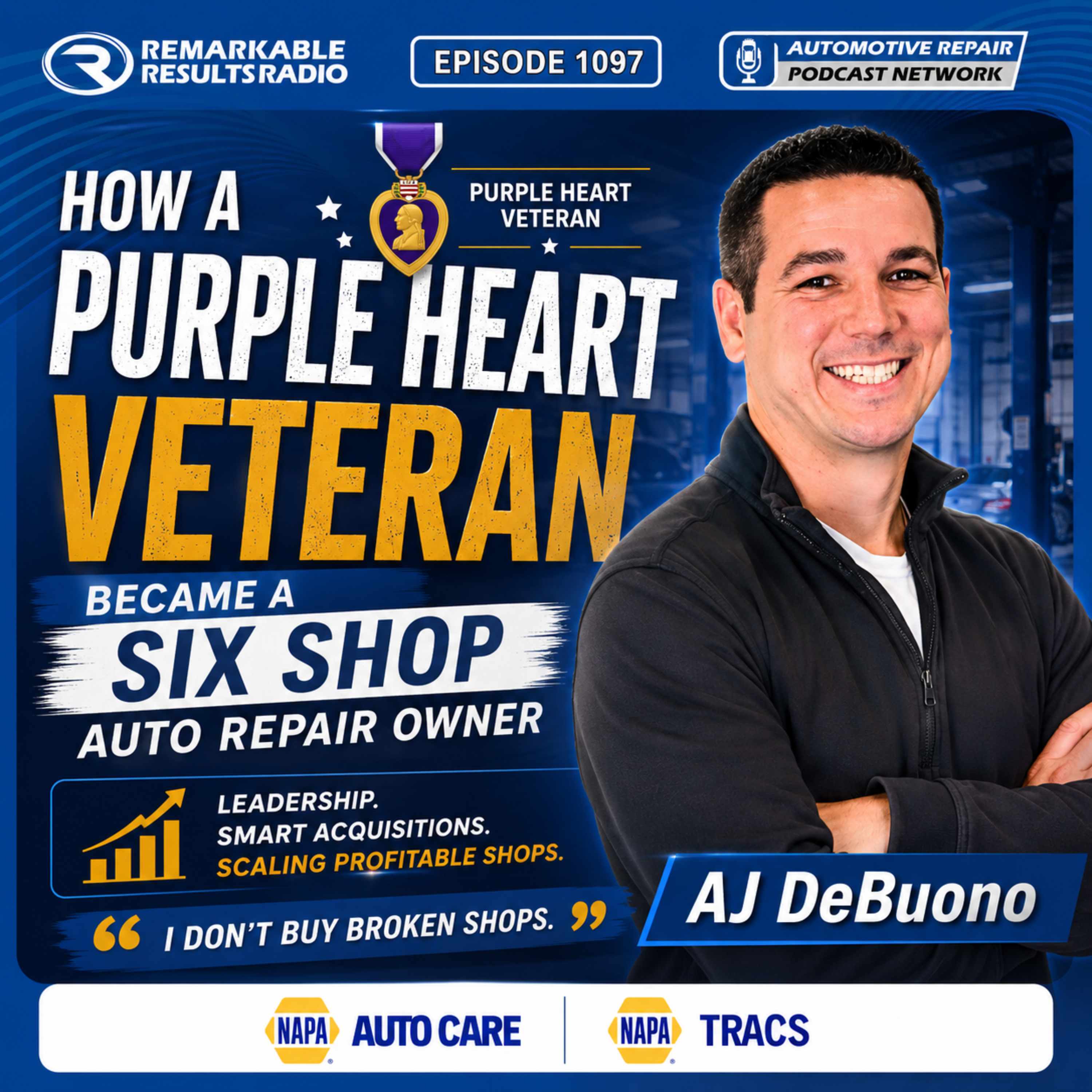
Remarkable Results RadioJune 23 · 30 min
How a Purple Heart Veteran Became a 6-Shop Auto Repair Owner [RR 1097]
Thanks to our Partners, NAPA Auto Care and NAPA TRACS Watch Full Video Episode What does it take to grow from a single auto repair shop to six locations in less than a decade? Host Carm Capriotto sits down with AJ DeBuono to discuss his journey from serving as a U.S. Marine in Iraq and Afghanistan to becoming a successful multi-shop operator. AJ shares the lessons learned through rapid growth, the acquisition strategy that has fueled his expansion, and how military discipline, financial discipline, and a commitment to people have shaped his leadership approach. Rather than buying struggling businesses and attempting turnarounds, AJ focuses on acquiring profitable shops with untapped potential. What You'll Learn How AJ leveraged SBA veteran loan programs to purchase and expand his first auto repair businessWhy he prefers acquiring profitable shops instead of distressed operationsThe key performance indicators he targets to quickly improve profitabilityHow military leadership principles influence his management style and business decisionsThe importance of creating career advancement opportunities through expansionLessons learned from growing too quickly and navigating financial stressHow AJ approaches shop transitions to minimize disruption for employees and customersWhy maintaining strong personal relationships with team members remains a priority despite operating multiple locations Growth is not simply about adding locations. It's about creating opportunities for your people, building systems that scale, and maintaining the discipline to make smart decisions when the pressure is highest. AJ DeBuono's story demonstrates that successful expansion comes from acquiring the right businesses, investing in your team, and staying focused on long-term value rather than short-term gains. AJ DeBuono, Diehl Auto Repair, Chicago, IL Learn more about NAPA Auto Care and the benefits of being part of the NAPA family by visiting https://www.napaonline.com/en/auto-care NAPA TRACS will move your shop into the SMS fast lane with onsite training and six days a week of support and local representation. Find NAPA TRACS on the Web at http://napatracs.com/ Connect with the Podcast: Visit the Website:https://remarkableresults.biz/Subscribe on YouTube:https://www.youtube.com/carmcapriottoFollow on Facebook:https://www.facebook.com/RemarkableResultsRadioPodcast/Follow on LinkedIn:https://www.linkedin.com/in/carmcapriotto/Follow on Instagram:https://www.instagram.com/remarkableresultsradiopodcast/Join Our Virtual Toastmasters Club:https://remarkableresults.biz/toastmastersJoin Our Private Facebook Community:https://www.facebook.com/groups/1734687266778976Join our Insider List:https://remarkableresults.biz/insiderAll books mentioned on our podcasts:https://remarkableresults.biz/booksOur Classroom page for personal or team learning:https://remarkableresults.biz/classroomSpecial episode collections:https://remarkableresults.biz/collectionsBuy Me a Coffee:https://www.buymeacoffee.com/carm The Automotive Repair Podcast Network: https://automotiverepairpodcastnetwork.com/ Remarkable Results Radio Podcastwith Carm Capriotto:Facilitating Wisdom Through Story Telling and Open Discussion.https://remarkableresults.biz/Diagnosing the Aftermarket A to Z:From Diagnostics to Metallica and Mental Health, Matt Fanslow is Lifting the Hood on Life.https://mattfanslow.captivate.fm/Business by the Numbers: Understand the Numbers of Your Business with CPA Hunt Demarest.https://huntdemarest.captivate.fm/The Auto Repair Marketing Podcast: Marketing Experts Brian & Kim Walker Work with Shop Owners to Take it to the Next Level.https://autorepairmarketing.captivate.fm/The Weekly Blitz: Weekly Inspiration with Business Coach Chris Cotton from AutoFix - Auto Shop Coaching.https://chriscotton.captivate.fm/Speak Up! Effective Communication: Develop Interpersonal and Professional Communication Skills with Craig O'Neill.https://craigoneill.captivate.fm
Listen →
11
Changing the Industry PodcastJune 22 · 1h 7m
Episode 274 - Can The Automotive Service Industry Be Saved? With Cecil Bullard and Wayne Marshall
Don't get to the end of this year wishing you had taken action to change your business and your life.Click here to schedule a free discovery call for your business: https://geni.us/IFORABEDon't miss an upcoming event with The Institute: https://geni.us/InstituteEvents2026Shop-Ware gives you the tools to provide your shop with everything needed to become optimally profitable.Click here to schedule a free demo: https://info.shop-ware.com/profitabilityTransform your shop's marketing with the best in the automotive industry, Shop Marketing Pros!Get a free audit of your shop's current marketing by clicking here: https://geni.us/ShopMarketingProsShop owners, are you ready to simplify your business operations? Meet 360 Payments, your one-stop solution for effortless payment processing.Imagine this—no more juggling receipts, staplers, or endless paperwork. With 360 Payments, you get everything integrated into a single, sleek digital platform.Simplify payments. Streamline operations. Check out 360payments.com today!In this episode, Cecil Bullard and Wayne Marshall discuss the challenges facing the automotive industry today. They examine the complexities and controversies surrounding technician licensing and certification, highlighting the need for industry-wide standards. The conversation also addresses the importance of financial literacy and measurable productivity in running a successful shop.00:00 Debating dealership licensing issues10:17 Balancing employee pay and motivation13:05 Building Employee Loyalty18:33 Improving employee wages and management23:01 Business fundamentals and financial ratios29:03 Planning an Exit Strategy35:00 Chris Enright on industry frustration41:01 Need for sophisticated testing46:14 Importance of unique selling proposition51:13 Importance of inclusivity and differentiation54:12 Challenges with membership relevance01:03:44 Young talent and enthusiasm01:04:15 Recruiting a young car enthusiast
Listen →
12
Changing the Industry PodcastJune 8 · 43 min
Episode 272 - Mentoring the Next Generation of Techs with Luke Murray and Charles Burke of Worldpac
Don't get to the end of this year wishing you had taken action to change your business and your life.Click here to schedule a free discovery call for your business: https://geni.us/IFORABEDon't miss an upcoming event with The Institute: https://geni.us/InstituteEvents2026Shop-Ware gives you the tools to provide your shop with everything needed to become optimally profitable.Click here to schedule a free demo: https://info.shop-ware.com/profitabilityTransform your shop's marketing with the best in the automotive industry, Shop Marketing Pros!Get a free audit of your shop's current marketing by clicking here: https://geni.us/ShopMarketingProsShop owners, are you ready to simplify your business operations? Meet 360 Payments, your one-stop solution for effortless payment processing.Imagine this—no more juggling receipts, staplers, or endless paperwork. With 360 Payments, you get everything integrated into a single, sleek digital platform.Simplify payments. Streamline operations. Check out 360payments.com today!In this episode, Lucas Underwood and David Roman are joined by Charles Burke and Luke Murray from the Worldpac Training Institute. The conversation focuses on the importance of mentorship and structured apprenticeship programs in the automotive industry, the challenges of reaching and engaging more shop owners with effective training and business resources, and the personal impact of mentorship—both in the industry and in personal life.00:00 Transitioning from technical to business training05:42 Grounded from flying career09:44 Choosing movies before streaming12:41 Becoming a BMW instructor14:04 Focus on mentor training18:43 Mentorship and training apprentices19:46 Creating a custom apprenticeship program23:10 The importance of effective mentorship28:29 Building ASTA through community sharing31:50 Explaining profit margins simplistically33:25 Helping others with industry insights38:01 Funny story about Chris Chesney39:21 Spreading the word about free training42:11 Passion-driven learning benefits
Listen →
13
The Jaded MechanicMay 26 · 1h 12m
Why Repair Shops are Toxic and Why Technicians Deserve More with Greg Hilliard
Like the show? Show your support by using our sponsorsNeed to update your shop systems and software? Try Tekmetric HERELaunch your tool game to the next level with Launch Tech USA! HEREIn this episode, Jeff Compton and Greg Hilliard talk about Greg's career spent in dealerships, independent shops, and finally as a one-man owner-operator. Greg pulls no punches about toxic shop dynamics, the true value of a technician’s labor, and the personal costs of striking out on your own. He and Jeff discuss compensation, mental health struggles in the industry, how digital tools like chat GPT are already impacting repair businesses, and why demanding respect is not negotiable for survival.Timestamps: 00:00 Feeling valued in engineering role05:56 Becoming the technical expert11:52 Buying a used truck at Ford19:49 Fixing stubborn cab issues24:57 Avoiding the boss at work27:52 Discussing fair compensation concerns35:41 Struggles with retaining mechanics41:08 Streamlining dental office visits43:47 Using technology for car repairs52:54 Struggling to hire a technician57:37 Choosing entrepreneurship over traditional jobs59:35 Getting advice from Larry Grogan01:07:17 Addressing workplace culture issues01:09:20 Electrician shortage and industry pride Follow/Subscribe to the show on social media! TikTok - https://www.tiktok.com/@jeffcompton7YouTube - https://www.youtube.com/@TheJadedMechanicFacebook - https://www.facebook.com/profile.php?id=100091347564232
Listen →
14
Changing the Industry PodcastMay 25 · 1h 1m
Episode 270 - Overcoming Shop Owner Struggles: Hiring, Training, and Shop Management With Shaun Tipton
Don't get to the end of this year wishing you had taken action to change your business and your life.Click here to schedule a free discovery call for your business: https://geni.us/IFORABEDon't miss an upcoming event with The Institute: https://geni.us/InstituteEvents2026Shop-Ware gives you the tools to provide your shop with everything needed to become optimally profitable.Click here to schedule a free demo: https://info.shop-ware.com/profitabilityTransform your shop's marketing with the best in the automotive industry, Shop Marketing Pros!Get a free audit of your shop's current marketing by clicking here: https://geni.us/ShopMarketingProsShop owners, are you ready to simplify your business operations? Meet 360 Payments, your one-stop solution for effortless payment processing.Imagine this—no more juggling receipts, staplers, or endless paperwork. With 360 Payments, you get everything integrated into a single, sleek digital platform.Simplify payments. Streamline operations. Check out 360payments.com today!In this episode, Lucas Underwood is joined by Shaun Tipton, who shares his 28-year journey from technician to shop owner. Shaun Tipton discusses the common pitfalls technicians face when transitioning to ownership, emphasizing the importance of understanding financials and setting fair labor rates. The conversation also highlights the critical role of workplace culture and effective leadership in building a successful, ethical shop.00:00 Advice for aspiring shop owners09:04 Understanding fair pricing for clients13:46 Recognizing the need for help15:51 Red flags in job histories24:19 Fair employee compensation discussion30:04 Balancing personal values and money32:43 Flaws in metro coaching models40:49 Switching to a single software system43:49 Benefits of using Shop-Ware48:09 Focusing on personal interests53:42 Importance of leadership in ownership59:46 Long-term life planning advice
Listen →
15
The Jaded MechanicApril 28 · 1h 33m
Dealer Plate Guy Compares Dealer Pricing with the Aftermarket
Like the show? Show your support by using our sponsors.Need to update your shop systems and software? Try Tekmetric HERELaunch your tool game to the next level with Launch Tech USA! HEREIn this episode, Jeff sits down with Dealer Plate Guy (Austin Conroy), who has a HUGE following on social media. Austin shares his unconventional career path from sales to service manager, emphasizing the importance of building customer and employee relationships in the dealership environment. They also talk about the most common misconceptions about dealership pricing compared to independent shops and the crucial role of technician career development and mentorship programs in addressing the ongoing technician shortage.Timestamps:00:00 International Connections: Jeff & Dealer Plate Guy Meet02:05 Growing Up Near Purdue & Serving College Town Clients03:17 From Car Sales to Multi-Store Manager: Austin’s Journey05:00 First Day as Service Manager: No Wrenching Background Needed07:10 COVID Resets the Department – Building New Structures08:53 Why Techs Should Talk To Customers (and Break Out of the Funk)10:10 Handling Difficult Customers & Flipping the Script13:36 The Unseen Cost of Long Test Drives & Flat Rate Frustrations16:28 Why Relationships Matter: Dealer vs. Independent Shop Service18:31 Career-Oriented Advisors & Building Repeat Business20:44 Managing Pay, Hours, & Mentality in Service Departments24:01 Changing Flat Rate Times: Pushback & Tracking Results29:12 Dealer vs. Aftermarket Parts Pricing: The Real Story33:43 Should Dealers Offer Aftermarket Parts? Educating Customers35:16 The Independent Shop Advantage in “Impossible” Diagnostics38:41 The 20-Minute Battery Draw: Stories From the Bay42:58 Why Dealers Still Need Flat Rate—With Real Solutions44:38 Feeding Your Best Techs: Who Should Get The Gravy Work?46:56 The Reality of Used Car Work, PDI, and Technician Dispatch49:28 Overpromising Service Times: Collision vs. Dealer Mentality52:16 Developing the Tech Career Path: Retaining Talent57:06 Mapping Out Progression Steps & Regular 1-on-1s With Techs1:02:45 Multi-Point Inspections: Making Video Pay Off1:09:29 How Social Media Skits Are Changing Dealerships1:13:42 Bridging the Advisor & Tech Divide: Cross-Training Works1:17:04 Beyond Money: Finding the Right Role for Each Employee1:20:17 The Real Fix for the Technician Shortage1:24:05 Apprenticeship, Dealer Responsibility & Recruitment1:28:47 Final Thoughts & Where to Find Dealer Plate Guy Online Follow/Subscribe to the show on social media! TikTok - https://www.tiktok.com/@jeffcompton7YouTube - https://www.youtube.com/@TheJadedMechanicFacebook - https://www.facebook.com/profile.php?id=100091347564232
Listen →
16
Confessions of a Shop OwnerApril 21 · 57 min
Ep 86 - Lucas Underwood and Tonnika Haynes | Did We Accomplish Anything Here??
Keep shop management, payments, marketing (all the things) all in one place with Tekmetric. It will CHANGE YOUR LIFE. Click HEREASTA is coming up September 24-26 in Raleigh. Be there or be square, dog! Register now and use code confess25 for $25.00 off your registration. Sign up HERETurnkey Marketing has made my life SOOO much simpler, AND they've helped keep the phone ringing. Do you need these two things too? Learn more HERETired of your shop’s social media looking like every other repair shop on the internet? Stand out with 47 Consulting. Learn more HEREWhen I used the maintenance tool for the fist time with Detect Auto, my mind was blown. My advisors had the same reaction - and then SO MUCH MORE TIME. Learn more about Detect Auto and book a free demo now!Elite Worldwide's Ignite 2027 is coming up in February and NOW is the time to sign up. It's happening in Vegas February 4-6 and it will be the best 3 days of your shops year when you attend. Learn now HEREThis one was fun - put three popular podcasts in a room for an hour, and you never know what will happen...THIS WAS NO EXCEPTION Today, Lucas Underwood, Mike Allen, and Tonnika Haynes open up about the real challenges of shop ownership, podcasting, and share some crazy stories along the way.They dive deep into the difficulties of managing growth and the importance of setting boundaries—especially when it comes to family businesses and succession planning. Timestamps:00:00 Lucas and Mike Make it Awkward01:42 The infamous Benji story and awkward work gaffes02:46 How Tonnika went from outsider to industry board member04:31 Reflecting on diversity, intimidation, and leadership in the industry06:36 Board politics, cleaning up after the "old guard," and learning the ropes08:01 Confessions about podcasting: growth, ego boosts, and business neglect09:37 On loving people (to a fault), hiring headaches, and why feelings can't run a business12:10 Tough lessons learned: leadership critiques gone wrong14:05 Reeling back commitments to avoid burnout and family drama16:45 Discussions about business hours, staff, and shifting industry cultures19:03 Why every shop is different and one-size-fits-all advice doesn't work20:13 Coaching, cult-followings, and why shop owners get fiercely loyal22:44 The weight of influence: why podcasters and coaches impact real lives24:31 When business coaching turns into a fraternity (and how to break free)26:20 The coaching gold rush: who's really helping, who's just cashing in28:33 Podcast production goes legit—systems, processes, SOPs34:25 Therapy time: handshake deals, business agreements, and life after podcasts36:32 Family business confessions—succession nightmares, buyout basics, and trust-but-verify50:43 Lessons learned the hard way—and why you’ll survive51:33 Practical advice: documentation, buy-outs, and avoiding family business disasters
Listen →
17
Changing the Industry PodcastApril 20 · 57 min
Episode 265 - Modern Pay Plans and Efficiency Tips To Fix The Tech Shortage With Eric Svedberg
Don't get to the end of this year wishing you had taken action to change your business and your life.Click here to schedule a free discovery call for your business: https://geni.us/IFORABEDon't miss an upcoming event with The Institute: https://geni.us/InstituteEvents2026Shop-Ware gives you the tools to provide your shop with everything needed to become optimally profitable.Click here to schedule a free demo: https://info.shop-ware.com/profitabilityTransform your shop's marketing with the best in the automotive industry, Shop Marketing Pros!Get a free audit of your shop's current marketing by clicking here: https://geni.us/ShopMarketingProsShop owners, are you ready to simplify your business operations? Meet 360 Payments, your one-stop solution for effortless payment processing.Imagine this—no more juggling receipts, staplers, or endless paperwork. With 360 Payments, you get everything integrated into a single, sleek digital platform.Simplify payments. Streamline operations. Check out 360payments.com today!In this episode, Lucas and David are joined by Eric Svedberg of European Autowerks. Eric shares his journey from starting in the gas station business at 16 to owning and growing a successful automotive shop. The conversation dives deep into the persistent technician shortage, with Eric outlining the challenges in attracting and retaining skilled talent and the evolving pay structures needed to stay competitive. The hosts and Eric also explore strategies for fair compensation, diagnostic testing systems, and the importance of shop culture and communication in bridging the divide between owners and technicians.00:00 Starting at a gas station job04:49 Rebranding to Automotive Specialists09:29 Mac and cheese cart setup11:26 Bellman warns about minibar sensor15:40 Salary expectations for auto techs18:05 Explaining the three-level system21:04 Handling customer pushback25:35 Technician pay discussions26:54 Negotiating a technician's pay raise30:33 Paying employees more than expected34:26 Explaining the production bonus system37:27 Growing demand for skilled technicians41:53 Ensuring seamless parts distribution44:01 Discussing social media dynamics48:42 Dealing with unreliable workers52:06 Understanding different industry perspectives55:27 Dealing with technician issues56:07 Discussing employee accountability
Listen →
18
Confessions of a Shop OwnerApril 14 · 41 min
Ep 85 - Jay Huh | Why So Many Shop Owners Are Broke
Tekmetric opened my eyes to just how much a good SMS will do for a shop. Their software is top of the line, and with them, so is my shop. Try them for yourself HEREASTA is coming up September 24-26 in Raleigh. Be there or be square, dog! Register now and use code Confess25 for $25.00 off your registration. Sign up HEREMy marketing before and after signing up with Turnkey Marketing is pretty scary. In a good way. Get your marketing right today HERETired of your shop’s social media looking like every other repair shop on the internet? Stand out with 47 Consulting. Learn more HERE Make your techs happier with Detect Auto. They'll stop getting "check noise" or "check vibration" from advisors with the customer concern tool. It will CHANGE YOUR LIFE. Book a demo HERESend your service advisor to hands down the BEST service advisor training in the industry (even other coaching companies agree). It's Elite Worldwide's Masters Program. The next one is happening in Dallas Texas, September 10-12. Learn more HEREJay Huh is the owner Carmedix in Durham, NC. Today, he tells Mike how he figured out how to run a shop the hard way. After years of struggling, he has built an efficient, highly profitable shop that gives him total freedom. They also talk about ShopFix and what the coaching company is doing after the loss of Aaron Stokes. Timestamps:00:00 – Jay's confession on not making enough money02:17 – Why sharing mistakes online changed everything04:40 – Living on $1,000 net per shop and barely making it06:07 – Consolidating down, shop tours, and landing in the “anchor” spot08:19 – Do we really need so many shop owner groups? Breaking down the division09:35 – Shop culture, coaching, and why too many owners are still broke10:45 – Shop Fix vs. other coaching: It’s about heart, not just numbers13:07 – Haters, jealousy, and why everyone thinks their way is best14:43 – Growing the right way—efficiency before expansion and protecting family time15:16 – Let’s talk cruises! Why Speaker A rides MSC and the yacht club life16:46 – Degenerate gambling confessions: Blackjack, craps, and cruise ship casinos18:01 – Owning a beach house: Boats, depreciation, and gathering your crew20:00 – The exit plan: Cashing out vs. the freedom of autopilot shops21:10 – The guardrails: How Speaker A uses daily numbers, not vibes23:00 – Forget top-line revenue, focus on real margin25:17 – Shop meetings, keeping techs and advisors rowing together26:01 – Why the multi-store “dog” life isn’t for everyone26:30 – The danger of scaling without the cash to back it up27:59 – Shop size vs. profit: Luke Walker’s $1M store reality check29:05 – The secret: Hire high skill, pay well, and net more31:12 – Money loves speed: Adapting shop processes for today’s customers32:13 – Show & sell: Finding the urgent fix, but always telling the whole story35:20 – Ethics, shortcuts, and hiring for integrity36:05 – Losing Aaron: Leadership, legacy, and moving Shop Fix forward39:14 – What’s next? Shop Fix’s plan and why the mission’s stronger than ever
Listen →
19
Shop Soup PodcastApril 9 · 19 min
EP24: Family Business. It's Pretty Ugly. It's Pretty Beautiful. It's All In The Mirror You Look Into
Welcome to another episode of ShopSoup. This week we cover just some commentary on operating a family business and how one might exit away from it. Sell it to the next generation? Give it away? Simply close it up? Or, do you go the Private Equity route? Many paths to consider.Greg Buckley shares insights on family business legacy, strategic planning, and leadership in the automotive industry, emphasizing the importance of purpose, succession planning, and continuous learning.KEY WORDSfamily business, automotive industry, leadership, legacy, succession planning, strategic growth, mentorship, business exit strategiesKEY TOPICSFamily business legacy and succession planningLeadership and team development in small businessesStrategic growth and diversification in automotive industrySOUND BITES"Knowing your exit strategy is crucial.""Say no more often to focus on your goals.""Put your team in a position to succeed."CHAPTERS00:00 Welcome to Tectonic: A Family Business Perspective02:24 The Importance of Planning for Business Exit05:15 Mentorship and Team Success in Family Businesses07:46 Navigating Family Dynamics in Business10:16 Legacy and Future of Family Businesses12:44 Curiosity and Continuous Learning in Business
Listen →
20
Changing the Industry PodcastApril 6 · 59 min
Episode 263 - Overcoming Addiction and Trying To Find Purpose in the Automotive Industry With Cole Tanner
Don't get to the end of this year wishing you had taken action to change your business and your life.Click here to schedule a free discovery call for your business: https://geni.us/IFORABEDon't miss an upcoming event with The Institute: https://geni.us/InstituteEvents2026Shop-Ware gives you the tools to provide your shop with everything needed to become optimally profitable.Click here to schedule a free demo: https://info.shop-ware.com/profitabilityTransform your shop's marketing with the best in the automotive industry, Shop Marketing Pros!Get a free audit of your shop's current marketing by clicking here: https://geni.us/ShopMarketingProsShop owners, are you ready to simplify your business operations? Meet 360 Payments, your one-stop solution for effortless payment processing.Imagine this—no more juggling receipts, staplers, or endless paperwork. With 360 Payments, you get everything integrated into a single, sleek digital platform.Simplify payments. Streamline operations. Check out 360payments.com today!In this episode, Lucas and David are joined by Cole Tanner, a veteran technician, who shares his journey through family business transitions, personal struggles, and the realities of working in the automotive industry. Cole opens up about overcoming addiction and trauma, emphasizing the importance of honest conversations about mental health in the trades. The group discusses technician frustrations regarding compensation, shop inefficiencies, and the vital need for support structures within the industry.00:00 Frustrating restaurant wait experience06:25 Growing up with my parents08:11 Discussing childhood challenges12:51 Breaking cycles of family trauma16:25 Losing friends to addiction19:34 Discussing compensation challenges22:25 Consistent vs erratic performance26:35 Running an efficient repair shop27:42 Technicians disconnected from inspection value33:12 End-of-month sales pressure36:27 Improving communication and accountability37:58 Discussing future plans and concerns41:13 Finding balance and past experiences46:02 Struggles with drinking habits47:53 Hitting rock bottom moments50:40 The dangers of addiction53:47 Pushing for constant improvement56:52 Taking responsibility after prison
Listen →
21
Confessions of a Shop OwnerMarch 31 · 39 min
Ep 83 - Hunt Demarest | How to Actually Make Money in Auto Repair
Tekmetric transformed my shop. Plain and simple. Want that for yours? Touch HEREASTA is coming up September 24-26 in Raleigh. Be there or be square, dog! Register now and use code confess25 for $25.00 off your registration. Sign up HEREIf you're like me and aren't good at marketing, don't do it on your own. Let the experts handle it. Touch HERE for more on Turnkey Marketing.Tired of your shop’s social media looking like every other repair shop on the internet? Stand out with 47 Consulting. Learn more HERESend your service advisor to hands down the BEST service advisor training in the industry (even other coaching companies agree). It's Elite Worldwide's Masters Program. The next one is happening in Dallas Texas, September 10-12. Learn more HERE When I used the maintenance tool for the fist time with Detect Auto, my mind was blown. My advisors had the same reaction - and then SO MUCH MORE TIME. Learn more about Detect Auto and book a free demo now!Hunt Demarest is a CPA with Paar, Melis, and Associates. Today, he joins Mike to talk shop financials, tax credits, and private equity. Hunt breaks down why consistent improvement—just 3% better each quarter—is more sustainable than chasing explosive growth. He offers a candid warning about risky investments, sharing his own hard lesson with a too-good-to-be-true real estate scheme. Finally, Hunt dives into the rise of private equity buying up repair shops, explaining how that's driving up valuations and changing the market for owners looking to sell. Timestamps:00:00 Incremental improvement beats unrealistic growth—why 3% better every quarter wins01:10 Teaching personal finance at Vision 2026 (and why accountants don’t read your Social Security statements)02:07 The truth about R&D tax credits and audit nightmares03:44 What you must ask before taking any credit—defending yourself at audit time05:03 Hunt’s background: how he got into auto repair accounting08:08 Will AI replace your bookkeeper or CPA? Real talk, not hype10:32 Why shop owners need to understand financial statements & what current ratio means for your cash12:18 Managing AR, cash flow, and the case for paying vendors weekly14:43 Shop profitability: 8 months out of 12 is the norm, not the exception15:43 Trends: The scale and extremes of shop margins have changed MASSIVELY17:21 Labor rates at $386/hr and what actually drives profit18:54 The 20% net profit “gold standard”—and who really gets there19:34 Why comparing owner compensation plus net income tells the real story21:26 What’s the average net profit for shops? (Spoiler: it’s better than you think)22:15 Beware public “industry average” surveys—actual profits vs. reported tax returns23:01 Why working with an industry-specialized CPA beats a generic accountant every time24:14 The inner circle: who should be on your financial “advisory board”25:00 The most common (and WRONG) beliefs about shop accounting29:53 Hunt’s biggest personal mistake: the $25k investment gone wrong (and what to learn from it)32:10 Private equity: what’s happening, who’s buying, and what it means for YOUR exit36:10 Should you sell now? How PE offers stack up vs. passing to family37:06 Why PE doesn’t care about your P&L—sometimes it’s all about your customer count38:02 Final thoughts, lessons learned, and why even the pros get it wrong sometimes
Listen →
22
Confessions of a Shop OwnerMarch 24 · 57 min
Ep 82 - Coaching Call #15 | Why Partnership Agreements Are a MUST!
Keep shop management, payments, marketing (all the things) all in one place with Tekmetric. It will CHANGE YOUR LIFE. Click HEREASTA is coming up September 24-26 in Raleigh. Be there or be square, dog! Register now and use code confess25 for $25.00 off your registration. Sign up HERETurnkey Marketing has made my life SOOO much simpler, AND they've helped keep the phone ringing. Do you need these two things too? Learn more HERETired of your shop’s social media looking like every other repair shop on the internet? Stand out with 47 Consulting. Learn more HEREWhen I used the maintenance tool for the fist time with Detect Auto, my mind was blown. My advisors had the same reaction - and then SO MUCH MORE TIME. Learn more about Detect Auto and book a free demo now!Elite Worldwide's Ignite 2027 is coming up in February and NOW is the time to sign up. It's happening in Vegas February 4-6 and it will be the best 3 days of your shops year when you attend. Learn now HEREIn this episode, Mike Allen and Matt Lofton go deep on the realities of starting a business partnership. Mike Allen shares lessons learned from his own experiences establishing partnerships, emphasizing the importance of clear agreements and communication. Matt Lofton draws from his experience with both successful and failed partnerships, highlighting the dangers of handshake deals and the need for thorough “what-if” planning.Timestamps: 00:00 "Spring Break, Partnerships, Feedback"03:17 "Partnerships: Risks and Considerations"08:27 "Clear Terms Before Partnerships"11:39 "Dissolved Partnership and Planning"15:49 "Partnerships and Business Assets"19:43 Private Equity Incentives Explained21:55 "Effectiveness of Profit-Based Incentives"26:23 "Financial Deep Dive Workshops"29:27 "Key Points in Partnership Agreements"31:14 "What-If Scenarios and Alignment"38:38 "Managing Business Equity Dynamics"41:50 "Front-End Business Agreement Setup"45:03 "Revisit Business Agreements Regularly"47:35 "Partnership Structure and Agreements"52:26 "High-Value Networking & Insights"53:38 "Best Shop Owners Seek Growth"
Listen →
23
Confessions of a Shop OwnerMarch 17 · 42 min
Ep 81 - Mike Martin, Travis May & Matt Lofton | Why Getting a Coach Will Change Your Life
Tekmetric opened my eyes to just how much a good SMS will do for a shop. Their software is top of the line, and with them, so is my shop. Try them for yourself HEREASTA is coming up September 24-26 in Raleigh. Be there or be square, dog! Register now and use code Confess25 for $25.00 off your registration. Sign up HEREMy marketing before and after signing up with Turnkey Marketing is pretty scary. In a good way. Get your marketing right today HERETired of your shop’s social media looking like every other repair shop on the internet? Stand out with 47 Consulting. Learn more HERE Make your techs happier with Detect Auto. They'll stop getting "check noise" or "check vibration" from advisors with the customer concern tool. It will CHANGE YOUR LIFE. Book a demo HERESend your service advisor to hands down the BEST service advisor training in the industry (even other coaching companies agree). It's Elite Worldwide's Masters Program. The next one is happening in Dallas Texas, September 10-12. Learn more HERETravis May and Mike Martin are shop owners who coach with Elite Worldwide. Matt Lofton, as many of you know, is the Director of Coaching for Elite (and my personal coach/therapist). Today, we all talk about how having coaches through Elite have literally changed our lives and helped us in ways we may never be able to truly explain.Timestamps:00:00 Falling in love with your own success: Absentee ownership pitfalls01:08 Meet the guests: Legacies, buyouts, and shop owner backgrounds05:21 The journey to Elite: Why top shop owners chose coaching06:30 Humbling lessons—how the Elite Master Service Advisor program changes everything10:09 Accountability, habit-building, and real growth with ongoing coaching12:17 2025 Recap: Big wins, tough months, and lessons learned14:31 The owner’s struggle: Profit discipline & staying out of “the cookie jar”16:02 Finally closing the building deal: How perseverance pays off17:19 Navigating post-pandemic reality: The “sugar rush” is over18:46 Big goals for 2026: Celebrating wins—and moving forward20:40 The power of taking action: Why implementation beats excuses23:45 Personal growth, team impact, and communicating with your staff24:32 Best event takeaways: Coffee Bean Analogy & daily goal setting28:15 Why community events and peer networks make all the difference33:11 Biggest struggles today: Generational gaps & trusting your process38:55 Parting wisdom: If you don’t have a coach, get one!
Listen →
24
Changing the Industry PodcastMarch 16 · 58 min
Episode 260 - Navigating Family Legacy and Change in the Automotive Business With Jackie & Darryl Beech
Don't get to the end of this year wishing you had taken action to change your business and your life.Click here to schedule a free discovery call for your business: https://geni.us/IFORABEDon't miss an upcoming event with The Institute: https://geni.us/InstituteEvents2026Shop-Ware gives you the tools to provide your shop with everything needed to become optimally profitable.Click here to schedule a free demo: https://info.shop-ware.com/profitabilityTransform your shop's marketing with the best in the automotive industry, Shop Marketing Pros!Get a free audit of your shop's current marketing by clicking here: https://geni.us/ShopMarketingProsShop owners, are you ready to simplify your business operations? Meet 360 Payments, your one-stop solution for effortless payment processing.Imagine this—no more juggling receipts, staplers, or endless paperwork. With 360 Payments, you get everything integrated into a single, sleek digital platform.Simplify payments. Streamline operations. Check out 360payments.com today!In this episode, Lucas and David are joined by Darryl and Jackie Beech to explore the dynamics of running and transitioning a family-owned automotive business. Darryl reflects on the importance of having strong business processes and work-life balance, sharing his motivation to set Jackie up for long-term success as she steps into a larger leadership role. Jackie opens up about the challenges—and privileges—of carrying forward her father's legacy, focusing on the value of maintaining strong customer relationships while preparing for inevitable changes.00:00 "Doubting His Radio Future"04:40 "Family, Loss, and Betrayal"08:19 "Mismanagement and Lack of Structure"10:42 "Shopware's Lifesaving Support"14:53 Forensic Analysis in Auto Failures18:21 "Tailored Vehicle Maintenance Advice"21:31 Transitioning Business Leadership and Operations23:38 "Balancing Business and Social Hurdles"28:52 "Senior Tech Rejects Management Training"31:54 "Saving a Family Legacy"35:02 Navigating Tough Clients Effectively38:49 "Embracing Leadership Humility"40:32 "Early Career Diversification Needed"44:45 "Growth Through Decisions and Challenges"48:08 Managing Stress and Support Systems49:55 "Overcoming Recession and Struggle"53:34 "Navigating Family Life and Struggles"56:48 "Childhood Memories: The Good Side"
Listen →
25
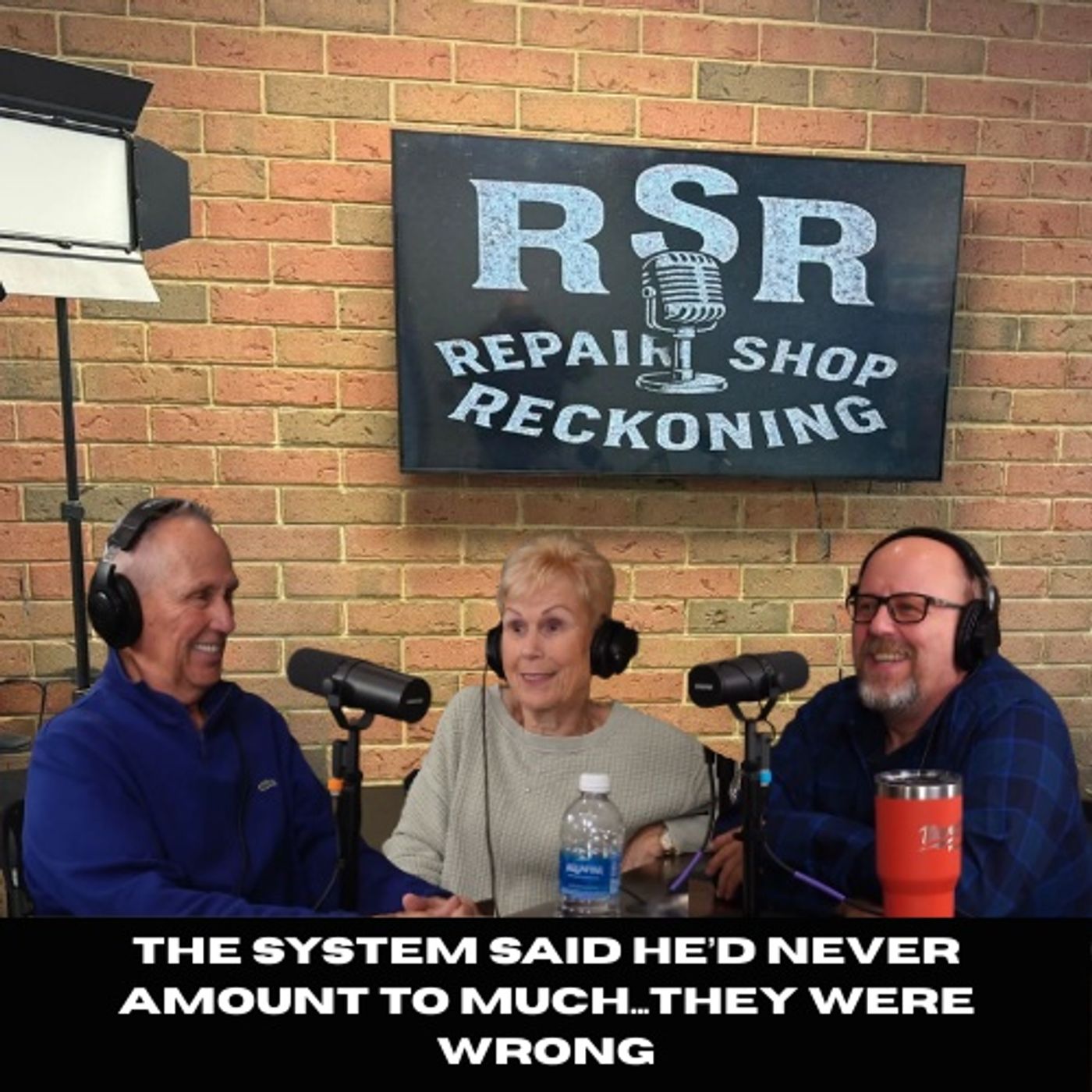
Repair Shop ReckoningMarch 13 · 1h 31m
The System Said He’d Never Amount to Much...They Were Wrong
Most people know Kevin Brown as the guy who tells it like it is. The shop owner. The operator. The guy calling out the chaos, the excuses, and the bad decisions that quietly kill shops. But this episode is different. This is the beginning of the...
Listen →
26

Master Tech to MillionaireAugust 27 · 1h 24m
99.08% Diagnostic Accuracy: Inside a Master Tech’s Playbook
Joe Adams interviews Adams Automotive Master Technician Josh Gerbrecht about his journey from technician to top diagnostician, sharing the systems that drove his 99.08% diagnostic accuracy and the big takeaways from a Key-to-Key-to-Callbacks weekend. They discuss the front-office/back-office symbiosis, the Rack Attack inspection process, recruiting and paying technicians their worth, shop tours and hospitality, and how AI could streamline diagnostics and incentivize accuracy over just speed. AutoshopAnswers.com Auto-Shop-Media.com
Listen →
27
Downshift with TonnikaAugust 25 · 59 min
Are You Running Your Shop… Or Is It Running You? | Darin Johnson - Ep 37
You shouldn't have to play detective just to figure out what's happening in your own shop. 😂 If you're ready for all your shop's information in one place, check out Tekmetric HEREConsistency is key - heard that! But, consistency is HARD. That's why I gave up on trying and let the experts handle it. Detect Auto. Let them clean up your estimating process and raise your ARO - like they did for me! CLICK HERE TO BOOK A DEMORunning an auto repair shop is one thing—but what happens when the shop starts running you? In this episode, Tonnika Haynes sits down with Darin Johnson, a one-man shop owner from Great Bend, Kansas, who admits he's working seven days a week, struggles to tell customers no, and hasn't taken a real vacation since 2018. They get into the difficult transition from technician to business owner, why coaching and industry connections have changed Darin's approach, and how raising his labor rate didn't create the customer revolt he feared. Tonnika also gets fired up about boundaries, last-minute customers, “free” tire pressure checks, and why serving your community doesn't mean allowing customers to control your schedule. Darin is heading to ASTA with a mission: build his network, learn how to step away from the shop, find help, and finally create a business that gives him a life outside the bays.Timestamps:00:00 Cold open: “It’s gonna be on one more day”00:19 Downshift intro00:38 Darin still has a FLIP PHONE?!02:10 Meet Darin: Running a one-man repair shop in Kansas02:44 How he accidentally became a shop owner04:27 From hot rods to 25 years in automotive05:39 Does Darin really want to stay a one-man operation?07:06 Heading to ASTA for the first time07:40 Why Darin LEFT his first training event early08:39 Coaching struggles: Knowing what to do vs. actually doing it09:55 The real reason Darin is coming to ASTA10:16 Shop ownership can feel like you’re on an island13:08 Working seven days a week & being married to the shop14:20 The people-pleasing problem15:03 Customers asking about cars at dinner and the grocery store16:27 What happens when the shop becomes your only hobby?20:26 Feeling guilty for taking time away20:57 “Schedule your hats”—including downtime22:59 Darin’s five-year plan: Train someone to replace him23:38 His last REAL vacation was in 201824:34 Open-heart surgery changed how Darin viewed the business25:21 Becoming an owner instead of just a technician28:06 Why 15–20 cars are constantly sitting at the shop28:34 The work Darin has finally started saying NO to30:49 Bringing an accountability partner to training32:42 Why a few unhappy customers can ruin your mindset33:58 Should you just FIRE the worst 5% of your customers?38:02 Tonnika gives Darin his official ASTA assignment40:40 Finding your automotive family42:39 Why Tonnika recommends coaching43:57 Coaching’s impact on Darin’s mindset and mental health45:01 “I wish I would’ve done this 10 years ago”46:04 Why shops that don’t train get left behind46:58 Darin now has the highest labor rate in town47:34 Tonnika’s $12 lawnmower tire era 😂49:00 Learning how to say NO without losing customers49:12 Scheduling your different “hats” as an owner51:10 Customers don’t control your schedule51:44 “It’s been on for two weeks? It can wait another day.”53:05 Your six-month-old check engine light isn’t suddenly my emergency53:50 How “real quick” jobs steal HOURS from your day54:52 Why Tonnika refuses to just throw air in a tire55:32 “My air isn’t free!”56:23 The right way to say no: Give customers another option57:45 Darin’s ASTA challenge & what’s coming in Part 2
Listen →
28
Master Tech to MillionaireAugust 23 · 31 min
Autoshop Ministries Episode 8: Do Your Part - When Faith Demands Action
Joe and Pastor Devante explore how faith and obedience work together, using examples from Exodus, Nehemiah, and Jesus’ first miracle. They challenge listeners to move from asking God for blessings to doing the practical next step—identify one thing you’ve been praying about and act on it before the end of the day.
Listen →
29
Remarkable Results RadioAugust 21 · 48 min
Your Shop’s Toughest Competitor Is in the Mirror [THA 499]
Thanks to our Partners, NAPA TRACS, Today's Class, KUKUI, and Pit Crew Loyalty Watch Full Video Episode *]:pointer-events-auto scroll-mt-[calc(var(--header-height)+min(200px,max(70px,20svh)))]" dir="auto" data-turn-id="request-WEB:8e59eec7-a235-4fa3-a072-956fea3fe478-7" data-testid="conversation-turn-4" data-scroll-anchor="false" data-turn="assistant"> *]:pointer-events-auto scroll-mt-[calc(var(--header-height)+min(200px,max(70px,20svh)))]" dir="auto" data-turn-id="request-WEB:49a777bf-d263-4496-bf0b-2eb3a46ac96a-11" data-testid="conversation-turn-24" data-scroll-anchor="false" data-turn="assistant"> Who is your shop's toughest competitor: the business down the street, or the people inside your own four walls? Carm Capriotto sits down with shop owners Dwayne Myers and Al Oramas to explore internal competition and why the biggest threats to a shop's success often come from within. The conversation challenges owners to stop obsessing over competitors and start examining their own leadership, consistency, processes, and customer experience. What You'll Learn Why operational consistency matters and how small deviations can create chaos.Why owners can't effectively lead from the "engine room."How true delegation requires owners to let go of control and trust their teams.Why "everything speaks" when it comes to the customer experience.How standing at the curb can reveal things owners no longer notice inside their own shops.How simple physical and operational improvements can create meaningful change.Why asking employees what they love and what they would change can reveal the true health of a business. Your greatest competitor may be staring back at you in the mirror. The shops that grow stronger are willing to look inward, challenge their own habits, listen to their teams, and consistently raise the standard. Leadership isn't about controlling every detail; it's about creating the environment, expectations, and trust that allow the entire team to perform at its best. Dwayne Myers, Dynamic Automotive, 8 locations, Maryland. Dwayne’s previous episodes HERE. Al Oramas, Pro Auto Care, 2 locations, Denver and Littleton, CO Optimize training with Today's Class: In just 5 minutes daily, boost knowledge retention and improve team performance. Find Today's Class on the web at https://www.todaysclass.com/ David Boyes, President of ‘Today’s Class” David’s previous episodes HERE Brad Updegraff, Dave’s Ultimate Automotive, 7 locations, Austin, TX. Brad’s previous episodes HERE. Thanks to our Partner, NAPA TRACS NAPA TRACS will move your shop into the SMS fast lane with onsite training and six days a week of support and local representation. Find NAPA TRACS on the Web at http://napatracs.com/ Thanks to our Partner, Today's Class Optimize training with Today's Class: In just 5 minutes daily, boost knowledge retention and improve team performance. Find Today's Class on the web at https://www.todaysclass.com/ Thanks to our Partner, KUKUI Stop juggling multiple marketing tools. KUKUI’s integrated platform delivers 4x better website conversions, automated follow-up, and real-time ROI tracking. Get industry-leading customer support with KUKUI at https://www.kukui.com/ Thanks to our Partner, Pit Crew Loyalty You’re probably tired of chasing new customers who never return. We understand. Pit Crew Loyalty ends the one-and-done cycle, turning first visits into lasting, reliable revenue at https://www.pitcrewloyalty.com/ Connect with the Podcast: Download and Listen on Our Mobile App: https://automotiverepairpodcastnetwork.com/app/Visit the Website:https://remarkableresults.biz/Subscribe on YouTube:https://www.youtube.com/carmcapriottoFollow on Facebook:https://www.facebook.com/RemarkableResultsRadioPodcast/Follow on LinkedIn:https://www.linkedin.com/in/carmcapriotto/Follow on Instagram:https://www.instagram.com/remarkableresultsradiopodcast/Join Our Virtual Toastmasters Club:https://remarkableresults.biz/toastmastersJoin Our Private Facebook Community:https://www.facebook.com/groups/1734687266778976Join our Insider List:https://remarkableresults.biz/insiderAll books mentioned on our podcasts:https://remarkableresults.biz/booksOur Classroom page for personal or team learning:https://remarkableresults.biz/classroomBuy Me a Coffee:https://www.buymeacoffee.com/carmSpecial episode collections:https://remarkableresults.biz/collections...
Listen →
30
Master Tech to MillionaireJuly 21 · 1h 20m
Using the Shop Tour to Identify Pain & Close the Deal
Joe Adams hosts a legendary wealth management advisor, exploring and breaking down the Sandler sales approach—professionals solve by identifying pain, quantifying it, and personalizing solutions—so shops can build trust and close more business. The episode also covers wealth-building basics: start early, buy assets not liabilities, use compounding, diversify outside the business, and plan estate and insurance strategies to protect family wealth and prepare for an exit. AutoshopAnswers.com Auto-Shop-Media.com
Listen →
31
Downshift with TonnikaJuly 21 · 2h 0m
The Mistake That's Costing Your Shop Money | Nick Yannessa & Chi Wong - Ep 30
Consistency is key - heard that! But, consistency is HARD. That's why I gave up on trying and let the experts handle it. Detect Auto. Let them clean up your estimating process and raise your ARO - like they did for me! CLICK HERE TO BOOK A DEMOAnybody can run a shop. Building one that lasts? That's a whole different story. If you're ready to build smarter systems and a better experience for your team and customers, check out Tekmetric HEREIn this episode, Tonnika welcomes Nick Yannessa & Chi Wong to talk about how they started a auto repair shop. Nick brought up how he thinks it's dangerous to judge customers based on their car or background—presenting recommendations equally is key for success. They all discuss the importance of efficiency and processes, especially for one-person operations, with strategies ranging from shop layout to streamlined part sourcing. The discussion explored how relationships—whether through peer support, coaching, or personal connection with customers—can make or break both morale and business success.Timestamps:00:00 Growing up in the business, judging customers & learning not to assume03:00 The wild origin story of a Philly-area repair friendship07:00 Shop ownership journeys: from dealer frustration to Craigslist finds13:15 Shop expansions, partnerships, and the big pains of growing fast16:30 Management mistakes: Getting hurt by the wrong coaching advice22:30 Why shop friendships (and roasting each other) drive real growth26:00 Breaking out of the tech mindset — why process & sales skills matter35:00 Single bay or big staff? How to thrive as a one-man show41:30 Efficiency hacks: leg surgery for your shop layout47:00 The power of batching tasks, double-dipping on equipment, and finding your warehouse51:00 Bootstrapping a new shop, from free desks to Techmetric (or not)59:00 Real-life sales training: How to pitch brakes and win trust1:12:00 Dealership vs. Indie: Why premium service isn’t just about the brand1:20:00 Body shop margins, insurance games, and why service rocks1:33:00 The secret sauce: Making your shop unforgettable1:39:00 Building trust over time (without a single DVI)1:44:00 Health, happiness, and generational wealth—success beyond KPIs1:46:00 Why driving a free CR-V might beat flexing a Cadillac1:52:00 Building benefits for your people, and leveling up your future1:58:00 Final rants and why you need to be the “dive bar” your customers love
Listen →
32
Shop Fix Academy PodcastJuly 20 · 25 min
I FIRED My Top Performers and Reached $5.6M | EP6 | The Shop Fix Academy Podcast
With a growing shop, a great local reputation and a team that ran the business without him, Allen Baughman thought he'd finally built the dream operation every shop owner chases, but instead his top performers were quietly telling his techs the shop was a sinking ship and plotting to start their own. In this episode, Allen breaks down the mistakes that led to 10 empty bays and him being forced to turn wrenches again, the pay plan switch that erased his profit for six straight months and the vital leadership and culture lessons that he learned to turn everything around and build a $5.6M repair shop. Join The Fastest Growing Network Of Auto Repair Professionals! Get the structure and clarity your shop has been missing with Shop Fix LITE. https://shopfixacademy.com/shop-fix-lite?utm_source=sfapodcast&utm_medium=podcast&utm_campaign=join-lite&utm_content=cta-textlinkGet Tickets Now!Learn the systems top shop owners use to consistently increase profit and build stronger teams at Shop Hackers Conference. https://shophackersconference.com/?utm_source=sfapodcast&utm_medium=podcast&utm_campaign=shophackers2026&utm_content=cta-textlinkJoin Us at Our Events! Explore Shop Fix Academy Events led by operators who have solved the same profit, leadership, and operational challenges you’re facing now. https://shopfixacademy.com/upcoming-events?utm_source=sfapodcast&utm_medium=podcast&utm_campaign=sfa-events-2026&utm_content=cta-textlink
Listen →
33
Master Tech to MillionaireJuly 19 · 30 min
AutoShop Ministries Episode 4 - Iron Sharpens Iron: The Power of Friction in Business
Joe Adams and Chaplain Devontae Tidwell discuss the importance of partnerships, community, and mentorship in business, using Proverbs and Ecclesiastes to show how the right people sharpen you and produce ROI. The episode emphasizes finding mentors, creating healthy friction to grow, paying it forward by mentoring others, and practical steps to get into the right rooms and relationships.
Listen →
34
Downshift with TonnikaJuly 14 · 1h 50m
What Nobody Warns You About Shop Ownership | Andrew Klement & Caleb McElmurry - Ep 28
You shouldn't have to play detective just to figure out what's happening in your own shop. 😂 If you're ready for all your shop's information in one place, check out Tekmetric HEREConsistency is key - heard that! But, consistency is HARD. That's why I gave up on trying and let the experts handle it. Detect Auto. Let them clean up your estimating process and raise your ARO - like they did for me! CLICK HERE TO BOOK A DEMOIn this episode, Tonnika Haynes sits down with Andrew Klement and Caleb McElmurry to dive into the realities of young shop ownership in the automotive industry. Andrew and Caleb talk candidly about their rough starts, the importance of being profitable (and actually charging the right prices), and how building a supportive community has made all the difference.Timestamps:00:00 Young shop owners introduce themselves, plant mom stories, and moving from mobile to brick-and-mortar04:36 Caleb describes his dealership beginnings, lessons from a used car lot, and why integrity matters06:35 Andrew shares his “started from the lawnmower” story, learning on the job, and meeting the right mentors12:27 Why both left bad bosses and how they leveled up their skills13:55 Building a customer base: overcoming $20 repair mindsets and finding the right clients17:15 The hardest part of moving from technician to owner—payroll, pricing, and pressure21:21 Learning to price (and value!) your work: Big mistakes shop owners make25:28 What it actually means to take care of your community—and yourself34:12 Balancing family and business: honest talk about shop life with kids39:16 The shop mistake neither will EVER repeat again43:03 Coaching, community, and why there’s no single right way to win in this business57:00 Are you building a legacy? Talking new generations and what it means for your shop1:01:50 What to know before you open your own shop (spoiler: it’s harder than you think!)1:16:10 Why undercharging and sacrificing profit is hurting everyone in the industry1:21:55 Being proud of what you’ve built—yes, you deserve that truck!1:29:12 Marketing in small towns & finding the customers who value your shop1:33:09 There’s more than one way to run a shop—and that’s okay1:39:09 Real talk: mental health, community, and lifting each other up in the industry1:44:01 Wrapping up: finding your people, making it your own, and why the journey is worth it
Listen →
35
Shop Fix Academy PodcastJuly 13 · 28 min
How an Ex-Firefighter Built a $9M Auto Repair Empire | EP5 | Shop Fix Academy Podcast
People don't usually go from working as a firefighter to accidentally starting a series of auto shops generating over $9 million, but that's exactly what happened to Coach Brandon Peavy. When Brandon saw a vacuum in his hometown to start an emergency services company he jumped on it and quickly scaled it to 100 employees, but what he wasn't expecting was for it to transform into a 7-figure auto repair business. In this episode, Berg and Guy sit down with Brandon as he explains the practical business level changes he implemented that turned his unintentional venture into his biggest success, including why your tech cost in your shop management system is probably lying to you, how he used the reset button to win his team over, and what finally unlocked multi-shop ownership after two years of dead ends. Get the structure and clarity your shop has been missing with Shop Fix LITE. https://shopfixacademy.com/shop-fix-lite?utm_source=sfapodcast&utm_medium=podcast&utm_campaign=join-lite&utm_content=cta-textlinkLearn the systems top shop owners use to consistently increase profit and build stronger teams at Shop Hackers Conference. https://shophackersconference.com/?utm_source=sfapodcast&utm_medium=podcast&utm_campaign=shophackers2026&utm_content=cta-textlink Explore Shop Fix Academy Events led by operators who have solved the same profit, leadership, and operational challenges you’re facing now. https://shopfixacademy.com/upcoming-events?utm_source=sfapodcast&utm_medium=podcast&utm_campaign=sfa-events-2026&utm_content=cta-textlink
Listen →
36
Downshift with TonnikaJuly 9 · 49 min
Stop Running Your Shop Like a Technician | Rick White and Buckaroobob Bucknbob (John Firm) - Ep 27
Consistency is key - heard that! But, consistency is HARD. That's why I gave up on trying and let the experts handle it. Detect Auto. Let them clean up your estimating process and raise your ARO - like they did for me! CLICK HERE TO BOOK A DEMOAnybody can run a shop. Building one that lasts? That's a whole different story. If you're ready to build smarter systems and a better experience for your team and customers, check out Tekmetric HEREWhat does it really take to run a thriving auto shop without living in the bays? Today Rick White and Buckaroo Bob join Tonnika to break down the journey from wrench-turner to true business builder. Hear firsthand stories about learning to trust your team, why “hiring smarter” is the real secret, and how the right coaching can seriously change your shop’s future.Plus: Why you need to delegate, why “set it and forget it” marketing frees you up to lead, and why building your network is as important as building your car count.Timestamps:00:00 Are you running your shop—or is your shop running you? 02:07 Letting go: When Bob's son joined the family business03:43 The long road from working IN the business to working ON it06:03 Bob’s transformation: Training yourself out of a job07:25 How group coaching built an unstoppable shop owner family10:03 ARO breakthrough: From $252 to $820 by trusting the process12:00 Control freaks, “Mama syndrome,” and learning to let your team lead14:50 Why you must hire people smarter than you—and how to spot them15:43 Book club for bosses: “One Minute Manager” and more game-changers18:01 Coaching: Are you looking for a coach—or just a cheerleader?21:20 Rick’s journey: From micromanagement to true leadership25:51 Letting go: Real growth means they don’t need you every day30:26 Training is NOT optional—why you’re never too good to learn31:39 The three reasons shop owners skip coaching (and how to fix it)33:02 Your only entitlement: Opportunity, not comfort35:59 Facing big challenges—without carrying all that baggage39:02 If you’re still taking technical classes… you’re not leading your shop40:34 Simple details that set your shop apart—yes, the smell matters!41:21 Saying yes to more—adventure, networking, and stepping outside your comfort zone43:22 Big invitations: Family reunions, cookouts & open mic wisdom44:07 Upcoming advisor training and summer events—don’t miss out!
Listen →
37
Downshift with TonnikaJuly 2 · 49 min
ATTENTION: Shop Owners - Buy Back Your Time | Dan Thieken - Ep 24
Consistency is key - heard that! But, consistency is HARD. That's why I gave up on trying and let the experts handle it. Detect Auto. Let them clean up your estimating process and raise your ARO - like they did for me! CLICK HERE TO BOOK A DEMOAnybody can run a shop. Building one that lasts? That's a whole different story. If you're ready to build smarter systems and a better experience for your team and customers, check out Tekmetric HEREIn this episode, Tonnika Haynes and Ash Kaplan chat with Dan Thieken, owner of Kreager Tire and Service LLC in Millersport, Ohio. Dan opens up about the journey from sweeping floors as a high school student to owning his own shop, emphasizing the importance of building the right team so that owners can eventually step away from day-to-day operations. He also shares his philosophy on why shops should offer tires—not only as a profit center, but as a window into the car's soul that keeps customers from ever needing another shop. Timestamps:00:00 Why you should ALWAYS offer tires at your shop02:11 Dan Thieken's origin story: From sweeping floors to owner04:32 The leap to management—and whistleblowing on bad leadership05:25 Not a tech? Why owning a shop is still for you07:07 People skills: Bartenders, restaurant work, and automotive service10:41 Building a team so you (finally) can step away13:31 Small town challenges: Hiring, no running water, and real culture16:14 The trust fall: Letting go of your “baby” shop18:17 Shop success = buying back your own time20:04 The slippery slope of coaching and paying it forward22:11 What’s your business mix? Service vs. tires, and how it changed24:22 Two reasons EVERY shop should offer tires25:10 How selling tires unlocks full-vehicle inspections26:20 Stop “selling”—just advise and build relationships28:00 Would Dan ever hire a coach? The answer might surprise you32:26 Advice for new shop owners: Train your replacement34:21 The personal side: Boundaries, empathy, and being “too nice”39:00 Mistakes owners make: Wanting to be absentee too soon43:12 The real trick: Let your staff learn from their mistakes46:00 Why Dan feels more at home away from the counter47:51 Upcoming events, classes, and golf trips
Listen →
38
Downshift with TonnikaJune 30 · 1h 2m
Your Shop Might Be Driving Customers Away | Jessica Watkins - Ep 23
Consistency is key - heard that! But, consistency is HARD. That's why I gave up on trying and let the experts handle it. Detect Auto. Let them clean up your estimating process and raise your ARO - like they did for me! CLICK HERE TO BOOK A DEMOAnybody can run a shop. Building one that lasts? That's a whole different story. If you're ready to build smarter systems and a better experience for your team and customers, check out Tekmetric HEREIn this episode, Jessica Watkins tells Tonnika and Ash about her time in marketing and how she got into the automotive industry. They bring up the challenges women face, from working in shops without AC or clean bathrooms to building customer-centered businesses. Learn from the ladies on how shop owners can make their spaces more inviting for women and why curb appeal, safety, and clean facilities truly matter.Timestamps:00:00 When shops refuse to upgrade: The pain of paper tickets01:04 Is it hot in here? Real talk about shop air conditioning (or the lack of it!)02:04 Jessica’s origin story: Tripling sales & demanding more05:18 Why clean bathrooms and AC matter for customer (and staff!) happiness07:16 The surprising power of shop curb appeal10:22 Making the automotive industry friendlier for women12:10 How Ash built Golden Hour Garage to make shop life easier14:35 The little things that build trust and boost your brand17:50 Want higher prices? Start by raising your standards20:12 Why your marketing matters (and how not to suck at it)22:46 Nosy people are your next customers. Get visible!25:41 Safety first: Creating a shop environment everyone feels safe in28:40 What women notice that shop owners miss31:14 True service stories: When a shop loses a customer for good36:29 Why front counter greetings and clean lobbies can’t be ignored40:13 The secret to staff training and customer loyalty43:06 Confessions & how to encourage more women to join the shop life47:25 Lessons (and laughs) from real shop experiences54:00 How to connect with Jessica and get solutions for YOUR shop!
Listen →
39

The Institute's Leading Edge PodcastJune 29 · 1h 1m
209 - The Real Story of Growing an Independent Auto Repair Shop with Andy Severein
209 - The Real Story of Growing an Independent Auto Repair Shop with Andy Severein June 24th, 2026 - 01:00:41 Show Summary: Andy Severein shares how Andrew's Auto grew from a single shop into a thriving multi shop operation through coaching leadership and a commitment to continuous improvement. Jennifer Hulbert explains how understanding financials improving repair order value and developing managers helped transform the business. They discuss building a strong culture creating opportunities for employees and preparing the next generation of leadership. Their story shows that long term success comes from intentional growth consistent training and serving both customers and employees well. Host(s): Jimmy Lea, VP of Business Development Guest(s): Director of Programs & Owner of Service Plus Automotive Owner, Andrew’s Auto Show Highlights: [00:02:29] – Jennifer shares her journey from shop owner to Institute program director. [00:06:11] – Andy explains why he purchased a struggling repair shop. [00:09:00] – Coaching revealed the business metrics Andy never knew existed. [00:11:54] – Average repair order nearly doubled through better processes and training. [00:16:00] – Profit sharing and community support became the business mission. [00:20:10] – Learning financial statements changed every business decision. [00:27:00] – Teamwide coaching fueled one million dollars in sales growth. [00:34:00] – Intentional leadership strengthened culture and employee development. [00:38:02] – A newly acquired second shop quickly doubled its repair order. [00:48:00] – Andy encourages owners to embrace coaching before opportunities disappear. In every business journey, there are defining moments or challenges that build resilience and milestones that fuel growth. We’d love to hear about yours! What lessons, breakthroughs, or pivotal experiences have shaped your path in the automotive industry? Share your story with us at info@wearetheinstitute.com, and you might be featured in an upcoming episode. 👉 Unlock the full experience - watch the full webinar on YouTube: https://youtu.be/_3LVDHjy2G4 Don’t miss exclusive insights, expert takeaways, and real talk you won’t hear anywhere else. Hit Subscribe, drop a comment, and share it with someone who needs to hear this! Links & Resources: Want to learn more? Click Here Want a complimentary business health report? Click Here See The Institute's events list: Click Here Want access to our online classes? Click Here ________________________________________ Episode Transcript Disclaimer This transcript was generated using artificial intelligence and may contain errors. If you notice any inaccuracies, please contact us at marketing@wearetheinstitute.com. Episode Transcript: The Real Story of Growing an Independent Auto Repair Shop with Andy Severin 06242026 Jimmy Lea: Good morning, good afternoon, good evening, or good night, depending on when and where you're joining us from today. It is a gorgeous day outside. I hope you are able to go outside and breathe in some beautiful fresh air. Hey, today is awesome. Today is going to be amazing. We've got a great conversation gonna happen with a phenomenal shop owner, with a phenomenal coach and trainer from the Institute for Automotive Business Excellence. But before we get into that, let's talk about you and where you're at, and what's going on in your life. This is going to be an interactive webinar. Interactive how? In the comments section, in the questions, in the comments, put in there where you're joining us from today. Love to give you a shout-out here as we are on the live webinar. We're streaming through many different, multiple streams. Multiple live streams are going out on Facebook, and on YouTube, and on StreamYard. So we've got all these avenues that we're reaching out to the industry to, to, for us to connect, for us to come together. So drop in the comments where you're joining us from, city, state, and your shop name. Love to give you a shout-out so we can recognize everybody who is here for this live event. And it seems that everybody is shy today. Which is awesome. That's great. You know where the comment button is. When you find it, put in there your information, and we'd love to give you a shout-out here as we're on our live event. Streaming on Facebook, and on LinkedIn, and on YouTube, and on StreamYard. Oh my gosh, this is so awesome. This is so awesome. All right, for our conversation today Jennifer Holbert is here from the Institute for Automotive Business Excellence. She is a shop owner. She is a a coach, an industry coach, an industry facilitator with the GEAR Performance Group, and most recently moved into the position of director of programs with the Institute for Automotive Business Excellence. Thank you so much, Jennifer, for being here. Good morning, good afternoon. Jennifer Hulbert: Thank you. Thank you for having me. Excited to be here. Jimmy Lea: Yes. We're gonna have an awesome conversation. I'm in the good morning part, and you're in the good afternoon part. Jennifer Hulbert: I am. Jimmy Lea: 'Cause you're in New York, right? Jennifer Hulbert: I am. Northern New York. Jimmy Lea: Northern New York, awesome. How long have you been in the industry, Jennifer? Jennifer Hulbert: Ooh 25 years? Yeah, 25 years. Jimmy Lea: So you started sweeping floors when you were, like, five, six years old then? Jennifer Hulbert: Yeah, you could say that. I started filing probably when I was in my teens, but officially joined the business in 2001 when we moved to our new building and started as service advising, accounting, marketing, and then now do it all. Jimmy Lea: Yeah. No, a- and you've had a long journey with the institute as well, joining as part of the GEAR Performance groups, and then moved into being an industry coach. Jennifer Hulbert: I did. Jimmy Lea: What did that... What's that short story look like for you? Jennifer Hulbert: Yeah. I was a group member in group two for about 19 years prior to the opportunity to become a facilitator with the institute. That was four years ago, and just was recently asked and accepted the director of programs position, so I'll be overseeing all of our coaching programs with our owners coaches, our service advisors, and our managers. So just in the infancy of that position right now, and we've got lots of good work to do and lots of exciting things to bring to the industry that I'm super excited to be part of. So yeah, it's been a journey. I, and I know all the things, all the positions, so as, first time coming to a meeting to being an integral part of a group process and looking at elevating our own internal groups and the members that we were talking to, including myself. So yeah, it's been quite the journey. Jimmy Lea: Oh, I love it. I love it. And here comes a shout-out from Downshift with Tanika. "That's my coach, Jennifer." She is. Thank you, T- Jennifer Hulbert: But love Tanika ... Jimmy Lea: Tanika's with Brown's Automotive out of- Yeah ... North Carolina. Yeah. Chapel Hill. David Boy's also saying, "Hey. Yay, Jennifer." And David, are you joining from Minnesota today? Minneapolis? Are you joining from Florida today? Where is home? Where are your feet planted today? Jennifer Hulbert: He's all over the place. Jimmy Lea: Yeah. No, that's awesome. That's awesome. Th- thank you for being a coach. Thank you for being in the industry. You are an inspiration f- to many. You have influenced many, and one of those people you have influenced is Andy Severin with Andrew's Auto. Andy, how the heck are you, brother? Andy Severein: Doing wonderful, Jimmy. Good to be here. Jimmy Lea: Good. Bro, you gotta sit up or something. You look... I got out... We Andy Severein: all these people back. Jimmy Lea: There we Jennifer Hulbert: go Jimmy Lea: I'm so excited to talk to you about this conversation a- as we talk about you and your shop and your business. How long have you been in the business, Andy? What does that look like for you? Andy Severein: I started in this business when I was in high school. I swept floors in a shop when I was 14, 15 years old, and got a job working there right out of... I went to Vo-Tech when I was a senior in high school and and their work work experience program puts you out in a shop halfway through senior year. So I started working there yeah, when I was 17, 18 years old, and was in that shop for, probably till I was about 25, I believe. Wow. Left the industry for a little bit, did some different things with trucks, and was learned a lot about life skills and running a business by owning big trucks. That teaches you a lot quickly. And when I got out of that, I got into the used car side of the business in inventory management, which I had my fingers in the repair side of our inventory. I was... I'd say I was a part of this industry at that part p- that point, that time, that 10 years of my life, but in a little different aspect. Yeah, most of my life I've had my hands getting dirty somewhere. Jimmy Lea: Oh, I love it. I love it. Isn't it funny we all start by sweeping floors? Yep. We got a shout-out coming in from David Boyd. Y- you need... You're sitting low for a tall guy. Reach up there, grab your camera, p- point it down just a little bit 'cause it looks like you're sitting on the floor. Andy Severein: It's down as far as it can go. I'm sorry. Jimmy Lea: Oh, really? That's funny. All right, Da- David, you just gotta get over it, man. Don't worry about it. Hey, so you got out, you went into trucking, you came back into into a shop. Did you go directly into owning another shop, or did you get back into turning a wrench first? Andy Severein: I went into the dealership world and- Yeah ... and purchasing and inventory management. The shop that we 10 years ago we started Andrew's Auto. There was a shop that had been in business for 50 years. It's I could see it from my house. We were that close, and it was a mess. Oh, I bet. I knew the owner. I had a relationship with the owner for years, and I planted that seed at one point. If you're, when you're interested in, in, in getting out that I'd be interested in talking. And I at that point, I don't know if my interest more was in cleaning the property up because I could see it from my house and it's that bad- ... or actually being in the auto repair business. But really my experience, the relationships I had had people coming to me constantly with advice, and had people- Yeah coming to me with looking at... They were looking for advice on their cars, and they were sharing experiences with me, experiences that they had at shops. A lot of them bad experiences. So it really it really it really Made me realize that there was a need in our area for a good, honest repair shop. Yeah. So that was my drive behind it, not having any idea what I was getting into at that point. I just knew how to work on cars. That w- that was really it. But thankfully through my life I've worked for some really good people, and looking back through, all the way back to when I was sweeping floors, what I learned from each one of those employers and even my years in, in being in trucking, what I've learned from each thing really prepared me for where I am today. Jimmy Lea: Oh, Jennifer Hulbert: yeah. For Jimmy Lea: sure. Jennifer Hulbert: In a previous conversation, Andy, you said you- you've always put yourself in front of the right people. Andy Severein: Yeah. Jennifer Hulbert: And I think right from an early age, that was just inherent in your personality to put you- ... in the right place at the right time, in front of the right person, to give you some of these opportunities. Andy Severein: Yep. Yep. Jimmy Lea: Oh, I love that you're learning along the way. At what point as the business grew, at what point did you realize that your role had to change from being involved in everything to truly being leading the business? Andy Severein: Definitely the institute had a, big part in that. I- Yeah. Jimmy Lea: Jennifer, why are you laughing? Jennifer Hulbert: Because we've had this conversation multiple times. Andy Severein: Yes, we have. Yes, we have. So we, I worked from, it was right in December of 2016 is when we started and things went well. We were busy from day one. We grew, we added people constantly. We did our first major addition renovation to our building in the end of 2019. The the, things were going very well, but there was just so many things I didn't know. And when I I was at the Napa Expo in 2022 in Vegas and and was in one of Cecil's classes, and it just it made me realize there was just a lot that I didn't know, and things I needed to know. And w- what he said really resonated with where we were at that point in time. I had no idea. Like I said, I knew how to fix cars. I didn't know what an average repair order was. We were using Mitchell at that point, and I really paid no attention to the reports. I didn't even know what that stuff was, right? We were just using Mitchell so we had a platform to give people invoices. So it taught me right away some of the, key indicators to, to look at, and I thought, "Whoa. We have a long way to go here." Jimmy Lea: Wow, and by that time you had already been six years in the business. Andy Severein: Yeah. Yeah. Jimmy Lea: And- Yep wow, there comes an eye-opening experience. Interesting. That's awesome. What, what- So from that point, you decided, "Oh my gosh, we've gotta change, we've gotta grow, we've gotta develop." What, at what point did you decide, "Hey, you know what? I need to really look at this coaching and training business. I really need to hire me a coach." What did that look like for you? Andy Severein: What drove that and what's still driving me today, I know I'm getting into the future there, but this business, I started it with my son on day one, and the intention of him taking this business over, I hadn't really put a timeframe on when that would happen, but it I think I realized that I need to make this a well-functioning successful business before I hand it over to him. So that, that was really what, resonated to me at that point. "Hey, we have a long way to go." So that that was, why we made some significant changes there right away and adapting to those changes is hard. I tell people that all the time. Being told, "Hey, your ARO should be this," and you think, "Oh my goodness, how are we ever gonna get from $350 to..." I believe our first goal was $550- ... if I'm not mistaken. And, we were inching- And I- ... inching to 500 and all of a sudden it was like maybe we ought to look at things a little different." Now at 600, I'm thinking, "Oh, my goodness." Jennifer Hulbert: I can remember one of those early conversations of, Jen, everyone's talking about this 850, $900 average repair order but you don't understand, my, my customers are different." Andy Severein: "My Jennifer Hulbert: customers aren't going to accept that because I live in an area of the country where we're completely different." And it wasn't until we started to break it down and Andy, you took a really a hard look at understanding the KPIs. We had a lot of discussions on what they meant, what the formulas were, how they're impacted, and that I think opened your eyes to say, "Okay we can do this with a better and a more thorough DVI, and some sales training for our advisors, and a different marketing strategy and conversations with our customers." So I, I was joking with Jimmy before we started this that's typically the first conversation that we as coaches get is, "Oh, wait a minute, you don't understand, my customers are different." And what we've found is what most people realize is no, they're not. They're, they're- ... Jennifer Hulbert: They will respond to the presentations and the information that you're going to give them. And I have some statistics in front of me. In 2022, your average repair order was $367. End of last year it's 732, and I think this year we're knocking the $800 range. So again- ... with some systems, process changes, ideology changes, training, this is exactly what's possible. Andy Severein: Yep. Jimmy Lea: Absolutely. So I have a coaching question for you, Jennifer. How often- are shops coming to you as a coach or you as a facilitator and singing the exact same song that Andy was singing? Jennifer Hulbert: Often. I would say probably 90% of the time. Jimmy Lea: Yeah. Jennifer Hulbert: And it's because we're fed, there, there's a lot of noise out there. There, there's a ton of noise of what the industry should be. There, there's news articles there's all kinds of news report of what our industry's reputation is, and it's not positive. So we look at this differently. We wanna educate our customers on what's best for you and your vehicle. Nowhere in our sales process that we teach at the institute or that we coach is a hard sales process. We're gonna look at your situation, your vehicle. We're gonna be open and honest about everything that we see, and then work a plan that's gonna work for you. Andy Severein: I Jennifer Hulbert: love that. So when you address it with honesty and true humility, it, it becomes a different conversation than one of a hard press sales, and I'm gonna sell you services that you don't need. It... That, that's not what we do. That's not the integrity of the institute, that's not the integrity of the coaches, and that's not the integrity of the shops that we work with. So a lot of times it's you don't know what you don't know. True. So you don't understand the power of a DVI process. You don't understand the power of an actual structured sales process. And that's exactly what Andy started to realize, and then really took a deep dive in, is, "Okay, I see things differently now, and I can see where we're benefiting our customers from doing this." "So I'm gonna put all the effort into training staff and making sure that we're starting to work towards those different key performance indicators." Jimmy Lea: Yeah. Andy, did you feel called out, just Tanika? She's wondering if this is a setup. She feels like she's being called out right now. Did you feel like you were being called out, Andy? Andy Severein: No. I would say not. No? No Jimmy Lea: When you were first starting, you didn't feel like you were being called out, you didn't feel like you were being spotlighted. And you know what? Now let me tell c- build up a little bit more, clarify a little bit more. I enjoy the process that we have at the institute where we're here to meet you where you are as a business and as a shop owner- Yeah and we're going to start from there. What does it take to run your business? What kind of business do you want to have? 100%. Now- Okay. If that's- Yeah, I do ... the kind of business you wanna have, these are the steps we need to take to get to that business that you wanna run. As opposed to a rubber stamp that says, "Follow this process, procedure, and you'll be successful." Okay you don't understand my clients or my customers Jennifer's laughing 'cause yeah we're gonna meet you where you are. What, how do you wanna run your business? What do you, what does success look like for you? 'Cause Andy, your definition of success might be different than Jennifer's, might be different than mine Andy Severein: Sorry, I dropped out with just a moment there. It was just about a five-second window where I had s- Jimmy Lea: For just the most important Andy Severein: point ... in the meat of that, I lost you. Jennifer Hulbert: He- he was saying what success is to you is not the success to someone else. And I'll use something that's very important to you, and that is compensating your staff very well with your profit sharing plan- and your community involvement and sponsorships. So Andy and I have had the conversation of the effects of that on his, to overall net profit- ... but that's his why. He wants to give the best financial outcome to all of his staff based on their efforts towards their success with a profit sharing plan. And then be a very good leader financially in the community to, to support those organizations that are supporting him. And that's much different than my why, and that's gonna be much different than Tanika's why as well. So we've looked at what's important to you in creating that profitability level so you can carry out that why. Andy Severein: Yeah. Absolutely. That why is something that we've figured out over time. We didn't realize going into it what our true why was. I just wanted to build a race car. I thought, "Hey, I have a shop. I can deduct all these parts and, it'll be great." And it took a few years of doing this until we figured out what our true why is, why we're here, and it's awesome. I love that. I'll back up just a minute, though, Jimmy, to your question, if I felt called out, and maybe I misunderstood what you were saying, but I'd probably share with the people that are listening that are thinking about coaching no. I went in there new to everything that was happening, and I never felt called out, put on the spot "Look at this guy." The group has been awesome from the first time I was there with helping me to feel comfortable and share their, their struggles and successes. I never felt called out in a way that I was uncomfortable. And I'm not sure if that's what you meant, but hindsight, that's what I was thinking. Jimmy Lea: Yeah. No. That's exactly it. You weren't called out in an embarrassment point of view, but you were- No ... enlightened into, "Oh, wow, these are some things that I can do. These are the steps I can take and need to take so I can run the business the way I want to." I love that. That's awesome. Now, question for you here about pricing and parts and parts GP and labor rates. This can be very emotional for shop owners. This is an emotional subject. What helped you move from being emotional about these topics and these subjects to becoming more logical in those areas? Jennifer Hulbert: Besides peer pressure. Jimmy Lea: Peer pressure is positive. It can be. Andy Severein: Definitely that emotional attachment that, that, as shop owners you have that. When you're working in the shop, you're, you're turning the wrenches you're hands-on with the vehicles, you're talking to the people at the customer. You're talking to the customers at the counter, and there's people you've known forever, and you know their, their families and their financial situations. There's a huge emotional attachment to that, and it's not bad. Yeah. But it definitely it, it definitely is a hindrance to the growth and success of a business, and I... It took me a while to, to learn and understand that. And it's still why I stay away from the the counter, and the, the service advisor role is so important, and I realize that. I'm so blessed to have the people we have now that are really good at what they do, and they get it. They understand. They're coaching with the APT programs, and I keep putting plugs in for you, but it's been very powerful for us. But overall the growth of the business is dependent on that, so we... I've learned to just stay away Jimmy Lea: Oh, I love it. Andy Severein: I, of course. Jimmy Lea: You know your strengths and your weaknesses. Go ahead, Jennifer. Andy Severein: Yeah. Jennifer Hulbert: I think you also had an understanding of the overall effect o- of what a labor rate increase will do. So that impacts labor gross profit, which impacts your total GP, which impacts your overall net profit. So- ... when we first started to talk about what is your why, and that you wanted it to input this profit sharing and your community involvement we need- those net profit dollars to be able to do that. And we get those through parts and labor GP. So no, it's not just a 10 or a 15% or 10 or $15 labor rate increase, it's going to overall impact that labor GP, which will help the net profit, which is gonna allow you to do what you want to do. Andy Severein: Absolutely. Yeah, that's so true. Absolutely. Yeah, being in the upstairs your knowledge teaching me initially how to read my P&L. I'd never looked at a P&L. When I started to enroll, I didn't even know how much money we had in the bank. I didn't care. Yeah. Bills were being paid, it was great. But now the composite reporting, which was really hard for me, and you remember that, it was super hard for me in the beginning. And now I'm I'm not gonna say I enjoy doing it, but I see the I see the... I do enjoy doing it. I enjoy the results of it. But the the understanding of how we're getting to net profit and why that net profit is so expensive is so important, Yeah that- It's critical ... that's not being downstairs, but w- my offices are upstairs staying up there and keeping an eye on that is is, it's been my the key to, to, to the growth here. Absolutely. Yeah. Jimmy Lea: And let's break this down for those that are watching that don't understand what a P&L is. They hear the word all the time. They hear P&L. This is your profit and loss, pro- P&L, profit and loss. Most shop owners will look at their P&L, they really don't understand it. They're looking for that last number. Is it red or is it black? If it's black we know we're good, we know we're making money. If it's red We're losing money, and that's what the understanding of most shop owners are. At the institute, we also have a financial intensive that helps you as a shop owner to understand how to read the entire P&L, how to get it set up properly with your accountant so that you are getting the right and correct information when you need it most. And a P&L should not take months and months for your accountant to put together and g- and- No ... deliver to you. W- what's the average? How long should it take, Jennifer? Jennifer Hulbert: To, for, to start to make changes? Jimmy Lea: Oh, no. J- In order- Hey, Mr. Accountant or Mrs. Accountant, I would like my P&L. Jennifer Hulbert: You should get that once a month. M- minimally, I would say, our require- our reporting requirement is by the 20th of the month. So you should be getting that by the 15th or the 18th from, for the previous month from your- ... accountant or your bookkeeper. Jimmy Lea: So if you're only getting a P&L once a year, you may wanna either ask for more and get a better understanding, or m- perhaps you need a different- accountant. So if you need a different accountant, we know a guy. Come talk to us. We know a guy. Jennifer Hulbert: We do. Yeah. We do. A- Yeah ... and it, knowing where you're at from a profitability standpoint tells a tenth of the story. So where do we need to put our focus? Yeah. Is it in gross profits for parts? Is it in gross profit for labor? Is it in expense control? Because, so many times- ... we have a lot of members who have really good gross profit percentages, but they're not controlling their expenses and they eat away, their profitability that way. Yeah. We break down our expenses into, what, 30 categories probably, 35 categories individually, and have benchmarks for individual expenses. So th- that's what our owner coaching and our group process does, is we- ... we focus on not only systems and processes within your shop, but the understanding of your financials, so you know- ... which specific areas to target and to make some improvements on. Andy Severein: Yeah. Jennifer Hulbert: And Andy, that's where I credit you because th- we had some, many meetings where he's "Jen, make me understand this. I really need to understand how all this works together," and we probably worked for six months- ... u- until you had that understanding and now you do, and, your profitability is, has increased ex- ... quite a Andy Severein: bit. Jimmy Lea: That's awesome. Yeah, and I think there's a lot of shop owners that are out there that are just like you, Andy, that are in that same position that says, "I don't know what I don't know, and this is definitely one area that I need to know more. Help me understand it." And you dig into it, and you dig into it, and you dig into it and the more you learn, the better you are. Our last financial intensive, I think we had 40 plus people here at, in Ogden at the financial intensive. So next April, if you're wanting to understand your income statement and your profit and loss and your balance sheet, come here to the institute. We've got a phenomenal program for you. You definitely want it. Whoa, that was cool. Now, oh, Raleigh. Props, dude. That was your dr- that was mic drop. Scan the QR code. Get in on our next financial intensive. Yes, that is going to be awesome. We'd love to have you here, y- and you will learn tremendous amount. I want to go back to another acronym you dropped out on, on everybody here. You mentioned the APG. N- our industry is full of acronyms. APG stands for the Advisor Performance Group, and that's with the institute. So Andy, you have your advisors in the program right now? Andy Severein: We do. Jimmy Lea: What have you seen with your advisors? What's the change that they've gone through? Andy Severein: Probably the biggest thing I've ... The biggest thing I appreciate that I that I'm getting directly is, their understanding of the numbers that they're achieving and ... But also, the way the program's put together, allowing them to see the big picture of what the business looks like, what it should look like, what it could look like, whatever your circumstance is. But doing that from a different perspective than myself talking to them, I think allows them to grow. And it's one thing for me, for an owner, for somebody to say something to somebody, but when they're hearing from an actual coach, it's like, "Hey, that guy's not just full of hot air. He knows what he's talking about." Now that's been powerful, but aligning all of our people, Yeah ... through those different programs has been really powerful for us. And that growth that we've really seen in the last, what, year or so I can directly attribute to, and I'll drop another acronym, the MPG program, as well as the APG program. Jimmy Lea: So what's the MPG? Andy Severein: The Manager Performance Group. Yep. We have two managers here now, Nate and Brian. My son, Nate, one of them. They just got back from Utah. We've been so busy, we haven't ... We've done some quick debriefs, but we haven't had time to really sit down and put everything together that that I brought back from the group five meeting last week, or the week before last, and then they came back from Utah with their normal plane delays. ... Oh, no. Jennifer Hulbert: Dang. Andy Severein: But they made it. Jennifer Hulbert: And let's talk about what that growth looks like. So in 2023, you ended the year at 2.1 million. 2025, you ended a million dollars up at 3.1. And you- you've entered the managers and the advisors into the program along with working in the owners of- Yep your performance group program. But like you said, you've aligned your entire staff in the direction that you want to take it- ... with training and opportunities and information of to align to that direction. So just you talking to your staff and coming back from one of the GPG meetings, Gear Performance Group meetings- A- and it's like them trying to absorb what your understanding of the training is- Versus now I'm getting it from a coach who is aligned with that ideology, and now we're gonna move everyone in the same direction. So I think for you, Andy, that's been the biggest change. Now, has it cost you some money? Yes. Coaching is not free. Sometimes, people say, "I want cheap coaching." You get what you pay for. That's what you get. And you're gonna get the results that you pay for. A 30%, 32% increase in two years in sales is the... you could attribute that directly to the coaching. And again I know this sounds like a sales presentation for the institute. It, it's not meant to be that way. I just know that Andy and I have had these discussions over the past three years of how, what can I do to improve? And because- ... you have dedicated the time and the energy to some coaching programs, you've got some very good results. Now, you've set some of that standard. I expect X out of you, service advisor, from a gross profit and an average repair order- ... and an effective labor rate standpoint 'cause you've held those standards high- ... and communicated those expectations, which is also very important for results. But y- you've done a very good job at communicating what the expectation is, and then your team has followed up with those results. Andy Severein: Yeah. Yeah. Jimmy Lea: I love it. Y- there's, the saying is you were talking about the expense of training. Training is so expensive. What what if I train my guys and they leave? What if you don't train them and they stay? Andy Severein: Yeah. Yeah. Jimmy Lea: Andy, have you ever had a situation where you've trained someone and they left? Andy Severein: I have not. We have very little turnover So that's Jimmy Lea: the benefit of training today, is your people will stay. Andy Severein: Yeah. Oh, yeah. Absolutely. No, we have very little turnover of people. In fact, I think there was only one advisor I had that was, he was here for a short period of time and he had come from managing an entire operation and had another opportunity to go back to what he had been doing. So I don't fault him at all. So he's the only person that I had in training and I hope that the things that he learned, he can take into his future. So- Jimmy Lea: Yeah ... Andy Severein: great guy. Yeah. He's a great guy. Oh, Jimmy Lea: I Jennifer Hulbert: totally agree. And let's talk about why your staff stays. What makes you different from some other shops that have some high turnover? And, and- Yeah ... we've talked about this. Andy Severein: Yeah. Jimmy Lea: Well- What are you Andy Severein: doing, Andy? Jimmy Lea: Is it pizza on Friday? Andy Severein: Wednesdays. Wednesdays. And we try not to do pizza too much. That really gets old, right? We have a big old grill here. I like to make food and do different things. But we really try to take care of our people in many different ways, not just, in their, problems that are going on in their life. We try to speak into their lives as, as much as we can and just be there for them. And, they're our family. We s- we spend more time with the people that work for us than anybody else. I'm careful who I allow into that family. And I feel we've done very well. In fact, we had somebody start here just recently, and his comments are just like every person I've heard in the past. Everybody here just gets along. Everybody helps each other. It's it's, it makes me... i'm really happy of that, and I'm really happy about that, because that's what I want. I wanna treat our guys really well. I want them to be excited about what they do, try to keep them motivated and and try to... My goal has always been to try to have a place that the word on the street is, "Hey, you wanna work for this guy, because they'll really take care of you in every way, not just pay." So it's extending a lot of grace regularly, that's that's part of it. Managing that grace can be tough. But but we... it's a blessing overall. It really is. We have a great staff of people here. Jimmy Lea: Oh, I love it. I love it. And what those people are talking about is the company culture, the culture that you have created in your company. They're j- it's, they're just so impressed by it, that this is a great company culture. So I... That doesn't happen by accident What are you doing today as a leader that is different than what you were doing three years ago, four years ago, five years ago? What are you doing different Andy Severein: I can't- honestly don't know if I'm really doing anything different. I hope I'm not, actually. I've always tried to connect with everybody regularly and just, listen to their needs and keep an open atmosphere that they can come to us with whatever's going on, if it's a problem at home or just, bumped into another car in the parking lot, don't be afraid to come to us with anything. And I... so to answer that, yeah, I don't feel like I'm doing anything really differently. I have the help of my wife now. She's a huge part of it. She was here in the beginning for the first five years, and she was working the front desk and it wasn't quite five years. It might've been three or four years and she just couldn't do it anymore. It was way over her head. She's a people person. And she had an opportunity to go work in a restaurant for some friends, which she took, and that opened the door for my, my, my front desk guy, Jimmy, to come in here. Jimmy's just an awesome person. He's just a light. He's always smiling. He's a lot like you, Jimmy. He- Jimmy Lea: It goes with the name. That's, Andy Severein: that's- You're both Jimmy. But yeah, Lori came back here in the beginning of '24, I believe. Nice. And she's been here a little over two years now. I convinced her that her skills, while she was much appreciated at the restaurant, the effort that she was putting in there would be would be very beneficial to us and our staff as we grow here. So she is a huge part of it. Plays Jimmy Lea: defense. Yeah. Jennifer, what are you seeing that Andy does different today? And by the way, Andy, you're constantly improving, so to say you're not doing anything different, it's not exactly true, because that constant improvement- ... is changing and you are becoming better. Andy Severein: True. Jimmy Lea: That's true. So as Coach, what are you seeing different that Andy does today that he didn't do when you first met? Jennifer Hulbert: I would agree with him. I think, hi- his heart i- is in the right place in wanting to do- Totally agree ... what's best for his staff. So that's just who, Andy, you are. I think today you're a little more intentional with that I- in some of the conversations and, interactions with the staff from discussions that we've had. I'll give you a recent example that they've just acquired their second shop months ago. Andy Severein: A couple weeks, three, four weeks ago. Yeah, beginning of May we started. Yep. Jennifer Hulbert: And the advisor there, they're looking to, w- we're gonna look to bring her to the service advisor intensive that's happening right now. She's never- Yeah ... flown before, so Lori says I'll go with you." I will join you on the plane. I will go to Utah with you. I will, get you all set up, make sure that you're completely just at peace with this. But that's who Andy and Lori are. So to say- Love it ... that they've done a lot different I would agree with you, Andy. I don't think you have. I just think you're a little more intentional- Yeah ... w- with it today than you may were three or four years ago. Jimmy Lea: Yeah. Andy Severein: Yeah. More clarity. Jimmy Lea: See, Andy Severein: and Jimmy Lea: That's to the core of who you are. That's to your heart. Your heart has always been in that right place. And that constant improvement are things that you're doing, the things that happen, you don't, probably don't see that you're doing it. But a coach, someone on the outside looking in would say, "You know what, Andy? You are becoming much more intentional. You are having these great conversations. Your heart has always been there," and it's something that you don't see because it's second nature to you, Andy. But a coach is gonna go, "Hey, you know what? This is unique. This is s- this is special. This is awesome that you do this." That's pretty cool. Andy Severein: Yeah. Jimmy Lea: That's pretty good. So what is the future? You just added a second shop. Does that mean that there's a third one, or is it too soon to ask? Andy Severein: I've planted the seeds for the third one. I did that a while ago. That might have been the second one, but this one just kinda flew in there quickly. But it's in a neighboring shop. I can see it. It's just one, two- Two buildings over? ... two buildings away. So they were our closest- Wow ... competition. Jimmy Lea: Wow. Andy Severein: Interesting. So we had the opportunity to buy that. The owner was was wanting to retire, and hap- wanted to make it happen quickly, so he we were able to work a deal out there. I acquired all of his employees and and, it's been a, it's been really good so far. We- I'm really excited about where that is and I've said this to Jennifer to take a business that has not been run well for years and apply, what we've learned we- we've learned and applied it here slowly to try to apply it to a business like that is, it's a pretty exciting challenge. And, seeing that ARO, it was 200-some dollars when we started it and I think we're substantially over that. We haven't advertised it yet. The building needs a lot of work, and we- we're looking forward to doing that work over the coming weeks and months. So we're really excited of what the possibilities are there. We really just needed some overflow, honestly. We're almost at capacity here where we are, and having a little bit of of option for more base space to send some work over there, customers we can't help in our time, in their timeframe with our busy schedule to be able to capture them is high on my priority list of what to do, love it. Always kinda looking for ways to, looking ahead to, what is our next, next, way to grow. To have... If there's more shops I don't know if that's- If that happens, fine. I'm, I've no problem with that. I'm not focused on that. I wanna... I still see a tremendous amount of improvement we could do where we are, and we'll try to, we'll try to continue to focus on that. But our pattern's been about every three years we do, what's the next step? 2023 we did a pretty large addition to be able to handle heavier pickup trucks and the dually trucks, construction pickup trucks. We were doing a lot of that stuff, so we put an addition on there. So here we are three years later, buying another shop. That's our that's- this is the next step and, what's the next in three more years? That's been our pattern. We've got some ideas, Jimmy Lea: Oh, I love it. It- What's gonna come in 2029? That's, you Andy Severein: got to be sweating. Jimmy Lea: Exactly. Andy Severein: Exactly. Oh, that's awesome. Got some pre- got some pretty cool ideas. We'll keep focused keep focused on what could happen there and work towards that goal. Jimmy Lea: Yeah, for sure. I- is it too soon, or can I ask this? You only bought this other shop at the beginning of May, so we're looking at six, seven weeks, eight weeks now that you've- owned the s- the second shop. $200 average repair order. Where are you now? In a very short time period, has it increased significantly, or are you still hovering in that 2 to $300 range? Andy Severein: No it's climbed. I think we're in the $400 range right now. I'm sorry, I haven't looked at that lately. I just realized- Yeah ... as you're asking me that question. So we've about- Yeah ... doubled that. Jimmy Lea: Doubled it in less than six weeks. Andy Severein: Yeah. Jimmy Lea: Implementing proper process, procedures. You intro- did you introduce a DVI program to them? Andy Severein: We did. Yep, introduced that. So that's been good. That's a... W- we're trying to... We have-- There's so many customers there that were the customers that that you don't want, that, we're trying to get rid of 'em. They, you tell 'em what their car needs, they take it home and fix it, and then bring it back and get an inspection sticker. We have state inspection here in Pennsylvania, an annual inspection, so that's a huge part of what we do and so yeah, that's been... working those customers out of our system is the goal here. Make way for good customers. And we've really seen a, an upturn just in the last few weeks of busyness. So it's it's exciting. Jimmy Lea: Oh, that is exciting. That's awesome. Congratulations. So a- as we, we look in towards the future here what leadership skills are you working on today To help you strengthen yourself, strengthen the business as you continue to grow, what are you working on yourself or the business in your leadership realm? Andy Severein: Oh, goodness. I'd love to say that I read a book a week or even a book a month, but that doesn't happen. I, and I could I, probably said it to Jennifer and I'll say it again. What we're doing in the GPG groups right now is so good. What we just did in the group five meeting in Indiana the other week our two main presentations are things that are so relevant to me right now, and that's, defining where in the business, where we need to be and what those roles are, and focusing on those things. That's, it, we're... i, it's funny I still struggle with basic things sometimes it feels even what my roles need to be, but that clarity is huge to me, and we're really, as a, we as our mana- myself and the managers really, working on that stuff. But, I'm, I personally, a- and I'll radiate where I started in, in this business, my goal almost from the start was to work my way out of this and create an opportunity for my son to move into which will probably at this point looks like it'll be my son and Brian together, the two managers. And presenting opportunities for them is exciting to me. They're both going to the to Michael Smith to the leadership- Leadership intensive ... in Washington, DC. Oh, yeah. There's another plug. You'll see the thing come across the bottom of the screen right now. Yeah. But Jimmy Lea: it's not- Leadership intensive in July in Washington, DC. Is that the one? That, oh! There it is. Look at that. There Andy Severein: it is. Oh, Mike Johnson. Jimmy Lea: There it is. Yeah, Raleigh, way to go, brother. He gave me a thumbs up. Andy Severein: But I did that course two years ago, I think it was in Ogden, and I really feel like I could do it again 'cause I'm at a I'm... I've learned so much in two years, but I'm really happy to be able to give those guys the opportunity to do that, to let them grow. Because I look at this now as "Hey this is gonna be for you to run." Yeah. And I want them to outperform anything I've ever done. I just wanna set the stage for them to be able to hit the ground running. Jimmy Lea: Yeah. And attending another leadership intensive, you're gonna learn even more because you've had two- Andy Severein: Yeah Jimmy Lea: years of runway under your belt that you have learned and developed and grown. Now when you attend it again, you have such a solid foundation. Now you're ready to build that building. You're ready to build upon what you've already learnt, implemented, discovered, rewrote as your truth tapes. You know what those next steps are gonna be, and y- you'll go to leadership intensive. You, your brain will still melt, we'll still have to pour it back in your head because of the learning that will happen And now the development and growth you'll have for the next year as well will be just tremendous. So Andy- ... Jimmy Lea: Get to the DC, get to the leadership intensive. You need to be there Andy Severein: I'll consider that. Jimmy Lea: That's a good idea. Yeah, take that into consideration. Anybody that's watching this as well, and you see it go back to that QR code, get into that Leadership Intensive. It really will change... thank you. It really will change the way you think about yourself, about your business, about your life- Yeah about why you think the way you think, and then you can help to discover why other people think the way that they think. Andy Severein: Absolutely. Jimmy Lea: Oh, so powerful. So powerful. Jennifer Hulbert: And one, one of the things that I really wanna point out to the listeners is, typically when we have a new client coming into our individual coaching program is they see people like Andy, and they're intimidated. But hearing Andy's story, that he started off, fixing cars in a very small shop himself, building it to now a multi-shop owner, not having to be an integral part of the day-to-day of the business because he has put people in the right seats, grown the business to a level that you can have a mid-tier manager- it's totally doable. Now, does it require blood, sweat, and tears? Absolutely. I own a shop. I was a service advisor for two years full time. You don't get to this point without going through some of those steps, but it is doable. A- and- Yeah ... sitting saying I only have 500 or $600,000 in sales this year," that, that was Andy at one Andy Severein: point. Jennifer Hulbert: And, now we're in a completely different scenario because of the changes and the improvements and the attention you've put to these improvements and your leadership style. So I, I get a lot of new members and I was actually at a group two member, or group two meeting a couple weeks ago, and then had a meeting with a member, and, she said, "Jen, you don't understand what we come back to because you have two managers in your shop." And I said, "Hold on a minute. I was you 15 years ago." So i- it does take time, and it does take attention but it is totally doable, and we can take you from opening your own shop, I have two members who had, have started to work with us prior to even purchasing their shop, to now owning their shop, to becoming a multi-shop owner. So the, all of those steps and processes we have the ability and the knowledge and the training and coaching to fill all of those steps, but it is a process. Yeah. You're not gonna go, from Andy opening your shop to $3.1 million being pretty much a hands-off owner in two years. It- ... had taken 10 or 14 to do Jimmy Lea: that. Yeah. Oh, yeah. You... If you keep doing what you've always done, you're gonna keep getting what you've always got. You- Yep ... you've gotta do something to change. And so Jennifer, to this specific scenario, a shop owner that you would have worked with that they went from a bucket and a wrench and a computer to multi shop owner what did their timeline look like? So maybe others who are listening can go, "Oh you know what? In six years, I'm gonna be six years older. I'm either gonna be still with a bucket and a wrench, or I can invest in myself and improve." What's that look like? So Jennifer Hulbert: the timeframe differs be- because of this. So it's your ideology, it's your mentality, it's where do you want to go and how are you going to take the steps to get there? We can give you the information. Again, one of the reasons I've suggested Andy being on this podcast is because he's done a lot with the information to get to where he is today. So if you enact it if you take it home and you actually implement some of the things that we talk about, you're gonna move much faster than someone who is, "You don't understand, my customers are different." Jimmy Lea: Yeah. Jennifer Hulbert: Two, two totally different types of shop owners. That's true. So I would say the timeframe is different for everyone, but five, six years to go from small to large, Maybe Yeah ... if I had to put a timeframe on it. Jimmy Lea: And I think you hit on the two elements that must be implemented in every situation. You talked about the attention. You've gotta give it attention. You've gotta give it the attention it needs because it doesn't happen by accident. It needs to be it needs your attention. And the second one is that you have to be intentional- Yes ... about what you're doing. Yes. If you don't know what you're doing, you could wander in the forest and be walking in circles because you don't have that compass. Compasses were created before time, before clocks. Why? Because we needed to know where we were going. So compasses are more important. You need a coach, you need a direction, you need some help to make sure you make- Jennifer Hulbert: And some accountability. That, that's what the premise of our whole GPG program is. Is it's not only the facilitator and the coach holding you accountable, you're being held accountable by a group of your peers. Jimmy Lea: Yes. Jennifer Hulbert: Yeah. Jimmy Lea: Yes. So if you're listening to this and you are the shop that's at that 500,000 or 600,000, let's start that journey together. We can do this. We can do it together and make it happen for you that in four, three, four, five, six years you're having the same conversation with somebody else who's doing a podcast to talk about your success story, and it's gonna be similar to what Andy has. Andy, final question from me and then Jennifer, a question from you for Andy if you want to pipe in here. And in fact, I might have two. My first question is gonna say what advice would you give another shop owner who is thinking that there's gotta be a next level? Andy Severein: There absolutely is, and I can say from experience to figure out what that level or what your goal is, what do you want to achieve and how can you achieve that? It, it-- That's true to anything in life, but it's having the understanding or the understanding of what tools you can use to, to get yourself to that point. Once again, in my case, it was I wanna work my way out of a job, what does that look like? And but certainly doable, with some input, some coach. People, most shop owners that I've found are pretty close-minded, don't wanna be told what to do. You know- ... they're doing it great, don't tell me. And that's why I was at an auction earlier today for a shop that closed down because, they just choose to just do the same thing they always did, and at the end of the day, they got nothing left. No business and just a bunch of tools to sell Jimmy Lea: Wow ... Andy Severein: doesn't have to be that way. Doesn't have Jennifer Hulbert: to be Andy Severein: that way at all. No way. Nope. Jimmy Lea: No. No. Yeah. They're getting pennies on the dollars for those tools and assets. Jennifer. Jennifer Hulbert: I don't think I have a question for you, Andy. I, and you're a pretty humble guy, and I want you to really hear this, so thank you for being an industry leader, and thank you for setting the tone and the example of what success can really look like. And, I hope you're an inspiration to those who are watching and listening to this because you've done exactly my why. My why is to help elevate individual shop owners, and because of your attention and intention to the information that we've been discussing you've climbed to that level. So I want you to really hear that you are an industry leader, and I thank you for being here, and thank you for being a part of the institute. Andy Severein: Yeah. Thank you. That means a lot to me. I certainly don't see myself that way. I I still hear Parker Branch telling me maybe two years ago, "With a few changes, you'll pass me." I'm like, "Yeah, whatever" Jennifer Hulbert: You're getting close Andy Severein: You are Jimmy Lea: getting close, yeah. Andy Severein: Yep. By the end of 2027 when shop number two kicks in, watch out, Parker. Jimmy Lea: You'll join him in that million dollar net club. Yeah. Andy Severein: That's the plan. Jimmy Lea: Yeah. That's the plan. Yep. Yep. All right. One final question coming from Tanika and then a final question from me. Did you get any pushback from your technicians, the technicians you acquired implementing a DVI program, changing their process, procedure, moving their cheese? Andy Severein: Honestly, if you're asking about the shop we just bought- No? ... not a whole lot because they knew that their leadership was terrible. They knew that there was better way to do things. They're a neighboring shop. They saw our parking lot full of cars all the time and their parking lot empty, right? So- Jimmy Lea: Ouch. Yeah ... Andy Severein: that was, for them to be shown How we do it. They understood right away that it worked. They knew that. So it's, it is it's been... Certainly has its challenges, but it hasn't been hard at all. Teaching them the processes has really been the hardest thing, but the understanding, the knowledge of it the knowledge of, the why we're doing it I don't wanna say it's one of the easier parts of taking over that business, but I think it has been. Jimmy Lea: It kinda sounds like it. It sounds like they were definitely primed and ready for you to step in there and take over. Andy Severein: They were all really hungry, yeah. They knew that our leadership was bad. I don't know why they didn't all quit and walk Jimmy Lea: out. Yeah. No, congrats, man. That's awesome. All right, last and final question. Years from now, years down the road, don't know what that number is w- what do you want people to say about your shop, about your team, and about the owner who built it all? Andy Severein: Boy, I, I hope it's, I hope it's what our goal's always been, and that's that we are just awesome people, trustworthy give back to the community, the same things we've always been. I I hope that can be our legacy here. Jimmy Lea: Yeah. For sure. I hope so as well 'cause you are awesome people. Andy Severein: Yeah. Thank you. Yes, Jimmy Lea: they are. Andy Severein: You guys are too, so that means a lot. Jimmy Lea: Thank you. Thank you very much. Thank you. Thank you for everybody who's listening. If any of this has sounded interesting or information that you wanna pursue even further, get out your cellphone 'cause as soon as we go to credits, there is a QR code. Let's meet. Let's talk. Let's sit down and review your business. What can we do to help you? Our goal, our core, is to help build a better business for you to... which results in a better life for you, which our intention is to build a better industry. So we are all about building a better business, a better life, and a better industry. With that, my name is Jimmy Lea. I'm with the Institute for Automotive Business Excellence, and thank you. Thank you, Jennifer. Thank you, Andy. Really appreciate you guys being here. Andy Severein: Yep. Thank you. Jennifer Hulbert: Thank you.
Listen →
40
Changing the Industry PodcastJune 29 · 1h 16m
Episode 275 - Trying To Elevate Automotive Training with Trevor Schlientz of Autonerdz
Don't get to the end of this year wishing you had taken action to change your business and your life.Click here to schedule a free discovery call for your business: https://geni.us/IFORABEDon't miss an upcoming event with The Institute: https://geni.us/InstituteEvents2026Shop-Ware gives you the tools to provide your shop with everything needed to become optimally profitable.Click here to schedule a free demo: https://info.shop-ware.com/profitabilityTransform your shop's marketing with the best in the automotive industry, Shop Marketing Pros!Get a free audit of your shop's current marketing by clicking here: https://geni.us/ShopMarketingProsShop owners, are you ready to simplify your business operations? Meet 360 Payments, your one-stop solution for effortless payment processing.Imagine this—no more juggling receipts, staplers, or endless paperwork. With 360 Payments, you get everything integrated into a single, sleek digital platform.Simplify payments. Streamline operations. Check out 360payments.com today!In this episode, the conversation focused on the evolution of diagnostics in the automotive industry and the transition from technician to business owner. One concept discussed was the value and limitations of certifications such as ASE, with a candid look at how credentialing and industry standards affect technician growth. A key theme that emerged was the importance of community-based training and support, emphasizing how shop owners and technicians can elevate industry standards by hosting and attending collaborative training events.00:00 Identifying and fixing a valve issue08:12 Early influence of my dad14:32 Debating test competency methods17:00 Discussing ADOS legislation requirements24:41 Criticizing school accreditation practices29:29 Continuous education in auto care36:00 Community troubleshooting and collaboration38:59 Getting support for Pico tools46:38 Getting help from friends52:22 Building community through hosting53:43 Collaborating with suppliers for training01:01:59 Advantages of live streaming01:08:14 Marketing strategy for 202601:14:30 Improving industry skills through content01:15:01 Getting started with the scope
Listen →
41
The Jaded MechanicJune 16 · 1h 56m
Why Some Technicians Are Leaving Flat Rate | Daniel Whitey
Like the show? Show your support by using our sponsorsNeed to update your shop systems and software? Try Tekmetric HERELaunch your tool game to the next level with Launch Tech USA! HEREIn this Jaded Mechanic Podcast episode, Jeff sits down with Canadian technician Daniel Whitey to discuss his journey through the automotive trade. Daniel shares how a Chrysler co-op program at Centennial College led to an apprenticeship, dealership experience, and eventually a move into fleet maintenance. They discuss the realities of flat rate pay, mentorship, shop culture, tool investments, diagnostics, and why Daniel ultimately chose the stability of a straight-time fleet position. The conversation also explores technician mental health, career development, and advice for new technicians entering the industry.Timestamps 00:00 Welcome 00:51 Meet Daniel Whitey 03:48 Career Origins and Licensing 09:09 Centennial Chrysler Co-op 10:58 Chrysler Dealer Experience 21:30 Mentorship and Flat Rate Life 35:12 Diagnostic War Stories 42:04 Hybrids and EV Discussion 44:15 Leaving Chrysler 50:46 Transition to Hyundai 56:45 Hyundai Challenges 01:01:34 Fleet Shop Life and Benefits 01:08:38 Daily Fleet Pressures 01:18:53 Leaving Dealerships Gracefully 01:21:11 Saturday Flat Rate Grind 01:25:35 Recall Day Stories 01:35:46 Advice for New Technicians 01:46:44 Licensing and Competency 01:52:37 Mental Health and Closing Thoughts Follow/Subscribe to the show on social media! TikTok - https://www.tiktok.com/@jeffcompton7YouTube - https://www.youtube.com/@TheJadedMechanicFacebook - https://www.facebook.com/profile.php?id=100091347564232
Listen →
42
Master Tech to MillionaireJune 14 · 36 min
Auto Shop Ministries Episode 1: Launching Faith-Driven Leadership in the Shop
Episode one of Auto Shop Ministries introduces Devante Tidwell as chaplain and outlines a weekly, faith-based series for shop leaders. This episode focuses on how trust scales: being faithful in small tasks signals readiness for bigger responsibilities, the importance of strong processes alongside competence, and practical tools like journaling and consistent evaluation to make better hiring and promotion decisions. AutoshopAnswers.com Auto-Shop-Media.com
Listen →
43

The Institute's Leading Edge PodcastJune 12 · 56 min
208 - A Technician Crisis or a Productivity Problem? Ask Me Anything with Cecil and David
208 - A Technician Crisis or a Productivity Problem? Ask Me Anything with Cecil and David June 10, 2026 - 00:55:43 Show Summary: Cecil Bullard and David Roman discuss whether the industry's biggest challenge is finding technicians or improving productivity. They explore why shop owners often keep struggling employees too long and how clear expectations make difficult staffing decisions easier. The conversation highlights the importance of job descriptions accountability and documented processes. They also explain how poor structure lowers shop value and limits growth. The discussion closes with a look at pricing strategies and why shop owners must stop blaming rising costs instead of adjusting their margins. Host(s): David Roman, Shop Owner Done With Care Auto and Changing the Industry Podcast Cecil Bullard, Founder of The Institute Show Highlights: [00:01:03] – Letting the wrong employee stay hurts the whole team. [00:05:22] – Every employee impacts the success of many families. [00:08:15] – Winning requires the right people in every role. [00:12:14] – Hire carefully and accountability problems become less common. [00:17:10] – AI makes creating job descriptions easier than ever. [00:20:11] – Structured businesses hold greater value and survive longer. [00:24:03] – Poor productivity and margins cost owners millions. [00:30:32] – Employees need coaching before owners assume resistance. [00:37:46] – New habits require daily follow up and accountability. [00:47:13] – Rising costs require pricing changes not excuses. In every business journey, there are defining moments or challenges that build resilience and milestones that fuel growth. We’d love to hear about yours! What lessons, breakthroughs, or pivotal experiences have shaped your path in the automotive industry? Share your story with us at info@wearetheinstitute.com, and you might be featured in an upcoming episode. 👉 Unlock the full experience - watch the full webinar on YouTube: https://youtu.be/Xrs_YGYDAic Don’t miss exclusive insights, expert takeaways, and real talk you won’t hear anywhere else. Hit Subscribe, drop a comment, and share it with someone who needs to hear this! Links & Resources: Want to learn more? Click Here Want a complimentary business health report? Click Here See The Institute's events list: Click Here Want access to our online classes? Click Here ________________________________________ Episode Transcript Disclaimer This transcript was generated using artificial intelligence and may contain errors. If you notice any inaccuracies, please contact us at marketing@wearetheinstitute.com. Episode Transcript: A Technician Crisis or a Productivity Problem Ask Me Anything with Cecil and David Cecil Bullard: Welcome. My name is Cecil Bullard. Welcome to the Institute Ask Me Anything. Today you get to ask me and David Roman from Changing the Industry podcast, a f- good friend of mine. Hey, David. How are you today? David Roman: This is so professional. I'm not used to this. Cecil Bullard: Oh, come on now. Wait a minute, brother. David Roman: I do the production work on my podcast. Trust me, this is professional. I just slap the stuff up on the internet and say, "Go." Cecil Bullard: There you go. I don't know. I'm a nut, so I'm a- ... I'm a perfectionist and- Yeah ... in fact, my hair is bothering me, right? And David Roman: just cut it all off. Cecil Bullard: Yeah. You'll like it. Just cut it all off. What's what's cooking with you, brother? What's what do you got for us today? I know we got some people that will be asking questions and all of that. And David Roman: you- Yeah. I've got an interesting question I- I'd like your opinion on, and this is a discussion Lucas and I have had in the past. In our minds, you, as you start to scale, you become more disconnected with the business on a personal level, and it becomes a business. I've... and this is specifically with your staff, where when the shop is small and maybe there's three employees, maybe four employees, you're all friends. You kinda hang out, you have lunch together. It's a whole thing, right? But as you start to grow the business and you've gotta start letting people go, the weak links or people that are causing problem or people that have just run their course in the business and they can no longer keep up with what you're demanding or what you need for the business to continue to succeed, you have to start letting people go. And that has and this question came up in the, in, in our Facebook group, where the person was having trouble finding the mindset and the wherewithal to let the person go that needed to be let go. And he just, he's "Man I'm just too c- too connected to the person. I don't know what to do. How do you disconnect that?" And he just, he felt bad, and he knew that when the time came, he wasn't gonna be able to pull the trigger. And I see this Incredibly detrimental to businesses in general. You see too many businesses that you walk into and you immediately identify that person's gotta go. That person is causing all this trouble here. They are binding up production. They're questioning everything you do. They're undermining your authority. They don't allow you to implement anything new because they wanna go immediately back to their old ways, and they wanna kinda hide in the weeds a- and hide in the chaos is what we call it, right? Yeah. There's chaos going on in the shop, and they just wanna hide in the chaos and just kinda cruise and collect their paycheck. And they don't let them go because they're like, "Oh, they've been with me for 15, 20 years. I can't let them go." H- how do you make that mindset shift? What have you seen? What have you seen work at other shops? How do you kinda make that change? And how have you done it within just the institute itself? Cecil Bullard: It's never easy to terminate somebody, especially someone that you may have been working with for a very long time. And there, there needs to be some loyalty to your people, right? Yeah. You can't just like, "Oh, you screwed up, so now you're gone." And I think that in mo- for me, it's been a difficult change. I, I think a lot of people think I'm a pretty cold-hearted SOB, so for me to fire somebody, no big deal. But I always keep people too long. I always have too much hope all of that. For me, I think we talk about a vision for the business. We talk about your vision statement, your mission statement, those kind of things. I think the more you clarify the rules and the roles of the job I would I might sit down with with you, David, and I might say, "What's the org chart looks like? What does this business look like, say, five years from now? What do you want out of your life," right? And you say to me Cecil, here's how that looks." And the organizational chart creates structure, right? Who answers to who. But it also, if you do it right, it can create description, job description. What do I need this person in this role to do, right? And so the more you clarify, the more the people that can't or won't get the job done will stand out, all right? And I think that I have to look at my business differently. So let's say that you and I we're buddies and we're gonna start a shop. And by the way, I'm gonna be the sales guy. You can be the tech 'cause I'm not a tech not now anymore. And I'm still pretty good at selling stuff, so- I David Roman: rebuild car, by the way. It'll be a terrible shop. Cecil Bullard: Yeah. So you don't fix cars either. We're gonna have to hire somebody. But let's say that we do that, right? And so we're best buds, and we go along for a couple of years, and I'm not getting what I need or want out of my life, right? I didn't start the institute to pay the bills, right? If I had started the institute to pay the bills, I would've worked for somebody else, right? Yeah. I started the institute to do something special in the world that I live in and to try to control my future and to create my future, and a future for my family and the families of the people I work with. So we have to start thinking differently, two years from now, we've got three techs, we've got a service advisor and you and I, and I'm not responsible for just Cecil or just Cecil and Dave. Now I'm responsible for, I don't know, 25 people, because everybody that works for me has a family, right? Yeah. And if I allow one person in the company or even two people in the company to hold the company back Then everybody gets penalized. This is a, an ecosystem. When the ecosystem gets screwed up, everybody suffers, okay? And it's one thing for me to say I'm gonna, I'm gonna hold onto David even though he's a pain in the ass, and even though he won't change and even though he costs me money and gives me aggravation because, I've got this loyalty thing and I like David and I'm gonna hold onto him." I can do that when it's just you and me, right? Because I'm only affecting me and my family, right? And I can make that decision. But, at the institute we've got 30, I don't know, 34 employees now and that only counts the institute. That doesn't count other companies that we now have brought into the institute, so we're probably closer to 60 or 70. And those are 60 or 70 families- David Roman: Yeah ... Cecil Bullard: that I have to affect. So if I have somebody in here that's fighting the, whatever, not doing their job correctly. Plus, I've created this structure in the organization, remember, because I don't wanna be the only person that's gonna draw... pull the hammer, right? I think you have to understand that and I think this is one of my, kinda one of my things. I wanna win, right? And in fact, I'm so mentally ill that I will do, l- I don't really wanna win, I just don't wanna lose. David Roman: Yeah. Cecil Bullard: And so I will do almost anything it takes to win. And I have to watch that, because that sometimes can push me over the edge, right? And so I have to control that part- And I have to, for, so for me, if I'm gonna win, I can't have people in the organization that can't or won't do their job- Yeah ... or that are fighting the organization. Think I used this morning with one of my clients. I said think if you were building a, you wanted to win the Super Bowl, and you're building a championship football team, and you had a receiver that couldn't catch." Yeah. Okay? What would you do with that guy? Yeah. Would you keep him on your team 'cause he's a nice guy, and, he always shows up to practice, he's early to practice, and he practices really hard? He just can't catch the ball, right? It's not his fault. He's a nice guy, right? Would you keep him? David Roman: Yeah. Cecil Bullard: And the answer's no, because y- you could never win the Super Bowl. You won't. And while that might seem harsh, my- personally, I don't believe it's harsh. David Roman: Yeah. Cecil Bullard: I had a... I took over this company that was failing miserably, and for the first, I don't know, eight, nine months I worked 80 hours a week. I interviewed people. I sold 1.9 million annually at the service counter by myself. I ordered parts. I did a bunch of stuff. And I was away from my family for all that, so my family suffered for that time. And so I hire this guy. We'll call him Mike. A nice guy. Really nice guy. He became my right ar- arm guy. He became the guy that when I decided I'm gonna take Mondays off, he was there Monday. If there was a unhappy customer, he took care of the unhappy customer. And so we're in this thing two and a half, three years, and he's my right arm guy, and he's allowing me to go spend time with my family. Holy smokes. Yeah. And all of a sudden, he is the most sour, rotten guy. "This effing company," and, "This it's the same effing crap every single effing day," and blah, blah, blah, and, "I hate this effing job." And, about two weeks of this, and I pull him in my office and I said, "Dude, I'm gonna terminate you." I said, "It's not that you're not, quote-unquote, doing your job, but you are so unhappy and you're so miserable, you're dragging all of us with you- Yeah ... and our customers with you. And I can't ha- " And I terminated him, right? And about two years later, he... I saw him somewhere and he came up and he said, "I just wanna thank you for firing me." David Roman: Yeah. Cecil Bullard: And you're like wait a minute," that was a hard thing to do. You were my right arm guy. David Roman: Yeah. Cecil Bullard: And he said, "No, I needed something else." "And I went somewhere else and I found something that made me happy. The Institu- It wasn't the Institute at the time, it was Larry's, but Larry's wasn't making me happy. I couldn't- Yeah ... be happy," right? "And you recognized that, and you did the hard thing and you terminated me." David Roman: Yeah. Cecil Bullard: I, I- I think that business, the, what's different between, say, corporate business and, small business- ... right? Little family-run business. We all know each other. Kinda in corporate I probably do, too. The problem with corporate is corporate has a very distinct reason for being there. Yeah. It's about profit, and if you don't make profit- It's well de- David Roman: well defined. Cecil Bullard: Yeah. A- and if you don't make profit, then the investors leave, and you don't have a company. Yeah. It's that easy, right? And so it's very easy, and they also are much more structured. So incorporation, in a corporate, you've got the manual, you've got your, your process manual, you've got the company a man- manual, you've got the safety manual. ... You got your procedures, and if you screw that up and the profits disappear from the company, you're fired. That's it, right? Yeah. There's not... Th- there wouldn't be a manager because if the manager didn't fire you, if your direct manager didn't fire you, the guy above him would. Yeah. And he'd also fire the manager, David Roman: right? Cecil Bullard: Yeah. And so there's no... but we as owners of small businesses, we're much more compassionate, and we put up with it a lot longer. Yeah. I would also say that in a, in corporate, because you know there's consequence and you know that consequence is, it's going to happen, that you're much more likely to handle it sooner rather than later. Sometimes. So what happens... Y- yeah. In small business- Nope ... a lot of times we watch somebody go downhill, and we watch them go downhill, and it's only after we've kinda got the courage up to have the conversation, that could be six months from now- David Roman: Yeah Cecil Bullard: that we have the conversation, and by then we're probably angry, and if we're angry, we're not doing the right things. David Roman: No, we're not rational. Yeah. Cecil Bullard: Yeah. David Roman: Yeah. I've seen, I, we just had somebody on the podcast, and the guy i- is doing extremely well. He's just killing it. He's super young, and he's he just blurted out, he's I fire them as fast as I hire them." And I go hold on now. You're just finding more people and you're just cycling through?" He's "Yeah, I just cycle through them until I find the right person." And it goes back to the phrase you hire slow, you fire fast. Cecil Bullard: Yeah. David Roman: But the hiring slow si- sometimes gets glazed over. If you're finding the right people and you're taking the time to find the right people, and then just as you stated earlier, you're putting them into an organization that is well-defined in their role, in the organizational chart, the likelihood that you're gonna have somebody that you're gonna have to fire is going to go way down. I don't fire a lot of people. I haven't had to fire a lot of people, and the ones that I've had to fire is for a reason. But- Cecil Bullard: If you create accountability and- David Roman: Exactly. But that, that- And if you Cecil Bullard: manage ... David Roman: that assumes that you've got well-defined roles, job description- And that's- everybody knows exactly what they're supposed to be doing because at that point you can then hold them accountable and go, "Hey, this is what we do. We do A, B, and C. You're not doing A or B or C, whatever it happens to be. We need to either fix this or you can't be in the organization." Cecil Bullard: And, a- and in what business can you go to work and say to your boss, "No, I'm not gonna do what you asked me"? David Roman: Yeah. Oh, yeah. Cecil Bullard: The o- the automotive industry, I'm sure a lot of small businesses, who knows, maybe the local bowling alley the guy that's supposed to be, spraying the disinfectant in the shoes and handing you shoes, maybe he's not doing his job right and nobody is catching it. But in, in- almost any world, if your boss asks you to do... I was when I've had an employee that won't do what I need them to do, and f- and I'm sure that we've discussed it, I'm sure they understand what it is, but they still refuse, I always ask them, "Is it illegal, immoral, or unethical?" And they're like no it's none of those. I just don't wanna do it." Okay. That's called gross insubordination, and that's means for termination. Yeah. That's in your employee manual, right? And if you read your employee manual, you understand that when the boss asks you to do something, if it isn't illegal, immoral, or unethical, then that's what you're supposed to do. I could change your whole job description. I could go, "Hey, David, from now on, you're not gonna be talking to anybody on these dang webinars," blah, blah, blah. If I'm the boss I could do that, and you could be really upset about that, but it's not illegal, it's not immoral, it's not unethical so what? Yeah. And then you have the choice to say, "I don't wanna be in that job anymore," right? I- Yeah. You changed my job to a place where I don't wanna... It's not what I wanna do. Yeah. And that's fine. But because we know people, because we're intimately involved with them, we know their lives. My our top admin person is in Ireland right now getting married, along with most of our admin staff. And and you're like, we know these people. We know their lives. We know their husbands, their wives, their kids. They've been to the barbecue, et cetera. I think the way that I look at it is I owe it to the company and to the people we serve. So I've had the opportunity to change- Probably anywhere from 4 to 10,000 lives for the better- in most cases. I, at least I hope so, right? And if I didn't terminate unhealthy people out of the organization- Yeah ... I would've changed a lot less lives. Yeah. I would've helped a lot less people, right? And so I, I look at it differently, and it still takes me too long, and it's still painful to let someone go. David Roman: Yeah. And th- this brings up another question that somebody had had popped up in, in one of the Facebook groups, and that ha- has to do with job descriptions. And just pertaining to the conversation we were just having, if the, if you're not outlining the job for the person, they will invent something for themselves. Cecil Bullard: Yep. David Roman: And then the minute you ask them to do something that in their mind they've created this job description, "This is what I do," it's okay, since I didn't define it, I guess you defined it for yourself. Now I'm asking you to do something that's not within that purview. You're gonna get upset, and then all of a sudden the the hostility starts because now they're slighted that, "Hey we didn't discuss this. Why are you asking me to do this? That's outside of my job description." I don't have a job description written out for you. You invented it for yourself. But This was somebody that needed a something on paper, and I said, "Look, at the very least, you can always start with technician fix the car." Cecil Bullard: Yeah, fix the car. Just David Roman: start Cecil Bullard: with- It should, frankly, right? David Roman: Yeah. Be- I'm telling you, these shop owners- ... they get in their heads about job descriptions and standard operating procedures, and they just overcomplicate it, and they're like I gotta have this outline, and it's gotta look like corporate," like you were saying, the HR manual, and this, that, and the other. You don't need to have all that. Just start with the very basics. Like- Cecil Bullard: But the funny thing is today, first of all, from the institute, if you want a job description, we got job descriptions. I- if you're a client, certainly you have access to all of that. But I would almost tell you that I have posted job descriptions, all kinds of things online- 50 times, yeah. And it... Right now, if you were to Google or use AI and say, "I need a job description for a technician that does XYZ," and you were to just basically define it, it would come up with a pretty dang decent job description for you. And you can- ... David Roman: adjust from there. Cecil Bullard: Yeah, and then you can make adjustments. It's AI, and a lot of us are afraid of AI in our industry, and a lot of us don't really understand what AI is or, some of us think it's gonna, it's gonna decide to destroy us, Skynet and all of that. It's coming David Roman: up. Cecil Bullard: But you never know. Skynet launching David Roman: the missiles or Cecil Bullard: coming to town. Any minute, right? But I think I don't even have to use AI. I can go online and say, "Can I have a job description for a technician?" And Google's gonna give me five different job descriptions. Yeah. And I can go through and pick and choose the pieces that fit my job descriptions. It is... It's not 25 years ago where you might if you went to Google and said I don't know if Google's 25 years old, it's probably about 25. I had- It's almost there ... an opportunity to buy Google stock way back then, which I did not do otherwise. But- David Roman: We wouldn't Cecil Bullard: be talking right now. But no, we would... Maybe not the same conversation. We'd be on a boat. But yeah. But if I... 25 years ago if I said, "Give me a job description," it would've went "I'm sorry. W- what? Huh?" And probably for the last 10 years, I could've went on and got a job description if I really wanted to get a job description. The other problem we have, I think just as an industry, is that we're so busy Just trying to do the job of keep the cars going through and keep the customer happy, that we forget that we need to organize and structure the business in order to ultimately be successful, right? Yeah. There are so many guys that are my age and older that are having to get out of the business for health issues that they haven't structured their business, so there's no- nothing to sell, right? It's solely based on whether or not you made any money, and if you didn't make enough, then it isn't, it has no value. And it's a real shame to watch guys in their, late 60s, mid sev- to mid-70s when they realize, "I'm gonna have to retire and all I'm really gonna have is the little bit of money I saved and my Social Security, if it exists, and I'm not gonna get, really get anything out of this company that I r- I ran for the last 45 years." David Roman: Or they're delusional and they think that thing's worth a quarter million doll- And it's dude- Cecil Bullard: Yeah, and they're David Roman: never gonna get it ... you're doing $30,000 a month and you're not even profitable. What? Cecil Bullard: Yeah. And they're ne- and they're never gonna get it. I mean- ... and, a-again, the more you st- you know with I know a lot of people are not happy with the thought of venture capital coming in and all that, but they're here. And the more you structure your business, the more you pull yourself out of the day-to-day roles in the business, the more your business becomes worth. David Roman: Yeah. Cecil Bullard: Whether you sell it to venture capital or you sell it to your service advisor or someone else who's looking to build their bench, right? Or their their platform. It's it... The game has changed a lot, unfortunately. I was do- a bunch of statistical data we did last week for this big meeting that we were having I think a 127,000 shops out of about 260 are just gonna close in the next five years. David Roman: Yeah. ' Cecil Bullard: Cause there's no, there's nothing there. There's no value. And there might be another 100,000 that will open and start, yeah. But a bunch of guys are just gonna disappear and fade away because they didn't structure, they didn't You know, build job descriptions and flow charts and, Biggest issue in the industry in my opinion is that we really don't fully understand our business, and therefore we don't really run our business in a financially prosperous way. David Roman: Yeah. Cecil Bullard: Yeah. David Roman: Not having those steps outlined... And I, a- about my shop. I'm not- Yeah ... in my shop at all, ever. Yeah. I don't go down. I avoid it. I go to the dumpster once a month and dump stuff out of my house that I need to throw away. And that's it. I just Cecil Bullard: did that this weekend, man. Dumpster's full. David Roman: Yeah. And but the reason why that's been possible, and it- not that I'm maximizing profitability or to the nth degree and tweaking this, that, and the other, but we at least got the blocking tackling down. Yeah. A- and it's automated to the, to a certain point that the manager can talk to anybody that they bring in and say, "This is where we hang the keys. This is where the car goes. This is where we hang the keys for the next car." "This is how we estimate." "This is how we dispatch the work." "This is how we price." "This is how we do the estimate." Yeah. Yeah. "This is how we..." Everything's automated on the shop management side. Y- so just whatever the price is, that's the price. This is how we outline the repairs. Everything is just set up in a specific fashion that it can be tra- it's trainable. They can go onto somebody else brand new... And I brought in two people in the last six months, a tech and somebody to help up front so I don't have to be there at all. And they have, they've been able to get trained on the processes where w- I just had a conversation with somebody, and they were saying that they had brought in this tech. This guy is just hurting for techs, just dying to get techs. Finally gets somebody to bite, and he's probably throwing huge money out there because he finally, he got somebody- I know. Yeah ... and they actually moved their box into the shop. So the money was there. Within two hours, the guy was gone. Two hours, Zola, it took for the guy go, "This isn't gonna work. I gotta go." " Cecil Bullard: I can't make this work." David Roman: Yeah. Yeah. And I guarantee he walked in and he's he was just handed a clipboard, and he's "Hey, fix that car." And he's li- looking at the clipboard, and there's some scribbles on it, and it, there's no process. Where do the keys go? Where are my parts? What work needs to be done? How many hours am I getting paid for? Like, all of these very basic things that need to be outlined haven't been outlined, and the, they're, everybody's just kinda shooting from the hip. 25 years later, they're trying to get rid of the business, and they're like What do you want me to sell here? There's nothing to sell. There's no processes, there's nothing. You're in the business every single day shooting from the hip. Yeah, you can't- You remove yourself from the business, like what do you do? Cecil Bullard: And you're also costing yourself, probably hundreds of thousands, if not millions of dollars over the 40 years that you run the business. Absolutely. Because you're not maximizing, your business. I had a new client it actually wasn't one of my clients, but I often am involved in new client meetings with some of our coaches and- so we have a new client come on board, and their parts margin's off by 14%. And you're like, "Oh, that's 50 grand," right? And then you look at their productivity's at about 55%. And you're like, "Oh, there's 200,000." And so think about that. If you can clean up your margins and your productivity and, put another, say, $200,000 a year into your profit, at over 40 years let's say you s- you saved f- 25% of that. You put 25 grand away every year for 40 years, what would you have, right? Yeah. It's... I- you'd have what, $10 million? Yeah ... maybe 20 because of the interest stuff. A- and so you're not just creating frustration for the people around you, you're not just reducing value in, say, your business, but you're potentially costing your family millions of dollars worth of revenue that you could have just even if you just ran your business smartly and saved a little bit on the- Yeah on the way. And it's unfortunate to see that because those are the same guys. We do a lot of I don't know, we do a lot of... I don't call it marketing, but we do a lot of meetings and stuff. And so we bring in people, we do this leadership intensive meeting, and we bring in shop owners. And a shop owner'll come in and he'll bring his two or three kids in. So we've got a, a 25-year-old a 23-year-old, and a 19-year-old, and they're all there, and they wanna have nothing to do with Dad's business. David Roman: Yeah. Cecil Bullard: Nothing. They don't wanna be involved because they watched their dad work 80 hours a week and struggle to pay the bills and all of a sudden- Stressed out David Roman: of his mind. Cecil Bullard: Yeah ... yeah, and all of a sudden, they're now at an age where they could participate and Dad would maybe like them to participate, but they're not interested at all. Because they don't see any future for themselves in it. We didn't show them a future 'cause we didn't even create a future for ourselves. And to me, that's- that's kinda a l- that's a little criminal. So i- it would go back to, Cecil, how do you terminate somebody that's been with you for seven years that, has-- When you started the business, they were an essential part, and they've kinda worked themselves out of that, their attitude or even what they do, or they haven't kept up on their education or whatever. How do you terminate? Because 15 years from now when my kids are 25, 30, I want them in the business with me. I don't want them, I don't want them going out to do something else with somebody else. Yeah. One of the greatest joys of my life today is being able to work with one of my children, day to day. Yeah. And my second greatest joy is having all of my family near me and having good relationships with all of my family. Yesterday- Yeah ... it was it was my birthday. Don't, please don't do anything or don't send me any more happy birthdays. But- But I was able to have my family with me. And just have a, a nice evening. And the f- the cool thing is the dad is to sit back and watch the kids interact with each other and have good interactions, right? Of they tease each other, give each other crap, but it's all in fun. And, that's... A- and part of that's because I didn't... 'Cause when I was home, I tried to be home 'cause I wanted to have those relationships, and when I was at work, I tried to be at work because I knew that I needed, when I'm at work, I need to be at work so that I can have the home time that I need, right? David Roman: Yeah. Cecil Bullard: Whoever might be listening to us, if you do have questions, we certainly would be more than happy if you'll put them in the comments to answer any of those questions. So- It's gotta be a David Roman: good question, otherwise I won't ask it. Cecil Bullard: Yeah, crappy question, we're not gonna- David Roman: Crappy questions are Cecil Bullard: ignored. No. No crappy quest- So how do you fire somebody? How do you actually terminate somebody? That might be, a good question. Yeah. First of all, you do not go into long, lengthy explanations about what they didn't do right. You're just opening yourself up for argument, pain, and I always just tell people, we've made a decision. We're going to be letting you go." Yeah. That's it. Yeah. And and, Now if, David Roman: In my state, if you don't have good documentation- Yeah ... it turns into now you're fighting them for unemployment benefits and this, that, and the other. In every state. Yeah. And th- and this is... if the person needs to just go, they just need to go and just pay up. It's whatever. Yeah, I don't care about unemployment. Cecil Bullard: And David Roman: we're having that Cecil Bullard: assist-- Yeah. I never cared about unemployment and I never used- David Roman: They raked me over the coals- I used that- in Kansas, let me tell you. Yeah. I never used that- If somebody actually dips into it. Cecil Bullard: Yeah, I never used that as a decision about hiring or terminating. If I need to terminate you and I end up paying unemployment, it's part of the game. Yeah. David Roman: But I will say that if you specifically have a job description You've got something outlined and they are violating whatever it is that you've got in writing with their- Yeah signature acknowledgement that they know that this is what's there, and you know that, hey, this is now going down this path. And it really for me, it's ... I'm looking at it two or three steps down. If I can sit down and coach this person and have conversation and go, "Hey, you're not doing this. I need you to pivot," then I'm gonna have that conversation, and it's not gonna get written down. However, if I see them going down this path that, hey, this is not salvageable, I need to let this person go, the first violation is a write-up. Got you. "Hey, you didn't do this. Here's your write-up." Usually they go on their own, but if they don't, it's just three write-ups and then boom, they're gone. Cecil Bullard: Yeah. David Roman: And- And then that's it. And then the minute- But- ... that the state sends me that letter- Yeah ... here's the write-ups. Boom boom. There you go. Fax it over. Done. Cecil Bullard: And, and- David Roman: I'm not paying squat. And Cecil Bullard: so I wanna make it real clear for anyone that's listening, you need to understand your state's HR laws because- Yeah. ... You need a, an HR professional in your state because each state has different rules about that. Yeah. And in Calif- I know California and Utah really well 'cause I've run businesses in both. I actually know New Jersey now pretty well. W- that's another long story- ... which we won't get into but I'll also tell you I'll never have an employee from New Jersey again. The rules are just too complicated. In California, I have to write you up three times for the same thing. David Roman: Yeah. Cecil Bullard: And I have to put deadlines in your write-ups I need, in two weeks I need improvement here, and this is the improvement I need to see, so that it's not ambiguous. Yeah. And you can't be ambiguous. It'll get you in trouble. David Roman: Yeah. Cecil Bullard: It looks like we have a question- We have a David Roman: question, yeah, Cecil Bullard: from Adam ... that someone's gonna ask there. David Roman: Says, "I'm interested to know if you have a limit to explaining a procedure to an employee. I've had to tell one of my advisors to go over inspections at pickup, and he keeps m- he keeps missing it. What should I do?" Cecil Bullard: I... For me I have a rule, and my rule is when I determine that there is no more hope, I terminate the employee. David Roman: Yeah. Cecil Bullard: So I don't I don't have somebody and I don't have a three times. Okay, I'm gonna explain it three times, and if you don't get it in three times you're done. I don't have that rule. As long as I, I believe that you can get it if I help you or someone else helps you, then I'm gonna keep you and keep working with you. David Roman: Yep. Cecil Bullard: Usually for me, maybe the fifth time is the time where I go, "They're just never gonna get it." The minute, the second I go, "They're never gonna get it," I terminate. I'm... And I don't keep people on because I've watched time and time again where someone said I'll fire him on Friday or next week," and they hurt their back or they- Yeah. Oh, yeah ... they tore their shoulder or they- ... dropped the wheel on their foot and broke their foot or- Yeah ... it just happens. This thing happens. And all of a sudden I've got an employee for life, or at least for the next year- ... that that I'm gonna end up paying for who I knew couldn't and wouldn't do the job. When you- Yeah There is a point and I gotta tell you, being the, like the director I am the direct guy, like I'm gonna sit down with somebody and say, "I've explained this to you four times and you're still not doing it. Why aren't you doing it?" David Roman: Yeah. Cecil Bullard: Because it's almost never, "I don't understand it. I don't know how to do it." It's either you didn't- If it is David Roman: a competency thing- Yeah ... what were you doing during the interview process that you couldn't identify that this person- That I- ... can't read or write? Cecil Bullard: Can't... Yeah. . Yeah. Did you have them? I have them write out a paragraph and, and- ... on their own. Like the wife can't do it or the husband can't do it for the wife. Yeah. And like you have to write a paragraph on your own and what was your interview process like? You may have somebody that i- in most cases, I would tell you it's probably somebody that has... It's like the, "I don't wanna do it." David Roman: Yeah. Cecil Bullard: The... I had an employee that I decided we were gonna announce sales over the intercom. "Hey, Bob, we sold all the work on that blue Honda. It's due Wednesday at 5:00." And so I brought two of my employees in, and both great employees, and I said "Here's what we're gonna do, and what do you guys think about that?" And they were all like, "Yeah, okay, fine." So you want us to do it, we'll do it," right? And so I watched, and my one guy did, the other guy didn't. And I brought the other guy in five, five weeks and I said, in, in five days, and I said, "Hey, remember that conversation we had five days ago about announcing things?" "Oh, yeah." I said I've watched. You haven't announced anything. What's up?" "Oh, it's stupid." Yeah. "Oh, okay. That's fair. It's okay." I said "What part of it is illegal, immoral, or uneth- unethical?" And he went none of it." I said, "Okay, so now you're putting me in a weird position because I'm your boss. I've asked you to do something that's not illegal, immoral, or unethical, and you're telling me no or you're just not gonna do it. So you're being passive-aggressive. You told me you would, but now you're not." Yeah. "That's passive-aggre- can't have passive-aggressive people in the company," blah, blah, blah. Okay, I'll do it," right? And he goes out and I watch another week and he doesn't announce anything. So I went to our HR cabinet, I got out a resignation form, I filled it out for him, gross insubordination. Brought him in my office. I said, "Remember the meeting we had five days ago about the meeting we had five days prior about announcing things?" "Yeah." I said, "You're still not announcing things." He goes, "Yeah, I know. It's stupid." I said, "Okay, that's fine. I just need you to sign this-" David Roman: Yeah . "... Cecil Bullard: and and we'll be walking you out of the building." And he went I don't wanna quit my job." I said you already have." Yeah. "You're not doing what I asked you to do." And so what are you telling all the other employees that I have, right? What are you telling everybody else? You David Roman: can pick and choose what you wanna do. Yeah. Cecil Bullard: Yeah. See, whatever Cecil says doesn't matter. Yeah. I can't have that, right? It's it's no way to run a successful company. David Roman: Here's a follow-up to this. Is this one of those things in California where you need to have multiple write-ups before you're able to fire them? Three, I can just check our HR laws, as you said as well, good old California. Yeah, so- Cecil Bullard: Yeah ... David Roman: check your HR laws. Be very specific about what it is. Cecil Bullard: Yeah. David Roman: Consult an attorney. Cecil Bullard: But David Roman: if you have- I have one of Cecil Bullard: those- If you have an employee manual and they're doing gross insubordination, let's say that you had a, I don't know, you had a cell phone policy that was like, "No cell phones while you're working on cars." That's a safety issue. If someone violates that in certain states, I believe California, that's gross insubordination. That is terms for immediate dismissal if it's spelled out that way in your employee manual, and I don't have- It's a safety concern ... to go through all the BS, right? Yeah. There are things that wouldn't fall under that, and you just have to, you have to look in your state, Yeah ... and have... I really recommend, and we don't understand as shop owners what our liability is. We work on... I got a I was talking to these new clients, and they're basically a general repair shop, but they're like we got our Toyota, Honda price. If we're working on a Maserati, should our price be different?" I said, "You're working on Maserati?" I said- Oh my God, right? The problem is if one of my guys backs a Toyota into the rack, it's gonna cost me a couple of grand. One of the guys backs a Maserati into the rack, it's gonna cost me $40,000 to fix it, right? Yeah. And we don't understand the liability that we create for ourselves sometimes in this business. And so I recommend that everybody, whatever state you're in, that you have an HR professional in that state that can give you the proper advice so you don't get yourself in trouble because- And a David Roman: lot of times, like my insurance company will provide- Yeah some assistance- Yeah ... with like manuals and things like that so you don't get yourself in trouble, because they're trying to limit their liability risks a- as well. And also- Cecil Bullard: Assuming that you have that kind of insurance, and everybody should. David Roman: Yeah, every, yeah. If your insurance company isn't offering that, you need to question whether you have the correct insurance company or if you have enough insurance coverage. Cecil Bullard: Yeah. David Roman: That's an issue as well. But specifically dealing with this employee you need to find out whether this is a competency thing or a compliance thing. If it's just that they don't wanna do it because they're uncomfortable, that's probably what it is. They're just uncomfortable bringing it up. Okay, that's a training opportunity, and you need to think back, "Why did I even hire this person, or why do I have th- what value do they bring to the table?" And if the value is more than what you're paying them, obviously, then it's a net benefit to the company, but you need to try to keep them and go, "Okay, let me give you the verbiage, and then you change it up to whatever best fits you, but this is the verbiage you should be using in order to bring the thing up," because maybe they're uncomfortable bringing the inspection up at after or at pickup. If it's just "No, I think it's dumb," then like you're saying, at this point, it's okay now we have a problem. Cecil Bullard: You're also, there's a question of habit. So my habit is to say, "Thank you very much," hand them their keys after I took their money, and now I, now my boss wants me to add this referral process, okay? And I'm not thinking that. For the last five years, I've just handed them the keys and said thank you, right? And so when y- whenever you're gonna introduce a new habit into your mix, a new thing, you need 60 days, and you need 60 days of daily QC, quality control. Yeah. You have to... You literally have to look- Over the employee's shoulder, make sure that they're doing it. And usually you're in 30, 35 days if you've got good QC. You've created the new habit, and now it's the norm and not- Yeah ... the old thing. Often you have an employee that you have asked to do things, but they don't exactly understand how to do it. And you have not really shown them how to do it. David Roman: Yeah. Cecil Bullard: And so therefore they don't know how to do it, and then they don't do it, and you go, "Why won't you do it?" And so I just wanna make sure that I'm... My wife tells me I'm a horrible communicator. I'm always... It's no, that's not what you said." I went to pick her up this weekend and I, I texted her, I, "I'm gonna be there at 2:30," and the night before we talked and then I said, "Somewhere between 2:00 and 3:00. We'll text tomorrow and we'll figure out, and I'll come get you." And so at about 2:10 I text her, "Hey, I'm gonna be there at 2:30." And she goes I'm already outside." And so I'm a terrible communicator. I don't communicate clearly, obviously, right? And so my assumption when I have someone that doesn't do what we've talked about, that I didn't communicate it well enough. And then my assumption the second time is that they don't really understand it, they don't really know how to do it, 'cause if they did, they'd probably be doing it. Yeah. And so I'm gonna go through that two, three, four times to make sure that I've taught them properly, that they actually know how to do it. I'm gonna sign them off on it, because I'm gonna watch them do it- Yeah ... the way it needs to be done. And then if they still won't do it past then I have a compliance problem, not a competence problem. David Roman: Yeah. And I think we fall into a trap ourselves where we communicate the way we would want it communicated to us, and these are completely different people. I'm a five percenter, like I... And I'm a high D. Like just tell me what the- Yeah, how much, how many people are like you and me, right? Exactly. Tell me- Cecil Bullard: There are like David Roman: five of them ... what the end goal is. What is it that you wanted to accomplish? And I'll make it happen. Yeah. I don't need the steps, I don't need you- Yeah ... to break it down. But most people aren't like that. And I had a manager that I worked under for years, and he used to tell me, "Break it down into the ridiculous." For some of these people, you need to break it down into the ridiculous, because if you don't- Pretend I'm a Cecil Bullard: third grader. David Roman: Y- yeah, if you don't do that, you're not gonna get the outcome that you want. You have a very specific outcome that you want accomplished, and these people just don't know the steps. They can't make the steps up themselves, or they're afraid to because they don't wanna mess up, so they just don't do anything. They freeze, right? So break it down to the ridiculous, step by step. Step one, do this. Step two, step this. And if you do that, then you will ensure the outcome that you want. And that might be all that's happening here is this person just needs to Give the person the verbiage, and then like you're saying, 60 days of, "I'm behi-" If you actually want it to happen, don't assume that the other, the, this advisor's gonna work like the other one. The other one was obviously was just like, "Hey, make this happen." Made it happen. But this one is not gonna be like that. It's gonna be, "I'm gonna stand behind you. We're gonna maybe step through this. What do you say next? Hand it, hand them the inspection," whatever the process happens to be. But you have to go step by step, and it's gonna be a little bit of work for you which I've tried to avoid. That's why I have a manager. Just give it to the manager- Yeah ... and go, "Hey, make this happen." Cecil Bullard: Make this happen, right? Yeah. I wanna make sure that every person that leaves has gone through the referral process and been asked for referrals, and scheduled for their next appointment. And I, it blows my mind because I just have these owners who tell me we can't, I can't get my people to do it. I can't I can't get..." And I'm like, "you... Yes, you can. I've seen it happen. It does work." Yeah. It's not impossible. David Roman: Yeah. " Cecil Bullard: Oh, no, this is impossible," "people won't schedule an appointment." Oh, if you ask them, if you tell them, they will, believe it or not, 'cause I've done it. And yeah I think that in most cases that we make a lot of assumptions, and we don't break it down into the pieces. And when we, whenever we make assumptions, we get ourselves in trouble, David Roman: right? Yeah. Oh, yeah. Cecil Bullard: Absolutely. Absolutely. We still have about 10 minutes here. Yeah, if, so if anyone's online and they wanna ask a question you got me and David both here. If not, David, what what other questions have come up on the podcast recently? David Roman: They we've had one that, that has been setting me off. And this isn't... Now this has come up in the Facebook group, but then I've seen this in other industries, and it's been about parts pricing. So there's a bunch of stuff going on in the Middle East, this, that, and the other, and there are announcements coming out saying that, "Hey, the price of synthetic oil is going to skyrocket because it's just not gonna be available." It Cecil Bullard: has. Yeah. David Roman: The... Yeah. And so everybody's freaking out, going what are you gonna do?" And then I just saw a story the other day about a, i've seen two. We had a barbecue place here in Kansas City shut down, and the guy didn't blame his marketing. The guy didn't say, "Hey, my marketing sucks. I have great barbecue but nobody shows up at my door because I'm not telling anybody about it, and I'm in a terrible location, and it's really hard to get into my building," and blah, blah, blah, blah, blah. None of those things. What did he blame? The price of beef. He said, "Man these beef prices are just out of control, and my margins are just getting tighter and tighter," and this, that, and the other. And then I saw another place in Texas, same line. "Oh, these beef prices are just out of control," this, that. And apparently, the beef prices wholesale haven't changed in the last two to three years. They're the exact same. They haven't gone up. They went up, but it was, like, two or three years ago they spiked, and then they've just been flat. And so these pla- these places and these shop owners are freaking out about cost of goods sold. Cost of goods sold are irrelevant to me because I just mark it up and sell it. That- I'm not paying for it. I've- My customer pays for it. I just mark it up- I've had- ... and sell it. Cecil Bullard: I've had- The David Roman: price is what I... It is what it is. Cecil Bullard: I've had people tell me recently, I don't know how to charge for oil because the price of oil has gone up so drama- three times what it was. And I'm like- It's okay ... how were you charging before, right? We were using a matrix or we had a lower price, right? You might have a lower price in. And all of a sudden they don't know how to price oil. If it costs me a dollar and I'm selling it for three if it costs me $3, I'm probably gonna sell it for nine. Yeah. It's not hard. To me, it's not hard at all. But I'm... I don't wanna close my doors because the price of beef went up. David Roman: Yeah. Cecil Bullard: Okay? I went over to McDonald's yesterday. I don't ever eat at McDonald's, but I got a dollar cheeseburger. I think it was, like, a buck 89. I was... Wait a minute. That's on the do- that's a dollar... it's a buck 89. Get a dollar- Yeah. It, the- ... dollar things aren't anymore. Dollar- The price of beef went up. McDonald's raised their prices. Holy crap. Are we really not smart enough? We're buying groceries. We're buy- we're getting gas. I went and got gas. It was $4.63. And do you think the people that sell us gas haven't raised their prices because the price of oil has gone up? Yeah. I mean- David Roman: It's the craziest mindset. I have no idea where these people are, like... are you nuts? It's... I can understand- He- ... the a bottom-of-the-line expense. "Hey, my insurance tripled. Okay, I'm gonna have to raise my prices because I need this percentage on my P&L to stay about the same, so this is gonna cost more up the top here." But a cost of goods sold? Like- Cecil Bullard: Yeah ... David Roman: the pri- whatever I buy it for, you just mark it up and you sell it. So whatever the price comes in at, it's like- Cecil Bullard: Who David Roman: cares? I'm sorry. And then if the customer says anything, you just, you blame something in the Middle East. You blame Saudi Ara- Cecil Bullard: You blame Iran. Yeah. You blame Trump. You, you- David Roman: Yeah. Just blame something that- I'm sorry ... you have no control over ... it had nothing to do with it ... because you don't. Yeah. I don't have any control of what they sell it to me for. Yeah. And neither do they because I still have to make my margins on it. So yeah, you don't blame the beef price. And what's insane is the, this guy in Kansas City that had to close his barbecue place The minute he got featured in In- he was on Instagram as one of those small business... He cleans windows, but he features these small businesses when he close, when he goes to clean their windows, and he wears the AI glasses, and he does this whole thing. It's a nice, it's a nice channel. It's all Kansas City businesses. The minute he was featured on this massive Instagram channel, he sold out of food every day for, from that point on until he closed his doors. For the next two weeks, he was... By 6:00, he was completely- So what if he raised his Cecil Bullard: price like $2 a pound or whatever? David Roman: If he had just raised his prices- Cecil Bullard: He'd still David Roman: be in business, right? Or he- Yeah ... I'm like, he didn't go, "Hey, if I just had better marketing. If I just had be- Yeah ... because these people found me, they'll probably come back." And it's w- it's insane to me. And he doesn't go "Hey, just a mile down the road is a barbecue place with a line out the door." Cecil Bullard: Yeah. " David Roman: They're paying the same price I'm paying for the beef. So you're done. You can't tell me these shops that are making three, four, five million, these shops that are expanding, they're hiring people, they're paying the same price as you for this oil. What are they doing?" Oh, they're marking it up. They're marking it up. Something, man. Yeah, they're marking Cecil Bullard: it up David Roman: because we're not nuts. Who the hell cares what you're buying it for? Yeah. You gotta... These... We gotta get out of this mindset. I have no idea. Cogs Cecil Bullard: of special- That's, it's the $29.99 oil change mindset. It's the, I have to have this loss leader that, that puts me out of business that gets people in my shop. And it makes me mad. I won't mention names, but we keep this myth alive because it gets us hits. David Roman: Yeah. Cecil Bullard: Because it gets us attention, right? I'm sorry. It's putting shops out of business. It's putting families at risk. It's... y- Your customers will pay what they believe there's value in, and they will not fight or argue about it. You and I both know that. Probably most of the people that li- will listen to this already know that. So if the oil price goes up, the price of the oil service goes up. It, i- it's what it is. If they raise coolant prices... I remember when you could buy coolant for two bucks a gallon. You're sure as hell not buying it for two bucks a gallon now. We used to sell it for six. Yeah. And and now, I don't know, 20 bucks a gallon or something. And so I'm not selling it for six. David Roman: It's oil right now. Yeah. But I'm just... it's... But two or three years ago it was freaking, Cecil Bullard: we David Roman: went through the- ... R1234yf. Yeah, we went through the whole- "What's everybody doing about 1234yf? I just don't understand. Blah, blah, blah." It's dude what Cecil Bullard: are you talking David Roman: about? Freon. Cecil Bullard: Freon back in the day. Just... Freon. Yeah, it just... Yeah. I... We were selling Freon for two bucks a pound when it was R12, and within three months it was $60 a pound. It, 'cause our cost went up dramatically and so the customer paid 60 bucks a pound. David Roman: And we're- And not only that the machines, the 1234yf machines- Yeah ... are so incredibly slow. Yeah. So it takes three times the amount of time that the old- They used to- ... 134a systems, you used to hit a couple buttons and it would zap through the service and then you're in and out. Where this one takes so much longer. So yeah, guess what? My refrigerant service, if you've got 1234yf and I have a specific line- Costs more money ... that we run performance testing, it's triple the price of the standard w- 134a system. And when they ask, you go, "Why is it so much?" It's 'cause you have 1234yf. You have the new refrigerant. Every car is gonna have the new refrigerant now. Yeah. So guess what? Every car is gonna have to be dealing with this. And I just wanna point this out. Lance makes a comment emotional discounting. The customer will walk in with a $10 Starbucks coffee. It... They will co- come in and complain about your price with their $10 Starbucks coffee. It's it's even worse than that, and I was telling this to Lucas. Da- DoorDash just reported profit reve- or record revenue- ... and profitability. DoorDash. They'll Cecil Bullard: pay for DoorDash. They'll pay $18 to get David Roman: a hamburger delivered. $18 for that $1.89 hamburger. To get that hamburger delivered to their- $18 because they want it at their door. While they're complaining about auto repair But then they complain about my $80 oil change. Yeah. No, no thanks. Get out of here. Cecil Bullard: No, thanks. David Roman: Nah. Just, just- People got money is all I'm saying ... and- People got money. You just gotta- And if the s- ... charge what you gotta charge. Yeah. Don't worry about it. And if we- They'll find a way to pay for it ... Cecil Bullard: if we at shops understood what our value is and what our liability is, we'd be charging more than we're charging now. Yeah. Yeah. Which is not... we don't have time for that discussion. In fact, we're gonna have to wrap it up. I guess we're getting to the end of this. Yeah. And we have important lives and other things to do. We'll have another one of these coming up in a few weeks. And David, thank you very much for being here, and thanks for your- Great conversation. I appreciate it ... questions and comments. Yeah. And you know I love you, brother, so- Yeah. You too ... take care, all right? David Roman: All right.
Listen →
44
The Limitless Leadership PodcastJune 11 · 43 min
Ep 157: Great Culture Doesn't Happen by Accident with Sam Freeman and Amber Wright
Listen →
45
The Limitless Leadership PodcastJune 9 · 43 min
Ep 156: Patrick Egan’s Secrets to Leading and Marketing in Auto Repair
Listen →
46

Remarkable Results RadioJune 9 · 35 min
Anyone Can Teach, But Not Everyone Can Educate: Lessons from 30 Years in Automotive Training [RR 1095]
Thanks to our Partners, NAPA Auto Care and NAPA TRACS Watch Full Video Episode Carm Capriotto sits down with Todd Fortier, retiring automotive professor and program coordinator from Illinois Central College, to discuss a lesson learned over three decades in education: anyone can teach, but becoming a true educator requires purpose, empathy, and continuous growth. Todd shares how his passion for education was sparked by helping students experience those breakthrough "lightbulb moments" and why the ultimate goal of teaching is not simply delivering information, but ensuring meaningful knowledge transfer. As he prepares for retirement, Todd reflects on the challenges facing automotive education and his mission to help develop the next generation of industry instructors. What You'll Learn Why technical expertise alone doesn't make someone an effective instructorHow educators can improve knowledge transfer and student engagementTodd's "Three C's" framework: Concern, Cause, and CorrectionWhy connection, empathy, and vulnerability are critical teaching toolsHow to identify the root causes behind student disengagementThe importance of recognizing the personal challenges students bring into the classroomWhy many students leave training programs early and how educators can help retain themHow trainers and mentors can evolve into true educatorsThe soft skills needed to successfully connect with today's students and technicians The best educators do more than share information, they build relationships. Todd Fortier's career demonstrates that teaching is most effective when instructors combine technical knowledge with empathy, curiosity, and genuine human connection. As the automotive industry works to address technician shortages and workforce development challenges, creating better educators may be one of the most important investments the industry can make. Todd Fortier, Professor/Program Coordinator, Illinois Central College, ToddFortier@techtoteacher.com Learn more about NAPA Auto Care and the benefits of being part of the NAPA family by visiting https://www.napaonline.com/en/auto-care NAPA TRACS will move your shop into the SMS fast lane with onsite training and six days a week of support and local representation. Find NAPA TRACS on the Web at http://napatracs.com/ Connect with the Podcast: Visit the Website:https://remarkableresults.biz/Subscribe on YouTube:https://www.youtube.com/carmcapriottoFollow on Facebook:https://www.facebook.com/RemarkableResultsRadioPodcast/Follow on LinkedIn:https://www.linkedin.com/in/carmcapriotto/Follow on Instagram:https://www.instagram.com/remarkableresultsradiopodcast/Join Our Virtual Toastmasters Club:https://remarkableresults.biz/toastmastersJoin Our Private Facebook Community:https://www.facebook.com/groups/1734687266778976Join our Insider List:https://remarkableresults.biz/insiderAll books mentioned on our podcasts:https://remarkableresults.biz/booksOur Classroom page for personal or team learning:https://remarkableresults.biz/classroomSpecial episode collections:https://remarkableresults.biz/collectionsBuy Me a Coffee:https://www.buymeacoffee.com/carm The Automotive Repair Podcast Network: https://automotiverepairpodcastnetwork.com/ Remarkable Results Radio Podcastwith Carm Capriotto:Facilitating Wisdom Through Story Telling and Open Discussion.https://remarkableresults.biz/Diagnosing the Aftermarket A to Z:From Diagnostics to Metallica and Mental Health, Matt Fanslow is Lifting the Hood on Life.https://mattfanslow.captivate.fm/Business by the Numbers: Understand the Numbers of Your Business with CPA Hunt Demarest.https://huntdemarest.captivate.fm/The Auto Repair Marketing Podcast: Marketing Experts Brian & Kim Walker Work with Shop Owners to Take it to the Next Level.https://autorepairmarketing.captivate.fm/The Weekly Blitz: Weekly Inspiration with Business Coach Chris Cotton from AutoFix - Auto Shop Coaching.https://chriscotton.captivate.fm/Speak Up! Effective Communication: Develop Interpersonal and Professional Communication Skills with Craig O'Neill.https://craigoneill.captivate.fm
Listen →
47
Remarkable Results RadioMay 29 · 43 min
When Personal Stress Walks Into the Shop: How Leaders Protect Performance [THA 487]
Thanks to our Partners, NAPA TRACS, Today's Class, KUKUI, and Pit Crew Loyalty Watch Full Video Episode Are you tired of telling your staff to “leave their problems at the door”? The reality is, what happens outside the shop often follows employees into the bays, the service counter, and every customer interaction throughout the day. Financial pressure, family struggles, burnout, stress, and emotional fatigue all impact confidence, communication, productivity, and sales performance, whether leaders recognize it or not. In this insightful episode, Rena Rennebohm, CEO of Empowered Advisor, and service advisor coach and shop owner Rachel Spencer, challenge the old-school mindset of “leave your problems at the door” and explore what modern leadership really looks like in high-performing repair shops. The strongest shops aren’t built only on process and productivity; they’re built on leaders who understand people. *]:pointer-events-auto scroll-mt-[calc(var(--header-height)+min(200px,max(70px,20svh)))]" dir="auto" data-turn-id="request-WEB:8e59eec7-a235-4fa3-a072-956fea3fe478-7" data-testid="conversation-turn-4" data-scroll-anchor="false" data-turn="assistant"> *]:pointer-events-auto scroll-mt-[calc(var(--header-height)+min(200px,max(70px,20svh)))]" dir="auto" data-turn-id="request-WEB:49a777bf-d263-4496-bf0b-2eb3a46ac96a-11" data-testid="conversation-turn-24" data-scroll-anchor="false" data-turn="assistant"> *]:pointer-events-auto R6Vx5W_threadScrollVars scroll-mb-[calc(var(--scroll-root-safe-area-inset-bottom,0px)+var(--thread-response-height))] scroll-mt-[calc(var(--header-height)+min(200px,max(70px,20svh)))]" dir="auto" data-turn-id="request-WEB:8a36a74e-94b9-45d2-82f2-3a0e09cdfefe-1" data-turn-id-container="request-WEB:8a36a74e-94b9-45d2-82f2-3a0e09cdfefe-1" data-testid="conversation-turn-4" data-scroll-anchor="false" data-turn="assistant"> What You’ll Learn How personal stress impacts sales performance and customer communicationWhy technician morale directly affects advisor confidence and trustThe connection between emotional stability and shop productivityHow great leaders identify performance struggles before KPIs declineWhy empathy and accountability must work togetherThe importance of daily check-ins and emotional awarenessHow negativity spreads through shop culture and how leaders can stop itWhy “soft skills” have become essential leadership skills in auto repair When employees feel supported, understood, and valued, communication improves, confidence grows, and performance follows. This episode offers practical insights for shop owners and managers who want to protect team performance, strengthen culture, and lead more effectively in today’s high-pressure auto repair environment. Rena Rennebohm, CEO and Creator of Empowered Advisor. Rena’s previous episodes HERE. Rachel Spencer, Spencer’s Auto Repair, Krum, TX. Rachel's previous episodes HERE Thanks to our Partner, NAPA TRACS NAPA TRACS will move your shop into the SMS fast lane with onsite training and six days a week of support and local representation. Find NAPA TRACS on the Web at http://napatracs.com/ Thanks to our Partner, Today's Class Optimize training with Today's Class: In just 5 minutes daily, boost knowledge retention and improve team performance. Find Today's Class on the web at https://www.todaysclass.com/ Thanks to our Partner, KUKUI Stop juggling multiple marketing tools. KUKUI’s integrated platform delivers 4x better website conversions, automated follow-up, and real-time ROI tracking. Get industry-leading customer support with KUKUI at https://www.kukui.com/ Thanks to our Partner, Pit Crew...
Listen →
48

Repair Shop ReckoningMay 29 · 1h 14m
Stop Running Your Shop Like A Charity
In this episode of Repair Shop Reckoning, Kevin breaks down one of the biggest problems killing repair shops right now: Owners are doing the work… but they are not controlling the money. What starts as a conversation about cash basis vs accrual...
Listen →
49
Remarkable Results RadioMay 22 · 52 min
Failing at Retirement: Building Eight Shops in Eight Years [THA 486]
Thanks to our Partners, NAPA TRACS, Today's Class, KUKUI, and Pit Crew Loyalty Watch Full Video Episode *]:pointer-events-auto scroll-mt-[calc(var(--header-height)+min(200px,max(70px,20svh)))]" dir="auto" data-turn-id="request-WEB:8e59eec7-a235-4fa3-a072-956fea3fe478-7" data-testid="conversation-turn-4" data-scroll-anchor="false" data-turn="assistant"> *]:pointer-events-auto scroll-mt-[calc(var(--header-height)+min(200px,max(70px,20svh)))]" dir="auto" data-turn-id="request-WEB:49a777bf-d263-4496-bf0b-2eb3a46ac96a-11" data-testid="conversation-turn-24" data-scroll-anchor="false" data-turn="assistant"> *]:pointer-events-auto R6Vx5W_threadScrollVars scroll-mb-[calc(var(--scroll-root-safe-area-inset-bottom,0px)+var(--thread-response-height))] scroll-mt-[calc(var(--header-height)+min(200px,max(70px,20svh)))]" dir="auto" data-turn-id="request-WEB:8a36a74e-94b9-45d2-82f2-3a0e09cdfefe-1" data-turn-id-container="request-WEB:8a36a74e-94b9-45d2-82f2-3a0e09cdfefe-1" data-testid="conversation-turn-4" data-scroll-anchor="false" data-turn="assistant"> Carm Capriotto talks with Matt Curry and Judy Curry of Craftsman's Auto Care about building one of the automotive industry’s most respected multi-shop operations twice. After growing Curry’s Auto Service to 10 locations and retiring in 2013, the Currys returned to the industry with a new vision, launching eight Craftsman’s Auto Care locations in eight years. Matt shares his role as the visionary leader driving momentum and ideas, while Judy explains how operational discipline, marketing, and customer experience keep the business grounded and scalable. The conversation explores their “5 Ps” philosophy: People, Policies, Processes, Procedures, and Profits, along with their commitment to employee development, strong culture, customer transparency, and community involvement. The Currys also discuss how Digital Vehicle Inspections and an intentional customer experience helped them earn nearly 10,000 five-star Google reviews. What You’ll Learn How Matt and Judy Curry scaled multiple successful shop operationsWhy leadership balance and “staying in your lane” mattersThe “5 Ps” framework for building a strong shop cultureHow employee investment drives long-term successWhy transparency and DVIs build customer trustHow culture and customer experience fuel growth and retention Sustainable growth in automotive repair comes from more than technical expertise. It requires intentional leadership, strong systems, a healthy culture, and a commitment to both employees and customers. Matt and Judy Curry, Craftsman Auto Care, 8 locations, Virginia Thanks to our Partner, NAPA TRACS NAPA TRACS will move your shop into the SMS fast lane with onsite training and six days a week of support and local representation. Find NAPA TRACS on the Web at http://napatracs.com/ Thanks to our Partner, Today's Class Optimize training with Today's Class: In just 5 minutes daily, boost knowledge retention and improve team performance. Find Today's Class on the web at https://www.todaysclass.com/ Thanks to our Partner, KUKUI Stop juggling multiple marketing tools. KUKUI’s integrated platform delivers 4x better website conversions, automated follow-up, and real-time ROI tracking. Get industry-leading customer support with KUKUI at https://www.kukui.com/ Thanks to our Partner, Pit Crew Loyalty You’re probably tired of chasing new customers who never return. We understand. Pit Crew Loyalty ends the one-and-done cycle, turning first visits into lasting, reliable revenue at https://www.pitcrewloyalty.com/ Connect with the Podcast: ...
Listen →
50
Repair Shop ReckoningMay 22 · 1h 28m
From Mechanic to Shop Owner: The First Thing You Have to Fix Is You
In this episode of Repair Shop Reckoning, Kevin gets personal. Before the shop ownership. Before the buildings. Before the consulting. Before the success. There was a broke mechanic blaming everybody else for problems he created himself. Kevin opens...
Listen →
51
Downshift with TonnikaMay 21 · 1h 4m
Build Your Shop, but Don’t Forget to Build a Life | Greg Buckley - Ep 14
Consistency is key - heard that! But, consistency is HARD. That's why I gave up on trying and let the experts handle it. Detect Auto. Let them clean up your estimating process and raise your ARO - like they did for me! CLICK HERE TO BOOK A DEMOAnybody can run a shop. Building one that lasts? That's a whole different story. If you're ready to build smarter systems and a better experience for your team and customers, check out Tekmetric HEREIn this episode, Tonnika and Greg Buckley talk about about the challenges and rewards of running a family business in the automotive industry. Greg shares how health struggles led to a period of self-reflection and stepping back from day-to-day shop operations, only to discover the importance of finding new purpose through nonprofit work. Tonnika also reflects on the influence of her entrepreneurial family and emphasizes the value of building strong, empowered teams—both in the shop and beyond.Timestamps:00:00 Why wait to live? Enjoying life before retirement03:05 Getting hands-off with the shop – and how that backfired04:16 Health scares, stepping back, and losing your sense of mattering06:33 Rediscovering purpose through nonprofit work08:00 The powerful impact of giving back: Charity, YMCA, Autism Delaware11:07 Letting go as a parent and a shop leader – joy and heartbreak13:10 How real leadership boosts your shop’s KPIs14:11 Building a winning team by putting people in the right positions15:04 Why Grandma was the ultimate motivational coach17:16 Family hustle: Lessons from generations of business legacy20:05 Getting fired by your own family (and other shop stories!)24:31 When growth brings new problems (and how to solve them)26:02 The fine line between great service and setting boundaries with customers29:32 The heartbreak and lessons of closing the family shop31:42 Wild shop promos: Parties, hot dog carts, and building community33:56 The secret: Leading with empathy, not the iron fist35:28 Making work really work for your team (4-day weeks & real life outside the shop)36:33 Empowering your team to thrive and need you less38:08 Rebuilding your social circle and connections in the digital age42:15 The importance of “entering the room” even when you doubt yourself46:07 Why representation matters in the industry and mentoring the next generation48:58 Playing the long game: Using your voice for good55:52 Finding your passion outside the shop – and how to get started59:05 How to finish strong – and live out loud, guns blazing
Listen →
52
The Limitless Leadership PodcastMay 20 · 50 min
Ep 152: She Grew from Zero to Eight Shops in Four Years?? | Jesse Jackson
Listen →
53
The Jaded MechanicMay 19 · 1h 36m
Derek Amodio Was a Chef but Now He’s a Technician?
Like the show? Show your support by using our sponsors.Need to update your shop systems and software? Try Tekmetric HERELaunch your tool game to the next level with Launch Tech USA! HEREIn this episode, Jeff chats with Derek Amodio about his unique path back into the automotive industry after spending years working as a chef. Derek opens up about making the switch from the kitchen to the shop, the challenges of moving from hourly pay to flat rate at a Chrysler dealership, and why having the right culture and mentorship around you matters so much. They also talk about keeping up with changing automotive technology, the importance of ongoing training, and how a supportive team can make all the difference for techs getting started or finding their way back into the industry.Timestamps:00:00 Weather and tire myth discussion09:24 Getting hired at FedEx12:32 Choosing a dealership career path20:12 Using memory notebooks26:33 Challenges of incentivized pay systems28:41 Discussing job training and challenges33:37 Tech training and helpful tips42:17 Balancing work hours and breaks45:59 Installing car seats on Saturdays50:56 Thinking about future innovations54:38 Tesla maintenance issues59:28 Driving a yellow SRT8 Challenger01:04:11 Mechanics sharing car repair challenges01:12:19 Teamwork and helping each other01:18:12 Discussing technician pay plans01:21:48 Chrysler heater core issue workaround01:25:34 Supportive service manager01:33:29 Supporting each other in tough times Follow/Subscribe to the show on social media! TikTok - https://www.tiktok.com/@jeffcompton7YouTube - https://www.youtube.com/@TheJadedMechanicFacebook - https://www.facebook.com/profile.php?id=100091347564232
Listen →
54

Remarkable Results RadioMay 15 · 54 min
The Rise of the Specialist: Redefining Automotive Professionalism [THA 485]
Thanks to our Partners, NAPA TRACS, Today's Class, KUKUI, and Pit Crew Loyalty Watch Full Video Episode *]:pointer-events-auto scroll-mt-[calc(var(--header-height)+min(200px,max(70px,20svh)))]" dir="auto" data-turn-id="request-WEB:8e59eec7-a235-4fa3-a072-956fea3fe478-7" data-testid="conversation-turn-4" data-scroll-anchor="false" data-turn="assistant"> *]:pointer-events-auto scroll-mt-[calc(var(--header-height)+min(200px,max(70px,20svh)))]" dir="auto" data-turn-id="request-WEB:49a777bf-d263-4496-bf0b-2eb3a46ac96a-11" data-testid="conversation-turn-24" data-scroll-anchor="false" data-turn="assistant"> *]:pointer-events-auto R6Vx5W_threadScrollVars scroll-mb-[calc(var(--scroll-root-safe-area-inset-bottom,0px)+var(--thread-response-height))] scroll-mt-[calc(var(--header-height)+min(200px,max(70px,20svh)))]" dir="auto" data-turn-id="request-WEB:8a36a74e-94b9-45d2-82f2-3a0e09cdfefe-1" data-turn-id-container="request-WEB:8a36a74e-94b9-45d2-82f2-3a0e09cdfefe-1" data-testid="conversation-turn-4" data-scroll-anchor="false" data-turn="assistant"> Host Carm Capriotto is joined by shop owners Craig Noel, Brett Beachler, and Tom Palermo for an important discussion on how “The Rise of the Specialist” is moving from idea to implementation inside automotive repair shops across the industry. Written by Carm Capriotto, “The Rise of the Specialist” is a growing movement and declaration designed to elevate the language, image, professionalism, and culture of the automotive service industry. In this episode, the panel shares how they are actively implementing “The Rise” within their own businesses, from changing terminology and redefining job titles to elevating customer communication, shop presentation, and team culture. The conversation highlights the real-world challenges and successes of shifting away from outdated labels like “mechanic,” “wrench,” and “technician” and embracing the more professional and accurate title of “specialist.” Carm explains that this movement is more than a branding exercise; it is a professional evolution aimed at helping the industry better reflect the expertise required to service today’s highly advanced vehicles. Modern automotive professionals are diagnosticians, calibration experts, technology specialists, and problem-solvers operating in one of the most sophisticated skilled professions today. Throughout the discussion, the shop owners explain how adopting the language and principles of “The Rise” has strengthened team pride, improved customer trust, and helped create a more professional identity within their organizations. The panel also explores how service advisors play a key role in communicating the value of diagnostics, testing, and specialist-level expertise to clients in a way that builds understanding and confidence. The episode draws powerful comparisons to professions like medicine and culinary arts, emphasizing that automotive specialists deserve the same respect given to highly trained experts in other industries. Just as chefs and medical specialists earn recognition through mastery and continuous education, today’s automotive professionals must also be seen as specialists whose expertise protects the safety and reliability of every vehicle entrusted to them. “The Rise of the Specialist” has already gained momentum throughout the industry. Carm’s signature keynote, The Rise of the Specialist, has been delivered to influential audiences across North America, including the ASE Board of Governors, Ford Motor Company, and hundreds of forward-thinking automotive professionals. What You’ll Learn Why “The Rise of the Specialist” was created and what it representsHow shop owners are implementing “The Rise” in their businessesWhy the industry must move beyond outdated titles like “technician” and “mechanic”How language shapes customer perception, professionalism, and team cultureThe role service advisors play in explaining specialist-level diagnostics and repairsHow hospitality, presentation, and communication strengthen customer trustWhy this movement can help attract the next generation of automotive professionals This episode demonstrates that “The Rise of the Specialist” is no longer just a concept; it is becoming a real cultural shift within the automotive industry. By adopting language that reflects expertise, elevating professionalism throughout the customer experience, and embracing the identity of the specialist, shop owners are helping reshape how the industry sees itself and how the world sees it. Download 'The Rise of the Specialist': https://remarkableresults.biz/rise Craig Noel, <a...
Listen →
55
The Jaded MechanicMay 12 · 2h 23m
Christopher Clingerman Compares Fleet Life to the Dealership
Like the show? Show your support by using our sponsors. Need to update your shop systems and software? Try Tekmetric HERELaunch your tool game to the next level with Launch Tech USA! HEREIn this episode, Jeff talks with Christopher Clingerman, a fleet mechanic out of Rochester, New York. Christopher shares how he went from working on tractor trailers to maintaining school buses, and what surprised him most about the switch from dealership life to fleet work. They get into the day-to-day challenges techs deal with, from bad parts and misdiagnosed vehicles to the importance of training and having a shop culture that actually supports its people.Timestamps:00:00 Working at Hyundai dealership11:46 Frustrations with car dealership service26:28 Routine vehicle inspections37:40 Using vegetable oil in hydraulics42:50 Modified trucks and safety issues56:41 Concerns with turbocharged engines01:09:59 Laid back work environment01:19:22 Training opportunities during work hours01:25:33 Changes in welding education01:37:39 Brian's electrical skills explained01:46:34 Working on vehicle repairs01:57:40 Using real tools to teach skills02:10:56 Comparing tire brands and costs02:18:54 Open door for venting support Follow/Subscribe to the show on social media! TikTok - https://www.tiktok.com/@jeffcompton7YouTube - https://www.youtube.com/@TheJadedMechanicFacebook - https://www.facebook.com/profile.php?id=100091347564232
Listen →
56
Confessions of a Shop OwnerMay 12 · 42 min
Ep 90 - Aniz Lavji | This Shop Owner Saw 50% Growth!?
Keep shop management, payments, marketing (all the things) all in one place with Tekmetric. It will CHANGE YOUR LIFE. Click HEREASTA is coming up September 24-26 in Raleigh. Be there or be square, dog! Register now and use code confess25 for $25.00 off your registration. Sign up HERETurnkey Marketing has made my life SOOO much simpler, AND they've helped keep the phone ringing. Do you need these two things too? Learn more HERETired of your shop’s social media looking like every other repair shop on the internet? Stand out with 47 Consulting. Learn more HEREWhen I used the maintenance tool for the fist time with Detect Auto, my mind was blown. My advisors had the same reaction - and then SO MUCH MORE TIME. Learn more about Detect Auto and book a free demo now!Elite Worldwide's Ignite 2027 is coming up in February and NOW is the time to sign up. It's happening in Vegas February 4-6 and it will be the best 3 days of your shops year when you attend. Learn now HEREAniz Lavji is a Canadian shop owner and new podcaster! Today, he and Mike reflect on Aniz's growth over the last year and how attending his first trade show (ASTA Expo) sparked a major shift in both mindset and operations, especially after adopting Tekmetric (the best software ever, obviously). They also talk about the explosive role AI is already playing in shop management, the importance of shop culture and community, and how Aniz plans to continue growing this year. Timestamps: 00:00 There MUST Be a Day Limit onLoaner cars01:14 First trade show jitters, family stress, & Niagara Falls survival09:25 Building heart-centered shop culture & supporting your community13:04 Miata confessions, advisors, and the subculture of small cars14:03 QuickBooks to Tekmetric: The leap that sparked 50% growth22:07 Shop struggles: 454 cars in one month & tech shortages23:12 Planning for the future, hiring advisors, and stepping back24:47 Will AI take over? Balancing efficiency and human connection25:24 Loaner car policies: Leadership, responsibility, and big lessons30:15 North Carolina vs. Ontario: Shop culture & competitive spirit33:04 Trade association impact, collaboration, and ethical business38:45 Go-kart racing, trophies, and shop owner bragging rights40:44 Rage bait, social media, and “winning” on YouTube
Listen →
57
Confessions of a Shop OwnerMay 8 · 1h 12m
Ep 89 - Sam "Awesome" Freeman & Ethan Whidden | Why You Don't "Need" an A-Tech
Tekmetric opened my eyes to just how much a good SMS will do for a shop. Their software is top of the line, and with them, so is my shop. Try them for yourself HEREASTA is coming up September 24-26 in Raleigh. Be there or be square, dog! Register now and use code Confess25 for $25.00 off your registration. Sign up HEREMy marketing before and after signing up with Turnkey Marketing is pretty scary. In a good way. Get your marketing right today HERETired of your shop’s social media looking like every other repair shop on the internet? Stand out with 47 Consulting. Learn more HERE Make your techs happier with Detect Auto. They'll stop getting "check noise" or "check vibration" from advisors with the customer concern tool. It will CHANGE YOUR LIFE. Book a demo HERESend your service advisor to hands down the BEST service advisor training in the industry (even other coaching companies agree). It's Elite Worldwide's Masters Program. The next one is happening in Dallas Texas, September 10-12. Learn more HERESam Freeman is the Partner Manager with Promotive Ethan Whidden is a Sales Representative. Today, they share with Mike what they've learned about the challenges of recruiting in the automotive repair industry. They discuss the unrealistic expectations shop owners often have when looking for that elusive “A tech” and why most owners should reconsider what they truly need in their shops. The conversation covers the importance of clear communication—both when hiring and when working with vendors—and the need for accountability on both sides of the hiring process.Timestamps:00:00 - The reality of open bays & shop hopping01:14 - Walking the trade show floor & exhibitor life03:23 - Ethan Whidden on joining Promotive, shop culture, and genuine conversation07:27 - Mike Allen confesses: why he hesitated to use Promotive08:45 - Effort vs. results in recruiting—Matt Lofton’s tough love09:01 - Why most shops think they need A-techs (and why they’re wrong)14:47 - Defining technician levels (and what “A-tech” really means)17:26 - Expectations vs. reality: shops, techs, and unicorn hires18:09 - The shop owner who took “unrealistic” to new levels19:31 - Diagnosing your real hiring needs20:01 - Chaos coordinators & fixing the front office21:02 - You don’t need a unicorn—you need to be a better owner24:01 - Shop competition: Mario Kart, go-karts, and Monopoly battles27:02 - Epic neighborhood parties and community building33:06 - Localized guerrilla recruiting vs. Promotive (can you DIY?)34:03 - Why shop owners make terrible customers for vendors35:09 - Communication, unspoken expectations, and messy outcomes37:58 - Candidate screening, accountability, and whose fault is it, really?41:41 - Hiring stories: ghosting, no-shows & offers used as leverage51:14 - Why techs really leave—(hint: it’s not always money)01:00:05 - What you SHOULD pay your B-techs and A-techs in 202601:06:09 - Boasting moms, cheer championships, and motivation01:11:08 - Code yellow, code red: shop bathroom confessions
Listen →
58
Downshift with TonnikaMay 7 · 1h 0m
Why Busy Doesn’t Mean Profitable in Auto Repair | Mike Allen and Jim Cokonis - Ep 12
Consistency is key - heard that! But, consistency is HARD. That's why I gave up on trying and let the experts handle it. Detect Auto. Let them clean up your estimating process and raise your ARO - like they did for me! CLICK HERE TO BOOK A DEMOAnybody can run a shop. Building one that lasts? That's a whole different story. If you're ready to build smarter systems and a better experience for your team and customers, check out Tekmetric HEREIn this episode, Tonnika Haynes, Mike Allen, and Jim Cokonis get real about what it actually takes to build a successful shop without letting the wheels fall off behind the scenes. They break down the danger of stepping away too soon, why empowering your team doesn’t mean checking out, and the numbers every shop owner needs to quit avoiding — labor rates, parts profit, and KPIs that actually matter. This episode is all about leadership, accountability, and building a shop that works because of you… not only when you’re in it.Timestamps: 00:00 — The $100k/month trap: why you need to be IN your shop01:08 — Free Diag for customer acquisition: smart or crazy?03:39 — Leadership styles, micromanagement, and setting your people up for success06:05 — Don’t let KPIs kill your culture08:19 — Giving up micromanaging — but not management itself10:22 — Echo chambers, business focus, and the dangers of stepping back too far12:56 — Toyota Kaizen, process improvements, and empowering your team16:00 — Debunking old-school shop management myths18:03 — Changing workforce motivations: is it really different now?20:26 — Owners chasing absentee dreams before putting in the work22:59 — “Sweep your floor”: hard truths about focusing on your own shop25:51 — Decoding parts profit, labor rates, and the future of shop profitability29:21 — Why effective labor rate actually matters31:08 — Real math for shop owners: hitting your numbers34:39 — Charging for diagnostics: what actually works?38:32 — Selling top-tier service through education, not pressure41:00 — Extreme ownership, replicating leaders, and building scalable success44:27 — Lessons from Toyota: process beats shortcuts46:14 — Can you really teach empathy, sales, and service skills?48:37 — The “I am the problem” moment for every shop owner51:16 — Scaling up: letting go of direct customer ties53:18 — Training, leadership, and the myth of instant success56:36 — Hard-won lessons from promoting the wrong people
Listen →
59
The Limitless Leadership PodcastMay 6 · 48 min
Ep 149: Mastering Servant Leadership with John Firm and Rick White
Listen →
60
Repair Shop ReckoningMay 1 · 1h 1m
Own Your Shop. Own Your Life. The Path To Freedom
In this episode of Repair Shop Reckoning, Kevin takes the conversation beyond numbers and into what every shop owner is really chasing… freedom. Freedom from chaos. Freedom from bad customers. Freedom from living week to week. Freedom from having to...
Listen →
61
Downshift with TonnikaApril 30 · 53 min
How to Build a Repair Shop From the Ground Up | Jennifer Hulbert - Ep 11
Consistency is key - heard that! But, consistency is HARD. That's why I gave up on trying and let the experts handle it. Detect Auto. Let them clean up your estimating process and raise your ARO - like they did for me! CLICK HERE TO BOOK A DEMOAnybody can run a shop. Building one that lasts? That's a whole different story. If you're ready to build smarter systems and a better experience for your team and customers, check out Tekmetric HEREIn this episode, Tonnika welcomes Jennifer Hulbert from the Institute of Automotive Business Excellence and Service Plus Automotive. Jennifer shares her own journey taking over her family shop, highlighting the challenges of building the right team and embracing real leadership. They bust the myth that coaching is a cookie-cutter scam, stressing that true culture and accountability transform both the owner and the team.Timestamps:01:00 – Meet Jennifer: From HR to Shop Owner to Coach05:00 – Building a Shop From the Ground Up (And Surviving Dad’s Retirement)10:35 – Numbers Don’t Lie: Why Financials Matter More Than “Hustle”14:38 – Team Culture That Actually Works (And How To Build Yours)16:30 – Monday Meetings, Leadership Classes, and Real-Life Accountability21:00 – Surviving Economic Downturns & Military Community Challenges25:25 – The Real Talk on Hiring, Firing, and Growing a Rock-Solid Team28:30 – The Truth About Working ON vs IN Your Business31:45 – Letting Go: How to Hand Off Roles and Still Win33:35 – Investing in Staff: Training, Trust, and Those “AHA” Moments36:35 – Employee vs. Team Member: Spotting the Difference39:00 – Profit’s Not a Dirty Word—And Why Your Shop Needs It41:10 – Feeling Stuck as a Shop Owner? Step-By-Step on Moving Forward43:50 – Why You Should Stop Chasing “Bottom Feeders” and Stand Your Ground47:00 – Why Jennifer’s Hopeful for the Future of Auto Repair49:30 – Growth Hurts (But It’s Worth It): Unfiltered Conversation for Shop Owners52:24 – How to Get Connected With The Institute and Take Your Next Step
Listen →
62
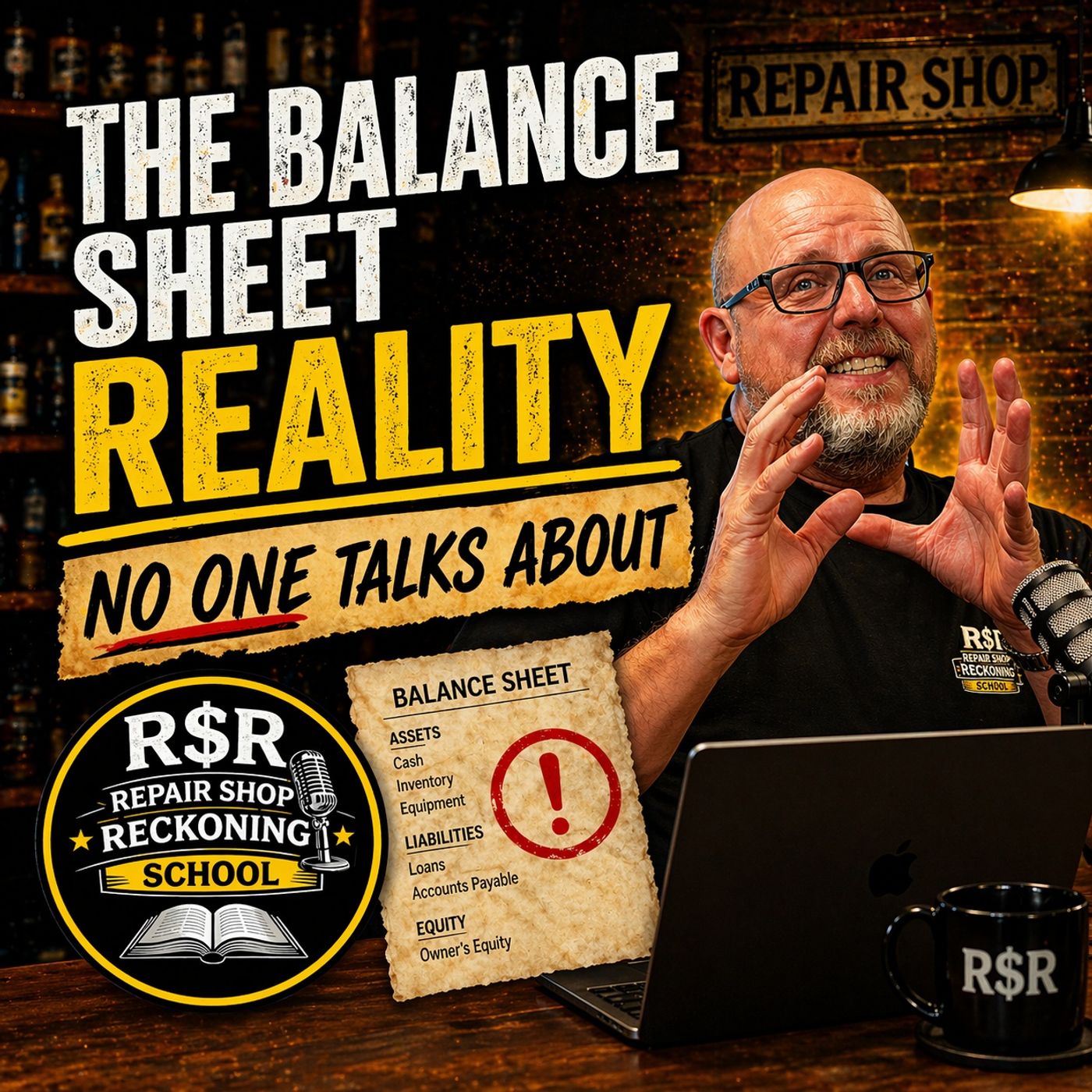
Repair Shop ReckoningApril 24 · 54 min
The Balance Sheet Reality No One Talks About
In this episode of Repair Shop Reckoning, Kevin breaks down the part of the business most shop owners either avoid or don’t fully understand… the balance sheet. You can be busy, profitable, and still not actually getting ahead. This is why. The...
Listen →
63
Downshift with TonnikaApril 20 · 1h 1m
[Special Audio Only Episode] Leadership vs. Management: The Truth Nobody Told You | Michael Smith - Episode 9
Consistency is key - heard that! But, consistency is HARD. That's why I gave up on trying and let the experts handle it. Detect Auto. Let them clean up your estimating process and raise your ARO - like they did for me! CLICK HERE TO BOOK A DEMOAnybody can run a shop. Building one that lasts? That's a whole different story. If you're ready to build smarter systems and a better experience for your team and customers, check out Tekmetric HEREIn this episode, Tonnika welcomes Michael Smith of The Institute for Automotive Business Excellence to talk about what it really takes to build a high-performing, people-first shop. Michael explains why genuine motivation can't be created by bonuses or external pressure—real motivation has to come from within. Tonnika brings up what she's learned about the differences between micromanagement and true leadership, opening up about the importance of self-awareness and the hard work of personal growth. Timestamps:00:00 – Why Real Motivation Comes from Within02:20 – What’s Your Shop Actually Worth? Legacy, Acquisitions & Selling05:08 – Why Shop Owners HATE Talking About the Big Picture07:37 – Leadership vs. Management: The Truth Nobody Told You10:06 – Facing Your Shadows: How Self-Awareness Changes Everything13:00 – Not Just Cars: Building a People-First Shop16:11 – Reverse Engineering Legacy: Starting with the End in Mind18:55 – Planning Your Future vs. Living Day to Day22:11 – The Secret Sauce of High-Performance Teams23:44 – Motivation, Bonuses & What Really Drives Great Work25:48 – The Power of Recognition vs. More Money29:12 – Breaking Through Old Industry Mindsets34:03 – Developing People First for Real Business Results37:18 – Little Things You Can Do Now (That Change Everything)42:00 – Resilience, Grit & The End of Imposter Syndrome46:43 – The Science of Growth: Transcendence & Asking Bigger Questions49:23 – Growth Means Getting Uncomfortable (And Why You Should Try)55:10 – How to Break Your Own Ceilings & Why It’s So Worth It59:48 – Recap: The Real Meaning of Leadership in Your Shop
Listen →
64
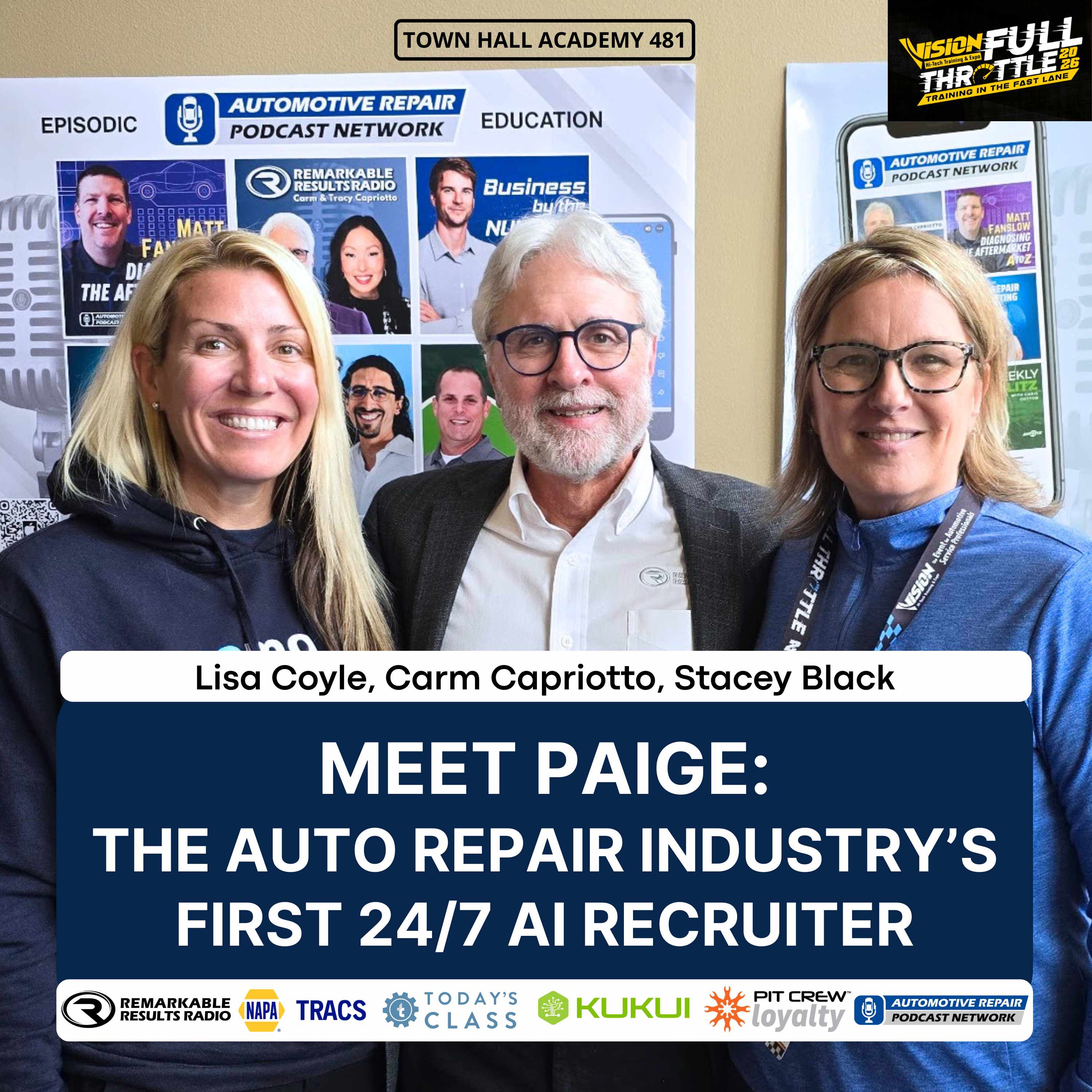
Remarkable Results RadioApril 17 · 42 min
Meet Paige: The Auto Repair Industry’s First 24/7 AI Recruiter [THA 481]
Thanks to our Partners, NAPA TRACS, Today's Class, KUKUI, and Pit Crew Loyalty Watch Full Video Episode *]:pointer-events-auto scroll-mt-[calc(var(--header-height)+min(200px,max(70px,20svh)))]" dir="auto" data-turn-id="request-WEB:8e59eec7-a235-4fa3-a072-956fea3fe478-7" data-testid="conversation-turn-4" data-scroll-anchor="false" data-turn="assistant"> *]:pointer-events-auto scroll-mt-[calc(var(--header-height)+min(200px,max(70px,20svh)))]" dir="auto" data-turn-id="request-WEB:49a777bf-d263-4496-bf0b-2eb3a46ac96a-11" data-testid="conversation-turn-24" data-scroll-anchor="false" data-turn="assistant"> Recorded live at the VISION 2026, this episode of Remarkable Results Radio features host Carm Capriotto in conversation with Lisa Coyle, Co-founder and CEO of Promotive, and Stacey Black, Account Manager at Promotive. Together, they unpack one of the most urgent challenges facing the automotive repair industry today: how to attract, hire, and retain top talent in an increasingly competitive and fast-moving market. What the Episode Covers: The “Ghosting” Problem in Hiring: Why candidates are applying to 15-20 shops at onceHow speed of response determines who wins the hireThe growing impact of declining soft skills like communication and accountability The Role of Shop Culture in Retention Why culture must be intentional, not assumedSimple, low-cost ways to build connection and loyaltyIdeas like celebrating milestones, supporting families, and investing in trainingHow strong culture reduces turnover and attracts better talent Introducing “Paige” The Industry's First AI-Powered Recruiting Promotive’s virtual recruiter designed for the automotive industryInstantly engages candidates via text after they applyConducts a guided, conversational pre-screening interviewCaptures key data: experience, commute, current benefits, and pay expectations A Live Demo of AI in Action Carm roleplays as a technician to demonstrate Paige’s capabilitiesShows how natural, fast, and effective the process is The 24/7 Hiring Advantage Why candidates often apply after hours, and how Paige captures them in that momentReal-world success, including dozens of completed interviews over a holiday weekendFaster engagement leads to fewer drop-offs and better-qualified candidates Hiring today requires more than posting a job and waiting. The shops that succeed are the ones that move quickly, communicate clearly, and create a culture people want to be part of. By combining intentional leadership with innovative tools like AI recruiting, you can reduce friction in the hiring process, improve retention, and ultimately build a stronger, more committed team. *]:pointer-events-auto scroll-mt-[calc(var(--header-height)+min(200px,max(70px,20svh)))]" dir="auto" data-turn-id="request-WEB:49a777bf-d263-4496-bf0b-2eb3a46ac96a-15" data-testid="conversation-turn-32" data-scroll-anchor="true" data-turn="assistant"> VISION Hi-Tech Training and Expo: https://visionkc.com/ Promotive has over 40 years of recruiting and automotive experience. If you need qualified technicians and service advisors and want to offload the heavy lifting, visit https://gopromotive.com/ Lisa Coyle and Stacey Black, https://gopromotive.com/ Thanks to our Partner, NAPA TRACS NAPA TRACS will move your shop into the SMS fast lane with onsite training and six days a week of support and local representation. Find NAPA TRACS on the Web at http://napatracs.com/ Thanks to our Partner, Today's Class Optimize training with Today's Class: In just 5 minutes daily, boost knowledge retention and improve team performance. Find Today's Class on the web at <a href="https://www.todaysclass.com/" target="_blank"...
Listen →
65
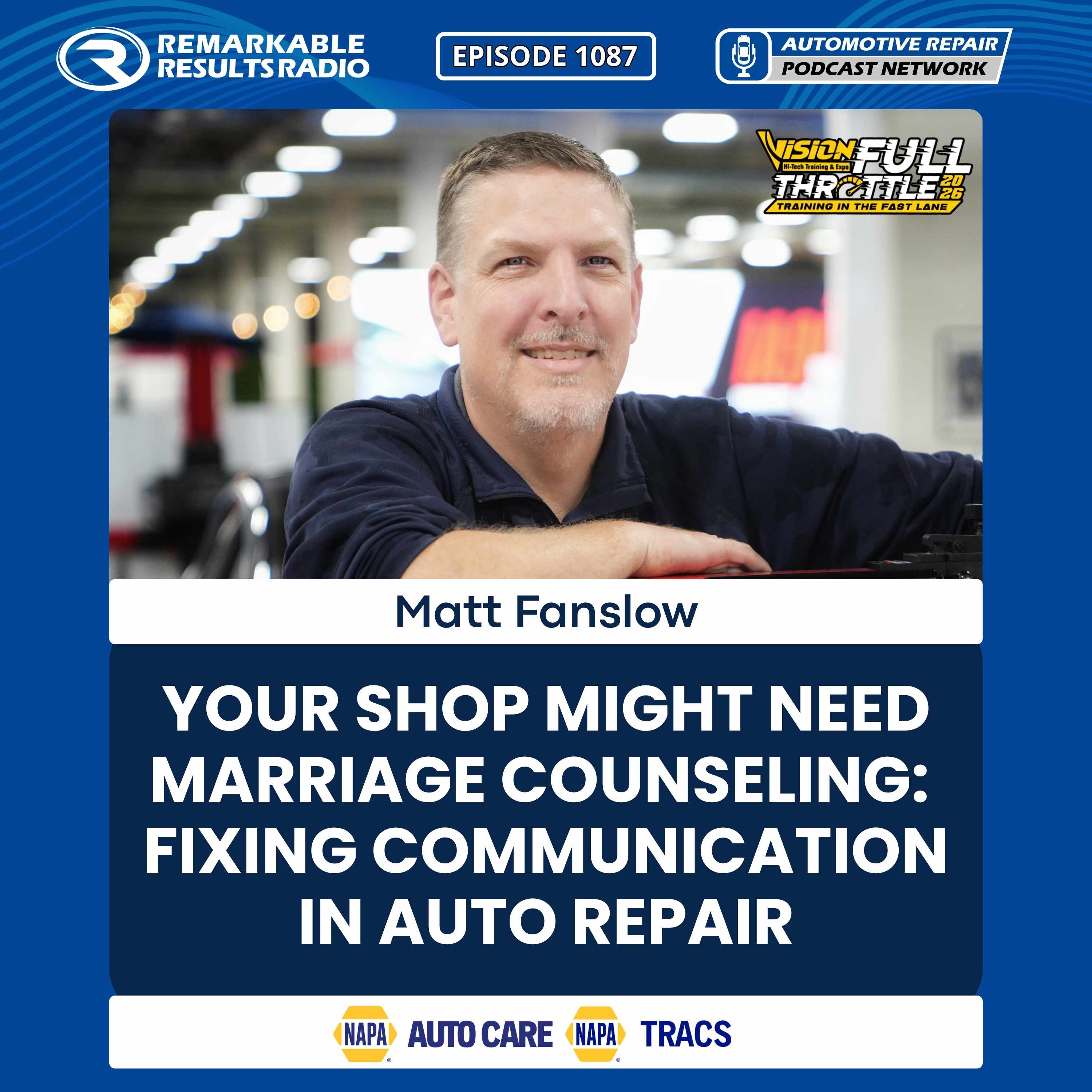
Remarkable Results RadioApril 14 · 47 min
Your Shop Might Need Marriage Counseling: Fixing Communication in Auto Repair [RR 1087]
Thanks to our Partners, NAPA Auto Care and NAPA TRACS Watch Full Video Episode Recorded live at VISION 2026, host Carm Capriotto and Matt Fanslow explore how lessons from marriage counseling can improve communication in auto repair shops. The core discussion centers on Matt’s article for NAPA Auto Care's Insight Magazine, “Your Shop Might Need Marriage Counseling,” and the industry’s gap in soft skills. His central argument is simple: most automotive professionals were never taught effective communication or soft skills. In the past, shop culture often relied on public criticism or shame to correct mistakes. Today, that approach backfires, especially for younger technicians, who are more likely to disengage or “quietly quit” in that kind of environment. Matt proposes a different approach: applying communication techniques commonly used in therapy to everyday shop interactions. Drawing from the Gottman Institute, Matt outlines common communication pitfalls: criticism, contempt, defensiveness, and stonewalling, and how they show up daily in shop environments. Key solutions include: Validating feelings, especially with anxious customersCoaching without shame, addressing mistakes privately with supportSeeking outside perspective, using coaches or therapists to uncover blind spots Finally, both Carm and Matt challenge the stigma around seeking outside help. They encourage shop leaders to work with coaches, counselors, or therapists to uncover blind spots and improve their leadership approach. Far from being a weakness, asking for help is framed as a sign of strength and self-awareness. The goal isn’t to turn shops into therapy sessions; it’s to make small, intentional changes in how people communicate every day. The payoff? Fewer emotional blowups, stronger team culture, and customers who feel safe, heard, and respected. Download Matt Fanslow's Full Article: https://remarkableresults.biz/download/45724/?tmstv=1775829579 VISION Hi-Tech Training and Expo: https://visionkc.com/ Matt Fanslow, Riverside Automotive, Red Wing, MN, Diagnosing the Aftermarket A to Z Podcast: https://mattfanslow.captivate.fm/ Photography by Joe Manna Thanks to our Partners, NAPA Auto Care and NAPA TRACS Learn more about NAPA Auto Care and the benefits of being part of the NAPA family by visiting https://www.napaonline.com/en/auto-care NAPA TRACS will move your shop into the SMS fast lane with onsite training and six days a week of support and local representation. Find NAPA TRACS on the Web at http://napatracs.com/ Connect with the Podcast: - Follow on Facebook: https://www.facebook.com/RemarkableResultsRadioPodcast/ Join Our Virtual Toastmasters Club: https://remarkableresults.biz/toastmasters Join Our Private Facebook Community: https://www.facebook.com/groups/1734687266778976 Subscribe on YouTube: https://www.youtube.com/carmcapriotto Follow on LinkedIn: https://www.linkedin.com/in/carmcapriotto/ Follow on Instagram: https://www.instagram.com/remarkableresultsradiopodcast/ Visit the Website: https://remarkableresults.biz/ Join our Insider List: https://remarkableresults.biz/insider All books mentioned on our podcasts: https://remarkableresults.biz/books Our Classroom page for personal or team learning: https://remarkableresults.biz/classroom Buy Me a Coffee: https://www.buymeacoffee.com/carm Special episode collections: https://remarkableresults.biz/collections The Automotive Repair Podcast Network: https://automotiverepairpodcastnetwork.com/ Remarkable Results Radio Podcast with Carm Capriotto: Advancing the Aftermarket by Facilitating Wisdom Through Story Telling and Open Discussion. https://remarkableresults.biz/ Diagnosing the Aftermarket A to Z with Matt Fanslow: From Diagnostics to Metallica and Mental Health, Matt Fanslow is Lifting the Hood on Life. https://mattfanslow.captivate.fm/ Business by the Numbers with Hunt Demarest: Understand the Numbers of Your Business with CPA Hunt Demarest. https://huntdemarest.captivate.fm/ The Auto Repair Marketing Podcast with Kim and Brian Walker: Marketing Experts Brian & Kim Walker Work with Shop Owners to Take it to the Next Level. https://autorepairmarketing.captivate.fm/ The Weekly Blitz with Chris Cotton: Weekly Inspiration with Business Coach Chris Cotton from AutoFix - Auto Shop Coaching. https://chriscotton.captivate.fm/ Speak Up! Effective Communication with Craig O'Neill: Develop Interpersonal and Professional Communication Skills when Speaking to Audiences of Any Size. https://craigoneill.captivate.fm
Listen →
66
Repair Shop ReckoningApril 10 · 1h 54m
Deeper Dive Into P & L and Budgeting
In this episode of Repair Shop Reckoning, Kevin breaks down the difference between knowing your numbers and actually running your business with them. Too many owners look at their P&L at the end of the month and treat it like a report card. By...
Listen →
67
Downshift with TonnikaApril 9 · 58 min
Before I Was the Boss Lady, I Was His Little Girl | William Brown and Ash Kaplan - Episode 7
Today, we welcome the man who started it all....William Brown, my daddio. It took some convincing to get him to open up, but I just HAD to let you meet him! Together with Ash Kaplan, we talk about how my dad didn't just build a shop, but and a legacy. He shares hard-earned wisdom from decades in the business, including how sacrifice and a refusal to quit paved the way for long-term success. Timestamps:00:00 Pricing for Profitability: Why YOUR benchmarks matter01:22 The Brown Effect: William Browns shop owner origin story05:10 From $3,000 Loans to $1.8 Million Shops—The Long Game07:35 Childhood Lessons Learned in the Shop09:02 “Excuses ain’t nothing but a made up lie”—Quitting in the Dip12:17 Making Hard Financial Choices (Do you need the Escalade?)16:28 When Is It OK to Treat Yourself? Dad’s Rules on Wealth18:57 Six Months in the Bank: Protecting Team and Family20:53 Work-Life “Balance”—What it Really Takes24:00 If Your Labor Rate Isn’t THEIR Business—Why Benchmarks are Personal28:38 “Pass the Baton”: Building Teams, Letting Go, and Growth37:40 Leadership vs. Boss: Why Pouring Into Your People Matters42:50 Firing, Hiring, and Being Held Hostage in Your Own Business47:10 When You Outgrow Your Shop (and Why that’s a Win!)56:25 Would You Do It Again?
Listen →
68
The Jaded MechanicApril 7 · 1h 50m
Why Technicians Are Leaving the Industry | Adam Matz
Like the show? Show your support by using our sponsors.Need to update your shop systems and software? Try Tekmetric HERELaunch your tool game to the next level with Launch Tech USA! HEREIn this episode, Jeff is join by Adam Matz to discuss challenges facing dealership mechanics today. They talk about stagnant wages, rising labor rates, and management practices that impact technician morale and retention. The conversation also brings up the growing technician shortage and the need for better support and fair compensation to sustain the industry.Timestamps:09:42 Starting in the car industry11:42 Challenges with car repairs20:53 Training and mentoring younger workers27:00 Challenges with customer feedback31:44 Talking about car audio setups36:44 Warranty pay limits for repairs42:57 How mechanics are paid44:26 Mentoring young mechanics and mistakes52:25 Feeling undervalued at work55:47 Generational views on mental health59:39 Keeping technicians happy01:07:38 Challenges of modern living01:13:47 Struggles of young adulthood01:20:13 Building trust with employees01:23:10 Frustrations with dealership management01:27:47 Challenges in fair technician pay01:36:00 The value of trade education01:38:05 Challenges in industry and workforce01:44:04 Dealing with toxic employees Follow/Subscribe to the show on social media! TikTok - https://www.tiktok.com/@jeffcompton7YouTube - https://www.youtube.com/@TheJadedMechanicFacebook - https://www.facebook.com/profile.php?id=100091347564232
Listen →
69
Shop Soup PodcastApril 4 · 38 min
EP23: Greg Shares Some Thoughts On Private Equity And Its Effect On The Automotive Aftermarket
Welcome to ShopSoup. I'm your host Greg Buckley and today it's just me on the mic and offering up some personal reflections since I had a week filled with listening and learning about the topic. Thanks for stopping in the Soup Kitchen and please subscribe!Greg Talks Private Equity in Automotive & HospitalityThe Impact of Private Equity on Small Businesses and the Automotive IndustryIn this episode, Greg shares his insights on how private equity influences industries like restaurants and automotive care, emphasizing the importance of understanding this financial strategy’s long-term effects. He reflects on local case studies, historical management practices, and broader economic implications.Main topics:The $29 billion acquisition of Restaurant Depot by Cisco services and its underlying data-driven motivesHow private equity’s focus on scalability and debt impacts small and independent businessesThe rise and fall of Iron Hill Brewery’s expansion through private equity, bankruptcy, and rebrandingManagement philosophies of Jack Welch and their influence on today’s corporate and manufacturing practicesGlobal manufacturing shifts, offshoring trends, and China’s strategic economic manipulationsThe cultural and operational challenges of maintaining independence in a fragmented automotive landscapeThe importance of industry pride, relationship management, and advocating for our craft amidst economic changesThe cyclical nature of business development, debt cycles, and industry consolidationReflection on societal attitudes towards capitalism, fairness, and legal versus ethical strategiesKey insights:Private equity often aims to leverage data and scale for maximum profit, sometimes at the expense of small business stability.High debt levels have caused even successful restaurant chains like Iron Hill to close operations unexpectedly.Management tactics like Jack Welsh’s aggressive workforce reductions have long-term impacts on industry culture and quality.Manufacturing has historically offshored to low-wage countries but is now somewhat returning to the U.S., with China's economic stratagems shaping global supply chains.The automotive service industry is increasingly divided but still retains core values of community and relationships.Industry stakeholders should stay informed, communicate openly, and advocate for a positive industry reputation.Timestamps:00:00 - Introduction and episode overview on private equity in business02:18 - Private equity’s focus on data and scalability in restaurant businesses04:39 - Insights from Adam Coffey on private equity deals and exits06:33 - Case study: Iron Hill Brewery’s expansion and bankruptcy09:03 - The dangers of debt and bankruptcy as strategic tools11:24 - Historical management practices and cultural shifts in business13:45 - Offshoring manufacturing: trends, reasons, and China’s manipulation tactics16:34 - The influence of management styles on today’s industry practices18:03 - The decline of teamwork and industry fragmentation19:29 - Building relationships with consumers and industry pride20:29 - The cyclical nature of debt, build, sell, and rebuild in business22:27 - Corporate history insights from Delaware and industry consolidations24:51 - Lessons from oil companies and industry turbulence26:14 - Reflection on industry resilience and future challenges30:07 - The importance of understanding and managing industry relationships32:27 - The impact of efficiency, debt, and pricing in automotive aftermarket34:53 - Personal reflections on industry passion and legacy36:26 - Final thoughts: industry strength, community engagement, and prideResources & Links:Adam Coffey - Private Equity ExpertRestaurant DepotIron Hill Brewery - Company WebsiteRepair Pal - Founder David's storyCarlyle GroupYelpConnect with Greg Buckley:LinkedInTwitter
Listen →
70
The Jaded MechanicMarch 31 · 1h 40m
Can the Technician Shortage Be Fixed?? | Josh Fowler
Like the show? Show your support by using our sponsors. Need to update your shop systems and software? Try Tekmetric HERELaunch your tool game to the next level with Launch Tech USA! HEREIn this episode, Jeff is joined by Josh Fowler, a shop foreman at a Chrysler dealership in Adams, New York. Josh talks about how tough it’s been to find good technicians, especially with changing job trends and not much local talent to pull from. He and Jeff swap ideas on how to bring people in and keep them around, like offering signing bonuses and bumping pay as techs level up their training.Timestamps:00:00 Fuccillo's influence and radio presence08:58 Discussing repair workflow challenges12:30 Using signing bonuses to attract talent19:20 Exploring high school co-op opportunities23:42 Employee training and probation process30:55 Addressing incentive structures for young workers32:53 Developing mentorship and skill-building plans41:36 Building confidence through experience45:55 Developing practical mechanical expertise52:37 Addressing car maintenance and trade-in options54:57 Challenges driving service advisors to leave01:00:16 Technician networking and collaboration01:05:01 Encouraging collaboration and knowledge sharing01:10:26 Evaluating roles in auto repair01:20:02 Selecting appropriate diagnostic tools01:21:23 Addressing wages in the auto industry01:26:20 Addressing technician problem-solving skills Follow/Subscribe to the show on social media! TikTok - https://www.tiktok.com/@jeffcompton7YouTube - https://www.youtube.com/@TheJadedMechanicFacebook - https://www.facebook.com/profile.php?id=100091347564232
Listen →
71
Repair Shop ReckoningMarch 27 · 1h 39m
You Don’t Have a Sales Problem… You Have a Culture Problem
Everybody keeps talking about how this industry is broken. How it sucks. How you can’t make money. How technicians are leaving and shops are struggling. Here’s the truth. Yeah, there are problems. But that’s not the whole story. Because there are...
Listen →
72
Shop Soup PodcastMarch 20 · 1h 14m
EP21: To Rise To A Level 10 You Must Dig Deep. With Guest Industry Coach Dave Schedin
Welcome To ShopSoup Podcast. I'm your host Greg Buckley, a multi-shop owner in Delaware that has seen, heard and experienced in being part of a 3 generation automotive repair shop.This weeks guest is Dave Schedin (pronouced, Shi-deen) of Computrek Systems, a coaching and consulting firm out of Spokane, Washington. Dave and I discuss the importance of personal development for the shop owner and it impacts the success of their business.In this engaging conversation, Dave Schedin shares his journey from automotive technician to coach, emphasizing the importance of personal development, purpose, and mindset in transforming auto repair shops. Discover practical strategies for leadership, team building, and creating a legacy that lasts beyond the business. keywordsauto repair, personal development, leadership, coaching, business growth, mindset, industry transformation key topicsPersonal development and self-awareness in businessThe importance of purpose and legacy in leadershipStrategies for team building and technician trainingOvercoming scarcity mindset and embracing abundanceThe role of mindset and emotional intelligence in industry success"Addressing the root pain points in shops""Profit is a map, not the destination""Growth happens outside the comfort zone"Chapters00:00 Introduction to Coaching and Personal Journey02:46 The Role of Psychology in Coaching05:34 Transformational Coaching vs. Behavior Modification08:23 Self-Awareness and Personal Development11:07 Addressing Pain Points in the Automotive Industry13:38 Defining Purpose and Legacy in Business16:36 The Importance of Continuous Growth19:39 Challenges Faced by Service Advisors22:25 Creating a Supportive Environment for Advisors25:20 The Infinite Game of Business27:58 Aging and Its Impact on Business Perspective30:34 Legacy and Long-Term Vision37:44 Taking Responsibility for Personal Growth38:10 Facing Life's Challenges39:47 Transformative Leadership and Self-Awareness42:19 The Journey of Personal Development47:13 Instilling Personal Development in Employees50:34 The Power of Self-Awareness56:19 Finding Joy in Business57:58 Transforming the Automotive Industry resourcesLeadership and Self-Deception by Arbinger Institute - https://www.arbinger.com/resources/books/leadership-and-self-deception/Anatomy of Peace by Arbinger Institute - https://www.arbinger.com/resources/books/anatomy-of-peace/ guest linksWebsite - https://computreksystems.com/
Listen →
73
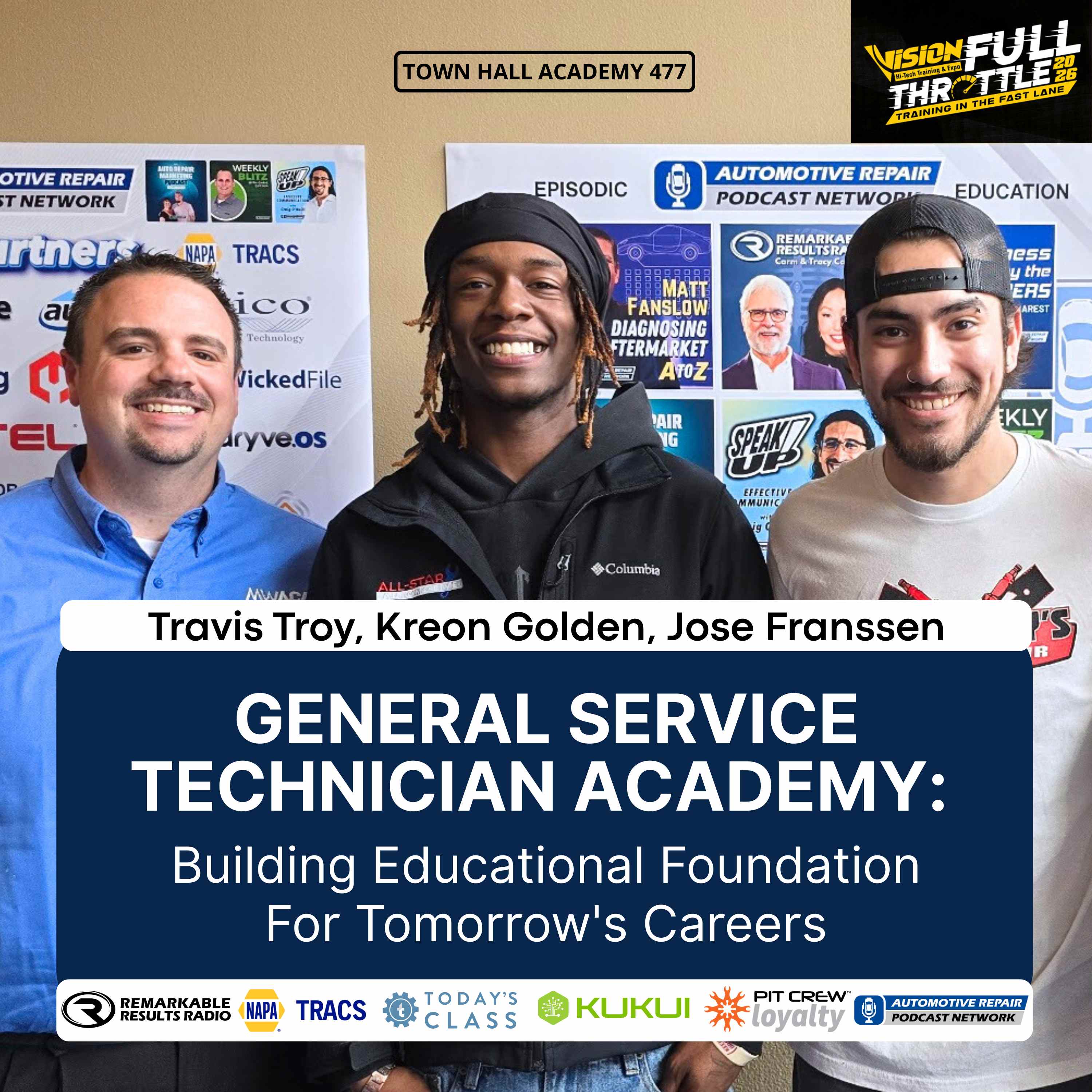
Remarkable Results RadioMarch 20 · 34 min
General Service Technician Academy: Building Educational Foundation For Tomorrow’s Careers [THA 477]
Thanks to our Partners, NAPA TRACS, Today's Class, KUKUI, and Pit Crew Loyalty Watch Full Video Episode *]:pointer-events-auto scroll-mt-(--header-height)" dir="auto" data-turn-id="0e35c993-ad2d-4e51-96b6-080ca2e8cdd2" data-testid="conversation-turn-3" data-scroll-anchor="false" data-turn="user">*]:pointer-events-auto scroll-mt-[calc(var(--header-height)+min(200px,max(70px,20svh)))]" dir="auto" data-turn-id="request-WEB:8e59eec7-a235-4fa3-a072-956fea3fe478-7" data-testid="conversation-turn-4" data-scroll-anchor="false" data-turn="assistant"> Recorded live at VISION 2026, this episode highlights the General Service Technician Academy (GSTA), a two-day training program offered at VISION designed to build strong foundational skills for early-career automotive technicians. Host Carm Capriotto speaks with industry leader and shop owner Travis Troy and two young technicians who completed the program about how mentorship and structured training are shaping their careers. The discussion emphasizes that great technicians are distinguished not by advanced tools alone, but by how well they execute fundamental skills. The GSTA curriculum covers essential, practical topics including OSHA training, lift safety, fluids and oil, tire safety and repair, alignments, thermal management (A/C), and hands-on electrical training. The academy addresses a critical training gap in the industry through a hands-on learning model that encourages participants to learn it, practice it, and teach it, reinforcing both understanding and communication. Mentorship plays a key role in guiding young technicians who often face unclear career paths and discouraging workplace experiences, helping them build confidence, opportunity, and long-term direction. Ultimately, the conversation reinforces a culture of continuous learning, highlighting that both new and experienced technicians benefit from revisiting the fundamentals to maintain safety, productivity, and professional growth in an increasingly high-tech automotive industry. VISION Hi-Tech Training & Expo: https://visionkc.com/ Travis Troy, Honest Wrenches, Akeny and Des Moines, IA. Listen to Travis’ other episodes HERE Kreon Golden, All Star Automotive, Columbia, MO Jose Franssen, Skalackys Auto Repair, Fargo, ND Thanks to our Partner, NAPA TRACS NAPA TRACS will move your shop into the SMS fast lane with onsite training and six days a week of support and local representation. Find NAPA TRACS on the Web at http://napatracs.com/ Thanks to our Partner, Today's Class Optimize training with Today's Class: In just 5 minutes daily, boost knowledge retention and improve team performance. Find Today's Class on the web at https://www.todaysclass.com/ Thanks to our Partner, KUKUI Stop juggling multiple marketing tools. KUKUI’s integrated platform delivers 4x better website conversions, automated follow-up, and real-time ROI tracking. Get industry-leading customer support with KUKUI at https://www.kukui.com/ Thanks to our Partner, Pit Crew Loyalty You’re probably tired of chasing new customers who never return. We understand. Pit Crew Loyalty ends the one-and-done cycle, turning first visits into lasting, reliable revenue at https://www.pitcrewloyalty.com/ Connect with the Podcast: - Follow on Facebook: https://www.facebook.com/RemarkableResultsRadioPodcast/ - Join Our Virtual Toastmasters Club: https://remarkableresults.biz/toastmasters - Join Our Private Facebook Community: https://www.facebook.com/groups/1734687266778976 - Subscribe on YouTube: https://www.youtube.com/carmcapriotto - Follow on LinkedIn: https://www.linkedin.com/in/carmcapriotto/ - Follow on Instagram: https://www.instagram.com/remarkableresultsradiopodcast/ - Follow on Twitter: https://twitter.com/RResultsBiz - Visit the Website: https://remarkableresults.biz/ - Join our Insider List: https://remarkableresults.biz/insider - All books mentioned on our podcasts: https://remarkableresults.biz/books - Our Classroom page for personal or team learning: https://remarkableresults.biz/classroom - Buy Me a Coffee: https://www.buymeacoffee.com/carm - Special episode collections: https://remarkableresults.biz/collections - The Automotive Repair Podcast Network: https://automotiverepairpodcastnetwork.com/ - Remarkable Results Radio Podcast with Carm Capriotto: Advancing the Aftermarket by Facilitating Wisdom Through Story Telling and Open Discussion. https://remarkableresults.biz/ - Diagnosing the Aftermarket A to Z with Matt Fanslow: From Diagnostics to Metallica and Mental Health, Matt Fanslow is Lifting the Hood on Life. https://mattfanslow.captivate.fm/ - Business by the Numbers with Hunt Demarest: Understand the Numbers of Your Business with CPA Hunt Demarest. https://huntdemarest.captivate.fm/ - The Auto Repair Marketing Podcast with Kim and Brian Walker: Marketing Experts Brian & Kim Walker Work with Shop Owners to Take it to the Next Level. https://autorepairmarketing.captivate.fm/ - <a...
Listen →
74
Repair Shop ReckoningMarch 20 · 1h 24m
They Ignored the Trades...Now They Have to Pay for It
Everybody keeps talking about the technician shortage like it just showed up out of nowhere. It didn’t. We built it. For the last 30 years, we told kids not to go into the trades. We stripped hands on training out of schools. We pushed college as the...
Listen →
75
Downshift with TonnikaMarch 12 · 1h 29m
Overcome Your Fears and Be YOU!! | Episode 3
In this episode, Tonnika Haynes welcomes Ash Kaplan to talk about the realities of shop ownership and building a business with authenticity. Tonnika Haynes shares her journey taking over her family’s automotive shop, highlighting the challenges of stepping into leadership and learning to trust her team. Ash details her path from tinkering as a kid to founding Golden Hour Garage, emphasizing the importance of meaningful connections, empowering shop owners to reclaim their time, and why authenticity is her #1 core value. Timestamps:00:00 Authority, legacy, and what it really means to be in control00:28 Welcome & the power of “downshifting” in business01:22 Meet Tonnika & Ash: Shop owner & efficiency expert introductions02:19 Family, motherhood, and how your “why” changes with time04:20 “Working on, not in the business”—the struggle to delegate06:01 How an industry call led to a friendship—and better business07:16 Generational divides & why standing out matters in shop life11:14 Why Tonnika thought she needed “the old white guy up front” & learning to lead as herself13:04 The moment walking into an industry event changed everything17:33 The story behind “Downshift”—slowing down to level up18:25 Relationships first: Building trust and brand beyond company names21:06 Investing in people: How remote services help reclaim time & sanity24:33 The health scare that became a wake-up call for better business balance27:33 Letting go, trusting the team, and why delegation pays twice29:13 The magic of remote estimating: More customer time, more profit30:58 Selling with empathy, not assumptions—the secret to loyal customers33:40 How serving people first changes everything44:06 Ash’s journey from duct tape diva to shop problem-solver53:00 The grit it takes: Advice for women entering the industry01:04:42 Tonnika turns a struggling shop into a legacy of growth01:16:34 Why shop culture means everything—and how to actually build it01:22:04 Owning your story, embracing authenticity, and letting your “why” shine
Listen →
76
Changing the Industry PodcastMarch 9 · 57 min
Episode 259 - Building Company Culture and Beating Chargebacks in Automotive Shops With Kevaughn Williams
Don't get to the end of this year wishing you had taken action to change your business and your life.Click here to schedule a free discovery call for your business: https://geni.us/IFORABEDon't miss an upcoming event with The Institute: https://geni.us/InstituteEvents2026Shop-Ware gives you the tools to provide your shop with everything needed to become optimally profitable.Click here to schedule a free demo: https://info.shop-ware.com/profitabilityTransform your shop's marketing with the best in the automotive industry, Shop Marketing Pros!Get a free audit of your shop's current marketing by clicking here: https://geni.us/ShopMarketingProsShop owners, are you ready to simplify your business operations? Meet 360 Payments, your one-stop solution for effortless payment processing.Imagine this—no more juggling receipts, staplers, or endless paperwork. With 360 Payments, you get everything integrated into a single, sleek digital platform.Simplify payments. Streamline operations. Check out 360payments.com today!In this episode, Lucas and David are joined by Kevaughn Williams, Operations Manager at 360 Payments. Kevaughn underscores the importance of company culture in building a motivated, accountable team, highlighting how 360’s values of transparency and peer-to-peer accountability support both employees and customers. The discussion covers practical strategies for automotive shops to protect themselves from payment chargebacks, with Kevaughn outlining red flags to watch for and offering tips to improve payment security. 00:00 "360 Culture and Leadership"04:28 "Honesty and Accountability Matter"08:13 "Impactful Workplace Culture Insights"11:16 "Towing Office Experience Reflection"14:50 Car Rental Customer Support Journey15:54 Rental Car Upgrade Mishap21:08 Mandatory Work Schedule Change24:40 Building Youthful Team for Success27:58 "Disney Trip as Life Milestone"28:40 Prioritizing People Over Business34:51 Preventing Text-to-Pay Fraud38:11 Fraud Awareness and Payment Precautions39:06 DocuSign ID and Card Verification44:24 Chargeback Fraud at Local Shop48:02 "High-Risk Account Threshold Explained"50:23 Transparency and Informed Decisions53:22 "David's CSP Concerns"56:19 "Buttoning Debate Unresolved"
Listen →
Questions answered on succession & exit planning
Practical questions on succession & exit planning, answered across the catalog — each linked to the episode it came from.
- What is the importance of measuring shop performance?
- Measuring shop performance helps identify areas for improvement and ensures that non-negotiables are being met, ultimately leading to increased profitability. From: Selling to the Curb: How AI Turned More Calls into Customers [RR 1099] →
- How can AI be utilized in an automotive shop?
- AI can analyze call data to improve conversion rates and provide insights into customer interactions, helping shop owners make informed decisions. From: Selling to the Curb: How AI Turned More Calls into Customers [RR 1099] →
- What strategies can shop owners use to prepare for retirement?
- Shop owners should focus on increasing profitability and understanding market trends to maximize their business's value when considering an exit strategy. From: Selling to the Curb: How AI Turned More Calls into Customers [RR 1099] →
- What should I do if my employees are not getting along?
- It's important to address conflicts directly and facilitate open communication to resolve issues before they escalate. From: Episode 268 - Mastering Shop Management and Technician Relations in Today’s Auto Industry →
- How can I improve my shop's performance?
- Focus on hiring the right technicians, implementing clear policies, and regularly reviewing your financials to identify areas for improvement. From: Episode 268 - Mastering Shop Management and Technician Relations in Today’s Auto Industry →
- What are the benefits of networking in the automotive industry?
- Networking allows shop owners to share experiences, learn from others, and gain insights that can help improve their business operations. From: Episode 268 - Mastering Shop Management and Technician Relations in Today’s Auto Industry →
- What is the primary cause of the technician shortage in the automotive industry?
- The technician shortage is largely attributed to a productivity shortage and workplace culture issues rather than a lack of qualified technicians. From: Ep 97 - Tektonic 2026 Coaches Panel | Flat Rate, Technician Shortage, Performance Based Pay →
- How can shop owners improve technician retention?
- Shop owners can improve retention by creating a positive work environment, offering clear career paths, and implementing performance-based compensation models. From: Ep 97 - Tektonic 2026 Coaches Panel | Flat Rate, Technician Shortage, Performance Based Pay →
- What marketing strategies can help attract new talent to the automotive industry?
- Effective marketing strategies include targeting young people through outreach programs and showcasing the benefits and opportunities available in the automotive trade. From: Ep 97 - Tektonic 2026 Coaches Panel | Flat Rate, Technician Shortage, Performance Based Pay →
- What are the benefits of using a virtual recruiting platform?
- A virtual recruiting platform can provide consistency in the hiring process and allow for quicker responses to candidates, improving the chances of securing top talent. From: Why Shops Lose Technicians Overnight | Lisa Coyle and Kat Ayers from Promotive →
- How can shop owners improve their hiring practices?
- Shop owners should focus on creating a positive work culture, provide clear expectations, and ensure they are responsive to candidates throughout the hiring process. From: Why Shops Lose Technicians Overnight | Lisa Coyle and Kat Ayers from Promotive →
- What should technicians consider when applying for jobs?
- Technicians should ensure they follow application instructions carefully and be prepared to discuss their skills and experiences in detail during interviews. From: Why Shops Lose Technicians Overnight | Lisa Coyle and Kat Ayers from Promotive →
- What is the importance of investing in your team?
- Investing in your team helps build trust and engagement, leading to a more motivated workforce. It shows employees that you care about their personal and professional growth. From: Ep 154: Turn Your Tragedy Into Limitless Leadership with JeanAnn SaintGrace →
- How can shop owners manage their time effectively?
- Shop owners should set clear boundaries and prioritize their schedules based on their energy levels. Time blocking for personal activities can help maintain a healthy work-life rhythm. From: Ep 154: Turn Your Tragedy Into Limitless Leadership with JeanAnn SaintGrace →
- What does servant leadership mean in the automotive industry?
- Servant leadership involves supporting and empowering your team to help them succeed. It means being approachable and willing to assist them in overcoming challenges, both professionally and personally. From: Ep 154: Turn Your Tragedy Into Limitless Leadership with JeanAnn SaintGrace →
- How can I manage my shop during a personal crisis?
- It's important to have a self-sustaining business model that allows others to operate effectively without your constant presence. Empower your team to make decisions. From: Episode 261 - Navigating Grief, Taxes, and Machine Shop Dreams in the Auto Repair Industry With David Veldman →
- What should I consider when hiring new employees?
- Look for candidates who not only have the right skills but also fit into your shop's culture. Implement clear training and onboarding processes to set them up for success. From: Episode 261 - Navigating Grief, Taxes, and Machine Shop Dreams in the Auto Repair Industry With David Veldman →
- What are the tax implications of running a shop?
- Shop owners must understand their tax obligations, including payroll taxes, to avoid unexpected liabilities. Consulting with a tax professional can provide clarity. From: Episode 261 - Navigating Grief, Taxes, and Machine Shop Dreams in the Auto Repair Industry With David Veldman →
- What should I do if my technician is struggling with personal issues?
- It's important to create a safe space for open communication. Offer support and let them know you're there to help, whether it's through time off or resources. From: Why Forward-Thinking in Auto Repair is Critical | JeanAnn SaintGrace →
- How can I ensure my shop is profitable?
- Focus on building a solid business model that includes fair pricing, effective marketing, and a strong team culture. Profit is essential for growth and sustainability. From: Why Forward-Thinking in Auto Repair is Critical | JeanAnn SaintGrace →
- What are the key elements of a successful shop culture?
- A successful shop culture includes open communication, mutual respect, support for employees, and a focus on teamwork. It's about creating an environment where everyone feels valued. From: Why Forward-Thinking in Auto Repair is Critical | JeanAnn SaintGrace →
- What is the importance of customer service in the automotive industry?
- Customer service is crucial as it builds long-term relationships, ensuring repeat business and customer loyalty. A focus on service can differentiate a shop in a competitive market. From: EP 19: Can The Industry's Past Be It's Future? With Todd Hayes Of AutoShopAnswers →
- How can shop owners improve their customer service?
- Shop owners can improve customer service by training staff to prioritize customer needs, maintaining a clean and welcoming environment, and ensuring open communication with clients. From: EP 19: Can The Industry's Past Be It's Future? With Todd Hayes Of AutoShopAnswers →
- What role does discipline play in running a successful shop?
- Discipline is essential for maintaining high standards in both personal health and business operations, leading to better decision-making and overall success. From: EP 19: Can The Industry's Past Be It's Future? With Todd Hayes Of AutoShopAnswers →
Weekly digest
The week's best automotive podcasts
Into Succession & Exit Planning? You'll likely enjoy the digest — one email a week with the latest automotive aftermarket podcasts from across the industry, Succession & Exit Planning and beyond. No spam, unsubscribe anytime.