← Hiring & Training
Technician Recruiting
Finding and hiring auto technicians in a tight market — sourcing, job ads, and interviewing strategies to beat the tech shortage.
155 episodes
01
The Jaded MechanicMarch 31 · 1h 40m
Can the Technician Shortage Be Fixed?? | Josh Fowler
Like the show? Show your support by using our sponsors. Need to update your shop systems and software? Try Tekmetric HERELaunch your tool game to the next level with Launch Tech USA! HEREIn this episode, Jeff is joined by Josh Fowler, a shop foreman at a Chrysler dealership in Adams, New York. Josh talks about how tough it’s been to find good technicians, especially with changing job trends and not much local talent to pull from. He and Jeff swap ideas on how to bring people in and keep them around, like offering signing bonuses and bumping pay as techs level up their training.Timestamps:00:00 Fuccillo's influence and radio presence08:58 Discussing repair workflow challenges12:30 Using signing bonuses to attract talent19:20 Exploring high school co-op opportunities23:42 Employee training and probation process30:55 Addressing incentive structures for young workers32:53 Developing mentorship and skill-building plans41:36 Building confidence through experience45:55 Developing practical mechanical expertise52:37 Addressing car maintenance and trade-in options54:57 Challenges driving service advisors to leave01:00:16 Technician networking and collaboration01:05:01 Encouraging collaboration and knowledge sharing01:10:26 Evaluating roles in auto repair01:20:02 Selecting appropriate diagnostic tools01:21:23 Addressing wages in the auto industry01:26:20 Addressing technician problem-solving skills Follow/Subscribe to the show on social media! TikTok - https://www.tiktok.com/@jeffcompton7YouTube - https://www.youtube.com/@TheJadedMechanicFacebook - https://www.facebook.com/profile.php?id=100091347564232
Listen →
02
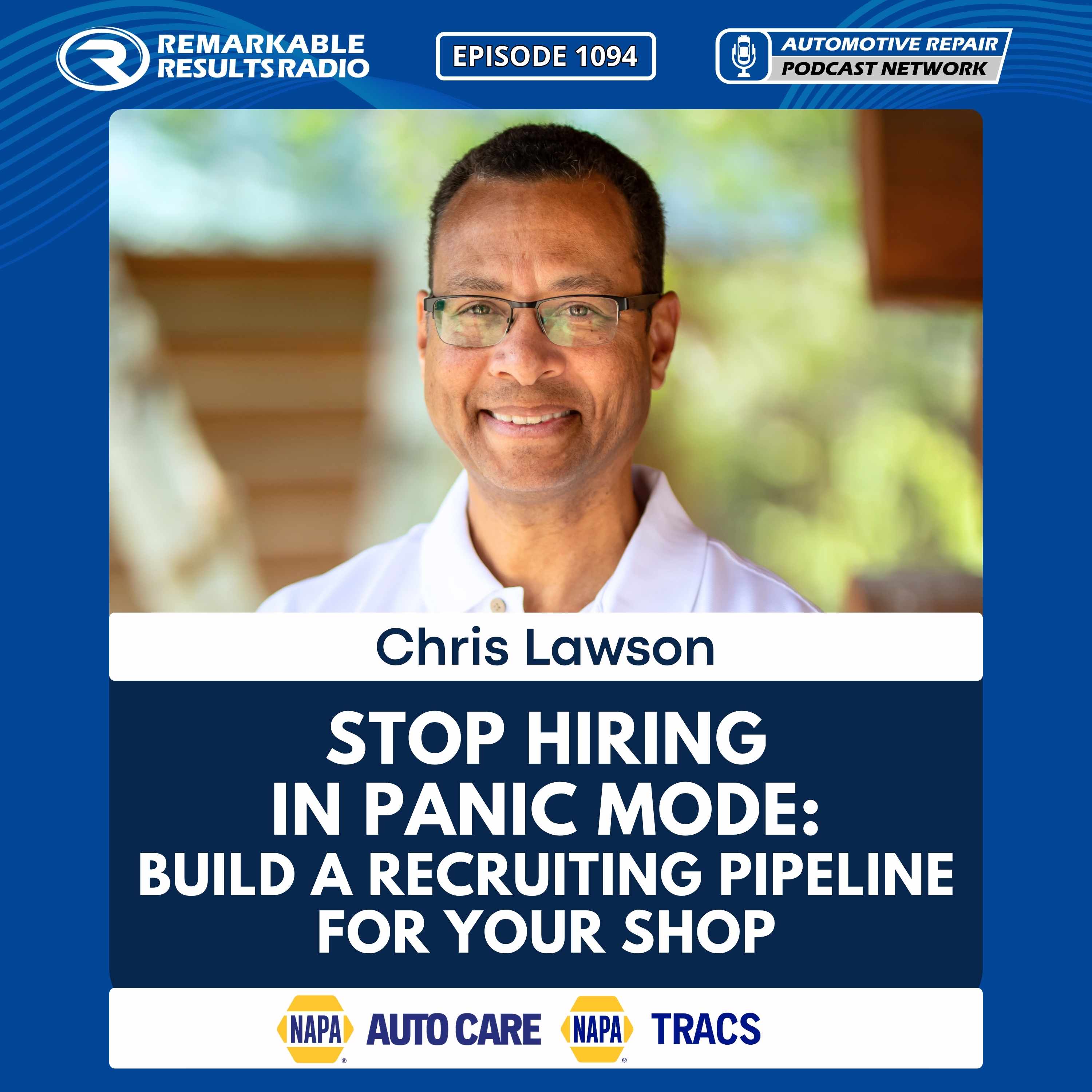
Remarkable Results RadioJune 2 · 38 min
Stop Hiring in Panic Mode: Build a Recruiting Pipeline for Your Shop [RR 1094]
Thanks to our Partners, NAPA Auto Care and NAPA TRACS Watch Full Video Episode Host Carm Capriotto welcomes Chris Lawson, founder of Technician Find, to discuss one of the biggest challenges facing independent auto repair shops today: finding and keeping great technicians. Chris explains why many shop owners fall into what he calls "fire alarm syndrome," waiting until a technician leaves before starting the hiring process. That reactive approach often leads to rushed decisions, poor hires, and ongoing turnover. Instead, he advocates for an "Always Be Recruiting" mindset, where shops continuously build relationships with potential candidates long before they have an opening. The conversation explores practical strategies for becoming a destination workplace, creating a recruiting pipeline, and building a culture that attracts top talent in a competitive market. What You'll Learn Why reactive hiring creates costly staffing problemsHow to build a bench of pre-qualified technicians before you need themWhy becoming "10-mile famous" can help attract both technicians and customersHow culture-focused marketing can outperform traditional help-wanted adsThe three things technicians value most: respect, growth, and compensationWhy sign-on bonuses often fail and how to structure them more effectivelyPractical ways to engage passive candidates who are not actively job huntingResources available through Chris Lawson's free online community for shop owners The best time to recruit a technician is before you need one. Shops that continuously market their culture, build relationships with local talent, and maintain a pipeline of qualified candidates are better positioned to grow, avoid staffing emergencies, and create a workplace where top technicians want to stay. Recruiting is no longer an occasional task. It is an ongoing business strategy. Chris Lawson, TechnicianFind.Com Love your shop? Stay, but stay ready. Auto techs join to level up, find good shops, and keep tabs on top indie jobs nationwide. Techs only. No BS. Independent Wrench Jobs: https://www.skool.com/independentwrenchjobs Finding Technicians Part 1- Chris Lawson [RR 803]: https://remarkableresults.biz/remarkable-results-radio-podcast/e803/ Finding Technicians Part 2 – Chris Lawson [RR 816]: https://remarkableresults.biz/remarkable-results-radio-podcast/e816/ Technician Attraction Blueprint [RR 921]: https://remarkableresults.biz/remarkable-results-radio-podcast/e921/ Attract, Develop, and Retain Top Automotive Talent [CC 113]: https://remarkableresults.biz/remarkable-results-radio-podcast/cc113/ Beyond Babysitters: Developing Strong Managers and Financial Transparency [RR 1076]: https://remarkableresults.biz/remarkable-results-radio-podcast/e1076/ Thanks to our Partners, NAPA Auto Care and NAPA TRACS Learn more about NAPA Auto Care and the benefits of being part of the NAPA family by visiting https://www.napaonline.com/en/auto-care NAPA TRACS will move your shop into the SMS fast lane with onsite training and six days a week of support and local representation. Find NAPA TRACS on the Web at http://napatracs.com/ Connect with the Podcast: Visit the Website: https://remarkableresults.biz/ Subscribe on YouTube: https://www.youtube.com/carmcapriotto Follow on Facebook: https://www.facebook.com/RemarkableResultsRadioPodcast/ Follow on LinkedIn: https://www.linkedin.com/in/carmcapriotto/ Follow on Instagram: https://www.instagram.com/remarkableresultsradiopodcast/ Join Our Virtual Toastmasters Club: https://remarkableresults.biz/toastmasters Join Our Private Facebook Community: https://www.facebook.com/groups/1734687266778976 Join our Insider List: https://remarkableresults.biz/insider All books mentioned on our podcasts: https://remarkableresults.biz/books Our Classroom page for personal or team learning: https://remarkableresults.biz/classroom Special episode collections: https://remarkableresults.biz/collections Buy Me a Coffee: https://www.buymeacoffee.com/carm The Automotive Repair Podcast Network: https://automotiverepairpodcastnetwork.com/ Remarkable Results Radio Podcast with Carm Capriotto: Advancing the Aftermarket by Facilitating Wisdom Through Story Telling and Open Discussion. https://remarkableresults.biz/ Diagnosing the Aftermarket A to Z with Matt Fanslow: From Diagnostics to Metallica and Mental Health, Matt Fanslow is Lifting the Hood on Life. https://mattfanslow.captivate.fm/ Business by the Numbers with Hunt Demarest: Understand the Numbers of Your Business with CPA Hunt Demarest. https://huntdemarest.captivate.fm/ The Auto Repair Marketing Podcast with Kim and Brian Walker: Marketing Experts Brian & Kim Walker Work with Shop Owners to Take it to the Next Level. https://autorepairmarketing.captivate.fm/ The Weekly Blitz with Chris Cotton: Weekly Inspiration with Business Coach Chris Cotton from AutoFix - Auto Shop Coaching. https://chriscotton.captivate.fm/ <span...
Listen →
03
The Jaded MechanicApril 28 · 1h 33m
Dealer Plate Guy Compares Dealer Pricing with the Aftermarket
Like the show? Show your support by using our sponsors.Need to update your shop systems and software? Try Tekmetric HERELaunch your tool game to the next level with Launch Tech USA! HEREIn this episode, Jeff sits down with Dealer Plate Guy (Austin Conroy), who has a HUGE following on social media. Austin shares his unconventional career path from sales to service manager, emphasizing the importance of building customer and employee relationships in the dealership environment. They also talk about the most common misconceptions about dealership pricing compared to independent shops and the crucial role of technician career development and mentorship programs in addressing the ongoing technician shortage.Timestamps:00:00 International Connections: Jeff & Dealer Plate Guy Meet02:05 Growing Up Near Purdue & Serving College Town Clients03:17 From Car Sales to Multi-Store Manager: Austin’s Journey05:00 First Day as Service Manager: No Wrenching Background Needed07:10 COVID Resets the Department – Building New Structures08:53 Why Techs Should Talk To Customers (and Break Out of the Funk)10:10 Handling Difficult Customers & Flipping the Script13:36 The Unseen Cost of Long Test Drives & Flat Rate Frustrations16:28 Why Relationships Matter: Dealer vs. Independent Shop Service18:31 Career-Oriented Advisors & Building Repeat Business20:44 Managing Pay, Hours, & Mentality in Service Departments24:01 Changing Flat Rate Times: Pushback & Tracking Results29:12 Dealer vs. Aftermarket Parts Pricing: The Real Story33:43 Should Dealers Offer Aftermarket Parts? Educating Customers35:16 The Independent Shop Advantage in “Impossible” Diagnostics38:41 The 20-Minute Battery Draw: Stories From the Bay42:58 Why Dealers Still Need Flat Rate—With Real Solutions44:38 Feeding Your Best Techs: Who Should Get The Gravy Work?46:56 The Reality of Used Car Work, PDI, and Technician Dispatch49:28 Overpromising Service Times: Collision vs. Dealer Mentality52:16 Developing the Tech Career Path: Retaining Talent57:06 Mapping Out Progression Steps & Regular 1-on-1s With Techs1:02:45 Multi-Point Inspections: Making Video Pay Off1:09:29 How Social Media Skits Are Changing Dealerships1:13:42 Bridging the Advisor & Tech Divide: Cross-Training Works1:17:04 Beyond Money: Finding the Right Role for Each Employee1:20:17 The Real Fix for the Technician Shortage1:24:05 Apprenticeship, Dealer Responsibility & Recruitment1:28:47 Final Thoughts & Where to Find Dealer Plate Guy Online Follow/Subscribe to the show on social media! TikTok - https://www.tiktok.com/@jeffcompton7YouTube - https://www.youtube.com/@TheJadedMechanicFacebook - https://www.facebook.com/profile.php?id=100091347564232
Listen →
04
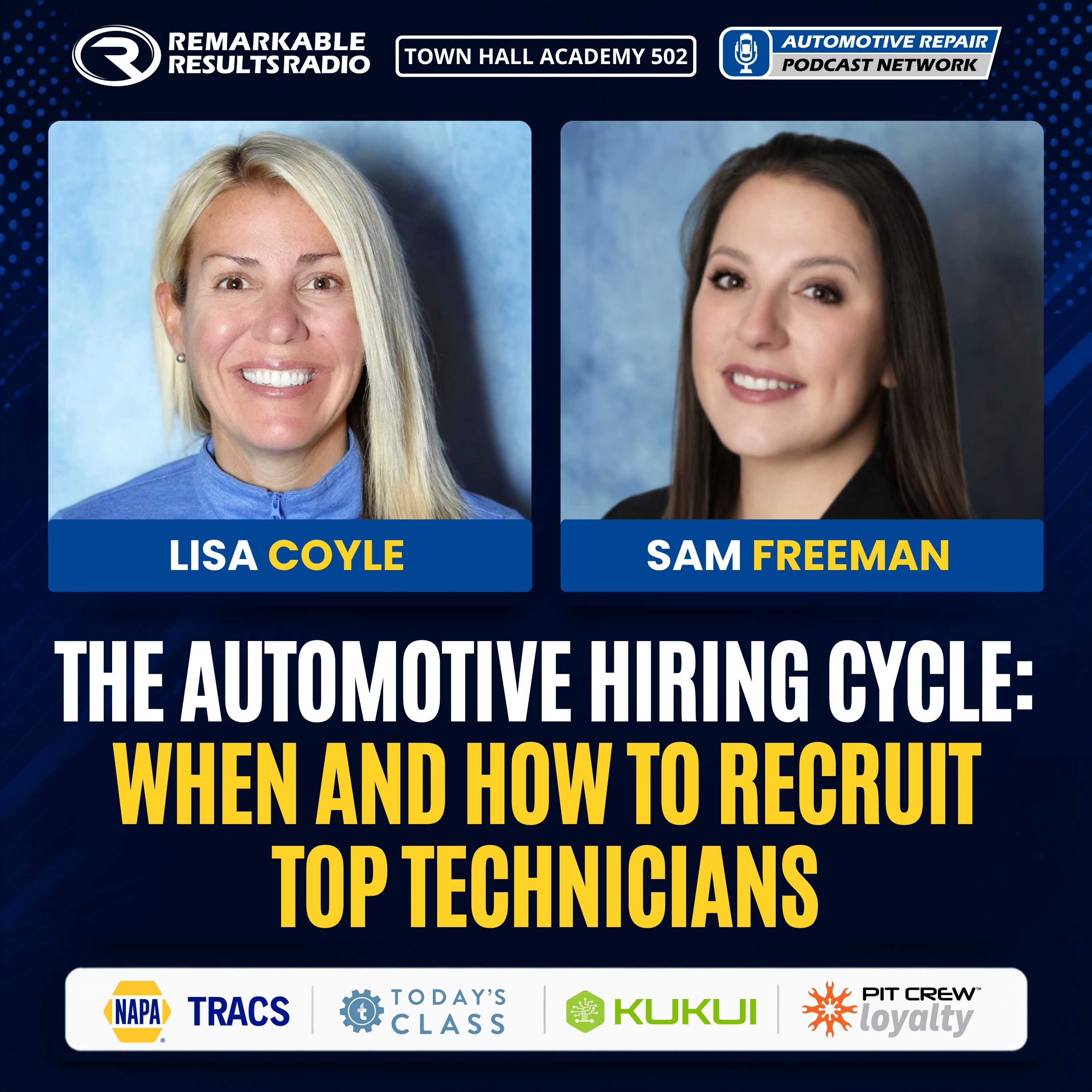
Remarkable Results RadioSeptember 11 · 55 min
The Automotive Hiring Cycle: When and How to Recruit Top Technicians [THA 502]
Thanks to our Partners: NAPA TRACS, Today's Class, KUKUI, and Pit Crew Loyalty Watch Full Video Episode *]:pointer-events-auto scroll-mt-[calc(var(--header-height)+min(200px,max(70px,20svh)))]" dir="auto" data-turn-id="request-WEB:8e59eec7-a235-4fa3-a072-956fea3fe478-7" data-testid="conversation-turn-4" data-scroll-anchor="false" data-turn="assistant"> *]:pointer-events-auto scroll-mt-[calc(var(--header-height)+min(200px,max(70px,20svh)))]" dir="auto" data-turn-id="request-WEB:49a777bf-d263-4496-bf0b-2eb3a46ac96a-11" data-testid="conversation-turn-24" data-scroll-anchor="false" data-turn="assistant"> What if the best time to recruit your next technician is when your shop isn't looking to hire? Lisa Coyle, CEO of Promotive, and Sam Freeman, Partner Manager at Promotive, reveal why automotive recruiting has a cycle, and why understanding when technicians are looking can give shop owners a significant advantage. Lisa and Sam explain how recruiting data, market timing, candidate behavior, and consistent relationship-building can create a much more proactive hiring strategy. Download the 6 Month Promotive Hiring Insights Report for FREE: https://info.gopromotive.com/RRR What You'll Learn Why technician recruiting has a cycle and why timing matters.Why “post and pray” recruiting puts your shop at a disadvantage.Why finding a top technician can take 60 to 70 days.How local market data can improve your job postings.Why you should recruit even when you don't have an opening.What may really be behind candidate ghosting.Why a counter-offer doesn't have to end the relationship.How consistent communication can prevent first-day no-shows.Why complicated hiring processes can cost you great candidates.How the F.O.R.D. method can make interviews more personal and effective. Great recruiting is about timing, data, and relationships. Don't wait for an empty bay to discover you need a recruiting strategy. Understand when technicians are most likely to consider a move, know what candidates in your market are searching for, simplify your hiring process, and stay connected with good people even when the timing isn't right. Your next great technician may not be looking when you're ready to hire. The opportunity is to build the relationship when they're ready to listen. Promotive has over 40 years of recruiting and automotive experience. If you need qualified technicians and service advisors and want to offload the heavy lifting, visit https://gopromotive.com/ Meet Paige: The Auto Repair Industry’s First 24/7 AI Recruiter [THA 481]: https://remarkableresults.biz/remarkable-results-radio-podcast/a481/ Lisa Coyle, CEO of Promotive Sam Freeman, Partner Manager at Promotive NAPA TRACS will move your shop into the SMS fast lane with onsite training, six days a week of support, and local representation. http://napatracs.com/ Optimize training with Today's Class: In just 5 minutes daily, boost knowledge retention and improve team performance. https://www.todaysclass.com/ Stop juggling multiple marketing tools. KUKUI’s integrated platform delivers 4x better website conversions, automated follow-up, and real-time ROI tracking. https://www.kukui.com/ You’re probably tired of chasing new customers who never return. Pit Crew Loyalty ends the one-and-done cycle, turning first visits into lasting, reliable revenue at https://www.pitcrewloyalty.com/ Connect with the Podcast: Download and Listen on Our Mobile App: https://automotiverepairpodcastnetwork.com/app/Visit the Website:https://remarkableresults.biz/Subscribe on YouTube:https://www.youtube.com/carmcapriottoFollow on Facebook:https://www.facebook.com/RemarkableResultsRadioPodcast/Follow on LinkedIn:https://www.linkedin.com/in/carmcapriotto/Follow on Instagram:https://www.instagram.com/remarkableresultsradiopodcast/Join Our Virtual Toastmasters Club:https://remarkableresults.biz/toastmastersJoin Our Private Facebook Community:https://www.facebook.com/groups/1734687266778976Join our Insider List:https://remarkableresults.biz/insiderAll books mentioned on our podcasts:https://remarkableresults.biz/booksOur Classroom page for personal or team learning:https://remarkableresults.biz/classroomBuy Me a Coffee:https://www.buymeacoffee.com/carmSpecial episode collections:https://remarkableresults.biz/collections The Automotive Repair Podcast Network: https://automotiverepairpodcastnetwork.com/ Remarkable Results Radio Podcastwith Carm Capriotto:https://remarkableresults.biz/<a href="https://mattfanslow.captivate.fm/" target="_blank"...
Listen →
05

The Limitless Leadership PodcastAugust 26 · 33 min
Ep 173: How to Upskill Leadership Skills in the AI Era with Jacki Lutz
Listen →
06
The Limitless Leadership PodcastJuly 23 · 37 min
Ep 166: Why Great Leaders Give People Permission to Fail with Ron Helmer
Listen →
07
Downshift with TonnikaJune 18 · 51 min
The Hiring Mistake Shop Owners Keep Making | Sara Fraser & Chrisi Falco - Ep 20
Consistency is key - heard that! But, consistency is HARD. That's why I gave up on trying and let the experts handle it. Detect Auto. Let them clean up your estimating process and raise your ARO - like they did for me! CLICK HERE TO BOOK A DEMOAnybody can run a shop. Building one that lasts? That's a whole different story. If you're ready to build smarter systems and a better experience for your team and customers, check out Tekmetric HEREIn this episode, Tonnika Haynes sits down with Sara Fraser and Chrisi Falco from Auto Ignite Management (AIM) to talk all things hiring. Chrissy shares why finding the right fit is about making genuine connections—not just filling a seat. The conversation dives into the challenges of matching candidates and shops, the importance of clear communication (ditch the tech jargon!), and why letting go as a shop owner is crucial for real growth.Timestamps:00:00 Why working 50 cars a day is a no 01:00 Meet the AIM team: Industry roots, passion for matchmaking, and growing connections03:10 Are there really no techs? Why it’s about relationships, not shortages05:50 Should you keep a “bench” of techs? The ethics of recruiting & shop loyalty07:00 Why Chrisi refuses to work with just any shop—setting a high bar for culture08:30 What are you even offering? Shop owner introspection and culture checklists10:00 Women connecting in auto care: From awkward networking to authentic friendships12:15 Real talk on imposter syndrome and why even “superstars” get nervous14:35 Learning to follow up, build real connections & support the women in your network17:30 Teaching shop teams: Building trust (not confusion) with your customers19:00 Communicating repairs like a human—forget the tech jargon21:00 When the dealership totally misses your actual problem (and how to do better)24:00 Interview horror stories: “Honey, darling, babe”—and why culture fit matters27:00 Price matching, value selling, and the scary jump from dealership to independent31:00 Why coaching & confidence count more than the perfect resume34:00 Real interview answers that make (and break) a candidate38:00 Letting go: Why shop owners struggle to step back (and why you should!)41:30 Building a team that actually lets you leave—while your shop THRIVES45:00 You’ve earned your break, boss—embracing leadership, legacy, and life outside the bay49:00 AIM’s not just recruiters—they’re your matchmakers for growth
Listen →
08
Confessions of a Shop OwnerJune 5 · 1h 0m
Ep 97 - Tektonic 2026 Coaches Panel | Flat Rate, Technician Shortage, Performance Based Pay
Tekmetric opened my eyes to just how much a good SMS will do for a shop. Their software is top of the line, and with them, so is my shop. Try them for yourself HEREASTA is coming up September 24-26 in Raleigh. Be there or be square, dog! Register now and use code Confess25 for $25.00 off your registration. Sign up HEREMy marketing before and after signing up with Turnkey Marketing is pretty scary. In a good way. Get your marketing right today HERETired of your shop’s social media looking like every other repair shop on the internet? Stand out with 47 Consulting. Learn more HERE Make your techs happier with Detect Auto. They'll stop getting "check noise" or "check vibration" from advisors with the customer concern tool. It will CHANGE YOUR LIFE. Book a demo HERESend your service advisor to hands down the BEST service advisor training in the industry (even other coaching companies agree). It's Elite Worldwide's Masters Program. The next one is happening in Dallas Texas, September 10-12. Learn more HEREThis episode was recorded at Tektonic 2026. Thank you to Tekmetric for allowing us to use this recording for an episode. Want to go to Tektonic 2027? Register HEREToday, Mike Allen leads a lively panel of coaches as they tackle some of the auto repair industry's most daunting topics. Things like flat rate and how compensation models impact recruitment, motivation, and shop culture. They also confront the persistent undervaluing of the industry, pointing out the urgent need for better marketing and self-regulation if auto repair is to attract the next generation. Plus, the coaches don’t hold back as they discuss private equity’s growing influence—offering straight talk on exit strategies, business legacy, and the real impact on teams left behind. Tekmetric opened my eyes to just how much a good SMS will do for a shop. Their software is top of the line, and with them, so is my shop. Try them for yourself HEREMy marketing before and after signing up with Turnkey Marketing is pretty scary. In a good way. Get your marketing right today HEREMake your techs happier with Detect Auto. They'll stop getting "check noise" or "check vibration" from advisors with the customer concern tool. It will CHANGE YOUR LIFE. Book a demo HEREFor years I thought I could handle the hiring process on my own. But, after far too many bad hires, it was clear I needed help. Promotive came through for me with a rock star hire in just a few days and I couldn't be happier. Swallow your pride and bring in Promotive for that open position you have at your shop today. You can thank me later. Learn more HEREAI for Shop Owners: Open the Hood of the Future is happening June 12-13 at Carfix in Raleigh, NC. Use AI to your advantage! Register HERETimestamps:00:00 Why is the auto industry undervalued? The real story behind pay and standards01:06 Flat rate pay: Is it tradition, incentive, or what’s driving the “tech shortage”?02:44 Hourly vs. flat rate vs. blended: Can we finally pay techs what they’re worth?04:06 What performance-based pay REALLY looks like in the real world07:03 Is there even a tech shortage, or just a leadership and culture failure?09:09 Recruiting top techs: Why should someone work for YOUR shop?11:05 Employees want more than money—how culture and environment win12:33 Why we can’t afford to be “broke” shop owners (& why most of us are)13:28 Are we destroying our own value? Party clowns vs. techs and the marketing gap15:56 Leadership confession: We got into cars, NOT for people, and it’s catching up16:26 How to reach the next generation of automotive stars17:17 One shop’s youth welding program that sparks real careers18:06 Why trades like welding are beating automotive for young talent20:03 How do we market the industry and reach parents, not just students?23:39 Got Milk? Why we need a national campaign to sell the value of this business24:53 Raising your labor rate: Genius or a recipe for backlash if you don’t raise value28:28 What customers are REALLY paying for—and how service changes the game30:13 Making your shop irresistible: Clean, beautiful, equipped, and worth the price31:42 You don’t need to wait to raise value—start by fixing your shop now34:36 Relationships and trust: The foundation for customer and team loyalty36:24 The biggest profit leak no one talks about: productivity loss39:35 Private equity: Golden parachute or community killer for auto shops?41:54 What’s your exit plan? How to think years ahead (and why it matters)45:45 Should coaches own shops? The truth about what makes a great coach51:39 Leadership, engagement, and communication: The four pillars of high-performing teams55:54 AI, DVI, and service advisors: The NEXT revolution in customer experience58:04 Why hospitality always wins—technology tools are only part of the story
Listen →
09
The Jaded MechanicJune 2 · 1h 48m
Why Shops Lose Technicians Overnight | Lisa Coyle and Kat Ayers from Promotive
Like the show? Show your support by using our sponsors. Need to update your shop systems and software? Try Tekmetric HERELaunch your tool game to the next level with Launch Tech USA! HEREIn this episode, Jeff Compton talks with Promotive’s Lisa Coyle and Kat Ayers about what’s changing in technician hiring, including their AI virtual recruiter and how it helps shops with consistency, speed-to-lead, and 24/7 candidate screening. They discuss common hiring bias, why resumes often don’t reflect real skill, how to interpret job hopping, and why following application instructions matters. The episode also covers shop culture and leadership as key retention drivers, how slow follow-up hurts candidate experience, and what Promotive is building next—expanded platform features, more automation, and plans to move into the Canadian market.Timestamps:0:00 Podcast Kickoff00:28 Fishing and Seafood Talk03:10 Bass Tournaments and Hockey06:30 What’s New at Promotive08:06 AI Recruiting Benefits11:13 Bias and Hiring Fairness20:03 Resume Gaps and Progress22:58 Following Instructions Matters24:43 Job Hopping Explained29:56 Walk-In Resumes vs Process34:35 Call Screen Limits36:23 Tagging Resumes For Future37:59 Techs Becoming Advisors42:56 Trade Shows And Outreach48:26 Cold Calls And Data52:42 Industry Negativity And AI01:00:20 Robots Costs And Culture01:06:41 Leadership Questions And Nepotism01:10:20 Multi Interview Triangulation01:12:13 Candidate Experience Matters01:16:11 Rehiring and Keeping Benches01:21:27 Job Searching Is Normal01:24:41 Legacy Over Resentment01:29:13 Plan B and Hard Questions01:32:02 What Have You Done Today01:34:14 Promotive Roadmap and Events01:37:18 Canada Expansion and Languages01:39:44 Hockey Talk and Show Circuit01:44:35 Final Thanks and Wrap Up Follow/Subscribe to the show on social media! TikTok - https://www.tiktok.com/@jeffcompton7YouTube - https://www.youtube.com/@TheJadedMechanicFacebook - https://www.facebook.com/profile.php?id=100091347564232
Listen →
10
The Limitless Leadership PodcastApril 14 · 24 min
Ep 144: How to Lead the Younger Generation with Eddie Campbell
Listen →
11
The Limitless Leadership PodcastMarch 11 · 42 min
Ep 137: From Technician Shortages to Thriving Teams with Jimmy Alauria
Listen →
12
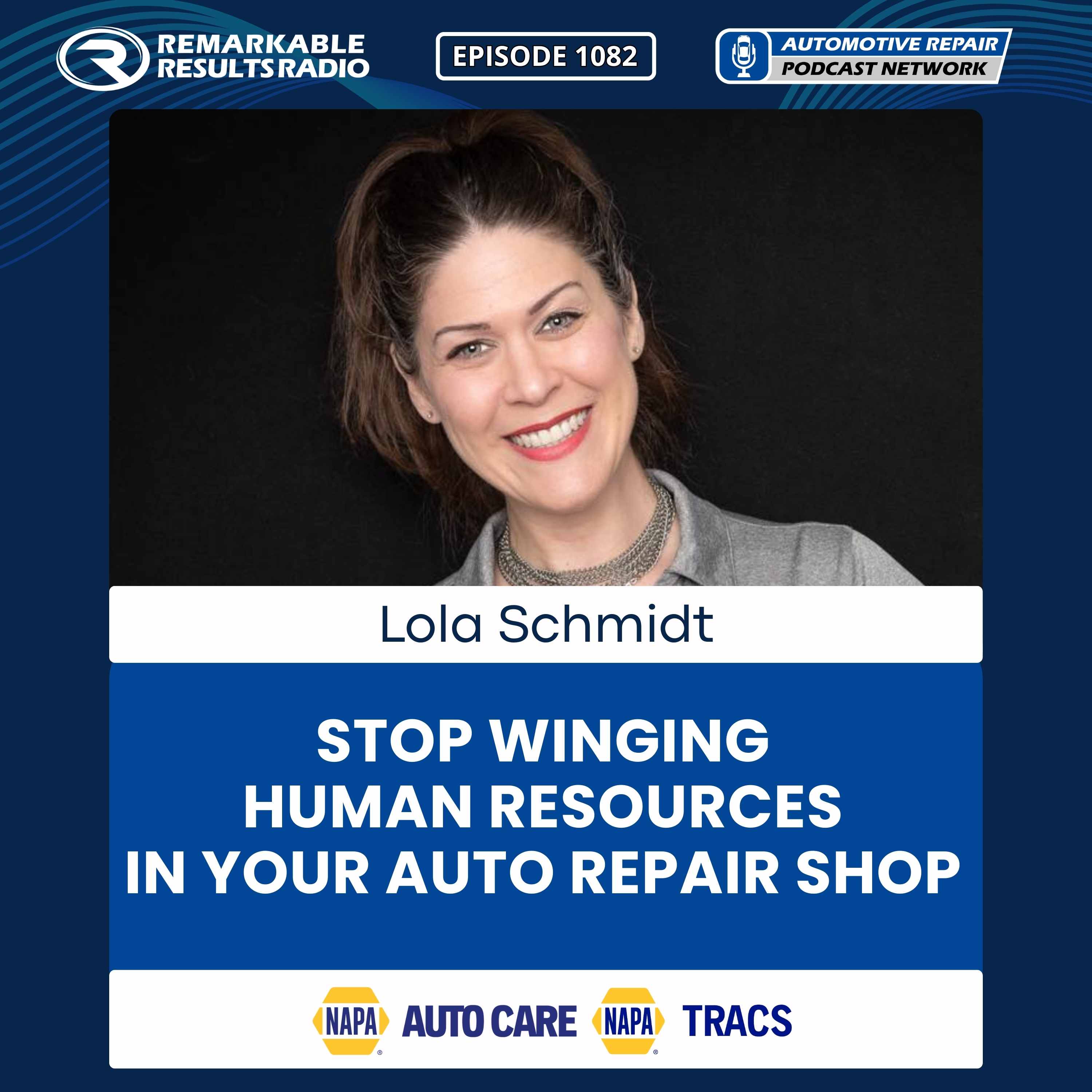
Remarkable Results RadioMarch 10 · 33 min
Stop Winging Human Resources in Your Auto Repair Shop [RR 1082]
Thanks to our Partners, NAPA Auto Care and NAPA TRACS Watch Full Video Episode *]:pointer-events-auto scroll-mt-[calc(var(--header-height)+min(200px,max(70px,20svh)))]" dir="auto" data-turn-id="request-WEB:b7123d23-4a4b-4700-b41f-68ea2bc61414-0" data-testid="conversation-turn-2" data-scroll-anchor="true" data-turn="assistant"> In this episode, host Carm Capriotto sits down with Lola Schmidt, COO of Schmidt Auto Care, to discuss how independent auto repair shops can professionalize their human resources and management systems. Lola outlines a deliberate, multi-step hiring process built to eliminate desperate decisions and reduce candidate ghosting. It begins with a focused 5-10 minute phone screen designed to evaluate attitude, communication skills, and professionalism before investing time in in-person interviews. Once hired, new team members go through a structured two-week onboarding experience that intentionally integrates them into the shop’s culture and operations, complete with personalized touches and cross-training across the team. To establish clarity and transparency, Lola shares her “no gatekeeping” philosophy: providing candidates with a legally reviewed employee handbook before a formal offer is made. She also explains how to handle HR documentation and unemployment claims using a “no feelings, just facts” approach, relying on accurate records, clear timelines, and policies tied directly to the signed handbook. The result? Intentional systems that protect the culture, the employees, and the long-term health of the business. In this episode, you’ll learn: How to build a structured hiring process that prevents reactive decisionsWhy a short phone screen reduces ghosting and wasted timeHow to hire for attitude and cultural fit firstWhat an effective two-week onboarding plan looks likeWhy a legally reviewed employee handbook is essentialHow to document HR issues clearly and objectively The Everyday Educator: How Leaders Reinforce Learning [THA 458]: https://remarkableresults.biz/remarkable-results-radio-podcast/a458/ 4 Day Work Week and Our Own App [AW 146]: https://remarkableresults.biz/remarkable-results-radio-podcast/aw146/ Lauralee/Lola Schmidt, Schmidt Auto Care, Springboro, OH Thanks to our Partners, NAPA Auto Care and NAPA TRACS Learn more about NAPA Auto Care and the benefits of being part of the NAPA family by visiting https://www.napaonline.com/en/auto-care NAPA TRACS will move your shop into the SMS fast lane with onsite training and six days a week of support and local representation. Find NAPA TRACS on the Web at http://napatracs.com/ Connect with the Podcast: - Follow on Facebook: https://www.facebook.com/RemarkableResultsRadioPodcast/ - Join Our Virtual Toastmasters Club: https://remarkableresults.biz/toastmasters - Join Our Private Facebook Community: https://www.facebook.com/groups/1734687266778976 - Subscribe on YouTube: https://www.youtube.com/carmcapriotto - Follow on LinkedIn: https://www.linkedin.com/in/carmcapriotto/ - Follow on Instagram: https://www.instagram.com/remarkableresultsradiopodcast/ - Visit the Website: https://remarkableresults.biz/ - Join our Insider List: https://remarkableresults.biz/insider - All books mentioned on our podcasts: https://remarkableresults.biz/books - Our Classroom page for personal or team learning: https://remarkableresults.biz/classroom - Buy Me a Coffee: https://www.buymeacoffee.com/carm - Special episode collections: https://remarkableresults.biz/collections - The Automotive Repair Podcast Network: https://automotiverepairpodcastnetwork.com/ - Remarkable Results Radio Podcast with Carm Capriotto: Advancing the Aftermarket by Facilitating Wisdom Through Story Telling and Open Discussion. https://remarkableresults.biz/ - Diagnosing the Aftermarket A to Z with Matt Fanslow: From Diagnostics to Metallica and Mental Health, Matt Fanslow is Lifting the Hood on Life. https://mattfanslow.captivate.fm/ - Business by the Numbers with Hunt Demarest: Understand the Numbers of Your Business with CPA Hunt Demarest. https://huntdemarest.captivate.fm/ - The Auto Repair Marketing Podcast with Kim and Brian Walker: Marketing Experts Brian & Kim Walker Work with Shop Owners to Take it to the Next Level. https://autorepairmarketing.captivate.fm/ - The Weekly Blitz with Chris Cotton: Weekly Inspiration with Business Coach Chris Cotton from AutoFix - Auto Shop Coaching. https://chriscotton.captivate.fm/ - Speak Up! Effective Communication with Craig O'Neill: Develop Interpersonal and Professional Communication Skills when Speaking to Audiences of Any Size. https://craigoneill.captivate.fm <img class=" wp-image-40058 alignleft" src="https://remarkableresults.biz/wp-content/uploads/2023/02/NAPA-Call-to-Action-Graphic-v3-1-1.png" alt="" width="720"...
Listen →
13

Master Tech to MillionaireSeptember 10 · 1h 10m
Hire Hammers, Build Champions: Inside Auto Hospitality’s Recruiting Playbook
Joe Adams and Todd Hayes dive into recruiting as the single biggest bottleneck for automotive businesses, sharing raw stories and practical tactics. They cover hands-on recruiting, building a better workplace (benefits, training, pay), identifying A-players, managing gray-area talent, and how strong onboarding + culture turn hires into high performers and generational opportunities. AutoShopAnswers.com Auto-Shop-Media.com
Listen →
14

The Limitless Leadership PodcastSeptember 3 · 36 min
Ep 175: Why Change Doesn't Have to Be Scary with Joe Flammer
Listen →
15

Remarkable Results RadioSeptember 1 · 46 min
Rapid-Fire Automotive News: AI, EVs, Autonomous Vehicles, and the $19B Trade School Boom [RR 1107]
Thanks to our Partners, NAPA Auto Care and NAPA TRACS Watch Full Video Episode How quickly is the automotive repair industry changing, and are you ready for what's next? Tom Ham, shop owner and founder of the Automotive Management Network, joins Carm Capriotto for a fast-paced conversation covering 12 major trends shaping the future of auto repair. From autonomous vehicles and solid-state batteries to the changing value of trade careers, AI, government regulation, 3D printing, and vehicle reliability, Tom and Carm explore the technologies and economic shifts shop owners need to understand. What You'll Learn How autonomous vehicles could reshape vehicle safety and the repair industry.What advances in solid-state batteries could mean for EVs and vehicle range.Why trade careers are gaining momentum as technology changes traditional employment.How the technician shortage is creating new opportunities for shops to develop talent.How government regulation and emissions enforcement could affect vehicle owners and repair shops.What current vehicle reliability trends reveal about today's automotive brands.How 3D printing could help shops solve parts availability challenges.Why AI is becoming a powerful tool for reducing friction and improving efficiency.Why shop owners need to stay curious and adapt as automotive technology continues to accelerate. The automotive repair industry is changing faster than ever. The shops that thrive will be the ones willing to understand emerging technology, embrace new tools, develop their people, and continually rethink how they operate. The future isn't coming someday. It's already showing up in the service bay. Tom Ham, Automotive Management Network. Tom’s previous episodes HERE. Learn more about the benefits of being part of the NAPA family by visiting https://www.napaonline.com/en/auto-care NAPA TRACS will move your shop into the SMS fast lane with on-site training and six days a week of support: http://napatracs.com/ Connect with the Podcast: Download Our Mobile App:https://automotiverepairpodcastnetwork.com/app/Website:https://remarkableresults.biz/YouTube:https://www.youtube.com/carmcapriottoFacebook:https://www.facebook.com/RemarkableResultsRadioPodcast/LinkedIn:https://www.linkedin.com/in/carmcapriotto/Instagram:https://www.instagram.com/remarkableresultsradiopodcast/Join Our Virtual Toastmasters Club:https://remarkableresults.biz/toastmastersJoin Our Private Facebook Community:https://www.facebook.com/groups/1734687266778976Join our Insider List:https://remarkableresults.biz/insiderBooks Page:https://remarkableresults.biz/booksOur Classroom Page:https://remarkableresults.biz/classroomEpisode Collections:https://remarkableresults.biz/collectionsBuy Me a Coffee:https://www.buymeacoffee.com/carm The Automotive Repair Podcast Network: https://automotiverepairpodcastnetwork.com/ Remarkable Results Radio Podcastwith Carm Capriotto:https://remarkableresults.biz/Automotive Field TheorywithMatt Fanslow:https://mattfanslow.captivate.fm/Business by the NumberswithHunt Demarest: https://huntdemarest.captivate.fm/The Auto Repair Marketing Podcastwith Brian and Kim Walker: https://autorepairmarketing.captivate.fm/The Weekly Blitzwith Chris Cotton: https://chriscotton.captivate.fm/Speak Up! Effective Communicationwith Craig O'Neill: https://craigoneill.captivate.fm
Listen →
16
Downshift with TonnikaAugust 27 · 1h 23m
Shop Owners: Maybe YOU'RE the Problem | Tristin Sweeney - 38
Running a shop is hard enough—you don't need your software making it harder. 😂 If you're ready for more clarity, better organization, and a smoother experience for both your team and your customers, check out Tekmetric HEREConsistency is key - heard that! But, consistency is HARD. That's why I gave up on trying and let the experts handle it. Detect Auto. Let them clean up your estimating process and raise your ARO - like they did for me! CLICK HERE TO BOOK A DEMOAt 29 years old, Tristin Sweeney is running an auto repair shop, building automotive technology, and questioning some of the industry's favorite excuses. In this episode, Tonnika Haynes talks with Tristin about his unconventional path from the startup world into automotive, acquiring Honest Automotive, building Shift, and why owning a shop became the ultimate testing ground for solving real industry problems. But things get spicy when they tackle the supposed technician shortage, outdated hiring practices, shop owners blaming younger generations, and why good employees may be leaving shops that refuse to change. They also dig into AI, technician training, communication, leadership, burnout, and why new technology should solve problems instead of creating more work. If you're a shop owner who keeps saying, “Nobody wants to work anymore,” this conversation might make you look in the mirror.Timestamps:00:00 Why automotive has become unattractive to work in00:23 Downshift intro00:42 Meet Tristin Sweeney: 29, busy, and obsessed with automotive01:23 Audi, Volkswagens, and where the car obsession started03:15 Can you be a great service advisor without knowing cars?04:40 There are more automotive careers than turning wrenches06:26 From tech startups to the automotive industry07:17 Getting laid off, joining ShopGenie, and finding his industry09:17 Running TWO automotive businesses at 2910:11 How Tristin bought Honest Automotive after finding it on Facebook14:01 Has shop ownership given him gray hair yet?14:32 Building a shop around passion and customer experience16:21 Honest Automotive is also Tristin’s “laboratory”16:48 How Shift Automotive was born18:19 Building software from the problems that drive shop owners crazy19:10 Technology problem or people problem?20:17 How does someone working 60–70 hours a week avoid burnout?22:55 Success isn’t worth burning yourself out by 3023:19 Tonnika gets VERY personal about Tristin having kids 😂25:32 Why Tristin is committed to automotive for the long haul28:53 Shift grows to more than 150 shops30:02 Why simply SHOWING UP can change your career31:21 The “Gen Z stare” and learning how to communicate33:34 Get in rooms where you’re uncomfortable37:04 What will automotive look like 10 years from now?41:11 Shop owners who ignore AI WILL get left behind42:43 How should shops prepare technicians for new technology?43:27 Does every tech need to understand the newest cars right now?45:48 Why the next generation matters more than ever47:58 What does a technician actually need to “look like”?48:48 Is the technician shortage actually a hiring problem?49:48 How many great technicians are shops overlooking?50:48 “I hire people. I don’t hire jobs.”52:00 Why automotive can be an unattractive place to work54:18 Great shops generally aren’t struggling to find applicants54:51 The talent is out there—and some of them want to leave their current shop55:55 If recruiters can steal your technicians, that’s a YOU problem56:04 Most shop problems start with the owner57:30 Accepting criticism from your employees—even your own son58:03 Old-school leadership vs. the way Tonnika leads today59:33 The macaroni-and-cheese recipe for evolving a family business1:01:47 Is treating every employee differently “coddling”?1:03:50 Why one universal pay plan doesn’t work for everyone1:04:39 Flexible schedules, flat rate, salary, and what actually motivates people1:07:08 Shop owners who refuse to compromise may lose great technicians1:07:56 Bad bosses create the next generation of bad bosses1:08:21 Why leadership and communication have to be learned1:13:00 Stop micromanaging every detail of your shop1:14:22 “Granddad did it that way” isn’t a good enough reason anymore1:15:28 The Carfax data debate gets spicy 😂1:16:24 What Carfax actually gets from your shop1:17:47 Tonnika’s grandfather discovers OnStar and thinks “they’re coming for him”1:19:03 Technology fear usually comes from misunderstanding1:19:45 Tristin’s legacy: Leave automotive better than he found it1:20:00 Where to find Honest Automotive and Shift Automotive1:21:22 Closing, AI hot takes, and what’s next
Listen →
17
The Jaded MechanicAugust 18 · 1h 55m
Why Flat Rate Is Failing Today's Technicians with Dustin Stutzman
Like the show? Show your support by using our sponsorsNeed to update your shop systems and software? Try Tekmetric HERELaunch your tool game to the next level with Launch Tech USA! HEREIn this episode, Dustin Stutzman, a shop foreman and high-efficiency flat-rate technician, shares why he left engineering for the automotive industry and how he became a master technician without a dedicated mentor. Drawing from years in dealership service departments, Dustin explains how flat-rate pay, poor dispatching, and corporate policies often discourage quality repairs and technician development. The conversation explores AI, diagnostic pay, training, dealership culture, and what it will take to retain skilled technicians in the future.Timestamps:00:00 Learning Without Mentors 00:47 From Engineering to Automotive 01:51 Work-Life Balance and Career Values 04:45 AI and the Future of Service Advisors 07:16 Paying Technicians for Video Inspections 11:45 The Shop Foreman Role 14:07 Dispatching Work by Skill Level 17:19 Solving a Cold-Start No-Start Mystery 23:31 Fighting for Diagnostic Pay 24:50 Feeling Appreciated by Great Leadership 30:00 Leaving After Pay Cuts 34:46 Dealer Groups and Industry Consolidation 39:48 Becoming a Chrysler Master Technician 42:40 Life on the Training Road 43:27 Why Dustin Avoided GM 44:30 Diesel Emissions and Warranty Pay 49:02 Getting Diagnostic Time Approved Upfront 55:40 Quoting Worst-Case Repairs 57:53 Service vs. Parts Department Friction 01:03:41 Dispatch Roulette at Dealerships 01:05:15 Demanding Real Diagnostic Data 01:05:46 The Air Filter Diagnostic Lesson 01:11:25 Old-School Electrical Diagnostics 01:13:57 Chrysler Warranty Pay and the Neon Squeak 01:15:19 The 40-Hour Dash Rattle 01:16:46 Brick Road Dash Rattle 01:17:32 One-Shot Repair Success 01:18:06 Foam-Filled Repair Solution 01:19:25 Why Dustin Praises Chrysler WiTech 01:21:09 Preventive Maintenance Matters 01:22:34 Oil Change Reality Check 01:25:19 The Cost of Oil Neglect 01:29:45 Training Technicians Under Flat Rate 01:33:18 The Missing Career Path for New Techs 01:34:39 Learning by Doing 01:37:45 Advocating for Better Pay and Metrics 01:41:20 Dealer Groups and Technician Burnout 01:45:07 The Technician Shortage and Pay Gap 01:50:16 Keeping Great Technicians 01:53:16 Closing Thoughts and Upcoming Events Follow/Subscribe to the show on social media! TikTok - https://www.tiktok.com/@jeffcompton7YouTube - https://www.youtube.com/@TheJadedMechanicFacebook - https://www.facebook.com/profile.php?id=100091347564232
Listen →
18
Changing the Industry PodcastAugust 17 · 1h 9m
Episode 282 - AI, Recruiting, Shop Culture, and the Drive for Better Hires with Promotive
Don't get to the end of this year wishing you had taken action to change your business and your life.Click here to schedule a free discovery call for your business: https://geni.us/IFORABEDon't miss an upcoming event with The Institute: https://geni.us/InstituteEvents2026Shop-Ware gives you the tools to provide your shop with everything needed to become optimally profitable.Click here to schedule a free demo: https://info.shop-ware.com/profitabilityTransform your shop's marketing with the best in the automotive industry, Shop Marketing Pros!Get a free audit of your shop's current marketing by clicking here: https://geni.us/ShopMarketingProsShop owners, are you ready to simplify your business operations? Meet 360 Payments, your one-stop solution for effortless payment processing.Imagine this—no more juggling receipts, staplers, or endless paperwork. With 360 Payments, you get everything integrated into a single, sleek digital platform.Simplify payments. Streamline operations. Check out 360payments.com today!In this episode, Lucas Underwood and David Roman are joined by Sam Freeman, Alexandra Pare, and Daniel Ekstrand from Promotive. The group demos “Paige,” Promotive’s AI-powered virtual recruiter, showcasing how AI is transforming the hiring and prescreening process in the automotive industry. The conversation dives into current industry trends, including why technicians are leaving dealerships for independent shops and the top reasons candidates are looking for new positions. They also get candid about the frustrations of online reviews, sharing stories and strategies shop owners use to respond to feedback—both good and bad.00:00 Overview of Promotive's Services11:55 Managing morning priority calls15:43 Handling Language and Mumbling Issues18:44 Automated messaging for applicants27:21 Icy disaster during bachelor party32:58 Early adoption of Facebook and DVI37:41 Missed email confusion42:59 Hotel room negotiation challenge44:38 A quick conference trip52:30 Challenges of running a car shop59:36 Trying the Worst BBQ in KC01:03:25 Handling negative feedback01:07:19 Feedback on Uber improvements
Listen →
19
The Limitless Leadership PodcastAugust 12 · 45 min
Ep 170: Why We Should Reject Mediocrity with Andrew Klement
Listen →
20
The Limitless Leadership PodcastAugust 4 · 41 min
Ep 168: Stop Guessing. Start Leading. | Eric Joern
Listen →
21
Shop Fix Academy PodcastAugust 3 · 19 min
Hiring Expert: How To Attract A-Level Repair Shop Staff | EP8 | The Shop Fix Academy Podcast
Get Tickets Now! Learn the systems top shop owners use to consistently increase profit and build stronger teams at Shop Hackers Conference. https://shophackersconference.com/?utm_source=sfapodcast&utm_medium=podcast&utm_campaign=shophackers2026&utm_content=cta-textlinkTed Becker went from being a solo operator in his shop with zero confidence to becoming a hiring and interviewing expert with a team of A-level staff members consistently bringing in $235k a month with three bays. In this episode Ted breaks down the hiring tips and tricks that he used to attract top tier talent to his shop and the mentality pitfalls that almost kept him at $30k a month. After losing his manager right before going on a life changing trip to a Shop Fix conference, Ted gave a shot to a brand new employee on his second day and learned what an A-tier staff member actually looks like and how hiring the best technicians and service advisors makes freedom in your shop a real option.Hiring great technicians is only the beginning. Build their skills with Tech Fix Live.https://shopfixacademy.com/techfixlive?utm_source=youtube&utm_medium=podcast&utm_campaign=sfa-podcast&utm_content=ctaGrowing your team starts with growing your leadership through Shop Fix LITE.https://shopfixacademy.com/shop-fix-lite?utm_source=youtube&utm_medium=podcast&utm_campaign=sfa-podcast&utm_content=cta
Listen →
22
The Limitless Leadership PodcastJuly 21 · 35 min
Ep 165: Leadership Isn't Talent, It's Daily Practice with Lynne Ghelfi
Listen →
23

Remarkable Results RadioJuly 21 · 49 min
Deferred Work: The Most Overlooked Growth Opportunity in Auto Repair [RR 1101]
Thanks to our Partners, NAPA Auto Care and NAPA TRACS Watch Full Video Episode Most auto repair shops are sitting on a goldmine of untapped revenue without realizing it. In this episode, Carm Capriotto welcomes Jimmy Alauria of 3A Automotive & Diesel Repair to discuss how deferred work can become one of your shop's most effective growth strategies. By pulling just two years of data from his shop's database, he discovered $3.3 million in potential revenue from deferred services. From better customer communication to smarter follow-up systems, Jimmy explains how to turn yesterday's declined repairs into tomorrow's repair orders. What You'll Learn Why your customer database is one of your shop's most valuable assets.How deferred work can create significant new revenue without increasing car count.Why shops should schedule the next appointment before the customer leaves.While DVIs provide excellent transparency, their primary goal should be to educate the customer and help them plan, rather than to force an immediate $5,000 repair order. Jimmy notes that customers decline work not necessarily because they lack trust, but because they need time to budgeHow categorizing repairs by safety, reliability, maintenance, and appearance improves customer understanding.Understanding the customer's personal "car goals," whether they love the car and want to avoid a new car payment, or they hate the car and want to trade it in, is also critical to framing recommendations effectively.The shortcomings of traditional CRM follow-up systems and how AI can improve communication.How AI helps prioritize repairs and translates technical repair language into customer-friendly messaging that drives response. Deferred work isn't lost business; it's future opportunity. By building better follow-up processes, educating customers, and using technology to communicate more effectively, shops can strengthen relationships, improve customer retention, and unlock substantial revenue already waiting in their database. Jimmy Alauria, 3A Automotive and Diesel Repair, Phoenix, AZ. Jimmy’s previous episodes HERE Learn more about NAPA Auto Care and the benefits of being part of the NAPA family by visiting https://remarkableresultsradiopodcast.captivate.fm/napaautocare NAPA TRACS will move your shop into the SMS fast lane with onsite training and six days a week of support and local representation. Find NAPA TRACS on the Web at http://napatracs.com/ Connect with the Podcast: Download and Listen on Our Mobile App:https://automotiverepairpodcastnetwork.com/app/Visit the Website:https://remarkableresults.biz/Subscribe on YouTube:https://www.youtube.com/carmcapriottoFollow on Facebook:https://www.facebook.com/RemarkableResultsRadioPodcast/Follow on LinkedIn:https://www.linkedin.com/in/carmcapriotto/Follow on Instagram:https://www.instagram.com/remarkableresultsradiopodcast/Join Our Virtual Toastmasters Club:https://remarkableresults.biz/toastmastersJoin Our Private Facebook Community:https://www.facebook.com/groups/1734687266778976Join our Insider List:https://remarkableresults.biz/insiderAll books mentioned on our podcasts:https://remarkableresults.biz/booksOur Classroom page for personal or team learning:https://remarkableresults.biz/classroomSpecial episode collections:https://remarkableresults.biz/collectionsBuy Me a Coffee:https://www.buymeacoffee.com/carm The Automotive Repair Podcast Network: https://automotiverepairpodcastnetwork.com/ Remarkable Results Radio Podcastwith Carm Capriotto:Facilitating Wisdom Through Story Telling and Open Discussion.https://remarkableresults.biz/Diagnosing the Aftermarket A to Z:From Diagnostics to Metallica and Mental Health, Matt Fanslow is Lifting the Hood on Life.https://mattfanslow.captivate.fm/Business by the Numbers: Understand the Numbers of Your Business with CPA Hunt Demarest.https://huntdemarest.captivate.fm/The Auto Repair Marketing Podcast: Marketing Experts Brian & Kim Walker Work with Shop Owners to Take it to the Next Level.https://autorepairmarketing.captivate.fm/The Weekly Blitz: Weekly Inspiration with Business Coach Chris Cotton from AutoFix - Auto Shop Coaching.https://chriscotton.captivate.fm/Speak Up! Effective Communication: Develop Interpersonal and Professional Communication Skills with Craig O'Neill.https://craigoneill.captivate.fm
Listen →
24

Remarkable Results RadioJuly 14 · 41 min
Curing Organizational Drag: The Courage to Fire a Non-Fit Employee [RR 1100]
Thanks to our Partners, NAPA Auto Care and NAPA TRACS Watch Full Video Episode Building a successful auto repair business isn't just about hiring great people; it's about creating a culture where the right people can thrive. In this episode of Episodic Education, Carm Capriotto welcomes Matt Lachowitzer, founder of Matt's Automotive Center, to discuss the leadership principles that helped grow his company to 11 locations. Matt shares why protecting culture sometimes means making difficult personnel decisions, how investing in employee development fuels long-term success, and why great leaders always begin by looking in the mirror. What You'll Learn Why one employee who doesn't fit your culture can create organizational drag.When letting go of a top performer is the best decision for your team.How leaders should evaluate their own role before blaming an employee's performance.How 29-day customer follow-up calls build trust and long-term loyalty.How company-wide training events reinforce culture and accelerate growth.The leadership mindset required to build a business that succeeds without depending on one person. Strong businesses are built by protecting culture, developing people, and leading with both accountability and compassion. Matt's leadership philosophy demonstrates that long-term success comes from investing in your team, making values-based decisions, and creating an organization where everyone has the opportunity to grow. Matt Lachowitzer, Matt’s Automotive Service Center, Fargo-Moorhead, North Dakota and Minnesota. Listen to Matt’s previous episodes HERE Learn more about NAPA Auto Care and the benefits of being part of the NAPA family by visiting https://remarkableresultsradiopodcast.captivate.fm/napaautocare NAPA TRACS will move your shop into the SMS fast lane with onsite training and six days a week of support and local representation. Find NAPA TRACS on the Web at http://napatracs.com/ Connect with the Podcast: Download and Listen on Our Mobile App:https://automotiverepairpodcastnetwork.com/app/Visit the Website:https://remarkableresults.biz/Subscribe on YouTube:https://www.youtube.com/carmcapriottoFollow on Facebook:https://www.facebook.com/RemarkableResultsRadioPodcast/Follow on LinkedIn:https://www.linkedin.com/in/carmcapriotto/Follow on Instagram:https://www.instagram.com/remarkableresultsradiopodcast/Join Our Virtual Toastmasters Club:https://remarkableresults.biz/toastmastersJoin Our Private Facebook Community:https://www.facebook.com/groups/1734687266778976Join our Insider List:https://remarkableresults.biz/insiderAll books mentioned on our podcasts:https://remarkableresults.biz/booksOur Classroom page for personal or team learning:https://remarkableresults.biz/classroomSpecial episode collections:https://remarkableresults.biz/collectionsBuy Me a Coffee:https://www.buymeacoffee.com/carm The Automotive Repair Podcast Network: https://automotiverepairpodcastnetwork.com/ Remarkable Results Radio Podcastwith Carm Capriotto:Facilitating Wisdom Through Story Telling and Open Discussion.https://remarkableresults.biz/Diagnosing the Aftermarket A to Z:From Diagnostics to Metallica and Mental Health, Matt Fanslow is Lifting the Hood on Life.https://mattfanslow.captivate.fm/Business by the Numbers: Understand the Numbers of Your Business with CPA Hunt Demarest.https://huntdemarest.captivate.fm/The Auto Repair Marketing Podcast: Marketing Experts Brian & Kim Walker Work with Shop Owners to Take it to the Next Level.https://autorepairmarketing.captivate.fm/The Weekly Blitz: Weekly Inspiration with Business Coach Chris Cotton from AutoFix - Auto Shop Coaching.https://chriscotton.captivate.fm/Speak Up! Effective Communication: Develop Interpersonal and Professional Communication Skills with Craig O'Neill.https://craigoneill.captivate.fmhttps://remarkableresultsradiopodcast.captivate.fm/napaautocare
Listen →
25
The Limitless Leadership PodcastJuly 7 · 55 min
Ep 162: How Coachability Turned a Struggling Shop Into a $7M Business with Thomas Andrews
Listen →
26
The Limitless Leadership PodcastJuly 1 · 40 min
Ep 161: The Leadership Lessons Behind Building a Trades Business with Evan Richard
Listen →
27
The Jaded MechanicJune 30 · 1h 4m
The Fine Line Between Viral Content and Rage Bait | Bryan Pollock, Tonnika Haynes and Braxton Critcher
Like the show? Show your support by using our sponsors.Need to update your shop systems and software? Try Tekmetric HERELaunch your tool game to the next level with Launch Tech USA! HERERecorded at Tools Pennsylvania 2026, this discussion brings together Jeff with Bryan Pollock, Tonnika Haynes and Braxton Critcher to talk about the realities of growing a podcast and business through social media. They explore why short-form content and reels are essential for reaching new audiences, the downside of viral clips attracting negative comments, and the challenge of balancing attention-grabbing content with long-term brand integrity. The conversation also covers dealing with online criticism, protecting your mental health, and staying focused on helping people make meaningful changes instead of chasing internet arguments.Timestamps: 00:00 Do You Focus? 01:34 Disc Golf Banter 01:52 Emotional Support Wiener 02:10 Tools PA Roundtable Introduction 02:30 Group Chat Chaos 03:32 Reels Are the Devil 05:05 Why Social Media Matters 06:51 Viral Reels and Online Hate 09:29 Deleting Ignorant Comments 11:01 Rage Bait vs. Clickbait 15:00 Shop Rates and Industry Reality 16:24 Producer Clip Strategy 20:58 Can You Change the Industry? 23:53 Choosing Positivity 29:34 Why Good Content Still Gets Hate 32:42 The "Must Be Nice" Mindset 34:40 Handling Large Audiences 35:53 Protecting Your Peace 36:16 Keyboard Warrior Stories 38:34 Why Viewers Get Angry 41:01 You Can't Save Everyone 42:30 The Highlight Reel Trap 48:24 Stop Complaining—Start Changing Follow/Subscribe to the show on social media! TikTok - https://www.tiktok.com/@jeffcompton7YouTube - https://www.youtube.com/@TheJadedMechanicFacebook - https://www.facebook.com/profile.php?id=100091347564232
Listen →
28
The Limitless Leadership PodcastJune 25 · 40 min
Ep 160: Hiring for Culture Changes Everything with Stacey Black and Ethan Whidden
Listen →
29
Master Tech to MillionaireJune 23 · 47 min
From $2,600 to $260,000: Key-to-Key Transformations - Bonus Zoom Episode 10
Glenn Piccolo and guests debrief an action-packed weekend in Houston covering Key-to-Key, Courtside and the Back Office Blueprint, sharing emotional success stories of shops that dramatically increased revenue and profit using Todd Hayes’ proven concept. They highlight hands-on VIP Rack Attack days, back-office systems, Todd Math, AI and leadership classes, and practical takeaways—saying “yes” on the phone, daily Take Fives, strong visuals, and consistent implementation—to help shops scale profit and build lasting value. AutoshopAnswers.com Auto-Shop-Media.com
Listen →
30
The Limitless Leadership PodcastJune 23 · 36 min
Ep 159: The Leadership Test Every Owner Faces with Dan Thieken and Ted Cooke
Listen →
31

Remarkable Results RadioJune 19 · 51 min
Why Auto Repair Specialists Leave Our Industry (And How Shop Owners Can Keep Them) [THA 490]
Thanks to our Partners, NAPA TRACS, Today's Class, KUKUI, and Pit Crew Loyalty Watch Full Video Episode *]:pointer-events-auto scroll-mt-[calc(var(--header-height)+min(200px,max(70px,20svh)))]" dir="auto" data-turn-id="request-WEB:8e59eec7-a235-4fa3-a072-956fea3fe478-7" data-testid="conversation-turn-4" data-scroll-anchor="false" data-turn="assistant"> *]:pointer-events-auto scroll-mt-[calc(var(--header-height)+min(200px,max(70px,20svh)))]" dir="auto" data-turn-id="request-WEB:49a777bf-d263-4496-bf0b-2eb3a46ac96a-11" data-testid="conversation-turn-24" data-scroll-anchor="false" data-turn="assistant"> Why do talented automotive technicians leave the automotive industry, and what can shop owners do to keep them? Host Carm Capriotto is joined by Technical Specialist Matt Fanslow and Technician Find CEO Chris Lawson to explore what it takes to attract, hire, and retain top talent in today's automotive repair industry. The conversation examines industry professionalism, workplace culture, compensation, employee engagement, and proactive recruiting strategies that help shops become destinations for exceptional technicians. What You'll Learn Why elevating the image of automotive professionals is critical to attracting the next generation of talentThe three primary reasons technicians leave shops: lack of respect, limited growth opportunities, and compensation concernsHow financial transparency can build trust, ownership, and a stronger team cultureThe difference between a shop's "official game" and its "shadow game," and why understanding both mattersPractical ways to gather meaningful employee feedback and turn ideas into actionHow leaders can remove obstacles that prevent technicians from finding joy and fulfillment in their workWhy relationships with tool truck drivers can become a valuable recruiting resourceHow a shop's appearance and reputation can influence whether top candidates choose to work there Finding and keeping great technicians requires more than competitive pay. Shops that create a culture of respect, provide clear growth opportunities, communicate openly, and actively remove workplace frustrations are far more likely to attract and retain top performers. The most successful shop owners don't wait for talent to find them, they intentionally build workplaces where skilled professionals want to stay and grow. Matt Fanslow, Riverside Automotive, Red Wing, MN, Diagnosing the Aftermarket A to Z Podcast: https://mattfanslow.captivate.fm/ Chris Lawson, TechnicianFind.Com. Listen to Chris' other episodes HERE Love your shop? Stay, but stay ready. Auto techs join to level up, find good shops, and keep tabs on top indie jobs nationwide. Techs only. No BS. Independent Wrench Jobs: https://www.skool.com/independentwrenchjobs Thanks to our Partner, NAPA TRACS NAPA TRACS will move your shop into the SMS fast lane with onsite training and six days a week of support and local representation. Find NAPA TRACS on the Web at http://napatracs.com/ Thanks to our Partner, Today's Class Optimize training with Today's Class: In just 5 minutes daily, boost knowledge retention and improve team performance. Find Today's Class on the web at https://www.todaysclass.com/ Thanks to our Partner, KUKUI Stop juggling multiple marketing tools. KUKUI’s integrated platform delivers 4x better website conversions, automated follow-up, and real-time ROI tracking. Get industry-leading customer support with KUKUI at https://www.kukui.com/ Thanks to our Partner, Pit Crew Loyalty You’re probably tired of chasing new customers who never return. We understand. Pit Crew Loyalty ends the one-and-done cycle, turning first visits into lasting, reliable revenue at https://www.pitcrewloyalty.com/ Connect with the Podcast: Visit the Website:https://remarkableresults.biz/Subscribe on YouTube:https://www.youtube.com/carmcapriottoFollow on Facebook:https://www.facebook.com/RemarkableResultsRadioPodcast/Follow on LinkedIn:https://www.linkedin.com/in/carmcapriotto/Follow on Instagram:https://www.instagram.com/remarkableresultsradiopodcast/Join Our Virtual Toastmasters Club:https://remarkableresults.biz/toastmastersJoin Our Private Facebook Community:https://www.facebook.com/groups/1734687266778976Join our Insider List:https://remarkableresults.biz/insiderAll books mentioned on our podcasts:https://remarkableresults.biz/booksOur Classroom page for personal or team learning:https://remarkableresults.biz/classroomBuy Me a Coffee:https://www.buymeacoffee.com/carmSpecial episode collections:https://remarkableresults.biz/collections The Automotive Repair Podcast Network:
Listen →
32
The Limitless Leadership PodcastJune 11 · 43 min
Ep 157: Great Culture Doesn't Happen by Accident with Sam Freeman and Amber Wright
Listen →
33

Remarkable Results RadioJune 9 · 35 min
Anyone Can Teach, But Not Everyone Can Educate: Lessons from 30 Years in Automotive Training [RR 1095]
Thanks to our Partners, NAPA Auto Care and NAPA TRACS Watch Full Video Episode Carm Capriotto sits down with Todd Fortier, retiring automotive professor and program coordinator from Illinois Central College, to discuss a lesson learned over three decades in education: anyone can teach, but becoming a true educator requires purpose, empathy, and continuous growth. Todd shares how his passion for education was sparked by helping students experience those breakthrough "lightbulb moments" and why the ultimate goal of teaching is not simply delivering information, but ensuring meaningful knowledge transfer. As he prepares for retirement, Todd reflects on the challenges facing automotive education and his mission to help develop the next generation of industry instructors. What You'll Learn Why technical expertise alone doesn't make someone an effective instructorHow educators can improve knowledge transfer and student engagementTodd's "Three C's" framework: Concern, Cause, and CorrectionWhy connection, empathy, and vulnerability are critical teaching toolsHow to identify the root causes behind student disengagementThe importance of recognizing the personal challenges students bring into the classroomWhy many students leave training programs early and how educators can help retain themHow trainers and mentors can evolve into true educatorsThe soft skills needed to successfully connect with today's students and technicians The best educators do more than share information, they build relationships. Todd Fortier's career demonstrates that teaching is most effective when instructors combine technical knowledge with empathy, curiosity, and genuine human connection. As the automotive industry works to address technician shortages and workforce development challenges, creating better educators may be one of the most important investments the industry can make. Todd Fortier, Professor/Program Coordinator, Illinois Central College, ToddFortier@techtoteacher.com Learn more about NAPA Auto Care and the benefits of being part of the NAPA family by visiting https://www.napaonline.com/en/auto-care NAPA TRACS will move your shop into the SMS fast lane with onsite training and six days a week of support and local representation. Find NAPA TRACS on the Web at http://napatracs.com/ Connect with the Podcast: Visit the Website:https://remarkableresults.biz/Subscribe on YouTube:https://www.youtube.com/carmcapriottoFollow on Facebook:https://www.facebook.com/RemarkableResultsRadioPodcast/Follow on LinkedIn:https://www.linkedin.com/in/carmcapriotto/Follow on Instagram:https://www.instagram.com/remarkableresultsradiopodcast/Join Our Virtual Toastmasters Club:https://remarkableresults.biz/toastmastersJoin Our Private Facebook Community:https://www.facebook.com/groups/1734687266778976Join our Insider List:https://remarkableresults.biz/insiderAll books mentioned on our podcasts:https://remarkableresults.biz/booksOur Classroom page for personal or team learning:https://remarkableresults.biz/classroomSpecial episode collections:https://remarkableresults.biz/collectionsBuy Me a Coffee:https://www.buymeacoffee.com/carm The Automotive Repair Podcast Network: https://automotiverepairpodcastnetwork.com/ Remarkable Results Radio Podcastwith Carm Capriotto:Facilitating Wisdom Through Story Telling and Open Discussion.https://remarkableresults.biz/Diagnosing the Aftermarket A to Z:From Diagnostics to Metallica and Mental Health, Matt Fanslow is Lifting the Hood on Life.https://mattfanslow.captivate.fm/Business by the Numbers: Understand the Numbers of Your Business with CPA Hunt Demarest.https://huntdemarest.captivate.fm/The Auto Repair Marketing Podcast: Marketing Experts Brian & Kim Walker Work with Shop Owners to Take it to the Next Level.https://autorepairmarketing.captivate.fm/The Weekly Blitz: Weekly Inspiration with Business Coach Chris Cotton from AutoFix - Auto Shop Coaching.https://chriscotton.captivate.fm/Speak Up! Effective Communication: Develop Interpersonal and Professional Communication Skills with Craig O'Neill.https://craigoneill.captivate.fm
Listen →
34
The Limitless Leadership PodcastMay 28 · 50 min
Ep 154: Turn Your Tragedy Into Limitless Leadership with JeanAnn SaintGrace
Listen →
35
Master Tech to MillionaireMay 26 · 47 min
Burn the Boats: AJ Nealey’s Multi-Unit Breakthrough - Bonus Zoom Episode 6
Glenn Piccolo interviews AJ Nealey about his journey from a one-bay garage to a five-store multi-unit operator in Maryland. AJ shares how Key to Key training, Rack Attack tactics, strict hiring standards, and fraud-prevention controls transformed his business, helped him stop tolerating mediocrity, and drove rapid improvement. The episode covers practical takeaways for shop owners: implement core fundamentals every day, recruit and retain A-players, use accounting controls to stop theft, and lead from the front with relentless execution to scale successfully.
Listen →
36
The Limitless Leadership PodcastMay 20 · 50 min
Ep 152: She Grew from Zero to Eight Shops in Four Years?? | Jesse Jackson
Listen →
37
Master Tech to MillionaireMay 18 · 48 min
Bill Lewandowski: Speed of the Leader is the Speed of the Pack - Bonus Zoom Episode 5
Glenn Piccolo interviews "Bay One" Bill Lewandowski about his five-year journey from sweeping floors to becoming a top managing partner at True Automotive. They discuss lessons from Courtside and Key2Key, the power of process, and the math behind growing revenue. Bill shares practical takeaways on recruiting, running effective inspections, increasing ticket averages through maintenance sales, accountability partners, and how consistent practice and leadership drive steady growth.
Listen →
38
The Limitless Leadership PodcastMay 14 · 39 min
Ep 151: The 4-Day Workweek Changed Their Lives | Erich and Lola Schmidt
Listen →
39
Confessions of a Shop OwnerMay 12 · 42 min
Ep 90 - Aniz Lavji | This Shop Owner Saw 50% Growth!?
Keep shop management, payments, marketing (all the things) all in one place with Tekmetric. It will CHANGE YOUR LIFE. Click HEREASTA is coming up September 24-26 in Raleigh. Be there or be square, dog! Register now and use code confess25 for $25.00 off your registration. Sign up HERETurnkey Marketing has made my life SOOO much simpler, AND they've helped keep the phone ringing. Do you need these two things too? Learn more HERETired of your shop’s social media looking like every other repair shop on the internet? Stand out with 47 Consulting. Learn more HEREWhen I used the maintenance tool for the fist time with Detect Auto, my mind was blown. My advisors had the same reaction - and then SO MUCH MORE TIME. Learn more about Detect Auto and book a free demo now!Elite Worldwide's Ignite 2027 is coming up in February and NOW is the time to sign up. It's happening in Vegas February 4-6 and it will be the best 3 days of your shops year when you attend. Learn now HEREAniz Lavji is a Canadian shop owner and new podcaster! Today, he and Mike reflect on Aniz's growth over the last year and how attending his first trade show (ASTA Expo) sparked a major shift in both mindset and operations, especially after adopting Tekmetric (the best software ever, obviously). They also talk about the explosive role AI is already playing in shop management, the importance of shop culture and community, and how Aniz plans to continue growing this year. Timestamps: 00:00 There MUST Be a Day Limit onLoaner cars01:14 First trade show jitters, family stress, & Niagara Falls survival09:25 Building heart-centered shop culture & supporting your community13:04 Miata confessions, advisors, and the subculture of small cars14:03 QuickBooks to Tekmetric: The leap that sparked 50% growth22:07 Shop struggles: 454 cars in one month & tech shortages23:12 Planning for the future, hiring advisors, and stepping back24:47 Will AI take over? Balancing efficiency and human connection25:24 Loaner car policies: Leadership, responsibility, and big lessons30:15 North Carolina vs. Ontario: Shop culture & competitive spirit33:04 Trade association impact, collaboration, and ethical business38:45 Go-kart racing, trophies, and shop owner bragging rights40:44 Rage bait, social media, and “winning” on YouTube
Listen →
40
Master Tech to MillionaireMay 11 · 45 min
Amy Bartel on 7-Day Shops, Hospitality Hires, and the Fraud-Fighting Formula - Bonus Zoom Episode 4
In this episode Glenn Piccolo interviews Amy Bartel about returning to the family auto business, rebuilding finances, and scaling performance through recruiting, culture, and seven-day operations. Amy shares recruiting strategies (especially hiring restaurant talent), lessons from fraud and accounting training, and more. They also discuss the impact of hands-on trainings like Key2Key, Courtside, and VIP Rack Attack Day, the importance of accountability partners, and practical tips for creating a high-performing team that delivers hospitality-driven service and sustainable growth.
Listen →
41
Confessions of a Shop OwnerMay 8 · 1h 12m
Ep 89 - Sam "Awesome" Freeman & Ethan Whidden | Why You Don't "Need" an A-Tech
Tekmetric opened my eyes to just how much a good SMS will do for a shop. Their software is top of the line, and with them, so is my shop. Try them for yourself HEREASTA is coming up September 24-26 in Raleigh. Be there or be square, dog! Register now and use code Confess25 for $25.00 off your registration. Sign up HEREMy marketing before and after signing up with Turnkey Marketing is pretty scary. In a good way. Get your marketing right today HERETired of your shop’s social media looking like every other repair shop on the internet? Stand out with 47 Consulting. Learn more HERE Make your techs happier with Detect Auto. They'll stop getting "check noise" or "check vibration" from advisors with the customer concern tool. It will CHANGE YOUR LIFE. Book a demo HERESend your service advisor to hands down the BEST service advisor training in the industry (even other coaching companies agree). It's Elite Worldwide's Masters Program. The next one is happening in Dallas Texas, September 10-12. Learn more HERESam Freeman is the Partner Manager with Promotive Ethan Whidden is a Sales Representative. Today, they share with Mike what they've learned about the challenges of recruiting in the automotive repair industry. They discuss the unrealistic expectations shop owners often have when looking for that elusive “A tech” and why most owners should reconsider what they truly need in their shops. The conversation covers the importance of clear communication—both when hiring and when working with vendors—and the need for accountability on both sides of the hiring process.Timestamps:00:00 - The reality of open bays & shop hopping01:14 - Walking the trade show floor & exhibitor life03:23 - Ethan Whidden on joining Promotive, shop culture, and genuine conversation07:27 - Mike Allen confesses: why he hesitated to use Promotive08:45 - Effort vs. results in recruiting—Matt Lofton’s tough love09:01 - Why most shops think they need A-techs (and why they’re wrong)14:47 - Defining technician levels (and what “A-tech” really means)17:26 - Expectations vs. reality: shops, techs, and unicorn hires18:09 - The shop owner who took “unrealistic” to new levels19:31 - Diagnosing your real hiring needs20:01 - Chaos coordinators & fixing the front office21:02 - You don’t need a unicorn—you need to be a better owner24:01 - Shop competition: Mario Kart, go-karts, and Monopoly battles27:02 - Epic neighborhood parties and community building33:06 - Localized guerrilla recruiting vs. Promotive (can you DIY?)34:03 - Why shop owners make terrible customers for vendors35:09 - Communication, unspoken expectations, and messy outcomes37:58 - Candidate screening, accountability, and whose fault is it, really?41:41 - Hiring stories: ghosting, no-shows & offers used as leverage51:14 - Why techs really leave—(hint: it’s not always money)01:00:05 - What you SHOULD pay your B-techs and A-techs in 202601:06:09 - Boasting moms, cheer championships, and motivation01:11:08 - Code yellow, code red: shop bathroom confessions
Listen →
42
The Limitless Leadership PodcastMay 6 · 48 min
Ep 149: Mastering Servant Leadership with John Firm and Rick White
Listen →
43
Master Tech to MillionaireMay 4 · 46 min
From $135K to $600K: J.J. Mont’s Auto Hospitality Breakthrough - Bonus Zoom Episode 3
J.J. Mont joins Glenn Piccolo to share his journey from a struggling shop to a high-performing auto hospitality business using Todd Hayes’ model. He covers how a single mindset shift — “saying yes on the phone” — recruiting top techs, shop upgrades, and outsourced callbacks drove predictable growth. Listen as J.J. explains the practical steps, key wins, and team changes that helped his store scale to record months and build a culture of service and growth.
Listen →
44
Changing the Industry PodcastMay 4 · 1h 4m
Episode 267 - Building and Scaling Auto Shops: Culture, Challenges, and the Drive to Grow With Arun Coumar
Don't get to the end of this year wishing you had taken action to change your business and your life.Click here to schedule a free discovery call for your business: https://geni.us/IFORABEDon't miss an upcoming event with The Institute: https://geni.us/InstituteEvents2026Shop-Ware gives you the tools to provide your shop with everything needed to become optimally profitable.Click here to schedule a free demo: https://info.shop-ware.com/profitabilityTransform your shop's marketing with the best in the automotive industry, Shop Marketing Pros!Get a free audit of your shop's current marketing by clicking here: https://geni.us/ShopMarketingProsShop owners, are you ready to simplify your business operations? Meet 360 Payments, your one-stop solution for effortless payment processing.Imagine this—no more juggling receipts, staplers, or endless paperwork. With 360 Payments, you get everything integrated into a single, sleek digital platform.Simplify payments. Streamline operations. Check out 360payments.com today!In this episode, Arun Coumar joins Lucas Underwood and David Roman to discuss the challenges and rewards of multi-shop ownership. Arun highlights the critical role of shop culture and management in shop performance, emphasizing how the right team can make or break operations. The conversation also dives into the evolving automotive industry landscape, touching on consolidation trends and the necessity for adaptability in both business structure and mindset.00:00 Implementing an alternative work week schedule10:26 Considering leaving a job13:46 Realizing success isn't easy19:57 Logging mileage for efficiency26:01 Focus on local expansion first29:37 Considering sole ownership vs. growth33:54 Finding purpose after life challenges42:44 Creating and defining meaning45:40 Talking about single life challenges53:06 Choosing your life's challenges58:51 Challenges in the parts distribution industry01:00:58 Discussing future market changes
Listen →
45
The Limitless Leadership PodcastApril 30 · 42 min
Ep 148: AVTECC Can Be the Change This Industry Needs with Dave Macholz
Listen →
46

Master Tech to MillionaireApril 28 · 1h 9m
Hire Like a Pro: The First 5 Seconds That Reveal A-Players
Joe Adams and Glenn Piccolo break down a no-nonsense interview playbook for auto shops: why first impressions and rapid rapport matter, how to use targeted pre-interview questions to spot commitment, and what distinguishes A-players from B and C-players. They cover working interviews and onboarding, technician vs. front-of-house hiring, extracting referrals, and the case for paying top talent what they’re worth. It's all about culture, accountability, and building a winning team that drives immediate results. This is just one part of the life-changing Key to Key to Callbacks concept - sign up for the next class at www.autoshopanswers.com/ or call 925-980-8012 right now.
Listen →
47
The Limitless Leadership PodcastApril 28 · 39 min
Ep 147: Scale Your Business with Culture | Eric Svedberg
Listen →
48
The Limitless Leadership PodcastApril 22 · 40 min
Ep 146: Why You MUST Embrace Change as a Leader | Charlie Burke and Luke Murray
Listen →
49
Changing the Industry PodcastApril 20 · 57 min
Episode 265 - Modern Pay Plans and Efficiency Tips To Fix The Tech Shortage With Eric Svedberg
Don't get to the end of this year wishing you had taken action to change your business and your life.Click here to schedule a free discovery call for your business: https://geni.us/IFORABEDon't miss an upcoming event with The Institute: https://geni.us/InstituteEvents2026Shop-Ware gives you the tools to provide your shop with everything needed to become optimally profitable.Click here to schedule a free demo: https://info.shop-ware.com/profitabilityTransform your shop's marketing with the best in the automotive industry, Shop Marketing Pros!Get a free audit of your shop's current marketing by clicking here: https://geni.us/ShopMarketingProsShop owners, are you ready to simplify your business operations? Meet 360 Payments, your one-stop solution for effortless payment processing.Imagine this—no more juggling receipts, staplers, or endless paperwork. With 360 Payments, you get everything integrated into a single, sleek digital platform.Simplify payments. Streamline operations. Check out 360payments.com today!In this episode, Lucas and David are joined by Eric Svedberg of European Autowerks. Eric shares his journey from starting in the gas station business at 16 to owning and growing a successful automotive shop. The conversation dives deep into the persistent technician shortage, with Eric outlining the challenges in attracting and retaining skilled talent and the evolving pay structures needed to stay competitive. The hosts and Eric also explore strategies for fair compensation, diagnostic testing systems, and the importance of shop culture and communication in bridging the divide between owners and technicians.00:00 Starting at a gas station job04:49 Rebranding to Automotive Specialists09:29 Mac and cheese cart setup11:26 Bellman warns about minibar sensor15:40 Salary expectations for auto techs18:05 Explaining the three-level system21:04 Handling customer pushback25:35 Technician pay discussions26:54 Negotiating a technician's pay raise30:33 Paying employees more than expected34:26 Explaining the production bonus system37:27 Growing demand for skilled technicians41:53 Ensuring seamless parts distribution44:01 Discussing social media dynamics48:42 Dealing with unreliable workers52:06 Understanding different industry perspectives55:27 Dealing with technician issues56:07 Discussing employee accountability
Listen →
50
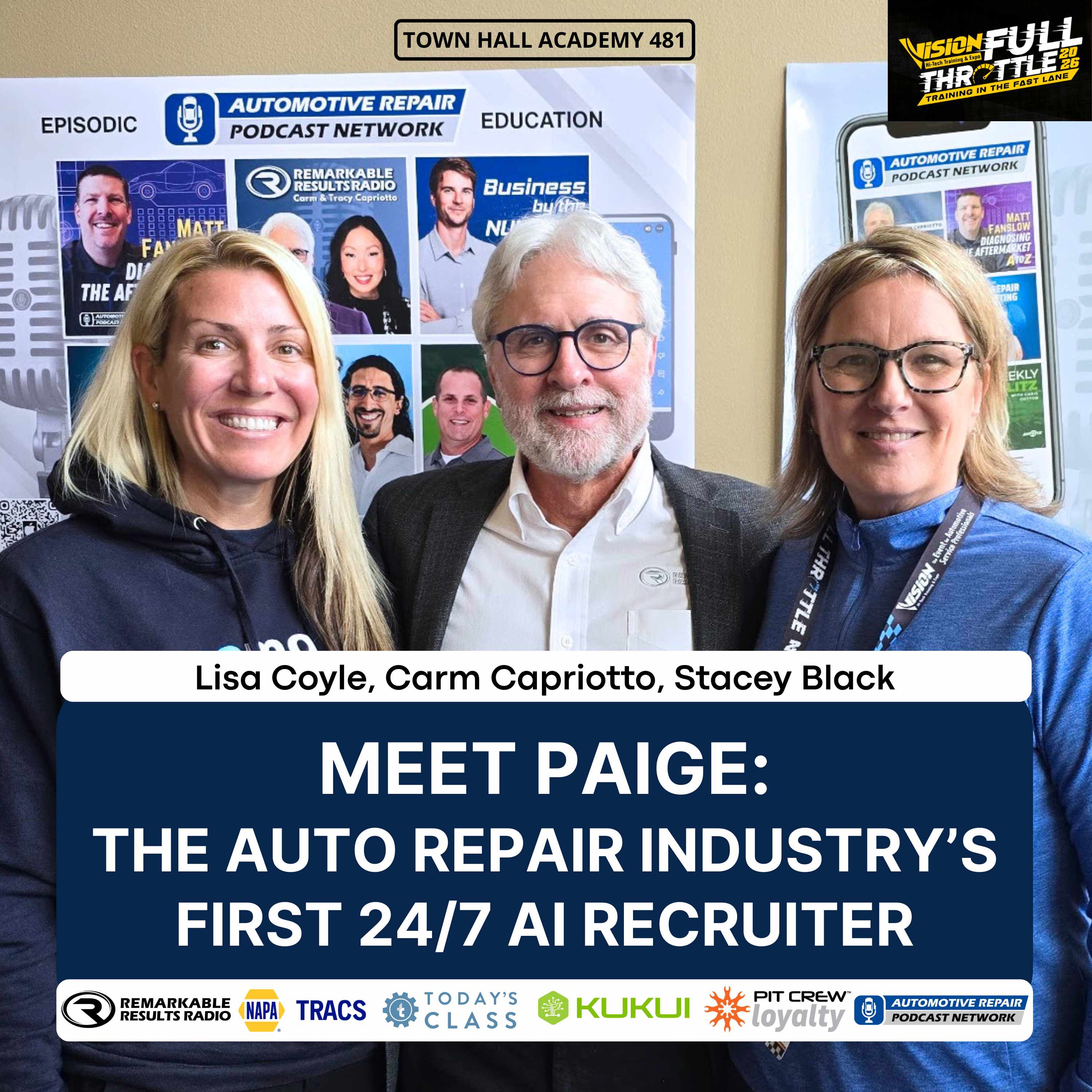
Remarkable Results RadioApril 17 · 42 min
Meet Paige: The Auto Repair Industry’s First 24/7 AI Recruiter [THA 481]
Thanks to our Partners, NAPA TRACS, Today's Class, KUKUI, and Pit Crew Loyalty Watch Full Video Episode *]:pointer-events-auto scroll-mt-[calc(var(--header-height)+min(200px,max(70px,20svh)))]" dir="auto" data-turn-id="request-WEB:8e59eec7-a235-4fa3-a072-956fea3fe478-7" data-testid="conversation-turn-4" data-scroll-anchor="false" data-turn="assistant"> *]:pointer-events-auto scroll-mt-[calc(var(--header-height)+min(200px,max(70px,20svh)))]" dir="auto" data-turn-id="request-WEB:49a777bf-d263-4496-bf0b-2eb3a46ac96a-11" data-testid="conversation-turn-24" data-scroll-anchor="false" data-turn="assistant"> Recorded live at the VISION 2026, this episode of Remarkable Results Radio features host Carm Capriotto in conversation with Lisa Coyle, Co-founder and CEO of Promotive, and Stacey Black, Account Manager at Promotive. Together, they unpack one of the most urgent challenges facing the automotive repair industry today: how to attract, hire, and retain top talent in an increasingly competitive and fast-moving market. What the Episode Covers: The “Ghosting” Problem in Hiring: Why candidates are applying to 15-20 shops at onceHow speed of response determines who wins the hireThe growing impact of declining soft skills like communication and accountability The Role of Shop Culture in Retention Why culture must be intentional, not assumedSimple, low-cost ways to build connection and loyaltyIdeas like celebrating milestones, supporting families, and investing in trainingHow strong culture reduces turnover and attracts better talent Introducing “Paige” The Industry's First AI-Powered Recruiting Promotive’s virtual recruiter designed for the automotive industryInstantly engages candidates via text after they applyConducts a guided, conversational pre-screening interviewCaptures key data: experience, commute, current benefits, and pay expectations A Live Demo of AI in Action Carm roleplays as a technician to demonstrate Paige’s capabilitiesShows how natural, fast, and effective the process is The 24/7 Hiring Advantage Why candidates often apply after hours, and how Paige captures them in that momentReal-world success, including dozens of completed interviews over a holiday weekendFaster engagement leads to fewer drop-offs and better-qualified candidates Hiring today requires more than posting a job and waiting. The shops that succeed are the ones that move quickly, communicate clearly, and create a culture people want to be part of. By combining intentional leadership with innovative tools like AI recruiting, you can reduce friction in the hiring process, improve retention, and ultimately build a stronger, more committed team. *]:pointer-events-auto scroll-mt-[calc(var(--header-height)+min(200px,max(70px,20svh)))]" dir="auto" data-turn-id="request-WEB:49a777bf-d263-4496-bf0b-2eb3a46ac96a-15" data-testid="conversation-turn-32" data-scroll-anchor="true" data-turn="assistant"> VISION Hi-Tech Training and Expo: https://visionkc.com/ Promotive has over 40 years of recruiting and automotive experience. If you need qualified technicians and service advisors and want to offload the heavy lifting, visit https://gopromotive.com/ Lisa Coyle and Stacey Black, https://gopromotive.com/ Thanks to our Partner, NAPA TRACS NAPA TRACS will move your shop into the SMS fast lane with onsite training and six days a week of support and local representation. Find NAPA TRACS on the Web at http://napatracs.com/ Thanks to our Partner, Today's Class Optimize training with Today's Class: In just 5 minutes daily, boost knowledge retention and improve team performance. Find Today's Class on the web at <a href="https://www.todaysclass.com/" target="_blank"...
Listen →
51
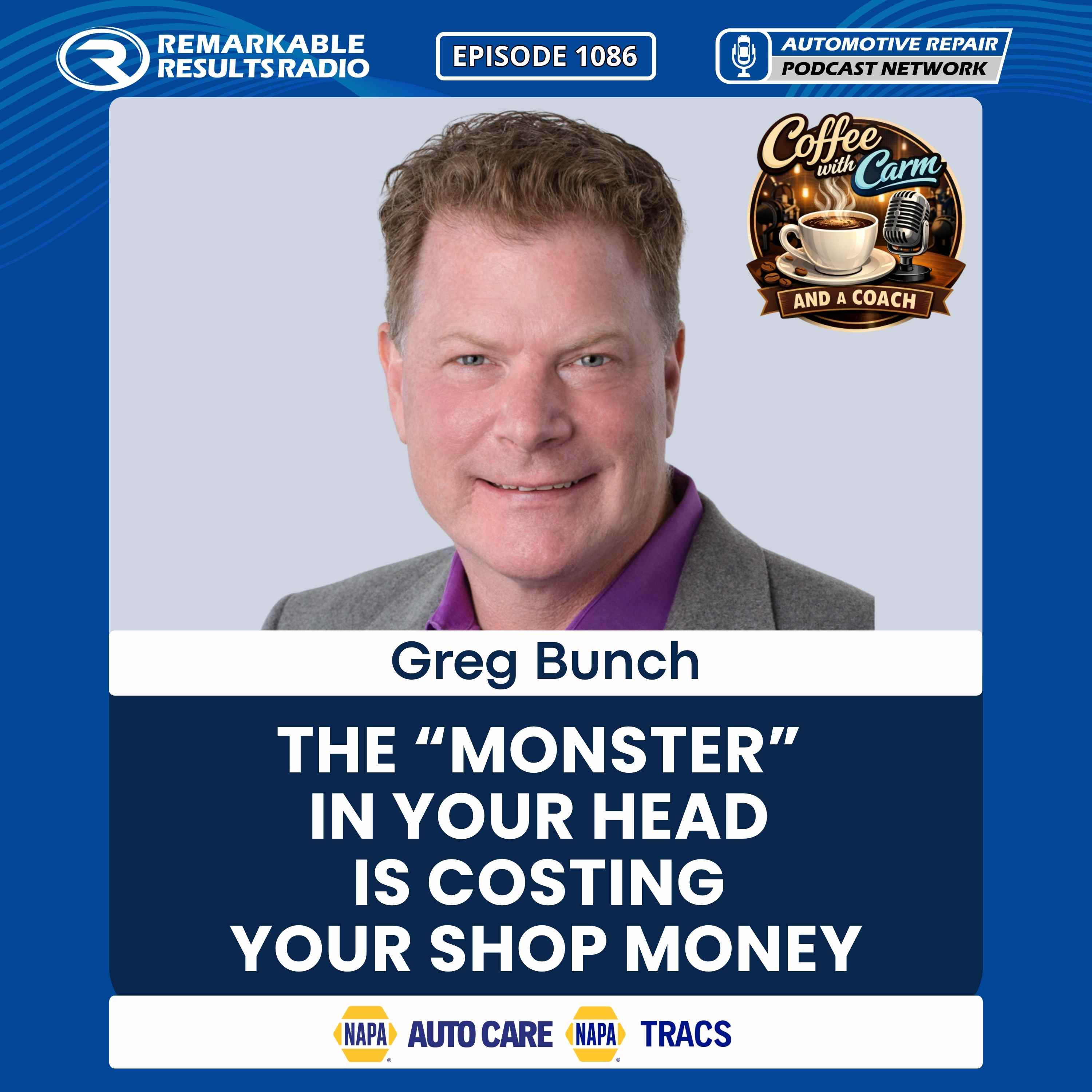
Remarkable Results RadioApril 7 · 46 min
The “Monster” in Your Head Is Costing Your Shop Money [RR 1086]
Thanks to our Partners, NAPA Auto Care and NAPA TRACS Watch Full Video Episode *]:pointer-events-auto scroll-mt-[calc(var(--header-height)+min(200px,max(70px,20svh)))]" dir="auto" data-turn-id="request-WEB:b7123d23-4a4b-4700-b41f-68ea2bc61414-0" data-testid="conversation-turn-2" data-scroll-anchor="true" data-turn="assistant"> In this episode of Coffee with Carm and a Coach, host Carm Capriotto sits down with Greg Bunch, business coach and Founder at Transformers Institute and owner of Aspen Auto Clinic, to unpack the mindset barriers that quietly limit leadership and growth in auto repair. At the center of the conversation is the “monster” voice that is wired for survival, not success. While it once kept us safe, today it often holds leaders and advisors back from difficult but necessary actions: addressing underperformance, having honest conversations, or confidently recommending needed work. Left unchecked, that fear can cost shops hundreds of thousands, even millions, in missed opportunities. Greg shares five foundational pillars for effective leadership: Wisdom: Surrounding yourself with the right voices and guidanceKnowledge: Understanding your numbers and facts without emotionUnderstanding: Knowing what those numbers actually mean in your businessDiligence: Doing what needs to be done, even when it’s uncomfortableRight Choices: Staying aligned with your values, no matter the pressure Together, Carm and Greg explore how business is ultimately an emotional math problem, a constant balance between data-driven decisions and the human side of leadership. They also challenge listeners to become perpetual students, actively seek honest feedback, and confront the habits that hold them back. The episode wraps with a powerful reminder: long-term success comes from “slow dimes,” not “fast nickels.” Doing the job right, every time, builds trust, safety, and sustainable profitability. Greg Bunch, Aspen Auto Clinic, Transformers Institute. Listen to Greg’s previous episodes HERE. https://transformersinstitute.com/ Thanks to our Partners, NAPA Auto Care and NAPA TRACS Learn more about NAPA Auto Care and the benefits of being part of the NAPA family by visiting https://www.napaonline.com/en/auto-care NAPA TRACS will move your shop into the SMS fast lane with onsite training and six days a week of support and local representation. Find NAPA TRACS on the Web at http://napatracs.com/ Connect with the Podcast: Follow on Facebook: https://www.facebook.com/RemarkableResultsRadioPodcast/ Join Our Virtual Toastmasters Club: https://remarkableresults.biz/toastmasters Join Our Private Facebook Community: https://www.facebook.com/groups/1734687266778976 Subscribe on YouTube: https://www.youtube.com/carmcapriotto Follow on LinkedIn: https://www.linkedin.com/in/carmcapriotto/ Follow on Instagram: https://www.instagram.com/remarkableresultsradiopodcast/ Visit the Website: https://remarkableresults.biz/ Join our Insider List: https://remarkableresults.biz/insider All books mentioned on our podcasts: https://remarkableresults.biz/books Our Classroom page for personal or team learning: https://remarkableresults.biz/classroom Buy Me a Coffee: https://www.buymeacoffee.com/carm Special episode collections: https://remarkableresults.biz/collections The Automotive Repair Podcast Network: https://automotiverepairpodcastnetwork.com/ Remarkable Results Radio Podcast with Carm Capriotto: Advancing the Aftermarket by Facilitating Wisdom Through Story Telling and Open Discussion. https://remarkableresults.biz/ Diagnosing the Aftermarket A to Z with Matt Fanslow: From Diagnostics to Metallica and Mental Health, Matt Fanslow is Lifting the Hood on Life. https://mattfanslow.captivate.fm/ Business by the Numbers with Hunt Demarest: Understand the Numbers of Your Business with CPA Hunt Demarest. https://huntdemarest.captivate.fm/ The Auto Repair Marketing Podcast with Kim and Brian Walker: Marketing Experts Brian & Kim Walker Work with Shop Owners to Take it to the Next Level. https://autorepairmarketing.captivate.fm/ The Weekly Blitz with Chris Cotton: Weekly Inspiration with Business Coach Chris Cotton from AutoFix - Auto Shop Coaching. https://chriscotton.captivate.fm/ Speak Up! Effective Communication with Craig O'Neill: Develop Interpersonal and Professional Communication Skills when Speaking to Audiences of Any Size. https://craigoneill.captivate.fm <img
Listen →
52
The Limitless Leadership PodcastApril 2 · 41 min
Ep 142: How People-First Leadership Drives Shop Performance with Chris Cloutier
Listen →
53
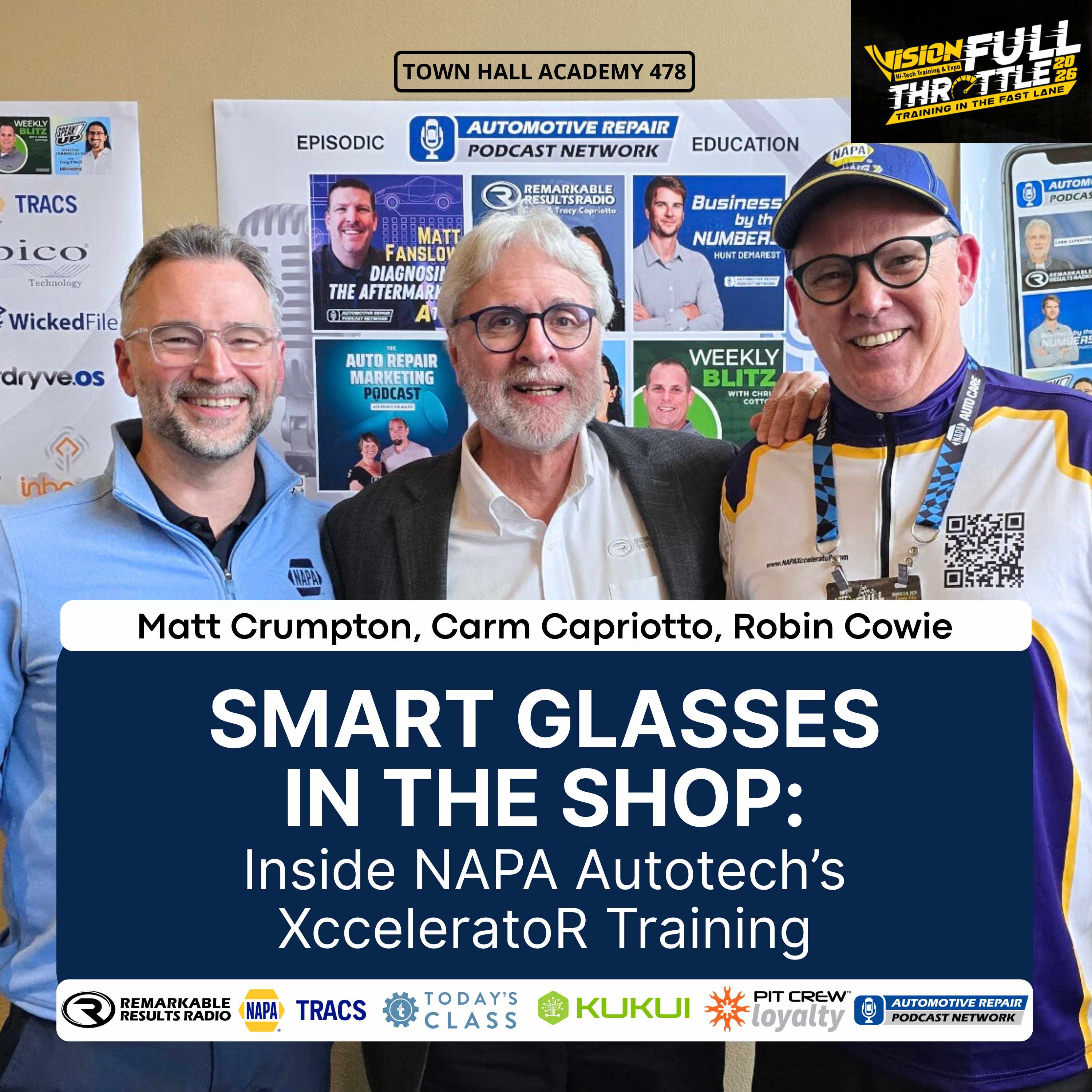
Remarkable Results RadioMarch 27 · 45 min
Smart Glasses in the Shop: Inside NAPA Autotech’s XcceleratoR Training [THA 478]
Thanks to our Partners, NAPA TRACS, Today's Class, KUKUI, and Pit Crew Loyalty Watch Full Video Episode *]:pointer-events-auto scroll-mt-(--header-height)" dir="auto" data-turn-id="0e35c993-ad2d-4e51-96b6-080ca2e8cdd2" data-testid="conversation-turn-3" data-scroll-anchor="false" data-turn="user">*]:pointer-events-auto scroll-mt-[calc(var(--header-height)+min(200px,max(70px,20svh)))]" dir="auto" data-turn-id="request-WEB:8e59eec7-a235-4fa3-a072-956fea3fe478-7" data-testid="conversation-turn-4" data-scroll-anchor="false" data-turn="assistant"> Recorded live at VISION 2026, host Carm Capriotto sits down with Matt Crumpton, Director of Program Development at NAPA Auto Care, and Robin Cowie, Creative Technologist, to explore the official rollout of NAPA’s Extended Reality (XR) training program. The conversation centers around solving some of the industry’s biggest challenges: the ongoing technician shortage, the high cost of tools for new hires, and the need to get technicians productive and billable faster. By leveraging immersive technology that feels familiar to younger generations, NAPA is creating a pathway for new technicians to build skills and confidence in a low-risk, high-impact learning environment. The XR ecosystem is built around three core technologies. Virtual Reality (VR) delivers immersive, point-of-view training with over 50 lessons focused on essential shop skills, reinforcing the idea that “brakes pay bills.” Using a structured “teach five, test five” approach, technicians develop muscle memory before ever working on a live vehicle. Mixed Reality (MR) bridges the gap between virtual and physical by combining real tools with guided digital overlays, allowing for hands-on practice with built-in support. Augmented Reality (AR) smart glasses bring the technology directly into the service bay, giving technicians instant, voice-activated access to critical information like torque specs, keeping them focused on the vehicle and saving valuable time on every job. Looking ahead, the platform continues to evolve. Future integrations are expected to include shop management systems, Identifix, and digital vehicle inspections, enabling fully hands-free workflows and even customer-facing video communication directly from the bay. After successful testing with early adopters, NAPA officially announced at VISION 2026 that its XR training packages are now available for general purchase, offering shops a powerful new way to train, support, and retain the next generation of technicians. https://napaxccelerator.com/ VISION Hi-Tech Training & Expo: https://visionkc.com/ Matt Crumpton, Director of Program Development, NAPA Auto Care Robin Cowie, Creative Technologist, AI, VR, AR, Content Producer/Director. https://skillmaker.ai/ Thanks to our Partner, NAPA TRACS NAPA TRACS will move your shop into the SMS fast lane with onsite training and six days a week of support and local representation. Find NAPA TRACS on the Web at http://napatracs.com/ Thanks to our Partner, Today's Class Optimize training with Today's Class: In just 5 minutes daily, boost knowledge retention and improve team performance. Find Today's Class on the web at https://www.todaysclass.com/ Thanks to our Partner, KUKUI Stop juggling multiple marketing tools. KUKUI’s integrated platform delivers 4x better website conversions, automated follow-up, and real-time ROI tracking. Get industry-leading customer support with KUKUI at https://www.kukui.com/ Thanks to our Partner, Pit Crew Loyalty You’re probably tired of chasing new customers who never return. We understand. Pit Crew Loyalty ends the one-and-done cycle, turning first visits into lasting, reliable revenue at https://www.pitcrewloyalty.com/ Connect with the Podcast: - Follow on Facebook: https://www.facebook.com/RemarkableResultsRadioPodcast/ - Join Our Virtual Toastmasters Club: https://remarkableresults.biz/toastmasters - Join Our Private Facebook Community: https://www.facebook.com/groups/1734687266778976 - Subscribe on YouTube: https://www.youtube.com/carmcapriotto - Follow on LinkedIn: https://www.linkedin.com/in/carmcapriotto/ - Follow on Instagram: https://www.instagram.com/remarkableresultsradiopodcast/ - Follow on Twitter: https://twitter.com/RResultsBiz - Visit the Website: https://remarkableresults.biz/ - Join our Insider List: https://remarkableresults.biz/insider - All books mentioned on our podcasts: https://remarkableresults.biz/books - Our Classroom page for personal or team learning: https://remarkableresults.biz/classroom - Buy Me a Coffee: https://www.buymeacoffee.com/carm - Special episode collections: https://remarkableresults.biz/collections - The Automotive Repair Podcast Network: https://automotiverepairpodcastnetwork.com/ - Remarkable Results Radio Podcast with Carm Capriotto: Advancing the Aftermarket by Facilitating Wisdom Through Story Telling and Open Discussion. https://remarkableresults.biz/ - Diagnosing the Aftermarket A to Z with Matt Fanslow: From Diagnostics to Metallica and Mental Health, Matt Fanslow is Lifting the Hood on Life. https://mattfanslow.captivate.fm/ - Business by the Numbers with Hunt Demarest: Understand the Numbers of Your Business with CPA Hunt Demarest. https://huntdemarest.captivate.fm/...
Listen →
54
The Limitless Leadership PodcastMarch 25 · 36 min
Ep 140: Why Daily Feedback is Valuable with David Boyd
Listen →
55
Shop Soup PodcastMarch 20 · 1h 14m
EP21: To Rise To A Level 10 You Must Dig Deep. With Guest Industry Coach Dave Schedin
Welcome To ShopSoup Podcast. I'm your host Greg Buckley, a multi-shop owner in Delaware that has seen, heard and experienced in being part of a 3 generation automotive repair shop.This weeks guest is Dave Schedin (pronouced, Shi-deen) of Computrek Systems, a coaching and consulting firm out of Spokane, Washington. Dave and I discuss the importance of personal development for the shop owner and it impacts the success of their business.In this engaging conversation, Dave Schedin shares his journey from automotive technician to coach, emphasizing the importance of personal development, purpose, and mindset in transforming auto repair shops. Discover practical strategies for leadership, team building, and creating a legacy that lasts beyond the business. keywordsauto repair, personal development, leadership, coaching, business growth, mindset, industry transformation key topicsPersonal development and self-awareness in businessThe importance of purpose and legacy in leadershipStrategies for team building and technician trainingOvercoming scarcity mindset and embracing abundanceThe role of mindset and emotional intelligence in industry success"Addressing the root pain points in shops""Profit is a map, not the destination""Growth happens outside the comfort zone"Chapters00:00 Introduction to Coaching and Personal Journey02:46 The Role of Psychology in Coaching05:34 Transformational Coaching vs. Behavior Modification08:23 Self-Awareness and Personal Development11:07 Addressing Pain Points in the Automotive Industry13:38 Defining Purpose and Legacy in Business16:36 The Importance of Continuous Growth19:39 Challenges Faced by Service Advisors22:25 Creating a Supportive Environment for Advisors25:20 The Infinite Game of Business27:58 Aging and Its Impact on Business Perspective30:34 Legacy and Long-Term Vision37:44 Taking Responsibility for Personal Growth38:10 Facing Life's Challenges39:47 Transformative Leadership and Self-Awareness42:19 The Journey of Personal Development47:13 Instilling Personal Development in Employees50:34 The Power of Self-Awareness56:19 Finding Joy in Business57:58 Transforming the Automotive Industry resourcesLeadership and Self-Deception by Arbinger Institute - https://www.arbinger.com/resources/books/leadership-and-self-deception/Anatomy of Peace by Arbinger Institute - https://www.arbinger.com/resources/books/anatomy-of-peace/ guest linksWebsite - https://computreksystems.com/
Listen →
56
Repair Shop ReckoningMarch 20 · 1h 24m
They Ignored the Trades...Now They Have to Pay for It
Everybody keeps talking about the technician shortage like it just showed up out of nowhere. It didn’t. We built it. For the last 30 years, we told kids not to go into the trades. We stripped hands on training out of schools. We pushed college as the...
Listen →
57
The Limitless Leadership PodcastMarch 19 · 28 min
Ep 139: Hard Times are Meant to Grow You with Josiah Martin
Listen →
58
Remarkable Results RadioMarch 17 · 34 min
Own the Technician Shortage: How One Shop Owner is Transforming Industry Recruitment [RR 1083]
Thanks to our Partners, NAPA Auto Care and NAPA TRACS Watch Full Video Episode *]:pointer-events-auto scroll-mt-[calc(var(--header-height)+min(200px,max(70px,20svh)))]" dir="auto" data-turn-id="request-WEB:b7123d23-4a4b-4700-b41f-68ea2bc61414-0" data-testid="conversation-turn-2" data-scroll-anchor="true" data-turn="assistant"> In this episode, Carm Capriotto speaks with Chris Machado, founder of XGen Academy, about a bold new approach to solving the automotive technician shortage. Machado has developed an intensive 16-week training program that blends virtual reality simulations, classroom learning, and hands-on shop experience to accelerate the development of new technicians. At the core of the academy’s philosophy is the “reverse funnel,” which attracts a wide pool of young talent and progressively refines their skills toward professional mastery. The program goes beyond technical instruction. Through its “Reality Hub,” students also learn essential life and workplace skills, including financial literacy, professionalism, and ethics. By modernizing the training experience and making automotive careers more appealing to younger generations, Machado aims to build a scalable model that can be replicated nationwide, offering a proactive, high-tech solution for developing the industry’s next generation of technicians. XGen Academy: https://xgened.email/ Chris Machado, Circle M Tire & Auto and Circle M Truck Repair Bakersfield, CA. Thanks to our Partners, NAPA Auto Care and NAPA TRACS Learn more about NAPA Auto Care and the benefits of being part of the NAPA family by visiting https://www.napaonline.com/en/auto-care NAPA TRACS will move your shop into the SMS fast lane with onsite training and six days a week of support and local representation. Find NAPA TRACS on the Web at http://napatracs.com/ Connect with the Podcast: - Follow on Facebook: https://www.facebook.com/RemarkableResultsRadioPodcast/ - Join Our Virtual Toastmasters Club: https://remarkableresults.biz/toastmasters - Join Our Private Facebook Community: https://www.facebook.com/groups/1734687266778976 - Subscribe on YouTube: https://www.youtube.com/carmcapriotto - Follow on LinkedIn: https://www.linkedin.com/in/carmcapriotto/ - Follow on Instagram: https://www.instagram.com/remarkableresultsradiopodcast/ - Visit the Website: https://remarkableresults.biz/ - Join our Insider List: https://remarkableresults.biz/insider - All books mentioned on our podcasts: https://remarkableresults.biz/books - Our Classroom page for personal or team learning: https://remarkableresults.biz/classroom - Buy Me a Coffee: https://www.buymeacoffee.com/carm - Special episode collections: https://remarkableresults.biz/collections - The Automotive Repair Podcast Network: https://automotiverepairpodcastnetwork.com/ - Remarkable Results Radio Podcast with Carm Capriotto: Advancing the Aftermarket by Facilitating Wisdom Through Story Telling and Open Discussion. https://remarkableresults.biz/ - Diagnosing the Aftermarket A to Z with Matt Fanslow: From Diagnostics to Metallica and Mental Health, Matt Fanslow is Lifting the Hood on Life. https://mattfanslow.captivate.fm/ - Business by the Numbers with Hunt Demarest: Understand the Numbers of Your Business with CPA Hunt Demarest. https://huntdemarest.captivate.fm/ - The Auto Repair Marketing Podcast with Kim and Brian Walker: Marketing Experts Brian & Kim Walker Work with Shop Owners to Take it to the Next Level. https://autorepairmarketing.captivate.fm/ - The Weekly Blitz with Chris Cotton: Weekly Inspiration with Business Coach Chris Cotton from AutoFix - Auto Shop Coaching. https://chriscotton.captivate.fm/ - Speak Up! Effective Communication with Craig O'Neill: Develop Interpersonal and Professional Communication Skills when Speaking to Audiences of Any Size. https://craigoneill.captivate.fm
Listen →
59
Shop Soup PodcastMarch 8 · 2h 1m
EP 19: Can The Industry's Past Be It's Future? With Todd Hayes Of AutoShopAnswers
Welcome to SoupRadio Podcast. I'm your host Greg Buckley, a 60 year old, multi-automotive repair shop owner in Delaware. Today's guest is Todd Hayes, a highly successful entrepreneur that is bring back customer service to the automotive aftermarket in a HUGE way. He is the COO of Adams Automotive in Houston along with the CEO of his private equity firm, Houston, Boston Partnership.In this engaging interview, Todd Hayes shares his journey from a young entrepreneur to a successful automotive industry leader. He emphasizes the importance of discipline, exceptional customer service, and innovative business strategies that have transformed his businesses and impacted lives. In this engaging conversation, industry veterans Todd Hayes and Greg Buckley share insights on transforming the auto repair industry through customer service, technology, and efficient business models. They discuss the importance of industry roots, leveraging AI, and building a culture of excellence to achieve sustainable growth and wealth.Keywords For The Showauto industry, customer service, business growth, discipline, automotive success, legacy business, private equity, auto hospitality auto repair, customer service, AI, business efficiency, industry transformation, auto hospitality, private equity, technician recruitmentKey Topics In The ShowDiscipline in business and healthCustomer service as a differentiatorLegacy building and business growth Industry roots and customer service excellenceLeveraging AI for customer relationshipsBuilding a high-performance auto repair businessKey PointsCustomer-Centric ModelEfficiency FrameworkAuto Hospitality ModelPractical Tips To Build The Client RelationshipImplement AI tools for customer profilingTrain staff on customer service excellenceAdopt the Ritz Carlton auto hospitality standards"Customer service is the key to industry success.""Building a team that respects each other is essential.""Focus on the customer, and success will follow."Chapters00:00 Introduction and Personal Connection01:48 Health Journey and Resilience03:42 Discipline in Life and Business07:25 Early Career and Business Foundations11:29 Customer Service and Industry Changes17:10 Legacy and Community Focus24:19 Transforming Auto Shops into Customer-Centric Businesses28:38 The Journey of Entrepreneurship and Family Values32:27 Changing Lives Through Business and Community37:16 Innovative Customer Service Strategies in Auto Repair44:06 De-risking Business Portfolios and Growth Strategies50:11 The Importance of Communication and Customer Relationships01:00:18 Revisiting Business Fundamentals01:01:12 The Evolution of Business Models01:01:49 Harnessing Technology for Customer Engagement01:02:58 Building Relationships Through AI01:04:24 Efficiency in Service Delivery01:06:27 The Importance of Customer Experience01:08:16 The Role of Team Dynamics in Business01:12:24 Customer Service as a Core Value01:14:10 The Need for Respect in the Workplace01:16:13 Choosing the Right Business Model01:18:50 The Importance of Cleanliness and Presentation01:23:28 The Future of Private Equity in Business01:31:42 The Importance of Winning in Sports and Business01:33:11 Running a Business Like a Pro Football Team01:35:56 Discipline and Professionalism in the Workplace01:37:51 Navigating Industry Events and Networking01:39:40 Customer Service as the Core of Business Success01:43:02 Honoring Mentorship and Industry Relationships resourcesAuto Shop Answers - https://autoshopanswers.comTodd Hayes on LinkedIn - https://linkedin.com/in/todd-hayesAI Development by Michael Floyd - https://aidev.comAuto Shop Answers - https://autoshopanswers.comAdam Coffey's Private Equity Books - https://www.amazon.com/s?k=Adam+CoffeyTechMetric - https://techmetric.comBryce's Auto Service Event - https://theaslconference.com guest linksLinkedIn - https://linkedin.com/in/todd-hayesLinkedIn - https://linkedin.com/in/greg-buckley
Listen →
60
Shop Fix Academy PodcastSeptember 7 · 29 min
Super Tech OR Owner: My 15 Year Struggle & How I Fixed It | EP13 | Shop Fix Academy Podcast
90 hours a week, elite technician credentials, and a growing shop... but Eric Walker was still failing as an owner. Why? He couldn't grow long term while carrying the whole auto shop on his back. The cars were being fixed, but nobody’s work was ever good enough. So the “super tech” kept stepping in, taking over, and teaching his team to depend on him. In this episode, Guy Roberts and Michael "The Berg" Rosenberger dig into the shift from technician identity to actual ownership. Learn the moment Eric realized his standards were holding his people back, why letting a technician struggle can actually reduce the owner’s struggle, and why the guy with the quickest answer can become the biggest bottleneck in the building. Your job is no longer to be the hero who fixes every car themselves. Your job is to build people who can solve problems without you. Eric spent more than a decade carrying the load. Today, his auto shop has a 13 person team rowing in the same direction even when he isn’t there.Stop searching for better technicians and start developing the ones you have with Tech Fix.https://shopfixacademy.com/tech-fix?utm_source=sfa-podcast&utm_medium=podcast&utm_campaign=join-tech-fix&utm_content=ctaGet the structure and support to stop carrying your entire shop yourself with Shop Fix LITE.https://shopfixacademy.com/shop-fix-lite?utm_source=sfa-podcast&utm_medium=podcast&utm_campaign=join-lite&utm_content=ctaLearn how top shop owners build teams that perform without everything falling back on you with our free Replays & Guides.https://shopfixacademy.com/replays-and-guides?utm_source=sfa-podcast&utm_medium=podcast&utm_campaign=shopfix-resources&utm_content=cta
Listen →
61
Master Tech to MillionaireSeptember 4 · 1h 8m
EVERYTHING You Need to Know about Master Tech to Millionaire + Autoshop Answers
In this crucial & very special episode of Master Tech to Millionaire, Joe Adams & Glenn Piccolo break down the essential terminology, history, and operational secrets of the Auto Hospitality Group to get you totally dialed in. Whether you’re gearing up for the legendary Key to Key to Callbacks weekend, VIP, Courtside, or just want the blueprint on how a master technician scales into a millionaire, we’re decoding it all. Get ready to learn the 8-figure difference between auto repair and auto hospitality, what a "VIP Rack Attack" actually looks like, and why hands-on jobs in "Bay 1" are your biggest opportunities. Stop guessing and start scaling. Hit play to learn the language of million-dollar auto shops, and visit AutoShopAnswers.com to get your business on the fast track. https://autoshopanswers.com
Listen →
62

The Institute's Leading Edge PodcastSeptember 3 · 1h 4m
217 - AMA: How the Best Shops are Confident in their Pricing
217 - AMA: How the Best Shops are Confident in their Pricing September 3, 2026 - 01:03:32 Show Summary: Profitable auto repair shops build pricing around financial data instead of fear or competitor rates. Rising technician pay and rapidly advancing vehicle technology make strong margins essential for investing in people training and equipment. Confidence comes from understanding the true cost of doing business and recognizing the value a skilled independent shop provides. Customers are often willing to pay more when they trust the quality and experience behind the service. Strong systems and productive teams also give owners the foundation needed to grow without sacrificing profitability. Long term success requires clean financials clear value and the willingness to charge what the business needs to thrive. Host(s): Lucas Underwood, Shop Owner of L&N Performance Auto Repair and Changing the Industry Podcast Cecil Bullard, Founder of The Institute Show Highlights: [00:01:00] – Rising technician pay makes accurate pricing more important than ever. [00:07:00] – Setting prices based on competitors leaves shop owners flying blind. [00:12:00] – Great technicians use diagnostic data but often ignore business data. [00:19:00] – Confidence means explaining why quality automotive repair costs more. [00:27:00] – Low prices can actually make customers question service quality. [00:31:00] – Build operating reserves before expanding into another shop. [00:37:00] – Create a shared vision to earn staff support for pricing changes. [00:44:00] – Automotive pricing has failed to keep pace with rising costs. [00:53:00] – Independent technicians bring valuable diagnostic skills to complex repairs. [00:59:00] – Clean financials create confidence in what your shop must charge. In every business journey, there are defining moments or challenges that build resilience and milestones that fuel growth. We’d love to hear about yours! What lessons, breakthroughs, or pivotal experiences have shaped your path in the automotive industry? Share your story with us at info@wearetheinstitute.com, and you might be featured in an upcoming episode. 👉 Unlock the full experience - watch the full webinar on YouTube: https://youtu.be/bk5g3FjpoEo Don’t miss exclusive insights, expert takeaways, and real talk you won’t hear anywhere else. Hit Subscribe, drop a comment, and share it with someone who needs to hear this! Links & Resources: Want to learn more? Click Here Want a complimentary business health report? Click Here See The Institute's events list: Click Here Want access to our online classes? Click Here ________________________________________ Episode Transcript Disclaimer This transcript was generated using artificial intelligence and may contain errors. If you notice any inaccuracies, please contact us at marketing@wearetheinstitute.com. Episode Transcript: Lucas Underwood: Good afternoon, everybody. My name is Lucas Underwood from Changing the Industry podcast. I'm a shop owner here in Blowing Rock, North Carolina, own LNN Performance Automotive Repair, and today I have the honor to be joined by Cecil J. Bullard, and we are talking pricing here, uh, on today's show, and we're talking about confidence in pricing. Cecil, buddy, how are you? Cecil Bullard: I'm great. I'm Lucas Underwood: great. You're not a has-been yet? Cecil Bullard: Not yet, brother. I'm a still-was, I think, or maybe never was. I don't know, man. Lucas Underwood: I'm a something, right? Cecil Bullard: I'm something. Somebody knows who I am. Lucas Underwood: Man, I love it, and, and listen, we're talking pricing today, and it's really interesting. I'm, I'm headed up to Kentucky, uh, for the Survive or Thrive Thoroughbred Diesel event in October, and I was working on a presentation for them, and it's really about my story as a shop owner. And for those who don't know, I, I started in diesel performance. I was selling diesel performance parts, and one of the things that we faced in the diesel performance world is they had these MAP prices, and all of these online vendors were selling their parts for MAP prices, and I thought I had to compete with that. And one of the biggest challenges I ever faced as a shop owner was overcoming that fear of charging what I needed to charge. So Cecil, how do we get these shop owners who are listening, these shop owners who are gonna view this later, to the place that they're confident in their pricing? Cecil Bullard: It, it's, it's a, a combination of multiple things obviously. I mean, we, uh, I think if you understand, um ... So let's ... See, this is gonna jump around like it always does. Uh, you keep me on focus. Um- Bet. I'll Lucas Underwood: do what I can. No promises. Cecil Bullard: Right, right now we, we have this, this, uh, techs coming in. Uh, had one yesterday, uh, you know, uh, one of my clients is interviewing a tech, and the guy's saying, "I want 100 grand guaranteed." And, uh, you know, I would tell you two years ago that was probably 65 or 70 maybe. Yeah. And so now it's 100,000. And so we have this, um, uh, you know, the, the, the shortage, right? Lucas Underwood: Yeah. Cecil Bullard: And, uh, we have a demand, and we have, uh, a necessity of probably paying more. So if I understand, you know, what I'm paying and why I'm paying it and what I need to pay, then I also have to relate that to my pricing. Because- Yeah ... um, if I don't charge enough, I don't get paid enough to pay the person that I need to enough to buy the equipment, to buy the training. And y- you know, when I, uh, was, was working as a tech, which is a long time ago, um- Lucas Underwood: Yeah ... Cecil Bullard: and, and people will go, "Oh, wow, did the cars have wooden tires?" Yeah. "Or were they rubber?" I was Lucas Underwood: gonna say, I, I Cecil Bullard: can't believe- They, they were rubber, man ... we had Lucas Underwood: cars that long ago, you Cecil Bullard: know? They were, they were rubber, yeah. But, but, um, you know, classes were, uh, few and far between frankly. Mm-hmm. Uh, mainly manufacturers had classes. We didn't have a lot of the aftermarket stuff like Asta that's coming up where we could get great tech training there or- Yeah you know, great management training. Um, and it wasn't ... But it also was very inexpensive in comparison maybe to what training is today. And the cars, of course, were a lot simpler. So there's this idea that, okay, what I'm doing ... Uh, and I think this might be one of the core problems we have with shop owners. They do not understand the value of what they do- For sure ... their knowledge, right? Yeah. Most of them, you know, uh, we still have a, probably a higher percentage of people in our industry that were not ... You know, they don't have a college degree. They didn't, uh, you know, have a master's degree in, in automotive technology or- Yeah or, you know, engineering or whatever that is. Um, and many of these guys, I had a, again, a conversation, uh, Sunday with one of the clients that, um, you know, he's like, "I, I didn't even graduate high school," right? "I, I, uh, I got into drugs. I went to, I went to prison. Uh, I got out of prison. I started to be a mechanic 'cause I, that's, I could do that." And now he owns a shop, and a pretty successful shop. Now he owns a couple pieces of property. And, but- Lucas Underwood: Yeah ... Cecil Bullard: I think if we don't value what we do- Or we don't see the value in what we do. And I also think that, that we have blinders on as, uh- Mm ... shop owners because all we really see, uh, we, and, and how we interpret what we see is probably, uh, very limited. So I drive down- Lucas Underwood: Yeah, through our lens. Yeah ... Cecil Bullard: I drive down these five streets to get to work, and there are three shops, and I drive by, you know, Billy Bob's shop, who is the cheapest guy in town, and I know that, and man, he's got a lot of cars parked outside that shop. He's always got a lot of cars. And then my phone doesn't seem to be ringing, and it's- Yeah a real, it's a natural leap to go, "Well, my price must be too high," right? Lucas Underwood: For sure. For Cecil Bullard: sure. Uh, as opposed, uh, as opposed to, number one, I don't know what Billy Bob's costs are. Yeah. I don't know if Billy Bob, uh, is paying rent, you know, how much rent. Uh, I don't know what Billy Bob's- Yeah ... paying his technicians. Don't Lucas Underwood: even know if he's doing any marketing. Right? And frankly- Those could all be comebacks, right? Yeah, and, and- Like, we don't know Cecil Bullard: Yeah, and frankly, I don't even know if he's making any money at all, right? He might be losing three grand a month, and- Lucas Underwood: That, that's a- But- That's a great point, right? Because I, I've been- Right there, done that, right? Because I, I, I was the guy riding by the other shops, looking at the other shops saying, "Oh, look how busy they are. Look at what they've got going on," not realizing that some of those cars had been sitting there for weeks. They hadn't- Yeah, for months ... got anything done. Yeah. Right. And, and a, as I dug in and I started talking to these guys, I'm going and talking to them, I'm realizing, hey, listen, they're doing twice the amount of work for the same amount of money. I'd rather have an empty parking lot and make the amount of money I'm making as I would- Cecil Bullard: Oh, yeah, yeah. If I'm not gonna make any money, I'd rather not work. I mean- Lucas Underwood: Exactly ... holy smokes, right? Exactly, and look, here, here's what I keep seeing, and I talk to shop owner after shop owner, and this- You know, David gets frustrated because we keep having this discussion over and over again. And he said- Yeah ... "Why do we keep having this discussion?" I said, "Because all of these techs leave shops and decide to start their own mobile mechanic business. They decide to start their own shop. They go out on their own and they do their own thing. And so we have to continue to teach them because they were uninterested in this when they were technicians. They didn't care." And eventually what happens is we have these new folks coming in, they get burnt, they're trying to figure out, "Why can't I pay my bills? This isn't working for me. What's going on? Why doesn't this work?" And Cecil Bullard: so then we- And by the way, they- when- Go ahead ... when people see this or, or people that are watching, many of them will be barely making a living. You know? Yeah. They, what they have is a bad job that doesn't- Yeah ... pay well. So I work- Lucas Underwood: Exactly. 100% ... Cecil Bullard: I work 70, 80 hours a week, and I, I can't go to my daughter's play and I can't do this and I can't do that, um, because I'm trying to get this car fixed so I have the money to go in the bank to pay the bills. And, and they're- They're payrolls we- ... trapped in this, they're- Yeah ... trapped in this thing, and, uh, they don't understand that, that you don't have to be trapped in that thing. Lucas Underwood: For sure. Right? And, and here's the thing, is, is over and over and over again, I have this discussion. Right? I talk to, to hundreds of shop owners and techs becoming shop owners through the span of a given month, right? Talk to- Yeah ... tons of them. Get a message every single hour throughout every single day- Yeah, every day ... from somebody, right? Cecil Bullard: I'm glad I'm not you, baby. Lucas Underwood: And so what I'm noticing is, is they're all going out and they're setting their prices, and they're using what I like to call the Oreo pricing method. Cecil Bullard: Yeah. Lucas Underwood: So they've got, you know, shop over here's on the high end, shop over here's on the low end, I'm gonna be somewhere in the middle. And I talk to them and I say, "Guys, hey, listen. I don't know if you know this, but you should probably be using data to set your prices. And that data comes from your financials, and otherwise you're flying blind because you don't know if you're pricing yourself correctly or not because you're not using the data. Now yeah, we can give you some numbers that the industry standard is, and we can get you 90% of the way there," but they all panic when you give them those numbers, Cecil. Cecil Bullard: But I'm also- They have a- I'm also, I'm also not sure there's an industry standard because- That's true ... you know, we still have shops, you know, uh, that are probably under $100 an hour in the industry. Yeah. I mean, there's that mobile guy that's out there for 80 bucks an hour. Lucas Underwood: Yeah, yeah. Cecil Bullard: And, uh, I've got shops that are- And thinks he's Lucas Underwood: doing them favors. Thinks he's doing- Yeah, Cecil Bullard: and I've Lucas Underwood: got- ... the guest a favor, man. Come on now. Cecil Bullard: I've got shops that are in the same- General location that are 250 an hour. Yeah. So I don't, I don't know that there's an industry standard. I don't think there is a standard. But- In fact... Yeah. Lucas Underwood: Here, here's the problem though, is that it- standard or no standard, the reality is, is they're setting their price- Survive ... based on feel. Yeah. They're setting their price based on what the market looks like around them and what they suspect the market will bear. And, and I'm telling you, would you go out and say, "I feel like this car needs a $4,000 control module"? No, you wouldn't do that because that's asinine. That's stupid. Why would you take your business, which has the potential to generate hundreds of thousands of dollars of revenue every single year, every single month in some cases- Cecil Bullard: Yeah Lucas Underwood: and take a gamble with it? Why would you do that? You wouldn't do that with a client's car. It just makes Cecil Bullard: no sense to me. Well, you know, we, we don't like... I, I wouldn't go to a doctor that didn't have a degree, and I don't mean this in the sense that mechanic-wise. I'm just saying if I knew the guy was a quack, I wouldn't go there because I don't want somebody- Yeah guessing about my health, right? Lucas Underwood: Yeah. Cecil Bullard: And yet I have this business, and, and my business has done everything for me, right? Lucas Underwood: Yeah. Cecil Bullard: Don't get me wrong, I've also done everything for my business, right? Yeah. But, but my business provides the money that allows me to live the lifestyle, that allows me to help the industry, that allows me to drive a nice truck, that allows me to, you know, have a, a nice coat- Yeah if I want it, that feeds my family. You know, and we can eat steak and, you know, all that. The, the business is the engine that runs your life- Yeah ... in a way, okay? And so I've got this thing that literally can create generational wealth- Mm-hmm ... or it can be a bad job where I work too hard too long and don't, and don't get paid for it. Be a burden take away from Lucas Underwood: my family. Yeah. Cecil Bullard: So, like, I, I'm talking to, uh, another shop a couple of days ago and, and we're talking about, uh, they're gonna- they wanna hire this guy who wants $100,000. And I'm like, "Okay, we can do that," right? Yeah. And I'm like, "Uh, so that's," whatever, it's 50 bucks an hour basically. And, and so, uh, what's our effective labor rate? Well, our effective labor rate's probably not what our po- Our, I think the posted labor rate was between 155 and 175, depending on the kind of car and the job we're doing and- Lucas Underwood: Yeah ... Cecil Bullard: and but the effective labor rate was probably 130, 140. And, and so now you're... I'm doing math saying, "Okay, it's $50." Then I've got 30% load, so it's really 65. And then if the guy comes in and he's only, say, 80% productive, then my cost goes from, say, 65 probably all the way up into the high 80s. Lucas Underwood: Yeah. Cecil Bullard: And now I'm paying out 55% of the labor I brought in- Instead of 40%. And so that difference of that 15% is the difference in my profit, right? Yeah. And it means I don't make money in most shops. Exactly. Yeah. Many shops are, are not even making 5% profit. Lucas Underwood: Hey. Cecil Bullard: And, and so if you're gonna lose 15% because you hired the wrong guy or you didn't price yourself correctly- Yeah ... or you didn't hold the line or you didn't build value, um, and you're gonna end up losing that 15% and only make 4%, then you have a terrible job with terrible hours and terrible pay. Um- Lucas Underwood: With no return on investment. Yeah. And, and he- here's on top of all of that, like when we look at this and we think about the whole strategy here behind setting our pricing and everything else, like profit doesn't happen by accident, okay? Cecil Bullard: No. Lucas Underwood: You're not gonna just walk into your shop one day and say, "I think the number needs to be X", and set that number and be profitable. Now, you might get lucky. Yeah. You might actually become profitable. But without clean books, without good data, without the ability to look and, and dig into the information- It's very unlikely you're gonna be Cecil Bullard: wrong Well, that's the other thing. That's the other thing that makes me a, a little bit crazy. We have these guys that are really great technicians. And- Lucas Underwood: Yeah ... Cecil Bullard: they're great technicians because of, they have the education, they have the hands-on experience, they have the right tools, the right equipment, and they also know how to read the data. Yeah. So, you know, I hook up the car, I get the, this from the scanner. It tr- I track down to the oxygen sensor. I know how to test the oxygen sensor. I know what good is, I know what bad is. I know how to look at a, a wave, uh, uh, form for a injector, and I know what good is and I know what bad is. Yeah. And so they, they do that in their job every day in their life because they think that's important and because it is, but they don't do the same thing in their business. Yeah. They, they literally pull stuff out of the air, or they listen to somebody like me, and they go, "Well, that guy's crazy 'cause he's saying we should be $220 an hour- Yeah. Yeah ... and there's no way we could be... We, every one of our clients- And let emotion drive it ... would run away. Um, you were, you were talking about the, um, the event that's coming up, the diesel event, Thoroughbred. Yeah. Yeah. And, uh, I was at, at Thoroughbred, uh, last year and the previous year. And so the previous year, uh, you know, I did a thing and, and talked about the numbers and all of that. And so the next year I'm there and I, I said, uh, "Is anyone here that joined up with the institute or became a client in the la- you know, from the last meeting?" Yeah. And there's a guy, uh, raised his hand a- and I said, "Okay. Um, if you don't mind me asking, and if you're willing to share, what is your labor rate, uh, when we started a year ago? When you joined the institute, what was your labor rate when you first came to this?" And he said, s- uh, he was like, "$79 an hour." Lucas Underwood: Yeah. Cecil Bullard: Right? And I was like, "Okay. And so I'm assuming that you walked away and you said, 'I'm gonna raise my labor rate.'" And he said, "Yeah." And, and I said, "Okay. If you don't mind me asking, what did you raise it to?" Right? He said, "Well, today we're at $180 an hour." Yeah. A year. Yeah. He went up over $100 an hour a year. Now he was- Didn't lose Lucas Underwood: all of his clients. Cecil Bullard: A- no. And I said, "Okay. A- and so how many clients realistically, just, just be as honest as you can, how many clients did you lose? Did you lose any?" And he went, "Yeah, we lost a few." Right? Yeah. And I said, "Okay. And, and who were they?" He said, "They were the people who would never pay us to do the work." I mean- Yep ... he lost maybe 3% of his clients. Yeah. And at, at 3%, so what? I mean- Exactly ... his labor rate- Lucas Underwood: 100%. Cecil Bullard: Think, think about, think about three guys, let's say they're only doing 70%. So- Mm-hmm ... you got three guys doing about six hours a day. You got 18 hours a day. If your labor rate goes up 100 bucks- Lucas Underwood: Yeah Cecil Bullard: that's $18,000 a day, right? Did I do that right? 1,800, uh, 1,800... It's $18,000 a day in a- uh, additional profit that because your labor rate went up 100 bucks, right? And- A- and most people, they're like, they can't even fathom that, right? They, first of all, they don't run the math. They don't figure it out. They're, they're diagnosing based on emotion, right? Yeah. Yeah. Um- 100%. I, I, uh, you know, I had a cl- if you, if you're in this industry, if you're in, in the industry, I don't care where you are, I don't care who you are today, you're gonna deal with price objections- Lucas Underwood: Yeah ... Cecil Bullard: every time. Lucas Underwood: Absolutely. Cecil Bullard: And, and, and you're gonna deal with a lot of them. Uh, you and I were kinda talking about that before we started. I mean, right now, uh, a lot of people are out of money. They don't know what's going on. The price of gas is, you know, higher than- Yeah ... it should be, blah, blah, blah, blah, blah. What's Trump doing? What's... What, what are the Democrats doing? What are the socialists doing? Um- Yeah. Credit card delinquencies- A lot of them- Lucas Underwood: are through the roof. Yeah. Car loans are through the roof. Delinquencies are through the roof. Cecil Bullard: A- and, and you're gonna deal with price objection. And the problem is, if you don't know how to deal with price objection and, and understand your value and be able to, uh, create value for your client- Yeah ... then you're not gonna win the game. 100%. And, and, and what's gonna h- the other thing that's gonna happen is you're gonna get this emotional response, and the emotional response is, "Wow, I have these people that are beating me up on price. And number one, I, it's uncomfortable for me, and I don't wanna be uncomfortable, so what do I do?" Lucas Underwood: Yeah. Cecil Bullard: "Well, let's lower our price." Yeah. I've shopped in, um, Tennessee- And, uh, the owner was like, "Yeah, we're really struggling right now," blah, blah, blah. Uh, I lowered the price on a, a, uh, several of our jobs, and I'm... I, I just wanna, like, you know... Yeah. Um, and, and what happened was his marketing was bringing the wrong customers in. Yep. It wasn't that- Reaching Lucas Underwood: the wrong people ... Cecil Bullard: we changed the marketing companies, we changed marketing strategies, and all of a sudden the shop is full and people are paying a full price. They're not discounted, right? Lucas Underwood: Yeah. Here, here's the thing is, is you're right, because it is all emotion. And, and- Yes for so long it's been driven by emotion, it's not been driven by data. And one of the things that we fall victim to, and, and I'm gonna tell you one of the greatest David rants of all time, and I was there to witness the telephone call. Because David, say what you want about the guy, he's extraordinarily intelligent, right? Absolutely. And I'm not saying that because he's my best friend. I love David. I'm saying that... Yeah. Yeah. If you really could get David to show you how smart David actually is, it would amaze the people who have negative things to say about him. Yeah. The man is genius level. I would say he's in the top 3% of- He just Cecil Bullard: gets frustrated. Lucas Underwood: Yeah. Cecil Bullard: He... And by the way, if you're really smart, you get frustrated- Yeah ... easier. Lucas Underwood: Exactly, because everything looks easy to you. You're just like- Yeah ... "Why are you this stupid?" Um, and- And then- That's why Cecil Bullard: we're friends, right? And then if you don't learn how to con- It works ... if you don't learn how to control that, it gets you in trouble. So. But, Lucas Underwood: but here's the thing is we, we were riding down the road one day, and this lady is, is fussing about his price. And he said, "I'm sorry, can you help me understand something?" And she said, "What are you talking about?" He said, "Are you an expert in automotive repair?" And she said, "No, I, I, I just own a car." And he said, "Okay, are you an expert in automotive parts?" And she said, "No, I, I, I'm not." And he said, "Okay, are you an expert in automotive diagnostics and testing?" And she said, "No, I'm not." I said, "Do you..." Or she said, "Do I... You know, what, what are you getting at here?" And he said, "I'm asking because I do this for a living. Every single day I make estimates to properly repair automobiles. I, I make sure that I get the torque-to-yield fasteners on. I make sure that I get all the gaskets on. I make sure that I have the part pricing proper so I can stand behind the repair after I'm done." Cecil Bullard: And qu- and a quality part is Lucas Underwood: not a- And a quality part. It's a, I am- And I, I am, I am a professional- Yeah ... at estimating your job. You are not. And I'm not trying to be disrespectful, but I don't need you sitting here telling me what the price should be unless you're an expert in pricing it. Now, if you want a different quality product, go somewhere else." Cecil Bullard: Yeah, 'cause that's not what I do, right? Lucas Underwood: And she stopped and she said, "What do you mean?" He said, "You can, you can go down the street and you can have somebody do this job with poor quality parts, not using the torque-to-yield fasteners, not torquing things to spec, lowering the time using a, a poor quality technician, and you can do that if you want. If you wanna take that risk, that's your business, but you're getting what you pay for." Cecil Bullard: Yeah. Lucas Underwood: And the lady said Just do the work. Cecil Bullard: Oh my. Lucas Underwood: And so- Right. Yeah ... it, it was so interesting because it's a completely different mentality than most shops take. Because the consumer comes to them and says, "I can't believe you're gonna charge that. That seems really expensive." It is really expensive because it's expensive- Yeah ... to fix a modern automobile. Yeah, I mean- But instead what do we do? We quiver, we shake inside, we get upset, our little hearts beat fast and we're like, "Oh, God, what do we do?" Cecil Bullard: So- And- ... I bou- I bought my first truck, um, uh, 40 years ago. And, uh, shortly after I bought, I bought a Toyota truck, and it was, it was kinda basic. It didn't have a lot of- Yeah ... crap in it. And that truck was, I think, uh, like eight grand or something. Seven, eight grand. It was not much. Yeah. And, and like, uh, two months later my wife was pregnant with our first and so I had to get rid of the truck and get something- Yeah that we had back seats in. But, but- Lucas Underwood: Yeah, they didn't like it- Cecil Bullard: I Lucas Underwood: bought a- ... back then when you put them in the back- Cecil Bullard: Right ... in Lucas Underwood: the snow. Cecil Bullard: I, yeah. In Lucas Underwood: Utah. Cecil Bullard: I, yeah. I bou- I bought a, a new truck, uh, about a year and a half ago. It was $82,000. Right? I mean, that comparison, I, I bought my first house. My dad's house was 13,000, my first house was 100,000. Uh, I think, you know, we're paying somewhere between six and 800,000 for houses out here today. Lucas Underwood: Yeah. Cecil Bullard: And, and you know, everything, what, what kills me is kinda this, you know, I, I don't know, I went to, um, uh, Jack in the Box, uh, this morning and got a couple of, uh, croissants, one for me and- Yeah ... and one for Kent. And, and it was 15 bucks. Yeah. And I was like, "Those used to be two bucks a piece." That was the- Exactly ... you know, two years ago it was $4. Lucas Underwood: Yeah. Cecil Bullard: And, a- and you know what I did? I gave them my credit card and I paid for it, right? Lucas Underwood: Exactly. Didn't say a word. Didn't Cecil Bullard: fuss. Didn't- And I didn't say a thing. And- Yeah ... I had to fill up the truck on the way home the other day. It was $4 and, whatever, 38 cents a gallon. Yeah. It was $4.38 a gallon. I got a 32 gallon tank. I mean, it was almost $80 to fill up the truck. And, and you know what I did? Filled up the tank. I ran my card through the machine and paid it and walked away. Yeah. I went to the grocery store, right? And, and eggs were, I don't know, whatever eggs are. Milk was whatever milk was. I spent $400 on, I don't know, a third of a basket of food. Lucas Underwood: Yeah. Cecil Bullard: And, and you know what I did? I paid it and walked out and, and I didn't think about it because that's the way it is. Lucas Underwood: You know, my first business coach taught me a very valuable lesson. He said, um, he said, "You're selling from your wallet." Cecil Bullard: Yeah. Lucas Underwood: And I said, "What do you mean?" He said, "You're selling from your wallet. Everything's from your perspective. And because you're broke, because you're not charging what you need to charge, everything feels expensive. So when you're pricing it, it does feel expensive." And so later on we had this discussion, we're talking about discounts. Because- Yeah ... it, now listen, I, I don't mean to, like, get y'all enraged here. I know it's going to. But here's the thing is like when we talk about this, all these shop owners come up and they say, "No, no, no, my labor rate's $200 an hour. My, my part margin's 60%." Cecil Bullard: Oh, but then they- Lucas Underwood: Why do you have $150,000- Well, they give it away on the other side in discounts? Yeah. Yeah. Right? And, and so he- Cecil Bullard: I see the financials. I'm like, I'm like, "You made t- $2,000 last month, but you had $12,000 in discounts." Lucas Underwood: Right. Exactly. Cecil Bullard: Help, help me understand that, right? Lucas Underwood: And so he- Cecil Bullard: How... Yeah. Lucas Underwood: Well, my, my first coach said to me, he said, um, "I've, I've got a, I've got a rule that you're gonna implement in your shop." And he said, "This is just a set rule. This is what it is." And I said, "What?" He said, "If you feel like giving a damn discount," he said- Yes, absolutely ... "I want you to keep some money in your wallet- Yeah. Cecil Bullard: Big Lucas Underwood: time ... and I want you to go up here and pull that money out of your wallet." I said, "Well, I ain't got no money." He said, "That's my point. You don't have any Cecil Bullard: damn money." And you, and you, and by the way, you never will if you, if you don't stay ahead on the straight. Lucas Underwood: Keep doing what you're doing. Cecil Bullard: Right. Lucas Underwood: And, and- You have to- But see- ... stay ahead on the straight ... we don't think about that, Cecil. We're so- Yeah ... disconnected because we're focused on fixing the car. And, and it, I believe it's a mindset, okay? Because we're back there in the bays and we're turning the wrenches, and in our mind, the, the desired outcome is that car gets fixed. And so we begin to change whatever it takes to get the car fixed. Well, I could lower the quality of the part. I could, I could reduce my labor rate a little bit. I could give them a discount here. Maybe I don't use that part there. Cecil Bullard: No, Lucas Underwood: it's to get the- Because we're technicians, we're- Cecil Bullard: It's not to get the car fixed. And, and I, I understand what you're saying. Lucas Underwood: Yeah. Cecil Bullard: But it's to get the car in, right? I believe that in order to get that car in, I need to bring my price down. I need to be, quote-unquote, price competitive. Except- Tell me what price competitive is. I have shops- Lucas Underwood: Yeah ... Cecil Bullard: I probably have, um, in some areas I have three or four shops that we work with, and the price variance between those shops that are in, within 30 miles of each other can be as much as $60 or $80 an hour. Lucas Underwood: Yeah. Cecil Bullard: And by the way, the shops that are most successful are not the cheaper shops. Yeah. They're the higher price shops. Lucas Underwood: Yep. Cecil Bullard: Because I think the consumer, there's this thing about price. So I'm, I'm in Edmonton doing a, a gig, and there's a Mercedes shop up there, and this is, I don't know, six, eight years ago, pre-COVID. And, uh, the, the lady that ran the Mercedes shop, she was like, "We can't... Nobody is booking, you know, the phone rings, but nobody wants to come into the shop." And they're a Mercedes shop. And I looked at the shop and it was, you know, it was, it was okay. It wasn't, like, filthy, it wasn't terrible, yada, yada. And, and you know, I called the shop, and it wasn't a bad con- It wasn't a great conversation. It wasn't a bad conversation. And I asked her, I said, "Well, what's your labor rate?" Now, by the way, at the time, say eight years ago, my shops up in Edmonton were between 130 and 160. All right? Lucas Underwood: Mm-hmm. Cecil Bullard: And she was 75 bucks an hour. Yeah. And I said, "Okay, if you own a Mercedes, right, and you're not the fourth owner, you know, the guy that- Yeah the, it's the hand-me-down Mercedes that I got that's not fixed, that's t- you know, falling apart- Yeah ... I have no money. If you're the second owner of the Mercedes or the first owner of the Mercedes, and somebody says, "Well, you know, my price is half of what everybody else's is," what's the first thing that comes into your mind? You know, if you, if you saw, I don't know, if you saw, uh, let's say, uh, tamales, right? You got, uh, tamales. You go in the grocery store, and there's two kinds of tamales. Yeah. They, they kind of look the same, but not exactly the same. And one of them for six tamales is 12 bucks, and the other one is three. Which one are you buying? Lucas Underwood: I Cecil Bullard: know, I'm telling you. I'm not buying the, I'm not buying the $3 tamales. That's a, that's a chance that number one, I'm not gonna like them, and number two, it could make me sick, blah, blah, blah. Might have Lucas Underwood: that listeria added in there. I'm, Cecil Bullard: yeah, I'm buying the $12 tamales. It- Between the ch- I- if I'm thinking about price, right? At all. Lucas Underwood: For sure. I, we, we had those cabins, right, where the shop's at, there used to be nine cabins here. Yeah. And for years they were $100 a night, and they were log cabins. Actual log cabins with a kitchen, with a sleeper sofa, and a living room, and a dining room, had a shower and a, a bathroom. Some of them had hot tubs, had a, a bedroom. And the, the occupancy rate stayed in the 40% range, and my parents were, were content with that. It was paying the bills. It wasn't that big of a deal. They're making Cecil Bullard: enough money to pay the overhead. Lucas Underwood: Yeah. My brother came in and decided he was gonna raise the prices, started charging $225 a night, and our occupancy jumped to 80%. Yeah. Nothing else changed. No marketing, no nothing else changed. And people started coming in saying, "I thought there was something wrong with them. I thought they were gross or nasty or something." ' Cecil Bullard: Cause they were, 'cause they were so cheap. Lucas Underwood: Because they were so cheap. Yeah. Yeah. And, and we don't think about that perspective. And I, I'm telling you, I buy things on Amazon, and I'll see two exact comparisons side by side. Like, I'm not gonna get the cheap one 'cause there's a reason it's cheaper, right? Cecil Bullard: Yeah, when I see the cheap, my, my thoughts are, uh, I just bought, uh, uh, some stuff yesterday and I saw the cheap stuff, and I was like, "I, I don't wanna buy that. It's too risky for me." Lucas Underwood: Yeah. Cecil Bullard: Right? It, it might not be... It might be some Chinese whatever, because I don't know. I mean, it looks like the product, but it's, it, it probably isn't. At that price, it can't be, right? Lucas Underwood: How... Uh, so look, here's the thing, because we, we're talking about confidence, right? And, and at the root, we, we know that the pricing has to go up in this industry. We know that- Yes ... beyond a shadow of a doubt. Yeah. There, there's no if, ands, or buts about it. Nope. And because we, we need to be paying our guys more. I don't think anybody debates that. And if you do debate that- Man, come on now. Second of all- Cecil Bullard: If you're, if, if you're not making 15% net profit minimum- Yep ... on your business, and your business isn't designed to make 20% net, then- Oh you're gonna end up with Ford and struggle. Lucas Underwood: Exactly. Absolutely. Cecil Bullard: Go ahead. Sorry. Lucas Underwood: And, and so here's the thing is, is the confidence piece of this. Because we know that the price needs to go up. We don't have to debate that the price needs to go up. How do we get shop owners to the point they're confident in sharing that price? And I, I think there's a, a, a myriad of things, and I, I think that a lot of small business owners tend to be people pleasers, and that's something that I am learning myself to overcome. And, and I'm trying to work on this concept that if you're not happy, I have to be unhappy, too. And I'm growing and developing in that, but I've, I've realized, like, hey, I can't let that person's emotion dictate my emotion. And so when they- What do you think- Go ahead. Cecil Bullard: What do you think the future of automotive repair... Who do you think are gonna be the existing successful shops, say, 10 years from now, right? Lucas Underwood: Well, I know we're gonna have venture capital and private equity with a bunch of big chain shops bought up. Yeah. Yeah. And then there's gonna be a handful of small independents left that, that could overcome the financial challenges associated with small business ownership and automotive repair in the, uh, in the 2030s. Cecil Bullard: It's all about... It will, it will all, it will all be about a couple of things. First of all- Lucas Underwood: Yeah ... Cecil Bullard: it's not about fixing the car. Lucas Underwood: Yeah. Cecil Bullard: You have to fix the car, okay? That, that's a given. That's the base level Lucas Underwood: expectation. Cecil Bullard: That's a, that's a base level. That's not Lucas Underwood: like a... Cecil Bullard: Yeah. Somebody shows up to your shop with their keys and says, "Here you go," they expect you to fix the car, okay? Yeah. It is going to be the, uh, the additional items, the way the customer feels about your service, the way the customer feels about your pricing, the way the customer feels about how you paid attention to them, did you listen to them- Yeah you know, all of those things. And, and by the way, the average person, in fact, I'd tell you 80, 85% of the people will buy the more expensive product if they feel good about the interaction and they feel good about the product. They will always do that. We got a couple questions coming in, so I think- Lucas Underwood: Yeah, I, there's some really good ones in here. Yeah. I've, I've got one, I'm passionate about this one. It says, "How much money should a shop have set aside?" I'm gonna tell you something. The best advice that I was given by anybody before building this new shop was maximize the shop that you have now. Cecil Bullard: Yeah. Lucas Underwood: Don't just decide to move. Don't just think that, and run the numbers and figure out what your max capacity is. And I'm gonna tell you, if I learned anything, I wish I had set on that bad boy for as long as I could, just letting it make money and stacking cash. I would get every single dime of money I can in the bank account, because here's what so many people don't realize about expanding They think when they have that small shop, that when they expand, all of a sudden they're gonna have all this demand and they're gonna be able- Yeah to fill up that new big shop. If you, if you build it, they will Cecil Bullard: come. Lucas Underwood: It does not work that way. Yeah. Right? That doesn't work that way, I promise. Cecil Bullard: Well, yeah, three bays, three bays, low roof, uh- Yeah ... no racks, uh- Exactly ... to, uh, what, 12 bays, uh- Yep ... you know, super high roof. Lot of space. You can get anything you want in, and all of a sudden you think, "Why isn't my shop full?" Lucas Underwood: Yeah. Cecil Bullard: Well, wait a minute, you didn't Lucas Underwood: do all the work. Well, uh, we're making more Cecil Bullard: revenue. Yeah, yeah. Lucas Underwood: That was just the limit of the capacity that we had at the given time. Cecil Bullard: Yeah. Lucas Underwood: And so, I, I Cecil Bullard: would- And so maximize it. Exactly, man. So I have a client... Lucas Underwood: Maximize what you got and stack the cash. Cecil Bullard: So that particular question, I think, I think the answer is ve- it varies. Yeah. First of all, every shop, every shop owner should have a minimum of three months worth of operating capital in a savings account, period. Lucas Underwood: Yeah. Cecil Bullard: Right? That's before I even think about buying another shop. So- Yeah ... uh, I have a client, uh, we're buying shop number three. Mm-hmm. Um, he's been a client now, I would say probably since 2021. Um, when he started with us, he was making three, four grand a month. Uh, we currently have two shops, we made $87,000 in profit last month. Now, he's got half a million dollars in the bank. His machine is generating between, say, 70 and 90,000 every month. Yeah. The machine that he has built. And, uh, and that's, and that's pure profit, right? It's not, "Oh, I'm gonna have to do this with that or that with it." And then it depends on the deal, because he's gonna buy a piece of property for, uh, a million dollars that comes with a shop on it that just hasn't been operating for a bit. So he's got some- Yeah ... expense for marketing, building it up, tools and equipment, et cetera, that if you bought an operational shop, you wouldn't have. And this is not an owner finance carry. Yeah. So if I'm, if I'm, if I'm gonna do owner financing and the owner's gonna carry it, I might need less cash, right? Yeah. Or if I have to buy more equipment, I might need more cash. Or if- Yeah ... if I have to go through and remodel the shop, I, I mean, I don't think anybody that I've dealt with when they bought their next shop didn't spend at least $40,000 in the move. Lucas Underwood: Yeah. Cecil Bullard: Right? Lucas Underwood: And, and at this point, I think 40,000's an undershoot because- Oh, it's way, it's way low ... things have gotten so expensive. I mean- Cecil Bullard: Yeah, you could... I need, my signage is 40 grand, right? Yeah. I mean, if I'm gonna- Yeah, for sure ... put signage on the building. And- Lucas Underwood: And- Cecil Bullard: And, yeah Lucas Underwood: Uh, here, here's the deal about this, is that, that you think, "I'm gonna go buy a shop," or, "I'm gonna go build a shop," and you get these numbers in your head. I promise you, because everybody told me, you can double it. Just double it. Just- Yeah ... right off the number, whatever it is, double that number. And so they told me- And the timeframe ... $2 million, that's what it's gonna be. Yeah. And I didn't believe them. Cecil Bullard: And Lucas Underwood: the timeframe- Cecil Bullard: And so... Exactly. So by the way, not six months, a year. Lucas Underwood: Oh, yeah. Double the money, double the timeframe- Cecil Bullard: Yeah ... Lucas Underwood: and, and then get comfortable with those numbers or even higher numbers than that. Target the lower numbers, sure, but be expecting for it to be way more expensive than you think it's gonna be and take way longer than you think it's gonna take, and be way more uncomfortable, create way more stress. And, and let me tell you something. If you think it's not gonna impact the shop you have now- Yeah ... when you're in the middle of that- Yeah ... you're gonna find out if you grew a team or not. Cecil Bullard: Well, the other thing, I- Lucas Underwood: Because you're gonna be focused on something else. Cecil Bullard: So the other piece of that is if I have a really great team and I have really good systems and processes, I need less money to open the other shop- Yeah because I don't need... Like, the shop I have, if it runs really well, if it runs, uh... You know, if it's very consistent, et cetera, and it's done that for, I don't know, six months, a year, year and a half- Yeah ... and I have a great team there, uh, um, then I need less money to open up the next shop because I'm, I'm, I'm comfortable. I'm putting money- Yeah ... in the bank routinely, et cetera. There was another part of the question, uh, best marketing strategy in a small town. I, I'll tell you the best marketing strategy, period. Do an unbelievable job- Yeah ... for your client. And, and- Treat people well ... and the other thing is, you know, learn how to answer the phone correctly, and learn how to build value from the start. You know, when people- Yeah ... called me and they said, "Hey, Cecil, um, you know, how much for a water pump on a whatever?" I'd say, "You know- Yeah ... I know price is important to you, but before we have that conversation, can I tell you about, you know, Larry's and, and why we do what we do here?" And I never had somebody say, "No, just give me a damn price." Um, I... Then I was able to say, "Look, we... This is our philosophy of taking care of cars. We, we believe that our customers can drive these cars for 10, 15, 20 years and take care of them, and if they do, it's gonna cost them a lot less over the, the lifetime of the- Yeah ... of the vehicle. So every time you come in here, we're gonna inspect the car. We're gonna do a- Yeah ... complete inspection, and every time you come in, someone like me is gonna sit down with you and have a conversation about what you need and, and, and why you need it- I'm gonna be- ... and be able to tell you exactly what it costs- Yeah ... so you can make a, an intelligent decision. For sure. And if that's good, if that sounds good to you, then I have an appointment on Tuesday or Wednesday. And- I think if you create a product that's different than everyone else's product, that's better, that's superior, that you get that, right? The, the, the person, uh, uh, uh, that the, the, the 80% of the population that's gonna value that is gonna value it. The 20%'s always gonna look for the cheapest price. And- Absolutely ... and by the way, they're not my, they're not my, they're not my clients. Lucas Underwood: Exactly. So- Exactly. And, and that's what they're gonna be going after no matter what. You're not gonna please them. And even if you made 50 cents on it, they're gonna be fussing about that. Yeah. Right? And so it, it doesn't work. Now I, I wanna jump into this next question and, and Steve from Wassbalden Motive, Steve, I really hope that we see you at ASTA. Uh, you're in Durham, it's in hometown, so we'd love to see you there. I'm, I'm gonna post a link down here in the comments, and I, I hope that you, uh, see that, Steve. Because I, I think it's important. Because he's asking the question is how do I get my legacy staff to buy in? And I think this is touching- Shoot them Cecil Bullard: all. Shoot Lucas Underwood: them all. There you go. Um- Shoot them Cecil Bullard: all. I, Lucas Underwood: I think it- No, Cecil Bullard: um- ... Lucas Underwood: starts for me with vision. Yeah. And it starts w- with destination. It starts with what we're trying to accomplish, what do we believe, where are we trying to go? Cecil Bullard: What if we really sat down and had a conversation with our staff that said, "Who are we and what do we wanna be?" Yep. "And what's the image that we wanna portray to our clients," right? Lucas Underwood: Exactly. Cecil Bullard: And, and we built that with our staff because, like, I took over a shop, I went in and, you know, within a week I sat everybody down, I said, "Okay, what kind of shop do you wanna work for?" Right? "What do you wanna be? You wanna be a discount shop, you wanna be a tire shop, you wanna be a transmission shop? Do you wanna be, like, a, a top shop in the industry? Do you want the community to look at you as a top shop, or do you care?" Right? And, and everybody in my shop said, "We wanna be a top shop." Yeah. And by the way... So then we started talking about, well, what does a top shop look like? What does it feel like? How, how do they answer the phone? How do they... What's their comeback rate? What's their, you know, what's, what do they charge? Are they on the lower end, are they on the higher end? Yeah. So you, you have to get your team on your side. You have to get your team behind. Like, if I can't value my own pricing- Lucas Underwood: Yeah ... Cecil Bullard: how can I expect my team to value my pricing, right? For Lucas Underwood: sure. 100%. Cecil Bullard: I have to be... My, my dad, and I've said this in a lot of classes and a lot of people, my dad always said I had an over, uh, developed sense of my own self-worth. Yeah. All right? But when I was a, a tech working on cars, I always thought, "Man, we are so cheap." And I've always thought that through the whole thing. Yeah. Even as a coach, I'm like, "Man, there are coaching companies that are a lot more expensive than us. Why are we so cheap?" Um, I'm always thinking that, right? Yeah. And, and what that did at the service counter for we was when we were $158 and everybody else was 100- It made me confident because I thought we should be charging 300, right? Yeah. But- It's, it's kind of the same thing as having that cash in your pocket. Lucas Underwood: Yeah. Cecil Bullard: But when I have cash- Yeah ... in my pocket, I think differently, right? Lucas Underwood: He- here's the thing, i- is for me, right? When we're talking about this staff and we're making this transition, we've never charged any more, especially somebody buying a shop, and they know the fundamentals of shop ownership. They know about financials. They're buying a shop that was from somebody who did not know, and they did not charge appropriately. They didn't have a lot of overhead. Now this person's buying the shop, so they've got payments, they've got all this stuff going into it, and they're trying to retain the legacy staff. And I get how hard that can be, but you can't have a staff member that is the equivalent of the bottom 20% of the clients that cause all the problems. If they believe- Yeah ... that no matter what, you shouldn't be making any more money than you have to make, and no matter what, they know how much you paid for those parts, and you shouldn't be marking those up that much. If that's their mindset, if they have a- Yeah, when- And, and I'm... Look, I mean no disrespect by what I'm getting ready to say. If you have a poor person mindset, you're not gonna fit into that organization well. Not a- If you don't believe people should have money- Cecil Bullard: Not a company, not a company that wants to be exceptional. So the other- Yeah ... thing would be, and, and this is not to tout, say, the institute, but well-trained people. We have a service advisor intensive coming up. You know, it's a- Yeah ... three-day service advisor, and, and after many days with some of the top service advisor trainers, sales trainers, what do we- Yeah ... really came up with? We need confidence. How do we build- Yeah ... confidence in the service advisor- Exactly ... in the product, in the price, in the things we do? Lucas Underwood: Yeah. Cecil Bullard: And, uh, you know, we have a, a big marketing event coming up. We have, uh, the MARS event, which is Marketing for Auto Repair Shops, coming up in October. And, and if you wanna have a great marketing strategy and you wanna learn what you need to do today and what the shops that are winning today- Yeah are doing, that's the place to be. Lucas Underwood: Yeah. Cecil Bullard: So I g- I, I have to, I have to a little bit, you know, sell the, the company and what we do, so. Lucas Underwood: Yeah. Cecil Bullard: Um, Lucas Underwood: uh- Cecil Bullard: Uh, this question comes from Steve ... how do we... A- and the other- Go ahead. Go ahead ... one, one more thing on that, on that legacy stuff If I can't bring them ahead, if I can't get them to think correctly, if I can't get them on the page, you can't have, you know, two people that think that you're too expensive- Yeah and that you can't, you can't make a profit or you shouldn't make a profit, and, you know, five people that wanna be profitable and wanna go. You can't have- Yeah ... slugs with, with, uh, super performers. You just- Yeah, you can't Lucas Underwood: have slugs- You can't do it ... with the racehorses. Cecil Bullard: Yeah. It's not gonna work out. You, you, it won't work. Right? You, you're exactly right. The racehorses will run a lot slower and be upset. Lucas Underwood: And, and look- Cecil Bullard: So- ... Lucas Underwood: I'm, I'm gonna tell you something. I used to be so afraid of letting people go, and, and I made a video this week talking about this as, hey, I get that there's a shortage of... And, and I'm gonna tell you right now, this is gonna upset some people, we don't have a technician shortage, we have a skilled and willing worker shortage across all trades, across all professions. There's a shortage of people who want to actually work. And so I get the fear associated with letting someone go, but that person will become toxic and cancerous inside your business if you keep them. They will start telling people you're too expensive if you keep them. Cecil Bullard: Yeah, even your clients, by the way. Lucas Underwood: Yeah, that's what Cecil Bullard: I'm saying. Will start making excuses for you with your clients. Yeah. Exactly. "Well, got this new, got this new owner. I don't know. He raised the price, and you know, I..." Lucas Underwood: Yep, because it's gotta be somebody's fault besides theirs. Cecil Bullard: But here- Yeah ... but here, let me help you out. I'll give you a discount. That's Lucas Underwood: it. Right? Cecil Bullard: We, I had a, I had a shop- Yeah ... out of, out of Arizona. Um, uh, we, we went in, and they were not profitable. They lost, I don't know, he, he did 2 million, they lost, like, 200 grand. Yeah. And so I said, "Next year, what do you wanna do?" He said, "I wanna do 3 million." I says, "So you wanna lose 300 grand?" Right. You go, "Wait a minute." And, and I said, "Why don't we do a million and a half, make 20% net?" Yeah. And, and we went in and we looked at their coolant flush and their brake flush, and at the time they were, like, $39. Lucas Underwood: They were charging- Cecil Bullard: Yeah ... $39. Now, by the way, this is 10 years ago, but everybody else was charging 100. Yeah. And so we instantly, we went to 79, right? These coolant flushes and brake flushes gotta go to 79. And his two sons are at the counter, and a month later we're looking at the numbers, no margin changes, no nothing. So we start pulling work orders, and what they were doing was discounting the $79 down to 39. Yeah. Right? Lucas Underwood: Yep. Cecil Bullard: People have to understand that, that first of all, we're not the, we're not Billy Bob's Auto down the street. And so I don't know what's going on at Billy Bob's. I do know what's going on at Cecil's, right? That's, that's what we're gonna do. And- Yeah ... this is who we wanna be, and if we wanna be that, this is what we need to look at, this is what we need to look like, this is what we need the education in, this, these are the things we need. And in order to get those things, we have to be able to afford them, so we have to charge X price, whatever X price is. Okay. And I'm not trying to set a price, but I can tell you right now by math, at, in 1980, we were $70 an hour in our shop. Okay? Yeah. And we were one of the higher priced shops in town at that time, because I'd been through a bunch of training. If I had started at $70 an hour in 1980, and I raised my price 3% to today, we'd be like 286 an hour. Right. Yeah. And, and we're not. I mean, I think the last survey I saw, which was one of the TechMetrix surveys, and it was like 150-something, 152 or Lucas Underwood: something. Yeah, that's what I saw as well. Cecil Bullard: Yeah, and- Lucas Underwood: That's what I saw as well Cecil Bullard: We're, we're not gonna survive at 152, nor would we be able to- Yeah, Lucas Underwood: and, and none of the other industries have lagged like we did Cecil Bullard: get the Lucas Underwood: cars fixed Cecil Bullard: and deliver the rest. No. Lucas Underwood: None of the other industries have lagged like we did. Now, here's a really interesting question by Steve, and I, I wanna answer this kind of from the technical aspect first. Okay. Because he says, "Manufacturers are making it increasingly difficult for anyone outside their dealer network to service their vehicles. As independent shops invest more in the tools, technology, and expertise required to keep up, how do they confidently price that capability and convince customers they aren't sacrificing quality by choosing an independent shop?" Now, a couple things. The first thing is, and, and I loved your explanation of this, all you have to do is go to a dealer one time and you realize the experience isn't so great. And so maybe this- I, I wanna... I, Cecil Bullard: I need to clarify something here. The dealer expenses I have, experiences I have had, have mostly been terrible, okay? Yeah. Lucas Underwood: Yeah. Cecil Bullard: I have had a couple of decent dealer experiences. Lucas Underwood: Yeah, for Cecil Bullard: sure. Just not very often, and, and, and few and far between. Yeah. And so I'm not saying all dealers suck, but the dealers I've dealt with suck. Lucas Underwood: Yeah, for sure. Right? And, and maybe this is a good one for Steve, too. Yeah. Is, like, Steve, go, go take your team, give them the money to go somewhere else and get their oil changed at a dealership and let 'em see what the experience is like, and they'll come back and they'll say, "We're amazing." Cecil Bullard: And I think you should do- And they will go to a, once a year you should go to a Quick Lube. Lucas Underwood: Yeah, exactly. Cecil Bullard: And get the Quick Lube experience, and see- So- ... how they do what they do, right? Lucas Underwood: Yeah, absolutely. So, you know, here, here's the first thing that I wanna say to Steve, is I personally believe, based on my relationship with a number of manufacturer guys, I personally believe... And there's, there's some folks in C-suites and manufacturers who have a very different outlook on this. But the engineering teams and the people, the boots on the ground, who are getting us tooling, who are getting us access to the information we need, genuinely want us to be able to work on their automobiles. There's a couple that don't. There's a couple manufacturers who are trying to lock things out. The large majority of the auto manufacturers are trying to provide us access in a meaningful yet secure way. And so the reality of that is it is more expensive. But here's the deal, is the car itself got more expensive to fix? The difference be- I don't think- Go ahead. Cecil Bullard: I, I don't think that it's more expensive than what they would be doing at the dealership. Well- And if you look at the survey data and the customer data, currently the consumer believes that the independent shop is a much better place for them to be. Lucas Underwood: Absolutely. All right? All right. But, but here's the thing. Here, here's where I was going with that, though. Right. Is the difference being the, the automobile got much more expensive to fix because the technology increased tenfold. I was in a meeting, and Mary Barra was there, and it was like 10 years ago, and she said, uh, the technology in the vehicle in the next two years, I think she said, will outpace what we've seen in the past 100 years. Oh, yeah. And then we saw her again at another event, and they said in six months we'd already outpaced that. Like, it happened before we realized it had even happened. Cecil Bullard: And- And we're gonna have self-driving cars on the road. I mean, and we have them now- It- ... but we don't, we don't have a mass. The problem- Fully autonomous, Lucas Underwood: yeah. Cecil Bullard: The problem that they're dealing with is data transfer, so they can't get the, the links good enough. So as the links improve, as the- Well- ... you know, StarNet and all that improves, that will happen better and faster. But it, it... There's gonna come a point in time in the future where we're gonna have a bunch of self-driving cars on the road. For sure. And that technology is not today's technology. That's not what I worked on five years ago. Lucas Underwood: Yeah. Cecil Bullard: Oh, yeah. You know, the- Lucas Underwood: Absolutely. And Cecil Bullard: the technology- Everything has Lucas Underwood: changed so dramatically ... the technology we're seeing in automobile right now has advanced- Yes ... so much in just the past few years, it's unbelievable. And, and here's, here's kinda what I'm getting at, though. Is that the automotive aftermarket, the independent shops have withheld increasing their pricing like they should, while the technology outpaced them. And that technology outpaced a lot of technicians too. And so we, we weren't investing in training of our people, we weren't investing in the tooling for our people, we weren't doing what it took as an industry to keep up. Now, there's a lot of really great shops that have done a fantastic job. You think of Seth Thorsen's shops, you think of, uh, Matt up there in Minnesota. Yeah. You think of these shops that have really put the work in to learn this technology, grow. Brandon Steckler, great educators out here teaching these guys how to take this next technology. And, and somebody commented the other day, and they said, "Lucas, it's voltage drop, it's all the same stuff," right, but it's theory and operation of these systems, understanding how it works, understanding Cecil Bullard: how the networks- It's also, yeah, how, how does the computer talk to itself? How, how, how do the networks talk to each other- It- and how does that data transfer and, a- and that. It, it's, it's changed dramatically in the last five years. Just dramatically. And Lucas Underwood: so, so here's the thing, though, is like as an aftermarket, we just didn't see the value ourselves. The consumer- I- ... sees the value. Cecil Bullard: I also think- Lucas Underwood: If they want their car fixed, they see- Yeah the value. Cecil Bullard: I, I also think that there are, are shop owners that believe that they can just do brake jobs or- Yeah ... I can still do suspension work, and so I'm gonna do that. Yeah. The problem is, is that- You're right up Lucas Underwood: to- ... Cecil Bullard: all of that's getting- ... Lucas Underwood: putting those piston calipers back in. Cecil Bullard: It's all getting... Yeah, it's all getting tied into the computer systems. Yeah. All, everything is being monitored now, and adjusted and changed as the, as the... And it's gonna get worse and worse and worse. Yeah. And I, by worse, I mean there's gonna be more and more opportunity for the peoples that understand the technology. And you said something that I think I gotta, I gotta make a statement about. So the manufacturers of the equipment are gonna continue to wanna sell us equipment. Mm-hmm. Okay? Yeah. So they want us, uh, uh, to do that. We currently work on, I don't know what it was, 78, 79% of the industry. Mm-hmm. So the independents do almost 80% of the work. Um, the dealerships tomorrow, if, if, if there was a law passed that dealerships had to do all the work or even half the work- Lucas Underwood: They couldn't take the- Cecil Bullard: They couldn't do it. Yeah. They're already, some of them are already scheduled out 8 weeks, 10 weeks, 12 weeks. Yeah. Because they also can't get good technicians in their shops, and- Yeah ... they have shops with 42 bays, right? Lucas Underwood: Yeah. Cecil Bullard: And, and, and so I don't fear for us as an industry because of that. I look at, at things like, you know, we just went to STX. What did that cost? Lucas Underwood: Oh, Cecil Bullard: yeah. And if, and if Worldpac decides not to support that because they lost, you know, $2 million putting on STX, now where are we gonna get that training that we need? Yeah. You know, uh, ASTA, the big e- uh, the big event coming up at ASTA, and, and I know that it'll be a great event, but that event should be five times the size it is- Yeah because of the training that's needed. And i- if we don't support that additional training and those equipment manufacturers, they're gonna stop supporting us. Yeah. That's the thing I worry about the most. It, it- That's the thing that keeps me up at night. Lucas Underwood: It's so interesting because I'm, I'm in other industries too, and I go to their trade shows. And, and there's one particular trade show, attendance starts at $1,500 a person- Yeah ... and they put approximately 400,000 people in a convention center, right? Cecil Bullard: Yeah. Lucas Underwood: And you think, at $1,500 a person, and- Cecil Bullard: That's not one of our trade shows in the automotive industry- No ... is it? No, okay. Lucas Underwood: No. Cecil Bullard: Just checking. Lucas Underwood: It's, Cecil Bullard: it's, Lucas Underwood: it is a big trade show. Cecil Bullard: Yeah. Lucas Underwood: And it's for the amusement industry. Yeah. And, and there's people here, and they're learning, and they're developing, and they're growing, and they're... Right? Lots of opportunities, yet we aren't there, yet we have a bigger footprint. We have a bigger presence. Definitely. Why are we not there? And, and I'm gonna tell you something, Steve. You're talking about these dealerships. There, there had long been a belief that the dealerships were the authority in fixing that brand's automobile, and I'm gonna tell you something. They screwed that Cecil Bullard: though. They Lucas Underwood: screwed it. That's gone. Yeah. Cecil Bullard: Yeah, Lucas Underwood: they screwed it. That's gone. They, nobody believes that. Cecil Bullard: When they- Yeah ... when they decided to try to be competitive with the industry. Lucas Underwood: Yeah. Cecil Bullard: So when they, when they, uh, decided not to have all A-Techs... Uh, 25 years ago, if you came in the program, you were gonna be an A-Tech. Yeah. There was no, "We're gonna have 10 C-Techs and one A-Tech." Uh- Yeah ... they couldn't make money because their expenses are so much higher than ours in general, and so they decided, "We need to make money, and we're gonna cut down on A-Techs. So we'll have one A-Tech-" Yeah ... "and we'll have 10 C-Techs, and that's how it's gonna be." Uh, when they decided to compete on tire prices, and when they decided to do quick lubes in their dealerships, they started competing in an area, and they, they lowered, they took themselves off of that, "We're the best" pedestal. They, they did. Yeah, Lucas Underwood: absolutely. Cecil Bullard: And when, when BMW started, uh, using aftermarket parts and going out to- Yeah ... uh, aftermarket suppliers to get a cheaper part for their customers, they don't even understand their market. Are they... Are you kidding me? You know? Well, Lucas Underwood: look, look, I'm gonna give you the hot take, and, and Raleigh's gonna cut this up, and it's gonna go out as a reel. Cecil Bullard: It wouldn't. Yeah. Lucas Underwood: And it's gonna, it's gonna upset a lot of people, so I'm just gonna put this out here. Cecil Bullard: Go, baby, go. Lucas Underwood: All right, here's the deal. I'm gonna tell you what happened, okay? All these technicians were paid unfairly And they were not treated fairly by the dealerships, and there was favoritism, and there was a lot of BS happening in dealerships. They did not see the value in continuing to develop themselves as a diagnostician because the way the pay systems were set up is they could make a whole lot more money hanging parts than they could truly understanding, learning, and growing how to diagnose a modern automobile. Yeah. So they are pattern failure fixers. They do not specialize in deductive reasoning like we see in the aftermarket industry. Now listen, automotive dealer technicians, that is not me talking trash about you. I'm not saying that. You were conditioned by the environment which you were faced with to behave and learn that way. In the independent aftermarket, we have to focus on deductive reasoning, learning, growing, developing at a much higher level. We work on all makes, models, brands of automobiles, and so we do things a lot differently in the aftermarket than you do in the dealership, and we have a lot more skill in the independent aftermarket that fixes cars that the dealerships can't fix. Cecil Bullard: It's a- Lucas Underwood: And so it's about a value thing in that sense. Cecil Bullard: There's another thing that happened, um, and this happened over the past 20 years, and that is, you know, uh, I know the guys that developed the... What's the, uh, mechanic thing where the mechanics would go on and ask questions, and they would have a whole library of- Lucas Underwood: Like IATN or something like diag.ad ... IATN. Cecil Bullard: Yeah. I know the guys. I was, I was... I wasn't involved with it, but I knew the guys. Lucas Underwood: Jeez, you're old, Cecil. No, I Cecil Bullard: am. I Lucas Underwood: wouldn't tell anybody. I wouldn't tell them I'm a diagnost- But- Let me know Scott Brown. Don't tell him you're 70, Cecil. Cecil Bullard: But, but I'm not 70 yet. Um, not yet. I'm not, I'm not dead yet. Um, but, but what's happened over the past, say, 10 years is with... An- and it's gonna happen more and more with AI, is they're looking at pattern failure diagnostic a- as the, as the key because they're saying, "Well, you know, 9 out of 10 times when this kind of a car with this engine, with this transmission has this problem, this is the solution." Lucas Underwood: Yeah. Cecil Bullard: And so now the m- the guys who are technicians at the dealerships, they haven't had to learn how to fix that, that 1 out of 10. Lucas Underwood: Yeah. Cecil Bullard: Right? 'Cause they just don't fix it. They just basically- Yeah ... you know, they throw the towel in and go, "No, thank you." And it goes out to the aftermarket, and in the aftermarket- Mm ... we have to... For some reason, we believe we have to fix the car, right? Yeah. Lucas Underwood: We, we don't send Cecil Bullard: them out. And, uh- Lucas Underwood: What Cecil Bullard: are we doing? No, we, we, we basically don't chase anything away. Uh- Lucas Underwood: Yeah ... Cecil Bullard: e- even though maybe sometimes we probably should. But, but I think that the skill set that we have developed in the aftermarket is a much broader skill set, a much better skill set, and I think it will take us into the future even- Yeah ... even better. So I, I agree with you 100%. I mean, the, the flat rate pay system, I, I... And here you go. Here's another one, right? It's not fair to the employee. It just is not. It's not. It puts all the responsibility of car count and flow and getting the right parts on the employee's shoulders. And it, it, it- I mean, I, I talked to a shop last week and they're like, "You're at 40% productivity." "Oh, well that's fine because I'm paying flat rate." And- Okay, so now you have a bunch of employees that aren't making any money. How do you think they wanna work? How do you- Exactly. What's the... How motivated do you think they are? I'm gonna come to work and make $400 this week, uh- Mm-hmm ... 'cause we, we're only gonna have, you know, six cars that I can work on. Um, and it's not because the cars aren't there, it's because the process of fixing the car and getting the parts here and getting the estimate done and getting the inspection done and getting the diag done, those processes are screwed up. Mm-hmm. We don't have a tech shortage. We have a productivity and process issue problem in our industry. Yeah. And if we fix the productivity and process issues in our business, every shop owner, I guarantee you, would make five times, 10 times more than they currently make- Lucas Underwood: Yeah ... Cecil Bullard: if they fixed that- Yeah ... and got their productivity up. And- Absolutely ... most shop owners are looking at the end and they're going, "Man, I hope I make it to the end of the month, and I hope there's still money left at, on the 1st in the account." Yeah. And they're working their butts off when what they should be doing is running their business and, and fixing those, those productivity and those, those process issues in their, in their business to create the machine that runs the best, right? Yeah. 100%. And I don't think we, we un- I don't think we understand our business in that way, right? Yeah. Lucas Underwood: We, Cecil Bullard: we don't- In this, in this industry. Not as a, as an industry. Lucas Underwood: Yeah. We, we've, we have fallen into the, uh, the trap of seeing our businesses as fixing cars. Yeah. And, and that's one of the issues with being technicians be- that become business owners- Yeah ... is we, we get stuck in the mentality of doing what the business does, and it, there has to be a shift. There has to be a- And, and- ... a view of synergy ... and Cecil Bullard: because it's, because fixing the car for us is relatively easy, right? Yeah. Um, you know, uh, uh, Wayne bought a, a, a used Cadillac and, uh, Escalade and the water pump, uh, was leaking and, and he was like, "Ah, I think I'm gonna do that. It looks pretty easy." So we got a water pump. Ah, easiest water pump I ever put on in my life, right? I mean- Yeah ... I think it took all of 15 minutes to take the water pump off and put the water pump... Took more time to figure out the serpentine belt and how it runs- Yeah, Lucas Underwood: figure how, how Cecil Bullard: to route it ... than, than doing all the rest, right? Mm-hmm. We know how to do that because we've done it a million times. Mm-hmm. Because when I started, I didn't, I, I couldn't have done any of that, right? Lucas Underwood: Yeah. Cecil Bullard: And so our, our, the consumer sees our value when we don't see our value often, and I think we've also trained the consumer to not see us as valuable 'cause we don't value ourselves. Lucas Underwood: Yeah. Cecil Bullard: Okay? Lucas Underwood: Yeah. Cecil Bullard: 100%. And until we fix that, until we, until we realize that, yeah, we probably should be upwards of 200, 250 an hour. And, and I'm not trying to set a price. Please, I'm not trying to. Yeah. Whatever it takes you to make 20% net in your, in your place- Amen ... where you're at, in your region with your costs, that's where you should be. That's what your pricing- Yeah ... should be. But- That's it ... if you don't understand how to figure that out, you need somebody that knows how to figure that out. Lucas Underwood: Amen. And listen- Cecil Bullard: So that you can be profitable ... Lucas Underwood: without clean financials, okay? It's gonna be real hard to have confidence in your pricing. But when you have clean financials, then you realize you ain't making no money, it's a whole lot easier to charge that money. " Cecil Bullard: Lucas, we, I think, I think we gotta go up 15 bucks an hour." I know. "Oh, I don't want to, Cecil." "Yeah, but, but we have to, brother, 'cause there's not money in the bottom line." 'Cause you're not paying your bills. Yeah. Well, yeah. Remember those bills that keep piling up? That's it. They're gonna still be there. Lucas Underwood: That's Cecil Bullard: it. Cecil- So confidence in your, in your product, you know, uh, I think the confidence we have sometimes is even weak that we're gonna fix the car. And so we- Yeah ... you know, even a sales guy sometimes doesn't trust the people behind him. Yeah. And I don't think you can sell when you don't trust the staff behind you to fix the car. Lucas Underwood: Amen. ' Cecil Bullard: Cause you're gonna be the one that takes the heat. And so it's more- Yeah ... than just, well, we should be 300 bucks an hour, so I'm gonna be 200 bucks an hour, or 220- Yeah and I can do that and I'll make money. I, I think it's more than, than, hey, I have a skill set that no one else has, or very few people have, and I have people that have that skill set, and there's value in that skill set, right? Yeah. And what we do and how we do it. And, and I think it's even more than, "Hey, if you go to Billy Bob's Auto down the street, maybe you won't get the same service level or the same quality part or, or those things. But here I know that we're gonna do all those things correctly." Yeah. I think it's also knowing that and feeling comfortable that, that in the end for yourself and the consumer, it's gonna be all right. It's all gonna be okay. Yeah. And if you feel that way, if you feel like no matter what I charge, it doesn't matter. What you charge, it really doesn't matter at all. How you treat the customer and whether or not you can build value in what you charge is everything. Yeah. And if I can do that and I feel good about it, then it, I can be very confident in my pricing, Lucas Underwood: right? You're exactly right. Cecil Bullard: Amen. A- and, and it, also, I have to be willing to send some people home Meaning I have to be willing to say, "You're not my customer. You're not willing to pay my price." You know, the guy comes out, I, I had a, um, a water heater blow up or whatever and leak, and guy comes out and, uh, I could go get a water heater at the time for around 1,100 bucks, and I could lug it in, you know, go down to the thing and lug it down and, you know, go out five times to my toolbox to get the right wrenches and, and all of that and, and, uh, then I could hurt my back trying to lug it out of my basement. And guy came in and, and he said, um, you know, how... I said, "How much for the thing?" He says, it's, I don't know, it was $2,200, 20, 26, whatever it was at the time. And I was like, "Okay, great. When can you have it done?" Right? "Oh, I'll, I, I got a water heater in my truck." Yes. "I'll Lucas Underwood: be done." Just Cecil Bullard: go get the water. "Put the water heater in. There you go." That's it. When we were all done, and I, I paid him, I said, "Now, I, I didn't argue about the price. I don't care about the price. What were you charging per hour?" Yeah. "What was your Lucas Underwood: hourly rate?" Cecil Bullard: Well, let's see. He was there for less than 45 minutes start to finish, and the part, uh, my cost at Home Depot was 11. You know, he paid less than that, and he charged me, I don't know, 22, let's say $2,200. I think it was 26, but he charged me $1,000 for being there for an hour- Yep ... and for driving over, right? Whatever that 15-minute, 10-minute... Uh, by the way, he only lives two blocks from me, 'cause I see his truck- That's it ... outside the house, right? Right. Um, but... And, and people tell me, "Well, Cecil, you lie when you say there are plumbers out there that are 4 or 500 bucks an hour." No, I don't. Lucas Underwood: Yeah. Cecil Bullard: I paid it. I've paid it more than once. That's it. And I'll pay it again tomorrow so I don't have to hurt my back lugging the, you know- Water heater ... heavy water heater out of my thing and, and carrying it away. Yeah. Um, and there are- Oh, that's so true ... lots of people in the world that are willing to, ready to, and able to pay that. Lucas Underwood: Yeah. Cecil Bullard: And they're not willing to, to do it themselves, and they want a quality product. Amen. If you're that person, be confident in what you do. Lucas Underwood: Amen, buddy. Cecil Bullard: You'll Lucas Underwood: sell a lot more crap. And, and we, we as the independent auto repair aftermarket are here to serve you. And Cecil, it has been great being here with you today. I'm excited to do the next one coming up here soon. Cecil Bullard: Always is, brother. Lucas Underwood: That's it, and I can't wait to see you guys next time. Cecil Bullard: Soon. Lucas Underwood: That's it, real soon.
Listen →
63

Master Tech to MillionaireAugust 31 · 1h 14m
The CFO In the Trenches with the Wrenches: How Accounting Powers a Million-Dollar Shop
In this episode, Joe Adams sits down with Auto Hospitality Group CFO Matt Keys to explore how accounting, systems, and AI transform fast-growing auto shops into scalable, investor-ready businesses. They discuss Matt's journey from audit to CFO, the challenges of parts and vendor reconciliation, and the importance of training and change management. Listeners will learn practical insights on preventing fraud, improving month-end close speed, and building a back office that supports revenue generators — including the vision of a real-time "zero-day" P&L and how technology can augment accounting teams without replacing them. Sign up for our upcoming Back Office Blueprint class here: https://autoshopanswers.com Auto-Shop-Media.com
Listen →
64
Master Tech to MillionaireAugust 27 · 1h 24m
99.08% Diagnostic Accuracy: Inside a Master Tech’s Playbook
Joe Adams interviews Adams Automotive Master Technician Josh Gerbrecht about his journey from technician to top diagnostician, sharing the systems that drove his 99.08% diagnostic accuracy and the big takeaways from a Key-to-Key-to-Callbacks weekend. They discuss the front-office/back-office symbiosis, the Rack Attack inspection process, recruiting and paying technicians their worth, shop tours and hospitality, and how AI could streamline diagnostics and incentivize accuracy over just speed. AutoshopAnswers.com Auto-Shop-Media.com
Listen →
65
The Jaded MechanicAugust 25 · 1h 54m
Building a Career From Scratch at 30 with Sean Pierce
Like the show? Show your support by using our sponsors. Need to update your shop systems and software? Try Tekmetric HERELaunch your tool game to the next level with Launch Tech USA! HEREIn this episode, Jeff talks with Oregon technician Sean Pierce about his unconventional path into automotive repair, from car audio and alarms to trade school, ASE certifications, and advanced diagnostics. Sean shares lessons from working on exotic vehicles and Sprinters, explains why process and proper brake work matter, and discusses his shop’s hourly-plus-bonus pay structure and technician development pipeline. They also explore scan tools, hybrids and EVs, ADAS calibration, liability, parts quality, and the challenges of bringing the next generation into the trade.Timestamps:00:00 Trade School Journey 00:53 Podcast Intro and Wildfires 01:30 Farm Life and Animals 02:58 Toyota vs. Sprinter Shop Specialties 03:44 Sprinter Repair Nightmares 06:55 Car Audio and Euro Roots 10:57 Exotic Car Installs and Ferrari Stress 12:48 Becoming a Technician and Earning ASEs 15:52 Training Technicians the Right Way 18:00 Pay Plans and Shop Culture 20:21 Building a Community Reputation 26:14 Parts Quality and Counterfeit Components 35:26 On-Car Rotor Truing 38:40 Hub Preparation and Brake Vibration 41:28 Flat Rate vs. Quality 43:05 Proper Brake Bedding 45:56 Why Diagnostics Is Addictive 51:33 Setting Diagnostic Expectations 57:44 Audi S8 Diagnostic Nightmare 01:03:49 Scan Tools and Diagnostic Resources 01:08:38 Hybrids and EVs 01:13:03 EV HVAC Safety Warnings 01:14:11 ADAS and Calibration 01:15:53 Tesla and Self-Driving Reality 01:17:25 Calibration Liability and Pay 01:25:07 What Frustrates Technicians Today 01:27:49 How Passion Changes With Age 01:31:22 Side Work and Going Solo 01:40:15 Building the Next Generation of Technicians 01:48:13 Two-Year Goals and Wrap Up Follow/Subscribe to the show on social media! TikTok - https://www.tiktok.com/@jeffcompton7YouTube - https://www.youtube.com/@TheJadedMechanicFacebook - https://www.facebook.com/profile.php?id=100091347564232
Listen →
66
Downshift with TonnikaAugust 20 · 1h 31m
Why Young Technicians Keep Failing | Riley Spence - Ep 36
Consistency is key - heard that! But, consistency is HARD. That's why I gave up on trying and let the experts handle it. Detect Auto. Let them clean up your estimating process and raise your ARO - like they did for me! CLICK HERE TO BOOK A DEMOAnybody can run a shop. Building one that lasts? That's a whole different story. If you're ready to build smarter systems and a better experience for your team and customers, check out Tekmetric HERE00:00 Meet Riley Spence and the dangers of reading internet comments03:12 Starting in the automotive industry at 14 years old04:54 Learning from mistakes, trouble, and a different career path06:06 Moving from turning wrenches into service and parts management07:36 Being promoted without training, procedures, or support08:21 Are service advisors really doing the easier job?09:52 How technician roles differ between dealerships, independents, and fleets12:31 Front and back must work together—not against each other14:35 Ego, arguments, and the shop cultures nobody wants17:23 Why Riley loves his current shop and the people around him18:34 Not every mentor is right for every apprentice19:02 Riley admits how ego hurt him as a young technician20:11 What Tonnika tells young employees who ask for help but won’t listen22:20 Making mistakes, slowing down, and learning without giving up24:20 What happens when a technician oversells their abilities25:51 Tonnika’s “green banana” scale for inexperienced technicians26:54 Do experienced technicians actually want to teach the next generation?28:30 The most important lesson for apprentices: shut up and listen30:00 Could an experienced technician learn from a 20-year-old apprentice?33:00 How younger employees can make an entire shop better35:18 Accountability, respect, and preparing young people for the workforce37:42 Mental health is real—but it cannot erase accountability41:04 Work-life balance and creating a safe place for technicians to talk44:10 Riley shares a costly mistake involving a car with no brake pedal47:52 The high-school dropout who became a talented technician50:35 Finding potential in unexpected employees51:24 How shops can make automotive careers more attractive53:01 Tool allowances and helping young technicians build a toolbox54:45 Why shops need to invest in training55:20 Technicians don’t have to wait for their employer to educate them58:40 Don’t let a bad shop stop your career growth01:03:00 Why support at home matters in a demanding automotive career01:05:11 Parenting your own children is not “babysitting”01:07:33 From “Brown’s daughter” to “Tonnika’s dad”01:08:09 Making a difference in employees’ lives01:10:36 What legacy really means inside and outside the shop01:12:52 Why shop owners need honest feedback from their employees01:21:11 Jordan’s roadside repair and a helpful stranger01:22:11 Banana pudding, Southern culture, and automotive friendships01:23:47 The automotive leaders Riley admires01:26:32 Why conversations and community are changing the industry01:27:00 Why Tonnika finally started a podcast01:27:29 Showing young people that automotive can be a great career01:29:24 Riley’s responsibility to the next generation01:29:42 Dirty hands, clean money
Listen →
67

Remarkable Results RadioAugust 18 · 39 min
Bring the Classroom to the Shop: Raising the Bar For On-Site Training [RR 1105]
Thanks to our Partners, NAPA Auto Care and NAPA TRACS Watch Full Video EpisodeWhat if the best place to train your technicians isn't a classroom, but your own shop?In this episode of Remarkable Results Radio, Carm Capriotto sits down with Brandon Steckler, former Motor Age editor and industry educator, to discuss S.W.A.T. (Steckler Worldwide Automotive Technical Training and Diagnostics) and his mission to elevate automotive repair through hands-on education, diagnostic support, and a culture of continuous learning.Brandon explains why effective training should close knowledge gaps rather than simply provide quick answers, and why shop owners should view education as an investment in their people, their business, and the entire local repair community.What You'll LearnHow S.W.A.T. combines just-in-time diagnostic support with technician training.Why on-site training can create stronger technical foundations and better diagnostic habits.Why shop owners shouldn't fear inviting neighboring businesses to participate in training.How collaboration between local shops can strengthen the entire automotive repair community.Why technicians need to become "perpetual students" as vehicle technology continues to evolve.How investing in training can improve technician confidence, productivity, and profitability.Why bringing education directly into the shop can shorten the distance between learning and earning.Great technical training doesn't simply help a technician fix today's vehicle. It builds the knowledge, habits, confidence, and diagnostic thinking needed for tomorrow's challenges. Brandon's message is clear: shops that consistently invest in education create stronger professionals, stronger teams, and a stronger industry.Brandon Steckler, S.W.A.T Training and Diagnostics. Brandon’s previous episodes HERE.Brandon's Cell Phone: 1 (484) 824-4621Learn more about NAPA Auto Care and the benefits of being part of the NAPA family by visiting https://remarkableresultsradiopodcast.captivate.fm/napaautocare NAPA TRACS will move your shop into the SMS fast lane with onsite training and six days a week of support and local representation. Find NAPA TRACS on the Web at http://napatracs.com/Connect with the Podcast:Download and Listen on Our Mobile App: https://automotiverepairpodcastnetwork.com/app/Visit the Website: https://remarkableresults.biz/Subscribe on YouTube: https://www.youtube.com/carmcapriottoFollow on Facebook: https://www.facebook.com/RemarkableResultsRadioPodcast/Follow on LinkedIn: https://www.linkedin.com/in/carmcapriotto/Follow on Instagram: https://www.instagram.com/remarkableresultsradiopodcast/Join Our Virtual Toastmasters Club: https://remarkableresults.biz/toastmastersJoin Our Private Facebook Community: https://www.facebook.com/groups/1734687266778976Join our Insider List: https://remarkableresults.biz/insiderAll books mentioned on our podcasts: https://remarkableresults.biz/booksOur Classroom page for personal or team learning: https://remarkableresults.biz/classroomSpecial episode collections: https://remarkableresults.biz/collectionsBuy Me a Coffee: https://www.buymeacoffee.com/carmThe Automotive Repair Podcast Network: https://automotiverepairpodcastnetwork.com/Remarkable Results Radio Podcast with Carm Capriotto: Facilitating Wisdom Through Storytelling and Open Discussion. https://remarkableresults.biz/Automotive Field Theory: From Diagnostics to Quantum Physics and Mental Health, Matt Fanslow is Lifting the Hood on Life. https://mattfanslow.captivate.fm/Business by the Numbers: Understand the Numbers of Your Business with CPA Hunt Demarest. https://huntdemarest.captivate.fm/The Auto Repair Marketing Podcast: Marketing Experts Brian & Kim Walker Work with Shop Owners to Take it to the Next Level. https://autorepairmarketing.captivate.fm/The Weekly Blitz: Weekly Inspiration with Business Coach Chris Cotton from AutoFix - Auto Shop Coaching. https://chriscotton.captivate.fm/Speak Up! Effective Communication: Develop Interpersonal and Professional Communication Skills with Craig O'Neill. https://craigoneill.captivate.fm
Listen →
68
Shop Fix Academy PodcastAugust 17 · 28 min
Your Shop Isn't Scaling Past $1M For These 5 Reasons...
The average U.S. auto repair shop profits under $600K, however the average Shop Fix Academy grown shop profits $2.4M. Guy Roberts and Michael “The Berg” Rosenberger cover 5 proven strategies that explain why so many owners still can’t break the $1M ceiling. This is not a car count problem. It is a leadership, people, systems, and capacity problem. Learn whether or not a $1M manager can actually lead a $2M store, why the employees who helped you reach your first million may not be the ones who can help you double profits, and how hiring more bodies can double overhead without moving production. They unpack the “Front of The Step, Back of The Step” model every growing shop owner needs to understand. Stay tuned to get the right people producing at the right level, and scale a $1M shop into a $2M operation without crushing cash flow along the way.Ready to break through your next growth ceiling? Shop Fix PRO gives you 1:1 coaching, proven systems, and a community of experienced shop owners to help you build a stronger, more profitable business.https://shopfixacademy.com/shop-fix-pro?utm_source=sfa-podcast&utm_medium=podcast&utm_campaign=join-pro&utm_content=ctaExplore free replays, practical guides, and proven resources designed to help you improve profitability, strengthen your team, and grow your shop with confidence.https://shopfixacademy.com/replays-and-guides?utm_source=sfa-podcast&utm_medium=podcast&utm_campaign=shopfix-resources&utm_content=ctaThe best shop owners never stop learning. Explore upcoming Shop Fix Academy events and find the training that's right for you and your team.https://shopfixacademy.com/upcoming-events?utm_source=sfa-podcast&utm_medium=podcast&utm_campaign=sfa-events-2026&utm_content=cta
Listen →
69
Repair Shop ReckoningAugust 14 · 1h 15m
Are Your Service Advisors Killing Technician Production?
This week on Repair Shop Reckoning, Kevin and Jason dig into a problem happening in shops everywhere: technicians are being blamed for not producing enough hours, but nobody is stopping to ask whether those hours were ever sold in the first place. If...
Listen →
70
Master Tech to MillionaireAugust 12 · 58 min
$910K in 1 Month From a 9-Bay Goodyear?! | The Woodlands Hammer Panel
The Adams Automotive - Woodlands team debriefs a record-breaking $910,000 month. They unpack the numbers — high service revenue, strong gross profit, and an unprecedented $300K net operating income — and credit the result to A-player staffing, shop tours, speed-of-service PMIs, and disciplined sales processes like second-voice tag teams. The roundtable covers leadership, technician workflow, training programs (Courtside, Key2Key), culture, and practical tactics owners can apply to scale revenue, increase ticket averages, and build a winning team. AutoShopAnswers.com Auto-Shop-Media.com
Listen →
71
Master Tech to MillionaireAugust 10 · 45 min
The Wheelbarrow That Changed Everything — Jaebird’s Automotive Journey - Superstar Series
Glenn Piccolo interviews Jae “Jaebird” Silva about his unlikely path from running movie stores to breaking into the automotive industry during COVID, learning on the job at Caliber Collision, and being mentored by Donovan Penny before joining Adams Automotive. Jae shares recruitment stories, career turning points, and his rapid growth into a top advisor and trainer. The episode highlights in-the-trenches leadership, the power of persistence and mentorship, and the value of hands-on training programs like Key to Key, Courtside, and VIP Rack Attack for anyone looking to level up in the auto service business. AutoShopAnswers.com Auto-Shop-Media.com
Listen →
72
Confessions of a Shop OwnerJuly 21 · 56 min
Ep 107 - Rich Falco | The ADAS Mistake That Could Cost You Everything
Keep shop management, payments, marketing (all the things) all in one place with Tekmetric. It will CHANGE YOUR LIFE. Click HEREASTA is coming up September 24-26 in Raleigh. Be there or be square, dog! Register now and use code confess25 for $25.00 off your registration. Sign up HERETurnkey Marketing has made my life SOOO much simpler, AND they've helped keep the phone ringing. Do you need these two things too? Learn more HERETired of your shop’s social media looking like every other repair shop on the internet? Stand out with 47 Consulting. Learn more HEREWhen I used the maintenance tool for the fist time with Detect Auto, my mind was blown. My advisors had the same reaction - and then SO MUCH MORE TIME. Learn more about Detect Auto and book a free demo now!Elite Worldwide's Ignite 2027 is coming up in February and NOW is the time to sign up. It's happening in Vegas February 4-6 and it will be the best 3 days of your shops year when you attend. Learn now HEREIn this episode, Mike Allen welcomes Rich Falco to talk about the challenges and stories behind running a shop in today’s changing automotive landscape. They focus heavily on why shop owners need to invest in technician training and the difficulties many shops face bridging the gap between what techs want to learn and what the industry demands. A key theme that emerged was the growing impact of ADAS calibrations, the risk of improper repairs, and the increasing need for specialized equipment and procedures.Timestamps:00:00 Scope Drama: Impressive Diagnostics or Just for the ‘Gram?01:05 Poker Nights & Shop Camaraderie02:58 CTI Training Center – Tech Paradise04:44 Bikers, Miatas & Life After Kids05:11 Running a Mobile Calibration Business06:29 Body Shop Calibrations: Bent Brackets & Bad Installs07:05 Small Shops vs. Chains: Who Cuts Corners?08:00 Essential Tools for Mobile Programming & Diagnostics09:11 How Much Does a Well-Equipped Van REALLY Cost?10:49 Why Shops Should Avoid “Hero” Jobs on Exotic Cars13:15 Overconfident Techs (And When Ego Bites Back)14:18 CTI’s Latest: Technician Evaluation & Skills Platform16:17 Closing the Gap: Tech Training You Want Vs. Need19:22 Best Training Tools: Online vs. In-Person21:02 Shop Owners Bringing In-Depth Training to Their Doorstep23:53 Should You Build Up Domestic Programming Skills?24:34 Playground for Technicians: Touring the Research Center25:07 Autel vs. PicoScope Throwdown26:44 Shops Chasing “Hero Work” vs. Profitable Bread & Butter28:18 Building Technician Career Paths—Real Tools for Real Growth30:21 The Real Deal: What Techs Actually Want in Shops32:42 Shop Owner Secrets: Training, Recruiting & Retention34:44 Why the Best Techs Invest In Their Own Training35:37 Networking & Recruiting at Industry Events37:17 Rookie Shop Owners Who Get It Right (And Bring Cocktails)41:47 Short-Form Training – The Secret Techs Actually Use42:39 Why Boring Training Videos Kill Your Shop Culture44:42 Not Reading the Service Info? Big Mistake45:09 ADAS Calibrations, Liability, and Lawsuit Risks47:24 Will Self-Driving Tech Change Everything?52:45 Should We Fear (or Welcome) Our Robot Car Overlords?54:05 Endgame: Cards, Cocktails & Hospitality at the Next Expo
Listen →
73
The Jaded MechanicJuly 21 · 1h 18m
The Biggest Mistake Shop Owners Make with Josh Coomes and Brian Ramsburg
Like the show? Show your support by using our sponsors.Need to update your shop systems and software? Try Tekmetric HERELaunch your tool game to the next level with Launch Tech USA! HERERecorded at Tools in Hershey, Pennsylvania, Jeff sits down with Josh Coomes of Auto Shop Therapy and technician Brian Ramsburg to discuss the realities of running a modern repair shop. Brian reflects on more than 18 years in the trade, the challenges of being a solo technician, and why he enjoys variety in his work, while Josh shares his customer-first approach, leadership lessons, and the importance of protecting a shop's reputation. Together, they explore diagnostics, pay plans, hiring, training, and building a culture that values quality over speed.Timestamps:00:00 Listen or Become a Liability 00:35 Tools in Hershey Introduction 02:37 Brian's Career Journey 04:18 Owning a Job vs. Owning a Shop 07:42 Customer Empathy and Service Standards 09:21 Turning Away Older Vehicles 14:48 Favorite Types of Repairs 18:02 Why They Avoid European Vehicles 19:40 Shop Scheduling and Profitability 21:56 Technician vs. Owner Priorities 25:38 Working Relationship Challenges 28:28 Hiring and Leadership Lessons 36:20 Mentoring and a Proof-Based Culture 40:41 Pay Plans and Team Morale 42:03 The Starter Diagnosis Debate 45:41 The Stress of Being the Only Technician 48:50 Quality Control vs. Book Time 52:40 Shop Standards and Fair Productivity 55:27 Workflow and Imperfect Data 58:51 Flat Rate Pressure Stories 01:05:10 Hiring Through Working Interviews 01:10:23 Charging Properly to Grow 01:12:44 Final Advice and Closing Follow/Subscribe to the show on social media! TikTok - https://www.tiktok.com/@jeffcompton7YouTube - https://www.youtube.com/@TheJadedMechanicFacebook - https://www.facebook.com/profile.php?id=100091347564232
Listen →
74
The Jaded MechanicJuly 14 · 1h 51m
Flat Rate Doesn't Match the Real Repair with Josh Forbes
Like the show? Show your support by using our sponsors. Need to update your shop systems and software? Try Tekmetric HERELaunch your tool game to the next level with Launch Tech USA! HEREIn this episode, Jeff is with Josh Forbes of Maxim Muffler in Winnipeg talks about his unconventional path into the automotive industry. What started with constant breakdowns on his first car—a 1993 Ford Tempo—turned into a career built through hands-on learning, apprenticeship experience, and years of navigating different shop environments. Josh shares lessons from dealership life, the importance of shop culture, why employee appreciation matters, and his concerns about the future of right-to-repair legislation.Timestamps:00:00 Tools and Debt Lessons 00:45 Podcast Introduction 02:44 Shop Schedule and Weather 03:27 First Cars and Fuel Costs 08:22 Tempo Breakdowns That Started It All 12:24 College Training at Fanshawe 14:17 Choosing the Trade Path 17:54 Ford Dealer Quick Lane Reality 24:19 Book Time vs. Real Repairs 36:41 Why He Left the Dealer 39:06 Finding the Right Shop 41:29 The Culture That Changed Everything 45:21 Appreciation Over Pay 52:17 How Bad Culture Breaks Technicians 55:04 Forever Apprentice Mindset 58:44 Trade Pay Gap Debate 01:02:19 DIY Repair Horror Stories 01:07:54 Training Service Writers 01:16:24 The Right to Repair Fight 01:21:22 Quality Control Basics 01:23:46 Training Instead of Punishment 01:27:35 Oil Leak Case Study 01:31:46 Recognition and Longevity 01:37:35 Smart Tool Buying 01:40:05 Diagnostics, Process, and School 01:47:00 Wrap Up and Final Thoughts Follow/Subscribe to the show on social media! TikTok - https://www.tiktok.com/@jeffcompton7YouTube - https://www.youtube.com/@TheJadedMechanicFacebook - https://www.facebook.com/profile.php?id=100091347564232
Listen →
75
Master Tech to MillionaireJuly 8 · 51 min
Wayne Stewart and his Precision Tune Shop Transformation - Bonus Zoom Episode 11
Glenn interviews Wayne Stewart, owner-operator of a top Precision Tune in Noonan, GA, about his journey from past struggles to running a high-performing shop. Wayne explains how Auto Shop Answers and Key2Key helped transform his business—boosting sales, improving shop presentation, and fostering a disciplined, winning culture. He shares practical lessons on hiring and developing A-players, managing conflict versus toxicity, and the day-to-day execution that drives results. The episode is a candid look at leadership, faith, and the real work behind creating a standout auto hospitality business. AutoShopAnswers.com Auto-Shop-Media.com
Listen →
76
Confessions of a Shop OwnerJuly 7 · 1h 3m
Ep 105 - Zeb Beard | Your Shop Doesn't Need More Techs
Tekmetric transformed my shop. Plain and simple. Want that for yours? Touch HEREASTA is coming up September 24-26 in Raleigh. Be there or be square, dog! Register now and use code confess25 for $25.00 off your registration. Sign up HERETurnkey Marketing takes the stress of doing something I'm not good at off my plate. And gives it to someone who is. Click HERE for more.Tired of your shop’s social media looking like every other repair shop on the internet? Stand out with 47 Consulting. Learn more HERESend your service advisor to hands down the BEST service advisor training in the industry (even other coaching companies agree). It's Elite Worldwide's Masters Program. The next one is happening in Dallas Texas, September 10-12. Learn more HEREWhen I used the maintenance tool for the fist time with Detect Auto, my mind was blown. My advisors had the same reaction - and then SO MUCH MORE TIME. Learn more about Detect Auto and book a free demo now!In this episode, Bryan Pollock sits down for a no-holds-barred conversation on shop ownership, team culture, and social media with Zeb Beard. Zeb shares why he's big on visualizing goals—and how that mindset helped him score a brand-new facility. They dive into why having dedicated roles, like a full-time DVI specialist, can massively boost shop efficiency (and profit). Plus, Bryan and Zeb talk about why they're not afraid to stir the pot with the trolls on social media, and how “playing grab ass” at the shop stalls progress.Timestamps:00:00 Why “100% production” is for amateurs01:18 Why techs need to get off Google and show initiative03:40 The hiring hack: leave info out and see who can problem-solve06:00 Raising independent kids—now considered “dangerous”?!08:26 Can’t = Motivation: Zeb's reverse psychology for success10:02 Visualizing ridiculous goals (and how it landed a new shop)12:13 Social media, comedy, and the birth of the viral “road report”14:11 From slow shop to slammed: the power of relatable content16:11 Why automotive posts attract trolls—and why Brian loves ‘em19:03 Haters gonna hate, but the right customers love the realness20:53 Stop showing brake jobs, start showing personality25:35 Growth mode vs “growing into your skin” after scaling up27:47 The struggle to find talent in rural America30:17 Choosing city vs small town for shop location32:41 Surviving a soft market and approval rate dips35:05 Organic marketing: how the “road report” really moved the needle37:00 Tracking the 10-year cycles in auto repair shop business41:58 Boundary setting: solving the “grumpy shop owner” syndrome43:53 Introducing William, the DVI wizard: why every shop needs one48:04 How a DVI specialist and cleanup guy can outpace 3 extra techs54:15 Unlocking ultimate tech efficiency with multiple bays per tech59:18 Real math: How more bays explode your bottom line01:00:47 Firing low producers—why your shop might actually run better
Listen →
77
Downshift with TonnikaJuly 7 · 42 min
The Conversation Women in Automotive Need to Hear | Maryann Croce , Melissa Birdie Patterson and Tiffany Scherado-Birou - Ep 26
Running a shop is hard enough—you don't need your software making it harder. 😂 If you're ready for more clarity, better organization, and a smoother experience for both your team and your customers, check out Tekmetric HEREConsistency is key - heard that! But, consistency is HARD. That's why I gave up on trying and let the experts handle it. Detect Auto. Let them clean up your estimating process and raise your ARO - like they did for me! CLICK HERE TO BOOK A DEMOIn this episode, the conversation focused on the Amazing Women in Automotive group and its mission to recruit, retain, and engage more women in the industry. One concept discussed was the importance of mentorship and how even new members can offer fresh perspectives to the group. A key theme that emerged was the challenge—and the necessity—of giving yourself permission to evolve as a leader and embrace new roles as your business and life change.Timestamps:00:00 Belonging in Automotive: Propping Each Other Up00:40 What’s Amazing Women in Automotive REALLY About?01:15 The Origin Story: Creating Space and the Mission02:12 Men, Listen Up: Why This Matters for Everyone03:24 Safe Spaces & Real Talk—NOT a Kumbaya Circle05:07 Welcoming Newcomers and Building Confidence06:22 Mentoring & the Power of Fresh Eyes07:09 Automotive Auntie: Why Mentorship Matters08:20 There’s a Community Out Here—Don’t Miss Out09:09 Transferable Skills: You DON’T Need to Be a Tech10:10 Bringing Marketing, Accounting, and More to the Shop11:16 Events, Retreats & Partnering with Schools12:13 It’s OK to Focus on You—Permission to Refuel13:38 Balancing Motherhood & Shop Life: Permission Granted14:41 Leading at Work, Leading at Home: Raising Leaders16:00 Why Don’t We Give Ourselves Enough Credit?17:15 Permission to Say Thank You (& Mean It!)18:14 Auntie Advice: Sometimes You Just Need a Dance Party19:25 AI, SOPs & Finding Time—Give Yourself Grace21:05 Getting Women Out of Their Shell & Into Community22:33 Technician Engagement: Cultural Differences and Challenges24:21 Why You Need to Show Up—Even if You Think You Don’t25:20 Weekly Encouragement & Why Laughter Matters26:07 Tears, Tough Days & Doing Leadership the Right Way27:31 Letting Go: Empowering Your Team and Yourself30:13 Redefining Your Role—No More Mom Guilt32:12 Coaching, Leadership & Sharing the Wins34:05 Raising Leaders at Every Level of the Shop36:00 When Your Why Changes—Identity, Shifts & Legacy40:43 How to Join Amazing Women in Automotive!41:18 The Power of Community & What’s Next
Listen →
78
Remarkable Results RadioJune 26 · 42 min
How to Sell Your Auto Repair Shop for Maximum Value [THA 491]
Thanks to our Partners, NAPA TRACS, Today's Class, KUKUI, and Pit Crew Loyalty Watch Full Video Episode *]:pointer-events-auto scroll-mt-[calc(var(--header-height)+min(200px,max(70px,20svh)))]" dir="auto" data-turn-id="request-WEB:8e59eec7-a235-4fa3-a072-956fea3fe478-7" data-testid="conversation-turn-4" data-scroll-anchor="false" data-turn="assistant"> *]:pointer-events-auto scroll-mt-[calc(var(--header-height)+min(200px,max(70px,20svh)))]" dir="auto" data-turn-id="request-WEB:49a777bf-d263-4496-bf0b-2eb3a46ac96a-11" data-testid="conversation-turn-24" data-scroll-anchor="false" data-turn="assistant"> The auto repair industry is facing a "Silver Tsunami" as thousands of shop owners approach retirement age. The challenge isn't simply selling a business; it's maximizing its value and creating a successful transition that benefits employees, customers, and future owners. In this episode, host Carm Capriotto welcomes shop owner and business coach Aaron Woods and Ryan Bushman, a recent shop owner seller, for a candid discussion on exit planning, business valuation, financial preparation, and the leadership mindset required to build a shop that can thrive without its founder. What You'll Learn Why every shop owner needs an exit strategy, even if retirement feels years away.How to transition from being the daily "hero" of the business to becoming a strategic guide.The key factors that influence shop valuation and why buyer risk impacts sale price.How creating a turnkey operation can significantly increase a business's market value.The importance of clean financial statements and separating personal expenses from business expenses.What "add-backs" are and how they can reveal the true profitability of your shop.Why investments in team development and training may strengthen valuation discussions.How defining your retirement goals helps determine the financial target your business must achieve.The value of coaches, peer groups, and industry-specific advisors during exit planning.Why finding an automotive-savvy accountant should be a priority for owners considering a future sale. The best business exits don't happen by accident. Owners who begin preparing years in advance can reduce buyer risk, increase profitability, strengthen leadership teams, and ultimately maximize their company's value. Whether retirement is five years away or fifteen, the time to start building a business that operates independently of you is now. A successful exit begins with intentional planning, disciplined financial management, and a clear vision for life after ownership. Ryan Bushman, Business Coach, Institute for Automotive Business Excellence Aaron Woods, CEO X-tra Mile Auto Care, Stillwater, OK, Business Coach, Institute for Automotive Business Excellence. Listen to Aaron’s previous episodes HERE Thanks to our Partner, NAPA TRACS NAPA TRACS will move your shop into the SMS fast lane with onsite training and six days a week of support and local representation. Find NAPA TRACS on the Web at http://napatracs.com/ Thanks to our Partner, Today's Class Optimize training with Today's Class: In just 5 minutes daily, boost knowledge retention and improve team performance. Find Today's Class on the web at https://www.todaysclass.com/ Thanks to our Partner, KUKUI Stop juggling multiple marketing tools. KUKUI’s integrated platform delivers 4x better website conversions, automated follow-up, and real-time ROI tracking. Get industry-leading customer support with KUKUI at https://www.kukui.com/ Thanks to our Partner, Pit Crew Loyalty You’re probably tired of chasing new customers who never return. We understand. Pit Crew Loyalty ends the one-and-done cycle, turning first visits into lasting, reliable revenue at https://www.pitcrewloyalty.com/ Connect with the Podcast: Visit the Website:https://remarkableresults.biz/Subscribe on YouTube:https://www.youtube.com/carmcapriottoFollow on Facebook:https://www.facebook.com/RemarkableResultsRadioPodcast/Follow on LinkedIn:https://www.linkedin.com/in/carmcapriotto/Follow on Instagram:https://www.instagram.com/remarkableresultsradiopodcast/Join Our Virtual Toastmasters Club:https://remarkableresults.biz/toastmastersJoin Our Private Facebook Community:https://www.facebook.com/groups/1734687266778976Join our Insider List:<a...
Listen →
79
Confessions of a Shop OwnerJune 26 · 58 min
Ep 103 - Coaching Call #18 | The BIGGEST Mistake Shop Owners Make
Keep shop management, payments, marketing (all the things) all in one place with Tekmetric. It will CHANGE YOUR LIFE. Click HEREASTA is coming up September 24-26 in Raleigh. Be there or be square, dog! Register now and use code confess25 for $25.00 off your registration. Sign up HERETurnkey Marketing has made my life SOOO much simpler, AND they've helped keep the phone ringing. Do you need these two things too? Learn more HERETired of your shop’s social media looking like every other repair shop on the internet? Stand out with 47 Consulting. Learn more HEREWhen I used the maintenance tool for the fist time with Detect Auto, my mind was blown. My advisors had the same reaction - and then SO MUCH MORE TIME. Learn more about Detect Auto and book a free demo now!Elite Worldwide's Ignite 2027 is coming up in February and NOW is the time to sign up. It's happening in Vegas February 4-6 and it will be the best 3 days of your shops year when you attend. Learn now HEREIn this episode, Mike and Matt talk about how to find and commit to a core operational identity—rather than constantly chasing new ideas or industry trends. True success comes from consistent execution of a strategy you believe in. You will NEVER underestimate the value of training, coaching, and leveraging proven systems like EOS or similar frameworks to help owners and employees gain clarity, stay accountable, and ultimately grow a sustainable, profitable business.Timestamps:00:00 Shop Owner Myths: $200 an Hour and the Truth about Starting Out02:19 Celebrating Good Months04:11 Best Month Yet—Sales Up, Staff Changes & a New Advisor06:40 Fixing What Was Broken: Process, Accountability & a Data-Driven Turnaround07:54 ARO Jumps by 20%—Here’s How They Did It08:27 DVI Process Overhaul: Getting Real Numbers and Customer Buy-In10:12 Tech Average Quotes—Setting and Hitting Profitable Targets11:08 Maintenance Sales Struggles & Industry-Wide Challenges12:23 Next Steps: Boosting Closing Ratios and Ongoing Advisor Training13:09 Sales Presentation, Confidence & Learning to Overcome Objections14:34 Regional Training Events: Why Travel Matters & Team Building15:07 Bridging the Owner-Employee Gap: Training Techs & Advisors for Buy-In17:20 Why Private Equity Buys Shops—Math, Mindset & Community Impact20:19 Winning as an Independent: Local Presence, Team Culture, and Staff Retention21:48 Training Takeaways: Eye-Opening Insights for Non-Owners23:14 P&L and Labor Rate Workshops—Should Your Team Bring Their Books?24:32 Shop Pay Plans & Real Labor Cost Realities26:22 $350,000 Techs: The Truth Behind the Numbers & What’s Possible in Your Market28:19 Pay, Value, and Raising Rates: What Customers Need to See30:30 McDonald’s Drive-Thru vs. Customer Perception: Value & Expectations31:33 Bringing Training In-House: Hosting Courses for Your Shop and Community34:30 EOS, Traction, Rocket Fuel: Finding a System that Clicks36:10 Visionary vs. Integrator: Why Every Shop Owner Should Read These Books38:45 Team Structure, Core Genius, and the Power of Discipline41:08 Identity Crisis? Finding (and Loving) Your Shop’s Unique Advantage43:53 Don’t Change the Recipe—Simplicity and Full Commitment Win46:43 Basketball Offense & Building the Right Team for YOUR System48:46 Discipline, Focus & How Elite Shop Owners Set Themselves Apart51:21 Quality Management Systems: Lessons from Manufacturing52:15 Finding the Right Coach & System—Any Structure Beats None53:46 Elon Musk Clarity: Vision, Discipline, and Blocking Out the Noise
Listen →
80
Changing the Industry PodcastJune 22 · 1h 7m
Episode 274 - Can The Automotive Service Industry Be Saved? With Cecil Bullard and Wayne Marshall
Don't get to the end of this year wishing you had taken action to change your business and your life.Click here to schedule a free discovery call for your business: https://geni.us/IFORABEDon't miss an upcoming event with The Institute: https://geni.us/InstituteEvents2026Shop-Ware gives you the tools to provide your shop with everything needed to become optimally profitable.Click here to schedule a free demo: https://info.shop-ware.com/profitabilityTransform your shop's marketing with the best in the automotive industry, Shop Marketing Pros!Get a free audit of your shop's current marketing by clicking here: https://geni.us/ShopMarketingProsShop owners, are you ready to simplify your business operations? Meet 360 Payments, your one-stop solution for effortless payment processing.Imagine this—no more juggling receipts, staplers, or endless paperwork. With 360 Payments, you get everything integrated into a single, sleek digital platform.Simplify payments. Streamline operations. Check out 360payments.com today!In this episode, Cecil Bullard and Wayne Marshall discuss the challenges facing the automotive industry today. They examine the complexities and controversies surrounding technician licensing and certification, highlighting the need for industry-wide standards. The conversation also addresses the importance of financial literacy and measurable productivity in running a successful shop.00:00 Debating dealership licensing issues10:17 Balancing employee pay and motivation13:05 Building Employee Loyalty18:33 Improving employee wages and management23:01 Business fundamentals and financial ratios29:03 Planning an Exit Strategy35:00 Chris Enright on industry frustration41:01 Need for sophisticated testing46:14 Importance of unique selling proposition51:13 Importance of inclusivity and differentiation54:12 Challenges with membership relevance01:03:44 Young talent and enthusiasm01:04:15 Recruiting a young car enthusiast
Listen →
81
Master Tech to MillionaireJune 21 · 32 min
Serve First, Lead Better — Lessons from Autoshop Ministries
Joe Adams and Autoshop Ministries' Devante Tidwell discuss how true purpose is rooted in service, not job titles. Using 1 Peter 4:10 and real shop examples, they explore leading by serving employees and customers, stewarding gifts, and creating lasting impact. Listeners receive practical challenges to serve others, improve morale, and use small acts of care to make a big difference in their teams and communities. AutoshopAnswers.com Auto-Shop-Media.com
Listen →
82
Confessions of a Shop OwnerJune 19 · 54 min
Ep 101 - Matt Curry & Richard Tonetti | The Secret Behind an $40 Million Auto Repair Business
Tekmetric transformed my shop. Plain and simple. Want that for yours? Touch HEREASTA is coming up September 24-26 in Raleigh. Be there or be square, dog! Register now and use code confess25 for $25.00 off your registration. Sign up HERETurnkey Marketing takes the stress of doing something I'm not good at off my plate. And gives it to someone who is. Click HERE for more.Tired of your shop’s social media looking like every other repair shop on the internet? Stand out with 47 Consulting. Learn more HERESend your service advisor to hands down the BEST service advisor training in the industry (even other coaching companies agree). It's Elite Worldwide's Masters Program. The next one is happening in Dallas Texas, September 10-12. Learn more HEREWhen I used the maintenance tool for the fist time with Detect Auto, my mind was blown. My advisors had the same reaction - and then SO MUCH MORE TIME. Learn more about Detect Auto and book a free demo now!What does it take to build a high-performing automotive business that continues to grow while maintaining a strong culture?In this episode, Mike Allen sits down with Matt Curry and Richard Tonetti from Craftsman Auto Care to discuss the systems, leadership philosophies, and growth strategies that helped build one of the industry's most respected shop groups. Matt shares lessons learned from growing to 10 locations and $18 million in revenue, including the importance of culture, leadership, sales training, digital inspections, and customer reviews. Timestamps:00:00 The $1 Raise That Changed Everything01:14 Are 4-Day Workweeks Actually Hurting Your Business?03:41 Why “Money Motivated” Isn’t a Dirty Word06:46 From Tire Changer to VP: Growth Stories from the Shop Floor07:16 Matt’s Path: 10 Stores, $18 Million, and a Comeback09:13 The Secret Sauce: Buying Distressed Shops & Turning Them Around10:36 How to Hit $1,000 Average ROs (and Why Volume Per Bay Matters)11:02 The Turning Point: Digital Inspections & Sales Training13:29 Being the Best Shop Cheerleader—Even on Bad Days14:11 Making the Hard Work Fun (Yes, It’s Possible!)19:00 Sales Scripts, Objection Handling, and The “One More Thing” Rule20:05 How to Hire the Perfect Counter Person (It’s Not About Automotive Experience!)22:49 Culture vs. Corporate: Why Good Techs Never Leave25:15 Google Review Domination: Building Trust and Cutting Marketing Costs28:20 Spiffs, Friendly Competition, and Making Reviews a Shop Habit32:10 Small Gestures, Big Impact: The Stuffed Animal Touch35:13 Why Internal Competition Works—But Only with the Right Culture37:46 When Growth Kills Culture (And How to Avoid It)40:36 Can Independents Still Win? Opportunity in a Corporate, Tech-Heavy Landscape43:27 The Blueprint: Build Slow, Build Right, Stay Nimble45:17 Level Up: Giving Back and Training the Next Generation47:04 Growing Your Own Techs & Locking Down Quarter-Million Dollar Talent
Listen →
83
Downshift with TonnikaJune 16 · 1h 7m
Why Young People Aren't Choosing the Trades | Zeb Beard and Benjie Burris - Ep 19
Consistency is key - heard that! But, consistency is HARD. That's why I gave up on trying and let the experts handle it. Detect Auto. Let them clean up your estimating process and raise your ARO - like they did for me! CLICK HERE TO BOOK A DEMOAnybody can run a shop. Building one that lasts? That's a whole different story. If you're ready to build smarter systems and a better experience for your team and customers, check out Tekmetric HEREYou can almost taste the cornbread listening to this episode!!! Boy oh boy, Benjie Burris and Zeb Beard on the same podcast for the first time ever??? Yes way. Today, Tonnika and the guys talk leadership, training, and the future of the trades. Benjie and Zeb reflect on their similar upbringings, sharing how old-school mentorship and tough love shaped their approach to running successful shops. The crew digs deep into why young people aren't entering the industry like they used to, pointing to a breakdown of family structure, lack of respect, and a missing "village" mentality.Timestamps:00:00 Why feelings and political correctness are overrated01:02 How Benjie & Zeb’s shop life and upbringings shaped their leadership05:32 Did they ever dream they’d get this far? Facing doubts and never dialing it back08:45 Biggest lessons learned—they’ve made every mistake so you don’t have to12:00 How screwing up (and getting up again) builds better techs15:04 Tough love truth: The best AND worst thing about this business is people18:05 Coaching up a new generation—pushing young techs out of their comfort zones25:00 Why there aren’t enough young people in the trades (and what’s REALLY to blame)31:40 “It Takes a Village”—what happened to respect and community?35:00 Petting vs. pounding: Can you train techs if you’re too soft?40:03 Whose responsibility is it when things go wrong in the shop?44:00 Why shop owners bear ALL the risk and how that shapes leadership47:00 Investing in real training—who’s actually willing to learn?52:00 Not all shop owners are created equal (and why some are holding you back)55:00 Independents vs. dealerships: what the next-gen needs to know58:15 Level up or get out—finding and keeping the hungry ones1:03:00 Final tough love: Stay real and keep growing—this industry needs YOU
Listen →
84
Confessions of a Shop OwnerJune 16 · 54 min
Ep 100 - Andrew Fischer | Why Most Technicians Shouldn't Own a Shop
Tekmetric transformed my shop. Plain and simple. Want that for yours? Touch HEREASTA is coming up September 24-26 in Raleigh. Be there or be square, dog! Register now and use code confess25 for $25.00 off your registration. Sign up HEREIf you're like me and aren't good at marketing, don't do it on your own. Let the experts handle it. Touch HERE for more on Turnkey Marketing.Tired of your shop’s social media looking like every other repair shop on the internet? Stand out with 47 Consulting. Learn more HERESend your service advisor to hands down the BEST service advisor training in the industry (even other coaching companies agree). It's Elite Worldwide's Masters Program. The next one is happening in Dallas Texas, September 10-12. Learn more HERE When I used the maintenance tool for the fist time with Detect Auto, my mind was blown. My advisors had the same reaction - and then SO MUCH MORE TIME. Learn more about Detect Auto and book a free demo now!This episode is Mikeless - just how we like it. HA! Today Bryan rides solo at TOOLS 2026 and talks dynamics between technicians and service advisors Andrew Fischer. They bring up the importance of fundamentals and communication—technicians often overlook basic testing but expect to dive into advanced diagnostics, leading to costly mistakes and frustration. They also talk about ego and misunderstanding: both between team members in the shop and toward customers, highlighting how crucial it is to clearly explain repairs and processes, not just rely on expertise. Timestamps:00:00 The real hardest job in the shop: service advisor confessions03:08 Training struggles, being away from family, and the reality of evening classes05:02 Why owners MUST vet what you’re paying for in auto training07:11 Technicians skipping fundamentals—and how it comes back to bite your shop10:20 Ego, ignorance, and the "alphabet soup" of tech skill levels13:13 Fast techs vs fixed cars: the hidden cost of comebacks and efficiency16:19 Communicating diagnostics: where most techs screw up (and how AI helps)19:06 Why the front counter is pure chaos—and techs can’t handle customers21:13 Explaining diagnoses in a way anyone can understand (with help from AI)25:26 The service advisor’s secret: what customers REALLY want to know28:12 The "zip code" analogy for why testing matters30:28 Shops that charge for time vs selling fixed vehicles—who really wins?32:40 Real-life story: four shops, still not fixed (and how a dead battery fooled them all)34:35 What to do when you just can’t fix the car (real talk and lessons learned)41:33 The problem with technician forums & why the smartest avoid them44:28 Why most technicians will never be ready for business ownership47:46 Full circle: gratitude, getting humbled, and growing as a leader50:02 What every technician NEEDS to understand before running a shop
Listen →
85
Master Tech to MillionaireJune 14 · 36 min
Auto Shop Ministries Episode 1: Launching Faith-Driven Leadership in the Shop
Episode one of Auto Shop Ministries introduces Devante Tidwell as chaplain and outlines a weekly, faith-based series for shop leaders. This episode focuses on how trust scales: being faithful in small tasks signals readiness for bigger responsibilities, the importance of strong processes alongside competence, and practical tools like journaling and consistent evaluation to make better hiring and promotion decisions. AutoshopAnswers.com Auto-Shop-Media.com
Listen →
86
The Jaded MechanicJune 9 · 1h 8m
From Tech to Service Advisor: Training, & Shop Leadership with Cody Kirkessner
Like the show? Show your support by using our sponsors.Need to update your shop systems and software? Try Tekmetric HERELaunch your tool game to the next level with Launch Tech USA! HERERecorded at Tools in Hershey, PA, Jeff Compton features Cody Kirkenester of Fadely’s Auto Masters. After 15 years as a technician and shop foreman, Cody transitioned into the service advisor and shop manager role. He shares his journey into the automotive industry, the training culture that helped shape his career, and a memorable diagnostic breakthrough using a lab scope. Cody also discusses mentoring technicians, managing customer relationships, parts quality challenges, AI in the shop, and one of his fears.Timestamps 00:00 Meet Cody Kirkenester 00:56 From Tech to Advisor 02:27 Early Car Obsession 04:25 School and First Shops 07:40 Joining Faidley’s Auto 08:33 Training Culture 12:31 Diagnostic Breakthrough 15:08 Corvettes and Specialty Cars 20:16 Team Development and Mentoring 28:09 Moving Into Management 38:45 Challenges of Being a Service Advisor 47:51 Parts Quality Issues 51:43 Recruiting Young Talent 55:55 Scopes and AI Tools 58:44 Succession Planning 01:01:20 Legacy and Leadership 01:07:41 Wrap Up and Next Steps Follow/Subscribe to the show on social media! TikTok - https://www.tiktok.com/@jeffcompton7YouTube - https://www.youtube.com/@TheJadedMechanicFacebook - https://www.facebook.com/profile.php?id=100091347564232
Listen →
87
Changing the Industry PodcastJune 8 · 43 min
Episode 272 - Mentoring the Next Generation of Techs with Luke Murray and Charles Burke of Worldpac
Don't get to the end of this year wishing you had taken action to change your business and your life.Click here to schedule a free discovery call for your business: https://geni.us/IFORABEDon't miss an upcoming event with The Institute: https://geni.us/InstituteEvents2026Shop-Ware gives you the tools to provide your shop with everything needed to become optimally profitable.Click here to schedule a free demo: https://info.shop-ware.com/profitabilityTransform your shop's marketing with the best in the automotive industry, Shop Marketing Pros!Get a free audit of your shop's current marketing by clicking here: https://geni.us/ShopMarketingProsShop owners, are you ready to simplify your business operations? Meet 360 Payments, your one-stop solution for effortless payment processing.Imagine this—no more juggling receipts, staplers, or endless paperwork. With 360 Payments, you get everything integrated into a single, sleek digital platform.Simplify payments. Streamline operations. Check out 360payments.com today!In this episode, Lucas Underwood and David Roman are joined by Charles Burke and Luke Murray from the Worldpac Training Institute. The conversation focuses on the importance of mentorship and structured apprenticeship programs in the automotive industry, the challenges of reaching and engaging more shop owners with effective training and business resources, and the personal impact of mentorship—both in the industry and in personal life.00:00 Transitioning from technical to business training05:42 Grounded from flying career09:44 Choosing movies before streaming12:41 Becoming a BMW instructor14:04 Focus on mentor training18:43 Mentorship and training apprentices19:46 Creating a custom apprenticeship program23:10 The importance of effective mentorship28:29 Building ASTA through community sharing31:50 Explaining profit margins simplistically33:25 Helping others with industry insights38:01 Funny story about Chris Chesney39:21 Spreading the word about free training42:11 Passion-driven learning benefits
Listen →
88
Confessions of a Shop OwnerJune 2 · 43 min
Ep 96 - Jesse Jackson | The Truth About Selling Your Shop to Private Equity
Tekmetric transformed my shop. Plain and simple. Want that for yours? Touch HEREASTA is coming up September 24-26 in Raleigh. Be there or be square, dog! Register now and use code confess25 for $25.00 off your registration. Sign up HERETurnkey Marketing takes the stress of doing something I'm not good at off my plate. And gives it to someone who is. Click HERE for more.Tired of your shop’s social media looking like every other repair shop on the internet? Stand out with 47 Consulting. Learn more HERESend your service advisor to hands down the BEST service advisor training in the industry (even other coaching companies agree). It's Elite Worldwide's Masters Program. The next one is happening in Dallas Texas, September 10-12. Learn more HEREWhen I used the maintenance tool for the fist time with Detect Auto, my mind was blown. My advisors had the same reaction - and then SO MUCH MORE TIME. Learn more about Detect Auto and book a free demo now!Jesse Jackson is the CEO of Mango Automotive and knows a thing or two about scaling an auto repair business. Mainly because she scaled to 8 Figures in 3 Years. Yeah. Pretty good. She tells Mike why it's important to her to help shop owners retire comfortably, the realities of private equity buyouts, and innovative solutions like the new co-op model aimed at giving small shop owners a fairer shot at big multiples.Email Jesse - jesse@mangoautomotive.comTimestamps:00:00 Why the gap between private equity & shop owner deals matters01:01 The surprising drag bar origin of the podcast logo02:14 Jessee’s family business journey: three generations, tough choices03:29 Why Jessee hated the shop as a kid…and college “studies”04:21 Why teaching wasn’t in the cards—parenting, patience, and expectations05:57 Public vs. private school and family debates about education07:06 Trades, college alternatives & raising hands-on kids08:33 Kids figuring out life—boomerangs and avoiding $100k mistakes10:06 Official intros: Mike Allen, mother of seven, owner of eight shops10:35 Mike’s unconventional leap from environmental engineer to automotive mogul11:46 Growth secrets: from 0 to $17M in four years13:10 The ultimate session: “Growing from zero to eight figures”14:41 Acquiring shops: The stories, motivations, and the human side16:35 Shop owners and retirement dreams—how Mango is changing the game19:11 The “1 to 3 out of 100” rule—finding shops worth acquiring20:05 The evolution of Mango’s team and Jesse’s focus on marketing & acquisitions22:45 Which shops do they buy? Turnarounds vs. high performers23:10 Shattering revenue records—and a little friendly competition24:32 Can the next gen kids take over? Mike’s family talks legacy26:08 The 30-by-2030 vision: getting rolled up with equity27:01 Why the current system feels broken—and how the Mango co-op could fix it29:35 Jessee’s TechMetric ad break – Shop life made simple31:09 The real question: Is selling to PE a betrayal or a smart exit?32:06 Getting honest: Life, legacy & why helping owners matters34:43 How the Mango co-op actually works—details & process36:44 What’s next? Growth, challenges & why five years feels like a lifetime39:00 Favorite markets, new territory, and expansion goals40:29 The thrill of the shop game—and the hunt for the next big thing41:44 Want to sell your shop or join the co-op?
Listen →
89

Master Tech to MillionaireMay 29 · 1h 3m
Why Most Shop Owners Never Become Millionaires
Todd Hayes and Glenn Piccolo debrief a powerful weekend of training—covering Courtside, Key2Key's first Vegas event—sharing how auto hospitality, take-fives, and relentless phone skills drove record weekends and consistent growth. They discuss practical strategies for opening weekends, improving close rates, recruiting top techs, using AI and video tools, and preparing for private equity to scale service businesses. https://youtu.be/3Ob32qawL5Y autoshopanswers.com auto-shop-media.com
Listen →
90
Changing the Industry PodcastMay 25 · 1h 1m
Episode 270 - Overcoming Shop Owner Struggles: Hiring, Training, and Shop Management With Shaun Tipton
Don't get to the end of this year wishing you had taken action to change your business and your life.Click here to schedule a free discovery call for your business: https://geni.us/IFORABEDon't miss an upcoming event with The Institute: https://geni.us/InstituteEvents2026Shop-Ware gives you the tools to provide your shop with everything needed to become optimally profitable.Click here to schedule a free demo: https://info.shop-ware.com/profitabilityTransform your shop's marketing with the best in the automotive industry, Shop Marketing Pros!Get a free audit of your shop's current marketing by clicking here: https://geni.us/ShopMarketingProsShop owners, are you ready to simplify your business operations? Meet 360 Payments, your one-stop solution for effortless payment processing.Imagine this—no more juggling receipts, staplers, or endless paperwork. With 360 Payments, you get everything integrated into a single, sleek digital platform.Simplify payments. Streamline operations. Check out 360payments.com today!In this episode, Lucas Underwood is joined by Shaun Tipton, who shares his 28-year journey from technician to shop owner. Shaun Tipton discusses the common pitfalls technicians face when transitioning to ownership, emphasizing the importance of understanding financials and setting fair labor rates. The conversation also highlights the critical role of workplace culture and effective leadership in building a successful, ethical shop.00:00 Advice for aspiring shop owners09:04 Understanding fair pricing for clients13:46 Recognizing the need for help15:51 Red flags in job histories24:19 Fair employee compensation discussion30:04 Balancing personal values and money32:43 Flaws in metro coaching models40:49 Switching to a single software system43:49 Benefits of using Shop-Ware48:09 Focusing on personal interests53:42 Importance of leadership in ownership59:46 Long-term life planning advice
Listen →
91
Confessions of a Shop OwnerMay 5 · 53 min
Ep 88 - Ashley Butler & Rochelle Gotsdiner | Scale Your Repair Shop by Doing This
Tekmetric transformed my shop. Plain and simple. Want that for yours? Touch HEREASTA is coming up September 24-26 in Raleigh. Be there or be square, dog! Register now and use code confess25 for $25.00 off your registration. Sign up HERETurnkey Marketing takes the stress of doing something I'm not good at off my plate. And gives it to someone who is. Click HERE for more.Tired of your shop’s social media looking like every other repair shop on the internet? Stand out with 47 Consulting. Learn more HERESend your service advisor to hands down the BEST service advisor training in the industry (even other coaching companies agree). It's Elite Worldwide's Masters Program. The next one is happening in Dallas Texas, September 10-12. Learn more HEREWhen I used the maintenance tool for the fist time with Detect Auto, my mind was blown. My advisors had the same reaction - and then SO MUCH MORE TIME. Learn more about Detect Auto and book a free demo now!Today, Ashley Butler and Rochelle Gotsdiner join Mike Allen to break down how to scale your repair shop through strong processes. Ashley shares how clear communication and consistent customer updates can set your shop apart—because most of your competitors get it wrong daily. They also chat about how embracing AI and innovative training methods can solve the industry’s notorious people problem and unlock serious growth.Timestamps: 00:00 Why “saying yes” matters and how to stop losing business03:56 Ashley Butler introduces her shop story and scaling to 14 stores04:46 How Ashley Butler structures her week for maximum impact08:42 Succession planning, family business, and running on “auto-pilot”10:18 The secrets to working with your spouse without disaster12:05 Turning crisis into opportunity: Creating a top-tier training center14:51 On a mission for talent: Training novices into flat-rate techs15:56 Why community involvement and university ties pay off18:18 Maximizing space, remodeling battles, and why your waiting room matters20:39 The “speed” advantage: Serving customers before they even ask27:31 Game-changing customer communication habits—so the phone never rings at 3pm32:22 Trust, integrity, and what it really takes to keep your reputation bulletproof35:14 Shop processes, procedures, and how competitors make you look good35:59 Integrating AI into shop training and HR: first steps and big potential41:10 How anyone can build custom AI tools for their shop43:35 Private equity, big chains, and why it’s opportunity (not threat!) for indies46:11 Guerrilla recruiting: real-world tactics for poaching top techs and advisors49:57 Shop owner black belt: Using networks and timing to score the best deals51:26 Why perfect policies don’t exist (and that’s okay!)
Listen →
92
Remarkable Results RadioMay 1 · 30 min
Turn Your Parts Spend Into Team Rewards with the NAPA Team Tool Rebate [THA 483]
Thanks to our Partners, NAPA TRACS, Today's Class, KUKUI, and Pit Crew Loyalty Watch Full Video Episode *]:pointer-events-auto scroll-mt-[calc(var(--header-height)+min(200px,max(70px,20svh)))]" dir="auto" data-turn-id="request-WEB:8e59eec7-a235-4fa3-a072-956fea3fe478-7" data-testid="conversation-turn-4" data-scroll-anchor="false" data-turn="assistant"> *]:pointer-events-auto scroll-mt-[calc(var(--header-height)+min(200px,max(70px,20svh)))]" dir="auto" data-turn-id="request-WEB:49a777bf-d263-4496-bf0b-2eb3a46ac96a-11" data-testid="conversation-turn-24" data-scroll-anchor="false" data-turn="assistant"> Recorded live at the VISION 2026, host Carm Capriotto sits down with shop owner Pete McNeil and NAPA Auto Care leaders Jason Rainey and Lauren Briggs to break down the impact of the NAPA Team Tool Rebate program. Listen to a powerful real-world example of how the program can energize a team, strengthen culture, and reward performance in meaningful ways. What You’ll Learn How the NAPA Team Tool Rebate program helps offset the high cost of technician tools while building a stronger shop cultureHow Pete McNeil turned a $13,000 rebate into a memorable, morale-boosting experienceWhy the shift from “tech tool rebate” to “team tool rebate” gives owners flexibility to reward the entire team, not just techniciansCreative ways shops can use rebate funds, from individual tool purchases to shared equipment, and even community support like vocational schoolsHow the program aligns the front and back of the shop, encouraging team-wide support of purchasing decisionsWhat’s ahead for the program, including improved tracking, communication, and enhanced buying power through supplier partnerships The NAPA Team Tool Rebate program is more than a financial incentive; it’s a strategic tool for building culture, driving alignment, and showing appreciation in a tangible way. When used intentionally, as demonstrated by Pete McNeil, it can transform routine business spending into a powerful investment in people, boosting morale, loyalty, and long-term shop success. VISION Hi-Tech Training and Expo: https://visionkc.com/ Pete McNeil, McNeil’s Auto Care, Sandy and Riverton, UT. Pete’s previous episodes HERE Lauren Briggs, Sales & Marketing Director. NAPA Auto Care. Lauren’s previous episodes HERE Jason Rainey, Vice President NAPA Auto Care. Jason’s previous episodes HERE Thanks to our Partner, NAPA TRACS *]:pointer-events-auto scroll-mt-[calc(var(--header-height)+min(200px,max(70px,20svh)))]" dir="auto" data-turn-id="request-WEB:49a777bf-d263-4496-bf0b-2eb3a46ac96a-15" data-testid="conversation-turn-32" data-scroll-anchor="true" data-turn="assistant"> NAPA TRACS will move your shop into the SMS fast lane with onsite training and six days a week of support and local representation. Find NAPA TRACS on the Web at http://napatracs.com/ Thanks to our Partner, Today's Class Optimize training with Today's Class: In just 5 minutes daily, boost knowledge retention and improve team performance. Find Today's Class on the web at https://www.todaysclass.com/ Thanks to our Partner, KUKUI Stop juggling multiple marketing tools. KUKUI’s integrated platform delivers 4x better website conversions, automated follow-up, and real-time ROI tracking. Get industry-leading customer support with KUKUI at https://www.kukui.com/ Thanks to our Partner, Pit Crew Loyalty You’re probably tired of chasing new customers who never return. We understand. Pit Crew Loyalty ends the one-and-done cycle, turning first visits into lasting, reliable revenue at https://www.pitcrewloyalty.com/ Connect with the...
Listen →
93

Remarkable Results RadioApril 28 · 38 min
Detective Mind Mapping: A Forensic Approach to Automotive Diagnostics [RR 1089]
Thanks to our Partners, NAPA Auto Care and NAPA TRACS Watch Full Video Episode Recorded live at the TST Big Event 2026, host Carm Capriotto sits down with Andrew Fischer, shop manager at Cergizan's Auto and Truck Repair in Northwest Indiana, and an industry trainer. Andrew shares his disciplined, process-driven approach to diagnostics, his passion for technician development, and why shop culture plays a defining role in long-term success. From daily habits to big-picture philosophy, this conversation is a roadmap for building more confident, capable technicians. What You’ll Learn: Why committing to at least 40 hours of continuous education each year can dramatically reduce comebacks and improve shop performanceHow to build learning into daily routines: whether through short practice sessions, webinars, or online training resourcesThe power of Standard Operating Procedures (SOPs) and why “going rogue” in diagnostics leads to inefficiencyHow Andrew’s “detective mind mapping” technique helps technicians visually organize problems and accelerate accurate diagnosesWhy revisiting foundational knowledge is critical and how ego often prevents technicians from mastering the basicsHow embracing failure strengthens diagnostic ability and builds real-world expertiseThe importance of capturing and studying “known good” vehicle data to improve accuracy on future repairs Great diagnostics is about discipline, process, and constant learning. Shops that invest in their people, reinforce foundational skills, and create a culture where failure fuels growth will not only solve problems faster but build stronger, more resilient teams. TST Big Event: https://tstseminars.org/ Andrew Fischer, Cergizan's Auto and Truck Repair, Burns Harbor, IN. Fischer Automotive Consulting and Training Services: factsautomotive@gmail.com Photography by Joe Manna Thanks to our Partners, NAPA Auto Care and NAPA TRACS Learn more about NAPA Auto Care and the benefits of being part of the NAPA family by visiting https://www.napaonline.com/en/auto-care NAPA TRACS will move your shop into the SMS fast lane with onsite training and six days a week of support and local representation. Find NAPA TRACS on the Web at http://napatracs.com/ Connect with the Podcast: Visit the Website:https://remarkableresults.biz/Subscribe on YouTube:https://www.youtube.com/carmcapriottoFollow on Facebook:https://www.facebook.com/RemarkableResultsRadioPodcast/Follow on LinkedIn:https://www.linkedin.com/in/carmcapriotto/Follow on Instagram:https://www.instagram.com/remarkableresultsradiopodcast/Join Our Virtual Toastmasters Club:https://remarkableresults.biz/toastmastersJoin Our Private Facebook Community:https://www.facebook.com/groups/1734687266778976Join our Insider List:https://remarkableresults.biz/insiderAll books mentioned on our podcasts:https://remarkableresults.biz/booksOur Classroom page for personal or team learning:https://remarkableresults.biz/classroomBuy Me a Coffee:https://www.buymeacoffee.com/carmSpecial episode collections:https://remarkableresults.biz/collections The Automotive Repair Podcast Network: https://automotiverepairpodcastnetwork.com/ Remarkable Results Radio Podcastwith Carm Capriotto: Advancing the Aftermarket by Facilitating Wisdom Through Story Telling and Open Discussion.https://remarkableresults.biz/Diagnosing the Aftermarket A to Zwith Matt Fanslow: From Diagnostics to Metallica and Mental Health, Matt Fanslow is Lifting the Hood on Life.https://mattfanslow.captivate.fm/Business by the Numberswith Hunt Demarest: Understand the Numbers of Your Business with CPA Hunt Demarest.https://huntdemarest.captivate.fm/The Auto Repair Marketing Podcastwith Kim and Brian Walker: Marketing Experts Brian & Kim Walker Work with Shop Owners to Take it to the Next Level.https://autorepairmarketing.captivate.fm/The Weekly Blitzwith Chris Cotton: Weekly Inspiration with Business Coach Chris Cotton from AutoFix - Auto Shop Coaching.https://chriscotton.captivate.fm/Speak Up! Effective Communicationwith Craig O'Neill: Develop Interpersonal and Professional Communication Skills when Speaking to Audiences of Any Size.https://craigoneill.captivate.fm
Listen →
94
Changing the Industry PodcastApril 27 · 1h 12m
Episode 266 - Building Shop Efficiency and Team Culture with Greg Miller of Figs Auto Repair
Don't get to the end of this year wishing you had taken action to change your business and your life.Click here to schedule a free discovery call for your business: https://geni.us/IFORABEDon't miss an upcoming event with The Institute: https://geni.us/InstituteEvents2026Shop-Ware gives you the tools to provide your shop with everything needed to become optimally profitable.Click here to schedule a free demo: https://info.shop-ware.com/profitabilityTransform your shop's marketing with the best in the automotive industry, Shop Marketing Pros!Get a free audit of your shop's current marketing by clicking here: https://geni.us/ShopMarketingProsShop owners, are you ready to simplify your business operations? Meet 360 Payments, your one-stop solution for effortless payment processing.Imagine this—no more juggling receipts, staplers, or endless paperwork. With 360 Payments, you get everything integrated into a single, sleek digital platform.Simplify payments. Streamline operations. Check out 360payments.com today!In this episode, David and Greg dive into the realities of shop ownership, growth, and staffing challenges in the auto repair industry. Greg shares his journey from IT business owner to owner of Figs Auto Repair in Charlotte, highlighting the importance of adapting processes for efficiency and using tools like Shop-Ware. The conversation also covers practical hiring lessons, including the need to hire and fire quickly and the value of connecting technicians with the broader industry through training events to improve retention.00:00 Blood draw complications05:28 Comparing safety of substances13:13 Navigating traffic delays18:35 Challenges with new hires24:24 Handling tough diagnostic jobs29:03 Adjusting pay for evaluation tasks36:10 Discussing car repair estimates40:51 Learning from industry veterans41:52 Community engagement in North Carolina49:25 Improving employee efficiency52:56 Customer communication and follow-ups01:02:58 Cooking steak tableside01:04:43 Discussing conference networking opportunities01:10:37 Networking and local support connections
Listen →
95
Confessions of a Shop OwnerApril 21 · 57 min
Ep 86 - Lucas Underwood and Tonnika Haynes | Did We Accomplish Anything Here??
Keep shop management, payments, marketing (all the things) all in one place with Tekmetric. It will CHANGE YOUR LIFE. Click HEREASTA is coming up September 24-26 in Raleigh. Be there or be square, dog! Register now and use code confess25 for $25.00 off your registration. Sign up HERETurnkey Marketing has made my life SOOO much simpler, AND they've helped keep the phone ringing. Do you need these two things too? Learn more HERETired of your shop’s social media looking like every other repair shop on the internet? Stand out with 47 Consulting. Learn more HEREWhen I used the maintenance tool for the fist time with Detect Auto, my mind was blown. My advisors had the same reaction - and then SO MUCH MORE TIME. Learn more about Detect Auto and book a free demo now!Elite Worldwide's Ignite 2027 is coming up in February and NOW is the time to sign up. It's happening in Vegas February 4-6 and it will be the best 3 days of your shops year when you attend. Learn now HEREThis one was fun - put three popular podcasts in a room for an hour, and you never know what will happen...THIS WAS NO EXCEPTION Today, Lucas Underwood, Mike Allen, and Tonnika Haynes open up about the real challenges of shop ownership, podcasting, and share some crazy stories along the way.They dive deep into the difficulties of managing growth and the importance of setting boundaries—especially when it comes to family businesses and succession planning. Timestamps:00:00 Lucas and Mike Make it Awkward01:42 The infamous Benji story and awkward work gaffes02:46 How Tonnika went from outsider to industry board member04:31 Reflecting on diversity, intimidation, and leadership in the industry06:36 Board politics, cleaning up after the "old guard," and learning the ropes08:01 Confessions about podcasting: growth, ego boosts, and business neglect09:37 On loving people (to a fault), hiring headaches, and why feelings can't run a business12:10 Tough lessons learned: leadership critiques gone wrong14:05 Reeling back commitments to avoid burnout and family drama16:45 Discussions about business hours, staff, and shifting industry cultures19:03 Why every shop is different and one-size-fits-all advice doesn't work20:13 Coaching, cult-followings, and why shop owners get fiercely loyal22:44 The weight of influence: why podcasters and coaches impact real lives24:31 When business coaching turns into a fraternity (and how to break free)26:20 The coaching gold rush: who's really helping, who's just cashing in28:33 Podcast production goes legit—systems, processes, SOPs34:25 Therapy time: handshake deals, business agreements, and life after podcasts36:32 Family business confessions—succession nightmares, buyout basics, and trust-but-verify50:43 Lessons learned the hard way—and why you’ll survive51:33 Practical advice: documentation, buy-outs, and avoiding family business disasters
Listen →
96
The Jaded MechanicApril 14 · 1h 39m
Fleet Work vs Auto Repair and Why Mental Health Needs More Attention | Riley Spence
Like the show? Show your support by using our sponsorsNeed to update your shop systems and software? Try Tekmetric HERELaunch your tool game to the next level with Launch Tech USA! HEREIn this episode, Jeff sits down with Riley Spence to talk about his move from the dealership world to working on a fleet for a construction company out in remote Labrador. Riley shares what it’s really like dealing with tough northern conditions, from tracking down parts to handling low-quality fuel. They also speak on mental health, the importance of having a strong community in the industry, and why continuing to learn and connect with others matters so much as a technician.Timestamps:00:00 Getting a second chance09:54 Managing equipment in dusty conditions12:40 Issues with quick lube services20:20 Dealing with self-doubt and burnout23:22 Challenges of being an apprentice27:34 Managing tough diagnostic situations36:13 Reflecting on career burnout37:37 Why I avoid working at dealerships45:19 Learning from skilled coworkers49:50 Reality of heavy equipment trades55:32 Pursuing skills over big money01:03:27 Outdated info in truck systems01:05:47 Fleet maintenance and master switches01:10:14 Frustrations with car parts stores01:15:45 Auto repair process improvements01:20:11 Discussing challenges in key programming01:29:34 Meeting online friends in person01:31:01 Managing questions during courses01:36:20 Advice on understanding older people Follow/Subscribe to the show on social media! TikTok - https://www.tiktok.com/@jeffcompton7YouTube - https://www.youtube.com/@TheJadedMechanicFacebook - https://www.facebook.com/profile.php?id=100091347564232
Listen →
97
Remarkable Results RadioApril 10 · 43 min
How to Get Unstuck When Your Auto Repair Business Stops Growing [THA 480]
Thanks to our Partners, NAPA TRACS, Today's Class, KUKUI, and Pit Crew Loyalty Watch Full Video Episode *]:pointer-events-auto scroll-mt-(--header-height)" dir="auto" data-turn-id="0e35c993-ad2d-4e51-96b6-080ca2e8cdd2" data-testid="conversation-turn-3" data-scroll-anchor="false" data-turn="user">*]:pointer-events-auto scroll-mt-[calc(var(--header-height)+min(200px,max(70px,20svh)))]" dir="auto" data-turn-id="request-WEB:8e59eec7-a235-4fa3-a072-956fea3fe478-7" data-testid="conversation-turn-4" data-scroll-anchor="false" data-turn="assistant"> *]:pointer-events-auto scroll-mt-(--header-height)" dir="auto" data-turn-id="2bbbdb6c-d025-4cb7-90c5-c8b790caf679" data-testid="conversation-turn-23" data-scroll-anchor="false" data-turn="user">*]:pointer-events-auto scroll-mt-[calc(var(--header-height)+min(200px,max(70px,20svh)))]" dir="auto" data-turn-id="request-WEB:49a777bf-d263-4496-bf0b-2eb3a46ac96a-11" data-testid="conversation-turn-24" data-scroll-anchor="false" data-turn="assistant"> In this episode of the Town Hall Academy, host Carm Capriotto is joined by Matt Wagg and Shiju Thomas to tackle a common challenge in the automotive repair industry: getting “unstuck.” The conversation focuses on breaking through growth plateaus by sharpening leadership, building a meaningful culture, and committing to continuous employee development. Leadership & Accountability Growth stalls when tenure is valued over performanceNot every team member will grow with the businessLeaders must make tough calls and avoid carrying “dead weight.”Practice radical candor: honest conversations build trustSelf-awareness is critical; seek outside accountability (coaches/peers) Culture & Development Culture must be intentional and tangible, not just social eventsBuilt through aligned hiring and shared valuesReinforced with tools like assessments, training, and team learningContinuous education prepares teams for evolving vehicle technologyA learning culture attracts higher-level talent Embracing Being “Stuck” Feeling stuck often signals ambition and growthIndicates you’re pushing into new challengesClear personal and business goals provide directionWithout clarity, the business risks drifting without purpose Ultimately, getting unstuck isn’t about quick fixes; it’s about honest reflection, intentional leadership, and a commitment to growth. The shops that move forward are led by people willing to have the hard conversations, invest in their teams, and take ownership of what needs to change. If you’re feeling stuck, take it as a signal, not a setback, and use it as the catalyst to refocus, realign, and lead your business to the next level. Matt Wagg, Accelerated Diagnostics and Automotive, Bennington, NE. Matt’s previous episodes HERE Shiju Thomas, Hotchkiss Auto Repair, Denver, CO. Shiju's previous episodes HERE Thanks to our Partner, NAPA TRACS NAPA TRACS will move your shop into the SMS fast lane with onsite training and six days a week of support and local representation. Find NAPA TRACS on the Web at http://napatracs.com/ Thanks to our Partner, Today's Class Optimize training with Today's Class: In just 5 minutes daily, boost knowledge retention and improve team performance. Find Today's Class on the web at https://www.todaysclass.com/ Thanks to our Partner, KUKUI Stop juggling multiple marketing tools. KUKUI’s integrated platform delivers 4x better website conversions, automated follow-up, and real-time ROI tracking. Get industry-leading customer support with KUKUI at https://www.kukui.com/ Thanks to our Partner, Pit Crew Loyalty You’re probably tired of chasing new customers who never return. We understand. Pit Crew Loyalty ends the one-and-done cycle, turning first visits into lasting, reliable revenue at https://www.pitcrewloyalty.com/ Connect with the Podcast: - Follow on Facebook: https://www.facebook.com/RemarkableResultsRadioPodcast/ - Join Our Virtual Toastmasters Club: https://remarkableresults.biz/toastmasters - Join Our Private Facebook Community: https://www.facebook.com/groups/1734687266778976 - Subscribe on YouTube: <a href="https://www.youtube.com/carmcapriotto"...
Listen →
98
Master Tech to MillionaireApril 8 · 1h 6m
Kaleb Nimz on How Auto Hospitality Transformed 98 Shops
Todd Hayes sits down with Kaleb Nimz, president of Grimaud Enterprises, to discuss how Precision Tune transformed its culture and performance across 98 locations using Key2Key and Courtside training. They cover leadership in the trenches, shop cleanliness, automotive hospitality, recruiting, and practical shop stories — including a memorable pit visit and record months for stores that embraced the process. Kaleb also explains how technology and accounting-first discipline support growth, the importance of daily Take Fives and phone skills, and how a faith-driven, people-first approach helped roll out consistent processes that boost sales, close rates, and team morale.
Listen →
99
Confessions of a Shop OwnerApril 7 · 59 min
Ep 84 - Keith Perkins and Seth Thorson | Will AI Replace Technicians?
Tekmetric transformed my shop. Plain and simple. Want that for yours? Touch HEREASTA is coming up September 24-26 in Raleigh. Be there or be square, dog! Register now and use code confess25 for $25.00 off your registration. Sign up HERETurnkey Marketing takes the stress of doing something I'm not good at off my plate. And gives it to someone who is. Click HERE for more.Tired of your shop’s social media looking like every other repair shop on the internet? Stand out with 47 Consulting. Learn more HERESend your service advisor to hands down the BEST service advisor training in the industry (even other coaching companies agree). It's Elite Worldwide's Masters Program. The next one is happening in Dallas Texas, September 10-12. Learn more HEREWhen I used the maintenance tool for the fist time with Detect Auto, my mind was blown. My advisors had the same reaction - and then SO MUCH MORE TIME. Learn more about Detect Auto and book a free demo now!Seth Thorson and Keith Perkins own shops and are both on the NASTF board. Today, they talk about AI and how shop owners can leverage Chat GPTs and Chrome extensions to streamline operations and keep their customer data protected. Keith weighs in on the future of technician roles, pointing out that while robotics and AI may eventually change the landscape, hands-on skills and adaptability will be critical for years to come.Timestamps: 00:00 Techs replaced by AI?06:25 AI and data ownership09:41 Learning the GTP foundation10:18 Teaching effective coding practices13:15 Teaching basic and premium features17:19 Using AI to access online data20:20 Circuit City vs. Best Buy insights25:37 Son considering trade school program31:28 Starting with the basics35:48 Putting in extra effort37:22 Learning through hard work42:59 Michael Brody-Waite's leadership approach43:38 Seth's class for shop owners49:18 Concerns about AI and human thinking51:12 NAPA's augmented reality training53:32 Balancing textbook learning and hands-on56:37 Mike's 90-day check-in
Listen →
100
The Jaded MechanicApril 7 · 1h 50m
Why Technicians Are Leaving the Industry | Adam Matz
Like the show? Show your support by using our sponsors.Need to update your shop systems and software? Try Tekmetric HERELaunch your tool game to the next level with Launch Tech USA! HEREIn this episode, Jeff is join by Adam Matz to discuss challenges facing dealership mechanics today. They talk about stagnant wages, rising labor rates, and management practices that impact technician morale and retention. The conversation also brings up the growing technician shortage and the need for better support and fair compensation to sustain the industry.Timestamps:09:42 Starting in the car industry11:42 Challenges with car repairs20:53 Training and mentoring younger workers27:00 Challenges with customer feedback31:44 Talking about car audio setups36:44 Warranty pay limits for repairs42:57 How mechanics are paid44:26 Mentoring young mechanics and mistakes52:25 Feeling undervalued at work55:47 Generational views on mental health59:39 Keeping technicians happy01:07:38 Challenges of modern living01:13:47 Struggles of young adulthood01:20:13 Building trust with employees01:23:10 Frustrations with dealership management01:27:47 Challenges in fair technician pay01:36:00 The value of trade education01:38:05 Challenges in industry and workforce01:44:04 Dealing with toxic employees Follow/Subscribe to the show on social media! TikTok - https://www.tiktok.com/@jeffcompton7YouTube - https://www.youtube.com/@TheJadedMechanicFacebook - https://www.facebook.com/profile.php?id=100091347564232
Listen →
101
The Limitless Leadership PodcastMarch 17 · 47 min
Ep 138: How Daily Actions Shape Tomorrow’s Results with Al and Alex Oramas
Listen →
102
Remarkable Results RadioMarch 13 · 45 min
The Affordability Myth in Auto Repair: Rethinking How Service Advisors Present Repairs [THA 476]
Thanks to our Partners, NAPA TRACS, Today's Class, KUKUI, and Pit Crew Loyalty Watch Full Video Episode "I think the push back is more in our head than it is in the pocketbook." In this episode, host Carm Capriotto talks with Andy Fiffick and Chris Letendre about the perceived affordability crisis in auto repair. Both guests challenge the idea that customers can’t afford repairs, suggesting that price resistance often stems from the service advisor's mindset rather than customer reality. The discussion highlights practical strategies for improving repair approvals, including repackaging repairs with different parts or warranty options, presenting financing as “payment option plans,” and avoiding the “Sophomore Jinx,” where advisors begin to pre-judge what customers can afford. They also address the “maintenance-free” myth promoted by automakers and encourage shops to proactively educate customers with long-term maintenance planning. Ultimately, the episode reinforces a key truth: auto repair is a relationship business. When shops build trust and focus on helping people, price objections become far less common. Andy Fiffick, CEO Rad Air, Listen to Andy’s other episodes HERE Chris Letendre, American Pride Automotive Thanks to our Partner, NAPA TRACS NAPA TRACS will move your shop into the SMS fast lane with onsite training and six days a week of support and local representation. Find NAPA TRACS on the Web at http://napatracs.com/ Thanks to our Partner, Today's Class Optimize training with Today's Class: In just 5 minutes daily, boost knowledge retention and improve team performance. Find Today's Class on the web at https://www.todaysclass.com/ Thanks to our Partner, KUKUI Stop juggling multiple marketing tools. KUKUI’s integrated platform delivers 4x better website conversions, automated follow-up, and real-time ROI tracking. Get industry-leading customer support with KUKUI at https://www.kukui.com/ Thanks to our Partner, Pit Crew Loyalty You’re probably tired of chasing new customers who never return. We understand. Pit Crew Loyalty ends the one-and-done cycle, turning first visits into lasting, reliable revenue at https://www.pitcrewloyalty.com/ Connect with the Podcast: - Follow on Facebook: https://www.facebook.com/RemarkableResultsRadioPodcast/ - Join Our Virtual Toastmasters Club: https://remarkableresults.biz/toastmasters - Join Our Private Facebook Community: https://www.facebook.com/groups/1734687266778976 - Subscribe on YouTube: https://www.youtube.com/carmcapriotto - Follow on LinkedIn: https://www.linkedin.com/in/carmcapriotto/ - Follow on Instagram: https://www.instagram.com/remarkableresultsradiopodcast/ - Follow on Twitter: https://twitter.com/RResultsBiz - Visit the Website: https://remarkableresults.biz/ - Join our Insider List: https://remarkableresults.biz/insider - All books mentioned on our podcasts: https://remarkableresults.biz/books - Our Classroom page for personal or team learning: https://remarkableresults.biz/classroom - Buy Me a Coffee: https://www.buymeacoffee.com/carm - Special episode collections: https://remarkableresults.biz/collections - The Automotive Repair Podcast Network: https://automotiverepairpodcastnetwork.com/ - Remarkable Results Radio Podcast with Carm Capriotto: Advancing the Aftermarket by Facilitating Wisdom Through Story Telling and Open Discussion. https://remarkableresults.biz/ - Diagnosing the Aftermarket A to Z with Matt Fanslow: From Diagnostics to Metallica and Mental Health, Matt Fanslow is Lifting the Hood on Life. https://mattfanslow.captivate.fm/ - Business by the Numbers with Hunt Demarest: Understand the Numbers of Your Business with CPA Hunt Demarest. https://huntdemarest.captivate.fm/ - The Auto Repair Marketing Podcast with Kim and Brian Walker: Marketing Experts Brian & Kim Walker Work with Shop Owners to Take it to the Next Level. https://autorepairmarketing.captivate.fm/ - The Weekly Blitz with Chris Cotton: Weekly Inspiration with Business Coach Chris Cotton from AutoFix - Auto Shop Coaching. https://chriscotton.captivate.fm/ - Speak Up! Effective Communication with Craig O'Neill: Develop Interpersonal and Professional Communication Skills when Speaking to Audiences of Any Size. https://craigoneill.captivate.fm
Listen →
103
Confessions of a Shop OwnerMarch 10 · 57 min
Ep 80 - Ash Kaplan | I Learn About Golden Hour Garage
Tekmetric transformed my shop. Plain and simple. Want that for yours? Touch HEREASTA is coming up September 24-26 in Raleigh. Be there or be square, dog! Register now and use code confess25 for $25.00 off your registration. Sign up HERETurnkey Marketing takes the stress of doing something I'm not good at off my plate. And gives it to someone who is. Click HERE for more.Tired of your shop’s social media looking like every other repair shop on the internet? Stand out with 47 Consulting. Learn more HERESend your service advisor to hands down the BEST service advisor training in the industry (even other coaching companies agree). It's Elite Worldwide's Masters Program. The next one is happening in Dallas Texas, September 10-12. Learn more HEREWhen I used the maintenance tool for the fist time with Detect Auto, my mind was blown. My advisors had the same reaction - and then SO MUCH MORE TIME. Learn more about Detect Auto and book a free demo now!Ash Kaplan is first and formost a friend of the show. Secondly, she's the founder of Golden Hour Garage. Today, Mike learns all about Ash and the new adventure of buisness owernship she's on. Ash Kaplan shares her vision for Golden Hour Garage, focusing on optimizing efficiency for shops through remote estimate building, warranty processing, and innovative advisor training. The conversation also highlights the importance of building meaningful customer relationships, as well as the value of attending industry events like the ASTA Expo for personal and professional growth.Learn more about Golden Hour Garage HERE Timestamps:00:00 "Ignite 2026 Wrap-Up Reflection"05:28 "Golden Hour Garage Vision"09:25 Intentional Onboarding and Quality Control12:14 "Warranty Costs vs Estimate Service"14:21 "Streamlined Warranty Estimate Solutions"17:58 "Empowering Shops Through Connections"21:23 "Optimizing Processes for Transparency"25:46 "Adapting for Growth in Business"27:27 Struggling to Sustain Employee Growth30:18 Do You Use a Bidet?35:51 "Free Beer Disappointment"38:18 Customized Pricing Approach Explained41:48 "Life-Changing ASTA Experience"42:42 "Red String Connections"48:06 Maximize Networking at Trade Shows49:28 "Breaking Isolation in the Industry"54:24 "AI Phone Systems Discussion"
Listen →
104
The Jaded MechanicMarch 10 · 2h 2m
Why Forward-Thinking in Auto Repair is Critical | JeanAnn SaintGrace
Like the show? Show your support by using our sponsors. Need to update your shop systems and software? Try Tekmetric HERELaunch your tool game to the next level with Launch Tech USA! HEREIn this episode, Jeff is joined by JeanAnn SaintGrace, host of the BRAND NEW podcast in the Changing the Industry Network "Shop Talk Her Way". She's also an automotive shop coach and former shop owner. JeanAnn shares her journey from accidental shop ownership to building a business focused on profitability, people, and succession planning. Together, they discuss the importance of protecting technicians' pay and treating them like "racehorses," strategies for consistent profit to secure employee futures, and the emotional realities behind leadership and preparing for unexpected life events.Click here to listen to JeanAnn's podcast "Shop Talk Her Way"Timestamps:00:00 "Envying the Natural Puzzle Guys"19:50 "Managing Reputation in Business"25:14 Husband-Wife Power Dynamics in Business32:37 Technician Dynamics and Customer Communication41:43 "Survival Mode and Unequal Pay"57:25 "Challenges of Running a Shop"01:03:40 "Challenges of Transparency in Sales"01:14:02 "Proof Her Method Works"01:29:25 "Have a Plan for Uncertainty"01:42:32 Work-Life Balance Perspectives01:49:59 "Finding Purpose Through Positivity"01:58:19 "Resilience, Connection, and Legacy" Follow/Subscribe to the show on social media! TikTok - https://www.tiktok.com/@jeffcompton7YouTube - https://www.youtube.com/@TheJadedMechanicFacebook - https://www.facebook.com/profile.php?id=100091347564232
Listen →
105
Master Tech to MillionaireSeptember 8 · 46 min
From Garage Beginnings to Master Tech: Ly Khoa’s Hustle and Humility
Glenn Piccolo interviews Ly Khoa (Master Lee), a top-performing technician, about his journey from lowering Hondas in high school to trade school, corporate shops, running his own business, and returning to tech work. They discuss efficiency, organization, parts management, shop culture, benefits of 7-day operations, and the realities of owning a shop versus being a master technician. Ly shares practical advice for technicians who want to increase hours and earnings—focus on skill mastery, maintain a great attitude, stay organized, seek out work proactively, and understand when entrepreneurship is (or isn’t) the right path. AutoShopAnswers.com Auto-Shop-Media.com
Listen →
106
Downshift with TonnikaSeptember 3 · 1h 8m
Young Technicians Aren’t the Problem. Bad Mentorship Is. | Phil Ubinger & Hunter Jackson - Ep 39
Consistency is key - heard that! But, consistency is HARD. That's why I gave up on trying and let the experts handle it. Detect Auto. Let them clean up your estimating process and raise your ARO - like they did for me! CLICK HERE TO BOOK A DEMOAnybody can run a shop. Building one that lasts? That's a whole different story. If you're ready to build smarter systems and a better experience for your team and customers, check out Tekmetric HEREEveryone complains about the technician shortage—but what if the automotive industry doesn't have a young-people problem as much as it has a mentorship problem? On this episode of Downshift with Tonnika, Tonnika sits down with veteran technician Phil Ubinger and his former mentee Hunter Jackson to talk about what real mentorship looks like inside an automotive repair shop. They dig into teaching technicians to think instead of simply handing them answers, why experienced techs need time and incentive to mentor, and why young technicians have a responsibility to invest in themselves. From shop culture and training to work ethic, confidence, standards, and career growth, this conversation challenges both generations to stop pointing fingers and start building the future of the automotive industry.Timestamps:00:00 Why mentorship matters in automotive02:35 Hunter’s journey into the automotive industry05:30 Phil’s 40+ years as a technician09:35 Why young technicians struggled to advance13:15 Training vs. true mentorship17:10 Building work ethic beyond technical skills21:20 How to give constructive criticism without killing confidence24:55 Stop giving technicians all the answers27:50 “You can’t use my brain to do your work”31:30 Finding the right mentor for the right technician34:55 Building professionals, not just parts changers38:25 “That’s not how we did it at Firestone”41:50 Finding the right shop culture44:20 A mentorship that became bigger than automotive48:30 Passing mentorship on to the next generation51:45 Hunter’s advice for young technicians52:55 Nobody will invest in you more than YOU54:50 Why shop culture can make or break mentorship58:30 Are your technicians actually taking advantage of training?1:01:25 If you’re not participating in your own rescue, that’s a YOU problem1:03:45 Stop complaining about the industry and help change it1:06:20 Leadership, legacy, and passing the torch
Listen →
107
The Jaded MechanicSeptember 1 · 2h 17m
Is Flat Rate Driving Young Technicians Out of the Trade? with Tanner Watters
Like the show? Show your support by using our sponsors.Need to update your shop systems and software? Try Tekmetric HERELaunch your tool game to the next level with Launch Tech USA! HEREIn this episode, Jeff Compton talks with Tanner Waters, a field and shop technician in rural Montana, about his path into the trade and what life is like working on tractors, combines, and hay equipment. Tanner shares his apprenticeship experience, field diagnostics, long drives, and major repairs while comparing hourly efficiency pay with flat rate.The conversation also explores why younger technicians leave the industry, the importance of shop culture and leadership, technician communication, diagnostic time, training apprentices, and the future of agricultural equipment with autonomy, EVs, emissions, and right to repair.Timestamps:00:00 Shop Culture Wins 00:34 Podcast Intro and Guest Setup 01:45 Montana Life and Fishing Talk 02:43 How Tanner Got Wrenching 03:24 Corvette and Hemi Memories 05:43 Wrangler Ownership and Oil Cooler 08:41 Life as a Field Tech 11:55 Winter Regens and Emissions 13:36 From Kenworth to John Deere 14:32 Old-School Trucks and Cabovers 18:17 Apprenticeship Tools and Toolboxes 22:50 Princess Auto and Canada Road Trip 26:14 MMA Stories 31:02 The Missing Age Group in the Trade 32:00 The Flat Rate Gap 34:48 Recalls and PIPs 36:08 Why Technicians Leave 40:54 Hourly Efficiency Pay 51:18 Workflow Support Roles 55:03 Technicians Selling the Job 59:54 Pre-Authorizing Repairs 01:04:18 Why Diagnostics Take Time 01:09:50 Transmission Service Expectations 01:11:05 Free Diagnostics vs. Evaluation 01:13:08 Asking Better Questions 01:14:07 Intermittent Turbo Faults 01:15:19 Parts Quality Reality Check 01:18:39 Build Quality and Technician Pay 01:20:54 Training Apprentices the Right Way 01:23:27 Motivation and Career Paths 01:27:13 Turnover and Leadership 01:32:56 Ag Tech Levels and Certifications 01:34:08 Autonomy and Electric Agriculture 01:38:29 EVs in Rural Life 01:41:32 Muscle Cars and Collectors 01:44:49 Jeep Ducks Culture 01:45:53 The Top-Off Jeep Debate 01:47:13 Wrangler Tops and Leaks 01:48:26 Refrigerant Changes and 1234yf 01:49:58 AC Repair Customer Headaches 01:52:57 DIY Refrigerant Cans and Regulations 01:57:29 Right to Repair Deere 02:01:26 Technician Shortage and OTA Updates 02:04:36 Self-Driving and Subscriptions 02:08:54 Shop Culture and Career 02:13:35 Events, Sponsors, and Farewell Follow/Subscribe to the show on social media! TikTok - https://www.tiktok.com/@jeffcompton7YouTube - https://www.youtube.com/@TheJadedMechanicFacebook - https://www.facebook.com/profile.php?id=100091347564232
Listen →
108
Changing the Industry PodcastAugust 31 · 50 min
Episode 284 - Managing Stress and Leading a Young Team in the Automotive Industry With Trey Holley
Don't get to the end of this year wishing you had taken action to change your business and your life.Click here to schedule a free discovery call for your business: https://geni.us/IFORABEDon't miss an upcoming event with The Institute: https://geni.us/InstituteEvents2026Shop-Ware gives you the tools to provide your shop with everything needed to become optimally profitable.Click here to schedule a free demo: https://info.shop-ware.com/profitabilityTransform your shop's marketing with the best in the automotive industry, Shop Marketing Pros!Get a free audit of your shop's current marketing by clicking here: https://geni.us/ShopMarketingProsShop owners, are you ready to simplify your business operations? Meet 360 Payments, your one-stop solution for effortless payment processing.Imagine this—no more juggling receipts, staplers, or endless paperwork. With 360 Payments, you get everything integrated into a single, sleek digital platform.Simplify payments. Streamline operations. Check out 360payments.com today!In this episode, Lucas and David are joined by Trey Holley, a shop owner from Thomaston, Georgia. Trey shares his journey from being a lifelong mechanic to learning the ropes of business ownership, highlighting the unique challenges faced in small Southern towns. The conversation touches on the importance of supporting fellow shop owners rather than viewing them purely as competitors, and Trey offers insight into the work-life balance struggles that led him to prioritize both his health and the building of a strong, supportive team.00:00 Atlanta airport's massive scale03:41 Long walks at airports06:27 Thunder Valley racetrack experience10:30 Southern business challenges with generosity13:29 Overwhelmed by business demands19:09 New guy in town setting up20:59 University town business challenges22:34 Building Industry Relationships26:46 Discussing business challenges with spouse31:14 Discussing labor cost strategy35:32 Quality control and final checks38:55 Balancing work and family time40:33 Dealing with family anxiety44:57 Balancing multiple responsibilities47:21 Discovering the Enneagram for Communication49:12 On choosing the right people
Listen →
109
Master Tech to MillionaireAugust 25 · 47 min
From Key2Key to Massive Cashflow - August Key2Key debrief - Bonus Zoom Episode 13
Glenn Piccolo and the Auto Hospitality Group debrief an explosive Courtside weekend and break down how shops can actually get started with the Key2Key concept. Also, overcoming public-speaking fear through repetition, using scatterplots to track team development, and available resources (VIP Rack Attack, leadership classes, AI Academy, and Auto Shop Answers) to help shops scale. AutoshopAnswers.com Auto-Shop-Media.com
Listen →
110

Remarkable Results RadioAugust 25 · 31 min
Top 5 Qualities of a Genuine Service Advisor [RR 1106]
Thanks to our Partners, NAPA Auto Care and NAPA TRACS Watch Full Video Episode What makes a good service advisor great? Levi Linseman, performance coach at Autoflow, shares the five human qualities that separate a good service advisor from a truly trusted professional. With 25 years of automotive experience, including 15 years at the service desk, Levi explains why eye contact, a smile, warmth, caring, and humility can turn everyday transactions into long-term customer relationships. The conversation also explores sophisticated professionalism, the role of AI in the customer experience, proactive communication, hiring for coachability, and why the best advisors know when to simply say, "I don't know." What You'll Learn The 5 qualities that define a genuine service advisor.How admitting mistakes can actually increase customer trust.Why AI should support the service advisor, not replace the human connection.How digital vehicle inspections can improve transparency and communication.Why coachability and continuous learning are essential for advisors.How proactive communication reduces customer anxiety.Why setting clear expectations can dramatically improve the customer experience.What shop owners should look for when hiring their next service advisor. Great service advisors do more than sell repairs. They build trust, reduce anxiety, communicate with honesty, and make customers feel cared for. Technology can make the process more efficient, but genuine human connection remains one of the most powerful advantages a shop can offer. Levi Linseman, Performance Coach, Autoflow Learn more about the benefits of being part of the NAPA family by visiting https://www.napaonline.com/en/auto-care NAPA TRACS will move your shop into the SMS fast lane with on-site training and six days a week of support: http://napatracs.com/ Connect with the Podcast: Download Our Mobile App:https://automotiverepairpodcastnetwork.com/app/Website:https://remarkableresults.biz/YouTube:https://www.youtube.com/carmcapriottoFacebook:https://www.facebook.com/RemarkableResultsRadioPodcast/LinkedIn:https://www.linkedin.com/in/carmcapriotto/Instagram:https://www.instagram.com/remarkableresultsradiopodcast/Join Our Virtual Toastmasters Club:https://remarkableresults.biz/toastmastersJoin Our Private Facebook Community:https://www.facebook.com/groups/1734687266778976Join our Insider List:https://remarkableresults.biz/insiderBooks Page:https://remarkableresults.biz/booksOur Classroom Page:https://remarkableresults.biz/classroomEpisode Collections:https://remarkableresults.biz/collectionsBuy Me a Coffee:https://www.buymeacoffee.com/carm The Automotive Repair Podcast Network: https://automotiverepairpodcastnetwork.com/ Remarkable Results Radio Podcastwith Carm Capriotto:https://remarkableresults.biz/Automotive Field TheorywithMatt Fanslow:https://mattfanslow.captivate.fm/Business by the NumberswithHunt Demarest: https://huntdemarest.captivate.fm/The Auto Repair Marketing Podcastwith Brian and Kim Walker: https://autorepairmarketing.captivate.fm/The Weekly Blitzwith Chris Cotton: https://chriscotton.captivate.fm/Speak Up! Effective Communicationwith Craig O'Neill: https://craigoneill.captivate.fm
Listen →
111
Changing the Industry PodcastAugust 24 · 56 min
Episode 283 - Revamping Trade Shows While Building Industry Community with Tonnika Haynes
Don't get to the end of this year wishing you had taken action to change your business and your life.Click here to schedule a free discovery call for your business: https://geni.us/IFORABEDon't miss an upcoming event with The Institute: https://geni.us/InstituteEvents2026Shop-Ware gives you the tools to provide your shop with everything needed to become optimally profitable.Click here to schedule a free demo: https://info.shop-ware.com/profitabilityTransform your shop's marketing with the best in the automotive industry, Shop Marketing Pros!Get a free audit of your shop's current marketing by clicking here: https://geni.us/ShopMarketingProsShop owners, are you ready to simplify your business operations? Meet 360 Payments, your one-stop solution for effortless payment processing.Imagine this—no more juggling receipts, staplers, or endless paperwork. With 360 Payments, you get everything integrated into a single, sleek digital platform.Simplify payments. Streamline operations. Check out 360payments.com today!In this episode, Lucas and David are joined by Tonnika Haynes. Tonnika shares her experiences navigating trade shows like Vision and ASTA, highlighting the challenges of scaling events while maintaining their community feel. The conversation touches on the struggle to balance profitable training with meaningful content for shop owners. They also discuss the importance of grassroots networking and accountability within industry associations, emphasizing the need to evolve while remembering what made previous events special.00:00 Trade show insights and takeaways04:45 Struggling to secure instructors09:25 Improving trade show quality11:08 Evaluating training investment costs15:18 Investing in employee training18:21 Challenges in Automotive Training22:41 Getting great deals at the show23:30 Boosting vendor sales at trade shows27:40 Considering a move to a convention center30:58 Regional networking events in Asheville35:07 Adjusting content for wider appeal37:22 Demand for hands-on Tesla class41:53 Early board experiences discussed42:36 Addressing organizational dysfunction46:57 Launching the new podcast52:03 Discussing video production deadlines53:03 Braxton starting a media company56:04 Introducing the next topic
Listen →
112
Master Tech to MillionaireAugust 23 · 31 min
Autoshop Ministries Episode 8: Do Your Part - When Faith Demands Action
Joe and Pastor Devante explore how faith and obedience work together, using examples from Exodus, Nehemiah, and Jesus’ first miracle. They challenge listeners to move from asking God for blessings to doing the practical next step—identify one thing you’ve been praying about and act on it before the end of the day.
Listen →
113
The Limitless Leadership PodcastAugust 18 · 46 min
Ep 171: How Emotional Intelligence Makes Better Leaders with Dan Taylor
Listen →
114
The Jaded MechanicAugust 11 · 2h 16m
How Honest Shops Win Customers for Life with Brian DiCesare
Like the show? Show your support by using our sponsors.Need to update your shop systems and software? Try Tekmetric HERELaunch your tool game to the next level with Launch Tech USA! HEREIn this episode, Jeff welcomes Pennsylvania technician Brian DeCesare to discuss how the automotive industry can rebuild customer trust through honest inspections, ethical recommendations, and consistent shop practices. Brian shares his journey from growing up in his father's body shop to working in independent repair shops, reflecting on burnout, poor shop culture, and the challenges of being the only productive technician. The conversation also covers technician training, right to repair, ADAS, TPMS, EVAP diagnostics, mental health, and why industry events are helping create a stronger automotive community.Timestamps:00:00 Trust and Estimates 00:46 Podcast Introduction and Guest 02:04 Growing Up Around Auto Shops 04:24 Choosing a Career in Automotive 05:59 School, Sales, and Training 07:36 First Shop and Subaru Lessons 11:30 Dealer vs. Independent Shops 14:22 Burnout as the Only Productive Technician 16:47 New Shop, Same Challenges 26:16 Building a Culture of Teaching 32:45 Explaining Diagnostics to Customers 33:39 Training Before the Internet 34:09 Meeting Industry Mentors 34:49 Calling Out Dishonest Shop Practices 38:40 Doing Right by Customers 41:30 The Reality of Dealership Life 44:42 Pay Structures and Incentives 46:38 Recommending Shops and Vehicles 49:13 Jeep Network Diagnostics 52:54 Programming Costs and Risks 57:21 Right to Repair and Over-the-Air Updates 01:03:53 ADAS Investment Challenges 01:05:42 Safety Technology vs. Shop Budgets 01:08:02 Privacy and Customer Trust 01:08:53 Parking Sensors and ADAS 01:09:28 Inspection Rules and Technician Responsibility 01:10:30 The Reality of TPMS Neglect 01:12:53 Self-Driving Vehicle Lockouts 01:13:27 Vehicle Subscriptions and Ownership 01:14:30 The Cost of Right to Repair 01:16:07 Losing Veteran Technician Knowledge 01:19:10 Shop Culture and Burnout 01:23:32 Mental Health and Addiction 01:28:15 The "Second 40 Hours" Trap 01:32:39 Pay Plans and Oil Change Pricing 01:39:56 Licensing and Vehicle Inspections 01:45:00 Safety Standards and Loopholes 01:46:57 Defeating Safety Systems 01:48:18 The Value of TPMS 01:49:20 Selling Tires with TPMS Sensors 01:52:15 Advisor Pricing Mindset 01:53:44 Proper TPMS Testing 01:55:42 Why EVAP Codes Matter 01:57:23 Solving the Technician Shortage 01:59:36 Improving Access to Tools and Training 02:03:37 Industry Events and Community 02:08:45 The Future of the Automotive Community 02:10:16 Reignited by Tools Conference 02:12:15 Final Thanks and Sign-Off Follow/Subscribe to the show on social media! TikTok - https://www.tiktok.com/@jeffcompton7YouTube - https://www.youtube.com/@TheJadedMechanicFacebook - https://www.facebook.com/profile.php?id=100091347564232
Listen →
115

Remarkable Results RadioAugust 11 · 24 min
Inside the ASTA Expo 2026: Training, Technology, and Tribal Networking [RR 1104]
Thanks to our Partners, NAPA Auto Care and NAPA TRACS Watch Full Video Episode What happens when one of the industry's fastest-growing events doubles its exhibit space and brings together more than 200 exhibitors, 80+ training sessions, and thousands of automotive professionals? Carm Capriotto sits down with Ryan Ragan, Executive Director of the Automotive Service and Tire Alliance (ASTA), for a preview of the upcoming ASTA Expo in Raleigh, North Carolina. Ryan shares what makes this year's event different, from its massive growth and unique Survivor themed networking experience to next-generation training and technology designed for today's increasingly complex vehicles. What You'll Learn Why the ASTA Expo has more than doubled its exhibit space to over 112,000 square feet.What attendees can expect from more than 200 exhibitors and 80+ educational sessions.How theSurvivorthemed networking activities are designed to get attendees out of their comfort zones and meeting new people.How AI, virtual reality, and augmented reality are changing automotive training.Why today's automotive professionals need skills beyond turning wrenches.How the event is designed to serve everyone from first-year apprentices to experienced shop owners. The ASTA Expo is evolving alongside the automotive industry. With expanded education, emerging technology, creative networking, and opportunities to connect with professionals across the industry, the event is designed to help attendees learn, adapt, and build relationships that move the industry forward. Exclusive $25 off your ASTA Registration with Code: Results25 Register Here: https://astausa.org/buy-expo-tickets Ryan Ragan, Executive Director, ASTA. Listen to Ryan's previous episodes HERE Learn more about NAPA Auto Care and the benefits of being part of the NAPA family by visiting https://remarkableresultsradiopodcast.captivate.fm/napaautocare NAPA TRACS will move your shop into the SMS fast lane with onsite training and six days a week of support and local representation. Find NAPA TRACS on the Web at http://napatracs.com/ Connect with the Podcast: Download and Listen on Our Mobile App:https://automotiverepairpodcastnetwork.com/app/Visit the Website:https://remarkableresults.biz/Subscribe on YouTube:https://www.youtube.com/carmcapriottoFollow on Facebook:https://www.facebook.com/RemarkableResultsRadioPodcast/Follow on LinkedIn:https://www.linkedin.com/in/carmcapriotto/Follow on Instagram:https://www.instagram.com/remarkableresultsradiopodcast/Join Our Virtual Toastmasters Club:https://remarkableresults.biz/toastmastersJoin Our Private Facebook Community:https://www.facebook.com/groups/1734687266778976Join our Insider List:https://remarkableresults.biz/insiderAll books mentioned on our podcasts:https://remarkableresults.biz/booksOur Classroom page for personal or team learning:https://remarkableresults.biz/classroomSpecial episode collections:https://remarkableresults.biz/collectionsBuy Me a Coffee:https://www.buymeacoffee.com/carm The Automotive Repair Podcast Network: https://automotiverepairpodcastnetwork.com/ Remarkable Results Radio Podcastwith Carm Capriotto:Facilitating Wisdom Through Storytelling and Open Discussion.https://remarkableresults.biz/Automotive Field Theory:From Diagnostics to Quantum Physics and Mental Health, Matt Fanslow is Lifting the Hood on Life.https://mattfanslow.captivate.fm/Business by the Numbers: Understand the Numbers of Your Business with CPA Hunt Demarest.https://huntdemarest.captivate.fm/The Auto Repair Marketing Podcast: Marketing Experts Brian & Kim Walker Work with Shop Owners to Take it to the Next Level.https://autorepairmarketing.captivate.fm/The Weekly Blitz: Weekly Inspiration with Business Coach Chris Cotton from AutoFix - Auto Shop Coaching.https://chriscotton.captivate.fm/Speak Up! Effective Communication: Develop Interpersonal and Professional Communication Skills with Craig O'Neill.https://craigoneill.captivate.fm
Listen →
116

The Institute's Leading Edge PodcastAugust 6 · 47 min
214 - The Future of Shop Training: Why Gear Group Acquired Today's Class
214 - The Future of Shop Training: Why Gear Group Acquired Today's Class July 29, 2026 - 00:47:05 Show Summary: Gear Group Holdings acquired Today’s Class to create a stronger training experience for automotive shops. The platform delivers personalized lessons in just a few minutes each day. Continuous reinforcement improves retention and reveals hidden skill gaps. Shops can develop stronger teams while improving productivity and customer satisfaction. Future updates will expand content and use AI to make training more effective. Host(s): Wayne Marshall, CEO & Industry Coach Guest(s): David Boyes, Founder of Today's Class Show Highlights: [00:03:14] – Daily reinforcement helps employees retain and apply new knowledge. [00:05:38] – Personalized training adapts to each employee and role. [00:09:35] – Shared learning builds motivation and stronger team chemistry. [00:13:12] – Shops need one clear path for complete employee development. [00:18:35] – Investing in training helps shops attract skilled technicians. [00:20:33] – Better training improves efficiency and reduces costly comebacks. [00:24:03] – Training data reveals skill gaps that experience may hide. [00:27:42] – Employee development creates a stronger workplace and business. [00:31:03] – Shop owners must learn business processes and financial performance. [00:39:21] – Working interviews confirm whether technicians can apply their knowledge. In every business journey, there are defining moments or challenges that build resilience and milestones that fuel growth. We’d love to hear about yours! What lessons, breakthroughs, or pivotal experiences have shaped your path in the automotive industry? Share your story with us at info@wearetheinstitute.com, and you might be featured in an upcoming episode. 👉 Unlock the full experience - watch the full webinar on YouTube: https://youtu.be/16mXEg1aOZI Don’t miss exclusive insights, expert takeaways, and real talk you won’t hear anywhere else. Hit Subscribe, drop a comment, and share it with someone who needs to hear this! Links & Resources: Want to learn more? Click Here Want a complimentary business health report? Click Here See The Institute's events list: Click Here Want access to our online classes? Click Here ________________________________________ Episode Transcript Disclaimer This transcript was generated using artificial intelligence and may contain errors. If you notice any inaccuracies, please contact us at marketing@wearetheinstitute.com. Episode Transcript: Wayne Marshall: Say hello to today, to everybody that's joined us for Ask Me Anything. Uh, today, Cecil normally does these, but today it gets to be myself as Cecil is traveling, as he is out east on the ASTA Roadshow. But today we have the privilege to bring in David Boies from, uh, Today's Class to talk a little bit about some of the things we have going on here at Gear Group Holding, and some of the things that are changing as we continue to expand, try to be bigger, better, the things that we can offer out to the industry. So I welcome in David. It's great to see you again. Great to have you. David Boyes: Happy to be here. Wayne Marshall: So many of you have seen and pay attention, some of you guys I know have been involved with the Institute at different levels in the past and have seen our change and growth. Some of you are more new, and maybe some are just coming in today for the first time. Uh, for those of you who are newer or coming in for the first time, uh, just to help set the stage, so here recently, a few months ago, uh, the Institute, we created Gear Group Holdings, and it's the holding company that now owns the Institute and still does the things that we've always been doing. And with that, though, we have the privilege of being able to now bring in a cl- a business of Today's Class and the things that they do, which we think is a great fit for everything we got going on with our coaching and our other programs, and we're continuing to look because as we've always said and as our tagline has been, is we wanna create a better industry. And part of helping to create that better industry is we know and understand we need to continue to offer up better things, better content, better programs, better services that can help to elevate all of us in what we're doing. So today we're gonna talk just a little bit of why we have Today's Class, some of the things it does for us and why we're excited, things that it's going to help not only strengthen what we have to offer with the Institute and the holding company, but also how this plays in, and I'll let David even talk about his excitement toward what this does for Today's Class, and some of the things that we're seeing in the future and what we're trying to develop and what we're trying to do. So hopefully, uh, those of you that are with us, if you got a question, we know we have the ability, you can, uh, add those in. You can put them into the chat. We'll try to take a moment or two and answer if there are anything as you listen to what we're having to say and as we share. So anything, uh, opening words, comments, David? David Boyes: No, e-excited to be here, excited to share the vision. You know, since the press release went out a couple weeks ago, there's been some questions about how this all works, so happy to have an opportunity to, to talk through it. You know, explain where we think this goes, explain, you know, how the institute will continue to carry on what it can do and today's class as well, but then also explore some of those opportunities for collaboration to, again, help, help our, uh, shared customers Wayne Marshall: Yeah. So as, you know, one of the questions I know we've been asked, uh, early on when we started to do this was the, you know, well, why? I mean, why, why was the reasoning behind some of this? And when we first got into conversations, we started looking at all this, and one of the things that we know through research and through adult learning and other things that have been done, when we hold a session, and we've done, you know, uh, intensives on different subject matters or different things, we know that when you leave those, those classes, if you don't apply it in short order, it's only a matter of days, and they say within five days you lose about 70% of it. And as the days go on, you continue to lose a little bit more, a little bit more, a little bit more. And one of the great things about today's class is it's very interactive. It's mobile-based, as those of you who have seen it and maybe even use it. But being that it's mobile-based, it's a short three to five minutes a day that helps to keep top of mind the things that we're trying to teach and coach and develop in the content. And whenever you can reinforce it on a regular and daily basis, the knowledge and retention just goes up dramatically, and you start to use it and remember it so it makes a difference for what you're trying to do as a business. So talk a little bit, if you would, David. So most know, you know, people get coaching. We teach at different industry events, but talk a little bit about what today's class is, how it functions, uh, some of the benefits, the gamification of, and how it brings the team together, 'cause it is. Even Cecil and I compete against each other when we go on with some of the daily questions of who's gonna be right or not. But just give, you know, the people an overview on that if you could, please. David Boyes: Yeah, of course. So, so generally what we're trying to do is helping to impart knowledge, you know, for, uh, personnel at shops, whether that's a technician, a service advisor, a manager. There's a lot of information that we all need to learn to get better, whether that's new vehicle technology, uh, being reminded of shop SOPs, uh, learning more about finance. There's no shortage of opportunities where, where we need to learn. What we always question was, what's the best way to make that happen? Uh, traditionally, you know, there's the standup instruction, there's traditional online learning, and what we, what we began to explore was, what is a potentially more efficient way that we can connect with somebody? Can we consider how much information that they can consume in a single, you know, in a single session? Can we account for the fact that, as what Wayne just described a second ago, that people forget? Are there ways to, to shift that? Ways to remediate that? So our learning approach is really applied at, at solving those problems. We wanna spend three to five minutes with you each day. That training will flex. There, there's a lot of advanced tools, AI, machine learning, and so forth, that would take my training, given my settings, my role, and make it different than it would for Wayne's training or somebody else's. So it's personalized. So there's a lot of really advanced learning technology underneath that, and then we build content to, to help be delivered through that channel, for lack of a better term. So whether that's training on engine performance, suspension systems, or phone skills, or financials, we've got a great pipeline to be able to, uh, push that information to the learner. But then maybe more importantly, measure what they know. That has historically been a big snag in all learning and development, is to understand, okay, how much did this person really comprehend? Uh, the way that we've often worked around that is to do an end of class assessment or something like that. Uh, but doing that one time may limit the visibility that, that we get. So for example, I might get lucky answering a question. That might be interpreted as I know this, and I don't. On the other hand, maybe I read something too fast and I really do understand this concept, but I got it wrong. So, so our approach through this daily interaction allows us to, to push you forward from a learning perspective, gather that data to really understand where you need help, and then we adjust tomorrow. So from a, from a learning strategy perspective, we think this is a really effective way to train, you know, personnel that are very, very busy, don't have a lot of time to sit down and, and do training. So if we can find that sweet spot operationally, and do it in a very effective way, we think that's a win-win. Wayne Marshall: Yeah. I'll tell you what, it, it's in, in the short time that we have now been working together, we're seeing it move the needle. And this is what gets me excited 'cause even though I am the CEO of, I still coach. So I've been working with shop owners and, and managers, and we talk about some of these things, and everybody's trying to raise the bar. I mean, the technology is constantly changing, and their techs, and even the serv- service advisors are constantly trying to get better, smarter at what they're doing and how to communicate. Going back to your phone skills as an example. David Boyes: Mm-hmm. Wayne Marshall: How to communicate with the consumer. I mean, what we do anymore has gotten very complex, and when you're sitting there and you're trying to communicate that and teach that or explain it, I should say, to the client, this just helps to bridge some of those technology gaps or understanding gaps that you can take the complex into good talking points that the client understands what we're doing and why. And the other thing of it is, is that it, uh, it also empowers a manager to see, are my team learning? Are they going and raising the bar? Because we all know y- y- you might be bringing in a tech, he might be a B tech, but you don't want him to stay a B tech. You want him to be a B plus, maybe an A minus. You want him to start climbing that ladder. This is a way to do it and connect some of those dots. Um, I, I mean, and it, and it is, and it's... It, it reminds me just here, just recently with one of your new, newer, uh, customers that we work together with at the institute. He's using it in such a way as a measurement for his service manager to make sure that the service manager's working with the techs, they're doing their training because part of his comp- you know, his comp plan is you need to coach up and we need to make our techs better. Mm-hmm. So they're supposed to do so much training every month. This is a way to make sure they're getting their training in. David Boyes: Yeah, and, and, and I, what we've found, it's been, well, this started as a very, um, focused learning activity. It's been a very interesting, like, social and, and team experiment. Yeah. And understanding where motivation and teams that are curious and wanna learn more, how powerful that is. Um, there is an element of this, and I think with any business, winning some hearts and minds, if you really wanna develop your team, you know, you're gonna need to get them, you know, rowing in the same direction. Uh, Today's Class has some capabilities that, that can foster some of that. Yeah, Wayne joked a bit about the, uh, the points competition with Cecil and, and there's avenues like that. But, um, we also know how that ties back to learning. So if, if you think about, um, attending an in-person training session, talking to somebody at the break in between, you might share some stories. And, and those things from a, from a memory and retention perspective are very sticky. So when we're able to create environments where teams can, can train together two or three times a week, four or five times a week, and they're talking and they're learning from each other, that's enhancing those memories. That's also building some of that team chemistry. That's exposing where somebody might be really strong, might need, uh, need a little more help, and also has kind of downstream retention benefits as well. So there's a lot of pieces to this that, um, that you really can, can leverage, uh, when implemented effectively. Wayne Marshall: Yeah, one of the early wins for us, excuse me, one of the early wins that I've really enjoyed is many are familiar with our advisor training program. And being able to take some of that content early on, create it into those bits of training, daily bites or bits of training every day when it comes direct to advisors on developing their selling skills or phone skills, some of the other, you know, how to go through that presentation aspect. So not only do they hear it from the coach, but then when they continue to get it every day and they stay on that very specific track, it really reinforces, and it just empowers them to be better at what they're doing faster because they keep getting it every day. And the other thing I think is really cool that I know you're able to do is, depending on what that, like, tech is or advisor, you can customize the track. Mm-hmm. So if, if you've got a young tech who doesn't have all that knowledge, well, you're not gonna give them the same things or content that an A tech's gonna get. So he gets this track, or she, they get this track so they can start to learn and build, and it's the same way that the advisor gets their specific track. So everybody can be on a little bit of different track or the same- Which is really pretty cool when you start to see. And thank you, Aaron. That's right. It is a good product, and it does make a difference. So, uh, i- it's exciting when we see these things all come together Because training is, it's a big thing in our industry. It's really needed, and we hear it from our clients all the time. You hear it. Everybody wants us and they're saying, "Well, we need better, even more tech training or service advisor training, manager training." It just goes on and on to raise this bar. David Boyes: Yeah, and it's, uh, the shops are in a difficult position to try and stitch together all of these different training solutions. And, and this leads into part of- Yes ... you know, where, where we, uh, were very motivated to become part of the GEAR Group. 'Cause Today's Class kinda grew up as more of a, a technical training solution. However, if you're running a shop, you need more than just technical training. Wayne Marshall: Yep. David Boyes: Um, and I, I worry for the shop owner that has to spend tons of energy and hours to stitch together a training program that covers everything fro- from tires, um, to drivability, uh, on the technical side, or basic phone skills up to management and financial training. There's a lot of information there, and it can be very challenging for somebody that's running the business to also put that all together. You know, larger organizations may have a, a training director that, that can support that, but, you know, if you're a single shop, unlikely you're gonna have somebody that's got that bandwidth to do that. So again, collaborating, you know, as part of the GEAR Group, alongside the Institute, we can begin to share more of those resources and get better a- and make it a simpler opportunity for a shop to say, "Look, if, if I need this, this, and this, this is a very effective way for me to go. 'Cause all these pieces fit together and make it very easy for me to roll out and maintain." Wayne Marshall: Yeah. You know, it's... And we talk about this as we have, as we just had here a few weeks ago, a strategy meeting, and we talk a lot about meeting staff, shops, organizations where they're at. Yeah. We have those who really need to start here and then grow. Some others are higher up. We can meet them and still help them and develop. Um, this customization and the things that you're saying, this is what excites me the most, is because, look, if someone comes in, they're like, "We need help on the selling at the front end," we have that track. We have the coaching that can do it. We can reinforce it with Today's Class. We can make it very holistic. And then when they get that mastered, sure, now you get that rock star and we start talking about we want them maybe to no longer be a service advisor. We need them to be a general manager or become- Mm-hmm ... a manager. And hey, we have that track, too. Not only can we coach it and teach it, we can reinforce it with the daily bits and bytes of learning and those snippets of questions to keep it top of mind and continue to grow. And even when it comes into that ownership and the tech work- And what I think is also really cool, um, one of your staff members, uh, Jim, I know he even goes out and does live teaching and training- Mm-hmm ... when it comes to the tech. So it's not just what we're doing online, we're even out there in front of people. I know he's speaking at upcoming industry events later this fall at different places, and that's exciting because we're even bringing it in live and connecting the dots, not just doing it online or through the app and the tool set we got. David Boyes: Yeah. I think, you know, if we look at vehicle systems, right? Do we, do we- Yeah measure things? Do we adjust things periodically, once a month, once a quarter? No. You know, these things are happening in real time. Um- Yeah ... we believe that there's, um, a need for that, for learning, engagement, all those types of things. We've got opportunities where we can, you know, push, uh, knowledge, a webinar, react to, to an audience day by day by day, where we can be a little more dynamic, a l- a little more nimble. That example with Jim Kokonis is a great one. We can see data- Yeah ... today about what's gone on in the past week in today's class, and if we see something that's concerning or we see an opportunity based on this data that we have right now, we can spin up a webinar like we're on right now and say, "Hey, we're gonna dr- jump in and provide, uh, an update on, you know, uh, latest and greatest in, in oil specifications and, and so forth." And because we have the advantage of having, you know, thousands of people log in today, they can see that message. They can see it's there. It's not something where next month they'll realize that, oh, this, this event happened. So we're trying to just shorten- Yeah ... the gap between what, what those shops need, um, and where they are right now. To your point, meeting them where they are and trying to find that path to them. Uh, but, but I believe very strongly that the m- the more work it takes for a shop owner to piece these things together, the less of an impact that they're gonna have. So, so, you know, I tend to see it as the, the more that we can meet them where they are and make that job easier so they can get what they need- Yeah to go perform their services, they'll win, and then we can develop those relationships, and obviously that's, that's good for us too. Wayne Marshall: Yeah, I just, hey, uh, I, I just saw, I'm looking at comments. We got some people sending in notes. Uh, I just shout out to Buckaroo Bob. Yeah, you're right. Jim Kokonis- Mm-hmm ... solid man. You're right. He is the best. Uh, so it made me smile when I saw that come through. And also, you know, and I think Kevin Clark, who also sent a note in, really made a good point here that we, you know, that training is a process, a continuous and process improve- performance improvement. But- Mm-hmm ... but the key is when we invest in people, people now wanna come work. It makes it easier to hire the next tech because in this industry, why it's very large and we got hundreds of thousands of shops, and you got hundreds and hundreds of thousands of people that work in it It's sometimes a very small industry. And when you look at your community, techs seem to see each other and talk at different events, be it through the parts company and other places. And when they start to say, "Yeah, my owner invests in training. They're in, they're doing this, they're doing this in coaching. They're doing this with today's class. They're helping to raise my game, my skill set to be a better employee and a better technician." And when people hear that, then that tech down the road, when his shop doesn't do it, he goes, "Yeah, I wanna go work for him." Now that becomes an attraction, and it helps bring in better people because they know you're gonna take care of them. They know you're gonna invest in them. So it helps to build a, a better and enhances that workplace culture. So great remark, Kevin. Thanks for sending that in, and as a reminder of why training and what we do from a developmental standpoint is so important. David Boyes: Yeah, and I would build on that and said, um, you know, what, what, what stands out to me with what Kevin said is continuous. Again- Yes ... uh, uh, uh, very commonly training is, is treated like, uh, an event. Check the box. We did this. We're good. I would ask anybody listening to this, you know, when was the last time you learned something, exposed to it once, and just remembered it forever? Maybe you did it 10 minutes ago, and you still got it, but think about something six months ago, 12 months ago. Yes. We need to be aware of that. It is continuous. So if it's gonna be continuous, how can we find these strategies that actually can fit in our day-to-day business world? We gotta start ... If we're looking for different outcomes, we gotta start changing what we're doing. We can't do the same old thing and expect different results. Wayne Marshall: No, no. And you know, it, it is. And I'm smiling again 'cause thank you, Buckaroo Bob. Bob's sending in a couple more notes of just ... And it's true. Training doesn't cost. It ultimately ends up paying because you're efficient. Things, cars come in. They get fixed first, right, correct. They go out. They're not coming back. All that stuff that you don't take advantage of to do it right the first time ends up costing you more. So if you invest in your team, you get a better customer experience. If you have a better customer experience, they come back, and they become sticky, and they stay with you. If you don't, and you have those problems, or it isn't fixed correctly the first time- Now you gotta spend more money in marketing and other things to get that car count back. So no, those are all really solid comments. Thank you for those who are sending in some of the notes and commenting over what we're talking about today, because it is important. And there's a lot, look, there's a lot of competition out there, and there's people who are doing it well, and some aren't doing it so well. So the better we can do and deliver a great experience, and part of that is, is doing the job correctly the first time and keeping the customer happy. So, and you have better employees when it's all said and done. So yeah, very much so. Very, very much so. David Boyes: Yeah, I, I, I tend to look at it in terms of the, the alternative, right? So if I'm not gonna train my team, if I'm not gonna invest in them, you know, what, what results do you expect? So, um- Yeah ... I recognize that it is not easy to develop a team, to take a, take a GST and, and build them up over time. So, so you need, you often need support. And again, that, that's why another reason that we're very excited about, uh, you know, working as, as part of the GEAR Group to, you know, with the customers that we deal with, often they'll say just, "I need more You know- Yeah ... and, and we wanna be able to, you know, say, "Oh, look, let me, let me connect you with, with Aaron and the team over at the institute. They might be able to help you out. Here's some resources that we're familiar with." Um, 'cause again, there's not just one, you know, uh, silver bullet provider that's got everything out there. So, uh, I tend to believe two heads are better than one. You know, so us working alongside the institute I think is a, is a great combination, and, uh, looking forward to continue to collaborate with the team, you know, as we, you know, begin this journey. Wayne Marshall: Yeah. It's, it's... And, and, and we're the same, because we, we, as we've strategized, we have so much content that has been developed that we teach, uh, at different events or that we coach through that we know we're gonna be able to convert and put it inside of today's class. And what even gets me more excited, because as we've talked, I mean, it's not uncommon that you're getting more than 4,000 people come in every day- Yeah that use the software. Sometimes it's more than that. Mm-hmm. 4,000 people that we can start to move the needle to teach, improve their skills, and hopefully, that... And the number is growing. We're getting more and more every week, and that number's getting bigger every week. But it's exciting when you know that you're starting to touch that many people with good information, training them up, getting better at their jobs, that we can deliver and make this industry what we hope it can be. 'Cause it's a great industry. David Boyes: Mm-hmm. It's Wayne Marshall: very rewarding. David Boyes: Yeah. And, and being able to understand where, where the gaps are. Um, you know, again, I think there's sometimes there's, uh, it can be a misunderstanding of where we need to focus our energy. Uh, we have a lot of customers that are surprised when they find out where, where their gaps are. For example, I, let's say I've got a very experienced technician that I thought was a rock star and all of these things. However, they've got major gaps, you know, in key fundamental areas. So we can do that, you know, at scale, and really understand where those opportunities are, and then try to apply a remedy. Um, one side project that, that we continue to explore is this idea of kinda going very broad with beginning to teach shop financials. Yeah. Not to be the headline of folks training each day, but we believe that, you know, if we can raise that bar little by little, and if you could snap your fingers and every, every employee in every shop had a basic understanding of, of shop financials, margins and so forth, I would argue that benefits the industry. I would argue that would promote, uh, better conversations, you know, in the shop. I would argue that better positions somebody to take that next step to become, you know, a, a foreman, a shop manager, and so forth. So again, we think we've got some good opportunities to- To, to make an impact, not just in the technical area, not just in the service advisory area, but as a team to, to overall benefit the shop. Wayne Marshall: Yeah, and that's, and that's something we're spending a lot of time when we talk internally and we're s- trying to, you know, work on our content, strategize, improve our educational material. That is truly gonna raise it up because it really does become your unique identifier. You know, I just... Earlier this week I was in Washington DC at one of our intensives talking to some of the people that were in attendance, and one of the things we got into conversation is is, like, well, what is your differentiator? And, you know, you get those people that start to say, "Well, you know, I offer a warranty." Okay. Does the guy down the street offer a warranty? "Well, yeah, but mine's 36 months. His is only 24 months." Well, the guy on the other side, well, he's offering 40 months, so now- Mm-hmm ... how are you? All of a sudden, well, that's not a differentiator. And you start going through and it's like, you know, what really starts to set you apart, and that's why we do what we do, is, is okay, well, let's, let's become better business people. Let's become better at what we do. Let's become that so, again, we don't have the comebacks, we don't have some of the other things that I was already talking about. Those start to become differentiators. It's how you make that customer feel and they leave happy and satisfied that they wanna come back. And, and it, and it takes time, and it doesn't happen when one, one, you know, one call or one visit. It happens in usually two to three. Um, there's been many a research of what creates brand loyalty. It doesn't happen on the first visit. People talk about going to your favorite restaurant or, shouldn't say favorite- Right ... but you go to a new restaurant. Sure, you have a great experience, but does it make you go right back? No. But if you have a second one and then a third one, and they say by studies by the time you get to three, the odds of someone coming back and becoming loyal goes up to 72% after three visits. So what are the ways to get there? Have good people, have good training, do your jobs well, deliver on that experience, and that's our goal here. That's our goal here at GEAR Group. It's what your goal is, is we want to make your people the best and let that be that differentiator that people wanna come back, and you get to that three plus, that you maintain that 70-plus percent retention. That's huge. That's huge. David Boyes: Yeah, and from a differentiation perspective as well, it's not just to your customers, it's to the job market, the employees. Like if you- Yes ... can create a, a work environment that is truly different, you know, than the other shop down the street- A place where people can grow, thrive, be connected, understand what's going on, have open conversations. Again, I recognize that's easier said than done. Uh, but taking steps towards that is important. And again, if you put in that work, you're likely to see those results in terms of the retention of your team, you know, building somebody up and, and setting yourself up as a shop owner in a more comfortable spot where maybe you don't have to have your hands on it every single day. So the more you invest in your team, obviously that- that's gonna pay off in the long run. Wayne Marshall: Well, and it gives the, it gives your techs even an example, uh, an opportunity to make more money. Mm-hmm. Because a lot of them have a performance bonus, and when they can do better and they become more efficient and more effective in their job, their productivity goes up. They're gonna get a few more hours in, available time over, you know, their clock rate or their clock time. That puts more money in their pocket. Yep. Plus everybody wins. The business wins, the tech wins, the customer wins because they're getting a better job. Everybody wins. And that's what we're trying to really do instead of just, eh, you know. And that's why, that's why we continue to say education in any industry, but especially in automotive, as much as it's changing, is so important to stay fresh and stay on top and keep doing it. So David Boyes: Yeah. Uh, yeah, could- couldn't agree more. And again, it, it's so diverse. You know, there's not just one thing you're gonna learn today that, that's gonna, you know, solve all your problems. You gotta continue to grow. It's gotta be continuous, gotta recognize that you have gaps in every area. Uh, but again, for the individual, similar to what I've said a couple times about shop owners being responsible for ha- stitching together this program, as an individual it's often difficult also to figure out, what do I need to learn? You know- Yeah ... there are these things I might be interested in, uh, but sometimes we don't know what we don't know, and there might be things I need to know to do this job. So again, that's where some of this more advanced technology changes things a bit. So instead of, let's say, looking at a list of, of classes at an upcoming event saying, "That's the one I think I should take," sure- Yeah that, that's fine and good, but there's other alternatives, today's class included, where the system's gonna figure out where you need help, and it's gonna push it. And your reaction might be a surprise, might, might react with, "I didn't realize I had gaps there-" Yeah ... "and I invite that." There could also be the more uncomfortable option where, "Oof, I, that doesn't feel good. I thought I knew this stuff, and apparently I'm a little shaky on that." But those that, that kind of embrace that and say, "All right, cool. Let me figure this out. It's gonna make me better," you know, that tends to be a very productive outcome. Wayne Marshall: Yeah. It's, it's always fun when I... We talk to some of our coaching clients, and they talk a little bit of how they start to build this out and start to really gain this understanding because what we see and you see, a lot of shop owners at one point was a technician. They were the best technician, one of the best technician at that time, and then they transfer into that ownership position. And part of this whole conversation we end up having is, well, it, it, and I'm, and I say this with high respect and regards, they look at the business as a trade because that's how they were taught- Mm-hmm when they went to, you know, to college, community college, went to tech training. They talk about it as the trade it is. But when you turn into a business owner, now it's not only about that trade, it's about the processes. It's about how you run that business, the KPIs you need to look at, why we're building out some of these different financial things so people can understand more what it takes. And it's about putting those things in. So it is exciting when we can build this and reinforce it. It stays in alignment with our coaching- And then you get more snippets of it every day that keeps it top of mind and just keeps building and building and building on that knowledge curve to where pretty soon it just becomes a natural thing. Just as you know when you were a tech and it came in, you could do a good inspection and write up a great, you know, report for the service advisor in a matter of 20 to 30 minutes 'cause you just knew what to look for and you knew what to do. And be able to do this and bring it together to, you know, not only tie it into the coaching and other things we're doing, but to the daily aspect of it, it comes so cyclical that it's just so nice to be able to do. And it's moving the needle, and that's what we see. We see it in the financial reports. We see it in their dashboards, you know, or their point-of-sale, you know, software. Um, that, that's what's exciting. David Boyes: Yeah. What, uh- And, and I, I would say that the... You know, that's not limited to- Oh ... that tech that becomes a, a shop owner, right? And I, and I think those that do that, you know, it does take a little bit of vulnerability, for lack of a better word, to say, "All right, look, I really understand this part well. This other stuff I need some help with it." But again, that's not limited to, to shops. In the spirit of transparency here, you know, like one thing that I'm personally excited about from a GEAR Group perspective i- is learning from, from yourself, Wayne, and, and others on the team in terms of how to grow a business, the, the governance, some of the structures that we at Today's Class, you know, some things that we could do better. Uh- Yeah ... like I said a little bit ago, two heads are better than one. Uh, I think all businesses can, uh, should look inward to see where some of their gaps are, where they, they need some help. Um, you know, we're, we're certainly doing that, and it's, it's been a good, uh, experience for me personally to see, okay, well, sure, we're trying to help shops improve, but we can't be blind to the fact that we also need to improve. Everybody's got those gaps. Everybody's got those opportunities to, to get better. Wayne Marshall: Amen. No, you, you are totally correct. That's why, I mean, even though as I've been doing a lot of this for a lot of years, I'm still learning. And even though I don't, I'm not on Today's Class every day, I have been on it enough. I've learned a few things, and even though I'm a hack mechanic and I do a lot of things in my own personal shop, uh, it's taught me a few little tricks to be a better tech on my own personal vehicles and the things I do. So I enjoy it. I love, I just love learning, and that's what we really see is, is there is a hunger in this industry. So it's great that we can be able to do some things and take this additional content and develop it into the different modules that we can obviously put inside of Today's Class. So- So what's, um... Tell me a little bit. I know there's some things that, uh, you and staff have been working on when it comes to AI. AI's a really big thing out there, and I know there's some things to help to look at how people are answering and how AI can come in to help you take those things and give you other feedback that teaches and shows you those weaknesses. Anything you wanna share? A little bit of some of the new stuff and exciting things you guys are working on? David Boyes: Yeah, so, so from an AI perspective, our approach to it is a little different than what I think most consumers s- see today with, with ChatGPT. A lot of it is more number crunching in, in the background. So if we've got thousands of people training today, we need to use very effective tools to, to see where, where their gaps are, where they need training and where they need reinforcement. So that's one layer. Uh, but then we're getting to other layers when it comes to, uh, evaluating our, our content as well. So we continue to build content. Do we use AI to support that? Sure. But at the end of the day, we need to make sure that our training is effective, meeting our standards. Um, so we use it more as an efficiency tool, but still, you know, bedrock to us is, you know, the ASE task list from, from a technical perspective- Mm-hmm and continue to build that out. Um, you know, we do have some upcoming, um, you know, content areas that we're releasing. That's gonna be something that we're gonna be able to accelerate as we get into the fall. But we're also really beginning to dig more into individual engagement and, and different tactics for, you know, enabling shops to, to drive adoption of the platform, putting some ownership, you know, back on the employees to learn, coming up with some fun and engaging tools for, for measuring that. And then we also, at the end of the year, are expecting kind of a, a big, uh, user interface update, which has been a lot of work- Yeah ... as well. So we gotta continue to, to keep pushing forward. Um, and then lastly, I would say just promoting communication in the platform. You mentioned the webinar approach. We're trying to get stronger and stronger in engaging with our audience, having some two-way communication through there so we understand where their needs are and how we can help. Wayne Marshall: Yeah, one of the, and the one of them that I know, 'cause I've seen some of what you've been working on behind the scenes- Mm-hmm and what I guess I would, uh- Get to tempt the audience to be excited about is when you can take 4,000 plus, 5,000 people who are coming in every day and, and growing, and take all of that information, how they're answering, how they're interacting, and how it can be boiled down to me as one individual to take all of those, you know, I guess, patterns and saying, "Here's what we can do to make you better, Wayne," because we're seeing what's going across. And AI, obviously some of the technology that can process that so much faster and then come back and give me something that's more personalized based on what they're seeing across the industry. Mm-hmm. To me, that's pretty cool when it can- Yeah ... get down to me on a personal level based on all the other things we're seeing to up my game. Yeah, it's gonna be exciting to get that pulled together and rolled out, so. David Boyes: Yeah, absolutely. Wayne Marshall: So, no, this is, th-this is all good. And we, you know, I can't... I know I've said it to you before, but just we are excited for what we're gonna be able to do and how we're going to be able to come together and only enhance what we've got on both ends. I think this is a great win-win because we're able to share our content, we're able to share your deliverables out to the marketplace in different ways. Um, and the consistency of what we're trying to build, that's only gonna make this industry better, our ultimate goal. So it is exciting. Anything else that we should, uh, people should be knowing? David Boyes: Yeah, I mean, I, I would say, again, I, I think the broader, you know, GEAR Group vision. So today it's the institute and today's class. You know, tomorrow, you know, we'll, we'll see where that goes. But I think it's, uh, you know, our, our visions are aligned for how we can, can impact, um, the industry. Um, you know, working in, in collaborative teams, you know, recognizing strengths of, of other parties I think i-is key. Uh, and that's something that, again, we're, we're very excited about in terms of being part of the GEAR Group. Wayne Marshall: So we got a couple questions that came in. First one is from, from Tyler, and thank you, Tyler, for sharing. Um, yeah, those are, those are hard. And I'll, I'm gonna use, I'm gonna use myself as an example. I tell this to people that, uh, could I study for an ASE and be certified? Sure. I could study up. I can understand the content. I could take the test. I could pass. But does that mean I can apply it? Because doing, doing exactly what you just referenced is they're really just memorizing the content. So in the, in the educational space, they always look at this. There's those who are certified and then there's those who are credentialized. And the difference is, is those who have the credentials, they, they have able to apply it. They're able to do it. So how to deal with situations like that is to have people actually show you. And I know one of the things that we're seeing, and I even talked to some people here just when I was traveling these, uh, previous two days, one of the things that you're hearing a lot of shops do, they're doing working interviews. They try to hire a new tech. They're pulling a car in, and they know there's something wrong with the car. They've already done the, the research of or the inspection of, and they're gonna see how well this guy can troubleshoot. And based on the complexity, they're making it harder if it's an A tech and he's at this level to then another, which actually is what they're trying to do to show that they have the credentials or the ability to actually do. And the best way that I could give you as a tip is to do some of that nature Um, one of the things that I know we talk and we coach is, is to do an inspection rodeo. Maybe you've already done this. That's another way to find out if people are really l- learning. Bring in one car, you know what's already there, but take your techs separate of each other, and take each tech and have them do the inspection and see what they see and don't see, and where's the inconsistency. That tells us what we need to do to focus in. That comes back from what they know here to what they actually apply or have that credentials to actually know how to execute it. So that's what we're seeing people do. It's some of the things that we suggest because it's easy to memorize. It's another to apply it and actually execute, and that's what you're wanting to do. Can they actually execute? So do a working interview, and if you're trying to hire somebody that they just didn't memorize the answers or know, but they actually know how to do it, do an inspection rodeo. Have them, have a tech go out and actually show you and do something of that nature. Um, another one that just came in was Brett. Thank you. I see, uh... Oh, you've already answered it Great. You can see you can send an email to David, uh, to get that information, Brad, on pricing and some of the different, uh, offerings that are available, and I know David would be happy to catch up with you and talk and, and, uh, further details on. David Boyes: I'm gonna, I'm gonna chime in on, uh, for Tyler as well. Tyler, another- Yes ... so, so for those that aren't familiar with today's class, one important aspect of it is our daily training sessions are, are question-based. They're... You can think of them like building blocks, but we lead with questions 'cause that allows us to gather data. So what Tyler mentioned is, you know, there are sometimes people that are really, really sharp, real great memories, where they might see question text essentially and just remember what the answer is. It could be just the, the pattern of the question. So Tyler, sometimes another tactic would be to, to take that and rearrange it, like come at the technician with, you know, structuring the question the opposite way, leading with the explanation and, and reframing that. And y- you know, one alternative would be to use an AI tool to kind of type that in, be like, "Okay, give me three different ways to ask this question." That might be a simple way if you're looking to just do a little prompting or nudging to see where this person is. 'Cause, yeah, I mean, if they're just kind of, I don't wanna say getting by, but, like, they're able- ... to leverage their memory to just- Yeah ... breeze through that, um, there could be some gaps. We see a lot of that. I, I was having a discussion with Jim Kokonis on our team yesterday. He's working on, uh, some material essentially on learning strategy. Sometimes we will see people that fly through this stuff and go really, really fast. That tends to be an indicator they're not really taking the time to learn it. So, so we really want to... You know, we can't pump the brakes through the platform on these folks. What we really wanna do i- is try to connect with them on another level and say, "Hey, what, what are we doing this for anyway?" Like, if, if you're really here to, to learn, here are some ways you wanna consider it. Here's how the brain works. Here's the way these are structured. Here's how you can get the most of it. It's not a, it's not a contest to get through your questions the fastest. It's not a contents- a contest to answer the most questions in a, in a given time period. The intent is to learn. The intent is to get you better. So we're gonna, we're gonna put in some more work to try and communicate that to a way with our audience where, a way where, where it makes sense and, and hopefully it can improve, uh, their experience so they can, they can get more out of it. Wayne Marshall: Hopefully, Tyler, that gave you some, uh, nuggets of, of skills or information to apply back to those so they can really show that they are understanding the content and can apply it correctly when they're doing their work. So thank you to everybody. I know we've got a handful of people that have chimed in on different things, so I, I appreciate the comments. Really appreciate some of those questions. So yeah, if there's anybody else out there listening that, uh, we're not seeing, throw them out here, and, uh, in the next, uh, few minutes we have left, we'd be happy to discuss or add in too. But nope, this has been good. I've b- I've enjoyed just being able to talk a little bit more of what we're doing, what we're trying to get accomplished here at GEAR Group Holdings, uh, with the addition of Today's Class and as we grow and expand. Um, and we're not, as you know, d- uh, David, we're not, we're not ending here. We wanna really work hard to continue to expand in other ways and other things that can and will help what we wanna do and the passion we have for this automotive space. So, uh, and thanks. It sounds like, Tyler, I see you h- had us back, so it sounds like that maybe helped you out a little bit. Happy to really do it. So just, yeah, and Kevin, you're right. I ... Just so everybody knows, uh, for those of you that do wanna reach out to David, it's D-B-O-Y-E-S, David Boyes, dboyes@todaysclass.com. Please reach out. We're happy to help. Uh, we're excited for what we're doing and how we're, uh, moving forward in this industry, and we just wanna be able to c- continue to contribute back and make a difference. David, I'll let you have the final words as we wrap this up today. David Boyes: Oh, well, well, thank you for that. Yeah. E- e- excited for n- next steps. Lot of, lot of exciting things around the corner. Yeah. A lot of work to do. Uh, but again, I think, I think we're well positioned to continue making an impact. Um, excited to collaborate, you know, with, with a broader team. You know, lots of sharp people that we're looking, uh, forward to working with and, uh, you know, looking just to continue to grow the experience as we move forward. Wayne Marshall: And thank you, Ken. Yeah, David and the Today's Class team are awesome. He just h- he just hits you up and, uh, and we appreciate that. Ken, Ken's the David Boyes: man. Yeah. Wayne Marshall: You know? Yeah. Appreciate that, uh, feedback. But yeah, they're ... It's a great team. Excited to have them part of, uh, the group and what we're doing. So with that, thanks everybody. We look forward to the next one. Keep the questions coming. Let's keep this building, and let's make this a better industry.
Listen →
117
The Limitless Leadership PodcastAugust 6 · 50 min
Ep 169: How They Doubled Revenue With Fewer People with Brian Moak
Listen →
118
The Jaded MechanicAugust 4 · 2h 0m
Is Flat Rate Destroying the Auto Repair Industry? | Steve Blanchard
Like the show? Show your support by using our sponsors. Need to update your shop systems and software? Try Tekmetric HERELaunch your tool game to the next level with Launch Tech USA! HEREIn this episode, Jeff welcomes veteran technician Steve Blanchard to compare Quebec's hourly-pay system with Ontario's flat-rate model. Steve shares his journey from GM dealerships in Quebec to working in Ontario, explaining how different pay structures affect technician morale, quality, and shop culture. The conversation explores leadership, service advisor processes, warranty work, EV technology, right-to-repair concerns, and why rewarding quality—not just billed hours—creates stronger teams.Timestamps:00:00 Incentives Without Flat Rate 00:46 Podcast Introduction and Guest 02:35 Steve's Early Career in Quebec 05:39 Hourly Pay and Seasonal Layoffs 12:20 Why Quebec Doesn't Use Flat Rate 16:48 Moving to Ottawa 21:03 Red Seal Exam and Flat Rate Shock 22:53 Hands-On vs. Written Testing 28:18 How Flat Rate Hurts the Trade 34:41 Comebacks and Bad Incentives 36:37 Warranty Work and Cutting Corners 39:22 Teamwork vs. Competition 39:49 Training Your Replacement 40:34 Gatekeeping in the Shop 42:32 Dispatch Challenges 44:52 Switching to Hyundai 45:48 Hyundai Failures and Shop Politics 49:31 When Flat Rate Becomes a Punishment 51:40 Warranty Repair Blowup 56:09 Free Labor and Employee Loyalty 01:02:27 DIY Repairs and Safety Risks 01:06:17 EVs and Self-Driving Technology 01:10:12 Vehicle Data and Privacy Concerns 01:14:13 Subscription Features and Paywalls 01:16:52 Software Pricing Challenges 01:17:28 Affordable EV Truck Discussion 01:19:51 EV Charging Reality 01:21:00 EV Lockouts and Liability 01:22:37 The Right-to-Repair Debate 01:25:30 Technician Certification Changes 01:27:11 Remote Vehicle Control and Privacy 01:30:25 Flat Rate vs. Hourly Pay 01:32:18 Leadership and Shop Culture 01:40:04 The Role of Service Advisors 01:43:03 Injury, Career Longevity, and Exit Plans 01:44:45 Better Appointment Preparation 01:55:07 Wrap Up and Closing Follow/Subscribe to the show on social media! TikTok - https://www.tiktok.com/@jeffcompton7YouTube - https://www.youtube.com/@TheJadedMechanicFacebook - https://www.facebook.com/profile.php?id=100091347564232
Listen →
119
Changing the Industry PodcastAugust 3 · 56 min
Episode 280 - Forgiveness, Mentorship, and Saving Lives in Shops With Tyler Steever
Don't get to the end of this year wishing you had taken action to change your business and your life.Click here to schedule a free discovery call for your business: https://geni.us/IFORABEDon't miss an upcoming event with The Institute: https://geni.us/InstituteEvents2026Shop-Ware gives you the tools to provide your shop with everything needed to become optimally profitable.Click here to schedule a free demo: https://info.shop-ware.com/profitabilityTransform your shop's marketing with the best in the automotive industry, Shop Marketing Pros!Get a free audit of your shop's current marketing by clicking here: https://geni.us/ShopMarketingProsShop owners, are you ready to simplify your business operations? Meet 360 Payments, your one-stop solution for effortless payment processing.Imagine this—no more juggling receipts, staplers, or endless paperwork. With 360 Payments, you get everything integrated into a single, sleek digital platform.Simplify payments. Streamline operations. Check out 360payments.com today!In this episode, Lucas Underwood and David Roman are joined by Tyler Steever, a technician from Sioux Falls, South Dakota. Tyler Steever shares his path into the industry, highlighting how mentorship and hands-on learning shaped his career. The conversation delves into the importance of good shop culture and personal development, with Tyler Steever emphasizing the impact of teaching others and building supportive relationships. The episode also addresses mental health in the industry, as Tyler Steever openly discusses his personal struggles and the need to break the stigma around seeking help.00:00 Getting into vehicle repair05:03 Team cattle sorting challenge06:51 Learning from a mentor10:02 Rodeo scene and local issues12:59 Changing jobs in the auto industry16:34 Teaching horse training clinics21:28 Reflecting on family and self-worth23:33 Marriage as a lifelong commitment26:01 Communication in Marriage30:32 Warren Buffett's best advice32:21 Struggling with mental health at school36:21 Growing up with a religious dad40:39 Technician's unexpected promotion story41:51 Quitting a job rashly46:39 Sharing personal goals and vision49:38 Dog comforts during a breakdown52:10 Discussing family and Ziploc bags56:10 Spreading awareness and support
Listen →
120
Master Tech to MillionaireJuly 23 · 49 min
July Courtside & Key2Key Debrief: The No‑Risk, Perfected Business Model - Bonus Zoom Episode 12
Glenn Piccolo hosts the Profit Panel with special guest Todd Hayes to debrief Key2Key to Callbacks and the Courtside program in Houston. They highlight our high-energy training, VIP Rack Attack day, and real stories from team members like Mike Quinn who transformed from knowing nothing about cars to running the entire Houston market in three years. Guests emphasize implementation over theory: surrendering to the concept, doing the work (start with the take‑five), teamwork between front and back of house, and the idea that this perfected business model removes risk when executed. To come and be a part, contact Todd Westerlund at 925-980-8012 or visit AutoshopAnswers.com. Auto-Shop-Media.com
Listen →
121

The Institute's Leading Edge PodcastJuly 23 · 1h 0m
213 - The Wealthy Tech: Building Value, Skills, and a Stronger Future
213 - The Wealthy Tech: Building Value, Skills, and a Stronger Future July 22, 2026 - 00:59:59 Show Summary: A technician’s greatest long term asset is the knowledge they build throughout their career. Intentional learning helps strengthen confidence and improve problem solving while creating more opportunities for growth. Experience becomes valuable when technicians review mistakes and use those lessons to improve future performance. Small efforts repeated over time can produce major gains in efficiency and skill. The right tools support the work but knowledge determines how effectively those tools are used. Technicians who continue learning become more adaptable and more valuable in a changing industry. Host(s): Kent Bullard, CCO, The Institute for Automotive Business Excellence Nick Pope, Industry Coach, The Institute for Automotive Business Excellence Jim Cokonis, Technical Director, Today's Class Show Highlights: [00:00:00] – Technician wealth includes skill value satisfaction income and opportunity. [00:05:42] – Growth begins when you seek people who challenge your thinking. [00:10:12] – Experience creates wisdom when mistakes become useful lessons. [00:15:02] – Every workday provides another chance to improve your skills. [00:18:27] – Intentional practice transforms routine work into professional growth. [00:23:36] – Confidence comes from knowing how to find solutions. [00:29:08] – Focused daily learning can quickly strengthen technical ability. [00:34:04] – Repetition improves efficiency productivity confidence and performance. [00:42:06] – Tools support the repair while knowledge creates lasting value. [00:47:02] – Investing in yourself creates the strongest long term return. In every business journey, there are defining moments or challenges that build resilience and milestones that fuel growth. We’d love to hear about yours! What lessons, breakthroughs, or pivotal experiences have shaped your path in the automotive industry? Share your story with us at info@wearetheinstitute.com, and you might be featured in an upcoming episode. 👉 Unlock the full experience - watch the full webinar on YouTube: https://youtu.be/UUqQdK1xqPM Don’t miss exclusive insights, expert takeaways, and real talk you won’t hear anywhere else. Hit Subscribe, drop a comment, and share it with someone who needs to hear this! Links & Resources: Want to learn more? Click Here Want a complimentary business health report? Click Here See The Institute's events list: Click Here Want access to our online classes? Click Here ________________________________________ Episode Transcript Disclaimer This transcript was generated using artificial intelligence and may contain errors. If you notice any inaccuracies, please contact us at marketing@wearetheinstitute.com. Episode Transcript: Kent Bullard: Hello everybody. I am so excited for the topic we're gonna cover today, the wealthy technician. Today we're gonna dive into building your skills, building your value as a technician in the marketplace, and really building a solid future for you. Today we've got Nick Pope and Jim Kokonis, both incredible instructors. And I couldn't be more proud to work alongside these gentlemen today. Gentlemen, welcome to the webinar. Good Jim Cokonis: morning, Kent. Everybody. Nick Pope: Good morning, Kent. Good morning everyone. Thanks for having us. Before we- I was... real quick, as Kent said w- we're gonna be covering the wealthy technician, and we wanted to just quick touch base on what defines wealthy. Jim, what are some thoughts that come to your mind right away? Jim Cokonis: I guess that depends on the person. But value, skill, job satisfaction, pay, all of it. Nick Pope: Yeah, I like that. And you said value and building on that. Value creates opportunity. So Kent, could you please take this away? I- Kent Bullard: yeah, I honestly, just coming back to this wealthy. Wealthy has several different definitions, and I know that we're gonna cover a few of those today. Let's jump into our, this next slide here and kick this thing off So before we get started, we know we've got a lot of you out there. I think we ended up having 40 to 45. Let us know that you guys are here in the chat, and I'd love for you guys to introduce yourselves. So what's your role? Where are you from? And think about this, name one thing that you've been able to do this year that made you a more valuable technician. As you guys are answering those questions in the chat I wanna cover some ground rules for this webinar. If you guys have any questions, please ask them in the chat. I'm gonna be your voice for this webinar. I'm gonna be p- paying attention to the comments and asking Nick and Jim your questions. Let's keep it as positive and constructive as we can. I know that sometimes these conversations can get very heated. We're very passionate. We care deeply, but let's try to put this in a positive forward perspective. And take notes, key takeaways, and most importantly, like all of us were having before we started this webinar, is to have fun. Nick, I'm gonna hand it back to you, sir. Nick Pope: Perfect. Thank you, Kent. So as we talk about what builds a, a valuable technician, Jim made some ex-excellent points and, the, the one thing that really stands out to me is every day we have the opportunity to build on where we were. And as we move on to our next slide here, we're gonna talk a little bit deeper about that. There's many areas that we can dive into, but before we do that, I want to start out with a little bit of a story. And, t-to take back myself in time, back when I was an early technician, a lot of what I knew then I do not know now, right? Over time, there are things that we're going to pick up along the way, but when we're at a certain point in our lives, we really don't have the capacity to look at things through a certain perspective. And what I mean by that is for most of us that were, or are right now young- ... early technicians, we're learning the ropes, right? We may be in a new role in a new business and understanding what the dynamic is there. Where do we fit in? We may have a family, and we're trying to figure out how to be, a good husband or a good wife and then, a good father or a good mother. Our focus is on a lot of other things, and a lot of the time, naturally, we're just trying to make a living to get by, and that's extremely understandable. Now, the one thing that I wish I would have known then that I know now is if I would've just opened my mind a little bit earlier, sooner in my career, I would've had the ability to learn a little bit more that would really add up over time. Just a little bit, versus just doing the same thing over and over again. Jim, can you think of a story back in your time when you can put yourself back into, in your early careers as a, or your early career as a technician when you were first starting out? What was your mindset like then? Jim Cokonis: My first job out of trade school was working in a fuel injection shop. And That that environment where one piece of dust can ruin a rebuild or destroy a piece of equipment gave me an extreme attention to detail and cleanliness. And it took me a long time to figure out that w- the way I need to do a fuel injection pump is different from what I need to do on an engine rebuild or a transmission repair. Because I would use the same really detail-oriented, super clean approach to everything I was doing, and there comes a point when you hit a spot where the customer's not willing to pay for that attention to detail on that job. So I had to learn that pretty early on in my career. Nick Pope: Yeah. Was it ever a thought in your mind to get yourself in a place to expand your mind and challenge yourself and find new things that you can use and apply in your career. Jim Cokonis: Wow. Okay, here's a quote we haven't talked about in the past, Nick, but, I heard a piece of advice from somebody a long time ago that says, "If you wanna keep growing, if you find you're the smartest person in the room, find another room." And I still find it very easy to be in a room where people are smarter than me. And I seek that out because, I like to be challenged and learning something every day. Even with all these experience highlights I still try to learn something every day. So yeah, I definitely would challenge myself, take on something new. Nick Pope: Yeah, I love that. Nick. And, yeah. Kent Bullard: Nick, we've got a question for you, by the way. Sure. From Michael on Facebook. Do you think you, younger Nick, would have listened? He says that, "I think this industry has to have some pivoting moments to even prepare their minds for that upgrade." Nick Pope: That's a great question. And I really think that if I was exposed to it in a way where it struck curiosity within me, yes. I was not, and, that's a big driving force why we're here right now, quite frankly to begin. But I only knew what I knew, and, I was surrounded by people who were very skilled. I had some great mentors that really elevated my game. As Jim stated, the, the people around you are going to shape you in one way, shape, or form. And ideally, it is a, a great honor to be around people that are extremely knowledgeable because you can pick up so much. You don't realize what you catch when you're around people of that stature and it's priceless. The moment you understand what's happening and you pick that up, and you're intentional about really paying attention to the details of how they carry themselves, how they think, how they respond upon certain situations and approach things, how they use the resources around them it's remarkable. Yeah, I th- I like to think if younger Nick had someone that planted that seed or maybe knocked me on the head and said, "Hey, we gotta look at it this way," I probably would've at least thought about it, right? So great question. Kent Bullard: At least in, in my perspective I didn't have to have an older Kent. I had other people that were there for younger Kent that really helped me on my own path, I take a bit of appreciation for that. So Nick, we've got a few of these Jim Cokonis: your environment will impact you good or bad. Choose your environment wisely. Kent Bullard: So Nick, you've got a couple of these things here listed for what builds a valuable technician. Nick Pope: Yep. There are just a few examples here. There are definitely going to be more, but these are a few areas that are going to work uniquely together. They're going to be combined. They're compounding quite a bit over, the course of a day into over a long period of time. So as we invest into ourselves and grow our knowledge we are hopefully gonna be in a position where we can take that and apply it into what we do. So the value of that is ultimately not only going to reflect, our role and our ability to be successful, but it's also hopefully going to impact our income, right? When we see wealthy, automatically we're going to think money. That's what I think when I hear it, but there's way more to it than that. And, circling back, the, the wealth really in our career is really what lies in between our ears. Our knowledge is going to take us places and as we continually grow that, we have the ability to stay on top of the trends within our industry and keep up it with, as things are evolving. And also just keep up with if we're working in independent shops, right? There's a large array of vehicles we're working on and that's a lot in its own. So ultimately it's endless and we can look at that two ways. We can look at it as, yeah, it's overwhelming, it's a lot or we can view it as this is great because there's always going to be something new to learn. We're ultimately challenged in the environment we're in, which is the ideal environment is to be challenged. Experience. Jim, how do you think experience factors into, building value within ourselves as technicians? Jim Cokonis: For me, I've always taken experience to grow wisdom. I've... Have you ever had your butt put in a bucket by a car and carried out of the shop? Nick Pope: Yeah, more times than I can count. Jim Cokonis: Yeah, that's experience. That's experience, and am I willing to take that and learn from it to not... To me, the craziest thing that you can do is continue to make the same mistake and get frustrated by it. If a method I tried didn't work we used to have this saying called "Fix the car backwards to learn forwards." So review what you did, what didn't go well today, what did go well today, and use that experience to practice in your mind to set your head up for the next time you see that. So that's what experience does for me. It helps my problem-solving. And there- Yeah ... there you go. There's a couple that tie together. Three, the three first, knowledge, experience, and problem-solving all feed off of each other. Nick Pope: Yeah, absolutely. And we could probably even tie consistency in there, 'cause that's happening over and over again, right? And I love how you said, what you said about experience because when we think about experience, what is it? It's in the h- it's in history, right? It's our past, which is ultimately our history, and what's done is done, but what's done is done as a reference for us to examine and articulate, what worked well, what didn't work. Kent Bullard: It's through those repetitions that you build that, that kind of, library of, "Hey, I've solved this problem in the past. This is what I did. I can use this in this new situation." I like what Joe said here, just relevant to building value. He said, "I was a tech at the beginning of my career. Now I oversee several Bosch auto service shops with apprentice technicians, and I wanna help them become certified master techs." So I think sometimes, especially we go back to that conversation of the technician coming out of out of the trade school. It's like, what does their field of view look like? Is it just finding a job so I can take care of myself, or is it this long-term, where's the road actually go? I see, a lot of technicians are in positions now in their careers that, that aren't working on cars. They might be, on a webinar teaching others, Nick Pope: yeah. Kent Bullard: Joe, thank you for the comment. Nick Pope: Yeah, Joe, that's- Just- ... amazing, and that sparked one thing on in my mind, Kent, when you said road, and with Joe's statement that we just saw, right now we have the opportunity to really, rise up. If we are senior level technicians, if we have a lot of experience if we're a foreman, a mentor, whatever the case may be. But there's an old saying "If you wanna know the road ahead, ask those coming back." And when I was young- ... I wish I would've had somebody that was already coming back that was intentional about trying to guide me, right? Nowadays, we have that opportunity and think about just the position that we're in where we can really build people up with knowing what we know, right? Experience, you cannot teach that from a book Kent Bullard: I love that quote Nick Pope: When we talk about measurable goals and results, those are gonna be tied together, and, these might be ind- individual goals where we're working on a certain area where we can improve upon. Maybe it's something new. When we talk about, results results are generally not gonna lie if we're measuring them accurately and we're being honest with ourselves as we monitor them. And it's good to measure, our progress because it's going to motivate us. It's gonna give us live, tangible data where we know where we are. And if we have to make any adjustments along the way, we can do that and that'll increase our ability to improve in all of these areas that you see here a-and then some. I'm gonna move on here. Go ahead, Kent Before we go to the next slide, I'm just curious 'cause as we're talking about going and experiencing new problems, solving new problems, does Joe... Joe, if you're still listening, do you find being a mentor is a new challenge that you're going through right now? Kent Bullard: And do you see that the experience you've had is helping you through that? I'd love to know in the comments Jim Cokonis: Give him a little while to type that out and keep rolling. Nick Pope: We... There we go. He Jim Cokonis: says yes. Straightforward answer. I love Nick Pope: it. I like it. Nice and direct. As we, forward think a little bit here, and we shift gears, what does our opportunity look like? And, as we talk about opportunity, we can really break it down. So for example, if we have 250 days out of the year that we're working over the span of 10 years, that's 2,500 opportunities that we have. 25 opportunities that we have while we're already at work, where we're making a living, doing what we do. But yes, we're going to get better by doing a lot of the same things day in and day out. However, what if, each day we spent a little bit of time being intentional about trying to learn something new and try something new while we're getting in the repetition, while we're making a living, while we're serving our customers Kent Bullard: When you put it like that it's almost a... Sorry to butt in, guys. No, you're good. It's almost a bit of a grace, right? Because maybe I'm not able to leverage every single day, but at the same time, there's hope because tomorrow's another day that I have a new opportunity to learn and grow, rather than saying I didn't learn today, so I'm just gonna stop trying." I, I remember somebody saying that you don't get fat eating one hamburger, and you don't get skinny eating one salad, right? So you've gotta... It's the multitude over a period of time. So if you end up having a cheeseburger on a Friday don't beat yourself up. Come back tomorrow better. Jim Cokonis: Find a better cheeseburger? Yeah. Sorry. Wagyu. You know- so I got a question for you, Nick. When you put something- Yeah ... like this up here- why can't I just learn from doing the job? Why-- W- I'm playing the game every day. Why can't I learn from playing the game? Nick Pope: I don't think that-- I think the real question is, how can I learn by playing the game? Because ultimately we're learning every day, right? We might not really realize it, but when we're in the daily grind we are going to face new things. There's gonna be a car that comes in with an electrical issue that we have not encountered before, right? So we are learning, but are we intentional about it? Meaning if I have an example that comes to mind it's an electrical issue I've had in the past, and we'll just say we have a We'll just make it simple. We have an electrical issue with a, a lighting system, right? We've been down this road before, and automatically we might already know, what the answer is. Do we really know? And when we shift our mind and when we try to create that with a little bit more of an open mindset, we are going to automatically put ourselves in position to learn with the understanding that we do not know, even though we have walked that path before. Does that make sense, Jim? Kent Bullard: It I see it Oh, I was gonna add on, or is that all right, Jim? Jim Cokonis: Go ahead. Kent Bullard: I feel like it's not okay. Jim Cokonis: No, Kent Bullard: it's... Go ahead. I've got my thought in my head. I feel like it has to be, it has to be intentional because when we get in the habits, when you get in the, the, I'm just doing the work, I'm just doing the work, you can turn off... And not to say that those of you aren't doing that out there, but you can turn off your brain, 'cause this is work I've done. This is work I'm used to. This is work. And you fall into those habits rather than having something that is a little more like you said, intentional. It's introspective. What are the things I'm doing specifically that I know that I can improve on, right? It's like going from, hey, I play basketball on the weekends, to somebody who's professionally playing. They're tracking how many assists they have, how many layups they have, how many, three three-pointers they shoot, those types of things Jim? Jim Cokonis: That you just, there, you segued right in. So there you are standing on two wheels going, "Neow." Professional athletes still work with coaches. They track their stats. And everything I've ever taught, I tell people, "Train your weak side. Train your places where you struggle so that you don't struggle and your performance comes up." And if a person's playing baseball and they struggle against left-handed pitchers, I'm gonna take practice from a left-handed pitcher until I can start to figure out how to see the ball come in the direction it's gonna come against that pitcher. If I go out in a game and I'm starting trying to throw a bunch of three-pointers and I can't hit it then all I'm doing is wasting time and offering a, a better opportunity for a turnover. I'm gonna practice my three-pointers when I'm not in the game. And so if you wanna learn a system, if you wanna learn a vehicle, to some extent we have to be able to do that on the fly at the car. I call it just-in-time training, JITT. You gotta know your JITT. And we have to have the ability to do that, but that gets easier if we already have the skills to look up service information, to comprehend it quickly, and to do all these things. A lot of us as techs, maybe we weren't that enamored in school and, we didn't like math, we didn't like science, and we didn't like to read. Okay, let's go be auto mechanics. And then the reality is we get out there, and what do we have to do? We've gotta read and comprehend technical information that may be at a upper high school or collegiate level. I've actually run Ford OBD information into an analyzer, and it came back that it was 12th grade or collegiate level. And if we struggle to read that, we gotta practice that, and we gotta get better with that because the faster we can digest that information and turn it into knowledge, then we can apply it. And that helps us get through the job faster. Kind of- So maybe my personal goal is to get better at reading I like some of the comments coming in. Andrew Condontzet said, "I wouldn't say that it's about learning every day," because you're right, not every day has those learning experiences, but what I tell our young techs is that every day you need to be 10% better every day. Kent Bullard: Sean, I love what Sean says because this goes back to it can't just be in the moment. You've gotta have some external feedback. I would rather learn from someone else's mistake than from my own. And then Joseph Joe said, "Great point on coaching. Doctors say they have a practice." I think that applies for our shops also, especially with the new products and technologies coming down the pipeline. We have so m- many more advancements, and they're getting faster and quicker and more every day Jim Cokonis: that, I like Joe's response because I used to tell people, they'd say, "What do you do for a living?" I'd say, "I'm a practicing technician." Kent Bullard: That's all it is. Nick Pope: There's a lot of truth to, to having that mindset. We never... let, let's circle back. We don't want to have our lid too low where we're not gonna be able to grow, right? So we wanna keep it- ... as high as we possibly can so we can continue to expand our capacity. Now, when we look at, just measuring, our workdays, right? We have 2,500 workdays, 2,500 opportunities and yes, every day we would love to get better. We would love to learn more every day. Whatever that case may be, whether we have training outside of work, whether we have a mentor that we're working with while we're in work the goal is to have some kind of system in place where we're just intentional about closing the gap on the areas that we need to improve upon. And Jim makes an extremely valid point. It may not directly mean, something to a system in the shop that we're struggling with. Most likely it will be, but what if, the biggest gap we can close right now is maybe improving how we comprehend things or how we read or understand information? Because as things continue to change, most of our resources are written documents and wiring schematics which change occasionally as well. So continuing to just understand that content throughout those resources is extremely massive. And not to go too deep into it, but I do wanna just plant this seed that everybody does learn differently. Everybody does hear things differently. And- ... it's good to keep that open mind as we begin to, coach a technician or if we're a technician that is being coached. If you don't understand something, ask questions. Make sure that we're receiving the information in a way that it is sinking in and we truly understand it, otherwise we're not going to be able to move forward and progress. Kent Bullard: That's right. You gotta have that feedback, which I think takes us to our next slide. Nick Pope: So when we talk about feedback and live data and, when we look at, data logger on vehicles, right? We're looking at live information and, let's just take that. We understand what that is, when we're looking at a car. But let's look under our hoods and think about, a few things and ask ourselves if we've been paying attention to this. Because again, as I alluded to earlier, we're all at different points in our lives, and wherever we are, we may not have had the exposure to this. And, we're-- we can look at, where is our knowledge level? How do we measure that? What does that look like? And confidence, confidence is gonna tie into so many things. And in our industry, we're most likely going to be presented with vehicles that have issues we may have not seen before. And- ... and that's okay, but how confident are we when we get a vehicle in our bay with a problem that we've never really ran into, right? And that's a testament to us, and it-it's not that we have to have all of the answers, but the real question is: Do we have the tools and the knowledge to find them? And then we can take a look at adaptability is another really important one, and that's really going to tie into, to our confidence, right? How adaptable are we to go from, being super efficient at general line work with steering and suspension and brakes and then jumping into, diagnosing we'll just say any networking issues, for example, right? There's a huge gap there. But, are we able to do that? Are we adaptable? Where are the low-hanging fruits that we can trim to get to the point where we need to be? And the most important thing is we just need to be honest with ourselves because nobody knows everything. And Jim, we've, we have talked about this before, but, when we have the mindset that we only know what we know, how does that help us as a technician? Jim Cokonis: We've had a lot of conversations, Nick. I'm trying to... I gotta know what I know, but I also have to know what I don't know. That's where wisdom comes from. So if I don't know what I don't know and I get a new vehicle in and I'm doing brakes on it I've been doing brakes for X number of years, maybe decades. And maybe I never learned that you gotta open the bleeder screws before you push a caliper back, and I shove the pistons back on a caliper, and I just trashed the ABS unit on a GM because I didn't read service information on that model to the point where GM had to put a bulletin out to inform their technicians that they were causing warranty issues on these cars 'cause they were doing it wrong. But knowing what I don't know when I get something new in front of me and having the ability to go to that service information real quick that's gonna keep me from having the mistake because I'm gonna go learn something. Did, did I answer your question? Nick Pope: Yeah. Yeah, absolutely. You're... I agree with you after we get off this webinar today, write this question down and, ask yourself if you're paying attention to the live data i- in your career. And write down some areas that are important to you, and here are some examples that are extremely universally related. However, we're all at different places, so whatever resonates with you, I encourage you to take some notes on that. Jim Cokonis: Love it. I like that you have mindset as determined, not stubborn. Nick Pope: Yeah. It is an option, but right now I think you were looking at this and using it, Jim. If I don't remember, ... forgive me, but I think you are determined. Jim Cokonis: Am I? Nick Pope: You are. So we're gonna talk a little bit ab- See Jim Cokonis: you're be- you're being a lot nicer here. One person in the comments said 10% every day, and you're only asking for one. Nick Pope: 1% of knowledge. He said 10% of i- I think just getting better every day. Okay. And but I- Yeah, there we go ... I caught that right away, and I'm like, "I love this guy. He's shooting high." Jim Cokonis: That's it. Nick Pope: Shoot high, baby. Jim Cokonis: I- Nick, the thing I said to you, and the thing I'll say to everybody here, right? We've all gotten those jobs. Maybe we had a job that didn't go real well, and we get one of those in the bay, and we spend the first 15 minutes going, "I really hate doing these," and Nick Pope: ra," Jim Cokonis: right? Because we're human, and we can get that stinking thinking which gives us a hardening of the attitudes. I love Zig Ziglar. He used to say stuff like that. But if we just go, "Let's get started." A journey of a thousand miles starts with a first step. So start taking things apart. Start looking at it. Get the service information. Look at the procedure. Maybe I did something that cost me time the last time. Just- I- ... just get going. Kent Bullard: Do something. I'm of the mind that rather, I'd rather make a mistake than not make a decision at all, because at least the, there's movement and there's feedback, right? So if I make a mistake, I can backtrack and go in the di- in a different direction. If I don't move, then I don't move. Just don't take the crank bolt out on that Ford. But anyway. I won't now, 'cause now I know. Nick Pope: Or take it out and have it towed into yours truly. We're here to help. There you go. When we talk about- Jim Cokonis: Does this take- im- Does this take four hours a day to do this? Do you have to have four hours a day dedicated to... some- somebody that's pretty, pretty well-known said that your skillset's really gonna get better in the second 40 hours. I won't call him out per- personally, but I hope this, this is one of the clips that gets made. He talked about the second 40 hours and got a lot of pushback. But is it really the second 40 hours? There's... Or are there any studies that say, if you wanna go from here to here So many minutes a day in your chosen field, focused and learning, within a number of years you'll be in the top percentage of knowledge in your field. Nick Pope: One study that I do know that has been done as of late they say one hour per day of dedicated time to learning whatever it is, new. If you want to learn how to play the guitar, for example, great, one hour a day for 365 days, Jim Cokonis: you're- It's gonna be intentional though ... Nick Pope: it's intentional learning, but you're going to be way up there as far as your skill set and knowledge in that. So you're-- I agree with you, Jim, you're right. And and the message here is not go and spend an hour a day at learning how to improve at, maybe using an oscilloscope, whatever the case may be. If you wanna do that, yeah, absolutely do that, but the key is you have to want it. You have to make that decision, and it has to be for the right reasons. And that's the most important thing, otherwise it's not going to be real or effective. Cameron, you make a really good point, and I love your mindset about staying positive when you're approaching something where you may have low confidence at the beginning. And I'm really glad you brought that up and shared your comment with us because the truth is where our mind goes is, a lot of times, is ultimately what's gonna dictate what the outcome is. So if we're gonna go into something, fearing failure, and failure is the only thing that's on our mind, we're most likely setting ourselves up to failer-- to fail. And if we're aware of our low confidence, that's fine. And how you're handling this is just remarkable. Keep doing what you're doing and share that with your team 'cause these are the little things that we're not gonna pick up in shop information. Last time I checked, there's no warnings on removing crank bolts from Ford to, tell you to be positive before you take this out without doing certain things. I'm gonna just jump forward and we're gonna talk a little bit about, how we can use information and understanding to create knowledge. One of the biggest common misconceptions that I believe when we're just talking about learning is when we think we have the information, a lot of times that doesn't mean that we ultimately have the knowledge, right? We might have read something or saw something or watched something on a video which is great. It's information. But how are we Getting ourselves to the point where we can really understand it, where we can apply it, right? If you've worked with somebody before maybe you've been on the receiving end and someone has just walked you through something new you have not done, and they ask to confirm that you understand, "Do you understand?" Or, "Do you have any questions?" And unconsciously, most of the time, we, we-- we'll answer, "No, I got it," because we just saw it. We think we have it. And, there's really no easy way to put this, but the truth is, do you really understand it, though? So when we talk about information, we're learning the what, right? So we're getting the facts, we're getting the data, we're getting the details. That's the what. But the real factor in this, what really ties it all together is the why. The why is gonna create that understanding and the why is for us to figure out. The why has to be intentionally driven and that's really gonna create that connection, and then we're gonna understand how to do it, and then we can go do it The only other area I wanted to just point out is don't take the information here to heart. This is just speculation with the multiplier here. Technically, when I did the math, if we have two hundred and fifty opportunities over the course of the year, it's about twenty-six times improvement if we spend fifteen minutes a day on intentional learning. But what I wanted to just point out is, how growth multiplies, right? And you can see over a series of time it really starts to trend in the right direction. It's a small amount, right? So just imagine if it's even more than this. It's gonna be quite substantial. So the goal is, whatever the opportunity may be, we're gonna be able to learn, we're gonna be able to apply what we learned a-a-and grow. And it's a cycle that is extremely repeatable Jim Cokonis: That next slide you have, I think that I teach the continual improvement cycle of, for problem-solving, and you basically have a learning cycle here that reinfor- you know, the different parts of it reinforces it. It's, it doesn't have a beginning and an end. It really doesn't. So go ahead and get into this, because this slide, And, the, the one-two after this I think we really need to cover before we wrap up. Nick Pope: Yeah. And a lot of this information we have covered, we're tying things together now to send her home. But, when we talk about repetition, right? The power of repetition is incredible. That's really where we go. We're going to get increases in our efficiency. We're gonna build our confidence. We are going to build our proficiency, our productivity. As long as we're doing, as long as we're hitting the mark, right? We're hitting the quality mark. We're not having comebacks. Yeah, there's things that are out of our control, and at the point, at that point, that's just what it is at the end of the day. There's never going to be perfection, but, we can aim high and wherever we land we adjust and we go back at it again. But, we have the ability to continually, use repetition to improve what we're already doing. But in addition to, we can tie in our intentional learning to that, which is really going to multiply our growth. It's gonna really give us, a little bit more wing under our wings to elevate our careers and have such a large impact across the board. So as we continue to climb and learn, in different areas that we're not completely competent in or continue in areas that we might think we are, but there's areas we maybe can learn a little bit better upon or catch up on something new that's just coming out. Whatever the case is, there's always going to be something and that's a beautiful thing. And the key here is together, we can continually grow over the period of time by creating this cycle. And like Jim said, it never ends, right? So there's going to be different levels as we go, but it's a constant cycle. This- It truly never ends. Kent Bullard: This goes back to something that you said earlier, Jim, where you're talking about, those, those additional hours and doing it an additional hour every day. There's a lot of studies that show-- This is why video games are being used heavily in education now, is because it's not about, hey, here's the insight, here's the stuff you need to learn, and here's all of this information. It has to go through a cycle of presen-presenting that information, gaining some competency and understanding, enough so that you can apply it. And once applied, you can see the feedback of that execution, which informs your next move, and it's the repetition of that cycle that builds competence Right? Is gaining that insight applying it, seeing the results, and then getting more information. You've got that there where you've got proficiency, efficiency, productivity, and confidence. What you're doing is you have to go through that cycle of application and insight to gain the competence, right? So you could sit in a class for four hours, but if I can't go and do something with that and apply it and see if it got the result I was hoping to get, I'm not gonna gain that, that confidence I was hoping to get from that insight. Nick Pope: Yeah, and, and I, can I s- can I share a hack for people who may struggle to be disciplined and learn? A lot of us techs have a We have a tick, we have a thing that we're normal. H- how many of you people, how many people in the audience have struggled to sit down and read a book or something like that? Jim Cokonis: But if you find something that interests you, you'll look up and four hours went by. Okay? So bring that last slide back up It's just an example, but if you are struggling to get started with learning to be disciplined in this, I encourage you, there's something about adults. Adults learn different than children, and we will be drawn to things that we're interested in. That's what the algorithms do on social media and everything. They find things you're interested in, they feed it to you so you get hooked. Do it with yourself. Pick it. Okay? So find something that you're interested in. Maybe you're not really good at electrical work, or you got bit by electrical work and now you're interested in figuring out why. That's when you're ready to learn electrical, not when you're sitting in class being taught that, volts and amps and ohms and resistance and all that stuff. You're "Oh my goodness just tell me how to fix the car." But when you get interested in something and you're like, "Why did I misdiagnose this blower motor?" And then you find something, you find that there's this relationship, and you go print out that formula and you stick it on the toolbox on that pull-out drawer where we can write up invoices, and every time you pull that drawer out, you see that formula, guess what? It's gonna stick in your head, right? And then you'll be able to do it from memory. So find something you're interested in to start with, and then once you do that, start looking for how things are related. Because I used to teach guys, "Look, electricity is fluid dynamics, and that applies to a fuel injection, it applies to hydraulics, and it applies to air flow in an engine." Okay? So if I have pressure through resistance, over time I get flow. And that's how a f- an old Ford DPFE sensor used to work. I used to draw it up as a series circuit and teach guys how it worked, and they went like, "Oh. Oh." So once you learn one thing really and you start seeing those common concepts, and you can start applying it to the brake job. Why do I step on the brakes and it dogs to the left, and then when I let up it dogs to the right? I've got an imbalance in application and release. What could cause that? I started asking myself better questions. Sorry. Yes. I'm on fire today, Nick. I apologize. It got my brain going. I figured I'd share it. No, let's go. Nick Pope: Glad you jumped in. Kent Bullard: No you made something- You had me going ... you made a really good point, Jim, in that not only do we have to learn this new stuff, but we have to find relevant examples where we can apply it in our own life. In talking about, "Yeah, I gotta get the work done, but why did I get the work done that way, and why do I need to pay attention to this?" Because it's gonna help me in the future. It's taking that insight and applying it to real world situations where you can execute and you gain that insight Nick Pope: Yeah. And in closing, one thing that sparked my interest here was there's more than one way to skin a cat. There's more than one way to cook a steak. There's always, other things that we can learn from other people around us. So keep your mind open because you might be able to take something away that could help you do what you're doing already just a little bit better. And, you know- That's right ... as we think about, how repetition makes us faster, right? It's gonna increase our efficiency. By combining that with intentional learning, it's going to make us better. This'll be just one quick slide, and the picture that we're painting here is we have one day, we have one decision, and we have one step forward. So over the course, we have, again, over the year, hypothetically, 250 opportunities. Each one is gonna count. You have the choice, right? You have the decision to make them count So Jim- Kent Bullard: Ooh. ... Nick Pope: Jim is really excited to talk about this slide. And, we've been... You probably noticed a little bit of a trend here. We've been talking about knowledge a little bit, right? And it's so important, right? It's extremely important in our careers, in our lives. This goes beyond the shop. It truly does. However, we wanna be in a position as professionals in whatever it is we do where we are valuable, right? In my opinion, nobody is replaceable, period, end of story. Now, we're gonna leave that at that because that's not what we're here to talk about but my point is we can invest in ourselves It doesn't have to be every day. It can be, designated to certain times, whatever the case may be. But the, the thing here is, what can we carry with us every day? I don't think I can carry my toolbox with me every day. I know we have toolboxes that have brakes and steering and suspension on them and that's awesome. Tow hitches. Yeah. It's extremely great, right? Toolboxes on wheels in our cars, wonderful. However, the tools help us get the job done. There's no question or doubt about that we need those tools. However, the most important part or asset to us is in our mind and we talk about interest. Jim, have you ever spent a lot of money on a tool truck? Have you ever financed anything, perhaps? Jim Cokonis: Oh, I have. I have. Yeah. But I always paid it quickly. Nick Pope: Yeah. Because Jim Cokonis: the, the- why did you pay it Nick Pope: quickly? Jim Cokonis: Because the, the amount of interest on the payments off of most of the tool trucks is almost like going for a payday loan. Nick Pope: Yeah. Jim Cokonis: But here's, here's the thing. Is it nice... And I'm specifically speaking to younger techs, and I'm not calling anybody out if you've made different decisions. I got a friend that has a toolbox so big he has a snowmobile mounted on top of it. But if we think about this, it's nice to have a nice toolbox. It's nice to have everything organized, and there will come a point in your career when organization of the toolbox, arrangement of tools, ability to do inventory quickly, will save you time over the course of the day, the week, the month, the year. And that's absolutely true. But you I worked for many years out of a repo'd Snap-on bottom box and a factory paint blem top box that I got for a graduation present, and it took me a long time before I bought a really nice, large, one of the largest roll cabinets they made at the time and paid it off quickly. But here's what I'll say about toolboxes. I love 'em. I love good tool storage. I like organization. I have not figured out how to plug that box up to a car and fix it yet. And so I had five scan tools before I bought a fancy s- fancy toolbox, okay? So the other thing that I learned in my career after a period of time, do I buy the whole rack of sockets? There was a time when I pre-delivered Kubota tractors, and there was one giant half-inch drive Allen wrench I needed to check the front differential for factory fill. I didn't buy the whole rack of half-inch Allen wrenches. I bought that one, and I still have it. I didn't buy all the large Allen drives. I bought the 17 millimeter for checking the diffs on certain vehicles, and that saved me a lot of money over the years. And that, that's what allowed me to buy some of the s- the tools and the scopes and the scan tools and things that I had, and I would get called to look at vehicles that other people couldn't get into because I had the equipment. Because getting the right kind of equipment drove my knowledge, and my knowledge drove my proficiency, and that actually made me wealthy in several ways. So if you're new to this, tools are fantastic. Buy judiciously and- ... put the money into yourself. Does that make sense? Kent Bullard: I'd love to, I'd love to add to this, Jim 'cause we do have a bunch of conver- comments coming in, but from my own part of this, it's like, look, y- you want to invest in the tools. Those are things that you can use your experience and your hands your body to go and fix the car. Like you said, I can't plug the, the toolbox into the car, and it's really our knowledge and experience that can make those tools valuable. What I've seen is that we can get transfixed on just building our tools and saying our tools is our value, and that's not necessarily true. You have to have both. You have to have the right tools to work on the vehicles, and you have right tools to do the job, but it's not gonna work unless you've got the experience, the knowledge, and the know-how. And you have to have both of those things. So don't lose sight of investing in your own skills and talents for investing in tools. James said something really great. He said, "In the beginning of this journey, the feedback was generally negative with our technicians, but it was a requirement that was implemented." I'm assuming training. Fast-forward to today, they have more interest in discussing topics and one has decided to pursue ASE certification. We lost Joe apparently on some of this, and I think that's par for the course. You've got a lot of technicians who've invested, thousand- hundreds of thousands of dollars in their tools. Andrew said it's for the free stickers." Cameron said "The day you stop learning is the day that you die." I truly believe that there. And then Joe said, "Very good information. Share this information with the shops." Joe, we'll connect with you after this. Yeah. Nick Pope: So the, it's clear, we're pushing that the greatest investment is in yourself. And the, the truth is, tools wear out. Knowledge is going to pay forever as long as we continue to nurture that and grow. So I wanna just talk a little bit about opportunity, right? We've talked a lot about opportunity and, if our shop is willing to invest in us and give us the opportunity outside of, the walls of our shop, or if we're looking into any type of training, within whatever the case may be, are we willing to embrace that and really take on that opportunity to the point where we see the value in it for us, for our career even going a little bit deeper- Jim Cokonis: is this... I'm sorry to cut you off, but is this like a 401? If the shop's gonna put money into the 401, is, if it's gonna match what we put in, are we willing to put in our level to get the extra? Is like that, actually. So this is kinda like the reverse of that. Kent Bullard: Oh Jim Cokonis: my gosh, that's Kent Bullard: such a brilliant analogy, Jim. Jim Cokonis: Don't tell Kent Bullard: anybody. I love that. No, I love that. Jim Cokonis: It just came into my head. I'm like, "Ah, this is like a 401." Nick Pope: Y- absolutely. Here's the thing. If, for one, if it's not costing us anything but our time and our energy, that's great. And whatever the cost may be, the value is something that we're gonna be able to carry with us, hopefully forever, right? And then multiply that around the people that work alongside us. But the point is, are you gonna multiply that investment? And, the caveat here is we talk about compound in- interest with tools- ... on a tool truck, right? Where is that money going, and is it adding value to us? If we're paying all that extra money and interest we're losing money. Jim Cokonis: Yeah. Nick Pope: And now let's flip it and go the other way. And Jim, your analogy's spot on. We can multiply the investment that's put into us for ourselves. So- Jim Cokonis: So can I kinda tie something together, Kent? And this'll kinda lead into what you wanna get to. Beautiful. You talked about how they're using video games and b- believe it or not, flight simulators were what really taught education and industry that gamification of training works. Okay? And everybody knows that most people know that I'm with Today's Class, and we have an app that delivers content. So many questions a day. It's designed to be, just a daily little hit of training that's related to your job role, and it really focuses on foundation and core content, and then throws some interesting things out from time to time And it gets the shop talking, and some shops run contests with the points because you get so many points for a correct answer, but you don't get as many points for an incorrect answer. But you have the opportunity to learn something right there. Because we'll explain it. We don't just go, "Eh, you failed." It's like, "Here's why." All right? So we gamify it, and it's still interesting because y- you'll ask a question about putting, dielectric grease on a connector for an ignition coil, and you'll get a lot of people that push back on that concept. "You can't put dielectric grease in the contacts." And I can't do this, but I will tell you all, I created a video that supported the practice with technical service bulletins and diagnostic charts from General Motors, part numbers from Toyota, BMW, Mercedes-Benz, Ford, for dielectric grease exactly for the purpose of preventing terminal fretting on connectors even though they're inside of a w- a weather pack fitting. And The question was designed to teach that piece of knowledge. But it is amazing how many people just go, "That's absolutely not true. You can't do that." And it's just you should really write this up and send it to all the engineers at these companies, because they're lost." But there's always opportunities to learn. Did you guys know that some Ford oil filters require no lubrication when you s- tighten them down? And it's like, what? And it's because some of them are on aluminum housings. Fords and Chryslers are on aluminum housings, and if you lube them up and you tighten them down too much, you warp the housing and you cause a leak. I didn't know that, not until we were doing research, and that's something I learned. I'm like, "Wow, I'm gonna share this in a question." That one gets a lot of angst too, but it's an opportunity to learn and it's a game. It's not a test, it's a game. Kent Bullard: I think this, this puts us near this end, end part here Jim. We started this series with an idea of just introducing some different concepts with the technical training that we move along. Investing in yourself, growing yourself. I know that the focus of today's class is building careers, and that's what we wanna do at the institute as well, is build lifelong meaningful careers. So I wanted to give a, a big thanks to today's class for helping us out with this webinar. And just to reinforce what Jim was saying today's class is Gear Group's daily training platform designed to help shops and technicians really build their knowledge and their capabilities through that consistent learning. Rather than relying solely on those occasional classes or events or webinars, like we're doing here, today's class delivers that training through personalized three to five-minute sessions each day that fit naturally into your guys' workflow just like the comment said there. The platform includes technical training for technicians, but we also have been working to and we have content now for service advisors, managers, and other team members as well, so the whole shop can get invested in this continuous growth and development every day. This experience is designed to keep everybody engaged through the daily participation, gamification, like you said, rewards, and personalized learning paths that you can customize with your shop. Today's class helps those technicians reinforce comprehension, build your confidence, and grow your performance and value as a technician one day at a time. You guys can schedule a, a free demo today, and I'm gonna put the link in the chat. If you guys are interested for a, a free demo, just to check out the training, it's incredible. Any questions, we'll hang out for a few minutes here. If we have any more questions for this. Nick, final thoughts? Nick Pope: Thanks for everyone for taking the time to, to be here today. And, in closing the the big takeaway I hope that you have is that the greatest investment that you will ever make is in yourself. So keep building every day. Jim Cokonis: Awesome. Thanks, Nick. Thanks, Kent. Kent Bullard: And thank you guys- Thank you, Jim and Kent everyone in the comments who attended here. Keep an eye out. Pay attention to the institute, to today's class, to GEAR Group. We're gonna be posting on social, and I guarantee you with the success of these webinars, we're gonna bring some new and incredible things to you guys very soon
Listen →
122

The Institute's Leading Edge PodcastJuly 15 · 1h 2m
212 - Think Like the Circuit: Mastering Electrical Diagnostics
212 - Think Like the Circuit: Mastering Electrical Diagnostics June 23, 2026 - 01:02:01 Show Summary: Electrical diagnostics become much easier when technicians understand the fundamentals instead of relying on guesswork or the parts cannon. Jim Cokonis and Nick Pope share real shop stories that highlight how critical thinking and a solid understanding of circuits lead to faster and more accurate repairs. They explain how wiring diagrams voltage drop testing and logical troubleshooting can eliminate costly misdiagnoses. The discussion also explores continuous learning teamwork and building stronger communication inside the shop. Finally they challenge technicians to close the gap between thinking they know the answer and proving it with proper testing. Host(s): Kent Bullard, CCO, The Institute for Automotive Business Excellence Nick Pope, Industry Coach, The Institute for Automotive Business Excellence Jim Cokonis, Technical Director, Today's Class Show Highlights: [00:00:00] – Learn why electrical knowledge is essential for every repair today. [00:05:05] – Jim shares a blower motor misdiagnosis that changed his testing approach forever. [00:08:00] – Nick explains how one corroded ground created a lasting lesson. [00:11:45] – A transmission replacement failed because the real problem was electrical. [00:20:05] – Learn how wiring diagrams guide faster and more accurate diagnostics. [00:24:10] – Follow current flow instead of guessing where the fault exists. [00:31:30] – Free circuit simulators help technicians visualize electrical theory and testing. [00:39:20] – Small daily learning habits create top performing technicians over time. [00:44:30] – Think like a circuit to improve communication across the entire shop. [00:49:55] – Strong fundamentals create confident technicians and accurate diagnostics every time. In every business journey, there are defining moments or challenges that build resilience and milestones that fuel growth. We’d love to hear about yours! What lessons, breakthroughs, or pivotal experiences have shaped your path in the automotive industry? Share your story with us at info@wearetheinstitute.com, and you might be featured in an upcoming episode. 👉 Unlock the full experience - watch the full webinar on YouTube: https://youtu.be/iMqCrP4N6JU Don’t miss exclusive insights, expert takeaways, and real talk you won’t hear anywhere else. Hit Subscribe, drop a comment, and share it with someone who needs to hear this! Links & Resources: Want to learn more? Click Here Want a complimentary business health report? Click Here See The Institute's events list: Click Here Want access to our online classes? Click Here ________________________________________ Episode Transcript Disclaimer This transcript was generated using artificial intelligence and may contain errors. If you notice any inaccuracies, please contact us at marketing@wearetheinstitute.com. Episode Transcript: Kent Bullard: Hello everybody, and welcome to today's webinar. We are s- kicking off our technical training series. I gotta tell you, the content that we have today is awesome. We've got some incredible instructors with us and some really fun stuff we're gonna cover. So to get things started, I'd like to introduce the webinar. Here we go. Today we're gonna be covering mastering electrical diagnostics, as well as some critical thinking skills. Where's everybody coming from? I'm out of Utah today. We've got some people on the East Coast. Our trainers, instructors are on the East Coast. Let us know in the chat. We're gonna be watching that as we go through this. Our real goal with this series was to dive into a lot of the technical skills, but at the same time some of the critical skills that you need to be a good technician in the shop, to work well with your the skills that you need to develop, the team that... and relationships you need to develop. And so we had a mashup of technical and business training, some development training here, and it's awesome. I've loved to see how these guys have put this content together. Today what we're gonna do is we're gonna dive into some technical content, some critical thinking skills. At the end of this training, we're gonna open up for a Q&A, and we'll actually hang on a few minutes past, maybe 10, 15 minutes after the hour, to answer any additional questions that you guys might have. So first off, we're gonna be asking some questions throughout, so let's practice this. What tool do you guys tend to start with or rely on more when starting electrical diagnostics? And type in the chat either a one or a two to answer the poll. One, a scan tool, or two, an altimeter. Let us know in the comments section. So looks like we've got Southeastern Tennessee, we've got Wyoming, South Florida. Oh my gosh, Milwaukee, Brookfield, Wisconsin, New Jersey. My goodness. So we've got that poll going. Let us know do you tend to start with a scan tool or with your multimeter when you start electrical diagnostics? At the same time, if you guys have any questions I've been in- involved in a lot of these trainings. I've done-- gone and taught classes. I tend to enjoy open discussion and conversation. Now, in this type of circumstance it can be a little challenging, but hey, that's what I'm here for. I'm gonna be your guys' voice with the instructors. So if you have questions or comments or you wanna add to the dialogue, I strongly urge you guys to let us know in the chat, and I'm gonna answer those questions for you or ask those questions for you so we can get them answered. At the same time, let's keep things positive and constructive. We wanna make sure that questions get answered. We don't wanna, maybe punish somebody who, if they don't know what's going on or they do have those curious questions, that's what this space is for, right? So we wanna keep things positive and constructive and again, take notes, key takeaways, and most important, we want you guys to have a lot of fun. So before we introduce our instructors, what I'd like to ask is, what would you rather leave with today? Actually, do we have poll results for that? Can you post those for the first question? All right. Let's try this one then, guys. What would you rather leave with today? Number one, one big idea that you can take back, or number two, several practical tips that you can deploy in the shop. While you guys answer either one or two in the chat, and I think it's just a one or a two. I'm not quite sure how the poll system works, but there we go. We've got a few there. Several practical tips. Love that. The guys that we have on here, we've got Jim Kokonis and Nick Pope. These guys have been some incredible instructors. I'd love to bring them on and introduce them. I'm very excited for the content they're gonna share with you today. We've got a lot to dive into. Welcome guys. Thank you for joining us. And Jim, I'm gonna hand things over to you. Jim Cokonis: Awesome. Welcome everybody. For those that don't know me, Nick and I had a conversation, and I always start off classes with, "My name's Jim Kokonis, and I don't know everything." We were joking about making the title under my name Eternal Student. But I have a question for you, and this is an official poll, but just give us a yeah or a no. Has anybody in the room ever had their hind end put in a bucket and carried out of the shop by a car that was being difficult? I have. I have, and I'm gonna share a story with you early on. But when we think about electricity, i- is there anything on the car that isn't controlled, monitored or communicated with electrical anymore? You don't, you can't even do suspension work and brake work without understanding electricity and systems and how those components work. I'm seeing some yeses in the chat. W- if you're, if you say no to that, I'm like, "What are you working on? Wrought iron gates? I don't know." We've all been humbled by a car, right? Nick? We've all had that, and what I wanted to share with you is that I had a long time ago in my career, I've got a experience highlights. I was diagnosing a vehicle with an inoperative blower motor, and I had bought one of those new-fangled logic probes. You hook it up to power, and you go around and you touch places on the circuit and right? If you touch something that had power, it goes meep, gives you a green light, and you touch something where it's supposed to be on the ground side of the circuit or the low side of the circuit, it goes merp, and it gives you a red light. So I go to the blower motor, and I get my meep, and I get my merp, and I call a blow- call a blower motor. And I put the blower motor in it, and it didn't fix it. For the longest time I had that logic probe. And it was great for some uses, but I had that thing in my toolbox with the pigtail cut off of it to remind me that electrical testing has other aspects of it that we've gotta keep in mind. So with that said- This slide was just an introduction to that conversation. But here's a, here's an interesting one. This is an example of one of the questions, not how it's presented, but the basic question that's on the platform. And this question is- questions aren't designed to test with today's class. They're designed to teach through the question. This particular question is looking for an understanding, and Nick and I had a conversation about that, and he's gonna chime in here in a minute. But the question basically says, which of the following choices apply to testing a circuit or a device with an ohmmeter? And these are the four options. Now, this is what we call a multi-answer question. And so on the real platform, it's always gonna say select all that apply. And it's gonna indicate through a couple different ways that there's more than one answer here. So the- there are two correct answers on this. And a lot of people get this one wrong, be honest with you. And so when they answer the question, they're gonna get a response. If they get it right, it'll look like this. Now, this is an actual screen capture. And it says that it can determine if a wire is completely broken and it can tell if a device has an open circuit. Then it ... An incorrect answer is it can determine if several strands inside of a wire are broken and it confirms if a device is good. What do you guys think about that? Put a comment in the chat. But Nick, what do you think about this? Nick Pope: Jim, this one really resonates with me. I would be lying if I said this does not trigger a memory that stuck with me most of my career. We've all had those, and this one for me started shortly after high school. I was working at the dealership and I had a customer vehicle with the complaint of a flashing four-wheel drive light, and come to find out I had that classic no communication with the four-by-four module. And upon traveling through the Ford trouble tree, I came to the point where I was presented that I needed to replace the module. And I put the module in, went through the programming process, and lo and behold, it was not repaired. And at that point- I had that gut-wrenching feeling. I was sick to my stomach. I felt horrible. Went back, went through the motions, not once, but twice, and ended up coming to the same result. So then at that point, I was embarrassed, I was frustrated I felt horrible. I, I spoke with my manager, and his automatic response shocked me. He automatically walked me over to the foreman, and the shop foreman came over and wanted to help walk me through this. And that really helped me feel a lot better aside from, the obvious, right? And we got to the realization that there was a corroded wire. So it's... in specific, it was a corroded ground wire. And, I knew right away what I did wrong, and I... it just slipped my mind, and at that point I realized a really valuable lesson that has stuck with me my whole life. And, this ties into, resistance is as only as good as the circuit is that can withstand the load of that circuit. And now this is something that I've been able to carry on and share with, all the people I have worked with throughout my career, and it was a very valuable lesson in so many ways, shapes, and forms. However, it really got me to the point where I understood that I have all of these resources around me, resources and service information, resources with tools, with my experience, with my peers, and I need to use them and I need to think for myself to really know why the failure occurred, how it occurred, if there were any other variables to it, to ensure that it is repaired properly and it does not happen a- again. And the one thing I wanna just point out, Jim, is in this process, not only did I have so many great takeaways that stuck with me my entire career, however, there were people there that were there to support me and help me learn this lesson. And yes, it cost the shop money, however, the silver lining is when we have people around us that are willing to invest in us and lift us up in these moments, it sticks and those are the really valuable things of wanting to continue and grow in our careers as technicians. Jim Cokonis: Thanks, Nick. Costing a shop money. Scott made a comment in chat that says an ohmmeter can only tell you when a circuit is bad. There's some other fancy types of tools and things that we can use to see very small changes, but most technicians when they're using an ohmmeter, and they love to give you... And I know Ford is "Check for continuity on this wire, check for continuity on this wire." It only takes, one or two strands to get an ohmmeter to go, "Yep, beep," and give you a continuity tone. And yet it can cost you money. So when we look at that, th- this is a, this was a real vehicle. And you can put your comments into the chat too. Here was a vehicle that had set multiple codes and the transmission was in limp mode All right? And so I've got a, I've got an example of the codes that were set, and I've got an example of the wiring diagram that's on this slide here. And w- we're not gonna dive into everything here, but this vehicle came in and the shop diagnosed it as a bad transmission, and they replaced the transmission. And it didn't fix the vehicle. And so the vehicle got a new PCM put in it. And the reason I know that is because they called me to program it at the time, and I'm like, "Where are you getting this PCM from?" And at the time, they w- the company they were buying it from would bench program this older GM because they had the tools to do it, and they would do it free of charge because they were buying the PCM from them. So I'm like, "They'll do it for you." So they did that. Unbeknownst to me customer was in a rental car while they were trying to figure this thing out 'cause they didn't get it back in time. So the customer's in a rental car. They put a transmission in it. That didn't fix it. They've had a PCM put in it. That didn't fix it. They had the transmission rebuilder, well-known company, send out a test box, and they ran through phone support and did a whole bunch of tests with this specialty box, and they said, "We're gonna send you another transmission." So now it's had a second transmission put in it, and it's still not fixed. And then I got another phone call. "Can you come out and look at this?" And of course, in their mind you have the factory scan tool for this General Motors vehicle. Can you come out here and see if you can see something that we can't see? And so I went out there. I did use my scan tool, but I used their service information and got a look at this thing. I went out and scanned the vehicle. I came in and went to the service information. I went back out. I found a- an area of the wiring that I was interested in. I found a problem. I took a jumper wire and connected from a fusible link to the output of a specific fuse, and then we took and drove the truck and the transmission was normal. Total elapsed time, 20 minutes. What do you guys think was wrong? Any thoughts? Anybody care to, to venture a guess? Kent Bullard: Nick, what do you think? Nick Pope: Gosh. Jim, could it have been a corroded wire? Jim Cokonis: It could have been. It could have been. I'm gonna highlight an area. You see all these shift solenoids? Down here on the right-hand side of this wiring diagram, if you look at that you see the splice S116, and that the PCM shows that's an ignition feed. So the PCM knows when the ignition is turned on, right? And then that wire feeds all of the shift solenoids. I like what- And then the shift solenoids are controlled by the PCM. Kent Bullard: I was gonna, I was gonna add, Scott said something interesting. He said, "There's three fuses in the world: good, bad, and missing." And he says, "Oh, four now, not seated properly." Jim Cokonis: I think I know Scott. If it, at least I know the name. We don't have faces on here, but anyway. Yeah, Scott. Yeah. It... and you're exactly right. But wait a minute, I'm gonna add a fifth. Incorrectly made fuses that are not fuses, they're pieces of wire that burn up harnesses when they should pop. Okay? And we've seen this in the world as well. So now we can make that into five. The whole sum total of the problem with this thing is this particular vehicle had a specific spot in the ignition switch that completed this circuit. And that's coming from a fuse, and I'm sorry the way this went on here, it cut it off. But that fuse is coming from an output of the ignition switch, and it feeds that transmission power. And all of those codes were all circuit-related electrical codes. And if we think about that, if we understand how electricity works, there was a reason why I looked at the codes, I looked at a wiring diagram, and I went straight to a specific spot on the truck to get to the fuse block because it was an easy place to test That computer is doing a voltage drop test at one point in the circuit. We're feeding it voltage, and it is saying that coming through these solenoids, I don't have enough voltage to control this thing. It's declaring a circuit problem A smoke fuse. Yeah, Michael, definitely a smoke fuse. So that's all the computer's doing when we're checking, con- continual component monitoring. It's looking at powers and grounds, and if we understand electricity and we look at this thing, how many of you guys have ever seen a code that says circuit open or shorted to ground? Wait a minute How can that be? How can it be those two different extremes? Back in the day, the, we didn't run a bunch of extra wires, we didn't have a bunch of extra circuits, and the computer, if it wasn't seeing voltage when it should, then either I'm on the control side of this device, like on, on the ground side of this solenoid, and the voltage can't come through the solenoid, so maybe I have an open in the circuit, or this wire is broken, or this wire is shorted to ground, which is making the voltage drop there, and the computer can't see it because it's only looking at one spot. And so the way I used to describe this is the computer only knows what it can see. If that computer was monitoring this little yellow wire here, and it also had the ability to monitor here and monitor up here and monitor over there, it could tell you exactly where the break was. Oh, I've lost voltage between these two points. But the computer can't do that. That's our job. So how well do we understand electricity? And so just like Nick said, he, when he had that one early in his career, it told a, taught him a lesson. When I misdiagnosed that blower motor, it taught me a lesson. And then, 25, almost 30 years ago, I was going out and doing this type of stuff for other shops, and was one of the first mobile diag and programming guys out there, and I can't tell you how many times you'd get there and this complex problem that had spent, three weeks in the shop and had a customer in a rental car turned out to be a pretty straightforward electrical problem So with that in mind, let's take a look at this one. This is older. Some of you guys will recognize this. But let's say we had a circuit code for fuel injector number five. So we had a P0205 code. If we had that, if we actually had that as a code, what is the most likely area that you would look in? Where would you start? Throw something into the comments Kent Bullard: Michael said "Could I watch a recording of the class?" Yes, we're gonna give recordings afterwards. We'll post those and share those out, Michael. Same with the resources and links. Let us know in the chat, guys. Jim Cokonis: Glad to have you here, Mike Kent Bullard: Nobody yet Jim Cokonis: Nobody, nobody's put anything in- Anybody have any ideas? Look, I'm gonna say something right now. This is a safe space. There will be no teasing, laughing, groaning. We all make mistakes, and I'm not gonna go, ha, you're wrong." That's not what this is about. This is about just, I don't know about you guys, but if you've ever been to a big event or whatever, You'll realize that the networking and talking through things, we think we need to learn hands-on, but actually if we have a conversation about something and we talk ideas and methods through, we actually are gonna retain probably about 60% of those conversations. We have some answers. When the only thing that gets a little bit past that- Kent Bullard: So Jim, it looks like Scott had said injector would be my starting point. Shad said fuse 15 amp, and then Scott also added the rat chewed wiring. Jim Cokonis: Okay. Okay. So remember what I was talking about with a voltage drop test, all right? As opposed to a resistance test, a voltage drop test. When this computer is looking, and I'm sorry, this is not a full good wiring diagram, but I wanted to be really detailed in. This is one of those old sequential fuel injection centralized injectors. This is old school, but I could have picked anything that has sequential fuel injection. When you look at this, each one of these w- pink wires is power to a fuel injector, okay? And then each injector is individually controlled by a specific driver circuit in the computer. So the fact that I'm setting a fuel injector number five circuit code But I'm not setting a circuit code for any of the other injectors Do you think this could be a fuse? Now I know somebody answered fuse, and I'm not picking on them, not at all. But I know a lot of technicians were taught by someone somewhere, always check your fuses. Now there's some validity to that, so I'm not knocking it. But my goodness if we have a situation where four things are fed off the same fuse and three of them are working, we can probably take the idea of the fuse being an issue and move it down in priority. Now- Michael- If it's injector- Michael said test the control side ... number five. Kent Bullard: Huh? Michael said, Test on the control side. Jim Cokonis: Test on the control side or at the device. But Mike, I don't disagree with you, but one of the things you have to realize, and this is why I love wiring diagrams for understanding what I'm gonna do with electricity. This connector point right here at D10, that connection, there's a splice and there's two wires coming right out of that connector. I could actually have a problem where one of them's making connection, and so that's why fuel injector two's not having an issue, but fuel injector five is. So that could be on the feed side. Now, if I go down to this central injection harness and I go along and I probe at E, D, B, H, J, and L, if I can get to those and they all have power, and then I go over here to this black and white wire at pin A and I don't have voltage, I've got it here and I don't have it here. Where's the open? It's at the injector. But if I have power coming out here and I have it all the way to the computer, could I potentially have a bad driver? Could. But if I have it coming out here at pin A on this black and white wire and I don't have it at the computer, now I'm looking for a broken wire on that ground side. Does all this, is all this making sense? Is it, are you seeing like this logical thought process of how we go after it? Nick Pope: Seems like you're going about it the, with the path of least resistance, Jim. Jim Cokonis: Ba-dum-bum. Yes. Yes. We don't want electrical work to be revolting, right? Sorry. This is one. And this cooling fan setup has been around forever. I'm gonna zoom in on this thing a little bit You guys have seen these General Motors cooling fans with the three relays used to control the fans. And if you see, it's got a cooling span low-feed relay, low-speed relay a span a fan speed control relay, that's an interesting term, and then a high-speed relay. And if we look at this there's multiple fuses here, right? There is there's a fuse here that's a 10 amp, and that's on the control side. Then we have this 40 amp fuse that's feeding the fan. That's hot at all times, right? And then we have cool fan high fuse, 40 amp. So we got two 40 amp fuses here. So how does this thing actually work? Here's my two fans down here. Left cooling fan, right cooling fan And I'm not gonna spend a lot of time on this 'cause we don't have it, and I need to get this thing turned over to Nick. But this fan, if I understand this diagram, when this relay, the low-speed relay is turned on, if I trace this, right? The power comes down from this K1 fuse, 40 amp. It goes through this relay and it goes down through this fan Then it comes up and goes up through this relay, and if this relay is normally open, it comes back down and it actually goes through the second fan to ground. So how are the fans wired? Are they in series or are they in parallel? Kent Bullard: In series? Jim Cokonis: They're in series. Okay? So if two identical devices are in series and we understand our electrical theory, they're gonna share source voltage. So if the car is running at 13 and a half volts, each one of these fans, if they're the same size, they're gonna share the voltage. They're gonna run at low speed. And then when we toggle on the switchover relay and the high-speed relay, basically what happens is when we toggle over here, we put the one fan directly to ground, so now it has full source voltage, and the other fan gets fed full source voltage. And so now these things will run at full speed. And I have watched time and time again where somebody will get a vehicle in and it's getting awful warm and the air conditioner doesn't work real well, and they've got one fan that runs all the time When the car gets hot, nothing happens and then one fan comes on high. So what can be wrong? It can be one of the relays, it could be one of the wires, could be one of the fuses, but we have to look at this circuit holistically and go after it. And so with that being said, I'm gonna show you guys a couple of things that you can use. And Kent, do you have the do you have the webpage? I do. The browser? Yep. Drop that in chat for everybody. I have used these simulators from the University of Colorado Boulder to help techs learn electrical and description and operation and theory for a lot of years. I don't even want to talk about it. But I have a couple of these open, and a lot of people have found these helpful. You can actually set up an electrical circuit, and I built this one already, and you can measure the battery voltage And it says 13 and a half volts, and I can actually adjust the battery voltage. And then I can go over and say, okay, with this circuit working, how much voltage is actually reaching the bulb? And I'm showing conventional theory. And oh, it says 13 and a quarter volts because I have the ability to add resistivity, which is the real thing that happens when a wire is carrying current. It's gonna have a little bit of internal resistance, and it's gonna cause a little bit of a drop. If there happened to be too much resistance, I would see that get bigger. I can do a voltage drop directly across a load. And so now out of 13 and a half volts from the battery, this light is getting 12.17. So is that because I've got a problem somewhere, or is that just the normal amount? And I can adjust that a little bit. Hang on a second There, now it's less than a volt lost in the wiring. So you can actually test along and see if there's an issue, and then if there is an issue, it could be because there's additional resistance somewhere Now look what happens when we start testing voltage We see 13 and a half there. We still have seven volts after the bulb. That's because it is taking energy get across that resistance, and that could be bad wire, a bad connection, a bad ground. And so this little simulator can help you have the time to play around with these concepts and prove them to yourself. And by the way, when you see a guy that's new to a scope and he's "I wanna check the injector current with my scope, which wire do I go around?" It's because they don't really understand that the current flow on a series circuit is the same no matter where you check, and this allows you to reinforce those concepts in your head. You guys think that this thing is useful? Kent Bullard: Oh yeah. Jim Cokonis: If you got a, if you've got a person you're trying to help learn electricity, probably one of the best references. Nick, you wanna take it away and talk about putting this all together? Nick Pope: Yeah, absolutely. And building on what you just shared with us, Jim, we had some conversation and electricity's tough to teach. It's tough to understand because you can't see it. So having these illustrations really helps, and it's a really powerful free resource to use. So I encourage those of you with us to, to use these and share these with people All right, so we're gonna talk a little bit about using our minds. And earlier in my story regarding the four-wheel drive module, I talked about the powerful takeaway I had a- about learning to think for myself and using the resources around me. I'd like to go a little bit deeper into that, and we'll just start with some of the items on the left here. So we have our scan tools, our wiring diagrams, service information, oscilloscopes, specialty tools. These are all tools that we can use. Now we do need to spend time to understand how to use them and how they work. And I'm gonna just pick on myself. When I was using the multimeter, I never once even thought about the amount of voltage that's induced into the circuit when I would be testing the resistance, right? And it's a small amount, and that's why when I ran that test to check for resistance that I had an acceptable reading. So those little tiny caveats to this multimeter, and really any tool that we're gonna be using, make a big difference. So it's not something we can just pull out of a toolbox and use. Understanding them understanding how we can read a wiring schematic is huge. Jim did a really good job pointing out how we can use a wiring diagram as a map and we can pinpoint certain areas to, to isolate. If we have several codes that are gonna be related to a certain circuit, that's gonna give us a really good direction to, to jump onto to look at and hopefully find the problem. Those are just resources that we can start to use once we understand them. The other resources I wanna talk about are on the right side. Technical training experience, mentors and peers, real world testing, curiosity and questioning. I can't stress how important it is to be curious and to question things. Take advantage of the situations in the shop and lean on those people that are around you. It really shouldn't be a competition. At the end of the day, we're all in this together and we're all gonna have our strong areas that we are really talented in. However, the more we work together and help build each other up, the better of an atmosphere we're gonna have, the more we're all gonna learn and grow together, and that's the mindset we want. The moment that we close that door on being curious or wanting to not learn or grow anymore is the moment we are stopped dead in our tracks. And with the way the industry has been going for as long as I can remember, it's constantly changing, right? We're always coming up with new innovations. There's new technology, new trends. It's endless. And Jim, what are your thoughts? Do you think that to stay ahead a little bit it's great to just try to stay on the cutting edge, to stay current with technology? Kent Bullard: Jim, I think you're muted, sir Jim Cokonis: Yes, I muted myself. I have a f- a friend that has a nickname called Rural Joe, and some people in the group probably will know who I'm referring to, who, who made the comment about a second 40 hours. And I pushed back on him a little bit that it only takes a little bit of effort to stay at the top of your game. And so the way I look at it, Nick, is Michael Jordan didn't do his practice only on the basketball court. Best golfers in the world still work with co- coaches and they still practice and they have practice sessions and train. And putting the time in to do some of that is how you keep up with the technology and you learn the new technique. But if you go try and pick up that fancy new thing without learning anything about it, it can actually cost you time in the shop. So where do you do that? So yeah, absolutely. I think you've gotta, you gotta put some effort in to stay up on it. Kent Bullard: Do you think it's a give and take? And I'm just gonna make some assumptions, guys, and I hope I'm not to- off base or putting myself out there. But do you think that s- some, in some cases technicians are looking at those questions, those sidebars where I might have somebody who's younger than me is asking these questions, it's taking away from my ability to produce hours, which can hit my, wallet. And I would just add on that, that I think sometimes we can get into... 'Cause I've done it myself. There's times where I've, "Hey, I can't help with this or that because I'm really just trying to get this thing done." But at the same time, that investment of the training, having somebody else with additional resources or knowledge or experience, or even just yourself investing in that additional insight, that frees up efficiency later on. So it's a small investment early on, but you'll make the dividends back later. Do you think that's About right or in that ballpark? Nick Pope: It- Jim Cokonis: Go ahead. I'd like to know what the people in the audience are thinking, but everybody seems to Kent Bullard: be quiet. Michael added it's the back 40, he said, by the way. Jim Cokonis: Yeah, I s- I saw that. It made me chuckle. I'm sure he'll make a meme of it soon Kent Bullard: So Michael a different Michael added, "Brian Pollack is a smart guy. By practicing new tests, he is becoming proficient with them by doing his second 40 hours of learning." Jim Cokonis: Yeah, he Mike knew exactly who I was referring to. And yet this person is also, a single dad and a business owner and everything else, and he's trying to juggle it all like we all are. And we're not telling somebody that if you wanna be, if you wanna be the absolute pinnacle, that you've gotta, work 100 hours a week. I heard a thing a long time ago, Nick, you may actually agree with this, but if you spend even 15 minutes a day doing some independent study or learning in your chosen field, that it's only a few number of years before you're in the top 10%. Nick Pope: Yeah, 100%. And I, building on that, I read a study where if you spend an hour a day working at anything over the course of the year, you're gonna be in, in that top 10%. So I think the trend here that is a commonly shared view is we don't need to spend, 40 hours a week in addition to training and learning. If we want to and we love that, great, go for it. That's awesome. However, we can take off smaller chunks, and those are going to compound and in the long run, in the grand scheme of things, we're gonna be able to maintain and continue to grow. And it doesn't have to be a one-all be-all with one resource. There are many different resources. So those are really wonderful things to take advantage of. But the point of this slide really ultimately is the most important tool that we have is in our minds, right? It's it is our minds. And when we think about that, how are we sharpening that? Jim Cokonis: Against other minds Nick Pope: Exactly Jim Cokonis: So there... how many of the names that are in the chat do you guys recognize? 'Cause I'm recognizing a bunch of these guys. And they are, to my knowledge, they're people who put in the extra time. So I would really be interested in hearing from them what do they think is a good approach to continue the opportunities for these types of conversations, of get-togethers, of building these groups where You know, because I don't know how Nick feels, but I know me. I don't have to be the smartest person in the room. As a matter of fact, I don't really wanna be the smartest person in the room. I wanna be in a room of people who challenge the way I think. I love it when I'm teaching a class and I have a student challenge me because it's like it could be my issue. Maybe I didn't explain it well. Now I have an opportunity to get better with what I'm doing, or my tongue might've gotten in front of my eye teeth and I didn't see what I was saying, and so I said it wrong. If nobody ever speaks up, everybody that was in the class gets hurt by that. I, Kent Bullard: I- Jim Cokonis: And so I wanna know what these guys think about what can we do with... there's 20 groups for owners, or should there be 20 groups for shop techs? Maybe we can handle a 40 group. I don't know. But should there be jam sessions like this that are deliberate with a chosen topic that gives us an opportunity to learn skills from each other? I have a- I'm just brainstorming here. Go ahead. Kent Bullard: I have a thought, Jim. So first off- ... I just wanted to bring in, Michael had said everyone should be attending, the ASTA event that's coming in September, where Jim and Brian are gonna be teaching some great classes. I think, and for me, this has been the differentiator, 'cause I flunked, barely graduated high school, totally flunked out of college. I've never considered myself a very smart guy, but I did surround myself with the tools and the resources, and definitely the people, that if ever I came into a problem, there was resources that I could lean on to help me move past that point. And I think there is a distinct difference between that back 40 that we were talking about, and it has to do with being proactive or reactive, intentional practice versus just reaction. So you're gonna be going through a lot of these things in your general day-to-day. You're gonna encounter these vehicles. You're gonna run through some of these, diagrams and these maps, and you're gonna deal the, with these problems, and those are all opportunities. You're gonna have online sessions like this. That's another opportunity. You're gonna have conversations with people about this specific webinar in your shop. That's another opportunity to gain some competency, to have that micro-learning opportunity, and it's whether or not you're intentional about it. If you are paying attention, if you are leveraging that and understanding this is an opportunity for me to gain a little bit of insight and a little bit of experience, that's where I think you get that compounding effect over time, where you have those opportunities because it's intentional and it's not reactionary. Does that make sense? Jim Cokonis: No, I agree. I just, the, Scott made a comment in the chat that back in the day that's what IATN was, and we used to have different chat rooms, and we used to have the forums and things. And there's still venues like that. But the other thing was there were events. I can remember going to to Toady's house and shop. We called him Toady because we called him Tech of the Year. But a guy that was in South Carolina hosted a whole bunch of people that came from around the country for a jam session one weekend, and we brought different tools and techniques and showed each other things and had fellowship and beverages and learned. So was it vision? No, but it was a very, it was a microcosm of vision. Oh, Tim. Yeah Scott remembers Tim Taylor. Yeah, not that Tim Taylor. But yeah we've been, we've b- we've done events like this, and I guess what I'm looking for is and Big Bird, Michael is out there calling me the Greek philosopher 'cause he knows me too. It's one of those deals where we need to figure out, 'cause What, what is going to change the industry? And I don't, I think the only thing that's gonna do it is us. That's just me. Kent Bullard: Nick, did you have a final thought on- Nick Pope: I do. Absolutely. And I wanna build on your statement, Jim, what is going to change the industry? And I also look at it as, how can we improve the industry? How can we rise above to the occasion, to the challenge, to find the resources, find the people, create the community where it's going to allow everybody to accelerate consistently? I have one more slide that I'd like to talk about, and this is gonna tie the team together in the shop. And this works out really well because we're on the electrical topic, and I want us to just think about for a moment how we can think like a circuit, and we can think about when we're linking our technician through our service advisor through the customer, right? When we have a complete circuit, our communication is clear. At any point, if we run into a resistance issue, that can slow down that process, right? In any of those areas, the technician could have a delay and maybe get caught up looking at something on the vehicle and then delay communication to the advisor, and then that trickles down to the customer, right? Just like on a vehicle, if we have high resistance in a circuit, it's gonna slow down our voltage. And again, the process is delayed. So thinking about this the power of continuity, not only on a car electronically speaking, but in, in our buildings and our businesses, is extremely important and valuable. I do realize that sometimes there are disconnects in really any of these areas. And I- I'm curious, I wanna know for those of you listening and that are with us, in the chat type in, and I want to know if your team is connected or disconnected or has resistance. So type in disconnected, connected, or resistance. I'm curious to know. This is extremely important. And when we're firing on our cylinders, our team dynamic is going to be outstanding, and it's just gonna continue to build a really great environment where we want to be at work every day. So I don't see anybody chiming in, so hopefully you do. I would really love to hear if you are connected, disconnected, or have resistance with your team. Jim, as we get to an end here I wanna share something with you and everyone with us. There are... There's one thing that I'd like to talk about, and it's the space between, and we're gonna look at the space between thinking and knowing. So we've all had multiple issues where we feel we've been here before, we've seen this before. We get that technician intuition where we have a code and a symptom and we just know we've been there. Now we think this is it. It's so tempting to just say, "Gosh, this is just what it needs and I'm gonna send it and we're gonna let it go." So tempting, right? We can get that one hour for our labor diag and move on to the next thing. Most of the time, does that work? I don't know. I'm not gonna say anything there, but I think you guys know where I'm going with that. But on the other side, there's knowing. Knowing isn't always just for you. It should be, but it should be for our customers, it should be for our business. That's the valuable part of doing what we do to the T. The value in going deep to find out the real why even though we feel like we've been there before. It might feel unnecessary, however, it's critical to do that because it's part of what we do. So I just want you to think about the gap between thinking and knowing, and when we close that gap, that really unifies us to a high-level professional, and at the end of the day it's the right thing to do. Jim Cokonis: Agreed. Just tell Scott not to load the parts cannon. He's over here laughing in the chat. Anyway. Nick Pope: The parts. Jim Cokonis: I think Kent Bullard: it's- Yes ... I think it's really important what you're saying here, Nick, when you're saying the space between. I think when we're in that point of, it's chaos at the shop. You've got so much on your plate. We can become reactionary in that we don't think about that gap. We think about either we hit it or we missed it, and that's it. And when we look back, that's what we're looking back towards. It's all past. We missed the mark, and then we feel bad. And by the way, you can't change anything that happened back there. But when you look at the gap, that is a forward-facing thing. Here is where I'm at, here's where I wanna be, and there's an, a space in between I can focus on. That is momentum building. That is progress. If you can focus on the gap, you can ask the right questions, you can leverage the resources available to you, that's how you close the gap and that's how you make progress. Doesn't have to be perfect. You can make mistakes, but then what's the gap, right? Nick Pope: Are learned. Lots of lessons are learned in the gap and the goal is to not make them over and over again. To learn it, the goal is to learn from them and share those with those around us so they can do better than us. Kent Bullard: Love that. Nick Pope: Yes, absolutely. So that's all I have for my slide, everybody. Jim, I'm gonna throw this back to you. Jim Cokonis: I've actually... My presentation portion of that's done. I think Kent had some- Kent Bullard: I was gonna ask- Closing business. Jim Cokonis: Go ahead ... Kent Bullard: so Jim, if there's one thing that you would want the attendees or the students to take away from the electrical training that you covered today, what would that be? Jim Cokonis: The biggest thing that I was trying to point out in that is that anything advanced that we wanna do is all in the basics, and it's that way in everything. If you don't have a solid foundation under a house it's not gonna be strong and it's not gonna stand. You can't build a skyscraper on a sound foundation. And a lot of people get frustrated 'cause they wanna learn the, the high-end moon phase type stuff, and they wanna focus on that. My message is that if you really understand the fundamentals, you can be the person that creates the moon phase tech when you, tech- technique when you need it. But if you're just copying somebody else, I wanna be careful how I say that. If you're just copying somebody else, you haven't internalized the skill yourself. That's it. Kent Bullard: I think that's really insightful, and I wanna go back 'cause I learned quite a lot. I'm not a car guy, so thank you for this. But I really liked, when you were talking about the sequential and connecting the dots. I think sometimes with those problems you're dealing with it's more of that sporadic I'm just trying to solve the problem," and you end up spinning your wheels. You're going in this direction or that direction. I think it's really important to have that base foundation to start with and an end goal, and just to connect the circuit. And if you can follow the path, then you can look at the opportunities or the challenges that you really need to deal with rather than the busy work that might be distracting you, the red herring that might be, pulling you in the wrong direction. And you can save a lot of time, effort, and stress by being a little more strategic in where your attention and focus is when you're dealing with these problems. Anyway that's one of my takeaways, is look at a lot of these challenges as a sequential, right? Go back through the map from the, where you need to, where you're starting from and where you need to be, and then work the map. That was my takeaway. I really appreciated that one. With that said, we're coming up on just a few minutes here, everybody. I wanna talk a little bit about this series and what we're planning with this, and I wanna give a big thank you to Today's Class for helping us put this together. We have another training coming up. Part two is gonna be on the 8th, and it's not just oil. We're gonna talk about understanding modern lubricants and service recommendations, and at the same time talk about, some of the skills necessary on the... to be a good technician, to have a good career in that phase and things that'll help you out be better and put you in a better opportunity. And part three is gonna be the wealthy technician. This is about building values, skills, and a stronger future for yourself. Just to highlight some things with Today's Class, we've had quite a lot of shops who are starting to use it, and a lot of technicians who really appreciate it. And it goes back to some of the things that we mentioned earlier. They have a lot of dynamic content in that it's going to evaluate where you're at, what are the needs, what are the gaps that you have in your skill set, and then help provide the training necessary in very short intervals, so you can get that consistent practice over time. There's a lot of fun gamification. I'm still going through and learning some of the, systems myself. It's really fun to beat my dad in scores and and share that. And no, it's been a, it's been a really good treat to see some of the paths that they have there, 'cause it's not just for technicians. It can be ser- for service advisors and managers, and you can even curate some of the training in your shop and in, with your team. Maybe if you're looking for ASE testing prep and wanna get your, really sharpen your ax on those, they've got a pathway for that as well. If you guys wanna know more information about that I'm gonna go ahead and share... Let's see. We'll go to this next slide here, but I'll share a link there that you guys can get more information on Today's Class. At this time, we're gonna open it up to just questions and takeaways. We're closing things out. We're gonna get to this point here, but any of you here wanna hang out with us for a few more minutes and ask some more pointed questions, some more detailed questions, we've got Jim and Nick here to answer those questions. And just a big thank you to ga- to everybody who participated in this, who joined us for this. Keep an eye out for the other ones. We're really excited for those to come out and yeah. And again, tell us what you guys want training on. You can send that to the link I provided it earlier. But let's see. I'll re-share that link as well. That's gonna be content@todaysclass.com. Any questions? Let's see what we got here. A few comments. Aziz said "Relating DTCS and wiring diagram and the basics of how to work helps a lot. Thanks for revalidating my techniques." I actually, I really appreciate that. Sometimes we just need that recognition and validation that we're doing the right things. Christopher Johnson said, "Know your fundamentals." Awesome. We here for a little bit longer if anybody has any questions Jim Cokonis: Electricity is actually one of my favorite things because it's physics and it's logical And unlike other aspects of life- It's not emotional. It's not emotional. It's not illogical. It can be Kent Bullard: emotional. Jim Cokonis: I'm the only moody one allowed in here. Anyway Thanks, Chad Always learning, lifelong learning. Listen, content@todaysclass.com is an email address. With some planning and knowing we can put together, one of these things and schedule it out. But here's one of the big things for me with training is how do we know we're covering the right stuff, and how do we know if it actually takes? And that's one of the reasons why I'm so excited about this platform with the adaptive learning content, because the forgetting curve is real. You can hear something and you can think you've got it down, and within a few days you're gonna lose 90% of what you heard. If you don't go and reinforce it and lock it down then it disappears. And so that's one of the reasons why I got excited about this concept of blended learning. So we can do an event like this, we can do an in-person jam session, and if it's intentional, we can actually create content that comes back and asks questions to be sure that somebody picked up the key points, that they lock those fundamentals down. And to me, that's the ultimate way to learn is because you have to... and then you can have a situation where somebody has taken some content and they've got a proficiency of understanding the basic terms we're gonna use, so now we don't have to explain the terms and we can get right into the meat of the topic. So if you have any interest in what that can look like in the future, again, send us an email and let's talk about what that looks like. Kent Bullard: I'm more excited to check out some of the simulations. I've had talks about electrical for a w- over the years, and I've never really understood it. This is one of the first times I've actually seen how those charts actually work and the way that the current's gonna flow and all of that. So that was really insightful to see it physically. It's digital, but to physically see you manipulate and show how it is affecting the current was really cool. Jim Cokonis: Awesome. Kent Bullard: I'm excited for the next one, which we're gonna be talking about, fluid dynamics and not just oil, right? Lubricants and service recommendations. You guys have some really good content on that as well. All right with that said, if we don't have any other questions, thank you all so much for being here. Jim Cokonis: And thanks for the comments in the chat too. Good stuff. Kent Bullard: Yeah. Thank you guys for your contribution and joining the conversation. We hope to see you on the next one with even more questions. Nick Pope: Thanks everyone. Bye for now. Kent Bullard: Thank you, Nick. Thank you, Jim. Jim Cokonis: Thank you.
Listen →
123
Downshift with TonnikaJuly 14 · 1h 50m
What Nobody Warns You About Shop Ownership | Andrew Klement & Caleb McElmurry - Ep 28
You shouldn't have to play detective just to figure out what's happening in your own shop. 😂 If you're ready for all your shop's information in one place, check out Tekmetric HEREConsistency is key - heard that! But, consistency is HARD. That's why I gave up on trying and let the experts handle it. Detect Auto. Let them clean up your estimating process and raise your ARO - like they did for me! CLICK HERE TO BOOK A DEMOIn this episode, Tonnika Haynes sits down with Andrew Klement and Caleb McElmurry to dive into the realities of young shop ownership in the automotive industry. Andrew and Caleb talk candidly about their rough starts, the importance of being profitable (and actually charging the right prices), and how building a supportive community has made all the difference.Timestamps:00:00 Young shop owners introduce themselves, plant mom stories, and moving from mobile to brick-and-mortar04:36 Caleb describes his dealership beginnings, lessons from a used car lot, and why integrity matters06:35 Andrew shares his “started from the lawnmower” story, learning on the job, and meeting the right mentors12:27 Why both left bad bosses and how they leveled up their skills13:55 Building a customer base: overcoming $20 repair mindsets and finding the right clients17:15 The hardest part of moving from technician to owner—payroll, pricing, and pressure21:21 Learning to price (and value!) your work: Big mistakes shop owners make25:28 What it actually means to take care of your community—and yourself34:12 Balancing family and business: honest talk about shop life with kids39:16 The shop mistake neither will EVER repeat again43:03 Coaching, community, and why there’s no single right way to win in this business57:00 Are you building a legacy? Talking new generations and what it means for your shop1:01:50 What to know before you open your own shop (spoiler: it’s harder than you think!)1:16:10 Why undercharging and sacrificing profit is hurting everyone in the industry1:21:55 Being proud of what you’ve built—yes, you deserve that truck!1:29:12 Marketing in small towns & finding the customers who value your shop1:33:09 There’s more than one way to run a shop—and that’s okay1:39:09 Real talk: mental health, community, and lifting each other up in the industry1:44:01 Wrapping up: finding your people, making it your own, and why the journey is worth it
Listen →
124
Downshift with TonnikaJuly 2 · 49 min
ATTENTION: Shop Owners - Buy Back Your Time | Dan Thieken - Ep 24
Consistency is key - heard that! But, consistency is HARD. That's why I gave up on trying and let the experts handle it. Detect Auto. Let them clean up your estimating process and raise your ARO - like they did for me! CLICK HERE TO BOOK A DEMOAnybody can run a shop. Building one that lasts? That's a whole different story. If you're ready to build smarter systems and a better experience for your team and customers, check out Tekmetric HEREIn this episode, Tonnika Haynes and Ash Kaplan chat with Dan Thieken, owner of Kreager Tire and Service LLC in Millersport, Ohio. Dan opens up about the journey from sweeping floors as a high school student to owning his own shop, emphasizing the importance of building the right team so that owners can eventually step away from day-to-day operations. He also shares his philosophy on why shops should offer tires—not only as a profit center, but as a window into the car's soul that keeps customers from ever needing another shop. Timestamps:00:00 Why you should ALWAYS offer tires at your shop02:11 Dan Thieken's origin story: From sweeping floors to owner04:32 The leap to management—and whistleblowing on bad leadership05:25 Not a tech? Why owning a shop is still for you07:07 People skills: Bartenders, restaurant work, and automotive service10:41 Building a team so you (finally) can step away13:31 Small town challenges: Hiring, no running water, and real culture16:14 The trust fall: Letting go of your “baby” shop18:17 Shop success = buying back your own time20:04 The slippery slope of coaching and paying it forward22:11 What’s your business mix? Service vs. tires, and how it changed24:22 Two reasons EVERY shop should offer tires25:10 How selling tires unlocks full-vehicle inspections26:20 Stop “selling”—just advise and build relationships28:00 Would Dan ever hire a coach? The answer might surprise you32:26 Advice for new shop owners: Train your replacement34:21 The personal side: Boundaries, empathy, and being “too nice”39:00 Mistakes owners make: Wanting to be absentee too soon43:12 The real trick: Let your staff learn from their mistakes46:00 Why Dan feels more at home away from the counter47:51 Upcoming events, classes, and golf trips
Listen →
125
Confessions of a Shop OwnerJune 30 · 42 min
Ep 104 - Jordan Mosely | The Truth About Scaling an Auto Repair Business
Tekmetric transformed my shop. Plain and simple. Want that for yours? Touch HEREASTA is coming up September 24-26 in Raleigh. Be there or be square, dog! Register now and use code confess25 for $25.00 off your registration. Sign up HEREIf you're like me and aren't good at marketing, don't do it on your own. Let the experts handle it. Touch HERE for more on Turnkey Marketing.Tired of your shop’s social media looking like every other repair shop on the internet? Stand out with 47 Consulting. Learn more HERESend your service advisor to hands down the BEST service advisor training in the industry (even other coaching companies agree). It's Elite Worldwide's Masters Program. The next one is happening in Dallas Texas, September 10-12. Learn more HERE When I used the maintenance tool for the fist time with Detect Auto, my mind was blown. My advisors had the same reaction - and then SO MUCH MORE TIME. Learn more about Detect Auto and book a free demo now!In this episode, Mike Allen sits down with Jordan Mosely to talk about growth, technology, and the realities of running a multi-location business. Jordan shares how sticking to a proven playbook has helped him scale his quick lube and hybrid locations, and explains why obsessing over small cost details—like labor and materials—makes a huge impact on the bottom line. The conversation also dives into the pain (and promise) of current AI and software integrations, when Mike and Jordan both agree that the right technology is important, but execution, adaptation, and focusing on the basics are what truly drive success.Timestamps:00:00 Covered wagons and old-school shop software02:14 What really goes down at shop events and happy hours03:15 Playbooks and the secret to sticking with a process04:14 The quick lube model vs. full-service auto repair05:48 Learning from industry “gurus” and finding what works06:38 Car wash business models and subscription secrets08:09 Breaking down car wash economics and margins09:26 Pennies make the profit: expense structure and labor10:22 Why every phone call counts—and how much fumbled calls really cost12:04 AI cameras, call reviews, and upgrading shop tech12:41 Why onboarding new AI tools is painful (but worth it)14:00 Using Rilla, custom AI, and making tech work for your team16:28 Are unified shop platforms possible—or is it always 19 subscriptions?18:42 The challenges of double-entry and why Tekmetric stands out20:54 Tectonic event review: what a professional trade show looks like22:24 Fixing cars vs. trying to code your own AI: why you should pick a lane24:00 Confessions about chaos, change—and the need for therapy26:14 Dealing with online haters in the auto industry27:16 Remote and virtual advisors: the future, or a flop?30:07 The “sales hammer” model and selling from afar31:49 What happens when you try to run a fully remote shop32:35 Why execution is everything for new shop models34:42 20 groups, private equity, and the independent shop owner line36:44 Why big shop owners show up at trade shows38:14 Confession time: Subaru oil change disasters and red flags39:25 High turnover in quick lube—onboarding and training struggles40:05 Why you need to launch that training, even if it’s not perfect41:57 What’s next: acquiring more stores, riding the oil price wave, and 1% daily improvement
Listen →
126
Downshift with TonnikaJune 30 · 1h 2m
Your Shop Might Be Driving Customers Away | Jessica Watkins - Ep 23
Consistency is key - heard that! But, consistency is HARD. That's why I gave up on trying and let the experts handle it. Detect Auto. Let them clean up your estimating process and raise your ARO - like they did for me! CLICK HERE TO BOOK A DEMOAnybody can run a shop. Building one that lasts? That's a whole different story. If you're ready to build smarter systems and a better experience for your team and customers, check out Tekmetric HEREIn this episode, Jessica Watkins tells Tonnika and Ash about her time in marketing and how she got into the automotive industry. They bring up the challenges women face, from working in shops without AC or clean bathrooms to building customer-centered businesses. Learn from the ladies on how shop owners can make their spaces more inviting for women and why curb appeal, safety, and clean facilities truly matter.Timestamps:00:00 When shops refuse to upgrade: The pain of paper tickets01:04 Is it hot in here? Real talk about shop air conditioning (or the lack of it!)02:04 Jessica’s origin story: Tripling sales & demanding more05:18 Why clean bathrooms and AC matter for customer (and staff!) happiness07:16 The surprising power of shop curb appeal10:22 Making the automotive industry friendlier for women12:10 How Ash built Golden Hour Garage to make shop life easier14:35 The little things that build trust and boost your brand17:50 Want higher prices? Start by raising your standards20:12 Why your marketing matters (and how not to suck at it)22:46 Nosy people are your next customers. Get visible!25:41 Safety first: Creating a shop environment everyone feels safe in28:40 What women notice that shop owners miss31:14 True service stories: When a shop loses a customer for good36:29 Why front counter greetings and clean lobbies can’t be ignored40:13 The secret to staff training and customer loyalty43:06 Confessions & how to encourage more women to join the shop life47:25 Lessons (and laughs) from real shop experiences54:00 How to connect with Jessica and get solutions for YOUR shop!
Listen →
127
The Jaded MechanicJune 23 · 2h 23m
Dealership or Independent Shop: Which Is Better? | Eric Schoenberger
Like the show? Show your support by using our sponsors. Need to update your shop systems and software? Try Tekmetric HERELaunch your tool game to the next level with Launch Tech USA! HEREIn this episode, Jeff Compton sits down with Kansas technician Eric Schoenberger of Holt Motor Company. Having grown up around Chrysler dealerships alongside his father, a veteran drivability and transmission specialist, Eric shares his experiences in dealer life and why he ultimately transitioned to the independent repair world. The conversation explores flat-rate frustrations, warranty and recall work, shop politics, diagnostic strategies, transmission repairs, evolving technology, and the value of ongoing training. Eric also discusses how independent shops offer less stress, and a different approach to customer service and technician growth.Timestamps: 00:00 Podcast Welcome and Holiday 00:45 Kansas Guest and Vision Talk 01:30 Shop Intro and Dealer Roots 06:03 Family Influence and Career Path 08:12 Flat Rate and Recall Frustrations 17:25 Favorite Dealer Work and Transmissions 23:03 PT Cruiser Love-Hate Jobs 25:35 Diagnostics and Techline Support 27:49 Dealer Life and Shop Politics 32:37 Misfires, Burnt Valves, and Borescopes 36:31 Pentastar Problems and Tips 41:26 Diesel Disasters 44:04 Recall Work Realities 49:21 Hybrid Battery Discussion 52:37 Leaving the Dealer World 55:47 Advisors, DVI, and Communication 01:01:38 Training Great Advisors 01:08:35 Transmission Service Debate 01:14:38 Moving to Independent Shops 01:16:27 Learning Through Service Information 01:18:46 Oddball Repairs and Old Mopars 01:27:05 Caravan Rear A/C Repairs 01:33:05 Training Events and Mentors 01:38:49 Shop Culture and Dispatching 01:40:44 A/C Diagnostics and Leak Testing 01:47:37 Parts Support Challenges 01:54:02 Technician Pay and Flat Rate 01:56:23 Gravy Work vs. Diagnostics 02:02:27 Independent Shop Mindset 02:12:28 Training and Networking 02:20:06 Final Thanks and Wrap Up Follow/Subscribe to the show on social media! TikTok - https://www.tiktok.com/@jeffcompton7YouTube - https://www.youtube.com/@TheJadedMechanicFacebook - https://www.facebook.com/profile.php?id=100091347564232
Listen →
128
Remarkable Results RadioJune 16 · 21 min
2026 Automotive Training Trends Every Professional Shop Owner Needs to Know [RR 1096]
Thanks to our Partners, NAPA Auto Care and NAPA TRACS Watch Full Video Episode How are automotive technicians learning today, and who is investing in their future? Matt Shepanek, President of the ASE Training Managers Council (ATMC), discusses the findings of the 2026 ATMC Benchmark Survey. The survey offers valuable insight into technician education, training preferences, emerging technologies, and the industry's commitment to continuous learning. The conversation highlights significant differences between dealerships and independent repair shops, reveals what technicians most want to learn, and reinforces why ongoing professional development remains essential in an era of rapidly advancing vehicle technology. What You'll Learn How dealerships continue to lead the way in training investment, paying for technician education 85% of the time, while many independent technicians still share the cost or pay out of pocket.Why Hybrid/EV systems and Electrical/Electronics training top the list of requested subjects as vehicle technology continues to evolve.What the survey reveals about technician learning preferences and why hands-on, instructor-led training remains the gold standard despite the growth of online education.The wide gap in annual training hours, from technicians receiving no structured education to others completing more than 56 hours each year.Why continuous learning has become a business necessity, not an option, for shops hoping to remain competitive and profitable. The 2026 ATMC Benchmark Survey reinforces a simple truth: the future belongs to technicians and shops that embrace lifelong learning. As vehicles become increasingly dependent on advanced electrical systems, software, hybrid technology, and diagnostics, professional development is no longer a luxury. Shops that invest in training, provide access to relevant education, and foster a culture of continuous improvement will be better positioned to attract talent, improve performance, and thrive in a rapidly changing automotive landscape. Download the 2026 ATMC Benchmark Survey: https://bit.ly/4aOaigM Matt Shepanek, President, ASE Training Managers Council (ATMC) Learn more about NAPA Auto Care and the benefits of being part of the NAPA family by visiting https://www.napaonline.com/en/auto-care NAPA TRACS will move your shop into the SMS fast lane with onsite training and six days a week of support and local representation. Find NAPA TRACS on the Web at http://napatracs.com/ Connect with the Podcast: Visit the Website:https://remarkableresults.biz/Subscribe on YouTube:https://www.youtube.com/carmcapriottoFollow on Facebook:https://www.facebook.com/RemarkableResultsRadioPodcast/Follow on LinkedIn:https://www.linkedin.com/in/carmcapriotto/Follow on Instagram:https://www.instagram.com/remarkableresultsradiopodcast/Join Our Virtual Toastmasters Club:https://remarkableresults.biz/toastmastersJoin Our Private Facebook Community:https://www.facebook.com/groups/1734687266778976Join our Insider List:https://remarkableresults.biz/insiderAll books mentioned on our podcasts:https://remarkableresults.biz/booksOur Classroom page for personal or team learning:https://remarkableresults.biz/classroomSpecial episode collections:https://remarkableresults.biz/collectionsBuy Me a Coffee:https://www.buymeacoffee.com/carm The Automotive Repair Podcast Network: https://automotiverepairpodcastnetwork.com/ Remarkable Results Radio Podcastwith Carm Capriotto:Facilitating Wisdom Through Story Telling and Open Discussion.https://remarkableresults.biz/Diagnosing the Aftermarket A to Z:From Diagnostics to Metallica and Mental Health, Matt Fanslow is Lifting the Hood on Life.https://mattfanslow.captivate.fm/Business by the Numbers: Understand the Numbers of Your Business with CPA Hunt Demarest.https://huntdemarest.captivate.fm/The Auto Repair Marketing Podcast: Marketing Experts Brian & Kim Walker Work with Shop Owners to Take it to the Next Level.https://autorepairmarketing.captivate.fm/The Weekly Blitz: Weekly Inspiration with Business Coach Chris Cotton from AutoFix - Auto Shop Coaching.https://chriscotton.captivate.fm/Speak Up! Effective Communication: Develop Interpersonal and Professional Communication Skills with Craig O'Neill.https://craigoneill.captivate.fm
Listen →
129
Changing the Industry PodcastJune 15 · 1h 2m
Episode 273 - Learning from Mistakes and Building Stronger Businesses With Tara Topel
Don't get to the end of this year wishing you had taken action to change your business and your life.Click here to schedule a free discovery call for your business: https://geni.us/IFORABEDon't miss an upcoming event with The Institute: https://geni.us/InstituteEvents2026Shop-Ware gives you the tools to provide your shop with everything needed to become optimally profitable.Click here to schedule a free demo: https://info.shop-ware.com/profitabilityTransform your shop's marketing with the best in the automotive industry, Shop Marketing Pros!Get a free audit of your shop's current marketing by clicking here: https://geni.us/ShopMarketingProsShop owners, are you ready to simplify your business operations? Meet 360 Payments, your one-stop solution for effortless payment processing.Imagine this—no more juggling receipts, staplers, or endless paperwork. With 360 Payments, you get everything integrated into a single, sleek digital platform.Simplify payments. Streamline operations. Check out 360payments.com today!In this episode, Lucas and David are joined by Tara Topel to dig into the challenges facing shop owners and the broader automotive industry. They examine the importance of building businesses that can run independently of their owners, emphasizing the need for processes, standards, and effective delegation. The conversation also highlights a lack of engagement with valuable industry resources, such as the Auto Care Association, underscoring the need for greater awareness and participation among shop owners. Finally, they discuss the shifting landscape of automotive technology—from EVs to ADAS calibrations—and the risks and responsibilities that come with staying current.00:00 Handling online criticism07:36 Balancing business and family time11:22 Trading our souls for convenience18:10 Preparing for business contingencies26:12 Joining a National Auto Association30:40 Helping People Who Want Change32:37 Importance of labor in auto shops40:45 ADAS calibration cost concerns46:05 ADAS system calibration advice48:59 Pilot and maintenance disagreement56:20 Traffic control and roundabouts59:47 Distracted driving habits
Listen →
130
Master Tech to MillionaireJune 11 · 38 min
Bonus Crossover Episode: Todd Hayes on the Howie Carr Show
In a special crossover episode, our very own Todd Hayes guest stars on the Howie Carr show, and explains how Auto Shop Answers teaches auto shops and service businesses "auto hospitality"—turning technicians into profitable business owners through customer service, operations, recruiting, and technology. The episode covers real results from attendees, how private equity partnerships can de-risk owners’ portfolios, and Houston Boston Partnership strategies to acquiring and scaling shops. To join, visit AutoShopAnswers.com. https://auto-shop-media.com/
Listen →
131
Downshift with TonnikaJune 9 · 35 min
How to Build a Team That Doesn't Need You Every Minute | Brandon Steckler - Ep 17
Consistency is key - heard that! But, consistency is HARD. That's why I gave up on trying and let the experts handle it. Detect Auto. Let them clean up your estimating process and raise your ARO - like they did for me! CLICK HERE TO BOOK A DEMOAnybody can run a shop. Building one that lasts? That's a whole different story. If you're ready to build smarter systems and a better experience for your team and customers, check out Tekmetric HEREIn this episode, Tonnika Haynes and Brandon Steckler talk leadership, technician training, and the messy but beautiful journey of managing a team. They bring up the challenges techs face when moving into ownership and leadership roles, the importance of building standard operating procedures to turn mistakes into teachable moments, and why raising up the next generation means focusing less on judgment and more on mentorship.Timestamps:00:00 – Balancing helping vs. enabling: How to stop being a crutch for your team01:32 – Early career: From dealership routine to independent challenges03:02 – Rapid growth, confidence, and being humbled by new experiences04:32 – The importance of mentorship and finding your “Jim Morton”07:00 – Becoming the teacher: Facing nerves and winning over your peers08:22 – Explaining things differently: The power of analogies in learning09:40 – Training new techs: Building a shop “bootcamp” for growth10:54 – Managing personalities: From future prodigies to lovable pains13:11 – Why investing in young staff pays off (despite the daily chaos)14:52 – Hard truths about leadership and letting go of micromanagement15:49 – Turning losses into SOPs: Learning from mistakes as a team17:01 – The importance of asking instead of always answering17:58 – Becoming a student again: Leveraging Audible and ongoing learning20:26 – Redefining shop culture for Gen Z techs22:55 – “Raising” techs vs. just hiring: Creating a rewarding path23:55 – Progression, promotion, and transferable skills for your team25:05 – Why today’s tech workforce is lost, not lazy28:24 – Finding purpose in mentorship and building shop legacy31:00 – On the road, new classes, and giving back to the industry33:55 – Building a leadership blueprint—with a little tough love
Listen →
132
Downshift with TonnikaJune 4 · 1h 2m
Why Most Shop Owners Stay Stuck | Jimmy Lea - Ep 16
Consistency is key - heard that! But, consistency is HARD. That's why I gave up on trying and let the experts handle it. Detect Auto. Let them clean up your estimating process and raise your ARO - like they did for me! CLICK HERE TO BOOK A DEMOAnybody can run a shop. Building one that lasts? That's a whole different story. If you're ready to build smarter systems and a better experience for your team and customers, check out Tekmetric HEREIn this episode, Tonnika Haynes Downshifts with Jimmy Lea, Vice President of Business Development at The Institute for Automotive Business Excellence, to talk about the real journey of becoming a successful shop owner. Jimmy breaks down the importance of bringing value whether you’re on stage speaking or working with your team at the shop. He shares how coaching can transform not just your business but your life, giving practical advice on moving from chaos to control and learning to delegate effectively.Timestamps:00:00 Bringing Value vs Chasing the Spotlight – The Key to Longevity02:13 The Recharge Routine: Thriving as an Industry Extrovert04:04 Honing Your Craft: Speaking, Coaching, and Constant Growth06:03 Connecting with Your Audience: The Secret Sauce of Great Presenters07:45 Daily Mindset Practices for Owners & Leaders09:09 Jimmy's Journey from Call Tracking to Industry Rockstar13:43 Nailing Your Niche: How to Stand Out & Grow in the Automotive Space16:18 Why Shop Owners, Service Advisors, and Trainers All Need to Bring Value21:28 The Power of Coaching: Why You Can’t Afford To Go It Alone26:06 Technician to Owner: The Real Phases of Shop Leadership30:25 From Chaos to Control: The Blueprint for Scaling & Letting Go34:52 Delegation and Team Building – Getting Out of Your Own Way35:10 The Real Payoff: How Coaching Impacted Tonnika Haynes’ Team and Life40:06 Raising Labor Rates, Elevating the Industry & Gaining Community Respect43:00 Trade Schools, Teen Techs, and Changing Perceptions51:10 Shop Lessons vs College Degrees – Real-World Business Smarts58:07 Final Takeaways: Coaching, Mindset, and Rethinking What “Success” Looks Like
Listen →
133
Changing the Industry PodcastJune 1 · 1h 2m
Episode 271 - Training New Technicians and Building a Lasting Automotive Business With Charles Mitchell
Don't get to the end of this year wishing you had taken action to change your business and your life.Click here to schedule a free discovery call for your business: https://geni.us/IFORABEDon't miss an upcoming event with The Institute: https://geni.us/InstituteEvents2026Shop-Ware gives you the tools to provide your shop with everything needed to become optimally profitable.Click here to schedule a free demo: https://info.shop-ware.com/profitabilityTransform your shop's marketing with the best in the automotive industry, Shop Marketing Pros!Get a free audit of your shop's current marketing by clicking here: https://geni.us/ShopMarketingProsShop owners, are you ready to simplify your business operations? Meet 360 Payments, your one-stop solution for effortless payment processing.Imagine this—no more juggling receipts, staplers, or endless paperwork. With 360 Payments, you get everything integrated into a single, sleek digital platform.Simplify payments. Streamline operations. Check out 360payments.com today!In this episode, listeners hear the story of a small-shop owner’s journey to purchase and grow TenPin Motors in Fort Atkinson, Wisconsin. The conversation focused on the challenges of transitioning from technician to owner, including finding and training quality staff. A key theme that emerged was the importance of building lasting customer relationships and delivering a superior client experience to stand out in a competitive market. The discussion also explored the realities and concerns of scaling to multiple locations, highlighting industry trends toward consolidation and the difficulty of maintaining quality and culture as shops grow.00:00 Buying the dealership08:21 Discussing small town expansion plans14:49 Transitioning from technician to business management16:35 Realizing the need to plan22:32 Creating a welcoming atmosphere27:13 Adjusting Services After Technician Left35:03 Focusing on customer care in auto shops40:14 Upgrading marketing and customer service45:41 Increasing Profit While Managing Costs49:17 Planning Future Business Growth53:24 Concerns about expanding quality01:00:47 Fostering positive industry growth
Listen →
134
Confessions of a Shop OwnerMay 26 · 51 min
Ep 94 - Coaching Call #17 | The Secret to a "Perfect" Day at the Shop
Keep shop management, payments, marketing (all the things) all in one place with Tekmetric. It will CHANGE YOUR LIFE. Click HEREASTA is coming up September 24-26 in Raleigh. Be there or be square, dog! Register now and use code confess25 for $25.00 off your registration. Sign up HERETurnkey Marketing has made my life SOOO much simpler, AND they've helped keep the phone ringing. Do you need these two things too? Learn more HERETired of your shop’s social media looking like every other repair shop on the internet? Stand out with 47 Consulting. Learn more HEREWhen I used the maintenance tool for the fist time with Detect Auto, my mind was blown. My advisors had the same reaction - and then SO MUCH MORE TIME. Learn more about Detect Auto and book a free demo now!Elite Worldwide's Ignite 2027 is coming up in February and NOW is the time to sign up. It's happening in Vegas February 4-6 and it will be the best 3 days of your shops year when you attend. Learn now HEREIn this episode, Mike and Matt talk about daily shop performance and the importance of defining what a "perfect day" looks like for the team. One concept Matt brought up was the need to move away from subjective evaluations and instead implement objective, binary metrics—like technician hours worked, appointments attended, and gross profit targets—for more effective management. One trick for shop owners is to use actionable mid-day check-ins to quickly identify and respond to potential issues, raising the floor on performance rather than merely chasing bigger highs. Timestamps:00:00 Setting the Standard: Defining a "Perfect Day" in Shop Management01:46 Upcoming AI Training Class: Why Early Adoption Means Opportunity04:13 Building the Event Calendar: Fall Shows, Course Selection & Hospitality Suite05:47 April Recap: Revenue, Profit, and Running a Leaner Team07:27 Unlocking the Numbers: ARO, Close Ratio & Tech Metric Deep Dive08:10 The DVI Dilemma: Why Process Slippage Hurts Your Bottom Line10:06 Only One-Third of Customers See Your DVI?! Here's Why That Matters12:06 Triggers for Action: When to Audit and How to Respond13:01 The "Perfect Day Plan" and Real-World Contingencies15:47 Scorecarding the Day: Checks at 10AM, 2PM, and Raising the Floor18:00 Subjective vs. Objective Reporting: What REALLY Tells the Story21:25 The Problem with Overreporting & What Data Actually Matters23:21 Real-World Action Plans: Handling Cancellations, No-Shows & Dead Days25:21 VIP Customers, Deferred Work, and Making Today Count27:01 Maximizing Opportunity: Not All Cars (or Customers) Are Equal28:35 Do You Exclude State Inspections From Your Numbers? The Truth Behind the Data30:03 Stepping Beyond Express Lube: Changing What Business You’re In32:01 Retention Rates & Why That Second Visit is GOLD35:10 Turning State Inspections into Repeat Business: The REAL Strategy40:14 Role Playing, AI in Training, and How Owners Stay Sharp42:22 Overcoming Price Objections: Getting Down to What Matters Most44:10 Fly With the Eagles & Masters Training: What’s Coming Next47:47 Hosting at ASTA Expo: Deep Dive, Hot Topics & Real Owner Conversation
Listen →
135
Remarkable Results RadioMay 22 · 52 min
Failing at Retirement: Building Eight Shops in Eight Years [THA 486]
Thanks to our Partners, NAPA TRACS, Today's Class, KUKUI, and Pit Crew Loyalty Watch Full Video Episode *]:pointer-events-auto scroll-mt-[calc(var(--header-height)+min(200px,max(70px,20svh)))]" dir="auto" data-turn-id="request-WEB:8e59eec7-a235-4fa3-a072-956fea3fe478-7" data-testid="conversation-turn-4" data-scroll-anchor="false" data-turn="assistant"> *]:pointer-events-auto scroll-mt-[calc(var(--header-height)+min(200px,max(70px,20svh)))]" dir="auto" data-turn-id="request-WEB:49a777bf-d263-4496-bf0b-2eb3a46ac96a-11" data-testid="conversation-turn-24" data-scroll-anchor="false" data-turn="assistant"> *]:pointer-events-auto R6Vx5W_threadScrollVars scroll-mb-[calc(var(--scroll-root-safe-area-inset-bottom,0px)+var(--thread-response-height))] scroll-mt-[calc(var(--header-height)+min(200px,max(70px,20svh)))]" dir="auto" data-turn-id="request-WEB:8a36a74e-94b9-45d2-82f2-3a0e09cdfefe-1" data-turn-id-container="request-WEB:8a36a74e-94b9-45d2-82f2-3a0e09cdfefe-1" data-testid="conversation-turn-4" data-scroll-anchor="false" data-turn="assistant"> Carm Capriotto talks with Matt Curry and Judy Curry of Craftsman's Auto Care about building one of the automotive industry’s most respected multi-shop operations twice. After growing Curry’s Auto Service to 10 locations and retiring in 2013, the Currys returned to the industry with a new vision, launching eight Craftsman’s Auto Care locations in eight years. Matt shares his role as the visionary leader driving momentum and ideas, while Judy explains how operational discipline, marketing, and customer experience keep the business grounded and scalable. The conversation explores their “5 Ps” philosophy: People, Policies, Processes, Procedures, and Profits, along with their commitment to employee development, strong culture, customer transparency, and community involvement. The Currys also discuss how Digital Vehicle Inspections and an intentional customer experience helped them earn nearly 10,000 five-star Google reviews. What You’ll Learn How Matt and Judy Curry scaled multiple successful shop operationsWhy leadership balance and “staying in your lane” mattersThe “5 Ps” framework for building a strong shop cultureHow employee investment drives long-term successWhy transparency and DVIs build customer trustHow culture and customer experience fuel growth and retention Sustainable growth in automotive repair comes from more than technical expertise. It requires intentional leadership, strong systems, a healthy culture, and a commitment to both employees and customers. Matt and Judy Curry, Craftsman Auto Care, 8 locations, Virginia Thanks to our Partner, NAPA TRACS NAPA TRACS will move your shop into the SMS fast lane with onsite training and six days a week of support and local representation. Find NAPA TRACS on the Web at http://napatracs.com/ Thanks to our Partner, Today's Class Optimize training with Today's Class: In just 5 minutes daily, boost knowledge retention and improve team performance. Find Today's Class on the web at https://www.todaysclass.com/ Thanks to our Partner, KUKUI Stop juggling multiple marketing tools. KUKUI’s integrated platform delivers 4x better website conversions, automated follow-up, and real-time ROI tracking. Get industry-leading customer support with KUKUI at https://www.kukui.com/ Thanks to our Partner, Pit Crew Loyalty You’re probably tired of chasing new customers who never return. We understand. Pit Crew Loyalty ends the one-and-done cycle, turning first visits into lasting, reliable revenue at https://www.pitcrewloyalty.com/ Connect with the Podcast: ...
Listen →
136
The Jaded MechanicMay 19 · 1h 36m
Derek Amodio Was a Chef but Now He’s a Technician?
Like the show? Show your support by using our sponsors.Need to update your shop systems and software? Try Tekmetric HERELaunch your tool game to the next level with Launch Tech USA! HEREIn this episode, Jeff chats with Derek Amodio about his unique path back into the automotive industry after spending years working as a chef. Derek opens up about making the switch from the kitchen to the shop, the challenges of moving from hourly pay to flat rate at a Chrysler dealership, and why having the right culture and mentorship around you matters so much. They also talk about keeping up with changing automotive technology, the importance of ongoing training, and how a supportive team can make all the difference for techs getting started or finding their way back into the industry.Timestamps:00:00 Weather and tire myth discussion09:24 Getting hired at FedEx12:32 Choosing a dealership career path20:12 Using memory notebooks26:33 Challenges of incentivized pay systems28:41 Discussing job training and challenges33:37 Tech training and helpful tips42:17 Balancing work hours and breaks45:59 Installing car seats on Saturdays50:56 Thinking about future innovations54:38 Tesla maintenance issues59:28 Driving a yellow SRT8 Challenger01:04:11 Mechanics sharing car repair challenges01:12:19 Teamwork and helping each other01:18:12 Discussing technician pay plans01:21:48 Chrysler heater core issue workaround01:25:34 Supportive service manager01:33:29 Supporting each other in tough times Follow/Subscribe to the show on social media! TikTok - https://www.tiktok.com/@jeffcompton7YouTube - https://www.youtube.com/@TheJadedMechanicFacebook - https://www.facebook.com/profile.php?id=100091347564232
Listen →
137

Remarkable Results RadioMay 15 · 54 min
The Rise of the Specialist: Redefining Automotive Professionalism [THA 485]
Thanks to our Partners, NAPA TRACS, Today's Class, KUKUI, and Pit Crew Loyalty Watch Full Video Episode *]:pointer-events-auto scroll-mt-[calc(var(--header-height)+min(200px,max(70px,20svh)))]" dir="auto" data-turn-id="request-WEB:8e59eec7-a235-4fa3-a072-956fea3fe478-7" data-testid="conversation-turn-4" data-scroll-anchor="false" data-turn="assistant"> *]:pointer-events-auto scroll-mt-[calc(var(--header-height)+min(200px,max(70px,20svh)))]" dir="auto" data-turn-id="request-WEB:49a777bf-d263-4496-bf0b-2eb3a46ac96a-11" data-testid="conversation-turn-24" data-scroll-anchor="false" data-turn="assistant"> *]:pointer-events-auto R6Vx5W_threadScrollVars scroll-mb-[calc(var(--scroll-root-safe-area-inset-bottom,0px)+var(--thread-response-height))] scroll-mt-[calc(var(--header-height)+min(200px,max(70px,20svh)))]" dir="auto" data-turn-id="request-WEB:8a36a74e-94b9-45d2-82f2-3a0e09cdfefe-1" data-turn-id-container="request-WEB:8a36a74e-94b9-45d2-82f2-3a0e09cdfefe-1" data-testid="conversation-turn-4" data-scroll-anchor="false" data-turn="assistant"> Host Carm Capriotto is joined by shop owners Craig Noel, Brett Beachler, and Tom Palermo for an important discussion on how “The Rise of the Specialist” is moving from idea to implementation inside automotive repair shops across the industry. Written by Carm Capriotto, “The Rise of the Specialist” is a growing movement and declaration designed to elevate the language, image, professionalism, and culture of the automotive service industry. In this episode, the panel shares how they are actively implementing “The Rise” within their own businesses, from changing terminology and redefining job titles to elevating customer communication, shop presentation, and team culture. The conversation highlights the real-world challenges and successes of shifting away from outdated labels like “mechanic,” “wrench,” and “technician” and embracing the more professional and accurate title of “specialist.” Carm explains that this movement is more than a branding exercise; it is a professional evolution aimed at helping the industry better reflect the expertise required to service today’s highly advanced vehicles. Modern automotive professionals are diagnosticians, calibration experts, technology specialists, and problem-solvers operating in one of the most sophisticated skilled professions today. Throughout the discussion, the shop owners explain how adopting the language and principles of “The Rise” has strengthened team pride, improved customer trust, and helped create a more professional identity within their organizations. The panel also explores how service advisors play a key role in communicating the value of diagnostics, testing, and specialist-level expertise to clients in a way that builds understanding and confidence. The episode draws powerful comparisons to professions like medicine and culinary arts, emphasizing that automotive specialists deserve the same respect given to highly trained experts in other industries. Just as chefs and medical specialists earn recognition through mastery and continuous education, today’s automotive professionals must also be seen as specialists whose expertise protects the safety and reliability of every vehicle entrusted to them. “The Rise of the Specialist” has already gained momentum throughout the industry. Carm’s signature keynote, The Rise of the Specialist, has been delivered to influential audiences across North America, including the ASE Board of Governors, Ford Motor Company, and hundreds of forward-thinking automotive professionals. What You’ll Learn Why “The Rise of the Specialist” was created and what it representsHow shop owners are implementing “The Rise” in their businessesWhy the industry must move beyond outdated titles like “technician” and “mechanic”How language shapes customer perception, professionalism, and team cultureThe role service advisors play in explaining specialist-level diagnostics and repairsHow hospitality, presentation, and communication strengthen customer trustWhy this movement can help attract the next generation of automotive professionals This episode demonstrates that “The Rise of the Specialist” is no longer just a concept; it is becoming a real cultural shift within the automotive industry. By adopting language that reflects expertise, elevating professionalism throughout the customer experience, and embracing the identity of the specialist, shop owners are helping reshape how the industry sees itself and how the world sees it. Download 'The Rise of the Specialist': https://remarkableresults.biz/rise Craig Noel, <a...
Listen →
138
Shop Soup PodcastMay 12 · 1h 19m
EP27: His Life Wouldn't Change Until His Name Was On The Building. With Andrew Dominguez Of Asher Auto Group
Welcome To ShopSoup Podcast. On Episode 27, I sit down with Andrew Dominguez of Asher Auto Group that includes Asher Automotive and DTX Automotive. Two dynamic shops that are a result of Andrews determination to provide growth and opportunities for his team members.SUMMARYIn this inspiring interview, Andrew Dominguez shares his journey from a young dealership employee to successful auto shop owner. He discusses overcoming challenges, building trust with customers, leadership, and strategic growth in the auto industry.KEYWORDSauto industry, entrepreneurship, leadership, business growth, customer trust, auto repair, dealership, small business, success storyKEY TOPICSAndrew's early start in auto industryBuilding customer trust and loyaltyLeadership and team developmentScaling multiple auto repair locationsSOUND BITES"People buy from those they trust""Uniform service is a leadership issue""Success is about giving value to others"CHAPTERS00:00 Introduction to Andrew Dominguez's Journey02:47 Early Career and Lessons Learned05:25 Transitioning to a Bigger Dealership08:34 Climbing the Ranks and Facing Challenges11:30 Desire for Independence and Entrepreneurship14:05 Building Relationships and Customer Trust17:00 The Decision to Start His Own Business19:48 Navigating Challenges and Building a Brand22:41 Personal Life and Support System28:04 The Impact of Tough Love30:45 Lessons from Loss and Leadership32:47 Taking Risks for Growth35:50 Navigating Partnerships and Challenges38:40 Building a Team and Expanding Opportunities40:33 The Role of Coaching in Business Success44:31 Learning from Mistakes and Adjusting Strategies48:13 Understanding Business Dynamics and Financing49:58 The Old vs. New Business Mindset52:18 Empowering the Next Generation of Technicians53:16 The Importance of Transparency in Leadership55:46 Balancing Family and Business Life58:39 Finding Hobbies and Personal Time59:57 Navigating Work-Life Integration01:04:38 The Evolving Nature of Success01:07:18 Future Aspirations and Growth StrategiesRESOURCESAuto Service Leaders Conference 2026 - https://theaslconference.comAuto Service Leaders - https://autoserviceleaders.comAndrew Dominguez's LinkedIn - https://www.linkedin.com/in/andrewdominguezAsher Automotive - https://asherautorepair.com/DTX Automotive - https://dtxautomotive.com/Guest LinksLinkedIn - https://www.linkedin.com/in/andrewdominguez
Listen →
139

Remarkable Results RadioMay 8 · 57 min
Why ADAS Calibrations Are Being Ignored in Auto Repair Shops [THA 484]
Thanks to our Partners, NAPA TRACS, Today's Class, KUKUI, and Pit Crew Loyalty Watch Full Video Episode *]:pointer-events-auto scroll-mt-[calc(var(--header-height)+min(200px,max(70px,20svh)))]" dir="auto" data-turn-id="request-WEB:8e59eec7-a235-4fa3-a072-956fea3fe478-7" data-testid="conversation-turn-4" data-scroll-anchor="false" data-turn="assistant"> *]:pointer-events-auto scroll-mt-[calc(var(--header-height)+min(200px,max(70px,20svh)))]" dir="auto" data-turn-id="request-WEB:49a777bf-d263-4496-bf0b-2eb3a46ac96a-11" data-testid="conversation-turn-24" data-scroll-anchor="false" data-turn="assistant"> Recorded live at the 2026 TST Big Event, host Carm Capriato sits down with shop owners and industry trainers Keith and Liz Perkins for a candid conversation about the evolving future of automotive repair. From the growing demand for private, hands-on training to the dangerous misconceptions surrounding vehicle calibrations, Keith and Liz share hard-earned insights from the front lines of the industry. They also pull back the curtain on how they successfully balance multiple businesses, a family farm, and life as entrepreneurial partners, all while staying deeply committed to technician development and industry advancement. What You’ll Learn: Why more shop owners are bringing trainers directly into their facilities for personalized, hands-on educationHow the flat-rate pay system can unintentionally discourage accurate diagnostics and proper repairsThe critical importance of vehicle calibrations and why skipping them creates major safety concernsA real-world story of how Keith and Liz challenged a dealership that failed to properly calibrate a vehicle after repairsHow Keith’s mobile diagnostics team operates as the “Navy SEALs” of the automotive industry, tackling the most complex repair challengesThe productivity systems, AI tools, and organizational habits that Keith and Liz use to manage multiple businesses and family responsibilitiesTheir perspective on partnership, marriage, and entrepreneurship, including why success is rarely a perfect 50/50 splitUpdates from the NASTF board, including a new mobile app designed to simplify D1 security processes This episode is a powerful reminder that professionalism in the automotive industry extends far beyond fixing vehicles. It requires continuous education, accountability, clear communication, and a commitment to doing the job correctly, even when it’s difficult or inconvenient. Keith and Liz Perkins demonstrate how technical excellence, strong systems, and true partnership can create lasting impact both inside and outside the shop. TST Big Event: https://tstseminars.org/ Liz and Keith Perkins, Previous episode HERE. L1 Automotive: https://www.l1diagnostics.com/ L1 Automotive Training: https://l1training.com/ Thanks to our Partner, NAPA TRACS *]:pointer-events-auto scroll-mt-[calc(var(--header-height)+min(200px,max(70px,20svh)))]" dir="auto" data-turn-id="request-WEB:49a777bf-d263-4496-bf0b-2eb3a46ac96a-15" data-testid="conversation-turn-32" data-scroll-anchor="true" data-turn="assistant"> NAPA TRACS will move your shop into the SMS fast lane with onsite training and six days a week of support and local representation. Find NAPA TRACS on the Web at http://napatracs.com/ Thanks to our Partner, Today's Class Optimize training with Today's Class: In just 5 minutes daily, boost knowledge retention and improve team performance. Find Today's Class on the web at https://www.todaysclass.com/ Thanks to our Partner, KUKUI Stop juggling multiple marketing tools. KUKUI’s integrated platform delivers 4x better website conversions, automated follow-up, and real-time ROI tracking. Get industry-leading customer support with KUKUI at https://www.kukui.com/ Thanks to our Partner, Pit Crew Loyalty You’re probably tired of chasing new customers who never return. We understand. Pit Crew Loyalty ends the one-and-done cycle, turning first visits into lasting, reliable revenue at https://www.pitcrewloyalty.com/ Connect with the Podcast: ...
Listen →
140
The Jaded MechanicMay 5 · 1h 50m
ADAS and Electric Vehicles Are Changing Auto Repair | Marco Palumbo
Like the show? Show your support by using our sponsorsNeed to update your shop systems and software? Try Tekmetric HERELaunch your tool game to the next level with Launch Tech USA! HEREIn this episode, Marco Palumbo shares his journey from technician to owner of Maxim Tire and Muffler in Winnipeg. He discusses the challenges of adapting to new automotive technologies, such as ADAS and electric vehicles, and the investments required in equipment, training, and staff. Marco also emphasizes the value of transparent customer service and community reputation, demonstrating how taking care of customers builds long-term loyalty and success.Timestamps:00:00 Meeting Mark and first impressions05:28 Importance of mentoring in shops12:13 Success with TikTok marketing17:38 Discussing car calibration and trust21:54 Unexpected car repair costs29:15 Dealerships vs. aftermarket dynamics34:45 Engaging waiting customers in showroom42:20 Oxygen sensor issues and specialization45:49 Tesla service challenges in smaller cities52:46 Celebrating Mark's impact56:16 Challenges with tech skills and training58:56 Managing training logistics01:04:09 Troubleshooting car electrical issues01:10:47 Managing customer service expectations01:16:04 Challenges with car part repairs01:24:28 Facing time management challenges01:28:24 Advocating for customer transparency01:34:09 Unresolved car maintenance issues01:37:26 Customer requests and shop policy01:42:08 Charging for technical auto repairs01:47:39 Recognizing Marco's passion and impact Follow/Subscribe to the show on social media! TikTok - https://www.tiktok.com/@jeffcompton7YouTube - https://www.youtube.com/@TheJadedMechanicFacebook - https://www.facebook.com/profile.php?id=100091347564232
Listen →
141
Master Tech to MillionaireApril 27 · 42 min
How One Weekend Can Rewrite Your Shop's Future - Bonus Zoom Episode 2
Glenn Piccolo with Adams Automotive hosts this bonus Master Tech to Millionaire episode presented by Autoshop Answers, recapping an electrifying weekend in Houston featuring Key to Key, Courtside, and VIP Rack Attack sessions. Industry Leaders from around the country discuss Todd Hayes’ perfected business model, the power of consistent implementation (morning Take Fives), simple high-impact steps — say yes on the phone, professional pictures/videos — and how relentless training drives predictable growth. Practical next steps, real success stories, and program details (Key to Key, Courtside, AI Academy, VIP Rack Attack) are shared to help shop owners start implementing and transform their business.
Listen →
142
Remarkable Results RadioApril 24 · 42 min
The Dealer Alternative Advantage in Today’s Auto Repair Industry [THA 482]
Thanks to our Partners, NAPA TRACS, Today's Class, KUKUI, and Pit Crew Loyalty Watch Full Video Episode *]:pointer-events-auto scroll-mt-[calc(var(--header-height)+min(200px,max(70px,20svh)))]" dir="auto" data-turn-id="request-WEB:8e59eec7-a235-4fa3-a072-956fea3fe478-7" data-testid="conversation-turn-4" data-scroll-anchor="false" data-turn="assistant"> *]:pointer-events-auto scroll-mt-[calc(var(--header-height)+min(200px,max(70px,20svh)))]" dir="auto" data-turn-id="request-WEB:49a777bf-d263-4496-bf0b-2eb3a46ac96a-11" data-testid="conversation-turn-24" data-scroll-anchor="false" data-turn="assistant"> In this episode, host Carm Capriotto sits down with Larry and Kara Rose of Larry’s Automotive in Newburgh, Indiana, to celebrate their recognition as the NAPA 2025 Auto Care Center of the Year. Their story is more than an award; it’s a roadmap for building a sustainable, family-driven business through discipline, culture, and long-term vision. What You’ll Learn How Larry turned a driveway side hustle into a scalable businessWhy Kara’s systems and structure were key to growthA clear, intentional plan for family successionHow strong culture outweighs individual talentThe impact of daily training and continuous learningWhy service advisors are critical to customer trustGrowth strategies like “dealer alternative” positioning and coaching Building a lasting shop requires more than technical skill; it takes structure, culture, and a long-term vision for people and growth. Larry and Kara Rose, Larry’s Automotive, Newburgh, IN Thanks to our Partner, NAPA TRACS NAPA TRACS will move your shop into the SMS fast lane with onsite training and six days a week of support and local representation. Find NAPA TRACS on the Web at http://napatracs.com/ Thanks to our Partner, Today's Class Optimize training with Today's Class: In just 5 minutes daily, boost knowledge retention and improve team performance. Find Today's Class on the web at https://www.todaysclass.com/ Thanks to our Partner, KUKUI Stop juggling multiple marketing tools. KUKUI’s integrated platform delivers 4x better website conversions, automated follow-up, and real-time ROI tracking. Get industry-leading customer support with KUKUI at https://www.kukui.com/ Thanks to our Partner, Pit Crew Loyalty You’re probably tired of chasing new customers who never return. We understand. Pit Crew Loyalty ends the one-and-done cycle, turning first visits into lasting, reliable revenue at https://www.pitcrewloyalty.com/ Connect with the Podcast: Visit the Website:https://remarkableresults.biz/Subscribe on YouTube:https://www.youtube.com/carmcapriottoFollow on Facebook:https://www.facebook.com/RemarkableResultsRadioPodcast/Follow on LinkedIn:https://www.linkedin.com/in/carmcapriotto/Follow on Instagram:https://www.instagram.com/remarkableresultsradiopodcast/Join Our Virtual Toastmasters Club:https://remarkableresults.biz/toastmastersJoin Our Private Facebook Community:https://www.facebook.com/groups/1734687266778976Join our Insider List:https://remarkableresults.biz/insiderAll books mentioned on our podcasts:https://remarkableresults.biz/booksOur Classroom page for personal or team learning:https://remarkableresults.biz/classroomBuy Me a Coffee:https://www.buymeacoffee.com/carmSpecial episode collections:https://remarkableresults.biz/collections The Automotive Repair Podcast Network: https://automotiverepairpodcastnetwork.com/ Remarkable Results Radio Podcastwith Carm Capriotto: Advancing the Aftermarket by Facilitating Wisdom Through Story Telling and Open Discussion.https://remarkableresults.biz/Diagnosing the Aftermarket A to Zwith Matt Fanslow: From Diagnostics to Metallica and Mental Health, Matt Fanslow is Lifting the Hood on Life.https://mattfanslow.captivate.fm/Business by the Numberswith Hunt Demarest: Understand the Numbers of Your Business with CPA Hunt Demarest.https://huntdemarest.captivate.fm/<a href="https://autorepairmarketing.captivate.fm/"...
Listen →
143
Shop Soup PodcastApril 24 · 34 min
EP25: Will AI Eliminate Jobs Or Enhance Them? A Review Of A Michael Stelzner Interview
Welcome to ShopSoup Podcast! Download and listen to our show on Apple, Google, Spotify and all other favorite streams.n this episode, I have a recap of not just the Tektonic event in Houston, but I listened and watched Michael Stelzner talk about the impact that AI will have on the future work force. Will copywriters become extinct? Will Service Advisors go the way of the dial phone? You might find it surprising to hear.SummaryGreg Buckley discusses the recent Tech Tonic event, the impact of AI on the automotive industry, and the future of technology in business. Insights include AI's role in efficiency, job evolution, and industry innovation.Key TopicsAI's impact on automotive industryEfficiency and automation in shopsIndustry evolution and future trendsTakeawaysAI will significantly improve shop efficiency and profitability.Automation can free up staff to focus on customer relationships.Industry leaders are embracing AI as a tool for growth, not a threat.Change is constant; adapting to new technology is essential.Transparency about AI use can enhance customer trust.Sound bites"Welcome to Shop Soup, a unique episode.""I'm excited about AI's role in our future.""Change is constant; we must adapt."Chapters00:00 Tech Tonic: A Premier Event Recap04:50 Embracing AI in the Automotive Industry10:08 AI's Impact on Job Efficiency and Relationships20:17 Navigating the Future of AI in BusinessResourcesTech Tonic 2023 Event - https://www.tekmetric.comMichael Stelzner - Social Media Examiner - https://www.socialmediaexaminer.com/michael-stelzner/
Listen →
144
Downshift with TonnikaApril 23 · 1h 23m
Jeff Compton Tells All - A Real Look At His Industry Impact | Jeff Compton - Ep 10
Consistency is key - heard that! But, consistency is HARD. That's why I gave up on trying and let the experts handle it. Detect Auto. Let them clean up your estimating process and raise your ARO - like they did for me! CLICK HERE TO BOOK A DEMOAnybody can run a shop. Building one that lasts? That's a whole different story. If you're ready to build smarter systems and a better experience for your team and customers, check out Tekmetric HEREIn this episode, Jeff Compton, Tonnika and Ash dig into what's been going on lately on social media because of Jeff's podcast the Jaded Mechanic. Jeff opens up on how highlight reels from his podcast can be misunderstood by technicians, stressing the importance of listening to the full message and always communicating openly within the shop. Together, they tackle the problem of toxic employees, with everyone agreeing that sometimes letting go—even when it hurts production—is essential for a healthy team.Timestamps: 00:48 Blind date confessions and why Jeff can’t stop talking02:10 Social media spotlight: When highlight reels create havoc at work03:38 Are podcasts causing techs to “hold the shop hostage”?05:10 What Jeff really tells techs: Not just “quit”—have the conversation07:14 Why bad shop culture crushes accountability (on both sides)10:34 Does Jeff feel responsible for how techs interpret the show?13:09 The truth about good shops: If your team is great, the podcast isn’t your problem14:49 Who Jeff used to be—a “problem tech” story you can’t miss17:45 Holding on to toxic employees: When to cut bait (for real)18:39 Empty bays vs. empty culture: What happens when you finally fire the wrong person21:14 Are you hiring for desperation, or for the long haul?24:25 When lack of information/tools costs EVERY shop time and money26:52 How shop environments drive young techs out—can we fix it?30:12 “Industry uncles and aunties”—our responsibility to the next generation32:08 The real risk: Shop culture, tech mental health, and suicide in the industry33:35 Get real: Who Jeff was, and who he doesn’t want YOU to become36:07 Can “star players” and teamwork mix on the shop floor?43:43 Why guarded leaders struggle—and how to break the cycle48:31 Don’t ask for validation—ask for REAL answers in shop groups52:00 Why we HAVE to keep having these tough conversations1:02:03 Why Jeff is not “causing a technician war”—and how to really connect1:10:52 Ending the division—accountability for both owners and techs1:12:49 Leadership is loving your industry and aiming for 1% better, every day1:20:37 Final thoughts: Building a softer, better industry for the future
Listen →
145
The Jaded MechanicApril 21 · 1h 59m
You Don’t Know What You’re Worth (Until You’re Wrong) | Jeremiah Hiatt
Like the show? Show your support by using our sponsors. Need to update your shop systems and software? Try Tekmetric HERELaunch your tool game to the next level with Launch Tech USA! HEREIn this episode, Jeff talks with Jeremiah Hiatt, a mobile mechanic from Montana, about his shift from ranch work to running his own ag repair business. They get into imposter syndrome, pricing your work, balancing family life, and the real challenges of modern diagnostics, plus solid advice for techs thinking about going out on their own.Timestamps:05:48 Fixing farm equipment for neighbors12:26 Issues with new technology durability17:09 Importance of equipment maintenance26:33 Discussing work-life balance27:32 Balancing career and family goals34:01 Dealing with software updates41:33 Appreciating Harbor Freight Tools44:40 Diagnosing and fixing the computer52:56 Hydraulic equipment repair experience55:20 Deciding on vehicle investments01:03:24 Challenges in car maintenance01:07:46 Discussing automotive customer communication01:10:18 Deciding between repair options01:17:47 Discussing truck emission problems01:23:06 Limitations on job responsibilities01:27:53 Discussing changes in tech industry01:35:40 The evolution of diagnostic skills01:39:19 Diagnosing a car engine misfire01:47:18 Ideal work-life balance fantasy01:48:20 Finding balance and unplugging Follow/Subscribe to the show on social media! TikTok - https://www.tiktok.com/@jeffcompton7YouTube - https://www.youtube.com/@TheJadedMechanicFacebook - https://www.facebook.com/profile.php?id=100091347564232
Listen →
146
Downshift with TonnikaApril 16 · 1h 3m
Women Are Impacting Auto Repair! | Coralee Zueff - Episode 8
Consistency is key - heard that! But, consistency is HARD. That's why I gave up on trying and let the experts handle it. Detect Auto. Let them clean up your estimating process and raise your ARO - like they did for me! CLICK HERE TO BOOK A DEMOAnybody can run a shop. Building one that lasts? That's a whole different story. If you're ready to build smarter systems and a better experience for your team and customers, check out Tekmetric HEREIn this episode, Coralee Zueff joins Tonnika Haynes and Ash Kaplan to share her journey in the automotive industry, reflecting on how her passion for racing and cars led her from technician to acclaimed author and trainer. Their conversation highlights the importance of building genuine customer relationships at the service counter, with Tonnika and Ash emphasizing how personal connection and communication drive trust and success far beyond KPIs. Find more about Coralee's book here00:00 – Why it’s RARE for everything to run perfectly in the shop01:00 – North Carolina cold vs. Canadian “lost snow”03:02 – Meet Coralee: 24 years in the automotive game04:13 – From car enthusiast teen to Red Seal technician07:03 – Writing the next resource for women in the trades08:22 – Why stories matter for the next generation of women10:07 – The power of mentorship and finding your “Automotive Auntie”12:21 – Advice for your younger self: embrace the winding road14:00 – Passion for hands-on work and leadership lessons from water parks16:00 – The reality and value of remote estimating17:36 – Building powerhouse teams: train from scratch or hire experience?19:27 – How service advisors from all backgrounds are raising the bar21:32 – Training tips: one successful thing at a time23:09 – Canadian in Texas: adventures at the Texas Two Step28:36 – Finding community as a woman in a male-dominated industry33:22 – No makeup, no judgment: the power of women’s retreats35:36 – Autocross, drifting, and motorcycles—track life confessions39:41 – Shop race cars and the benefits of getting employees out racing40:13 – All-girls high school racing teams and changing the pipeline41:43 – Will AI take our jobs? Not if people still need people44:11 – How spending just 15 more minutes with each customer pays off46:33 – Frontline service tips: name recognition and building trust49:01 – Why the best advisors might be bartenders51:21 – Setting expectations: the art of handling upset customers54:03 – Downshift: Slow down for more meaningful growth55:10 – Coralee on learning to say NO – and loving it58:03 – Take an extra day, enjoy the journey59:09 – Where to find Coralee’s books and training
Listen →
147
Shop Soup PodcastApril 9 · 19 min
EP24: Family Business. It's Pretty Ugly. It's Pretty Beautiful. It's All In The Mirror You Look Into
Welcome to another episode of ShopSoup. This week we cover just some commentary on operating a family business and how one might exit away from it. Sell it to the next generation? Give it away? Simply close it up? Or, do you go the Private Equity route? Many paths to consider.Greg Buckley shares insights on family business legacy, strategic planning, and leadership in the automotive industry, emphasizing the importance of purpose, succession planning, and continuous learning.KEY WORDSfamily business, automotive industry, leadership, legacy, succession planning, strategic growth, mentorship, business exit strategiesKEY TOPICSFamily business legacy and succession planningLeadership and team development in small businessesStrategic growth and diversification in automotive industrySOUND BITES"Knowing your exit strategy is crucial.""Say no more often to focus on your goals.""Put your team in a position to succeed."CHAPTERS00:00 Welcome to Tectonic: A Family Business Perspective02:24 The Importance of Planning for Business Exit05:15 Mentorship and Team Success in Family Businesses07:46 Navigating Family Dynamics in Business10:16 Legacy and Future of Family Businesses12:44 Curiosity and Continuous Learning in Business
Listen →
148
Remarkable Results RadioMarch 31 · 35 min
Stop Leaving Money on the Table: How to Master Your Shop Management System [RR 1085]
Thanks to our Partners, NAPA Auto Care and NAPA TRACS Watch Full Video Episode *]:pointer-events-auto scroll-mt-[calc(var(--header-height)+min(200px,max(70px,20svh)))]" dir="auto" data-turn-id="request-WEB:b7123d23-4a4b-4700-b41f-68ea2bc61414-0" data-testid="conversation-turn-2" data-scroll-anchor="true" data-turn="assistant"> Recorded live at VISION 2026, host Carm Capriotto speaks with Evis Husejnovic of NAPA TRACS about how shops can boost profitability and customer service by better using their shop management systems. Husejnovic highlights that most owners use only 10–15% of their software, often missing key tools for managing operations. NAPA TRACS addresses this with hands-on support, user groups, and daily training. The conversation also emphasizes a “treatment plan” approach to digital vehicle inspections, helping shops increase revenue through thorough, preventative maintenance rather than higher car counts. While technology has rapidly evolved, Husejnovic reinforces that auto repair remains a relationship-driven, “handshake” business, and shares how NAPA TRACS is helping train future technicians through partnerships with technical schools. VISION Hi-Tech Training & Expo: https://visionkc.com/ Evis Husejnovic, Regional Sales Manager, NAPA TRACS will move your shop into the SMS fast lane with onsite training and six days a week of support and local representation. Find NAPA TRACS on the Web at http://napatracs.com/ Thanks to our Partners, NAPA Auto Care and NAPA TRACS Learn more about NAPA Auto Care and the benefits of being part of the NAPA family by visiting https://www.napaonline.com/en/auto-care NAPA TRACS will move your shop into the SMS fast lane with onsite training and six days a week of support and local representation. Find NAPA TRACS on the Web at http://napatracs.com/ Connect with the Podcast: - Follow on Facebook: https://www.facebook.com/RemarkableResultsRadioPodcast/ - Join Our Virtual Toastmasters Club: https://remarkableresults.biz/toastmasters - Join Our Private Facebook Community: https://www.facebook.com/groups/1734687266778976 - Subscribe on YouTube: https://www.youtube.com/carmcapriotto - Follow on LinkedIn: https://www.linkedin.com/in/carmcapriotto/ - Follow on Instagram: https://www.instagram.com/remarkableresultsradiopodcast/ - Visit the Website: https://remarkableresults.biz/ - Join our Insider List: https://remarkableresults.biz/insider - All books mentioned on our podcasts: https://remarkableresults.biz/books - Our Classroom page for personal or team learning: https://remarkableresults.biz/classroom - Buy Me a Coffee: https://www.buymeacoffee.com/carm - Special episode collections: https://remarkableresults.biz/collections - The Automotive Repair Podcast Network: https://automotiverepairpodcastnetwork.com/ - Remarkable Results Radio Podcast with Carm Capriotto: Advancing the Aftermarket by Facilitating Wisdom Through Story Telling and Open Discussion. https://remarkableresults.biz/ - Diagnosing the Aftermarket A to Z with Matt Fanslow: From Diagnostics to Metallica and Mental Health, Matt Fanslow is Lifting the Hood on Life. https://mattfanslow.captivate.fm/ - Business by the Numbers with Hunt Demarest: Understand the Numbers of Your Business with CPA Hunt Demarest. https://huntdemarest.captivate.fm/ - The Auto Repair Marketing Podcast with Kim and Brian Walker: Marketing Experts Brian & Kim Walker Work with Shop Owners to Take it to the Next Level. https://autorepairmarketing.captivate.fm/ - The Weekly Blitz with Chris Cotton: Weekly Inspiration with Business Coach Chris Cotton from AutoFix - Auto Shop Coaching. https://chriscotton.captivate.fm/ - Speak Up! Effective Communication with Craig O'Neill: Develop Interpersonal and Professional Communication Skills when Speaking to Audiences of Any Size. https://craigoneill.captivate.fm
Listen →
149
Shop Soup PodcastMarch 25 · 42 min
EP22: How His Broken Down Cavalier Lead To His Success. With Guest Shop Owner Nate Winston
Welcome to the ShopSoup Podcast! This week we welcome Nate Winston, solo shop owner of Winston's Complete Auto Care in Cuyahoga Falls, Ohio. Nate's began on the side of the road when his Cavalier broke down due to a failed alternator. Since then, he has survived multiple headwinds over the course of twenty years to finally have a complete place of his own.In this episode, Nate Winston shares his journey from a self-taught mechanic to a successful shop owner, navigating partnership challenges, specializing in Japanese cars, and balancing family life with business growth. Gain insights into industry trends, effective hiring practices, and maintaining shop excellence.auto repair, shop ownership, industry trends, hiring, Japanese cars, business growth, work-life balanceKey TopicsShop ownership journeyPartnership challenges and resolutionsIndustry trends and future outlookSpecialization in Japanese carsWork-life balance and family prioritiesIndustry specializationWork-life balanceEffective hiring processSound bites"He was my retirement plan""They sent me six dollars""Working and moving on with my life"Chapters00:00 Introduction and Background02:45 Navigating Business Partnerships05:37 The Journey into Automotive Repair08:08 Training and Specialization in the Industry10:55 Family Life and Work-Life Balance14:50 Personal Experiences with Car Theft20:18 Future Plans and Aspirations20:22 Building the Business: Hiring and Growth24:01 Creating a Clean and Efficient Shop26:38 Balancing Work and Family Life29:33 Navigating the Future of the Automotive IndustryResourcesShop Soup Podcast - https://www.shopsoup.fmConig Wall Art - https://www.conig.comElite Training Events - https://www.eliteworldwide.comPromotive Industry Service - https://www.promotive.com
Listen →
150
The Jaded MechanicMarch 24 · 1h 10m
We Need to Call Training "Continuing Education" | Bret T. Fadley
Like the show? Show your support by using our sponsorsNeed to update your shop systems and software? Try Tekmetric HERELaunch your tool game to the next level with Launch Tech USA! HEREIn this episode, Jeff is joined by Bret T. Fadley to discuss the upcoming TOOLS training event in Hershey, Pennsylvania. Bret talks about why it’s so important to keep learning and stay connected in the automotive world, and how events like this help you build strong relationships that benefit both you and your shop. Jeff also shares some of his past experiences, highlighting the super welcoming vibe at TOOLS and how these events leave you with fresh ideas and a boost of confidence heading back into your business.Timestamps:00:00 "Reflecting on TOOLS Event Vibes"08:32 Albert's Process and Event Bonds13:57 "Diagnosing Cylinder 2 Misfire"20:12 "Connecting Friends and Mentors"26:54 "TOOLS: Intimate, High-Quality Training"29:52 Networking Drives Automotive Inspiration34:11 "Canadian Caravan to Tools Event"38:56 "Casual Meet and Greet"48:46 "Enhancing Team Communication Skills"59:03 "Dealer Techs and Industry Perspectives" Follow/Subscribe to the show on social media! TikTok - https://www.tiktok.com/@jeffcompton7YouTube - https://www.youtube.com/@TheJadedMechanicFacebook - https://www.facebook.com/profile.php?id=100091347564232
Listen →
151
Remarkable Results RadioMarch 24 · 47 min
Is Your Shop the Problem? Hard Truths from the Voice of the Technician Survey Results [RR 1084]
Thanks to our Partners, NAPA Auto Care and NAPA TRACS Watch Full Video Episode *]:pointer-events-auto scroll-mt-[calc(var(--header-height)+min(200px,max(70px,20svh)))]" dir="auto" data-turn-id="request-WEB:b7123d23-4a4b-4700-b41f-68ea2bc61414-0" data-testid="conversation-turn-2" data-scroll-anchor="true" data-turn="assistant"> Host Carm Capriotto speaks with Jay Goninen, co-founder and president of WrenchWay, about insights from the 2026 Voice of the Technician Survey and what it reveals about the state of the automotive workforce. Jay encourages shop owners to download the free report to uncover blind spots and start meaningful conversations with their teams. The data show that technicians strongly prefer a four-day, 10-hour workweek with no weekends, along with proper equipment, paid vacation, retirement benefits, and paid training. While dealership technicians made up a larger share of respondents, independents stood out in workplace culture. 63% of independent technicians would recommend their shop to a friend, compared to 36% at dealerships, though dealerships scored higher in providing paid training. Across both groups, technicians favor an hourly wage plus bonus structure, which many feel better supports diagnosticians than traditional flat-rate systems. The discussion also highlights a troubling trend: the industry’s Net Promoter Score dropped to -60 in 2026, signaling that many technicians would not recommend the profession to others. To strengthen the talent pipeline, Jay discusses ASE Connects, a new initiative aimed at connecting shops with high school and technical school automotive programs to support them through mentorship, advisory roles, and community engagement. Carm also advocates elevating the profession by shifting the language from “mechanic” or “technician” to “specialist,” emphasizing the expertise required to work on today’s vehicles. Overall, the episode serves as a wake-up call for shop owners to use the survey insights to evaluate their culture, communication, and work environments, and to become employers technicians are proud to recommend. https://wrenchway.com/resources/2026-voice-of-technician-survey-report/ Jay Goninen, Co-Founder and President, WrenchWay Thanks to our Partners, NAPA Auto Care and NAPA TRACS Learn more about NAPA Auto Care and the benefits of being part of the NAPA family by visiting https://www.napaonline.com/en/auto-care NAPA TRACS will move your shop into the SMS fast lane with onsite training and six days a week of support and local representation. Find NAPA TRACS on the Web at http://napatracs.com/ Connect with the Podcast: - Follow on Facebook: https://www.facebook.com/RemarkableResultsRadioPodcast/ - Join Our Virtual Toastmasters Club: https://remarkableresults.biz/toastmasters - Join Our Private Facebook Community: https://www.facebook.com/groups/1734687266778976 - Subscribe on YouTube: https://www.youtube.com/carmcapriotto - Follow on LinkedIn: https://www.linkedin.com/in/carmcapriotto/ - Follow on Instagram: https://www.instagram.com/remarkableresultsradiopodcast/ - Visit the Website: https://remarkableresults.biz/ - Join our Insider List: https://remarkableresults.biz/insider - All books mentioned on our podcasts: https://remarkableresults.biz/books - Our Classroom page for personal or team learning: https://remarkableresults.biz/classroom - Buy Me a Coffee: https://www.buymeacoffee.com/carm - Special episode collections: https://remarkableresults.biz/collections - The Automotive Repair Podcast Network: https://automotiverepairpodcastnetwork.com/ - Remarkable Results Radio Podcast with Carm Capriotto: Advancing the Aftermarket by Facilitating Wisdom Through Story Telling and Open Discussion. https://remarkableresults.biz/ - Diagnosing the Aftermarket A to Z with Matt Fanslow: From Diagnostics to Metallica and Mental Health, Matt Fanslow is Lifting the Hood on Life. https://mattfanslow.captivate.fm/ - Business by the Numbers with Hunt Demarest: Understand the Numbers of Your Business with CPA Hunt Demarest. https://huntdemarest.captivate.fm/ - The Auto Repair Marketing Podcast with Kim and Brian Walker: Marketing Experts Brian & Kim Walker Work with Shop Owners to Take it to the Next Level. https://autorepairmarketing.captivate.fm/ - The Weekly Blitz with Chris Cotton: Weekly Inspiration with Business Coach Chris Cotton from AutoFix - Auto Shop Coaching. https://chriscotton.captivate.fm/ - Speak Up! Effective Communication with Craig O'Neill: Develop Interpersonal and Professional Communication Skills when Speaking to Audiences of Any Size. https://craigoneill.captivate.fm ...
Listen →
152
Shop Fix Academy PodcastMarch 23 · 58 min
Remembering Aaron - The Best Moments of Success Leaves Clues
Today’s episode is a Berg and Jay sit down to reflect on some of the most impactful moments from the Success Leaves Clues podcast with Aaron Stokes. Together, we revisit the conversations, the wisdom, and the heart Aaron poured into so many people. His ability to encourage, challenge, and lead—always given freely, as he liked to say, at 0%—left a lasting mark on everyone he encountered.Aaron’s consistent care for shop owners and his passion for helping others succeed is evident throughout these clips. Over the past couple of years, we’ve had the privilege of speaking with incredible people, and this episode highlights some of those unforgettable moments.We invite you to sit back, reflect, and relive some of the very best of Success Leaves Clues.As we share this episode, we also want to let you know that the podcast will be taking a short break as we prepare for a relaunch—bringing you even more guests, deeper conversations, and content designed to challenge and inspire you to make a difference in your life.Stay tuned for what’s next, and thank you for being part of this journey with us.
Listen →
153
Changing the Industry PodcastMarch 23 · 1h 5m
Episode 261 - Navigating Grief, Taxes, and Machine Shop Dreams in the Auto Repair Industry With David Veldman
Don't get to the end of this year wishing you had taken action to change your business and your life.Click here to schedule a free discovery call for your business: https://geni.us/IFORABEDon't miss an upcoming event with The Institute: https://geni.us/InstituteEvents2026Shop-Ware gives you the tools to provide your shop with everything needed to become optimally profitable.Click here to schedule a free demo: https://info.shop-ware.com/profitabilityTransform your shop's marketing with the best in the automotive industry, Shop Marketing Pros!Get a free audit of your shop's current marketing by clicking here: https://geni.us/ShopMarketingProsShop owners, are you ready to simplify your business operations? Meet 360 Payments, your one-stop solution for effortless payment processing.Imagine this—no more juggling receipts, staplers, or endless paperwork. With 360 Payments, you get everything integrated into a single, sleek digital platform.Simplify payments. Streamline operations. Check out 360payments.com today!In this episode, Lucas and David are joined by David Veldman, who shares his personal journey coping with the recent loss of his father and its impact on his direction and motivation in the automotive repair business. The conversation explores how major life events, such as grief or health struggles, can affect business owners, especially those without strong support systems or sustainable operations. David Roman provides a contrasting perspective, emphasizing the importance of shifting focus toward the next generation and building a business that can survive without constant owner involvement.00:00 "Grieving Without a Rudder"10:05 "Finding Aim Through Adversity"12:08 "Finding Direction and Motivation"17:14 "Dad's Varied Career Path"24:37 Machine Shop Succession Challenges30:13 "The Box That Changed Me"34:50 Efficient Flywheel Machining Strategy39:58 "Importance of Knowledge and Processes"47:09 "Pay Taxes Like an Employee"51:14 "Tax Payment Delays Explained"57:40 "Sad Start, Weird Ending"01:03:03 Lakeside Anniversary Offer01:04:49 "Possible Marijuana Overdose"
Listen →
154
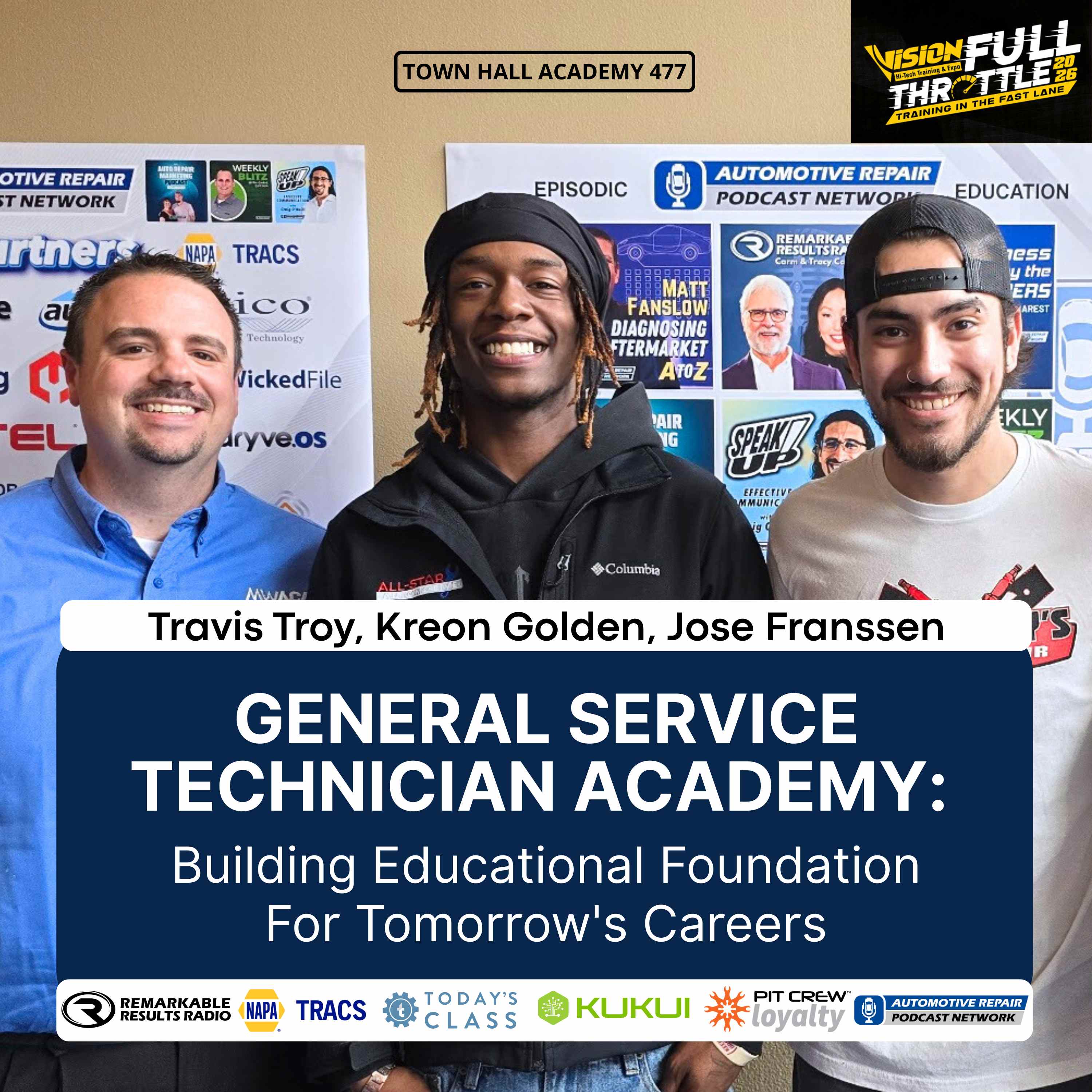
Remarkable Results RadioMarch 20 · 34 min
General Service Technician Academy: Building Educational Foundation For Tomorrow’s Careers [THA 477]
Thanks to our Partners, NAPA TRACS, Today's Class, KUKUI, and Pit Crew Loyalty Watch Full Video Episode *]:pointer-events-auto scroll-mt-(--header-height)" dir="auto" data-turn-id="0e35c993-ad2d-4e51-96b6-080ca2e8cdd2" data-testid="conversation-turn-3" data-scroll-anchor="false" data-turn="user">*]:pointer-events-auto scroll-mt-[calc(var(--header-height)+min(200px,max(70px,20svh)))]" dir="auto" data-turn-id="request-WEB:8e59eec7-a235-4fa3-a072-956fea3fe478-7" data-testid="conversation-turn-4" data-scroll-anchor="false" data-turn="assistant"> Recorded live at VISION 2026, this episode highlights the General Service Technician Academy (GSTA), a two-day training program offered at VISION designed to build strong foundational skills for early-career automotive technicians. Host Carm Capriotto speaks with industry leader and shop owner Travis Troy and two young technicians who completed the program about how mentorship and structured training are shaping their careers. The discussion emphasizes that great technicians are distinguished not by advanced tools alone, but by how well they execute fundamental skills. The GSTA curriculum covers essential, practical topics including OSHA training, lift safety, fluids and oil, tire safety and repair, alignments, thermal management (A/C), and hands-on electrical training. The academy addresses a critical training gap in the industry through a hands-on learning model that encourages participants to learn it, practice it, and teach it, reinforcing both understanding and communication. Mentorship plays a key role in guiding young technicians who often face unclear career paths and discouraging workplace experiences, helping them build confidence, opportunity, and long-term direction. Ultimately, the conversation reinforces a culture of continuous learning, highlighting that both new and experienced technicians benefit from revisiting the fundamentals to maintain safety, productivity, and professional growth in an increasingly high-tech automotive industry. VISION Hi-Tech Training & Expo: https://visionkc.com/ Travis Troy, Honest Wrenches, Akeny and Des Moines, IA. Listen to Travis’ other episodes HERE Kreon Golden, All Star Automotive, Columbia, MO Jose Franssen, Skalackys Auto Repair, Fargo, ND Thanks to our Partner, NAPA TRACS NAPA TRACS will move your shop into the SMS fast lane with onsite training and six days a week of support and local representation. Find NAPA TRACS on the Web at http://napatracs.com/ Thanks to our Partner, Today's Class Optimize training with Today's Class: In just 5 minutes daily, boost knowledge retention and improve team performance. Find Today's Class on the web at https://www.todaysclass.com/ Thanks to our Partner, KUKUI Stop juggling multiple marketing tools. KUKUI’s integrated platform delivers 4x better website conversions, automated follow-up, and real-time ROI tracking. Get industry-leading customer support with KUKUI at https://www.kukui.com/ Thanks to our Partner, Pit Crew Loyalty You’re probably tired of chasing new customers who never return. We understand. Pit Crew Loyalty ends the one-and-done cycle, turning first visits into lasting, reliable revenue at https://www.pitcrewloyalty.com/ Connect with the Podcast: - Follow on Facebook: https://www.facebook.com/RemarkableResultsRadioPodcast/ - Join Our Virtual Toastmasters Club: https://remarkableresults.biz/toastmasters - Join Our Private Facebook Community: https://www.facebook.com/groups/1734687266778976 - Subscribe on YouTube: https://www.youtube.com/carmcapriotto - Follow on LinkedIn: https://www.linkedin.com/in/carmcapriotto/ - Follow on Instagram: https://www.instagram.com/remarkableresultsradiopodcast/ - Follow on Twitter: https://twitter.com/RResultsBiz - Visit the Website: https://remarkableresults.biz/ - Join our Insider List: https://remarkableresults.biz/insider - All books mentioned on our podcasts: https://remarkableresults.biz/books - Our Classroom page for personal or team learning: https://remarkableresults.biz/classroom - Buy Me a Coffee: https://www.buymeacoffee.com/carm - Special episode collections: https://remarkableresults.biz/collections - The Automotive Repair Podcast Network: https://automotiverepairpodcastnetwork.com/ - Remarkable Results Radio Podcast with Carm Capriotto: Advancing the Aftermarket by Facilitating Wisdom Through Story Telling and Open Discussion. https://remarkableresults.biz/ - Diagnosing the Aftermarket A to Z with Matt Fanslow: From Diagnostics to Metallica and Mental Health, Matt Fanslow is Lifting the Hood on Life. https://mattfanslow.captivate.fm/ - Business by the Numbers with Hunt Demarest: Understand the Numbers of Your Business with CPA Hunt Demarest. https://huntdemarest.captivate.fm/ - The Auto Repair Marketing Podcast with Kim and Brian Walker: Marketing Experts Brian & Kim Walker Work with Shop Owners to Take it to the Next Level. https://autorepairmarketing.captivate.fm/ - <a...
Listen →
155
The Jaded MechanicMarch 17 · 1h 27m
The Impact of ADAS on Auto Repair | Eric Pagliughi from Launch Tech USA
Like the show? Show your support by using our sponsors.Need to update your shop systems and software? Try Tekmetric HERELaunch your tool game to the next level with Launch Tech USA! HEREIn this episode, Jeff is joined by Eric Pagliughi, Senior Vice President of Launch Tech USA. Eric talks about his journey from shop owner and distributor to leading product development at Launch Tech USA, emphasizing the importance of direct technician feedback in tool innovation. They speak on the company's commitment to quick software updates based on user input, navigating the challenges of manufacturer security requirements, and building strong industry relationships to increase access to OE information.Timestamps:00:00 "Journey from Mechanic to Dealer"10:03 "Global Silos and Business Growth"13:38 "Right Tools, Right Market"19:14 Tech Efficiency and OE Challenges22:48 "Responsibility in Automotive Ethics"30:39 Evolving Automotive Data Accessibility35:41 "Cloud-Dependent Vehicle Repairs Emerge"41:17 Dealership Security Concerns and Limitations43:55 "Industry Costs and Responsibility"53:29 "Building Relationships Through Innovation"57:29 "Streamlined Updates with Tech Tips"01:04:05 ADAS Impact on Auto Repairs01:05:34 ADAS Calibration and Liability Risks01:11:22 "Commitment to Craft and Community"01:18:50 "Space-Saving Touchless Alignment Solution"01:25:04 Empowering Technicians Through Innovation Follow/Subscribe to the show on social media! TikTok - https://www.tiktok.com/@jeffcompton7YouTube - https://www.youtube.com/@TheJadedMechanicFacebook - https://www.facebook.com/profile.php?id=100091347564232
Listen →
Questions answered on technician recruiting
Practical questions on technician recruiting, answered across the catalog — each linked to the episode it came from.
- What strategies can shops use to attract new technicians?
- Shops can offer competitive pay, signing bonuses, and create a positive work culture to attract new talent. Networking with local schools and other shops can also help. From: Can the Technician Shortage Be Fixed?? | Josh Fowler →
- How can mentorship improve technician performance?
- Mentorship provides guidance and support, helping young technicians build confidence and develop their skills. Experienced technicians can share valuable knowledge and troubleshooting techniques. From: Can the Technician Shortage Be Fixed?? | Josh Fowler →
- What role does training play in technician retention?
- Offering training opportunities and a clear progression plan can motivate technicians to stay with a shop. It shows that the shop is invested in their professional growth. From: Can the Technician Shortage Be Fixed?? | Josh Fowler →
- What is the 'fire alarm syndrome' in hiring?
- The 'fire alarm syndrome' occurs when shop owners scramble to hire a technician only after one leaves, often leading to poor hiring decisions due to stress. From: Stop Hiring in Panic Mode: Build a Recruiting Pipeline for Your Shop [RR 1094] →
- How can shops build a talent bench?
- Shops can build a talent bench by consistently engaging with potential candidates, even when fully staffed, to ensure they have a pool of qualified technicians ready when needed. From: Stop Hiring in Panic Mode: Build a Recruiting Pipeline for Your Shop [RR 1094] →
- What are the three main factors technicians look for in a job?
- Technicians prioritize respect, opportunities for growth, and competitive pay, with respect being the most crucial factor. From: Stop Hiring in Panic Mode: Build a Recruiting Pipeline for Your Shop [RR 1094] →
- How can dealerships improve technician retention?
- Dealerships can improve retention by offering structured career paths and regular check-ins to support technician growth and development. From: Dealer Plate Guy Compares Dealer Pricing with the Aftermarket →
- What role does cross-training play in the service department?
- Cross-training allows technicians and advisors to understand each other's roles better, fostering teamwork and improving customer service. From: Dealer Plate Guy Compares Dealer Pricing with the Aftermarket →
- Why is effective communication important in the service department?
- Effective communication ensures that technicians and advisors are aligned on customer needs, leading to better service outcomes and customer satisfaction. From: Dealer Plate Guy Compares Dealer Pricing with the Aftermarket →
- What is the best time to post job openings?
- The best time to post job openings is during slow periods when technicians are more likely to be looking for new opportunities, rather than when your shop is busy. From: The Automotive Hiring Cycle: When and How to Recruit Top Technicians [THA 502] →
- How can I build a talent bench effectively?
- Building a talent bench involves maintaining relationships with potential candidates, engaging with them regularly, and keeping track of their skills and interests to ensure you're ready when a position opens. From: The Automotive Hiring Cycle: When and How to Recruit Top Technicians [THA 502] →
- What should I do if a candidate ghosts me after an interview?
- If a candidate ghosts you, don't take it personally; follow up with a friendly message to check in and express your continued interest, as they may have gotten overwhelmed with other opportunities. From: The Automotive Hiring Cycle: When and How to Recruit Top Technicians [THA 502] →
- Why is a digital presence important for automotive shops?
- A digital presence helps shops be found by potential customers and technicians, as most people now rely on online searches rather than word of mouth. From: Ep 173: How to Upskill Leadership Skills in the AI Era with Jacki Lutz →
- How can AI benefit automotive repair shops?
- AI can streamline operations, enhance customer engagement, and assist in marketing efforts, making it easier for shops to manage their business effectively. From: Ep 173: How to Upskill Leadership Skills in the AI Era with Jacki Lutz →
- What should shop owners focus on during times of change?
- Shop owners should concentrate on what they can control, such as their personal branding and how they present themselves online, rather than worrying about external factors. From: Ep 173: How to Upskill Leadership Skills in the AI Era with Jacki Lutz →
- How can I improve retention of technicians in my shop?
- Providing clear career pathways and investing in your team's development can significantly enhance retention rates. From: Ep 166: Why Great Leaders Give People Permission to Fail with Ron Helmer →
- What role does emotional intelligence play in leadership?
- Emotional intelligence helps leaders manage their emotions and respond effectively to challenges, which sets a positive example for their teams. From: Ep 166: Why Great Leaders Give People Permission to Fail with Ron Helmer →
- How can I create a culture that allows for failure?
- By encouraging team members to take risks and learn from their mistakes, you create an environment where growth and innovation can thrive. From: Ep 166: Why Great Leaders Give People Permission to Fail with Ron Helmer →
- What should shop owners focus on when hiring new technicians?
- Shop owners should prioritize finding candidates who fit the shop's culture and are willing to grow, rather than just focusing on their technical skills. From: The Hiring Mistake Shop Owners Keep Making | Sara Fraser & Chrisi Falco - Ep 20 →
- How can shops improve their communication with customers?
- Shops can enhance communication by using clear, relatable language and ensuring that service advisors understand the customer's perspective. From: The Hiring Mistake Shop Owners Keep Making | Sara Fraser & Chrisi Falco - Ep 20 →
- What role does leadership play in a shop's success?
- Effective leadership creates an environment where team members feel empowered and valued, which is essential for a thriving shop. From: The Hiring Mistake Shop Owners Keep Making | Sara Fraser & Chrisi Falco - Ep 20 →
- What is the primary cause of the technician shortage in the automotive industry?
- The technician shortage is largely attributed to a productivity shortage and workplace culture issues rather than a lack of qualified technicians. From: Ep 97 - Tektonic 2026 Coaches Panel | Flat Rate, Technician Shortage, Performance Based Pay →
- How can shop owners improve technician retention?
- Shop owners can improve retention by creating a positive work environment, offering clear career paths, and implementing performance-based compensation models. From: Ep 97 - Tektonic 2026 Coaches Panel | Flat Rate, Technician Shortage, Performance Based Pay →
- What marketing strategies can help attract new talent to the automotive industry?
- Effective marketing strategies include targeting young people through outreach programs and showcasing the benefits and opportunities available in the automotive trade. From: Ep 97 - Tektonic 2026 Coaches Panel | Flat Rate, Technician Shortage, Performance Based Pay →
Weekly digest
The week's best automotive podcasts
Into Technician Recruiting? You'll likely enjoy the digest — one email a week with the latest automotive aftermarket podcasts from across the industry, Technician Recruiting and beyond. No spam, unsubscribe anytime.